
Judge, 1920-09-11 · page 16 of 32
Judge — September 11, 1920 — page 16: what you’re looking at
What you’re looking at
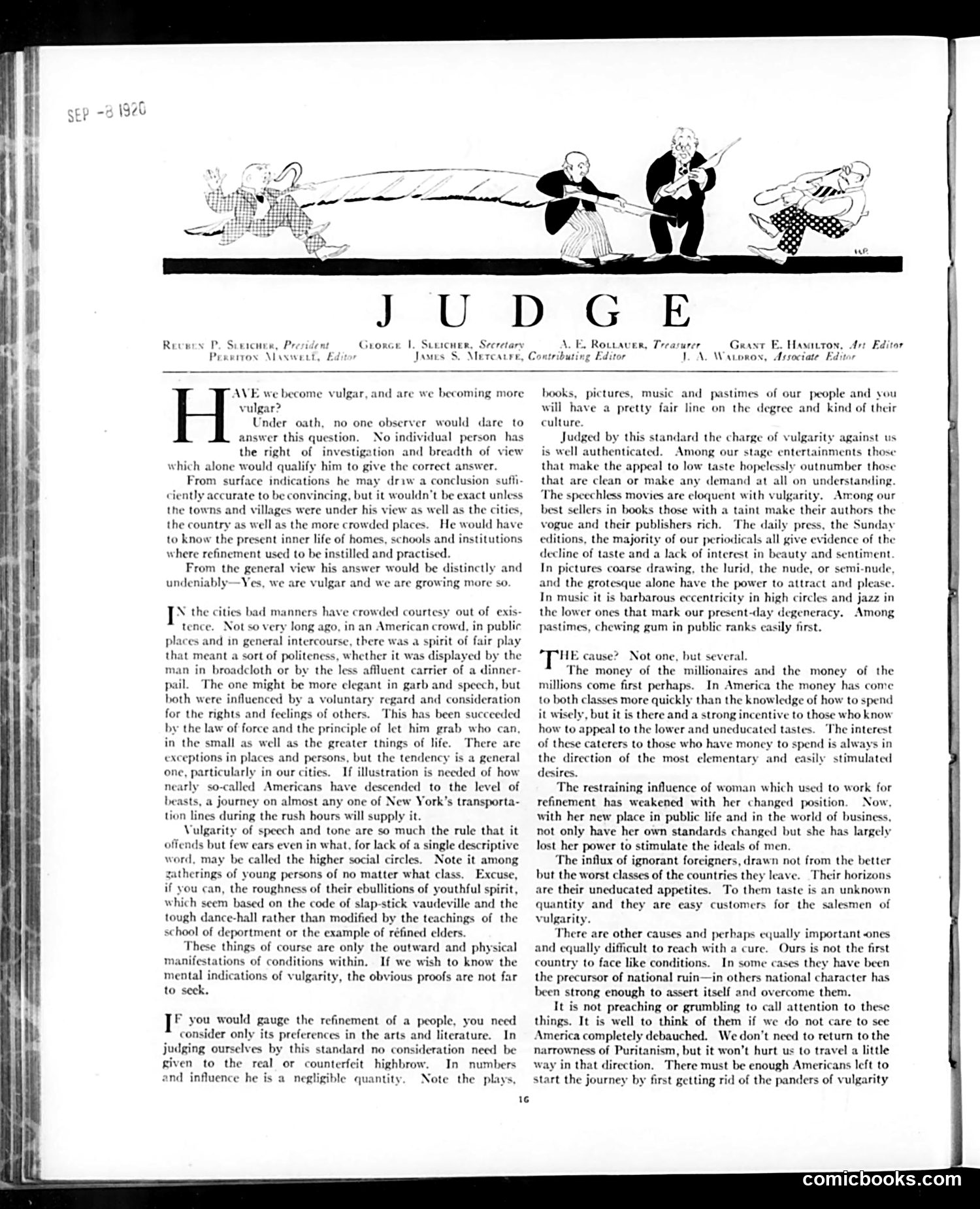
This editorial piece, not a political cartoon, tackles American cultural decline. The decorative header shows figures in a tug-of-war, symbolizing societal tension. The article argues Americans are becoming increasingly vulgar—evidenced by declining manners in cities, coarse language among youth, and poor taste in entertainment. The author claims this vulgarity reflects deeper moral decay: entertainment prioritizes lowbrow appeal over refinement; bestselling books contain "taint"; movies are "eloquent with vulgarity." The piece blames multiple causes: wealth enabling poor taste, women's weakened "restraining influence" as they entered public life and business, and ignorant immigrants lacking education. The author suggests America has descended to "the level of beasts," citing subway behavior during rush hours. This reflects 1920s anxieties about modernization, immigration, and changing social roles—common Judge magazine themes during this period of rapid cultural transformation and generational conflict.
📄 Transcribed text from this page (OCR, searchable)
Machine-transcribed from the original scan — historical spelling and the odd misread are preserved.
I. Suercner, Secretary James S. Mereatre, Editor Steicuer, Pr Grorce Peeettox Maxwett, C Hasatron, 411 Editor ssociate Editor Rottaver, Treasurer Grant Editor I. AL Warpros, ALE. ributing AVE we become vulgar, and are we becoming more vulgar? Under oath, no one observer would dare to answer this question. No individual person has the right of investigation and breadth of view which alone would qualify him to give the correct answer. From surface indications he may driw a conclusion sufii- ciently accurate to be convincing, but it wouldn’t be exact unless the towns and villages were under his view as well as the cities, the country as well as the more crowded places. He would have to know the present inner life of homes, schools and institutions where refinement used to be instilled and practised. From the general view his answer would be distinctly and undeniably—Yes, we are vulgar and we are growing more so. N the cities bad manners have crowded courtesy out of exis- tence. Not so very long ago, in an American crowd, in public places and in general intercourse, there was a spirit of fair play that meant a sort of politeness, whether it was displayed by the man in broadcloth or by the less affluent carrier of a dinner- The one might be more elegant in garb and speech, but both were influenced by a voluntary regard and consideration for the rights and feelings of others. This has been succeeded by the law of force and the principle of let him grab who can, in the small as well as the greater things of life. There are exceptions in places and persons, but the tendency is a general one, particularly in our cities. If illustration is needed of how nearly so-called Americans have descended to the level of beasts, a journey on almost any one of New York's transporta- tion lines during the rush hours will supply it. Vulgarity of speech and tone are so much the rule that it offends but few ears even in what, for lack of a single descriptive word, may be called the higher social circles. Note it among gatherings of young persons of no matter what class, Excu: if you can, the roughness of their ebullitions of youthful spirit, which seem based on the code of slap-stick vaudeville and the tough dance-hall rather than modified by the teachings of the school of deportment or the example of réfined elders. These things of course are only the outward and phy al manifestations of conditions within. If we wish to know the mental indications of vulgarity, the obvious proofs are not far to seck. pail F you would gauge the refinement of a people, you need consider only its preferences in the arts and literature. In judging ourselves by this standard no consideration need be given to the real or counterfeit highbrow. In numbers and influence he is a negligible quantity. Note the plays, 16 books, pictures, music and pastimes of our people and you will have a pretty fair line on the degree and kind of their culture. Judged by this standard the charge of vulgarity is well authenticated. Among our stage entertainments those that make the appeal to low taste hopelessly outnumber those that are clean or make any demand at all on understanding. The speechless movies are eloquent with vulgarity. Among our best sellers in books those with a taint make their authors the vogue and their publishers rich. The daily press, the Sunday editions, the majority of our periodicals all give evidence of the decline of taste and a lack of interest in beauty and sentiment In pictures coarse drawing, the lurid, the nude, or semi-nude, and the grotesque alone have the power to attract and please. In music it is barbarous eccentricity in high circles and jazz in the lower ones that mark our present-day degeneracy. Among pastimes, chewing gum in public ranks easily first. cause? Not one, but several. H T The money of the millionaires and the money millions come first perhaps. In America the money h: to both classes more quickly than the knowledge of how to spend it wisely, but it is there and a strong incentive to those who know how to appeal to the lower and uneducated tastes. The interest of these caterers to those who have money to spend is always in the direction of the most elementary and easily stimulated desires. The restraining influence of woman which used to work for refinement has weakened with her changed position. Now, with her new place in public life and in the world of business, not only have her own standards changed but she has largely lost her power to stimulate the ideals of men. The influx of ignorant foreigners, drawn not from the better but the worst classes of the countries they leave. Their horizons are their uneducated appetites. To them taste is an unknown quantity and they are easy customers for the salesmen of vulgarity. There are other causes and perhaps e and equally difficult to reach with a cure. Ours is not the first country to face like conditions. In some cases they have been the precursor of national ruin—in others national character has been strong enough to assert itself and overcome them. It is not preaching or grumbling to call attention to these things. It is well to think of them if we do not care to see America completely debauched. We don’t need to return to the narrowness of Puritanism, but it won't hurt us to travel a little way in that direction. There must be enough Americans left to start the journey by first getting rid of the panders of vulgarity of the come ly important ones comicbooks.com