
Judge, 1920-09-11 · page 22 of 32
Judge — September 11, 1920 — page 22: what you’re looking at
What you’re looking at
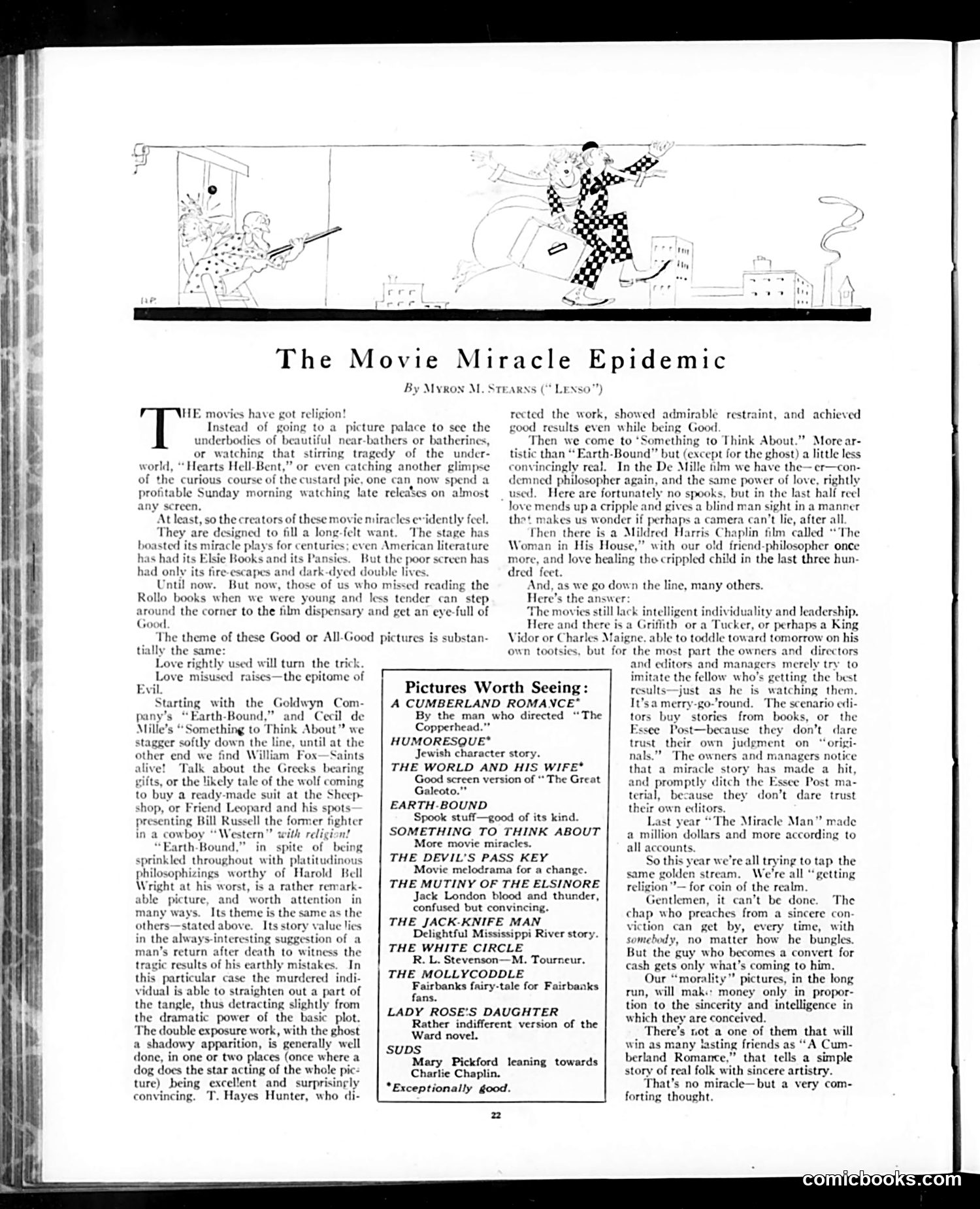
This satirical article by Myron M. Stearns critiques a trend in 1920s cinema: "religious" or morality-focused films where love solves all problems. The piece mocks movies like Cecil B. DeMille's "Something to Think About," "Earth-Bound," and Mildred Harris Chaplin's "The Woman in His House"—films featuring ghosts, crippled children healed by love, and philosophical platitudes. Stearns' satire targets the formulaic nature of these pictures: they all repeat the same message that "love rightly used will turn the trick" while "love misused raises the epitome of Evil." He ridicules the absurdity of casting unlikely figures (like boxer Bill Russell) in religious roles and mocks the reliance on special effects (double-exposure ghosts) to create emotional impact. The cartoon at top shows filmmakers literally "shooting" moral lessons like weapons at audiences. Stearns concludes these films lack "intelligent individuality and leadership"—they're manufactured sentiment rather than genuine artistry, cynically exploiting audiences' desire for moral uplift.
📄 Transcribed text from this page (OCR, searchable)
Machine-transcribed from the original scan — historical spelling and the odd misread are preserved.
a ~ oe HE movies have got religion! Instead of going to a picture palace to sce the underbodies of beautiful near-bathers or batherines, By Myron M. Stearys (“* LENO”) The Movie Miracle Epidemic rected the work, showed admirable restraint, and achieved good results even while being Good Then we come to ‘Something to Think About.” More ar- or watching that stirring tragedy of the under- _ tistic than “Earth-Bound” but (except for the ghost) a little less world, “Hearts Hell-Bent,” or even of the curious course of the custard pi any screen, boasted its Rollo book arou Good. The theme of these Good or All-Good pictures is substan- tially the same: Love rightly used will turn the trick. Love misused raises—the epitome of Evil. Starting with the Goldwyn Com- pany’s “Earth-Bound,” and Cecil. de Mille’s “ Something to Think About” we stagger softly down the line, until at the other end we find Wil ‘ox—Saints alive! Talk about the Greeks bearing gifts, or the likely tale of the wolf coming to buy a ready-made suit at the Sheep- shop, or Friend Leopard and his spots presenting Bill Russell the former fighter in a cowboy “Western” with religion! rth-Bound,” in spite of being sprinkled throughout with platitudinous philosophizings worthy of Harold Bell Wright at his worst, is a rather remark- picture, and worth attention in many ways. Its theme is the same as the others—stated above. Its story value lies in the always-interesting suggestion of a man’s return after death to witness the tragic results of his earthly mistakes. In this particular case the murdered. indi- vidual is able to straighten out a part of the tangle, thus detracting slightly from the dramatic power of the basic plot. The double exposure work, with the ghost a shadowy apparition, is generally well done, in one or two places (once where a dog does the star acting of the whole pic- ture) being ellent and surprisingly convincing. T. Hayes Hunter, who di- the corner to the film dispensary and get an eye-full of ching another glimpse convincingly real. one can now spend a lives. dred fee d reading the And Here and the demned philosopher agai: profitable Sunday morning watching late releaSes on almost | used. Here are fortunat love mends up a cripple At least, so the creators of these movie miracles evidently feel. thet makes us wonder They are designed to fill a long-felt want. The stage has racle play's for centuries; even American literature has had its Elsie Books and its Pansies. But the poor screen has had only its fire-escapes and dark-dyed double Until now. But now, those of us who m when we were young and less tender can. step Her Vidor or Charles Maigne. In the De Mille nlm we have the—er—con- nd the same power of love, rightly ly no spooks, but in the last half reel nd gives a blind man sight in a manner perhaps a camera can’t lie, after all Then there is a Mildred Harris Chaplin film called “The Woman in His House,” with our old friend-philosopher once more, and love healing the crippled child in the last three hun- we go down the line, many others. 's the answer: ‘The movies still lack intelligent individus lity and leadership. Grifiith ora Tucker, or perhaps a King ble to toddle toward tomorrow on his own tootsies, but for the most part the owners and directors Pictures Worth Seeing: A CUMBERLAND ROMANCE* By the man who directed “The Copperhead. HUMORESQUE* Jewish character story. THE WORLD AND HIS WIFE* Good screen version of “ The Great Galeoto.” EARTH-BOUND Spook stuff—good of its kind. SOMETHING TO THINK ABOUT More movie miracles. THE DEVIL’S PASS KEY Movie melodrama for a change. THE MUTINY OF THE ELSINORE Jack London blood and thunder, confused but convincing. THE JACK-KNIFE MAN Delightful Mississippi River story. THE WHITE CIRCLE R. L. Stevenson—M. Tourneur. THE MOLLYCODDLE Fairbanks fairy-tale for Fairbanks fans. LADY ROSE'S DAUGHTER Rather indifferent version of the Ward novel. SUDS Mary Pickford leaning towards Charlie Chaplin. *Exceptionally good. and editors and managers merely try. to imitate the fellow who's getting the best results—just as he is watching them, It’sa merry-go-round. The scenario edi- tors buy stories from books, or the Essee Post—because they don’t dare trust. their own judgment on “origi- nals.” The owners and managers notice that a miracle story has m: a hit, and promptly ditch the Essce Post ma- terial, because they don’t dare trust their own editor: he Miracle Man” made a mill lars and more according to all accounts. So this year we're all trying to tap the same golden stream. We're all “getting — for coin of the realm. entlemen, it can’t be done. The chap who preaches from a sincere con- viction can get by, every time, with somebody, no matter how he bungles. hat’s coming to him. pictures, in the long run, will make money only in_ propor- tion to the sincerity and intelligence in which they are conceived. There’s not a one of them that will win as many lasting friends as “A Cum- berland Romance,” that tells a simple story of real folk with sincere artistry. That’s no miracle—but a very com- forting thought. Comicbooks.com