
Judge, 1920-09-11 · page 18 of 32
Judge — September 11, 1920 — page 18: what you’re looking at
What you’re looking at
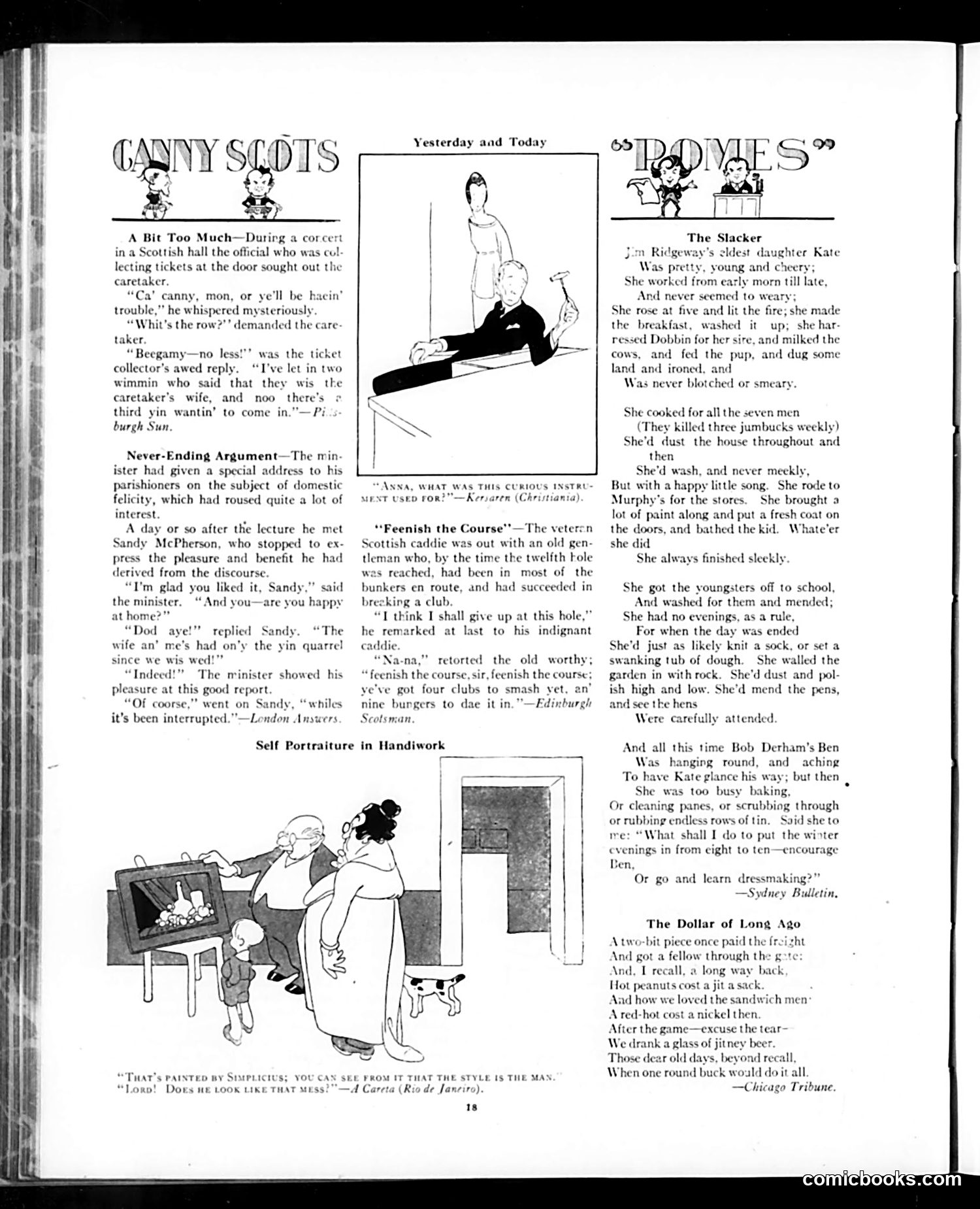
This page from *Judge* contains Scottish humor and domestic satire typical of early 20th-century American publications. **"Gandy Scots"** presents three brief Scottish anecdotes emphasizing dialect comedy and marital conflict: - A ticket collector's mishap (a man admits his wife *and* two other women claiming to be his wife) - A minister's surprise that a parishioner's marriage quarrel only seemed interrupted (implying constant fighting) - A golf caddie's persistence, encouraging a struggling player to finish despite breaking clubs **"Domes"** contains "The Slacker"—a poem contrasting a hardworking rural woman (Kate) with Bob Derham's idle "Ben." Kate performs endless labor (cooking, cleaning, farming, childcare) while Ben merely hangs around hoping for her attention, unable to compete with her work ethic. The satire targets male idleness. **"Self Portraiture in Handiwork"** shows a couple viewing a Simplicius painting, with the woman sarcastically noting the artist's "style" matches the messy subject—likely satirizing modern art's lack of realism. These pieces reflect period attitudes: Scottish caricature, domestic discord as humor, and gender expectations around work.
📄 Transcribed text from this page (OCR, searchable)
Machine-transcribed from the original scan — historical spelling and the odd misread are preserved.
A Bit Too Much—During a corcert in a Scottish hall the official who was col lecting tickets at the door sought out the caretaker. canny, mon, or ye'll be hacin’ he whispered mysteriously. 's the row?"’ demanded the care- was the ticket “T've let in two “Beegamy—no less!"’ collector's awed reply. wimmin who said that they wis the caretaker’s wife, and noo there's third yin wantin’ to come in.”"—Pi burgh Sun. Never-Ending Argument—The min- ister had given a special address to his parishioners on the subject of domestic felicity, which had roused quite a lot of interest. day or so after the lecture he met Sandy McPherson, who stopped to ex- press the pleasure and benefit he had derived from the discour: “I'm glad you liked it, the minister. “And you—are you happy at home?” “Dod e!’’ replied Sandy. “The wife an’ me’s had on’y the yin quarrel since we wis wed!" “Indeed!” The minister showed his pleasure at this good report. “Of corse,” went on Sandy, “whiles it’s been interrupted.”—London Answers Self Portraitu: “THAT's PAINTED BY SIMPLICIUS; YOU CAN “Loro! Does ne Loox Like THAT Mess?” Yesterday and Today “ANNA, WHAT WAS THIS CURIOUS INSTRU- MextT usep ror?” —Kersaren ( iania) ‘Feenish the Course’’—The veteron Scottish caddie was out with an old gen- tleman who, by the time the twelfth Fole reached, had been in most of the bunkers en route, and had succeeded in brezking a club, “I think I shall give up at this hole he remarked at last to his indignant caddie. “Na-na,” retorted the old worthy; “feenish the course, sir, feenish the course; ye've got four clubs to smash yet, an’ nine burgers to dae it in.” —Edinburgh Scotsman re in Handiwork | | | SEE PROM IT THAT THE STYLE Is THE MAN 4 Careta (Rio de Janeiro). The Slacker y's eldest daughter Kate y, young and cheery; She worked from early morn till late, And never seemed to weary; She rose at five and lit the fire; she made the break washed it up; she har- ressed Dobbin for her sire, and milked the cows, and fed the pup, and dug some land and ironed, and Was never blotched or smeary. jast, She cooked for all the seven men (They killed three jumbucks weekly) She'd dust the house throughout and then She'd wash, and never meekly, But with a happy little song. She rode to Murphy's for the stores. She brought a lot of paint along and put a fresh coat on the doors, and bathed the kid. Whate’er she did She always finished sleckly She got the youngsters off to school, And washed for them and mended; She had no evenings, as a rule, For when the day was ended She'd just as likely knit a sock, or set a swanking tub of dough. She walled the garden in with rock. She'd dust and pol- ish high and low. She'd mend the pens, and see the hens Were carefully attended And all this time Bob Derham's Ben Was hanging round, and aching To have Kate glance his way; but then She was too busy baking, . Or cleaning panes, or scrubbing through or rubbing endless rows of tin. Said she to “What shall I do to put the winter encourage ne evenings in from cight to ten Ben, Or go and learn dressmaking?” dney Bulletin, The Dollar of Long Ago \ two-bit piece once paid the fr. And got a fellow through the g And, I reea Hot peanuts cos And how we loved the sandwich men. A red-hot cost a nickel then. After the game—excuse the tear- We drank a glass of jitney beer. old days, beyond recall, When one round buck would do it all —Chicago Tribune.