
Judge, 1920-09-11 · page 8 of 32
Judge — September 11, 1920 — page 8: what you’re looking at
What you’re looking at
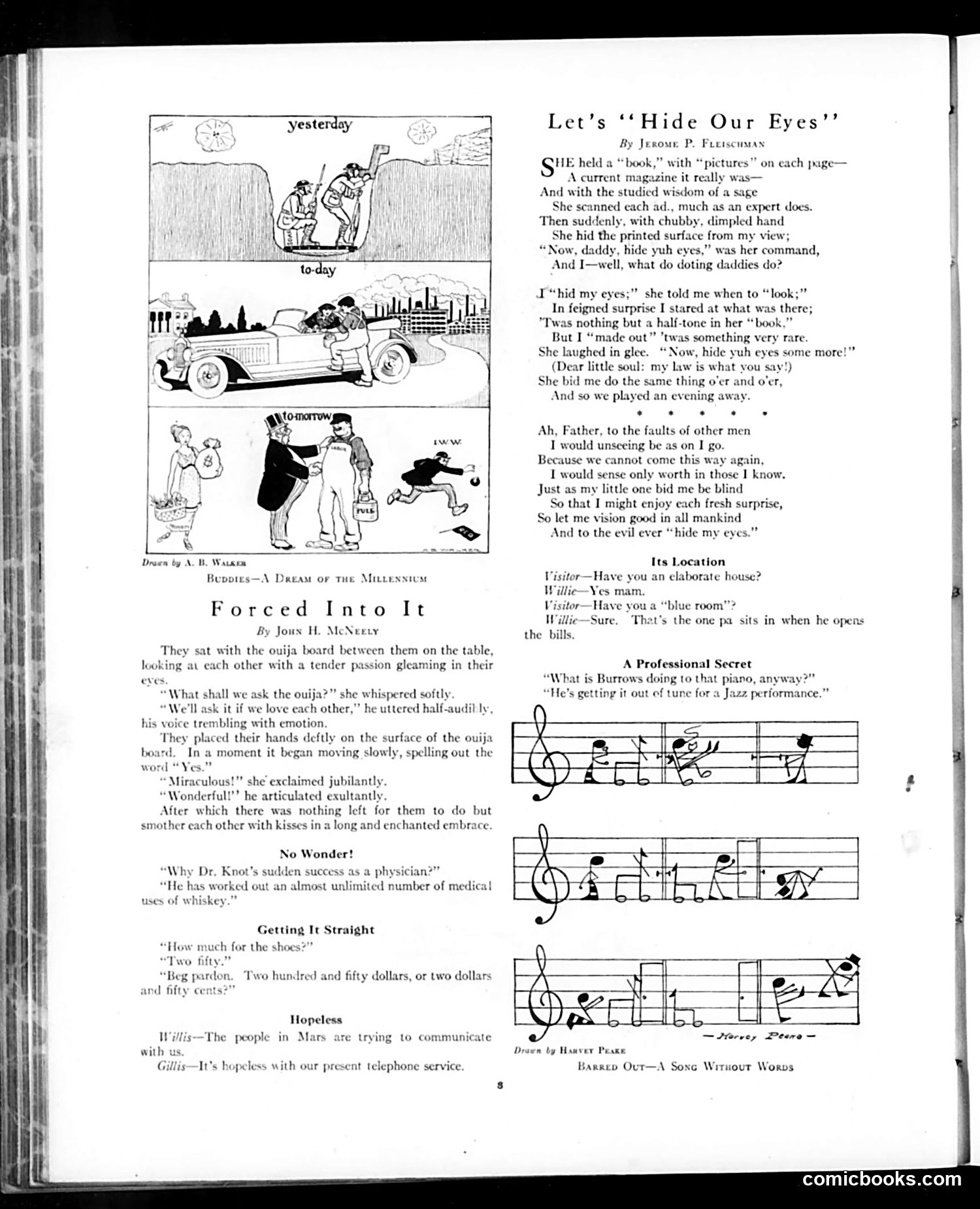
This page contains several satirical pieces reflecting early 20th-century American attitudes: **"Let's Hide Our Eyes"** depicts a father and daughter playing with a magazine. The satire suggests that advertising—particularly objectionable ads—fills publications so thoroughly that one must literally hide from them to enjoy content. The poem's closing plea to "hide my eyes" to evil in mankind reflects period anxieties about moral corruption. **"Forced Into It"** mocks spiritualism's popularity, showing a couple using a Ouija board. The joke: the "supernatural" answer "Yes" to whether they love each other is so obvious that the supernatural apparatus becomes pointless—they simply need an excuse to embrace. **"A Professional Secret"** jokes about Jazz music being intentionally out-of-tune, reflecting conservative disapproval of jazz as discordant and illegitimate. **Smaller gags** reference Prohibition-era medicine (whiskey as cure-all), real estate pretension ("blue room" as euphemism for debt), and telephone technology limitations. The overall tone reflects genteel, middle-class satirical humor of the Jazz Age era.
📄 Transcribed text from this page (OCR, searchable)
Machine-transcribed from the original scan — historical spelling and the odd misread are preserved.
eres. a ae Let’s ‘‘Hide Our Eyes’’ By Jexour, P. Fuetscusax HE held a “book,” with “pictures” on cach page— A current magazine it really was— And with the studied wisdom of a sage | She scanned each ad., much as an expert does. Then suddenly, with chubby, dimpled hand She hid the printed surface from my view; ‘ow, daddy, hide yuh eyes,” was her command, And I—well, what do doting daddies do? a I'“hid my eyes; she told me when to “look;” In feigned surprise I stared at what was there; ’Twas nothing but a half-tone in her “book,” But I “made out” ’t omething very rare. She laughed in glee. “> hide yuh some more!" (Dear little soul: my law is what vou say She bid me do the same thing o'er and o'er, And so we played an evening aw o 8 © # Ah, Father, to the faults of other men I would unseeing be as on I go. Because we cannot come this way again, I would sense only worth in those I know. Just as my litue one bid me be blind So that I might enjoy each fresh surprise, So let me vision good in all mankind And to the evil ever “hide my eyes.” Drown by A.B. Waren Its Location 4 Bupotes—A\ Dream or THe Mittennivat Visiter—Have you an elaborate house? é Willie—Yes mam. Force d In to I t Visitor Hay youa “blue room"? | Willie—Sure. That's the one pa sits in when he opens By Joux H. McNeety the bills. They sat with the ouija board between them on the table, looking at each other with a tender passion gleaming in their A Professional Secret eves “What is Burrows doing to that piano, anyway?” “What shall we ask the ouija?” she whispered softly “He's getting it out of tune for a Jazz performance.” “We'll ask it if we love each other,” he uttered half-audit ly his voice trembling with emotion. = They placed their hands deftly on the surface of the oui. | =] board. In a moment it began moving slowly, spelling out the word “Yes.” Miraculous!" she exclaimed jubilantly. s “Wonderful!” he articulated exultantly, . After which there was nothing left for them to do but smother each other with kisses in a long and enchanted embrace. No Wonder! “Why Dr, Knot’s sudden success as a physician?” i “He has worked out an almost unlimited number of medical uses of whiskey.” = Getting It Straight “How much for the shocs?” i “Two fifty.” f “Beg pardon. Two hundred and fifty dollars, or two dollars and fifty cents?” Hopeless j Willis—The people in Mars are trying to communicate Pierre, Peeve — with Drawn by Hanver Peace : Gillis—It’s hopeless with our present telephone service. Barrep Our—A Soxc Wrriout Worvs comicbooks.com