
A complete issue · 36 pages · 1920
Judge — August 7, 1920
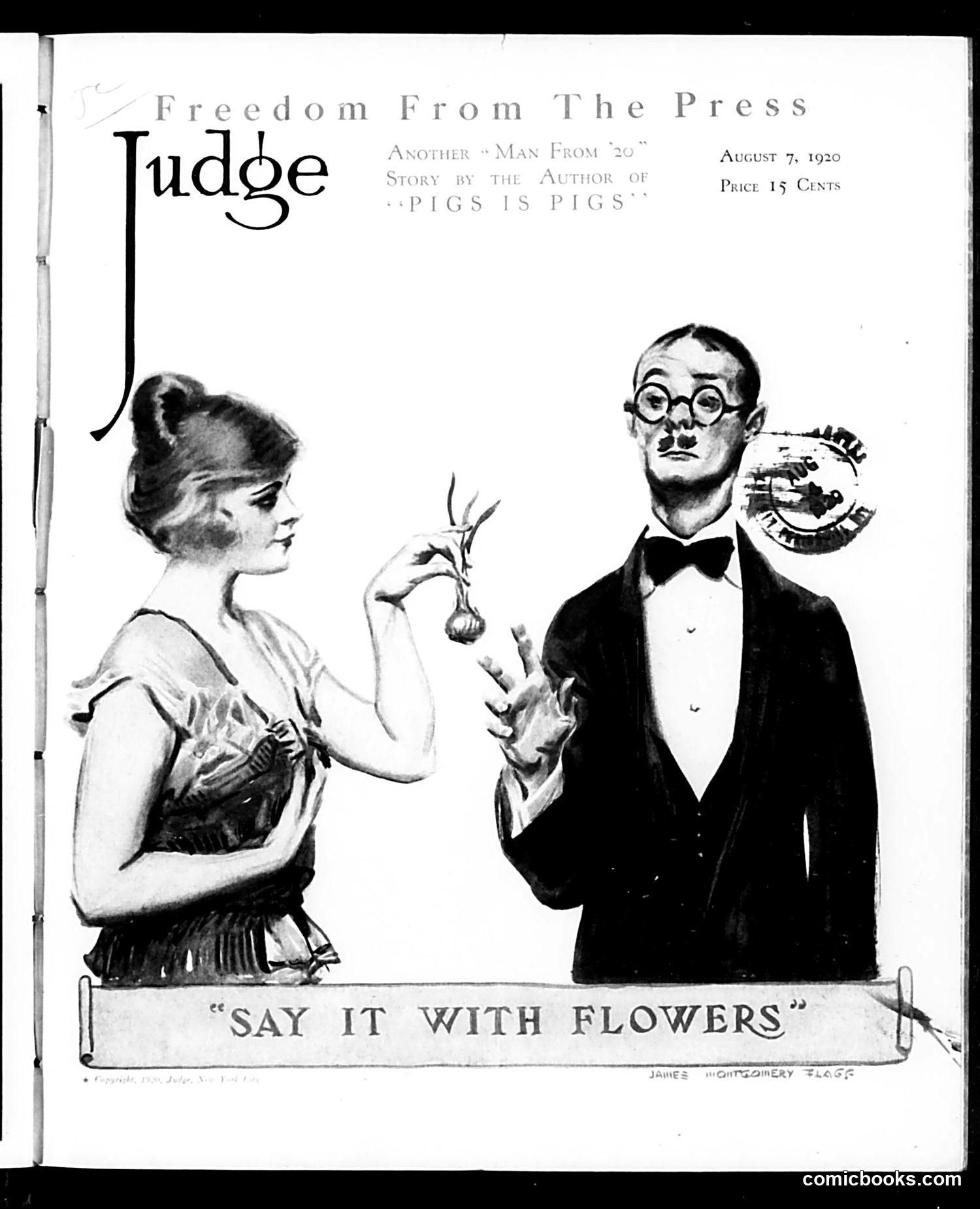
This Judge magazine cover from August 7, 1920 satirizes the phrase "say it with flowers"—a popular advertising slogan of the era promoting flowers as gifts to express emotions. The cartoon shows a man in formal attire holding both flowers and what appears to be a onion or garlic bulb, looking dismayed. A woman holds the onion, suggesting she's rejecting his romantic gesture. The joke plays on the slogan's promise: flowers are supposed to romantically "say" what words cannot, but here the man has apparently bungled the gesture by bringing something as unromantic as an onion instead—or alongside—the flowers. This mocks both the advertising trend and male courtship fumbling during the 1920s.
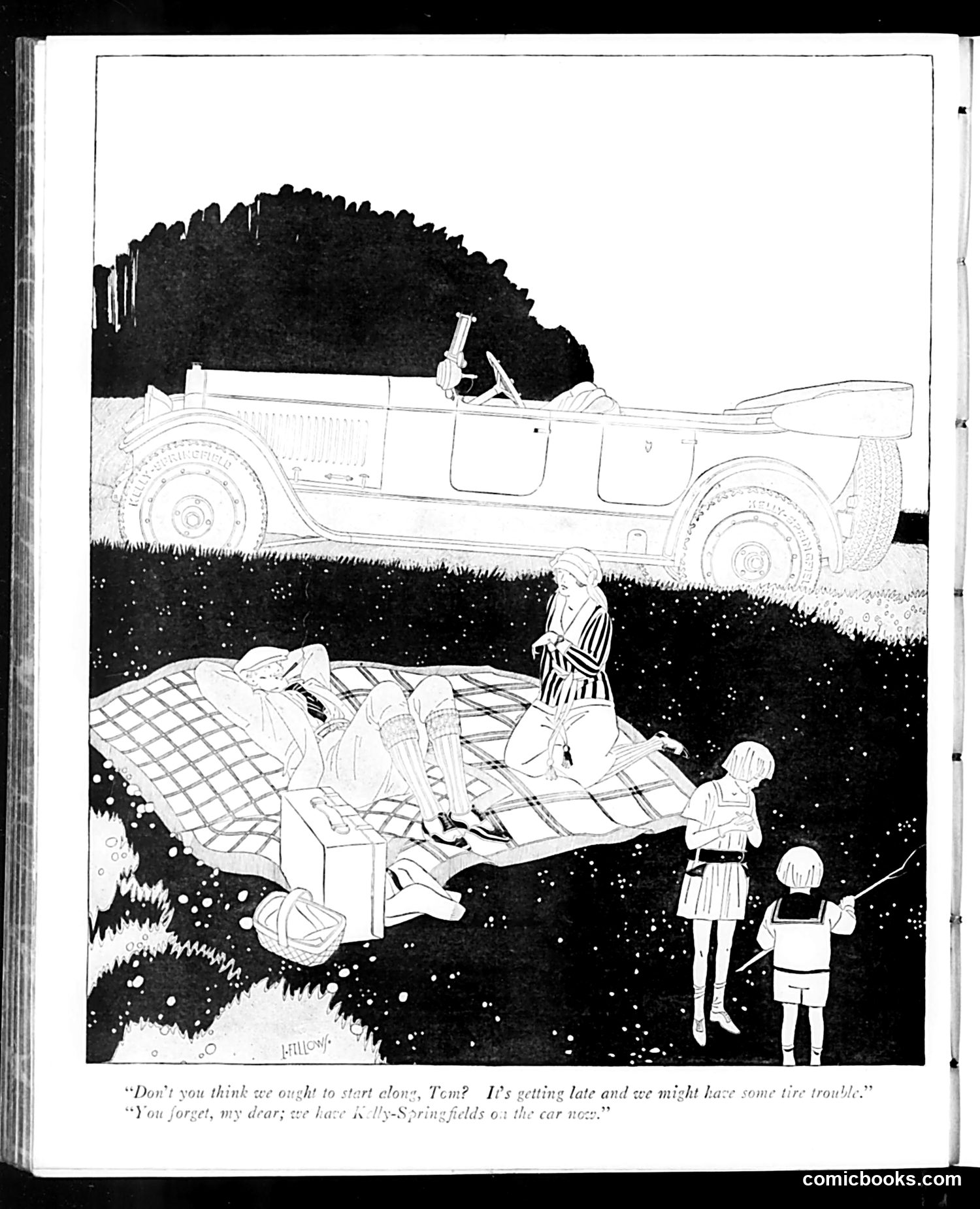
This cartoon depicts a nighttime roadside scene where a couple has stopped their car for what appears to be a picnic or rest. A woman on a blanket speaks to a man (Tom), while two children stand nearby looking at the automobile. The caption reads: "Don't you think we ought to start down, Tom? It's getting late and we might have some tire trouble." "You forget, my dear; we have a full tank—Springfield as the car now." The satire targets automobile reliability and marketing claims. The joke hinges on "Springfield" (likely a car brand), suggesting the vehicle's supposed superiority makes tire trouble impossible—an absurd exaggeration of advertising promises. The woman's practical concerns about travel safety are dismissed based on brand confidence alone, mocking both overconfident marketing and consumer credulity about mechanical guarantees.
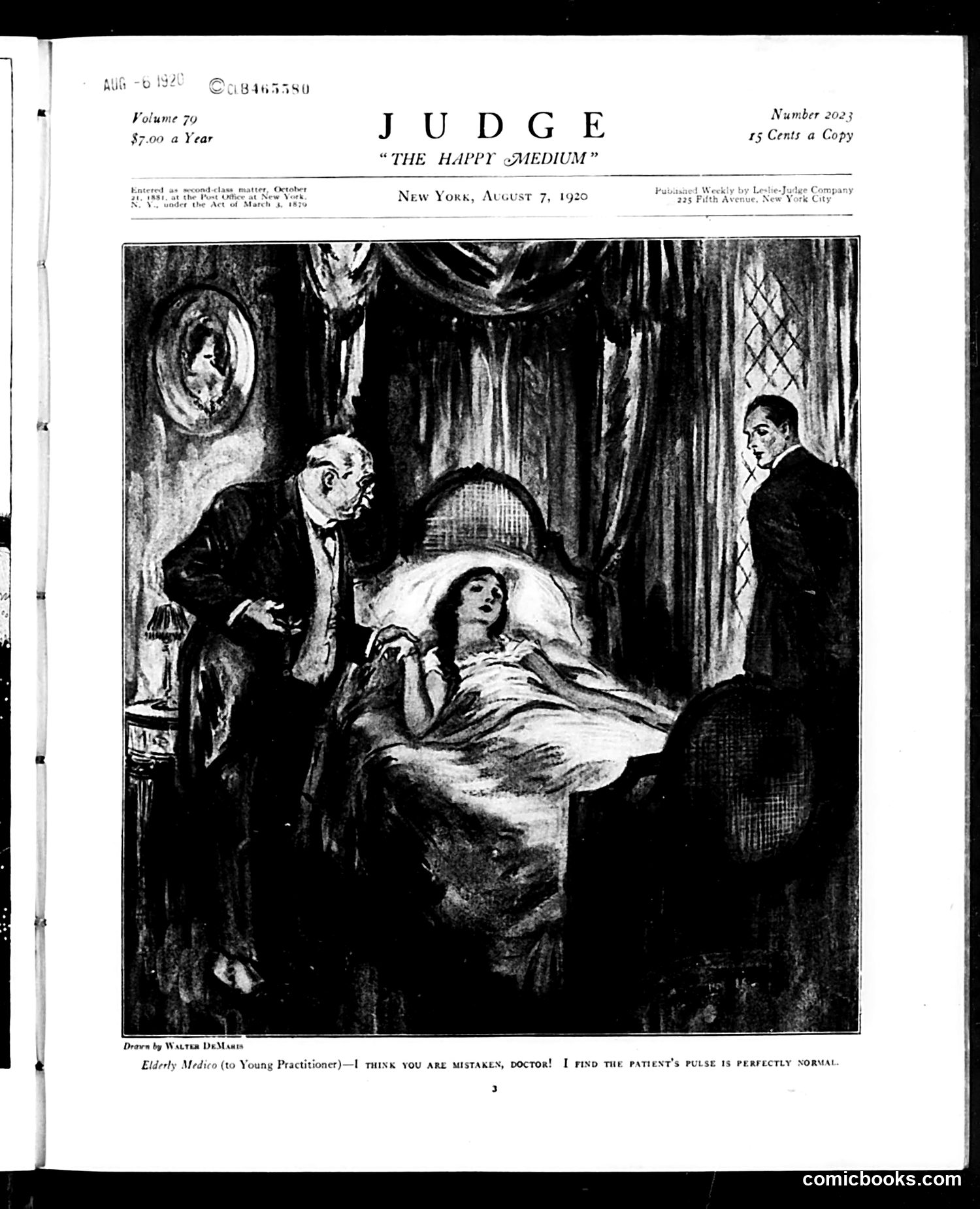
This cartoon depicts a medical scene with an elderly doctor (left) examining a young female patient in bed while a young doctor (right) observes. The caption reads: "Elderly Medico (to Young Practitioner)—I think you are mistakes, doctor! I find the patient's pulse is perfectly normal." The satire targets generational medical practice: the established, experienced physician corrects the younger doctor's diagnosis. This reflects broader 1920s anxieties about professional competence and the tension between traditional medical practice and newer methods. The joke implies the young doctor is overly alarmed or misreading basic vital signs—a cautionary tale about inexperience in serious matters. The artwork is credited to Walter Dumaux.
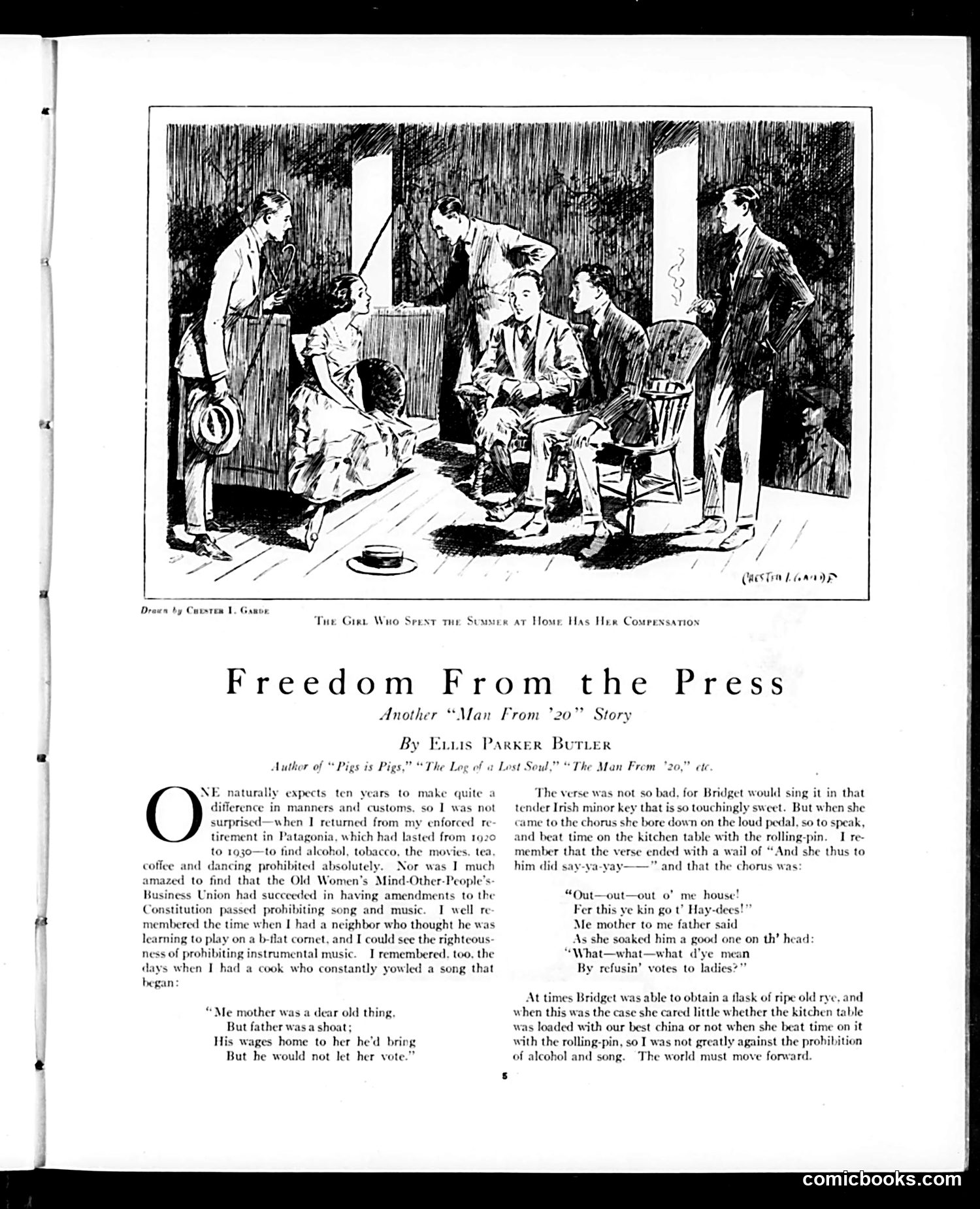
This story by Ellis Parker Butler satirizes Prohibition-era hypocrisy. The illustration shows a girl entertaining a group of men in what appears to be a parlor, with the caption "The Girl Who Spent the Summer at Home Has Her Compensation." The narrative mocks the contradiction between public prohibition laws and private alcohol consumption. Butler recounts discovering that despite legal bans on alcohol, tobacco, and coffee, people still secretly enjoyed these items. The story references Bridget, apparently a domestic worker, who sang songs about prohibition while the household covertly consumed alcohol. The satire targets the gap between America's official moral stance on Prohibition and the reality of widespread underground drinking and rule-breaking among ordinary citizens, suggesting that laws couldn't eliminate people's actual behaviors and desires.
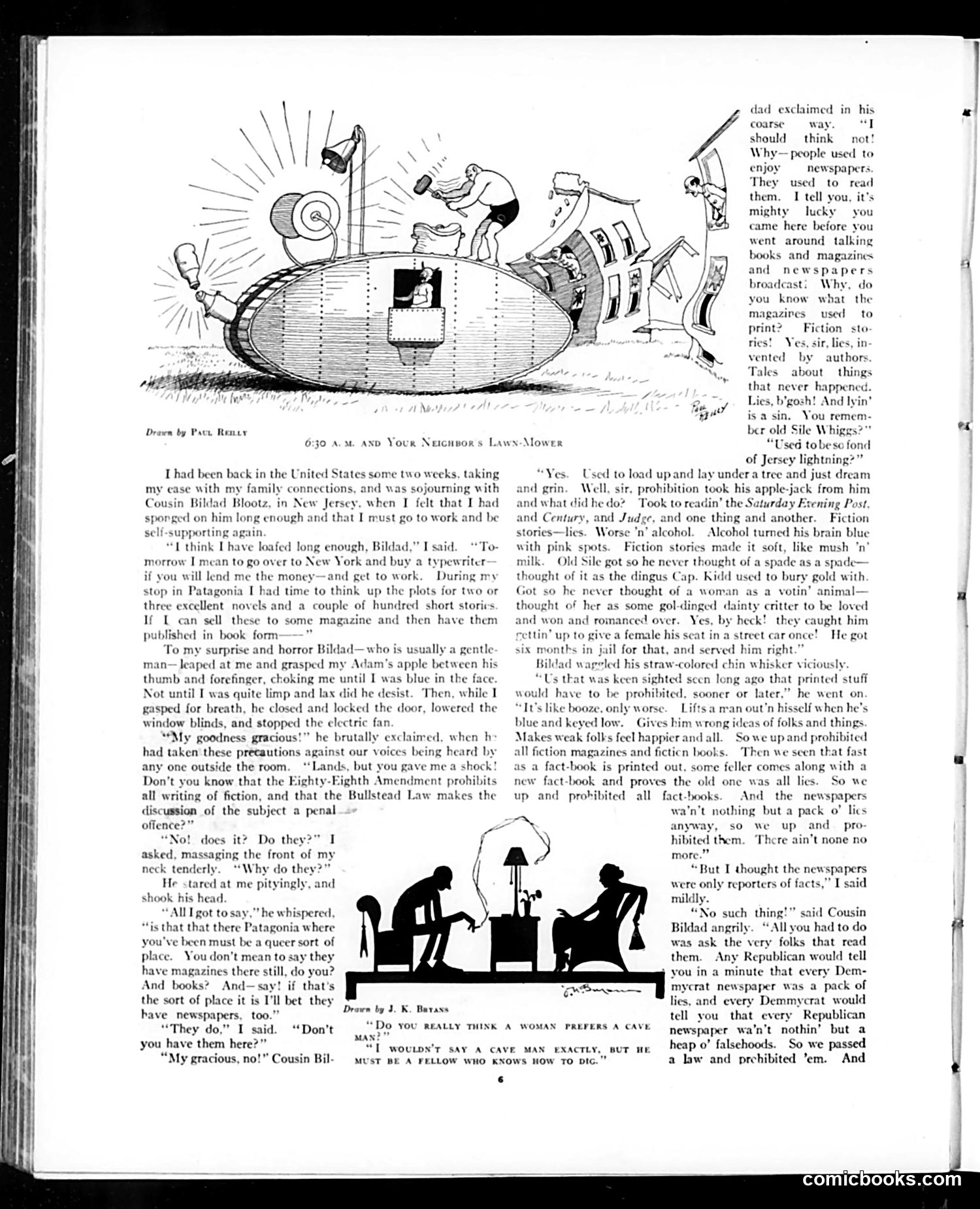
The page contains a short story debate between the narrator and his cousin Hildad Blootz about the purpose and morality of fiction magazines and newspapers. **The Satire's Point:** Hildad argues that fiction magazines and newspapers are inherently dishonest—filled with invented stories and lies ("Fiction stories—lies, invented by authors"). He contends that prohibiting such publications would be justified since they deceive the public with falsehoods, comparing them to alcohol's corrupting effects. The narrator counters that newspapers themselves spread political lies (referencing Republican and Democratic partisan dishonesty), suggesting hypocrisy in condemning fiction while accepting partisan propaganda. **The Cartoon Below** illustrates this debate visually, showing two silhouetted figures discussing the matter. **Historical Context:** This appears to satirize Progressive Era concerns about media trustworthiness, fake news, and whether entertainment should be restricted by law—issues remarkably modern in character.
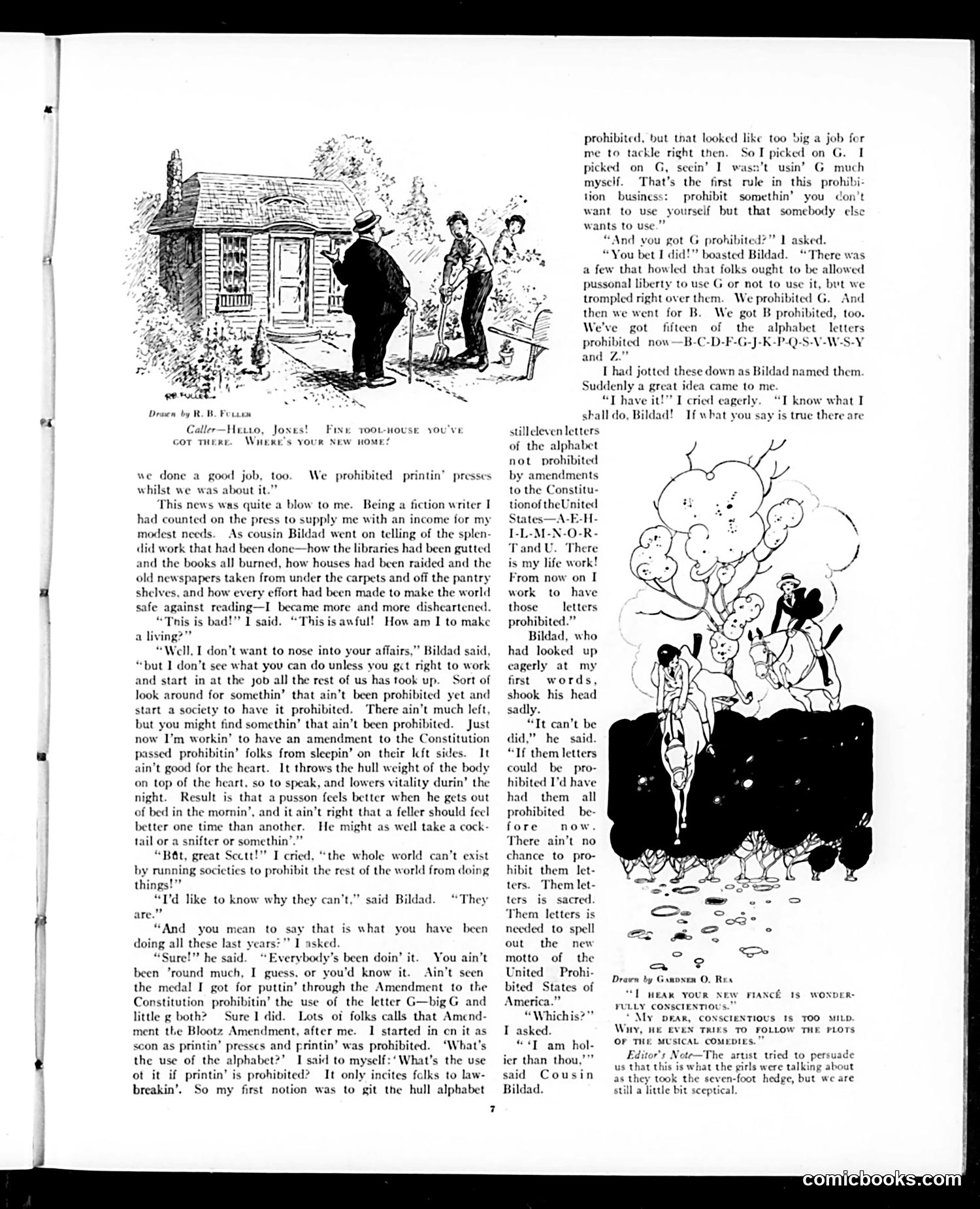
This is a satirical story about the unintended consequences of Prohibition (the constitutional ban on alcohol, 1920-1933). The narrator meets a character named Bildad, a self-righteous prohibitionist who has expanded his crusade beyond alcohol to absurd extremes—prohibiting letters of the alphabet simply because he personally doesn't use them (G, B, C, D, F, etc.). The satire mocks the prohibition movement's overreach and zealotry. Bildad represents prohibitionists who, having achieved their primary goal, become drunk on power and arbitrarily restrict others' freedoms under the guise of moral protection. The narrator—a fiction writer—faces ruin because his profession requires the prohibited letters. The cartoons illustrate this absurdist logic: one shows Bildad presenting his scheme to authorities; another depicts the cascading chaos of letters being prohibited. The joke critiques how prohibition movements, once empowered, inevitably expand beyond their original justifications, threatening basic freedoms and practical necessity.
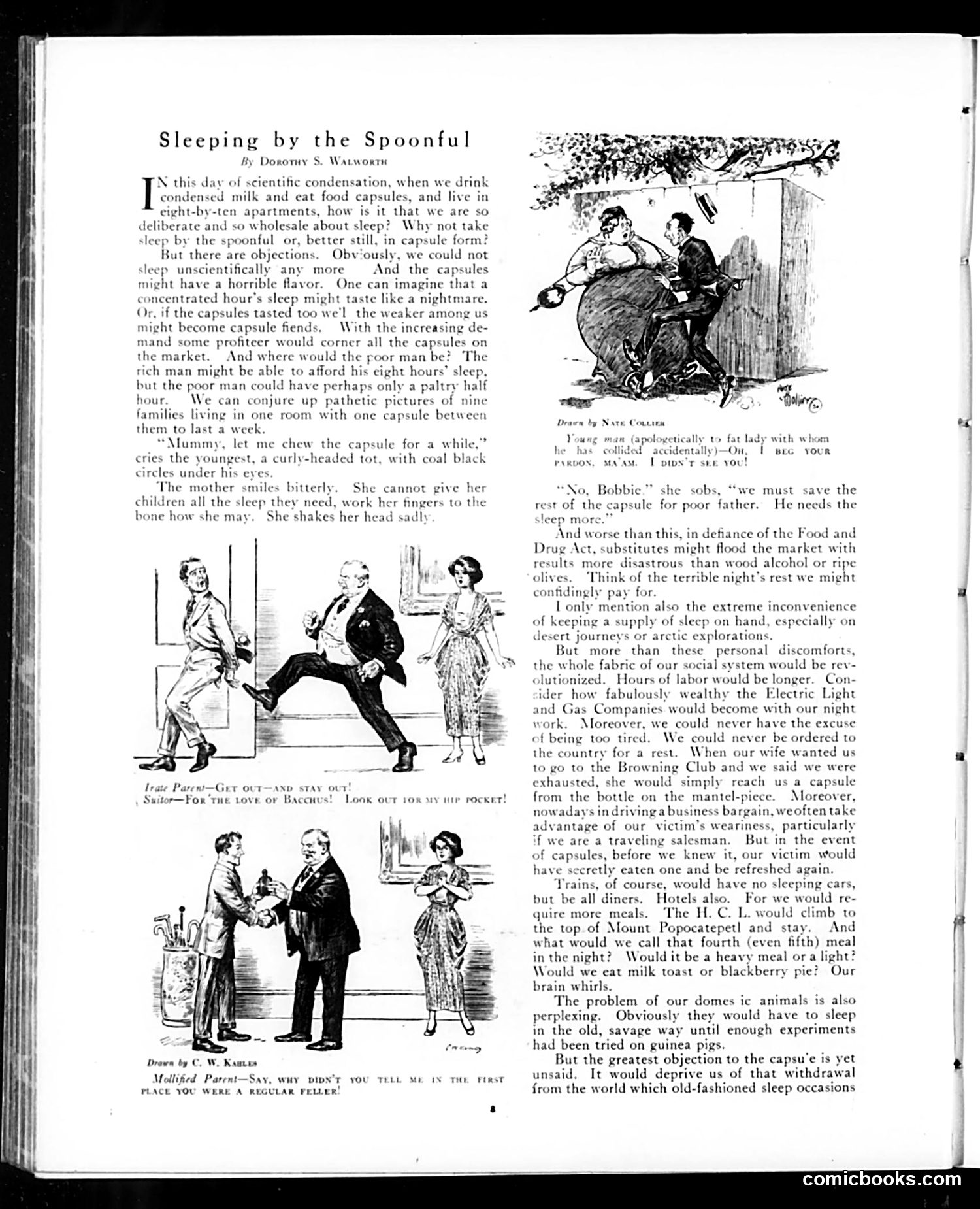
This article satirizes early 20th-century enthusiasm for "scientific" efficiency and convenience. The author imagines sleep condensed into capsule form—matching the era's fascination with concentrated foods and labor-saving inventions. The satire targets multiple social anxieties: wealth inequality (rich people could afford full sleep; poor families would share one capsule weekly), addiction (sleep capsule "fiends"), Food and Drug Act violations, and unintended consequences on labor and commerce. The author warns that eliminating sleep's natural inconvenience would destroy excuses for rest, increase working hours, and benefit utility companies. The accompanying comic vignettes (drawn by C.W. Kahles and Nate Collier) illustrate social embarrassment—a sailor's crude behavior, a young man colliding with a woman—typical Judge humor contrasting propriety with modern disorder. The piece's deeper point: uncritical acceptance of technological "progress" without considering human and social costs.
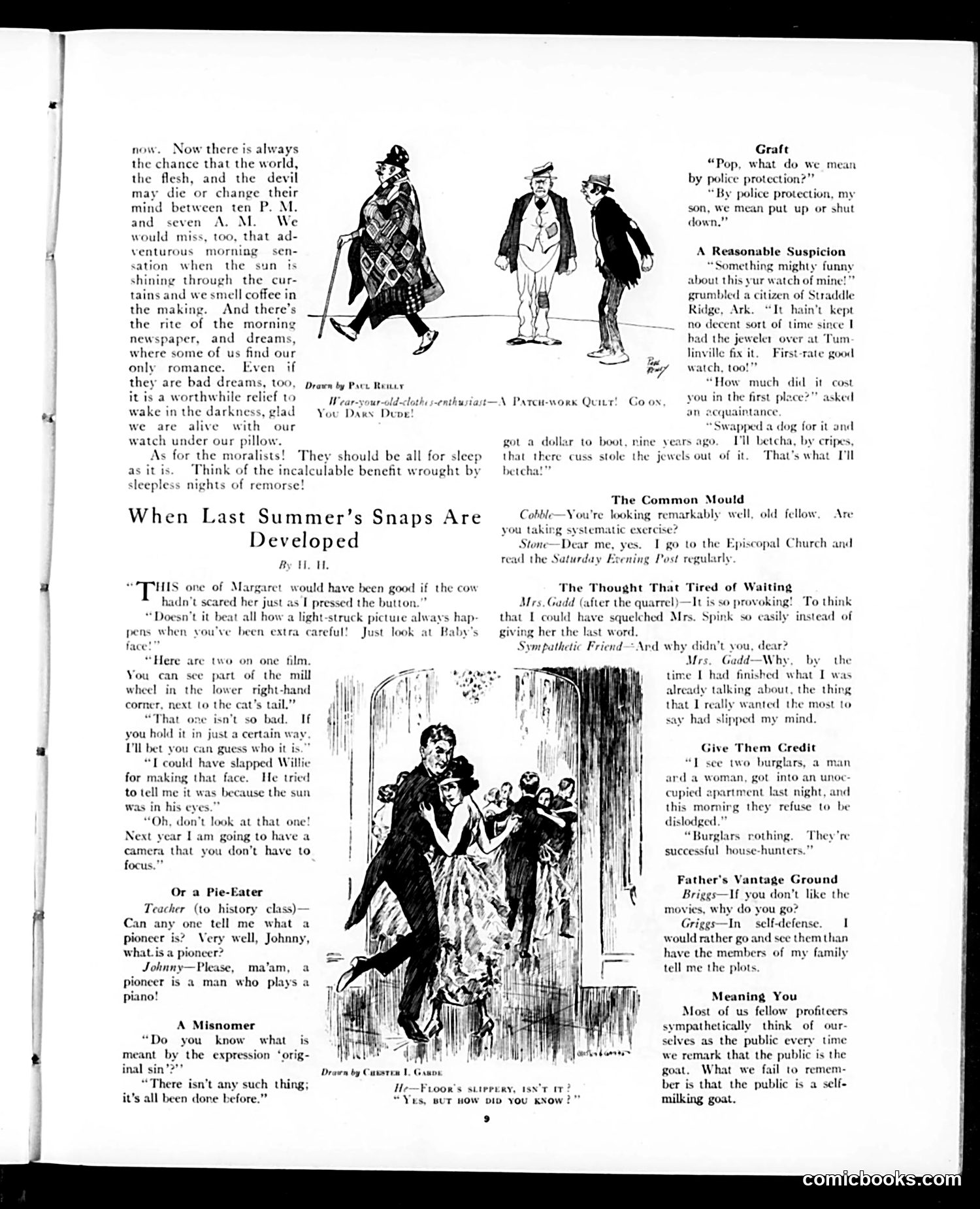
This page contains multiple short humor pieces satirizing early 20th-century American society. The central cartoon depicts figures in period dress, likely representing corrupt politicians or businessmen with hangers-on—a common Judge subject. Key satirical targets include: **"Graft"**: A cynical joke where "police protection" means paying off police to allow illegal activity ("put up or shut down"). **"A Reasonable Suspicion"**: Mocks rural skepticism and petty swindling—a farmer suspects a jeweler stole gems from his watch. **"Meaning You"**: Critiques wealthy profiteers who hypocritically call the public "the goat" while considering themselves separate from it. Other pieces mock everyday absurdities: bad photography, malapropisms ("pioneer" confused with "piano"), and marital frustration. The humor reflects Judge's satirical stance toward corruption, social pretension, and human folly during the Progressive Era.
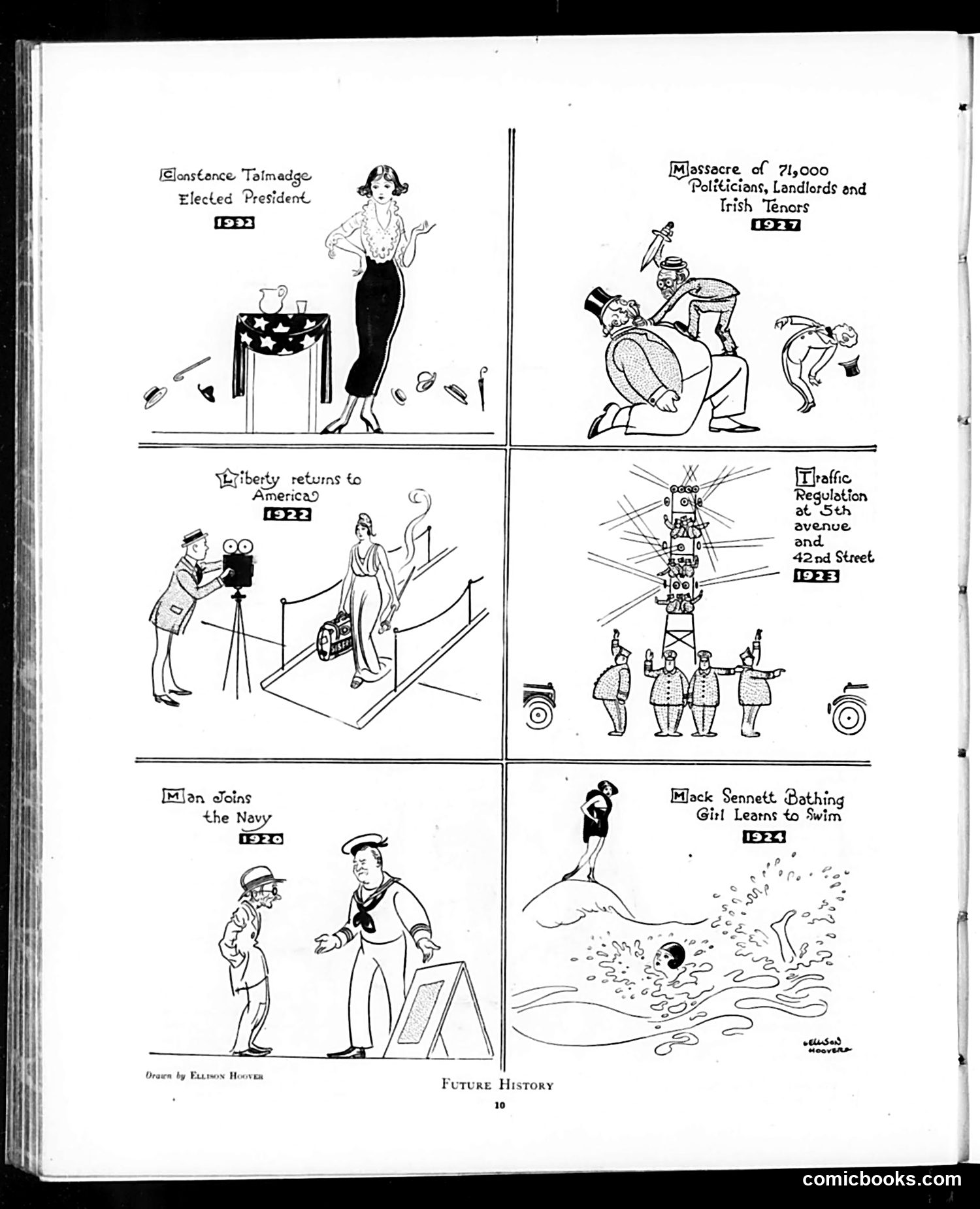
This page presents satirical predictions labeled "Future History," apparently from the 1920s. The cartoons mock contemporary figures and events: **Top left**: Constance Talmadge (actress) elected president in 1923—satirizing celebrity culture and women's recent voting rights. **Top right**: "Massacre of 71,000 Politicians, Landlords and Irish Tenors" (1927)—dark humor about class conflict and Irish-American stereotypes. **Middle left**: "Liberty returns to America"—likely mocking Prohibition's restrictions on personal freedom. **Middle right**: Traffic regulation at Fifth Avenue and 42nd Street—New York City congestion humor. **Bottom panels**: References to Mack Sennett (silent film director) and naval recruitment. The overall tone is cynical about American politics, social upheaval, and urban modernization. The cartoons use exaggeration and absurdist predictions to critique contemporary society, typical of Judge magazine's satirical approach during this era.
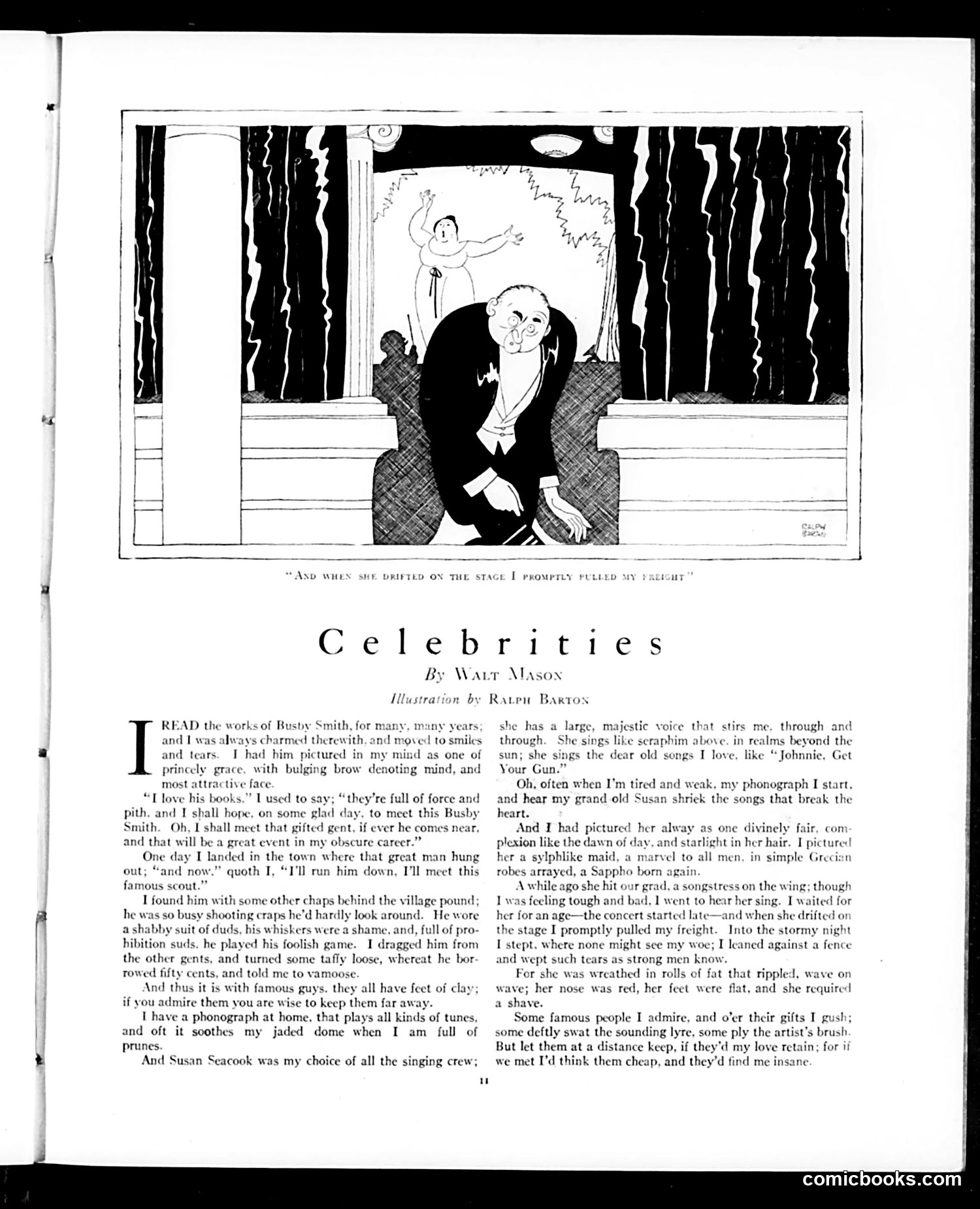
This humorous essay satirizes the gap between fan imagination and reality. The narrator describes his admiration for famous people—first "Busby Smith" (a writer), then singer "Susan Seacook"—whom he's idealized in his mind based on their work. The cartoon illustrates the punchline: when he finally encounters these celebrities in person, they disappoint catastrophically. Busby Smith is revealed as a shabby drunk shooting craps behind a village pound. Susan Seacook, imagined as a sylph-like beauty, appears on stage as an overweight woman with a red nose, flat feet, and poor grooming. The satire mocks celebrity worship and our tendency to construct false idols. Mason's conclusion is cynical: admire famous people only "at a distance"—actually meeting them risks disillusionment. The cartoon's exaggerated caricature of the disappointed man watching from the audience drives home the joke: idealization requires ignorance.
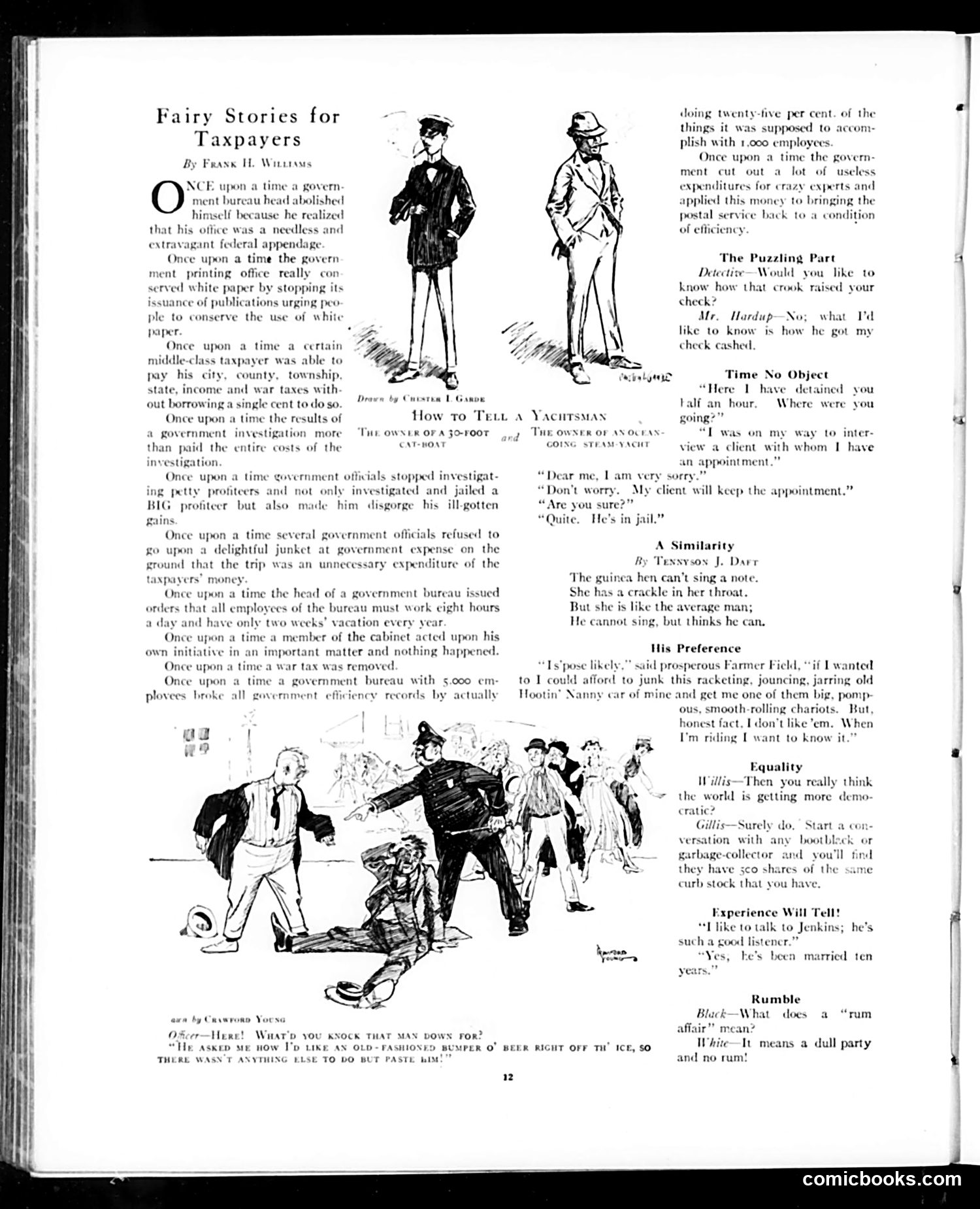
This Judge magazine page satirizes government inefficiency and waste through mock fairy tales—presenting absurd scenarios presented as impossibilities. Each "once upon a time" story describes something that *never* happens: a bureau chief abolishing his own unnecessary office; government actually conserving resources; a citizen paying taxes without debt; investigations that save money rather than cost it. The cartoons below reinforce the theme. One depicts police beating a man for no reason ("there wasn't anything else to do"), mocking pointless government action. Another shows a yacht owner detained for half an hour—illustrating how government wastes citizens' time without consequence. The overall message criticizes bloated, self-perpetuating federal bureaucracies, wasteful spending, inefficiency, and officials' indifference to taxpayer burden. The "fairy story" framing—treating competent government as pure fantasy—reflects Progressive Era skepticism of bureaucratic reform efforts.
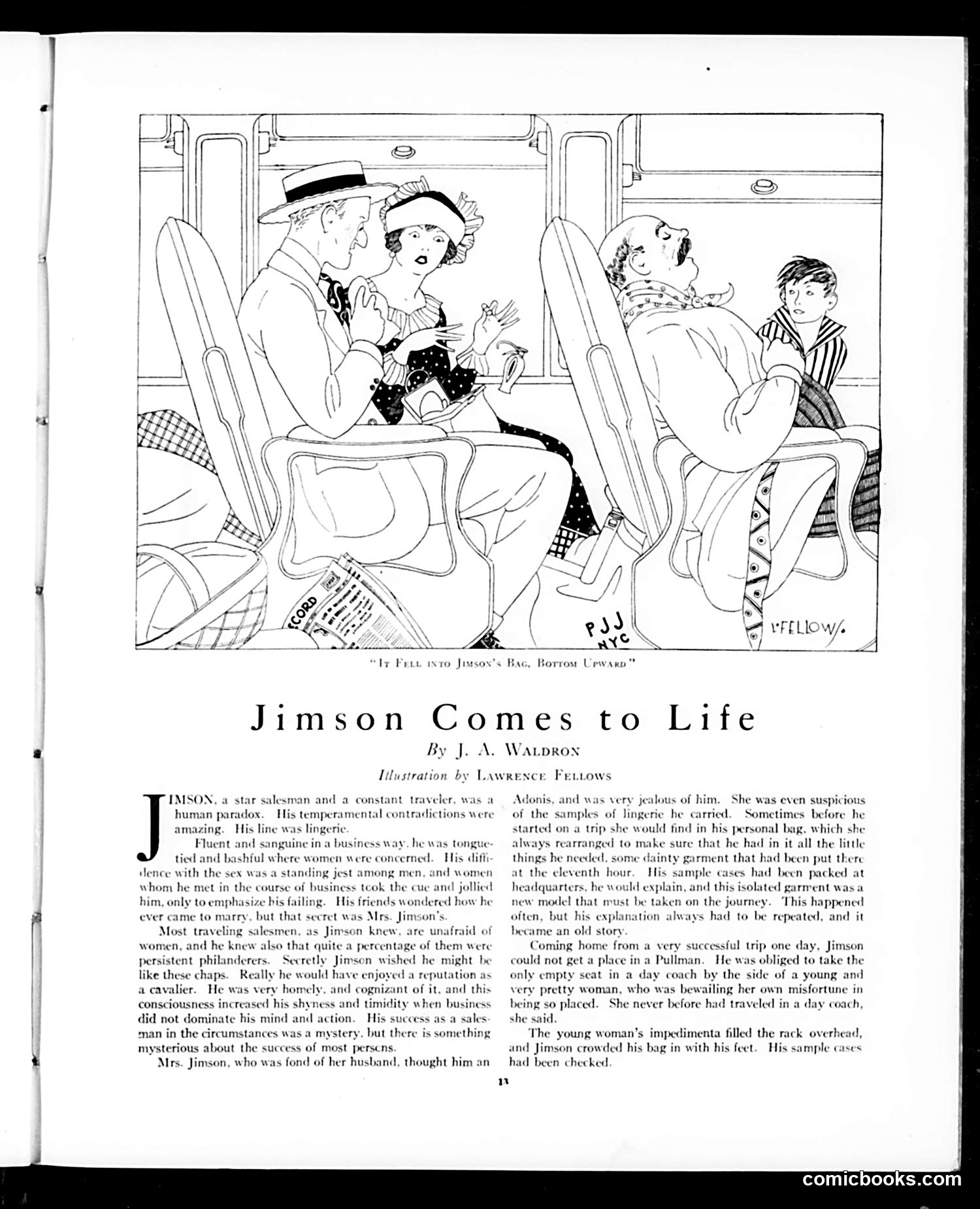
This is the opening of a short story illustrated by Lawrence Fellows for *Judge* magazine, not a political cartoon. The narrative introduces Jimson, a traveling salesman of lingerie who embodies a social contradiction: confident and eloquent in business, yet shy and homely around women. His jealous wife suspects infidelity based on his sample cases. The story's setup—Jimson forced to share a day coach seat with an attractive young woman—establishes a premise playing on period anxieties about travel, propriety, and marital fidelity. For contemporary readers, this reflected real concerns about the impropriety of strangers sharing close quarters on trains. The accompanying illustration depicts the awkward encounter, with other passengers observing. The humor derives from Jimson's internal contradiction: he wishes to appear as a confident "cavalier" but is fundamentally timid and homely, creating comic tension.
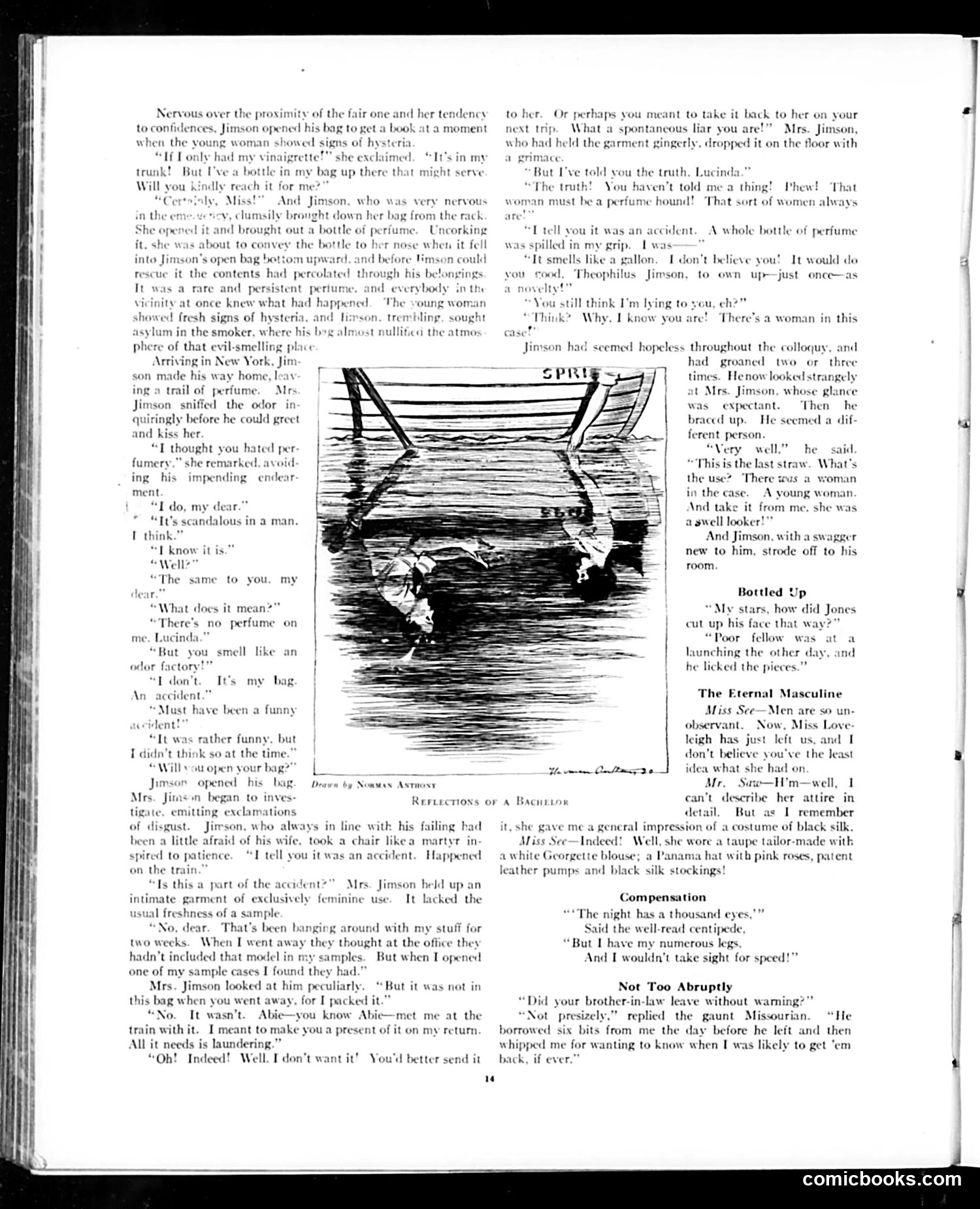
This page depicts a domestic comedy centered on **infidelity suspicion**. A husband (Jimson) returns home trailing perfume, which his wife (Lucinda) notices immediately. The satire mocks **male duplicity and transparent lying**. Jimson offers increasingly implausible excuses—a spilled bottle, a friend's gift, laundry mishaps—each more absurd than the last. His wife, skeptical and sharp-tongued, cuts through his pretenses, finally forcing a "confession" of an affair. The humor targets **masculine weakness**: Jimson capitulates immediately once pressed, admitting to infidelity with almost relief. The cartoon (by Norman Anthony, visible in credits) shows the steamship "Spree," the location where the perfume bottle supposedly spilled—a visual punchline emphasizing the ridiculous excuse. The page satirizes both **male infidelity** and the performative nature of marital dishonesty in early 20th-century bourgeois life, where wives' vigilance and husbands' fumbling attempts at deception are comedy.
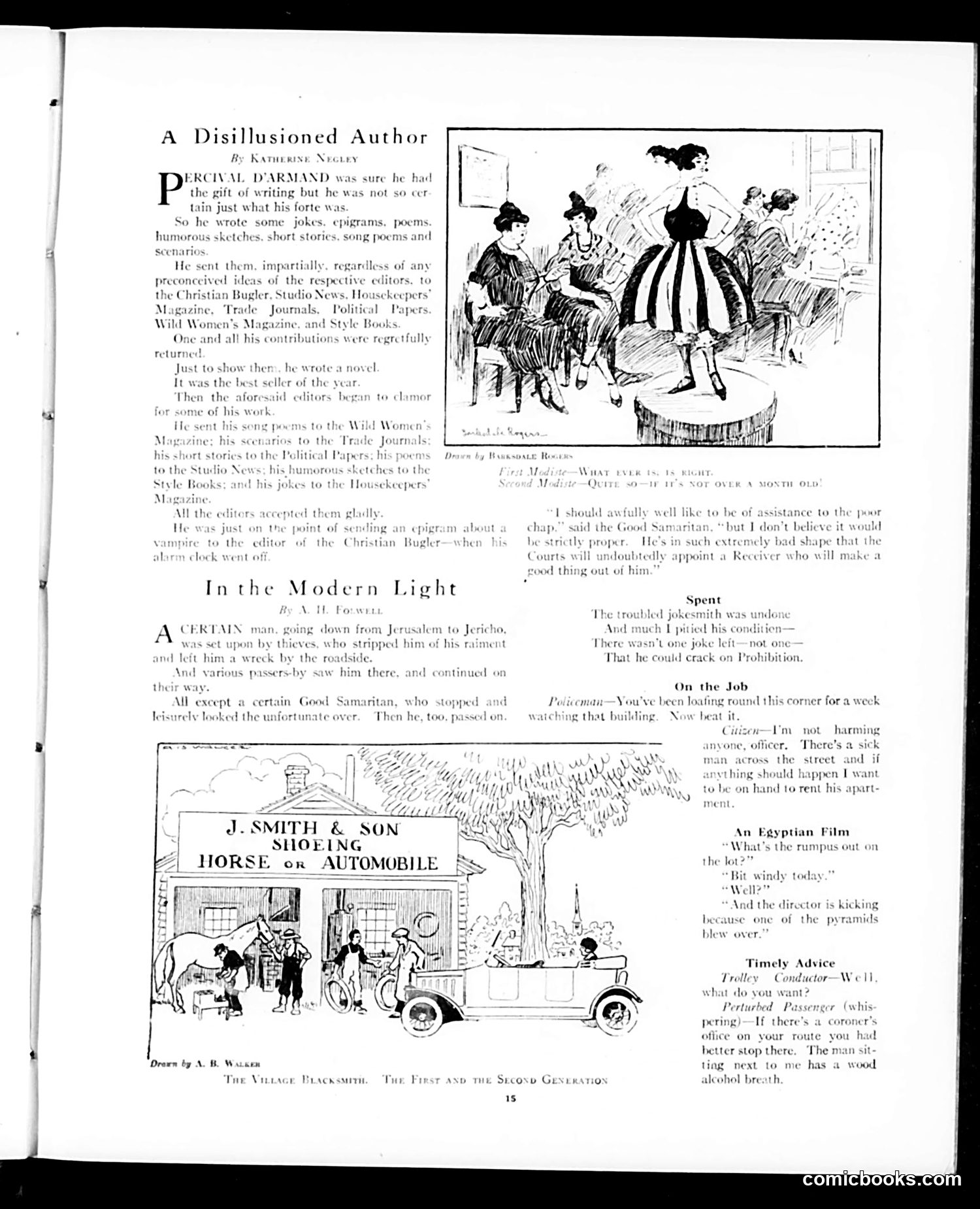
This page satirizes the publishing world's treatment of a struggling writer, Percival D'Armand, who submits work across multiple publications (Christian Bugler, Studio News, Trade Journals, Political Papers, Wild Women's Magazine, Style Books) seeking his niche. The joke: all editors reject his contributions, then one accepts his novel—which becomes a bestseller. The satire mocks editorial gatekeeping and the unpredictability of literary success. The page also contains unrelated humorous sketches: "In the Modern Light" (riffing on the Biblical Good Samaritan story), a J. Smith & Son advertisement parodying modernization (horses vs. automobiles), and brief joke items about workplace absurdities and urban life ("On the Job," "Egyptian Film," "Timely Advice"). These represent typical Judge magazine filler—quick gags reflecting early 20th-century concerns about technology, employment, and social interaction.
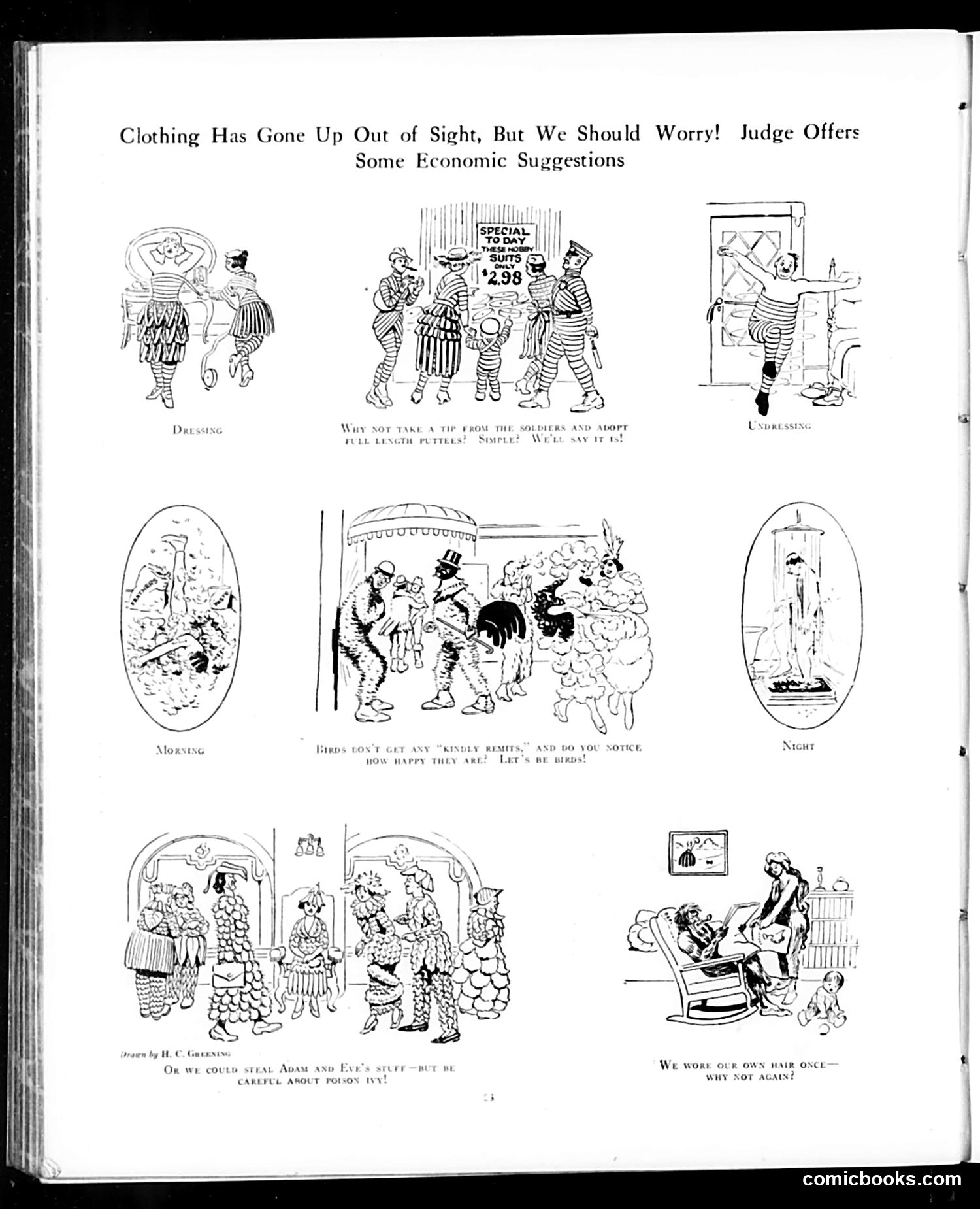
This page satirizes wartime clothing rationing and economic hardship. The headline references clothing prices becoming prohibitively expensive ("gone up out of sight"). The cartoons mock various cost-saving measures: soldiers in full-length puttees as a cheap clothing solution; children undressing to save fabric; people dressing in minimal clothing at night to reduce laundry needs; and adopting bird-like plumage (likely referencing absurd fashion alternatives during scarcity). The recurring joke appears to be that in desperate economic times, people resort to ridiculous solutions—wearing less, wearing animal-inspired clothing, or adopting nature's approach—rather than accepting higher prices. The reference to "Adam and Eve's stuff" suggests going naked as the ultimate economy. This likely dates from WWI or the 1920s inflation period, when American clothing costs significantly increased and rationing became a social concern.
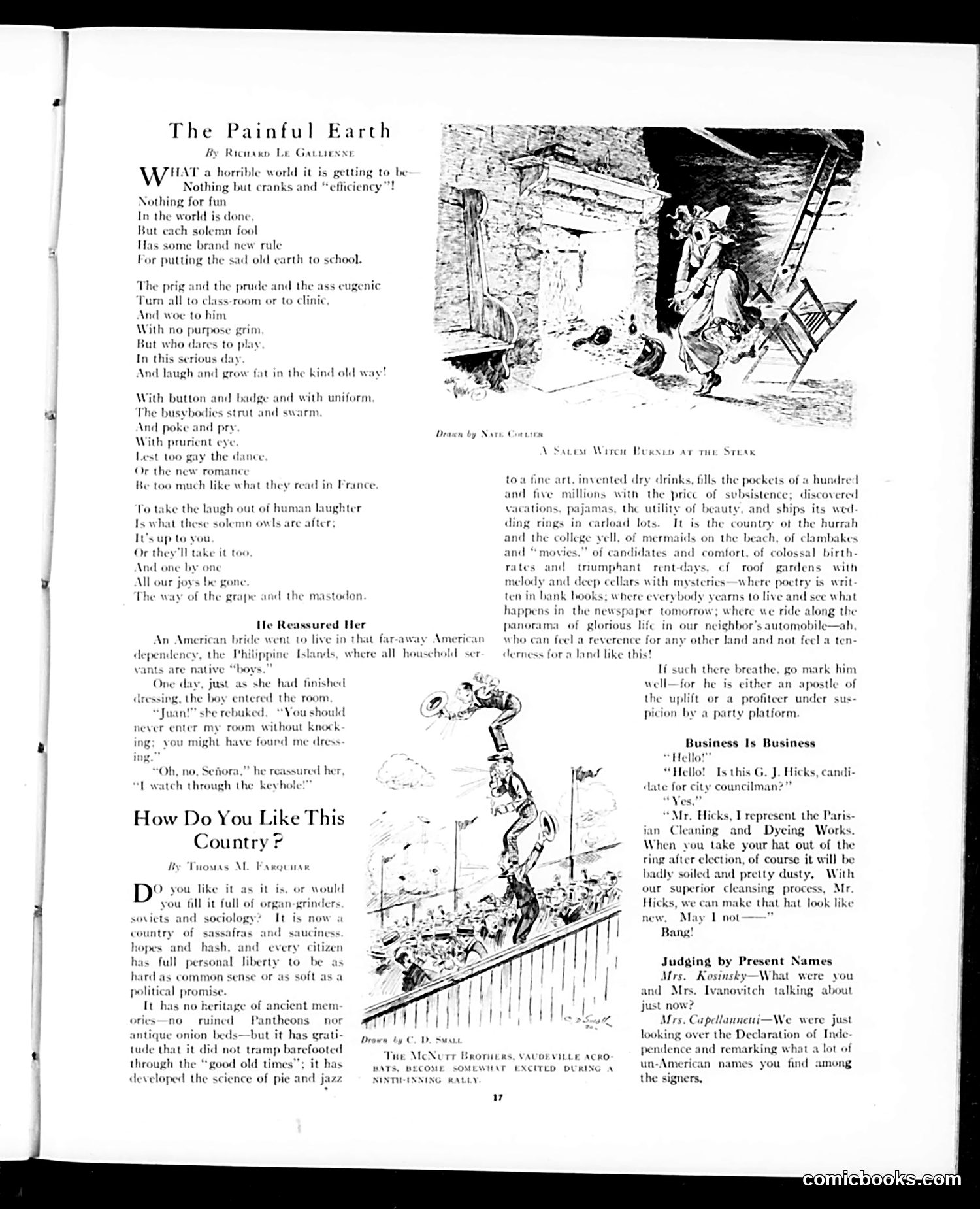
This page contains three satirical pieces critiquing early 20th-century American social trends: **"The Painful Earth"** attacks the Progressive Era's obsession with efficiency, regulation, and moral reform. Le Gallienne mocks "cranks" imposing rules, "busybodies" enforcing conformity through uniforms and surveillance, and puritans suppressing fun and "new romance"—likely referencing anxiety about modern sexuality. The poem laments lost freedom and joy. **"How Do You Like This Country?"** defends American informality and liberty against critics seeking European-style refinement. Farquhar celebrates sass, pie, jazz, and common sense over pretension, though the ending ambiguously suggests only "apostles of uplift or profiteers" could criticize America. **The minor pieces** ("Business is Business," "Judging by Present Names") offer quick jokes: one mocks a political candidate's lost dignity; another satirizes ethnic prejudice by having Mrs. Capellanneui (Italian surname) mock the "un-American names" of the Declaration's signers—highlighting the absurdity of nativist attitudes. Overall, the page reflects 1910s-20s tensions between Progressive reformers and traditionalists defending American individualism.
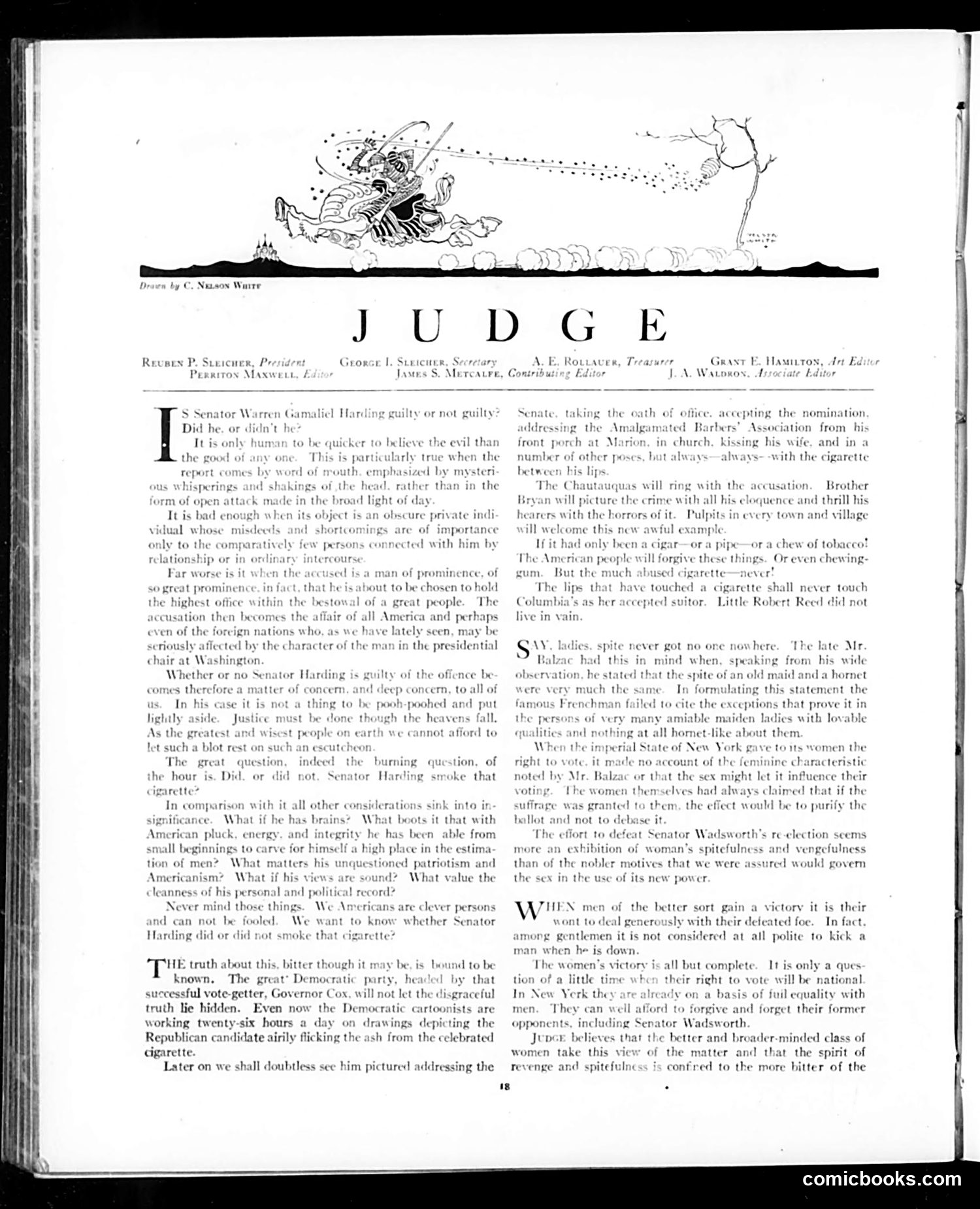
This page from *Judge* magazine satirizes Senator Warren G. Harding's involvement in a scandal where he allegedly kissed his wife in public while smoking a cigarette. The cartoon (drawn by C. Nelson Watte, visible at top) depicts Harding being chased by an angry mob—a visual joke about the public outrage. The accompanying article critiques both the scandal itself and the Democratic response to it. The text argues that while Harding's behavior was improper, Democrats are hypocritically using it as a campaign weapon against the Republican candidate. The piece sarcastically suggests that Americans are "clever persons" who can judge character, yet the whole controversy seems trivial. The article also discusses women's suffrage concerns, noting that women voters might be influenced by spite rather than reason when voting against Harding. Overall, this is partisan political satire defending Harding while mocking Democratic opportunism—typical of *Judge's* Republican-leaning editorial stance during the 1920 presidential campaign.
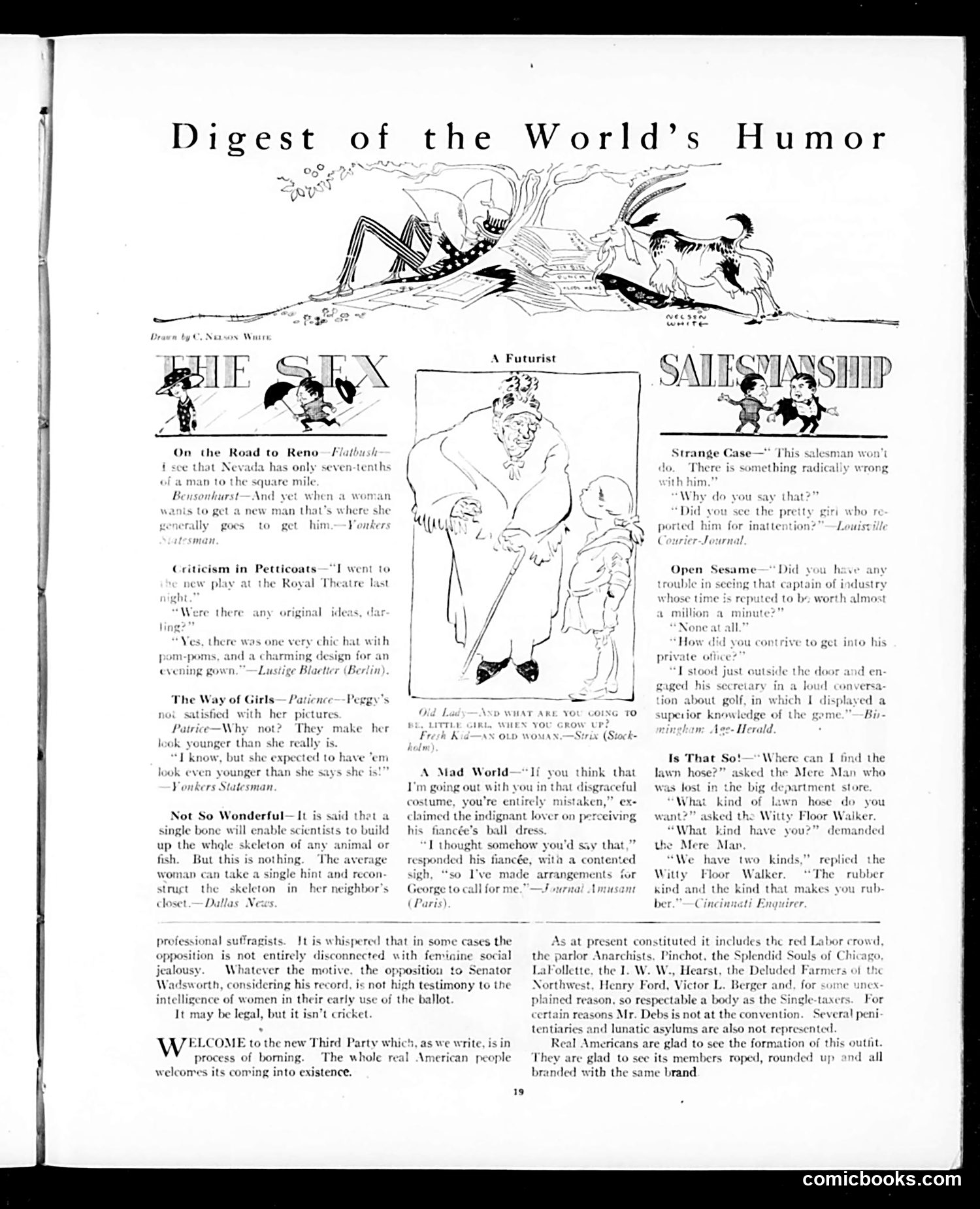
This page collects brief satirical jokes reflecting early 20th-century American social attitudes. Key targets include: **"On the Road to Reno"**: References Nevada's lenient divorce laws, mocking women seeking divorces (Reno was a divorce destination). **"The Way of Girls"**: Jokes about women's vanity and deception with photographs. **"A Futurist"**: The central cartoon depicts modernist artistic pretension, likely satirizing the Futurist art movement's absurdity. **The Third Party section** (bottom): Satirizes a nascent progressive political movement, mocking its diverse membership—including labor radicals, anarchists, Pinchot conservationists, the IWW, William Randolph Hearst, Henry Ford, and Victor Berger—as a chaotic coalition of incompatible groups "branded with the same brand." The tone is dismissive of this reform coalition's legitimacy. Overall, the page reflects Judge's conservative stance toward women's rights, modernism, and progressive politics.
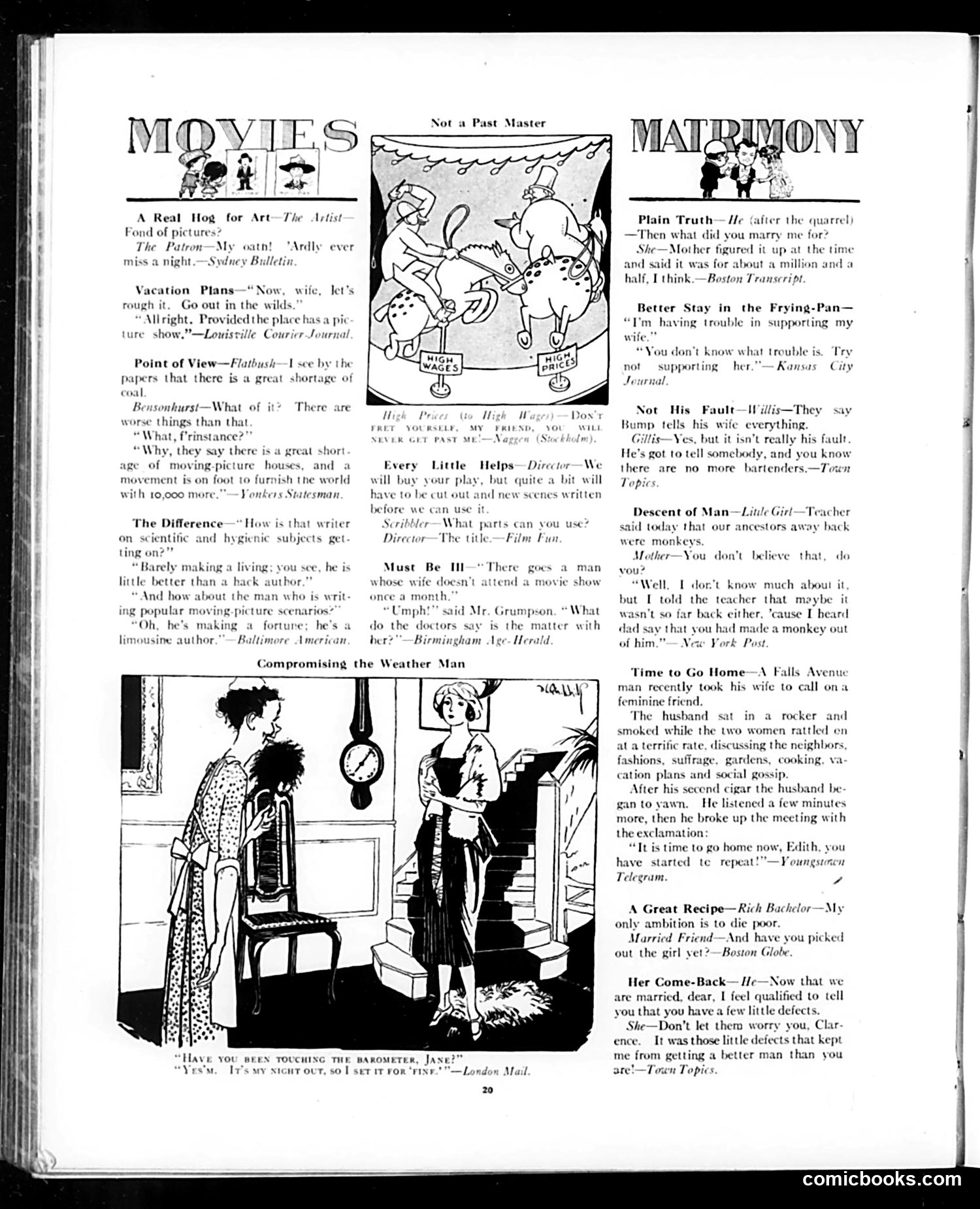
This page contains multiple brief satirical humor pieces typical of early 20th-century Judge magazine, targeting middle-class American life and emerging popular culture. **Key Satire Targets:** The "Movies" section mocks cinema's growing cultural dominance—one piece jokes that a man whose wife never attends movie shows must be ill, implying movies had become essential entertainment. Another satirizes film producers who buy scripts but demand extensive cuts, leaving only the title usable. **The central cartoon** depicts a domestic dispute where a wife accuses her husband of tampering with the barometer to predict "fine" weather, suggesting he's trying to manipulate circumstances (likely to avoid social obligations). **Marriage humor** pervades the right column: wives are portrayed as expensive, talkative, and inherently flawed, while husbands must endure their company. One joke suggests a man telling his wife "everything" isn't his fault because bartenders no longer exist—referencing Prohibition's impact. The satire reflects anxieties about cinema's social role, changing marriage dynamics, and Prohibition-era social shifts.
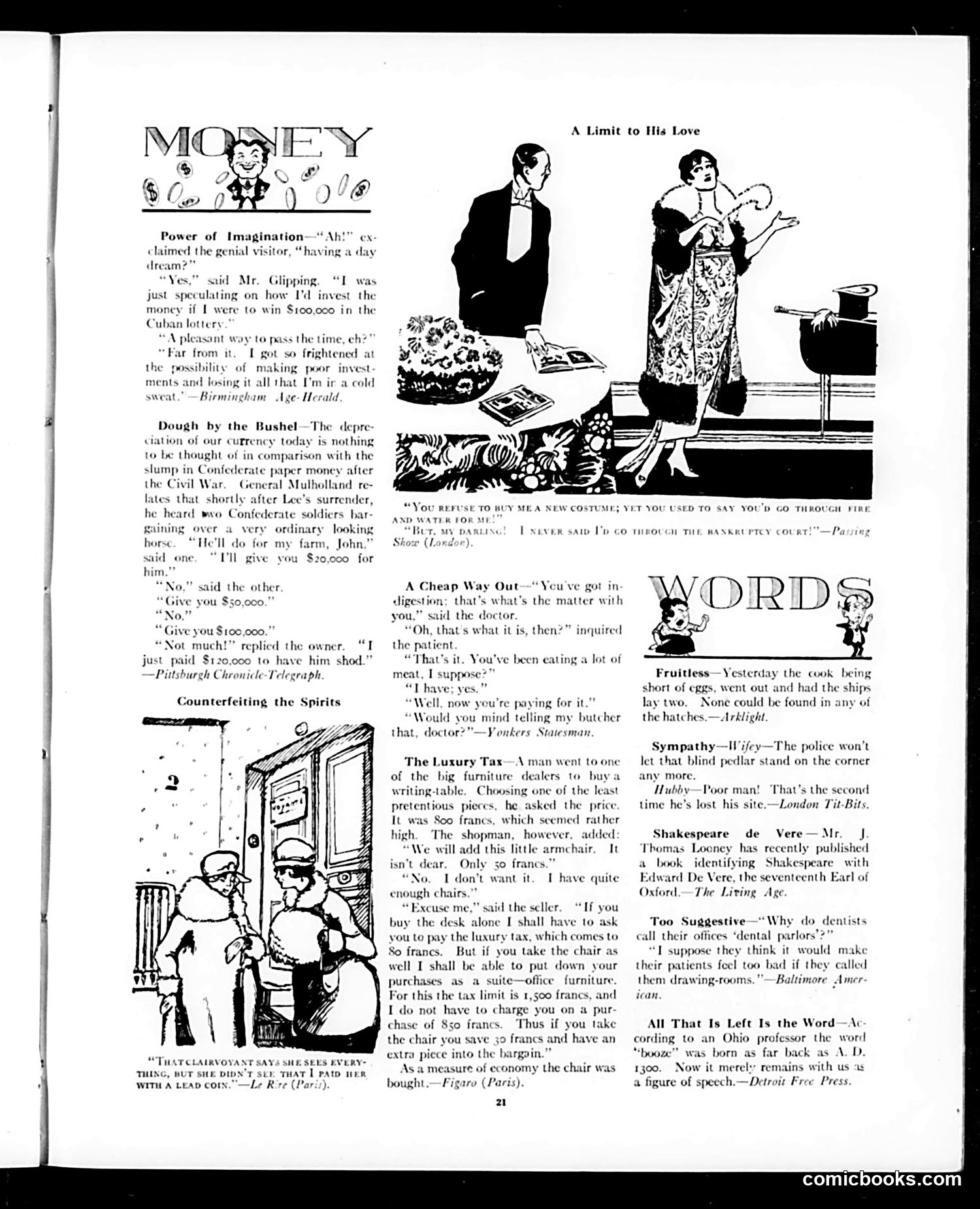
This page from the satirical magazine **Judge** contains multiple short humor pieces typical of early 20th-century American comedy. **Key content:** The "Power of Imagination" joke mocks anxiety about wealth—a man imagines winning $100,000 in a Cuban lottery but becomes so stressed about investing it poorly that he works himself into a cold sweat. "Dough by the Bushel" references **post-Civil War Confederate currency collapse**, where worthless Confederate money became a humorous analogy for rapid financial depreciation. "A Limit to His Love" shows marital humor: a husband refuses to buy his wife a new costume, claiming he'd go "through fire and water" for her—but she notes he'd never go through bankruptcy court. Other brief jokes target common early-20th-century concerns: indigestion (blamed on butchers), luxury taxes on furniture (French setting), and dentists calling offices "parlors" to avoid sounding ominous. The page demonstrates Judge's formula: topical economic/social satire mixed with domestic and professional humor, all designed for quick laughs from contemporary readers familiar with these specific cultural anxieties.
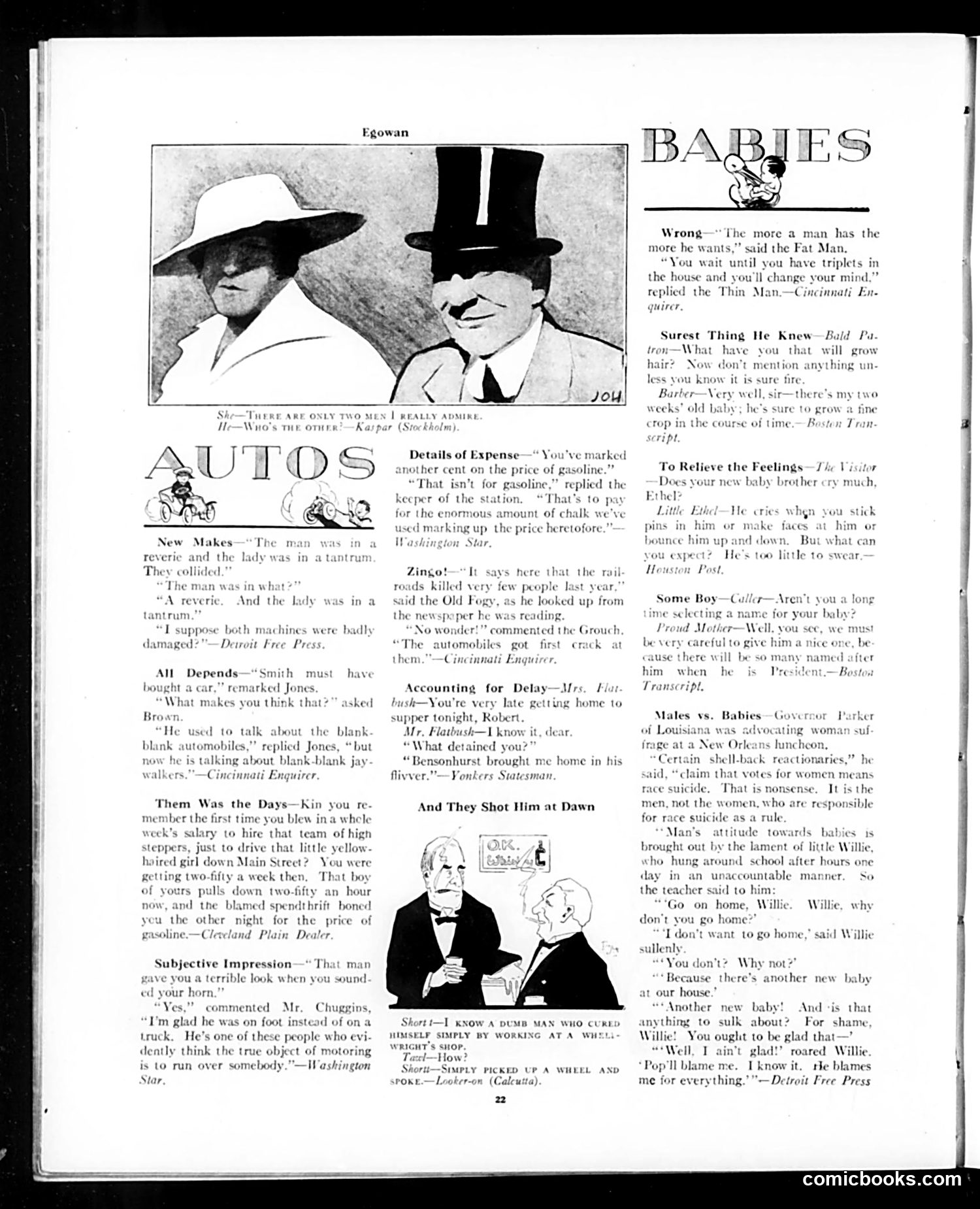
This page from *Judge* presents humor about babies, automobiles, and contemporary social attitudes circa 1910s-1920s. **Top cartoon**: Two men in contrasting hats—one wearing a wide-brimmed hat, the other a top hat—with the caption questioning "There are only two of us really—He—Who's the other?" This appears to be a visual gag about physical appearance or identity, though the specific reference is unclear. **"Autos" section**: Contains brief comedic anecdotes mocking early automobile culture—inflated gasoline prices, mechanical failures, and dangerous driving. These jokes target both automobile operators and the new expense of motoring. **"Babies" section**: Satirizes attitudes toward large families and childbearing. One joke depicts a boy reluctant to go home because of a new baby sibling. Another references Governor Parker's advocacy for women's suffrage, sardonically arguing men (not women) cause "race suicide" through indifference toward babies—clearly mocking anti-suffrage arguments of the era that claimed women's rights threatened population growth. The overall tone reflects early 20th-century anxieties about modernization, automobiles, and shifting gender roles.
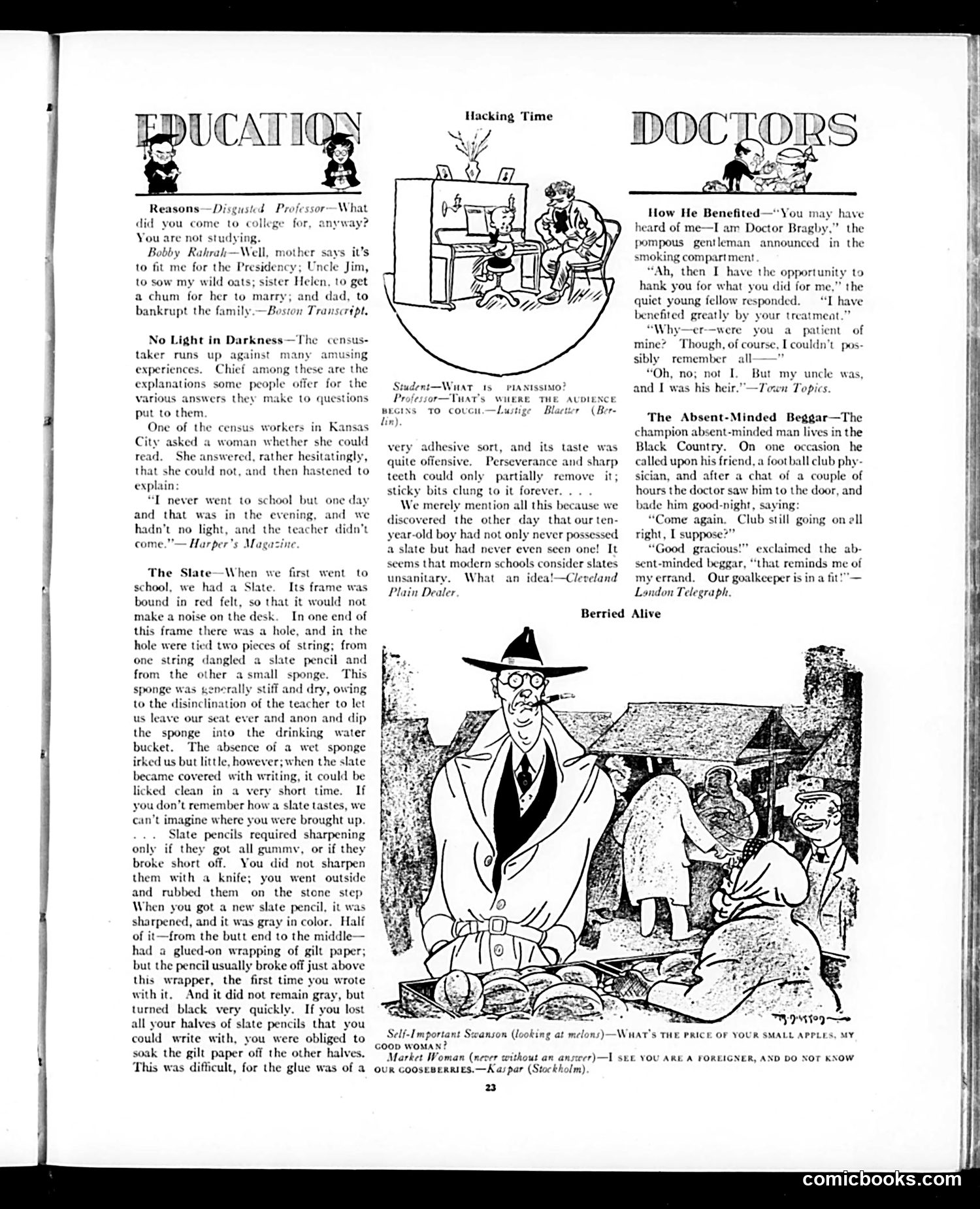
This satirical page contains several short humorous pieces mocking American society and institutions: **"Reasons"** jokes about college as a pointless institution—a student admits attending merely to prepare for the presidency, sow wild oats, find a wife, or bankrupt his family, not for education itself. **"No Light in Darkness"** ridicules census data and illiteracy, featuring a woman's absurd explanation for not reading: she attended school only one evening with inadequate lighting. **"The Slate"** is nostalgic commentary on old schoolroom equipment, lamenting that modern schools now consider slates "unsanitary"—a gentle satire on progressive education's rejection of traditional methods. **"How He Benefited"** contains dark humor: a man thanks a pompous doctor for beneficial treatment—the doctor being his late uncle whose inheritance he received. **"The Absent-Minded Beggar"** depicts a comically forgetful man who visits a doctor, forgets his actual errand (retrieving his goalkeeper from a fit), and only remembers upon leaving. The cartoons employ everyday American situations to satirize pretension, folly, and changing social customs.
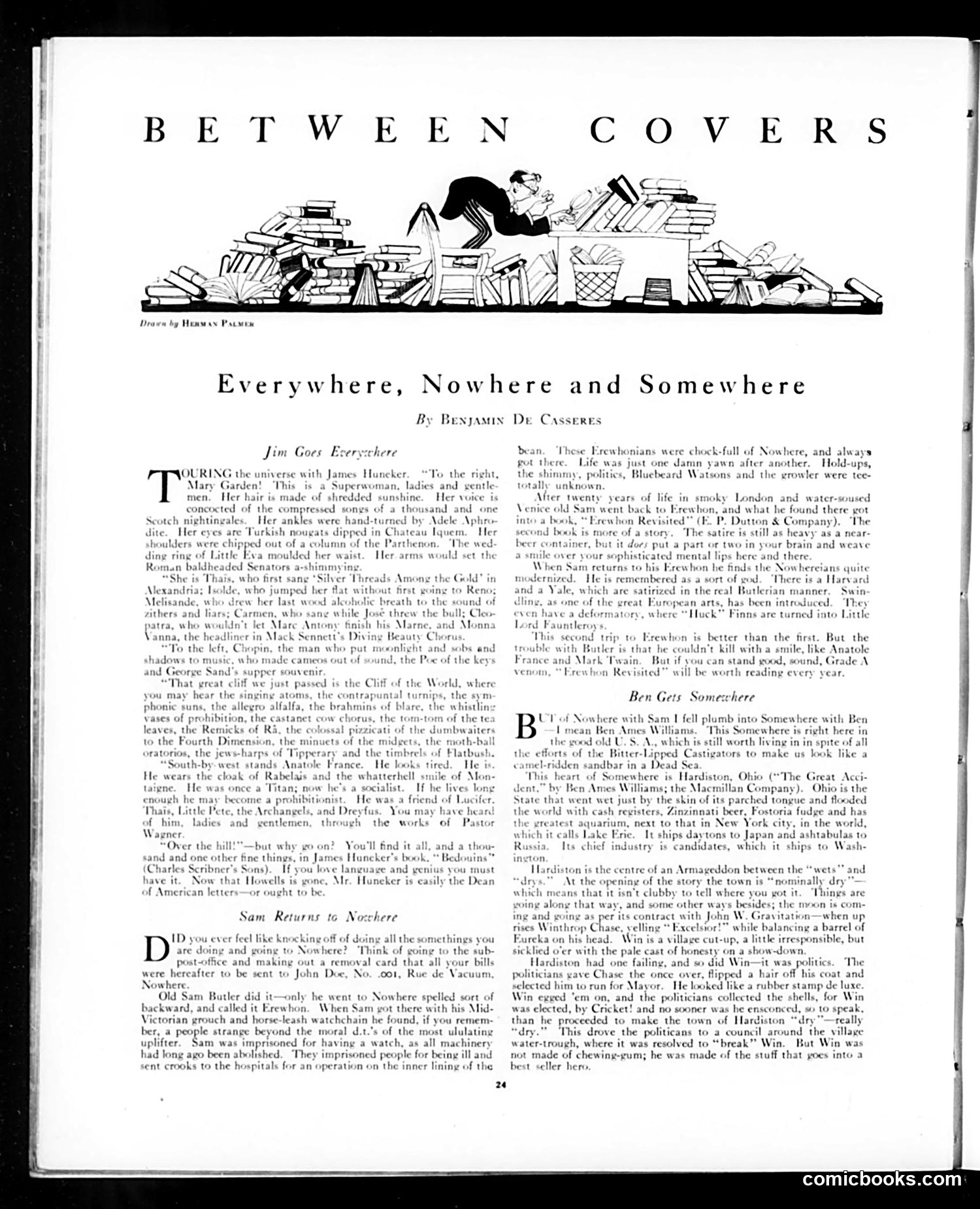
This appears to be a literary essay with illustrations rather than a political cartoon. The piece, by Benjamin De Casseres, discusses three fictional/literary locations inspired by real authors and works. **Key References:** - **"Nowhere"**: References Samuel Butler's satirical novel *Erewhon* (1872)—"Nowhere" spelled backward—which critiqued Victorian society through an inverted world where machinery is forbidden and illness is criminalized. - **"Somewhere"**: Appears to be a fictional American town (likely inspired by realistic American fiction), featuring a character named "Win" who becomes mayor through populist appeal and pursues Prohibition ("making the town...dry"). - The essay celebrates literary genius and unconventional thinking, mentioning James Huneker (real critic) and referencing Mark Twain and other American authors. **The Satire's Point:** The piece satirizes American small-town politics and Prohibition-era moralizing through the character Win, who manipulates townsfolk despite his flaws, suggesting criticism of populist politicians and reform movements.
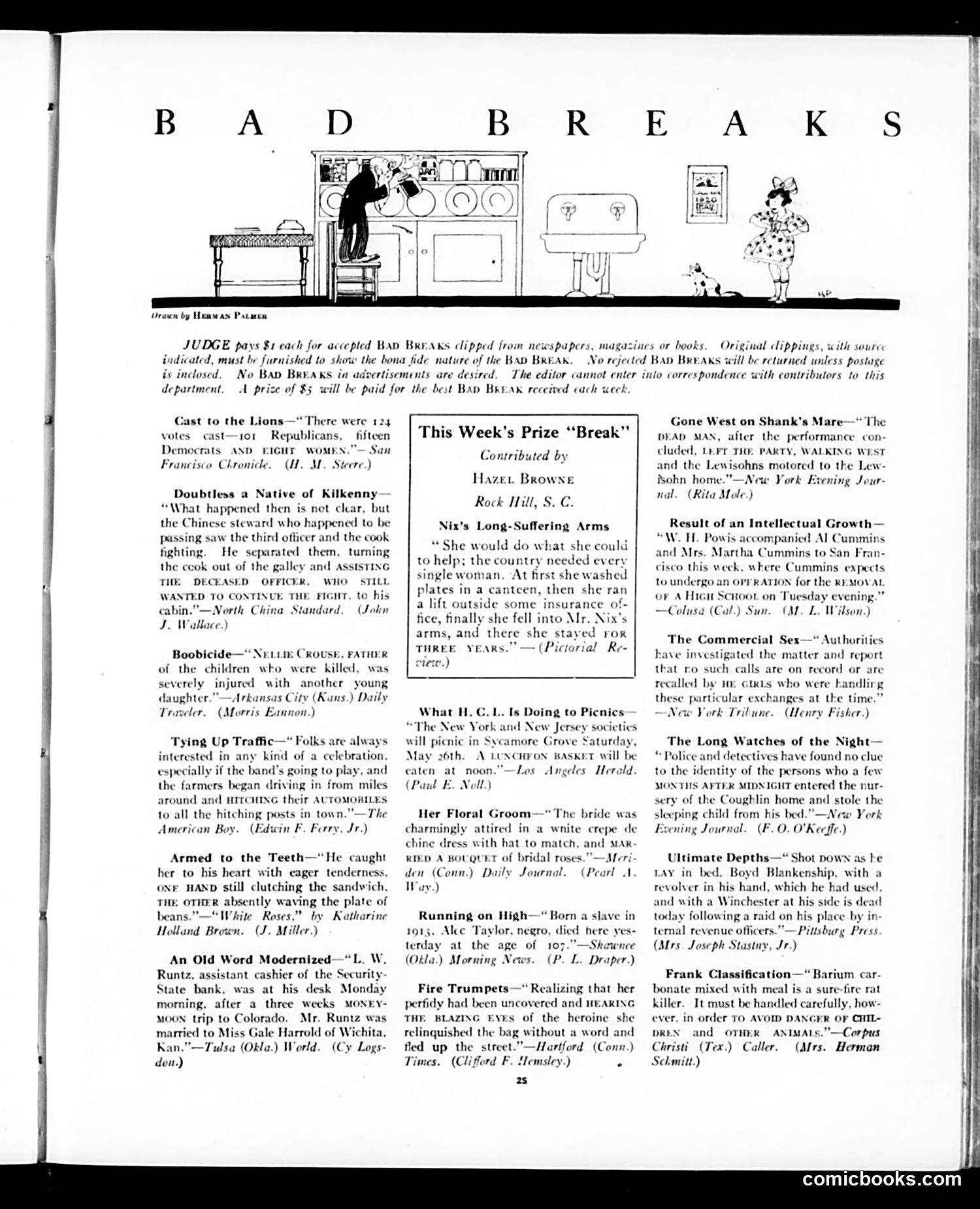
This page showcases Judge's "Bad Breaks" feature—a humor column where readers submitted unintentionally funny newspaper clippings. The joke is ironic: these items are *literally true* but read as absurdly illogical. Examples include: - A voting report that mentions "EIGHT WOMEN" separately from parties, implying women aren't quite voters - A report that a dead man "LET THE PARTY" continue after his death - "MARRIED A BOUQUET of bridal roses"—making the bride's flowers her groom - A person "BORN a slave in 1913" and dying at 107 (impossible timeline) The humor relies on awkward phrasing, malapropisms, and contradictions created by careless newspaper writing. Judge paid contributors $1 per clipping accepted, $5 weekly for the best. This format satirizes both press incompetence and—subtly—social attitudes (the women-voters item) of the era. The cartoon header, credited to Heywood Partridge, suggests newspaper chaos.
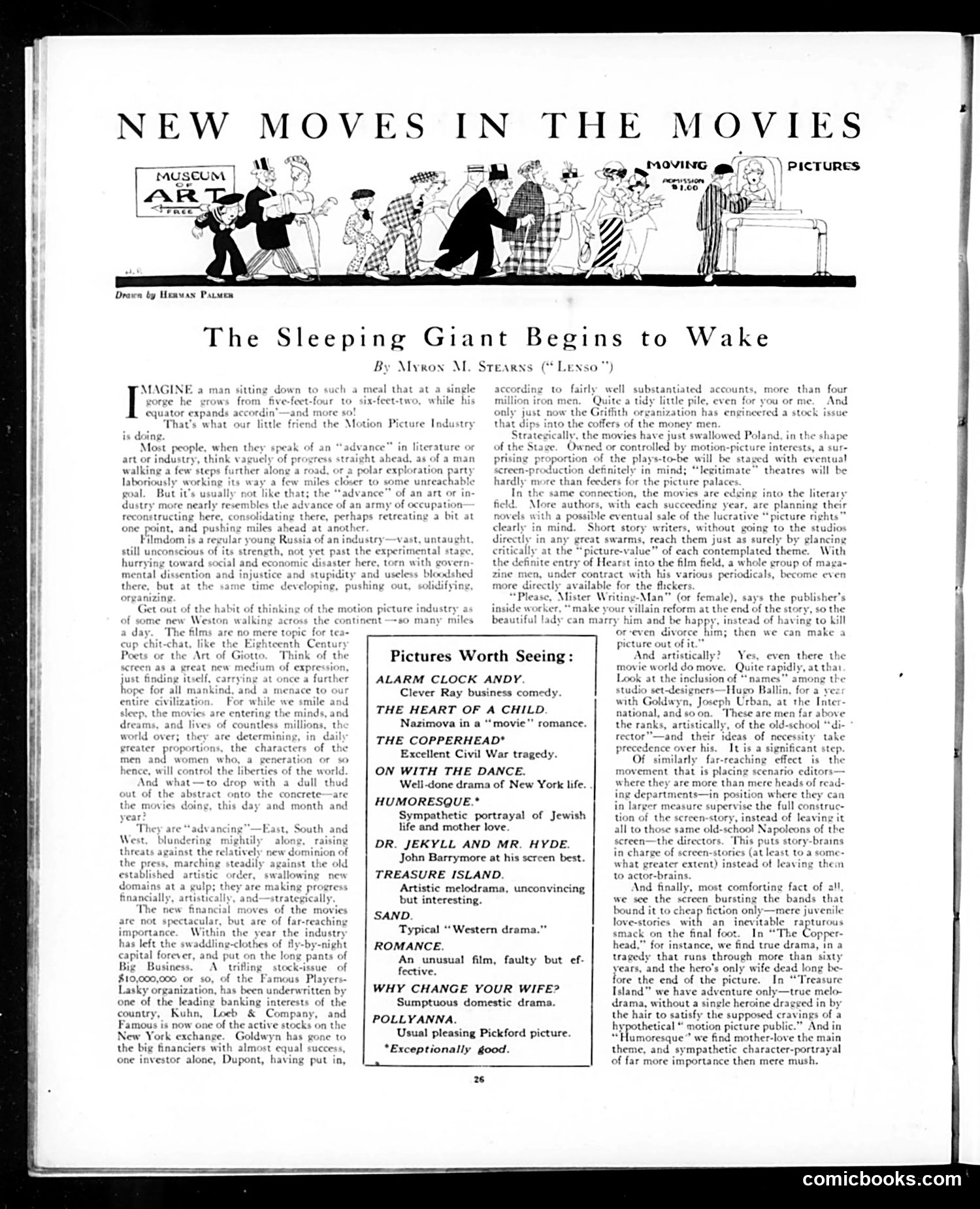
This article by Myron M. Stearns argues that the motion picture industry is maturing artistically and organizationally. The "sleeping giant" metaphor refers to the film industry awakening from its early, crude state. The key points of satire/criticism: **The Problem**: Early movies were controlled by financiers focused only on profit, not art. The industry lacked proper organization and serious artistic direction. **The Solution**: New leadership (likely the Lasky organization mentioned) is professionalizing filmmaking by hiring trained stage directors and artists, giving creative control to skilled professionals rather than leaving decisions to "actor-brains." **The Progress**: Films are moving beyond cheap melodrama and romance toward serious drama (Civil War tragedies, literary adaptations). The sidebar lists films demonstrating this new respectability—notably *Dr. Jekyll and Mr. Hyde* with John Barrymore, suggesting prestige actors now take cinema seriously. **The Joke**: The cartoonist celebrates that movies are finally becoming legitimate art, shedding their disreputable origins as mere entertainment for the masses. The industry's "awakening" means adopting standards of serious theater.
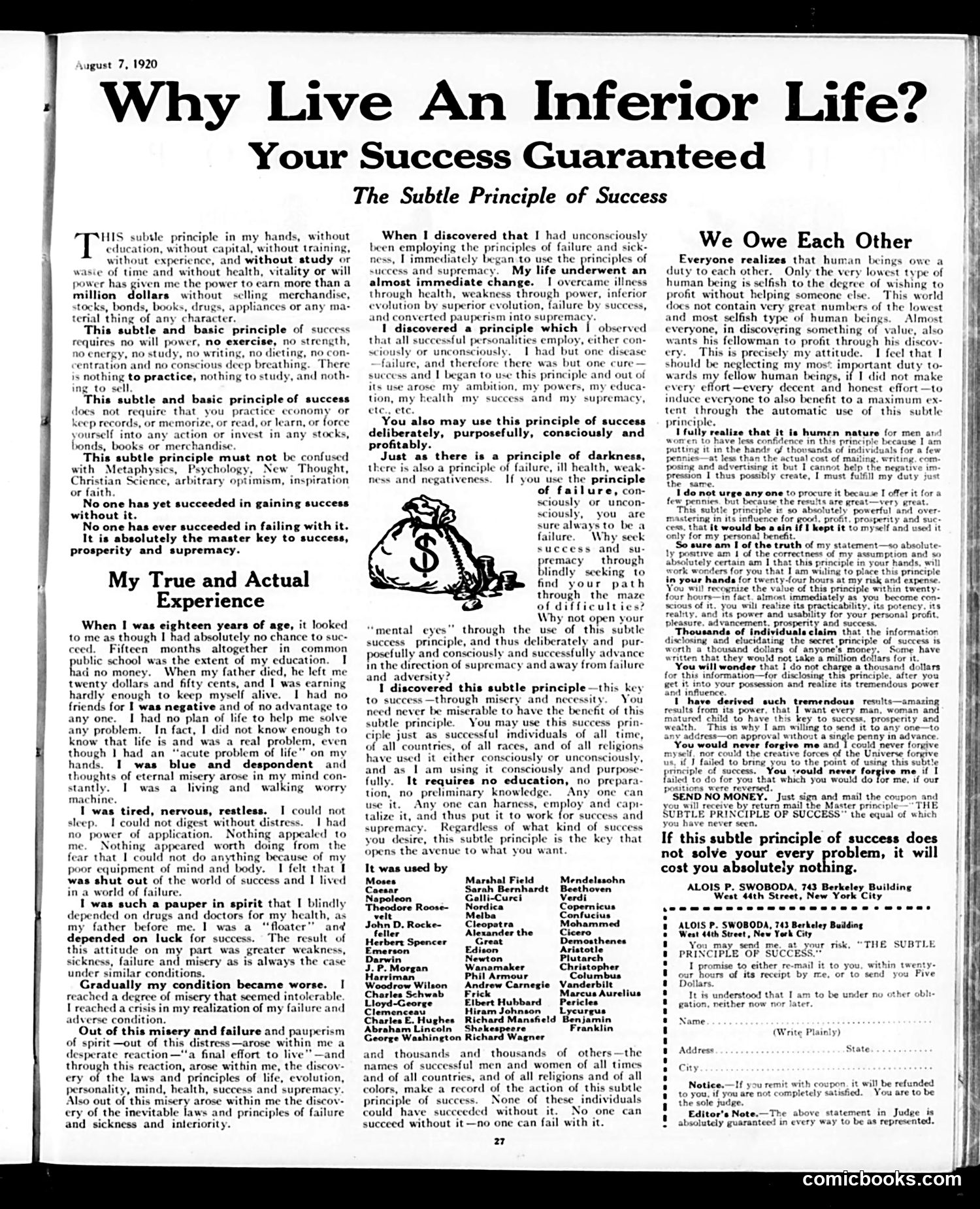
This page is primarily **self-help advertising disguised as editorial content**, not political satire. It promotes "The Subtle Principle of Success"—a vaguely defined self-improvement scheme promising wealth and health through unnamed mental principles, requiring "no exercise," "no study," and "no action." The author uses a rags-to-riches personal testimony (poor youth with minimal education overcoming poverty) to establish credibility. This was a common early-20th-century marketing formula: the motivational success narrative. The page includes testimonial names (Marshal Field, Napoleon, Darwin, etc.)—likely implying these historical figures implicitly endorsed the principle—a misleading advertising technique. The coupon at bottom invites readers to request the full principle for $1 and a stamp, making this fundamentally a **mail-order scam or dubious self-help scheme** rather than satire. Judge may have accepted such ads, or this could be **self-referential satire mocking gullibility** of readers pursuing "get-rich-quick" schemes during the 1920s prosperity era.
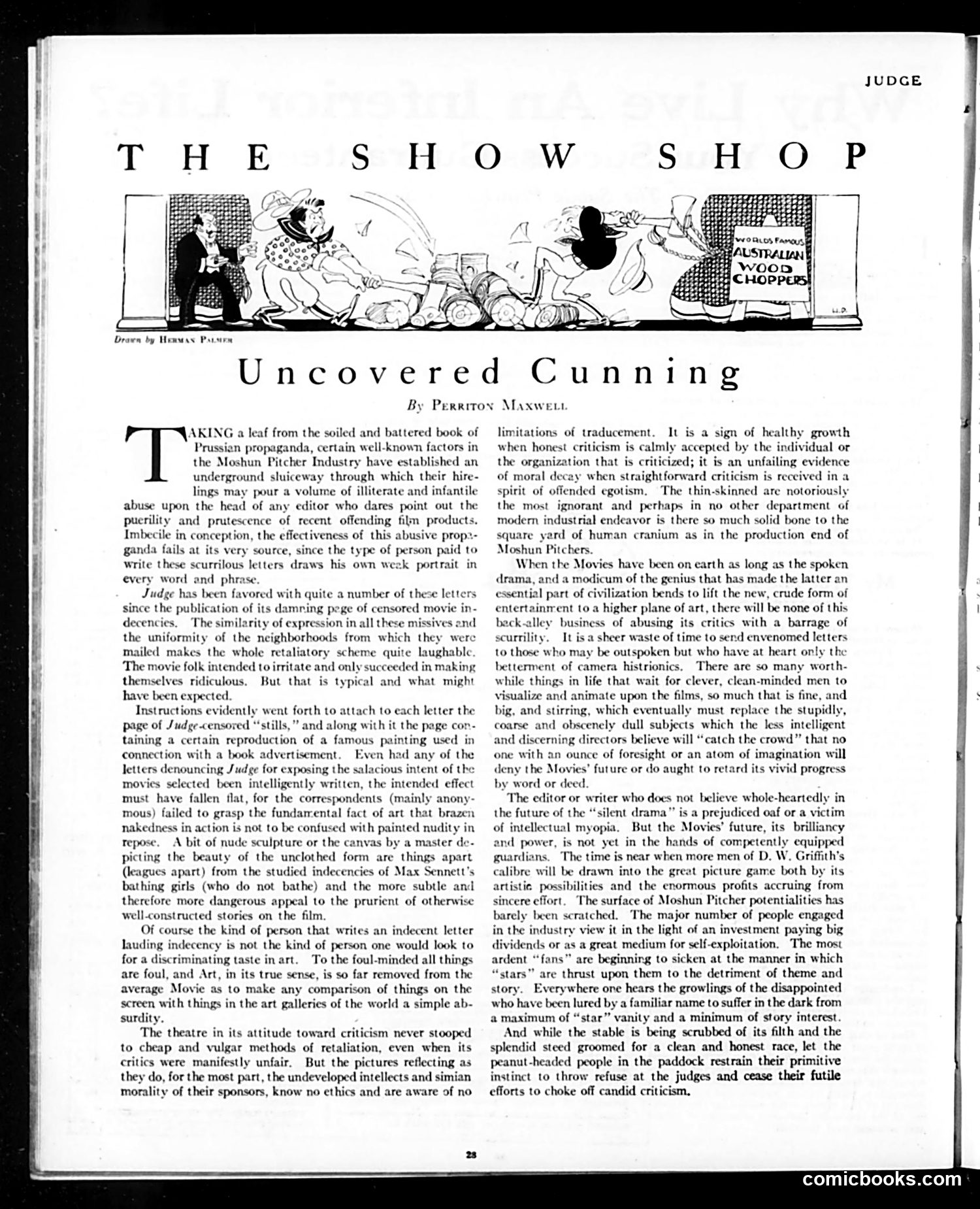
This article by Perriton Maxwell attacks the movie industry's practice of orchestrating abusive letter-writing campaigns against critics. Judge magazine had published a damning expose of indecent content in films, and the film studios responded by flooding Judge with hostile letters—apparently coordinated, as evidenced by their similar language and origin. Maxwell compares this tactic to "Prussian propaganda" (wartime reference), mocking the studios' defensiveness. He argues the movie industry, unlike legitimate theater, lacks the maturity to accept honest criticism. Instead of engaging intellectually, producers resort to thuggish retaliation. The cartoon at top shows "The Show Shop"—likely depicting studio executives and their hired letter-writers generating this abuse campaign. Maxwell's broader point: the film industry's crude response proves Judge's original criticism about its low intellectual standards and moral decay.
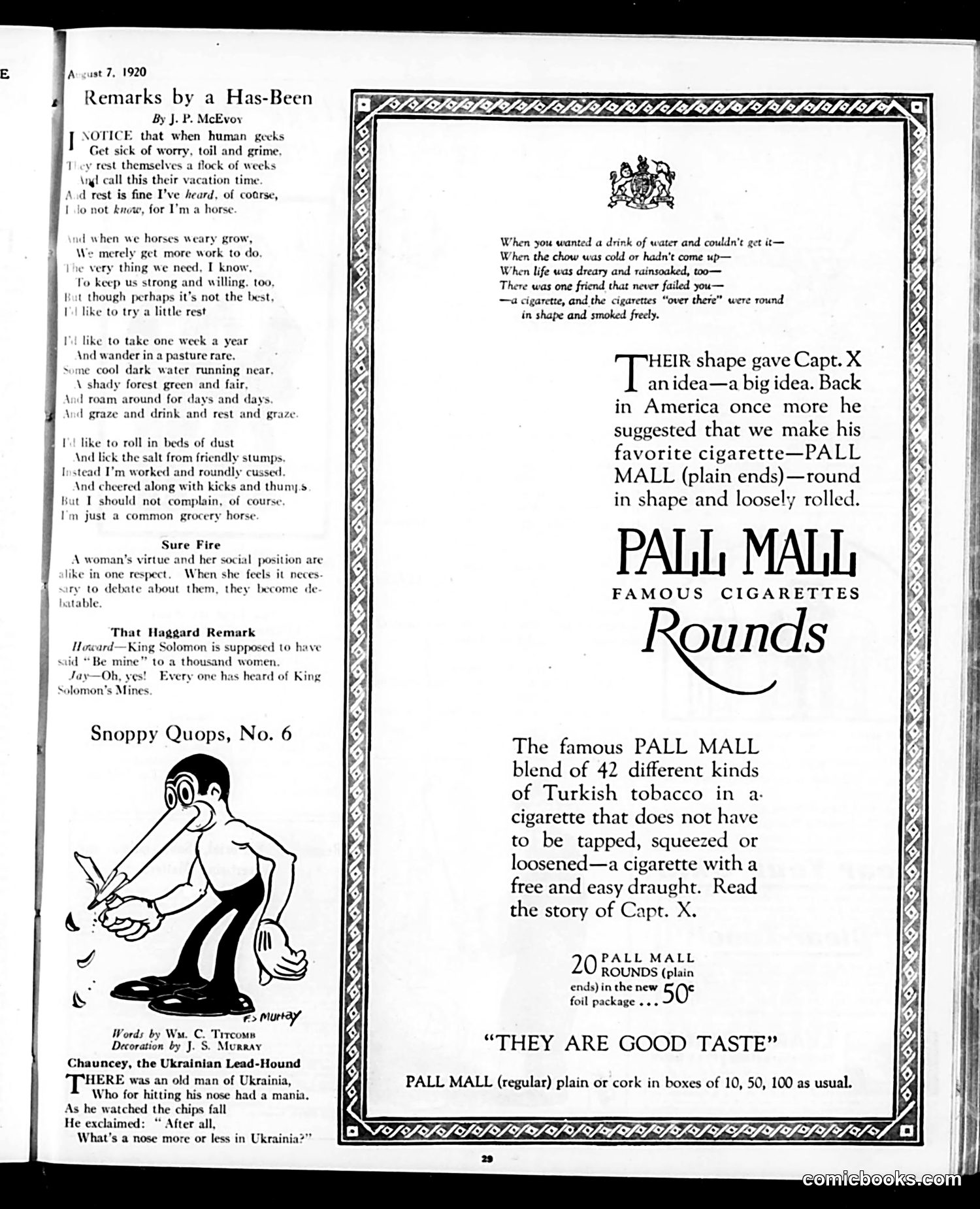
This page mixes satirical content with advertising. **The main satire** is McEvoy's "Remarks by a Has-Been"—a horse complaining that while humans get vacations to rest, horses only receive more work. The joke targets labor inequality: working-class people get brief respite, but working animals get none. It's gentle social commentary on exhaustion and unfair treatment. **"Snoopy Quops, No. 6"** is a absurdist joke-cartoon about a Ukrainian man obsessed with hitting his own nose, watching pieces fall while philosophically shrugging it off. It appears to mock either Ukrainian stereotypes or simply present nonsensical humor typical of the era. **The bulk of the page is a Pall Mall cigarette advertisement**, framed as a story: a Captain X smoked round cigarettes ("over there"—likely WWI reference) and brought the idea back to America. The ad positions round Pall Malls as inspired by wartime experience, appealing to returning soldiers' nostalgia. The page reflects post-WWI 1920 American culture: labor concerns, absurdist humor, and marketing leveraging soldier identity.
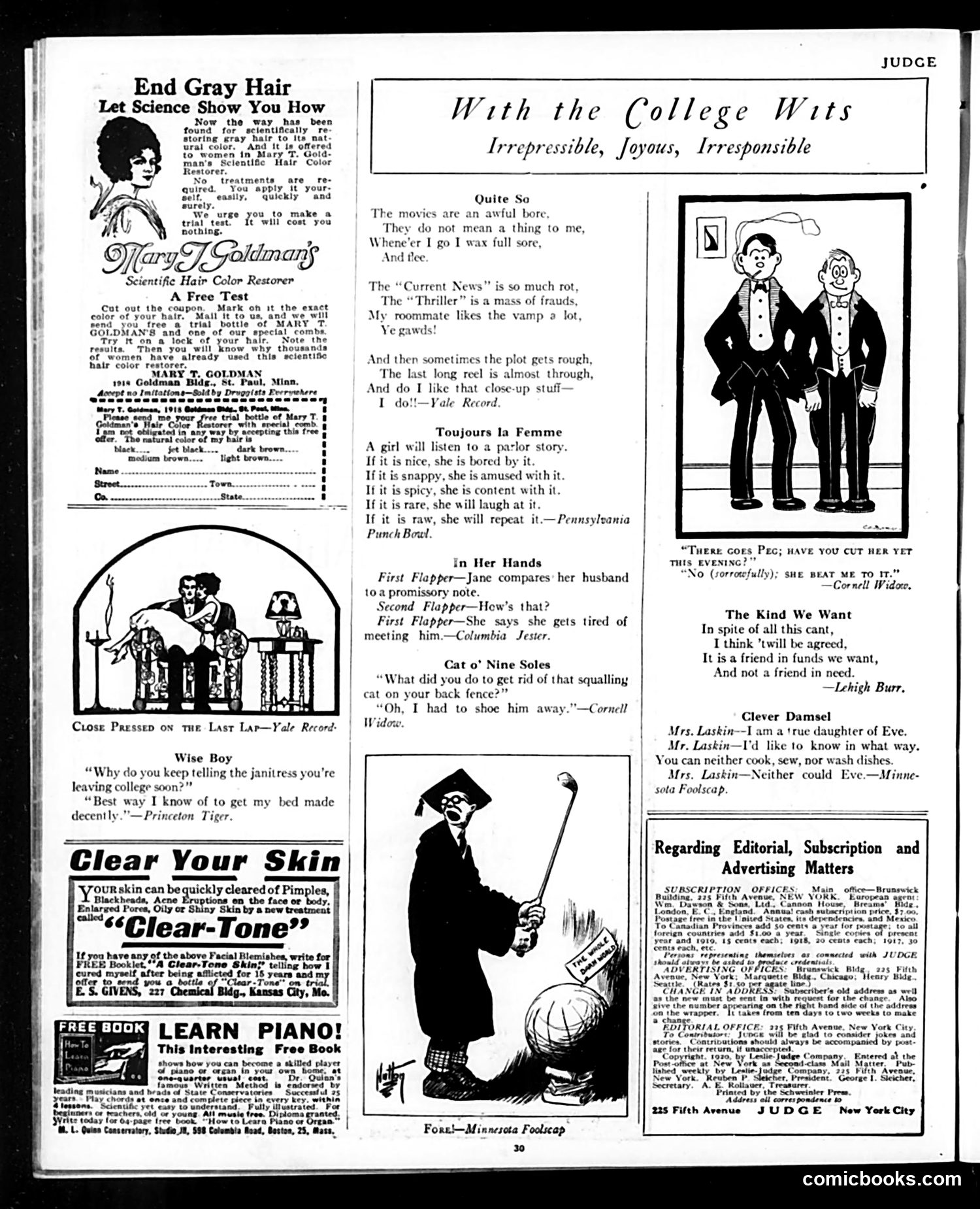
This page from Judge (circa 1920s) combines advertising with humor columns typical of the era's satirical magazines. **The Cartoons:** Two illustrated jokes appear—one showing a couple in a parlor, another depicting a man with a golf club and large ball (likely titled "Fosl"). These are visual gags without clear political content. **"With the College Wits" Section:** This is a humor column featuring short jokes from various college publications (Yale Record, Columbia Jester, Cornell Widow, etc.). The jokes target college life: tedious movies, unfaithful roommates, flapper dating culture, and marital dynamics. One joke compares a husband to a "promissory note" (suggesting financial obligation), reflecting 1920s gender tensions. **Advertisements:** The page heavily features product ads—Mary T. Goldman's hair color restorer, Clear-Tone skin treatment, and a piano learning book—typical of Judge's revenue model. **Overall Context:** This represents early-20th-century satirical humor aimed at educated, urban audiences, with light social commentary on modern anxieties (aging, appearance, courtship) rather than serious political critique.
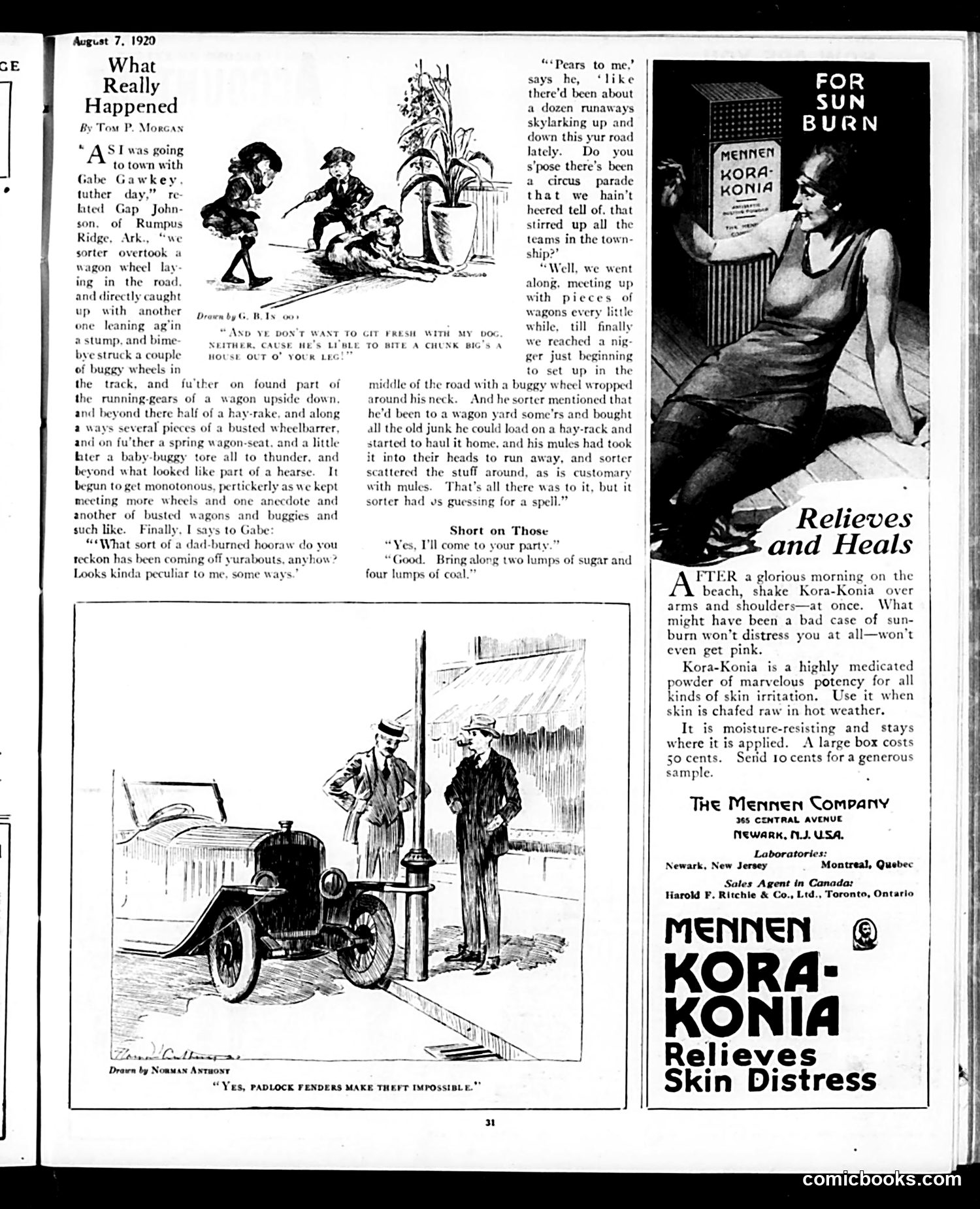
This August 1920 Judge page contains rural humor and period advertising. **"What Really Happened"** is a tall tale narrated in exaggerated rural dialect by "Gap Johnson of Rumpus Ridge, Arkansas." He describes finding scattered wagon and buggy parts strewn across a road, which he hilariously speculates might indicate a circus parade or mass runaway. The punchline reveals a Black man caused the debris by purchasing junk and overloading a hay-rack, which his mules then scattered during a runaway—presented as predictable animal behavior. The humor relies on rural stereotypes, dialect comedy, and racial caricature typical of 1920s mainstream magazines. The accompanying cartoons offer additional comic vignettes about rural life and automobiles. **The right side features a Kora-Konia sunburn remedy advertisement**, a medicated powder product marketed for skin irritation relief, with contact information for the Mennen Company's Newark, New Jersey headquarters.
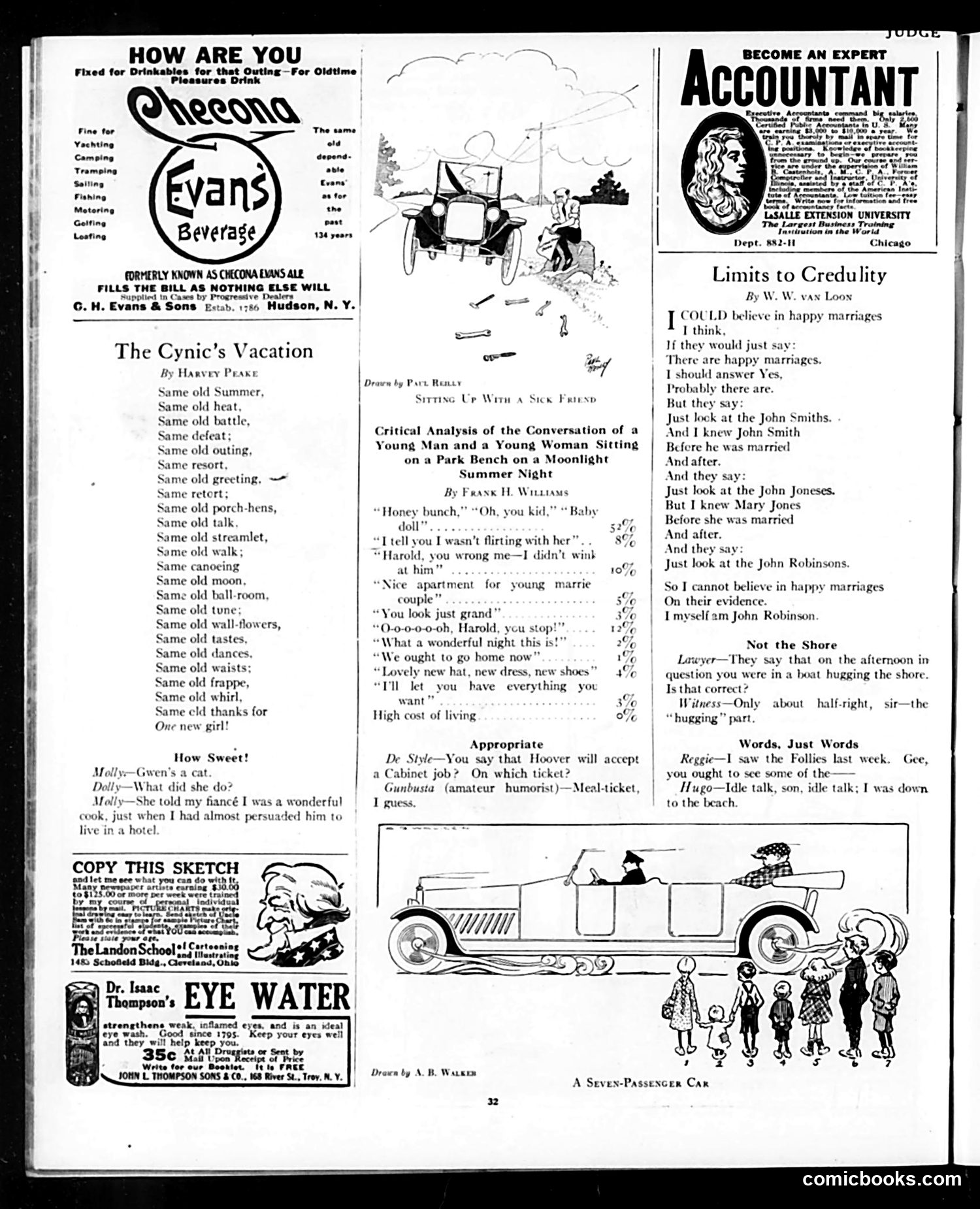
This is a mixed-content magazine page from *Judge* (a satirical publication) featuring humor and advertisements. Key content includes: **"The Cynic's Vacation"** (poem): Satirizes repetitive summer vacations—same activities, same people, same conversations repeated yearly, with only "one new girl" offering novelty. It mocks the predictability of leisure culture. **"Limits to Credulity"** (essay): Cynically argues that happy marriages don't exist. The author uses examples of couples he knew (the Smiths, Joneses, Robinsons) who changed after marriage, concluding he "cannot believe in happy marriages / On their evidence." **Other pieces** include light comedic dialogues about courtship conversations and wordplay ("Words, Just Words"). **Advertisements** promote Chicona Evans Ale, accounting courses, and Dr. Thompson's Eye Water—typical early 20th-century product pitches. The overall tone reflects pre-WWI American cynicism about domesticity, vacation routines, and consumer culture, presented through gentle satire rather than sharp political critique.
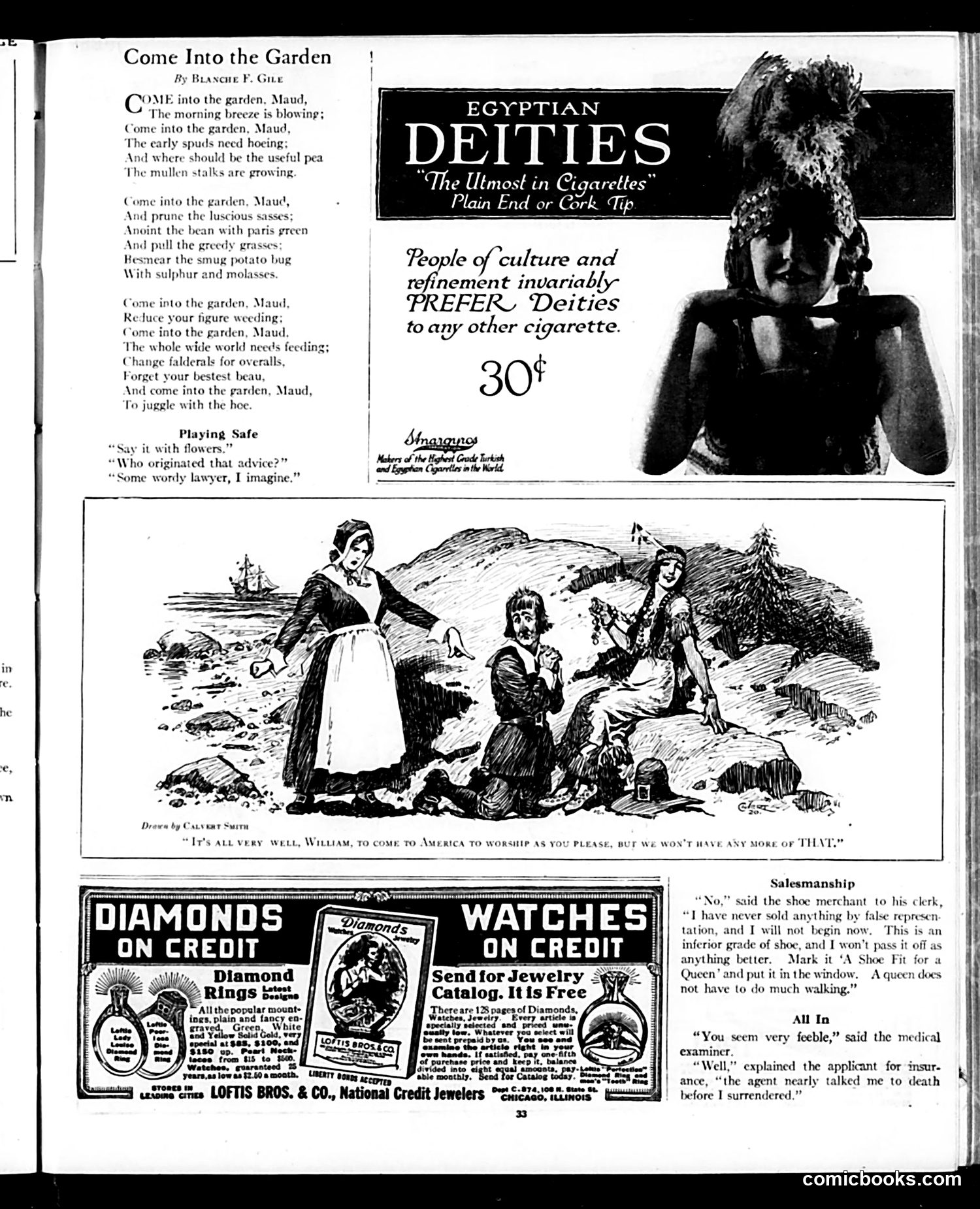
This page mixes poetry, advertising, and short humor pieces typical of early 20th-century satirical magazines. **"Come Into the Garden, Maud"** parodies Tennyson's romantic poem, replacing courtship with mundane wartime gardening tasks—a commentary on WWI-era food conservation efforts ("the whole wide world needs feeding"). **The immigration cartoon** depicts European immigrants arriving in America. The caption suggests tension over religious freedom: authorities welcome them to worship freely, but warn against bringing "evil" (likely referencing anarchist or radical associations feared during post-WWI nativism). **Egyptian Deities cigarette ad** uses exotic imagery and appeals to "culture and refinement"—typical luxury marketing of the era. **The brief humor pieces** ("Playing Safe," "Salesmanship," "All In") offer quick satirical jabs at everyday life: the "say it with flowers" exchange mocks popular advertising slogans; the shoe merchant's story ironically celebrates dishonesty as virtue; the insurance joke plays on applicant desperation. The page reflects 1920s American anxieties: food rationing, immigration concerns, consumerism, and social hypocrisy.
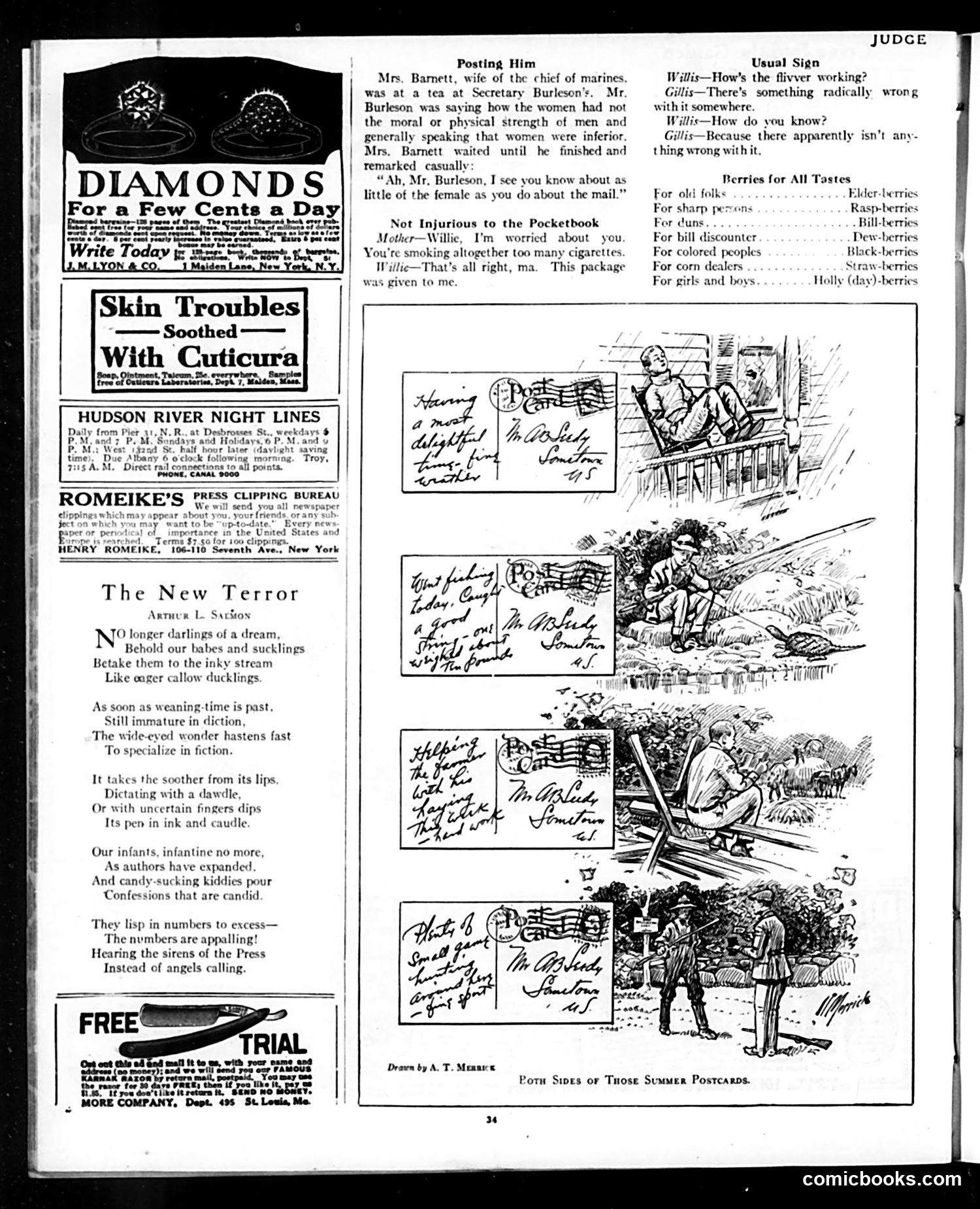
This page primarily contains **advertisements and light humor pieces** rather than political satire. The main content includes: **"The New Terror"** — A poem by Arthur L. Salmon mocking the trend of child authors and young writers flooding the press. It satirizes children prematurely pursuing literary careers instead of normal childhood, becoming "candy-sucking kiddies" who submit "confessions" to newspapers—a jab at what the author saw as premature professionalization of youth and sensationalized journalism exploiting children's stories. **"Posting Him"** — A brief anecdote where Mrs. Barnett (wife of a marine chief) rebuts Secretary Burleson's claims about female inferiority by sarcastically suggesting he knows as little about women as he does about mail—a mild feminist jab at a government official's paternalistic attitudes. The **postcard illustrations** (drawn by A.T. Meaure) show generic summer vacation scenes with handwritten captions, appearing to be humorous greeting card designs. The remainder is standard period advertising for beauty products, river transportation, and press clipping services.

This page is **not satire**—it's a straight cigarette advertisement for Camel brand, appearing in Judge magazine. The camel imagery (both the logo and decorative camels flanking the text) references the product's exotic "Turkish and choice Domestic tobaccos" blend, which was a major selling point emphasizing sophistication and quality. The ad employs typical 1920s-30s marketing rhetoric: claims about "mildness," lack of aftertaste, and superior quality compared to competitors. The emphasis on sealed packaging and portability ("for the home or office supply or when you travel") reflects modern distribution concerns of that era. **For modern readers**: This is a historical artifact showing how openly cigarettes were advertised and what health claims manufacturers made before regulations prohibited such advertising. The casual promotion of cigarettes as universally desirable would be shocking and illegal today.
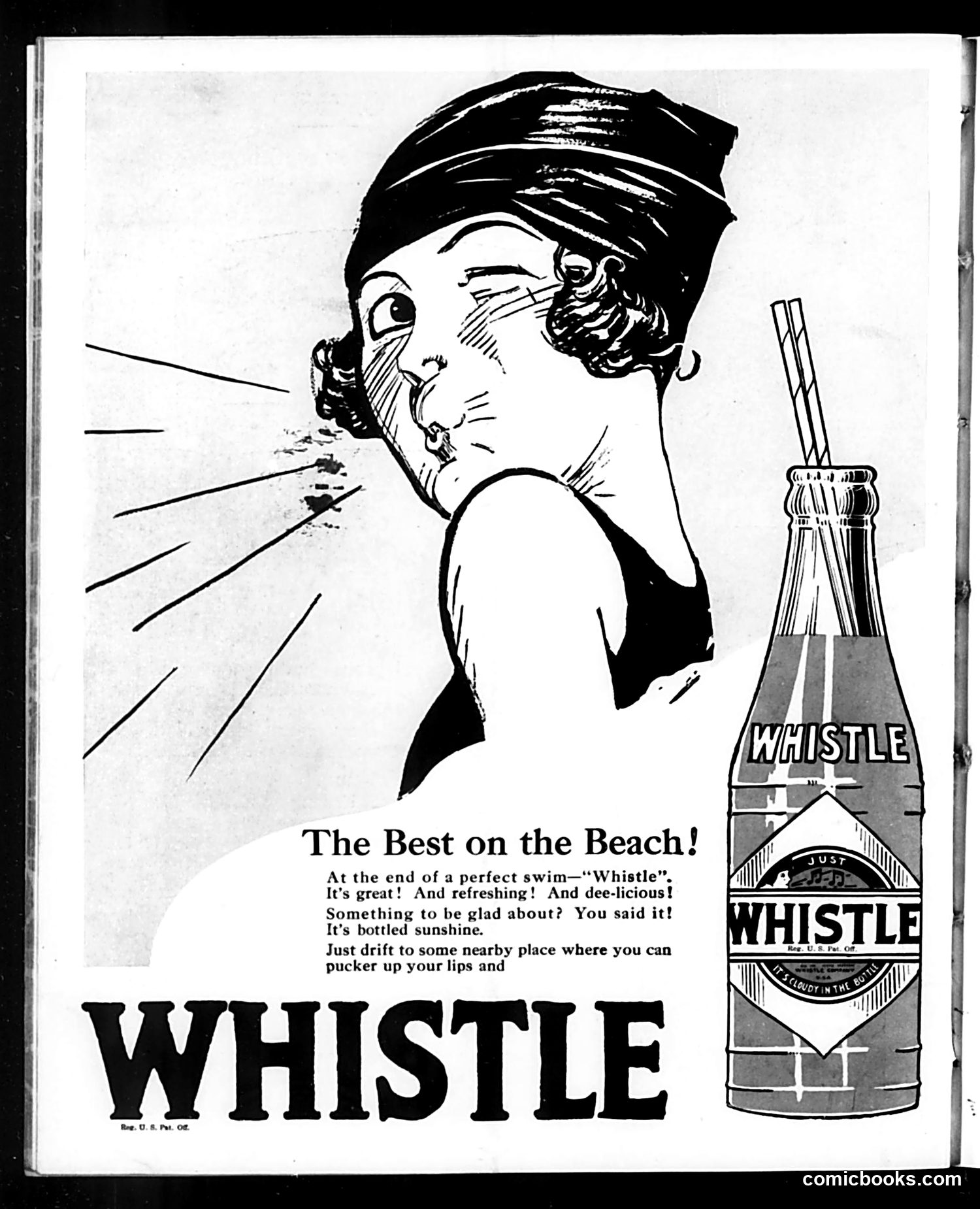
This is a vintage advertisement for Whistle, a soft drink, rather than political satire. The illustration shows a woman at the beach in 1920s-style clothing and swimwear, depicted in an exaggerated caricature style typical of the era. The ad copy uses period slang ("You said it!") and playful language to market the beverage as a refreshing beach drink—"bottled sunshine." The woman's expression and the radiating lines suggest satisfaction and delight. This represents early 20th-century consumer advertising that appeared in Judge magazine, using attractive figures and lifestyle imagery to promote commercial products to readers, reflecting the era's marketing conventions and social attitudes.