
Judge, 1920-08-07 · page 6 of 36
Judge — August 7, 1920 — page 6: what you’re looking at
What you’re looking at
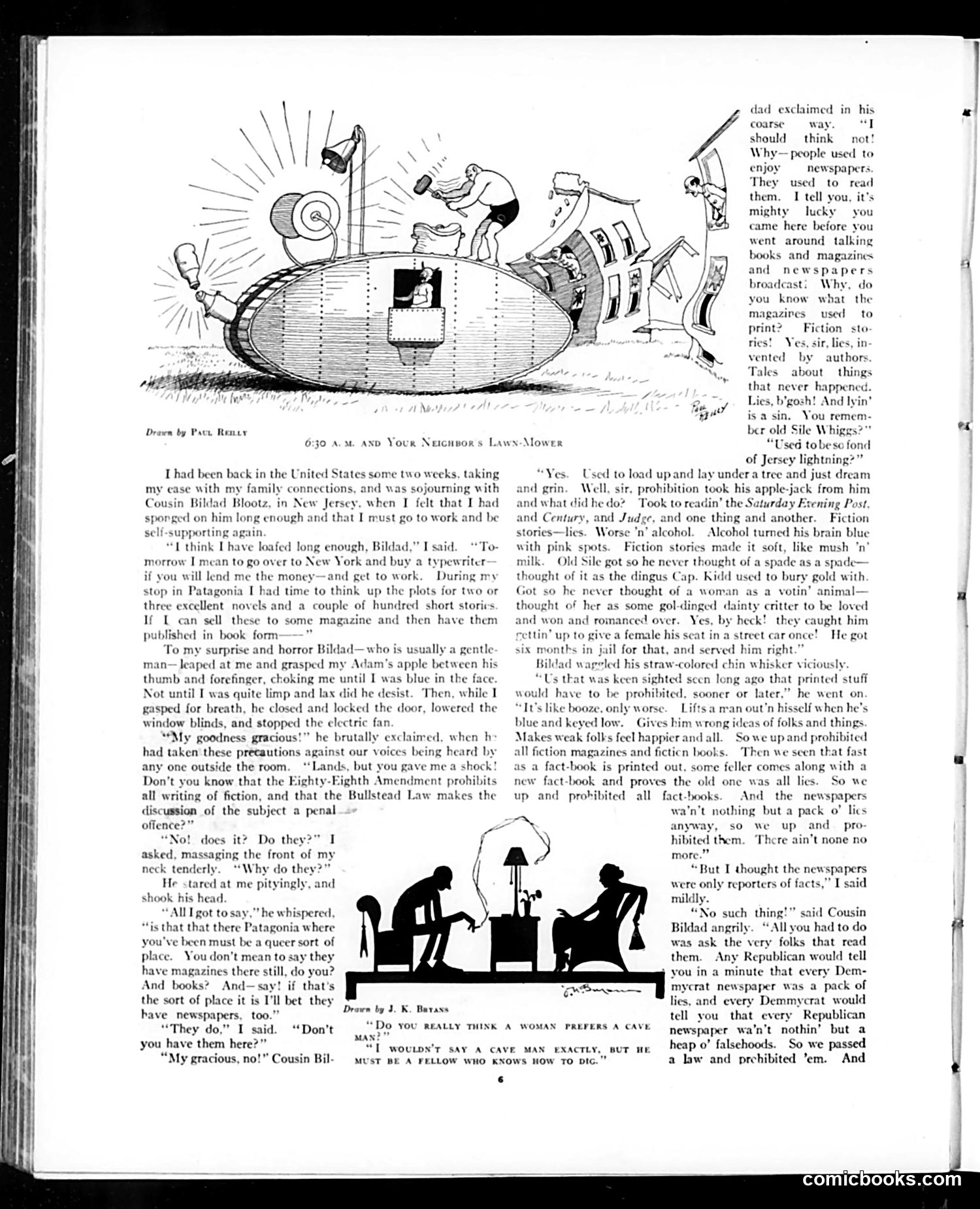
The page contains a short story debate between the narrator and his cousin Hildad Blootz about the purpose and morality of fiction magazines and newspapers. **The Satire's Point:** Hildad argues that fiction magazines and newspapers are inherently dishonest—filled with invented stories and lies ("Fiction stories—lies, invented by authors"). He contends that prohibiting such publications would be justified since they deceive the public with falsehoods, comparing them to alcohol's corrupting effects. The narrator counters that newspapers themselves spread political lies (referencing Republican and Democratic partisan dishonesty), suggesting hypocrisy in condemning fiction while accepting partisan propaganda. **The Cartoon Below** illustrates this debate visually, showing two silhouetted figures discussing the matter. **Historical Context:** This appears to satirize Progressive Era concerns about media trustworthiness, fake news, and whether entertainment should be restricted by law—issues remarkably modern in character.
📄 Transcribed text from this page (OCR, searchable)
Machine-transcribed from the original scan — historical spelling and the odd misread are preserved.
Drawn by Pace Rener 6:30 a.m. axon Your Netcuvor s Lawn-Mower “U I had been back in the United States some two weeks, taking my ease with my family connections, and was sojourning with Cousin Bildad Blootz, in New Jersey, when I felt that I had sponged on him long enough and that I must go to work and be f-supporting again. “1 think [have loafed long enough, Bildad,” I said. “*To- morrow I mean to go over to New York and buy a typewriter if you will lend me the money—and get to work. During my stop in Patagonia I had time to think up the plots for two or three excellent novels and a couple hundred short stori If L can sell these to some magazine and then have them published in book form To my surprise and horror Bildad—who is usually a gentle man— leaped at me and grasped my Adam’s apple between his thumb and forefinger, choking me until I was blue in the face Not until I was quite limp and lax did he desist. Then, while I gasped for breath, he closed and locked the door, lowered the window blinds, and stopped the electric fan “*My goodness gracious!” he brutally exclaimed, when h had taken these precautions against our voices being heard by any one outside the room, ‘Lands, but you gave me a shock! Don’t you know that the Eighty-Eighth Amendment prohibits all writing of fiction, and that the Bullstead Law makes the discussion of the subject a penal offence?” “No! does it? Do they?” I asked, m: ging the front of my neck tenderly. ‘Why do they? He stared at me pityingly, and shook his head. All I got to say,”’ he whispered, “is that that there Patagonia where you've been must be a queer sort of place. You don’t mean to say they have magazines there still, do you? And books? And—say! if that’s the sort of place it is I'll bet they have newspapers, too.” “They do,” I said. “Don’t “Do you REALLY THINK you have them here?” we “My gracious, no’ Draven by 3. K. Barass a “T WOULDN'T SAY A CAVE MAN EXACTLY, BUT HE Cousin Bil- aust pe A FELLOW WHO KNOWS How TO DIC.” dad exclaimed in his coarse way. “I should think not! Why— people used to enjoy newspapei They used to. re: them. I tell you, it’s mighty lucky you came here before you went around talking books and magazines and newspapers broadcast: Why, do you know what the magazines used to print? Fiction sto ries! Yes, sir, lies, in vented by authors. Tales about things that never hs Lies, b’gosh ; isa sin. You remem- ber old Sile Whiggs?” d tobeso fond of Jersey lightning?” “Yes. Used to load up and lay under a tree and just dream and grin. Well, sir, prohibition took his apple-jack from him and what did he do? Took to readin’ the Saturday Evening Post. and Century, and Judge, and one thing and another. Fiction stories—lies. Worse 'n’ alcohol. Alcohol turned his brain blue with pink spots. Fiction stories made it soft, like mush ’n‘ milk. Old Sile got so he never thought of a spade as a spade— ought of it as the dingus ¢ Kidd used to bury gold with Got so he never thought of a woman as a votin’ animal— thought of her as some gol-dinged dainty critter to be loved and won and romanced over. Yes, by heck! they caught him ettin’ up to give a female his seat in a street caronce! He got six months in jail for that, and served him right.” d hi -colored chin whisker viciously. s keen sighted seen long ago that printed stuff * he went on Bildad wag “Us that w would have to be prohibited, sooner or late: “It’s like booze, only worse. Lifts a man out’n hisself when he’s blue and keyed low. Gives him wrong ideas of folks and things: Makes weak folks feel happier and all. So we upand prohibited all fiction magazines and ficticn books. Then we seen that fast as a fact-book is printed out, some feller comes along with a new fact-book and proves the old one was all lies. So we up and prohibited all fact-books. And the newspapers wa'n't nothing but a pack 0’ lics , we up and pro ‘There ain't none no more.” “But I thought the newspapers were only reporters of facts,” I said mildly. “No such thing!” said Cousin Bildad angrily. “All you had to do was ask the very folks that read them. Any Republican would tell g you in a minute that every Dem- mycrat newspaper was a pack of lies, and every Demmycrat would tell you that every Republican A WOMAN PREFERS A CAVE newspaper wa'n't nothin’ but a heap 0’ falschoods. So we passed a law and prehibited ’em. And Gao « —— — comicbooks.com