
Judge, 1920-08-07 · page 26 of 36
Judge — August 7, 1920 — page 26: what you’re looking at
What you’re looking at
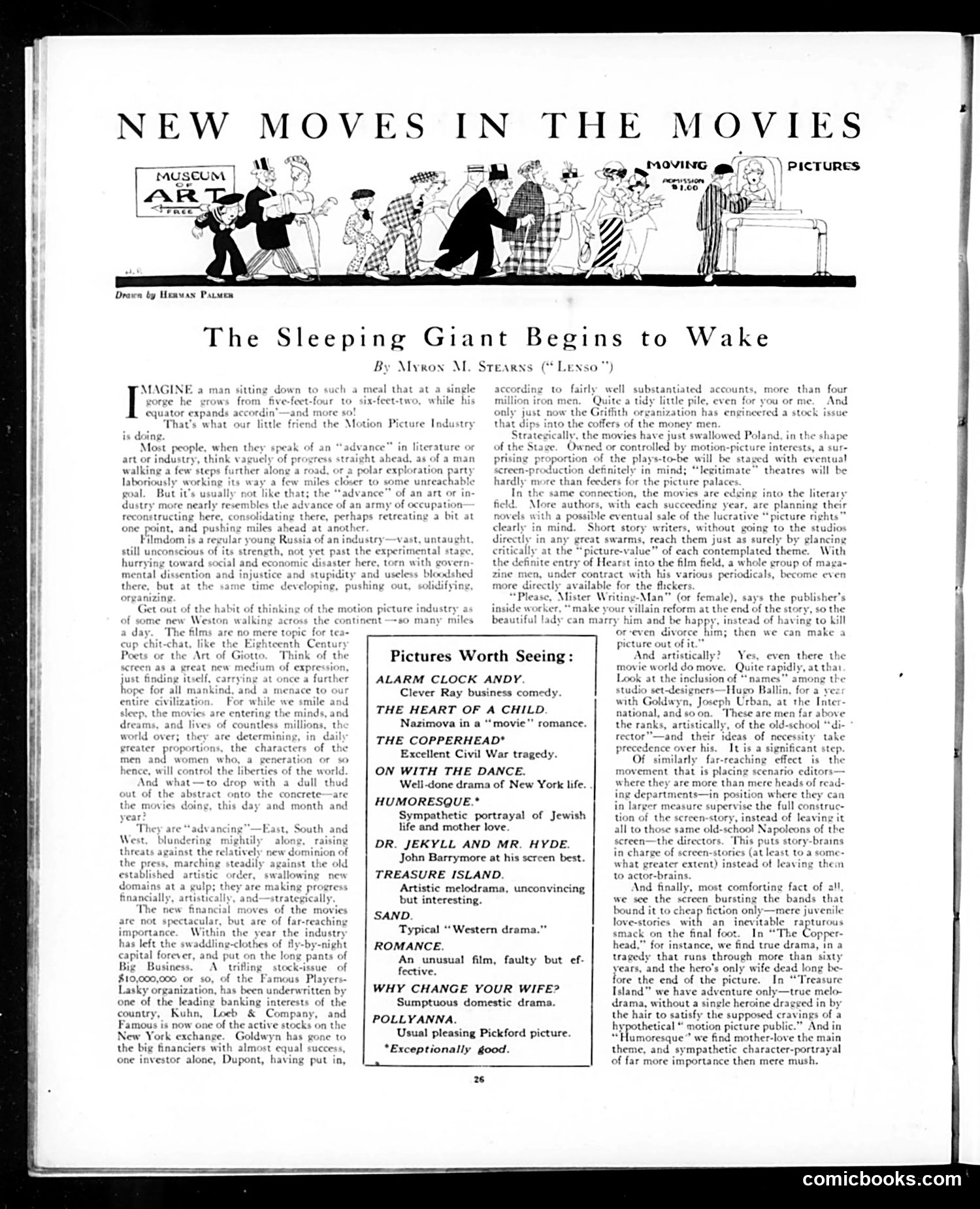
This article by Myron M. Stearns argues that the motion picture industry is maturing artistically and organizationally. The "sleeping giant" metaphor refers to the film industry awakening from its early, crude state. The key points of satire/criticism: **The Problem**: Early movies were controlled by financiers focused only on profit, not art. The industry lacked proper organization and serious artistic direction. **The Solution**: New leadership (likely the Lasky organization mentioned) is professionalizing filmmaking by hiring trained stage directors and artists, giving creative control to skilled professionals rather than leaving decisions to "actor-brains." **The Progress**: Films are moving beyond cheap melodrama and romance toward serious drama (Civil War tragedies, literary adaptations). The sidebar lists films demonstrating this new respectability—notably *Dr. Jekyll and Mr. Hyde* with John Barrymore, suggesting prestige actors now take cinema seriously. **The Joke**: The cartoonist celebrates that movies are finally becoming legitimate art, shedding their disreputable origins as mere entertainment for the masses. The industry's "awakening" means adopting standards of serious theater.
📄 Transcribed text from this page (OCR, searchable)
Machine-transcribed from the original scan — historical spelling and the odd misread are preserved.
NEW MOVES IN THE MOVIES 6 wa museum | - 1 AR ———s Drawn by Henwas Patacen 5 )) PicTures The Sleeping Giant Begins to Wake Most people, when they or industry, think vague hurryin mental nd women who, hence, will control the I atively new artistically, and al moves of ut are of Lasky organization, one of the leading bank: Kuhn, ur to oncrete month and . South and raising dominion of the movies far-reaching the industry By Myrox M that ix-feet-two, Motion Picture Industry Stearns (“ Lenso™ trolled by m n of the plays-to-be will be st on picture nent —so many Pictures Worth Seeing: ALARM CLOCK ANDY. Clever Ray business comedy THE HEART OF A CHILD. Nazimova in a “ movie" romance. THE COPPERHEAD* Excellent Civil War tragedy. ON WITH THE DANCE. Well-done drama of New York life. HUMORESQUE.* Sympathetic portrayal of Jewish life and mother love DR. JEKYLL AND MR. HYDE. John Barrymore at his screen best. TREASURE ISLAND. Artistic melodrama, unconvincing but interesting. SAND. Typical “Western drama.” ROMANCE. An unusual film, faulty but ef- fective. WHY CHANGE YOUR WIFE? Sumptuous domestic drama. POLLYANNA. Usual pleasing Pickford picture *Exceptionally good. ao 26 ble for the flicker ¢ Writ S “legitimate” theatres will b is various periodic (or female), says And artistically? move Yes, even there t igners—Hugo Ballin, for a ye h Urban, at the Inter- national, and far above the ranks, artis rector” —at Of similarly that is placin! they are more than mere he -school **di- ure supervise the full con story, instead of leavin ¢ same old-school Na the directors. ‘This puts n-stories (at least hat greater extent) instead of leaving t to actor-brains. And finally, most comforting fact of we sce the screen bursting the bands th. bound it to cheap fiction only e lov h an inevitable rapturous head,” for instance, we find true drama, in a tragedy that runs through more than sixty years, and the hero's only wife dead long be fore the end of the picture. In “Treasure Island” we have adventure only—true melo- drama, without a single heroine dragged in by hair to satisfy the supposed cravings of a pothetical “ motion picture public.” And in “Humoresque” we find mother-love the main theme, and sympathetic character-portrayal more importance then mere mush. —mere juve comicbooks.com