
Judge, 1920-08-07 · page 5 of 36
Judge — August 7, 1920 — page 5: what you’re looking at
What you’re looking at
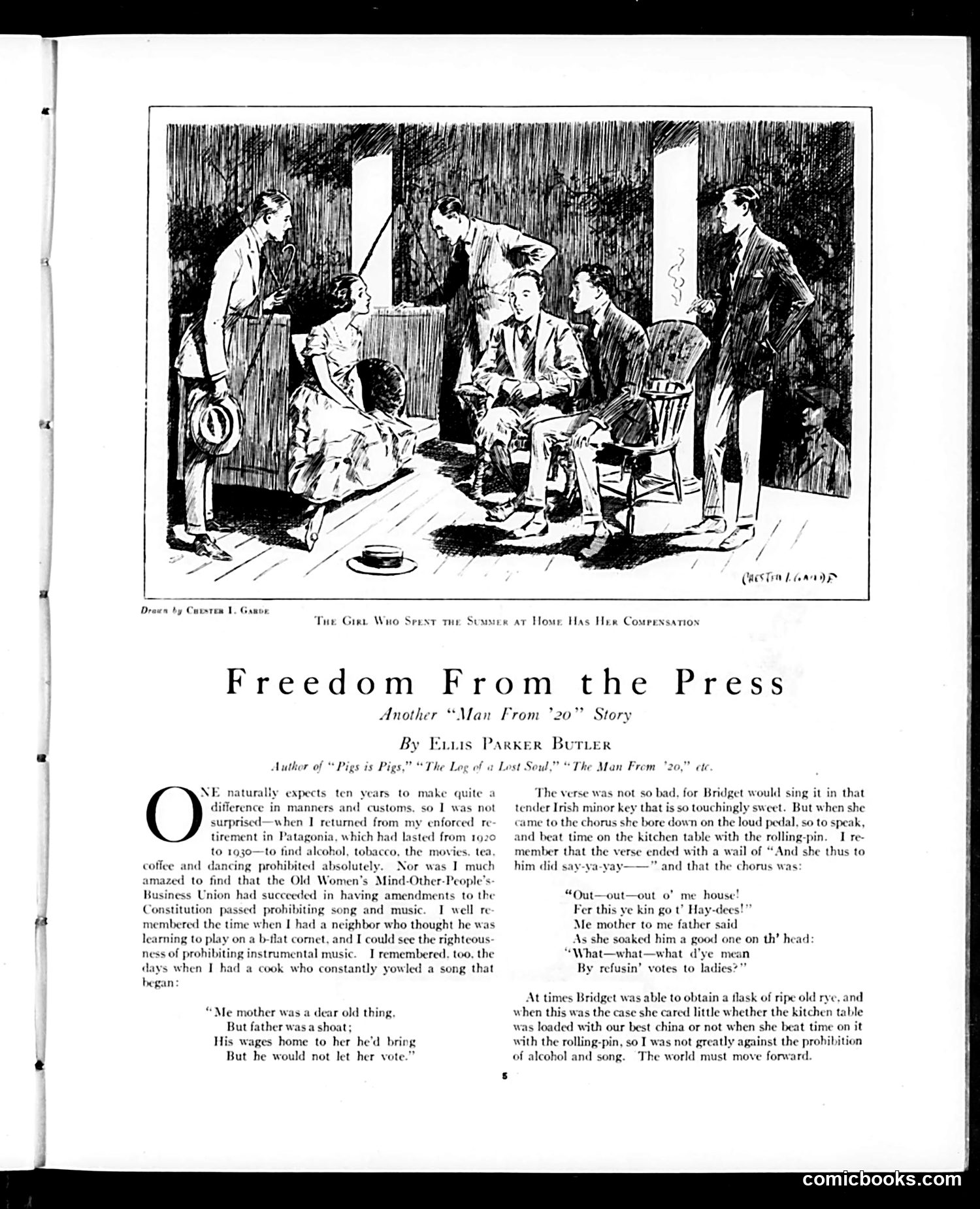
This story by Ellis Parker Butler satirizes Prohibition-era hypocrisy. The illustration shows a girl entertaining a group of men in what appears to be a parlor, with the caption "The Girl Who Spent the Summer at Home Has Her Compensation." The narrative mocks the contradiction between public prohibition laws and private alcohol consumption. Butler recounts discovering that despite legal bans on alcohol, tobacco, and coffee, people still secretly enjoyed these items. The story references Bridget, apparently a domestic worker, who sang songs about prohibition while the household covertly consumed alcohol. The satire targets the gap between America's official moral stance on Prohibition and the reality of widespread underground drinking and rule-breaking among ordinary citizens, suggesting that laws couldn't eliminate people's actual behaviors and desires.
📄 Transcribed text from this page (OCR, searchable)
Machine-transcribed from the original scan — historical spelling and the odd misread are preserved.
- a 4 —_ . (aes T9 Lange Drown by Cuestes 1. Ganor Tue Girt Wro Srext me Summen av Howe Has Her Compensation Freedom From the Press Another “Man From ?20” Story By Faris Parker Butter be Author of “Pigs is Pigs,’ “The Log of « Lost Soul,” “The Man From *20,” ct NE naturally expects ten years to make quite a The verse was not so bad, for Bridget would sing it in that difference in manners and customs. so 1 was not — tender Irish minor key that is so touchingly sweet. But when she surprised—when I returned from my enforced re came to the chorus she bore down on the loud pedal, so to speak, tirement in Patagonia, which had lasted from 10. and beat time on the kitchen table with the rolling-pin. I re- to 1930—t0 find alcohol, tobacco, the movies. tea, — member that the verse ended with a wail of “And she thus to coffee and dancing prohibited absolutely. Nor was I much — him did say-va-yay——” and that the chorus was to find that the Old Women’s Mind-Other-People’s s Union had succeeded in having amendments to the “Out—out—out 0’ me house! Constitution passed prohibiting song and music. I well re Fer this ye kin go t’ Hay-dees!” fs membered the time when I had a neighbor who thought he was Me mother to me fi rs learning to play on a b-flat cornet, and I could see the righteous: As she soaked him a good one on th’ head: ness of prohibiting instrumental music. I remembered. too, the “What—what—what d’ye mean days when I had a cook who constantly yowled a song that By refusin’ votes to ladies?” began: At times Bridget was able to obtain a flask of ripe old rye, and “Me mother wa lear old thing, when this was the case she cared little whether the kitchen table But father was a shoat; was loaded with our best china or not when she beat time on it His wages home to her he'd bring with the rolling-pin, so I was not greatly against the prohibition e But he would not let her vote.” of alcohol and song. The world must move forward. 8 comicbooks.com