
A complete issue · 36 pages · 1920
Judge — July 31, 1920
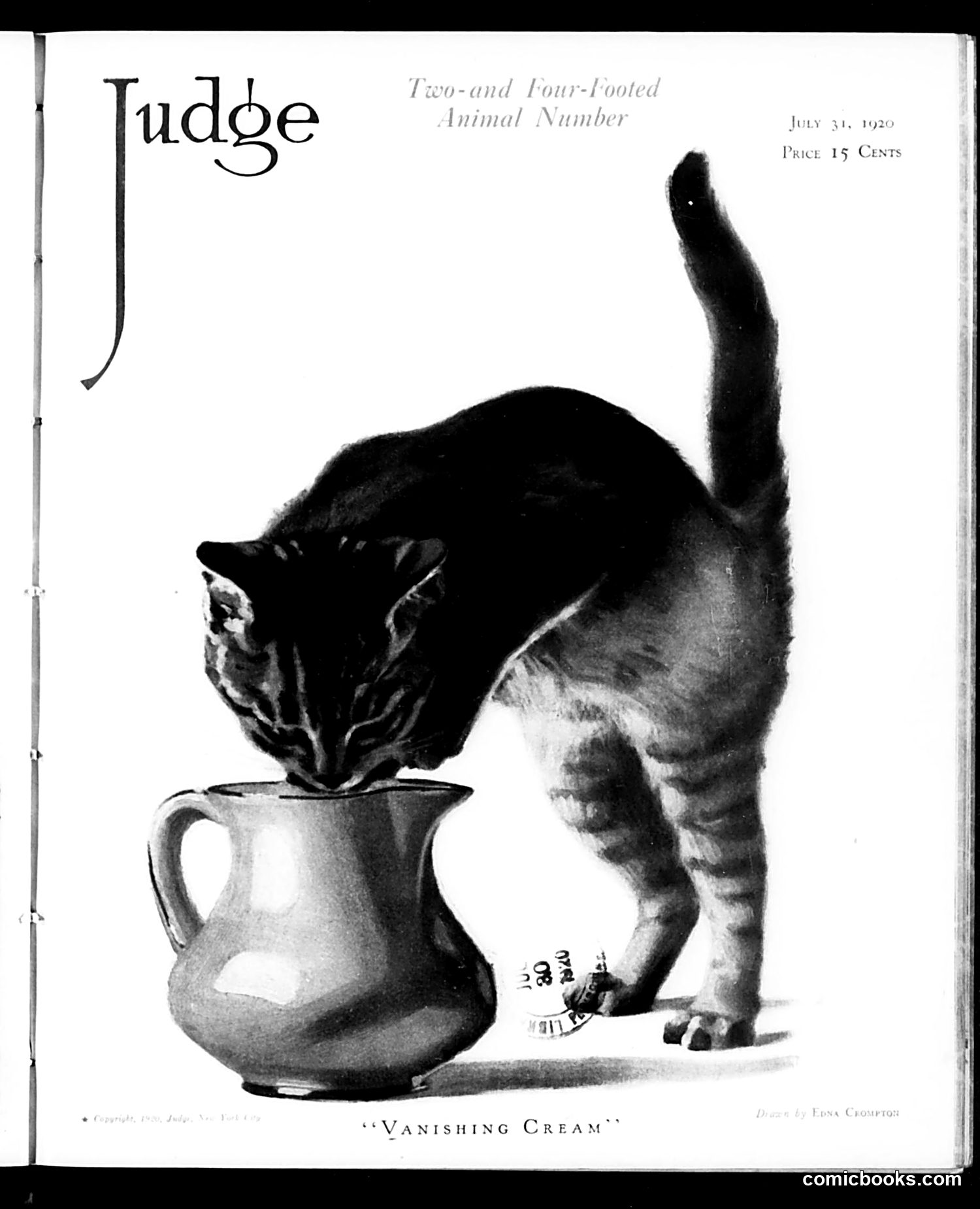
This is a humorous advertisement or illustrated piece rather than political satire. It depicts a cat investigating a pitcher labeled "Vanishing Cream," a real cosmetic product popular in the early 20th century. The joke plays on the product's name literally: the cat appears curious about what "vanishes" when the cream is used. The cartoon relies on visual wordplay—the cat's confusion about a cream that supposedly disappears—rather than political commentary. The artist (credited as Edna Crompton) uses anthropomorphic appeal to market the beauty product to readers. This represents typical Judge content mixing advertising with light humor for commercial purposes.
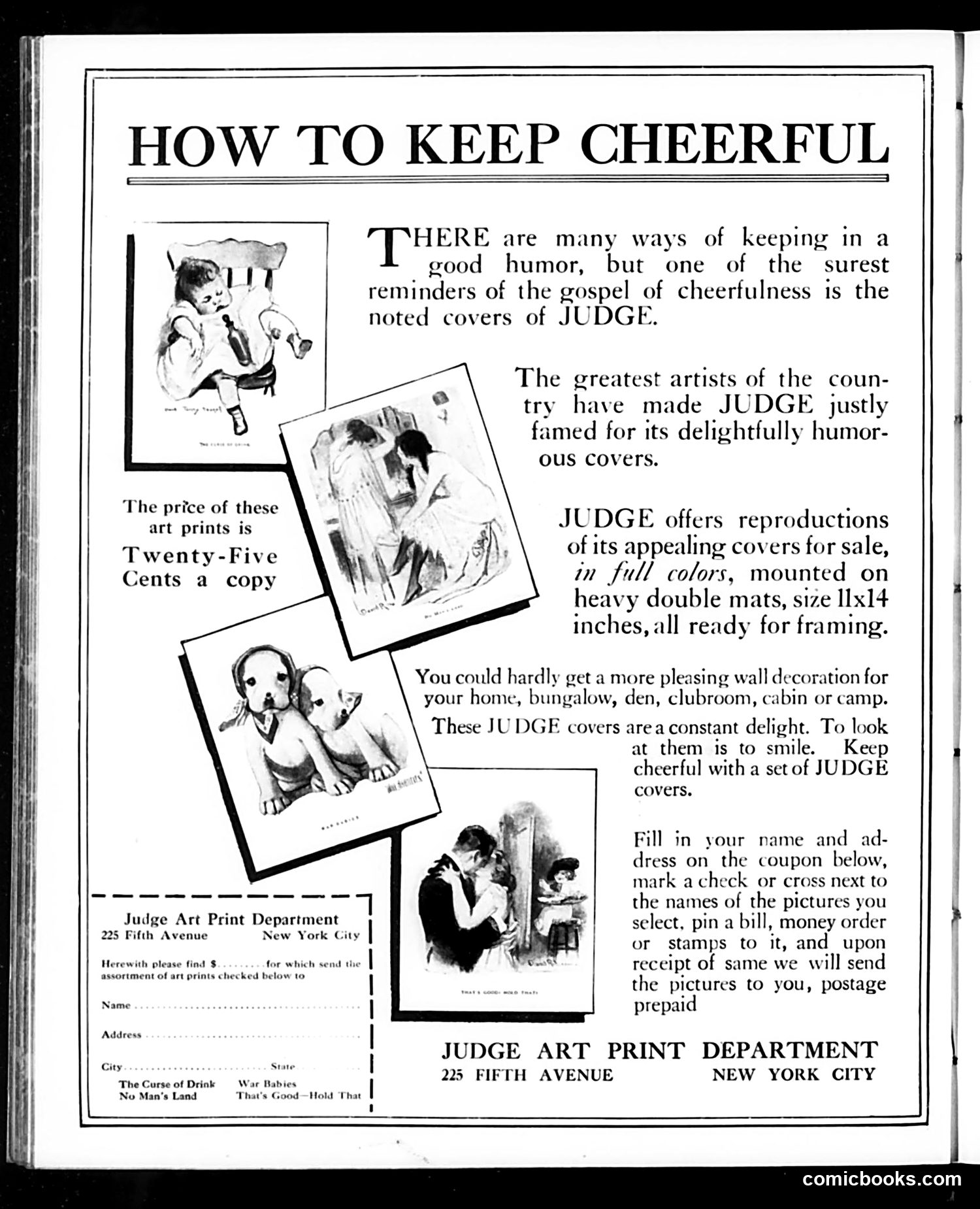
This is primarily **advertising content**, not editorial satire. The Judge Art Print Department is marketing humorous cover reproductions from Judge magazine itself—the publication's own artwork. The page shows four sample illustrations featuring whimsical, sentimental scenes: a child on a chair, figures in intimate moments, and a dog with puppies. These represent Judge's signature comedic style, which combined gentle humor with appealing domestic imagery. The ad emphasizes these prints as cheerful home decoration for various settings (home, cabin, clubroom). At twenty-five cents per copy, mounted on heavy mats and ready for framing, they were affordable mass-market art reproductions. This reflects early-20th-century magazine culture: publications monetized their editorial content by selling reprints to readers seeking pleasant wall decoration.
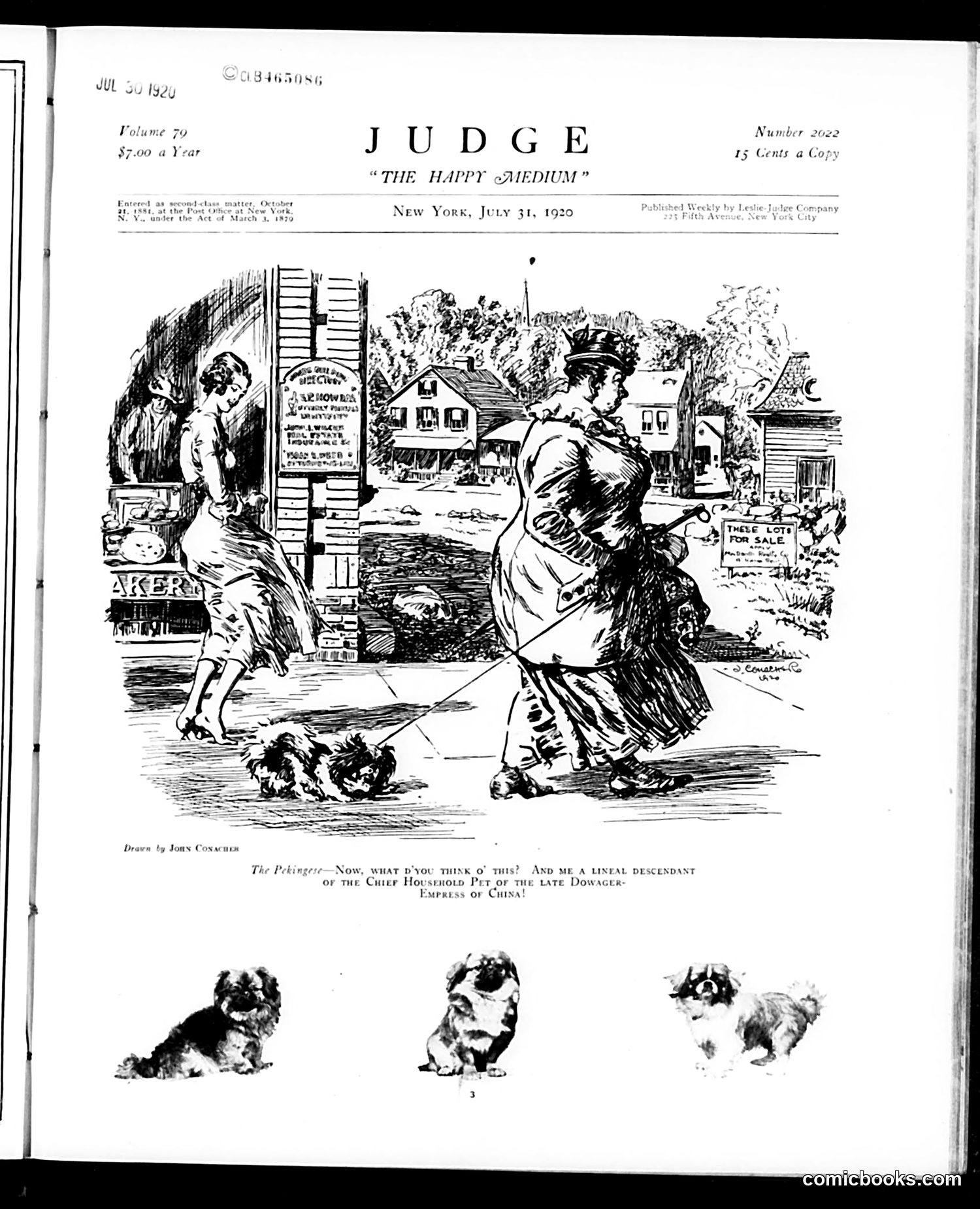
The main illustration depicts two women with small dogs in a suburban setting. The caption reads: "The Pedigree—Now, what d'you think o' this? And me a lineal descendant of the Chief Household Pet of the late Dowager Empress of China!" **The Satire:** This mocks the pretentiousness of dog owners who boast about their pets' aristocratic lineage. One woman proudly claims her dog descends from the Chinese Empress's pet, a ridiculous pedigree claim meant to convey status. The joke targets American social climbing and snobbery—the absurd lengths people go to establish superiority through ancestry, even for animals. The three dog portraits below compare different breeds, likely continuing the theme of pedigree obsession. This reflects 1920s anxieties about class and social positioning in post-WWI America.
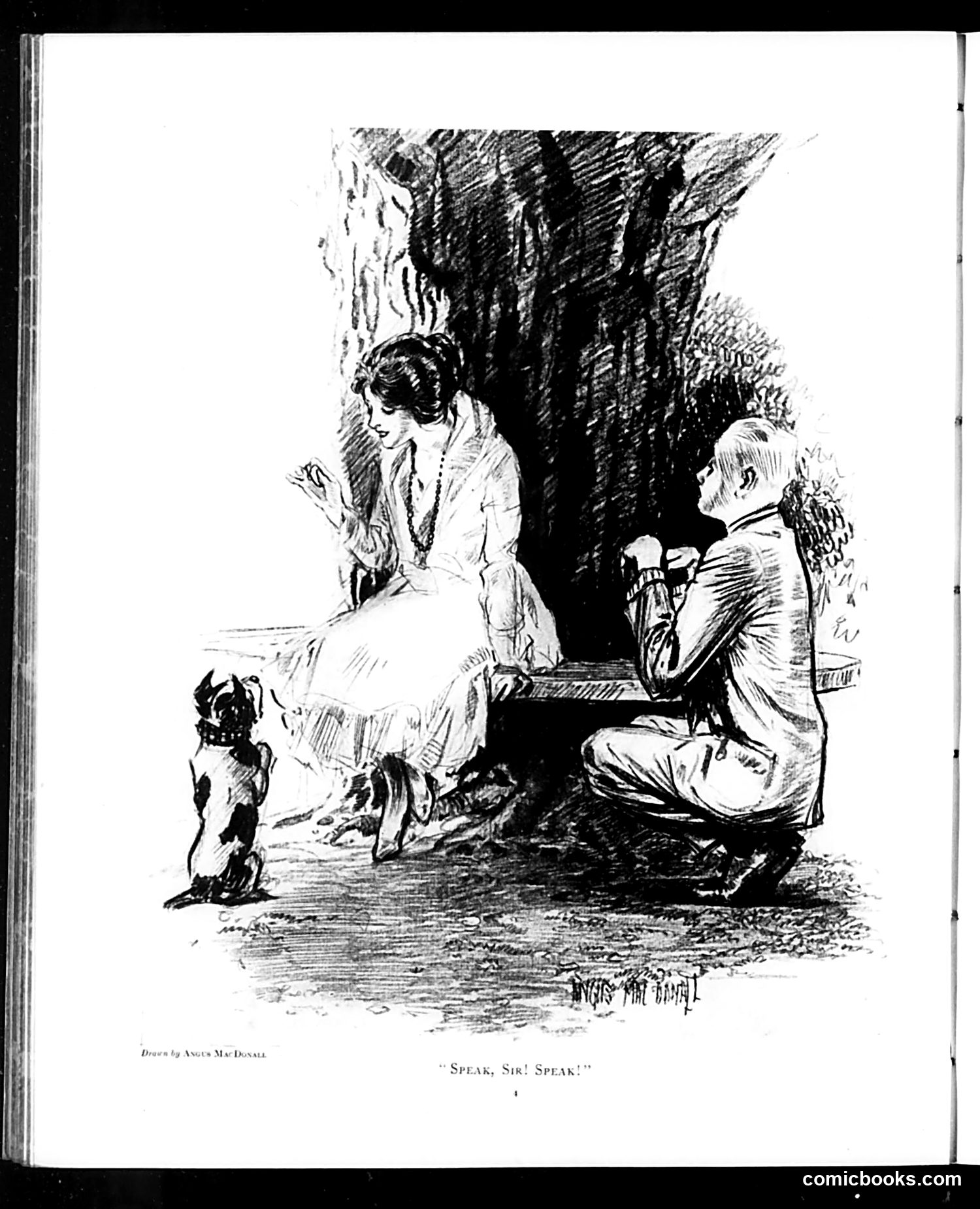
This illustration by Agnes MacDonald depicts a woman gesturing urgently toward a small dog, commanding it to speak. A young boy crouches nearby, observing the scene beneath what appears to be a large tree or cave. The cartoon likely satirizes the expectation that someone—possibly a public figure or reluctant witness—should break their silence on an important matter. The dog, unable to speak, serves as a comedic stand-in for a person who remains silent despite pressure to do so. Without additional context from Judge magazine's publication date and contemporary events, the specific target of this satire remains unclear, though it appears to mock either stubbornness, cowardice, or deliberate evasion of accountability.
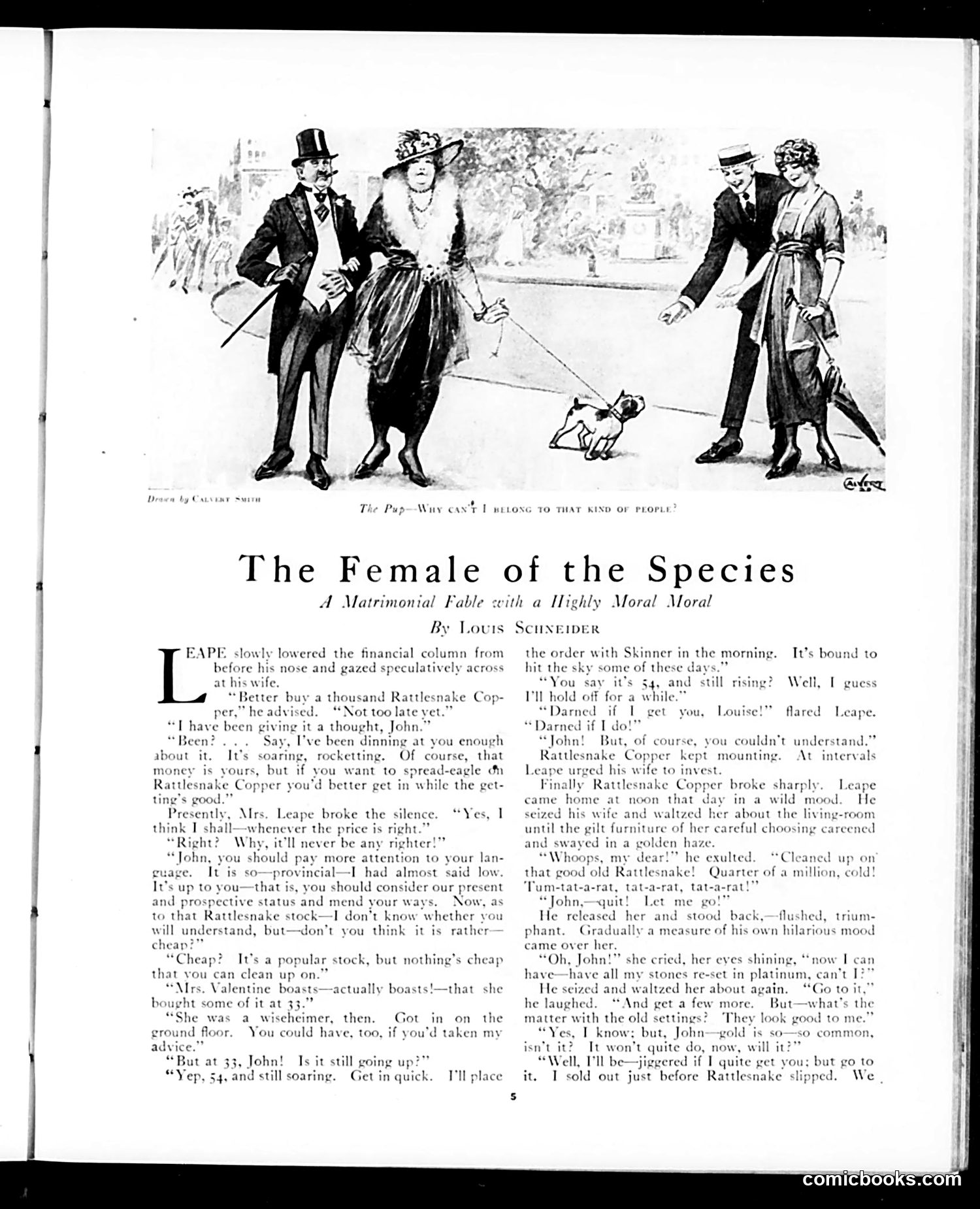
This satirical story by Louis Schneider mocks upper-class matrimonial dynamics, likely from the early 20th century. The cartoon caption—"The Pup: Why can't I belong to that kind of people?"—suggests commentary on social class distinctions. The narrative depicts a husband (Leape) and wife (Louise) negotiating financial matters. Louise has invested in "Rattlesnake Copper" stock that's rising. The satire centers on her asserting financial independence and shrewd business acumen, while John initially patronizes her. By story's end, she's bought costly furnishings and he admits she outsmarted him. The "moral" appears ironic: the story critiques both gender dynamics and the era's nouveau-riche consumerism, where women increasingly controlled household finances despite prevailing attitudes about female inferiority in business matters.
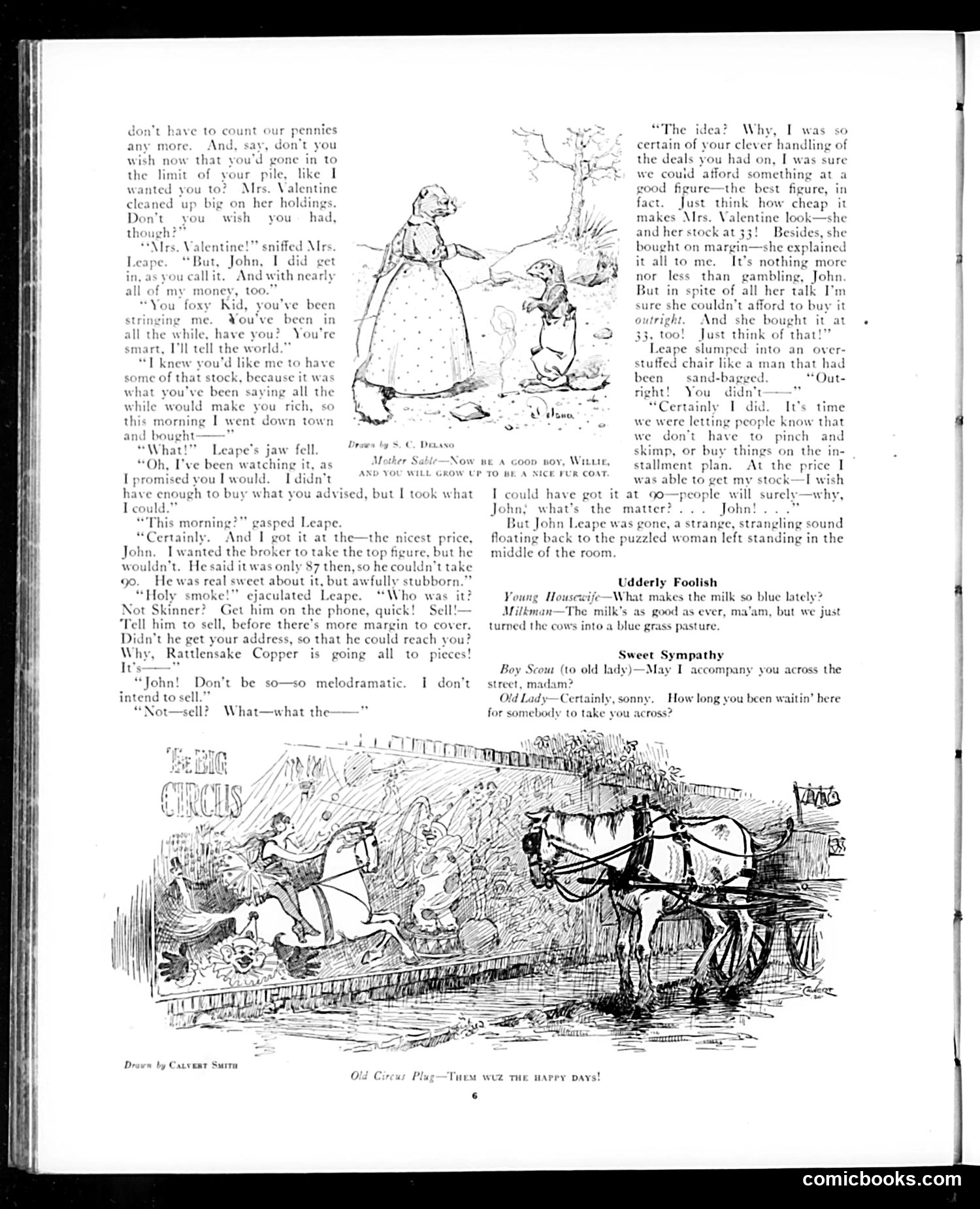
This page contains three separate humorous pieces rather than political cartoons: **Top section**: A domestic comedy dialogue where Mr. Leape has been secretly saving money, and Mrs. Leape discovers he's been pinching pennies. She's angry he didn't tell her—she could have afforded something nice. The joke satirizes marital financial secrecy and differing spending philosophies among middle-class couples. **Middle section**: Three brief "Udderly Foolish" joke vignettes with simple punchlines about milk, sympathy, and a circus scene. **Bottom cartoon**: Shows circus performers with horses, captioned "Old Circus Days—Them wuz the happy days!" This appears nostalgic commentary about entertainment, though the specific satirical target is unclear. The page focuses on domestic humor and gentle social observation rather than political satire typical of Judge's editorial content.
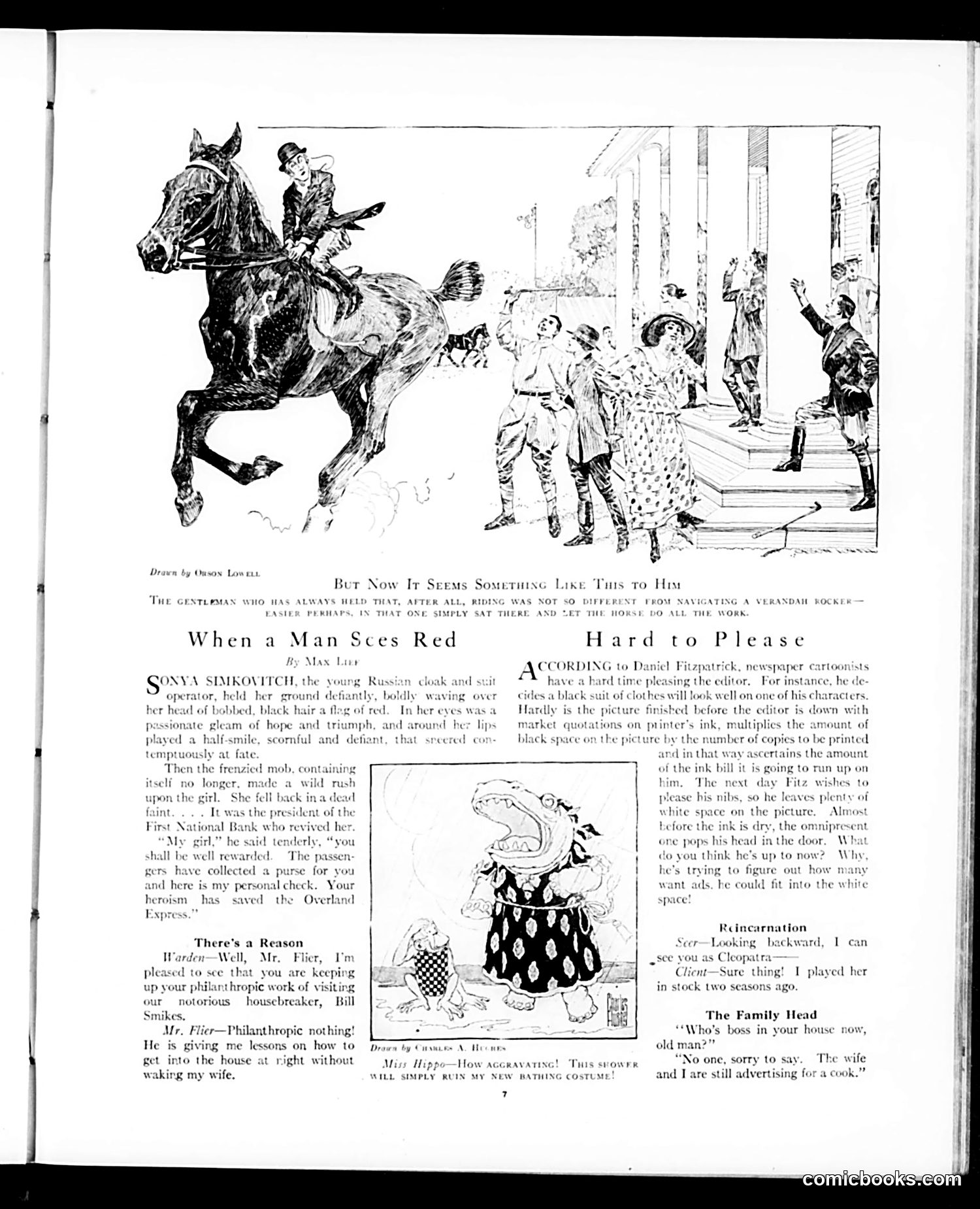
This page contains three separate humorous pieces typical of early 20th-century satirical magazines: **Top cartoon**: Shows a gentleman on a rearing horse, contradicting his stated belief that horseback riding requires no skill—just sitting while the horse does the work. The joke is visual irony: his horse is clearly out of control, undermining his philosophy. **"When a Man Sees Red"**: A story about Sonya Simkovitch, a Russian cloak-and-suit model, who causes a mob frenzy. A bank president rescues her and rewards passengers who helped. The satire targets wealthy businessmen's performative philanthropy and sensationalist media. **Bottom section**: Three brief comedic dialogues—"There's a Reason" mocks a man learning burglary from a prisoner under the guise of philanthropy; "Hard to Please" discusses editorial cartooning logistics; "The Family Head" jokes about domestic role reversal through a wife's job-hunting. The page primarily offers light social satire about class, gender roles, and masculine pretense rather than pointed political commentary.
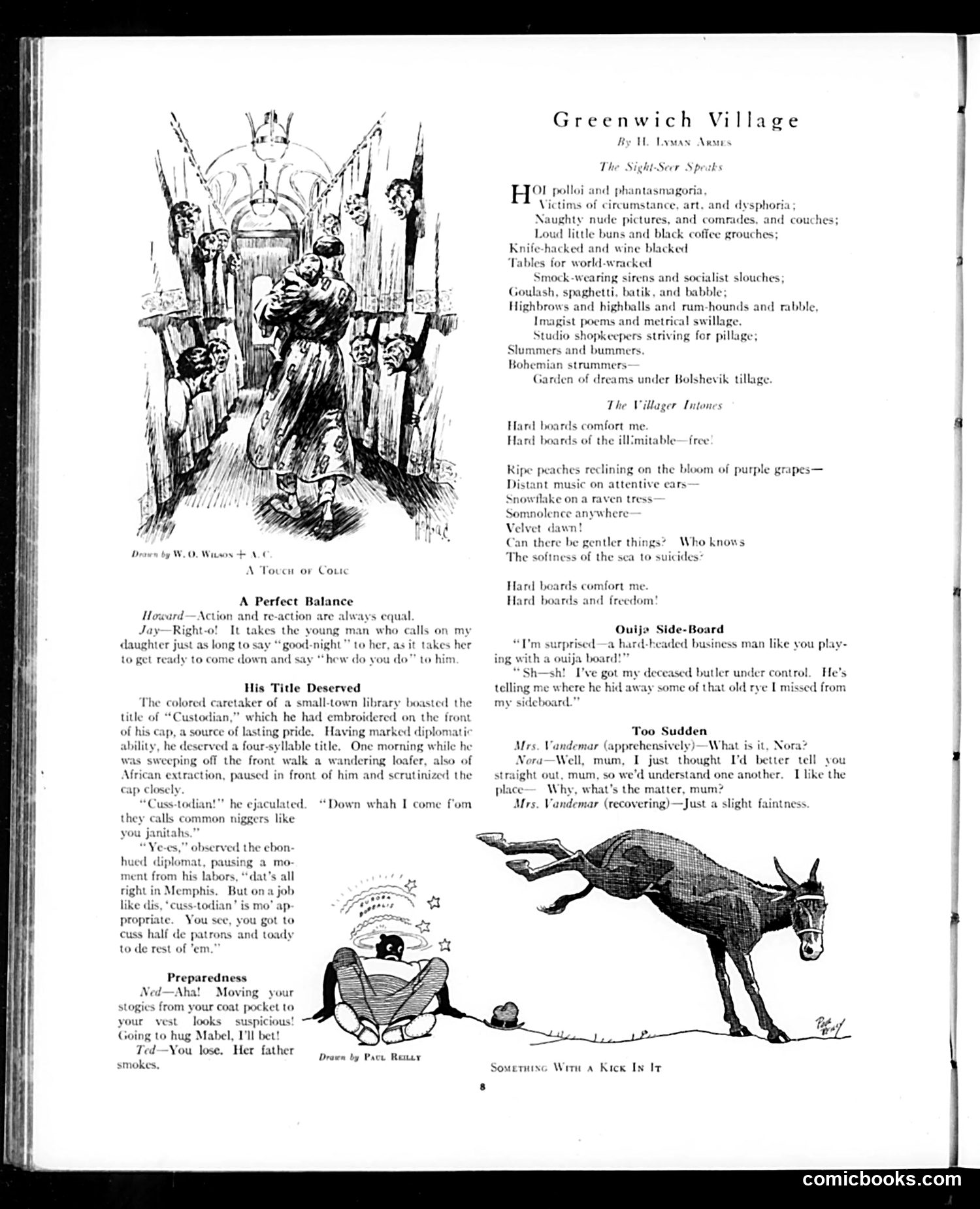
This Judge magazine page contains several satirical pieces: **"His Title Deserved"** mocks racial stereotypes through dialect humor. A Black library custodian defends his formal job title over "janitor" by claiming in Memphis they use a cruder term, so his current position requires "cursing half the patrons." The satire appears to target pretension and class distinction rather than support the racial slurs embedded in the dialogue—typical of early 20th-century humor that used offensive language reflexively. **"Greenwich Village" section** satirizes bohemian/artistic subculture of 1920s New York—mocking pretentious artists, socialists, imagist poets, and "slummers" (wealthy tourists visiting poor neighborhoods for entertainment). References to ouija boards, nude pictures, and Bolshevism reflect contemporary anxieties about radical and unconventional lifestyles. **The domestic comedies** ("Perfect Balance," "Preparedness," "Too Sudden") use standard boy-meets-girl scenarios for mild humor about courtship and household staff interactions. The page reflects era-specific class anxieties and prejudices now dated.
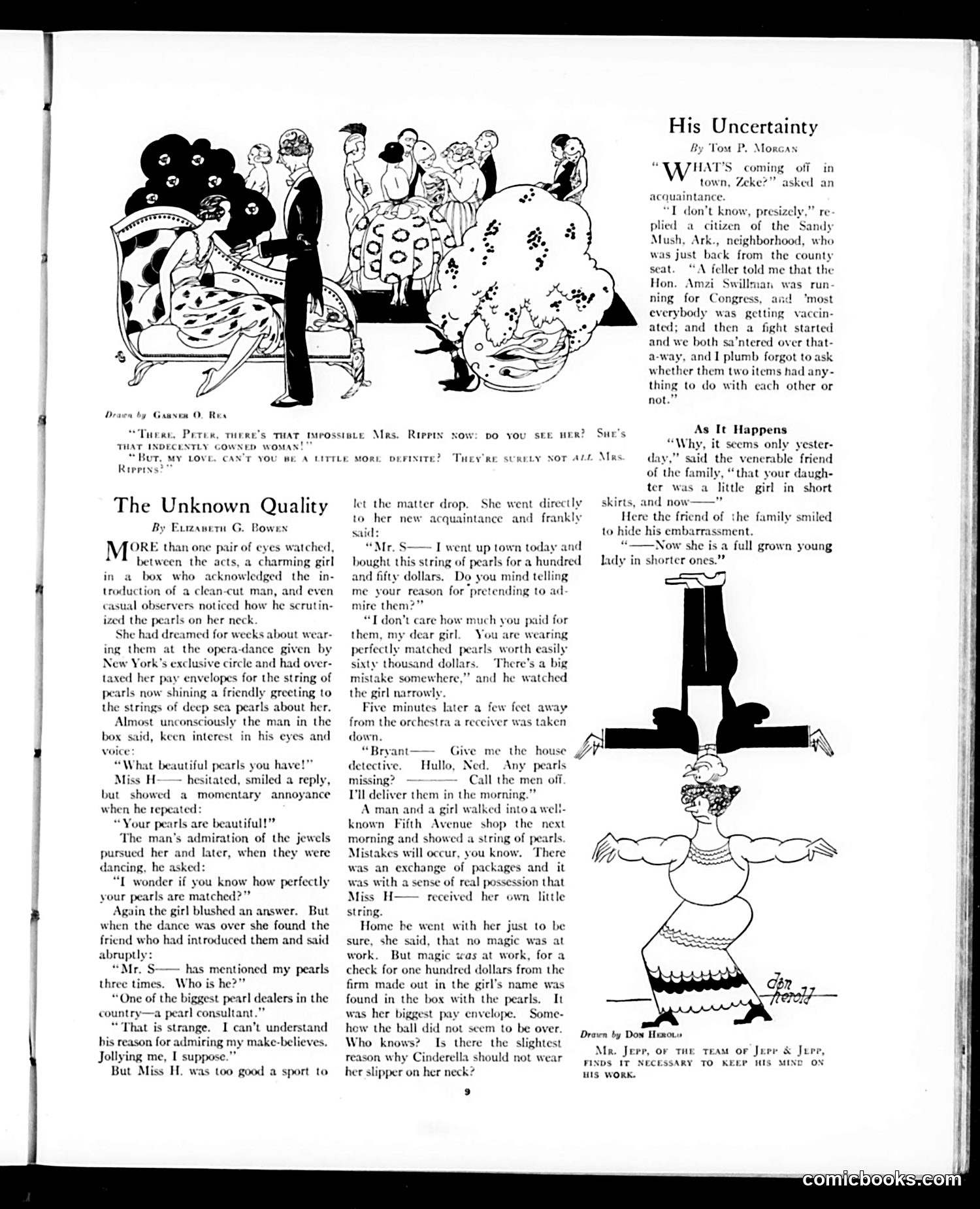
This page contains three short stories with satirical illustrations: **"The Unknown Quality"** depicts a social comedy: a woman wearing fake pearls at an opera is complimented repeatedly by a pearl dealer who recognizes they're actually *genuine* high-value pearls—worth $60,000, not the $150 she paid. A stolen jewelry case is resolved when the real pearls are recovered and exchanged. The satire mocks either the woman's ignorance of her own possession or the absurdity of such fortune. **"His Uncertainty"** satirizes political confusion in rural Arkansas: a citizen reports vaguely that Congressman Amzi Swillman is "running for" something, but nobody—including himself—seems certain what office or what's actually happening. **"As It Happens"** is a brief joke about time's passage: an older man remarks that a girl he knew is now "full grown" in "shorter" skirts (referencing 1920s fashion hemlines rising), embarrassing her. The cartoons by Gluyas Williams and Don Herold use exaggerated caricature typical of 1920s-era Judge magazine satire targeting urban sophistication, political incompetence, and social change.
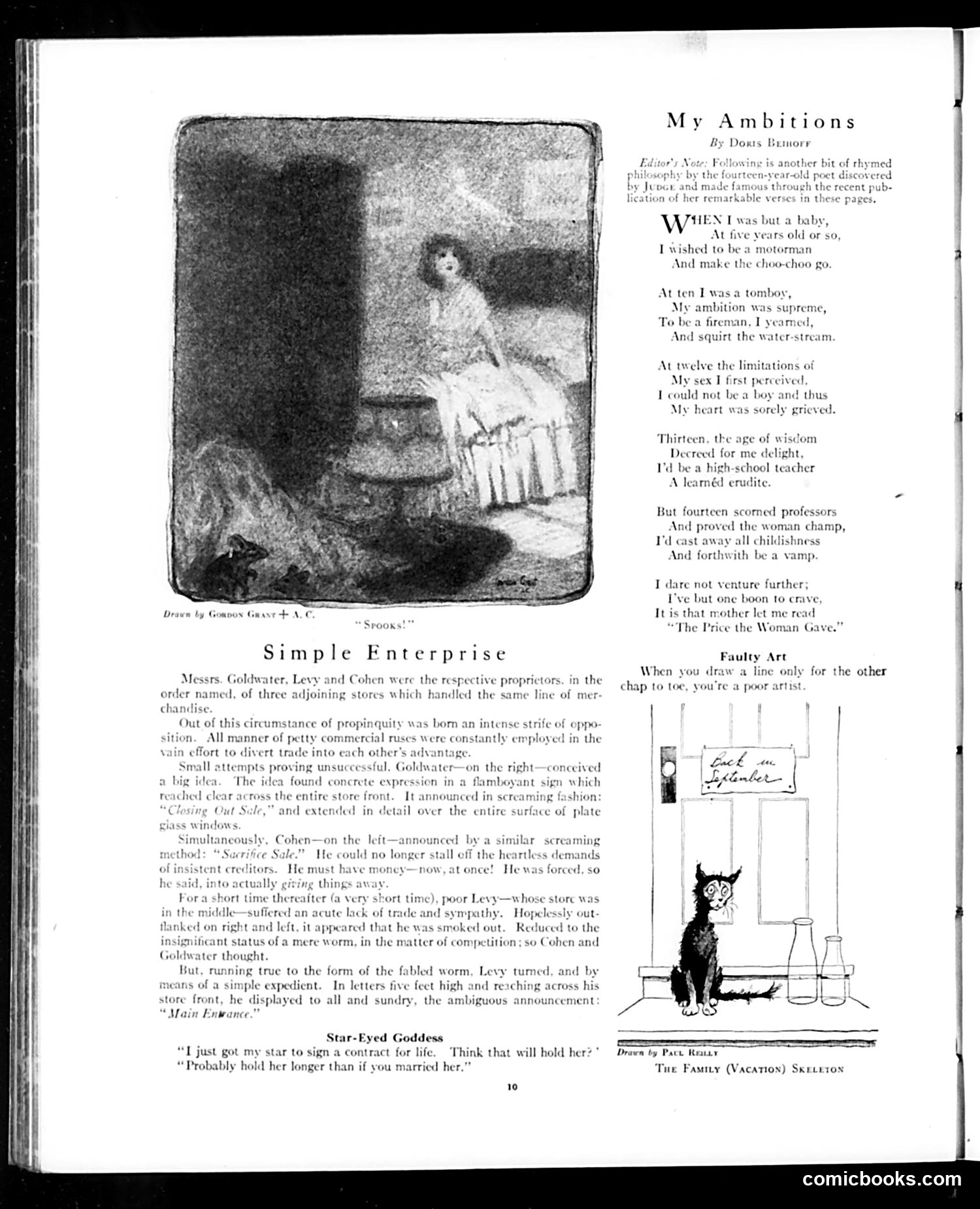
This page contains three satirical pieces: **"Simple Enterprise"** mocks Jewish business owners (Goldwater, Levy, Cohen) engaged in cutthroat retail competition on the same street. Each uses increasingly desperate advertising tactics—"Closing Out Sale," "Sacrifice Sale," culminating in Levy's ambiguous "Main Entrance" sign. The satire targets petty commercial fraud and competitive desperation, exploiting ethnic stereotypes common to early 20th-century American humor. **"My Ambitions"** by Doris Bemoff presents a teenage girl's evolving career aspirations, from motorman to fireman to teacher, concluding she'll become a "vamp"—reflecting anxieties about women's ambitions and sexuality. The tone is mildly satirical about women's limited options. **"Faulty Art"** and "Star-Eyed Goddess"** are brief jokes about art and romance respectively, with minimal satirical content. The page reflects Judge's characteristic blend of ethnic stereotyping, gender mockery, and commercial satire typical of early American humor magazines.
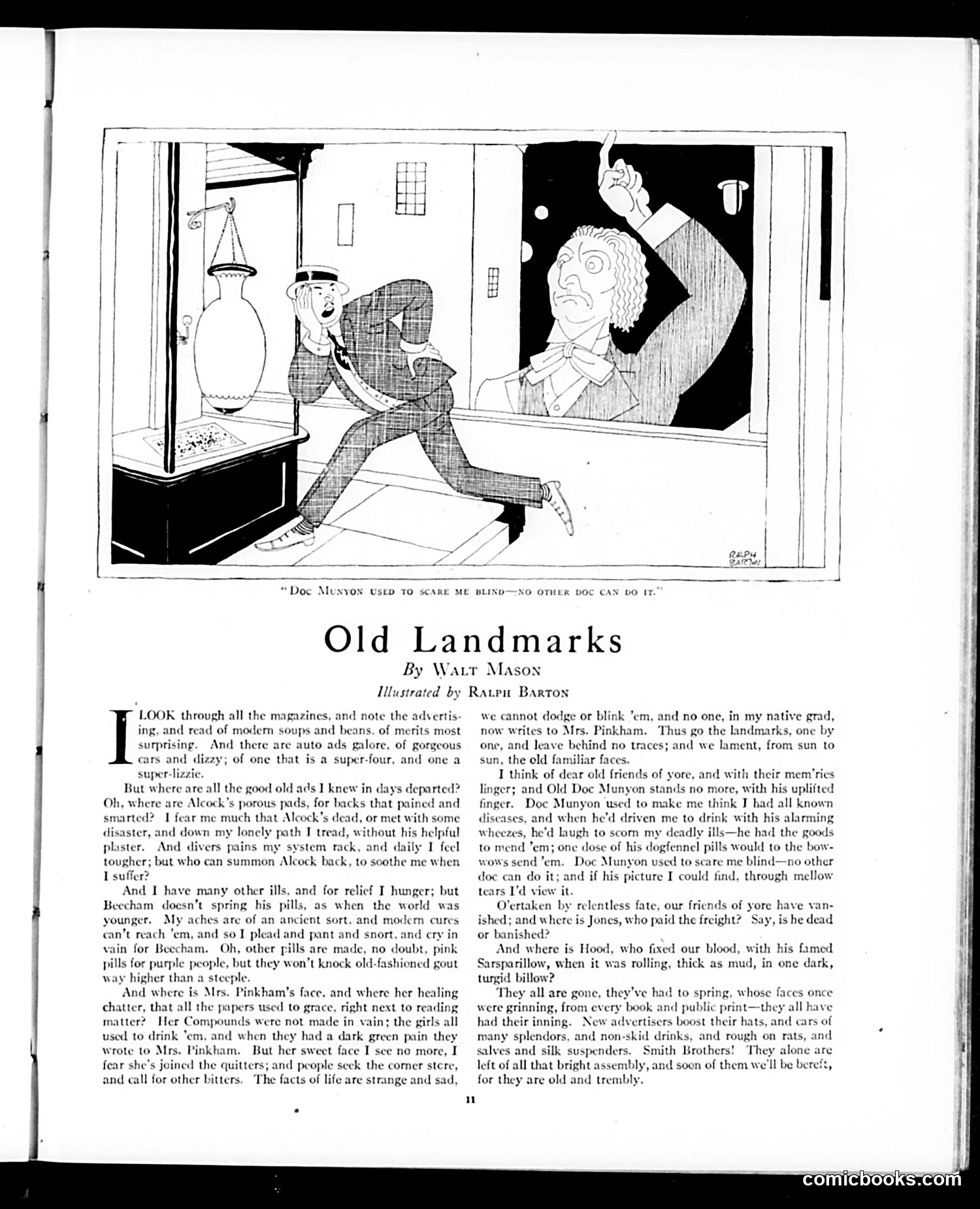
This page satirizes the disappearance of once-ubiquitous patent medicine and nostrum advertisements from American publications. The cartoon caption references **Dr. Munyon**, a real figure who aggressively marketed dubious patent medicines through fear-based advertising, claiming to cure virtually any ailment. The accompanying poem by Walt Mason laments vanished advertising "landmarks"—brands like **Alcock's porous pads** (pain relief), **Beecham's pills**, **Lydia Pinkham's Compound** (a popular "women's tonic"), **Hood's Sarsaparilla**, and **Smith Brothers cough drops**—all once omnipresent in magazines. The satire targets two things: the gullibility of consumers who believed these remedies worked, and the shift in advertising away from unregulated patent medicines toward automobiles and modern products. The tone is nostalgic yet darkly comic—Mason portrays these fake cures as comforting old friends, now gone. This reflects early 20th-century medicine before the FDA regulated false health claims.
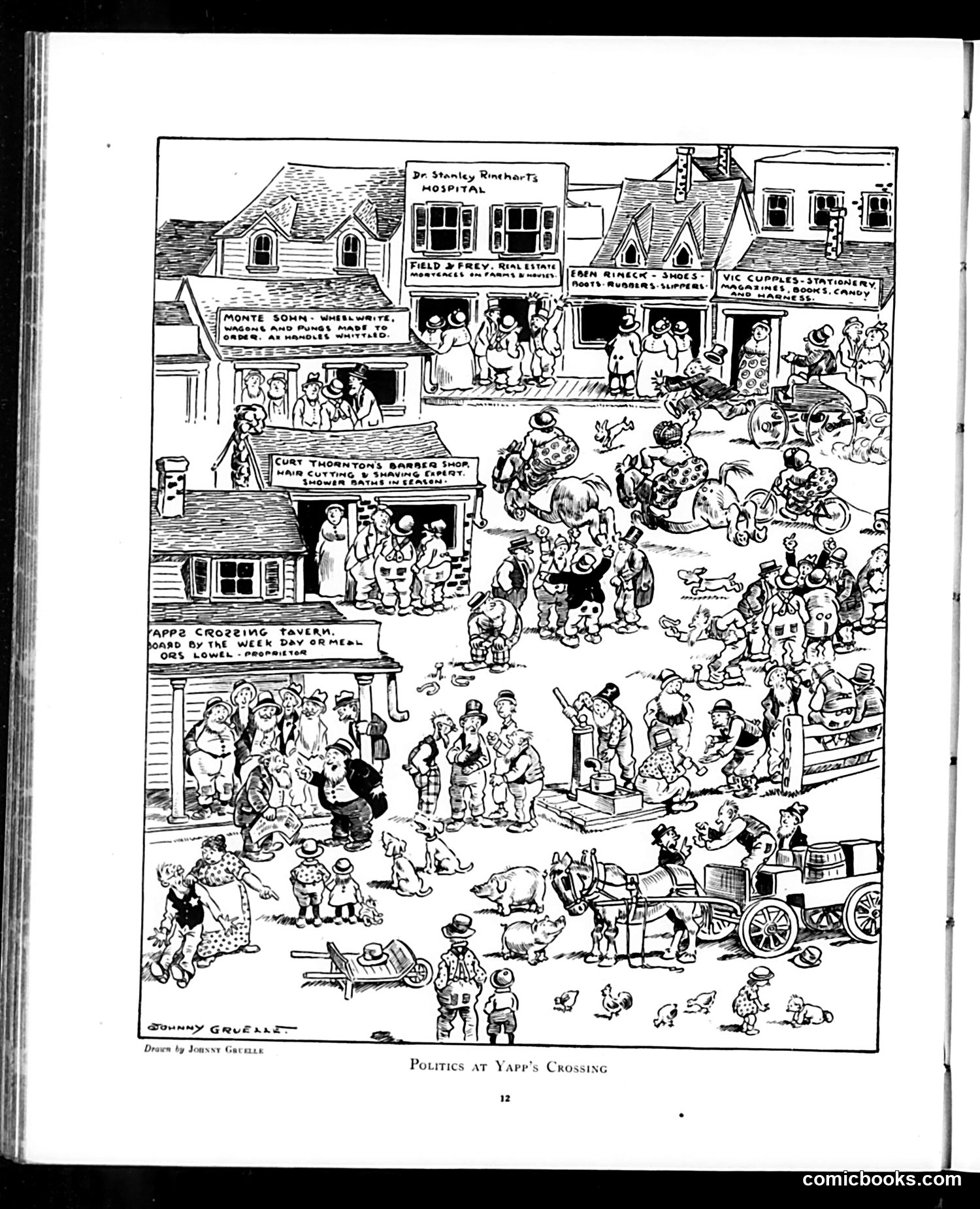
This is a crowded street scene drawn by Johnny Gruelle depicting a small-town commercial district. The cartoon satirizes local small-town life through various labeled businesses: Dr. Stanley Rinthart's Hospital, Monte Somm's general store, Curt Thornton's Barber Shop, Emen Rineck's shop, and Appo's Crossing Tavern. The title "Politics at Yapp's Crossing" suggests the cartoon mocks how politics permeates even the most mundane small-town activities—the gathering crowds, the busy commerce, and everyday interactions all become sites of political discourse and local maneuvering. The chaotic, densely-populated scene captures the competitive social dynamics of rural American life, where local merchants and citizens navigate commerce, gossip, and influence within their tight-knit community. The humor lies in treating minor local affairs with mock-serious political significance.
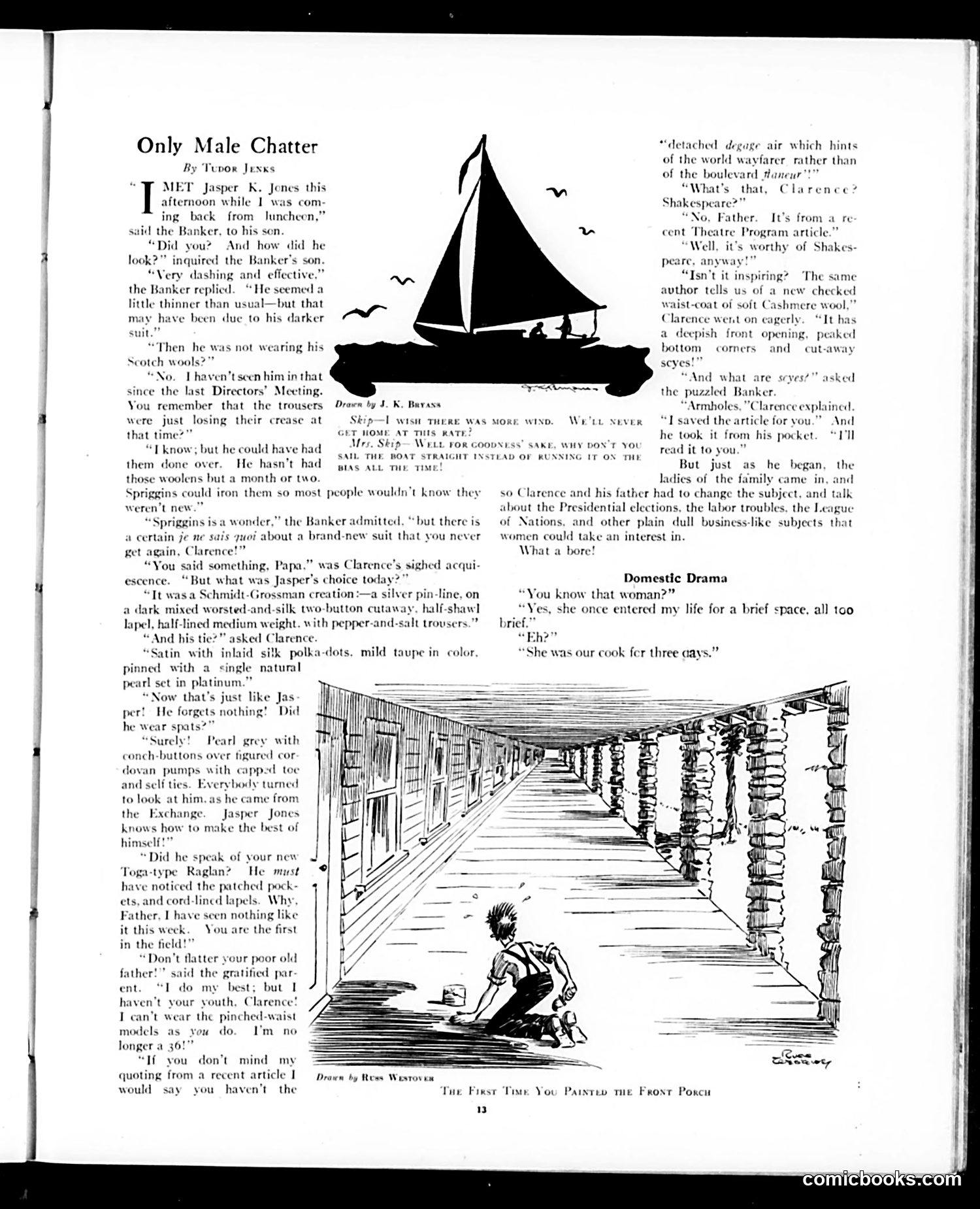
This page satirizes upper-class male fashion obsession through contrasting domestic scenes. **"Only Male Chatter"** depicts a banker and his son discussing a third man's (Jasper K. Jones) clothing in meticulous, absurd detail—silver pin-lines, specific trouser fabric blends, platinum-set pearl pins. The satire targets wealthy men's pretentious preoccupation with fashion minutiae and status symbols. The interruption by the women of the family, who force a shift to "plain dull business-like subjects," underscores the era's gender dynamics: men's trivial concerns versus women's supposed intellectual inadequacy. **"Domestic Drama"** (lower section) offers brief comic relief about a former cook, but remains minor. The overall message: even privileged men waste time on superficial vanity while dismissing women's interests. The irony is sharp—the father and son obsess over clothing details while the women are excluded from this "male chatter," suggesting both the triviality of male fashion culture and contemporary attitudes toward gender roles.
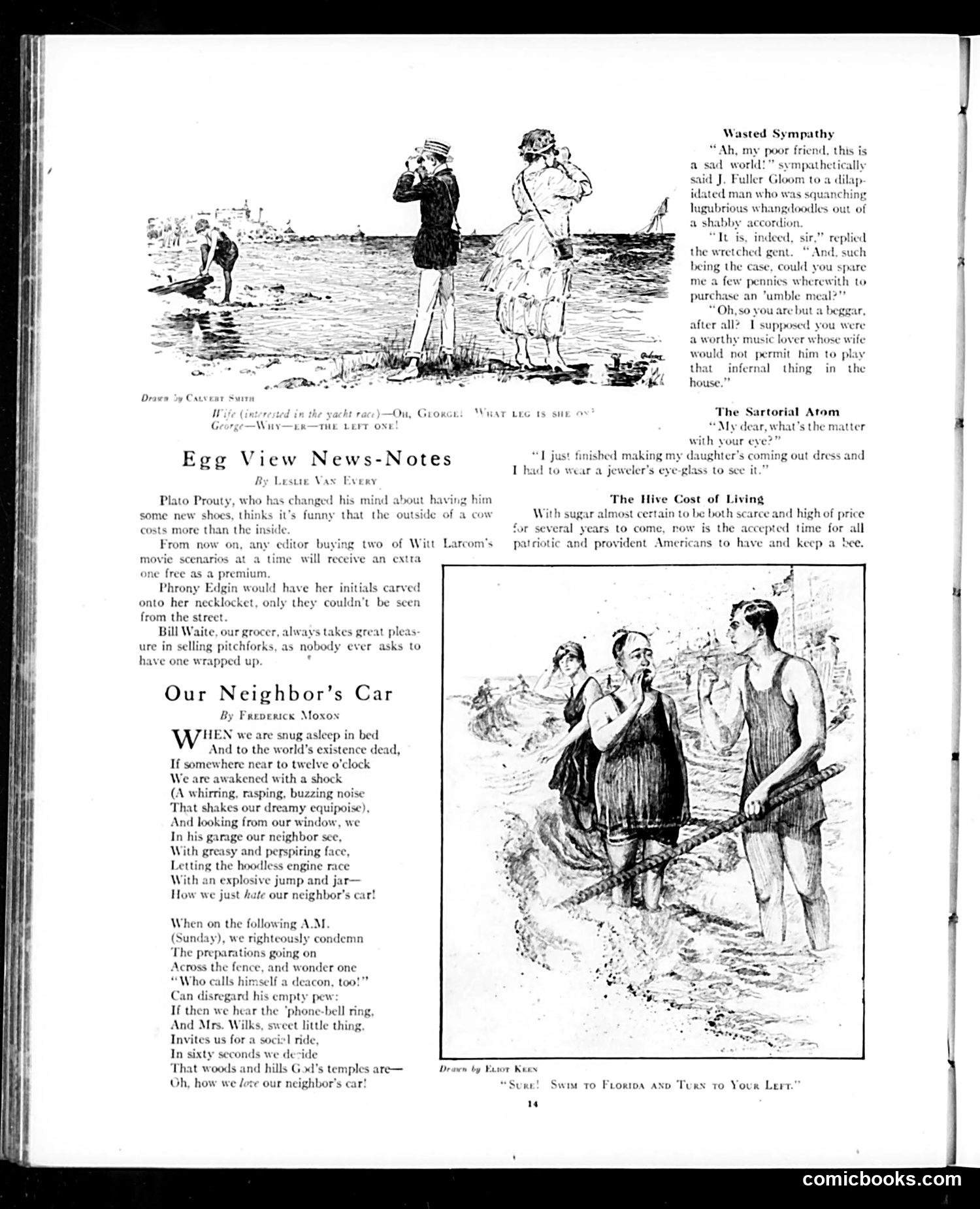
This page contains three satirical pieces from *Judge* magazine: **"Wasted Sympathy"**: A well-dressed man (J. Fuller Gloom) expresses pity to a beggar playing accordion, assuming he's a suffering musician. When the beggar asks for money for food, Gloom's sympathy evaporates—he realizes the man is simply poor, not a worthy artist. The satire mocks selective compassion: wealthy people sympathize with suffering only when it fits their romantic notions, not actual need. **"Our Neighbor's Car"**: A humorous poem about suburban hypocrisy. Neighbors resent their peer's noisy car at night but eagerly accept a ride in it the next day. It satirizes how people criticize neighbors' possessions while coveting the same things. **"The Hive Cost of Living"**: Brief notes on wartime rationing, suggesting Americans should keep bees to ensure sugar supplies. This reflects WWI-era food scarcity and government encouragement of home production. All three pieces use gentle social satire targeting middle-class behavior and attitudes.
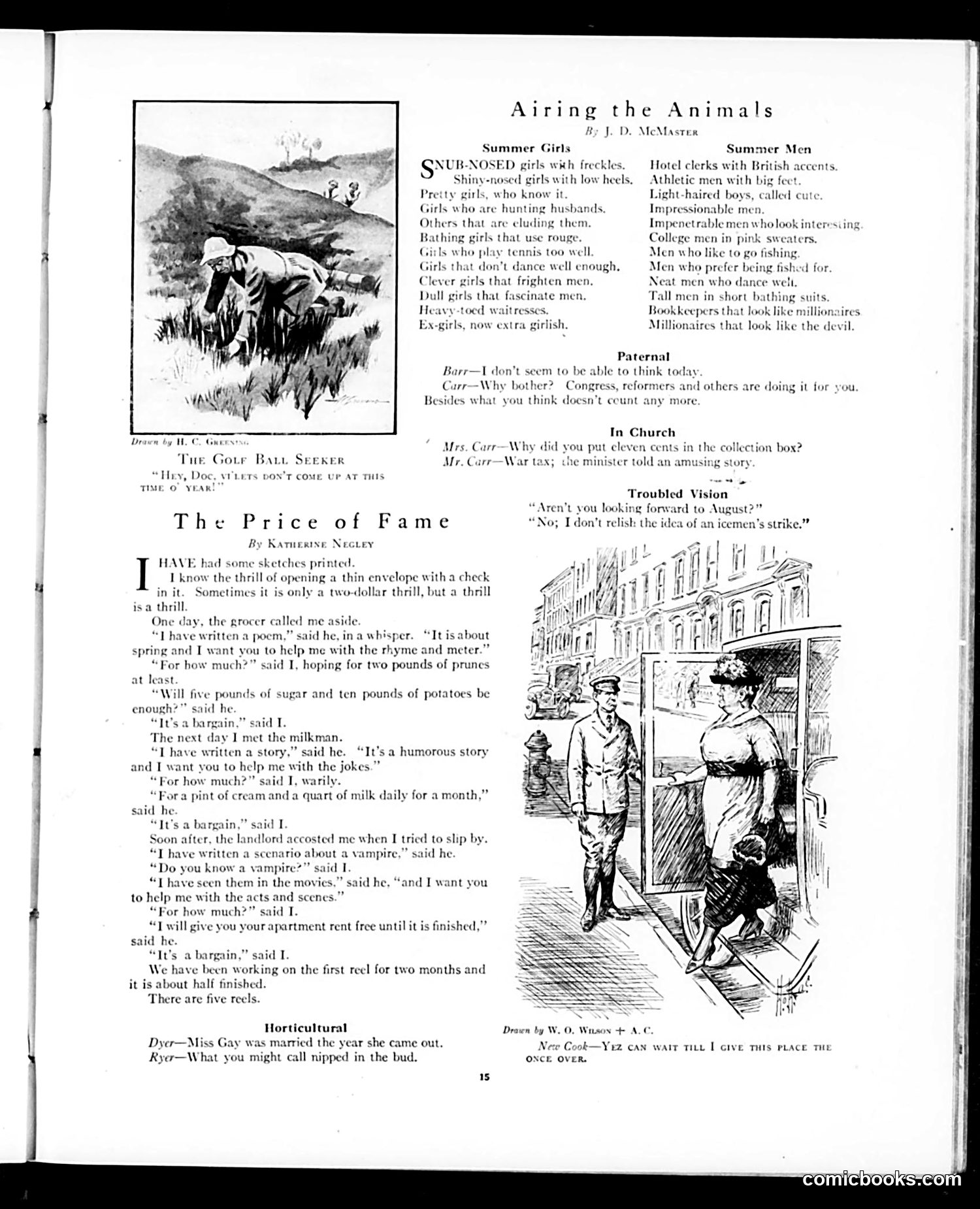
**"The Price of Fame"** is a humorous story about the narrator being approached by various people—a poet, milkman, landlord, and grocer—who seek help with creative projects. Rather than offering payment, each proposes barter: sugar and potatoes, milk, free rent, etc. The joke satirizes struggling writers and artists who exploit connections, expecting free labor in exchange for meager or deferred compensation. By the vampire scenario's end, the narrator is trapped in an ongoing, barely-progressing project, exposing the exploitation inherent in aspiring creators' attempts to leverage personal relationships. **"Airing the Animals"** is a satirical character inventory contrasting types of "Summer Girls" and "Summer Men" with deliberate unflattering observations (girls with freckles, shiny noses; men with big feet). The humor derives from mock-sociological categorization of seasonal social types, poking fun at predictable summer stereotypes. Other brief humor pieces include **"Horticultural"** (a marriage pun) and vignettes about church collections and an icemen's strike complaint—typical period social satire targeting middle-class concerns.
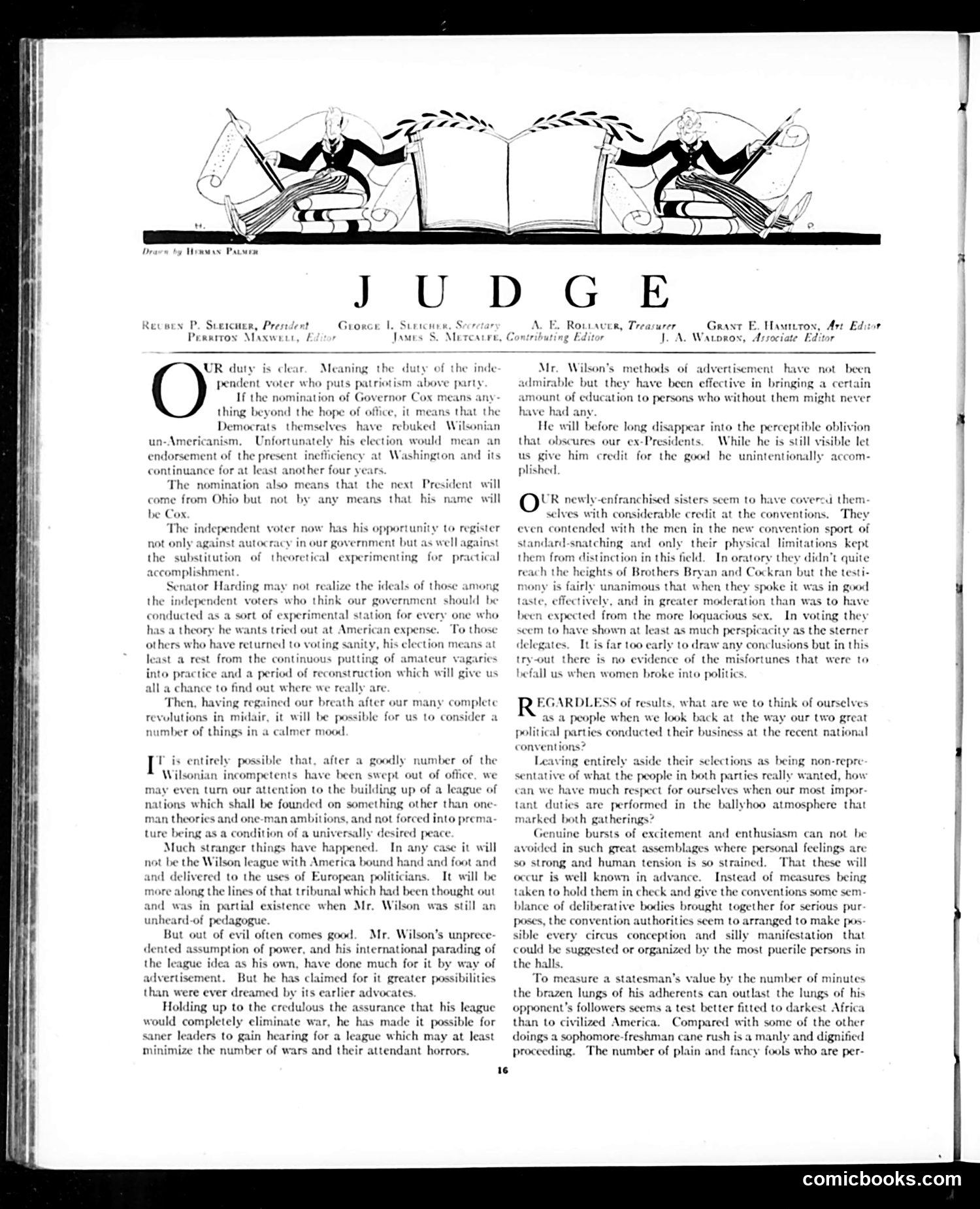
This editorial page addresses the 1920 U.S. presidential election, likely written after the Democratic National Convention nominated Governor James M. Cox. The text criticizes President **Woodrow Wilson** and his policies, termed "Wilsonian un-Americanism," particularly his internationalist approach and the League of Nations proposal. The editorial endorses Republican candidate **Senator Harding** as offering a "period of reconstruction" after Wilson's experimental governance. However, it hedges, noting Cox's nomination might signal Democratic rejection of Wilson's methods. A secondary commentary praises women's recent convention participation ("newly-enfranchised sisters"), noting their competitive spirit in "standard-snatching" (capturing state delegation standards at conventions). The tone is mildly patronizing, emphasizing their physical limitations while acknowledging their oratorical contributions. The overall message: Wilson's defeat would benefit American politics, while women's newfound political participation shows promise despite inexperience.
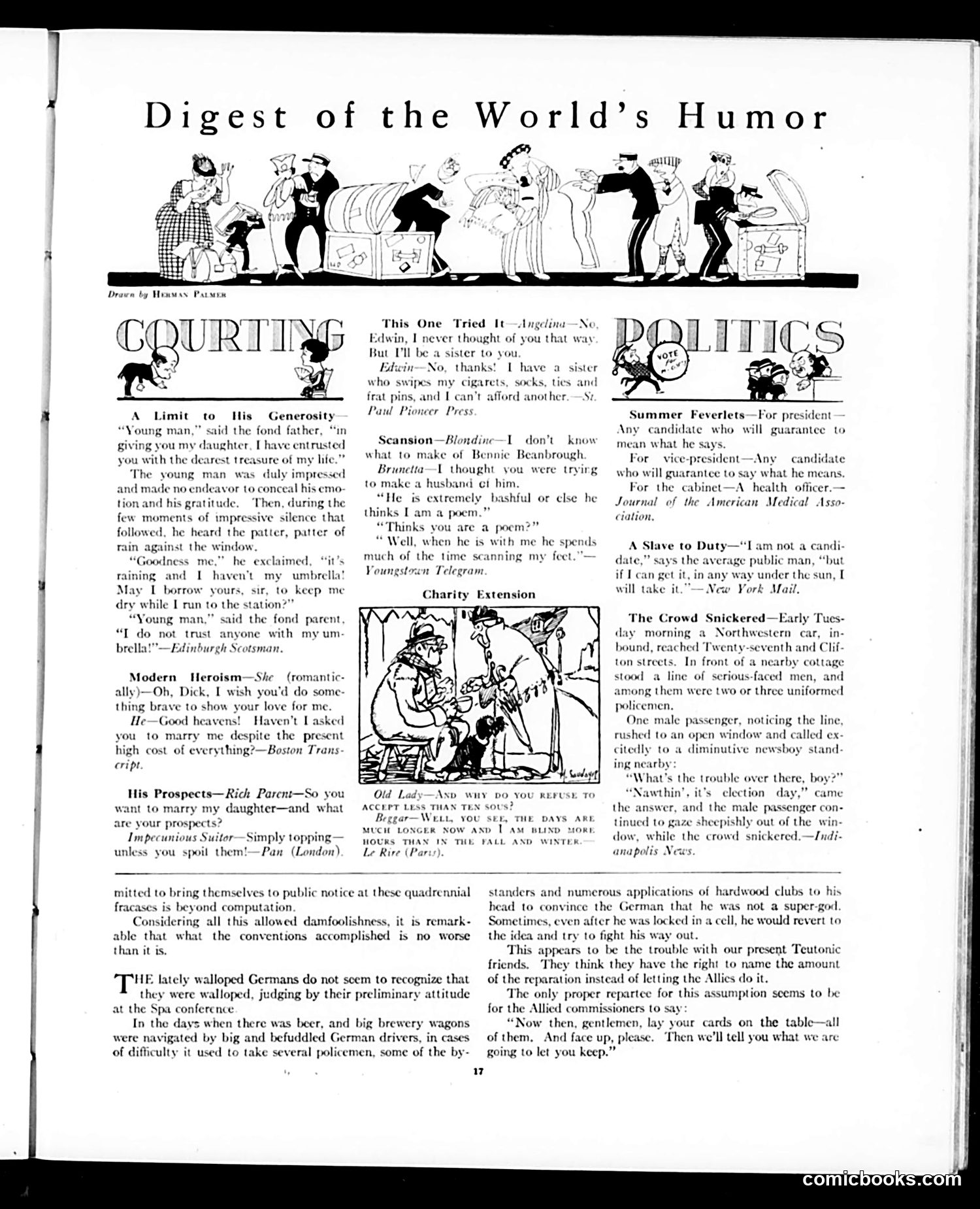
This page collects brief humorous anecdotes and jokes on themes of courtship, marriage prospects, and politics. The satirical sketches mock: **Social conventions:** A father who guards his umbrella more jealously than his daughter; suitors claiming poverty while seeking wealthy matches; a woman friend-zoning a suitor. **Modern romance:** A man asking to borrow an umbrella immediately after accepting a marriage proposal, revealing his true priorities. **Political satire:** "Summer Feverlets" mockingly lists desired presidential candidates—someone who means what he says, someone who says what he means, and a health officer—implying politicians typically fail on all counts. **Election absurdity:** A street scene where an election day gathering of police and serious-faced men causes curiosity, but proves trivial—highlighting how Americans treat elections as minor spectacles. The overall message critiques human hypocrisy around love, money, and civic engagement through quick, ironic observations typical of Judge magazine's satirical approach.
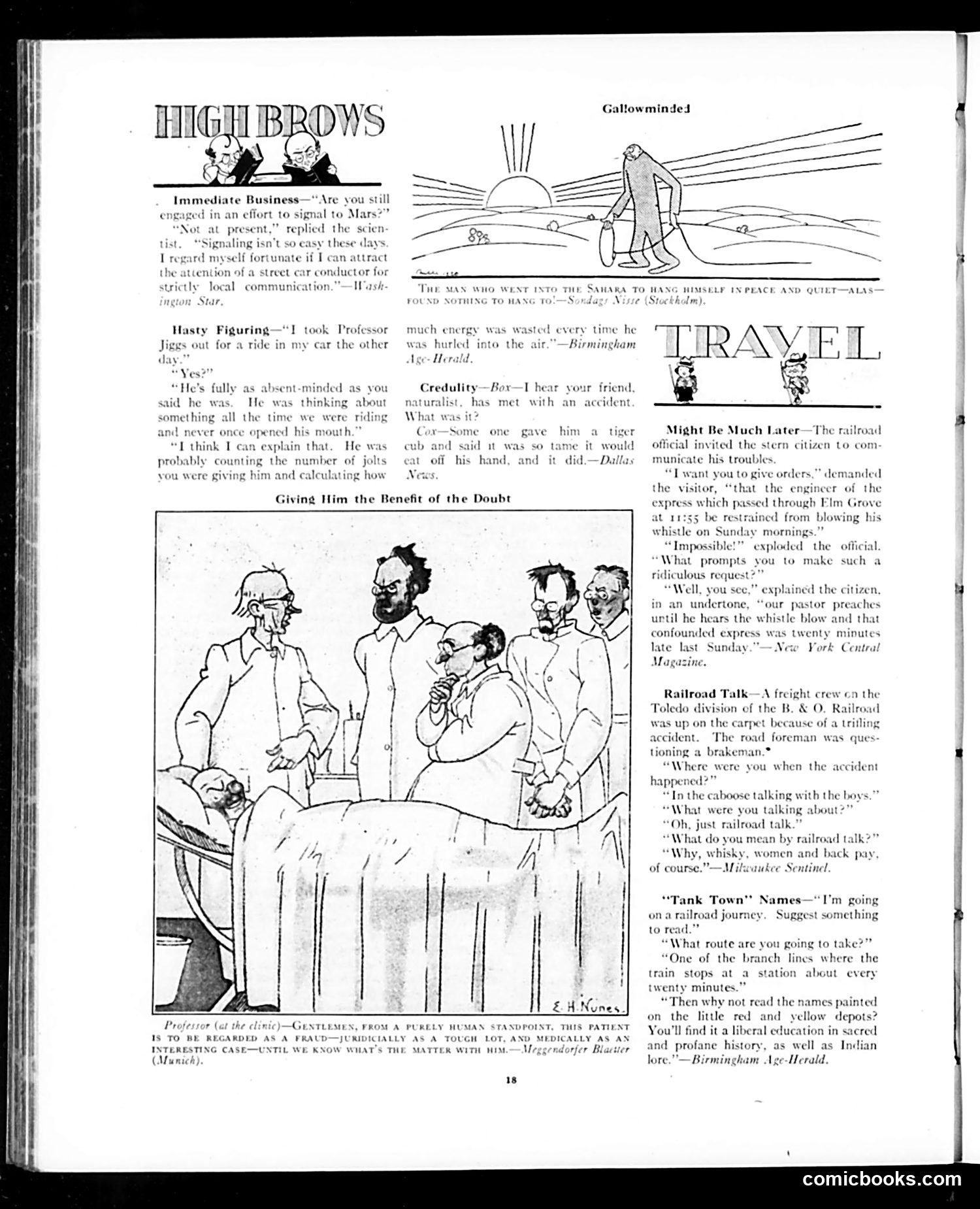
This page contains several humor sections typical of early 20th-century Judge magazine: **"High Brows" section**: Short jokes mocking absent-minded academics and upper-class pretension—a recurring Judge target. **Main cartoon "Giving Him the Benefit of the Doubt"**: Shows a doctor (at clinic) with students examining a patient. The caption satirizes medical diagnostic uncertainty and legal/moral ambiguity—the doctor can't determine if the patient is a "fraud," a criminal ("tough lot"), or genuinely ill. It's satirizing the limits of medical science and professional judgment. **"Travel" section**: Contains three anecdotes mocking: - A citizen demanding trains not whistle during Sunday sermons - Railroad workers' crude conversation ("whisky, women and back pay") - Passengers reading station names as "education" These jokes target middle-class hypocrisy, working-class vulgarity, and small-town pretension—standard Judge fare. The humor relies on exaggerated character types rather than specific political figures or events.
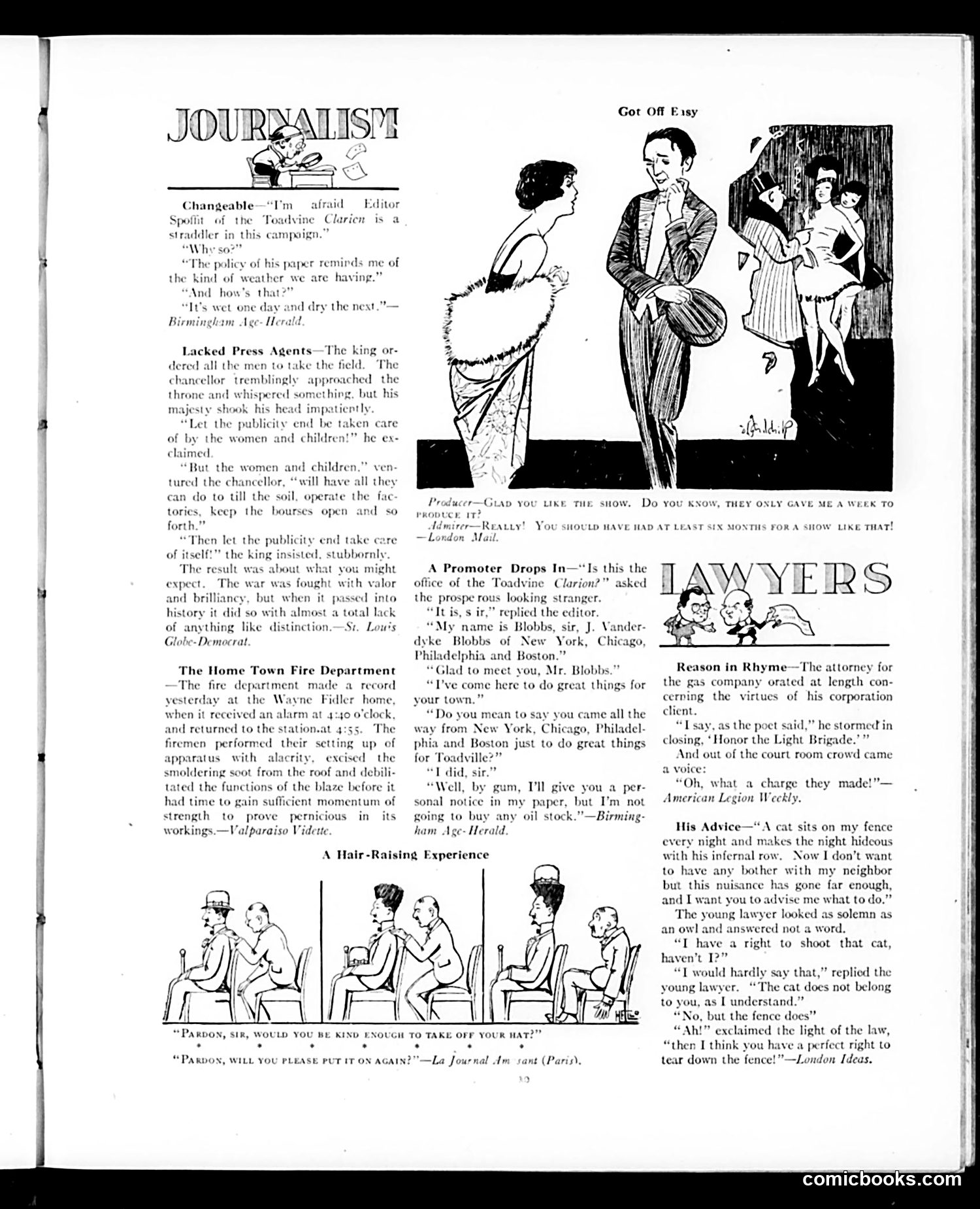
This page from *Judge* magazine contains several satirical pieces mocking early 20th-century journalism, politics, and legal absurdities. **"Journalism" section**: Satirizes newspaper editors as inconsistent "straddlers" who won't take clear positions during campaigns—their editorial policies flip-flop like unpredictable weather. **"Got Off Easy"**: A theatrical producer complains he only received one week to mount a show, while a small-town newspaper editor remains unimpressed by a self-proclaimed promoter named Blobbs from major cities who claims he'll bring "great things" to the town. The editor deflates his ego by refusing to buy stock—exposing Blobbs as a con artist. **"Lawyers"**: A comedic legal anecdote where an attorney gives absurd advice: instead of shooting a neighbor's noisy cat, tear down your own fence (technically making it the neighbor's problem). The joke ridicules lawyer pedantry and technicalities over practical solutions. The cartoons employ exaggeration and wordplay typical of satirical magazines critiquing professional incompetence and self-importance.
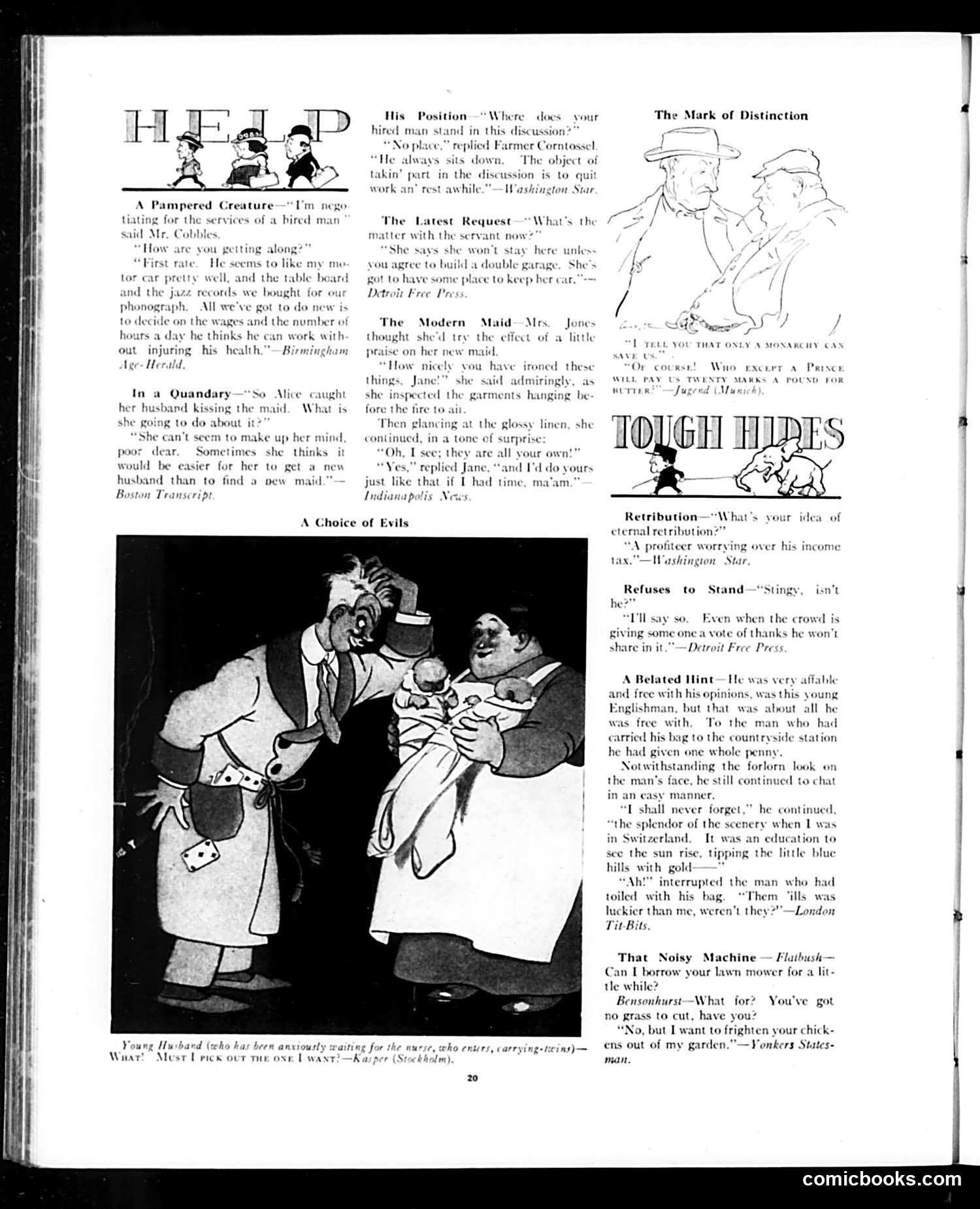
This page collects brief satirical humor pieces typical of early 20th-century Judge magazine, targeting social anxieties of the era: **"A Pampered Creature"** mocks the servant problem—hired help becoming increasingly demanding and difficult to manage, valuing the employer's possessions (motor car, phonograph) over actual work. **"The Latest Request"** satirizes the nouveau riche servant class now demanding modern amenities (double garages for automobiles), reversing traditional servant-master dynamics. **"The Modern Maid"** plays on class tension: the maid receives praise for ironing, then reveals she owns all those clothes herself—inverting expectations about servant poverty. **"A Choice of Evils"** (large cartoon) appears to show a man choosing between two unappealing options, though specific context is unclear from the caption alone. The recurring theme: rapid social change unsettling traditional hierarchies. Servants, once deferential, now possess consumer goods and make demands. These pieces reassure middle-class readers that such presumption is ridiculous, even as economic reality was shifting labor relations.
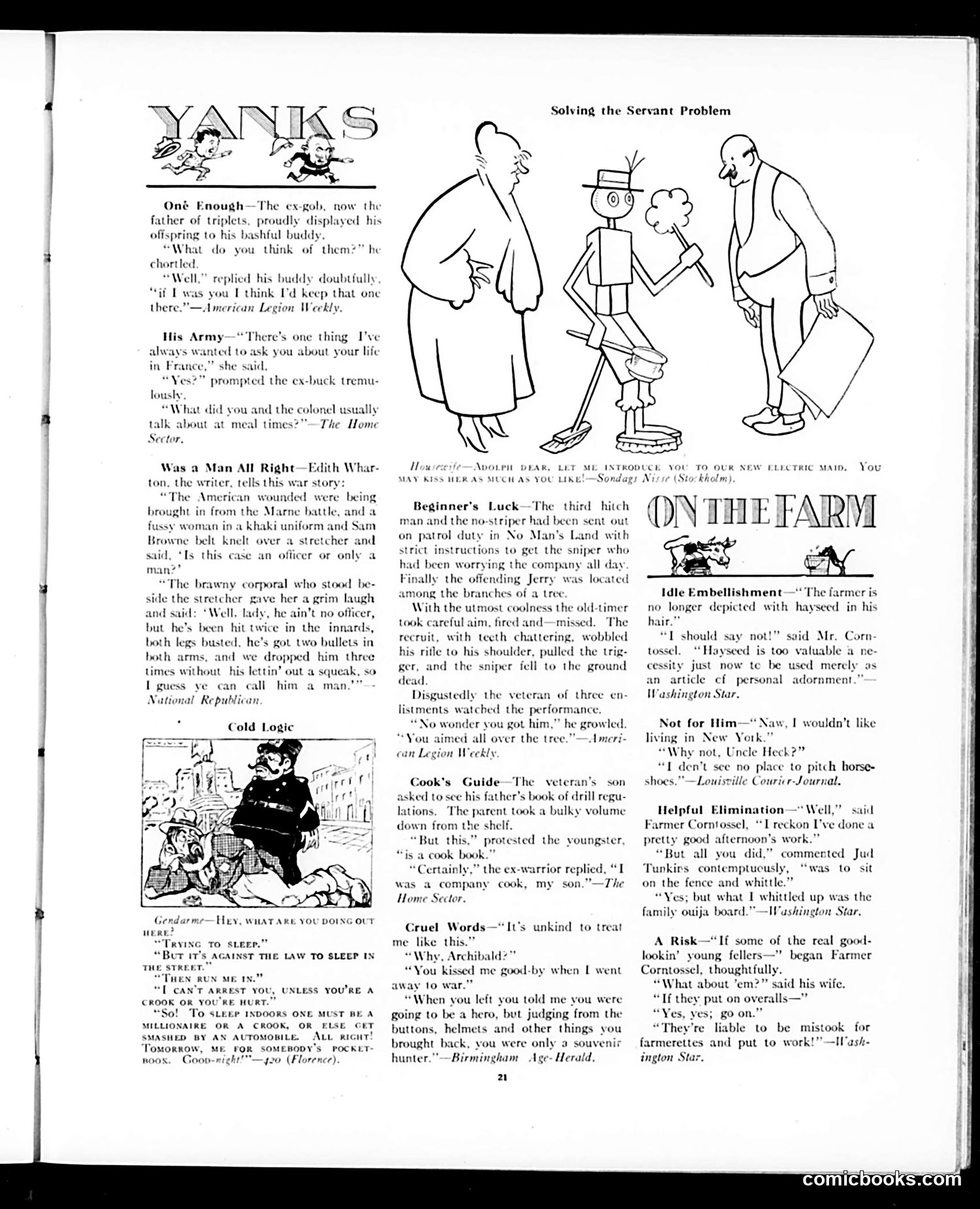
This page contains vintage humor anecdotes and cartoons from Judge magazine, likely from the 1920s post-WWI era. **Key Content:** The "Yanks" section features short jokes about American soldiers and veterans, reflecting post-WWI attitudes. Stories include servicemen's interactions—a corporal defending a wounded soldier's dignity against a snobbish officer, a recruit accidentally outshoosting a veteran sniper, and soldiers describing their wartime experiences. **The "Cold Logic" cartoon** satirizes French bureaucracy: a homeless man realizes that under the law, he can only legally sleep indoors if he's rich, a criminal, or hit by a car—highlighting absurd legal contradictions. **"Solving the Servant Problem"** depicts introducing a new electric maid (a robot-like figure), reflecting early-20th-century anxiety about domestic labor shortages and fascination with technological solutions. **"On the Farm" section** includes rural humor contrasting city and country life, poking fun at farmers' simple preferences and pastimes. The overall tone satirizes American social hierarchies, bureaucratic absurdity, and post-war adjustments—common Judge magazine themes of the era.
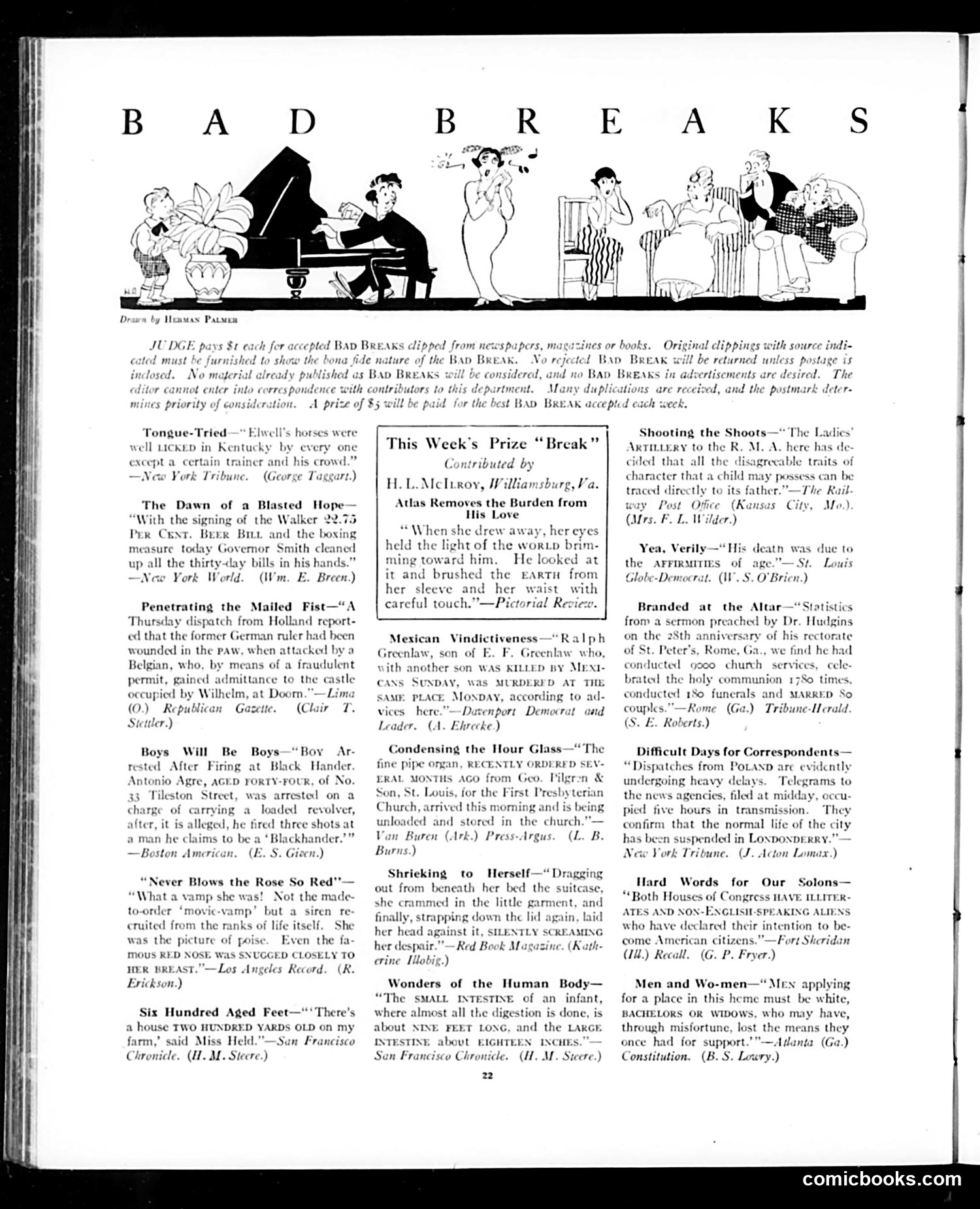
This page showcases **"Bad Breaks,"** Judge magazine's humor feature where readers submitted embarrassing real-life newspaper clippings and quotes. The cartoon header (drawn by Herman Palmer) depicts various social scenes—a piano lesson, performers, domestic life—illustrating everyday situations ripe for comedic mishaps. The feature collected unintentional double meanings and malapropisms from newspapers and magazines. Examples include: - A quote about a German ruler wounded "in the paw" (absurdly animal-like language) - A report of someone "SILENTLY SCREAMING" (contradictory) - Claims about a priest who "MARRED 50 Couples" (awkward word choice for "married") The satire targets **poor newspaper writing and editing**—showing how careless phrasing creates unintended humor. Judge paid $1 per accepted submission, making this a participatory feature where readers mocked journalistic incompetence. It's essentially an early version of modern "oops" collections, satirizing the quality (or lack thereof) of American newspaper prose during this era.
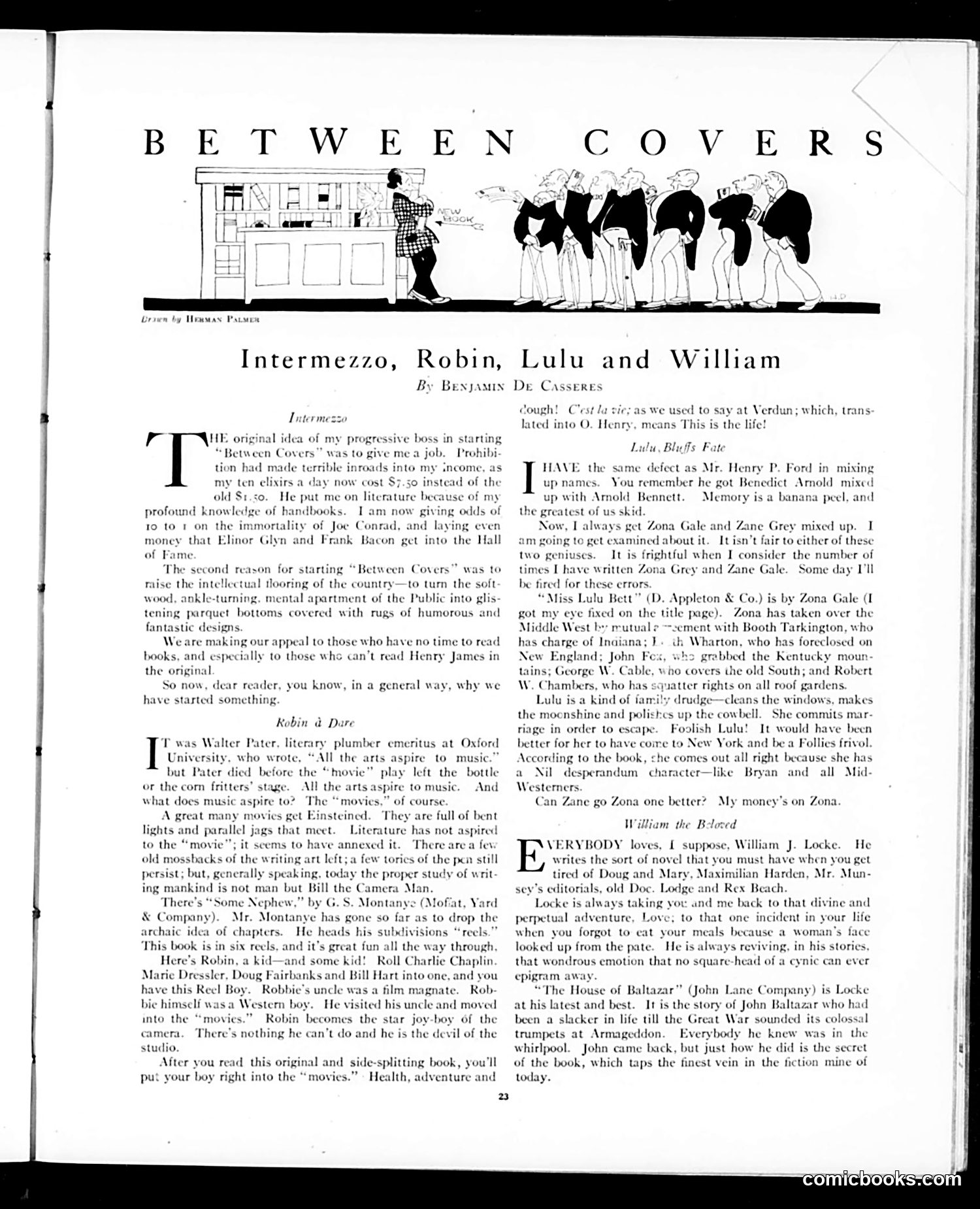
This page satirizes contemporary American literature and the emerging film industry. The cartoon at top shows figures representing different literary characters being herded into "movies," depicting literature's perceived annexation by cinema. The text discusses three book reviews: *Intermezzo* (a prohibition-era satire about the author's job), *Some Nephew* by G.S. Montanye (structured like film "reels" rather than chapters), and *Miss Lulu Bett* by Zona Gale. The author humorously confesses mixing up authors' names (Zona Gale/Zane Grey, Benedict Arnold/Arnold Bennett). The satire targets: - Literature adapting to cinema's format and pace - The "Camera Man" as modern writing's subject - Regional American authors (Tarkington, Wharton, Cable) dividing the nation's literary territory - Middlebrow characters like Lulu escaping provincial drudgery through marriage The piece reflects 1920s anxieties about film's cultural dominance and literature's perceived decline.
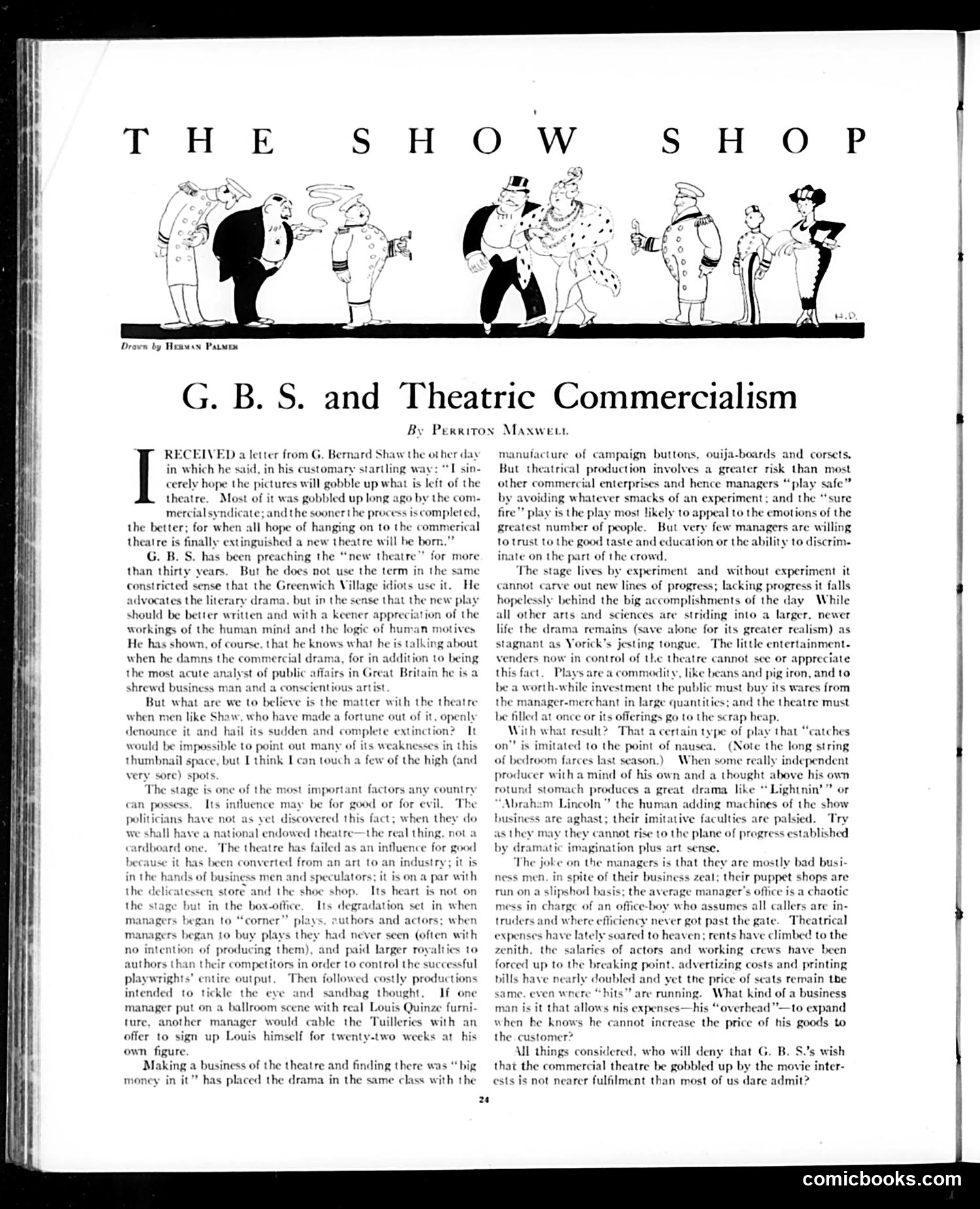
This article critiques the commercialization of theater through a letter from George Bernard Shaw (G.B.S.), the famous Irish playwright and social critic. **The argument:** Shaw claims movies will destroy commercial theater, which is good because it will force a rebirth of genuine "literary drama"—art-focused rather than profit-driven. **The satire's target:** Theater managers who've transformed drama from art into commodity, prioritizing box-office returns over artistic merit. They buy plays sight-unseen, produce expensive spectacles designed for mass appeal rather than innovation, and avoid experimental work because it's financially risky. **The comparison:** Theater is lumped with manufacturing campaign buttons and corsets—reduced to mere commercial enterprise rather than culturally important institution. **The broader critique:** Without government support (a "national endowed theatre"), theater remains controlled by businessmen obsessed with "sure fire" plays that appeal to crowds' emotions rather than their taste or intellect. Other arts progress; drama stagnates. The cartoon's silhouettes likely depict various theatrical character types embodying this commercial degradation.
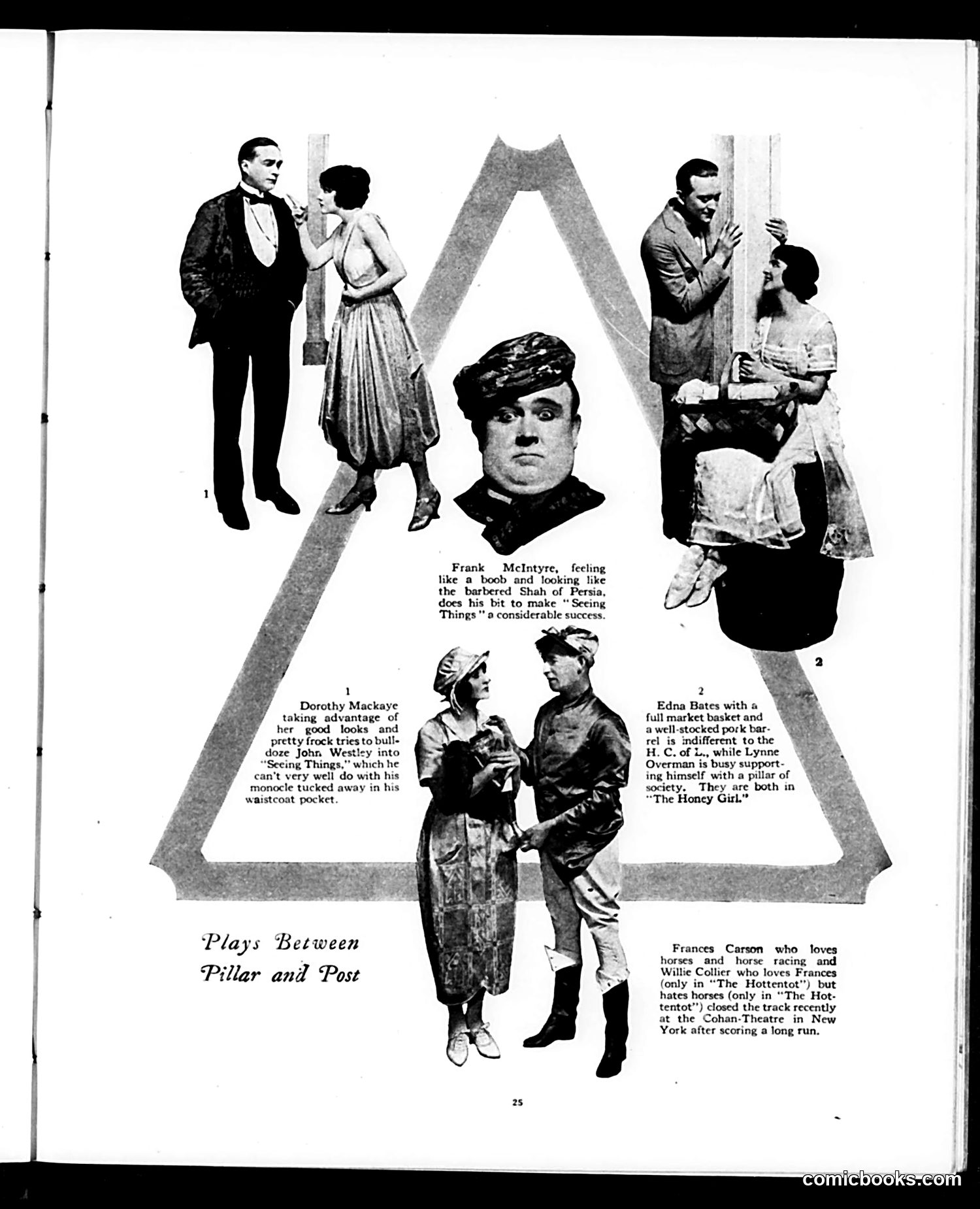
This page reviews Broadway theatrical productions, using photographs of actors with satirical captions. The title references the show "Seeing Things" and plays on the phrase "between a rock and a hard place." The captions mock the actors' performances and appearance. Frank McIntyre is ridiculed for looking like "the barbered Shah of Persia" while promoting "Seeing Things." Dorothy Mackaye attempts to "bulldoze" co-star John Westley into the same production. The captions for "The Honey Girl" and "The Hottentot" make jokes about the plots—one actress indifferent to "H.C. of L." (high cost of living), another actor supporting himself with "a pillar of society." This is entertainment journalism presented as humorous commentary, typical of Judge magazine's approach to cultural coverage in the early 20th century.
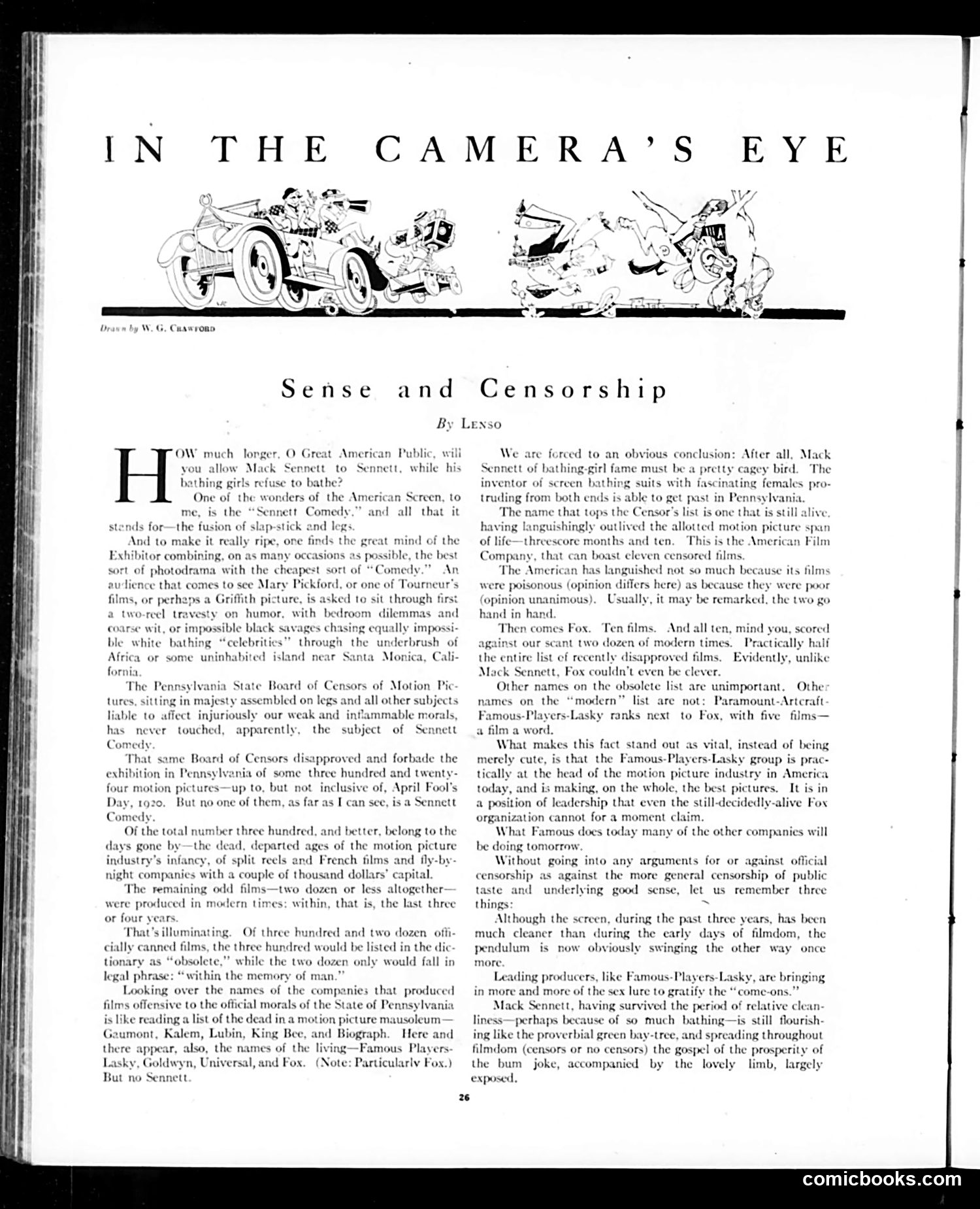
This article by Lenso criticizes Pennsylvania's film censorship board for banning outdated Mack Sennett comedies while allowing contemporary films by major studios like Famous Players-Lasky and Fox. **The satire's point:** The censor board appears moralistic but hypocritical. They banned 300+ old films (mostly from defunct companies like Gaumont and Biograph) for containing "bedroom dilemmas" and bathing scenes, yet permit modern versions of the same content from living studios—particularly Sennett's own bathing-girl comedies, which successfully evade censorship. **The joke:** Sennett, famous for his "bathing beauties" films, somehow escapes the board's wrath despite producing exactly the material they ostensibly forbid. Meanwhile, genuinely struggling studios like American Film Company face banning. **The critique:** This exposes selective censorship based on corporate power rather than moral principle—dead companies get retroactively condemned while profitable ones escape judgment. The illustration (by W.G. Crawford) depicts Sennett's slapstick chaos alongside censorious reaction.
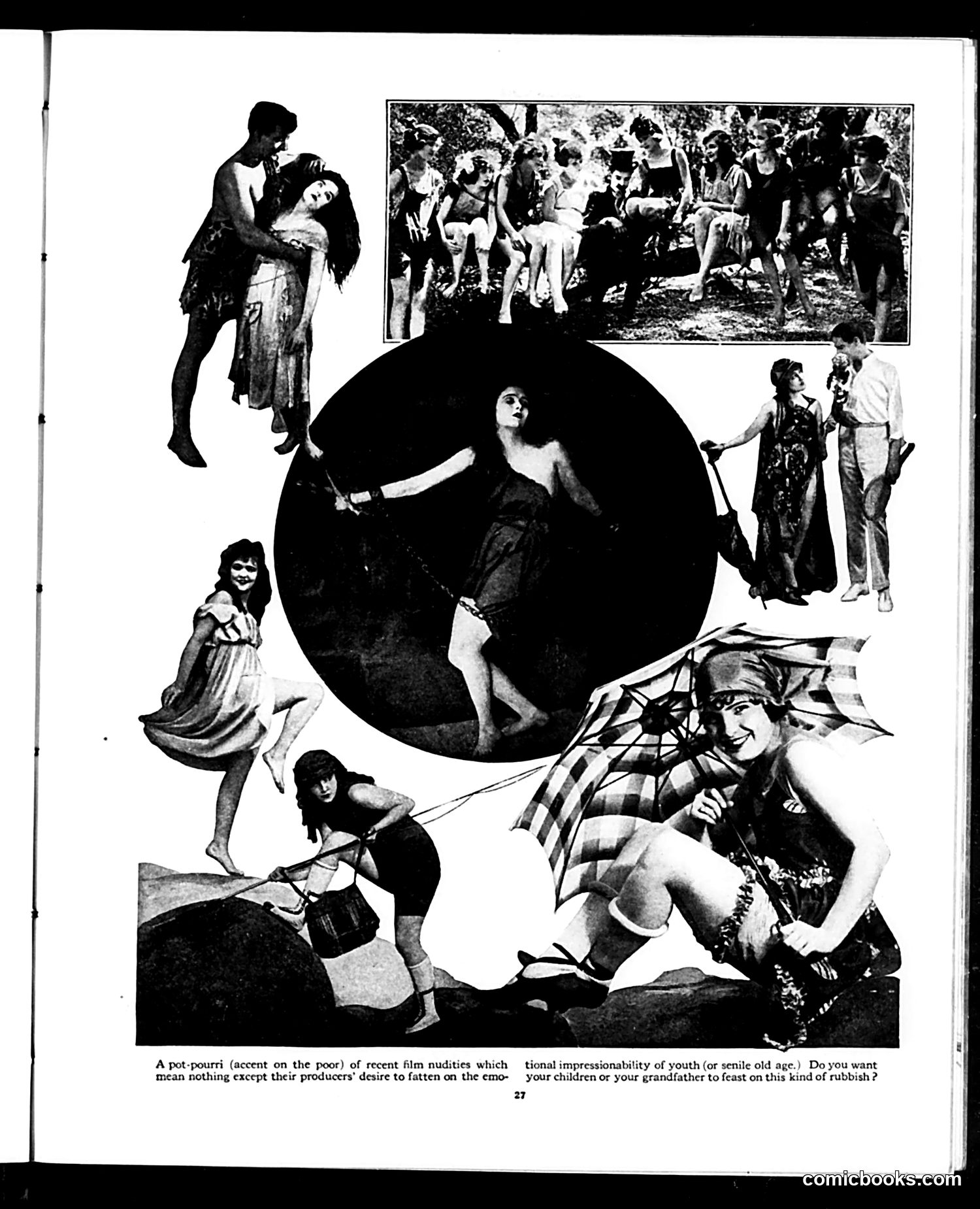
This page satirizes what Judge magazine considered moral degradation in 1920s-30s cinema. The central large circle frames a woman in a suggestive pose, surrounded by smaller images of actresses in various states of undress or compromising situations from recent films. The caption's "pot-pourri (accent on the poor)" is a pun—literally "poor mixture"—suggesting these films are cheap exploitation. The satire targets film producers for profiting from nudity and sexual content by appealing to viewers' base emotions rather than artistic merit. The rhetorical question at the end ("Do you want your children or your grandfather to feast on this kind of rubbish?") reflects contemporary moral panic about cinema's corrupting influence on youth and the elderly. This represents the era's censorship debates and anxiety about mass media's social impact.
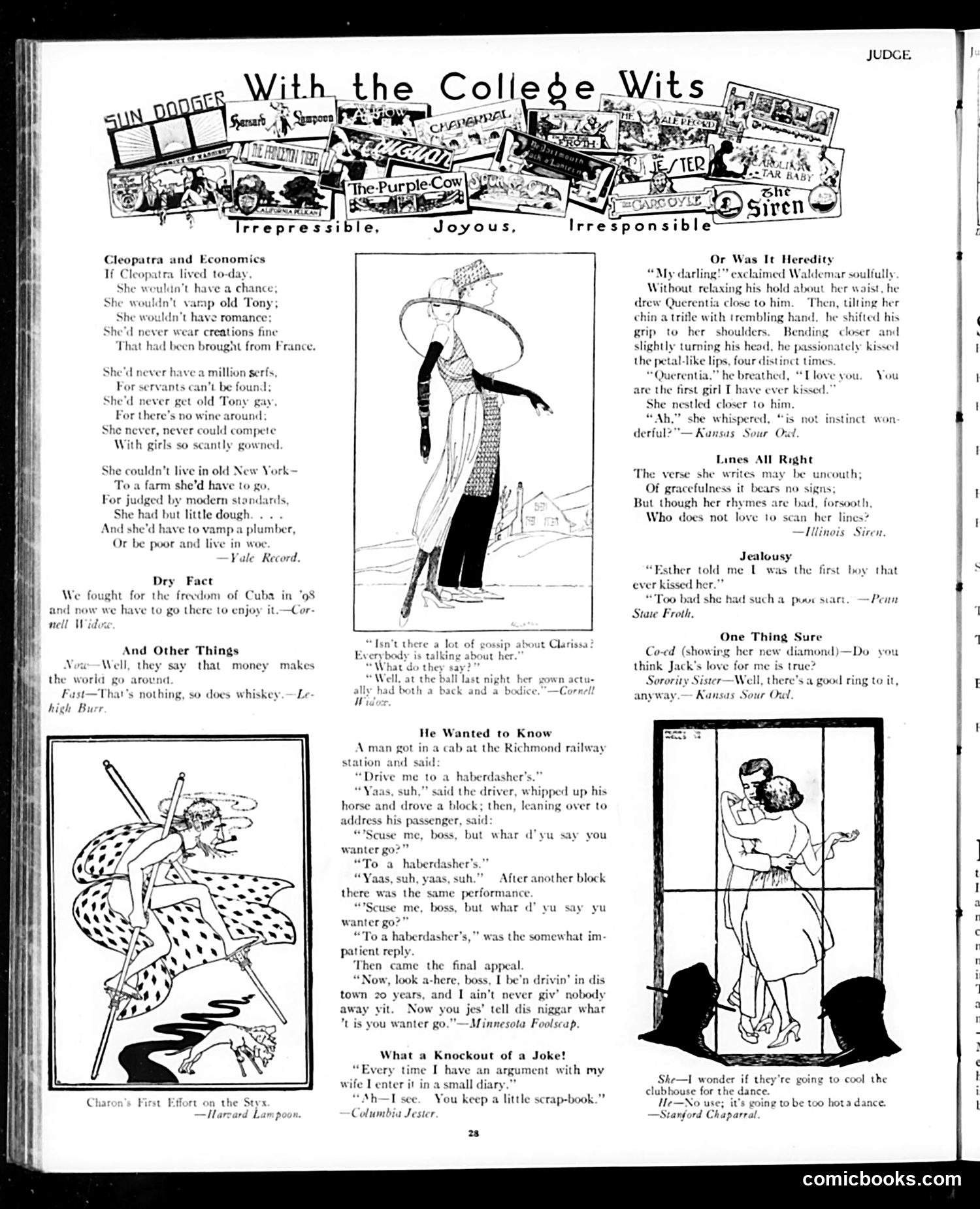
This is a humor page from Judge magazine featuring short comedic pieces and cartoons typical of early 20th-century college humor. The content includes: **"Cleopatra and Economics"**: A satirical poem mocking modern women's economic dependence. It contrasts the historical Cleopatra's wealth and power with a contemporary woman who couldn't compete because she lacks servants, fine imported goods, and wine (likely referencing Prohibition), and would need to "vamp a plumber" instead of royalty. **"He Wanted to Know"**: A dialect humor piece featuring a confused Richmond taxi driver repeatedly asking a passenger where he wants to go, only to reveal he's never heard of the destination. This reflects period stereotypes about African American dialect for comic effect. **Other sections** include brief quips about romance, marriage, and courtship among college-aged characters, using wordplay and mild flirtation as humor. The overall tone reflects Jazz Age social commentary—economics, women's roles, class differences—filtered through casual collegiate satire.
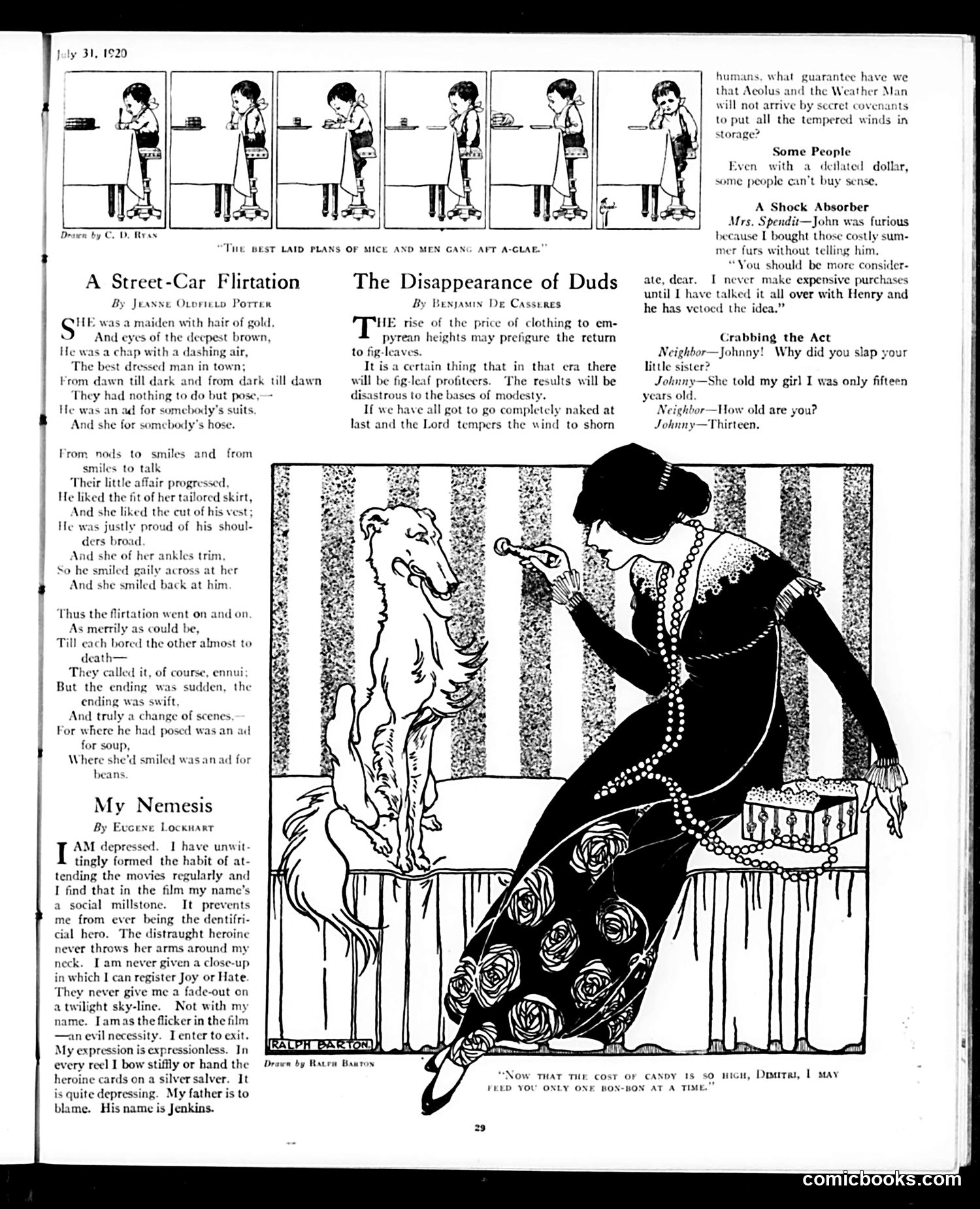
This page contains several satirical pieces reflecting 1920s social anxieties: **"A Street-Car Flirtation"** mocks advertising's pervasiveness—a couple flirts while literally serving as human billboards (he's "an ad for somebody's suits," she for "somebody's hose"). The joke: their romance ends when they're replaced by soup and bean advertisements, reducing human connection to commercial space. **"The Disappearance of Duds"** satirizes post-war inflation and shifting morality. As clothing prices skyrocket toward absurdity, the author jokes society will return to fig leaves. The cartoon illustrates a wealthy woman rationing candy to her husband due to cost—commentary on how wartime inflation affected even the rich. **"My Nemesis"** humorously complains that having the surname "Jenkins" typecast him as a villain in silent films—he's never the romantic lead, only the stiff supporting character. This reflects silent cinema's reliance on crude character types. The smaller anecdotes address marital dynamics and childhood behavior—typical Judge humor targeting middle-class life. Overall, the page reflects 1920s concerns: commercialism, inflation, and social propriety.
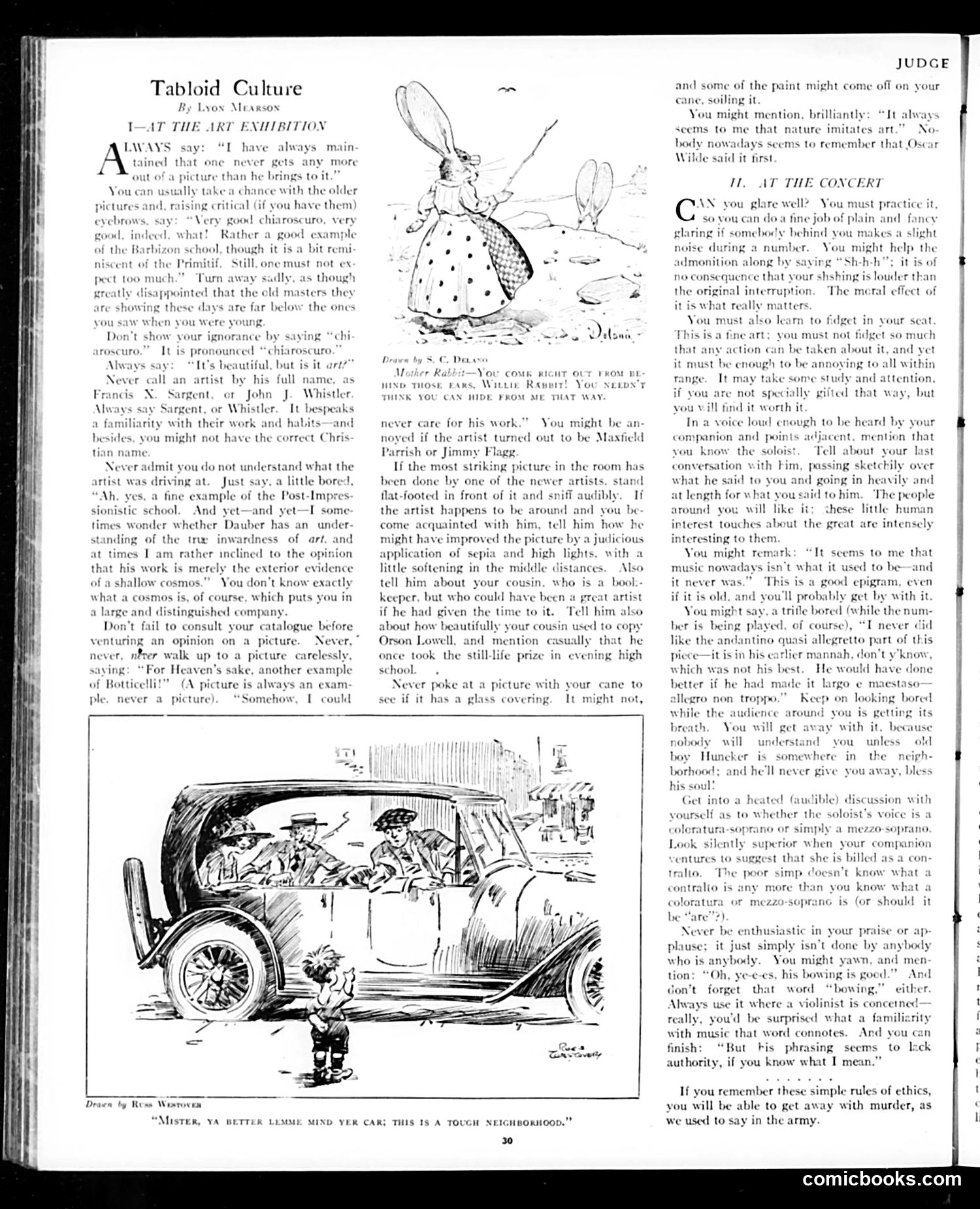
This satirical article by Lyon Mearson mocks the pretentious behavior of middle-class cultural tourists at art exhibitions and concerts. The piece offers tongue-in-cheek "rules" for appearing cultured without genuine knowledge or appreciation. **Key targets:** - People who use art jargon (like "chiaroscuro") without understanding it - Those who name-drop artists casually to seem familiar with their work - Visitors who consult catalogs only *after* forming opinions - The hypocrisy of praising mediocre work while criticizing masterpieces by living artists **The cartoons illustrate** this shallow posturing: one shows a pretentious rabbit examining art, another depicts rude concert behavior treated as an art form. The satire suggests that "tabloid culture"—superficial engagement with high culture for social status—is absurd. By explicitly instructing readers how to fake sophistication, Mearson exposes how easily people adopt cultural masks without substance, a recurring theme in Judge's critique of American manners and pretension.
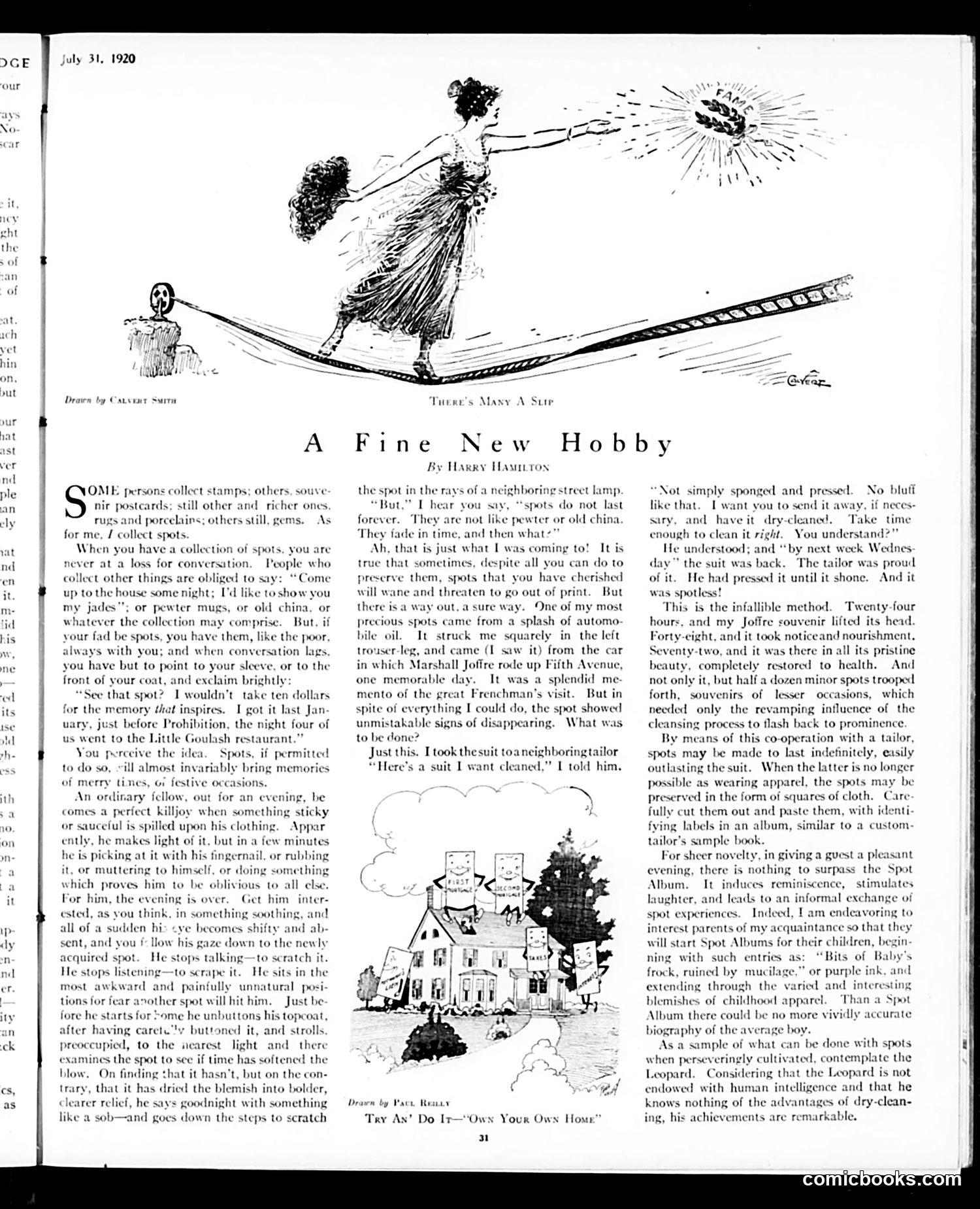
This humorous essay by Harry Hamilton satirizes the collector's mindset by proposing an absurd hobby: collecting stains and spots on clothing. The piece gently mocks wealthy collectors of stamps, postcards, porcelain, and gems by suggesting spots are superior—they're always with you and trigger nostalgic memories. The joke hinges on the contrast between the narrator's enthusiasm for preserving meaningful spots (like one from Marshal Joffre's 1920 visit to Fifth Avenue) and ordinary people's dismay at soiling their clothes. The satire peaks when he describes sending a suit to the tailor to *prevent* spot removal, only to have it cleaned anyway—defeating his entire "collection." Published just after Prohibition's enactment (January 1920), the reference to "before Prohibition" at the Little Goulash restaurant adds topical humor: the lost age of casual dining and accidental spills now seems nostalgic. The accompanying illustrations by Cesare Serra and Paul Henley show a woman with exaggerated gestures, likely visualizing the absurdity of spot-collecting.
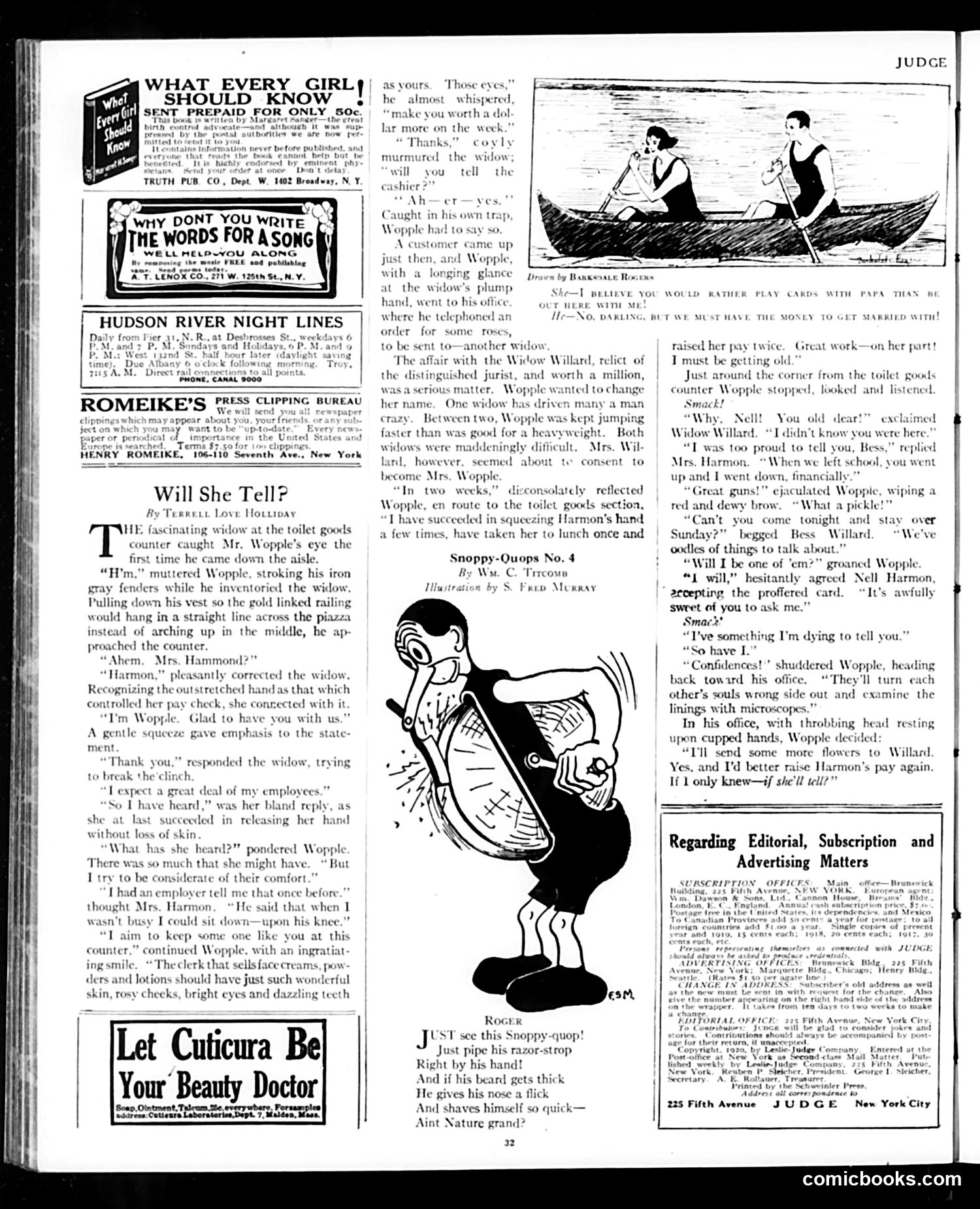
This is a short comedic story about workplace dynamics and romantic entanglement, not political satire. **The Plot:** Mr. Wopple, a cosmetics counter manager, flirts with and courts two wealthy widows—Mrs. Harmon (a clerk) and the affluent Widow Willard—simultaneously. He offers Mrs. Harmon raises and compliments to keep her as a sales asset, unaware she's actually an old school friend of his other romantic interest. The story's tension hinges on whether Mrs. Harmon will reveal Wopple's duplicitous courtship to Widow Willard when they unexpectedly encounter each other. **The Satire:** The humor targets opportunistic male behavior—Wopple's transparent seduction tactics (flattery, small gifts, promises) and his assumption that women can be manipulated through vanity and financial incentive. The ironic ending implies the women's reunion will expose his game. The accompanying advertisements and "Snoopy-Quoops" cartoon are unrelated content typical of this magazine's mixed format.
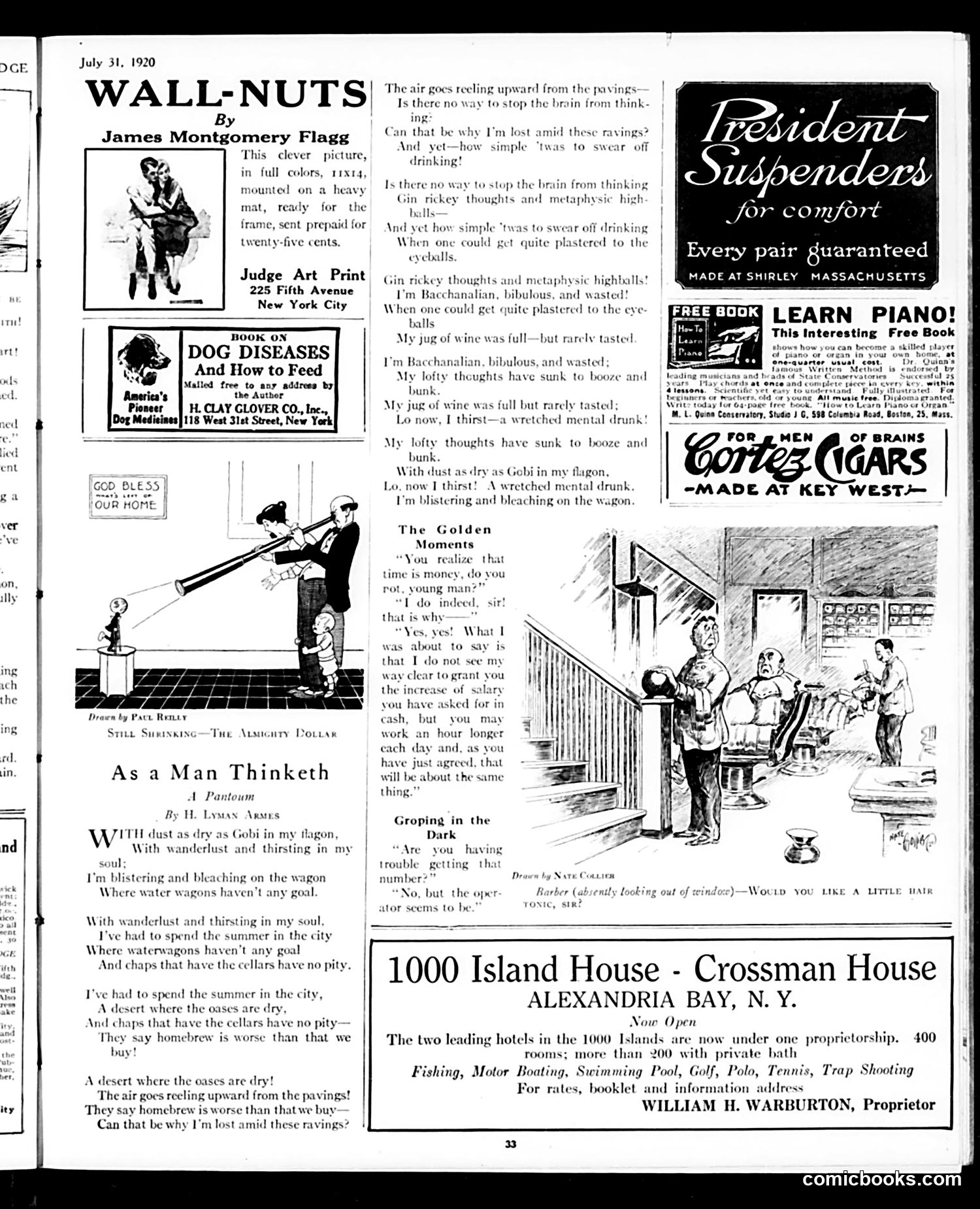
This page mixes satirical poetry and comics with advertisements. The main literary piece, "Wall-Nuts," is a comic poem by James Montgomery Flagg depicting Prohibition-era frustration. The narrator complains of summer heat and thirst while yearning for alcohol—he's barred from buying it legally ("homebrew" references illegal drinking during Prohibition, which began January 1920). The poem satirizes the impossibility of abstinence, with puns on "gin rickey" (a cocktail) and becoming a "wretched mental drunk" from temptation, not actual drinking. The smaller cartoon "Still Shrinking—The Almighty Dollar" shows a businessman denying a salary increase to an employee, instead offering longer work hours—satirizing post-WWI economic hardship disguised as benefit. Advertisements (suspenders, piano lessons, cigars, hotels) fill the remainder, typical of Judge's commercial content. The page reflects 1920s anxieties about Prohibition's enforcement and working-class economic struggle.
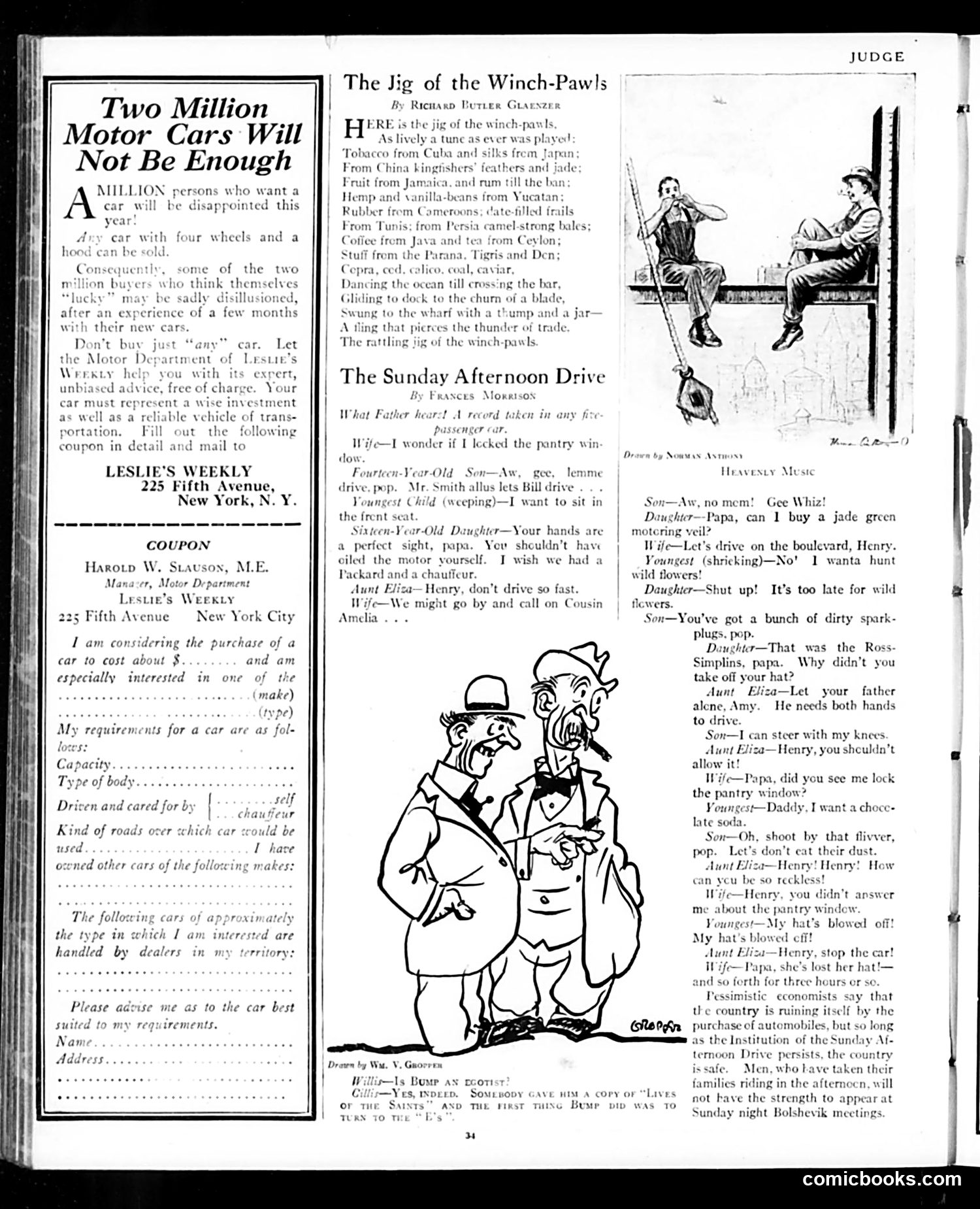
This page contains two distinct pieces of satirical content: ## "Two Million Motor Cars Will Not Be Enough" An advertisement for Leslie's Weekly magazine disguised as editorial commentary. It mocks newly wealthy car buyers who purchase automobiles without genuine expertise, warning them not to buy "just any" car. The satire suggests that two million motor cars won't satisfy America's aspirational middle class, poking fun at consumer culture and automobile mania in the early 20th century. ## "The Sunday Afternoon Drive" A domestic comedy sketch depicting a chaotic family car ride with multiple generations—parents, teenagers, and aunts—all backseat driving and bickering. The humor lies in the cacophony of complaints: concerns about reckless driving, requests for ice cream, lost hats, and mechanical problems. The closing satirical note is particularly pointed: it suggests that automobile culture actually *prevents* social upheaval by keeping working-class men occupied with Sunday drives rather than attending "Bolshevik meetings"—a reference to communist organizing. The joke critiques both domestic chaos and implicitly mocks the period's Red Scare anxieties.
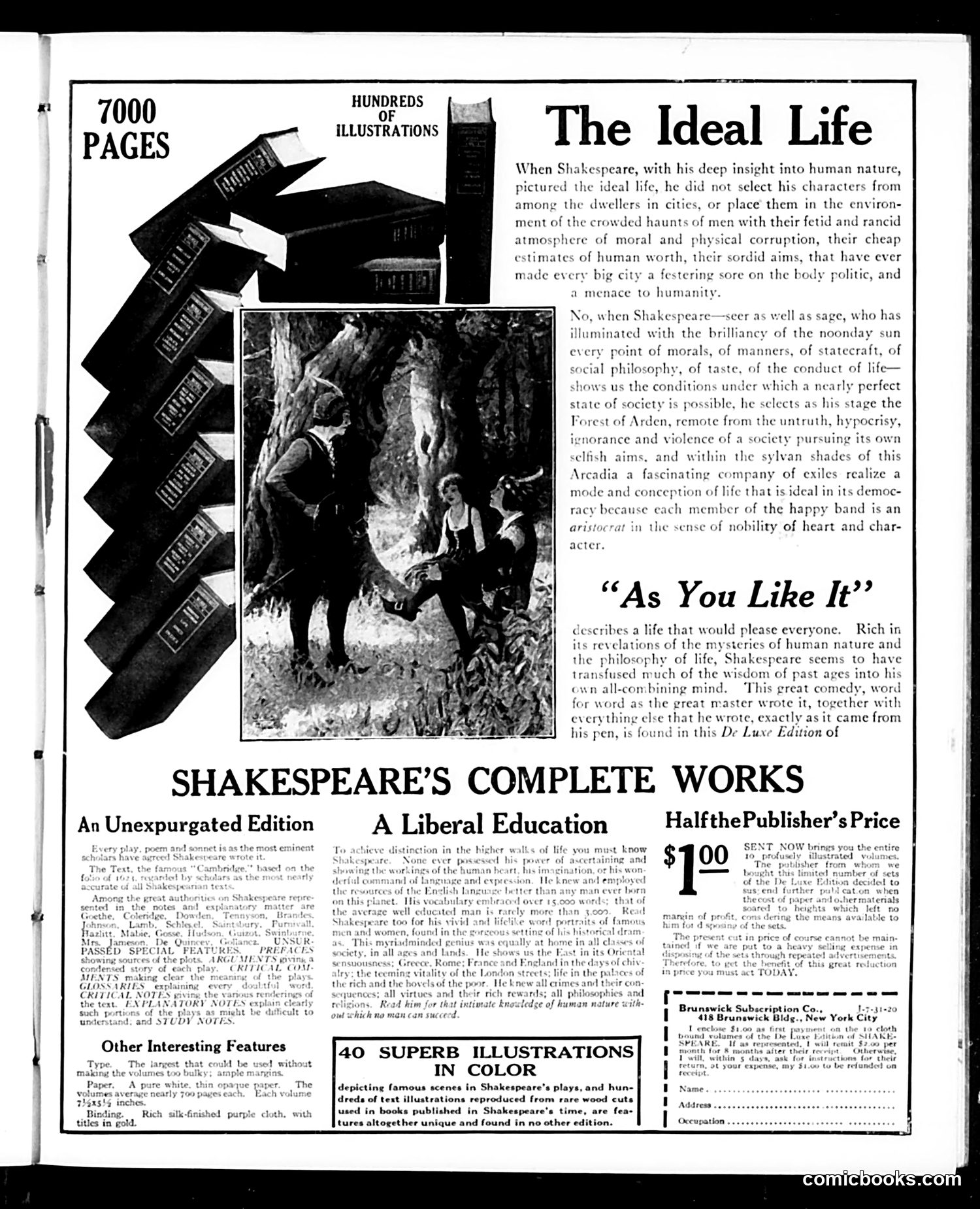
This is primarily a **full-page advertisement** for a deluxe Shakespeare edition, not a political cartoon. The page uses editorial content as marketing framing. The advertisement leverages Shakespeare's *As You Like It* to promote an idealized vision of rural life versus urban corruption. The text argues that Shakespeare—presented as a moral sage—deliberately set his ideal society in the Forest of Arden rather than corrupt cities, where people suffer "moral and physical corruption" and "cheap estimates of human worth." This reflects **turn-of-century anti-urbanism**: a common cultural anxiety about industrial cities as moral wastelands. The publisher positions their complete Shakespeare edition as offering philosophical wisdom on how to live properly—implying that Shakespeare's rural idyll provides guidance for modern readers. The advertisement emphasizes comprehensiveness ("7000 pages," glossaries, color illustrations) and affordability ("half the publisher's price" at $1.00) to appeal to educated middle-class buyers seeking cultural refinement and moral instruction through literature.
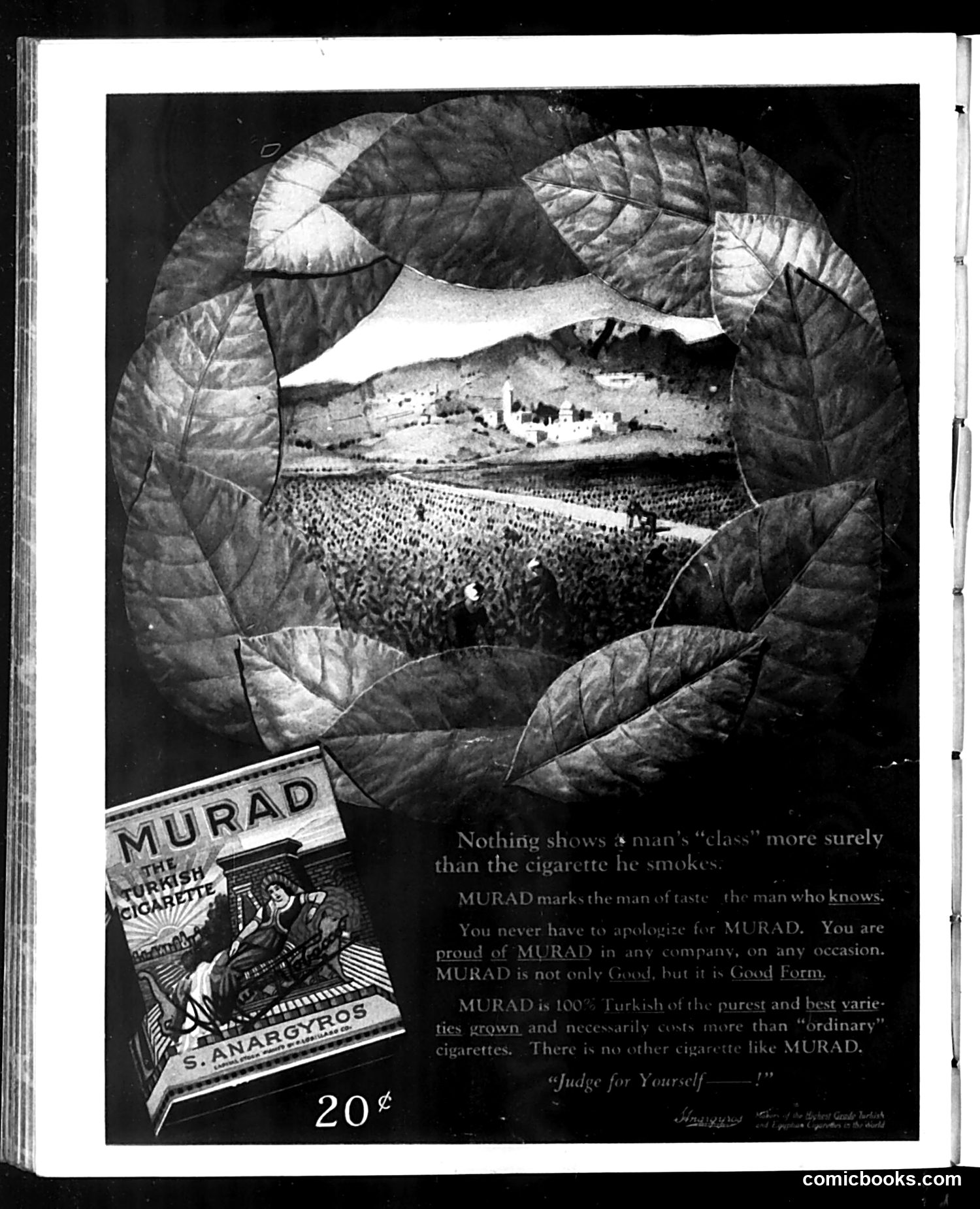
This page is primarily a **cigarette advertisement**, not political satire. It advertises Murad brand cigarettes (20¢), specifically Turkish tobacco varieties made by S. Anargyros. The image uses a framing device—a landscape photograph of agricultural fields and a distant town viewed through large leaves—to suggest natural purity and quality. This visual metaphor reinforces the text's claim that Murad represents superior taste and class. The advertisement's messaging ("Nothing shows a man's 'class' more surely than the cigarette he smokes") appeals to status-consciousness and social aspiration, a common advertising strategy of this era. The phrase "Judge for Yourself" invites consumer confidence. There is no political cartoon or satire evident on this page—it is straightforward commercial promotion.