
Judge, 1920-07-31 · page 14 of 36
Judge — July 31, 1920 — page 14: what you’re looking at
What you’re looking at
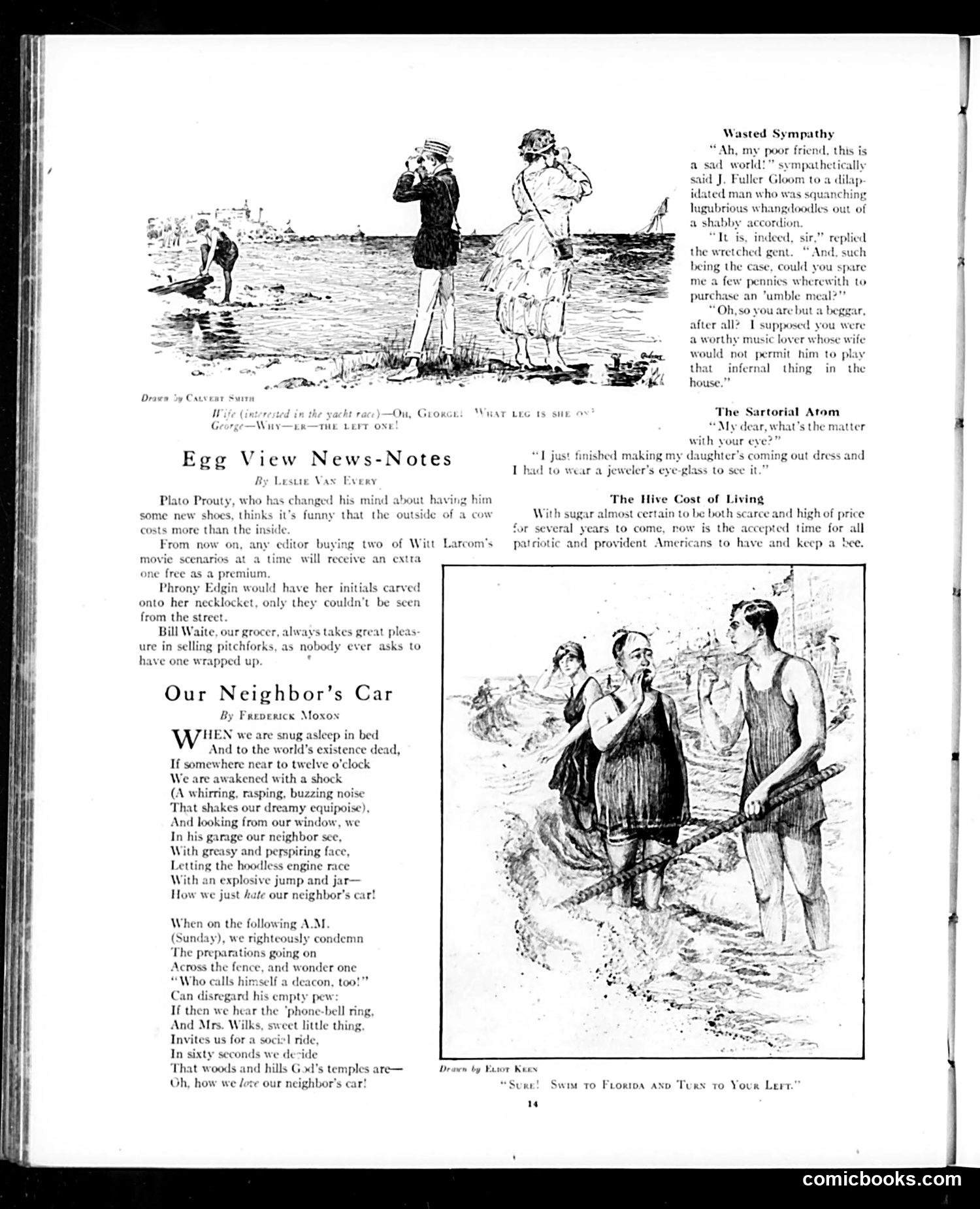
This page contains three satirical pieces from *Judge* magazine: **"Wasted Sympathy"**: A well-dressed man (J. Fuller Gloom) expresses pity to a beggar playing accordion, assuming he's a suffering musician. When the beggar asks for money for food, Gloom's sympathy evaporates—he realizes the man is simply poor, not a worthy artist. The satire mocks selective compassion: wealthy people sympathize with suffering only when it fits their romantic notions, not actual need. **"Our Neighbor's Car"**: A humorous poem about suburban hypocrisy. Neighbors resent their peer's noisy car at night but eagerly accept a ride in it the next day. It satirizes how people criticize neighbors' possessions while coveting the same things. **"The Hive Cost of Living"**: Brief notes on wartime rationing, suggesting Americans should keep bees to ensure sugar supplies. This reflects WWI-era food scarcity and government encouragement of home production. All three pieces use gentle social satire targeting middle-class behavior and attitudes.
📄 Transcribed text from this page (OCR, searchable)
Machine-transcribed from the original scan — historical spelling and the odd misread are preserved.
Wasted Sympath “Ah, my poor friend, this is a sad world!” sympathetically said J. Fuller Gloom to a dilap idated man who was squanching lugubrious whangdoodles out of a shabby accordion “It is, indeed, sir,” replied the wretched gent.“ And, such being the case, could you spare me a few pennies wherewith to purchase an ‘umble meal?” “Oh, so you are but a beggar, after all? I supposed you were a worthy nusic lover whose wife Id not permit him to play infernal thing in’ the Sartorial Atom y dear, what’s the matter with your eye? Egg View News-Notes “1 just finished making my daughter's ¢ ing out dress and Ry Leste Vas Every yut having him The Hive Cost of Living le of a cow With sugar almost certain to be both scare id high of price al years to come, row is the accepted time for all ic and provident Americans to have and keep a bee. Plato Prouty, who has changed his n some new shoes, thinks it’s funny that the for sev From now on, any editor buying two of Witt Larcom’s patric movie scenarios at a time will receive an extra one free as a premium Phrony Edgin would have her initials carved onto her necklocket, only they couldn't be seen from the street Bill Waite, our grocer, always takes great pleas ure in selling pitchforks, as nobody ever asks to have one wrapped up. ‘ Our Neighbor’s Car By Frepenicx Moxox costs more than the insi HEN we are snug asleep in bed And to the world’s existence dead, If somewhere near to twelve o'clock We are awakened with a shock rasping, buzzing noise That shakes our dreamy equipoise), And looking from our window, we In his garage our neighbor see, With greasy and perspiring face, Letting the hoodless engine race With an explosive jump and jar— How we just /ate our neighbor's car! When on the following A.M. (Sunday), ighteously condemn ‘The preparations going on Across the fence, and wonder one “Who calls himself a deacon, too!” Can disregard his empty pew If then we hear the ‘phone-bell rin And Mrs. Wilks, sweet little thin; Invites us for a socisl ride, In sixty seconds we decide That woods and hills God's temples are— Drawn by Eutor Kees Oh, how we ve our neighbor's car! “Sure! Swit to Frortoa axp Turx ro Your Lert. 4 a i comicbooks.com