
Judge, 1920-07-31 · page 24 of 36
Judge — July 31, 1920 — page 24: what you’re looking at
What you’re looking at
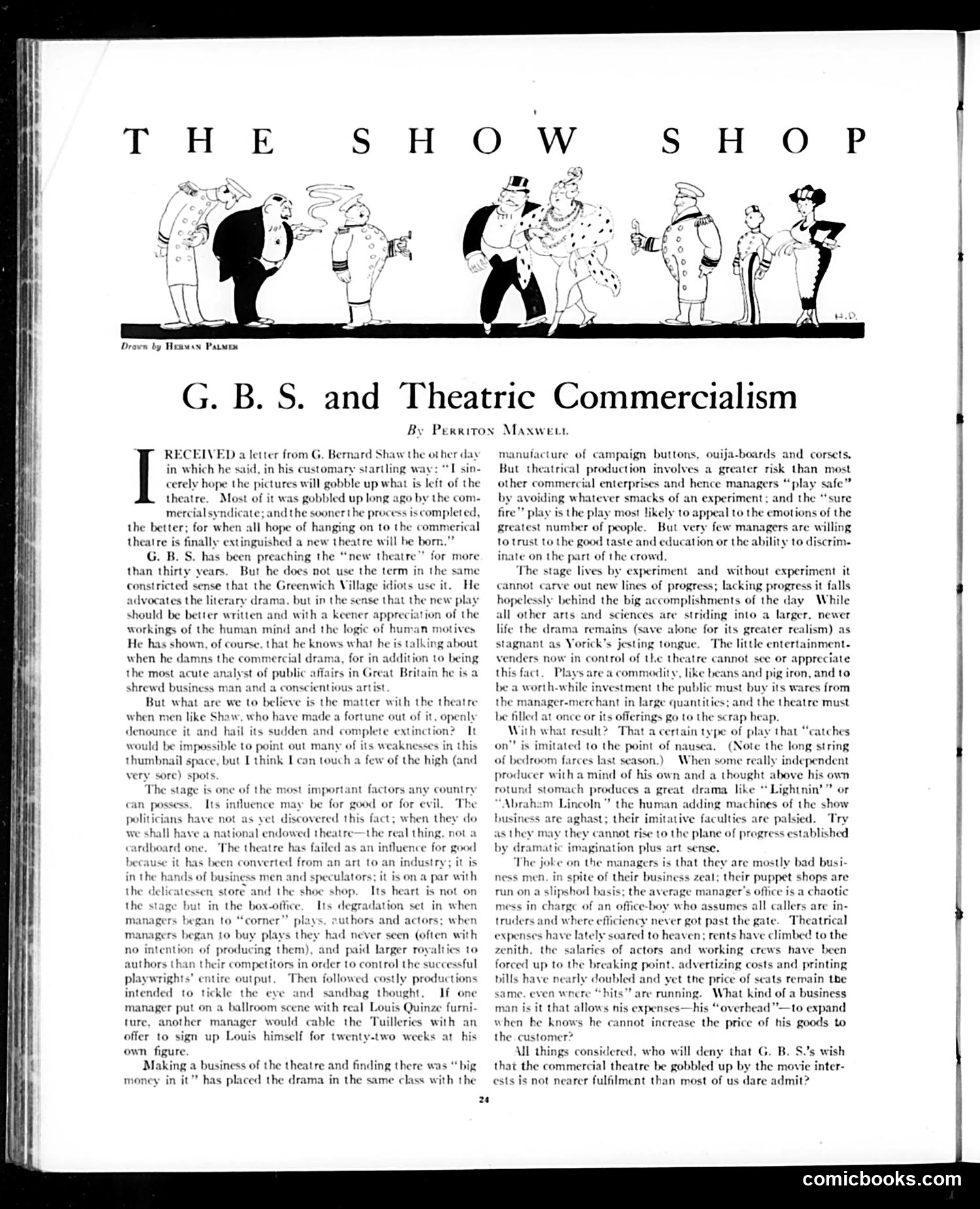
This article critiques the commercialization of theater through a letter from George Bernard Shaw (G.B.S.), the famous Irish playwright and social critic. **The argument:** Shaw claims movies will destroy commercial theater, which is good because it will force a rebirth of genuine "literary drama"—art-focused rather than profit-driven. **The satire's target:** Theater managers who've transformed drama from art into commodity, prioritizing box-office returns over artistic merit. They buy plays sight-unseen, produce expensive spectacles designed for mass appeal rather than innovation, and avoid experimental work because it's financially risky. **The comparison:** Theater is lumped with manufacturing campaign buttons and corsets—reduced to mere commercial enterprise rather than culturally important institution. **The broader critique:** Without government support (a "national endowed theatre"), theater remains controlled by businessmen obsessed with "sure fire" plays that appeal to crowds' emotions rather than their taste or intellect. Other arts progress; drama stagnates. The cartoon's silhouettes likely depict various theatrical character types embodying this commercial degradation.
📄 Transcribed text from this page (OCR, searchable)
Machine-transcribed from the original scan — historical spelling and the odd misread are preserved.
Drown by Heawan Pawex G. B. S. and Theatric Commercialism By Perriton Maxwett RECEIVED a letter from G. Bernard Shaw the ot her day in which he said, in his customary startling way: “I sin- cerely hope the pictures will gobble up what is left of the theatre. Most of it was gobbled up long ago by the com- mercial syndicate; and the sooner the process is completed, the better; for when all hope of hanging on to the commerical theatre is finally extinguished a new theatre will be born.”” G. B. S. has been preaching the “new theatre” for more than thirty years. But he does not use the term in the same constricted sense that the Greenwich Village idiots use it. He advocates the literary drama, but in the sense that the new play should be better written and with a keener appreciation of the workings of the human mind and the logic of human He has shown, of course. that he knows what he is talh about when he damns the commercial drama, for in addition to being the most acute analyst of public affairs in Great Britain he is a shrewd business man and a conscientious artist But what are we to believe is the matter with the theatre when men like Shaw. who have made a fortune out of it, openly denounce it and hail its sudden and complete extinction? It would be impossible to point out many of its weaknesses in thumbnail space, but I think I can touch a few of the high (and very sore) spots. The stage is one of the most important factors any country olives can possess, Its influence may be for good or for evil. The politicians have not as yet discovered this fact; when they do we shall have a national endowed theatre—the real thing, not a cardboard one. The theatre has failed as an influence for bec ed from an art to an industry it is ona par with « it has been conv hands of business men and speculate atessen store and the shoe shop. Its heart is not on © but in the box-office, [Is degradation set in when corner” plays, cuthors and actors; when in th the de the s managers began to managers began to buy plays they had never seen (often with no intention of producing them), and paid larger royalties to authors than their competitors in order to control the successful playwrights’ entire output. Then followed costly productions intended to tickle the eye and sandbag thou manager put on a ballroom scene with real Louis Quinze furni- ture, another manager would cable the Tuilleries with an offer to sign up Louis himself for twenty-two weeks at his own figure Making a business of the theatre and finding there was “ig y in it” has placed the drama in the same class with the me 2 manufacture of campaign buttons, ouija-boards and corsets. But theatrical production involves a greater risk than most other commercial enterprises and hence managers “play safe” by avoiding whatever smacks of an experiment; and the “sure fire” play is the play most likely to appeal to the emotions of the greatest number of people. But very few managers are willing to trust to the good taste and education or the ability to discrim- inate on the part of the crowd, The stage lives by experiment and without experiment it cannot carve out new lines of progress; lacking progress it falls hopelessly behind the big accomplishments of the day While all other arts and sciences are striding into a larger, newer life the drama remains (save alone for its greater realism) as stagnant as Yorick’s jesting tongue. The little entertainment. venders now in control of the theatre cannot see or appreciate this fact. Plays are a commodity, like beans and pig iron, and to be a worth-while investment the public must buy its wares from the manager-merchant in large quantities; and the theatre must be filled at once or its offerings go to the scrap heap With what result?) That a certain type of play that “catches on” is imitated to the point of nausea. (Note the long string of bedroom farces last season.) When some really independent producer with a mind of his own and a thought above his own rotund stomach produces a great drama like ‘Lightnin’ or “Abraham Lincoln” the human adding machines of the show business are aghast; their imitative faculties are palsied. Try as they may they cannot rise to the plane of progress established by dramatic imagination plus art sense. The joke on the managers is that they are mostly bad busi- ness men. in spite of their business zeal; their puppet shops are run on a sl the average manager's office is a chaotic mess in charge of an office-boy who assumes all callers are in- truders and where efficiency never got past the gate. Theatrical expenses have lately soared to heaven; rents have climbed to the zenith, the salaries of actors and working crews have been forced up to the breaking point, advertizing costs and printing Is have nearly doubled and yet the price of seats remain the same. even where “hits” are running. What kind of a business man is it that allows nis expenses—his “overhead ’’—to expand when he knows he cannot increase the price of his goods to the customer? Ml things considered, who will deny that G. B. S.’s wish that the commercial theatre be gobbled up by the movie inter- ests is not nearer fulfilment than most of us dare admit? rshod basis comicbooks.com