
Judge, 1920-07-31 · page 30 of 36
Judge — July 31, 1920 — page 30: what you’re looking at
What you’re looking at
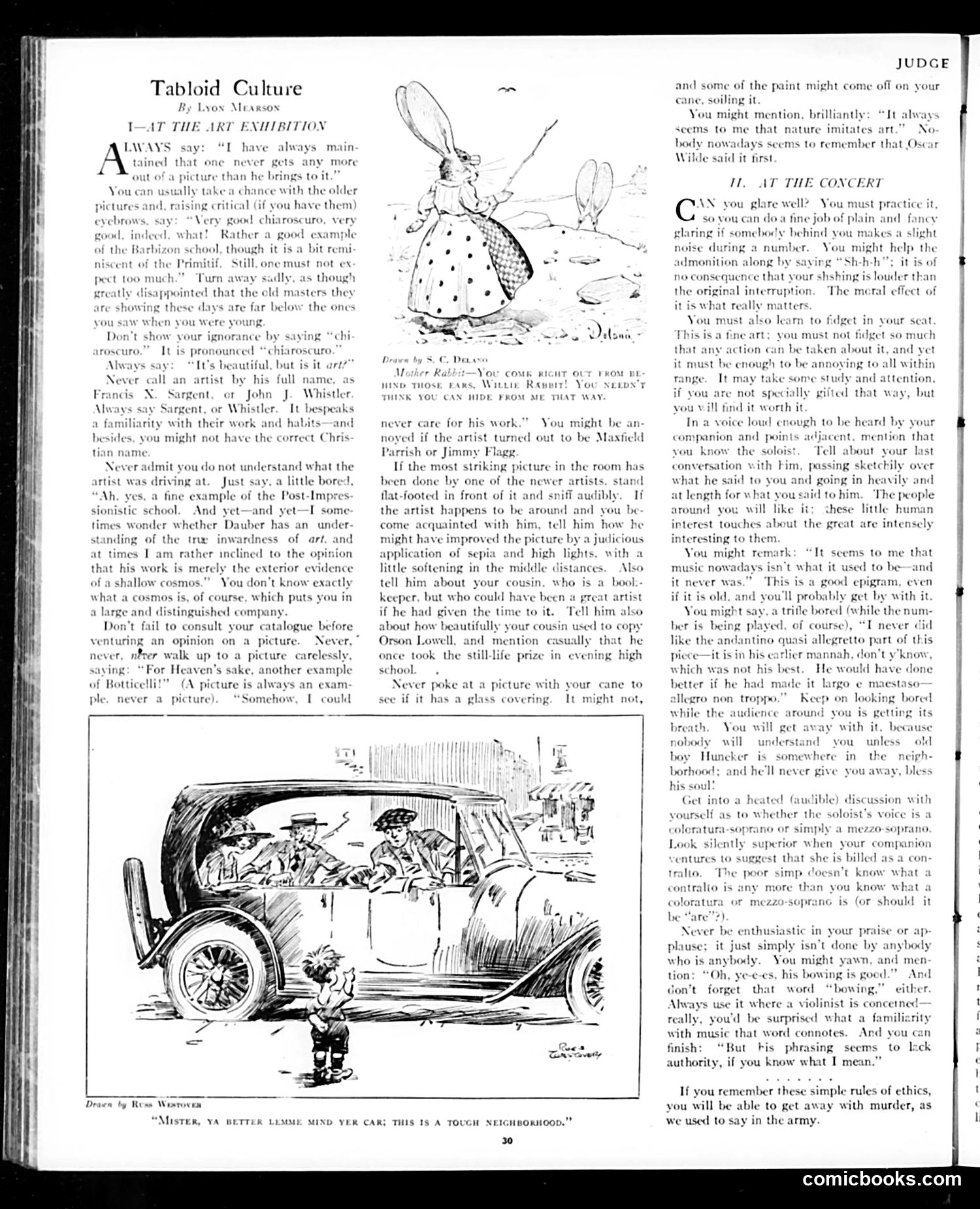
This satirical article by Lyon Mearson mocks the pretentious behavior of middle-class cultural tourists at art exhibitions and concerts. The piece offers tongue-in-cheek "rules" for appearing cultured without genuine knowledge or appreciation. **Key targets:** - People who use art jargon (like "chiaroscuro") without understanding it - Those who name-drop artists casually to seem familiar with their work - Visitors who consult catalogs only *after* forming opinions - The hypocrisy of praising mediocre work while criticizing masterpieces by living artists **The cartoons illustrate** this shallow posturing: one shows a pretentious rabbit examining art, another depicts rude concert behavior treated as an art form. The satire suggests that "tabloid culture"—superficial engagement with high culture for social status—is absurd. By explicitly instructing readers how to fake sophistication, Mearson exposes how easily people adopt cultural masks without substance, a recurring theme in Judge's critique of American manners and pretension.
📄 Transcribed text from this page (OCR, searchable)
Machine-transcribed from the original scan — historical spelling and the odd misread are preserved.
Tabloid Culture By Lyox Mearsox I—AT THE ART EXHIBITION LWAYS say: “I have always) main FA tained that one never gets any more out of a picture than he brings to it.’ You can ally take a chance with the older pictures and, raising critical (if you have them) eyebrows, say Very good chiaroscuro, very good hat! Rather a good example of th hool, though it is a bit remi Still, one must not ex niscer Prim Tum away sadly, as though Id masters they pect too muc greatly disappointed that the these days are far belov the ones are showi you saw when you Were young Don’t show y ignorance by saying “chi uro.”” It is pronounced “chiaro: “Lt's beautiful, but is it art?” iroscuro.”” Always say Never call an artist by his full name. Francis X. Sargent. er John J. Whistler s say Sargent, or Whistler. It bespeaks liarity with their work and habits—and ides, you might not have the correct Chris tian name Never admit you do not understand what the artist was driving at. Just say, a little bored, “Ah, yes, a fine example of the Post-Impres sionistic school, And yet—and yet—I some times wonder whether Dauber has an under standing of the tre inwardness of art. and ut times I am rather inclined to the opinion hat his work is merely shallow cosmos.” You don’t know exactly what a cosmos is, of course, which puts you in a large and distinguished company Don't fail to consult your catalogue be venturing an opinion on a_ picture. never, nfrer walk up to a picture carelessly, ying: “For Heaven's sake, another example Botticelli!” (A picture is always an exam ple, never a mehow, I the exterior evidence ore could picture) Never, ” Drawn by S.C. Denase M ¢ Rabiit—You comm KiGnt OUT FROM BE Wixp THOSE BARS, Wintie Reworr! You xeeps’r THINK YOU CAN HIDE FROM ME THAT WAY You might be an to be ¥ ld never care for his work.” noyed if the artist turned ¢ Parrish or Jimmy Flagg If the most striking picture in the room has been done by one of the newer artists. stand flat-footed in front of it and sniff audibly. If the artist happens to be around and you be come acquainted with him, tell him how he might have improved the picture by a judicious application of sepia and high lights. with a little softening in the middle distances. Al tell him about your cousin, who is a be keeper, but who could have been a great artist if he had given the time to it. Tell about how beautifully your cousin used to copy Orson Lowell, and sually that he once took the still-life prize in evening high school. Never poke at a pict see if it has a glass covering. so mention ¢ with your cane to It might not, Dracn by Ress Wostowen “MISTER, YA BETTER Lesae MIND YER CAR; THIS IS A TOUGH NEIGHBORHOOD.” 30 and some of the paint might con off on your fg it might mention, brilliantly seems to me that nature imitates art.” body n Wilde said it first “Tt always wadays seems to remember that Oscar WW. AT THE CONCERT You must practice it so you can doa fine job of plain and f y behind ye AN you glare well? if somebe noise during a number. admonition along by saying e that your shshing is louder than The meral effect of no consequer original interruption what really matters You must also Jeam to fidget in your seat art; you must not fidget so mu on can be taken about it, and y that any act it must be enough to be annoying to all with range. It may take some study and attention. if you are not specially gifted that way, but you will find it worth it gh to be heard t ncent, mention that Tell about your last th him, passing sketchily over what he said to you and going in heavily and at length for what you said tohim. The people around you will like it; these little human interest touches about the great are intensely In a voice loud en your companion and poin you know the conversation \ eresting to th You might rer music nowadays isn’t what it used to be it never was.” This is a good epigram, even if it is old, and you'll probably get by with it You might say. a trifle bored (while the num- ber is being pls f course), “T never did like the andantino quasi allegretto part of this piece—it is in his carlier mannah, don’t y'know, which was not his best. He would have better if he had made it largo ¢ mae allegro Keep on looking bored while the is getting its ark: “It seems to me that and on troppo audience around ye breath. You will get away with it, because nobody will understa you unless ol boy Huneker is where in the neigh- borhood; and he'll never give you away, bless his { Get into a heated (audible) discussion with c ist’s voice is a rself as to whether t coleratura-soprano or simply a mezz« , Look silently superior when you gest that she is 1 poor simp doesn’t kn eny more than you kn sopra Fr companion led as a con- entures to s alto. Th tralio is 16 is (or should it be * Never be enthusiastic in your praise or ap plause; it just simply isn’t done by anybody You might yawn, and men mezz0-soy who is anybody tion: “Oh, ye-e-es, his bowing is good.” And don’t forget that word “bowing.” either. Always use it where a violinist is concerned really, you'd be surprised what a. familiarity And you can Ieck with music that word connotes. finish: “But his phrasing secms to authority, if you know what I mean.” rules of ethics, you will be able to get away with murder, as we used to say in the army. JUDGE comicbooks.com