
Judge, 1920-07-31 · page 23 of 36
Judge — July 31, 1920 — page 23: what you’re looking at
What you’re looking at
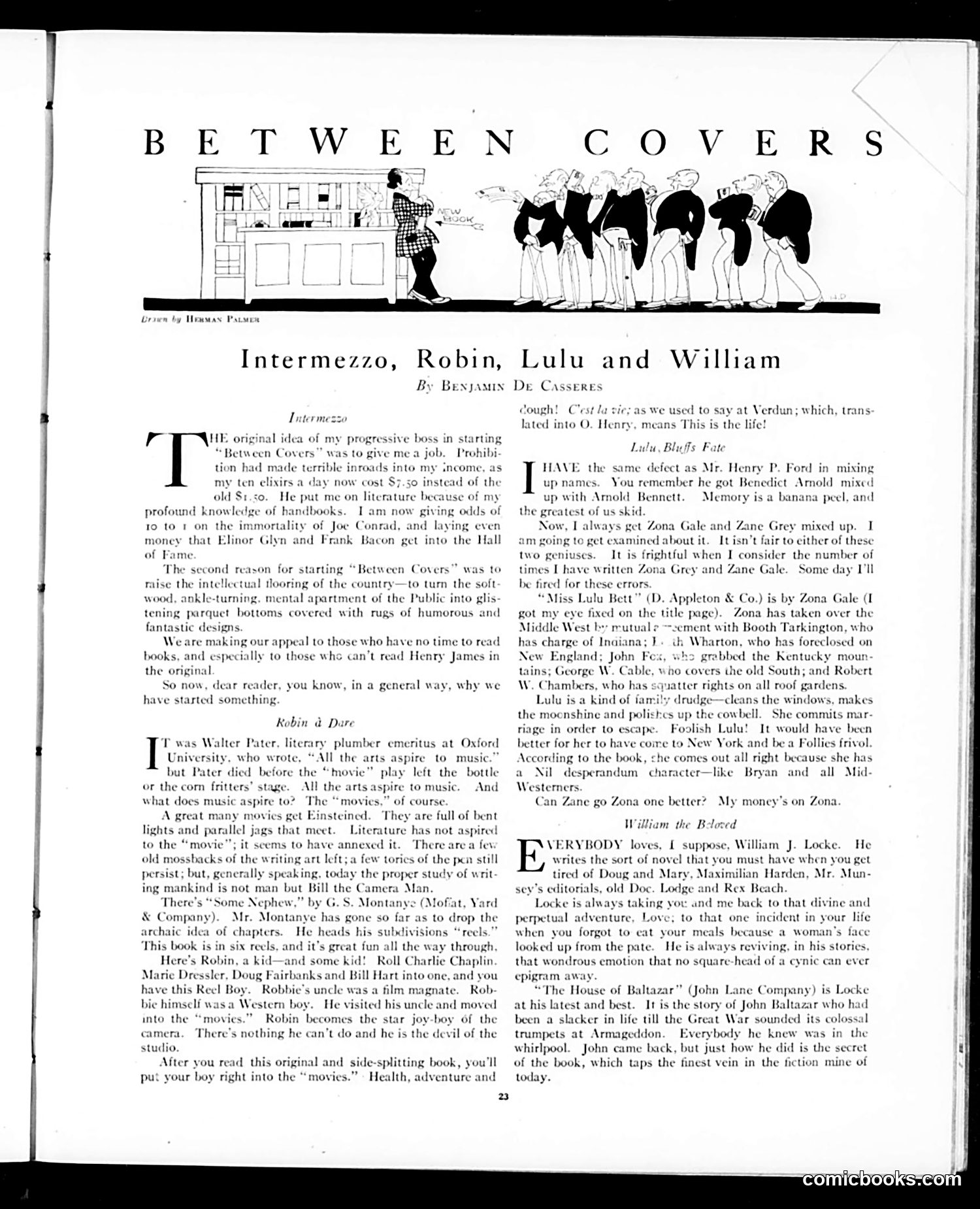
This page satirizes contemporary American literature and the emerging film industry. The cartoon at top shows figures representing different literary characters being herded into "movies," depicting literature's perceived annexation by cinema. The text discusses three book reviews: *Intermezzo* (a prohibition-era satire about the author's job), *Some Nephew* by G.S. Montanye (structured like film "reels" rather than chapters), and *Miss Lulu Bett* by Zona Gale. The author humorously confesses mixing up authors' names (Zona Gale/Zane Grey, Benedict Arnold/Arnold Bennett). The satire targets: - Literature adapting to cinema's format and pace - The "Camera Man" as modern writing's subject - Regional American authors (Tarkington, Wharton, Cable) dividing the nation's literary territory - Middlebrow characters like Lulu escaping provincial drudgery through marriage The piece reflects 1920s anxieties about film's cultural dominance and literature's perceived decline.
📄 Transcribed text from this page (OCR, searchable)
Machine-transcribed from the original scan — historical spelling and the odd misread are preserved.
Crven by Weawas Parsee Intermezzo, Robin, Lulu and William By Bexyamix De Casseres Titer me r HE original idea of my progressive boss in starting “Between Covers” was to give mea job. Prohibi tion had made terrible inroads i my ten elixirs a day now cost old $ He put me on literate profound knowledge of handbooks. Iam now giving odds of 10 to 1 on the immortality of Joe Conrad, and laying even money that Elinor Glyn and Frank Bacon get into the Hall of Fame The second r or starting “Between Covers” was to raise the intellectual Nlooring of the country—to tum the soft wood, ankle-turning. mental apartment of the Public into glis tening parquet bottoms covered with rugs of humorous and to my income, as 7.50 instead of the ‘¢ because of my fantastic designs. We are making our appeal to those who have no time to read books, and especially to those whe can’t read Henry James in the original So now, dear reader, you know, in a genera have started something. Kobin & Dare T was Walter Pater, literary plumber emeritus at Oxf University, who wrote, “All the arts aspire to music.” but Pater died before the “movie” play left the bottle or the com fritters’ stage. All the arts aspire to music. And what does music aspire to? The “movies,” of course A great many movies get Einsteined. They are full of bent lights and parallel jags that meet. Literature has not aspired to the “movie”; it seems to have annexed it. There area fev old mossbacks of the writing art left; a few tories of the pen still persist; but, generally speaking. today the proper study of writ ing mankind is not man but Bill the Camera Ma There's “Some Nephew,” by G.S. Montanye (2 t, Yard & Company). Mr. Montanye has » far as to drop the rchaic idea of chapters. He heads his subdivisions “reels.” This book is in six reels, and it’s great fun all the way through, Here’s Robin, a kid—and some kid! Roll Charlie Chaplin Marie Dressler, Doug Fairbanks and Bill Hart into one, and you have this Reel Boy. Robbie's uncle was a film magnate. Rob: bic himself wasa Western boy. He visited his uncle and moved into the “movies.” Robin becomes the star joy-boy of the camera. There's nothing he can’t do and he is the devil of the studio. After you read this original and put your boy right into the “ movie way, why we plitting book, you'll Health, adventure and cough! Crest t yas We used to say at Verdun; which, trans: lated into O. Henry, means This is the life! Lulu, Bl I HAVE the same defect as Mr. Henry P. Ford in mixing names. You remember he got Benedict Amold mixed sp with Amold Bennett. Memory is a banana peel, and the greatest of us skid Now, [ always get Zona Gale and Zane Grey mixed up. I am going to get examined about it. Lt isn’t fair to either of these two geniuses. It is frightful when I consider the number of times L have written Zona Grey and Zane Gale. Some day I'll be fired for these errors. “Miss Lulu Bett” (D. Appleton & Co.) is by Zona Gale (I got my eye fixed on the title page). Zona has taken over the Middle West tv’ reutual 7 ~2ement with Booth Tarkington, who has charge of Inaiana; }. Uh Wharton, who has foreclosed on New England; John Fex, wh> grabbed the Kentucky moun tains; George W. Cable, who covers the old South; and Robert W. Chambers, who has squatter rights on all roof gardens. Lulu is a kind of family drudge—cleans the windows, makes the mocnshine and polishes up the cowbell. She commits mar- riage in order to escape. Foolish Lulu! It would have been better for her to have come to New York and be a Follies frivol. According to the book put all right because she has a Nil desperandum character—like Bryan and all Mid Westerners. Can Zane go Zona one better? My money's on Zona e com William the Beloved | Peers loves, [ suppose, William J. Locke. He writes the sort of novel that you must have when you get tired of Doug and Mary, Maximilian Harden, Mr. Mun- sey’s editorials, old Doe. Lodge and Rex Beach. Locke is always taking you and me back to that divine and perpetual adventure, Love; to that one incident in your life when you forgot to eat your meals because a woman's face looked up from the pate. He is always reviving, in his stories, that wondrous emotion that no square-head of a cynic can ever cpigram away. “The House of Baltazar” (John L: npany) is Locke at his latest and best. It is the story of John Baltazar who had been a slacker in life till the Great War sounded its colossal trumpets at Armageddon. Everybody he knew was the whirlpool. John came back, but just how he did is the secret of the book, which taps the finest vein in the fiction mine of today.