
A complete issue · 36 pages · 1920
Judge — July 17, 1920
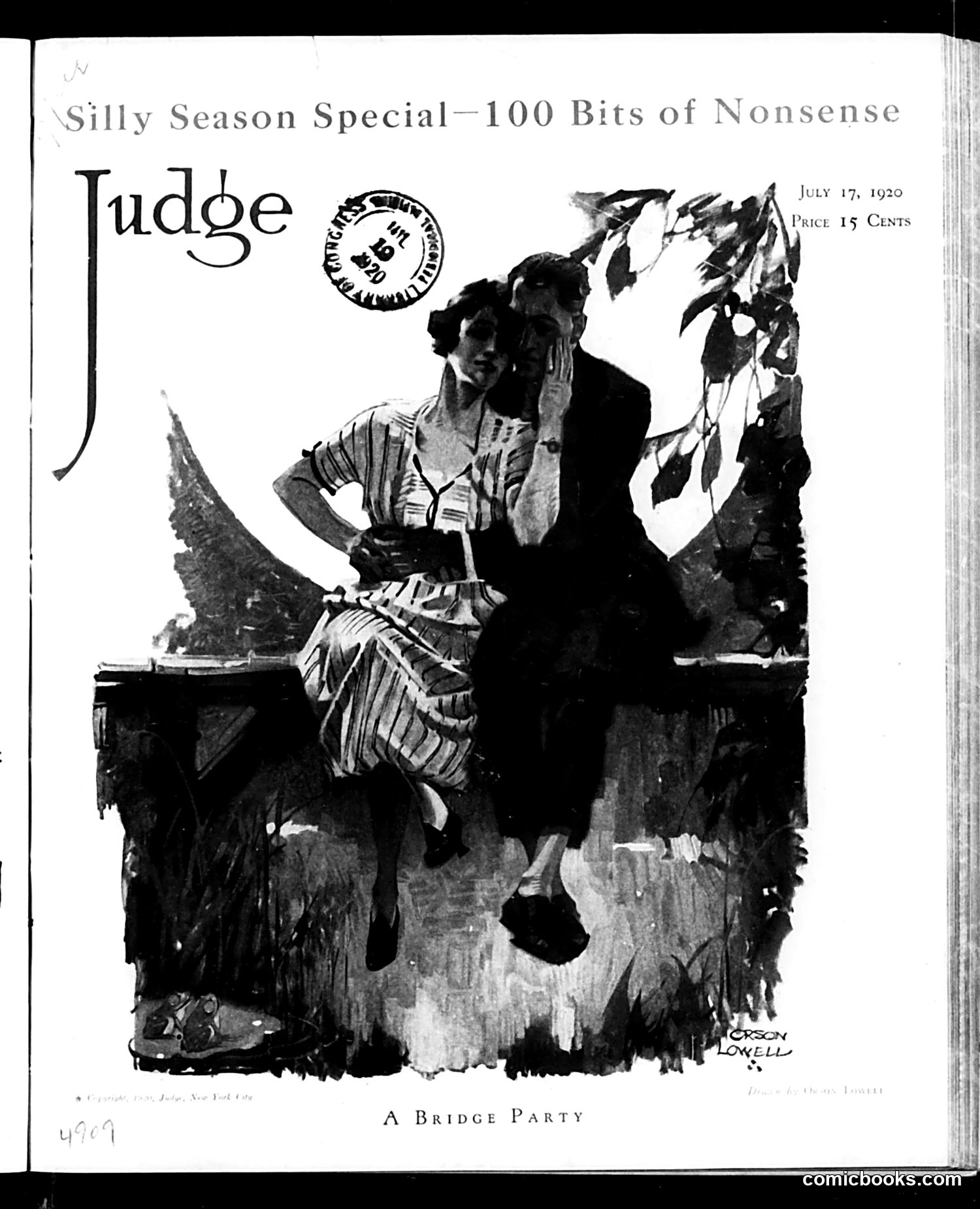
This illustration satirizes a **bridge party**, a popular 1920s social gathering where people played the card game bridge. The cartoon depicts two well-dressed figures in an exaggerated, comedic pose at what appears to be a bridge table, with dramatic gestures suggesting heated competition or drama over the game. The satire likely mocks the social pretensions and intense emotions surrounding bridge among the leisure class—a game that had become a status symbol and source of considerable social tension among affluent Americans in this era. The "Silly Season Special—100 Bits of Nonsense" framing confirms this is light, humorous commentary on trivial upper-class pastimes rather than serious political satire. The artist is credited as "Cesare Lowell" or similar.
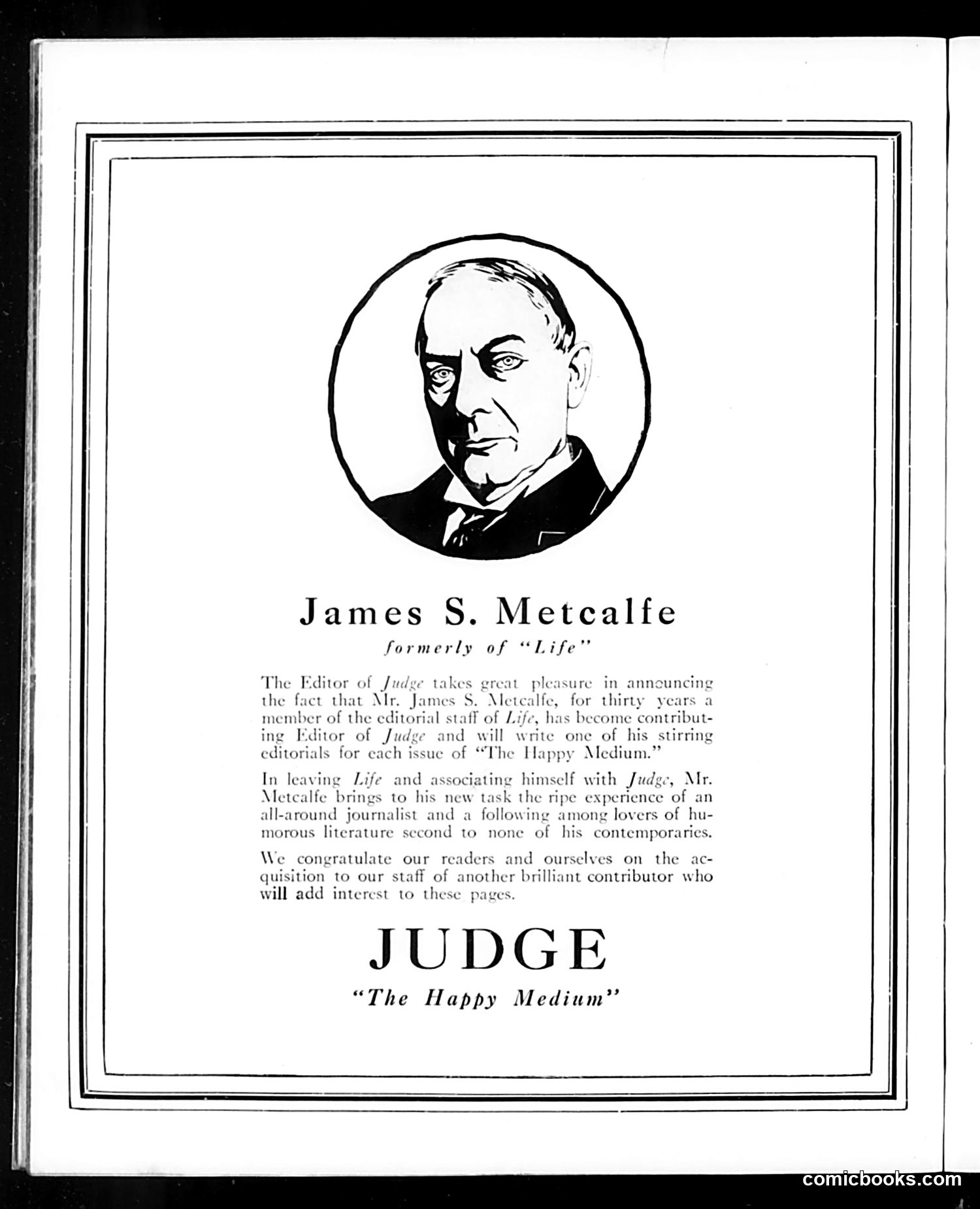
This page is primarily an **announcement/advertisement** rather than a cartoon. It announces that James S. Metcalfe, who spent thirty years as an editor at *Life* magazine, has joined *Judge* magazine's staff as a contributing editor. The text emphasizes Metcalfe's credentials as "an all-around journalist" with a strong following among readers of humorous literature. *Judge* positions his arrival as a significant acquisition for their publication, promising readers that Metcalfe will write editorials for "The Happy Medium" (apparently a regular *Judge* feature). The portrait is a formal woodcut-style illustration typical of early 20th-century magazine layouts. This is essentially a professional recruitment announcement disguised as editorial content.
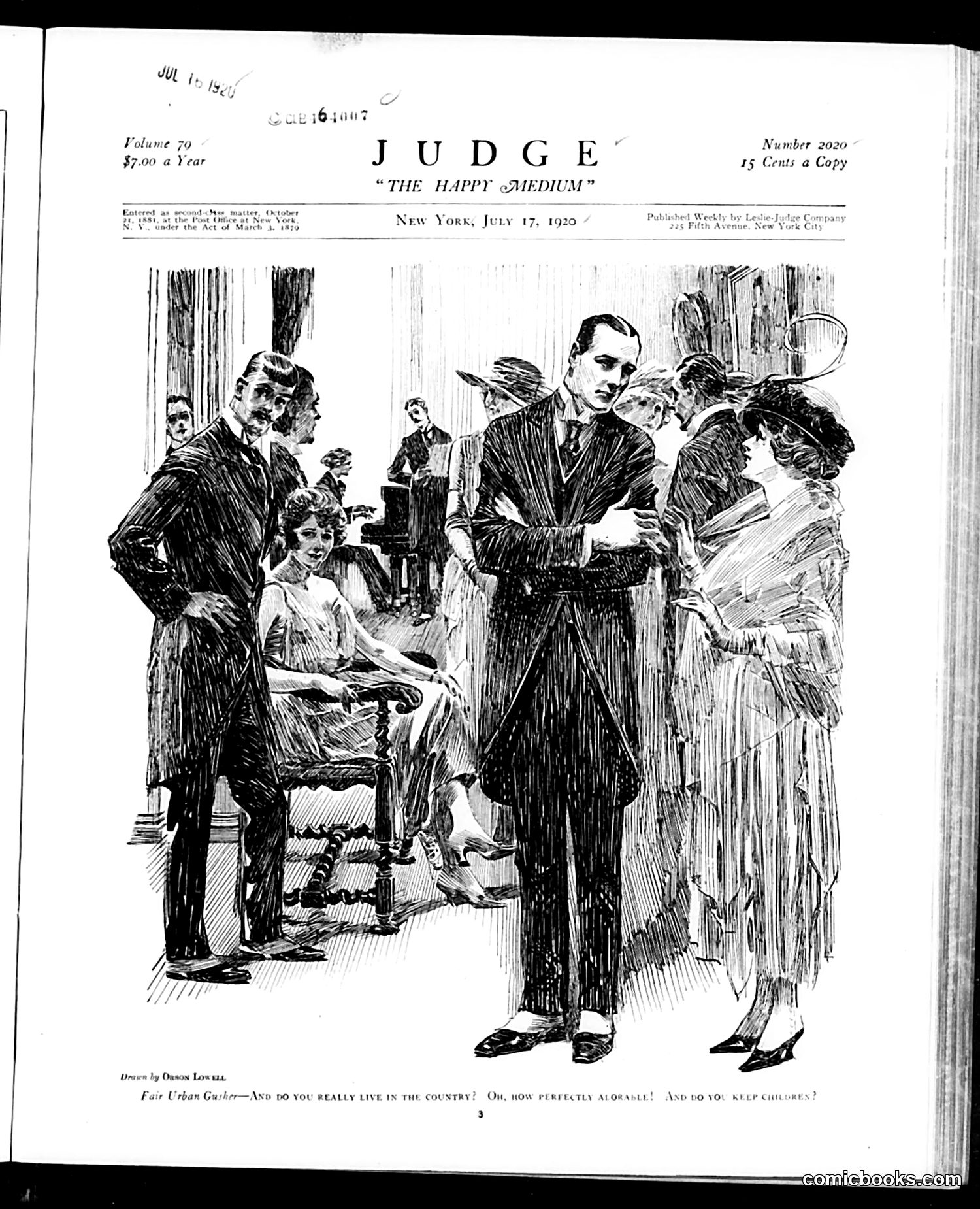
This cartoon satirizes urban sophistication versus rural simplicity. The caption reads "Fair Urban Gaitery—AND DO YOU REALLY LIVE IN THE COUNTRY? Oh, HOW PERFECTLY AGONIZE! AND DO YOU KEEP CHICKENS?" The drawing depicts a sophisticated urban woman (right) condescendingly interviewing a country visitor in an elegant drawing room. Her exaggerated interest in rural life—particularly chickens—mocks city dwellers' romanticized curiosity about farming while simultaneously revealing their ignorance of and condescension toward country living. This reflects 1920s tensions between urbanizing America and rural traditions, satirizing the fashionable affectation of urban elites who found rustic life quaint and amusing rather than genuinely understanding agricultural reality.
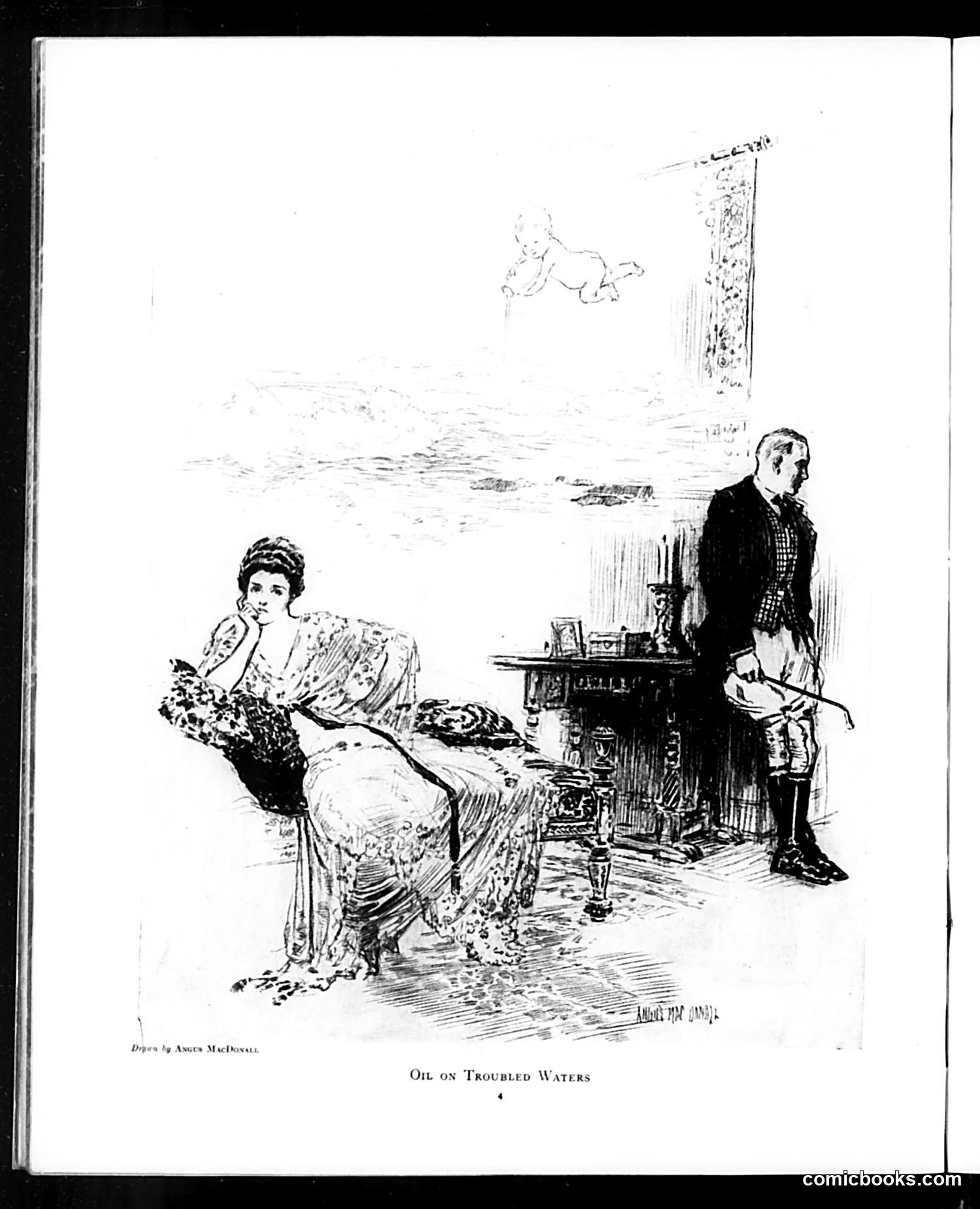
This cartoon by Amos MacDougall depicts a domestic marital conflict. A woman sits dejected, holding flowers, while a man stands distant by a fireplace, turning away from her. The title "Oil on Troubled Waters" is a metaphor referencing the proverb about calming turbulent situations. The satire appears to commentary on relationship discord—likely depicting how one party attempts reconciliation (the woman with flowers) while the other remains emotionally withdrawn. The "oil" suggests futile attempts to smooth over problems. Without additional context about specific 1890s-1910s events Judge magazine was referencing, the cartoon's precise target remains unclear, though it generally mocks failed marital peace efforts and emotional distance between spouses.
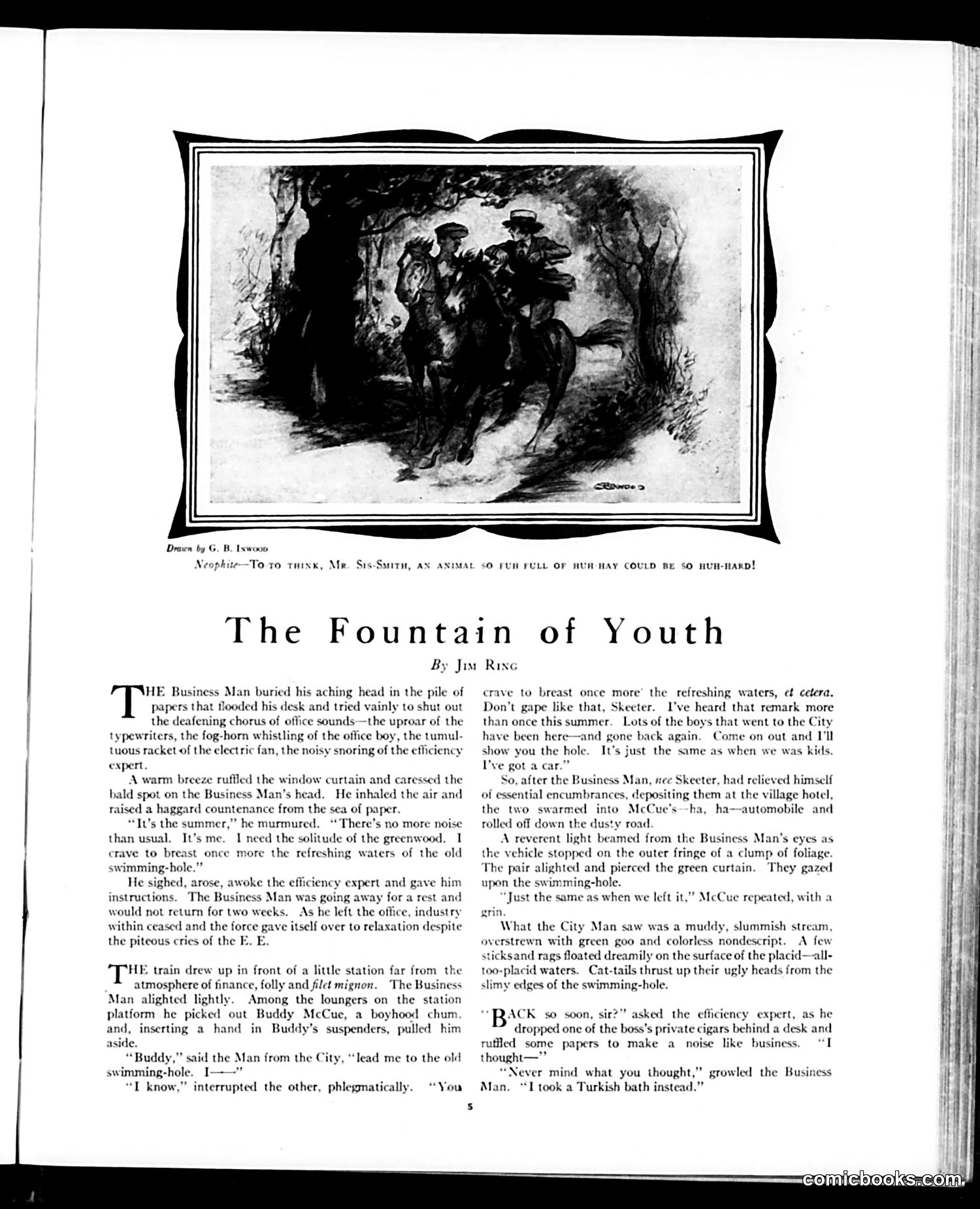
This page contains the opening of a short story by Jim Ring, illustrated by G. B. Iverson. The cartoon at the top depicts what appears to be a forest or wooded scene with several figures gathered together, though the specific satirical point is unclear from the image quality. The story itself is not political satire but rather a narrative about a businessman seeking respite from urban life. References to a "swimming-hole," "Turkish bath," and dialogue about efficiency and relaxation suggest the story explores themes of urban stress versus rural simplicity—a common early 20th-century literary motif. The satire likely mocks either the businessman's pretensions or contemporary attitudes toward leisure and modernization, though without clearer image resolution or additional context, the precise target remains uncertain.
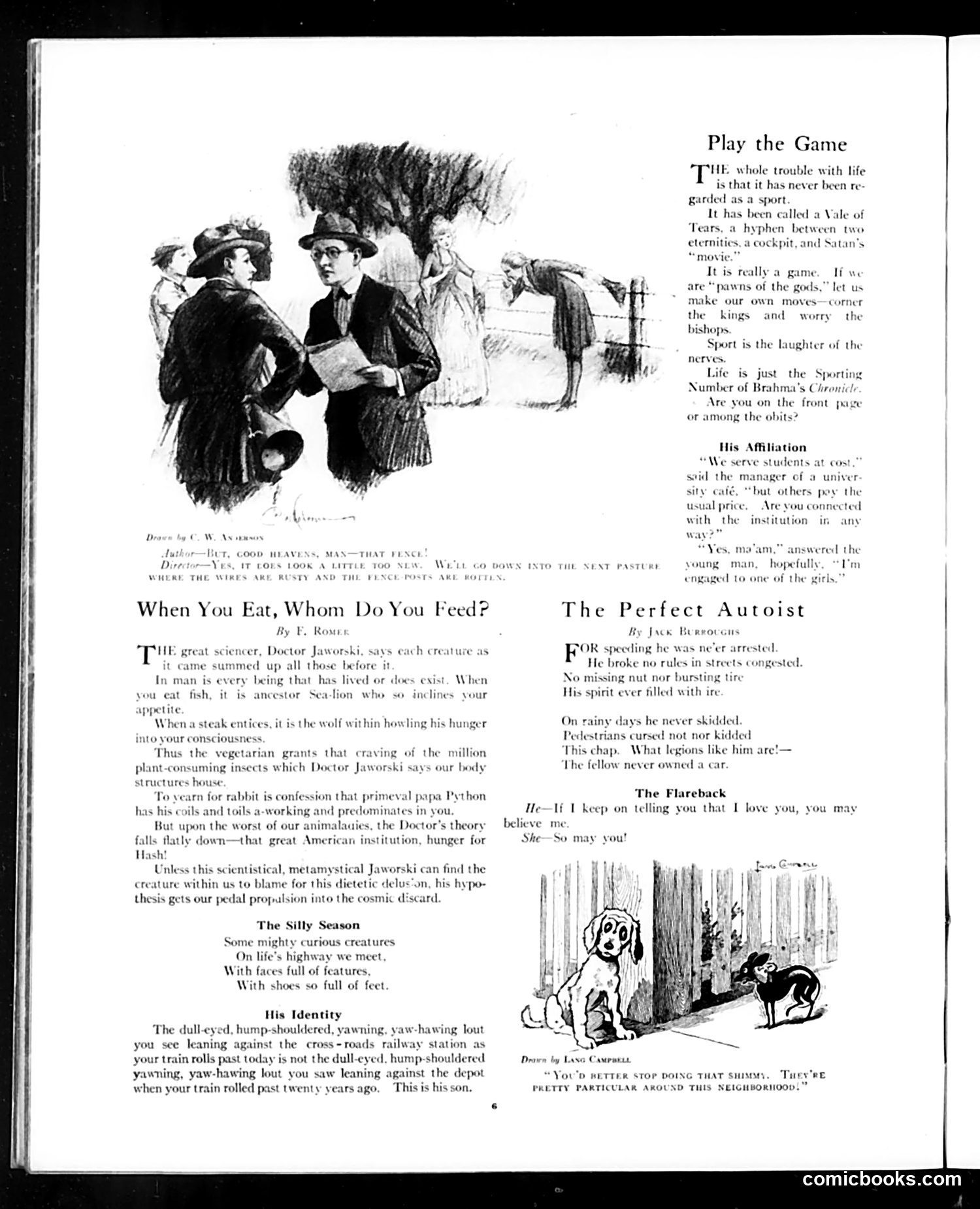
This page contains several short humorous pieces and cartoons typical of early 20th-century Judge magazine. The top cartoon depicts two men in formal dress discussing theater, with a caption about a director and actor debating whether a fence looks "too new." This appears to be satire about theatrical realism and production design debates. The main text pieces include "When You Eat, Whom Do You Feed?" (satirizing dietary choices and Doctor Jaworski's scientific theories), "The Perfect Autoist" (mocking reckless drivers), and "His Affiliation" (joking about university cafe pricing). "The Flireback" cartoon shows a dog and cat with dialogue about romantic declarations—simple visual humor with no apparent political content. Overall, this represents Judge's typical mix of light social satire targeting contemporary manners, institutions, and absurdities rather than specific political figures or events.
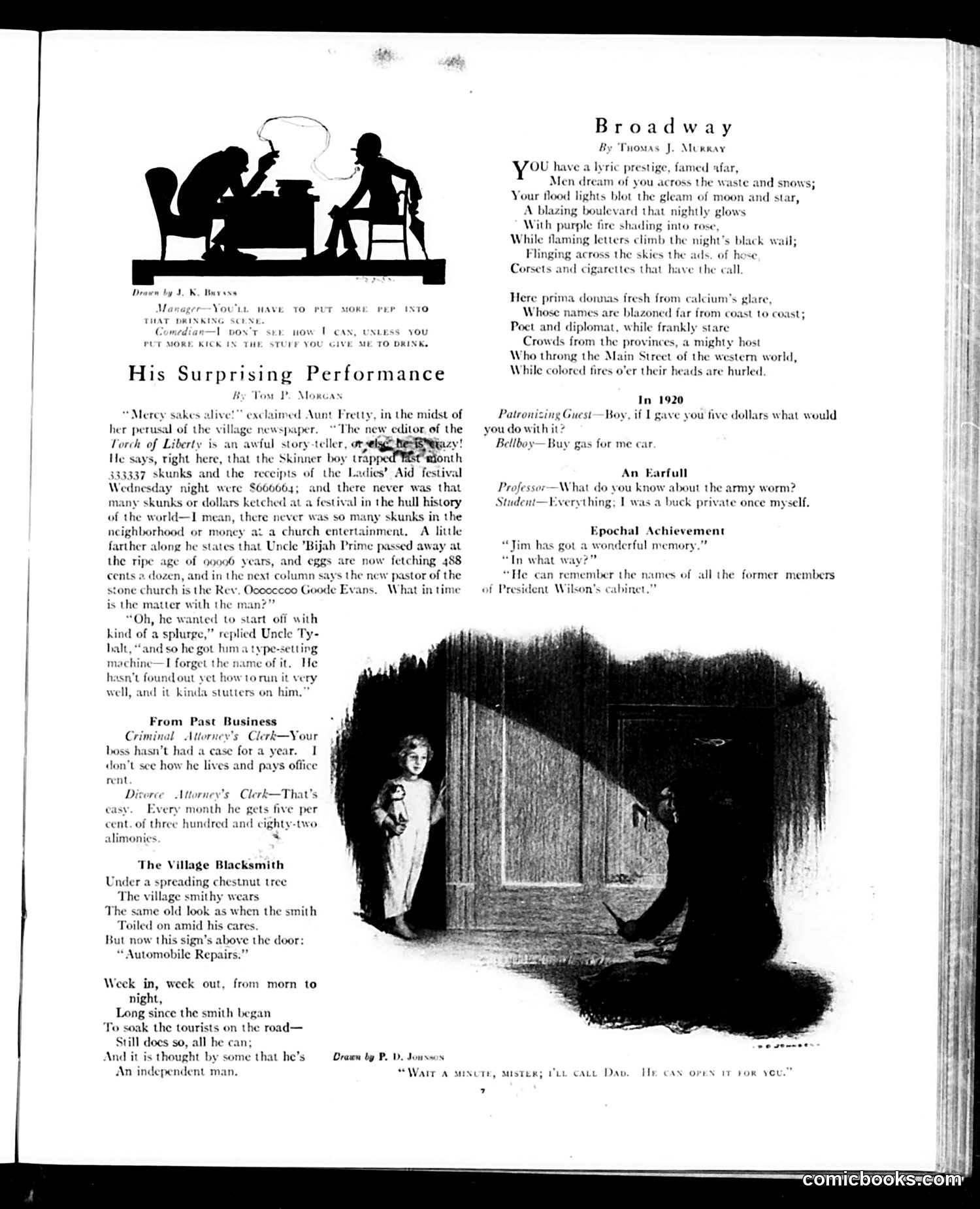
This page contains several satirical pieces typical of early 1920s American humor: **"His Surprising Performance"** mocks a small-town newspaper editor who's purchased a new typesetting machine but doesn't know how to operate it properly. The story absurdly reports 333,337 skunks caught and a man dying at age 90,006—obvious mechanical errors that appear believable to the rural characters. The satire targets both technological incompetence and gullible rural readers. **"The Village Blacksmith"** updates Longfellow's famous poem, showing the old craftsman has pivoted to "Automobile Repairs"—satirizing how automobiles were displacing traditional trades in the 1920s. **"Broadway"** is a straightforward celebratory poem about New York's theatrical district and its glamorous appeal. The remaining items are brief jokes: a bellboy wanting gas money instead of a tip, and a quip about remembering Wilson's cabinet members as an "epochal achievement"—likely poking fun at President Wilson's administration, which had recently left office (1921). The page reflects post-WWI American concerns about modernity, rural versus urban culture, and political transitions.
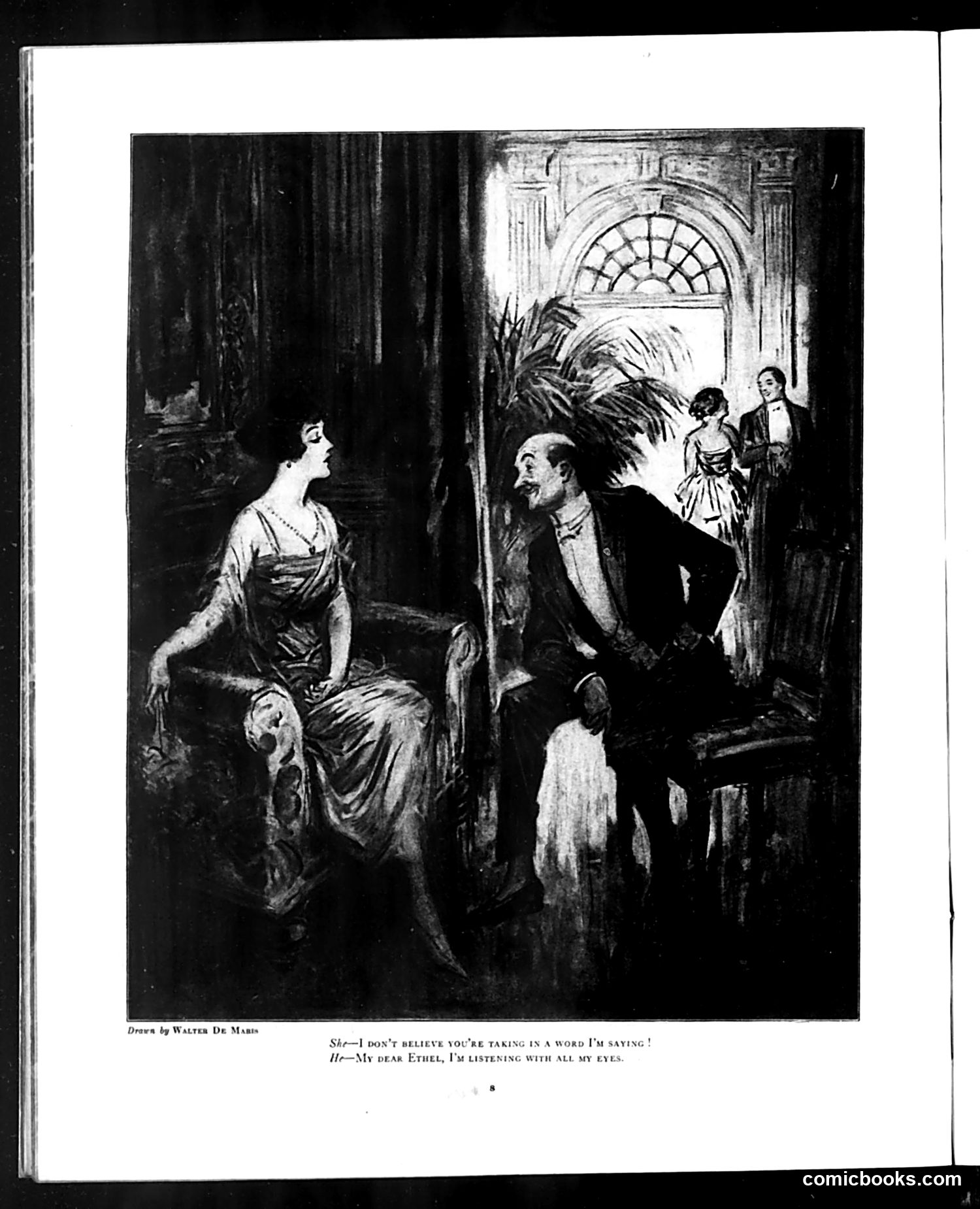
This illustration by Walter De Maris depicts a domestic scene where a woman accuses her male companion of not listening to her. His response—"My dear Ethel, I'm listening with all my eyes"—is the joke's crux. The humor satirizes men's inattentiveness in relationships. The man, positioned closer to the woman but gazing elsewhere (toward other figures visible through a doorway), claims to be listening intently while his body language contradicts this. His quip about "listening with his eyes" is deliberately absurd, suggesting he's distracted by visual stimulation rather than genuinely attending to her words. This reflects early 20th-century gender commentary typical of Judge magazine: critiquing men's divided attention and dismissive attitudes toward women's conversation as a relatable marital frustration.
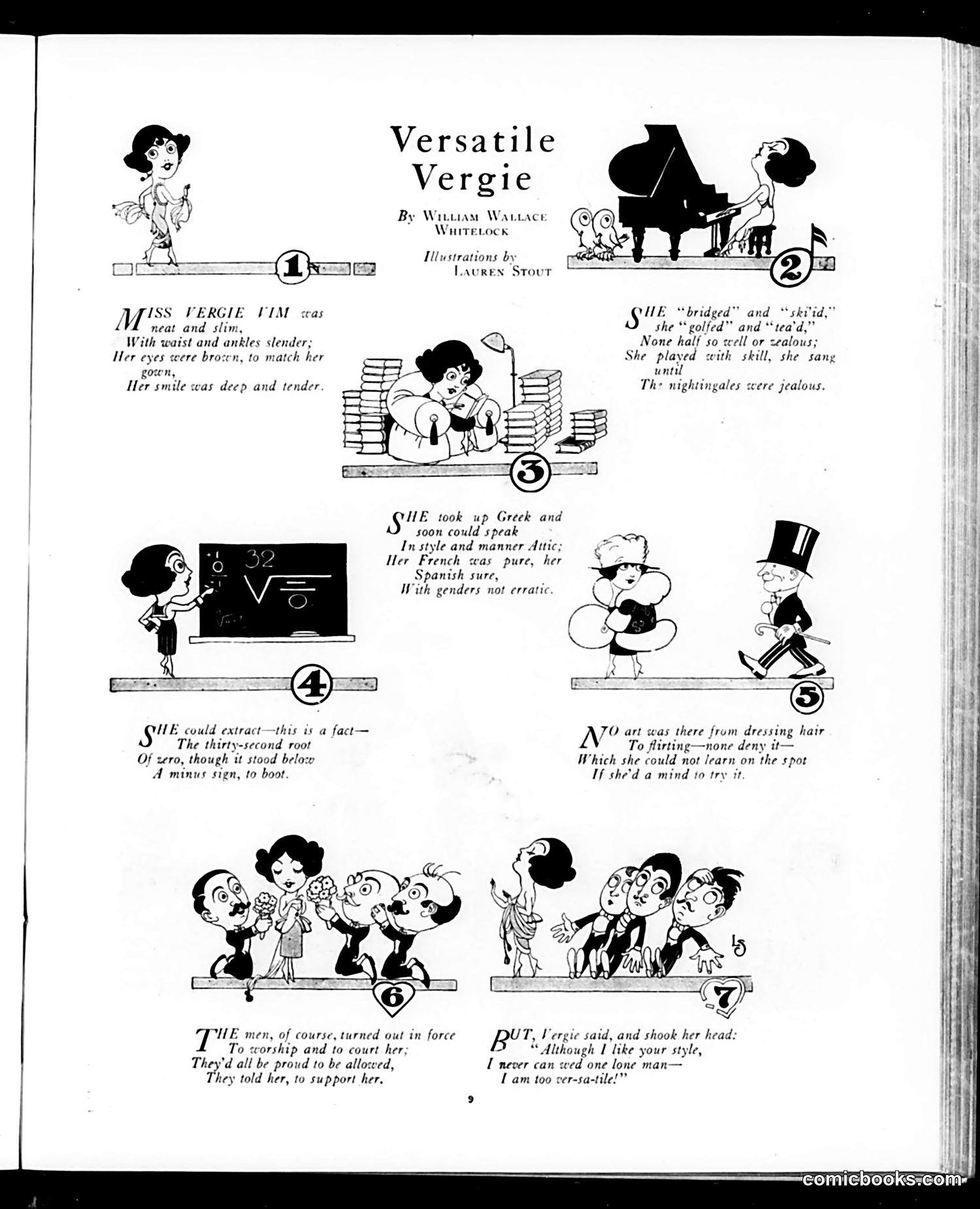
This illustrated verse by William Wallace Whitelock satirizes the "New Woman" of the early 20th century—specifically, a young woman named Vergie who possesses multiple talents and accomplishments (athletics, languages, mathematics, music, art, flirtation). The satire's point: Vergie's very versatility becomes her fatal flaw. While she excels at everything—bridging, skiing, golfing, Greek, French, Spanish, mathematics, singing, and hairdressing—her inability to commit to a single role (particularly marriage) makes her unmarriageable. Multiple suitors seek her hand, but she rejects them all, declaring she's "too ver-sa-tile." The joke mocks both the ambitious "modern woman" and male expectations: her accomplishments are impressive yet frivolous, and her independence is presented as romantic dysfunction rather than virtue. This reflects period anxieties about educated, talented women who didn't fit traditional domestic roles.
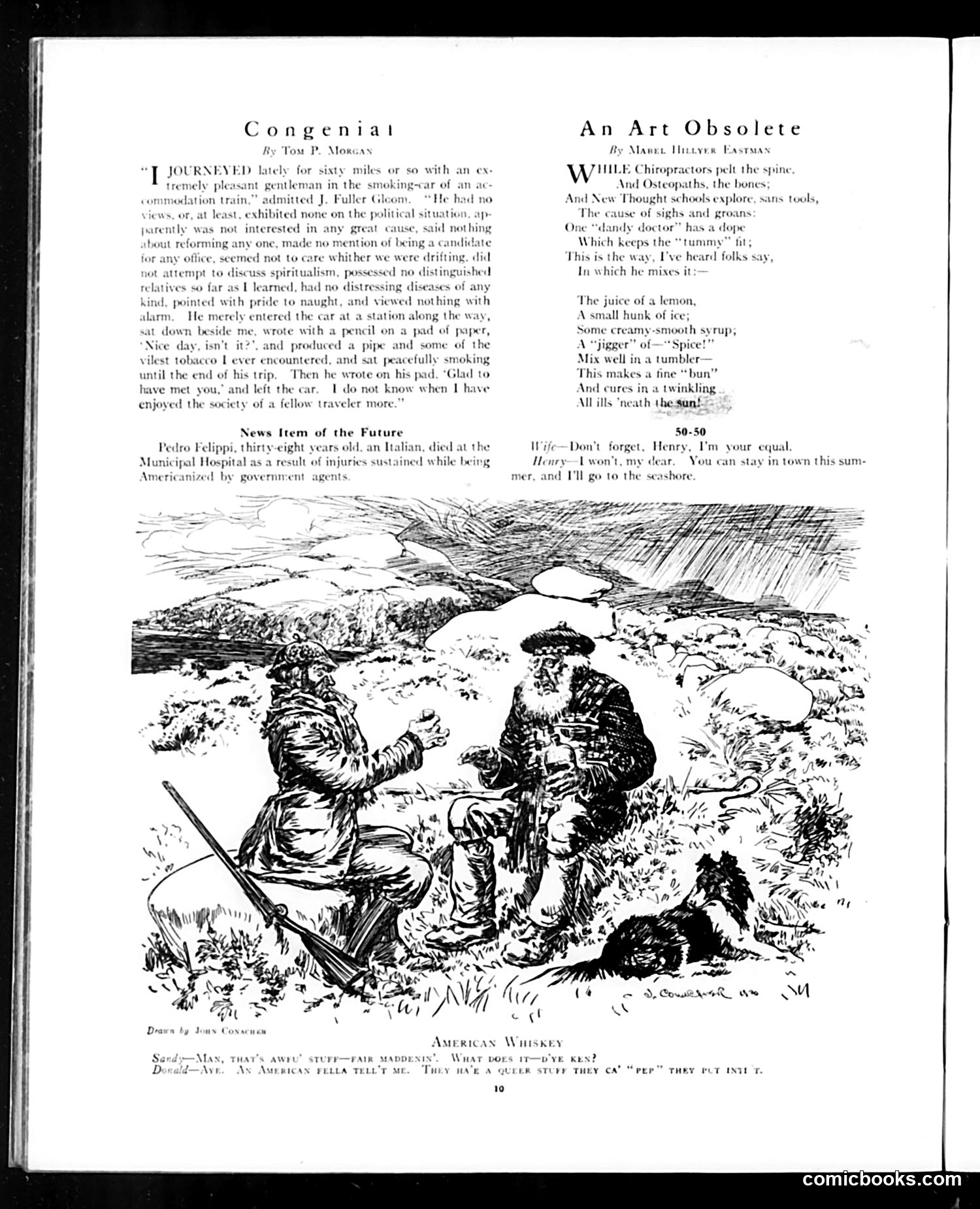
This page contains three distinct pieces of satirical content: **"Congenial"** (top left) satirizes the modern tendency toward constant self-promotion and opinion-sharing. The narrator praises a fellow train passenger simply for being unremarkable—avoiding politics, reform causes, boasting, or pushing any agenda. The joke is that doing *nothing* notable has become refreshingly rare, implying contemporary society is exhaustingly full of self-important people demanding attention. **"News Item of the Future"** presents dark satire about government overreach, predicting deaths caused by "Americanization" of immigrants through official force—likely referencing 1920s anxieties about assimilation policies and government abuse. **"An Art Obsolete"** mocks modern medical fads (chiropractors, osteopaths, "New Thought" schools) by suggesting old-fashioned home remedies—essentially alcohol disguised as medicine ("bun")—worked just as well. It's satirizing the rush to embrace unproven modern treatments. **"American Whiskey"** (bottom cartoon) uses dialect humor to joke about Prohibition-era bootleg whiskey, with rural characters discussing illicit spirits.
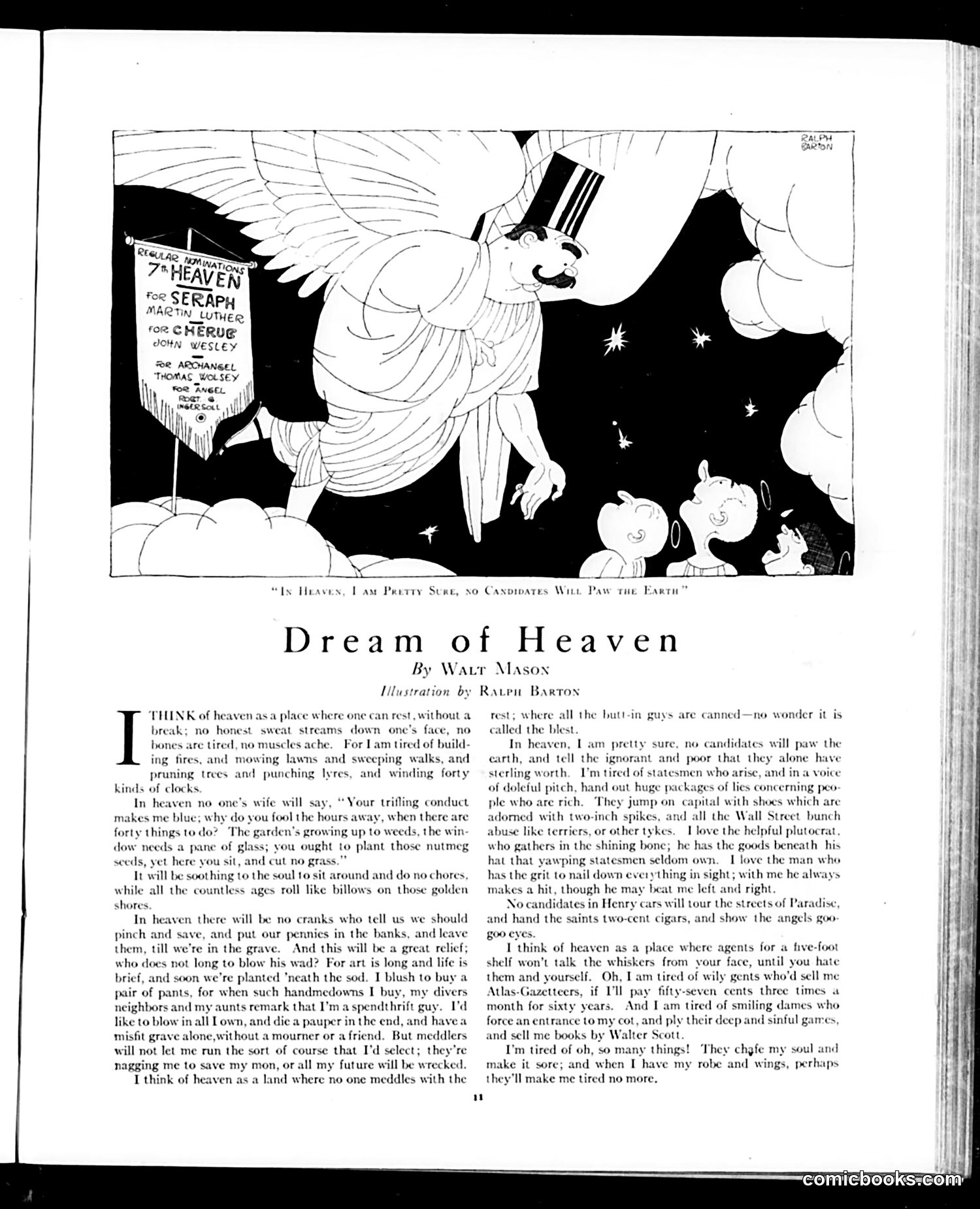
This satirical piece imagines heaven as an escape from earthly frustrations—specifically, the social annoyances and moral hypocrisies of early 20th-century American life. Mason catalogs his grievances: nagging wives, financial pressure from neighbors judging his spending, aggressive salesmen pushing encyclopedias and other products, corrupt politicians making empty promises to the poor while enriching themselves, Wall Street plutocrats, and meddlesome relatives. The cartoon's illustration shows an angel with a top hat and cherubs—a genteel vision contrasting with Mason's biting complaints. The satire targets materialism, status anxiety, and commercialism of the era. Heaven represents not spiritual peace but *freedom from society's demands*—no chores, no one telling him to save money, no aggressive salesmanship or political corruption. The joke is that Mason's heaven isn't divine transcendence; it's simply escape from American capitalism and social conformity. The subtitle's reference to various religious figures (Luther, Wesley, Wolsey) adds mock-serious weight to this irreverent vision.
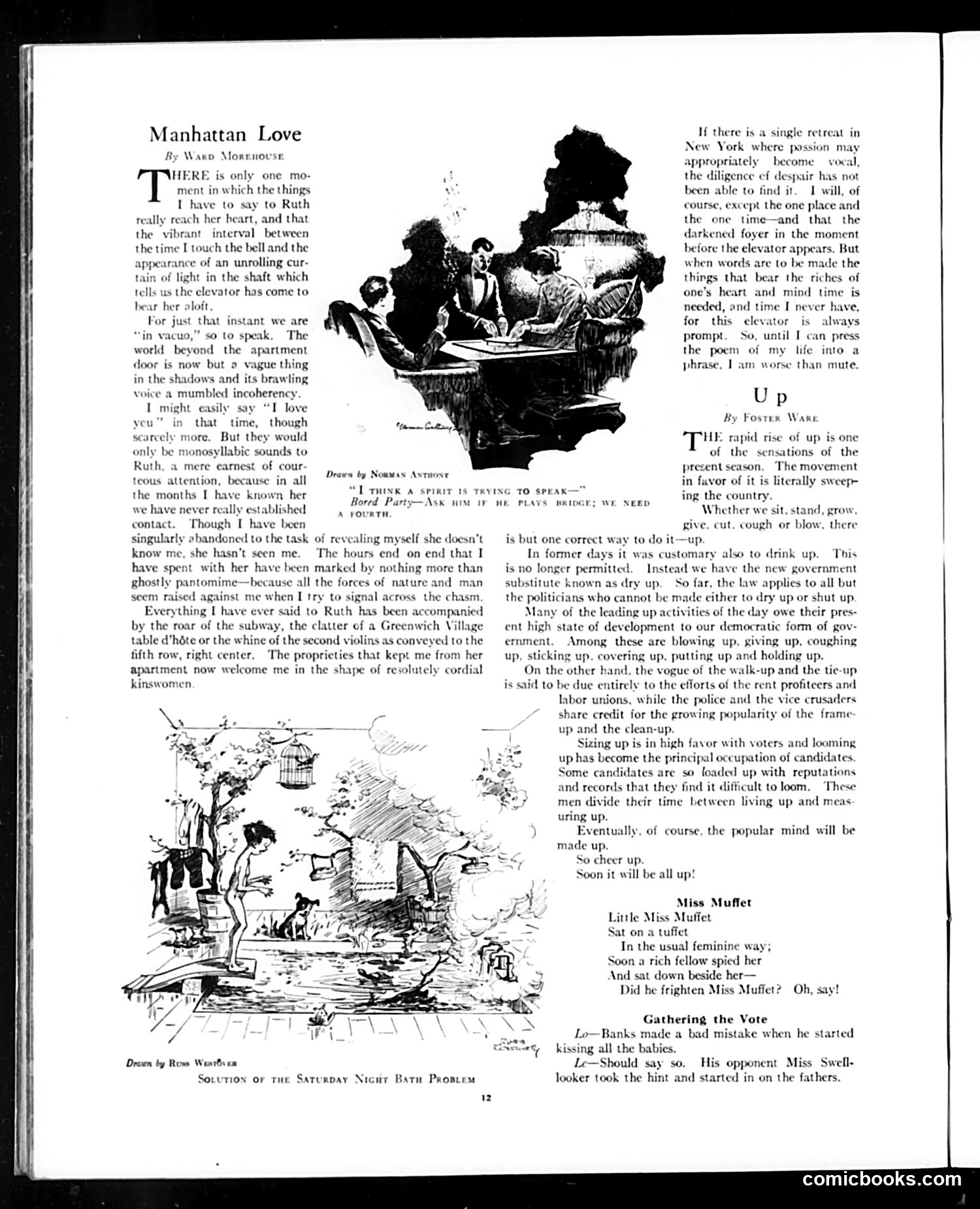
This page contains two separate pieces of satirical writing with illustrations: **"Manhattan Love"** (by Ward Morehouse) is a romantic lament about a man who can only express his love to Ruth during the brief moment an elevator arrives—the only quiet moment in noisy 1920s Manhattan. The satire mocks urban life's constant interruptions (subways, restaurants, orchestras) that prevent genuine human connection. The illustration shows a couple in an apartment building. **"Up"** (by Foster Ware) is political satire on Prohibition-era slang. It mocks the newly mandated phrase "dry up" (replacing "drink up") as politicians hypocritically ignore the law while citizens must obey. The piece catalogs contemporary "up" phrases (blow up, give up, sizing up, etc.), satirizing how Americans obsess over linguistic compliance while corruption persists. **"Miss Muffet"** appears to be opening a humorous poem fragment at the page's bottom. The cartoons illustrate urban middle-class life and government overreach concerns typical of 1920s Judge magazine satire.
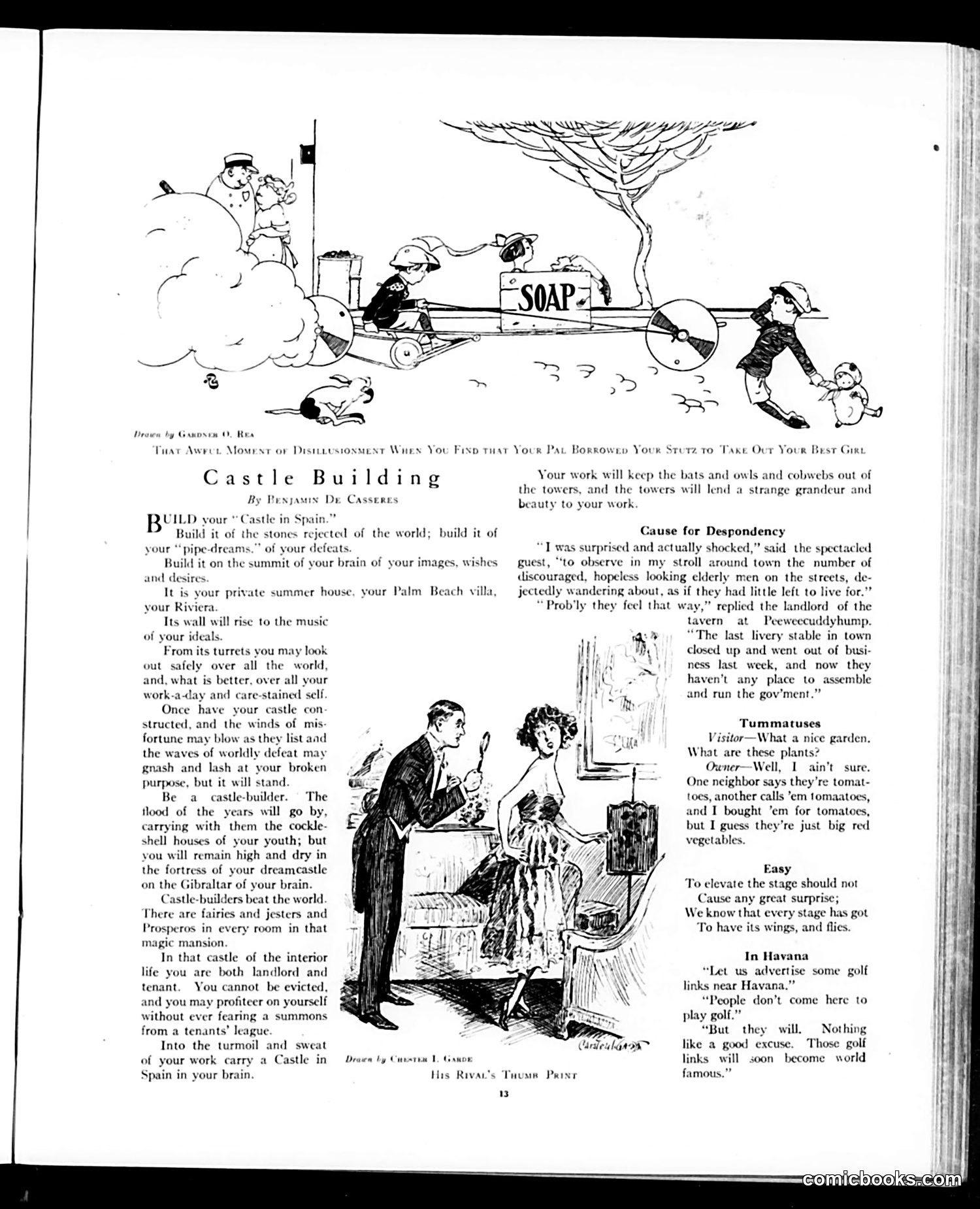
This page contains three distinct pieces of satirical content: **"Castle Building"** (main essay): A philosophical piece encouraging readers to build mental "castles in Spain"—fantasies and dreams—as psychological refuges from harsh reality. It's aspirational rather than overtly political satire. **"His Rival's Thumb Print"** (cartoon): Shows a man confronting a woman about her borrowed car (a Stutz, a luxury automobile). The satire appears to target the folly of lending expensive possessions to romantic interests. The title's reference to a "thumb print" is unclear from context. **Brief comic items** ("Cause for Despondency," "Tummatoes," "Easy," "In Havana"): Quick satirical quips mocking contemporary issues—elderly men losing purpose after a livery stable closes (auto-age displacement), confusion over vegetable names, theater trivialities, and Cuban tourism marketing. The overall tone reflects early 20th-century American humor: gentle social observation rather than sharp political critique, targeting middle-class anxieties, romantic mishaps, and modern technological change.
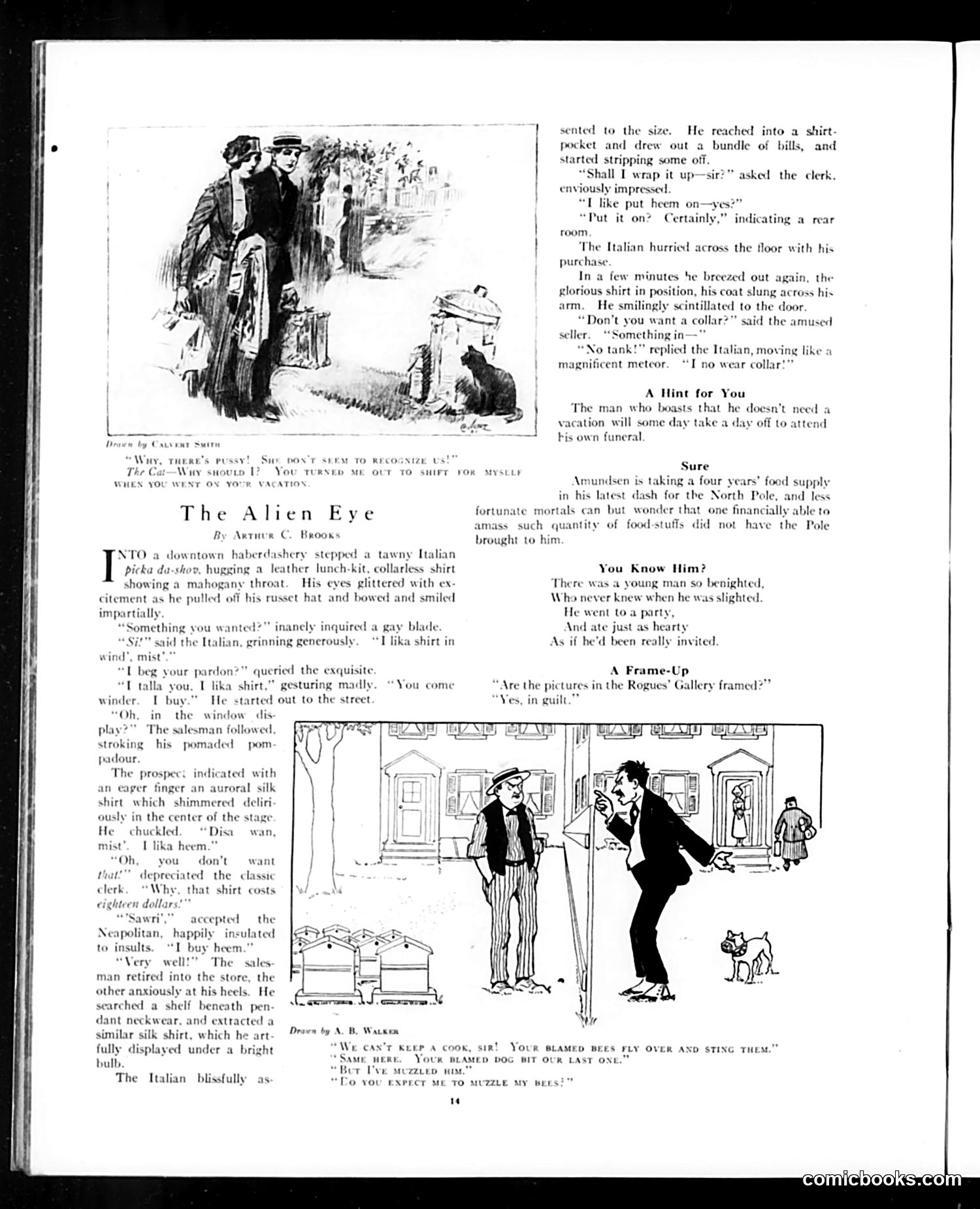
This story mocks both working-class Italian immigrants and upper-class American snobbery. The protagonist is a stereotyped Italian laborer ("picka da-shov," broken English) who enters a haberdashery and selects an expensive silk shirt despite his modest background. The salesman's condescension—offering him a cheaper alternative—contrasts sharply with the Italian's casual wealth and confidence. The satire cuts both ways: it ridicules the clerk's class assumptions (the Italian can easily afford the expensive shirt) while also mocking the immigrant's inability to properly wear or understand American fashion conventions (he wears the shirt immediately without a collar, departing without proper etiquette). The accompanying humor pieces ("A Hint for You," "You Know Him?") are unrelated filler content typical of Judge magazine's format. The main cartoon by A.B. Walker depicts a domestic dispute over pets—clearly comedic but separate from the Italian narrative.
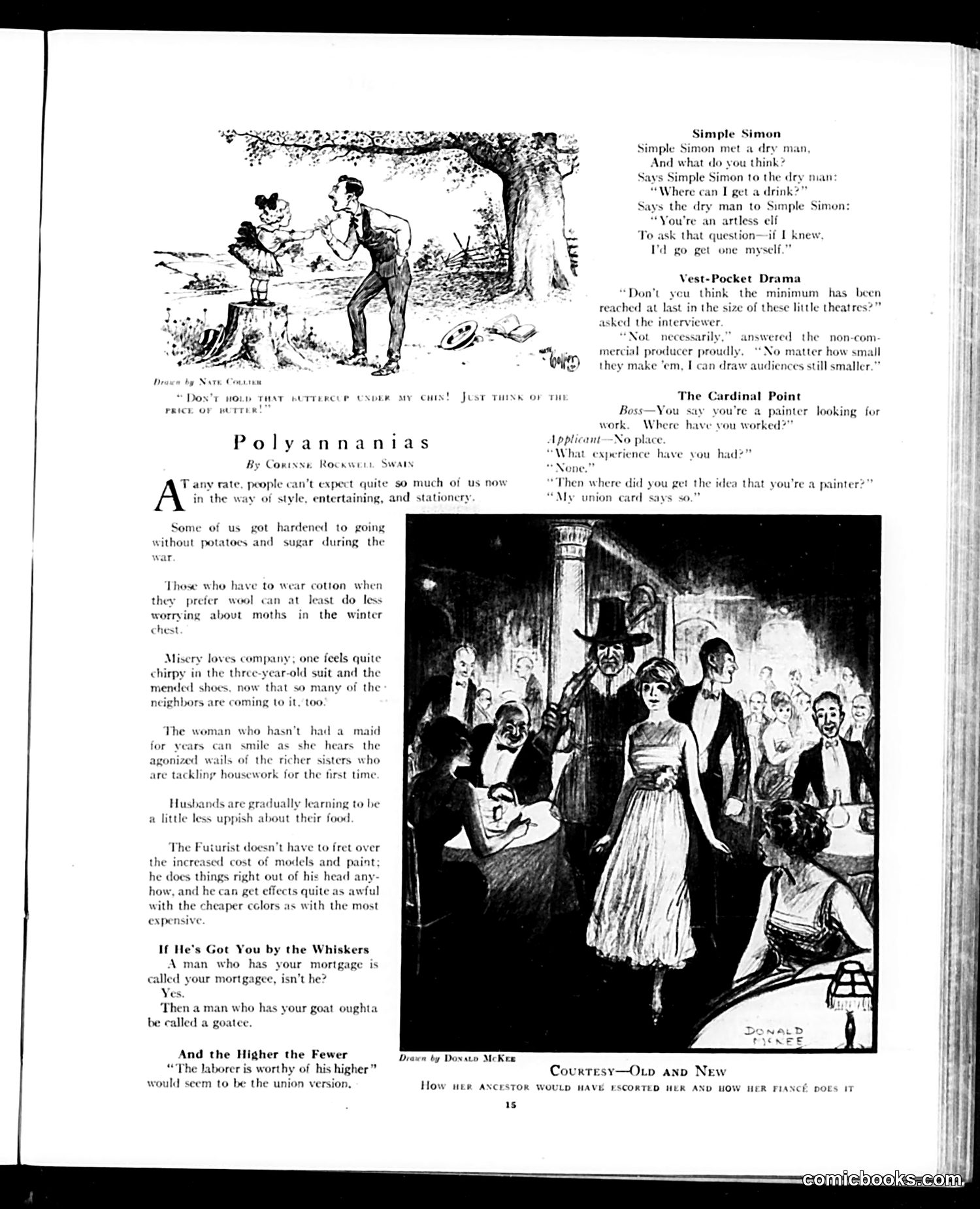
This page contains several brief satirical pieces reflecting post-WWI American life: **"Polyannanias"** mocks forced optimism about wartime deprivations—people claiming to feel cheerful about wearing old clothes, lacking maids, or eating poorly. The satire targets those who pretend hardship is actually pleasant. **"Simple Simon"** is a wordplay joke about Prohibition (the "dry man"), playing on the nursery rhyme character's naiveté. **"Vest-Pocket Drama"** jokes about minimalist theater—a producer claims he can draw audiences even *smaller* than the tiniest theaters already are, suggesting absurdist theater has limits. **"The Cardinal Point"** satirizes labor unions: a man with no work experience or qualifications claims to be a painter solely because "my union card says so," mocking union protectionism. **"Courtesy—Old and New"** (the large illustration) appears to contrast historical courtship etiquette with modern behavior, though specific details are unclear from the caption alone. The page reflects 1920s anxieties about unions, changing social customs, and economic adjustment post-war.
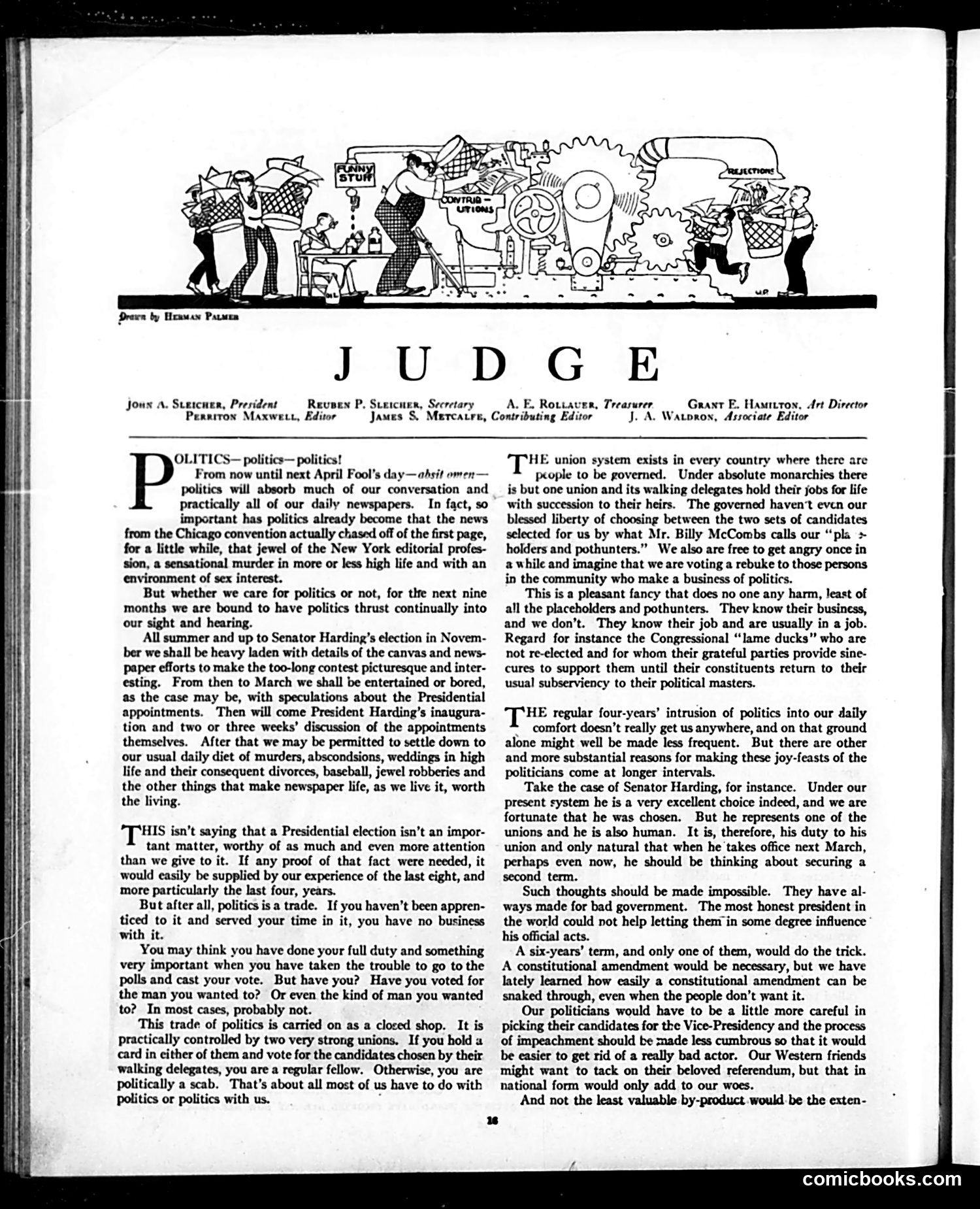
This editorial page satirizes American political systems by comparing them to labor unions. The illustrated masthead shows a complex machine with workers—a visual metaphor for the political "machinery." The text argues that politics operates as a "closed shop" controlled by two dominant unions (the Democratic and Republican parties). Ordinary voters are either "regular fellows" who obey party-chosen candidates or "scabs" who vote independently. The author suggests citizens have little real choice—they merely select between pre-selected candidates. The piece references Senator Harding's 1920 election and upcoming presidential appointments, indicating this was written around that time. The satire mocks the public's illusion of democratic choice while powerful political machines actually control outcomes. The comparison to union labor practices—where walking delegates enforce party loyalty—emphasizes how American democracy mirrors a hierarchical, exclusionary system rather than truly representing the people's will.
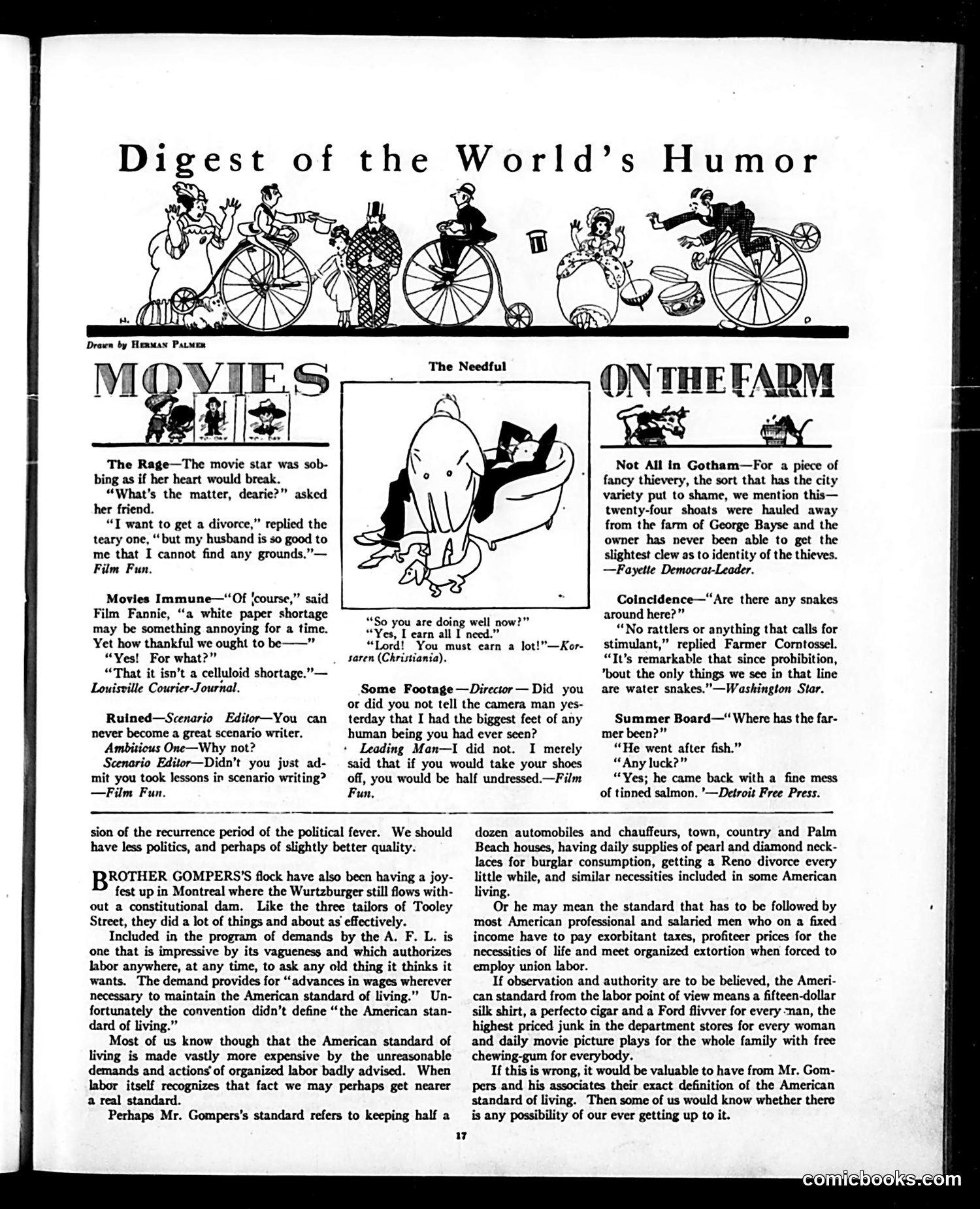
This page from *Judge* magazine contains reprinted short jokes and satirical commentary, primarily targeting three subjects: **Movies & Hollywood**: The "Movies" section mocks film industry absurdities—actors seeking divorces for publicity, scenario writers, and leading men's vanity about physical appearance. **Labor & Samuel Gompers**: The lengthy editorial critiques AFL (American Federation of Labor) union demands, specifically Gompers's call for wages maintaining "the American standard of living." The satire argues the phrase is meaninglessly vague, then ridicules it two ways: suggesting either union leaders demand luxuries (diamonds, multiple houses, divorces) OR that workers expect unrealistic standards while employers face "organized extortion" through union demands. **Farm Life**: Brief rural anecdotes joke about Prohibition-era snake references, fishing, and stolen farm animals. The overall tone reflects post-WWI, anti-labor, anti-Hollywood sentiment common in *Judge*'s conservative readership—skeptical of unions, celebrity culture, and regulatory language.
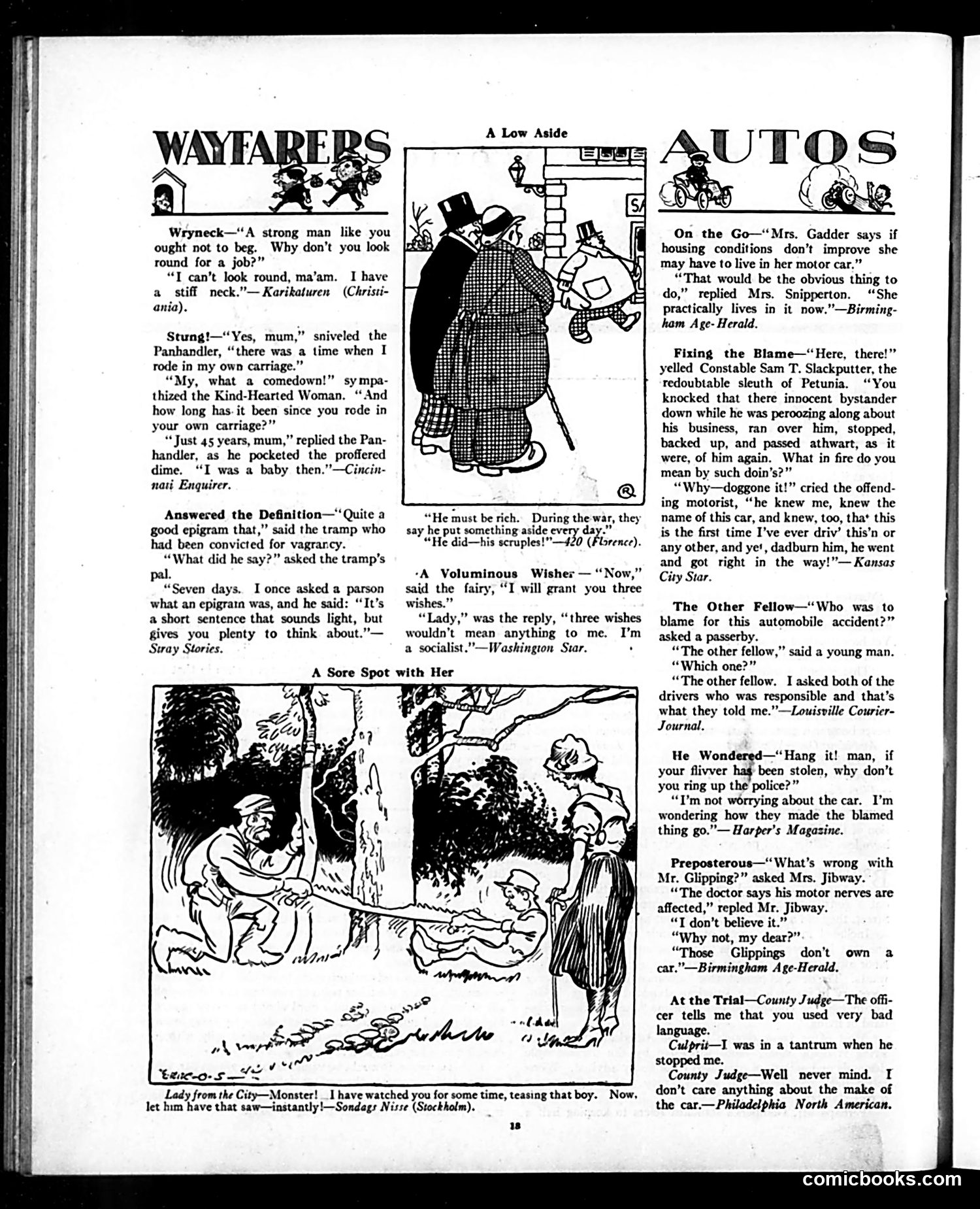
This page collects brief humorous anecdotes and one cartoon, all satirizing early 20th-century social foibles. Most notably, several jokes mock the automobile and its owners—a relatively new phenomenon. The "Fixing the Blame" and "The Other Fellow" pieces mock drivers' tendency to blame accidents on others while denying responsibility. "On the Go" jokes that a wealthy woman practically lives in her car, suggesting the newly mobile upper class. "He Wondered" satirizes a man more concerned with understanding his stolen car's mechanics than reporting the theft. The cartoon "A Sore Spot with Her" depicts a city woman scolding a boy with a saw, reversing expectations: she's the aggressive one, not the child. Other jokes target beggars, socialists (the three-wishes joke), and wartime profiteering. The humor relies on period-specific references to class, mobility, and emerging consumer culture that would puzzle modern readers unfamiliar with early automotive culture and its social implications.
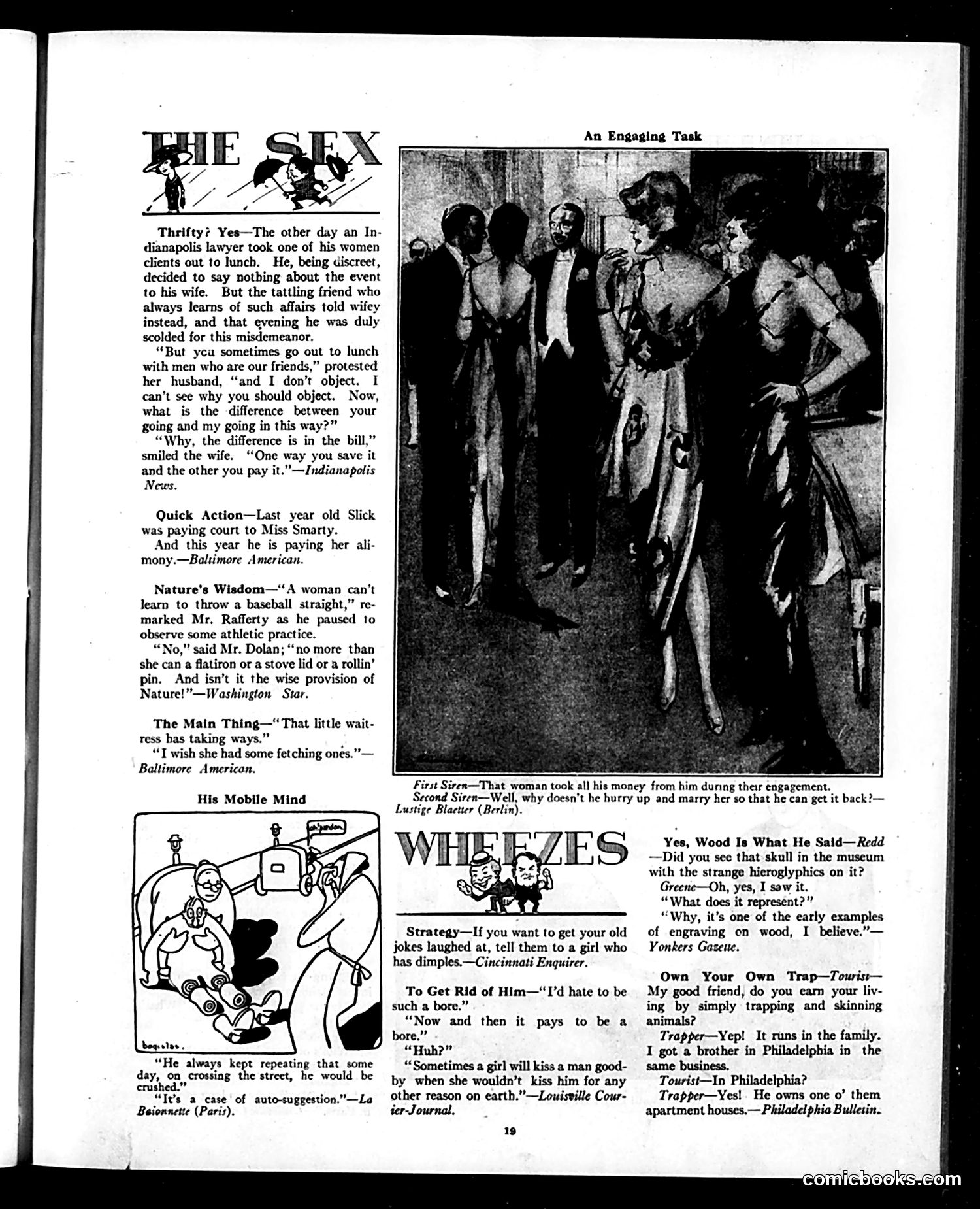
This page collects short humor pieces from various newspapers, representing early 20th-century satirical commentary on gender relations and marriage. **Main themes:** The "Thrifty?" anecdote mocks marital double standards: a husband lunches with a female client and hides it, but his wife objects—yet she lunches with male friends freely. Her retort—"the difference is in the bill"—suggests husbands expect wives to be economical while men spend freely. It's social satire about financial inequality in marriage. **Other pieces** target stereotypes: women can't throw straight (essentialist "nature's wisdom"), and a waitress has "taking ways" but lacks "fetching ones" (beauty). The "Quick Action" joke cynically notes a man paying alimony after courting someone—suggesting marriage as financial trap. The cartoon "His Mobile Mind" (bottom left) depicts a man's forgetfulness through visual metaphor. **"Whelzes"** section includes dated humor about seduction tactics and a pun on "wood" (wood-engraving/wooden skull). Overall, this reflects period attitudes: women as financial liabilities or manipulators, marriage as transaction, and rigid gender roles presented as natural law.
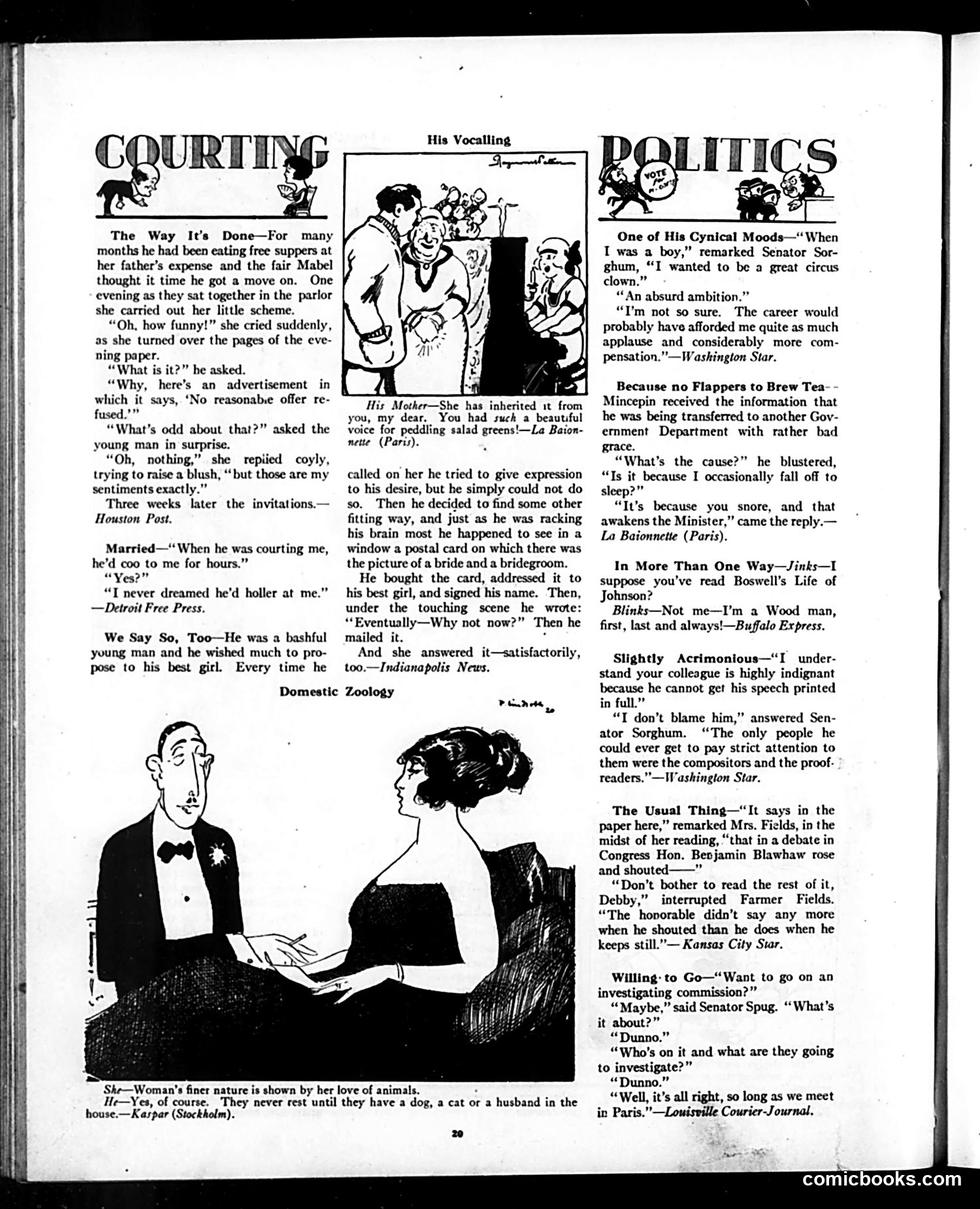
This page from *Judge* contains multiple short satirical pieces mocking courtship, marriage, and politicians: **"Courting & Politics" sections** feature brief humorous anecdotes about romance—a woman tricks her bashful suitor into proposing by circling a newspaper ad saying "no reasonable offer refused," and another man sends a postcard proposal reading "Eventually—Why not now?" **"His Vocalling"** mocks a senator's mother for her poor singing voice, suggesting she was only suited to "peddling salad greens." **"Domestic Zoology"** presents a crude joke equating women's nature with animal domestication—claiming women "never rest until they have a dog, a cat or a husband in the house." **The political humor** targets Senator Sorghum (appears to be a fictional character representing a generic politician) and others, satirizing congressional ineffectiveness, senators' willingness to join investigations regardless of purpose, and the public's indifference to political speeches. The overall tone reflects early-20th-century satirical magazine conventions: cynical about politics and somewhat misogynistic by modern standards.
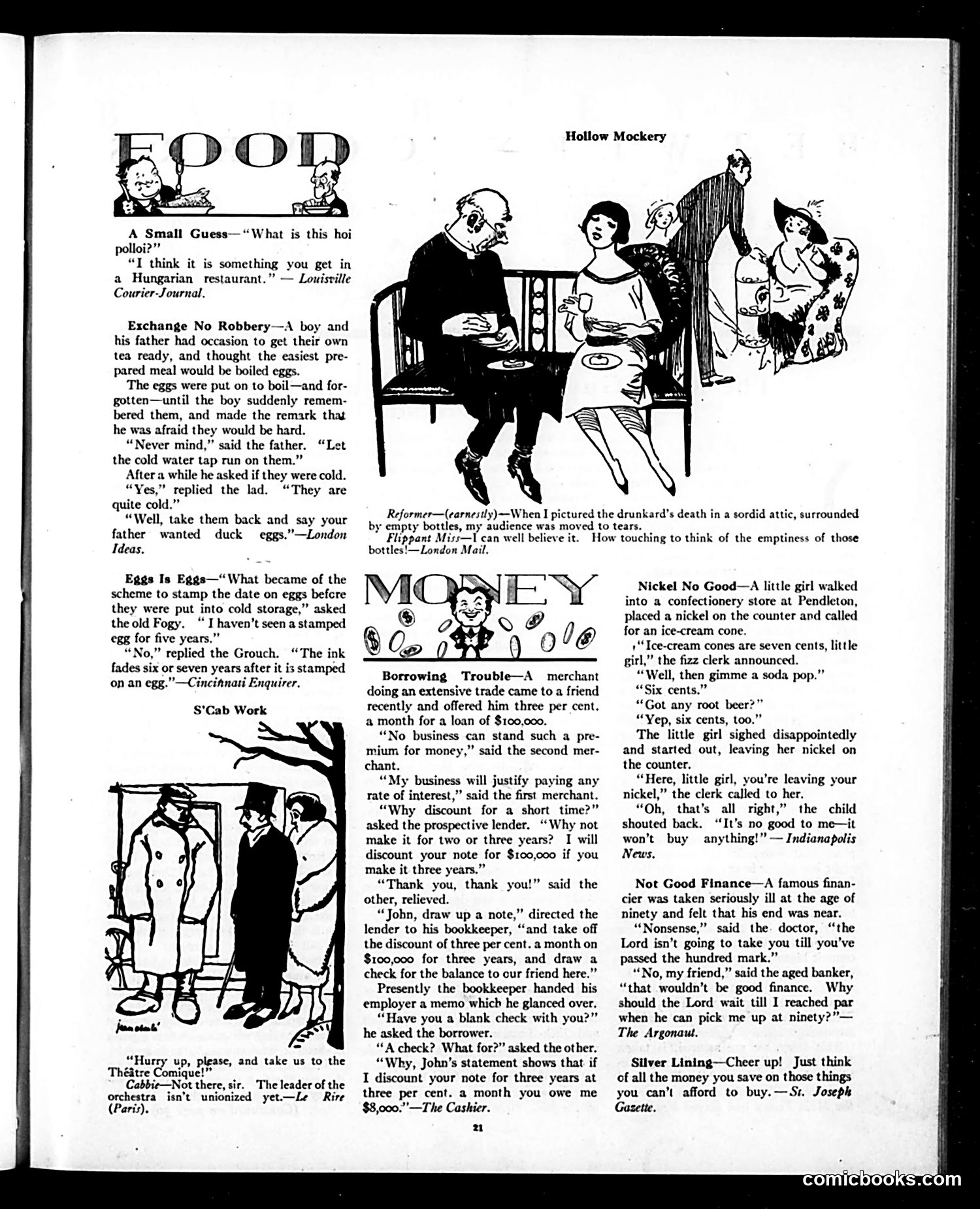
This page collects brief humorous anecdotes typical of early 20th-century American humor magazines. The jokes target several social anxieties: **"Exchange No Robbery"** satirizes working-class domesticity—a father and son boiling eggs, then deceiving themselves about the result being intentional ("duck eggs"). The humor mocks masculine incompetence in the kitchen. **"S'Cab Work"** references labor unionization debates of the era, joking that a theater performance cannot proceed because the orchestra leader isn't unionized—suggesting satire of both labor demands and their perceived absurdity. **"Borrowing Trouble"** depicts financial naïveté: a desperate businessman agrees to compound interest that grows from a $100,000 loan to $108,000 over three years—yet celebrates this as relief, apparently not understanding mathematics. **"Nickel No Good"** shows Depression-era deflation anxiety: a child's nickel cannot buy anything (items cost 6-7 cents), rendering small change worthless. The cartoons mock incompetence, labor politics, financial illiteracy, and economic hardship through working-class and domestic scenarios typical of Judge's readership.
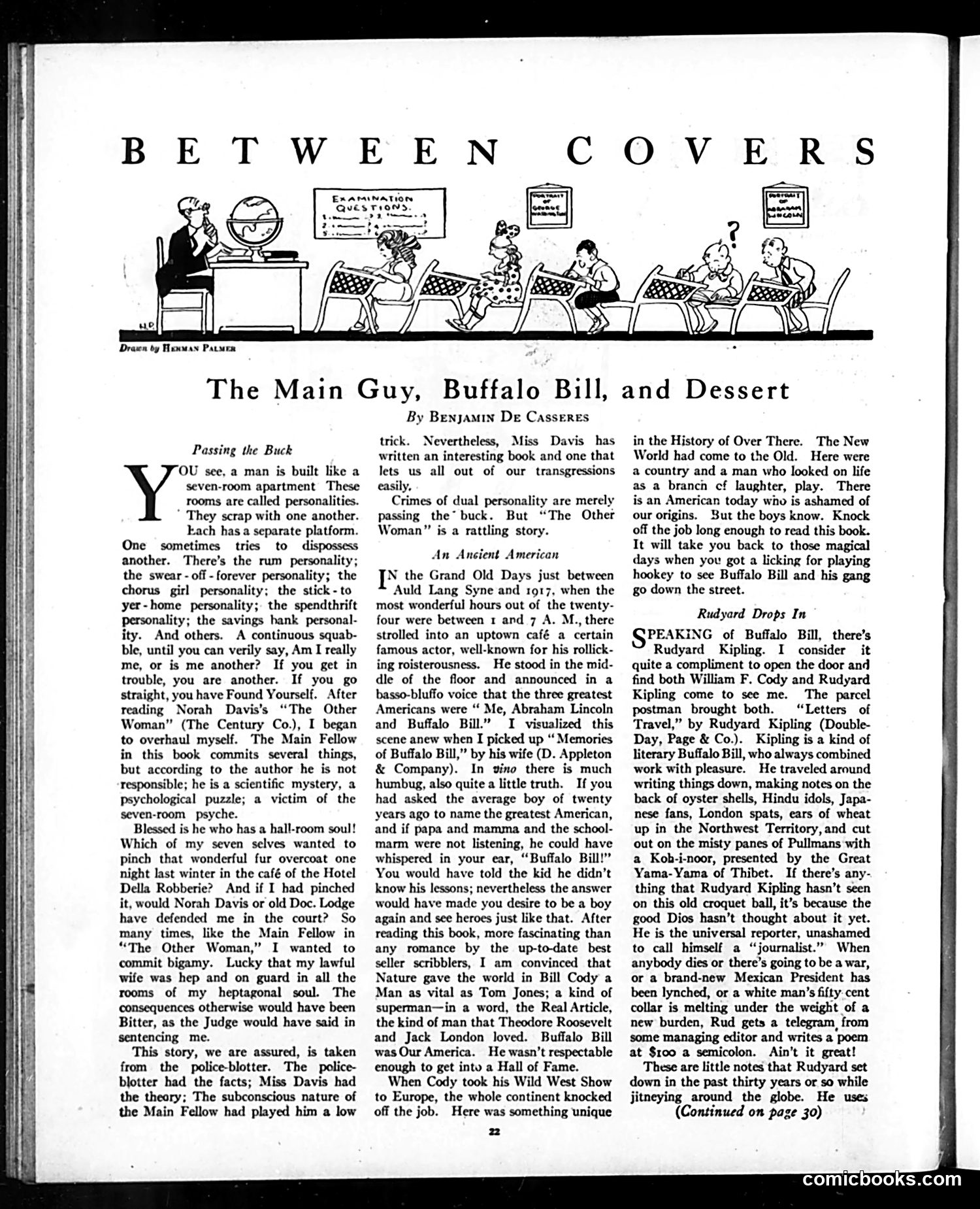
This Judge magazine page contains book reviews rather than political cartoons. The header illustration shows a classroom examination scene, presumably satirizing educational testing. The reviews discuss three books: Norah Davis's "The Other Woman," which explores "dual personality" as psychological excuse-making (the "Main Guy" passing moral responsibility to his subconscious); and D. Appleton & Company's "Memories of Buffalo Bill" by his wife. The Buffalo Bill section nostalgically recalls early 1900s American hero-worship. The author notes that twenty years prior, boys would name Buffalo Bill as America's greatest figure—a "superman" comparable to literary characters like Tom Jones. The review praises Cody's authenticity and his 1880s-1890s Wild West Show's impact on Europe, positioning him as vital cultural export representing American vitality. The satire is gentle: celebrating frontier mythology while acknowledging Buffalo Bill's unsuitability for respectable institutions like Halls of Fame—he was too authentically rough-hewn for establishment approval.
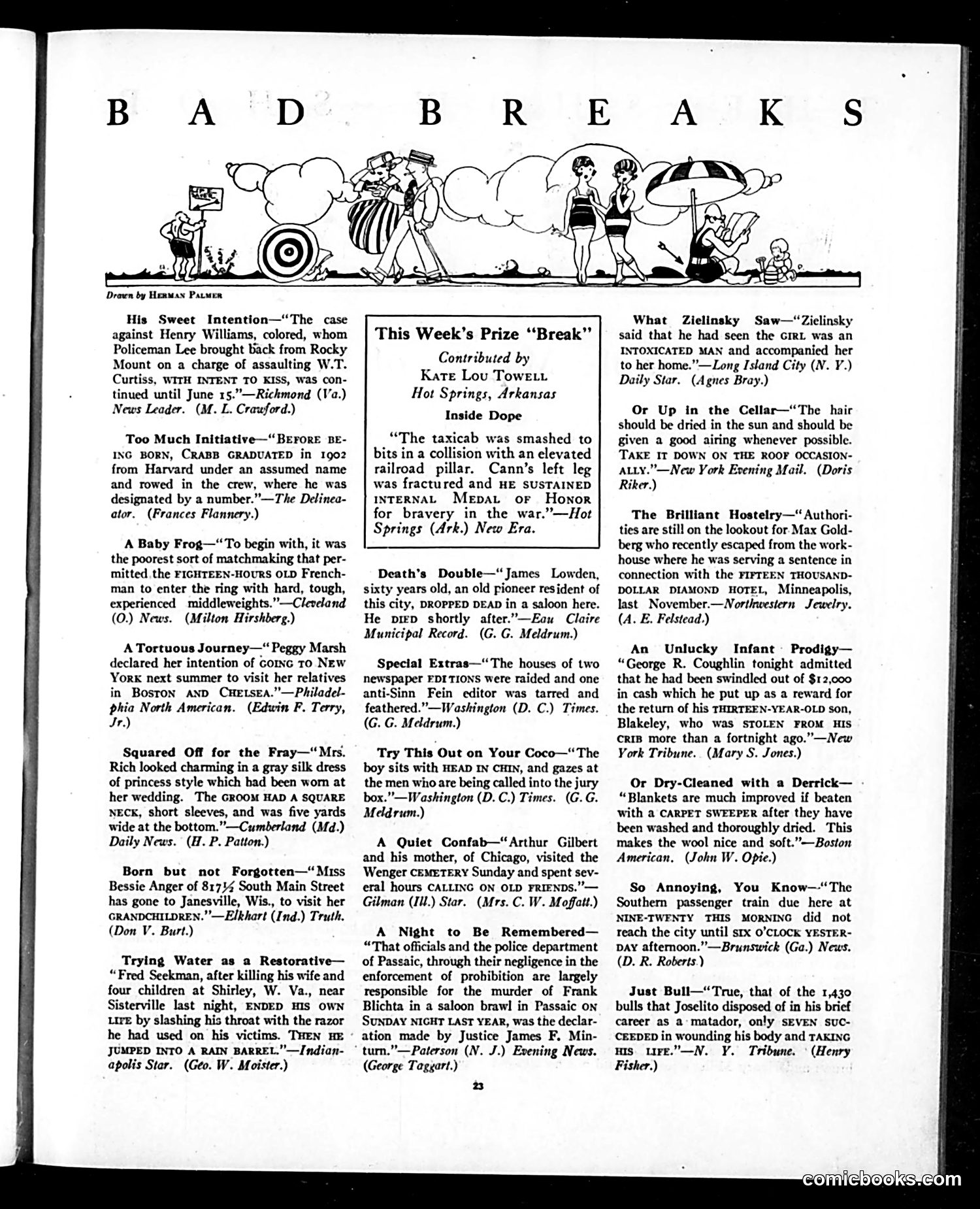
This page features *Judge* magazine's humor column showcasing humorous newspaper typos and editorial errors—the "breaks" of the title. The cartoon by Herman Palmer depicts various comedic mishaps. The satire works by reprinting actual newspaper excerpts where *unintentional* word choices or formatting create absurd meanings. For example: a man assaulting someone "WITH INTENT TO KISS" (likely "with intent to hit"), a groom described as "FIVE YARDS WIDE AT THE BOTTOM" (probable sizing error), and a murder victim who "DROPPED DEAD" then "DIED shortly after" (redundant reporting). The humor appeals to readers' appreciation of journalism's carelessness. Some entries reference contemporary issues like Prohibition enforcement and Irish independence ("tarred and feathered" anti-Sinn Féin editors), but the primary joke remains simple: newspapers' accidental absurdities. This represents early 20th-century satirical humor targeting media incompetence.
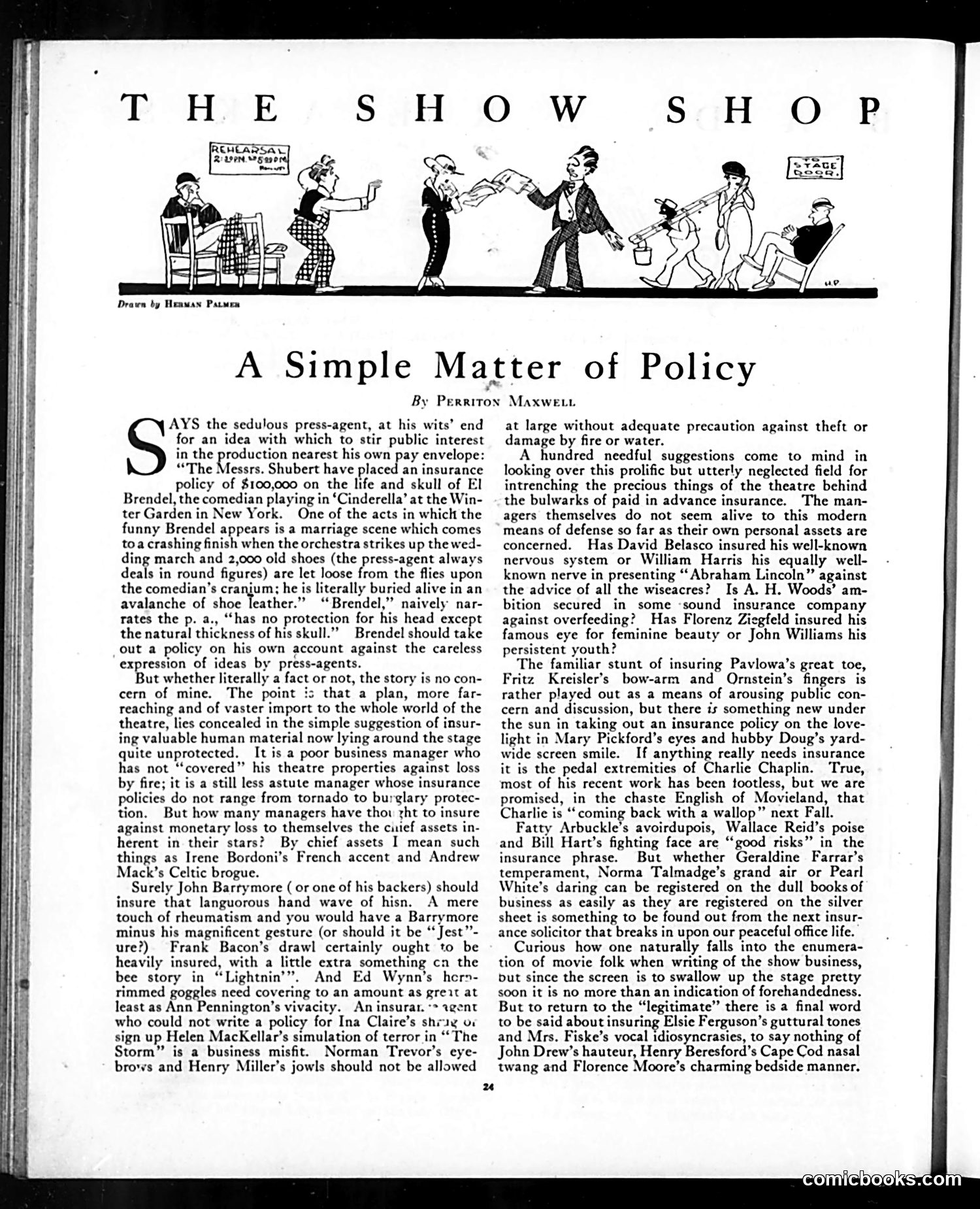
This satirical article by Perriton Maxwell mocks the theatre industry's failure to insure its stars' most valuable assets—their distinctive personal qualities and physical characteristics. The piece begins with a press agent's publicity stunt: comedian El Brendel being insured for $100,000 against injury from 2,000 shoes dropped on his head during a theatrical performance. Maxwell uses this absurd anecdote as a springboard to argue that theatre managers should logically insure the unique traits that make their stars valuable: John Barrymore's hand gestures, Frank Bacon's drawl, Ann Pennington's vivacity, Ina Claire's charm, and even Mary Pickford's eyes. The satire targets both theatrical managers' shortsightedness and the absurdity of attempting to quantify and insure intangible human qualities. By extending the logic of the Brendel insurance policy to increasingly ridiculous extremes—insuring David Belasco's nervous system or Florenz Ziegfeld's eye for beauty—Maxwell exposes the foolishness of literal-minded business thinking applied to art and performance.
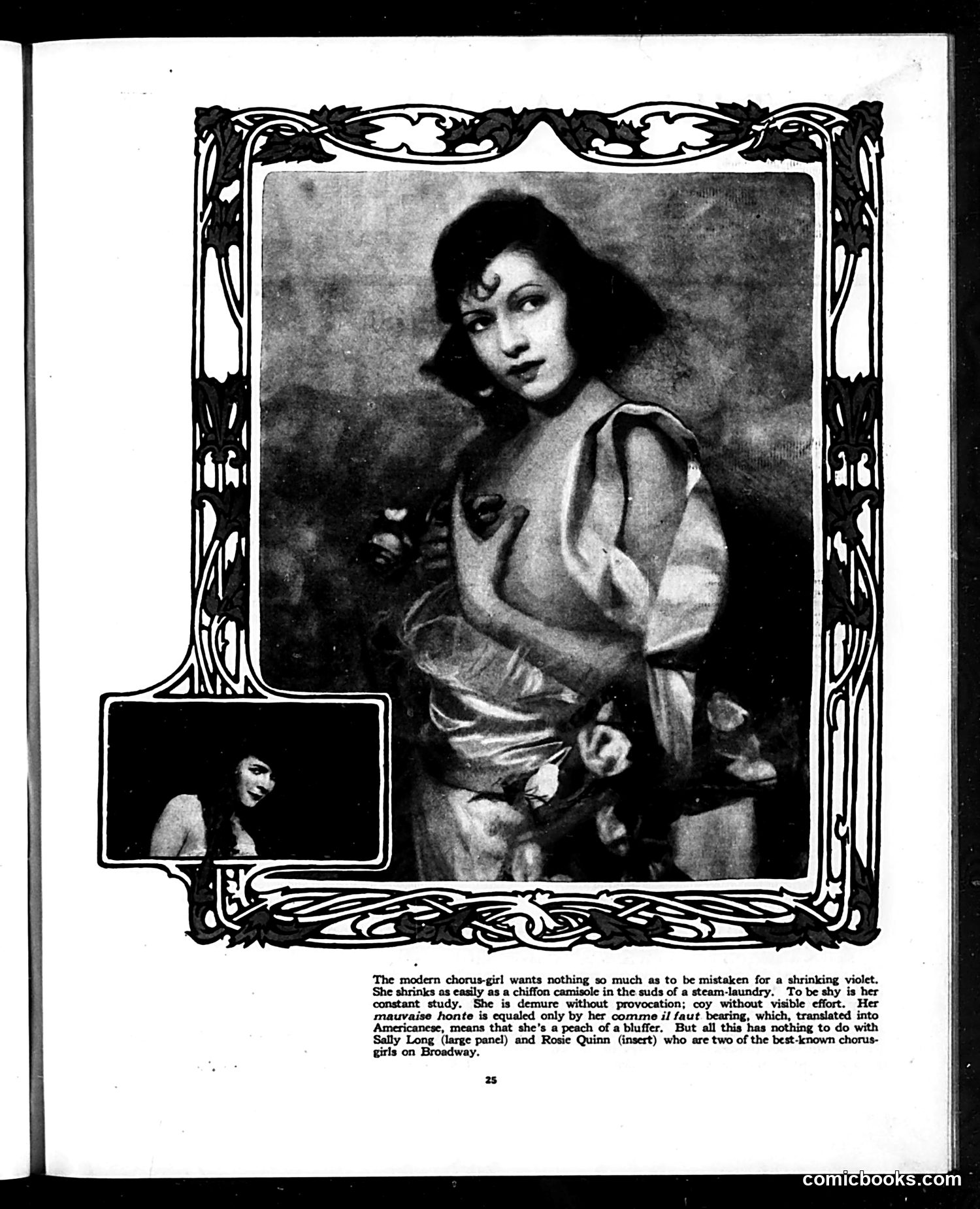
This page satirizes the pretensions of Broadway chorus girls circa early 20th century. The text mocks how modern chorus girls affect an exaggerated modesty—wanting to appear like "shrinking violets" while actually performing in revealing costumes. The satire targets their calculated coyness and their attempts to seem refined ("comme il faut") despite working in entertainment considered risqué at the time. The accompanying photographs showcase Sally Long and Rosie Quinn, identified as "two of the best-known chorus-girls on Broadway." The satirical point appears to be that these women's carefully constructed images of demure respectability contradict their actual public personas as performers. The ornate art nouveau frame around the large photograph emphasizes the theatrical presentation being mocked—the gap between performers' public personas and their actual professional roles.
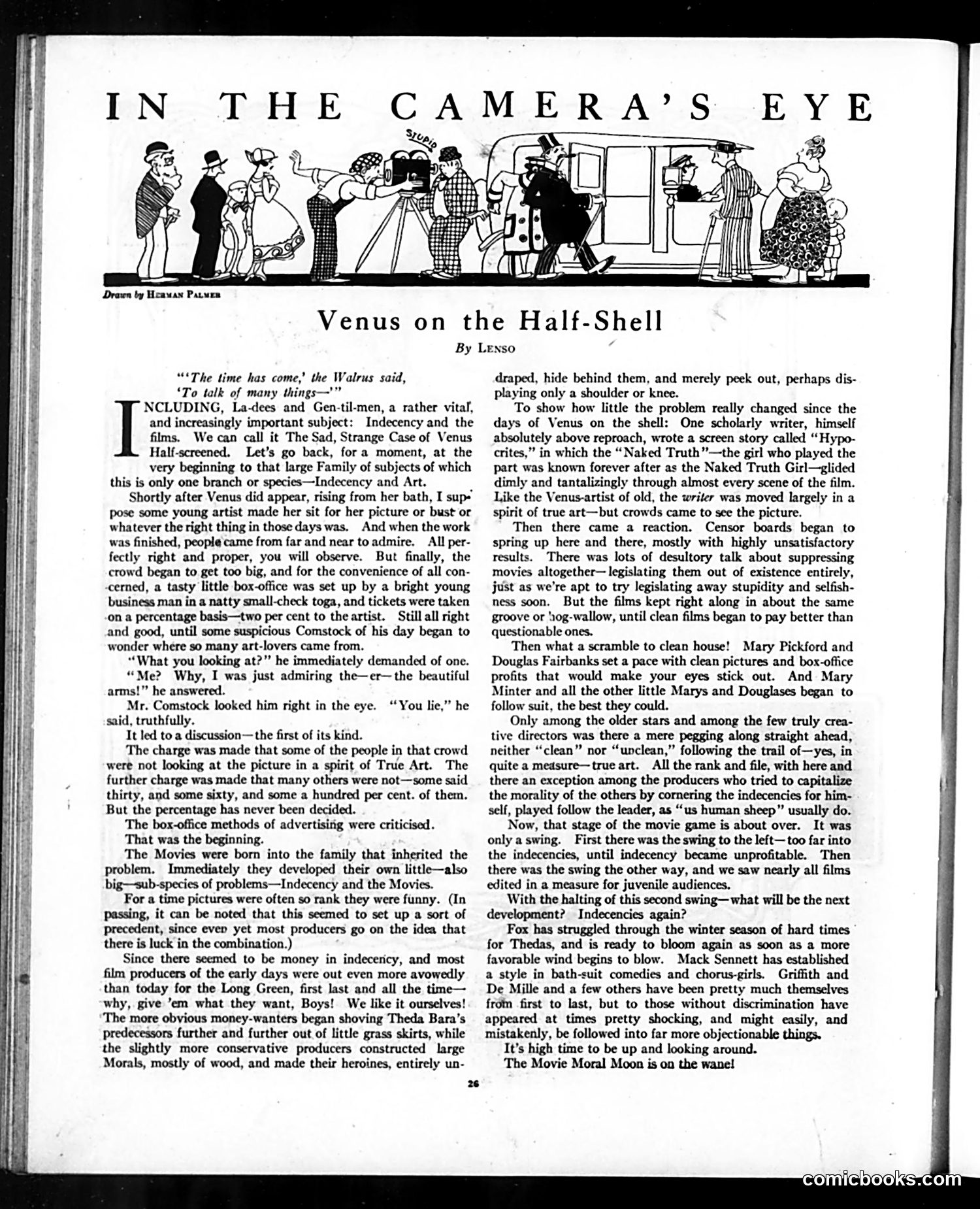
This article by Lenso satirizes film industry censorship debates of the silent era. The piece traces indecency concerns back to classical art—specifically Botticelli's "Birth of Venus"—arguing that controversy over viewing motives is timeless. The satire targets: 1. **Hypocrisy**: Artists and producers claiming "True Art" while profiting from audiences' prurient interest 2. **Early censorship efforts**: "Comstock" references Anthony Comstock, the famous 1800s vice crusader; the article mocks inadequate censorship solutions 3. **Theda Bara and similar actresses**: Referenced as predecessors to increasingly exposed performances marketed as art 4. **"Hypocrites" film**: A real 1915 film featuring a nude actress ("Naked Truth Girl"), presented as proof that artistic justification masks commercial exploitation The cartoon header shows film production activity. The piece argues censorship is futile—the real problem is distinguishing genuine artistic intent from commercial manipulation of human nature, a distinction that may not exist.
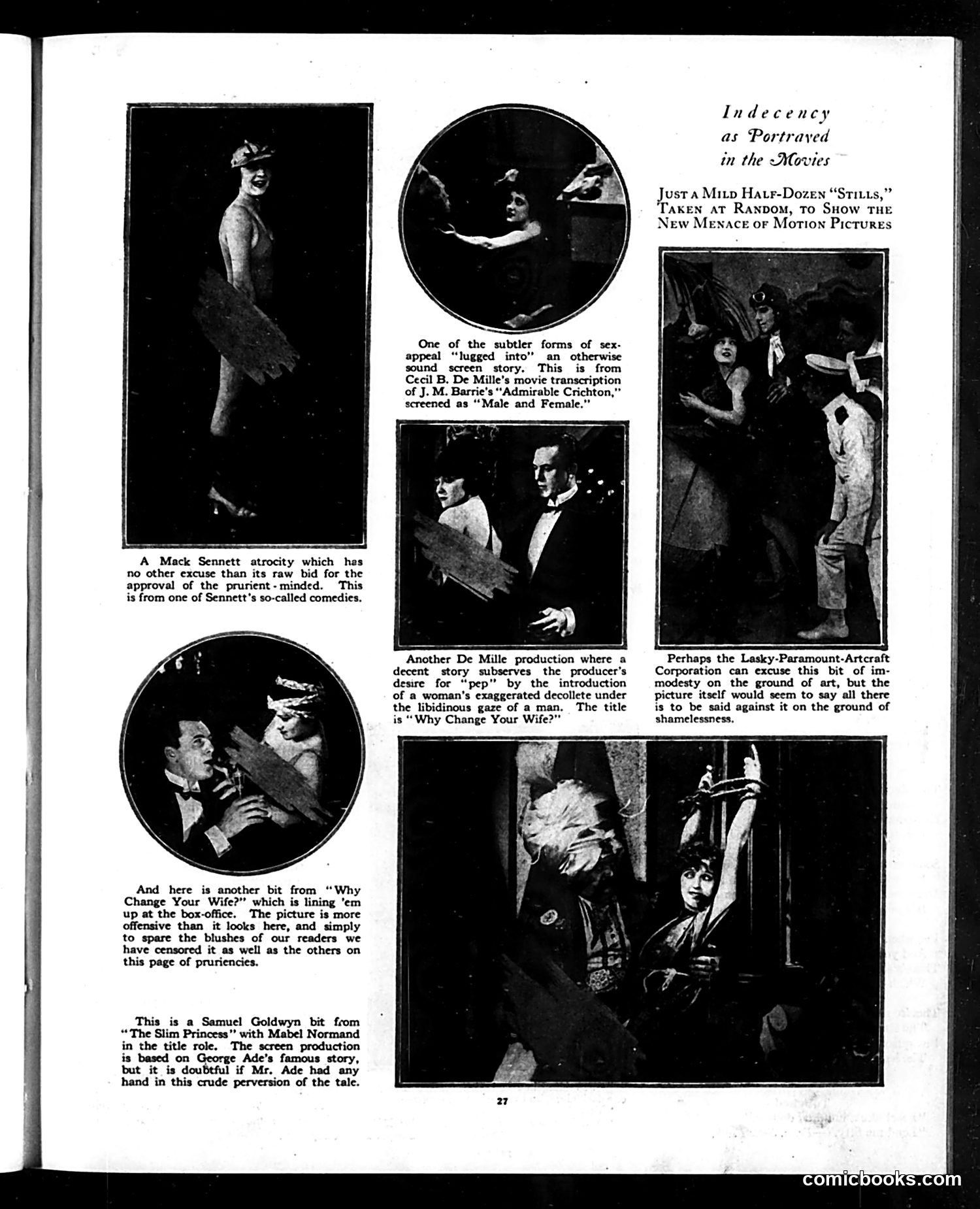
This Judge magazine page critiques early 1920s Hollywood films for exploiting sexual content. The satirist condemns producers—Mack Sennett, Cecil B. DeMille, Samuel Goldwyn, and Lasky-Paramount-Artcraft—for inserting gratuitous "sex appeal" into otherwise respectable stories to boost box-office appeal to "prurient-minded" audiences. The criticism targets specific films like "Why Change Your Wife?" and adaptations of J.M. Barrie and George Ade's works, arguing that producers corrupt classic literature by adding unnecessary scenes of underdressed women and suggestive content. The author sarcastically notes he's censored the images "to spare the blushes of our readers," implying the original content was genuinely offensive by 1920s standards. The page reflects broader Progressive Era anxieties about cinema's moral influence and calls for industry self-regulation.
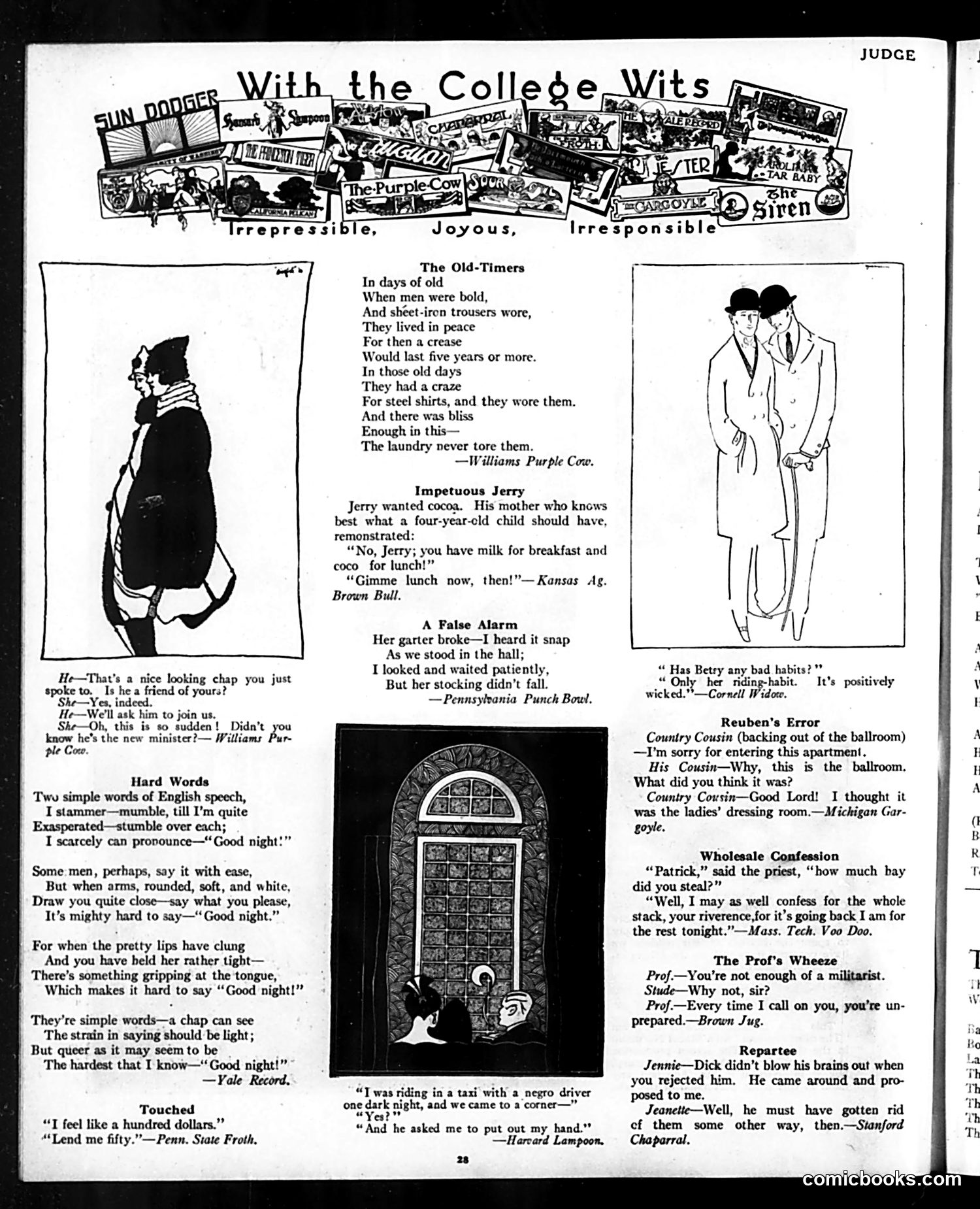
This is a humor anthology page from *Judge* magazine, featuring jokes and short comic pieces sourced from college humor publications (Yale Record, Brown Jug, Michigan Gargoyle, etc.). **Content includes:** - Social comedy about courtship difficulties ("Hard Words"—a young man struggling to say goodnight to a woman he's romantically attracted to) - Domestic humor ("Impetuous Jerry"—a child demanding lunch instead of milk) - Nostalgic satire ("The Old-Timers"—mocking past generations' supposedly superior durability of clothing) - Light observational humor about class confusion and romantic mishaps - A racist joke involving a taxi driver (reflecting period attitudes) - An Irish-Catholic confession joke playing on dialect humor The page's central illustrations appear to be generic college-life scenes. The overall tone is lighthearted, romance-focused, and relies on period conventions: sentimental courtship, generational contrasts, and ethnic/class-based comedy typical of 1920s college humor magazines.
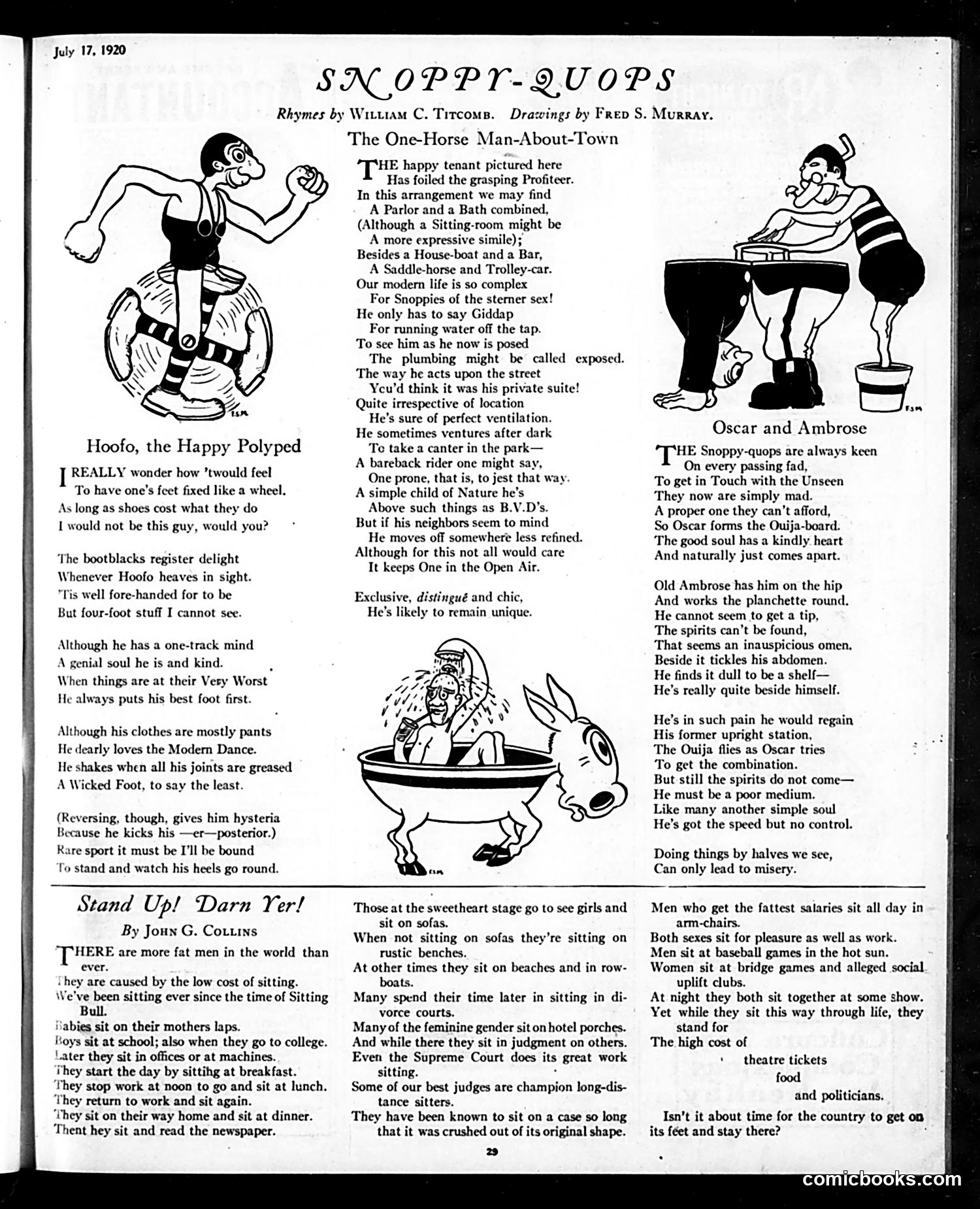
This page contains three satirical comics mocking modern urban life and fads: **"Hoofo, the Happy Polyped"** ridicules a man living in extremely cramped quarters, moving about on wheeled feet like furniture. It's satire on post-WWI housing shortages and poverty. **"The One-Horse Man-About-Town"** depicts a homeless vagrant using a horse as his entire dwelling—combining parlor, bath, and bar. The satire targets wealthy profiteers exploiting housing during this period, while the poor are reduced to absurd living arrangements. **"Stand Up! Darn Yer!"** (by John G. Collins) is a commentary on sedentary modern life, claiming excessive sitting causes obesity. It catalogs sitting at every life stage from infancy through adulthood. **"Oscar and Ambrose"** mocks the 1920s spiritualist craze (Ouija boards), showing two men attempting séances with comical results. The overall theme: post-war America's social anxieties about housing, class disparity, and fashionable but ridiculous trends.
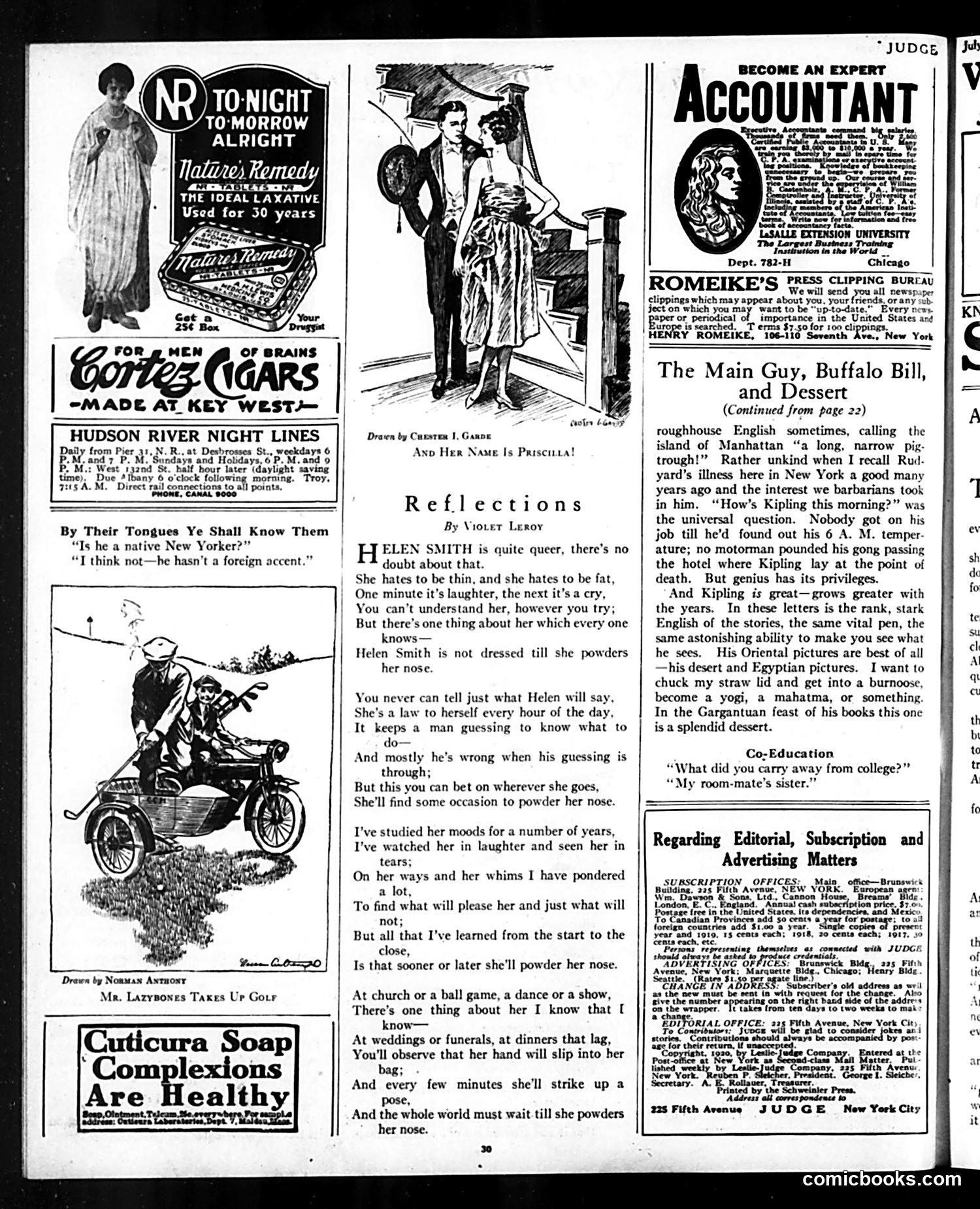
This page is primarily **advertisements and light humor pieces** rather than political satire. The notable content includes: **"By Their Tongues Ye Shall Know Them"** — A quip about New York identity: someone asks if a person is a native New Yorker, the answer being "no—he hasn't a foreign accent." This satirizes the expectation that *real* New Yorkers speak with an accent, reflecting turn-of-century assumptions about immigrant populations dominating the city. **"Reflections by Violet Leroy"** — A poem humoring female vanity, particularly about women constantly powdering their noses—a mundane beauty ritual repeated throughout their day, presented as an amusing character trait that defines women's behavior across all social situations. **"Mr. Lazybones Takes Up Golf"** — An illustration with no visible caption; appears to be about an idle man on a motorcycle/sidecar (golfing reference unclear from visible text). **The remainder** consists of advertisements (Nature's Remedy laxative, Cortez Cigars, Hudson River Night Lines, Cuticura Soap) and subscription information—typical magazine filler of the era. The page has minimal serious political content.
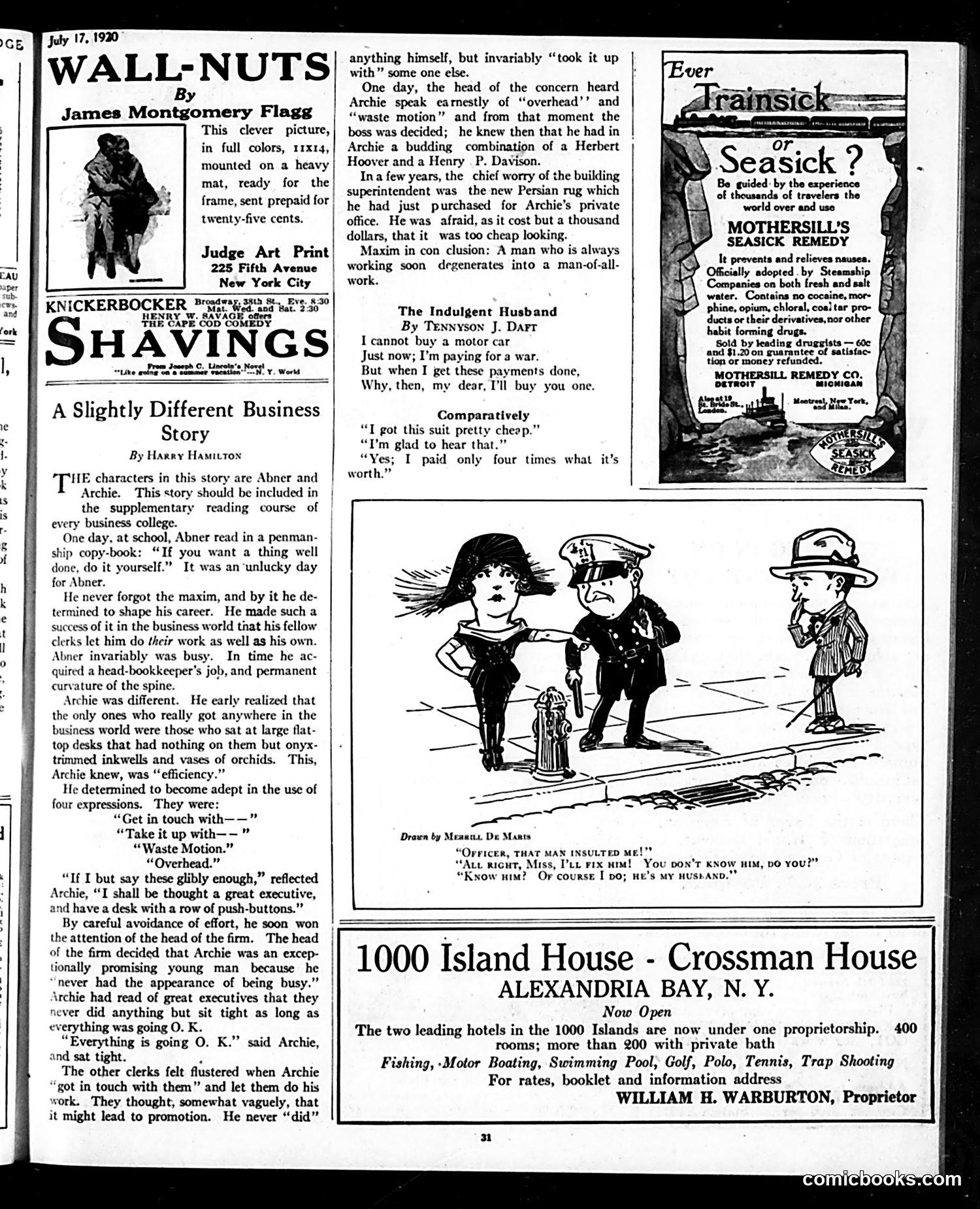
This page contains satirical business commentary relevant to post-WWI America. **Main Story ("A Slightly Different Business Story"):** The narrative contrasts two office workers—Abner, who works diligently but exhausts himself, and Archie, who succeeds through appearing busy while delegating everything. Archie becomes an executive by mastering corporate jargon ("Get in touch with," "Take it up with," "Overhead," "Waste Motion") without actually accomplishing work. The satire mocks 1920s corporate culture and the rise of middle managers who prioritized appearance over substance. **The Cartoon:** Shows a woman confronting a man (her husband, apparently) with two other men present. The caption implies marital conflict and miscommunication—typical domestic humor of the era. **Historical Context:** References to Herbert Hoover and Henry P. Davison (a J.P. Morgan partner) ground the story in contemporary business figures. The "war" payments mentioned likely reference post-WWI debts. The page satirizes emerging corporate inefficiency and management theater in the 1920s business boom.
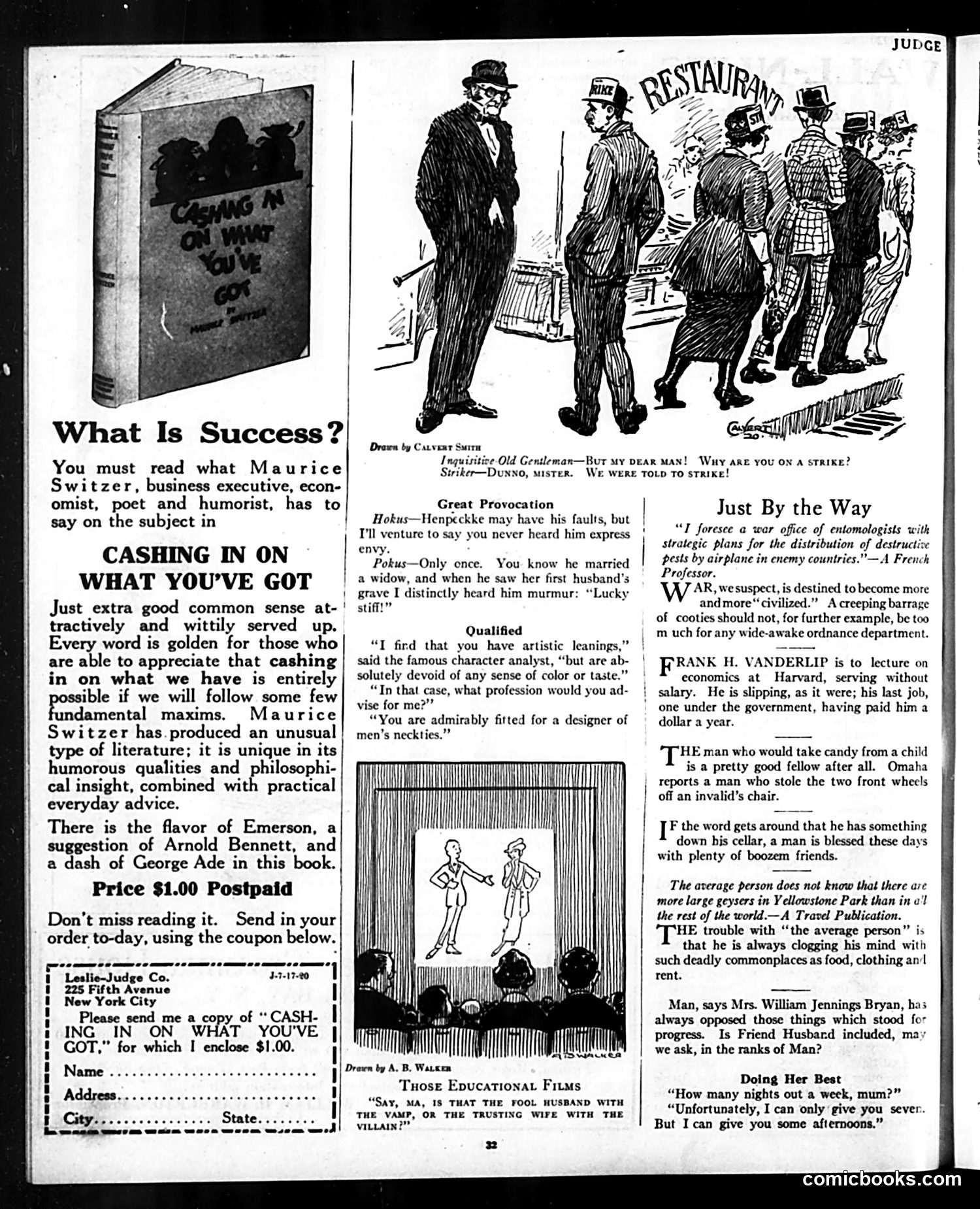
This page mixes advertisement and satirical commentary typical of Judge magazine's format. **The Book Advertisement** (left) promotes Maurice Switzer's "Cashing In On What You've Got," positioning it as practical wisdom with philosophical depth—comparing it to Emerson and George Ade. **The Cartoons** showcase Judge's humor: 1. **"Great Provocation"**: A joke about a henpecked husband who envies a widow's deceased first husband—dark humor about marital unhappiness. 2. **"The Strike"**: An elderly gentleman asks a striker why he's striking; the striker admits "Dunno, sister"—satirizing labor movements as thoughtless or mob-driven rather than principled. 3. **"Qualified"**: A character analyst tells an artistically talentless man he's perfect for designing neckties—absurdist humor. 4. **Various quips** mock "average persons," reference Frank Vanderlip (an actual banker/economist), and make casual jokes about Prohibition-era bootlegging and marital discord. The overall tone is conservative, mocking labor activism and celebrating bourgeois sensibility.
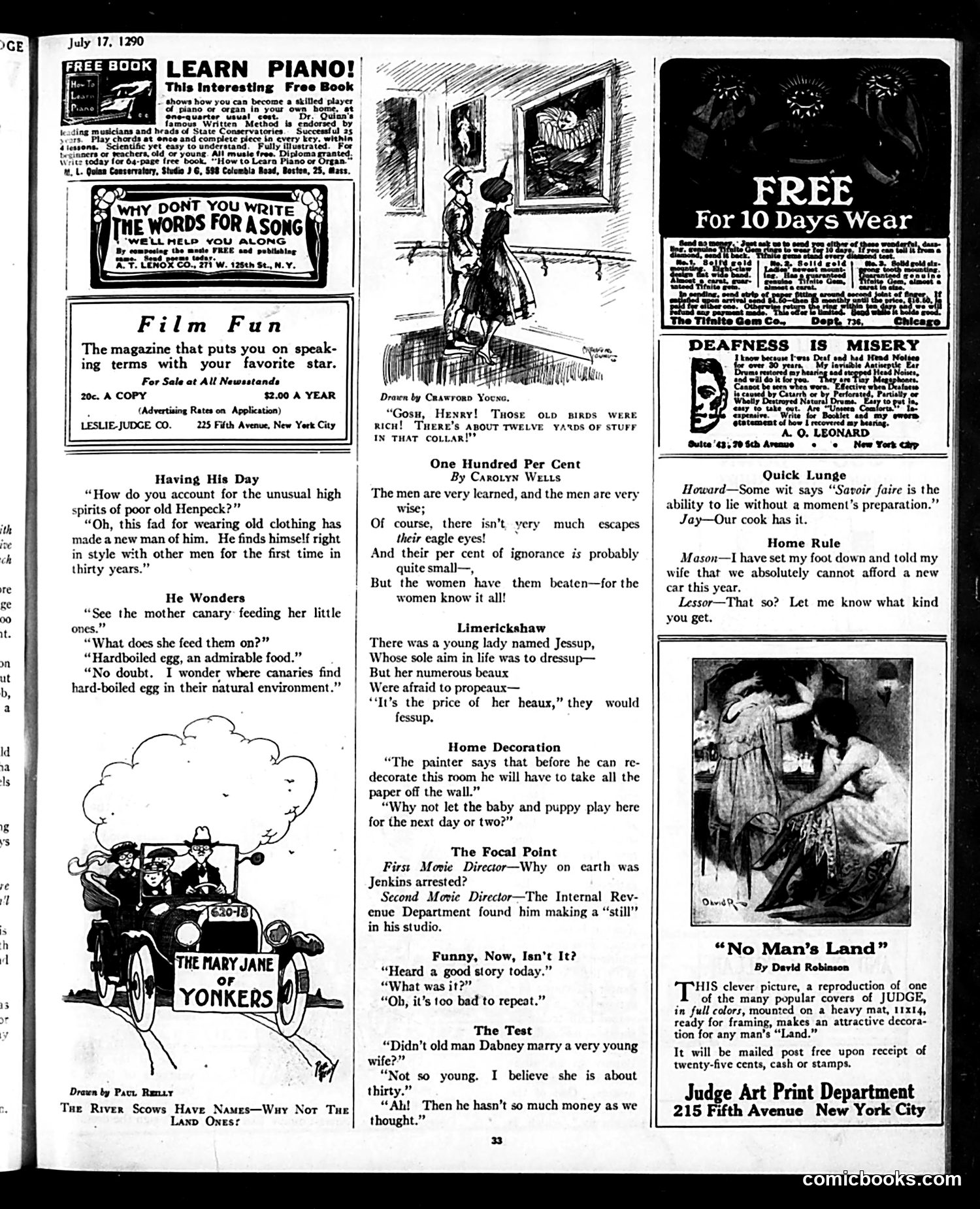
This is primarily an **advertising and humor page** from Judge magazine, featuring lightweight social comedy rather than political satire. ## Key Content: **The Cartoons** are mostly domestic humor: - "Having His Day": A joke about shabby clothing becoming fashionable, making an ordinary man ("Henpeck") feel stylish - "The River Scows Have Names": A single-panel cartoon questioning why boats have names but land doesn't - Limericks and jokes about fashion obsession, home decoration, and marital dynamics **The Advertisements** dominate—promoting piano lessons, "Film Fun" magazine, deafness cures, and Judge art prints. **The Humor** reflects early 1920s concerns: women's independence ("women know it all"), changing fashion, consumer culture, and marital power dynamics (wives spending money on cars). **What's Missing**: No major political figures or events are referenced. This page reflects mainstream consumer-focused humor rather than the satirical edge Judge sometimes delivered. The content is gentle, apolitical domestic comedy aimed at middle-class readers.
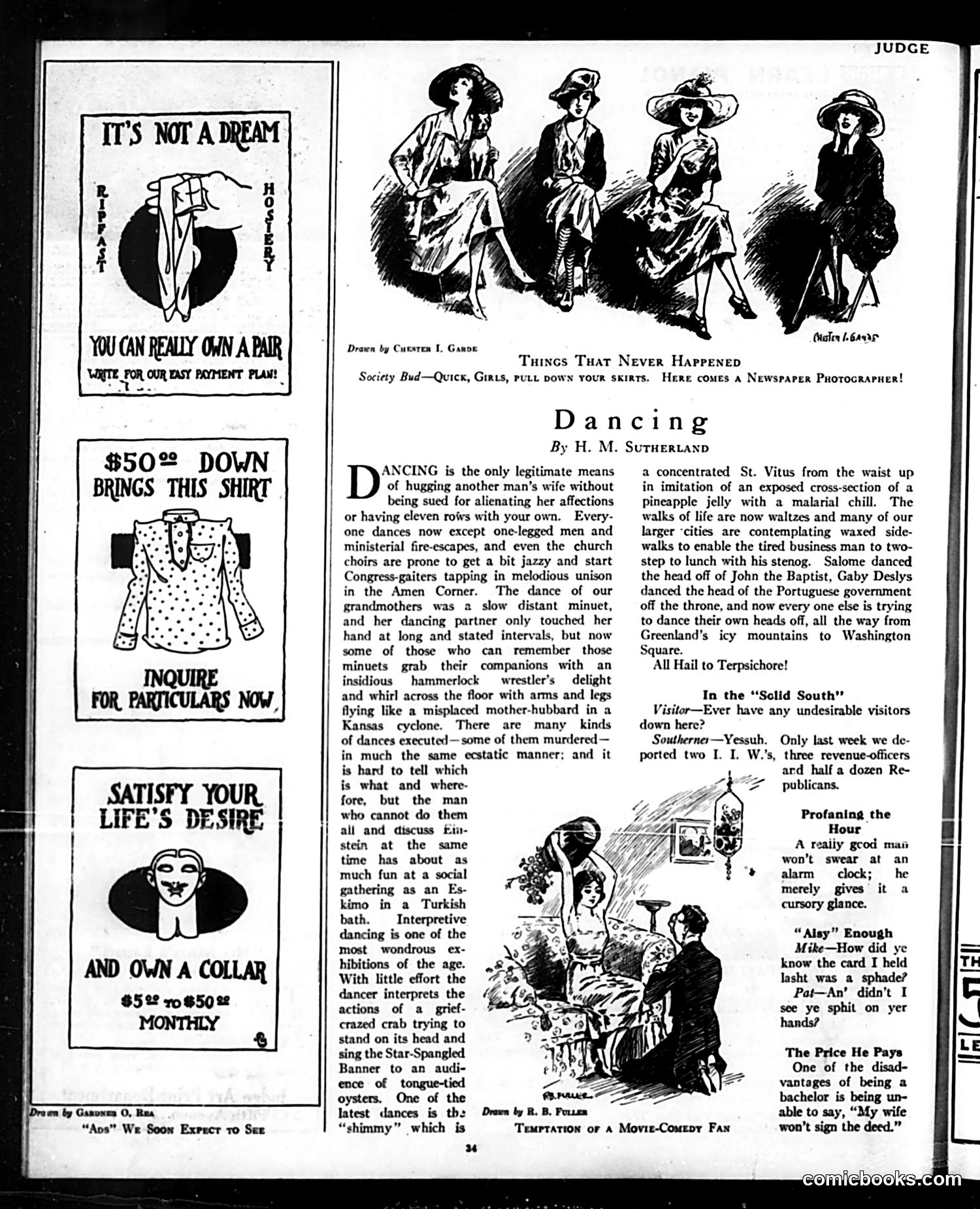
This Judge magazine page contains satirical commentary on 1920s social trends and politics: **Left side ads**: Mock commercials satirizing consumerism—offering cheap collars and shirts on installment plans, mocking middle-class aspirations to gentility through purchased accessories. **"Things That Never Happened"**: A visual gag about newspaper photographers catching society women in undignified poses, reflecting anxieties about new media exposure and women's changing social roles. **"Dancing" essay**: Sharp satire on the Jazz Age's wild new dances (the "shimmy" and others) versus Victorian-era restraint. References "St. Vitus" (involuntary movement disorder) to mock the jerky, uncontrolled movements of modern dance. **"Solid South" dialogue**: Political jab—a Southerner boasts of deporting I.W.W.s (radical labor unionists), revenue officers, and Republicans, reflecting post-WWI anti-radical sentiment and regional politics. **Bottom humor**: Brief jokes about working-class speech patterns and bachelor disadvantages. The page reflects 1920s cultural anxiety over rapid social change, new technologies, labor unrest, and generational conflict.
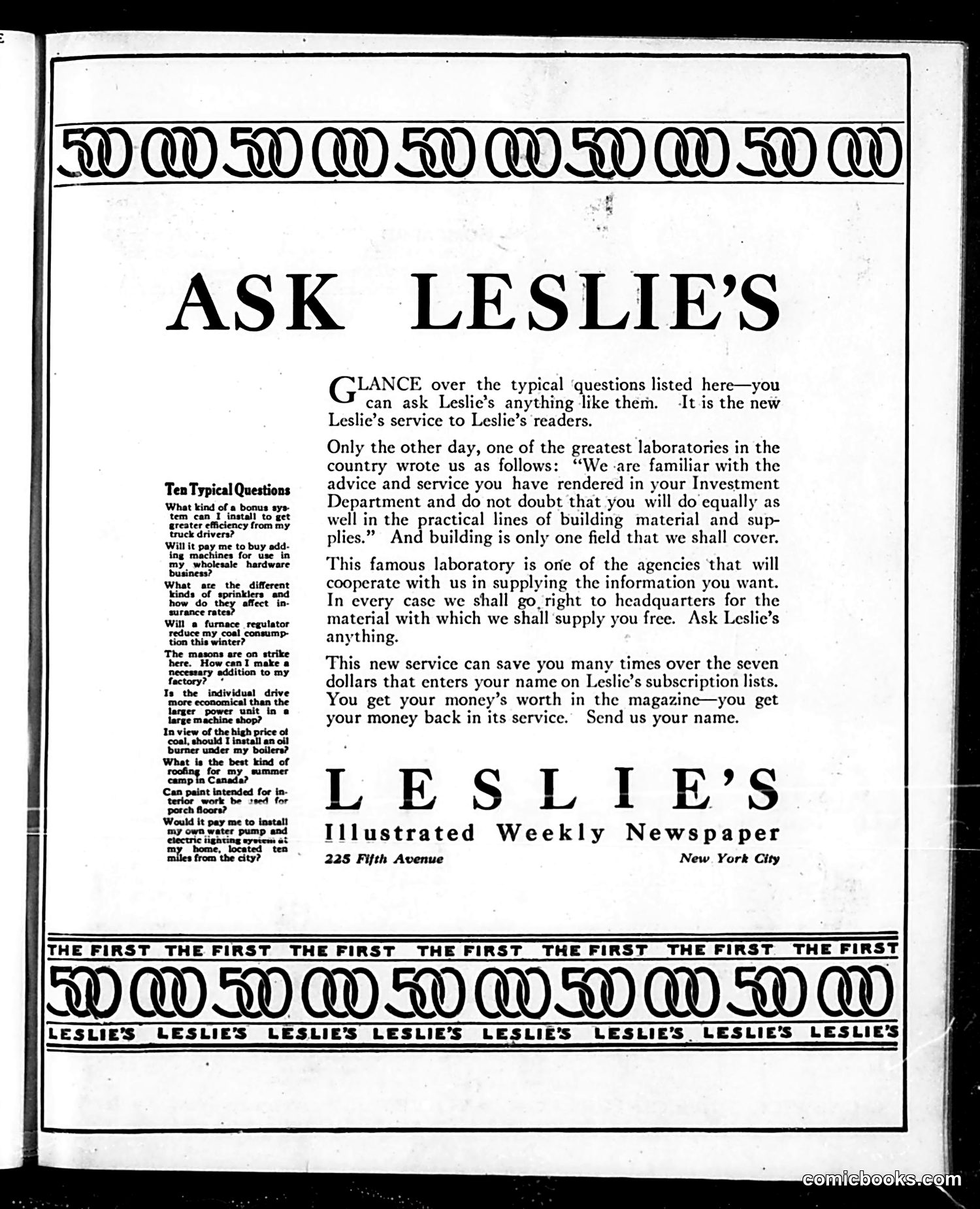
This is primarily an **advertisement page**, not a political cartoon. It announces Leslie's Illustrated Weekly Newspaper's new "Ask Leslie's" reader service—essentially an advice column for practical questions about construction, home improvement, heating systems, and other domestic matters. The page lists "Ten Typical Questions" readers might submit (visible on the left margin), ranging from bonus systems for truck drivers to furnace regulators to water pump installation costs. The satire is subtle: Leslie's is marketing itself as an authority on nearly everything by showcasing endorsement from "one of the greatest laboratories in the country," suggesting the magazine now offers expert consulting beyond journalism. The pitch emphasizes readers get practical value—"your money back in its service"—from their subscription. There are **no identifiable political figures or caricatures**. The humor lies in the magazine's expansive claim to answer any reader question across multiple fields, positioning Leslie's as an indispensable resource for the practical American homeowner.
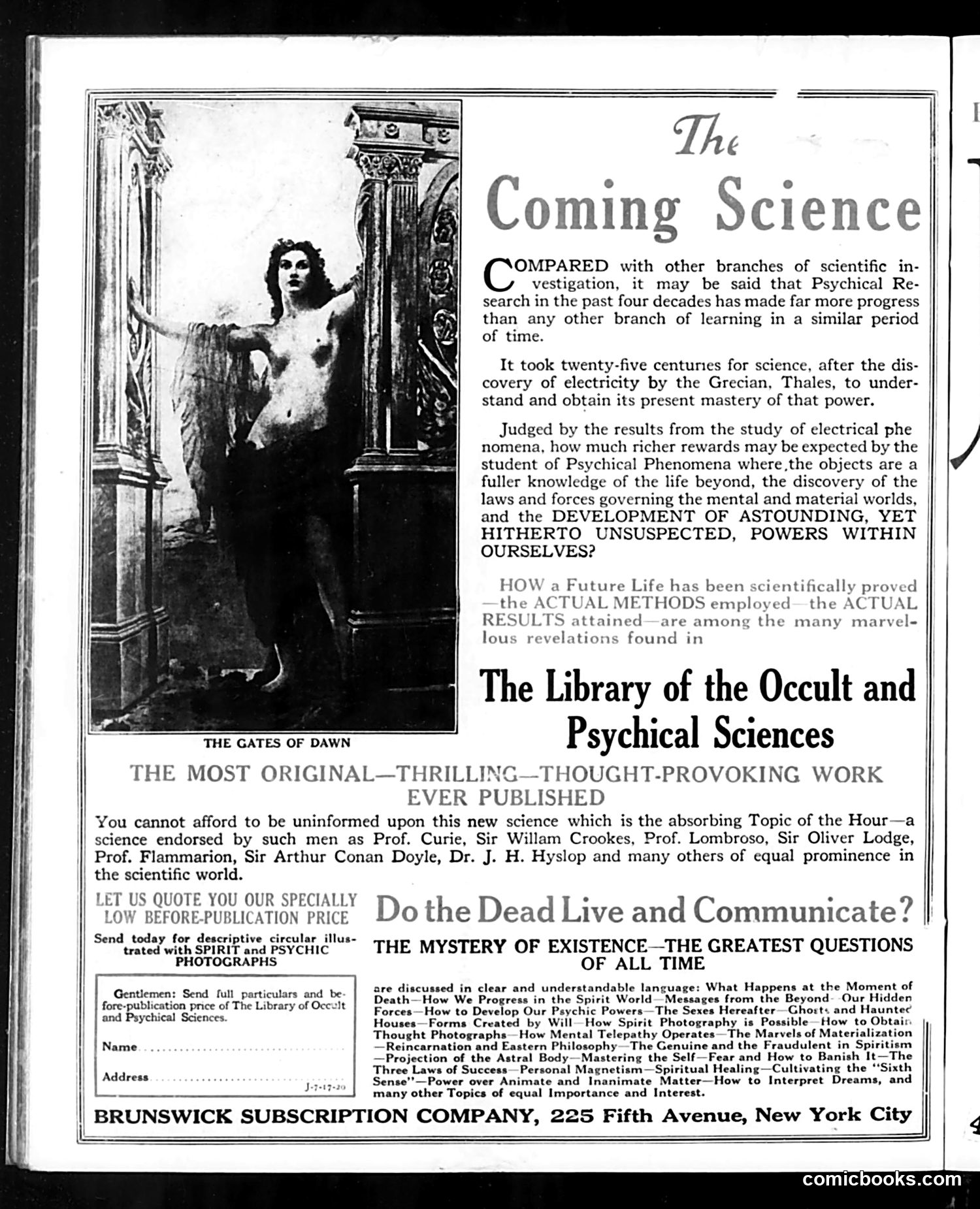
This is primarily an **advertisement**, not a satirical cartoon. It promotes "The Library of the Occult and Psychical Sciences," a mail-order book series. The page capitalizes on early-20th-century fascination with spiritualism and psychical research—then considered quasi-scientific by some. It claims the study of the supernatural has advanced faster than electricity did over 25 centuries, positioning occultism as cutting-edge science. The advertisement lists respected scientists (Curie, Crookes, Conan Doyle) to lend credibility. It promises revelations about communicating with the dead, astral projection, spirit photography, and developing hidden psychic powers. The illustrative image labeled "The Gates of Dawn" depicts a woman in classical dress, evoking mysticism and the otherworldly. **For modern readers**: This reflects how occultism was marketed as legitimate science in the early 1900s, before such claims were thoroughly debunked. It's a time capsule of pseudoscience dressed in scientific language to attract educated audiences.