
Judge, 1920-07-17 · page 22 of 36
Judge — July 17, 1920 — page 22: what you’re looking at
What you’re looking at
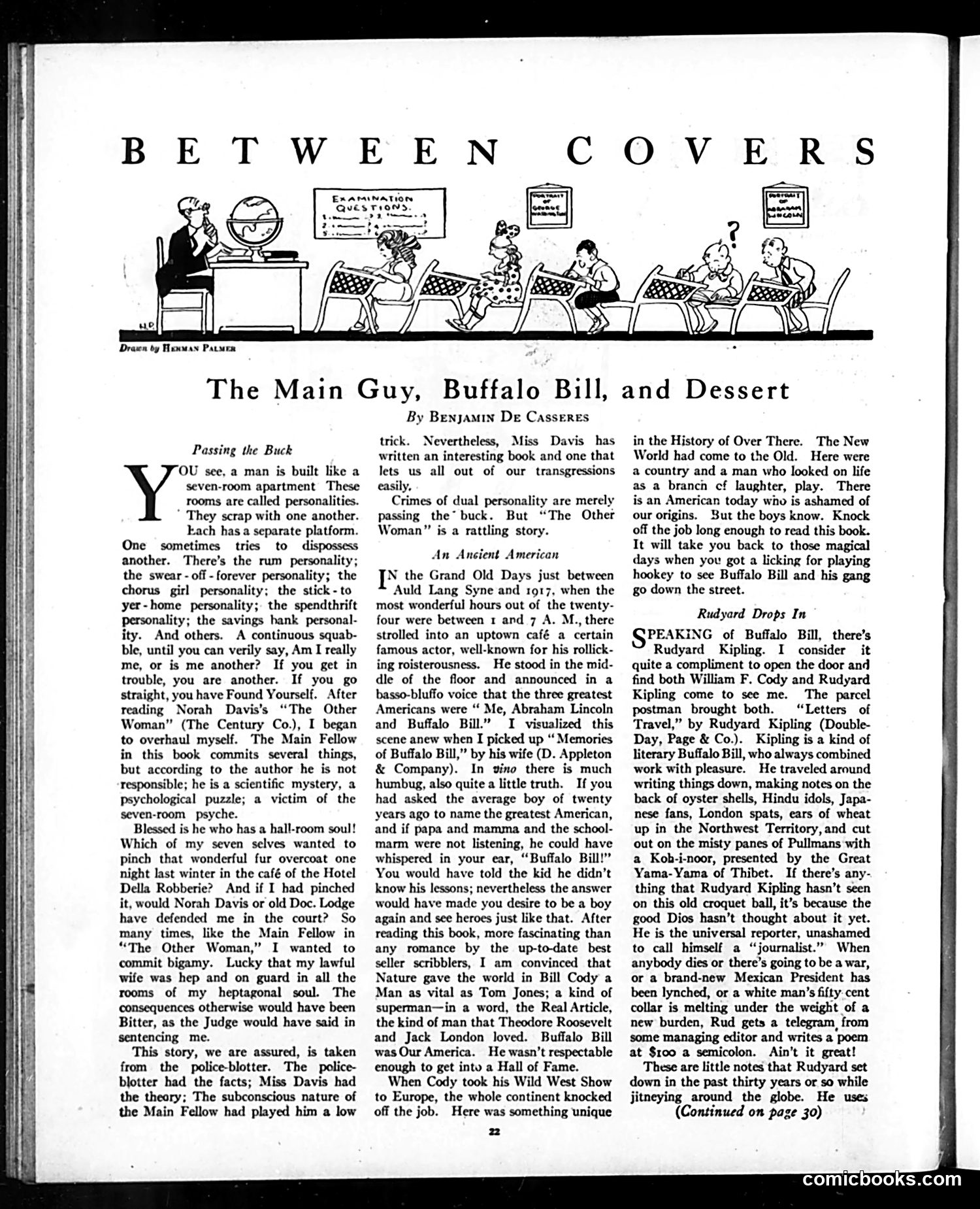
This Judge magazine page contains book reviews rather than political cartoons. The header illustration shows a classroom examination scene, presumably satirizing educational testing. The reviews discuss three books: Norah Davis's "The Other Woman," which explores "dual personality" as psychological excuse-making (the "Main Guy" passing moral responsibility to his subconscious); and D. Appleton & Company's "Memories of Buffalo Bill" by his wife. The Buffalo Bill section nostalgically recalls early 1900s American hero-worship. The author notes that twenty years prior, boys would name Buffalo Bill as America's greatest figure—a "superman" comparable to literary characters like Tom Jones. The review praises Cody's authenticity and his 1880s-1890s Wild West Show's impact on Europe, positioning him as vital cultural export representing American vitality. The satire is gentle: celebrating frontier mythology while acknowledging Buffalo Bill's unsuitability for respectable institutions like Halls of Fame—he was too authentically rough-hewn for establishment approval.
📄 Transcribed text from this page (OCR, searchable)
Machine-transcribed from the original scan — historical spelling and the odd misread are preserved.
Examination THON). Ques Drawn ty Howas Patuen The Main Guy, Buffalo Bill, and Dessert Passing the Buck ‘OU see, a man is built like a seven-room apartment These rooms are called personalities. * They scrap with one another. Each has a separate platform. One sometimes tries to dispossess another. There’s the rum personality; the swear - off - forever personality; the chorus girl personality; the stick-to yer-home personality; the spendthrift personality; the savings hank personal- ity. And others. A continuous squab- ble, until you can verily say, Am I really me, or is me another? If you get in trouble, you are another. If you go straight, you have Found Yourself. After reading Norah Davis's “The Other Woman” (The Century Co.), I began to overhaul myself. The Main Fellow in this book commits several things, but according to the author he is not responsible; he is a scientific mystery, a psychological puzzle; a victim of the seven-room psyche. Blessed is he who has a hall-room soul! Which of my seven selves wanted to pinch that wonderful fur overcoat one night last winter in the café of the Hotel Della Robberie? And if I had pinched it, would Norah Davis or old Doc. Lodge have defended me in the court? So many times, like the Main Fellow in “The Other Woman,” I wanted to commit bigamy. Lucky that my lawful wife was hep and on guard in all the rooms of my heptagonal soul. The consequences otherwise would have been Bitter, as the Judge would have said in sentencing me. This story, we are assured, is taken from the police-blotter. The police- blotter had the facts; Miss Davis had the theory; The subconscious nature of the Main Fellow had played him a low By Benyamin De Casseres trick. Nevertheless, Miss Davis has written an interesting book and one that lets us all out of our transgressions easily, Crimes of dual personality are merely passing the buck. But “The Other Woman” is a rattling story. An Ancient American IX the Grand Old Days just between Auld Lang Syne and 1917, when the most wonderful hours out of the twenty- four were between 1 and 7 A. M., there strolled into an uptown café a certain famous actor, well-known for his rollick- ing roisterousness. He stood in the mid- dle of the floor and announced in a basso-bluffo voice that the three greatest Americans were “ Me, Abraham Lincoln and Buffalo Bill.” I visualized this scene anew when I picked up “ Memories of Buffalo Bill,” by his wife (D. Appleton & Company). In vino there is much humbug, also quite a little truth. If you had asked the average boy of twenty years ago to name the greatest American, and if papa and mamma and the school- marm were not listening, he could have whispered in your ear, “Buffalo Bill!” You would have told the kid he didn’t know his lessons; nevertheless the answer would have made you desire to be a boy again and see heroes just like that. After reading this book, more fascinating than any romance by the up-to-date best seller scribblers, I am convinced that Nature gave the world in Bill Cody a Man as vital as Tom Jones; a kind of superman—in a word, the Real Article, the kind of man that Theodore Roosevelt and Jack London loved. Buffalo Bill was Our America. He wasn’t respectable enough to get into a Hall of Fame. When Cody took his Wild West Show to Europe, the whole continent knocked off the job. Here was something unique in the History of Over There. The New World had come to the Old. Here were a country and a man who looked on life as a branch cf laughter, play. There is an American today who is ashamed of our origins. But the boys know. Knock off the job long enough to read this book. It will take you back to those magical days when you got a licking for playing hookey to see Buffalo Bill and his gang go down the street. Rudyard Drops In PEAKING of Buffalo Bill, there’s Rudyard Kipling. I consider it quite a compliment to open the door and find both William F. Cody and Rudyard Kipling come to see me. The parcel postman brought both. “Letters of Travel,” by Rudyard Kipling (Double- Day, Page & Co.). Kipling is a kind of literary Buffalo Bill, who always combined work with pleasure. He traveled around writing things down, making notes on the back of oyster shells, Hindu idols, Japa- nese fans, London spats, ears of wheat up in the Northwest Territory, and cut out on the misty panes of Pullmans with a Kob-i-noor, presented by the Great Yama-Yama of Thibet. If there’s any- thing that Rudyard Kipling hasn’t seen on this old croquet ball, it’s because the good Dios hasn’t thought about it yet. He is the universal reporter, unashamed. to call himself a “journalist.” When anybody dies or there’s going to be a war, or a brand-new Mexican President has been lynched, or a white man’s fifty cent collar is melting under the weight of a new burden, Rud gets a telegram, from some managing editor and writes a poem at $100 a semicolon. Ain't it great! These are little notes that Rudyard set down in the past thirty years or so while jitneying around the globe. He uses (Continued on page 30) comicbooks.com