
Judge, 1920-07-17 · page 21 of 36
Judge — July 17, 1920 — page 21: what you’re looking at
What you’re looking at
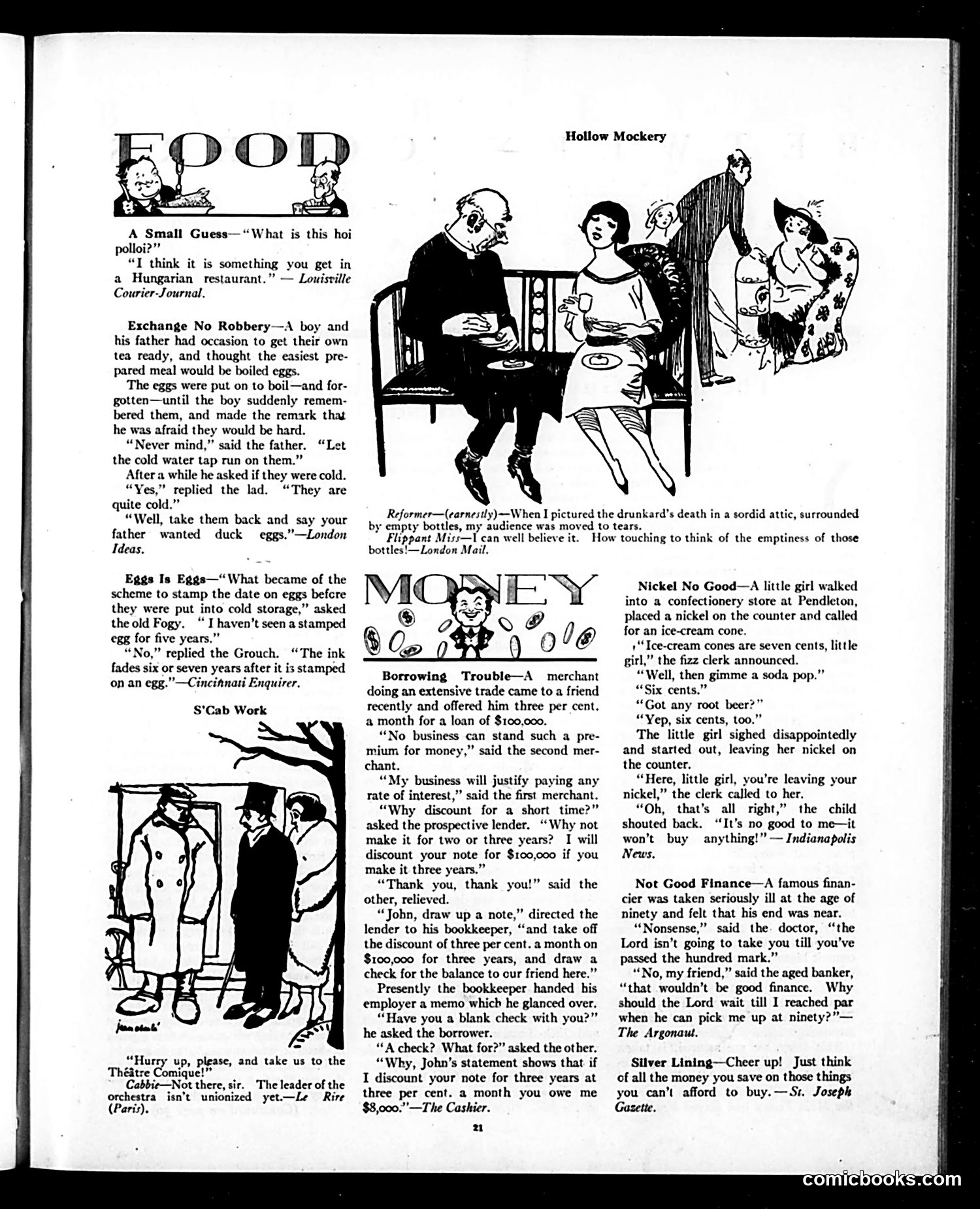
This page collects brief humorous anecdotes typical of early 20th-century American humor magazines. The jokes target several social anxieties: **"Exchange No Robbery"** satirizes working-class domesticity—a father and son boiling eggs, then deceiving themselves about the result being intentional ("duck eggs"). The humor mocks masculine incompetence in the kitchen. **"S'Cab Work"** references labor unionization debates of the era, joking that a theater performance cannot proceed because the orchestra leader isn't unionized—suggesting satire of both labor demands and their perceived absurdity. **"Borrowing Trouble"** depicts financial naïveté: a desperate businessman agrees to compound interest that grows from a $100,000 loan to $108,000 over three years—yet celebrates this as relief, apparently not understanding mathematics. **"Nickel No Good"** shows Depression-era deflation anxiety: a child's nickel cannot buy anything (items cost 6-7 cents), rendering small change worthless. The cartoons mock incompetence, labor politics, financial illiteracy, and economic hardship through working-class and domestic scenarios typical of Judge's readership.
📄 Transcribed text from this page (OCR, searchable)
Machine-transcribed from the original scan — historical spelling and the odd misread are preserved.
A Small Guess— “What is this hoi polloi?”” “I think it is something you get in a Hungarian restaurant.” — Louisville Courier-Journal. Exchange No Robbery—A boy and his father had occasion to get their own tea ready, and thought the easiest pre- pared meal would be boiled eggs. The eggs were put on to boil—and for- gotten—until the boy suddenly remem- bered them, and made the remark that he was afraid they would be hard. “Never mind,” said the father. the cold water tap run on them.” After a while he asked if they were cold. “Yes,” replied the lad. “They are quite cold.” “Well, take them back and say your father wanted duck eggs.”—London Ideas. “Let Eggs Is Eggs—“ What became of the scheme to stamp the date on eggs befcre they were put into cold storage,” asked the old Fogy. “ I haven’t seen a stamped egg for five years.” “No,” replied the Grouch. “The ink fades six or seven years after it is stamped on an egg.” —Cincinnati Enquirer. S'Cab Work “Hurry up, please, and take us to the Théatre Comique!” Cabbie—Not there, sir. The leader of the orchestra isn’t. unionized yet.—Le Rire (Paris). Hollow Mockery by empty bottles, my audience was moved to tears. Flippant Miss—I can well believe it. bottles!—London Mail. Borrowing Trouble—A_ merchant doing an extensive trade came to a friend recently and offered him three per cent. a month for a loan of $100,000. “No business can stand such a pre- mium for money,” said the second mer- chant. “My business will justify paying any rate of interest,” said the first merchant. “Why discount for a short time?” asked the prospective lender. “Why not make it for two or three years? I will discount your note for $100,000 if you make it three years.” “Thank you, thank you!” said the other, relieved. “John, draw up a note,” directed the lender to his bookkeeper, ‘and take off the discount of three per cent. a month on $100,000 for three years, and draw a check for the balance to our friend here.” Presently the bookkeeper handed his employer a memo which he glanced over. “Have you a blank check with you?” he asked the borrower. “A check? What for?” asked the other. “Why, John’s statement shows that if I discount your note for three years at three per cent. a month you owe me $8,000.”"—The Cashier. 2 How touching to think of the emptiness of those Nickel No Good—A little girl walked into a confectionery store at Pendleton, placed a nickel on the counter and called for an ice-cream cone. +“Ice-cream cones are seven cents, little girl,” the fizz clerk announced. “Well, then gimme a soda pop.” “Six cents.” “Got any root beer?” “Yep, six cents, too.”” The little girl sighed disappointedly and started out, leaving her nickel on the counter. “Here, little girl, you're leaving your nickel,” the clerk called to her. “Oh, that’s all right,” the child shouted back. ‘It’s no good to me—it won’t buy anything!” — Indianapolis News, Not Good Finance—A famous finan- cier was taken seriously ill at the age of ninety and felt that his end was near. “Nonsense,” said the. doctor, “the Lord isn’t going to take you till you’ve passed the hundred mark.” “No, my friend,” said the aged banker, “that wouldn’t be good finance. Why should the Lord wait till I reached par when he can pick me up at ninety?”— The Argonaut. Silver Lining—Cheer up! Just think of all the money you save on those things you can’t afford to buy.—St. Joseph Gazette.