
Judge, 1920-07-17 · page 16 of 36
Judge — July 17, 1920 — page 16: what you’re looking at
What you’re looking at
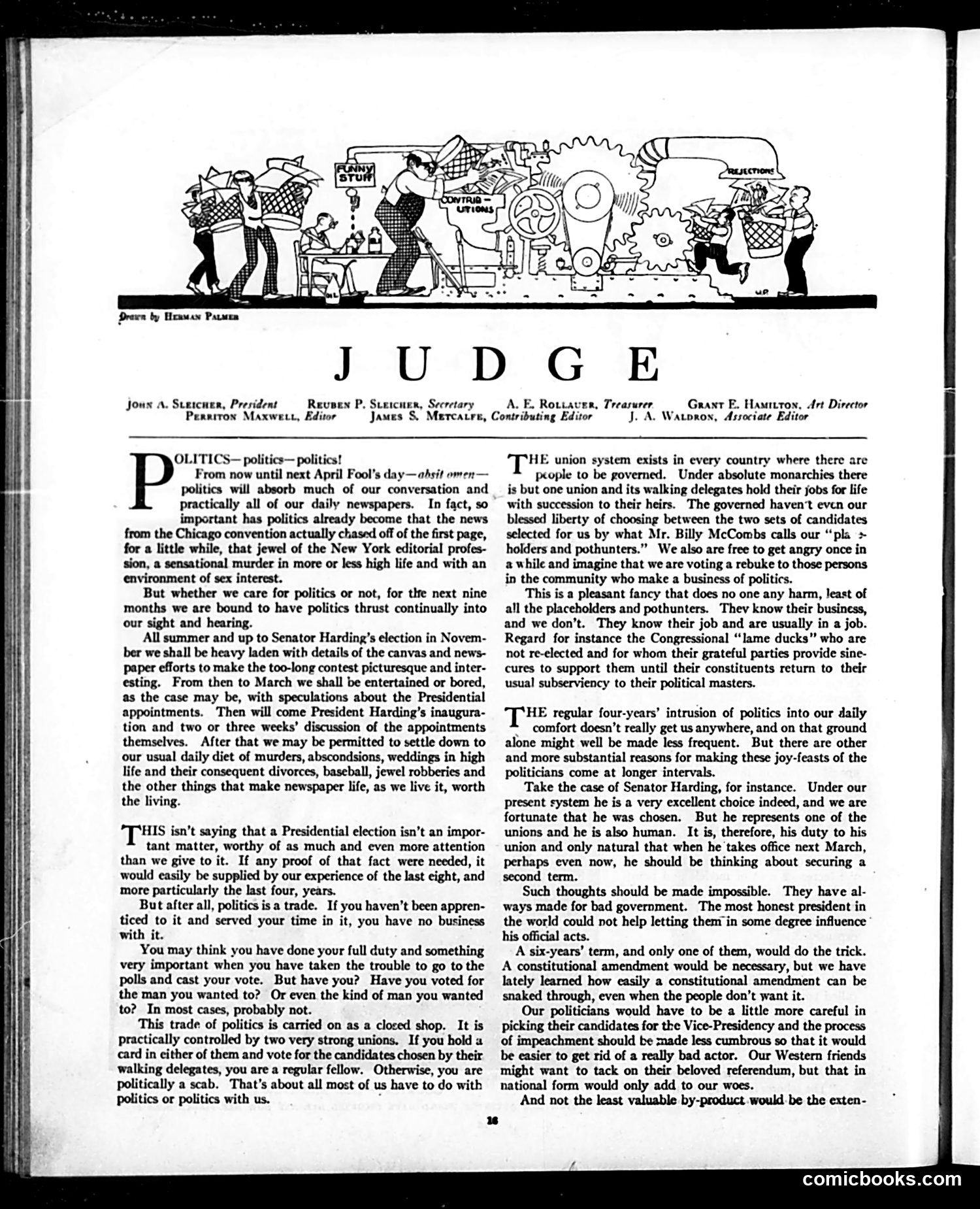
This editorial page satirizes American political systems by comparing them to labor unions. The illustrated masthead shows a complex machine with workers—a visual metaphor for the political "machinery." The text argues that politics operates as a "closed shop" controlled by two dominant unions (the Democratic and Republican parties). Ordinary voters are either "regular fellows" who obey party-chosen candidates or "scabs" who vote independently. The author suggests citizens have little real choice—they merely select between pre-selected candidates. The piece references Senator Harding's 1920 election and upcoming presidential appointments, indicating this was written around that time. The satire mocks the public's illusion of democratic choice while powerful political machines actually control outcomes. The comparison to union labor practices—where walking delegates enforce party loyalty—emphasizes how American democracy mirrors a hierarchical, exclusionary system rather than truly representing the people's will.
📄 Transcribed text from this page (OCR, searchable)
Machine-transcribed from the original scan — historical spelling and the odd misread are preserved.
Revpen P, Sretcuer, Secretary James S. Mercarre, Contributing Editor Joux A. Stercner, President Perarron Maxwett, Editor OLITICS— politics— politics! From now until next April Fool's day—ahsit omen— politics will absorb much of our conversation and practically all of our daily newspapers. In fact, so important has politics already become that the news from the Chicago convention actually chased off of the first page, for a little while, that jewel of the New York editorial profes- sion, a sensational murder in more or less high life and with an environment of sex interest. But whether we care for politics or not, for the next nine months we are bound to have politics thrust continually into our sight and hearing. All summer and up to Senator Harding’s election in Novem- ber we shall be heavy laden with details of the canvas and news- paper efforts to make the too-long contest picturesque and inter- esting. From then to March we shall be entertained or bored, as the case may be, with speculations about the Presidential appointments. Then will come President Harding’s inaugura- tion and two or three weeks’ discussion of the appointments themselves. After that we may be permitted to settle down to our usual daily diet of murders, abscondsions, weddings in high life and their consequent divorces, baseball, jewel robberies and the other things that make newspaper life, as we live it, worth the living. ‘THs isn’t saying that a Presidential election isn’t an impor- tant matter, worthy of as much and even more attention than we give to it. If any proof of that fact were needed, it would easily be supplied by our experience of the last eight, and more particularly the last four, years. But after all, politics is a trade. If you haven’t been appren- ond to it and served your time in it, you have no business with it. You may think you have done your full duty and something very important when you have taken the trouble to go to the polls and cast your vote. But have you? Have you voted for the man you wanted to? Or even the kind of man you wanted to? In most cases, probably not. This trade of politics is carried on as a closed shop. It is practically controlled by two very strong unions. If you hold a card in either of them and vote for the candidates chosen by their walking delegates, you are a regular fellow. Otherwise, you are politically a scab. That's about all most of us have to do with politics or politics with us. : A. E. Rotiaver, Treasurer, Grant E. Hasttton, Art Director J. A. Watprox, Associate Editor HE union system exists in every country where there are people to be governed. Under absolute monarchies there is but one union and its walking delegates hold their jobs for life with succession to their heirs. The governed haven’t evcn our blessed liberty of choosing between the two sets of candidates selected for us by what Mr. Billy McCombs calls our “pla > holders and pothunters.” We also are free to get angry once in a while and imagine that we are voting a rebuke to those persons in the community who make a business of politics. This is a pleasant fancy that does no one any harm, least of all the placeholders and pothunters. Thev know their business, and we don’t. They know their job and are usually in a job. Regard for instance the Congressional “lame ducks” who are not re-elected and for whom their grateful parties provide sine- cures to support them until their constituents return to their usual subserviency to their political masters. TH! regular four-years’ intrusion of politics into our daily © comfort doesn’t really get us anywhere, and on that ground alone might well be made less frequent. But there are other and more substantial reasons for making these joy-feasts of the politicians come at longer intervals. Take the case of Senator Harding, for instance. Under our present system he is a very excellent choice indeed, and we are fortunate that he was chosen. But he represents one of the unions and he is also human. It is, therefore, his duty to his union and only natural that when he takes office next March, perhaps even now, he should be thinking about securing a second term. Such thoughts should be made impossible. They have al- ways made for bad government. The most honest president in the world could not help letting them in some degree influence * his official acts. z A six-years’ term, and only one of them, would do the trick. A constitutional amendment would be necessary, but we have lately learned how easily a constitutional amendment can be snaked through, even when the people don’t want it. Our politicians would have to be a little more careful in picking their candidates for the Vice-Presidency and the process of impeachment should be made less cumbrous so that it would be easier to get rid of a really bad actor. Our Western friends might want to tack on their beloved referendum, but that in national form would only add to our woes. And not the least valuable by-product would: be the exten- comicbooks.com