
Judge, 1920-07-17 · page 26 of 36
Judge — July 17, 1920 — page 26: what you’re looking at
What you’re looking at
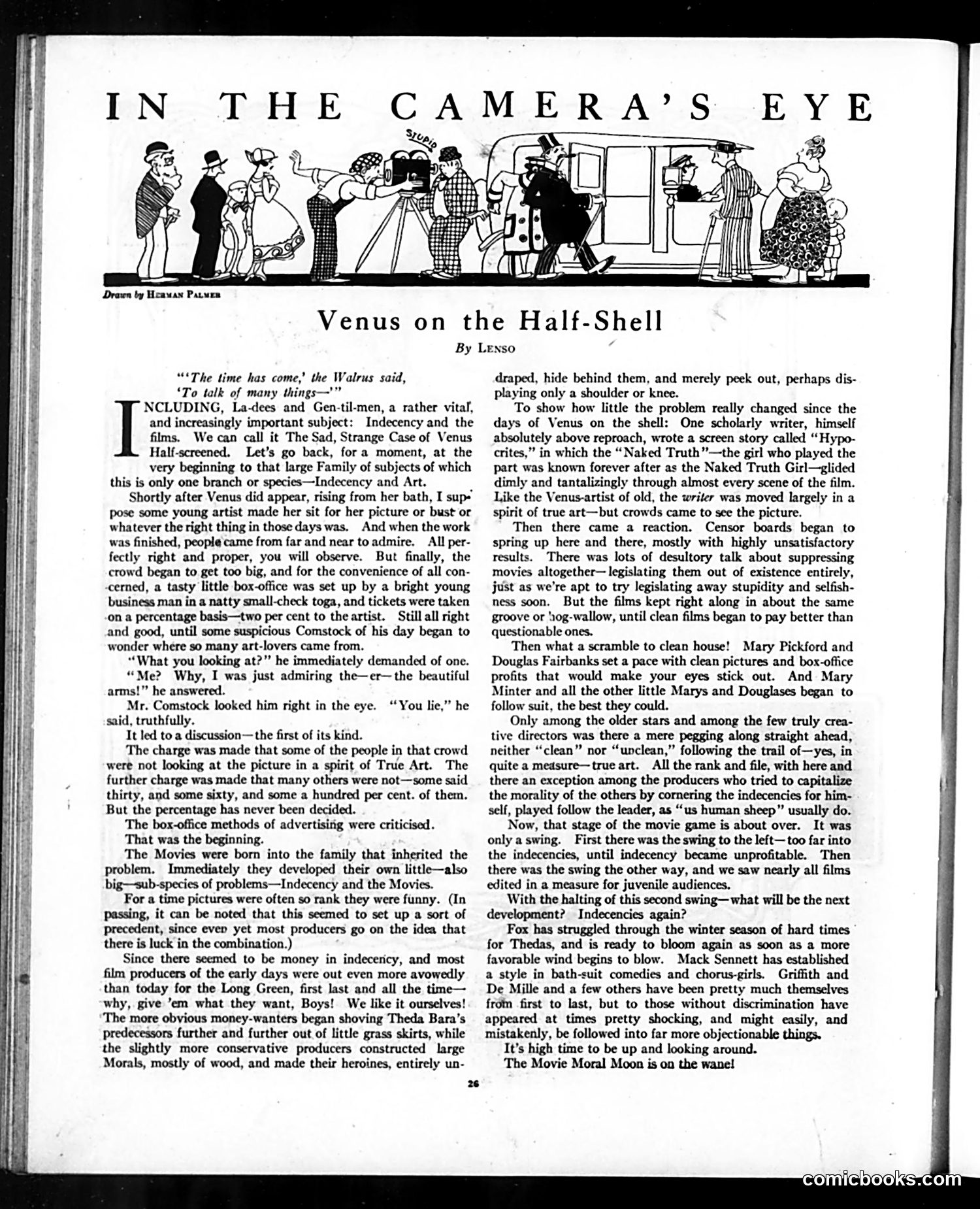
This article by Lenso satirizes film industry censorship debates of the silent era. The piece traces indecency concerns back to classical art—specifically Botticelli's "Birth of Venus"—arguing that controversy over viewing motives is timeless. The satire targets: 1. **Hypocrisy**: Artists and producers claiming "True Art" while profiting from audiences' prurient interest 2. **Early censorship efforts**: "Comstock" references Anthony Comstock, the famous 1800s vice crusader; the article mocks inadequate censorship solutions 3. **Theda Bara and similar actresses**: Referenced as predecessors to increasingly exposed performances marketed as art 4. **"Hypocrites" film**: A real 1915 film featuring a nude actress ("Naked Truth Girl"), presented as proof that artistic justification masks commercial exploitation The cartoon header shows film production activity. The piece argues censorship is futile—the real problem is distinguishing genuine artistic intent from commercial manipulation of human nature, a distinction that may not exist.
📄 Transcribed text from this page (OCR, searchable)
Machine-transcribed from the original scan — historical spelling and the odd misread are preserved.
IN THE CA ea, Drawn by Hrawan Patwee MERA’S EYE Venus on the Half-Shell By “The time has come,’ the Walrus said, ‘To talk of many things—'” NCLUDING, La-dees and Gen-til-men, a rather vital, and increasingly important subject: Indecency and the films. We can call it The Sad, Strange Case of Venus Half-screened. Let’s go back, fora moment, at the very beginning to that large Family of subjects of which this is only one branch or species—Indecency and Art. Shortly after Venus did appear, rising from her bath, I sup= pose some young artist made her sit for her picture or bust or whatever the right thing in those days was. And when the work was finished, people came from far and near to admire. All per- fectly right and proper, you will observe. But finally, the crowd began to get too big, and for the convenience of all con- cerned, a tasty little box-office was set up by a bright young business man in a natty small-check toga, and tickets were taken ‘on a percentage basis—two per cent to the artist. Still all right and good, until some suspicious Comstock of his day began to wonder where so many art-lovers came from. “What you looking at?” he immediately demanded of one. “Me? Why, I was just admiring the—er—the beautiful arms!” he answered. Mr. Comstock looked him right in the eye. said, truthfully. It led to a discussion— the first of its kind. The charge was made that some of the people in that crowd were not looking at the picture in a spirit of True Art. The further charge was made that many others were not—some said thirty, and some sixty, and some a hundred per cent. of them. But the percentage has never been decided. The box-office methods of advertising were criticised. That was the beginning. The Movies were born into the family that inherited the problem. Immediately they developed their own little—also big—sub-species of problems—Indecency and the Movies. For a time pictures were often so rank they were funny. (In passing, it can be noted that this seemed to set up a sort of precedent, since even yet most producers go on the idea that there is luck in the combination.) Since there seemed to be money in indecericy, and most film producers of the early days were out even more avowedly than today for the Long Green, first last and all the time— why, give ’em what they want, Boys! We like it ourselves! ‘The more obvious money-wanters began shoving Theda Bara’s predecessors further and further out of little grass skirts, while the slightly more conservative producers constructed large Morals, mostly of wood, and made their heroines, entirely un- “You lie,” he Lexso draped, hide behind them, and merely peek out, perhaps dis- playing only a shoulder or knee. To show how little the problem really changed since the days of Venus on the shell: One scholarly writer, himself absolutely above reproach, wrote a screen story called “Hypo- crites,” in which the “Naked Truth”’—the girl who played the part was known forever after as the Naked Truth Girl—glided dimly and tantalizingly through almost every scene of the film. Like the Venus-artist of old, the writer was moved largely in a spirit of true art—but crowds came to see the picture. Then there came a reaction. Censor boards began to spring up here and there, mostly with highly unsatisfactory results. There was lots of desultory talk about suppressing movies altogether— legislating them out of existence entirely, just as we're apt to try legislating away stupidity and selfish- ness soon. But the films kept right along in about the same groove or ‘10g-wallow, until clean films began to pay better than questionable ones. Then what a scramble to clean house! Mary Pickford and Douglas Fairbanks set a pace with clean pictures and box-office profits that would make your eyes stick out. And Mary Minter and all the other little Marys and Douglases began to follow suit, the best they could. Only among the older stars and among the few truly crea- tive directors was there a mere pegging along straight ahead, neither “clean” nor “unclean,” following the trail of—yes, in quite a medsure—true art. All the rank and file, with here and there an exception among the producers who tried to capitalize the morality of the others by cornering the indecencies for him- self, played follow the leader, as “us human sheep” usually do. Now, that stage of the movie game is about over. It was only a swing. First there was the swing to the left—too far into the indecencies, until indecency became unprofitable. Then there was the swing the other way, and we saw nearly all films edited in a measure for juvenile audiences. With the halting of this second swing—what will be the next development? Indecencies again? Fox has struggled through the winter season of hard times for Thedas, and is ready to bloom again as soon as a more favorable wind begins to blow. Mack Sennett has established a style in bath-suit comedies and chorus-girls. Griffith and De Mille and a few others have been pretty much themselves from first to last, but to those without discrimination have appeared at times pretty shocking, and might easily, and mistakenly, be followed into far more objectionable things. It’s high time to be up and looking around. The Movie Moral Moon is on the wane!