
Judge, 1920-07-17 · page 5 of 36
Judge — July 17, 1920 — page 5: what you’re looking at
What you’re looking at
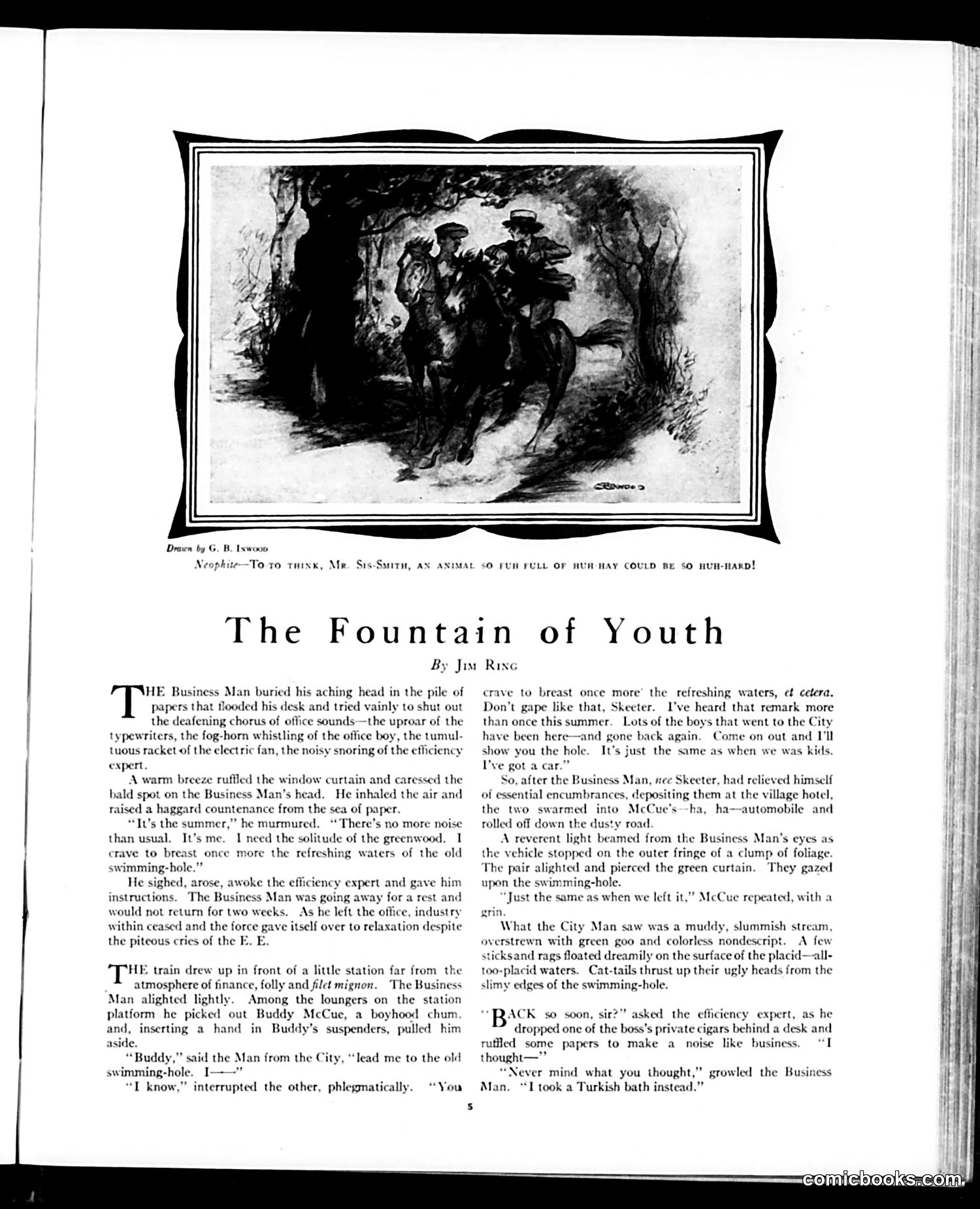
This page contains the opening of a short story by Jim Ring, illustrated by G. B. Iverson. The cartoon at the top depicts what appears to be a forest or wooded scene with several figures gathered together, though the specific satirical point is unclear from the image quality. The story itself is not political satire but rather a narrative about a businessman seeking respite from urban life. References to a "swimming-hole," "Turkish bath," and dialogue about efficiency and relaxation suggest the story explores themes of urban stress versus rural simplicity—a common early 20th-century literary motif. The satire likely mocks either the businessman's pretensions or contemporary attitudes toward leisure and modernization, though without clearer image resolution or additional context, the precise target remains uncertain.
📄 Transcribed text from this page (OCR, searchable)
Machine-transcribed from the original scan — historical spelling and the odd misread are preserved.
Drawn by G. B. Ixwooo ‘Toro THIxK, Mr. Sis-Ssttn, aN aNitat sO FUN FULL OF HUN HAY COULD BE so HUT The Fountain of Youth By Jim Rixe HE Business Man buried his aching head in the pile of papers that flooded his desk and tried vainly to shut out the deafening chorus of office sounds—the uproar of the typewriters, the fog-horn whistling of the office boy, the tumul- tuous racket of the electric fan, the noisy snoring of the efficiency expert. A warm breeze ruffled the window curtain and caressed the bald spot on the Business Man’s head. He inhaled the air and raised a haggard countenance from the sea of paper. “It’s the summer,” he murmured. here’s no more noise than usual. It’s me. I need the solitude of the greenwood. 1 crave to breast once more the refreshing waters of the old swimming-hole.”” He sighed, arose, awoke the efficiency expert and gave him instructions. The Business Man was going away for a rest and would not retum for two weeks. As he left the of industry within ceased and the force gave itself over to relaxation despite the piteous cries of the HE train drew up in front of a little station far from the atmosphere of finance, folly and filet mignon. The Business Man alighted lightly. Among the loungers on the station platform he picked out Buddy McCue, a boyhood chum and, inserting a hand in Buddy’s suspenders, pulled him aside. “Buddy,” said the Man from the City, “lead me to the old swimming-hole. I ” “I know,” interrupted the other, phlegmatically. “You crave to breast once more’ the refreshing waters, et cetera. Don’t gape like that, Skeeter. I’ve heard that remark more than once this summer. Lots of the boys that went to the City have been here—and gone back again. Come on out and I'll show you the hole. It’s just the same as when we was kids. I've got a car.” So, after the Business Man, nee Skeeter, had relieved himself of essential encumbrances, depositing them at the village hotel, the two swarmed into McCue’s--ha, ha—automobile and rolled off down the dusty road. A reverent light beamed from the Business Man’s eyes as the vehicle stopped on the outer fringe of a clump of foliag The pair alighted and pierced the green curtain. They gazed upon the swimming-hole. ‘Just the same as when we left it,” McCue repeated, with a What the City Man saw was a muddy, slummish stream, overstrewn with green goo and colorless nondescript. A few sticksand rags floated dreamily on the surface of the placid—all- too-placid waters. Cat-tails thrust up their ugly heads from the slimy edges of the swimming-hole. . ACK so soon, sir?” asked the efficiency expert, as he dropped one of the boss’s private cigars behind a desk and rutiled some papers to make a noise like business. “I thought—” “Never mind what you thought,” growled the Busi Man, “1 took a Turkish bath instead.” ess.