
A complete issue · 36 pages · 1920
Judge — July 3, 1920
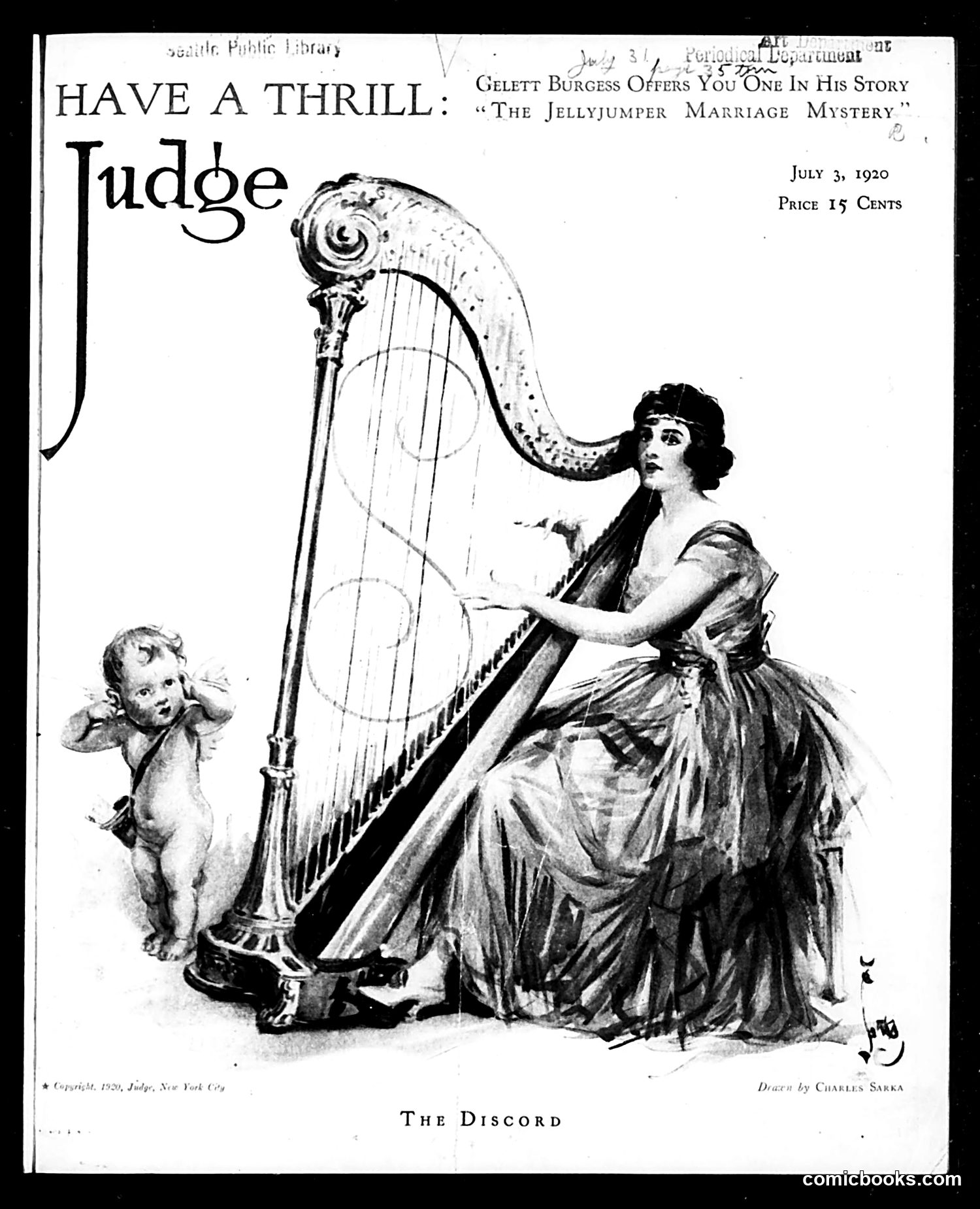
This cover illustrates "The Discord," depicting a woman playing a harp while a cherub (Cupid) covers his ears in distress. The image appears to be satirizing discord in marriage or romance—the harp, traditionally a symbol of harmony and beauty, produces discordant sounds that distress even the god of love himself. The cover advertises Gelett Burgess's serial story "The Jellyjumper Marriage Mystery," suggesting the content relates to marital conflict or romantic complications. The title "The Discord" emphasizes the contrast between what should be harmonious (marriage, love, music) and the reality of conflict depicted here. The satire targets the gap between romantic ideals and marital reality—a common theme in 1920s social commentary.
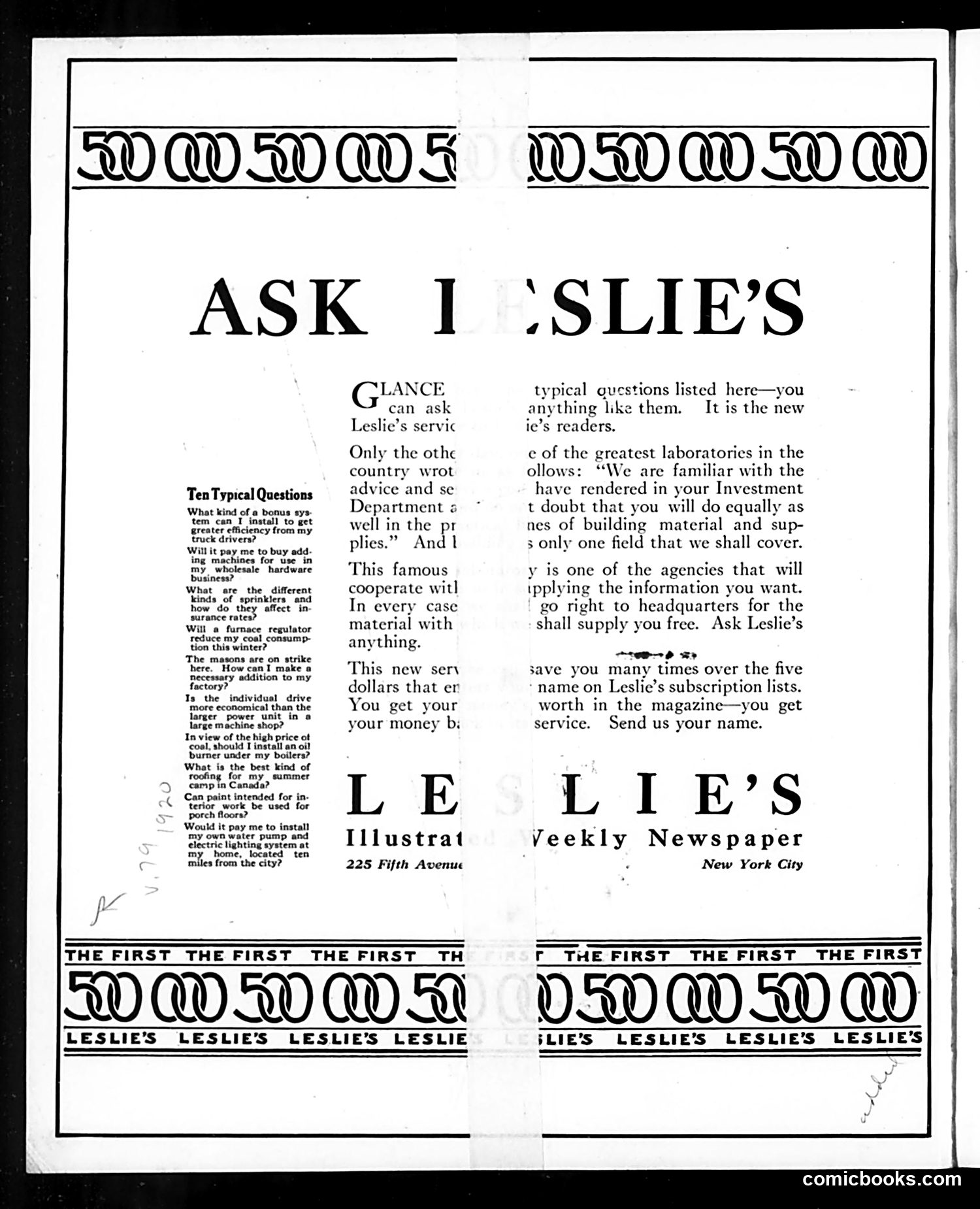
This page is primarily **advertising**, not satire or political commentary. It promotes Leslie's Illustrated Weekly Newspaper (located at 225 Fifth Avenue, New York City) through an "Ask Leslie's" advice column feature. The advertisement highlights that Leslie's offers a free information service answering reader questions on various practical topics—listed as "Ten Typical Questions" covering subjects like bonus systems, machinery installation, and building materials. The ad emphasizes this service's value and encourages readers to submit their names to receive it. The decorative borders reading "THE FIRST LESLIE'S" are branding elements, not satirical imagery. There are no identifiable caricatures or political references—this is straightforward magazine promotion targeting readers seeking practical advice and information.
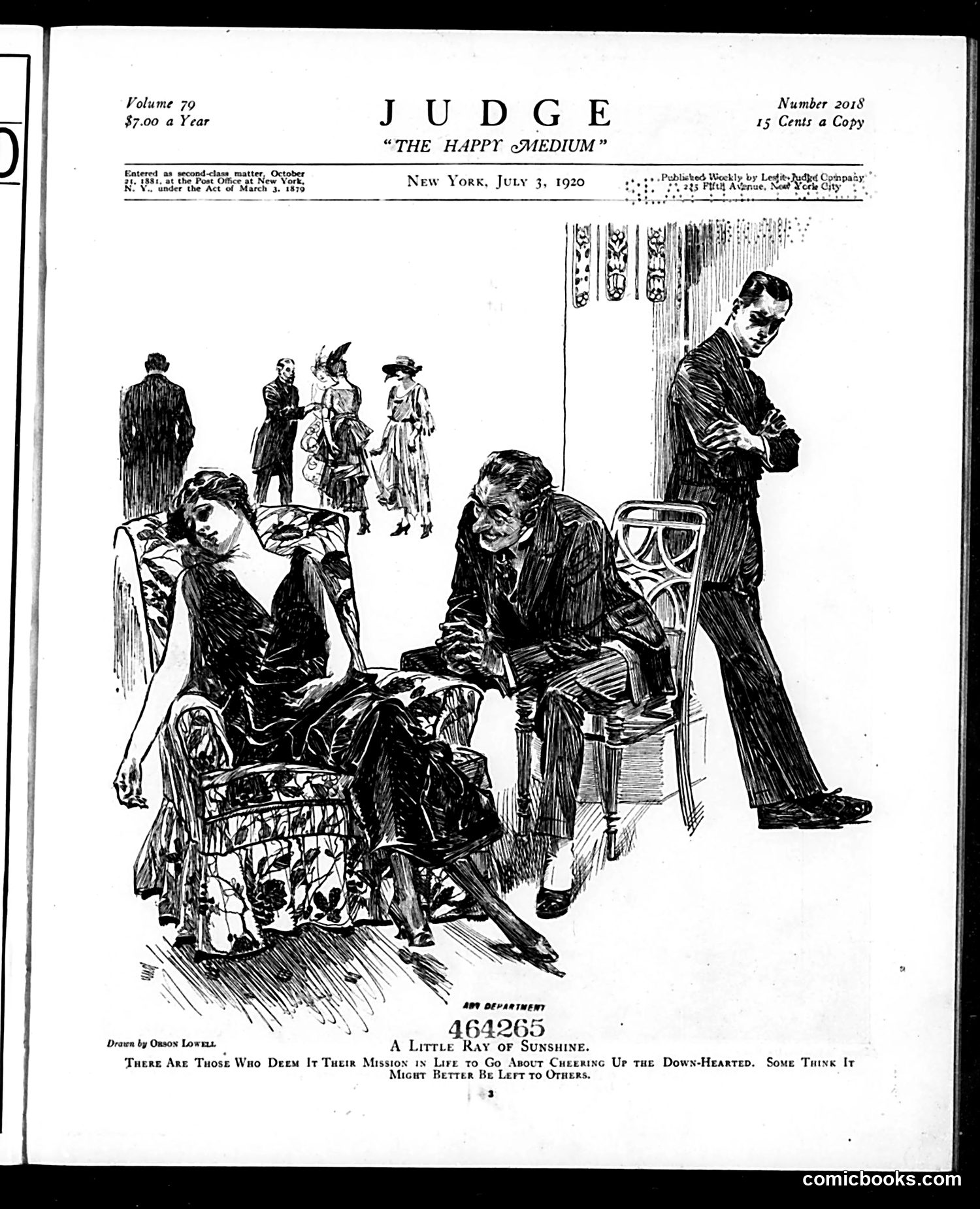
This satirical cartoon by Onslow Lowell depicts a social scene where a woman reclines in a chair while a man sits attentively beside her. The title "A Little Ray of Sunshine" combines with the caption to suggest the cartoon's point: certain people believe their mission in life is "cheering up the down-hearted," though some think "it might better be left to others." The satire appears to target excessive sentimentality or unsolicited emotional labor—specifically, people who insert themselves into others' affairs under the guise of helpfulness. The well-dressed figures and indoor setting suggest this critiques upper-class social pretension. The background figures and bystanders emphasize the public nature of this unwanted attention, reinforcing the satirical judgment of such intrusive "cheerfulness."
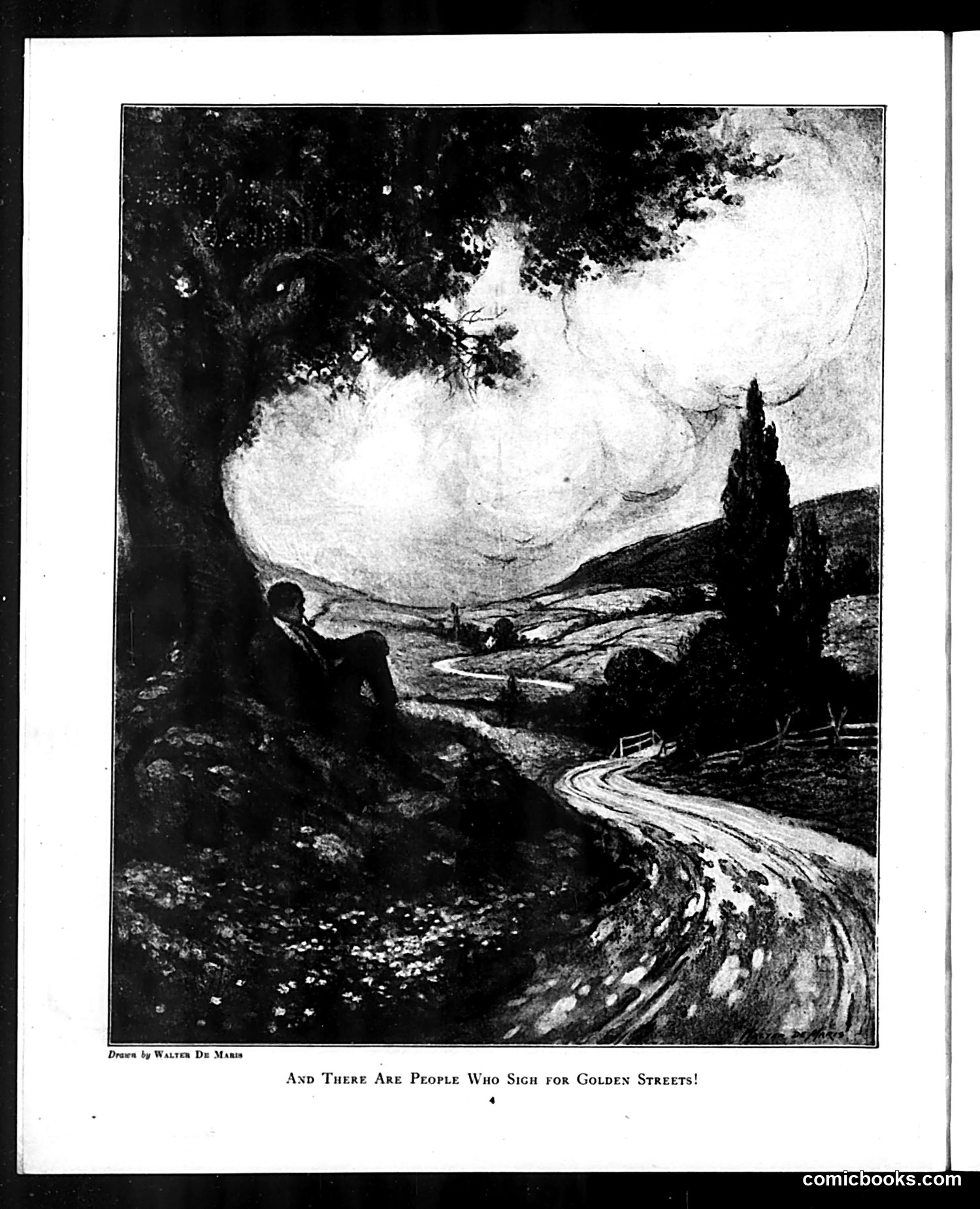
This is a satirical illustration by Walter De Maris titled "And There Are People Who Sigh for Golden Streets!" The image depicts a nighttime rural landscape with a large moon, a cypress tree, a winding path, and a solitary figure gazing at the scene. The satire appears to target romantic idealization of rural or rustic life. The caption ironically suggests that despite people's nostalgic longing for "golden streets" (presumably referencing idealized pastoral simplicity or perhaps biblical imagery of heaven), the reality shown is a lonely, dark countryside landscape. The joke criticizes the disconnect between romanticized fantasies of simpler living and the actual, sometimes bleak reality of rural existence.
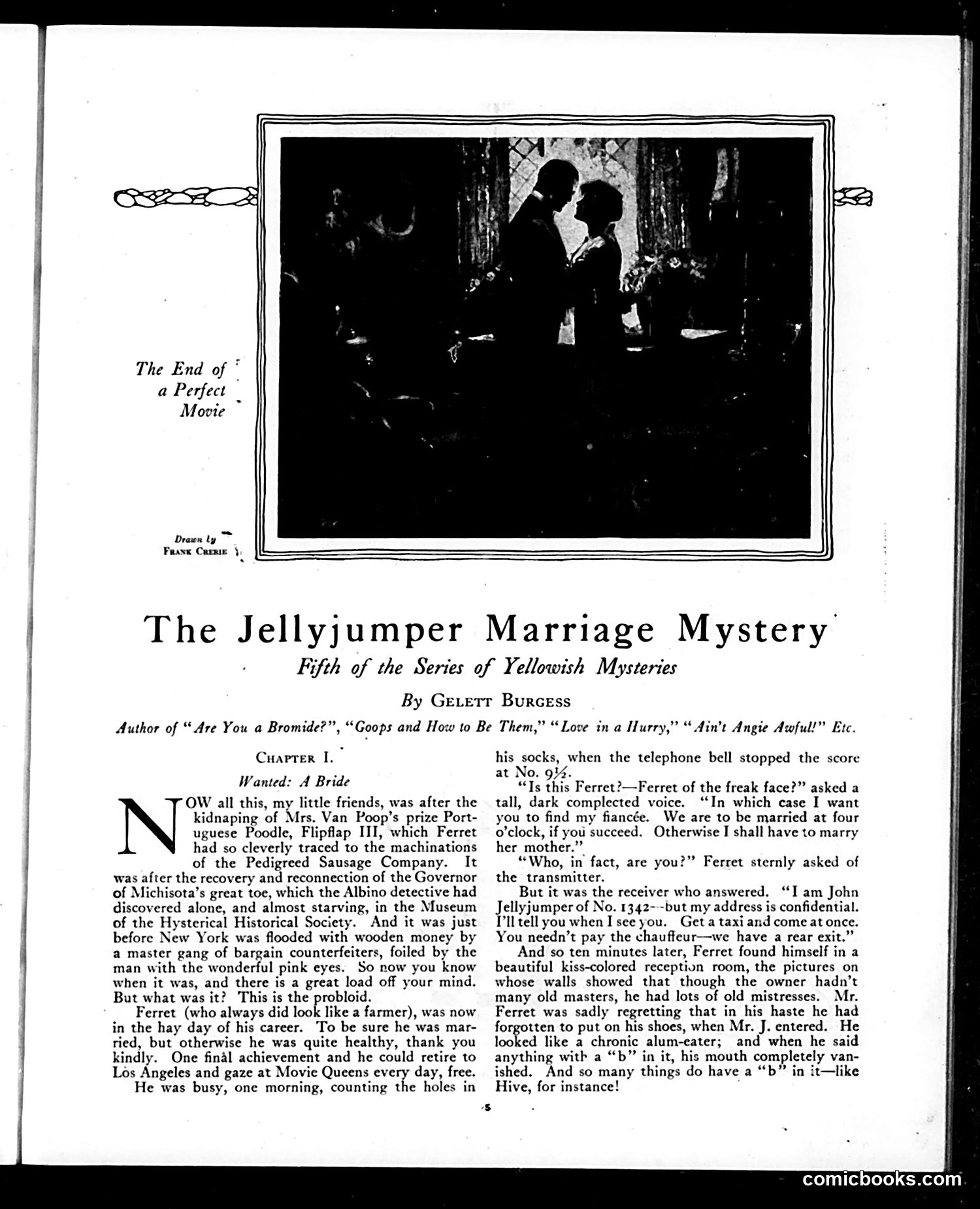
This page presents the opening of a serialized mystery story by Gelett Burgess, titled "The Jellyjumper Marriage Mystery," described as the fifth in a series of "Yellowish Mysteries." The narrative concerns a man named Ferret seeking his fiancée. The story employs comedic wordplay and absurdist humor typical of early 20th-century Judge magazine—notably, the protagonist's surname "Jellyjumper" and references to characters with whimsical names like "Van Poop." The piece satirizes detective fiction and romantic melodrama popular in the era, using exaggerated plot elements (kidnapping, counterfeiting gangs, mysterious mansions) and deliberately silly character names for humorous effect. Rather than political satire, this is light entertainment poking fun at mystery story conventions themselves.
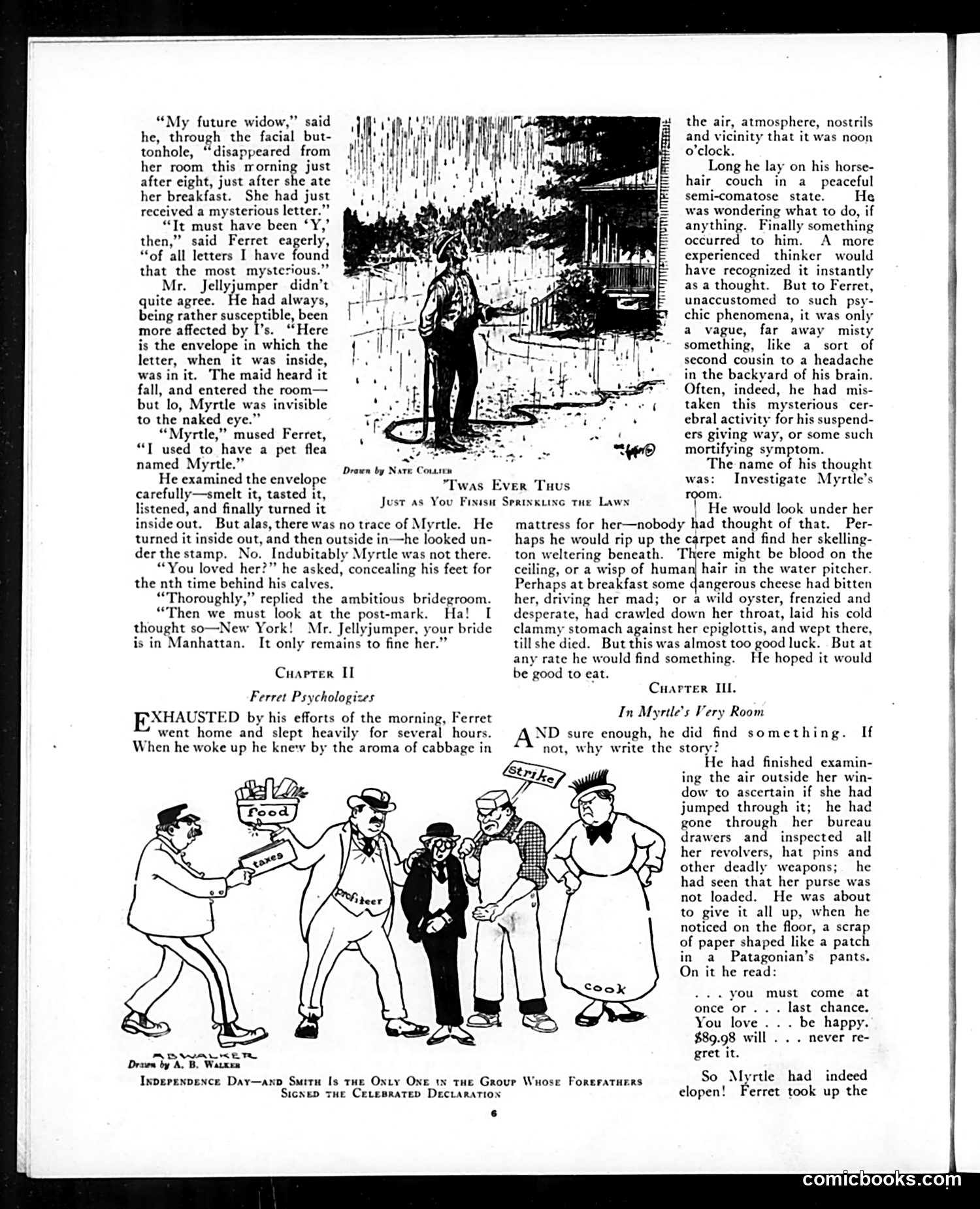
This page contains serialized fiction ("Ferret Psychologizes" and "In Myrtle's Very Room") rather than political satire. The narrative involves a character named Ferret investigating his bride Myrtle's mysterious disappearance. The only cartoon appears below the text—captioned "Independence Day—and Smith Is the Only One in the Group Whose Forefathers Signed the Celebrated Declaration." It shows five men labeled with American ideals (Food, Liberty, Smith, Independence, Cook), apparently satirizing how only one man's ancestry actually connects to America's founding. This appears to mock either immigration debates or claims of American pedigree—common Judge magazine themes—though the specific context remains unclear without additional historical information.
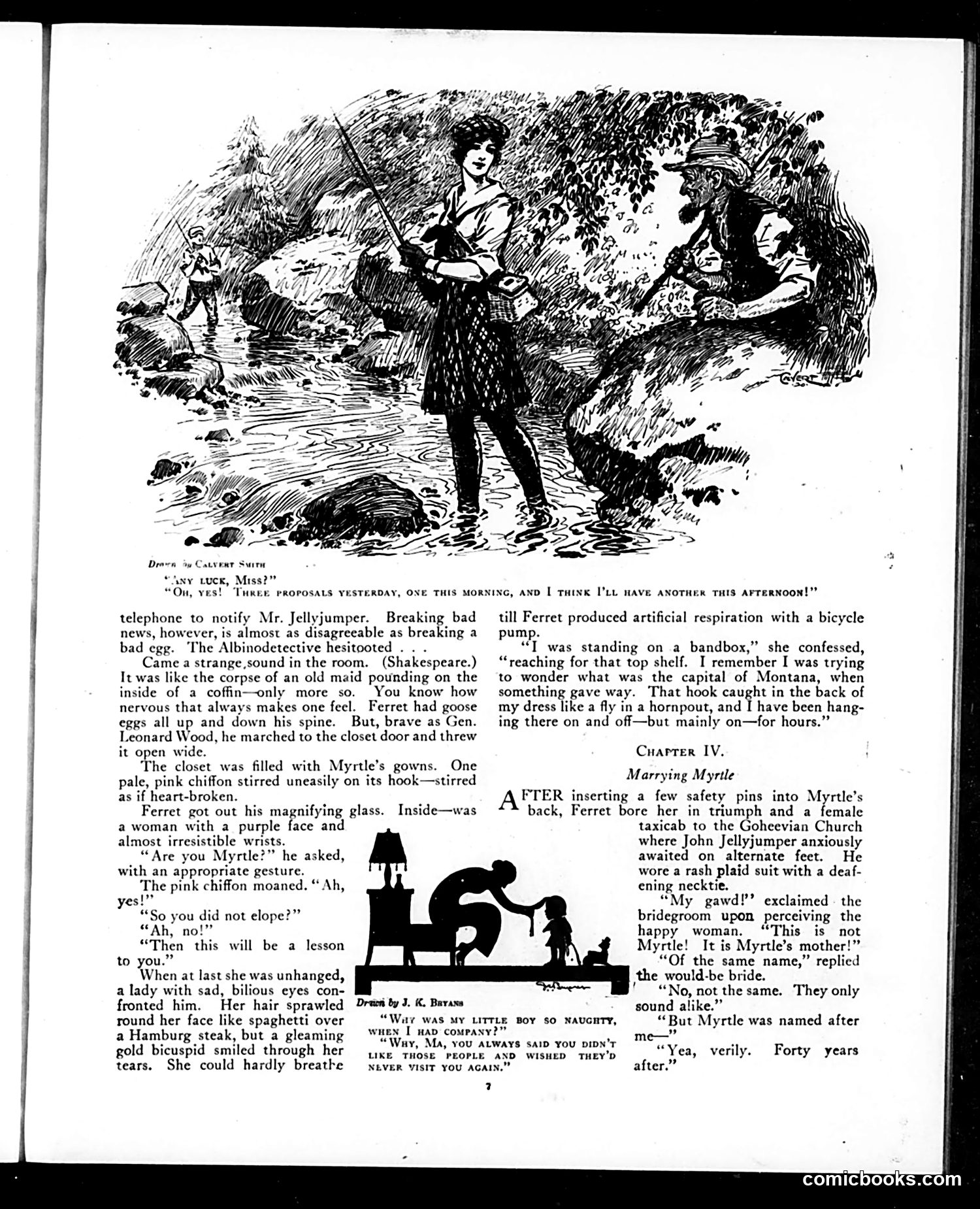
This page contains a satirical serialized story from Judge magazine, not a political cartoon. The narrative concerns a detective named Ferret investigating a missing woman named Myrtle, whom he finds accidentally hanged in a closet by her dress. The humor relies on absurdist situations and exaggerated descriptions typical of early-20th-century American comedy: a woman surviving hours suspended by a dress hook while pondering Montana's capital; revival via bicycle pump; the groom's shock at marrying someone he believes is Myrtle's mother (though she was named after him 40 years prior). The small illustration by J.K. Barama depicts a parenting/discipline scene unrelated to the main text—apparently a separate comic. The satire targets no specific political figures or events but rather mocks melodramatic detective fiction and romantic complications through absurdist wordplay and visual gags. This represents Judge's entertainment-focused content rather than political commentary.
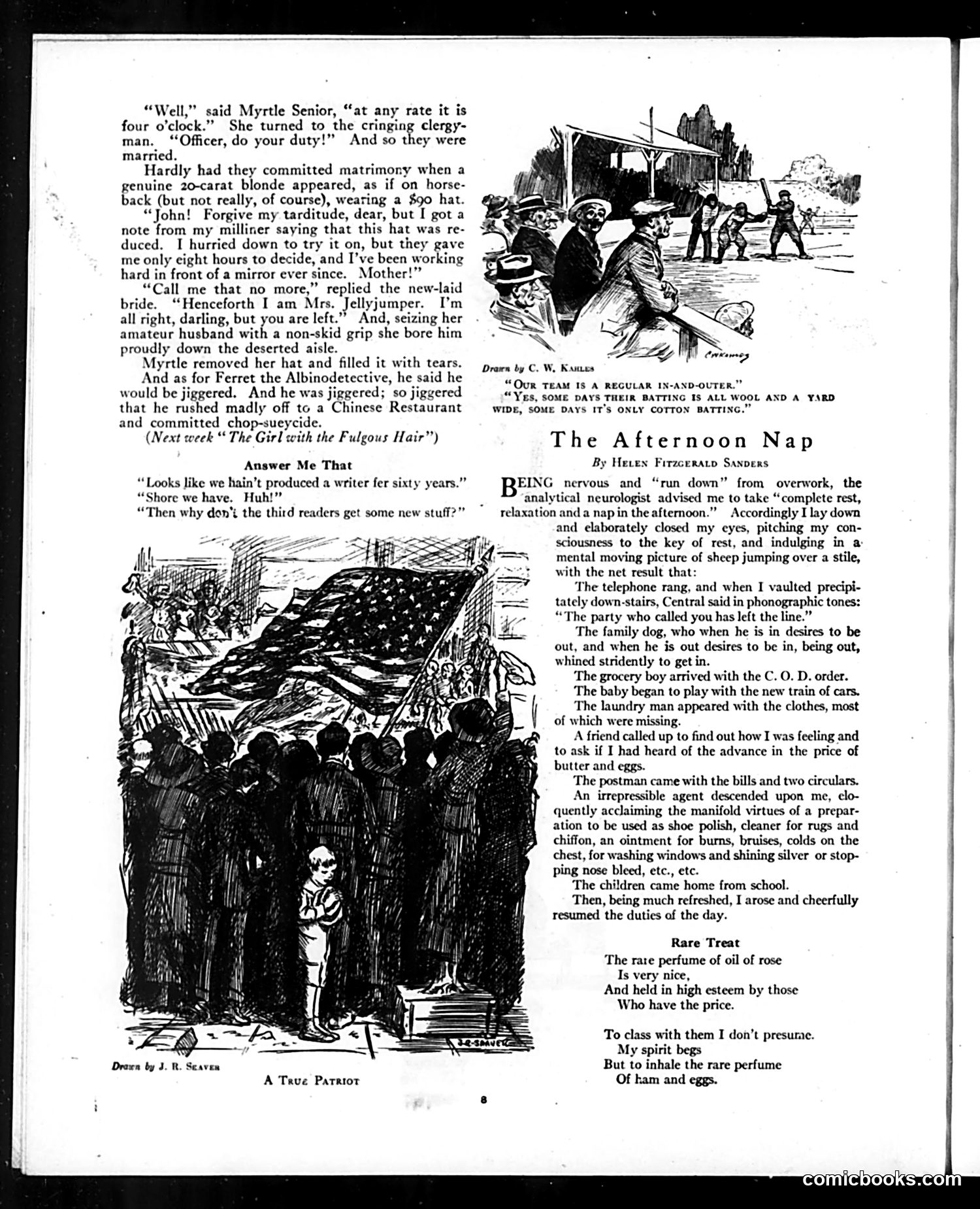
This page contains three distinct pieces of humor typical of early 20th-century American satire: **"Answer Me That"** (top): A brief dialogue joke about literary productivity—mocking that no new writers have emerged in sixty years, so readers get no fresh material. It's lightweight commentary on creative stagnation. **"A True Patriot"** (left cartoon): The drawing shows a man surrounded by piles of papers/documents in what appears to be a bed. The accompanying dialogue about baseball teams batting being "all wool" versus "cotton" appears to be wordplay conflating patriotic duty with consumer goods—likely satirizing superficial or commercialized patriotism. **"The Afternoon Nap"** (main feature): A humorous essay describing a doctor's prescription for rest being systematically destroyed by domestic interruptions—phone calls, demanding pets, deliveries, children, salesmen. The joke is that complete relaxation is impossible in modern life. **"Rare Treat"** (poem): A brief verse humorously suggesting that while rose oil perfume is luxurious, the speaker prefers the "rare perfume" of ham and eggs—a working-class preference over aristocratic refinement. The page emphasizes everyday frustrations and class-conscious humor typical of Judge's audience.
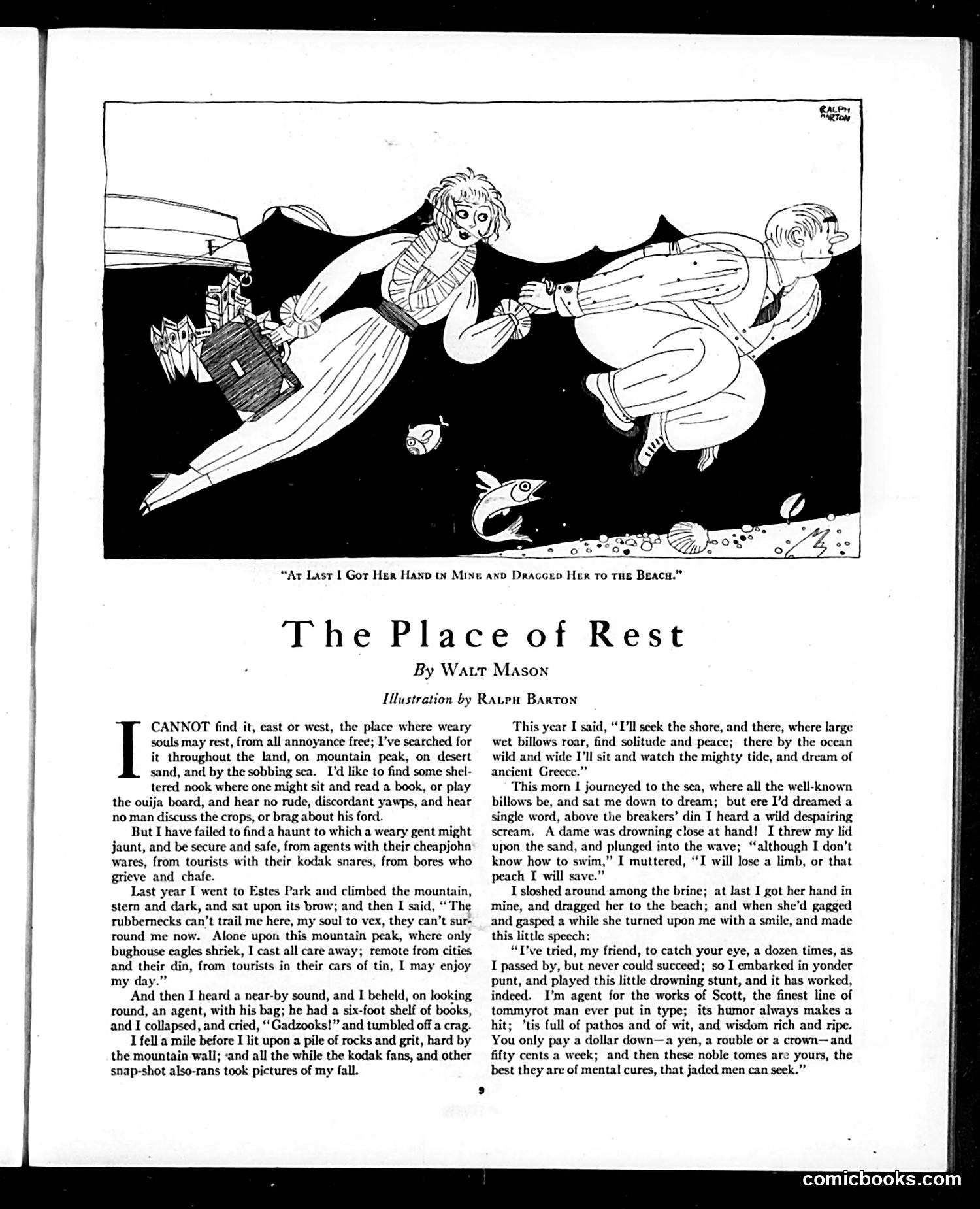
This is a humorous short story with illustration rather than a political cartoon. It satirizes the commercialization of American leisure and the inescapability of aggressive salesmanship in early 20th-century life. The narrative follows a man seeking solitude—first at Estes Park, then at the beach—only to be constantly pestered by traveling salesmen hawking cheap goods (kodak cameras, books) and tourists with their own commercial enterprises. The joke culminates when he rescues a drowning woman, only to discover she's a con-artist book agent who deliberately staged the drowning to capture his attention and sell him cheap "Scott" novels. The satire targets two things: the exhausting omnipresence of salesmen and advertising, and the desperation of commercial vendors who will use any deceptive tactic to make a sale. For modern readers, it reflects anxieties about commercialism invading every space—concerns that resonate today with digital advertising and marketing saturation.
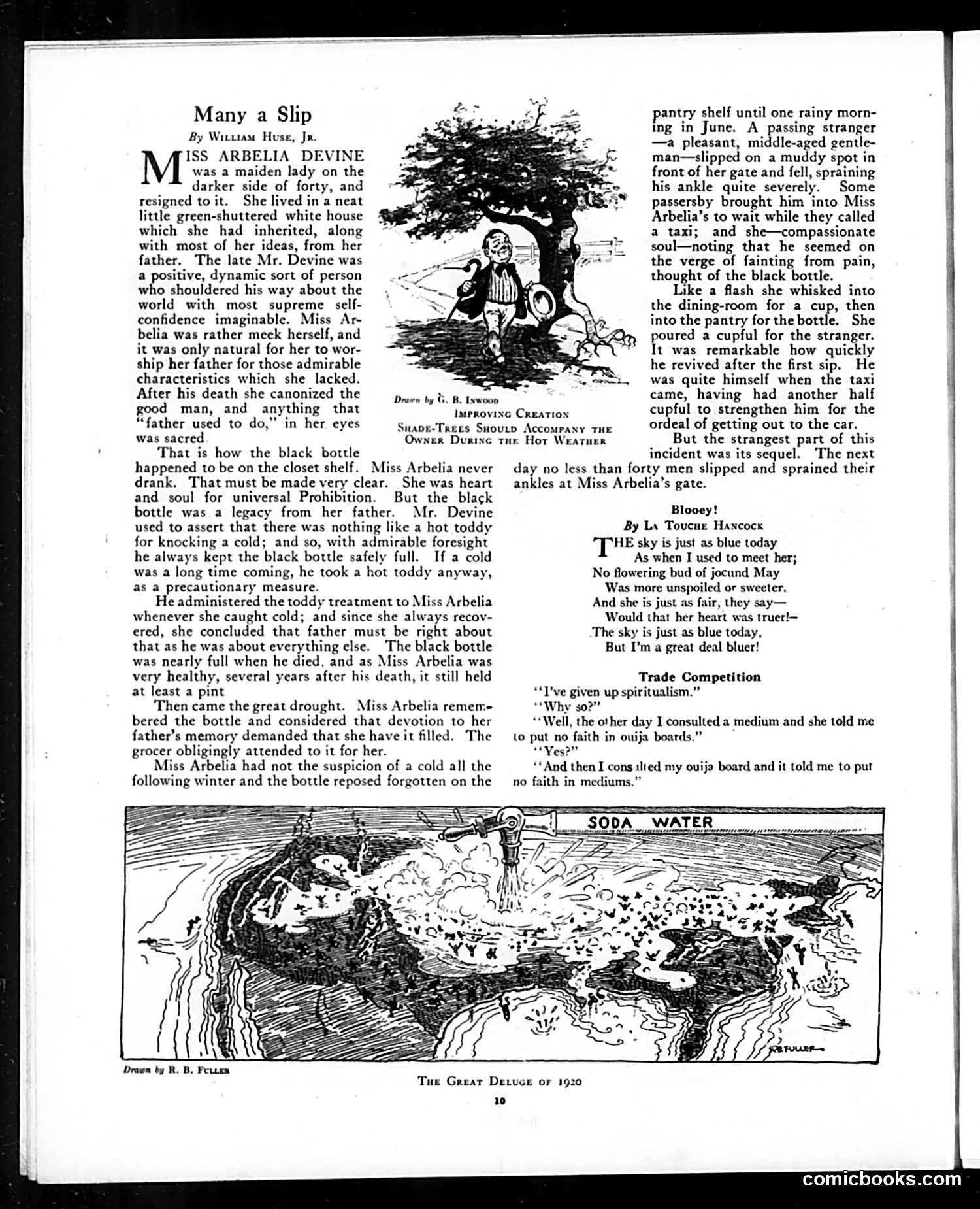
This page from Judge (appears to be circa 1920, based on "The Great Deluge of 1920" cartoon) contains three separate pieces of humor: **"Many a Slip"** is a short story satirizing Prohibition-era hypocrisy. Miss Arbelia, a strict prohibitionist, inherits her father's liquor bottle and refills it during Prohibition ("the great drought"). When she generously gives a stranger alcohol for pain relief, word spreads—suddenly forty men mysteriously "sprain their ankles" at her gate seeking the same remedy. The joke mocks how people exploited medical pretexts to obtain alcohol during Prohibition's ban. **"Blooey!"** is a sentimental poem about lost love. **"Trade Competition"** is a brief joke about spiritualism's internal contradictions: a medium tells someone to distrust ouija boards, then the ouija board tells them to distrust mediums. **The cartoons** include a tree illustration and "The Great Deluge of 1920," which appears to depict Prohibition's chaotic consequences as a flood, likely satirizing the amendment's unintended social disruptions.
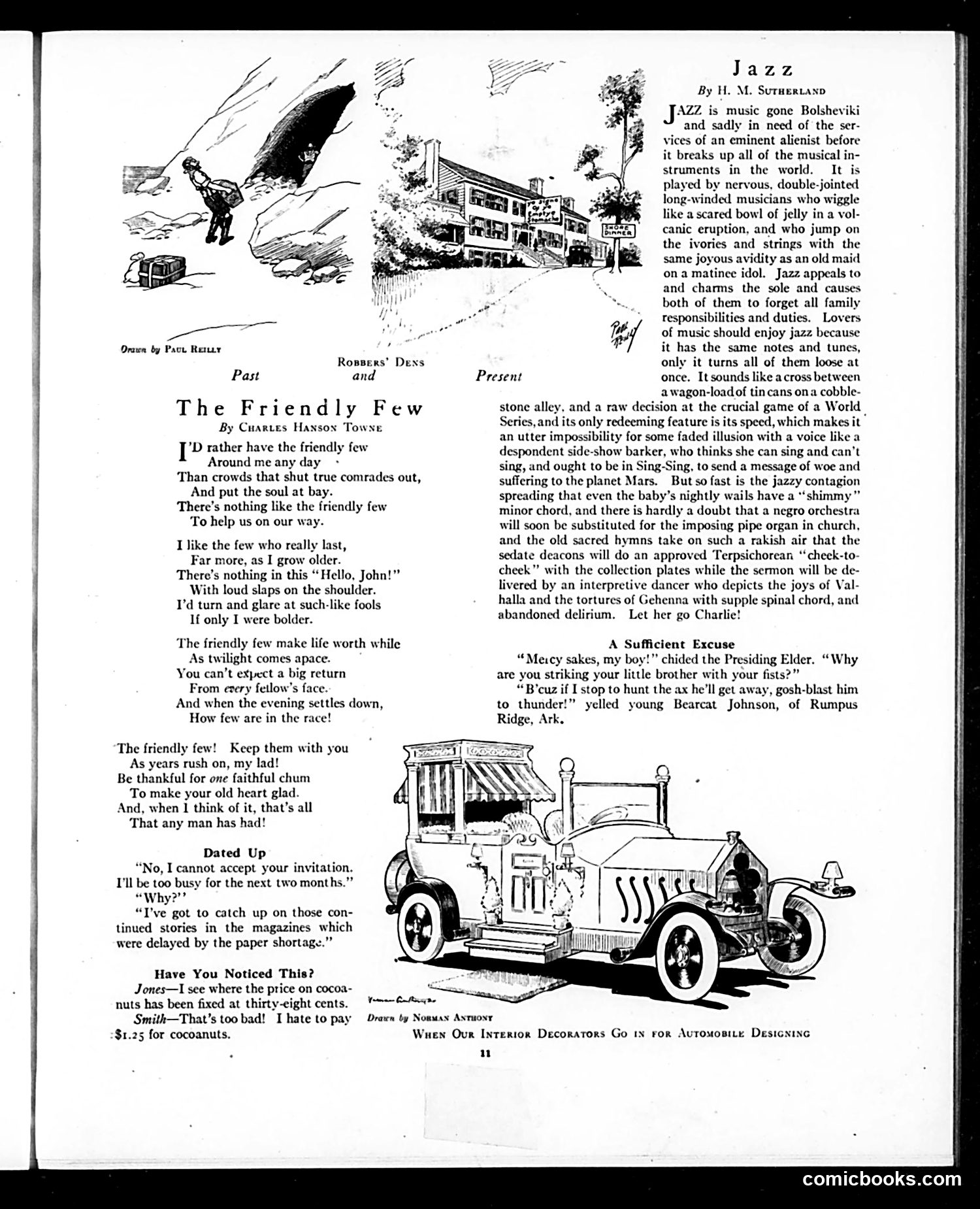
This Judge magazine page contains three separate satirical pieces: **"The Friendly Few"** is a sentimental poem celebrating intimate friendships over shallow social crowds—straightforward social commentary with no specific topical reference. **"Dated Up" and "Have You Noticed This?"** are brief jokes about post-WWI paper shortages (which affected magazine and newspaper distribution) and price controls on coconuts, likely referencing wartime/postwar economic disruptions. **"Jazz"** is the page's main satirical piece. The author condemns jazz music using hyperbolic, contemptuous language—describing it as "gone Bolsheviki" (referencing communist/radical associations), comparing it to "tin cans on cobblestones," and predicting it will replace church organs. The piece reflects 1920s establishment anxiety about jazz as morally corrupting, racially transgressive (noting "negro orchestras"), and destructive to social order. The satire appears to mock this panic rather than endorse it, though the text's tone remains ambiguous.
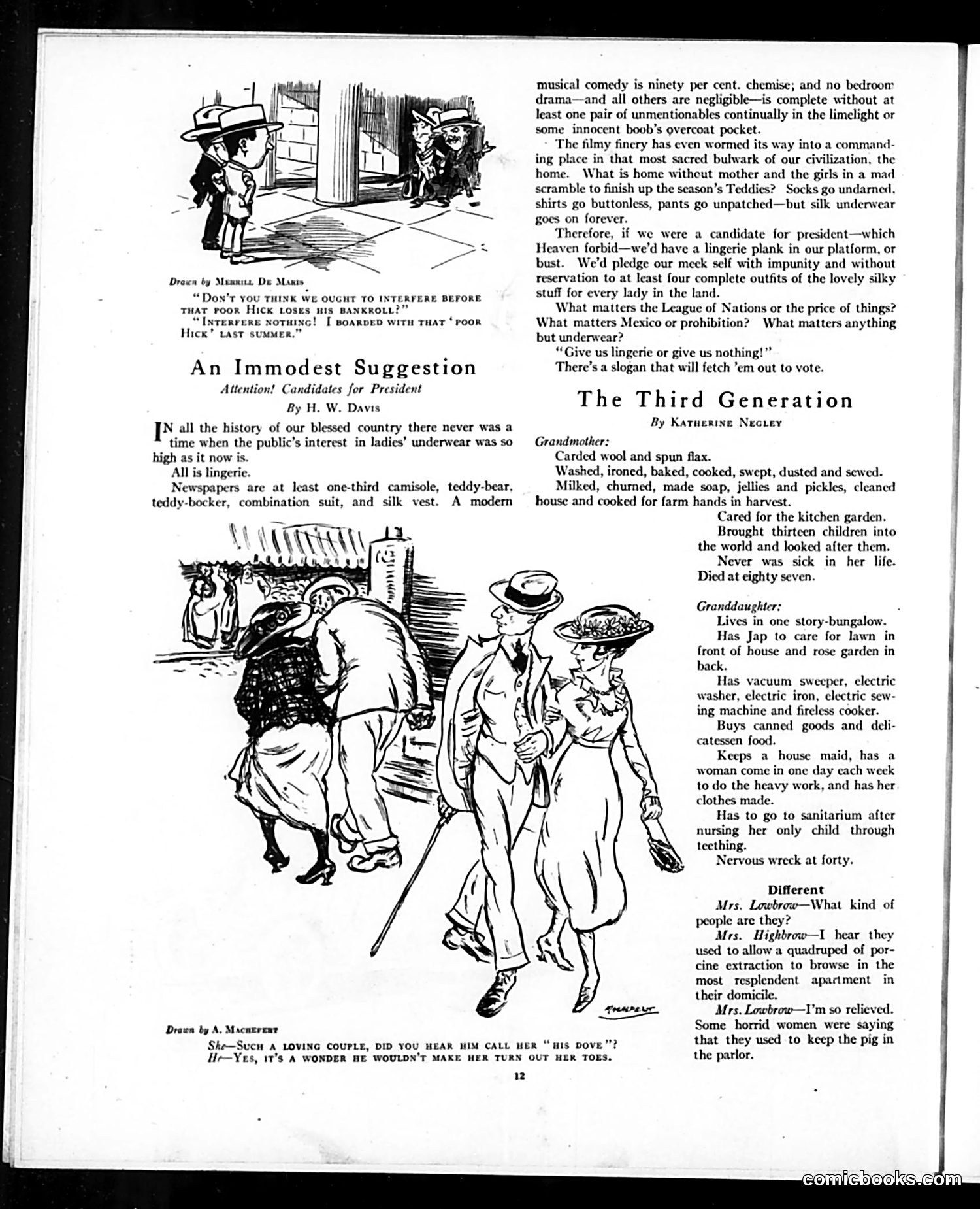
**"An Immodest Suggestion"** satirizes the 1920s public obsession with women's lingerie. The author argues that newspapers, musicals, and even home life revolve around undergarments—socks go undarned and shirts unbuttoned while families prioritize silk underwear. The satire proposes a presidential candidate should campaign on a platform promising "four complete outfits of lovely silky stuff for every lady in the land," ridiculing how trivialized women's fashion has become compared to serious issues like the League of Nations or Prohibition. **"The Third Generation"** contrasts the hardy grandmother (who raised 13 children, never fell ill, died at 87) with her modern granddaughter (who employs servants, owns electric appliances, buys convenience foods, yet becomes a "nervous wreck at forty" after nursing one child). The satire criticizes how modern labor-saving devices and easier lives have paradoxically made women weaker and less resilient. **The lower cartoon** appears to joke about a couple's affectionate nickname ("dove"), though the punchline is partially cut off.
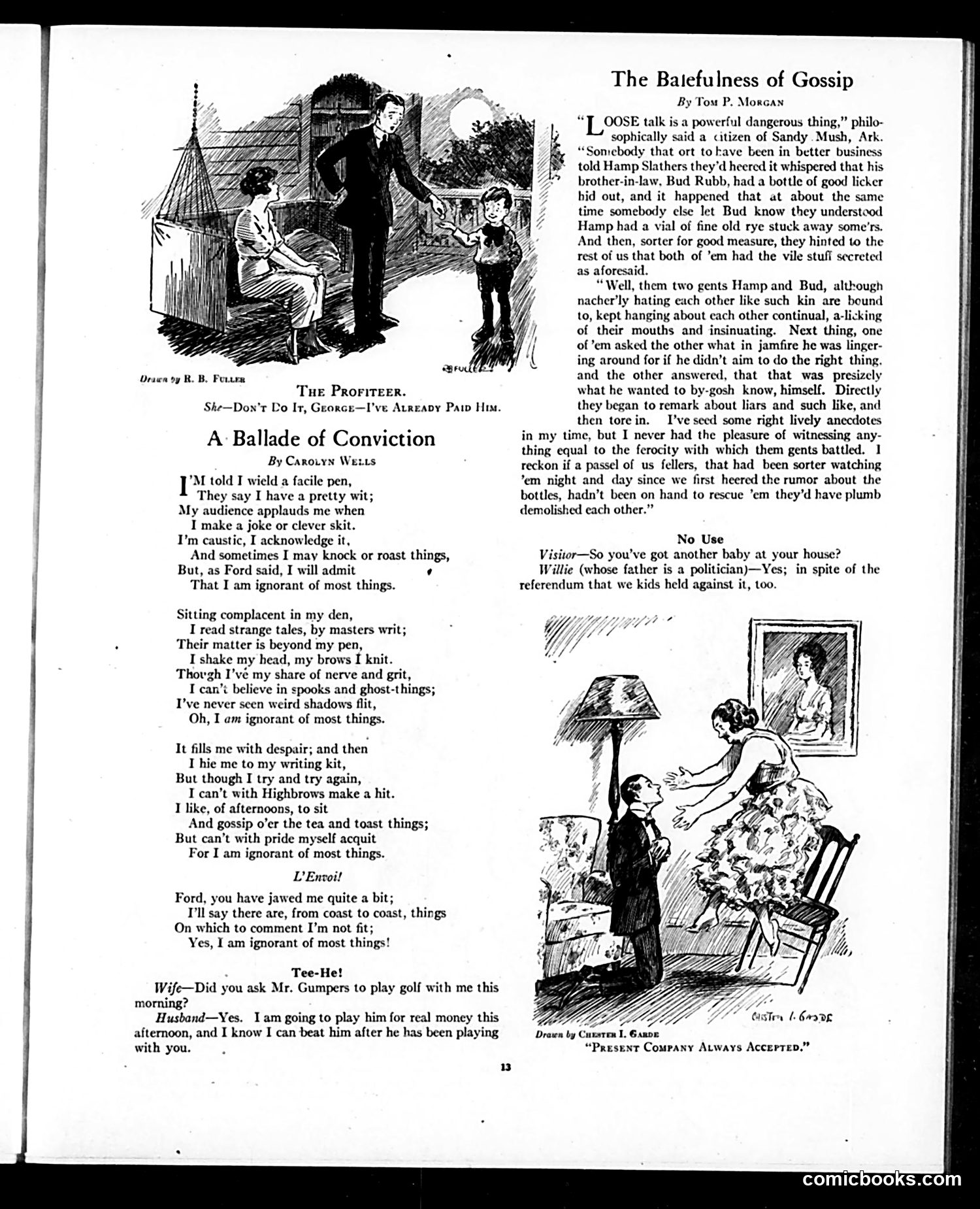
This page contains three distinct pieces of satirical humor: **"The Balefulness of Gossip"** (main story): A tall tale about how idle rumor—whispered gossip about hidden liquor—escalates into violent conflict between two relatives, Hamp Slathers and Bud Rubb, who initially hated each other but become obsessed with each other's alleged bottles. The satire mocks how gossip manufactures drama and brings people together destructively, illustrating that "loose talk is a powerful dangerous thing." **"A Ballade of Conviction"** (poem): A self-deprecating writer admits ignorance while making witty commentary anyway—satirizing intellectuals who pontificate beyond their actual knowledge. **"Tee-He!" and "No Use"** (brief jokes): Quick gags about golf betting and a politician's child noting that even a family referendum couldn't stop another baby's arrival—satirizing both masculine competitiveness and political rhetoric's ineffectiveness on domestic matters. The illustrations complement these themes with period-style sketches of the characters and situations described.
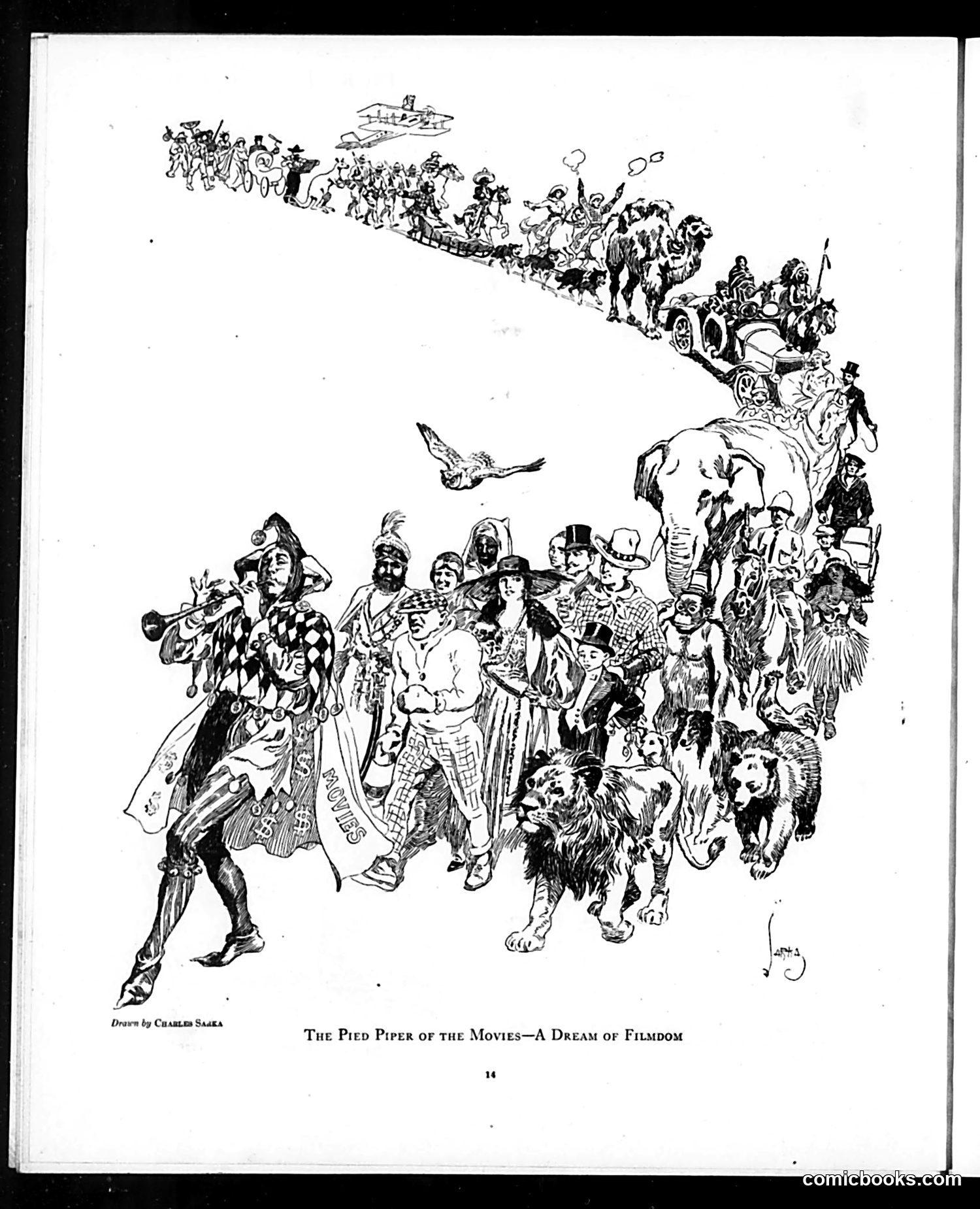
This satirical drawing by Charles Saarb depicts the film industry as a modern version of the Pied Piper legend. A flamboyantly dressed figure (likely representing a movie producer or the allure of cinema itself) plays music while leading a procession of diverse characters—actors, performers, animals, and vehicles—in a winding path upward. The satire suggests Hollywood's hypnotic power over entertainers and the public. The Pied Piper reference implies the film industry "enchants" people into following it, possibly critiquing cinema's growing cultural dominance in the early 20th century. The chaos of the procession—mixing circus performers, society figures, and animals—emphasizes the surreal, fantastical nature of "Filmdom" as an all-consuming dream world.
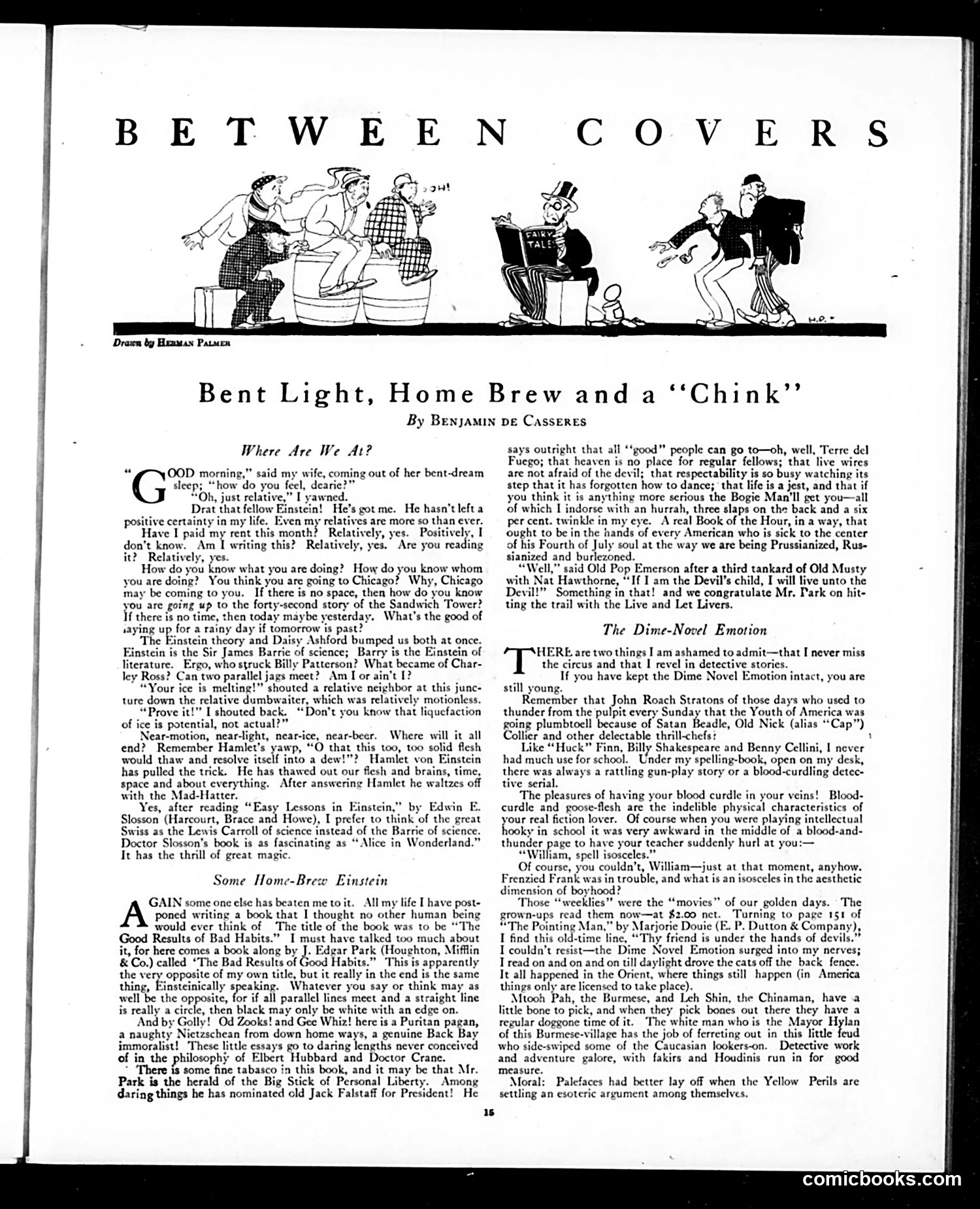
This page satirizes the early-1920s intellectual craze around Einstein's theory of relativity. The article humorously depicts how Einstein's concepts of relative space and time have permeated everyday American consciousness, creating existential confusion. The author jokes that Einstein has made certainty impossible in daily life—one can't know if rent was truly paid, if one is actually moving, or if time exists. References to "Daisy Ashford" (a child author) and Lewis Carroll suggest how Einstein's ideas have become as bewildering as nonsense literature. The second section mocks similarly daring contemporary books promoting moral relativism and personal liberty—citing J. Edgar Park's *Bad Results of Good Habits* and the nomination of Falstaff for President as examples of this new irreverent philosophy. The cartoon shows characters representing these confused, relativistic attitudes through exaggerated physical poses, illustrating how the era's intellectual trends affected popular culture and social behavior.
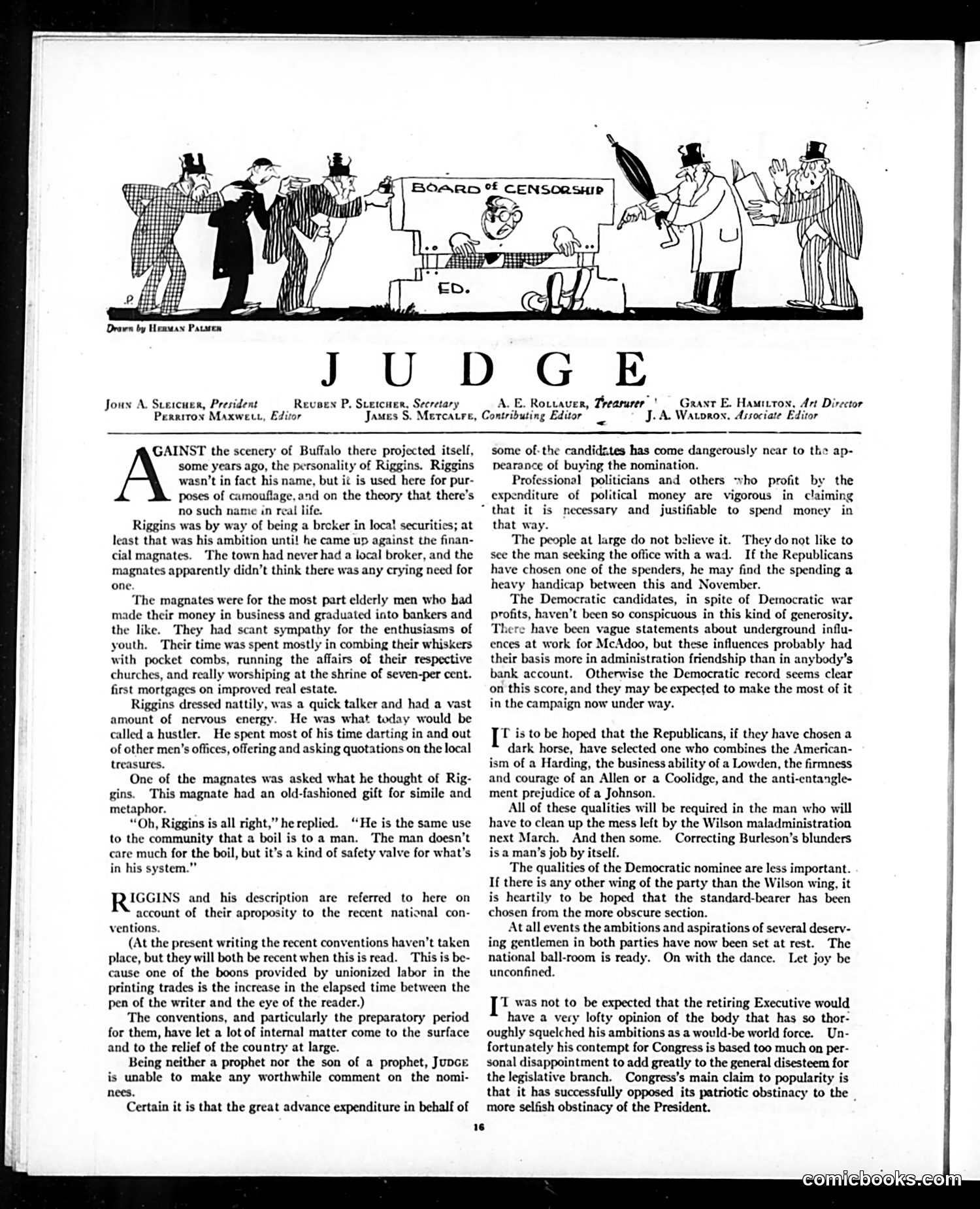
The cartoon header depicts a "Board of Censorship" examining content—a visual joke about editorial gatekeeping. The article uses "Riggins," a fictional Buffalo broker character, as an allegory for candidates in recent national political conventions. A magnate's dismissive comparison—that Riggins is like "a boil" that serves as a "safety valve"—represents how established money views ambitious newcomers. The essay's main argument concerns **campaign spending**. Judge criticizes candidates spending lavishly to "buy" nominations, claiming Republicans appear more guilty of this than Democrats. The piece sarcastically notes professionals justify such expenditures as "necessary," but the general public dislikes candidates with obvious financial backing. The text references McAdoo (likely William Gibbs McAdoo, Democratic candidate in 1920) and Wilson administration "maladministration," indicating this addresses the 1920 presidential race. Judge advocates for selecting candidates with less obvious financial influence and warns Republicans that heavy spending may become a "handicap" in November's election.
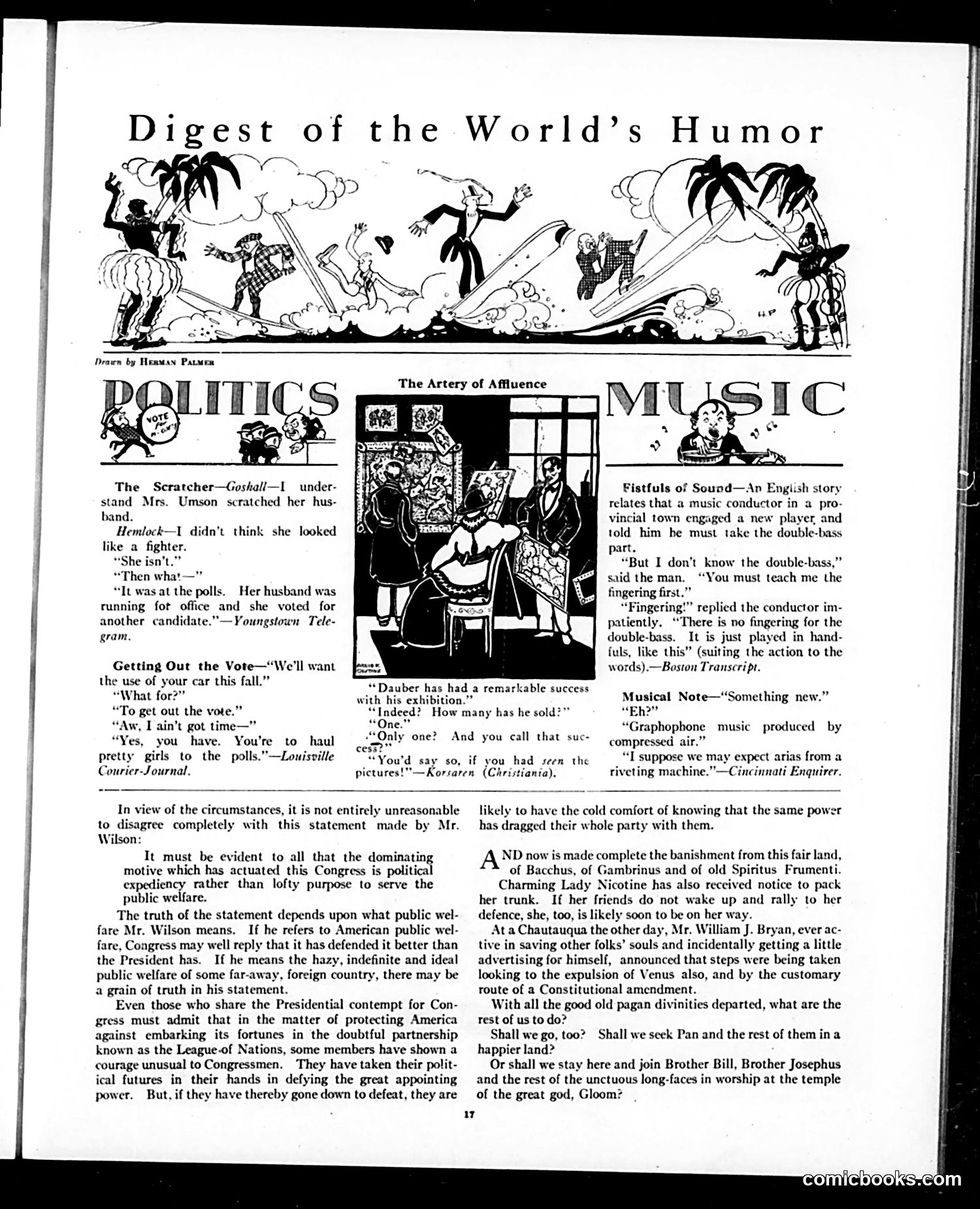
This page collects brief satirical jokes organized by topic (Politics, Music, etc.), plus a longer political editorial. **The Politics section** includes jokes mocking voting behavior—one about a wife voting against her husband's candidacy, another about using pretty women to encourage voter turnout, suggesting women's votes were obtained through superficial appeals rather than civic engagement. **The Music section** contains anecdotes poking fun at musical incompetence and new technology (the "graphophone"). **The main editorial** attacks President Wilson's criticism of Congress, arguing Congress actually *protected* American interests better by opposing the League of Nations. The piece defends Congressional independence against presidential pressure. **The closing section** sarcastically mourns Prohibition and anti-smoking campaigns (referencing "Bacchus," "Nicotine," and "Venus"), mocking William Jennings Bryan's moral crusades. It cynically suggests that with all vices banned, only "the great god, Gloom" remains—criticizing puritanical reformism as joyless.
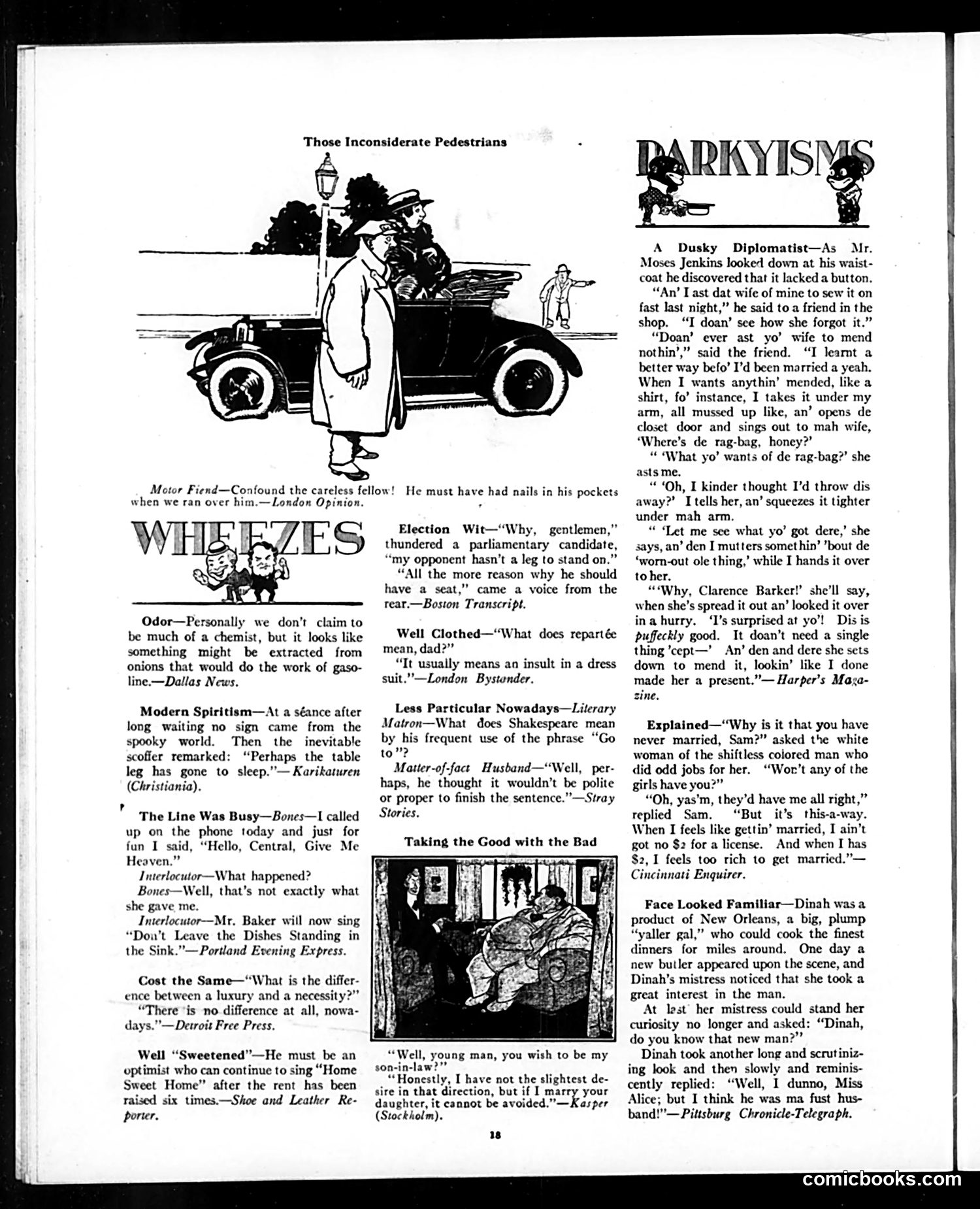
This page collects brief humorous anecdotes and jokes typical of early-20th-century satirical magazines. Key items include: **"Those Inconsiderate Pedestrians"** (top): A cartoon satirizing motorists' callousness toward pedestrians, with a driver complaining about hitting someone without getting a good view—mocking the dangerous, careless attitude of early automobile drivers toward public safety. **"Dusky Diplomatist"** (right column): A dialect piece using offensive racial stereotypes, presenting a Black man's supposed strategy for getting his wife to mend clothes by pretending he wants to discard them. This reflects the era's casual, dehumanizing racial humor. **Other brief jokes** mock spiritualism, telephone operators, landlords raising rent, and parliamentary candidates—typical targets of period satire. The page reflects Judge's satirical aims regarding automobiles, class relations, and contemporary absurdities, though much of the humor—particularly racial material—reflects deeply offensive attitudes now recognized as racist stereotyping.
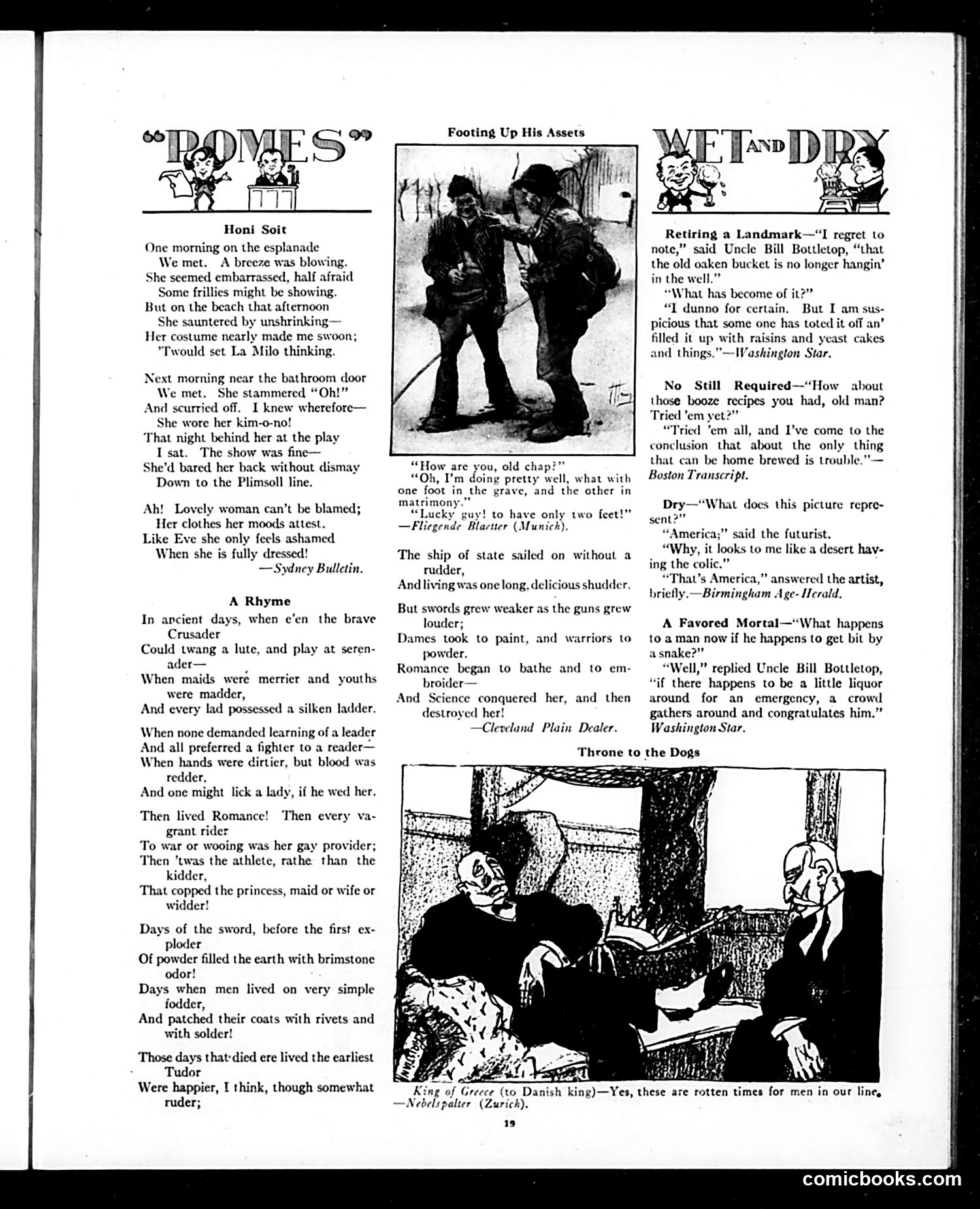
This page collects humorous verses and cartoon jokes typical of Judge's satirical content. The **"Domes" section** presents poems mocking women's fashion inconsistency—a woman embarrassed by glimpses of her body on the beach yet brazenly exposing it at the theater. The accompanying cartoon shows two figures, likely illustrating this hypocrisy about female modesty. The **"Wet and Dry" section** contains Prohibition-era humor. Jokes reference the "oaken bucket" (possibly alluding to nostalgia for pre-Prohibition America) and mock failed home-brewing attempts. One cartoon depicts what appears to be a "Throne to the Dogs"—showing men in conversation, likely commenting on social degradation during Prohibition times. The extended poem "A Rhyme" nostalgically contrasts medieval romance with modern times, suggesting civilization has declined from chivalry to science and artificiality. Overall, this page satirizes women's contradictory social behavior, mourns lost pre-Prohibition traditions, and expresses skepticism about modern progress—typical Judge content for the Prohibition era.
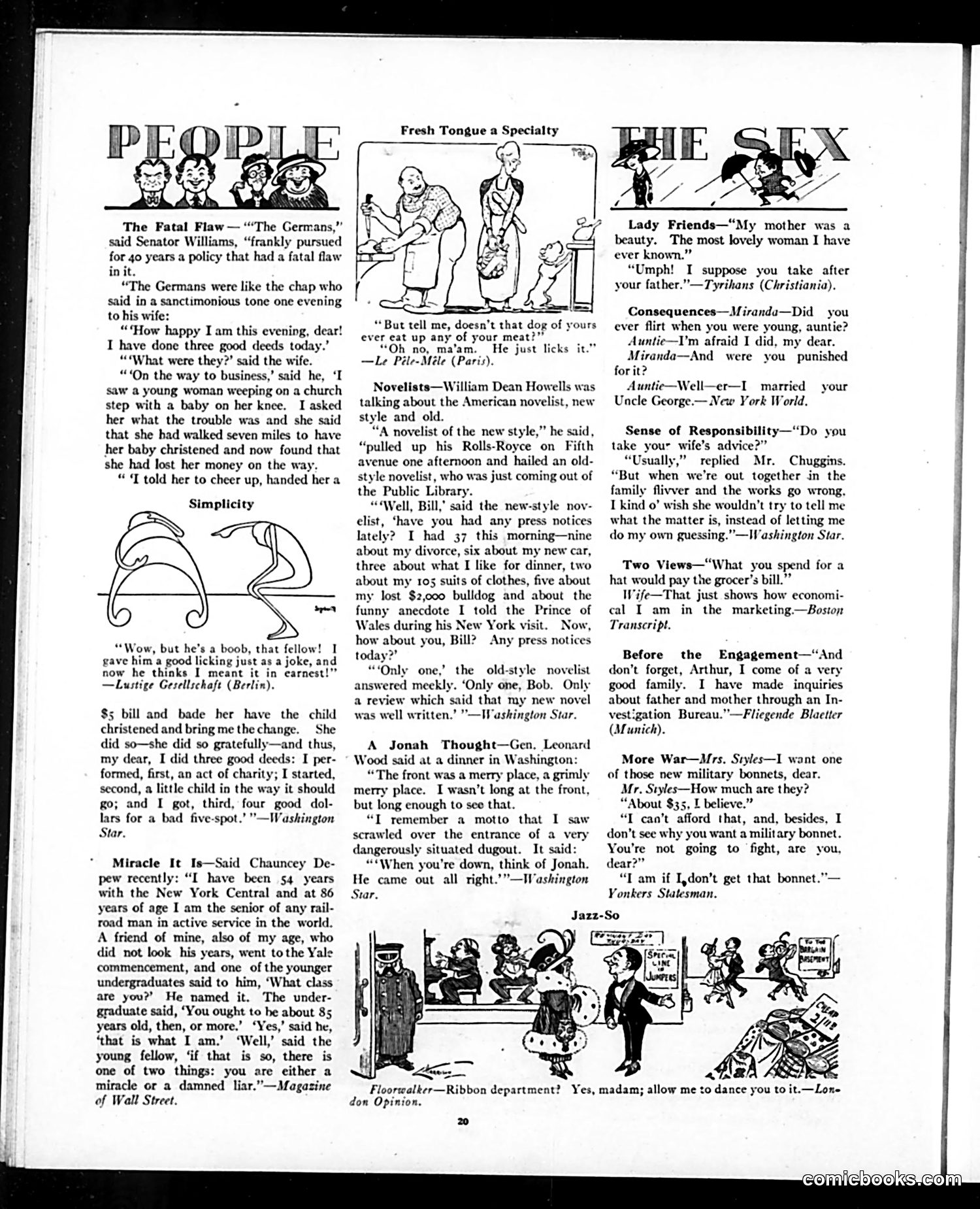
This page from *Judge* magazine contains several brief humorous anecdotes targeting German policy and contemporary American social attitudes. **"The Fatal Flaw"** sarcastically critiques Senator Williams's complaint about German foreign policy by comparing it to a hypocritical man who performs acts of charity for selfish gain. The joke suggests that Germany's policy failures stemmed from similar moral contradiction—pursuing militarism while claiming virtue. **"Simplicity"** mocks German sentimentality, depicting someone who beats someone as a "joke" then expresses shock at being taken seriously. **"Novelists"** contrasts old and new American writers: the new-style novelist obsesses over trivial press coverage (divorces, possessions, celebrity encounters), while the old-style novelist values actual literary merit. This satirizes 1920s celebrity culture and modern marketing over substance. **Other brief items** joke about courtship consequences, marital dynamics, and class differences—typical period humor about gender relations and social climbing. The overall tone reflects post-WWI American attitudes toward Germany and contemporary anxieties about modernization and changing values.
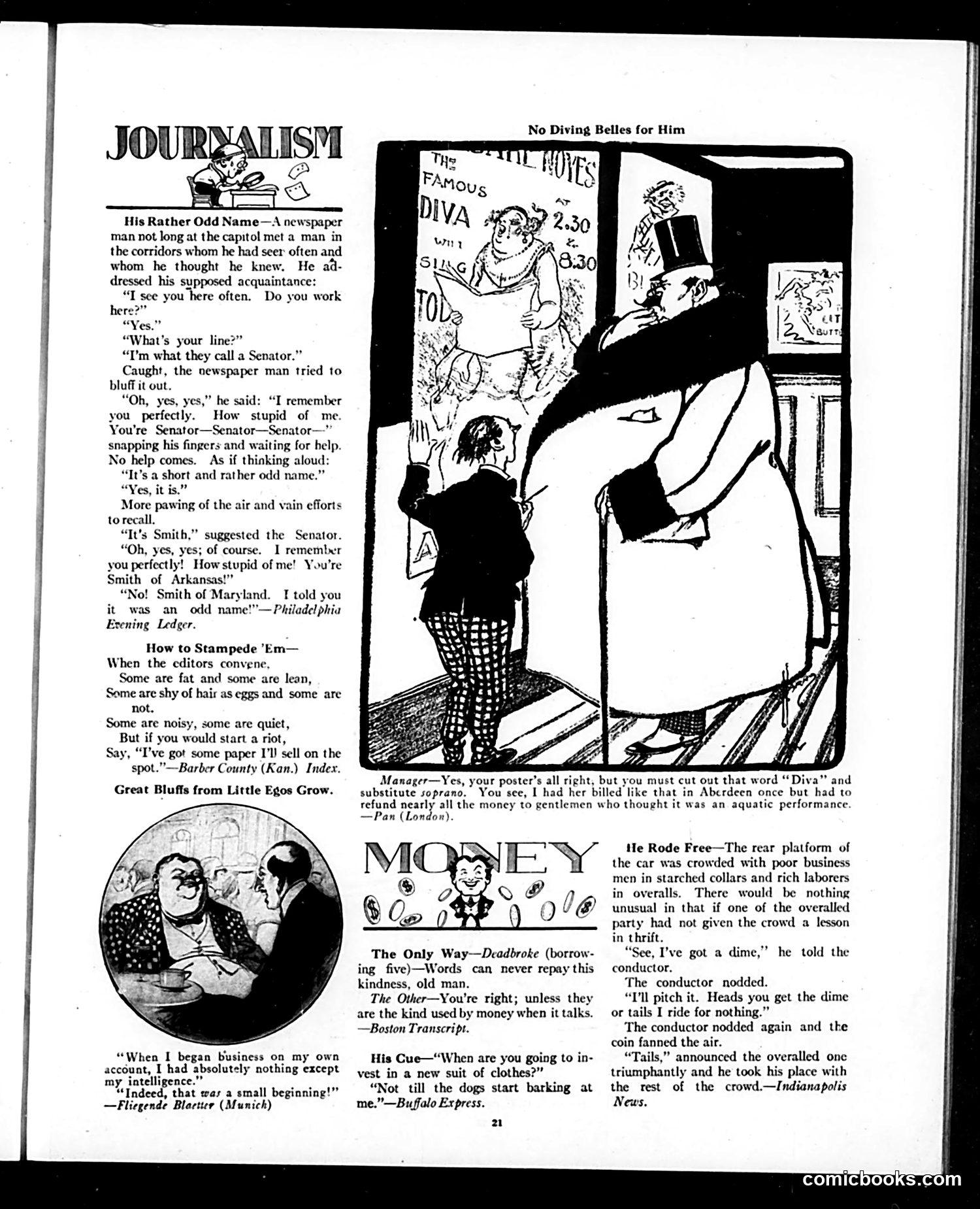
This page collects humorous anecdotes satirizing American social types and pretension: **"His Rather Odd Name"**: A newspaper reporter encounters a Senator whose name he's forgotten. After awkwardly fumbling—snapping his fingers, guessing "Smith"—he wrongly places him as "Smith of Arkansas" when he's actually "Smith of Maryland." The joke mocks the reporter's embarrassing bluff and social climbing. **"How to Stampede 'Em"**: A quip about editors—offering to sell them paper supposedly causes chaos among competing publications. **"Great Bluffs from Little Egos Grow"**: A businessman credits his success solely to his intelligence, mocking such self-aggrandizing pride. **"No Diving Belles for Him"**: Theater management must change "Diva" to "soprano" on a poster because patrons thought it advertised an aquatic performance, not singing. **"He Rode Free"**: A poor laborer tricks a conductor with a coin flip over free passage—celebrating working-class wit over paying fares. All pieces gently lampoon pretension, business bluffing, and social awkwardness.
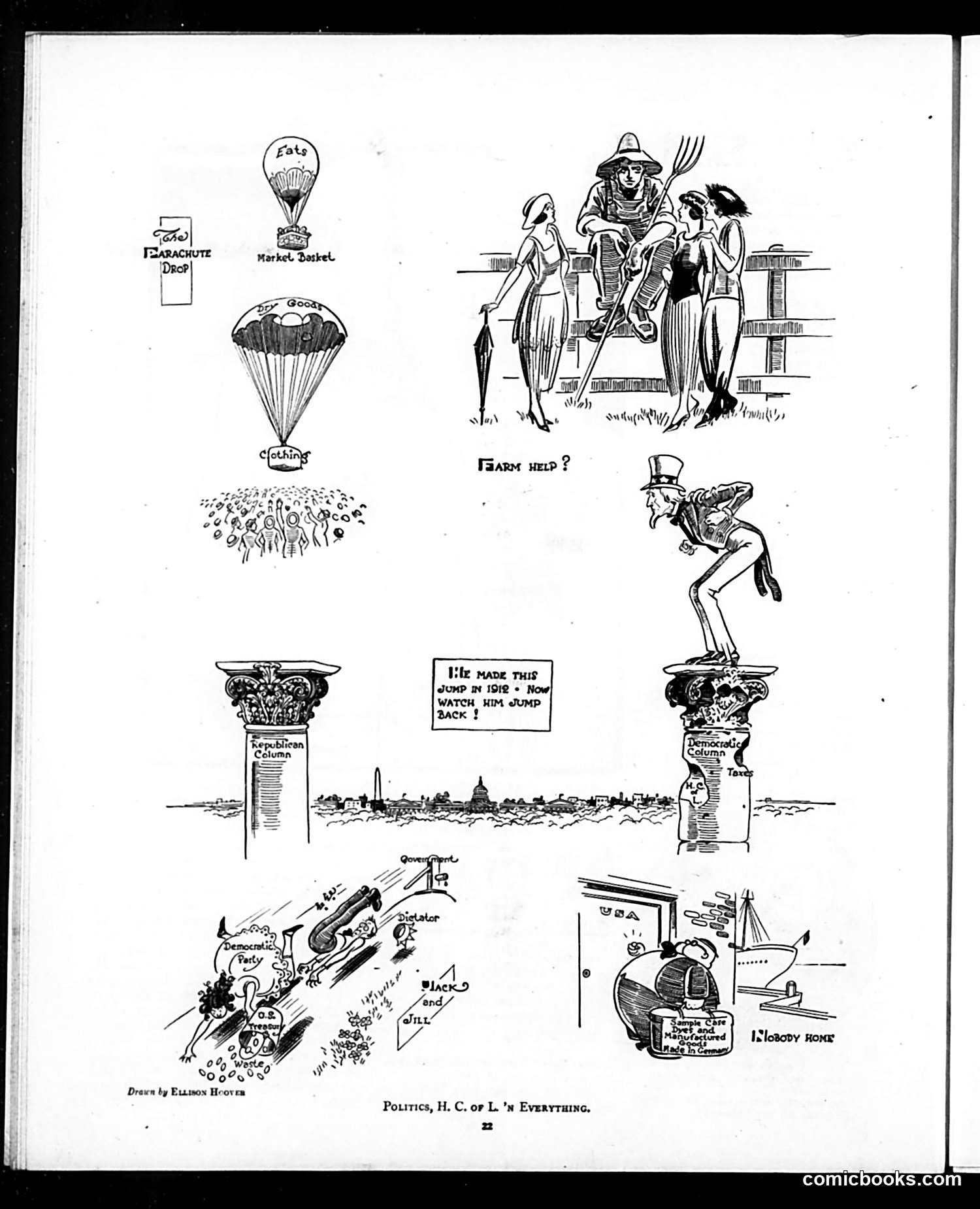
This page presents multiple cartoon vignettes satirizing American politics and society. The central image shows a farmer asking "Farm Help?" while a wealthy gentleman in top hat stands between two pedestals labeled "Republican Column" and "Democratic Column," suggesting both political parties fail working Americans. Other elements include: - Parachutes and balloons labeled "Fats" and "Clothing," likely mocking wartime rationing or profiteering - A figure jumping between columns with text about making a jump "in 1918" and "watching him jump back"—possibly referencing political flip-flopping - A chaotic bottom panel with labels including "Party," "Dictator," "Black and Blue," and "Jill," appearing to satirize political corruption and violence The overall theme critiques how mainstream politics ignores common citizens' needs while politicians opportunistically switch positions. The artist is credited as Elixson Hoover. The tone is cynical about political integrity across party lines.
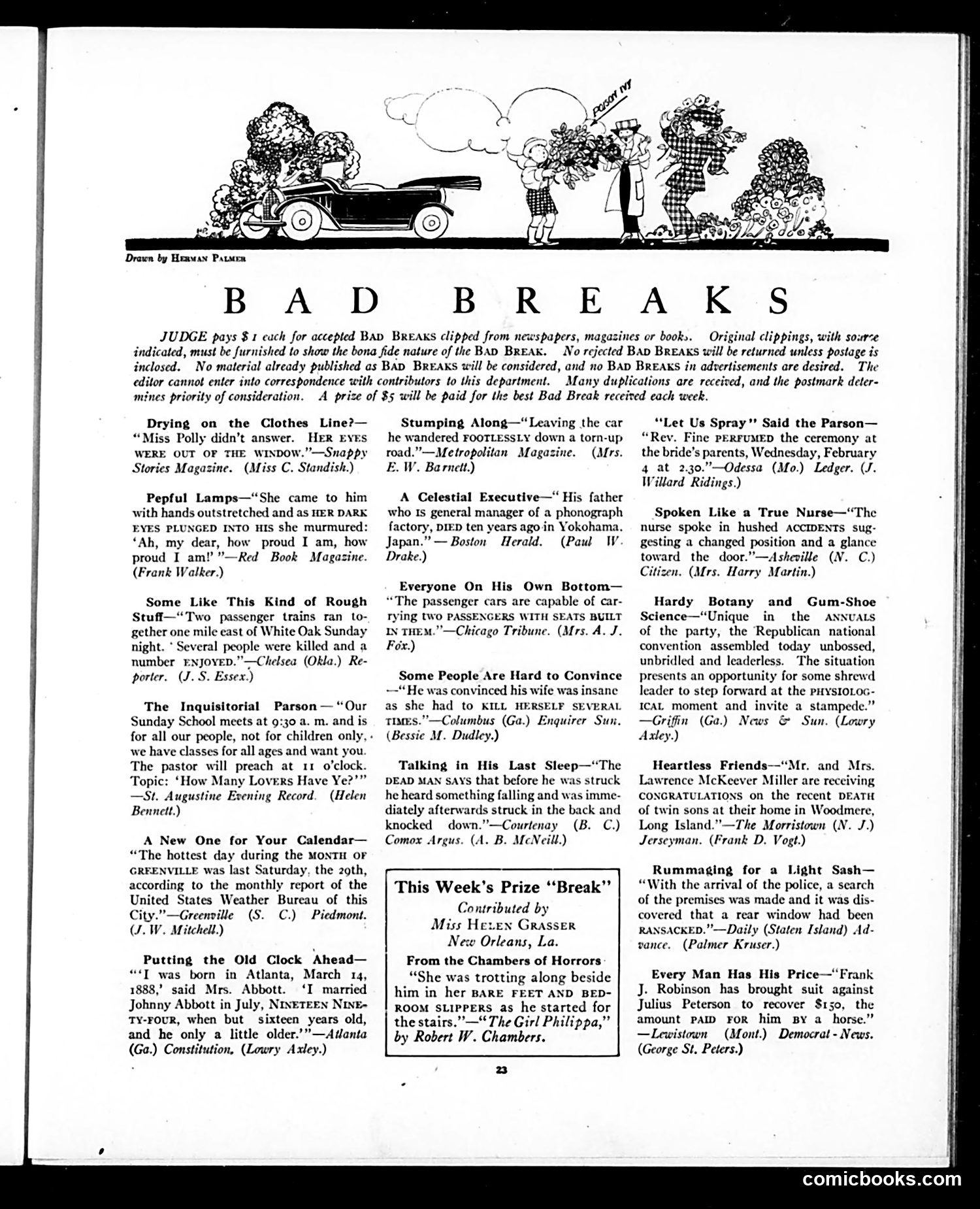
This page showcases "Bad Breaks," a recurring Judge magazine feature. "Bad Breaks" are unintentionally funny errors—grammatical blunders, malapropisms, and absurd sentences—clipped from published newspapers, magazines, and books. Judge pays $1 for accepted submissions and $5 weekly for the best one. The cartoon header (drawn by Herman Palmer) satirically depicts a family outing disrupted by a car, illustrating editorial chaos. The text below contains dozens of examples: a dead man speaking from the grave, passenger cars holding two passengers "with seats built in them" (implying impossible geometry), a parson who "perfumed" a ceremony, and a nurse discussing "accidents" when meaning something else. These highlight editorial carelessness and provide gentle, slapstick humor—common in early 20th-century comedy.
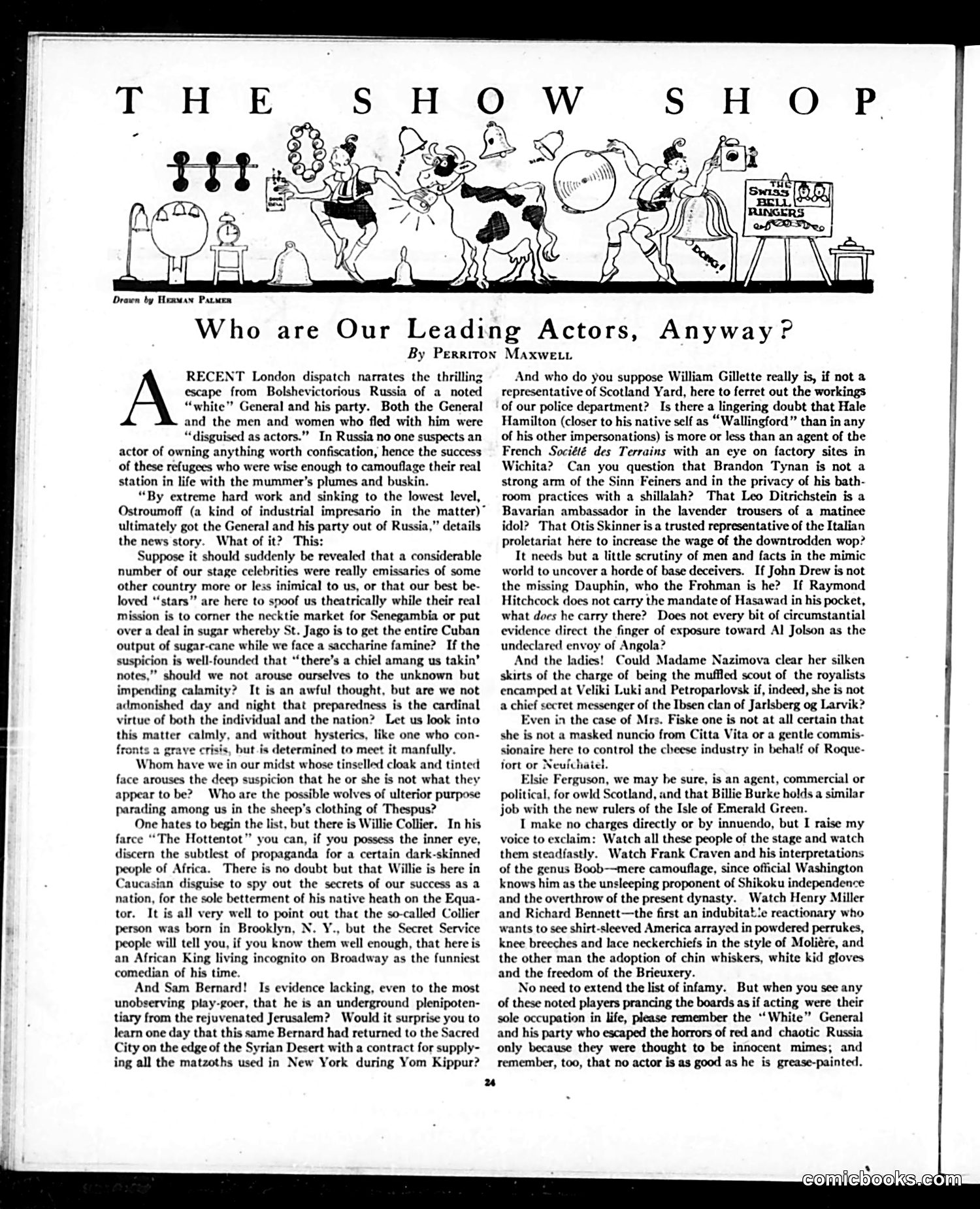
This article satirizes American paranoia about foreign infiltration during the post-WWI, early Bolshevik-era period. The author uses absurdist humor to mock widespread suspicion that stage actors might be secret agents for hostile nations. The piece opens with a news story about Russian "White" generals escaping Bolshevism by disguising themselves as actors—exploiting the cultural assumption that actors are worthless and transparent. The satirist then inverts this: what if *our* famous Broadway actors are actually foreign spies? He then humorously "exposes" leading American actors of the era (Willie Collier, Sam Bernard, William Gillette, etc.) as purported agents for Scotland Yard, France, Israel, Ireland, Bavaria, and other nations—each accusation deliberately absurd and based on stereotypes. The satire targets nativist hysteria and xenophobia of the period, mocking how readily Americans suspected foreign conspiracy. By making the accusations progressively ridiculous, the author ridicules this paranoid mindset.
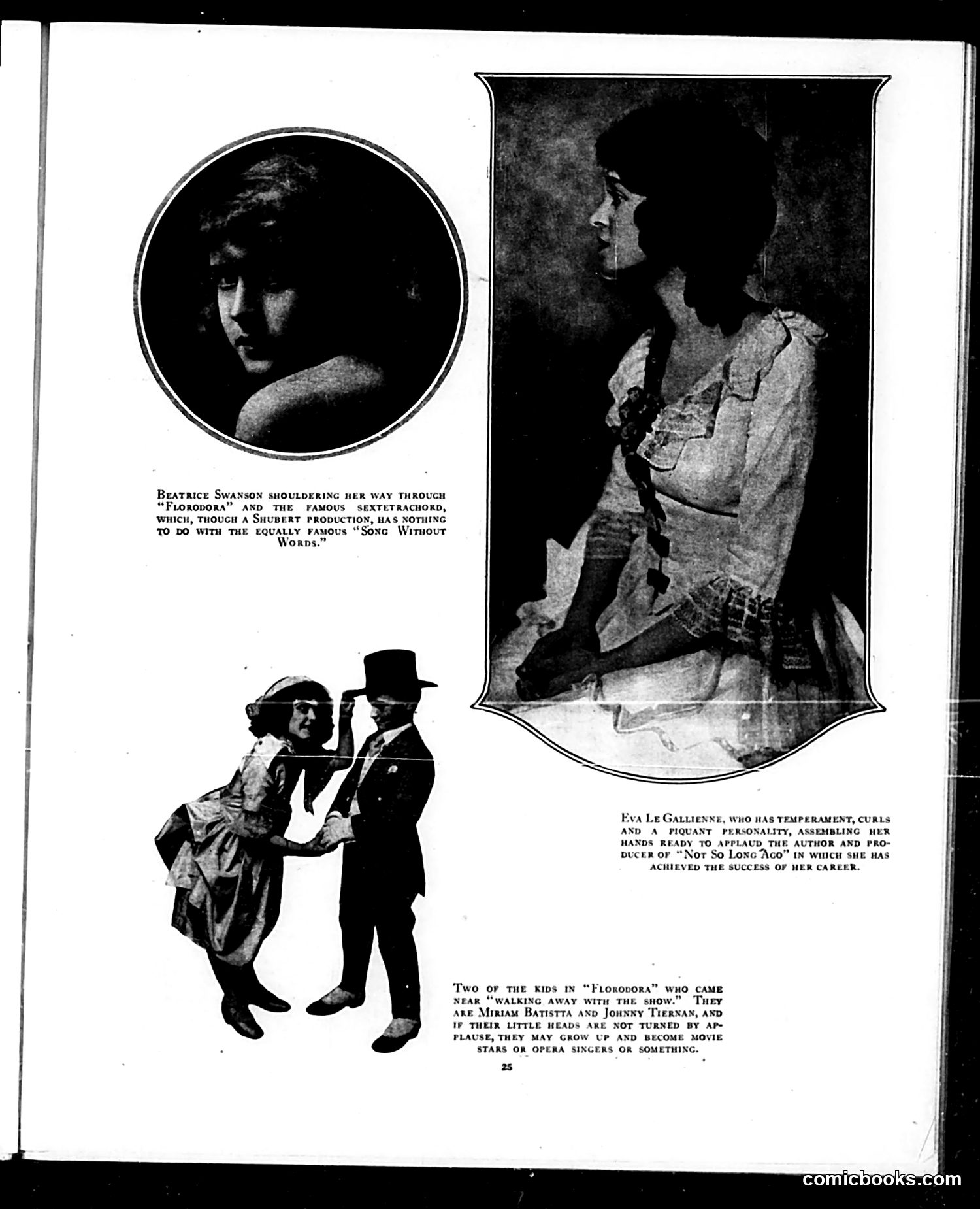
This is an entertainment page from *Judge* magazine featuring photographs and commentary on theatrical performers. It highlights: **Beatrice Swanson** — appearing in the musical *Florodora* (a Shubert production), with a joking reference to "Song Without Words," suggesting she's making her way through the show without distinguishing herself vocally. **Eva Le Gallienne** — praised for her temperament, curls, and "piquant personality" in the play *Not So Long Ago*, noted as a career success. **Miriam Battista and Johnny Tiernan** — child performers in *Florodora* who nearly "walked away with the show," with speculation they might become movie or opera stars if fame doesn't spoil them. The page is essentially celebrity gossip and promotion typical of *Judge's* entertainment coverage—mildly satirical commentary on theater personalities, with the implicit humor being backhanded compliments and gentle mockery of theatrical egos and child actors' prospects.
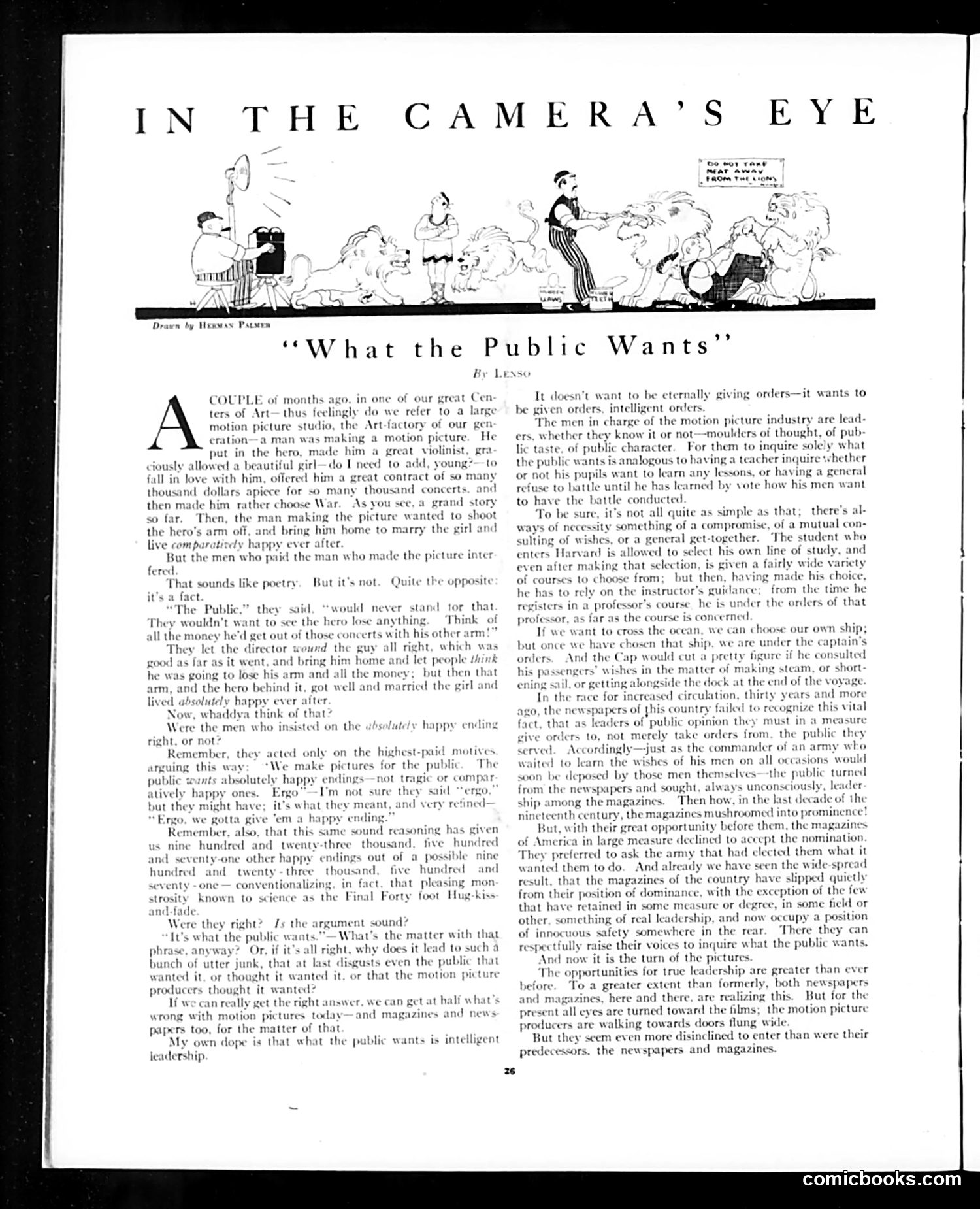
This article by Lesso critiques the motion picture industry's slavish devotion to audience preferences. The cartoon (drawn by Hermes Paten) depicts filmmakers consulting the public. **The Satire's Point:** The author describes a studio executive who removed an unhappy ending (the hero losing his arm in war) because "the public" supposedly wouldn't accept tragedy. This created formulaic, sentimental happy endings instead. **The Argument:** Lesso argues that while studios claim to serve "what the public wants," they're actually abdicating *leadership*. He contends that newspapers and magazines similarly capitulated to public taste rather than guide it intelligently. The public, he argues, doesn't actually want endless cheerful drivel—it wants *intelligent orders* and direction, like students accepting a professor's curriculum after initial choice. **The Critique:** Motion picture producers, newspapers, and magazines should function as cultural leaders shaping taste, not mere servants pandering to lowest-common-denominator preferences. Treating the audience as a voting body rather than intelligent consumers produces mediocrity.
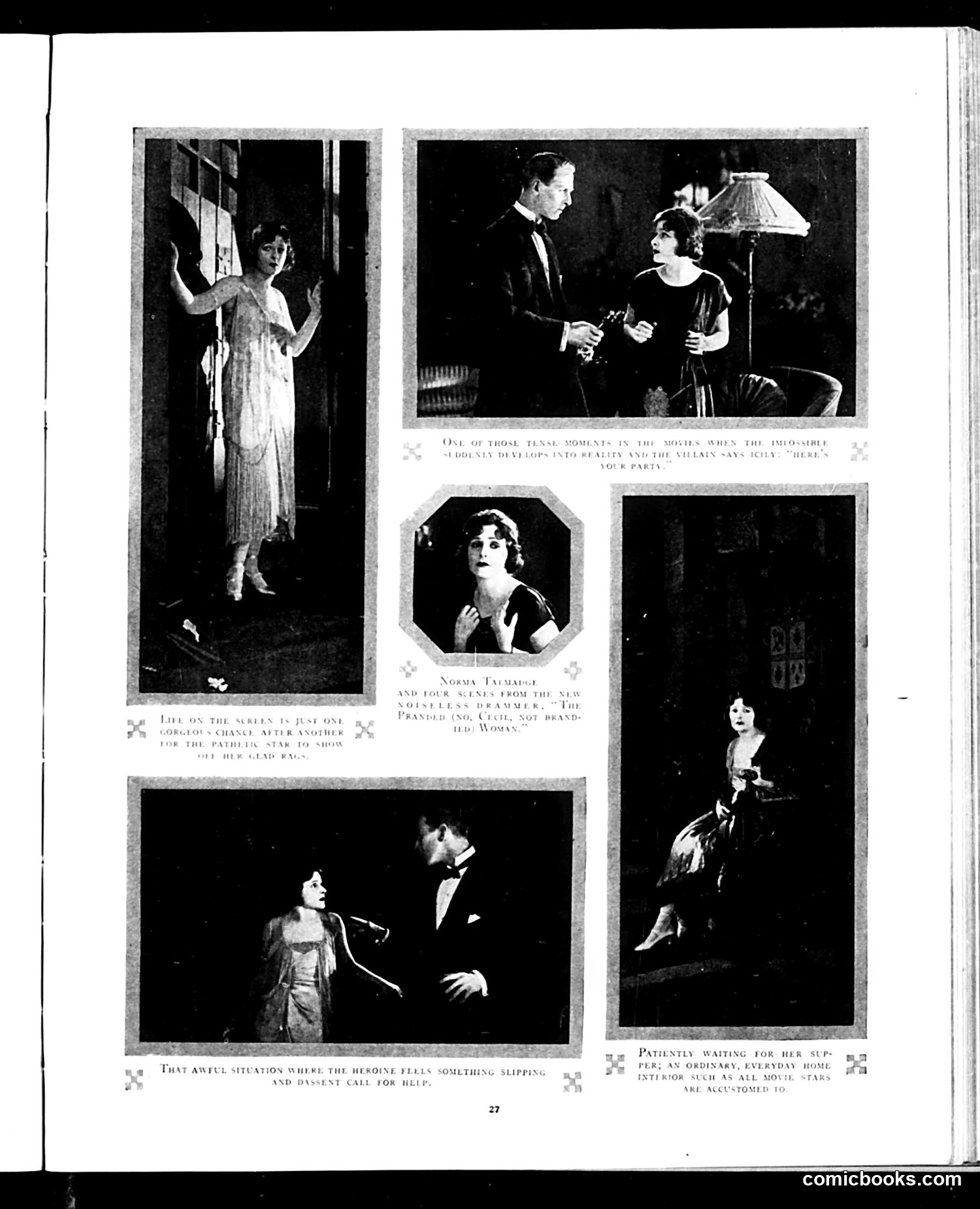
This page features film stills and captions from what appears to be a silent movie review in Judge magazine. The images showcase scenes from a dramatic narrative involving a female protagonist in various situations—standing in a doorway, confronting men in formal attire, and waiting anxiously indoors. The captions reference plot elements: a "pathetic star" showing off, an "impossible suddenly" developing into reality, a villain's declaration, and the heroine "patiently waiting for her supper" in an "ordinary, everyday home interior." The satire likely mocks melodramatic silent film conventions—overwrought emotion, improbable plot twists, and domestic drama—common targets for Judge's entertainment criticism. Without identifying specific actors or films, the page demonstrates how Judge ridiculed Hollywood's tendency toward theatrical excess and contrived storylines. The page number indicates this is editorial content rather than advertising.
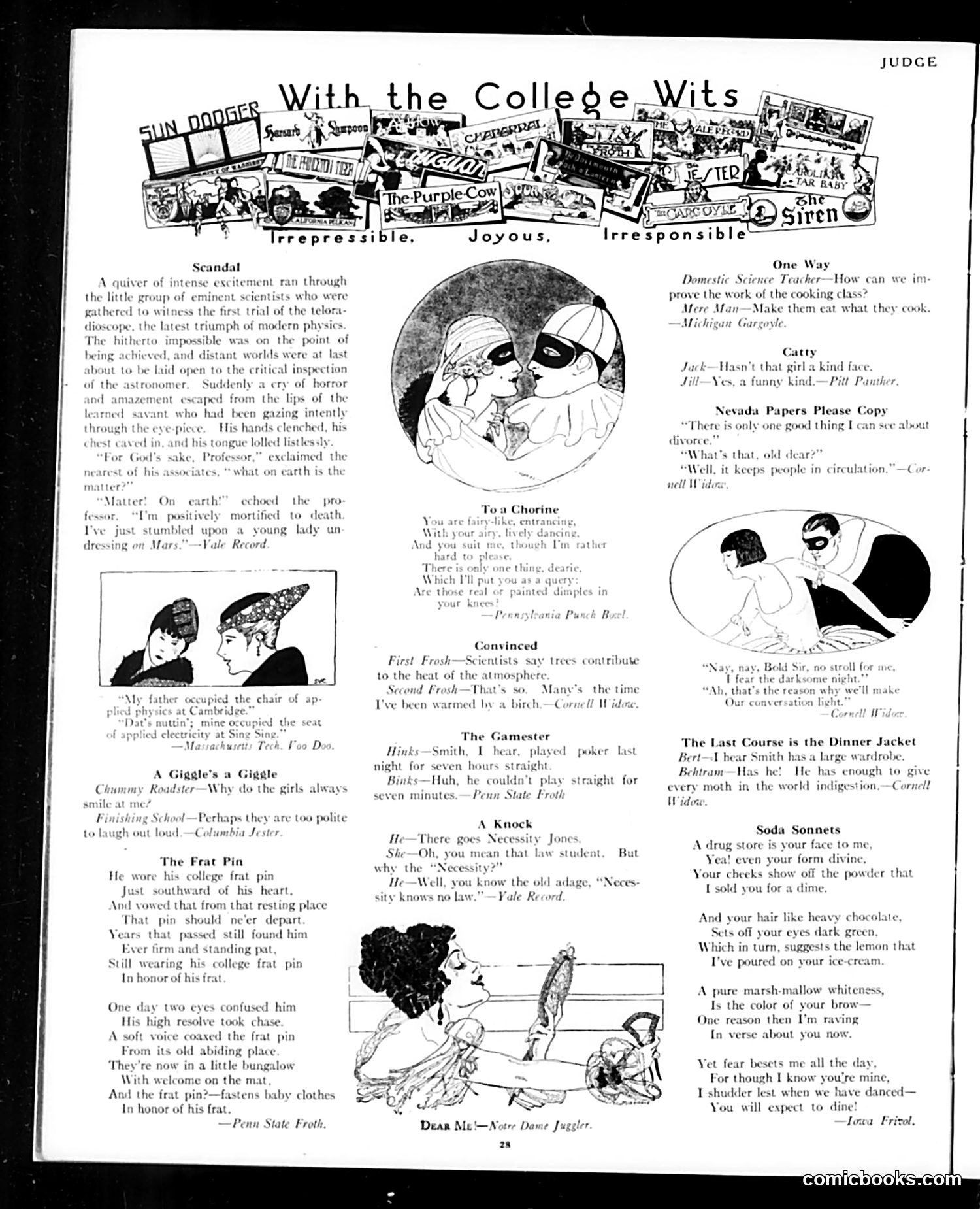
This is a humor page targeting college life and student culture, circa early 20th century. The content consists of short jokes and satirical quips attributed to various college publications (Penn State Froth, Yale Record, Cornell Widow, etc.). **Key satirical targets:** - **Academic pretension**: Scientists witnessing a telescope trial, domestic science students cooking poorly - **Dating/romance**: Jokes about girls' appearances, men's romantic confusion, the expectation that dates should end in dinner - **Male vanity**: The "Frat Pin" story mocks a man's emotional attachment to his college pin—treated as a sacred keepsake yet used to fasten baby clothes - **Female behavior**: Jokes about women's politeness, makeup ("powder"), and materialism The cartoons (two small illustrations visible) accompany these college-focused gags. The humor relies on the assumption that readers recognize specific college traditions and anxieties—fraternity culture, competitive dating, and intellectual pomposity—making fun of young adults' self-importance and romantic mishaps.
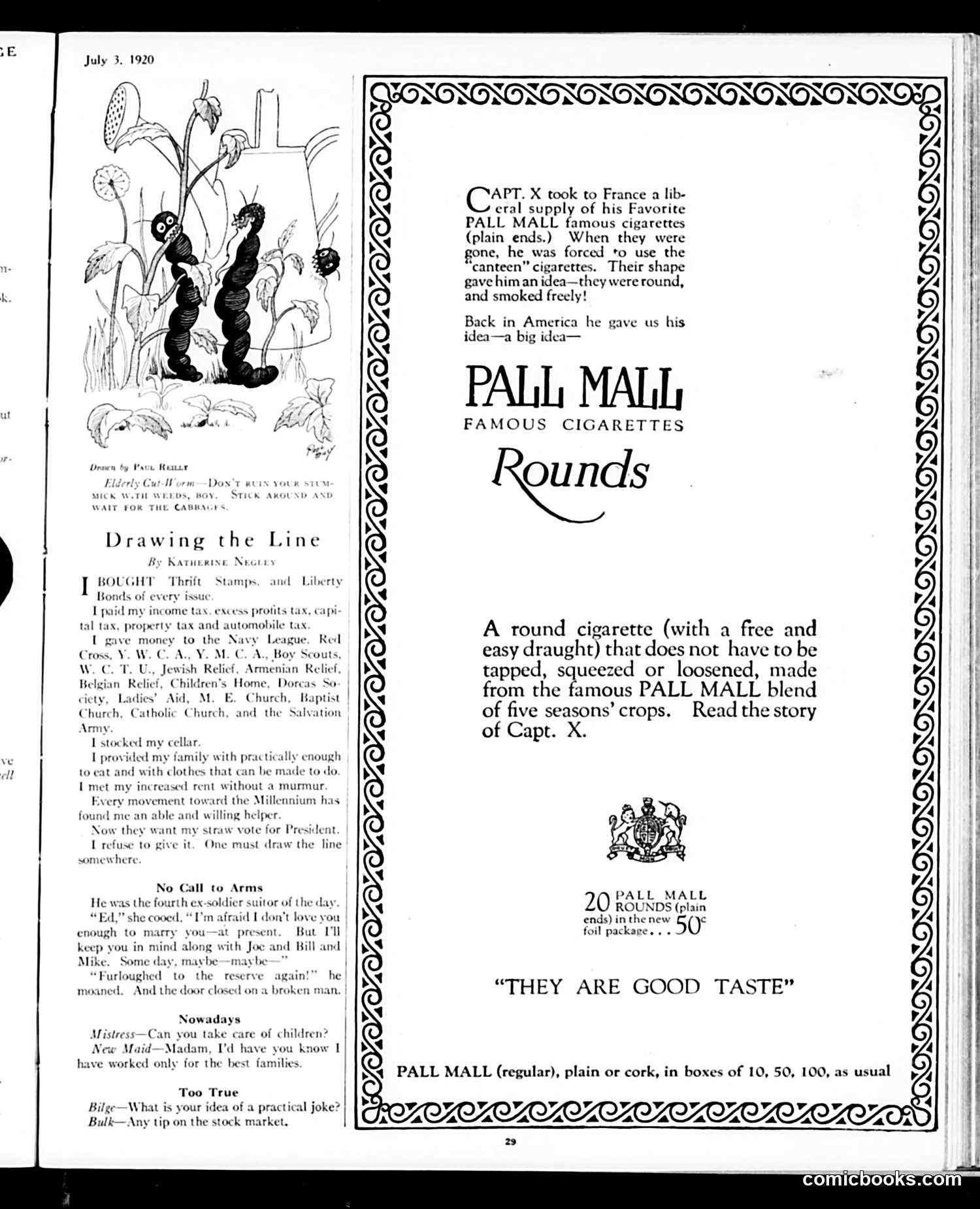
This page mixes satirical commentary with advertising. The main cartoon, "Drawing the Line" by Katherine Negley, depicts a woman who has complied with every patriotic and financial demand of the post-WWI era—paying multiple taxes, buying war bonds, donating to numerous charities, accepting higher rent—but refuses one final request (likely voting or some civic duty). The satire mocks the exhaustion of the citizenry from relentless wartime sacrifice demands, suggesting there's a limit to patriotic obligation. The minor joke "No Call to Arms" satirizes returning soldiers competing for the same woman's affection, with each rejected suitor departing in despair—commentary on post-war dating competition and economic instability. The right page is a cigarette advertisement featuring a Captain X who popularized round "Pall Mall Rounds" cigarettes inspired by army rations. This appears designed to capitalize on soldier nostalgia and the "freedom" of the round format.
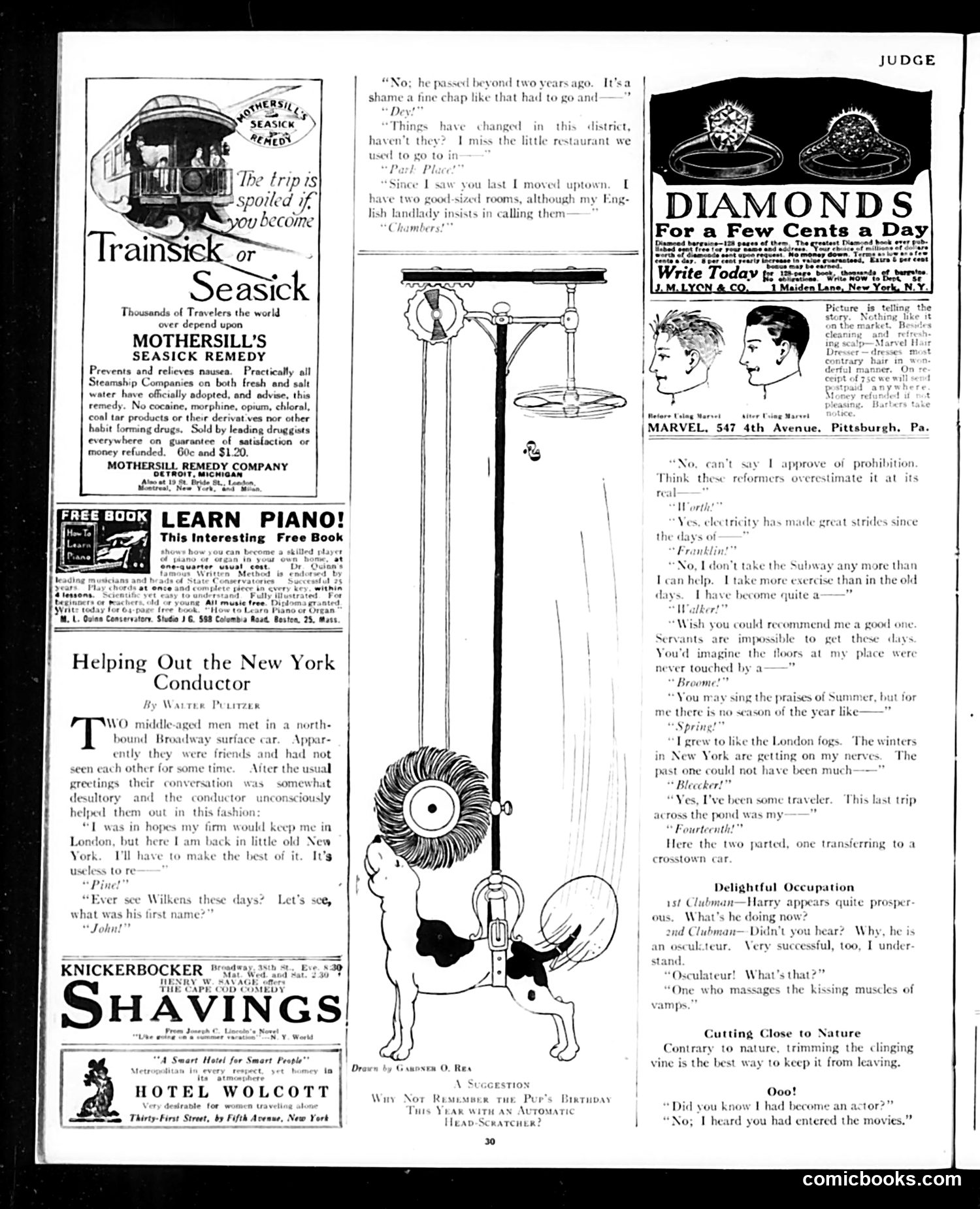
This page is primarily **advertisements and short humorous dialogues** rather than political satire. The main content includes: 1. **Mothersill's Seasick Remedy ad** - a patent medicine advertisement claiming to prevent nausea for steamship travelers, with no habit-forming drugs 2. **Diamond rings ad** - J.M. Lyon & Co. offering affordable jewelry ("For a Few Cents a Day") 3. **"Helping Out the New York Conductor"** - a mundane dialogue between two middle-aged men on a Broadway streetcar catching up after years apart, with a conductor assisting them 4. **Miscellaneous short jokes** about electricity, prohibition, servants, and acting/movies The cartoon by Grantson O. Rex (center) shows a figure with theatrical hair styling, illustrating a joke about remembering "the pup's birthday" with an "automatic head-scratcher." The humor is largely **social and domestic** rather than political—focused on everyday inconveniences (seasickness, servants), modern technology (electricity, subways), and contemporary entertainment (movies). The page reflects early 20th-century American life and commercial culture.
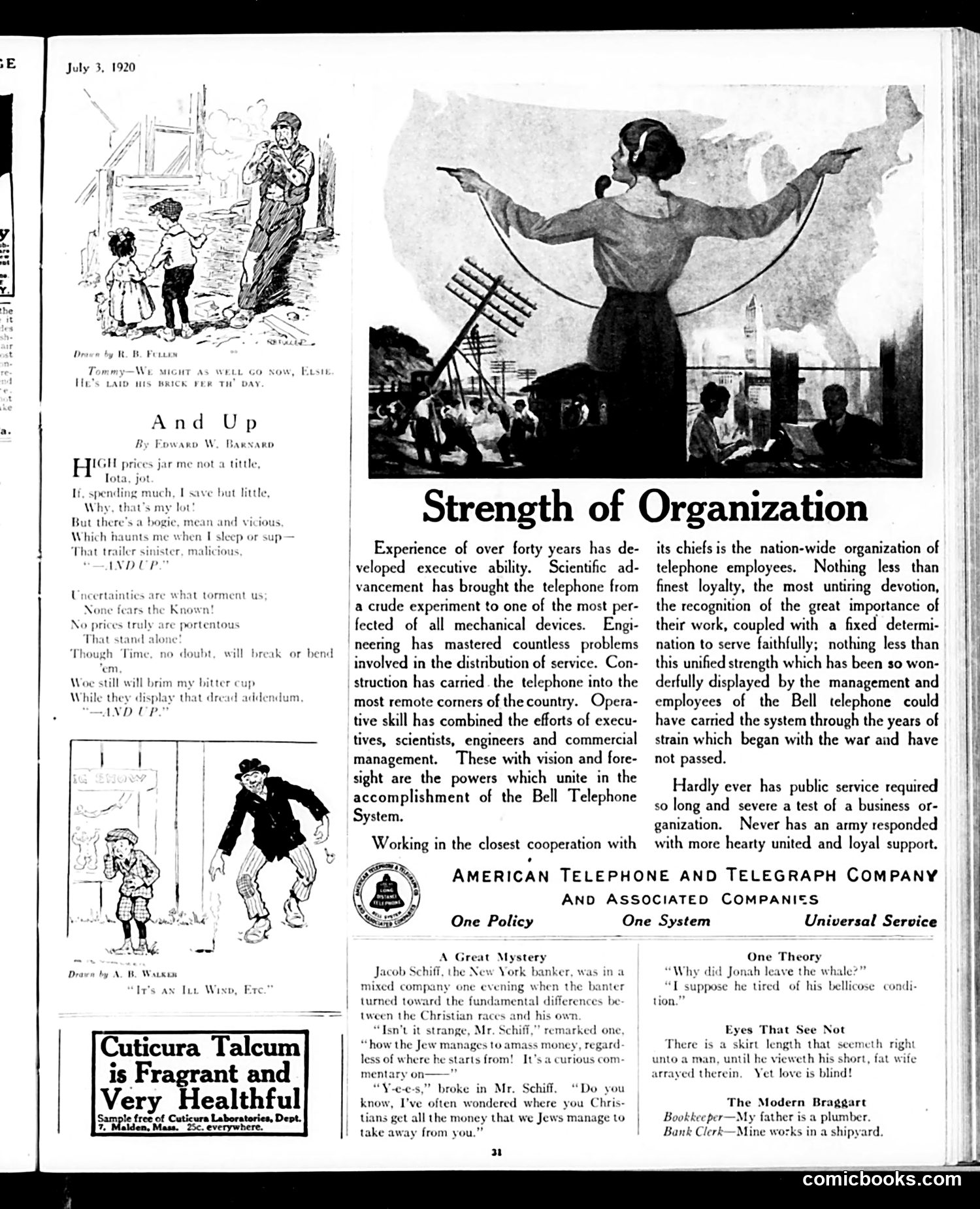
This page combines a corporate advertisement for Bell Telephone with period satirical content. The large right-side image shows a woman with outstretched arms before a map of the United States, celebrating the telephone system's nationwide reach and employee loyalty. The advertisement itself celebrates AT&T's infrastructure and workforce dedication, particularly praising employees' "unwavering devotion" through wartime strain. However, the page also contains deeply offensive antisemitic "humor." "A Great Mystery" depicts Jewish banker Jacob Schiff in a stereotype joke where a Christian remarks on Jewish financial success, and Schiff retorts by claiming Jews extract money from Christians—presenting antisemitic tropes as clever wit. This reflects the casual bigotry normalized in 1920s American publications. The other cartoons ("It's an Ill Wind," etc.) appear to be standard period humor about domestic complaints and office dynamics, now largely forgotten.
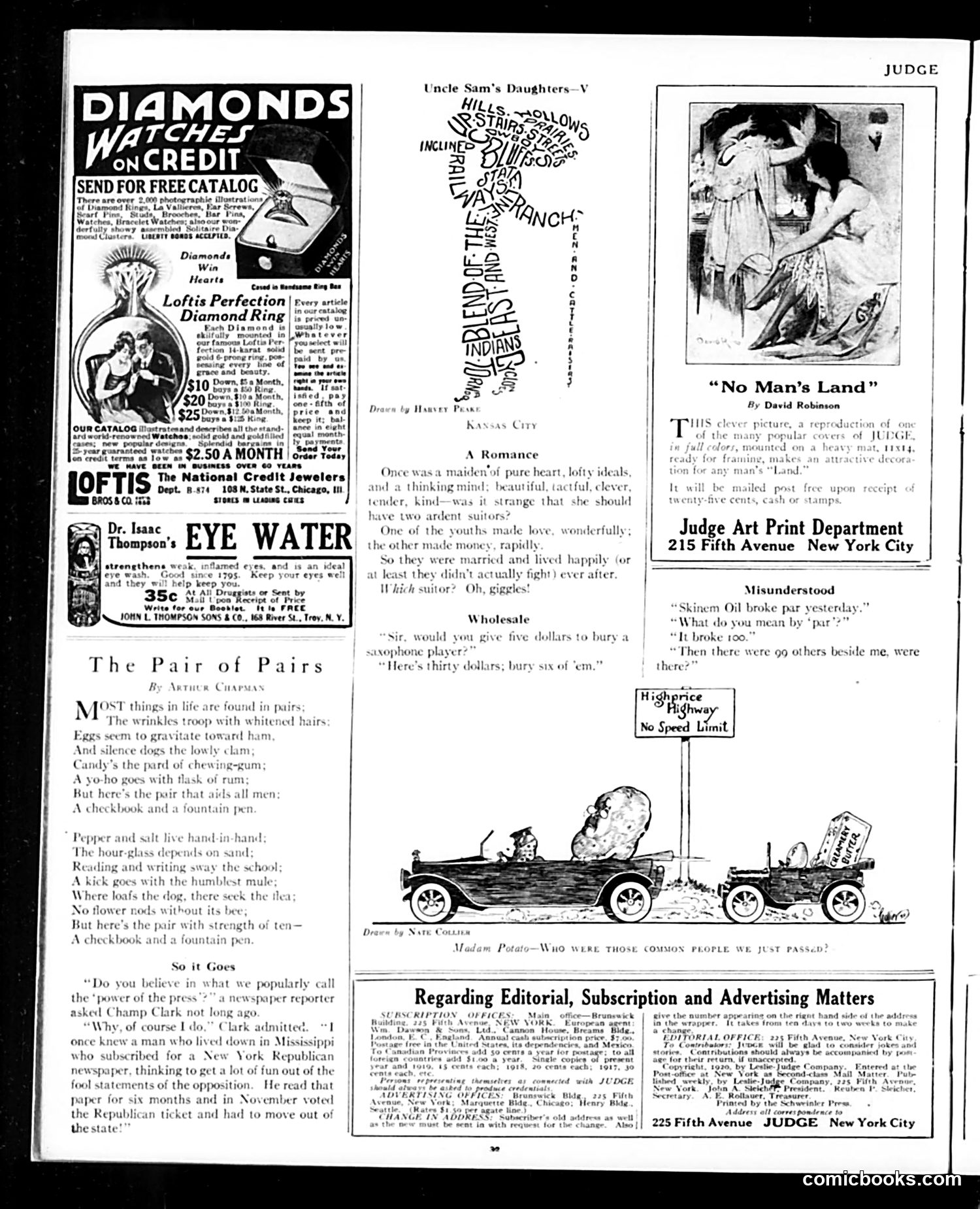
This page contains mostly **advertisements and filler content** rather than significant political satire. The main cartoon, "Modern Potato" (bottom), depicts a car on a "High Speed Highway—No Speed Limit" sign, loaded with baggage, passing another vehicle. The caption asks "Who were those common people we just passed?" This appears to be **social satire about wealthy travelers** and class distinctions—mocking the assumption that only the rich travel by automobile. "The Pair of Pairs" is a **humorous poem** playing on the phrase "pair of pairs" (opposites that work together), with tongue-in-cheek observations about complementary relationships. The page otherwise features **diamond ring advertisements**, an eye-water remedy ad, and an anecdote about a Mississippi newspaper reader who voted Republican after reading opposition coverage—**mild political humor** about journalism's persuasive power. The content reflects early 20th-century concerns: automobile culture, class anxiety, and skepticism about media influence.
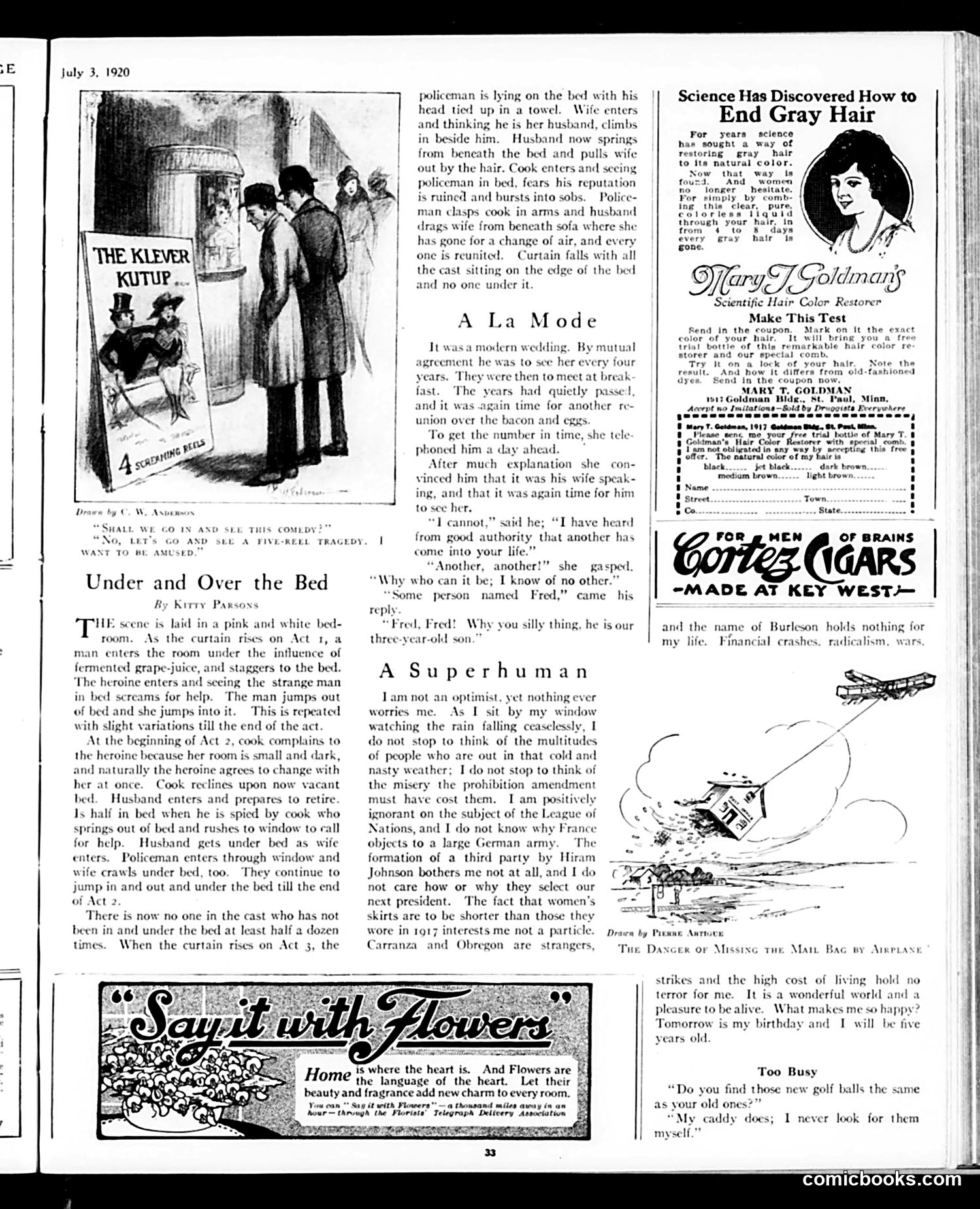
This Judge magazine page (July 3, 1920) contains three satirical short stories mocking contemporary life: **"Under and Over the Bed"** parodies farce comedies of the era—absurd bedroom-door-slamming plots where characters repeatedly jump in and out of beds. The joke: audiences prefer this ridiculous "five-reel tragedy" to actual comedy. **"A La Mode"** satirizes modern marriage's emotional distance. A couple meets only every four years by appointment. The husband confuses their three-year-old son "Fred" with a romantic rival, exposing how disconnected spouses have become. **"A Superhuman"** mocks selective apathy—a narrator claims indifference to major 1920 concerns: Prohibition, League of Nations, women's hemlines, and Mexican politics (Carranza/Obregon). The title is ironic; true detachment from all this is inhuman. The page also contains period advertisements (hair dye, cigars, flowers) reflecting 1920s consumer culture. The satirical intent throughout: to ridicule both theatrical excess and modern social/political disconnection.
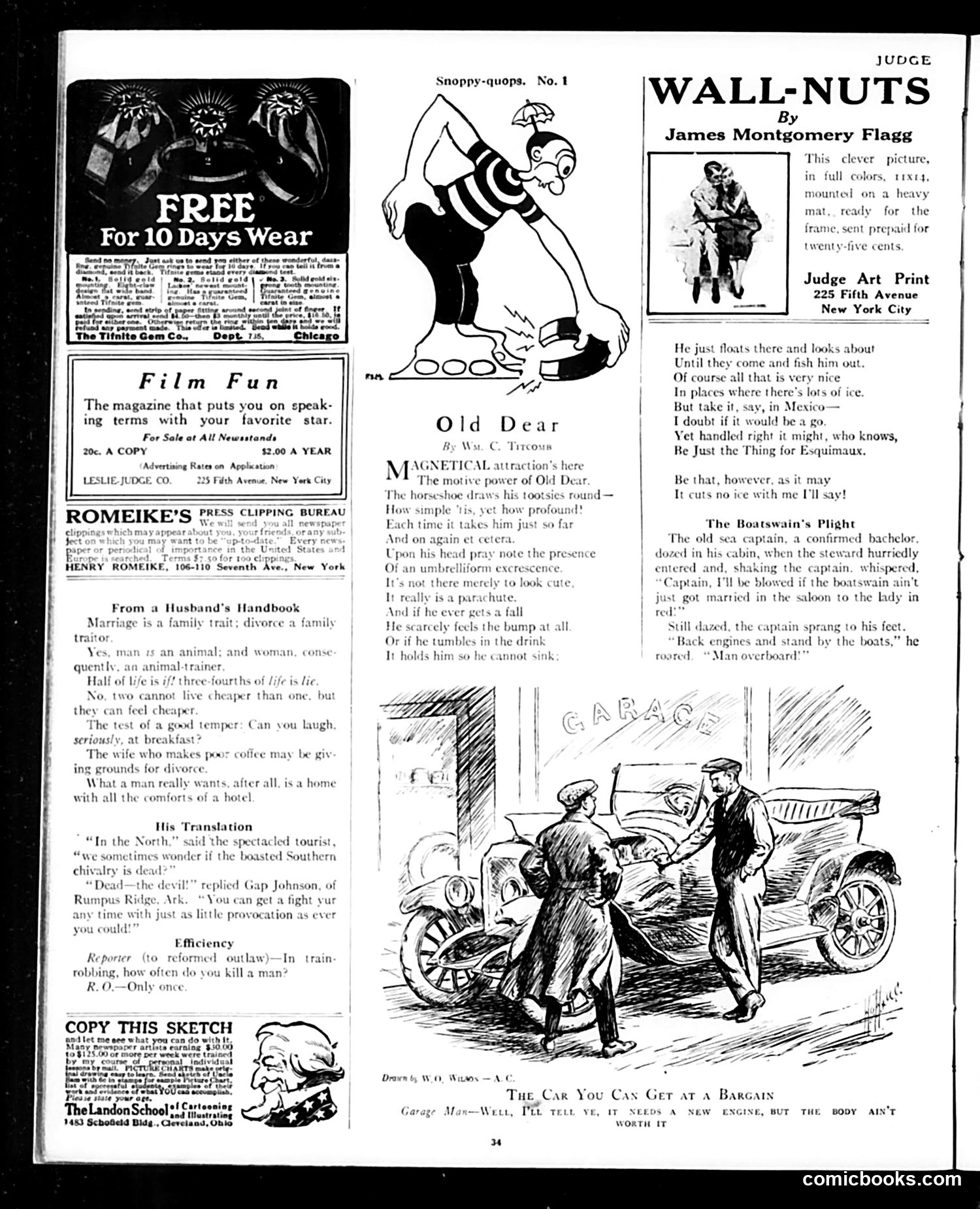
This page from *Judge* magazine contains several unrelated satirical items typical of early 20th-century humor publications. **"Wall-Nuts" by James Montgomery Flagg** is an advertisement for an art print depicting a character labeled "Snoopy-quops"—a cartoon figure in striped clothing doing something with his feet, sold as a framed picture. **"Old Dear"** is a humorous poem about the magnetic attraction of an old horse, using crude rhyming to mock sentimental notions of animals. **"The Boatswain's Plight"** tells a comedic naval anecdote: a ship's captain learns his boatswain married a woman in the saloon, causing the captain to frantically order the crew to "man overboard," confusing the situation. **"The Car You Can Get at a Bargain"** is a joke cartoon about a used car—the engine is new but the body is worthless, mocking shabby automobile sales practices. The page also contains period advertisements and advice columns typical of satirical magazines of this era.
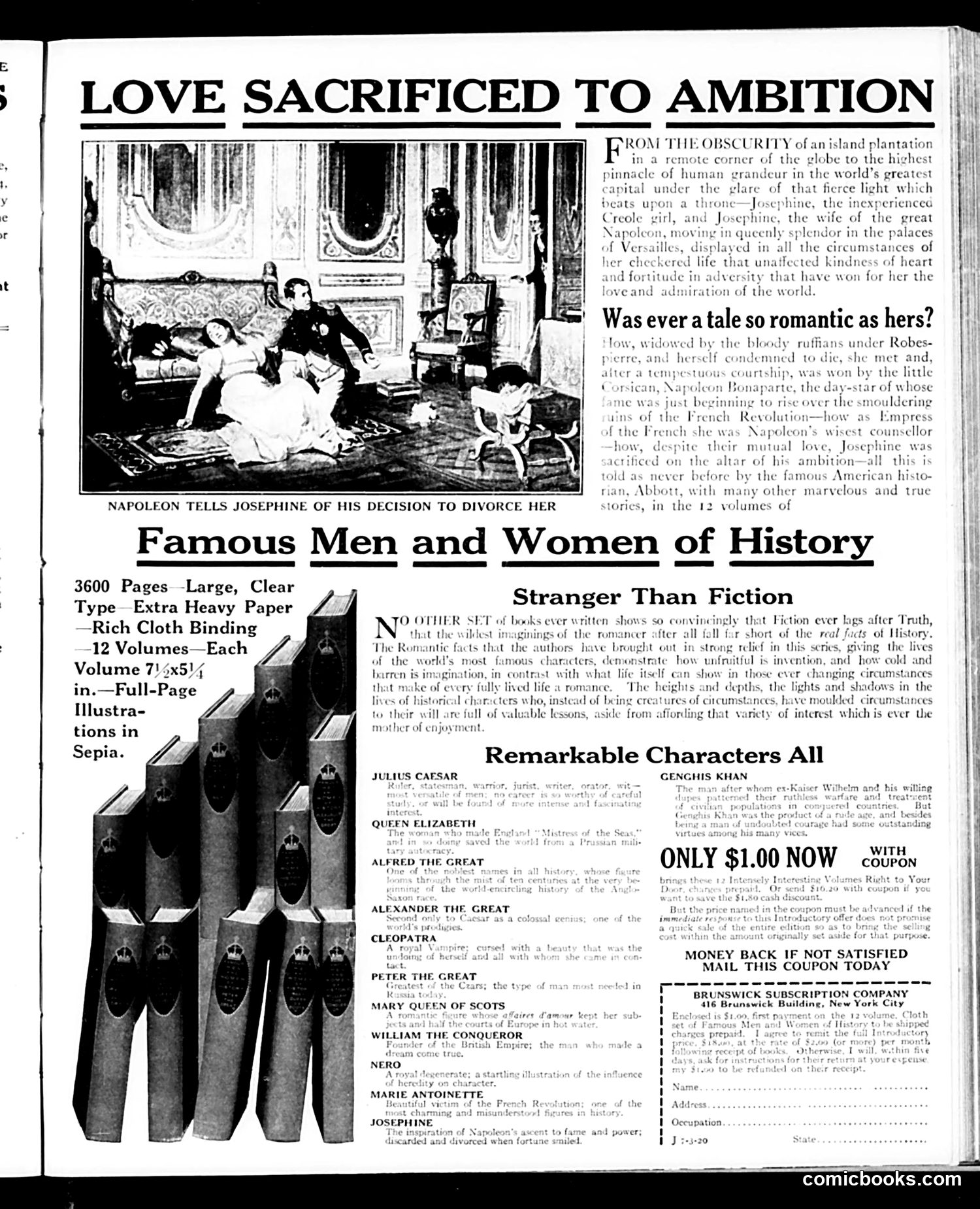
This page advertises a 12-volume encyclopedia titled *Famous Men and Women of History*. The central illustration depicts **Napoleon telling Josephine of his decision to divorce her**—a historically accurate event (1809) presented as romantic tragedy. The page frames Josephine's story as exceptionally romantic: a widow who survived the French Revolution's terror, rose to become Empress of France alongside Napoleon, yet was divorced when Napoleon's ambition for a new heir superseded their love. The text emphasizes the poignancy—her "unaffected kindness" and "fortitude in adversity" won her the world's admiration despite this betrayal. The advertising copy argues that real history surpasses fiction in drama and emotional depth. The encyclopedia promises to present famous historical figures not merely as products of circumstance, but as active shapers of destiny, offering "valuable lessons" alongside entertainment. This reflects early 20th-century popular education: packaging history as compelling human narrative to sell reference works.
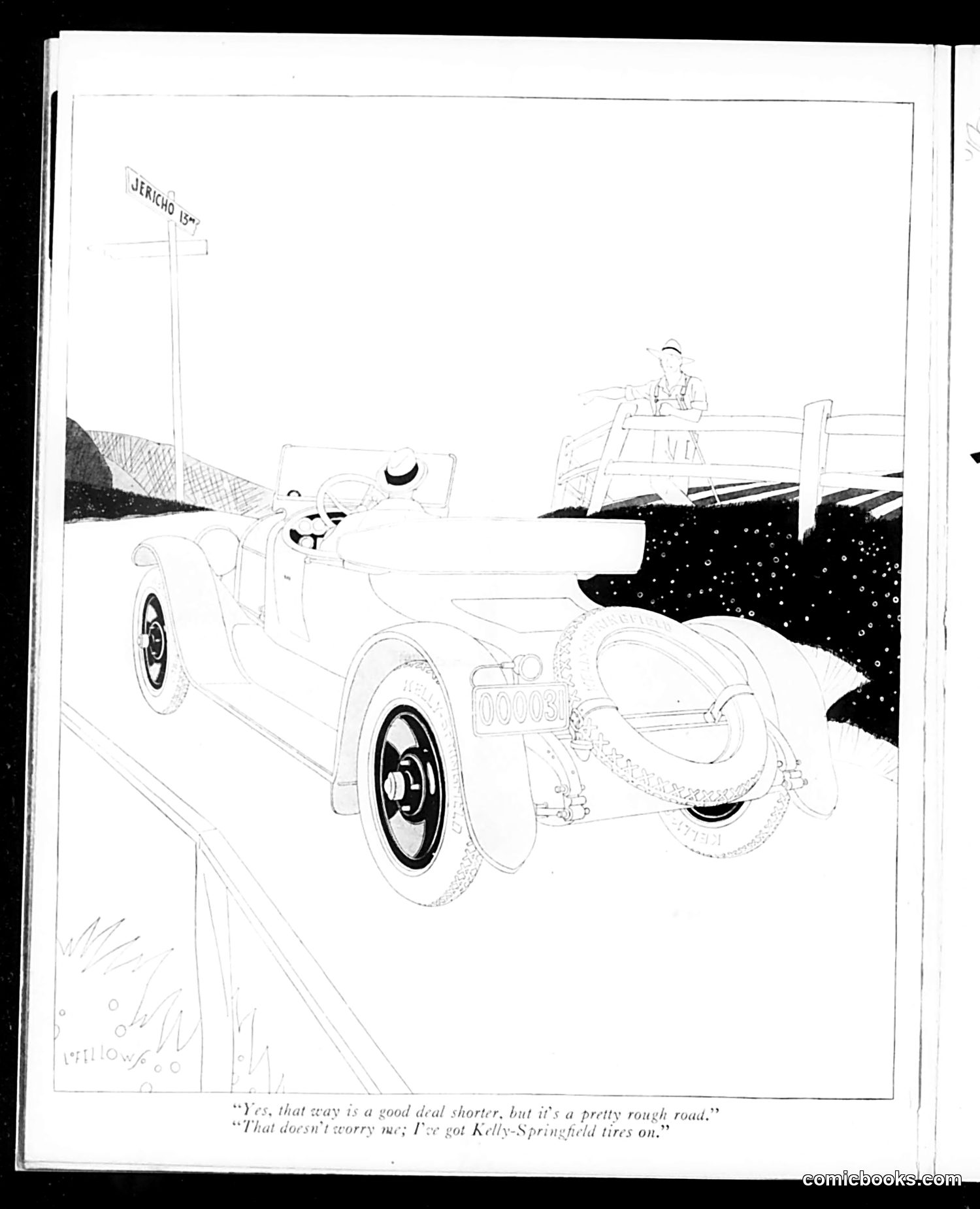
This is a single-panel cartoon depicting two men in a racing car on a rough road. One driver wears a hat and goggles; the passenger sits beside him. The caption reads: "Yes, that way is a good deal shorter, but it's a pretty rough road." The driver responds: "That doesn't worry me; I've got Kelly-Springfield tires on." This is a **product advertisement disguised as humor**. The joke hinges on the implied superiority of Kelly-Springfield brand tires, which supposedly make rough road conditions irrelevant. The cartoon suggests these tires are so durable and reliable that taking a shorter, rougher route becomes practical—a common advertising strategy of promoting product quality through comic scenarios rather than direct claims.