
Judge, 1920-07-03 · page 17 of 36
Judge — July 3, 1920 — page 17: what you’re looking at
What you’re looking at
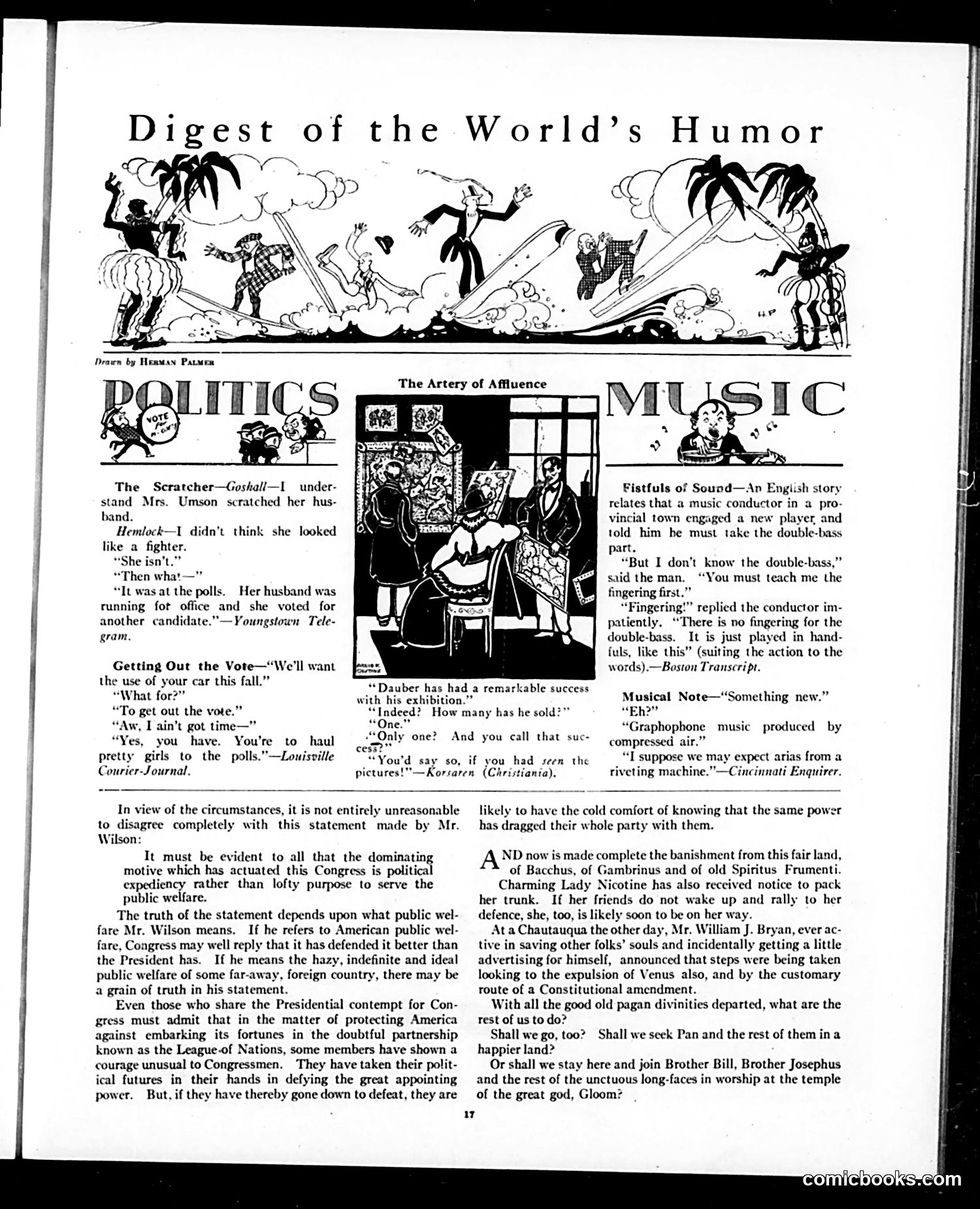
This page collects brief satirical jokes organized by topic (Politics, Music, etc.), plus a longer political editorial. **The Politics section** includes jokes mocking voting behavior—one about a wife voting against her husband's candidacy, another about using pretty women to encourage voter turnout, suggesting women's votes were obtained through superficial appeals rather than civic engagement. **The Music section** contains anecdotes poking fun at musical incompetence and new technology (the "graphophone"). **The main editorial** attacks President Wilson's criticism of Congress, arguing Congress actually *protected* American interests better by opposing the League of Nations. The piece defends Congressional independence against presidential pressure. **The closing section** sarcastically mourns Prohibition and anti-smoking campaigns (referencing "Bacchus," "Nicotine," and "Venus"), mocking William Jennings Bryan's moral crusades. It cynically suggests that with all vices banned, only "the great god, Gloom" remains—criticizing puritanical reformism as joyless.
📄 Transcribed text from this page (OCR, searchable)
Machine-transcribed from the original scan — historical spelling and the odd misread are preserved.
The Scratcher—Goshall—I__under- stand Mrs. Umson scratched her hus- band. Hemlock—1 didn’t think she looked like a fighter. “She isn’t.” “Then what—" “It was at the polls. Her husband was running fot office and she voted for another candidate.”"—Youngstown Tele- gram. Getting Out the Vote—“We'll want the use of your car this fall.” “What for?” “To get out the vote.” w, I ain’t got time—” “Yes, you have. You're to haul pretty girls to the polls.”—Louisville Courier-Journal. “One “Dauber has had a remarkable success with his exhibition.” “Indeed? How many has he sold?” And you call that suc- ‘ou'd say so, if you had seen the !"—Korsaren (Christiania). Fistfuls of Sound—An English story relates that a music conductor in a pro- vincial town engaged a new player, and told him he must take the double-bass part. “But I don’t know the double-bass,” said the man. ‘You must teach me the fingering first.” “Fingering!” replied the conductor im- patiently. “There is no fingering for the double-bass. It is just played in hand- fuls, like this” (suiting the action to the words).—Boston Transcript. Musical Note—“Something new.” “Graphophone music produced by compressed air.” “I suppose we may expect arias from a riveting machine.”—Cincinnati Enquirer. In view of the circumstances, it is not entirely unreasonable to disagree completely with this statement made by Mr. Wilson: It must be evident to all that the dominating motive which has actuated this Congress is political expediency rather than lofty purpose to serve the public welfare. The truth of the statement depends upon what public wel- fare Mr. Wilson means. If he refers to American public wel- fare, Congress may well reply that it has defended it better than the President has. If he means the hazy, indefinite and ideal public welfare of some far-away, foreign country, there may be a grain of truth in his statement. Even those who share the Presidential contempt for Con- gress must admit that in the matter of protecting America against embarking its fortunes in the doubtful partnership known as the League-of Nations, some members have shown a courage unusual to Congressmen. They have taken their polit- ical futures in their hands in defying the great appointing power. But, if they have thereby gone down to defeat, they are likely to have the cold comfort of knowing that the same power has dragged their whole party with them. AND now is made complete the banishment from this fair land, of Bacchus, of Gambrinus and of old Spiritus Frumenti. Charming Lady Nicotine has also received notice to pack her trunk. If her friends do not wake up and rally to her defence, she, too, is likely soon to be on her way. a Chautauqua the other day, Mr. William J. Bryan, ever ac- saving other folks’ souls and incidentally getting a little advertising for himself, announced that steps were being taken looking to the expulsion of Venus also, and by the customary route of a Constitutional amendment. With all the good old pagan divinities departed, what are the rest of us to do? Shall we go, too? happier land? Or shall we stay here and join Brother Bill, Brother Josephus and the rest of the unctuous long-faces in worship at the temple of the great god, Gloom? Shall we seek Pan and the rest of them in a