
Judge, 1920-07-03 · page 26 of 36
Judge — July 3, 1920 — page 26: what you’re looking at
What you’re looking at
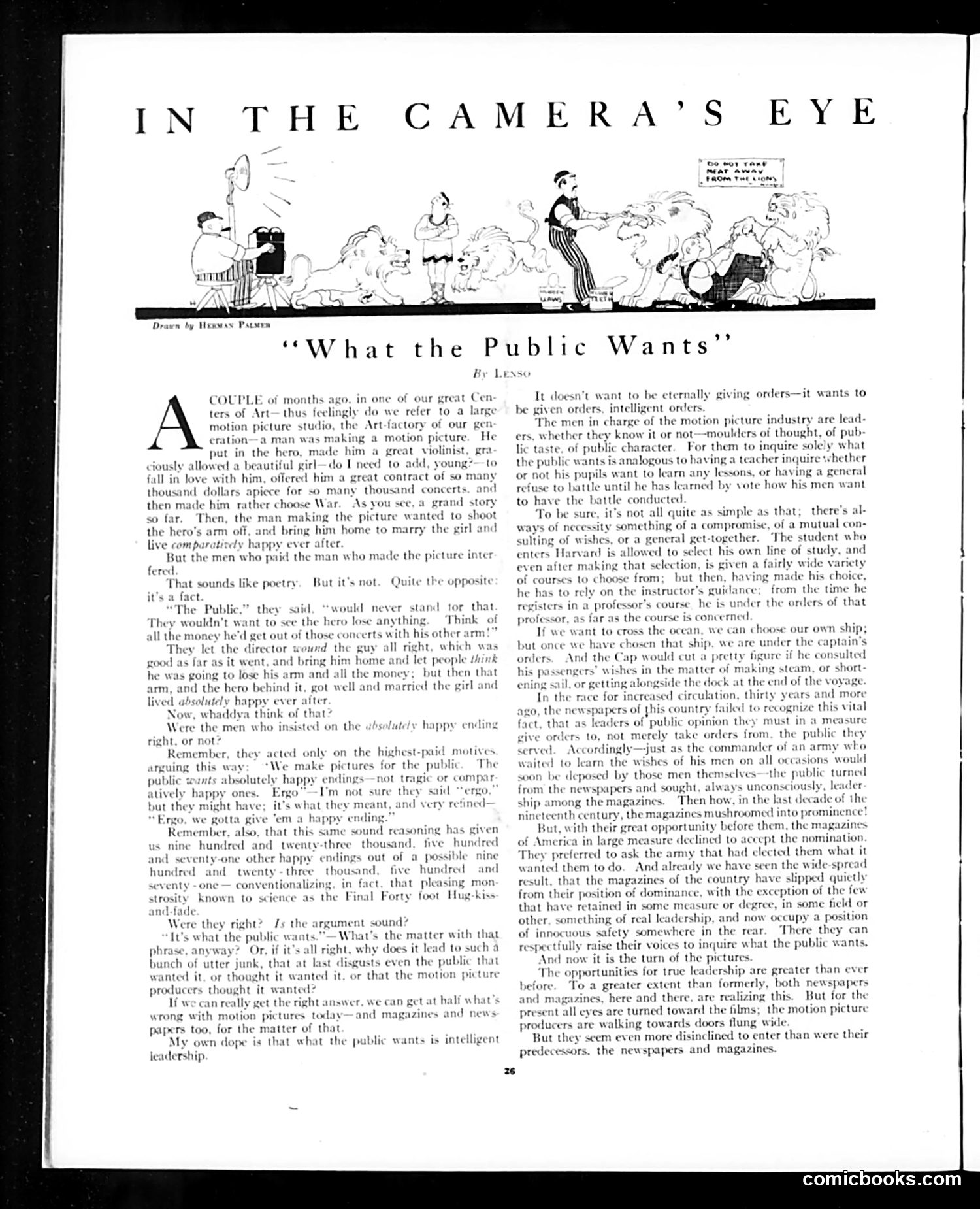
This article by Lesso critiques the motion picture industry's slavish devotion to audience preferences. The cartoon (drawn by Hermes Paten) depicts filmmakers consulting the public. **The Satire's Point:** The author describes a studio executive who removed an unhappy ending (the hero losing his arm in war) because "the public" supposedly wouldn't accept tragedy. This created formulaic, sentimental happy endings instead. **The Argument:** Lesso argues that while studios claim to serve "what the public wants," they're actually abdicating *leadership*. He contends that newspapers and magazines similarly capitulated to public taste rather than guide it intelligently. The public, he argues, doesn't actually want endless cheerful drivel—it wants *intelligent orders* and direction, like students accepting a professor's curriculum after initial choice. **The Critique:** Motion picture producers, newspapers, and magazines should function as cultural leaders shaping taste, not mere servants pandering to lowest-common-denominator preferences. Treating the audience as a voting body rather than intelligent consumers produces mediocrity.
📄 Transcribed text from this page (OCR, searchable)
Machine-transcribed from the original scan — historical spelling and the odd misread are preserved.
IN THE CAMERA’ Drawn by Hexwes Patten S EYE * Go wor vane miar Away | FaOr Toe Crom “What the Public Wants” By Lease COUPLE of months ago, ters of Art— thus feelir motion picture studio, the Art-factory of our gen eration—a man was making a mot picture. He put in the hero, made him a great violinist, gra ciously allowed a beautiful girl—do L need to add, young’—to fall in love with him, offered him a great contract of so many thous: lars apiece for so many thousand concerts then made him rather choose War. As yo grand story so far. Then, the man making the picture wanted to shoot the hero's arm off, and bring him home to marry the girl and live comparatively happy ever after But the men who paid the man who made the picture inter d That sounds like poetry fact “The Public.” they said never lor that They wouldn’t want to see the hero anything. Think f those concerts with his other arm! ound the guy all right, which was ing him home and let people Hsink was going to lose his arm and all but then that arm, and the hero behind it, got well a at lived absolutely happy ever after Now, whaddya think of that? Were the men w on the lut h ight t? Remember, they acted only on the highest-paic this way: ‘We make pictures for the pub solutely happy endings—not atively happy ones. Ergo"—I'm not sure ut they might it’s what they meant Ergo. we gotta give ‘em a happy ending Remember, also, that this suc «© hundred and twenty-three seventy-one other happy twenty - three nventionalizin as th great Cen refer to a large in ¢ » we see fe But it’s not. Quite the oppe it’s | tor would star all the money he'd get out They let the director good as far as it went, and bi he he mone hii d married the girl a i ppy end 0 insistec ipt ri or ni motive wrung i ublic « enc tragic or ¢ they very re said ave ned ¢ has given hundred sound reason thousand, five 1 possible thousand. hundred in fact. that pleasing Final Forty foot Hug-ki endings out of nine hundred = an five and seventy - one — cd known to Were they rig! Ts the argument sound? It's what the public wants.”"—What’s the matter with that phrase, anyway? Or, if it’s all right, why does it lead to suck bunch of utter junk, that at last disgusts even the public that wanted it, or thought it wanted it. or that the producers thought it wanted? If we can really get the right answer wrong with motion pictures today papers too, for the matter of that My own dope is that what the leadership at half wh and magazines an we can is intelli, It doesn’t want to be eternally giving orders—it wants to be given orders, intelligent orders. The men in charge of the motion picture industry are lead- ers, whether they know it or not—moullers of thought, of pub- lic taste. of public character. For them to inquire solely what the public wants is analogous to hav ing a teacher inquire whether or not his pupils want to learn any lessons, or having a general refuse to battle until he has learned by vote how his men want to have the battle conducte To be sure, it’s not all quite as simple as that; there's al- ys of necessity something of a compromise, of a mutual con iting of wishes, or a general get-together. The student who enters Harvard is allowed to select his own line of study, and after making that selection, is given a fairly wide variety h from; but the made his choice, he has to rely on the instructor’s guid: from the time he he is under the orders of that w eve isters in a professor's course 1s far as the course is concerned an, we can choose our own shi but once we have chosen that ship, we a r the captain's And the Cap would cut a pretty figure if he consulted s’ wishes in the matter of making steam, or sh professor, Ii we want to cross the 0c his ing sail, or getting alongside the ¢ In the race for increased circulation, thirty years and more y, the newspapers of {his country failed to recognize this vital tas leaders of public opinion they must in a measure rely take orders from, the public they y—just as the commander of an arm to learn the wishes of his men on all occasions would deposed by those men themselves—the public turned from the newspapers and sought, always unconsciously, leader umong the magazines. Then how, in the last decade of the enth century, the magazines mushroomed into prominence! ith their great opportunity before them, the magazir of America in large measure declined to accept the nomination They preferred to ask the army that had clected them what it wanted them todo. And already we have seen the wide-spread result, that the magazines of the country have slipped quietly from their position of dominance, with the exception of the few that have retained in some measure or p field or other, something of real leadership, and now occupy a position f innocuous safety somewhere in the rear. There they can respectfully raise their voices to inquire what the public wants, And now it is the turn of the pictures, The opportunities for truc leadership are greater than ever before. To a greater extent than formerly, both newspapers and magazines, here and there, are realizing this. But for the present all eyes are turned toward the films; the motion picture Jucers are walking towards doors flung wide But they seem even more disinclined to enter than were their predecessors. the newspapers and magazines. ort mn wk at the end of the voyage who comicbooks.com