
A complete issue · 36 pages · 1920
Judge — January 10, 1920
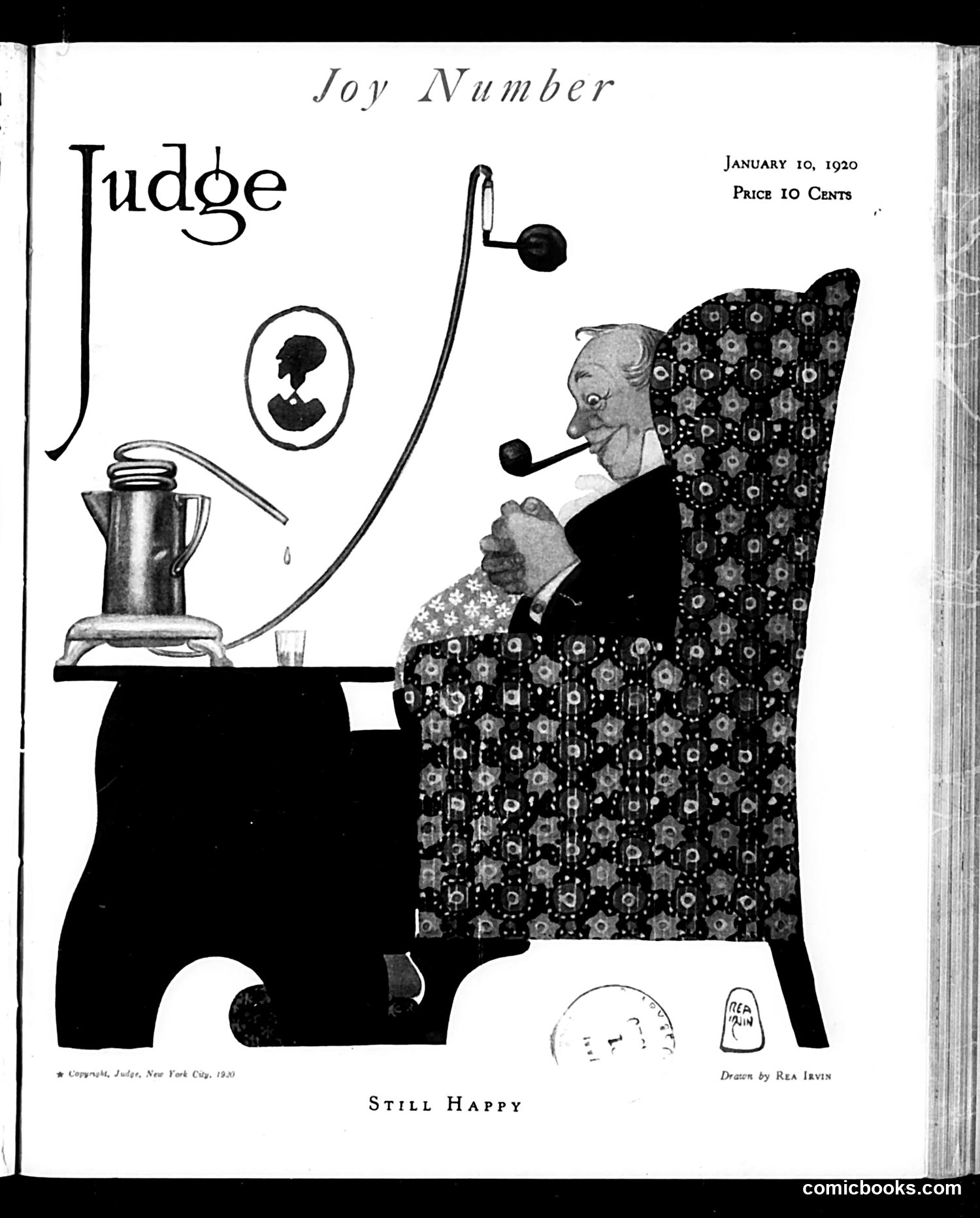
This cartoon by Rea Irvin depicts an elderly man contentedly smoking a pipe while operating an old-fashioned coffee percolator on a table beside him. The title "Still Happy" and the Prohibition-era dating suggest this is satirizing Americans adapting to the newly-enacted 18th Amendment (January 1920). The joke appears to be that despite Prohibition's ban on alcohol, this figure remains cheerful—likely because he can still enjoy other pleasures like coffee and tobacco, which remained legal. The cartoon may mock both Prohibition advocates who believed the law would improve society, and those who found simple workarounds to maintain their contentment during the ban. The inset profile portrait's purpose remains unclear from the visible text.
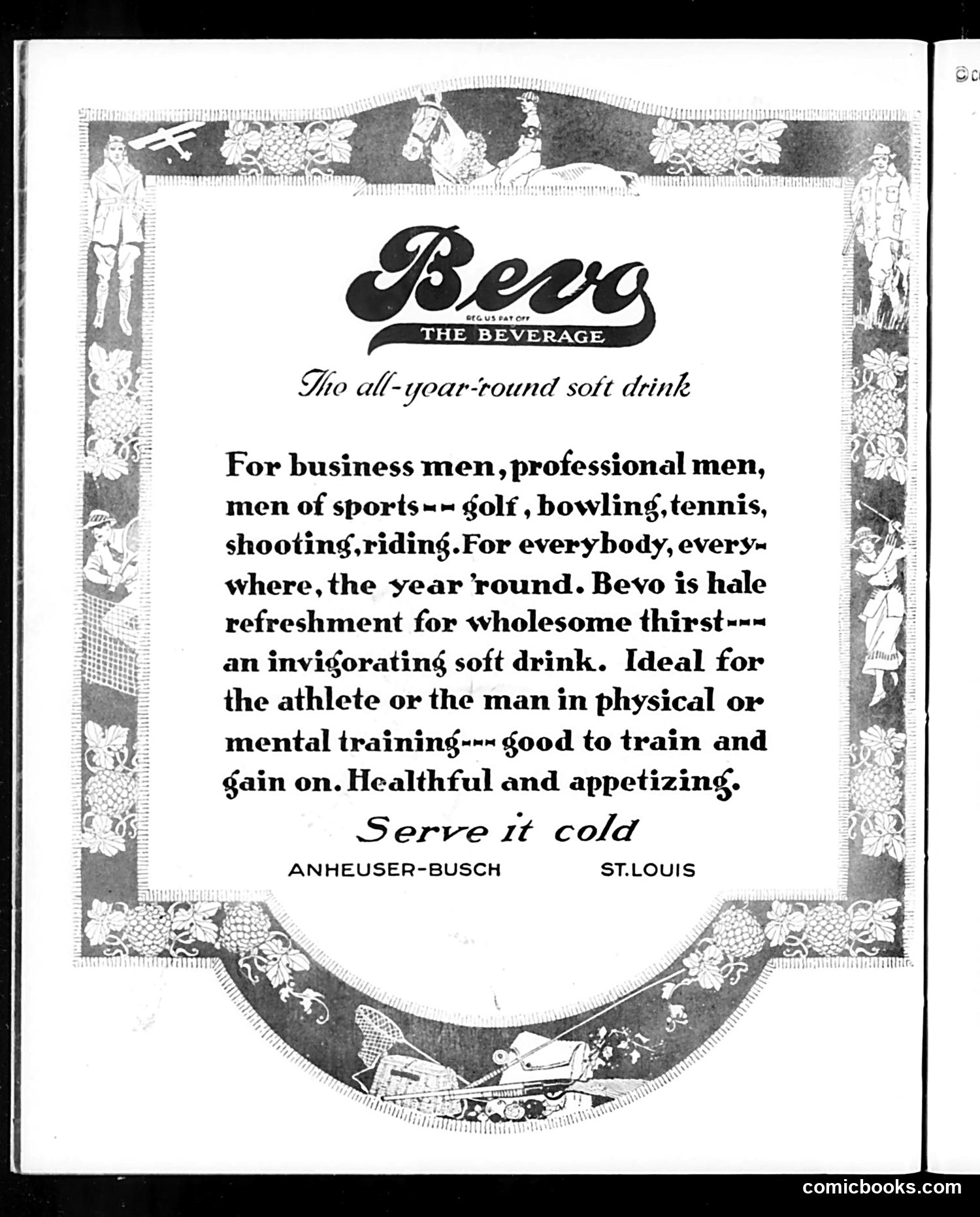
This is a **Bevo advertisement, not satirical content**. Bevo was a soft drink manufactured by Anheuser-Busch (St. Louis) marketed as a wholesome, non-alcoholic alternative—likely introduced during Prohibition or as a temperance option. The ad targets affluent men: businessmen, professionals, and athletes (golfers, bowlers, tennis players, shooters, riders). It emphasizes year-round refreshment, health benefits, and physical training. The decorative border features sporting and leisure imagery. There is **no political satire or cartoon** on this page—it's purely commercial advertising. The historical interest lies in how Anheuser-Busch pivoted from beer to soft drinks during the temperance era, and how marketing pitched non-alcoholic beverages to masculine, athletic audiences.
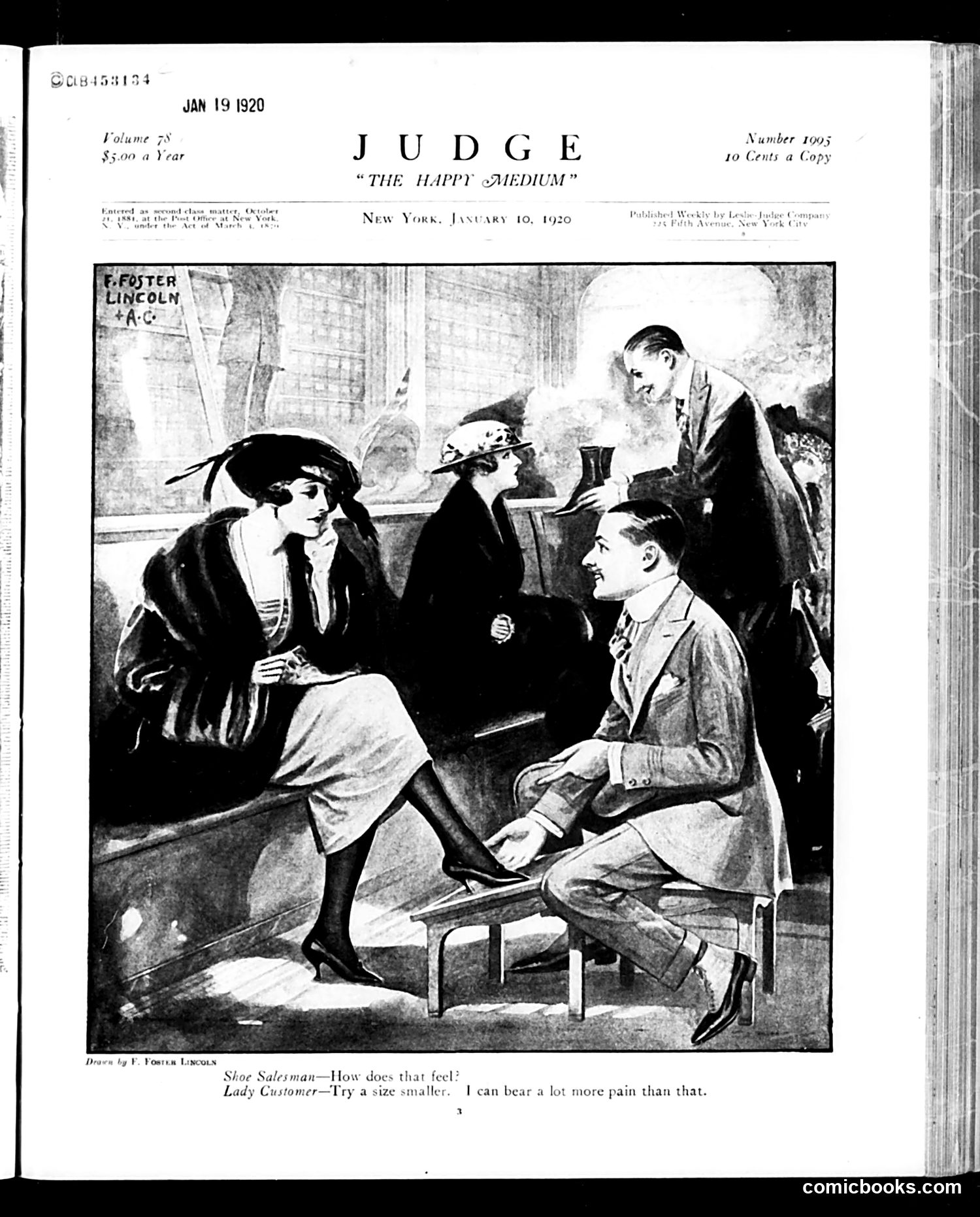
This illustration satirizes shoe shopping and poor customer service. The cartoon shows a shoe salesman asking a female customer "How does that feel?" after fitting her with what appears to be an uncomfortably tight shoe. Her deadpan response—"Try a size smaller. I can bear a lot more pain than that"—is the joke's punchline. The satire targets the shoe salesman's indifference to customer comfort and perhaps broader commentary on 1920s retail practices or gender dynamics. The woman's sarcastic willingness to endure pain suggests resignation to poor service or, possibly, satirizes contemporary attitudes about women's fashion and the physical discomfort they accepted for style. The cartoon's humor relies on the absurdity of recommending a *smaller* shoe to someone already in pain.
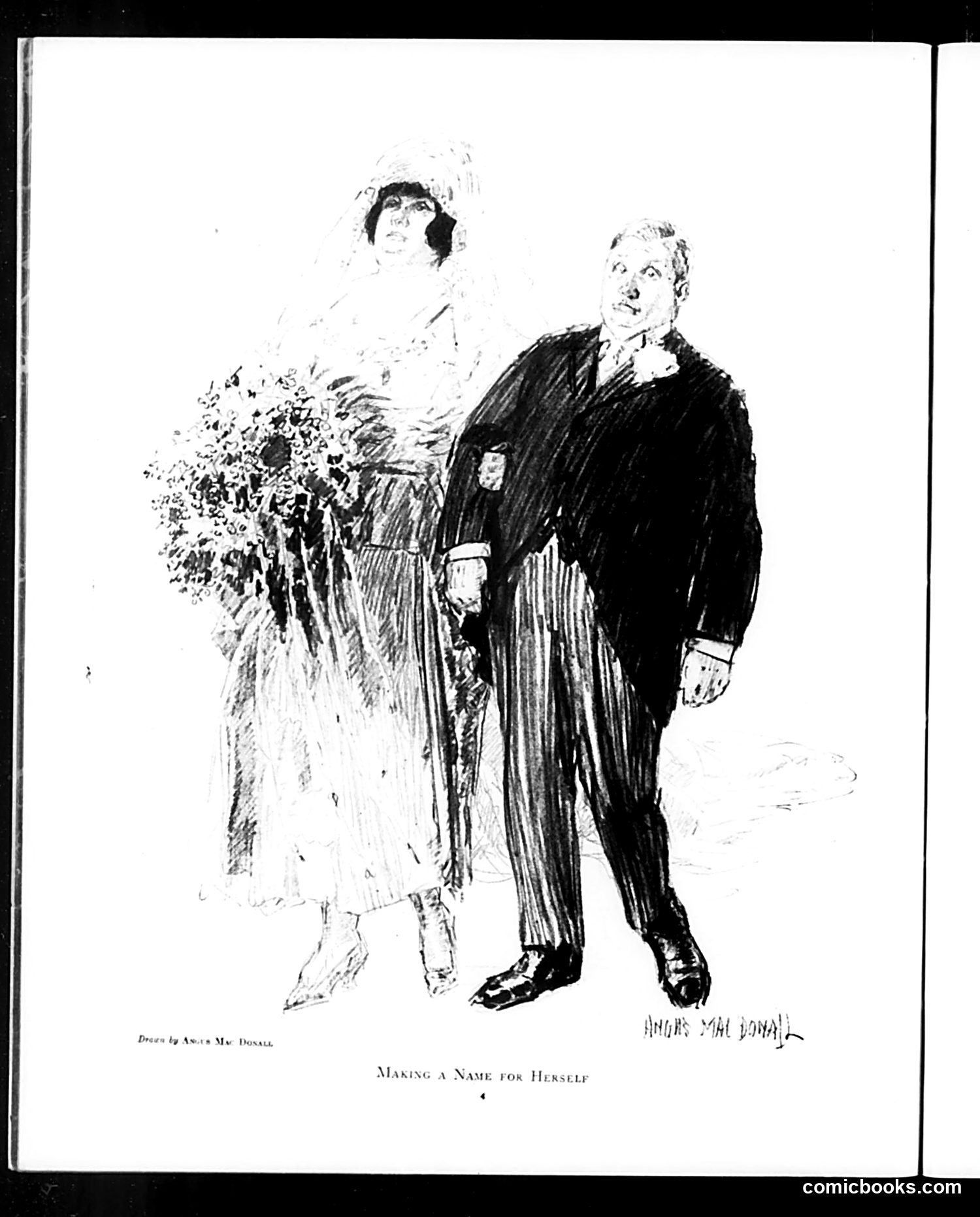
This sketch depicts two figures: a woman in a wedding dress on the left and a man in formal attire on the right, both looking upward with concerned expressions. The title "Making a Name for Himself" suggests social satire about ambition and reputation. The cartoon likely satirizes a common concern of the era: a man gaining prominence or notoriety through marriage rather than merit. The woman's uncertain gaze and the man's determined expression suggest tension between personal desire and social climbing. The phrase "making a name" could reference either gaining respectability through marriage or, conversely, acquiring notoriety. Without additional historical context, the specific individuals or event remain unclear, but the satire targets matrimonial ambition and social aspiration common to Gilded Age comedy.
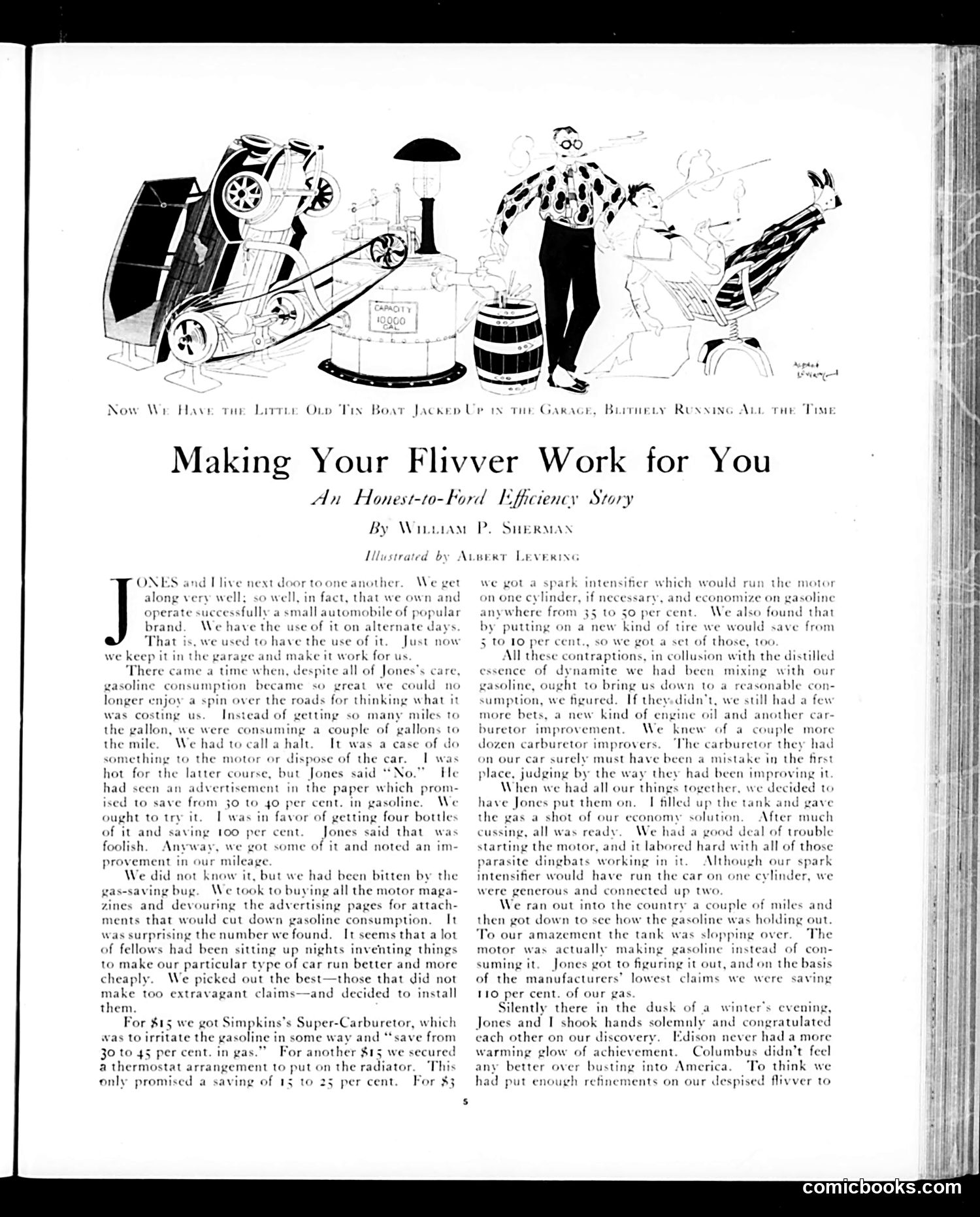
This page combines an illustration with an article titled "Making Your Flivver Work for You" by William P. Sherman. "Flivver" was slang for the Model T Ford, the mass-produced automobile that revolutionized American transportation. The illustration depicts a man and woman with various automotive parts and contraptions, humorously representing DIY efficiency modifications. The article describes practical (if somewhat humorous) attempts to improve fuel economy through carburetor modifications, tire changes, and thermostat adjustments—achieving savings of 10-45 percent on gasoline. This reflects post-WWI America's automotive culture and practical ingenuity during an era when car ownership was becoming widespread but gas consumption remained a genuine concern for average owners. The satire gently mocks the period's obsession with efficiency and mechanical tinkering.
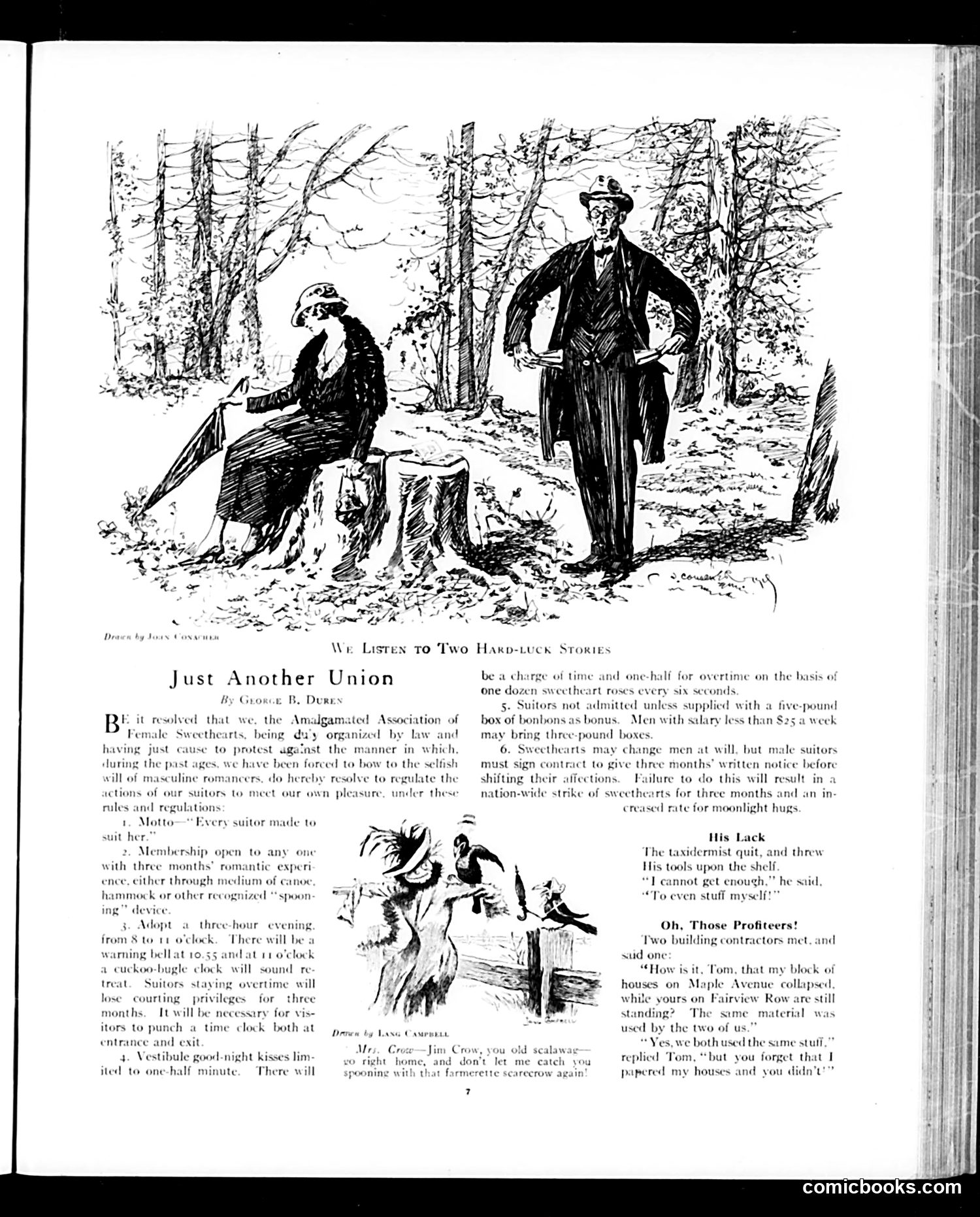
This 1920s Judge magazine page satirizes labor organizing through two cartoons: **"Just Another Union"** mocks the "Amalgamated Association of Female Sweethearts"—a fictional parody of labor unions. The cartoon ridicules union demands by applying them absurdly to dating: mandatory time clocks for courtship, overtime pay for kisses, bonus candy boxes as "wages," and three-month notice before switching boyfriends. The satire targets real labor movements of the era (likely the Amalgamated Clothing Workers, a major union). The joke suggests unions are unreasonable and emasculating, turning romantic relationships into contractual transactions. **"Oh, Those Profiteers!"** criticizes wartime/postwar profiteering. Two contractors built from identical materials, but one's building collapsed while the other stands firm—because the profiteer cut corners on materials but *papered over* the defects to hide them. The cartoon attacks dishonest contractors who exploit scarcity and regulations for profit while deceiving customers. Both cartoons reflect post-WWI anxiety about labor power, corporate dishonesty, and economic chaos.
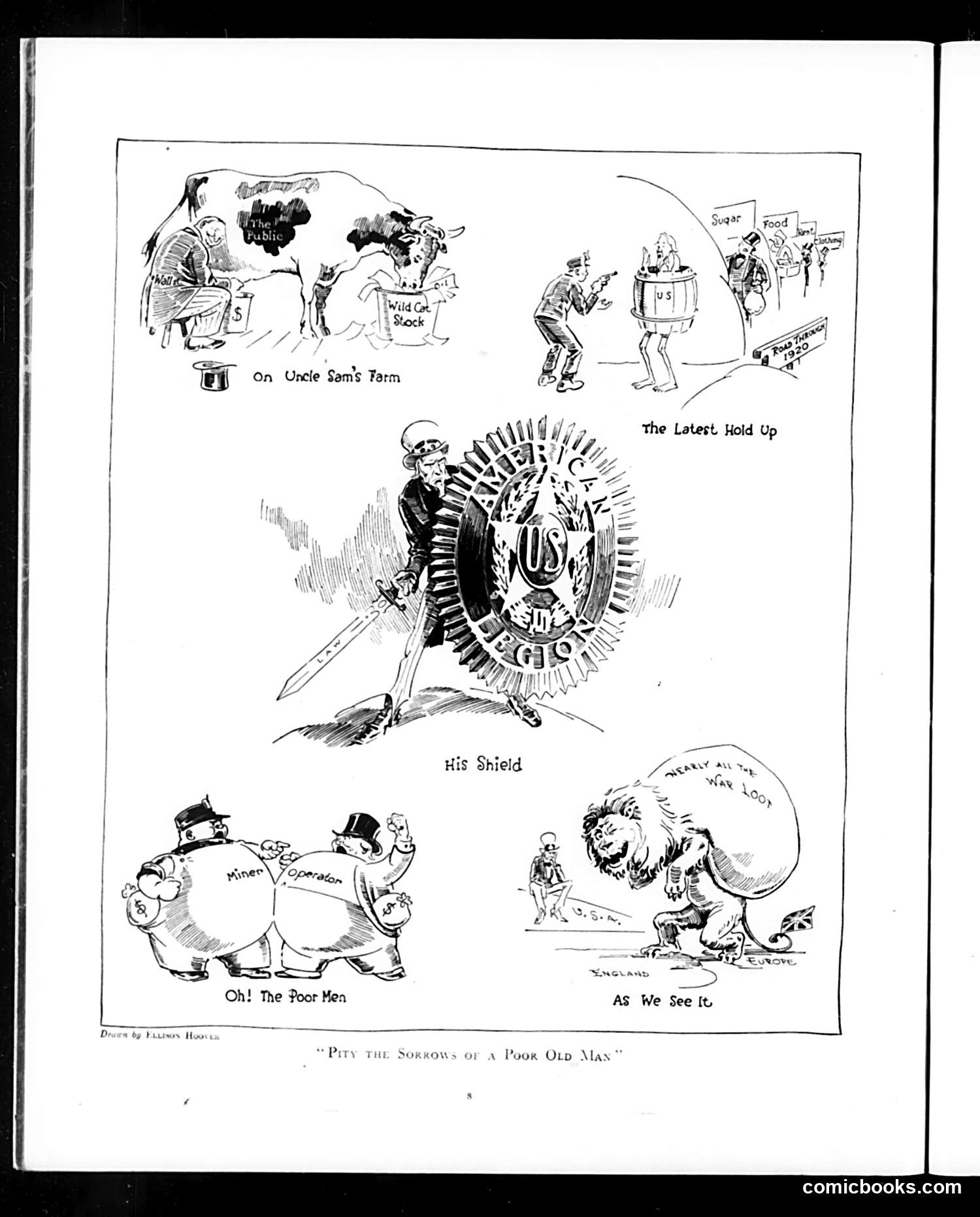
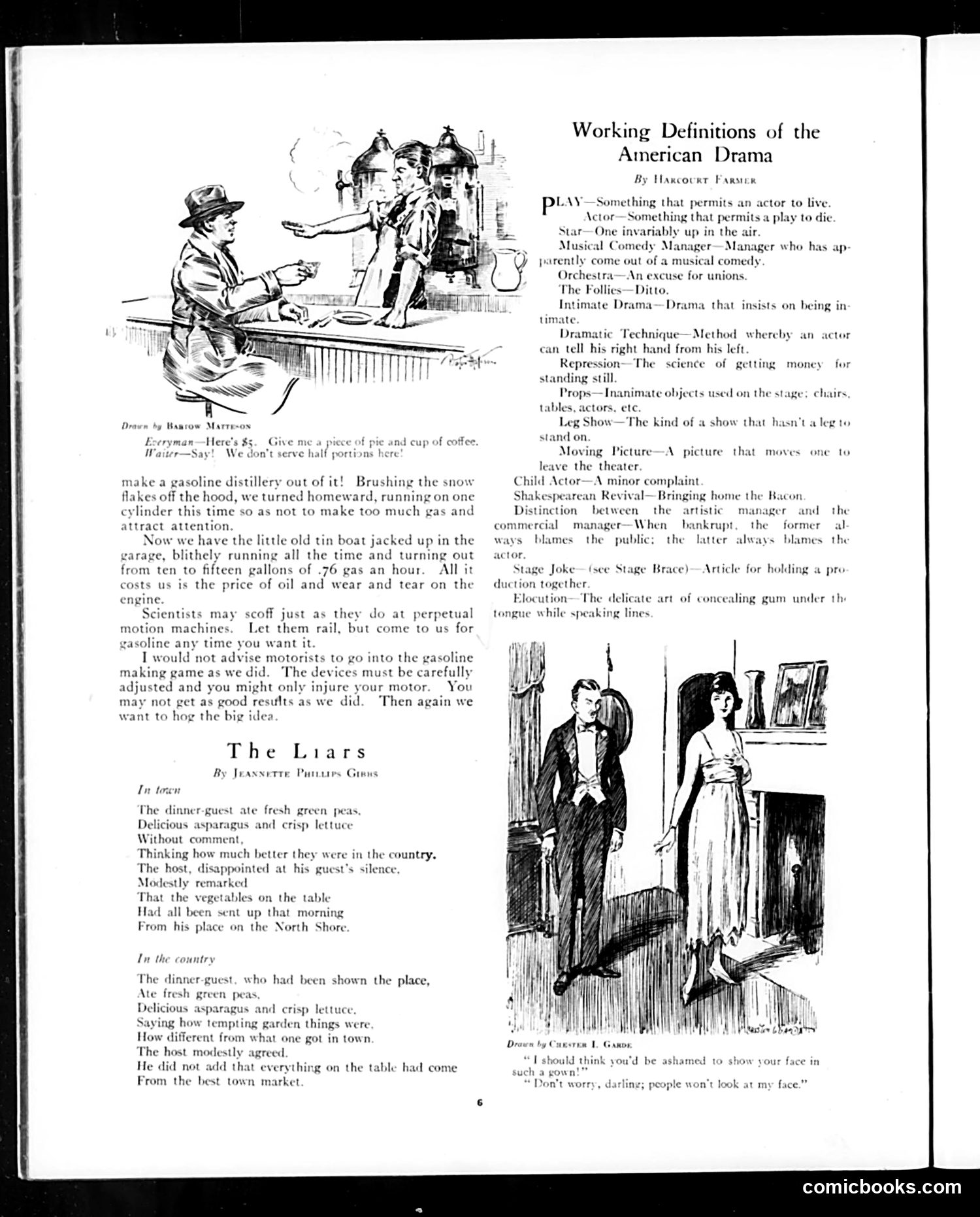
This political cartoon page uses multiple vignettes to satirize economic hardship and social inequality. The top section, "On Uncle Sam's Farm," depicts poverty and instability ("Wild Cat Stock"). "The Latest Hold Up" shows armed robbery or economic predation. "His Shield" features the U.S. seal as inadequate protection. "Oh! The Poor Men" caricatures miners and operators as bloated figures, likely referencing labor disputes and wealth disparity during industrial conflict. "As We See It" shows a lion (Britain) towering over a small figure, possibly commenting on international economic or imperial relations. Overall, the page critiques American economic conditions, labor exploitation, and the disparity between rich and poor—typical Judge magazine social commentary from the Progressive era.
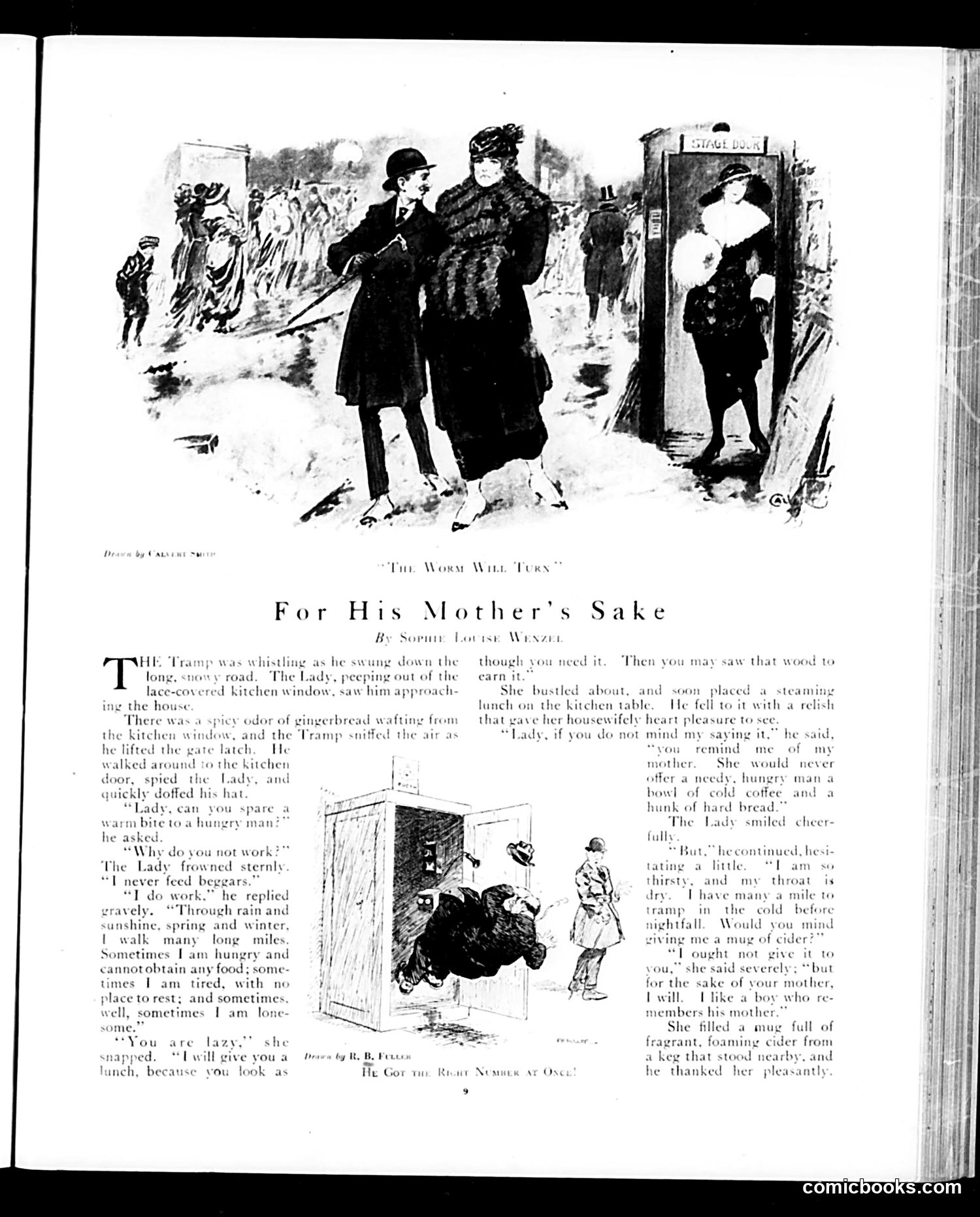
This page presents a sentimental short story by Sophie Louise Wenzel accompanying two illustrations. The narrative depicts a social-issue theme common to early 20th-century literature: a tramp (homeless wanderer) appeals to a well-to-do woman for food. The story's "twist" relies on period attitudes toward poverty and charity. The Lady initially dismisses the tramp as lazy and a beggar, refusing him harshly. However, when he invokes his mother—claiming he seeks the food "for his mother's sake"—her stern demeanor softens. She provides him a meal and hot cider. The satire is gentle rather than biting: it critiques how the wealthy rationalize selective charity, showing that emotional appeals ("mother") succeed where direct need fails. The tramp's calculated invocation of motherhood manipulates the Lady's sentimentality, exposing the arbitrary nature of her charitable impulses. The story suggests that genuine need matters less than the *narrative frame* through which need is presented.
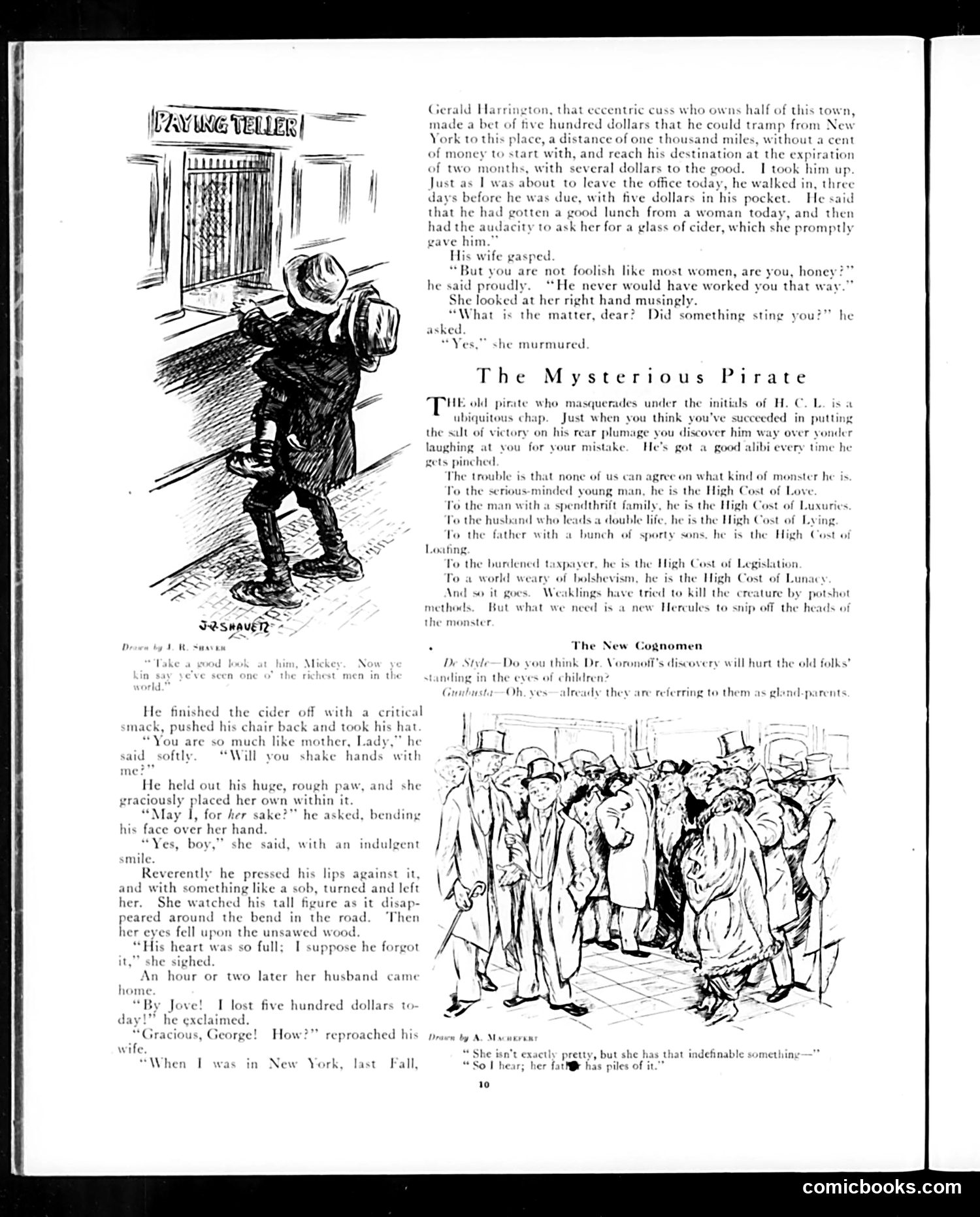
This page contains three satirical pieces reflecting early 20th-century American concerns: **"The Mysterious Pirate"** (center) uses "H.C.L." as a personified villain representing the "High Cost of Living"—a major economic anxiety of the era. The satire lists how different social groups experience inflation: wealthy spendthrifts, taxpayers, families, and those concerned about Bolshevism all blame this abstract "monster." The call for a "new Hercules" suggests readers felt helpless against rising prices. **"The New Cognomen"** (bottom) references Dr. Voronoff's controversial 1920s gland-transplant experiments promising youth restoration. The joke: elderly people are now called "gland-parents"—a pun on "grandparents," mocking the pseudo-scientific fad. **Top story** depicts a con artist's exploitation of rural kindness: a wealthy man wins a bet by manipulating a woman's generosity, then boasts of "working" her. His wife's cryptic response suggests she's discovered his infidelity or deception—dark humor about male hypocrisy.
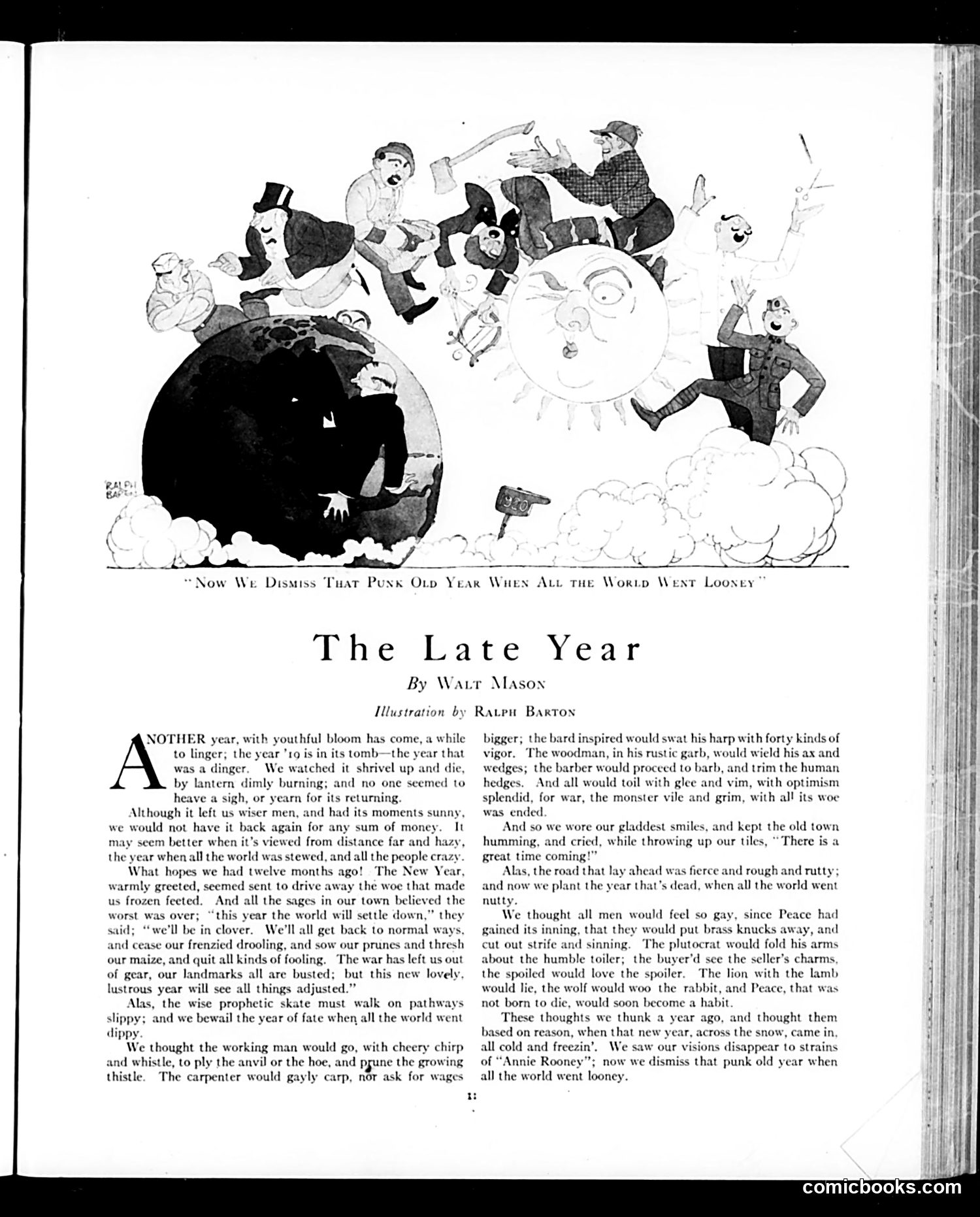
This is a reflective essay-cartoon hybrid from Judge magazine dismissing the previous year—apparently 1919, the year after World War I ended—as a disappointment. **The Satire:** The piece mocks public optimism about 1919. Citizens and "wise prophetic skate[s]" (fools) believed peace would restore normalcy: workers would labor contentedly, carpenters wouldn't demand wages, and even class conflict would vanish ("the plutocrat would fold his arms / about the humble toiler"). **What Actually Happened:** Instead, 1919 was chaotic—marked by labor unrest, social upheaval, and continued instability. The cartoon's central illustration shows figures tumbling around a dark globe amid chaos, symbolizing a world "went looney" and "dippy." **For Modern Readers:** This captures post-WWI disillusionment. Despite war's end, society didn't magically heal. The text's folk-humor tone—"all cold and freezin'" and references to "Annie Rooney"—reflects popular sentiment that idealistic hopes collided with harsh reality. The cartoon essentially asks: "We thought peace solved everything. Why didn't it?"
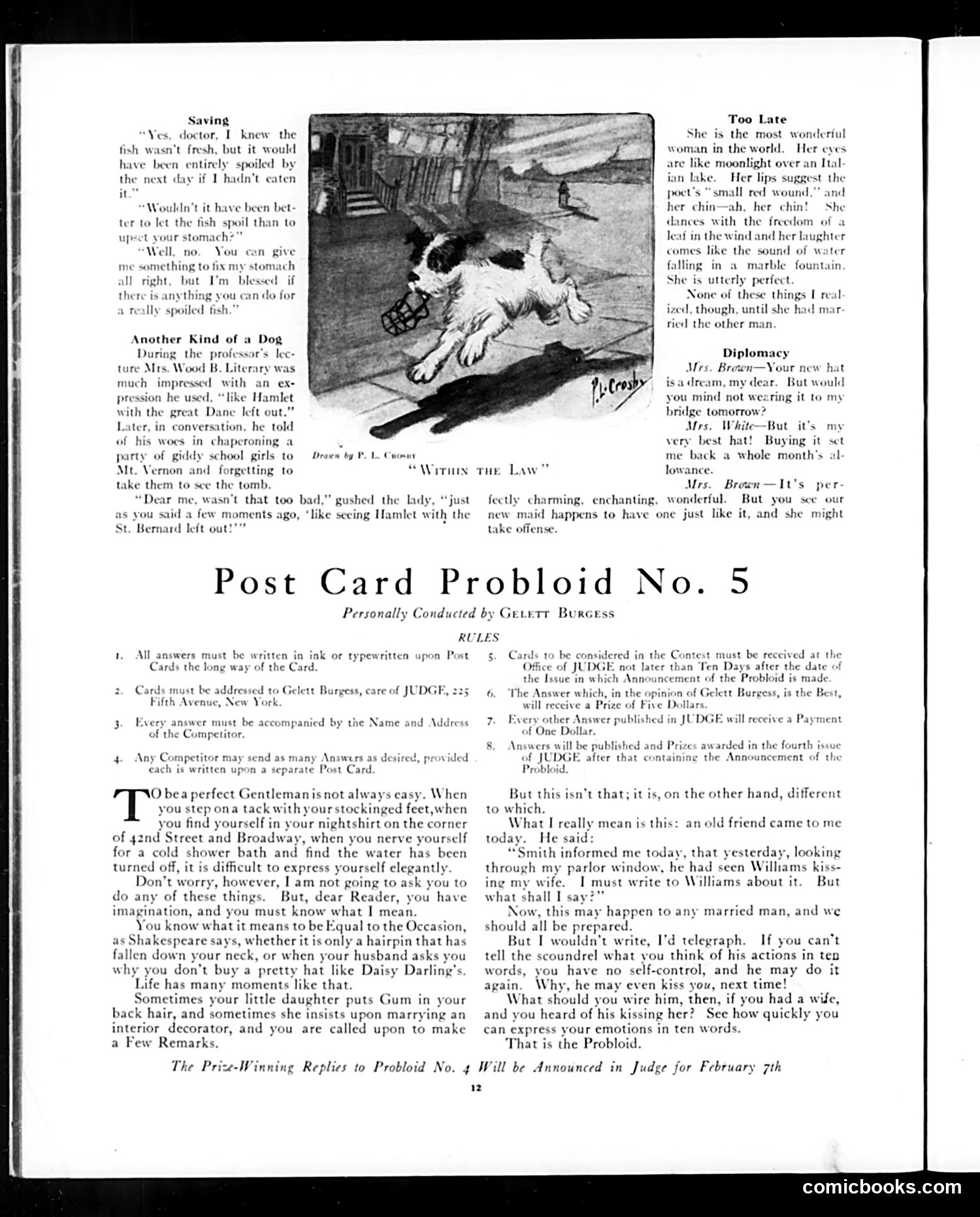
This page from Judge presents humorous short sketches and a reader-participation contest. The cartoons mock social situations: **"Saving"** satirizes rationalization—a man justifies eating spoiled fish to avoid waste, then needs a doctor. **"Another Kind of a Dog"** plays on literary pretension. A woman misunderstands the phrase "like Hamlet with the great Dane left out" (meaning omitting important elements) and humorously applies it to a real dog, creating absurdist humor about misapplied education. **"Too Late"** uses melodramatic language to describe a woman's perfection—"moonlight over an Italian lake," poetic lips—then the punchline: she married someone else, so the narrator's appreciation arrives too late. **"Diplomacy"** illustrates social etiquette: a woman can't wear her new hat without offending a friend whose maid has an identical one. The **Probloid** is Gelett Burgess's interactive feature inviting readers to solve a social dilemma in ten words—here, how to handle a friend kissing your wife. Judges award prizes, positioning readers as participants in Judge's humor.
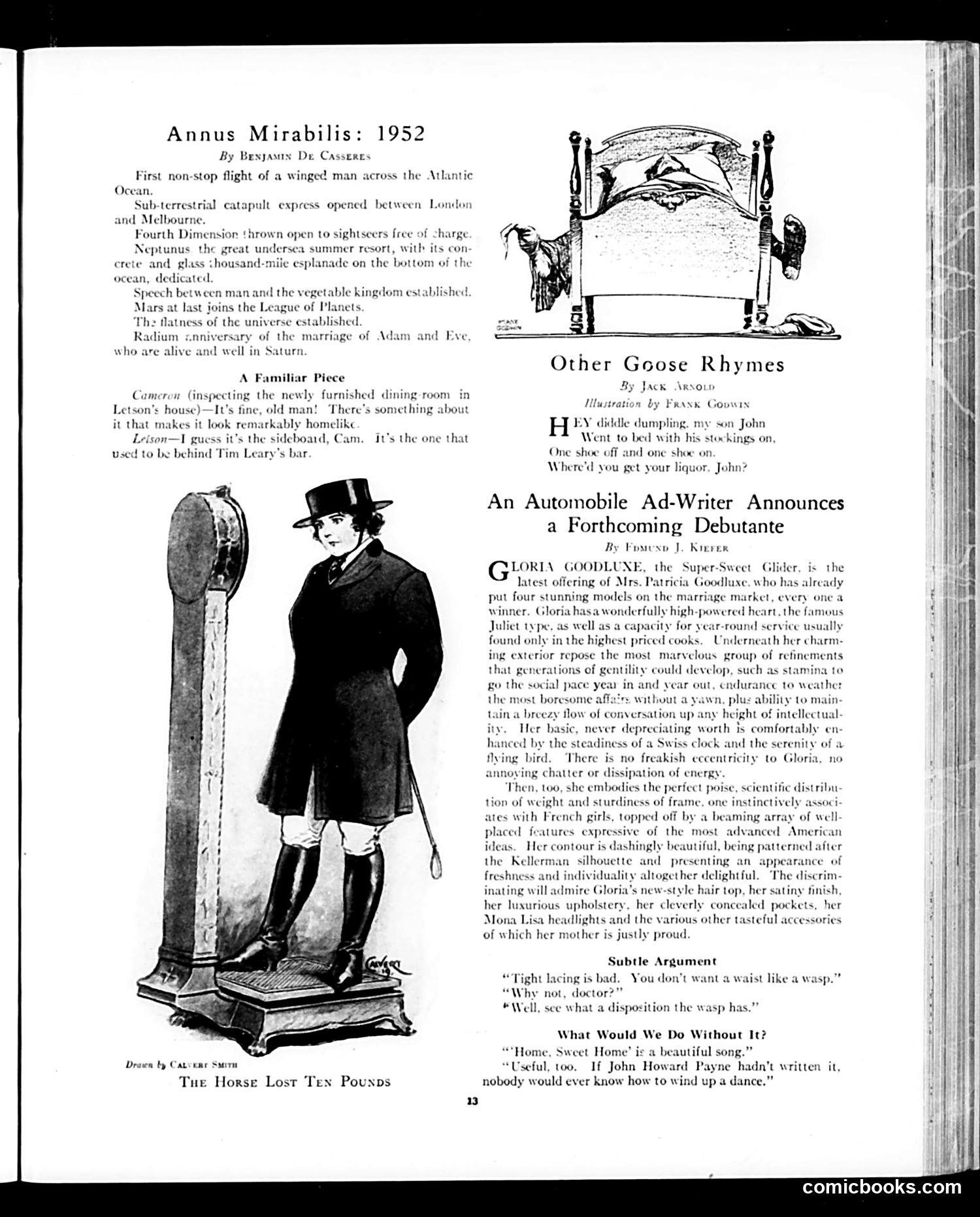
This page contains several satirical pieces reflecting 1950s American culture: **"Annus Mirabilis: 1952"** is a futuristic fantasy listing absurd technological and cosmic achievements (winged transatlantic flight, undersea resorts, talking to vegetables, Mars joining the League of Planets). It's whimsical social commentary on post-WWII optimism and technological utopianism. **"The Horse Lost Ten Pounds"** (left cartoon) shows a well-dressed man at a weighing scale—likely satirizing America's emerging health-consciousness and weight-obsession culture in the prosperous 1950s. **"Other Goose Rhymes"** parodies nursery rhymes with contemporary references, including one mocking alcohol consumption ("Where'd you get your liquor, John?"). **"An Automobile Ad-Writer Announces a Forthcoming Debutante"** satirizes absurdly overwrought advertising language by describing a young woman's "debut" into marriage using automotive sales-speak—critiquing both commercial excess and women being treated as commodities in the marriage market.
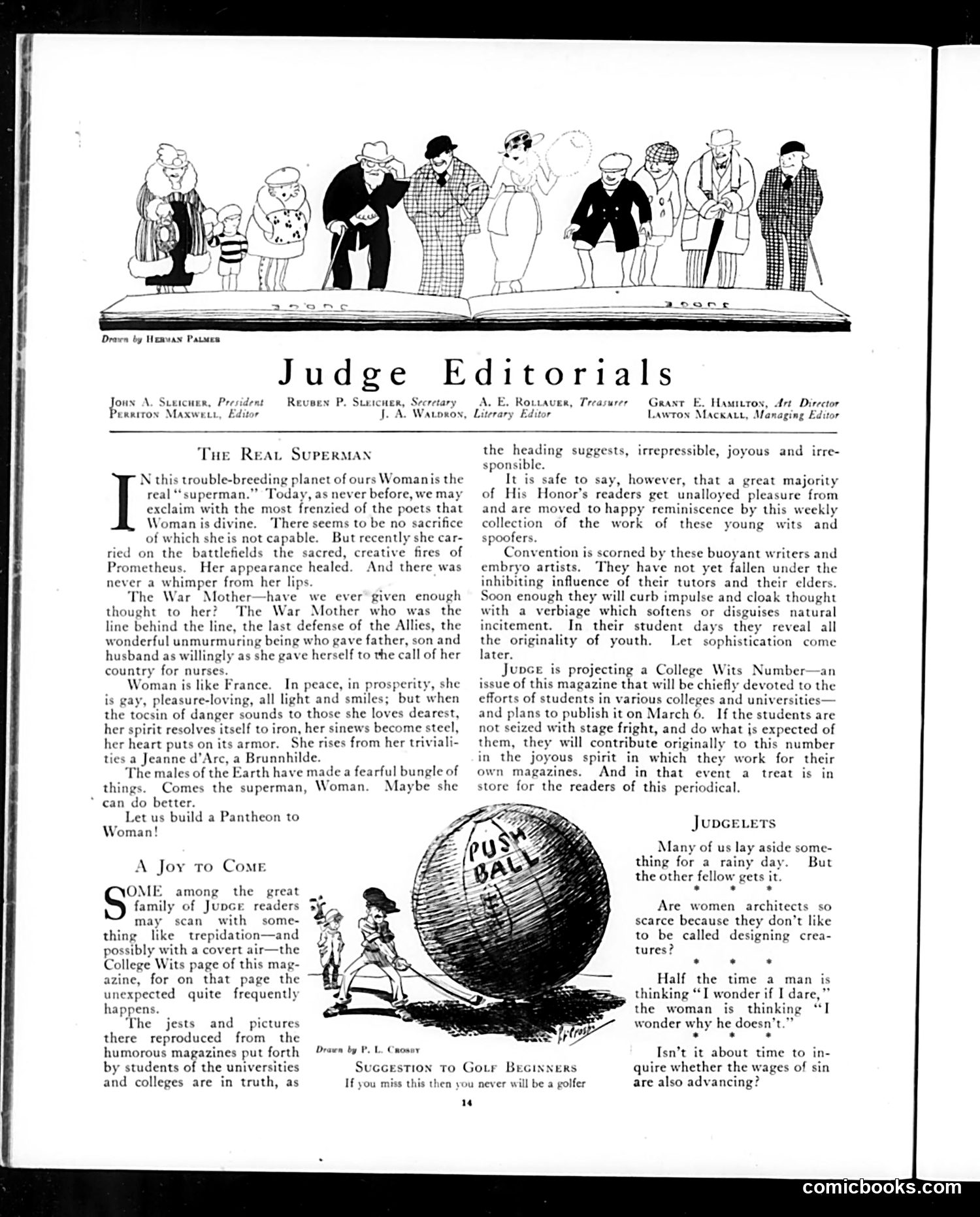
This editorial page from Judge magazine celebrates women's contributions, particularly during World War I. The top drawing by Wendon Patten depicts a cross-section of diverse women representing different ages and social classes. **"The Real Superman"** praises women as society's true heroes, invoking Joan of Arc and Brunnhilde as historical comparisons. It specifically honors "War Mothers"—women who sacrificed sons and husbands to the war effort while serving as nurses. The piece argues women have proven superior problem-solvers compared to men, who have "made a fearful bungle of things." **"A Joy to Come"** announces Judge's upcoming "College Wits Number," celebrating irreverent student humor from universities. The accompanying cartoon (by P.L. Crosney) shows young people rolling a large "Push Ball"—a popular college sport of the era. **"Judgelets"** presents brief satirical quips about gender relations and economics, using humor to comment on women architects, courtship dynamics, and wage inflation. The page reflects post-WWI attitudes crediting women's wartime service while maintaining light mockery of gender differences—typical of Judge's satirical approach.
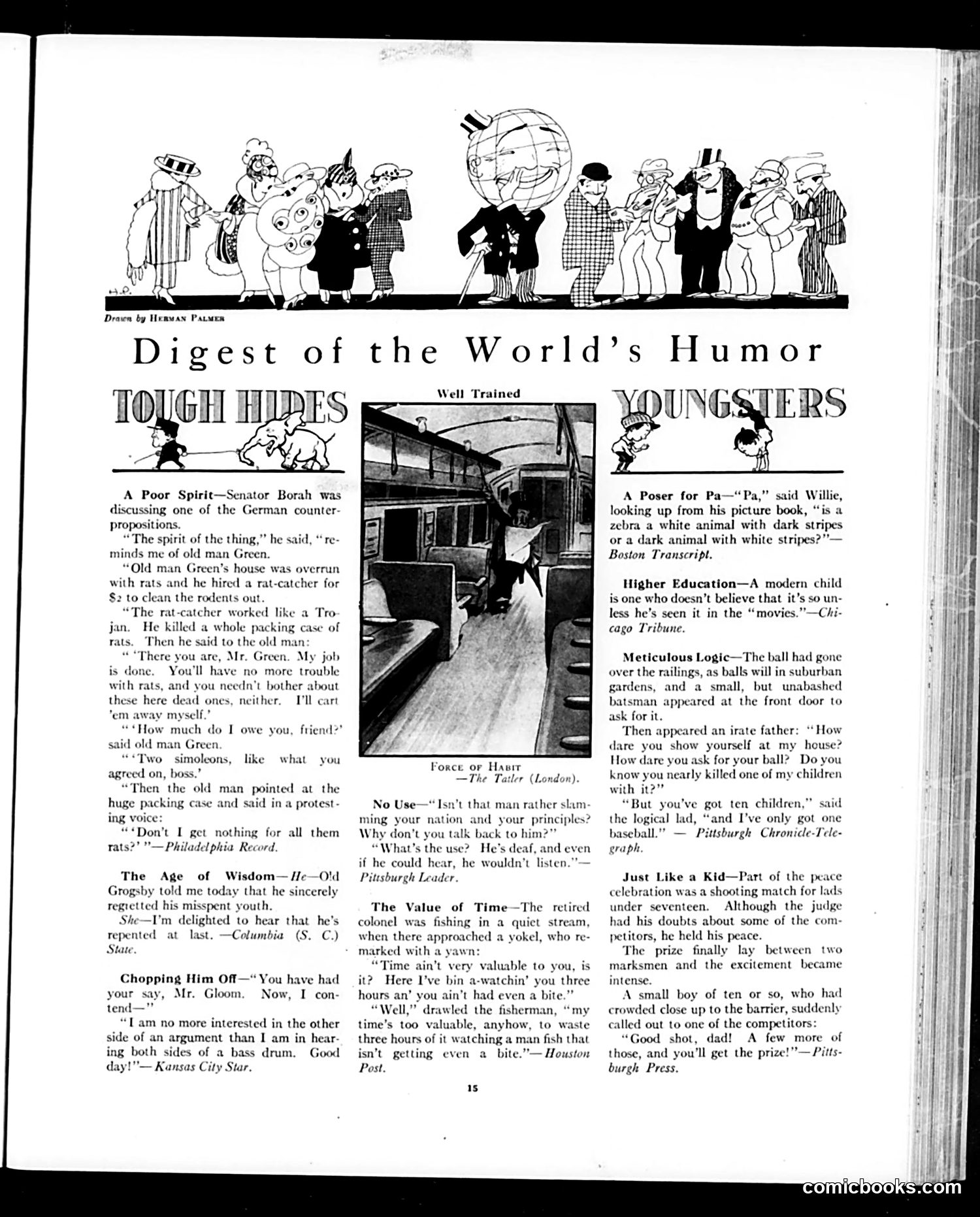
This page collects brief satirical anecdotes from various American newspapers, presented as "Digest of the World's Humor." The cartoons mock contemporary figures and attitudes: **"A Poor Spirit"** features Senator William Borah discussing German peace proposals, using an anecdote about old man Green and a rat-catcher to suggest negotiators aren't getting fair value—likely satirizing post-WWI treaty negotiations. **The other items** are lighter social commentary: a child's innocent question about zebras; modern children requiring "movies" as proof; suburban fathers defending property; and a boy confusing a shooting competition competitor with his father. The page's "Tough Hides" and "Youngsters" sections contrast cynical adult humor with children's innocent logic. The overall tone reflects 1920s-era American periodical humor—topical, punchy, and reliant on recognizable types rather than specific named figures (except Borah).
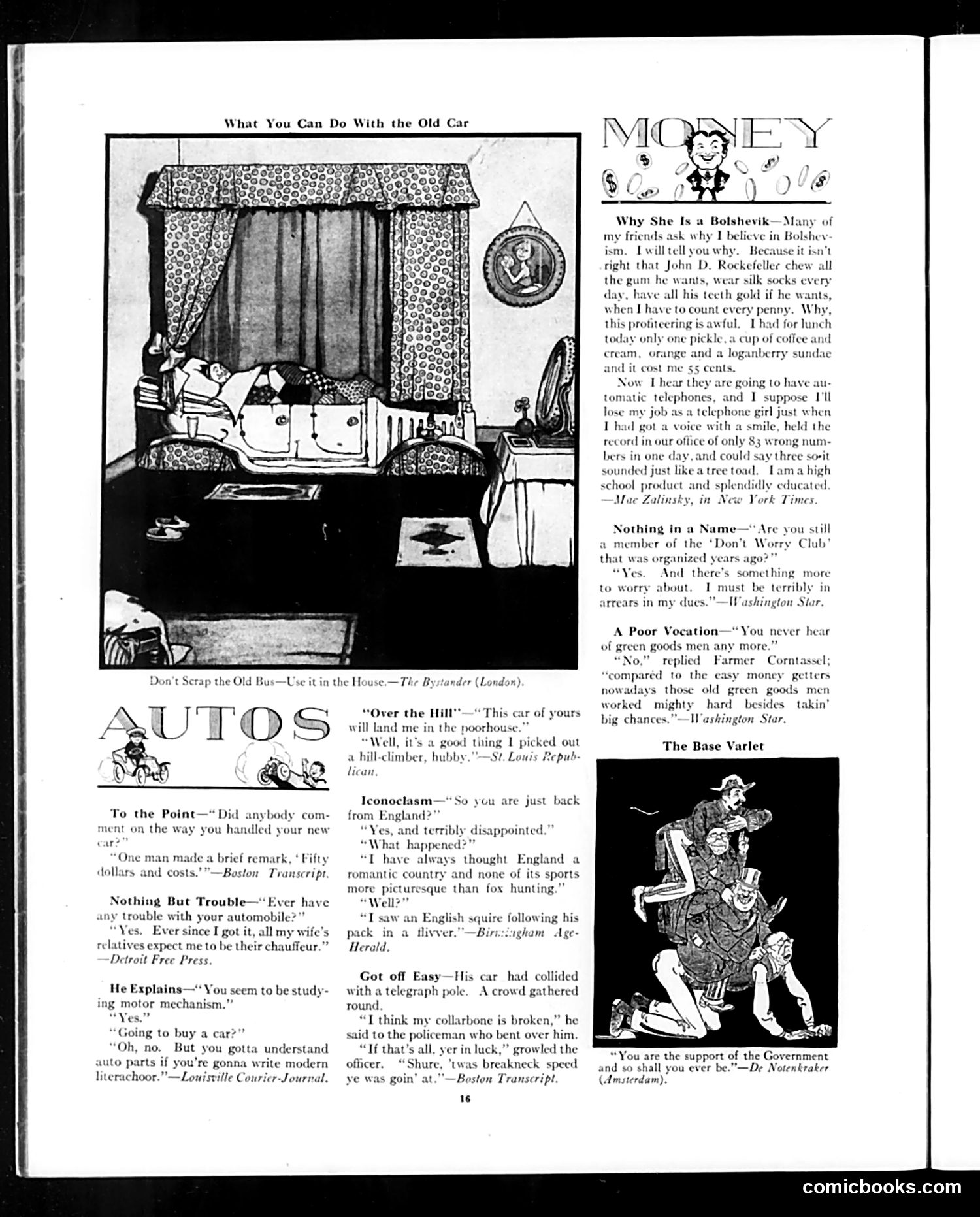
This page collects automotive humor and social commentary from the 1920s. The main cartoon shows converting an old car into a bedroom/living space—reflecting post-WWI economic hardship and the used-car market boom. The jokes satirize: **Class anxiety**: A woman embraces "Bolshevism" not from ideology but pettish entitlement—she resents Rockefeller's luxury while she counts pennies, yet complains about a 55-cent lunch (expensive for the era). The satire targets shallow radicalism driven by consumerism. **Modern anxieties**: References to automatic telephones replacing operators and "green goods" (counterfeit money schemes) becoming obsolete reflect rapid technological change displacing workers. **Automobile culture**: Several jokes mock the car's unreliability, expense, and social obligations—wives expecting chauffeur service, collisions with poles, costs exceeding income. The British "flivver" (cheap car) joke mocks modernization replacing romantic traditions. Overall, the page reflects 1920s anxiety about technology, wealth inequality, and automobiles reshaping American life.
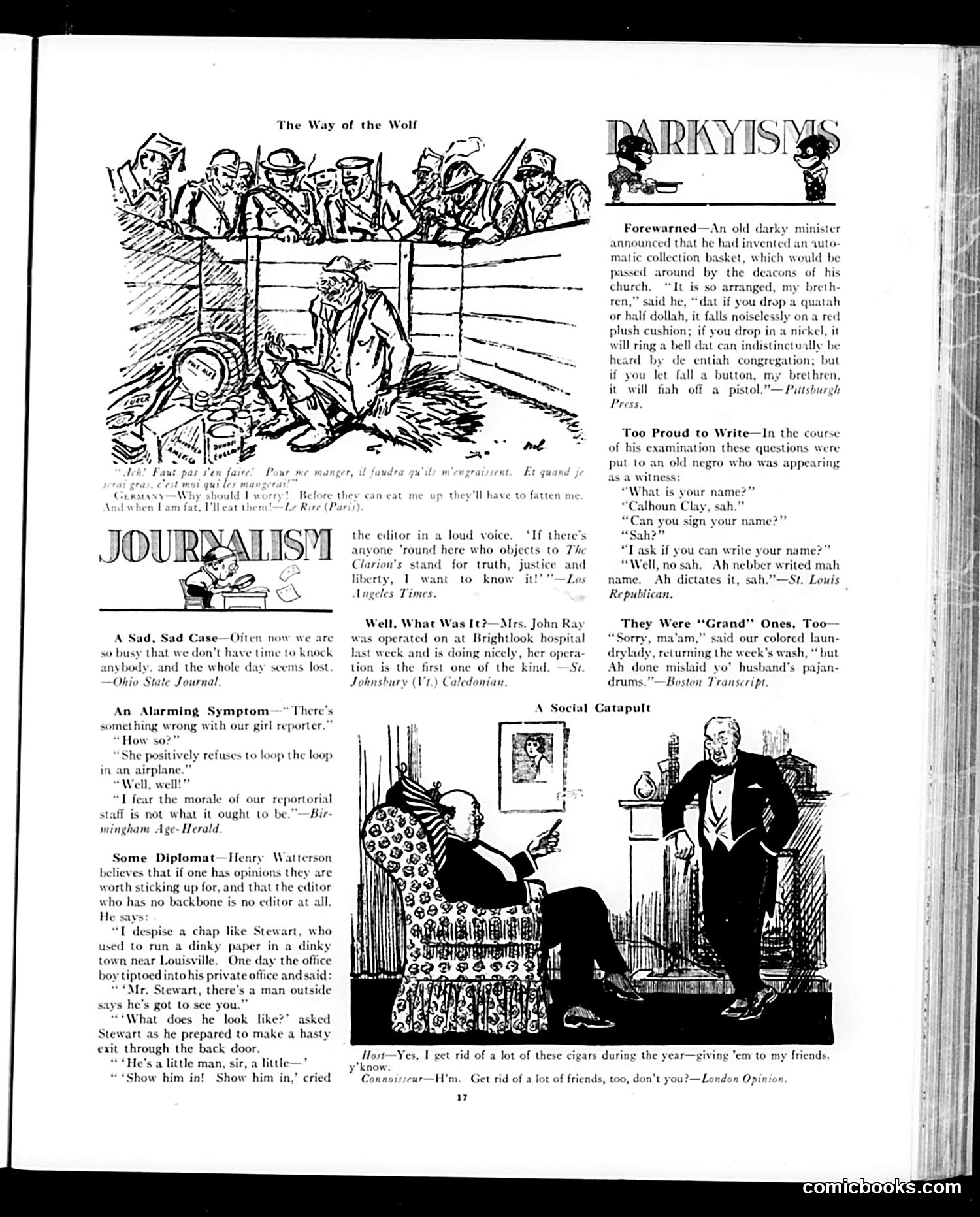
This page contains satirical commentary on early 20th-century American journalism and social customs. **Main Cartoons:** 1. **"The Way of the Wolf"** (top): Depicts newspaper editors as aggressive predators, satirizing sensationalist journalism's claim to pursue "truth, justice and liberty" while actually pursuing circulation and profit. 2. **"A Social Catapult"** (bottom): Shows a wealthy man distributing unwanted cigars to acquaintances, then claiming he's "getting rid of friends too"—mocking the pretense of generosity masking self-interest. **Key Satirical Points:** - **Journalism section**: Mocks editors who bluster about principles while lacking integrity; references Henry Watterson criticizing spineless editors like "Stewart," who flee confrontation - **Humorous anecdotes**: Including a joke about a "colored" preacher's automatic collection basket (period racist humor), and commentary on girl reporters who won't perform dangerous stunts The page satirizes hypocrisy across professional and social spheres—particularly how people mask self-serving motives behind claims of principle or generosity.
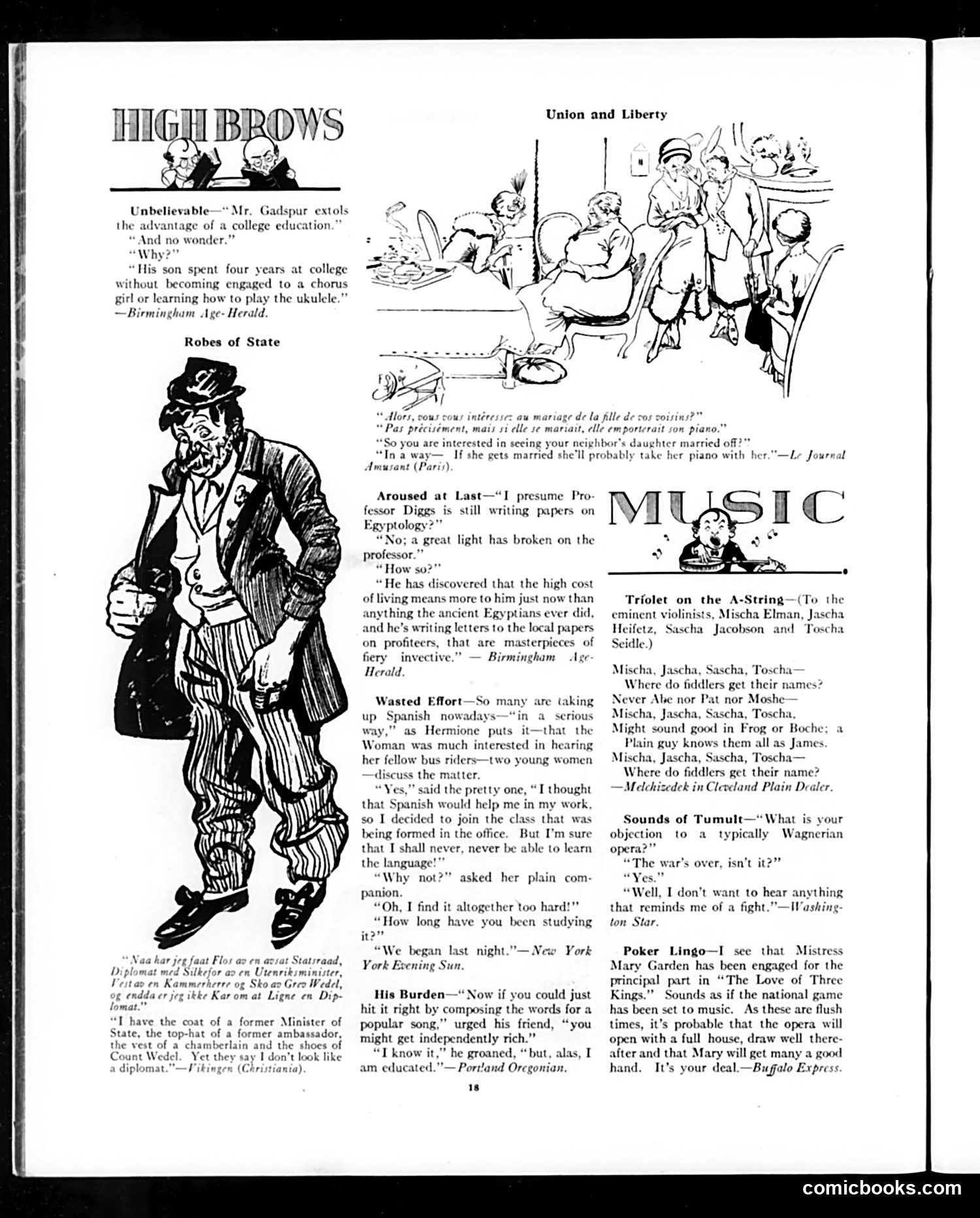
This page from *Judge* magazine presents several brief satirical pieces mocking early 20th-century social pretensions and absurdities: **"Robes of State"** depicts a shabby diplomat cobbled together from borrowed official garments—coat from a former minister, hat from an ambassador, vest from a chamberlain, shoes from Count Wedel—yet still doesn't look dignified. It satirizes how appearances of authority are merely costume. **"Union and Liberty"** jokes about a father welcoming his neighbor's daughter's marriage, not from sentiment but because she'll take her piano with her—removing an annoying noise source. **"Aroused at Last"** mocks an ivory-tower academic (Professor Diggs) suddenly engaged with practical concerns: he's abandoned Egyptology papers to write angry letters about wartime profiteers and high living costs. It's satire on scholars disconnected from real-world concerns until personal hardship forces engagement. Other pieces mock language students giving up Spanish after one night, and there's wordplay on violinists' Eastern European names. Overall, the page ridicules pretension, academic detachment, and social climbing.
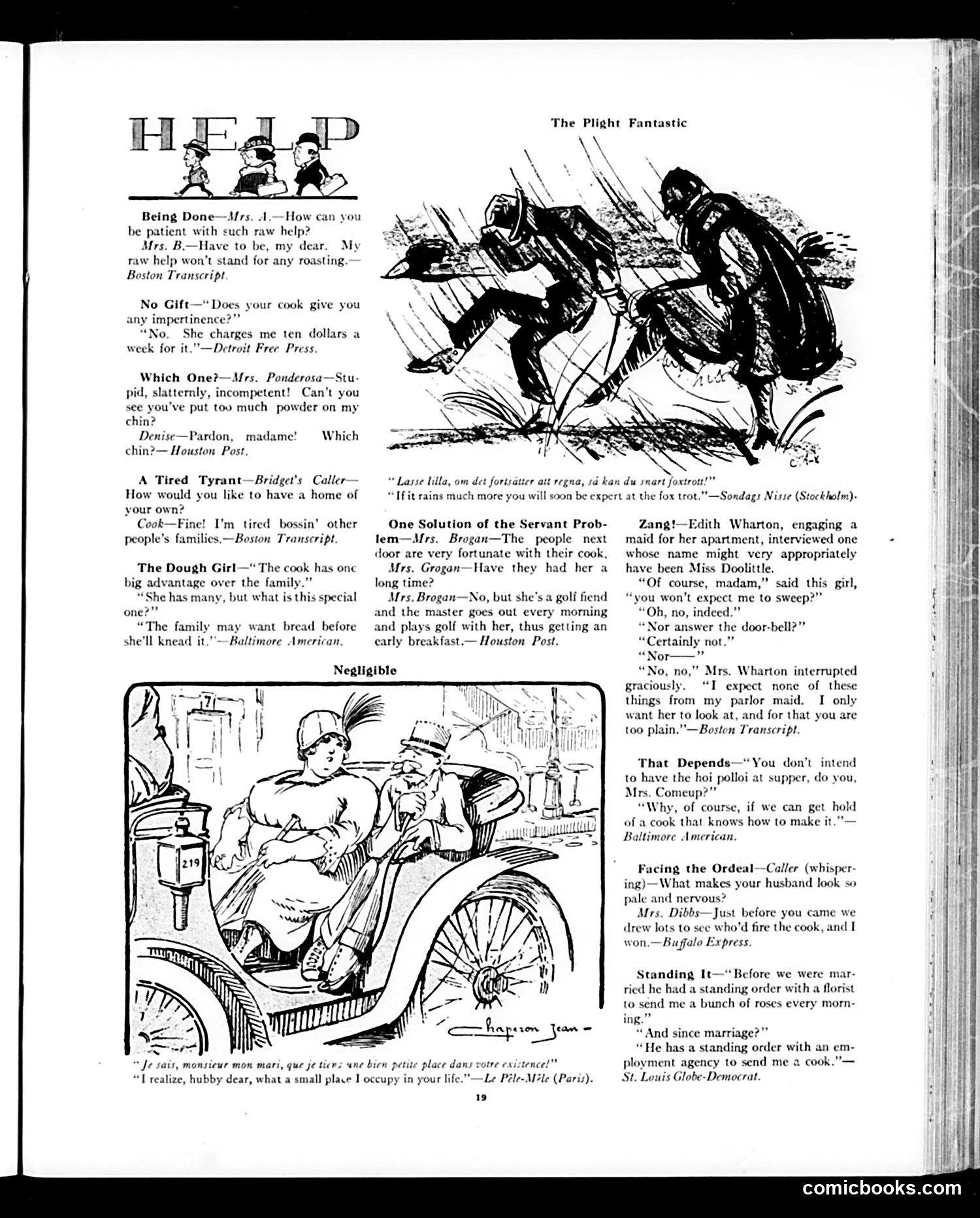
This page satirizes the domestic servant crisis of the early 20th century through multiple short jokes. The central issue: household help—particularly cooks—were increasingly difficult to hire and retain, and servants themselves were growing less deferential to employers. The humor operates on class anxiety: wealthy women (Mrs. Ponderosa, Mrs. Comeup, Mrs. Wharton) struggle with insubordinate or incompetent servants who demand respect, higher wages, or simply refuse traditional roles. One joke features a cook who'd rather manage her own household than work for others; another shows a servant so plain the employer won't hire her despite her refusal to perform basic duties. The "Negligible" cartoon and Swedish reference suggest this was a widespread phenomenon, not just American. The final joke—contrasting pre-marital roses with post-marital employment agency orders—frames finding a cook as harder than courtship, reflecting genuine domestic labor shortages of the era.
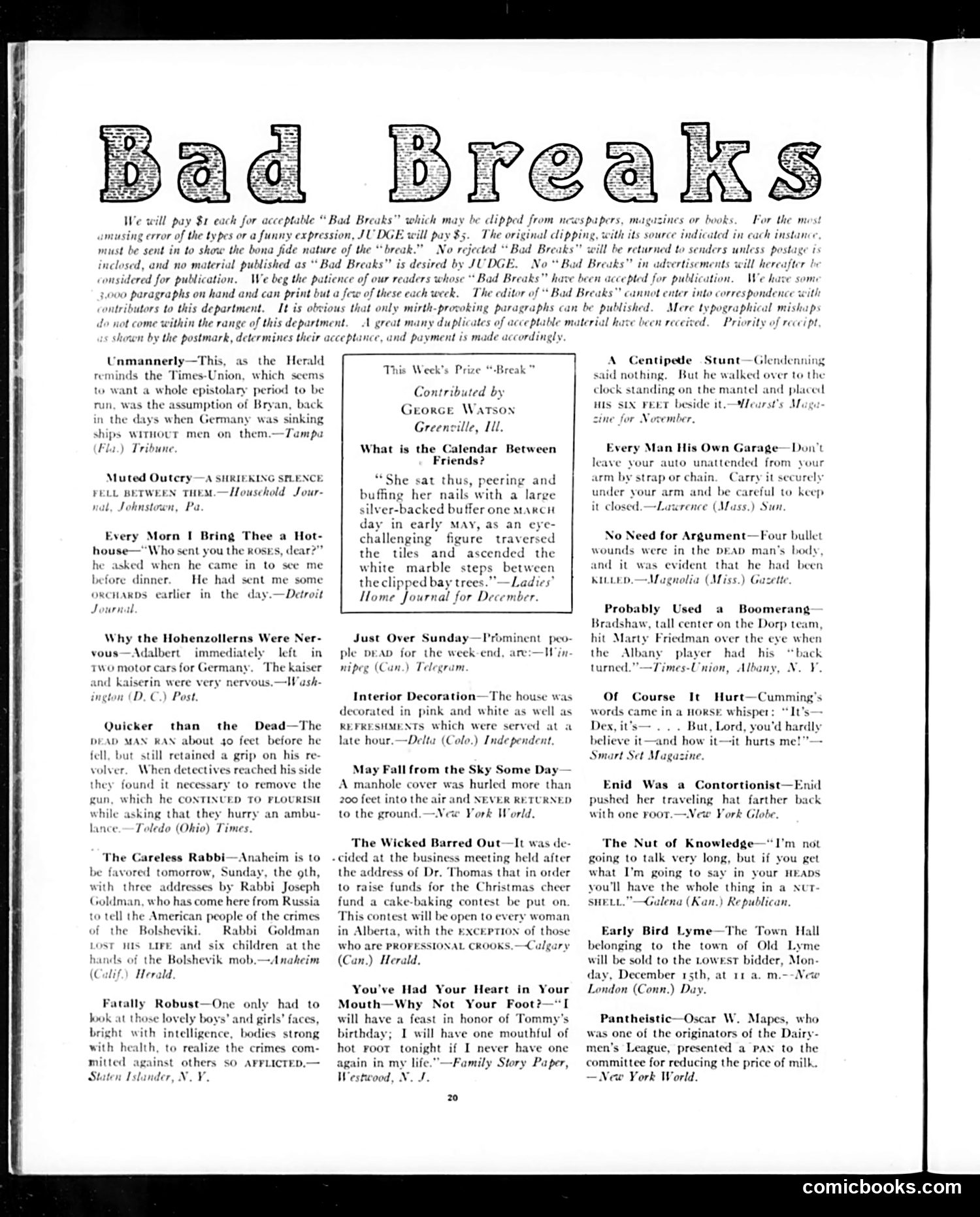
This page is a humor column from Judge magazine featuring typographical and printing errors ("bad breaks") clipped from newspapers. The format presents amusing mistakes—often unintentional double meanings or absurd phrasings—culled from real publications nationwide. Examples visible include: a dead man who "ran about 40 feet" (should specify the corpse was found), a manhole cover "never returned" to the ground (implying permanent loss rather than simple absence), and a cake contest "open to every woman in Alberta, with the exception of those who are professional crooks" (an unintended jab at Alberta women). The satire works by exposing editorial carelessness through these genuine printing errors. The page also includes contributing editor George Watson's prize-winning entry about someone filing nails in contradictory seasons ("March day in early May"). This reflects Judge's role documenting American newspaper quality during the early 20th century.
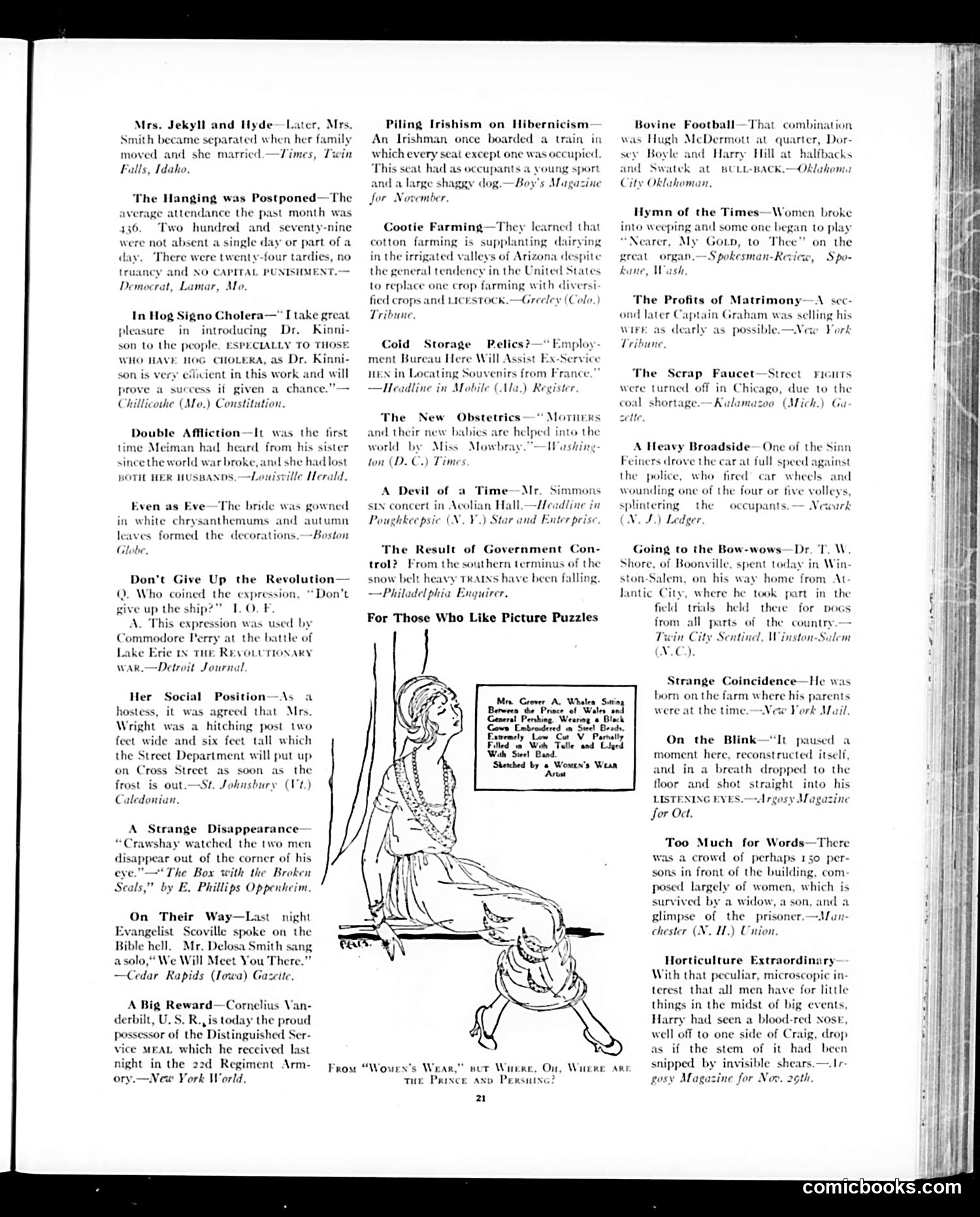
This page from *Judge* magazine collects humorous newspaper excerpts and a cartoon puzzle. The humor relies on **unintentional absurdity** in local newspaper headlines and articles—a common early-20th-century satirical device. The examples mock incompetent editing and awkward phrasing: a woman losing "both her husbands" during WWI; a bride decorated with "autumn leaves"; Commodore Perry credited with a phrase actually from the Revolutionary War; a "Distinguished Service Meal" instead of Medal. The cartoon shows a woman being pulled in opposite directions by two caricatured figures, illustrating the common saying about women's fashion's unpredictability (caption mentions "Women's Wear"). The page's humor targets **small-town and regional newspaper incompetence**—their grammatical errors, logical contradictions, and malapropisms. This reflects *Judge*'s urban, educated audience's condescension toward provincial American journalism and society.
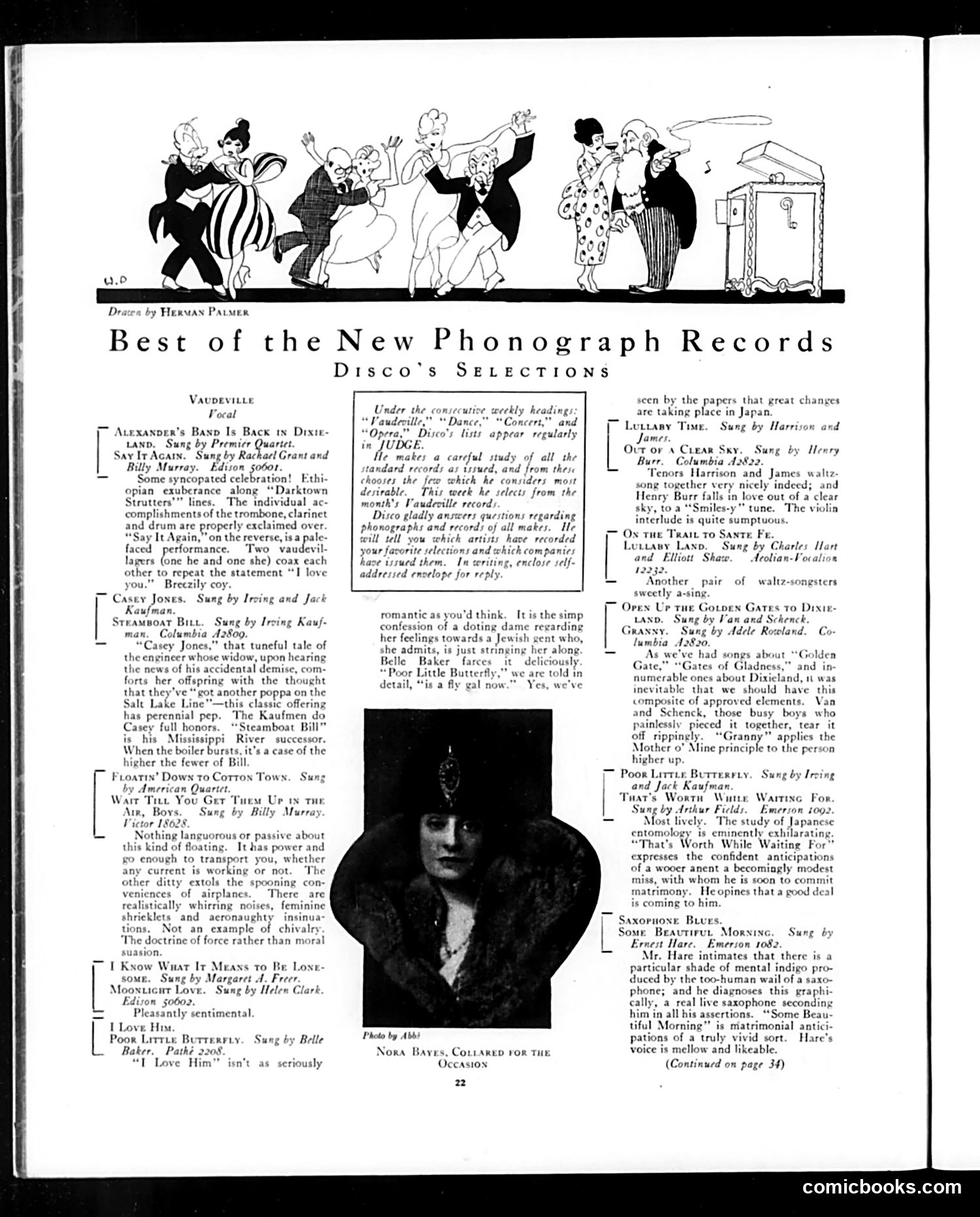
This page features **Disco's record reviews** — a regular column recommending phonograph records across vaudeville, vocal, and dance categories. The top cartoon by Herman Palmer shows cheerful patrons at what appears to be a record store or listening establishment. The reviews focus on **early 1920s popular music**: ragtime numbers like "Alexander's Band Is Back in Dixieland," sentimental ballads ("I Love Him"), novelty songs with sound effects ("Wait Till You Get Up in the Air"), and character pieces like "Casey Jones." **Key context for modern readers**: These brief, enthusiastic reviews reflect the era when recorded music was still novel entertainment. References to "syncopated celebration," "Ethiopian exuberance," and "Darktown" reveal period racial attitudes embedded in entertainment terminology. The reviews praise vocal performances and novelty effects (whirring noises, feminine shrieks) as cutting-edge entertainment. The centered photograph shows **Nora Bayes, "Collared for the Occasion"** — likely a contemporary recording artist or performer. This is essentially **early music journalism**, treating phonograph records as significant popular culture worthy of critical attention.
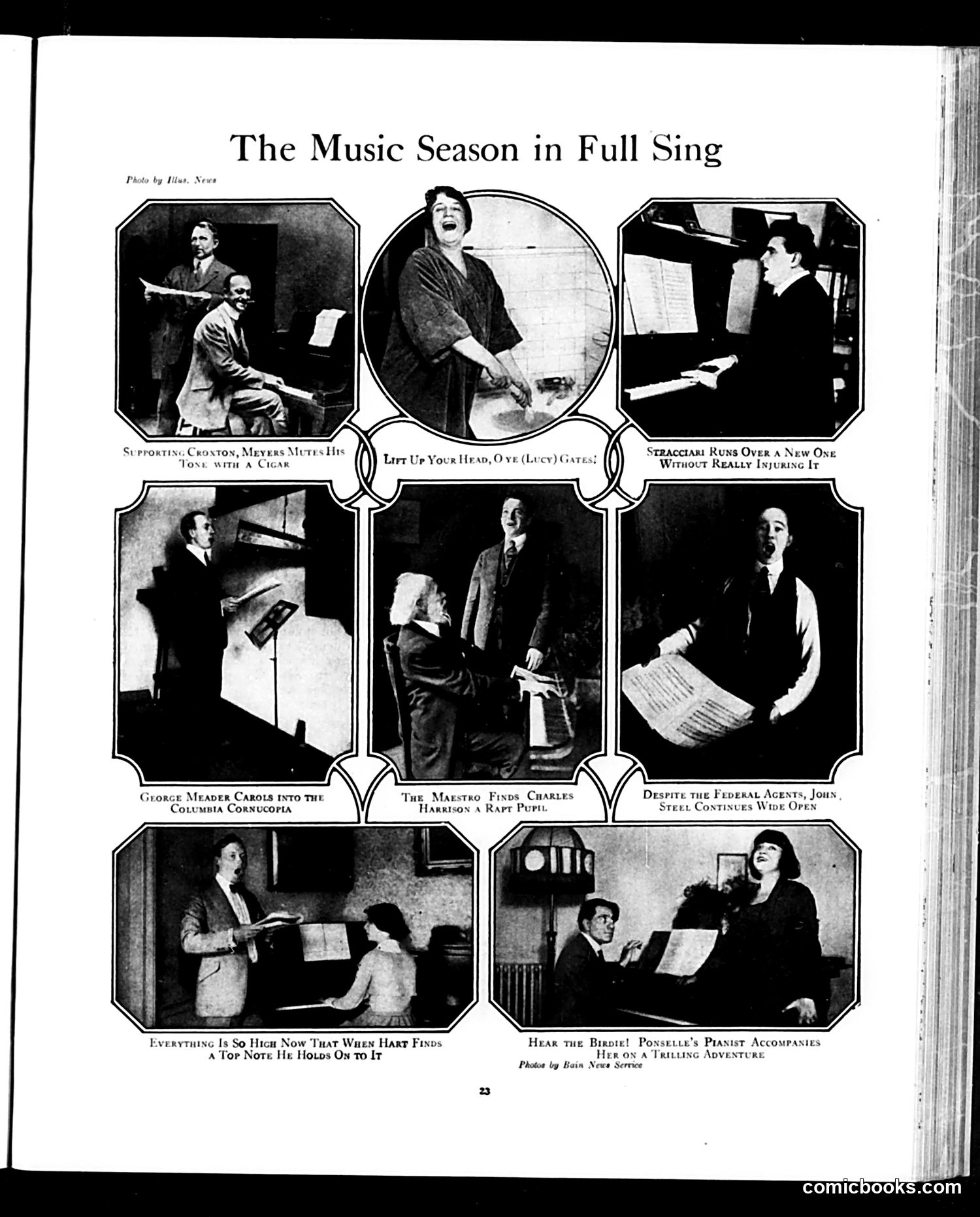
This Judge magazine page satirizes the 1910s classical music world through humorous vignettes. The captions reference real performers: George Meader singing into Columbia's gramophone; a maestro discovering Charles Harrison as a rare pupil; Stracciati (likely an opera singer) causing commotion; John Steel continuing performances despite federal scrutiny; Hart achieving high notes; and Ponselle's pianist accompanying her on "a thrilling adventure." The satire mocks the pretensions and drama of the opera/concert world—overhyped talent discoveries, singers' tendency toward accidents and mishaps, and the inflated self-importance of classical musicians. The recurring joke seems to be that despite chaos and interruptions, the "show must go on," poking fun at both performers' dedication and their self-aggrandizement. The page captures the popular entertainment discourse of that era's music scene.
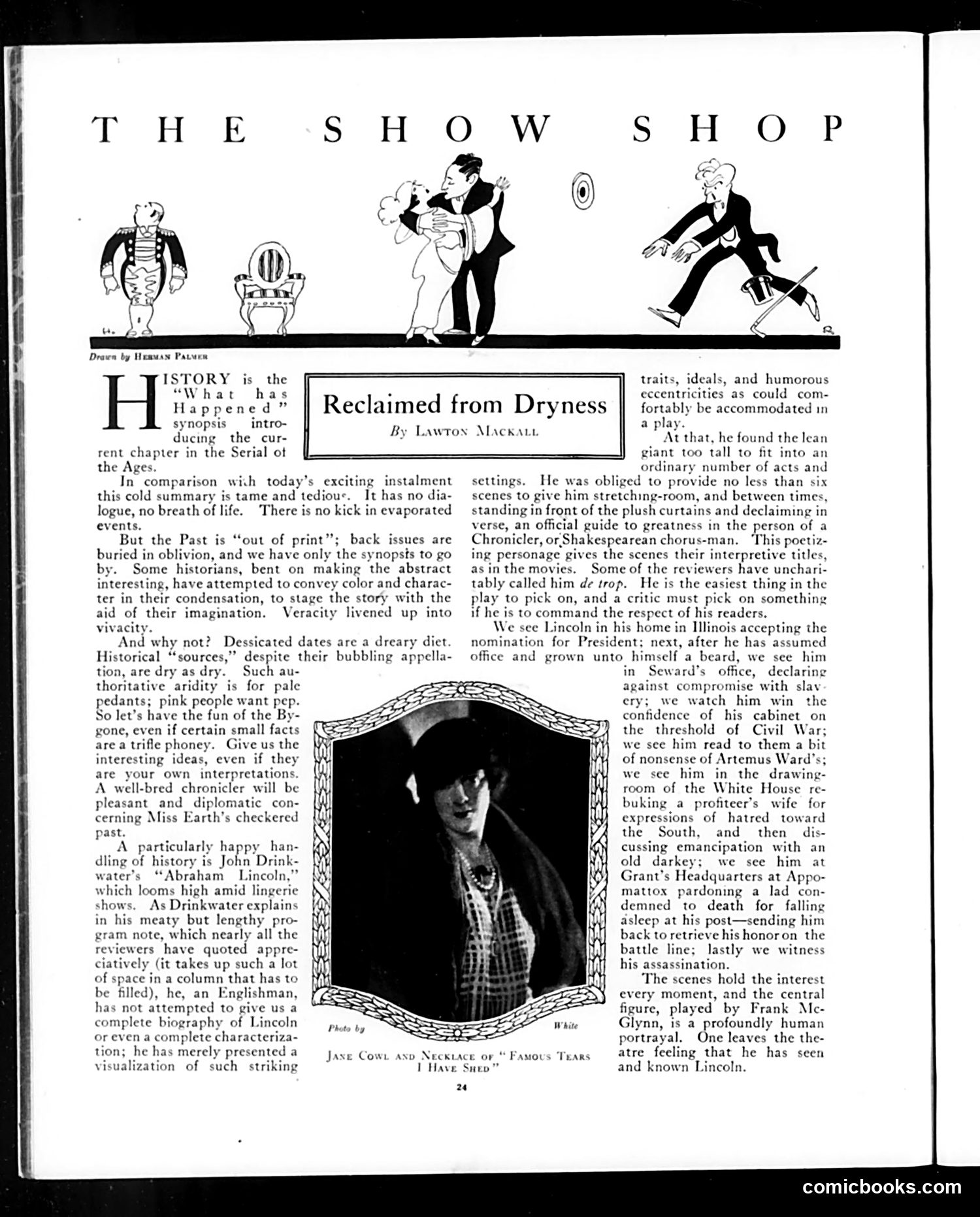
This page reviews John Drinkwater's play "Abraham Lincoln," which was a contemporary theatrical production. The article defends dramatizing history with theatrical flair rather than dry factual recitation. The satire targets academic pedantry: historians who present "desiccated dates" and abstract facts bore audiences, while dramatists who visualize historical figures and scenes—even with some invented details—engage people emotionally. The author argues there's nothing wrong with this approach; a "well-bred chronicler" can present an interpretive visualization rather than complete biographical accuracy. Drinkwater's six-scene play depicts Lincoln at key moments: accepting the presidency, managing his cabinet during the Civil War's outbreak, and his assassination. The reviewer praises actor Frank McGlynn's "profoundly human" portrayal. The only mild criticism is the Shakespearean "Chorus" figure who provides interpretive commentary between scenes—called *de trop* (excessive) by some critics, though the reviewer finds it necessary exposition. The cartoons at top satirize theatrical excess and audience reactions.
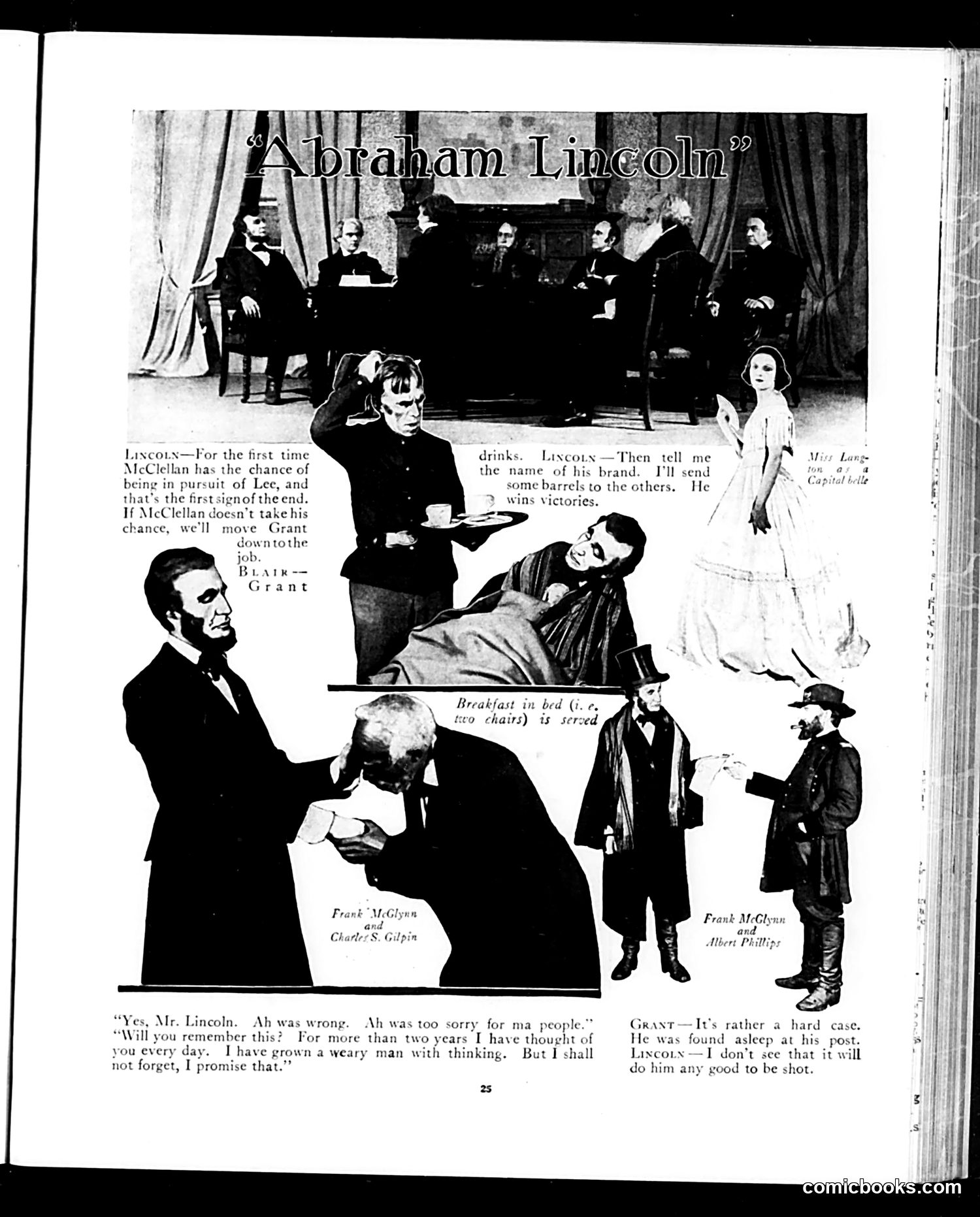
This appears to be a film or theatrical scene from an "Abraham Lincoln" production, showing multiple dramatic moments. The page displays photographs of actors portraying Lincoln and other Civil War-era figures in various scenes—including Lincoln in bed, conversing with military officials, and interacting with soldiers. The dialogue snippets reference Lincoln's strategic decisions during the Civil War, particularly regarding General McClellan's military leadership and the pursuit of General Lee. One exchange mentions sending "barrels" (likely ammunition/supplies) to win "victories." The satirical tone appears directed at depicting Lincoln's wartime decision-making and his handling of military commanders. Without a clear date visible, the exact historical moment being lampooned is uncertain, though it likely reflects contemporary Civil War debates about military strategy and command decisions.
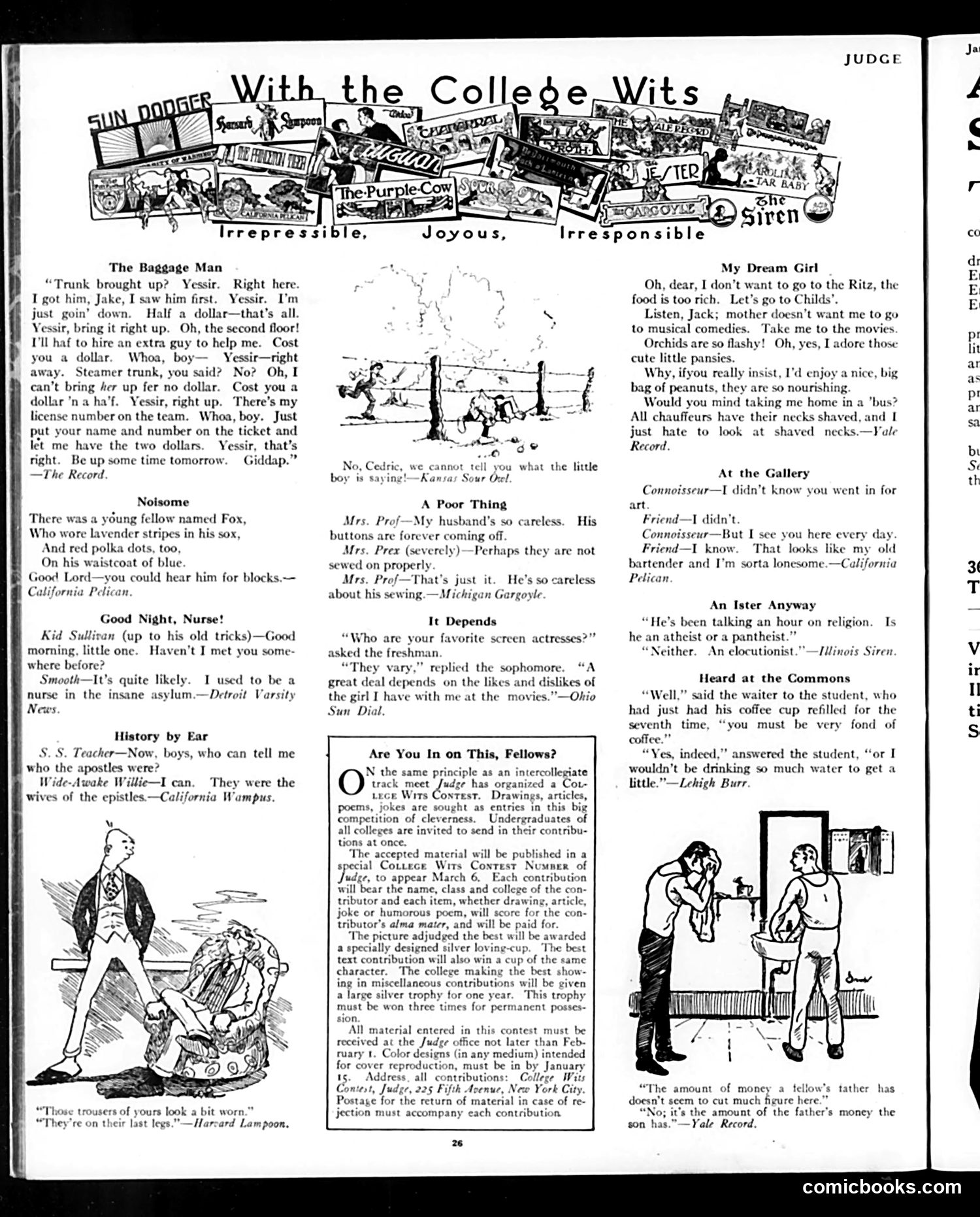
This page collects humorous short jokes and cartoons aimed at college students, plus an advertisement for Judge's "College Wits Contest." The cartoons mock student life and social pretensions: "The Baggage Man" satirizes a porter's escalating fees for hauling luggage; "My Dream Girl" depicts a young woman who affects refined tastes (rejecting expensive restaurants, requesting peanuts instead) while demanding practical transportation—satirizing affected modesty or inconsistent values among college dating culture. Other jokes poke fun at academic incompetence ("History by Ear," where a student mangles biblical knowledge), fashion affectation ("Noisome," about a loudly-dressed student), and careless married professors. The contest advertisement invites undergraduates nationwide to submit drawings, poems, and jokes to Judge for publication and payment, with prizes for winning colleges—positioning Judge as a platform celebrating collegiate wit and humor.
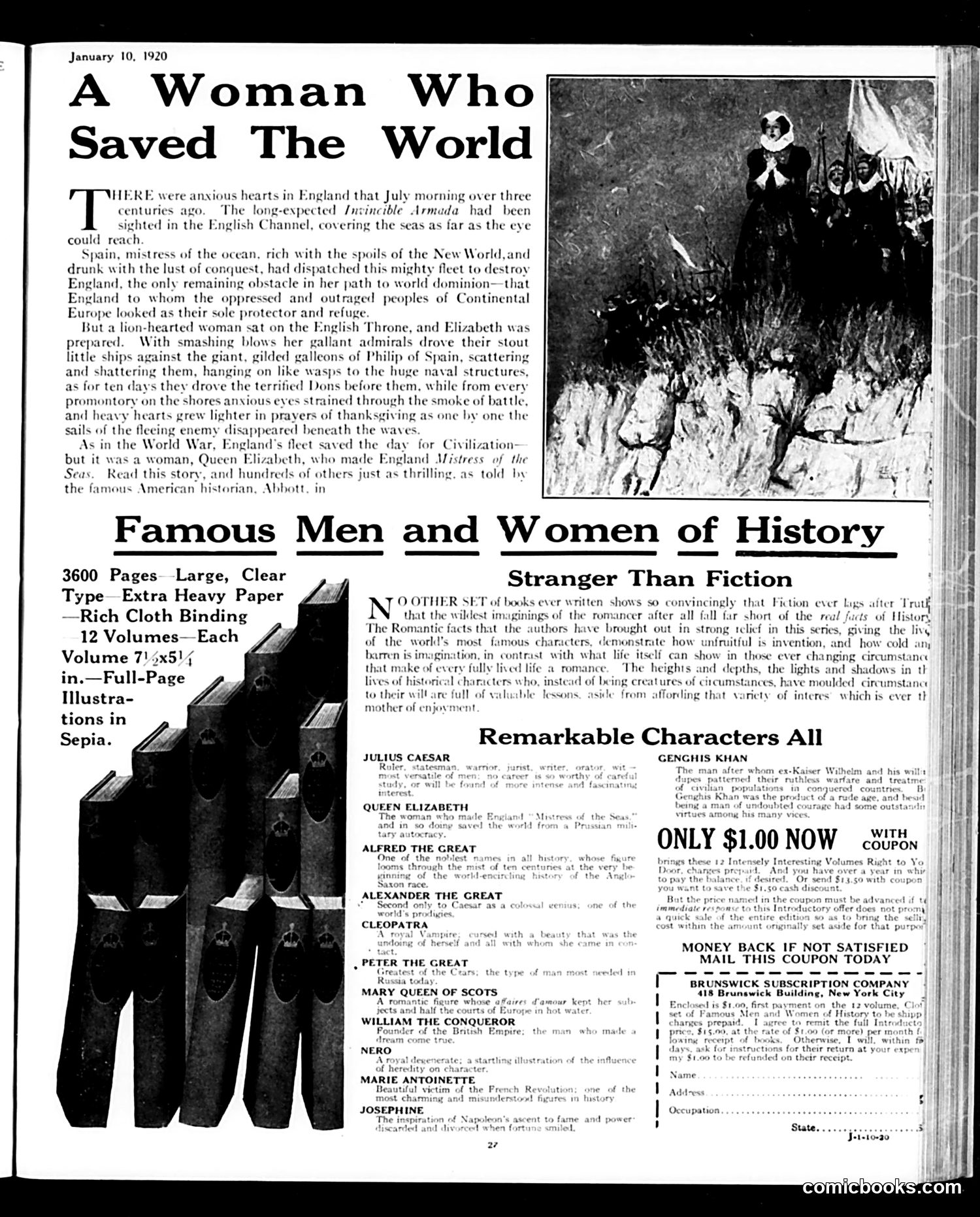
This page is primarily **advertising for a book series**, not satire or political commentary. The top article celebrates **Queen Elizabeth I** deflecting the Spanish Armada (1588), framing her as history's decisive female leader who "saved the world" from Spanish conquest. The accompanying illustration shows Elizabeth in period dress. The bulk of the page advertises "Famous Men and Women of History"—a 12-volume encyclopedia set selling for $1.00 (with coupon). The ad emphasizes that real historical facts exceed fiction in drama and interest, listing notable figures: Julius Caesar, Queen Elizabeth, Alfred the Great, Cleopatra, Peter the Great, Mary Queen of Scots, and others. **Context for modern readers:** This represents early-20th-century popular history marketing, using the Armada narrative to celebrate female leadership while simultaneously promoting an educational product for middle-class American households. The Elizabeth story serves as the hook to sell the encyclopedia.
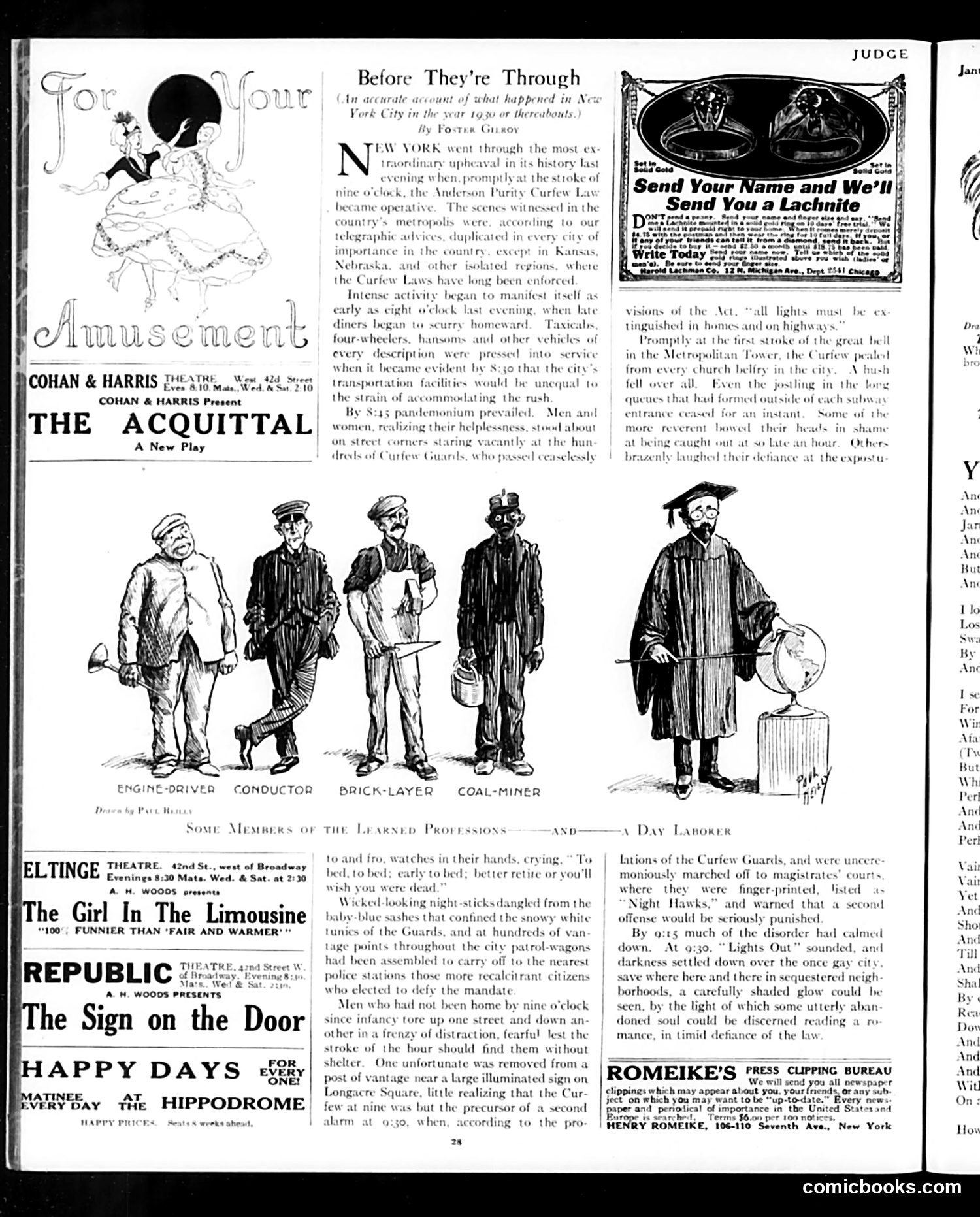
This page from *Judge* satirizes a hypothetical "Curfew Law" imposed on New York City—likely referencing Progressive Era moral reform movements. The illustrated article describes chaos when the law takes effect at 9 PM, requiring all citizens indoors. The satire mocks both the law's absurdity and public panic: **The cartoon** shows five working-class figures—an engine driver, conductor, brick-layer, coal-miner, and day laborer—representing ordinary people disrupted by rigid government control. **The joke**: The text describes frantic scenes of people scrambling home, police with nightsticks enforcing compliance, and even a second curfew at 9:30 PM. It portrays the enforcement as militaristic and the public as helpless. **The target**: Progressive reformers who pushed "moral improvement" laws they believed would benefit society. *Judge* ridicules both the paternalistic assumption that government should control citizens' nighttime activities and the inevitable chaos such enforcement would create. This reflects anxieties about government overreach during the early 20th century reform movement.
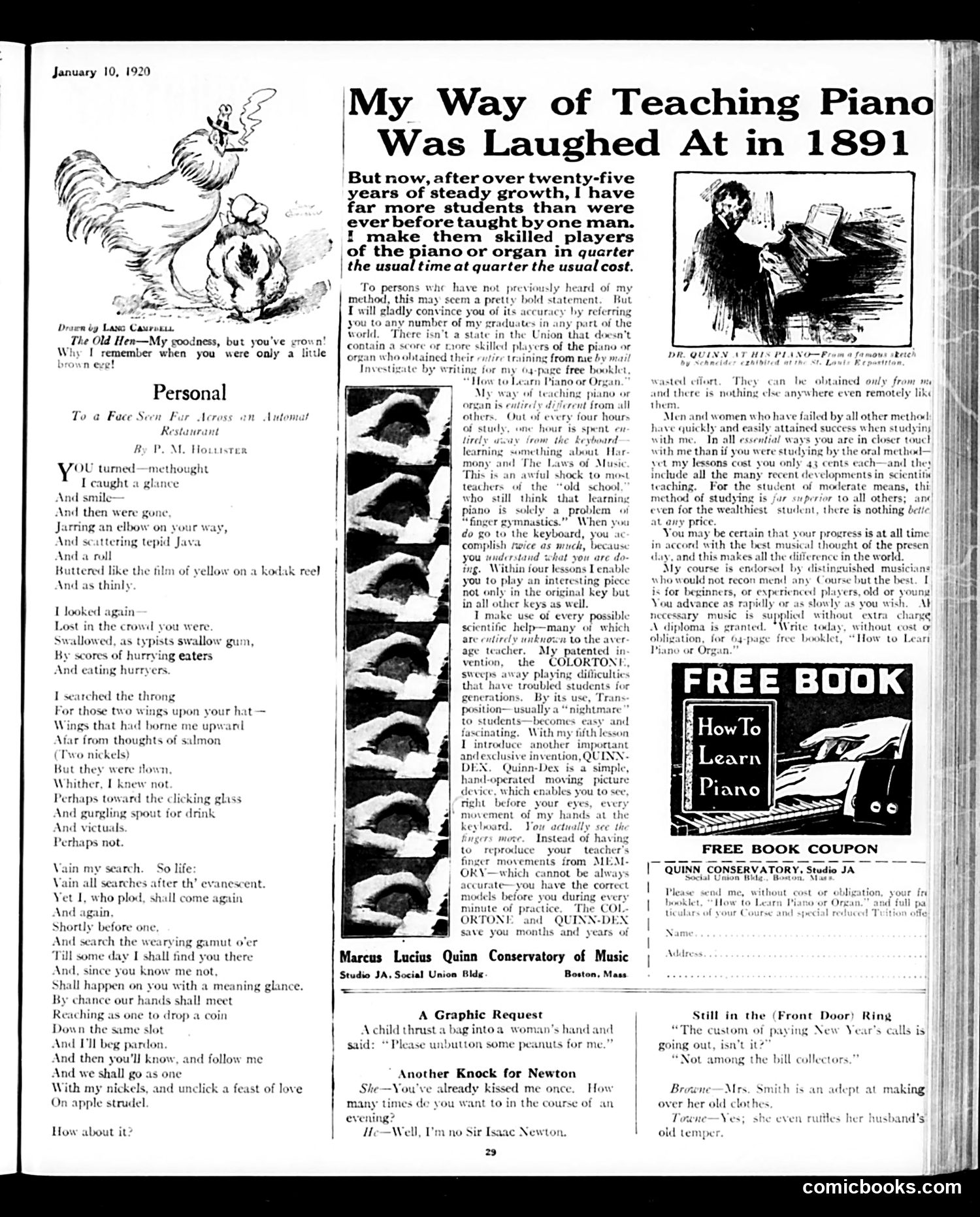
This page primarily advertises Marcus Lucius Quinn's piano teaching method, which he claims was mocked in 1891 but has now proven successful. The advertisement boasts that Quinn's system produces skilled pianists in a quarter of the usual time at a quarter the cost, using patented devices like the "COLORTONE" and "QUINN-DEX" to teach hand positioning and finger movement. The cartoon at top left (by Lane Casewell) shows an old hen commenting on a rooster's growth—a simple visual gag with no apparent satirical intent. The page also includes two humorous anecdotes and a poem titled "Personal" about a fleeting romantic encounter in a crowd, typical light personal-interest content for Judge magazine. The central content is essentially a direct-mail advertisement offering a free instructional booklet, representing the kind of mail-order self-improvement marketing common in early 20th-century magazines.
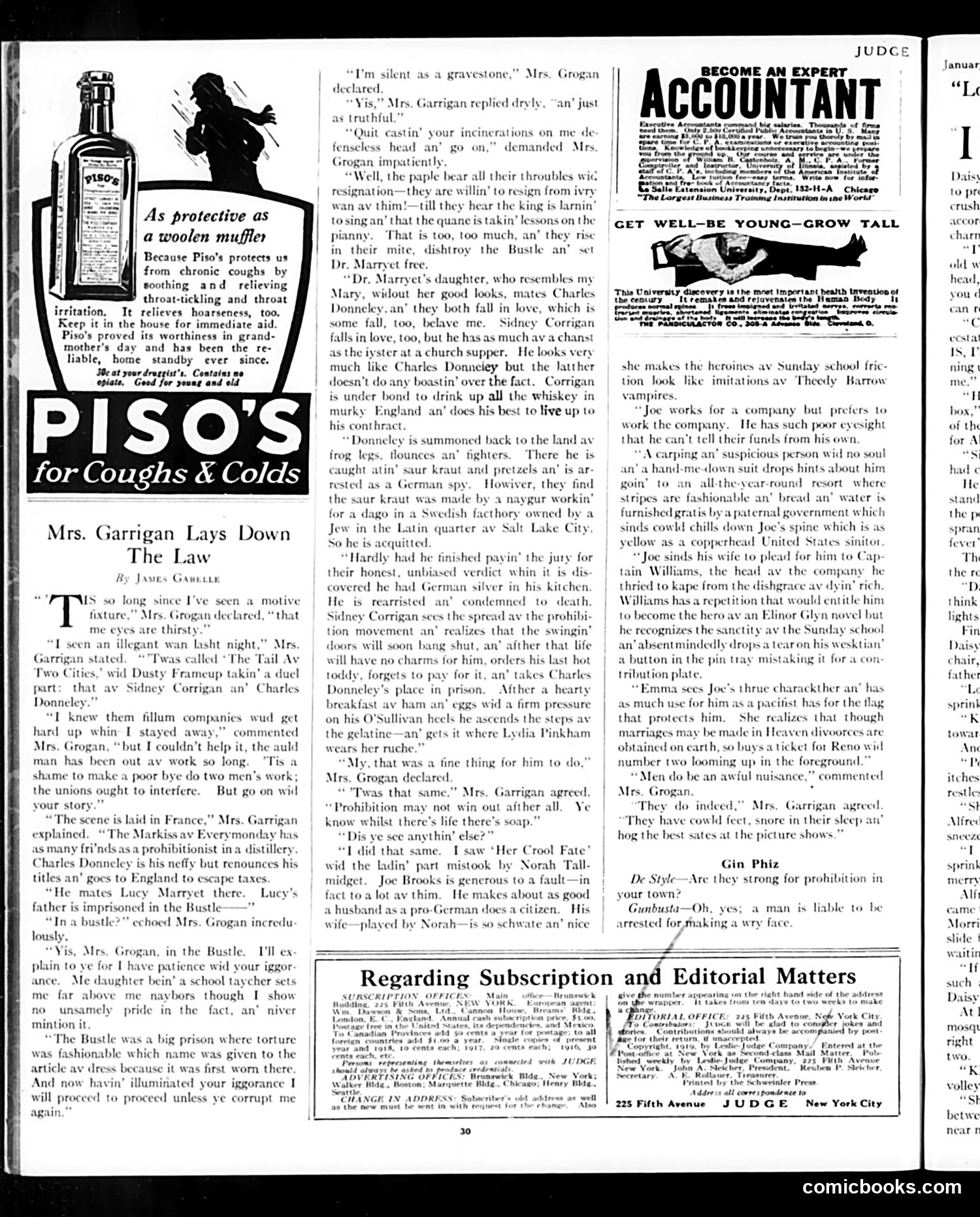
This page contains a serialized humorous story ("Mrs. Garrigan Lays Down The Law") written in exaggerated Irish-immigrant dialect, featuring two working-class women discussing a movie they've seen—a melodramatic adaptation of *A Tale of Two Cities*. The satire targets: 1. **Silent film plots**: The absurdly convoluted storyline mocks overwrought period dramas popular in early cinema. 2. **Prohibition anxieties**: A recurring joke involves a character determined to drink all England's whiskey before prohibition closes bars—reflecting contemporary American prohibition debates (this likely dates to the 1910s-1920s). 3. **Immigrant stereotypes**: The Irish brogue dialect and malapropisms (calling the Bastille "the Bustle") are comedic devices playing on how immigrants were portrayed in American media. 4. **Class commentary**: The women's frank, irreverent discussion of high-drama plots emphasizes how working-class audiences consumed "serious" art. The page is primarily advertising (Piso's cough medicine dominates), with the story as editorial content typical of *Judge* magazine's format.
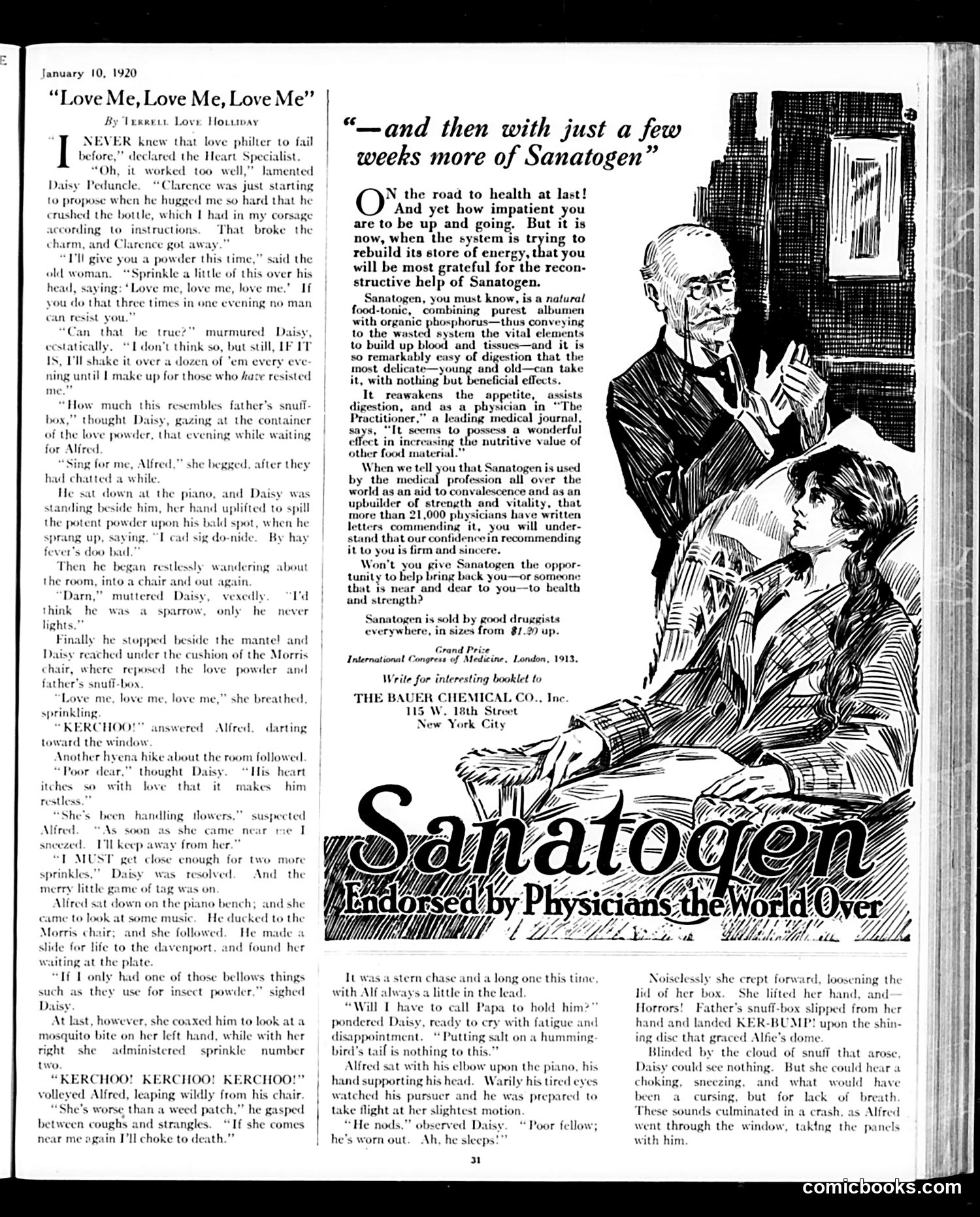
This page contains two distinct elements: a humorous short story and a patent medicine advertisement. **The Story ("Love Me, Love Me, Love Me"):** A comedic tale about a woman named Daisy who obtains a "love powder" from an old woman to make her suitor Alfred fall in love with her. The joke relies on physical comedy: each time she attempts to sprinkle the powder on Alfred's head, he sneezes violently and flees, thinking she's the cause of his hay fever. The satire mocks both the magical thinking behind love potions and the desperation of romance. **The Advertisement (Sanatogen):** The right page advertises Sanatogen, a "natural food-tonic" claiming to aid post-illness recovery. It features a physician examining a weakened patient and cites endorsements from over 21,000 doctors worldwide. This represents typical early-20th-century patent medicine marketing—making grand health claims with alleged medical authority. Such products were common before modern FDA regulations. The juxtaposition is ironic: the fictional love powder doesn't work, while the real "medicine" promises miraculous results with equally dubious evidence.
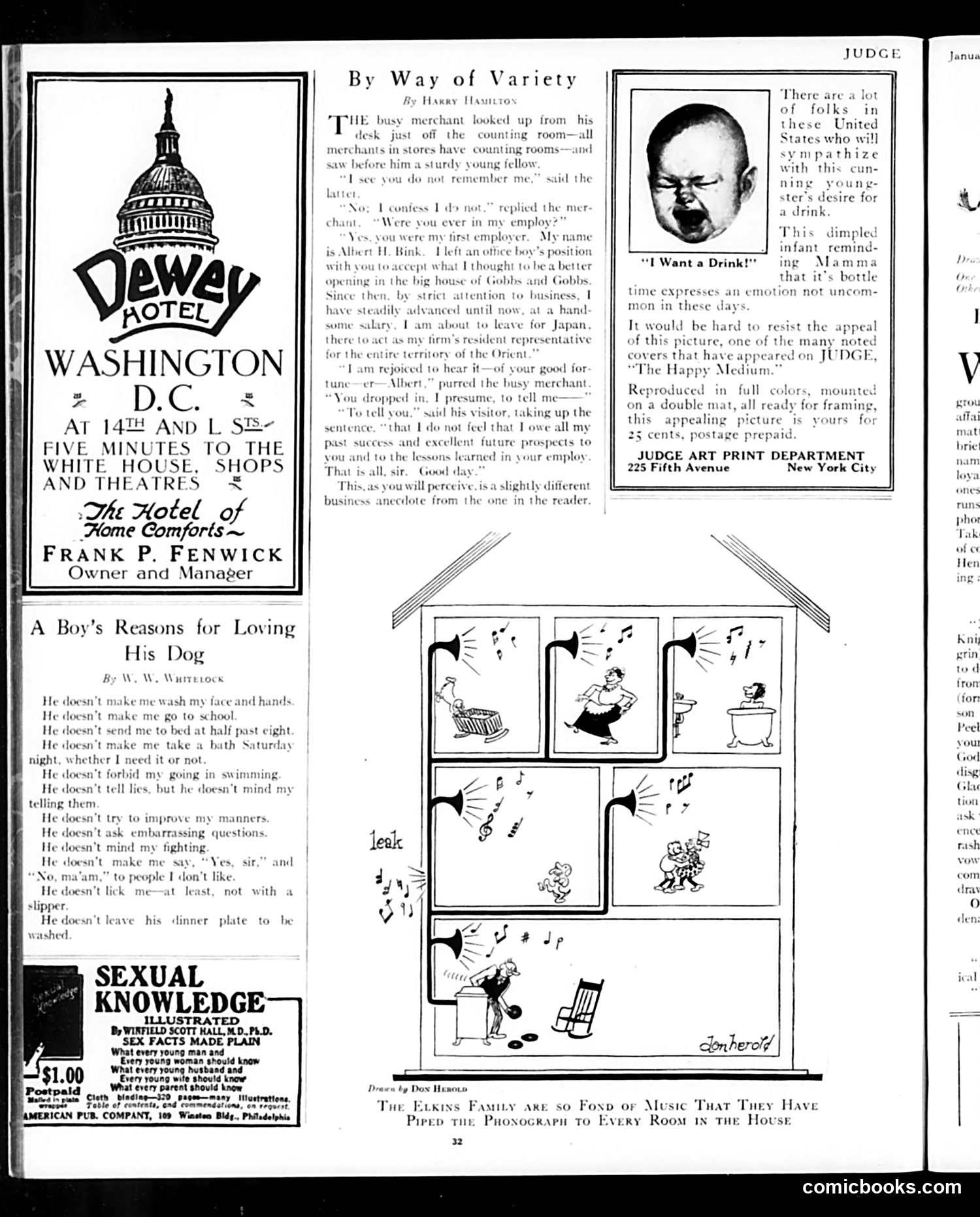
This page contains three distinct pieces of content: **"By Way of Variety" (center):** A business anecdote about a merchant who encounters a former employee leaving to represent the firm in Japan. The story illustrates corporate loyalty and advancement—the young man credits his success entirely to his first employer's lessons, flattering the merchant. The satirical "point" appears to be mockery of such transparent brown-nosing in business contexts. **"A Boy's Reasons for Loving His Dog" (left):** A humorous list contrasting what dogs won't do (enforce discipline, manners, education) versus what parents and guardians will. The joke relies on period concerns about child-rearing and parental authority. **"I Want a Drink!" cartoon (right):** A baby's plea, with commentary suggesting sympathy from American readers who understand the desire for alcohol—likely referencing Prohibition-era frustrations (though the magazine's exact date is unclear from the page). The page is primarily content-driven rather than overtly political, mixing light satire with domesticated humor typical of Judge's early 20th-century style.
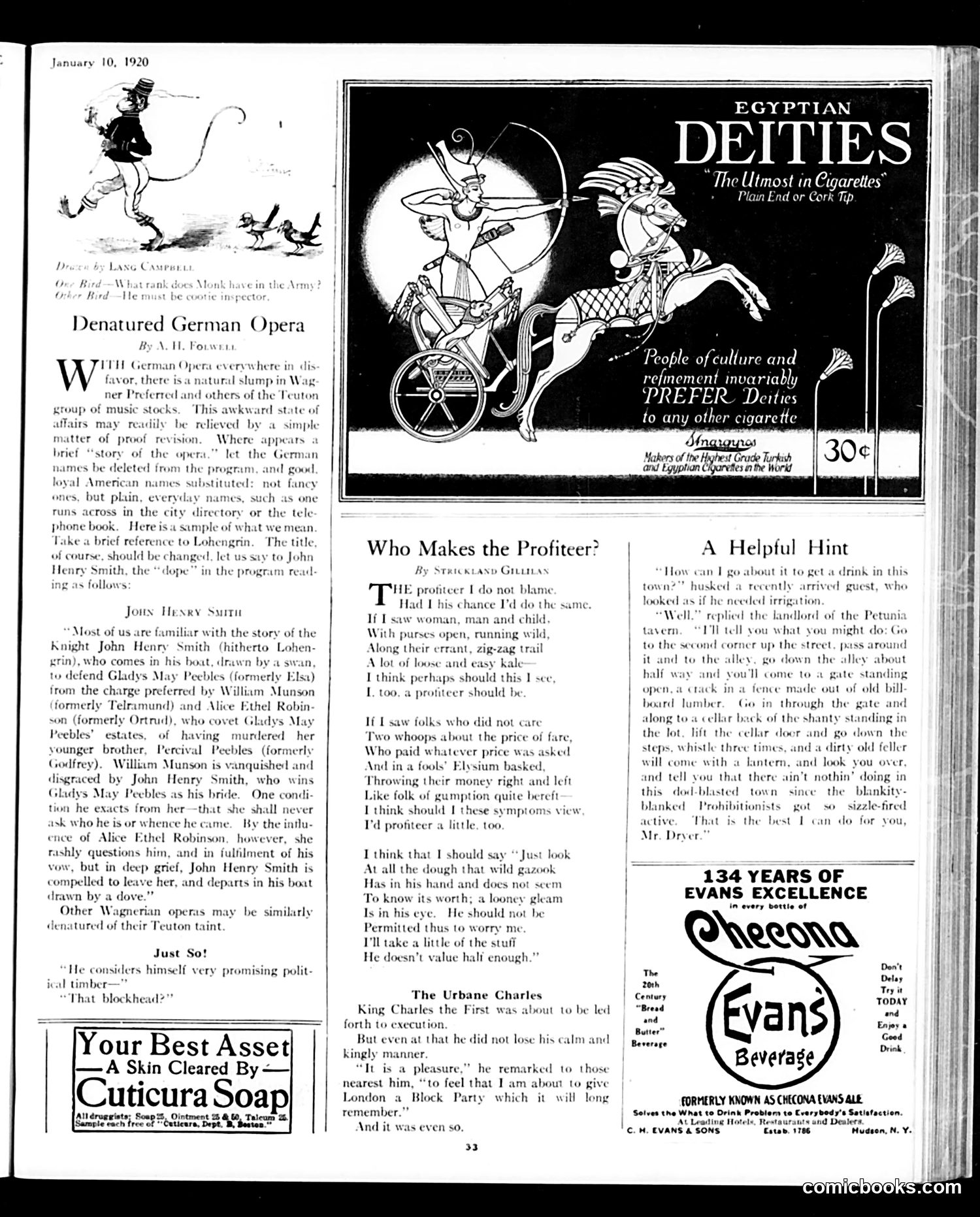
This satirical piece, dated January 10, 1920 (just after World War I), mocks the anti-German sentiment sweeping America by proposing to "Americanize" German operas. The author suggests renaming Wagner's *Lohengrin* to "John Henry Smith"—replacing Germanic names with mundane American ones like "Gladys May Peebles" and "William Munson." The joke targets both post-war xenophobia and the absurdity of such "cultural cleansing." By keeping the plot identical while changing only names, the satire exposes how arbitrary such nationalist purges are. The opera remains unchanged—only American prejudice demands the renaming. The accompanying cartoons and advertisements (Egyptian Deities cigarettes, Cuticura Soap, Evans Beverage) are period commercial content unrelated to the opera satire. The "Helpful Hint" section appears to reference Prohibition (enacted in 1920), humorously describing how to find illegal alcohol during the newly-enacted ban.
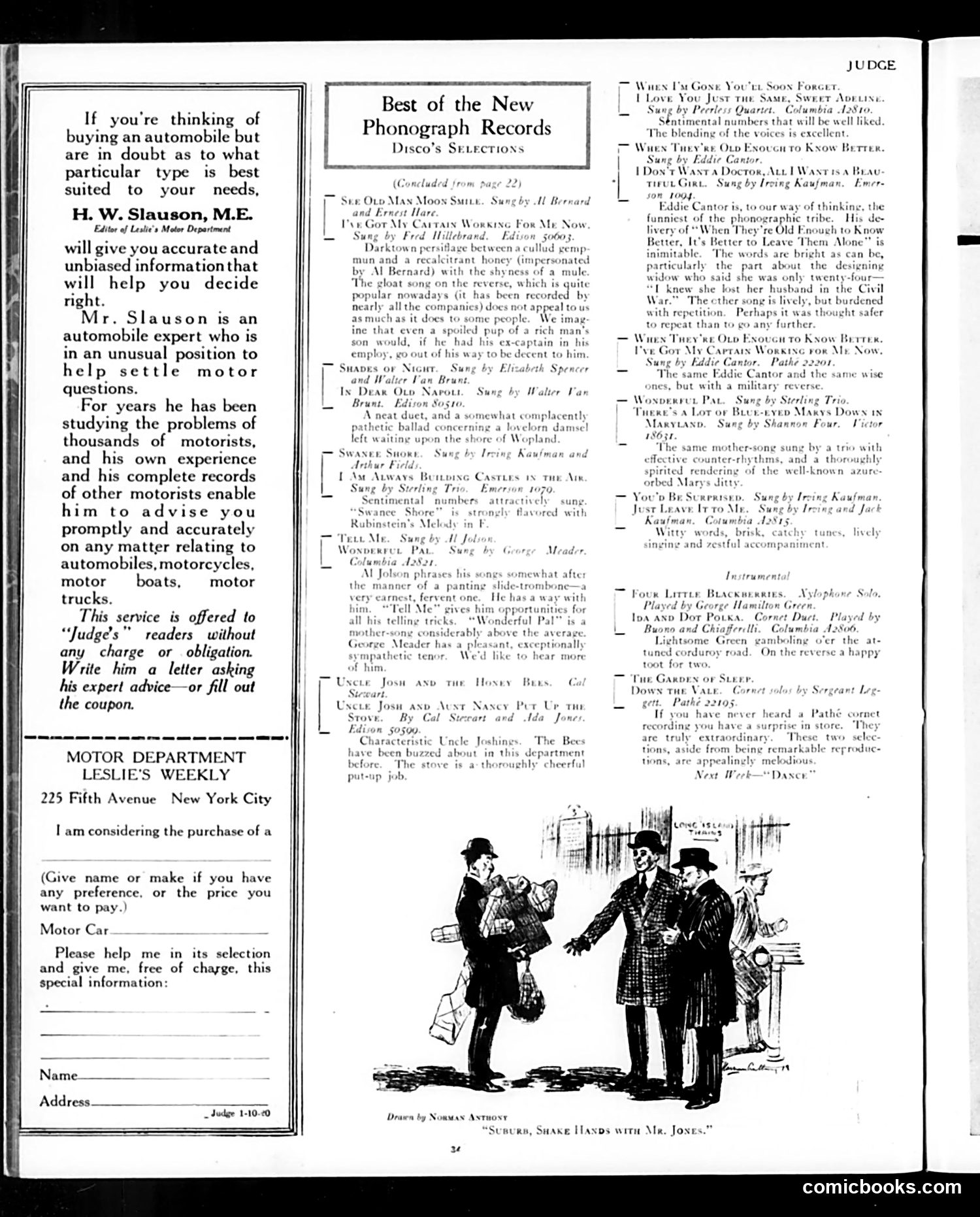
This page combines advertising with phonograph record reviews and a single cartoon. The main cartoon, "Shrug, Shake Hands with Mr. Jones," depicts three men in formal attire meeting on a city street—a common social scenario of the era. The satire appears to mock insincere or formulaic upper-class social interactions. The title suggests these men are performing the obligatory handshake and pleasantries of polite society with Mr. Jones, implying the gesture is hollow or ritualistic rather than genuinely warm. The remainder of the page features H.W. Slauson's automotive advice column and a substantial section reviewing new phonograph records for Disco Records. These reviews discuss vocal performances, song quality, and accompaniment—typical entertainment commentary for a 1910s-era publication when recorded music was still a novelty. The advertising tone and format indicate Judge's target audience was educated, middle-to-upper-class readers interested in consumer goods and culture.
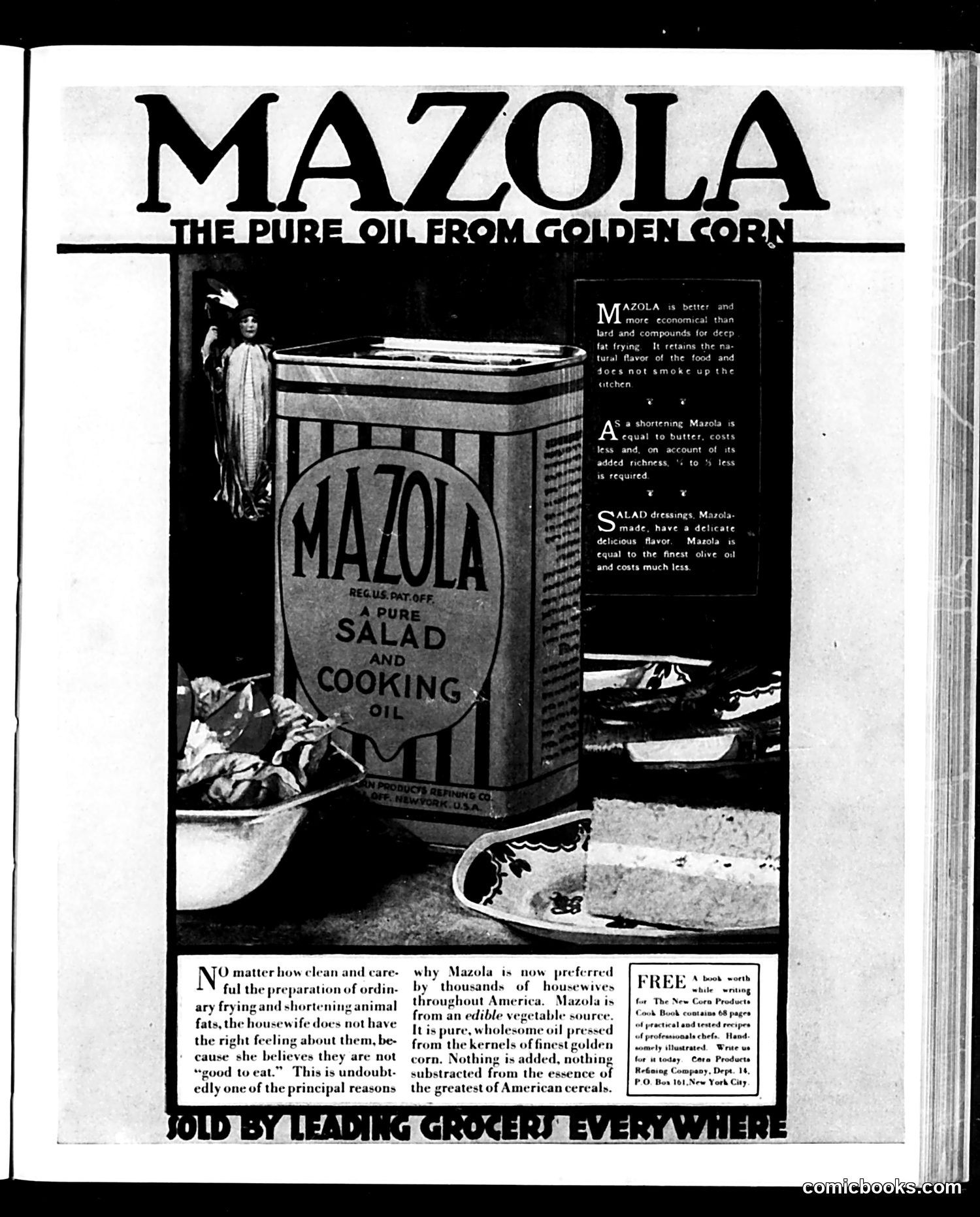
This is **not a political cartoon or satire**—it's a straightforward commercial advertisement for Mazola cooking oil, a corn-based product made by Corn Products Refining Company (New York). The ad targets housewives by claiming Mazola is superior to animal fats for cooking and salad dressing. Key selling points: it's economical, doesn't smoke in the kitchen, retains food flavor, and costs less than olive oil. The copy emphasizes psychological reassurance—animal fats were considered potentially unhealthy ("not good to eat"), so Mazola offers a "pure" vegetable alternative from wholesome American corn. The page includes product imagery, testimonial-style text blocks, and a coupon offering a free cookbook. This represents early 20th-century marketing that combined aspirational messaging with practical home-economics appeals to gain market share against competing cooking fats.
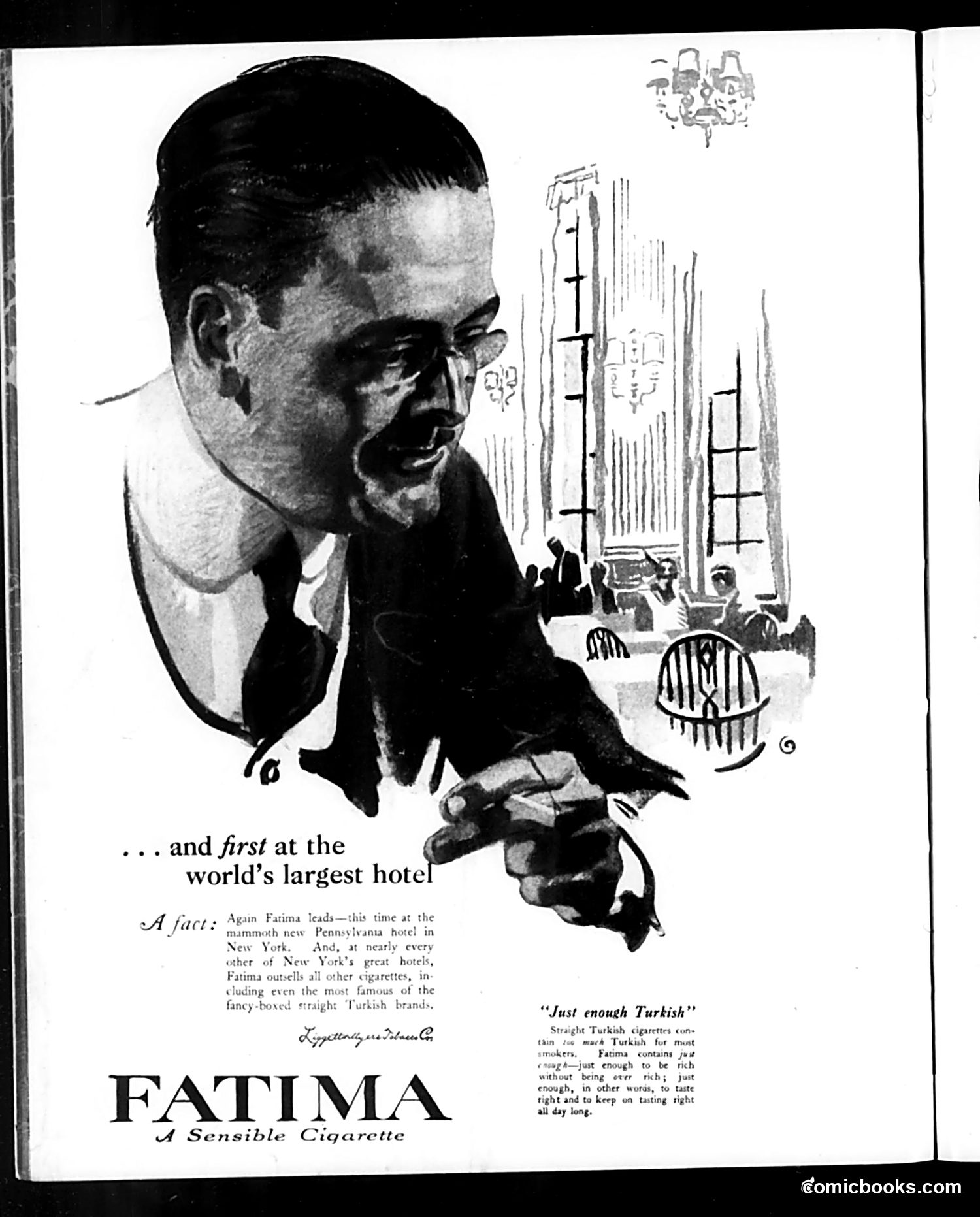
This is primarily a **Fatima cigarette advertisement** disguised as editorial content in Judge magazine. The caricatured man represents an unnamed hotel manager or proprietor at the Pennsylvania Hotel in New York (described as "the world's largest hotel"). The ad's joke plays on competitive brand loyalty: Fatima cigarettes are supposedly "first" at this prestigious establishment, outselling other brands including "fancy-boxed straight Turkish" competitors. The phrase "Just enough Turkish" suggests Fatima's appeal lies in balanced Turkish tobacco content—rich but not excessive. The caricature style is typical of early 20th-century advertising's exaggerated portraiture. This represents the common practice of blending advertisements into magazine editorial sections without clear distinction, presenting commercial claims as factual endorsements from notable figures or establishments.