
Judge, 1920-01-10 · page 5 of 36
Judge — January 10, 1920 — page 5: what you’re looking at
What you’re looking at
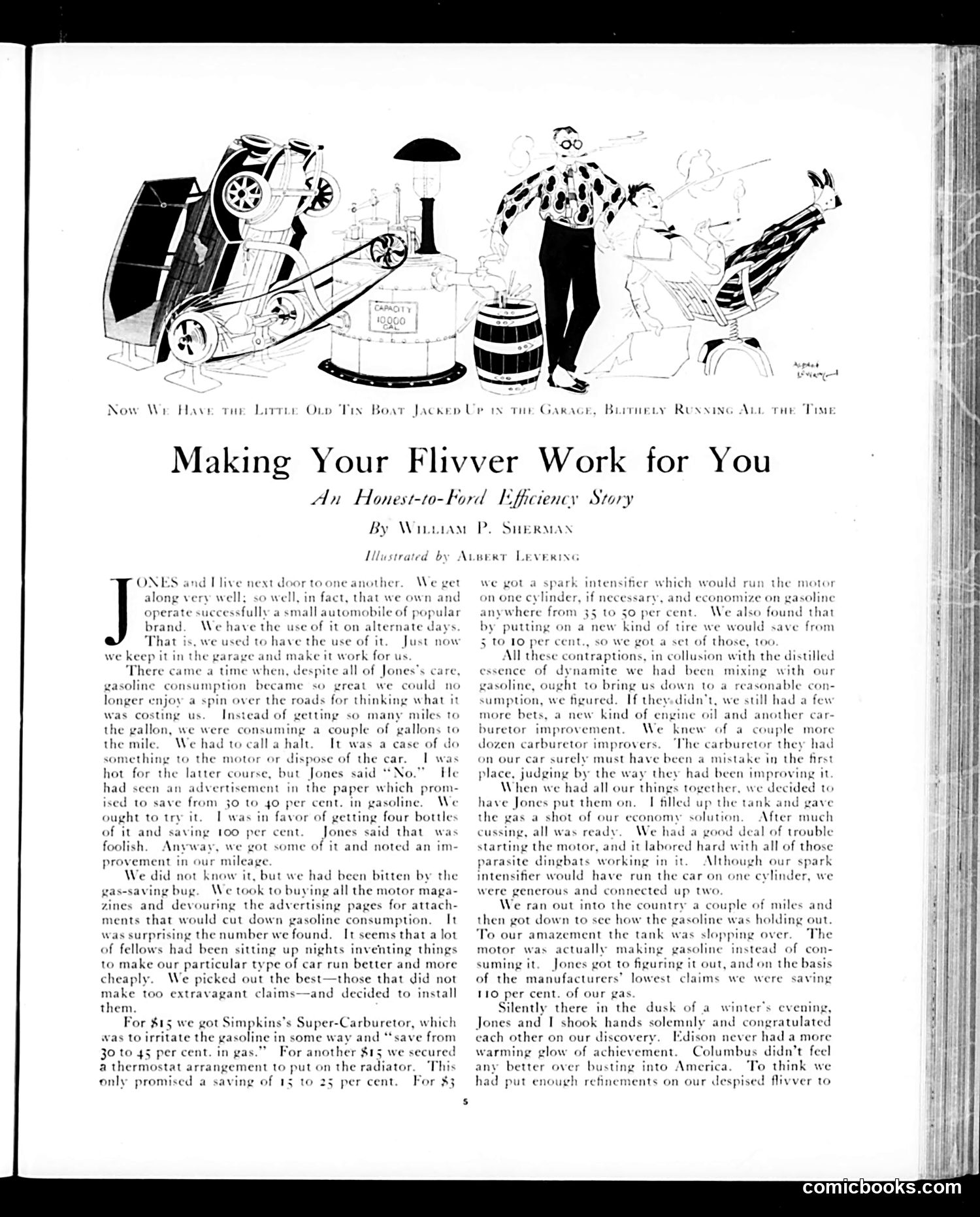
This page combines an illustration with an article titled "Making Your Flivver Work for You" by William P. Sherman. "Flivver" was slang for the Model T Ford, the mass-produced automobile that revolutionized American transportation. The illustration depicts a man and woman with various automotive parts and contraptions, humorously representing DIY efficiency modifications. The article describes practical (if somewhat humorous) attempts to improve fuel economy through carburetor modifications, tire changes, and thermostat adjustments—achieving savings of 10-45 percent on gasoline. This reflects post-WWI America's automotive culture and practical ingenuity during an era when car ownership was becoming widespread but gas consumption remained a genuine concern for average owners. The satire gently mocks the period's obsession with efficiency and mechanical tinkering.
📄 Transcribed text from this page (OCR, searchable)
Machine-transcribed from the original scan — historical spelling and the odd misread are preserved.
ow Wh Livtir Op Tix Boat Have vir Jackep Up ix tur Garacr, Buirneny Ruxxinc Ant tHe ‘Time Making Your Flivver Work for You An Honest-to-kord Kffiiciency Stary By Winsiam P. Hlustrated by ONES a Joor toone another. We along ver operate successfully a small automobile of f brand. We have the use of it on alternate days That is, we used to have the use of it. Just now we ke nd make it work for us There came a time when, despite all of Jones's care, gasoline consumption became so great we could no longer enjoy a spin over the roads for thinking what it etting so many miles iT live next y well; so well, in fact, that we own and yular he garag was costing us. Instead of the gallon, we were consuming a couple of gallons to the mile. We had to calla halt. It was a © of « something to the motor or dispose of the car. | was hot for the latter course, but Jones said “No.” He had seen an advertisement in the paper which prom- ised to save from 30 to 40 per cent. in gasoline. We ought to try it. Iwas in favor of getting four bottles of it and saving 100 per cent Jones said that was foolish. Anyway, we got some of it and noted an im- provement in our mileage We did not know it, but we had been bitten by the gas-saving bug. We took to buying all the motor ma zines and devouring the advertising pages for attach- ments that would cut down gasoline consumption. It was surprising the number we found. It seems that a lot of fellows had been sitting up nights inventing things to make our particular type of car run better and more cheaply. We picked out the best—those that did not make too extravagant claims—and decided to install them. For $15 we got Simpkins’s Super-Carburetor, which was to irritate the gasoline in some way and “save from For another $15 we secured This For 33 30 to 45 per cent. in gas.” a thermostat arrangement to put on the radiator only promised a saving of 15 to 25 per cent. ALBERT SHERMAN LeveRING intensifier Which would run the motor if necessary, and economize on gasoline We also found that would save we got a spark on one cylinder, anywhere from 35 to 30 per cent by putting on a new kind of tire we 5 to 10 per cent., so we got a set of those, too. All these contraptions, in collusion with the distilled essence of dynamite we had been mixing with our . ought to bring us down to a sumption, we figured. If theysdidn’t, we still had a few more bets, a new kind of engine oil and another car- buretor improvement. We knew of a couple more dozen carburetor improvers. ‘The carburetor they had on our car surely must have been a mistake in the first place, judging by the way they had been improving it When we had all our things together, we decided to have Jones put them on. I filled up the tank and gave the gas a shot of our economy solu \fter much We had a good deal of trouble labored hard with all of those t. Although our s from gasolir reasonable co cussing, all was ready starting the motor, and it parasite dingbats working in intensifier would have run the car on one cylin were generous and connected up two We ran out into the country a couple of miles and then got down to sce how the gasoline was holding out. To our amazement the tank was slopy over. The motor was actually making gasoline instead of con- suming it. Jones got to figuring it out, and on the basis of the manufacturers’ claims we were saving 110 per cent. of our gas Silently there in the dusk of a Jones and I shook hands solemnly and congratulated cach other on our discovery. Edison never had a more warming glow of achievement. Columbus didn’t feel any better over busting into America. To think we had put enough refinements on our despised flivver to lowest winter's evening, comicbooks.com