
Judge, 1920-01-10 · page 19 of 36
Judge — January 10, 1920 — page 19: what you’re looking at
What you’re looking at
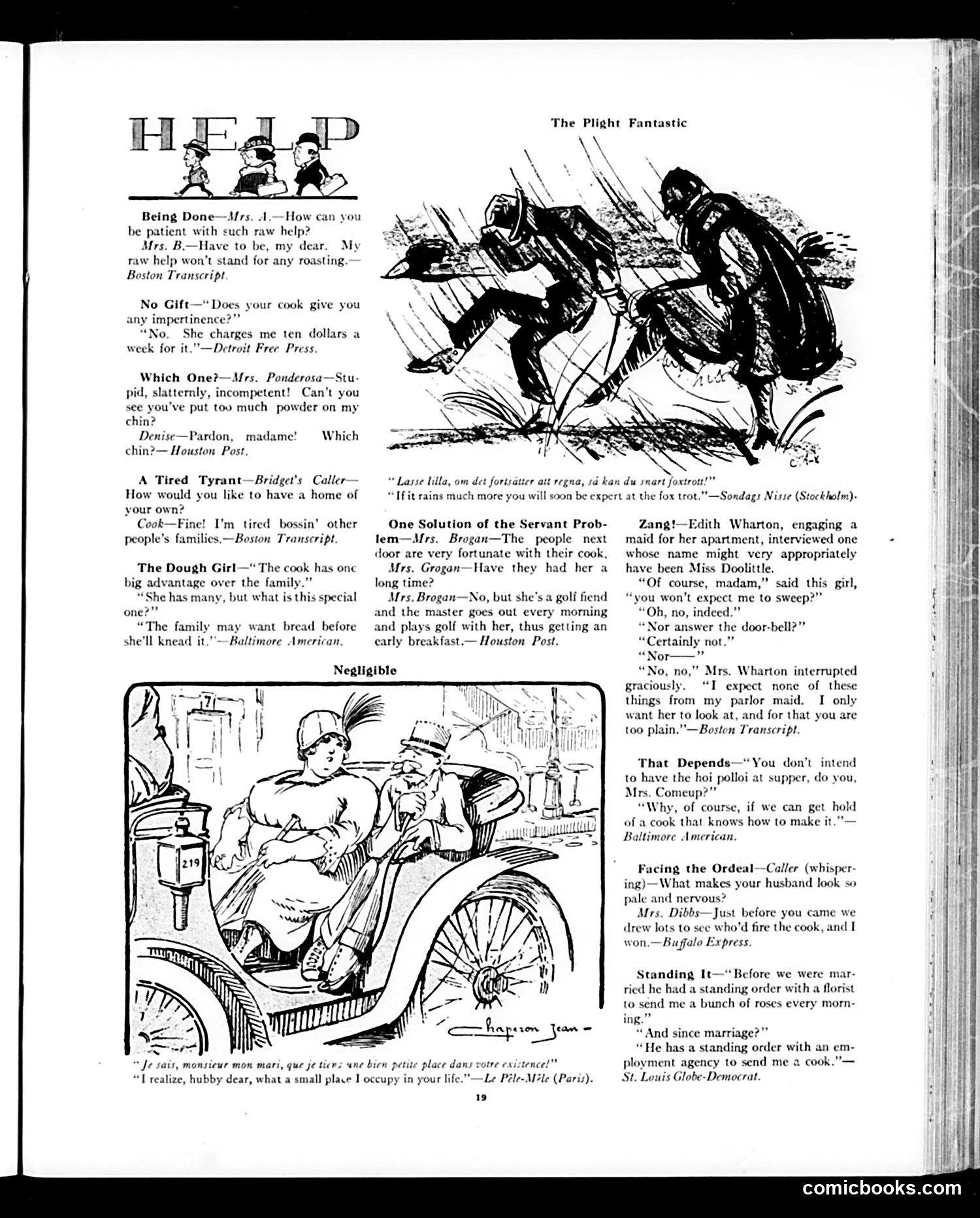
This page satirizes the domestic servant crisis of the early 20th century through multiple short jokes. The central issue: household help—particularly cooks—were increasingly difficult to hire and retain, and servants themselves were growing less deferential to employers. The humor operates on class anxiety: wealthy women (Mrs. Ponderosa, Mrs. Comeup, Mrs. Wharton) struggle with insubordinate or incompetent servants who demand respect, higher wages, or simply refuse traditional roles. One joke features a cook who'd rather manage her own household than work for others; another shows a servant so plain the employer won't hire her despite her refusal to perform basic duties. The "Negligible" cartoon and Swedish reference suggest this was a widespread phenomenon, not just American. The final joke—contrasting pre-marital roses with post-marital employment agency orders—frames finding a cook as harder than courtship, reflecting genuine domestic labor shortages of the era.
📄 Transcribed text from this page (OCR, searchable)
Machine-transcribed from the original scan — historical spelling and the odd misread are preserved.
Being Done—Mrs. .1.—How can you be patient with such raw help? Mrs. B.—Have to be, my dear. My raw help won’t stand for any roasting. Boston Transcript. No Gift—“Does your cook give you any impertinence?” “No. She charges me ten dollars a week for it."”"—Detroit Free Press. Which One?—Mrs. Ponderosa—Stu- pid, slatternly, incompetent! Can’t you see you've put too much powder on my chin? Denise—Pardon, madame! Which chin?— Houston Post. A Tired Tyrant—Bridget’s Caller How would you like to have a home of your own? Cook—Fine! I’m tired bossin’ other people’s familics —Boston Transcript. The Dough Girl—“ The cook has onc big advantage over the fa “She has many, but what is this special one?” “The family may want bread before she'll knead it.’’—Baltimore American, The Plight Fantastic ~ “Lasse lilla, om det fortsatter att regna, sd kan du snart foxtrott!”” “ [fit rains much more you will soon be expert at the fox trot.”"—Sondags Nise (Stockholm). One Solution of the Servant Prob- lem—AMrs. Brogan—The people next door are very fortunate with their cook, Mrs. Grogan—Have they had her a long time? Mrs. Brogan—No, but she’s a golf fiend and the master goes out every morning and plays golf with her, thus getting an carly breakfast.— Houston Post. Negligible le sais, monsicur mon mari, que je tiers ane bien petite place dan. “I realize, hubby dear, what a small place I occupy in your life.” existence!” Le Péle-Mile (Paris). 19 Zang!—Edith Wharton, engaging a maid for her apartment, interviewed one whose name might very appropriately have been Miss Doolittle. “Of course, madam,” said this girl, “you won’t expect me to sweep?” Oh, no, indeed.” Nor answer the door-bell?” tainly not.” vor a . no,” Mrs, Wharton interrupted graciously. “I expect none of these things from my parlor maid. I only want her to look at, and for that you are too plain.” —Boston Transcript. That Depends—“ You don’t intend to have the hoi polloi at supper, do you, Mrs. Comeup?” “Why, of course, if we can get hold of a cook that knows how to make it.”"— Baltimore American, Facing the Ordeal—Caller (whisper- ing)—What makes your husband look so pale and nervous? Mrs, Dibbs—Just before you came we drew lots to see who'd fire the cook, and I won.—Buffalo Express Standing It—“ Before we were mar- ried he had a standing order with a florist to send me a bunch of roses every morn- ing.” “And since marriage?” “He has a standing order with an em- ployment agency to send me a cook.”-— St. Louis Globe-Democrat. comicbooks.com