
Judge, 1920-01-10 · page 24 of 36
Judge — January 10, 1920 — page 24: what you’re looking at
What you’re looking at
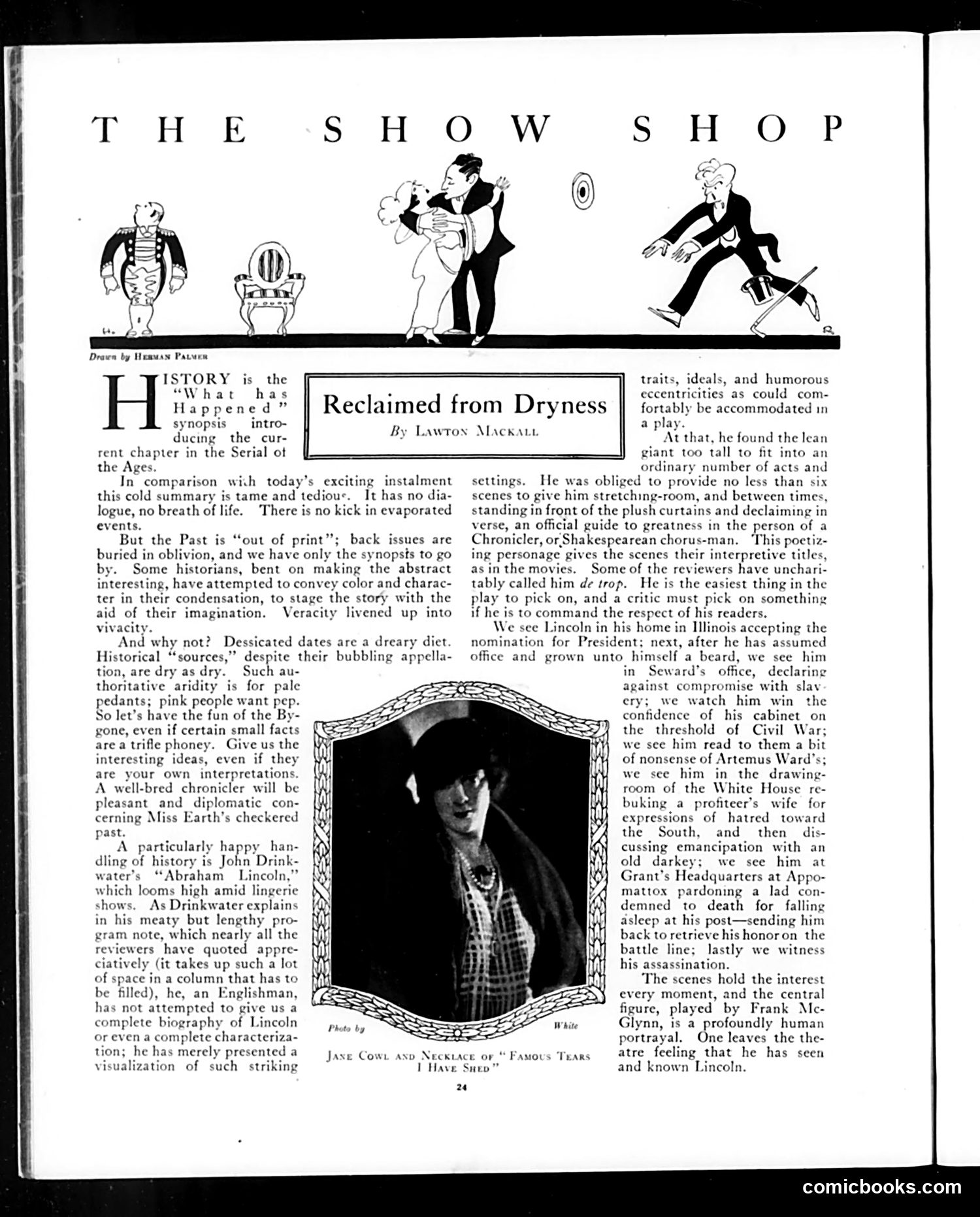
This page reviews John Drinkwater's play "Abraham Lincoln," which was a contemporary theatrical production. The article defends dramatizing history with theatrical flair rather than dry factual recitation. The satire targets academic pedantry: historians who present "desiccated dates" and abstract facts bore audiences, while dramatists who visualize historical figures and scenes—even with some invented details—engage people emotionally. The author argues there's nothing wrong with this approach; a "well-bred chronicler" can present an interpretive visualization rather than complete biographical accuracy. Drinkwater's six-scene play depicts Lincoln at key moments: accepting the presidency, managing his cabinet during the Civil War's outbreak, and his assassination. The reviewer praises actor Frank McGlynn's "profoundly human" portrayal. The only mild criticism is the Shakespearean "Chorus" figure who provides interpretive commentary between scenes—called *de trop* (excessive) by some critics, though the reviewer finds it necessary exposition. The cartoons at top satirize theatrical excess and audience reactions.
📄 Transcribed text from this page (OCR, searchable)
Machine-transcribed from the original scan — historical spelling and the odd misread are preserved.
Drawn by Heawax Patwen ISTORY the “What has Happened ” synopsis __ intro- ducing the cur- rent chapter in the Serial ot the Ages. In comparison wich today’s exciting instalment this cold summary is tame and tedious. It has no dia- logue, no breath of life. There is no kick in evaporated events. But the Past is “out of print”; back issues are buried in oblivion, and we have only the synopsts to go by. Some historians, bent on making the abstract interesting, have attempted to convey color and charac- ter in their condensation, to stage the story with the aid of their imagination. Veracity livened up into vivacity. And why not? Dessicated dates are a dreary diet. Historical “sources,” despite their bubbling appella- tion, are dry as d Such au- thoritative aridity is for pale pedants; pink people want pep. So let’s have the fun of the By- gone, even if certain small facts area trifle phoney. Give us the interesting ideas, even if they are your own interpretations. A well-bred chronicler will be pleasant and diplomatic con- cerning Miss Earth’s checkered past. A particularly happy_han- dling of history is John Drink- water’s “Abraham Lincoln,” which looms high amid lingerie shows. As Drinkwater explains in his meaty but lengthy pro- gram note, which nearly all the reviewers have quoted appre- ciatively (it takes up such a lot of space in a column that has to be filled), he, an Englishman, has not attempted to give us a complete biography of Lincoln or even a complete characteriza- tion; he has merely presented a visualization of such striking B Jaxe Cowt Reclaimed from Drynes Lawtox Mackaun AND NECKLACE 1 Have Suep” 24 traits, ideals, and humorous eccentricities as could com- fortably be accommodated in a play. At that, he found the lean giant too tall to fit into an ordinary number of acts and settings. He was obliged to provide no less than six scenes to give him stretching-room, and between times, standing in front of the plush curtains and declaiming in verse, an official guide to greatness in the person of a Chronicler, or Shakespearean chorus-man. ‘This poetiz- ing personage gives the scenes their interpretive titles, as in the movies. Some of the reviewers have unchari- tably called him de trop. He is the easiest thing in the play to pick on, and a critic must pick on something if he is to command the respect of his readers. We see Lincoln in his home in Illinois accepting the nomination for President; next, after he has assumed office and grown unto himself a beard, we see him in Seward’s office, declaring against compromise with slav ery; we watch him win the confidence of his cabinet on the threshold of Civil War; we see him read to them a bit of nonsense of Artemus Ward’s; we see him in the drawing- room of the White House re- buking a profiteer’s wife for expressions of hatred toward the South, and then dis- cussing emancipation with an old darke we see him at Grant’s Headquarters at Appo- mattox pardoning a lad con- demned to death for falling asleep at his post—sending him back to retrieve his honoron the battle line; lastly we witness his assassination. The scenes hold the interest every moment, and the central figure, played by Frank Mce- Glynn, is a profoundly human portrayal. One leaves the the- atre feeling that he has seen Tears t and known Lincoln. or “ Famous comicbooks.com