
A complete issue · 36 pages · 1919
Judge — December 20, 1919
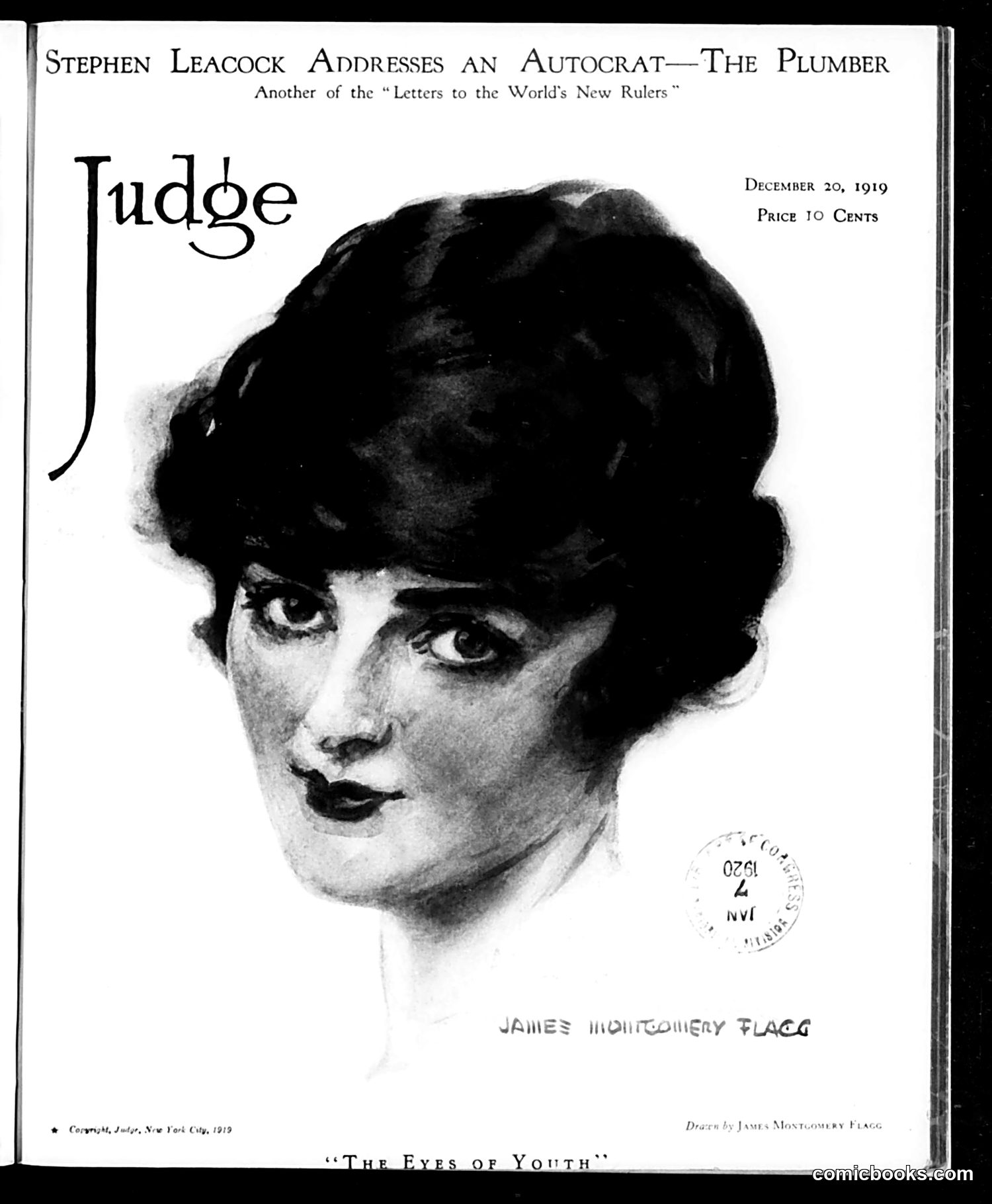
This is the cover of Judge magazine from December 20, 1919, featuring a portrait illustration by James Montgomery Flagg titled "The Eyes of Youth." The page indicates this is part of a series called "Letters to the World's New Rulers," with Stephen Leacock addressing "an Autocrat—The Plumber." The portrait shows a young woman with short, dark hair in a 1920s style—likely representing "youth" in the post-WWI era. The subtitle "The Eyes of Youth" suggests the article or accompanying content examines youth's perspective or idealism during the transitional period after World War I. However, without access to the interior content, the specific satirical target and Leacock's argument remain unclear from this cover alone.
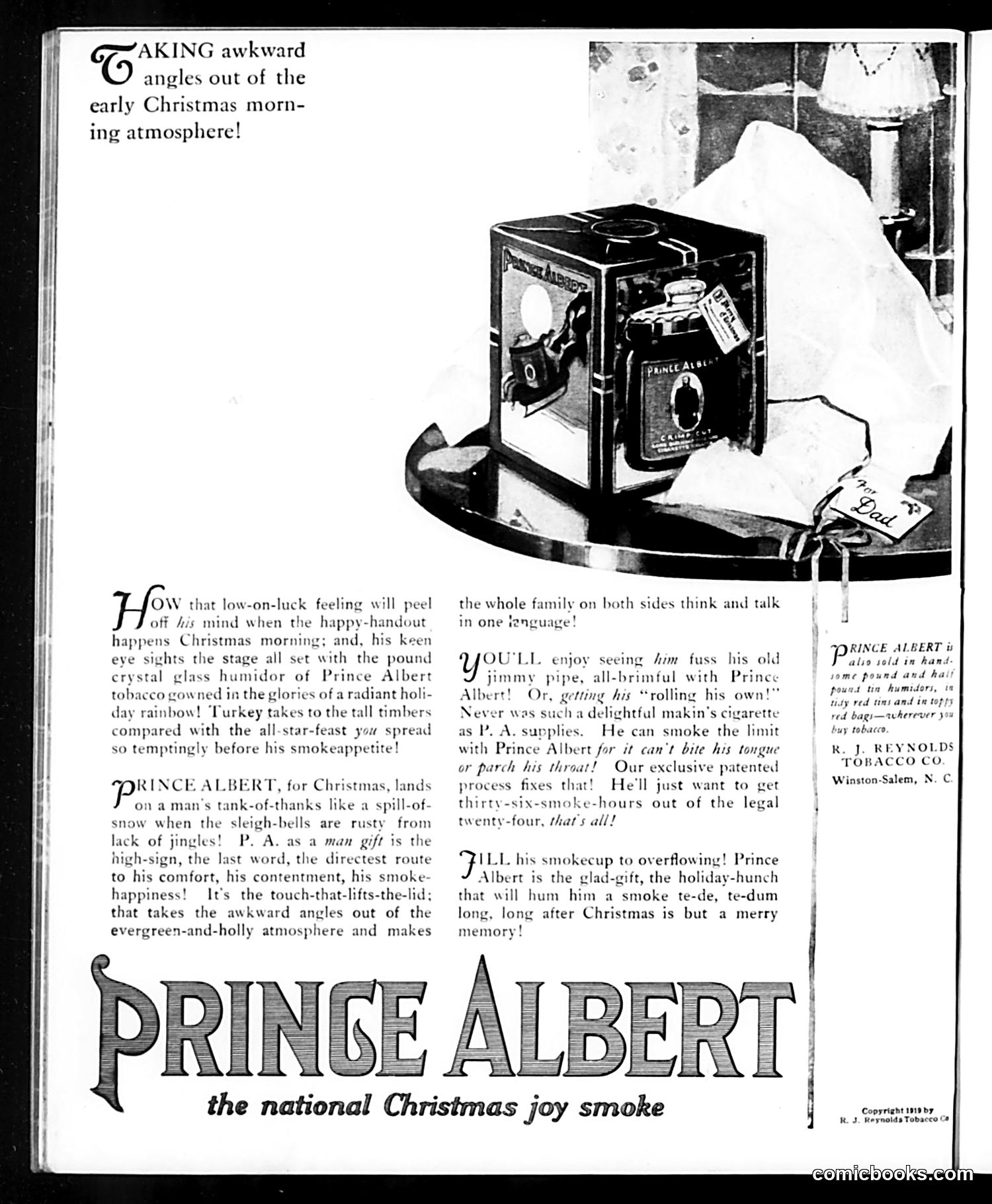
This is a **cigarette advertisement**, not political satire. It promotes Prince Albert tobacco as an ideal Christmas gift, using humor to address social awkwardness rather than making political commentary. The ad jokes that giving cigarettes solves the problem of gift-giving anxiety—a man won't feel "low-on-luck" on Christmas morning if he receives Prince Albert. The copy emphasizes the product's appeal: it can be smoked in a pipe, has no throat-irritation due to a "patented process," and provides "thirty-six smoke-hours" of enjoyment. The imagery shows the product prominently displayed as a wrapped gift. The satire here is gentle social commentary about masculine gift-giving and comfort, not political commentary. This reflects early 20th-century advertising norms when cigarettes were marketed as desirable, respectable consumer goods with no health warnings.
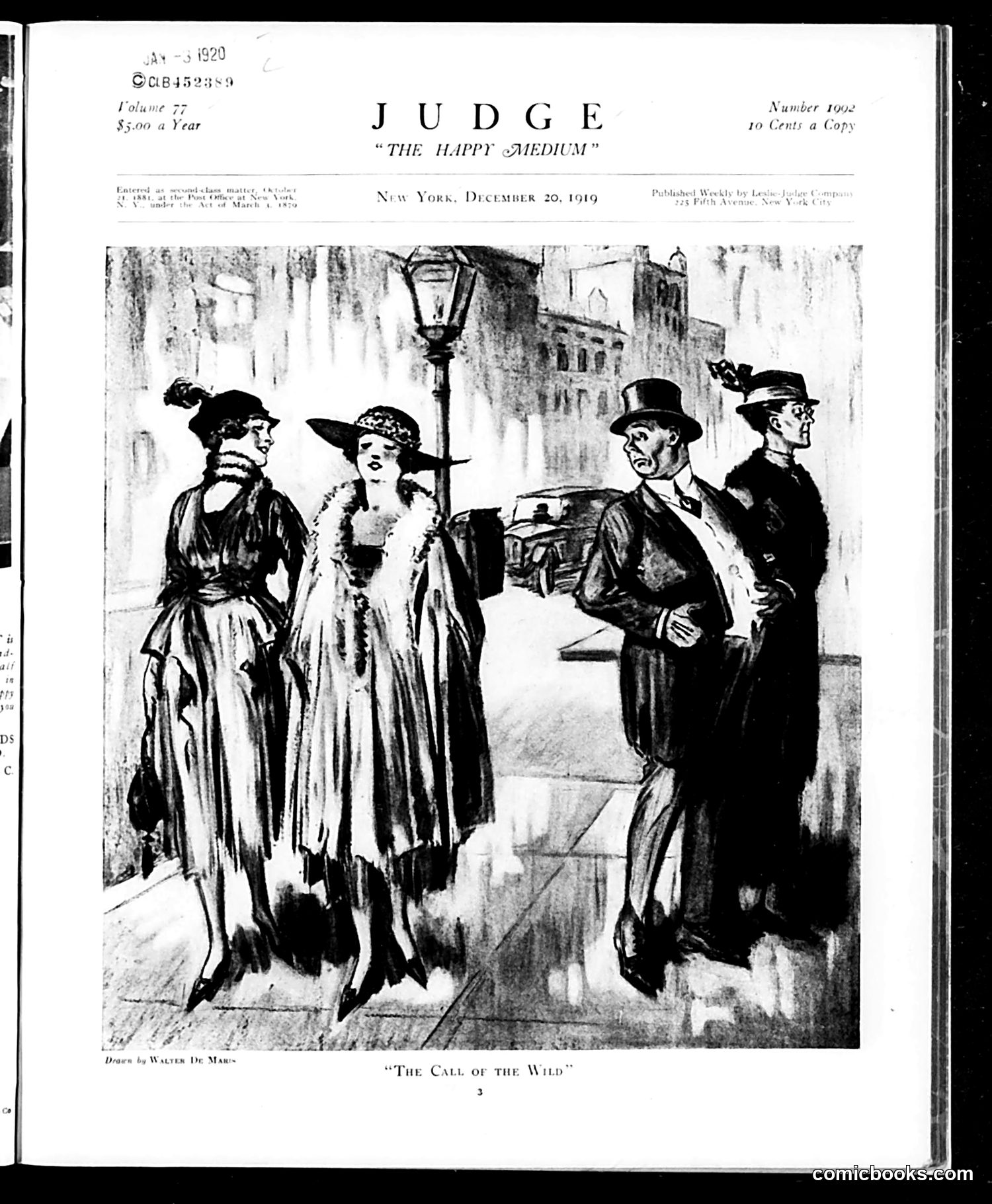
This cartoon by Waiter de Maris depicts four well-dressed urbanites on a city street, seemingly responding to an irresistible impulse. The title "The Call of the Wild" suggests they're experiencing a primal urge despite their refined appearance and formal attire. The specific meaning is unclear without additional context, but the satire likely mocks a contemporary social trend—possibly Prohibition-era characters seeking illegal alcohol, or perhaps urban dwellers succumbing to some fashionable fad or vice. The contrast between their genteel presentation and their apparent compulsion to heed "the wild" suggests the cartoon critiques either hypocrisy or the irresistible appeal of forbidden behavior among respectable society.
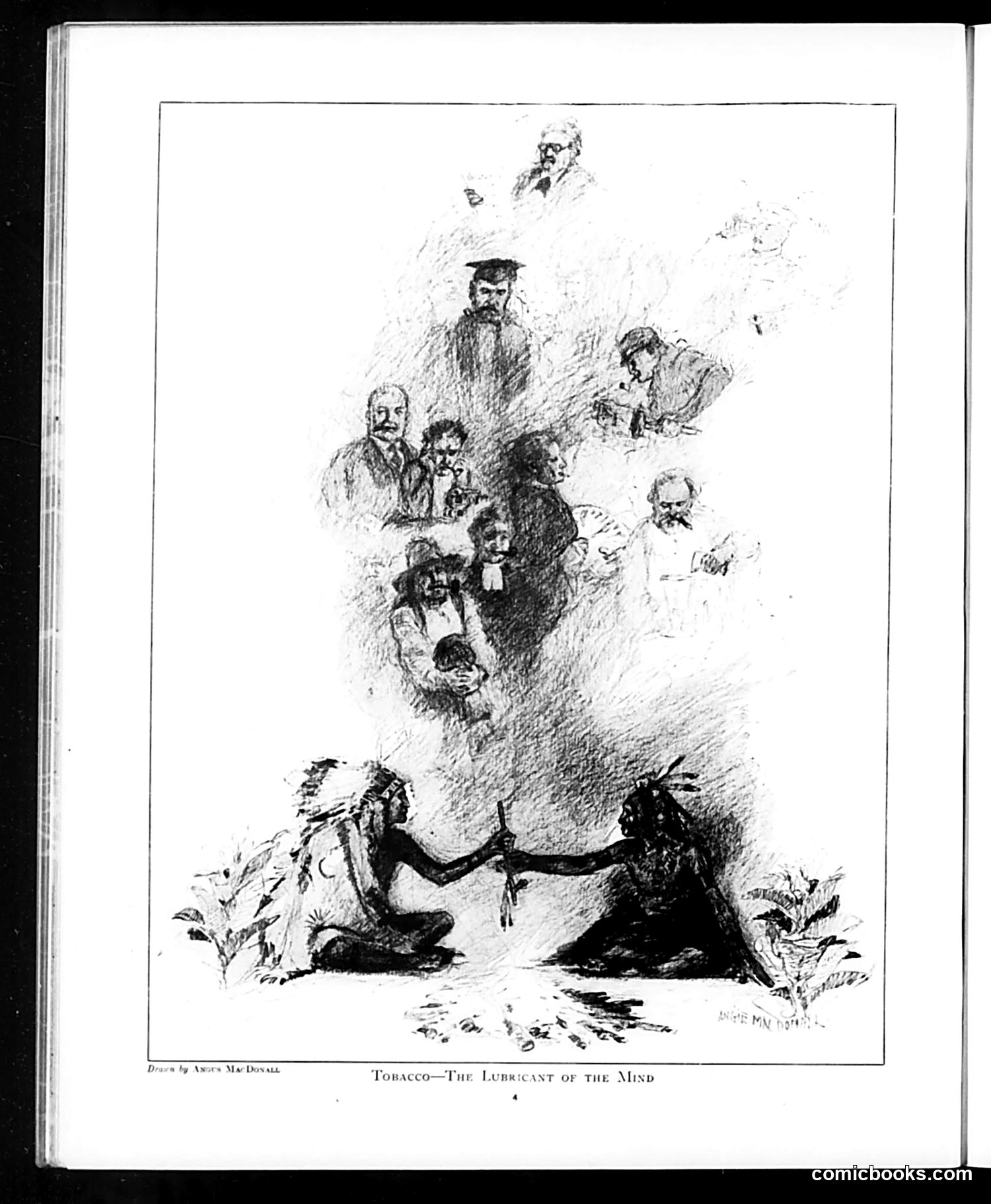
This satirical drawing by Ames MacDowell depicts tobacco smoke literally elevating various human figures upward. The cartoon uses the metaphor of smoke as a "lubricant" to mock the popular belief that tobacco enhanced mental function and creativity. The figures appear to represent different social types—scholars, gentlemen, and laborers—all being lifted or influenced by tobacco's effects. The artist presents this ironically: rather than showing intellectual enlightenment, the rising figures suggest intoxication or delusion. This likely critiques the 19th-century cultural practice of romanticizing tobacco use as mentally stimulating, when the cartoon suggests it merely produces smokiness and elevation without genuine intellectual benefit. The satire targets both tobacco promotion and the gullibility of those who believed such claims.
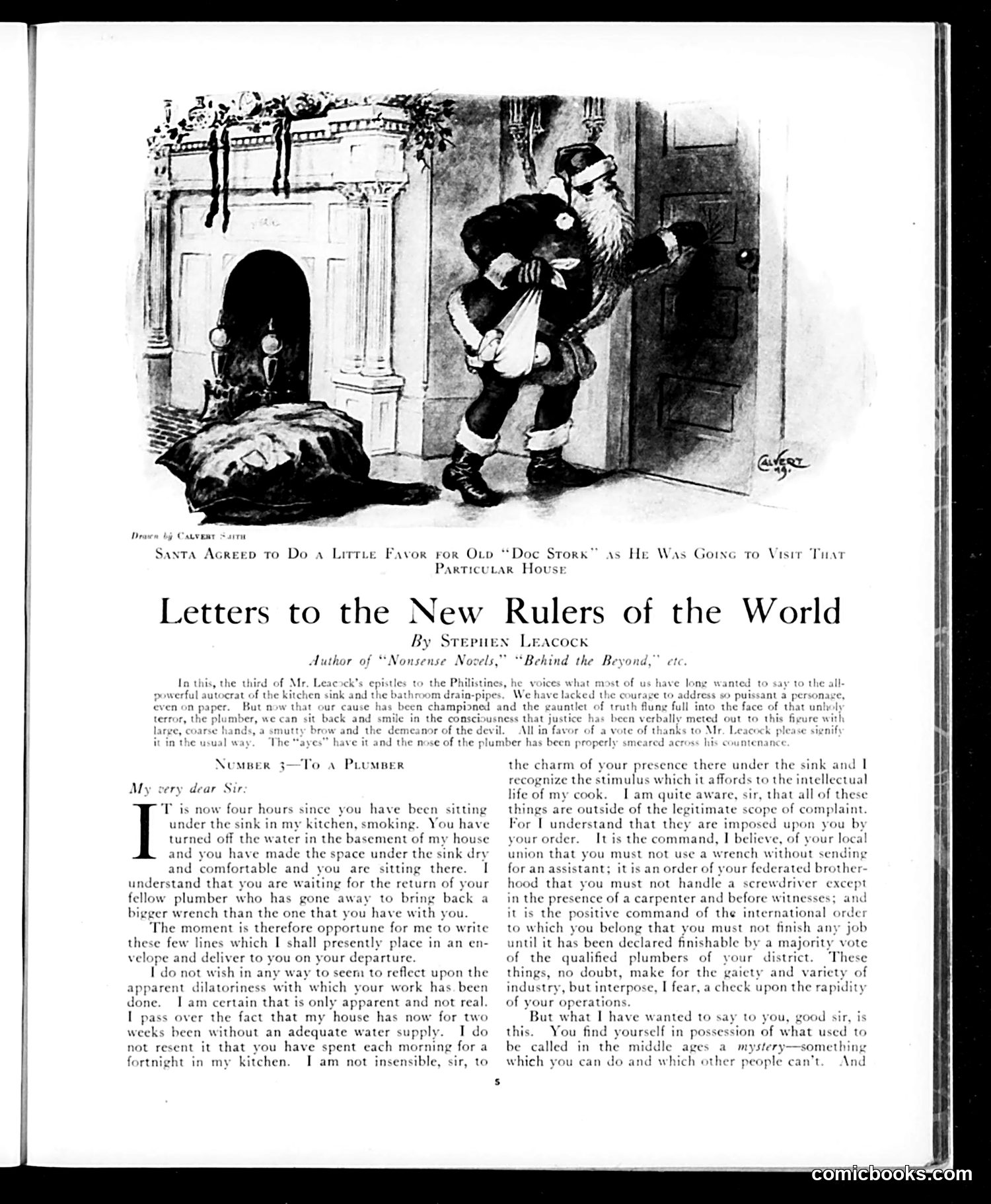
The cartoon depicts Santa Claus carrying a child, heading toward a house—illustrating the caption about Santa agreeing "to do a little favor for old 'Doc Stork'" during a house visit. This is a dated euphemism: "Doc Stork" refers to the stork delivering babies, so the joke plays on Santa as an accomplice in childbirth or fertility matters. The article below, "Letters to the New Rulers of the World" by Stephen Leacock, is a satirical piece addressed to plumbers. The first letter complains about a plumber's poor service and high-handedness, sarcastically suggesting plumbers now wield such power they're like rulers. The satire mocks how essential tradespeople had become—or how they acted superior to their employers. This reflects early 20th-century class tensions and the growing power of organized labor.
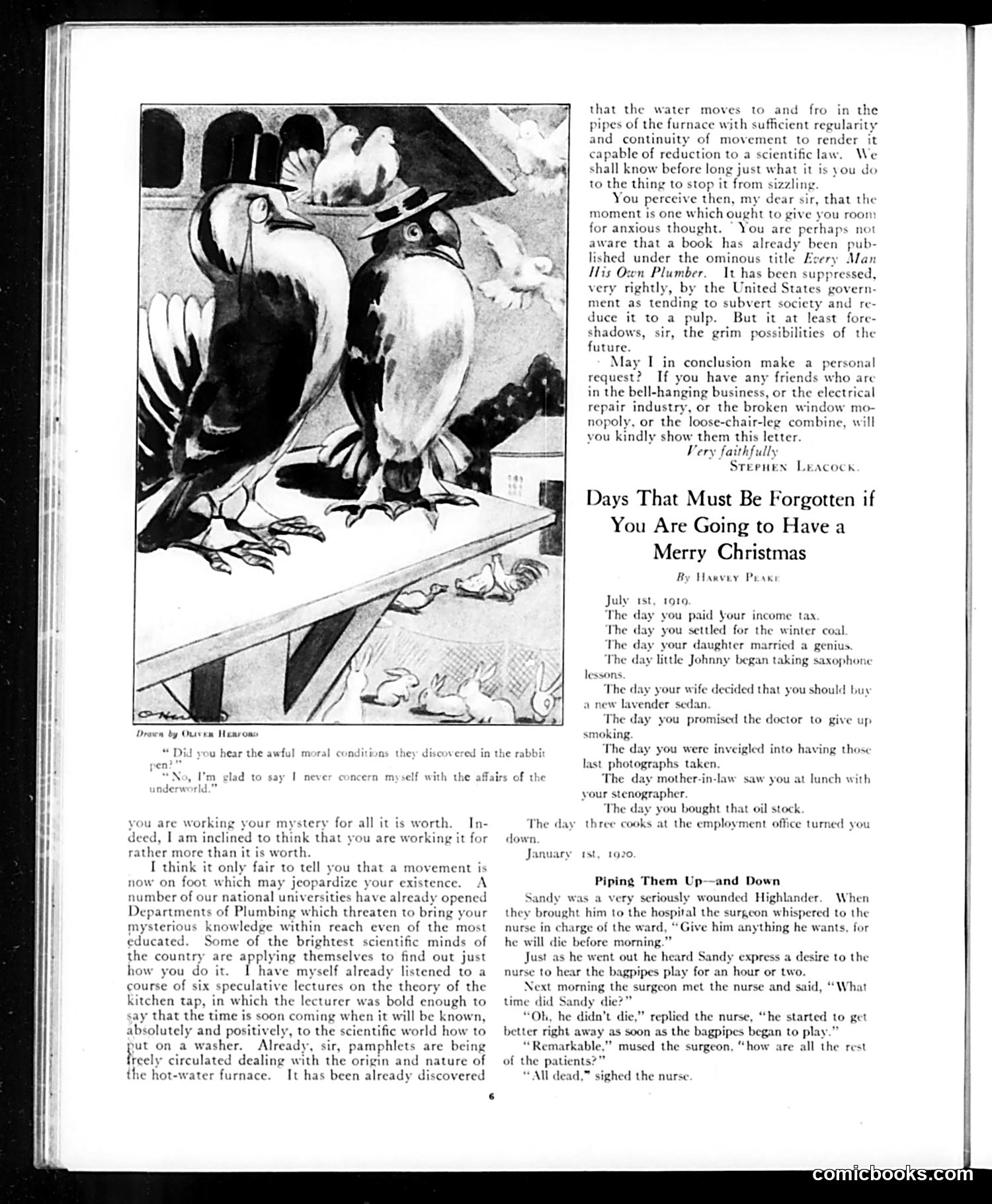
The main illustration depicts **anthropomorphic birds (likely roosters or similar fowl) near plumbing fixtures**, drawn by Cesare Mazzoni. The accompanying text discusses plumbing and furnace mechanics, suggesting this is satirical commentary on the **plumbing industry or household management**. The caption references "moral conditions" discovered in plumbing work, implying plumbers encounter unsavory domestic situations. This appears to be **social satire about what service workers observe in homes**—a common Judge magazine theme mocking middle-class pretensions. Below are unrelated pieces: Stephen Leacock's letter about industrial concerns and Harvey Peake's humorous article about forgettable days, listing mundane 1919-1920 life events (tax day, daughter's marriage, doctor visits). These represent typical magazine miscellany rather than unified editorial content.
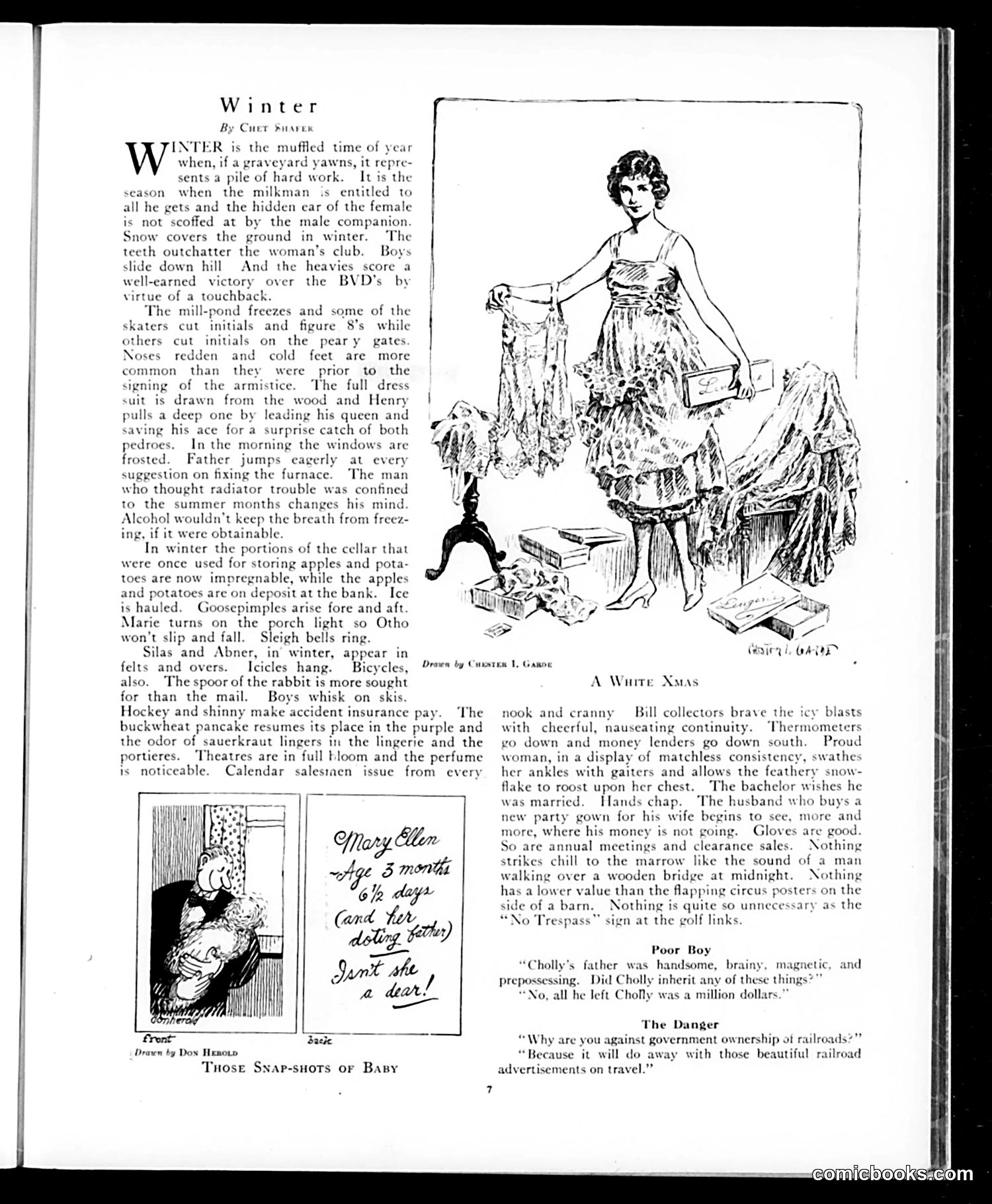
**"Winter" by Chet Shafer** is a humorous essay about seasonal hardships, with comedic observations about cold weather's effects: frozen ponds, radiator troubles, bill collectors braving "icy blasts," and women bundling ankles in gaiters. The humor relies on everyday winter annoyances familiar to 1920s readers. **"Those Snap-shots of Baby"** (illustrated by Don Herold) appears to be a joke about baby photography—the drawing shows parents displaying infant photos. **"A White Xmas"** depicts a woman surrounded by holiday shopping chaos and packages—satirizing consumer excess during Christmas season. **"Poor Boy"** jokes about class: a wealthy father leaves his son "a million dollars" but none of his positive qualities (handsomeness, brains). **"The Danger"** satirizes opposition to government railroad ownership, suggesting critics value railroad advertisements more than public benefit—a dig at capitalism prioritizing commercialism over social good. This reflects 1920s debates over government regulation.
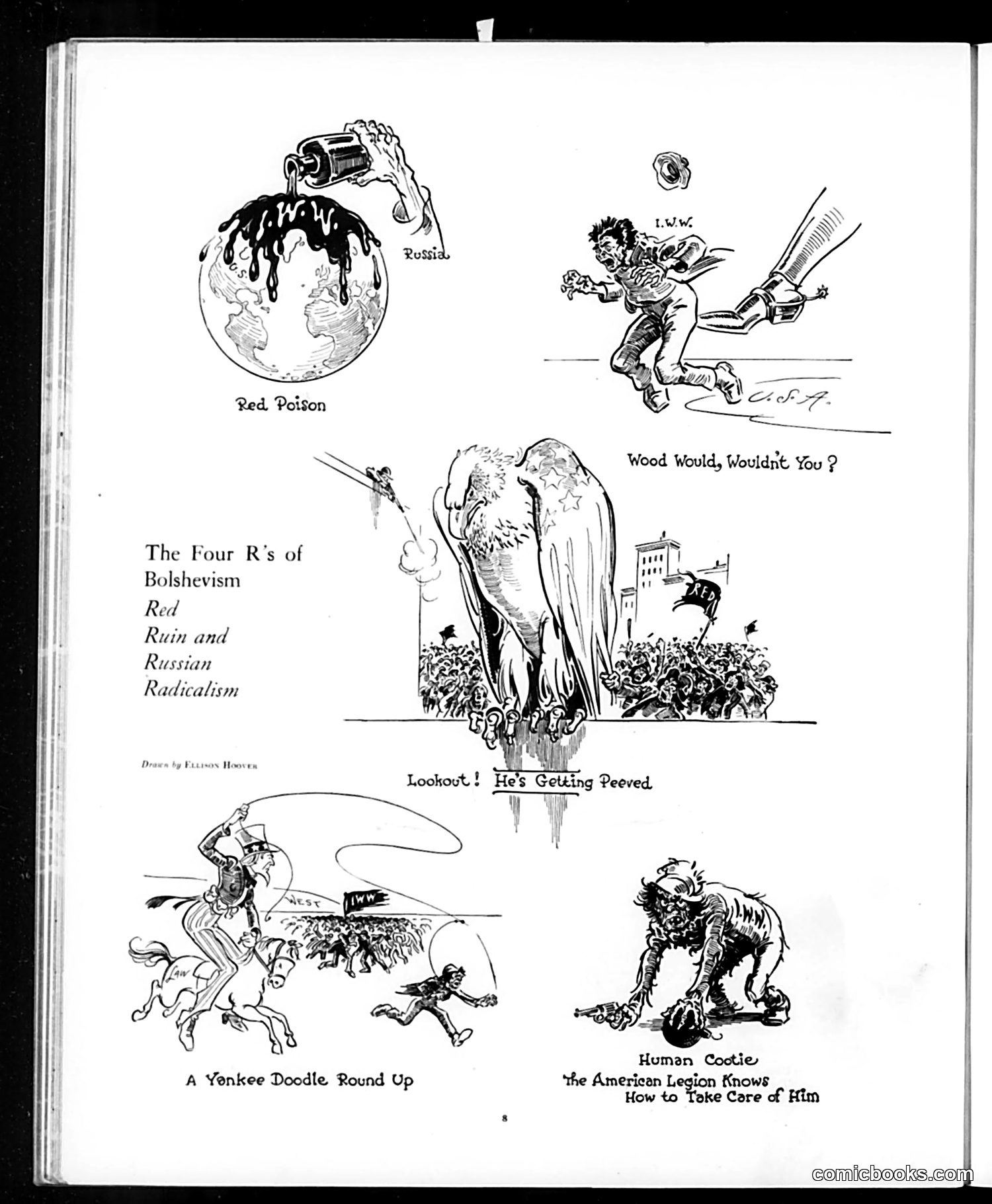
This Judge magazine page satirizes anti-Bolshevik sentiment during the Red Scare era (likely 1918-1920s). The central concept frames Bolshevism through "Four R's": Red, Ruin, Russian, and Radicalism. The cartoons depict Bolshevism as a threatening foreign menace. Top panels show Russia "poisoning" the world and a demonic figure spreading destruction. The bottom panels illustrate American responses: cowboys ("Yankee Doodle") lassoing Bolshevism, and the American Legion violently suppressing it ("Human Cootie"). The satire supports aggressive anti-communist action, portraying Bolshevism as an external plague requiring military-style containment. The caricatures emphasize the foreign/alien nature of the threat, while celebrating American institutions (military, Legion) as protectors against radicalism. This reflects mainstream American Cold War anxiety preceding the actual Cold War.
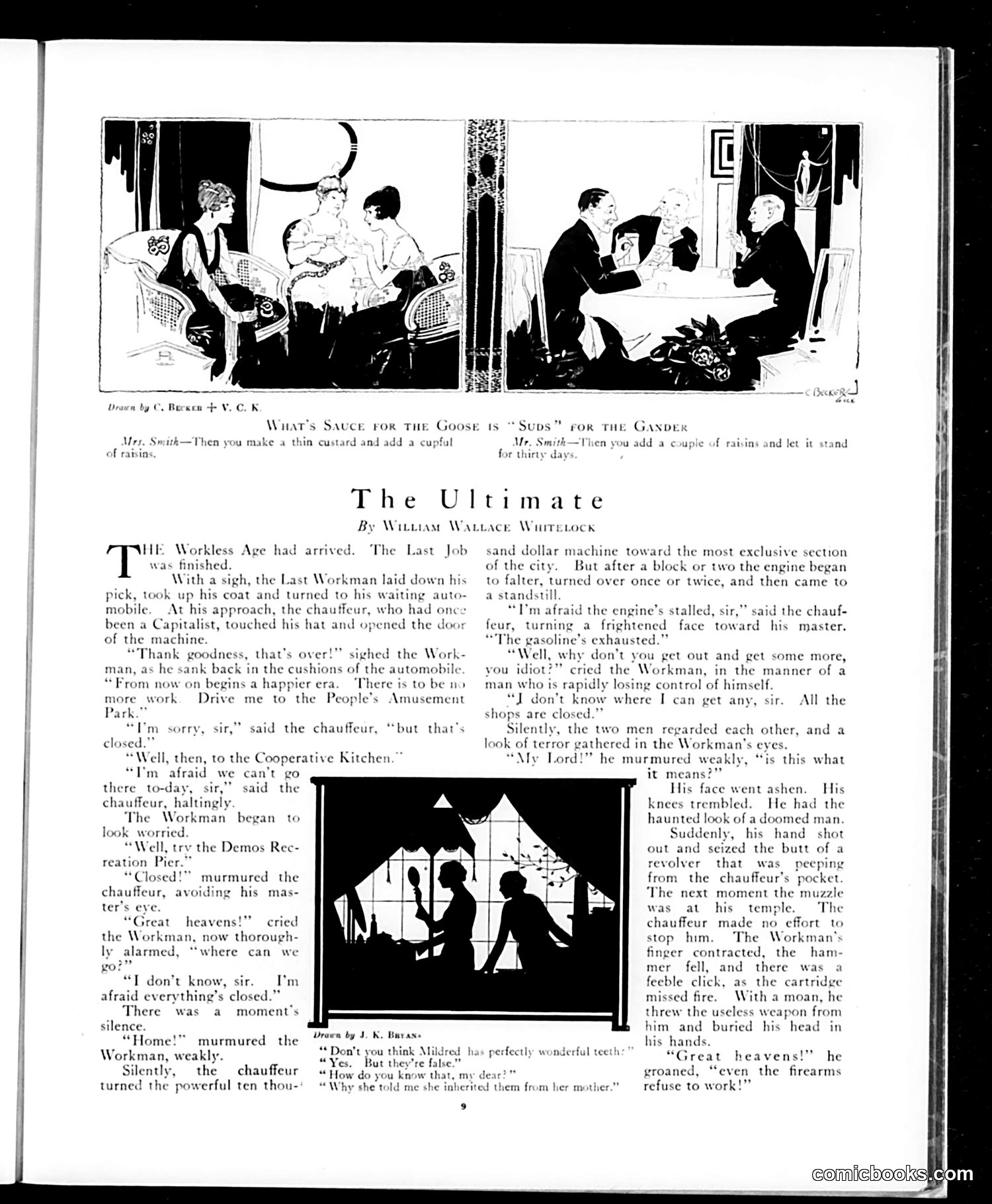
This satirical story depicts a dystopian "Workless Age" where automation has eliminated all jobs. The narrative follows the "Last Workman," who discovers that society has collapsed into complete dependency on mechanical systems and cooperative institutions. The satire targets early 20th-century anxieties about technological unemployment and socialist organization. When the workman seeks leisure at various public facilities (amusement park, cooperative kitchen, recreation center), all are closed—suggesting that without workers, even utopian collective systems fail. The climax—where even firearms refuse to function—represents total societal breakdown. The humor is dark: the former capitalist chauffeur and workman are equally helpless. The story mocks both fears of automation eliminating human purpose and optimism about socialist alternatives, suggesting neither system accounts for human agency or survival needs. The upper cartoons show domestic dining scenes, likely contrasting pre- and post-work social arrangements, though the specific joke requires clearer resolution.
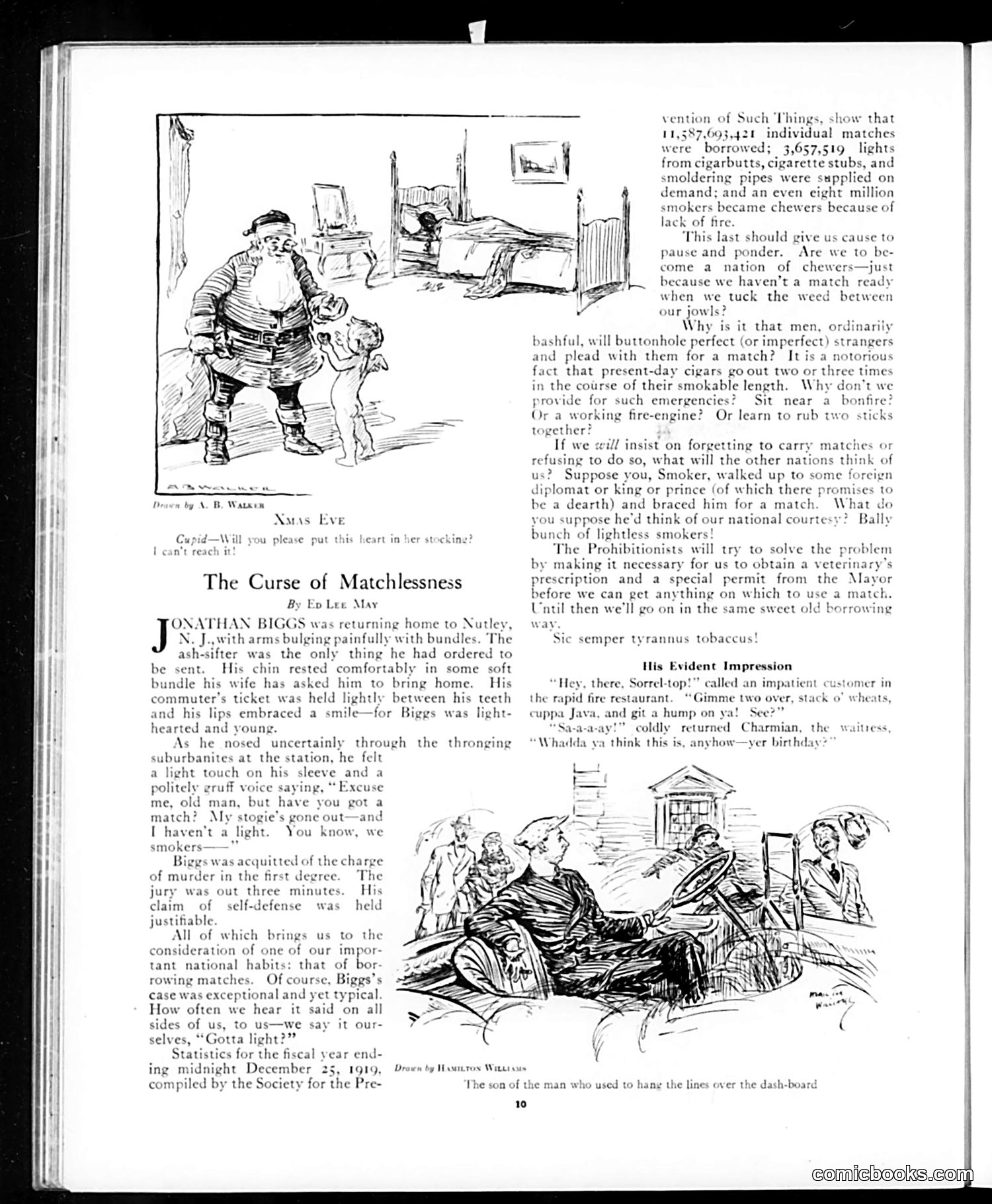
This 1919 *Judge* magazine page satirizes American men's dependence on borrowing matches—a social habit the author treats as absurdly symptomatic of national character decline. **The Main Satire:** The article "The Curse of Matchlessness" mocks how ordinary men will shamelessly approach strangers (even diplomats or royalty) to beg for a match, yet cigars of the era constantly went out, creating perpetual need. The satire suggests this reflects broader moral weakness: Americans are becoming a "nation of chewers" rather than smokers because they won't carry matches. **The Illustrations:** The top cartoon shows Santa Claus with children, captioned about putting "this heart" in a stocking—likely part of a separate holiday piece. The lower drawing depicts a casual street or park scene with multiple figures. **The Point:** This is gentle social mockery of masculine etiquette and planning failures, treating a mundane inconvenience as emblematic of national character—typical of *Judge*'s satirical approach to everyday American life.
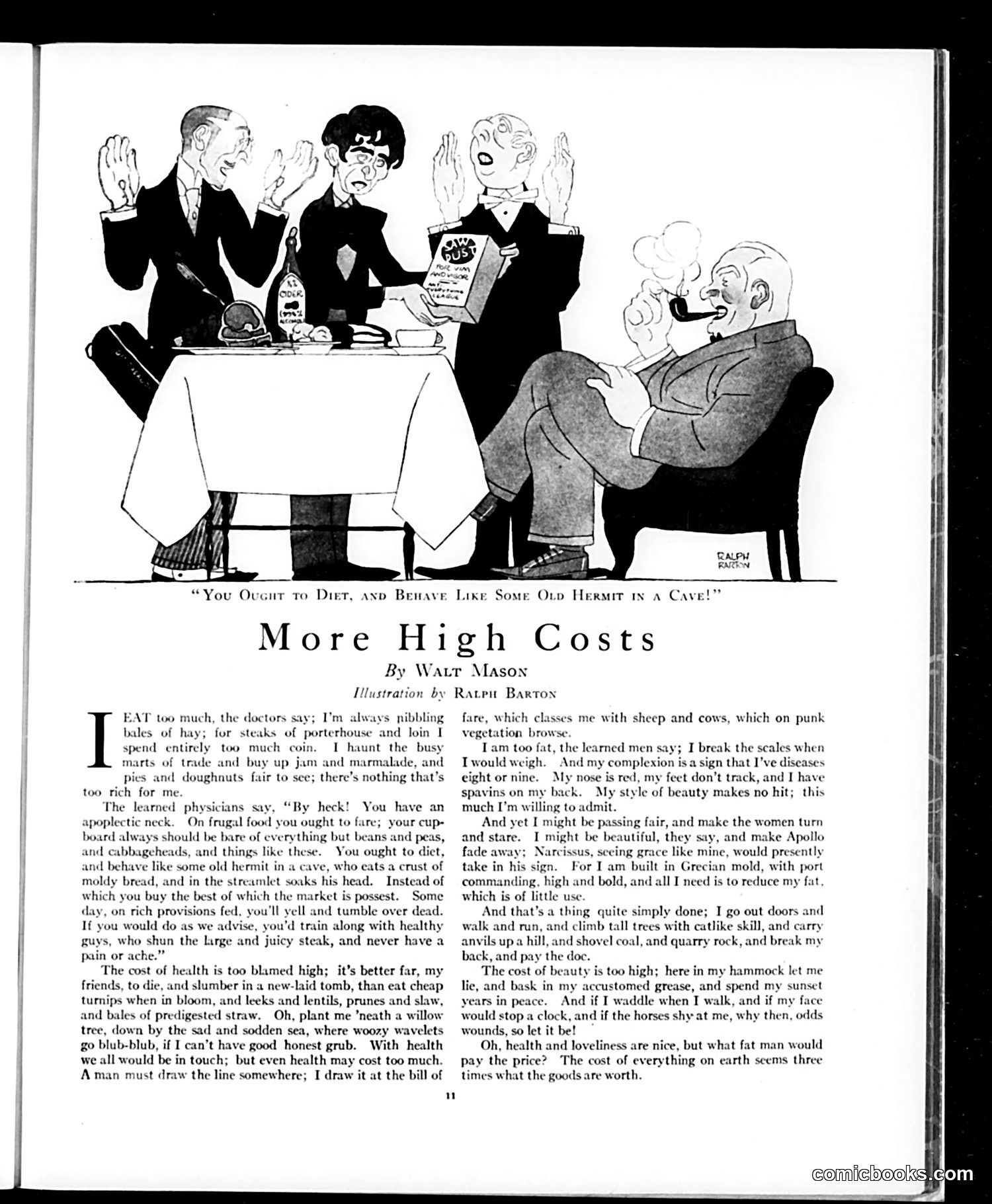
This is a humorous essay-cartoon about the tension between health advice and economic reality during an era of rising living costs (likely early 20th century). **The Setup:** A portly man sits relaxed while three well-dressed figures (appearing to be doctors or health advisors) gesture frantically at him, holding what looks like a diet book or health guide. **The Satire:** Mason mocks physicians who demand he eat cheaply—beans, cabbage, lentils—while avoiding expensive meats and rich foods. The narrator sarcastically argues that achieving health through frugal dieting is economically unreasonable. His logic: maintaining health requires expensive exercise equipment, doctor visits, and gym memberships, making the total cost prohibitive. He concludes it's cheaper to simply die than pursue health. **The Point:** This satirizes the growing cost-of-living crisis and exposes how health advice ignores economic realities for working people. The cartoon critiques doctors for prescribing remedies only the wealthy can afford, while the poor face impossible choices between health and financial survival.
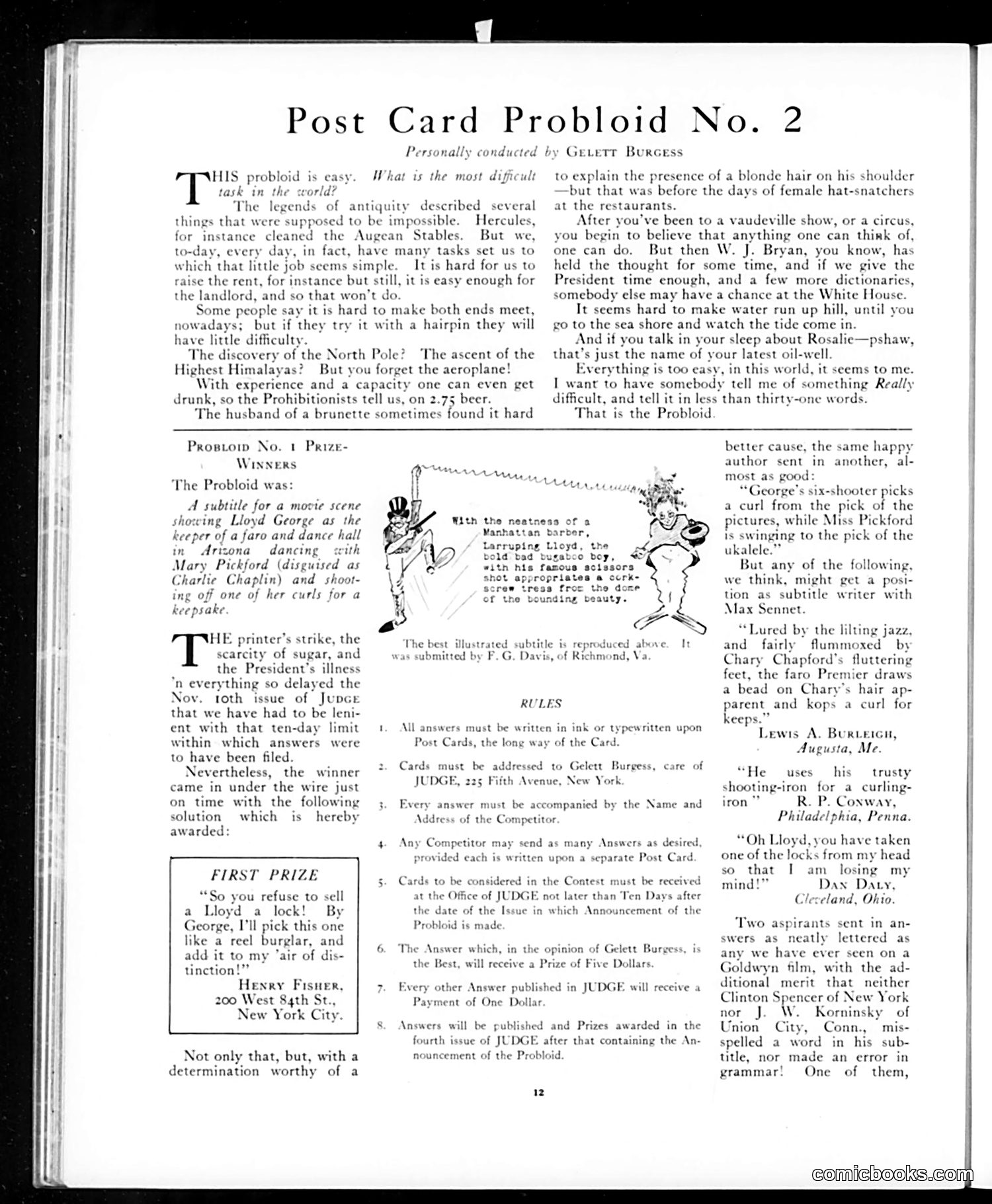
This page presents a humorous contest where readers submit witty film subtitles. The winning entry describes a scene with **Lloyd George** (British Prime Minister), **Mary Pickford** (silent film star), and **Charlie Chaplin**—all major celebrities of the era—in an absurdist Arizona scenario involving a faro hall and a dance. The joke relies on contemporary fame: Pickford was cinema's biggest star; Chaplin was the iconic "Tramp" character; Lloyd George was a newsworthy political figure. The subtitle's absurdity (using a curl as a keepsake, the random Arizona setting) parodies overwrought silent-film melodrama. Other submitted entries reference W.J. Bryan (politician) and Rosalie (likely a contemporary song). The "Probloid" format invites readers to solve impossible tasks humorously—reflecting post-WWI American culture's wit and the magazine's satirical approach to celebrity and popular entertainment.
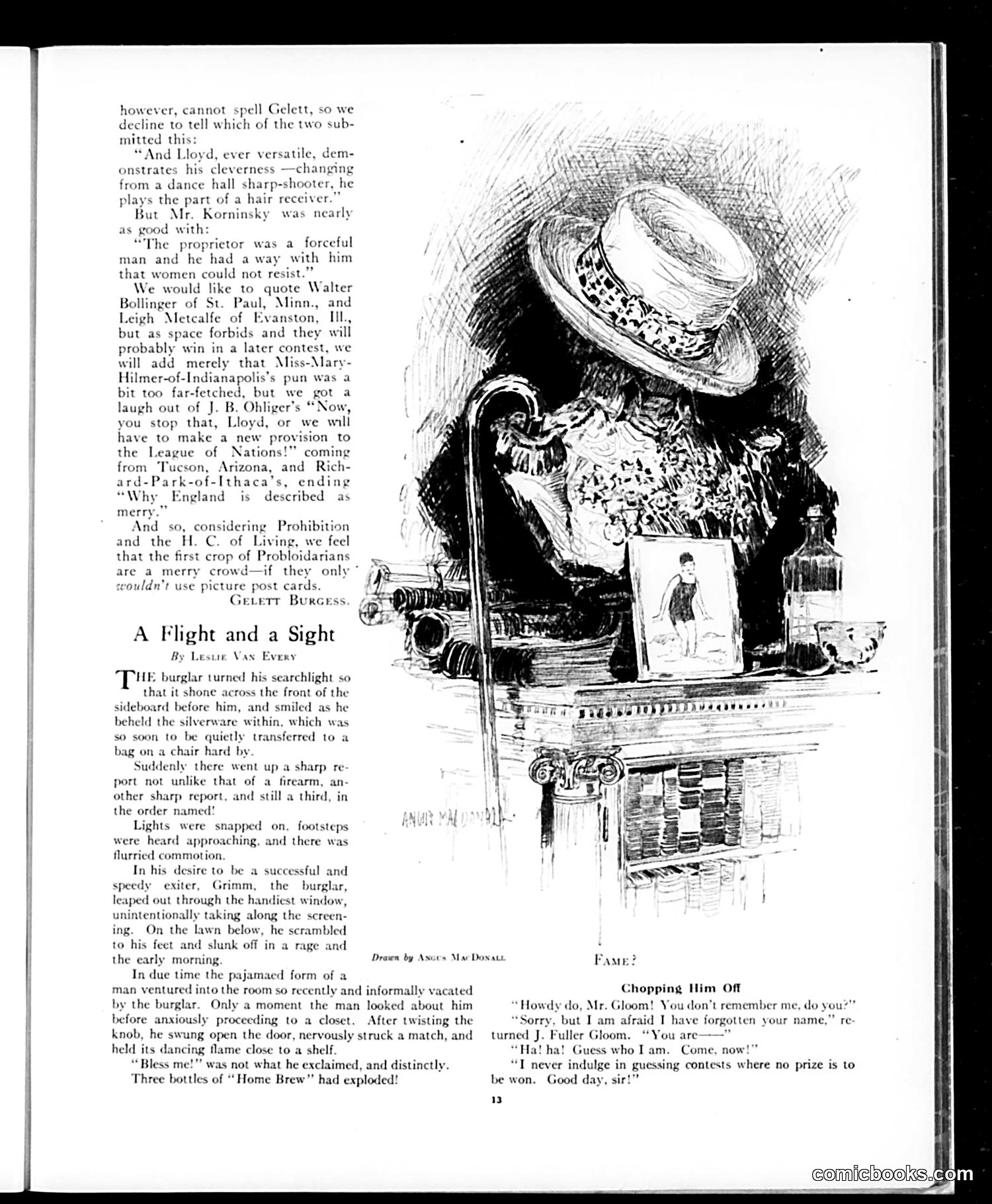
This page contains two distinct pieces: **Upper section:** A "Problemoidarians" contest discussing clever wordplay submissions about various performers (Lloyd, Korninsky, etc.). The satire mocks Prohibition-era humor—suggesting that people struggling under Prohibition and high cost-of-living ("H.C. of Living") have become a "merry crowd" making jokes, though they're "too far-fetched." The jab at "picture post cards" suggests cheap, mass-produced humor. **Lower section:** "A Flight and a Sight" is a humorous short story illustrated by Agnes May Donald. A burglar breaks in to steal silverware but flees when three loud explosions occur—caused by homebrewed alcohol bottles exploding on a shelf. The joke: Prohibition-era illegal "Home Brew" inadvertently foils the burglary. The accompanying cartoon "Chopping Him Off" depicts a gloomy man refusing to participate in a guessing game without a prize—mild social satire on penny-pinching during economically difficult times. Both pieces use Prohibition and economic hardship as comedic backdrops.
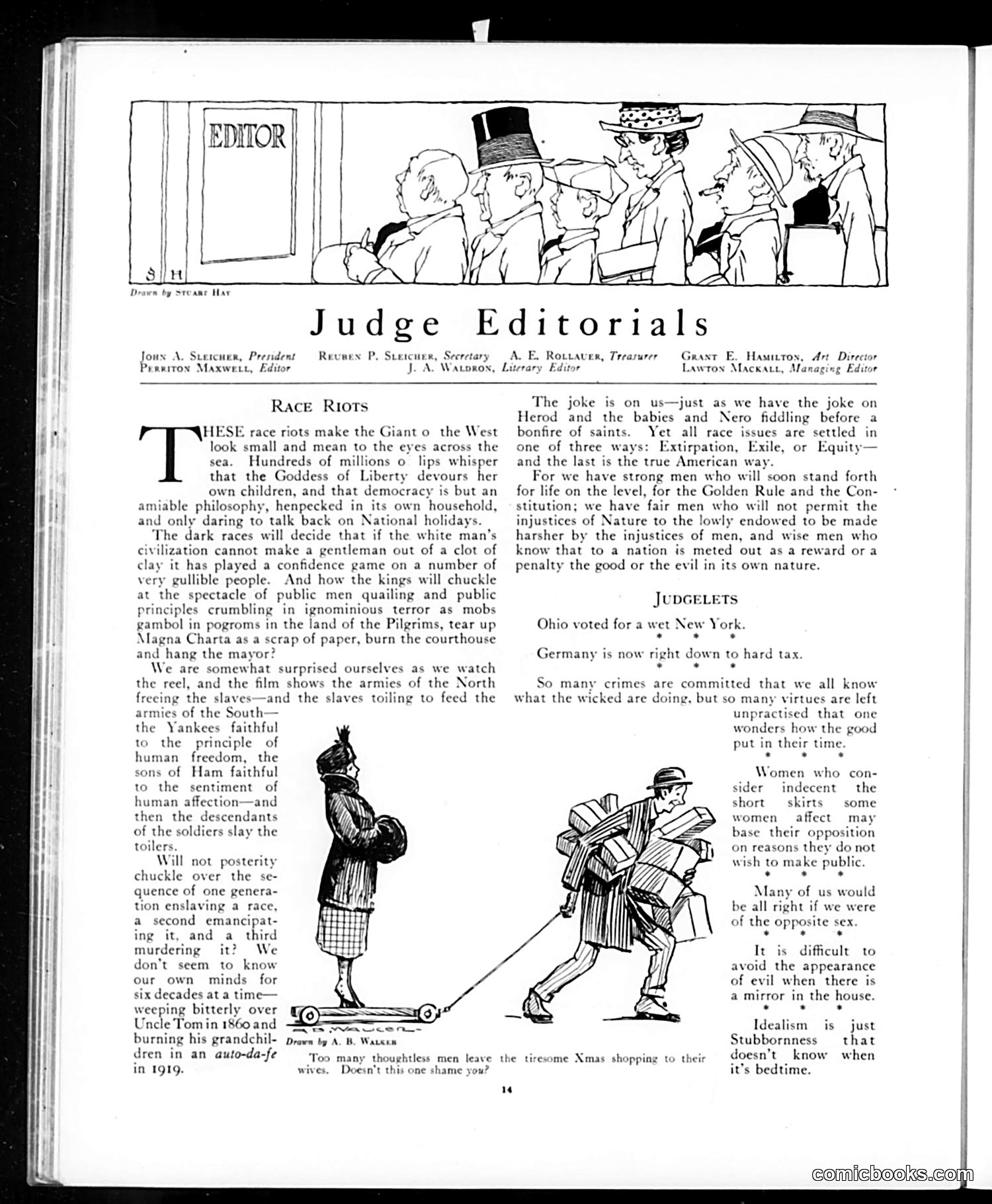
This page contains two satirical pieces from Judge magazine (likely early 1920s based on the 1919 reference). **"Race Riots" Editorial:** The main article critiques American race violence, arguing that such riots undermine America's democratic ideals internationally. It sarcastically compares the nation's hypocrisy: freeing slaves in the 1860s, employing them in the Civil War, then murdering their descendants in 1919 (referencing the Red Summer race riots). The editorial calls for principled men to enforce justice equitably. **Lower Cartoon:** Drawn by A.B. Walker, shows two men carrying Christmas shopping bundles. The caption reads "Too many thoughtless men leave the tiresome Xmas shopping to their wives. Doesn't this one shame you?" This satirizes gender roles and male avoidance of holiday duties, suggesting men shirk responsibilities by leaving shopping entirely to women. The "Judgelets" section offers brief satirical observations on contemporary issues including Prohibition, German reparations, and social hypocrisy.
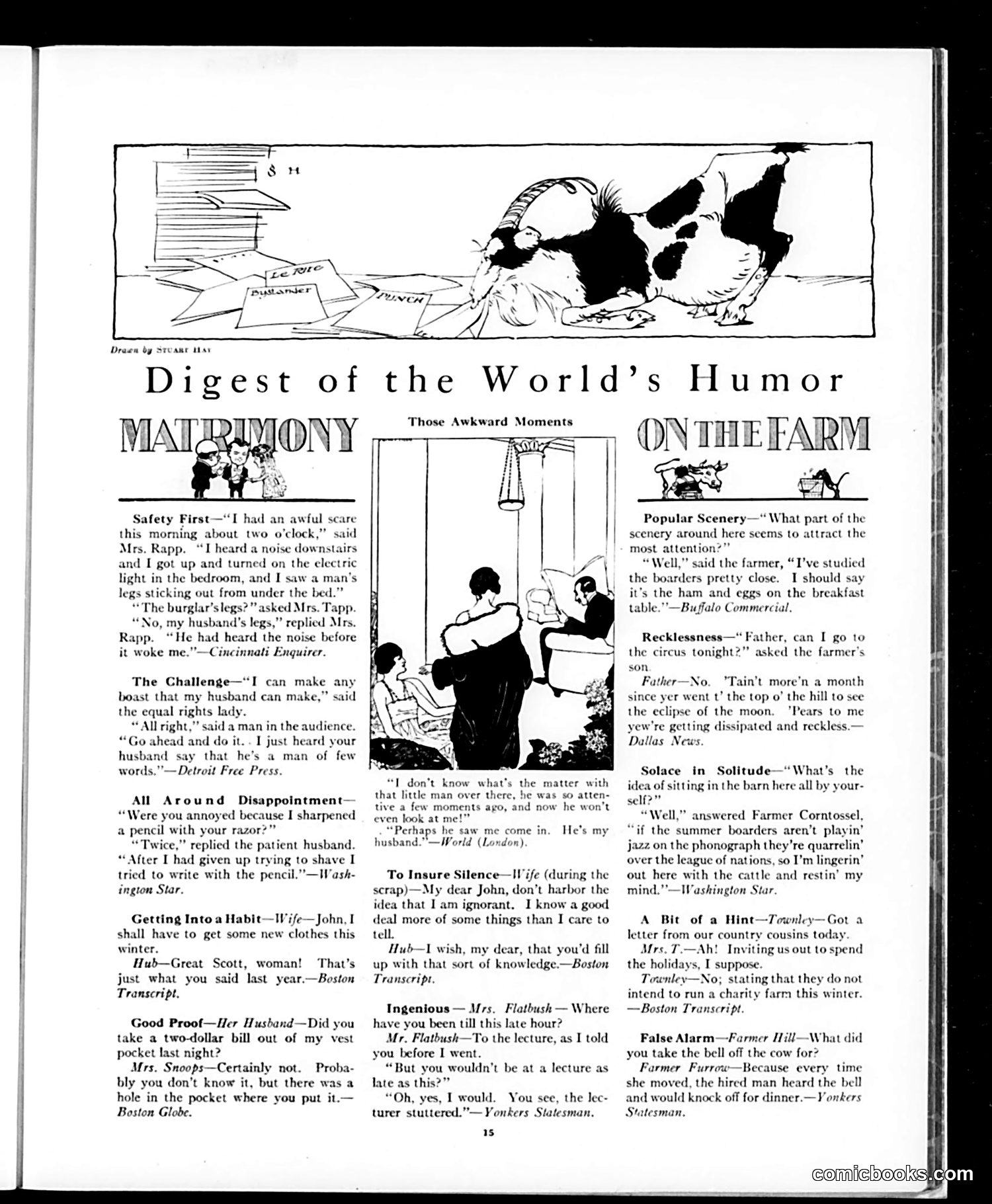
This page collects brief humorous anecdotes organized by theme. The content reflects early 20th-century domestic and rural humor, centering on familiar situations: marital bickering, mistaken identities, and farmer life. The jokes target predictable targets: wives who constantly demand new clothes, husbands caught in lies or caught under beds (the "Safety First" opener), and nagging spouses. The "Equal Rights" joke mocks women's suffrage activism. Rural humor emphasizes farmers' practical shrewdness—like the hired man stopping work when the cow's bell rings, or a farmer noting boarders are most attracted to breakfast ham and eggs. The cartoon at top (by Stuart Hay) appears to show people or animals in domestic disarray, though specific subjects are unclear. These jokes rely on period stereotypes: befuddled husbands, demanding wives, and clever rustic characters. The humor assumes reader familiarity with these stock characters and scenarios, offering gentle mockery of everyday married life and rural America.
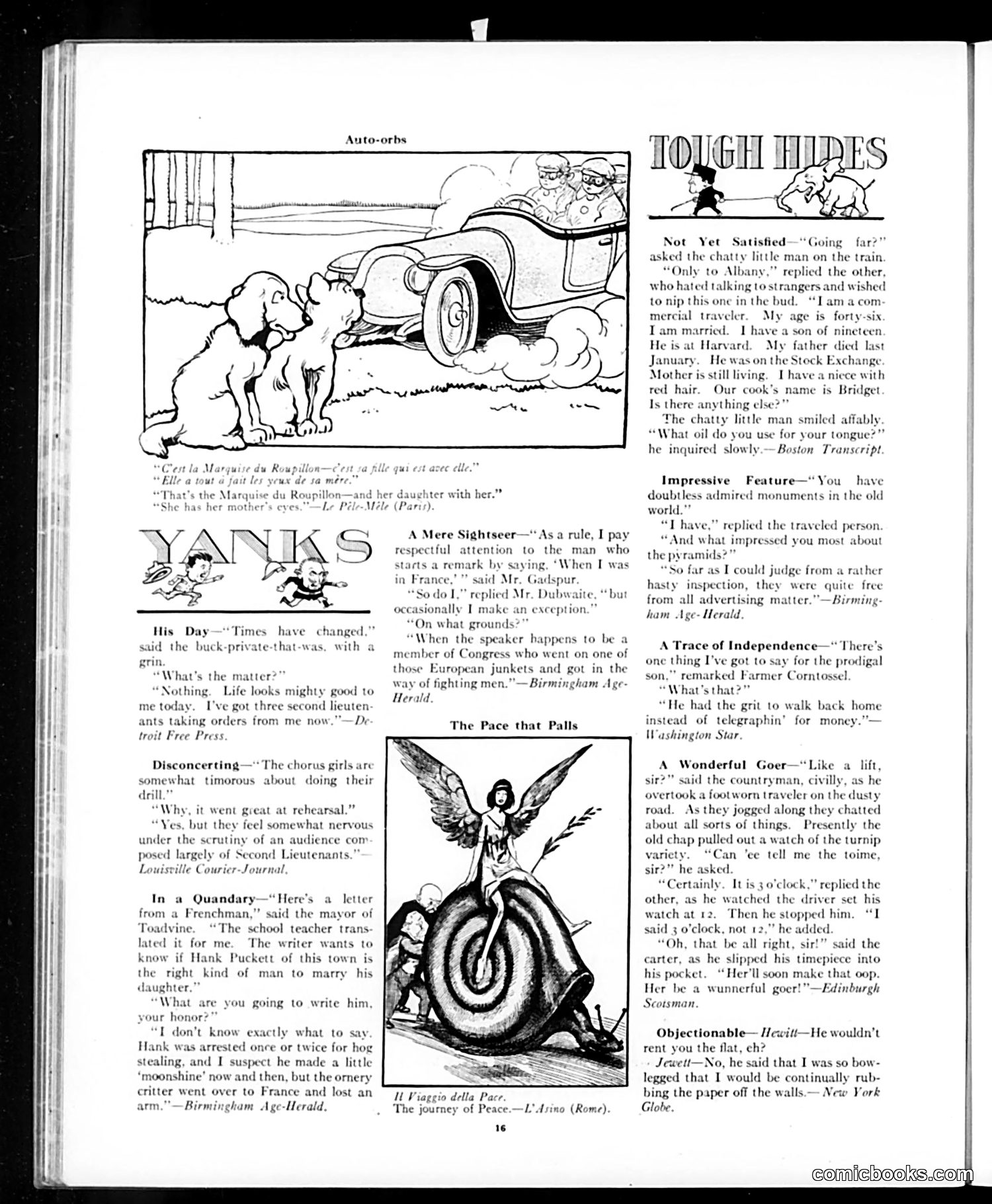
This page contains several brief humorous anecdotes satirizing American social types and behaviors circa the early 20th century. **"Not Yet Satisfied"** mocks the compulsively talkative stranger—a common social annoyance. The commercial traveler's unsolicited life story parodies people who overshare with strangers. **"A Mere Sightseer"** and **"Impressive Feature"** ridicule tourists who reference European travel pretentiously, with the punchline that even monuments lack advertising—a jab at America's commercialism. **"His Day"** comments on post-WWI military life: a buck private notes times have improved because he now has subordinates taking orders from him. **"A Trace of Independence"** praises a prodigal son's self-reliance for walking home rather than telegraphing for money—valuing grit over modern convenience. **"A Wonderful Goer"** humorously depicts a country carter whose pocket watch runs slow; he sets it incorrectly but maintains confidence in its reliability anyway. The remaining anecdotes satirize chorus girls' nervousness, letter-writing confusion, and physical appearance.
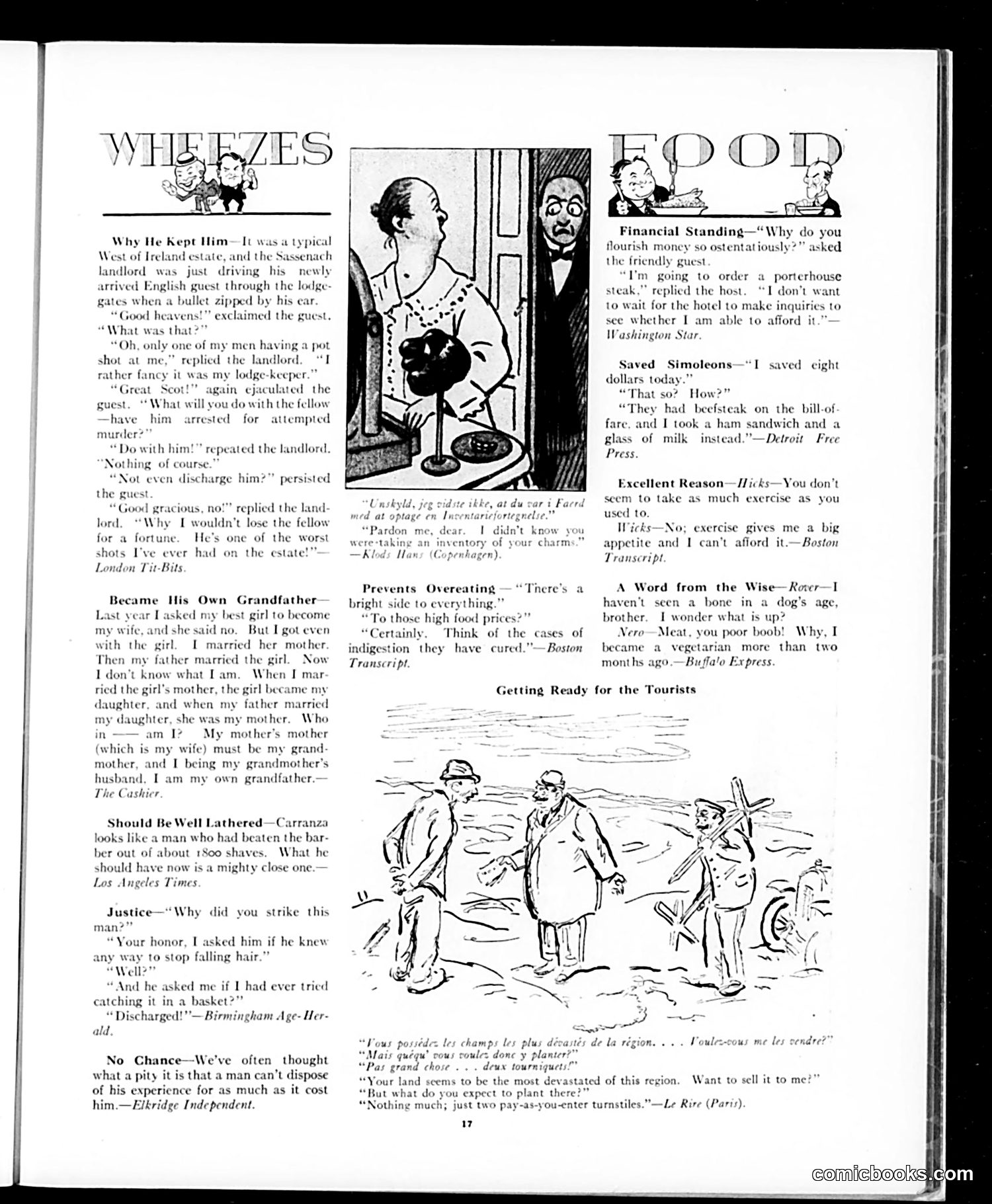
This page from *Judge* magazine presents a collection of short humorous anecdotes typical of early 20th-century American satire. **Key content:** The main cartoons and jokes satirize contemporary social anxieties: - **Irish landlord violence**: "Why He Kept Him" depicts an Irish estate worker shooting at his English landlord—a reference to real tensions between Irish tenants and British/Anglo-Irish landowners during this period. - **Food prices and poverty**: Multiple jokes ("Saved Simoleons," "Excellent Reason") mock the economic strain of rising food costs, with working-class characters substituting cheaper meals or avoiding exercise to save money. - **Carranza reference**: "Should Be Well Lathered" appears to mock Mexican revolutionary Pancho Villa or Emilio Zapata through the fictional "Carranza"—reflecting American anxieties about instability south of the border. - **Tourist cartoon**: The bottom illustration humorously shows Parisians preparing for tourists with turnstiles, satirizing commercialization of tourism. The humor relies on economic hardship, class tensions, and xenophobic stereotypes—now-dated reference points reflecting pre-WWI American attitudes.
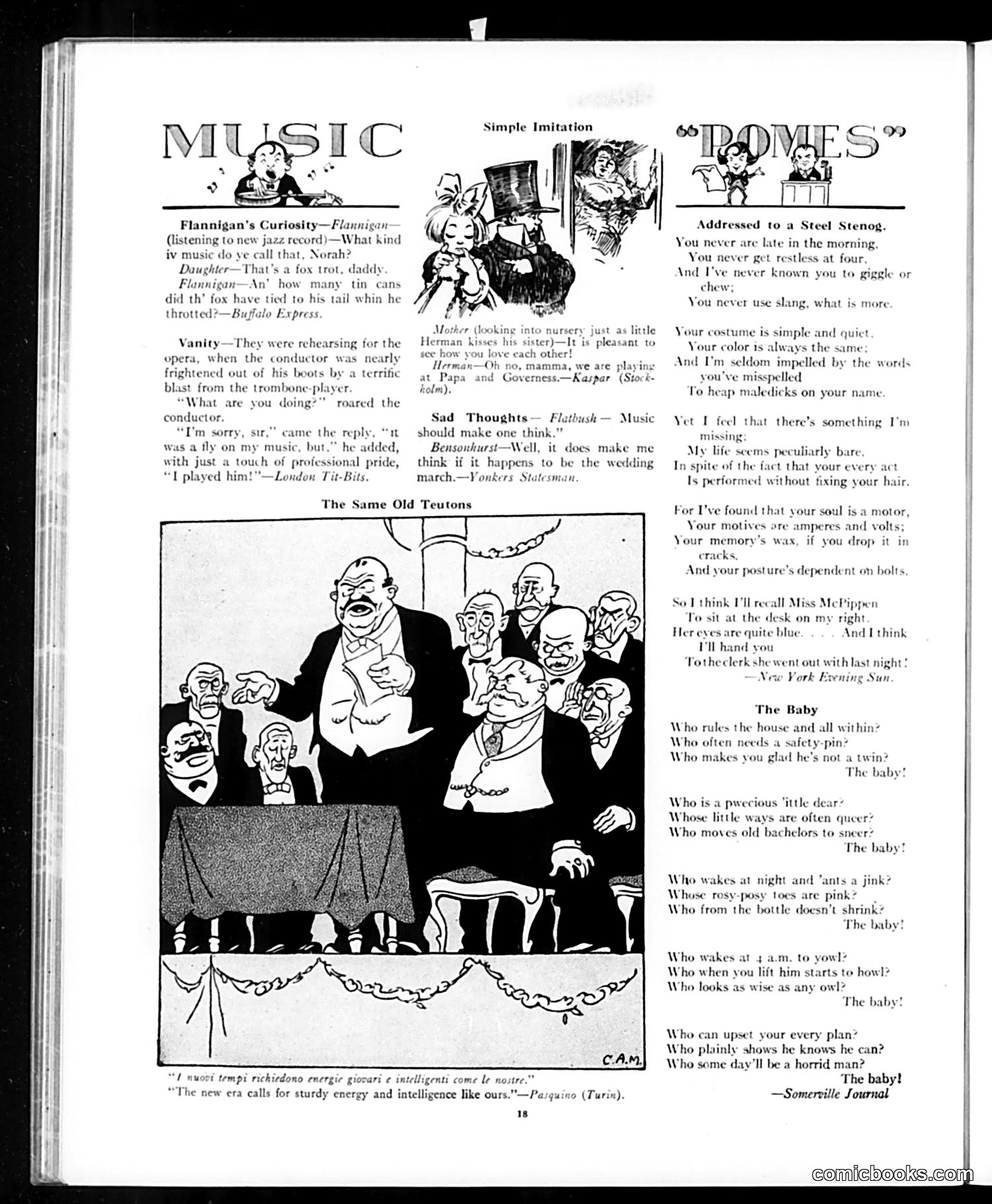
This page from *Judge* contains several brief humor pieces satirizing early 20th-century American life: **"The Same Old Teutons"** cartoon depicts German diners at a formal gathering, likely referencing pre-World War tensions and ethnic stereotypes about German heaviness and militarism. The caption quotes Paganino (Turin) promoting "sturdy energy and intelligence," suggesting American anxiety about German competition. **Other pieces mock contemporary manners**: "Flannigan's Curiosity" jokes about jazz music and working-class speech; "Vanity" satirizes rehearsal mishaps; "Simple Imitation" uses a stenographer as a symbol of modern, emotionless efficiency replacing human warmth. **"The Baby"** is a playful nursery-rhyme piece cataloging infant chaos—ruling the household, disrupting plans, and promising future misbehavior—typical light domestic humor of the era. The overall tone reflects period concerns: mass-produced music, changing gender roles (working women stenographers), ethnic anxieties, and modern life's disruptions to tradition.
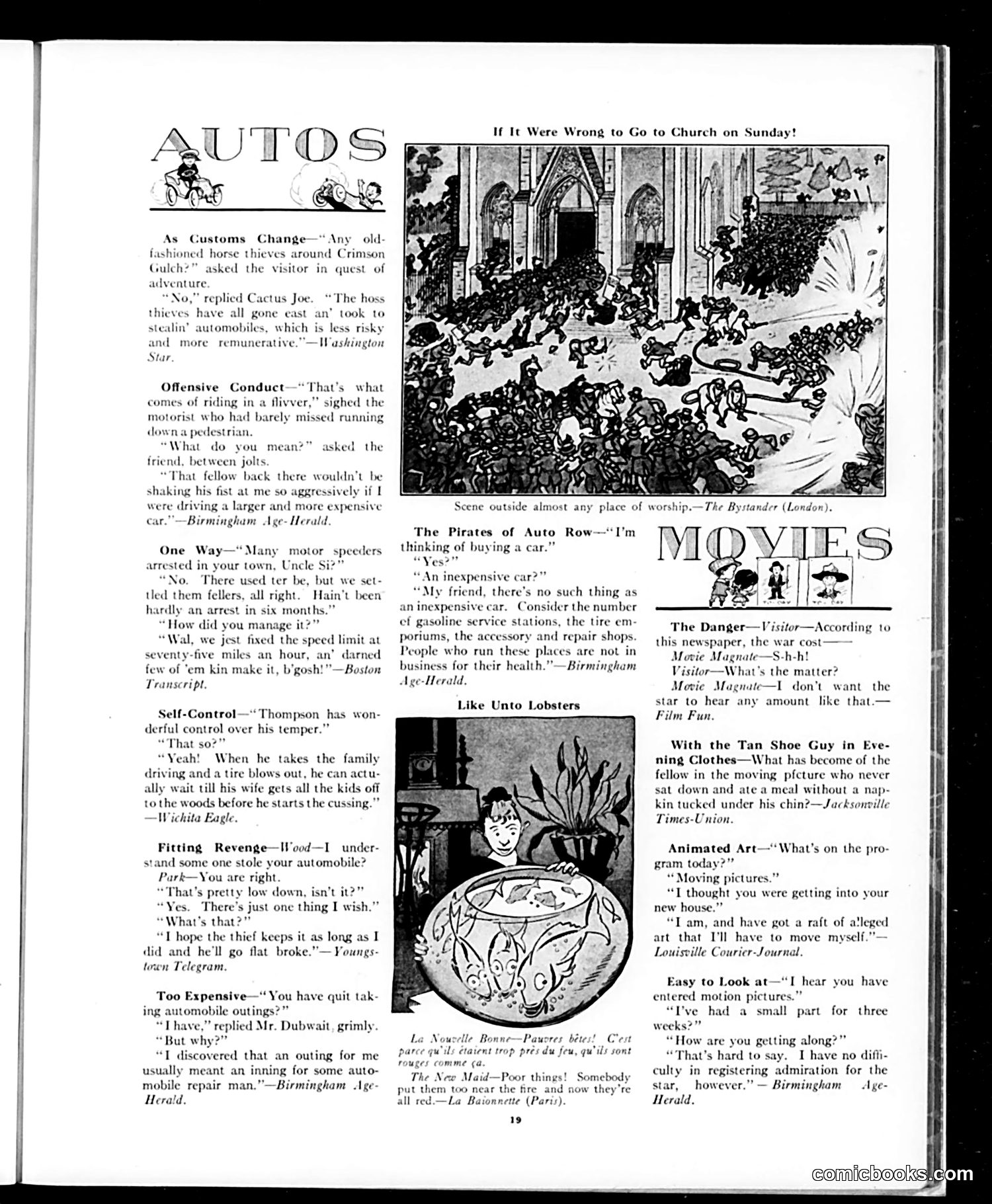
This page from Judge presents early-20th-century American satirical commentary on automobiles and emerging cinema, organized as brief jokes and anecdotes. **Auto-Related Satire:** The jokes mock the nascent automobile industry's hidden costs and dangers. "The Pirates of Auto Row" jokes that "inexpensive" cars don't exist—repair shops, gas stations, and accessory dealers constitute a profitable ecosystem. Other pieces satirize reckless driving, speeding (addressed through speed limits), car theft, and the expense of vehicle ownership and maintenance. **Cinema References:** The "Movies" section mocks early motion pictures as an emerging entertainment form. Jokes about "moving pictures" and "animated art" suggest novelty and skepticism about this new medium. **The Church Cartoon:** The large illustration ironically contrasts the title "If It Were Wrong to Go to Church on Sunday!" with a chaotic street scene of automobile traffic and accidents—suggesting cars have become a competing Sunday activity, creating disorder rather than spiritual devotion. **Overall Tone:** Satirical commentary on how automobiles and movies are reshaping American society, with anxiety about safety, costs, and social disruption.
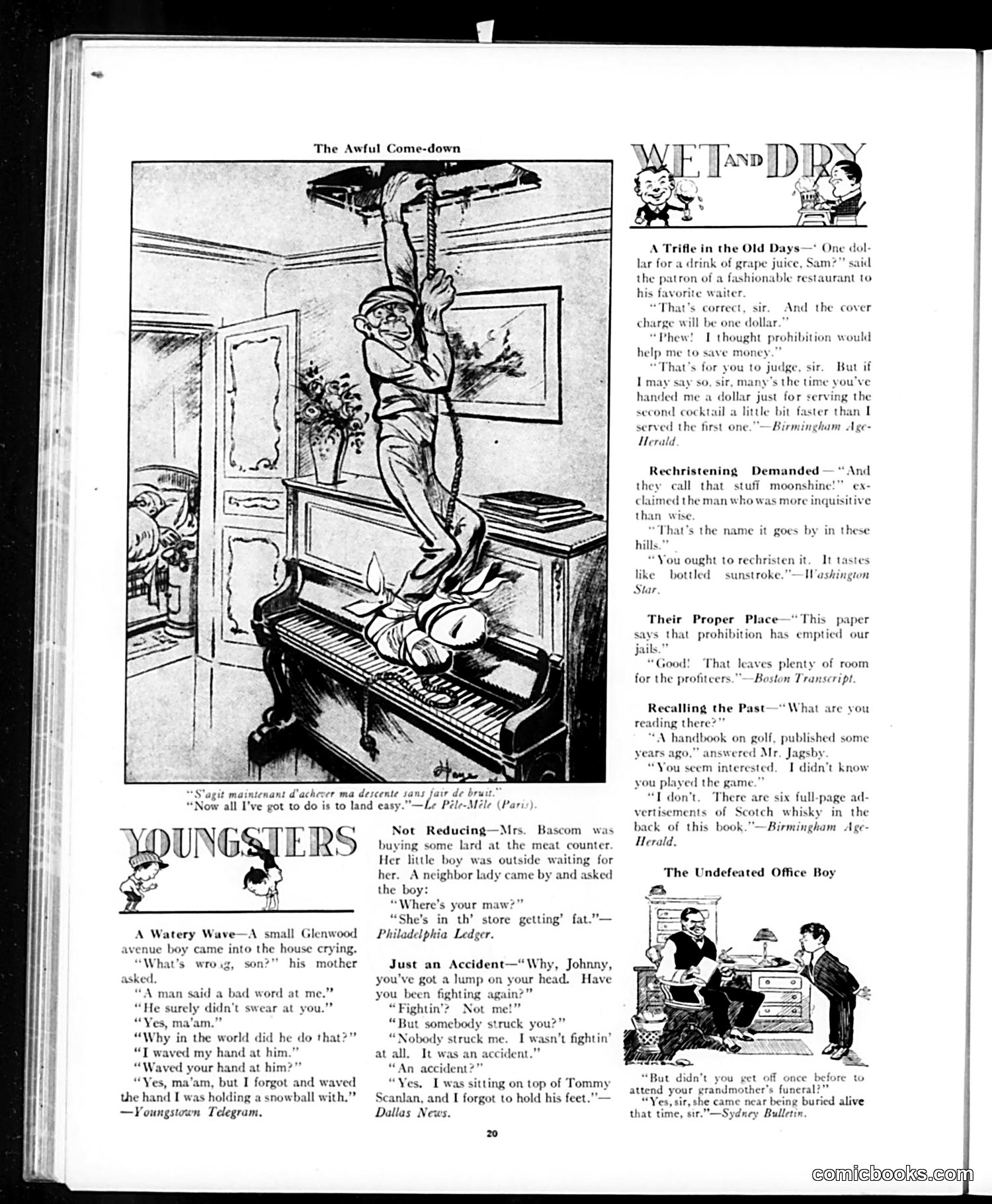
This page contains multiple brief humorous anecdotes satirizing **Prohibition-era America**. The main cartoon depicts a man hanging upside-down from a rope—"The Awful Come-down"—which serves as a visual metaphor for the social collapse caused by alcohol prohibition. The accompanying jokes mock Prohibition's failures: a restaurant patron discovers he now pays the same total (dollar drink + dollar cover charge) for grape juice as he previously paid for cocktails; another joke suggests illegal "moonshine" should be "rechristened" because it tastes like "bottled sunstroke"; a man reads a golf handbook solely to view Scotch whisky advertisements; and a reference notes prohibition "emptied our jails" but left "plenty of room for the profiteers." The satire targets Prohibition's hypocrisy—it failed to reduce drinking or save money, instead enriching illegal alcohol producers while making legitimate purchases absurdly expensive. Judge's position appears critical of the policy's ineffectiveness and unintended economic consequences.
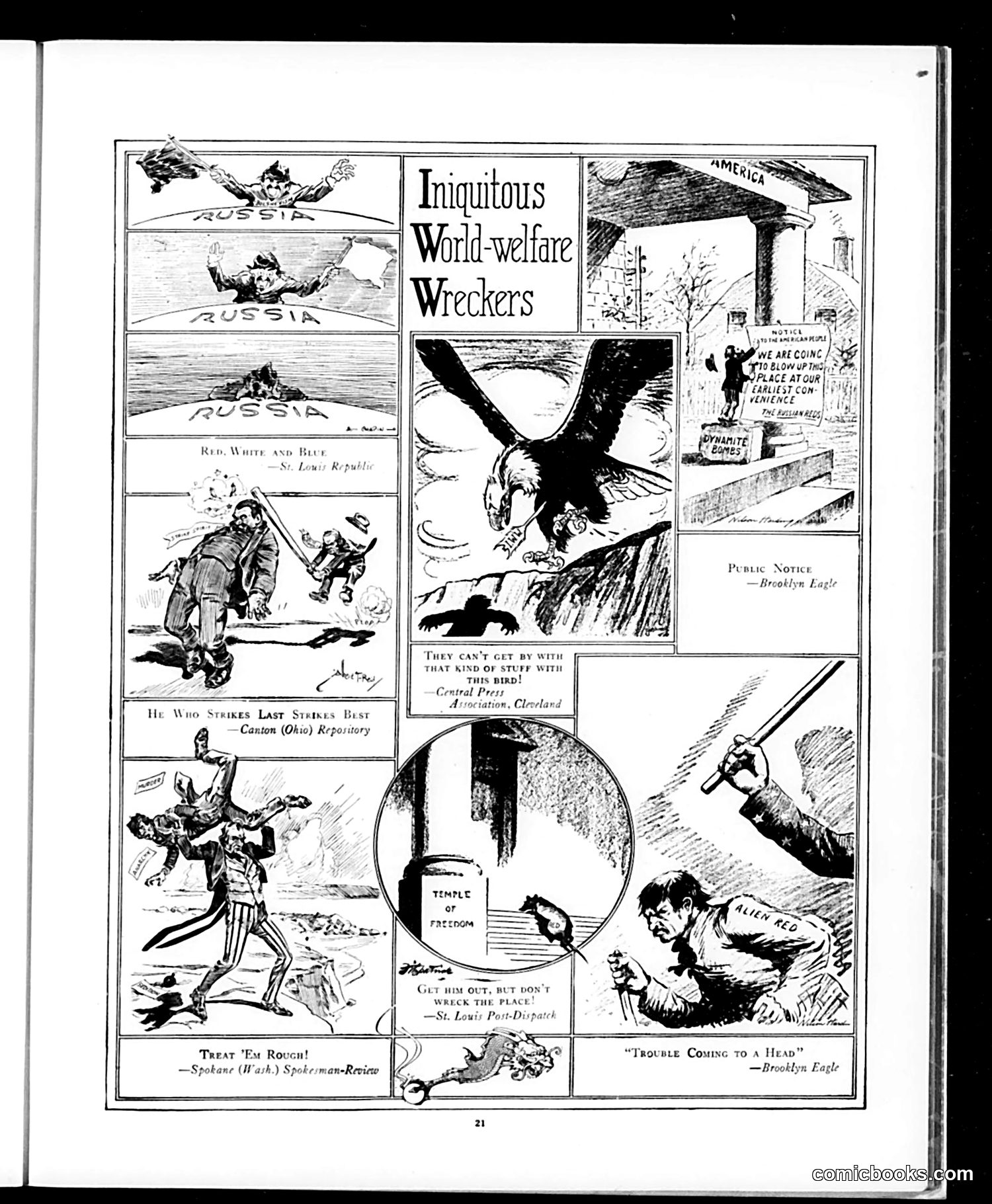
This page satirizes American pacifists and anti-war activists during what appears to be the World War I era, branding them as "Iniquitous World-welfare Wreckers." The cartoons depict pacifists as destructive radicals using violent imagery ironically: an eagle (representing America) attacks figures labeled "Russia"; Uncle Sam strikes aggressively; and a figure labeled "Alien Red" wreaks havoc at a "Temple of Freedom." The captions—sourced from newspapers like the *Brooklyn Eagle* and *Spokane Spokesman-Review*—mock pacifists' hypocrisy: they claim peaceful intentions while allegedly sabotaging American interests. The "get him out, but don't wreck the place" quote sarcastically suggests removing pacifists without damage. The satire conflates pacifism with radicalism and foreign (particularly Russian/communist) influence, a common propaganda tactic of the period. The cartoons argue pacifists threaten national security and social order.
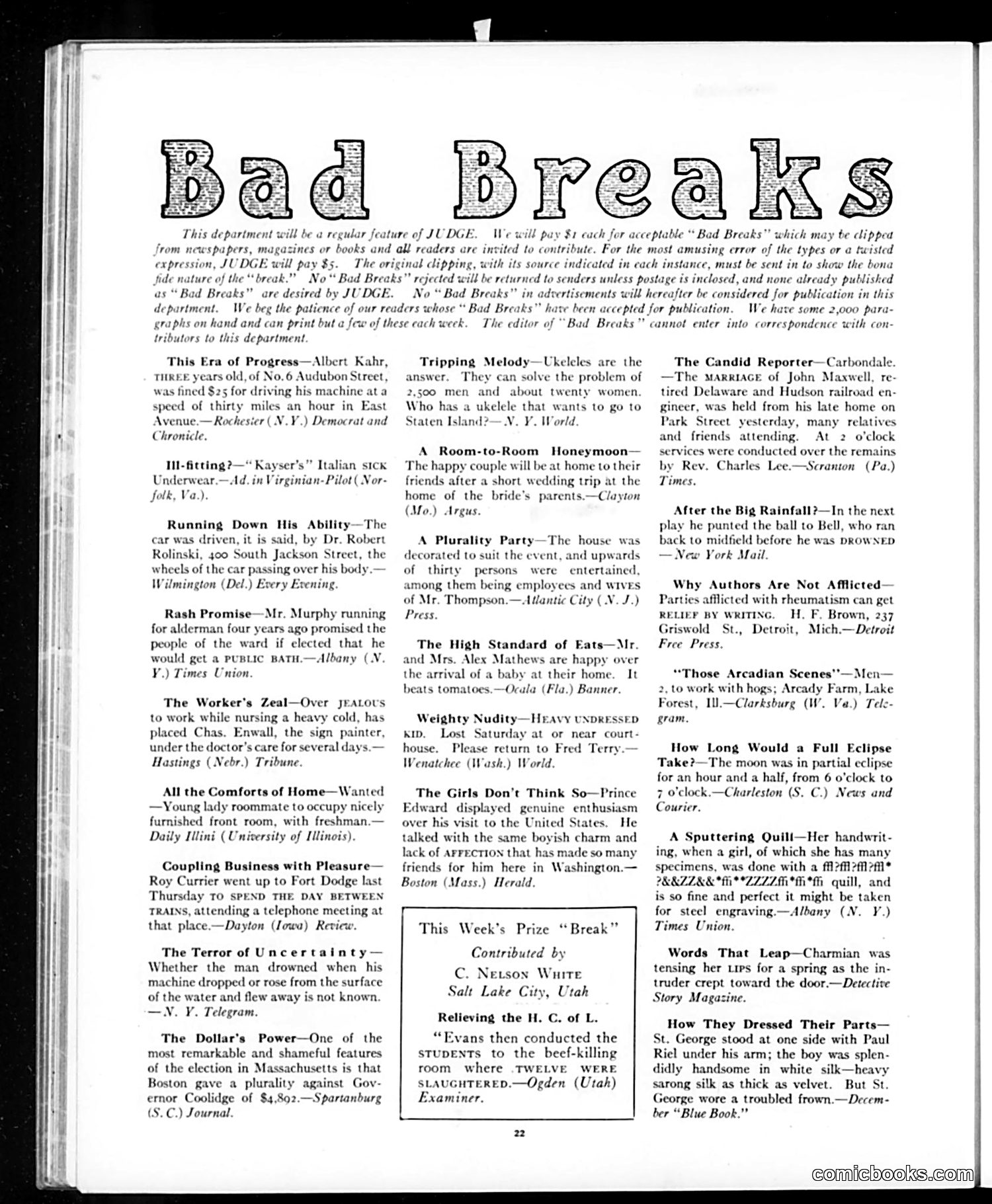
This page showcases Judge magazine's humor column collecting unintentional typographical and editorial errors from newspapers. The department invites readers to submit amusing printing mistakes for $1 each. The examples ridicule absurd results from careless editing: a three-year-old fined for speeding, a man run over by car wheels, a politician promising a "PUBLIC BATH" (implying he himself needs one), and most notably, the week's prize break where students were "SLAUGHTERED" in a beef-killing room—apparently a verb usage error for what should be a factory tour description. The satire targets newspaper incompetence and the unintentional comedy created by typos that reverse or distort meaning. This was popular early-20th-century humor exploiting the human element in print journalism before modern editing practices standardized proofreading. The column also mocks contemporary society through these errors—ineffective public servants, industrial hazards, and class anxieties about "affectation."
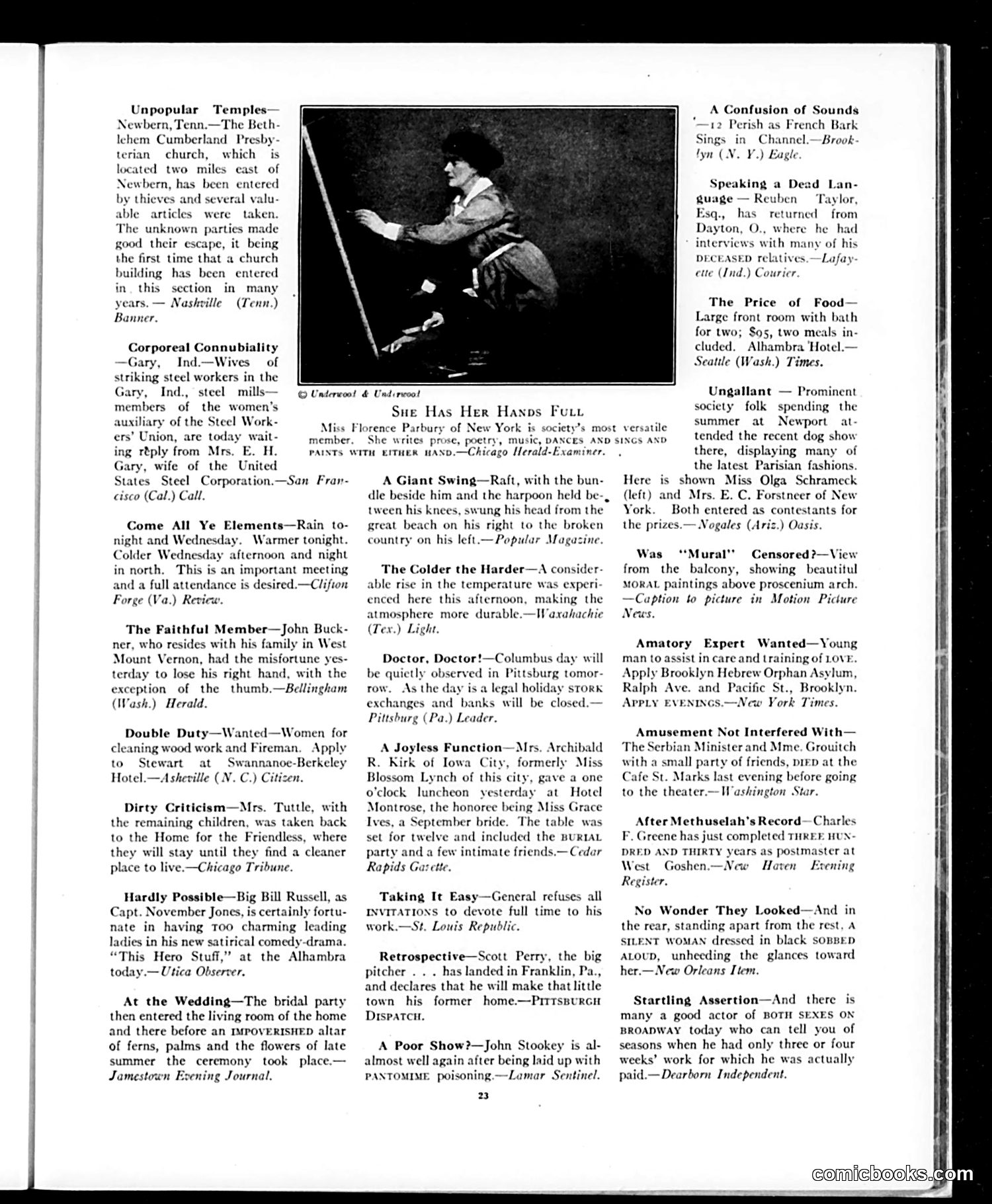
The primary image on this page is a photograph captioned "She Has Her Hands Full," showing Miss Florence Parbury, described as a versatile society member who writes, sings, dances, and paints. However, Judge magazine's main purpose here is displaying "found humor"—unintentionally funny newspaper headlines and passages. The page collects dozens of these absurdities, such as: - A church theft being the "first time" in "many years" (implying churches in the region are routinely robbed) - "Impoverished altar of ferns" (a poverty reference at a wedding) - A job posting for "cleaning wood work and Fireman" (unclear job duties) - "Burial party" at a luncheon (confusing funeral/social terminology) - A pitcher declaring he will "make" a small town his "former home" (chronological impossibility) These are early 20th-century newspaper editing errors and awkward phrasing. The satire depends on readers recognizing the accidental absurdities—the joke is not at anyone's expense but at incompetent newspaper writing itself.
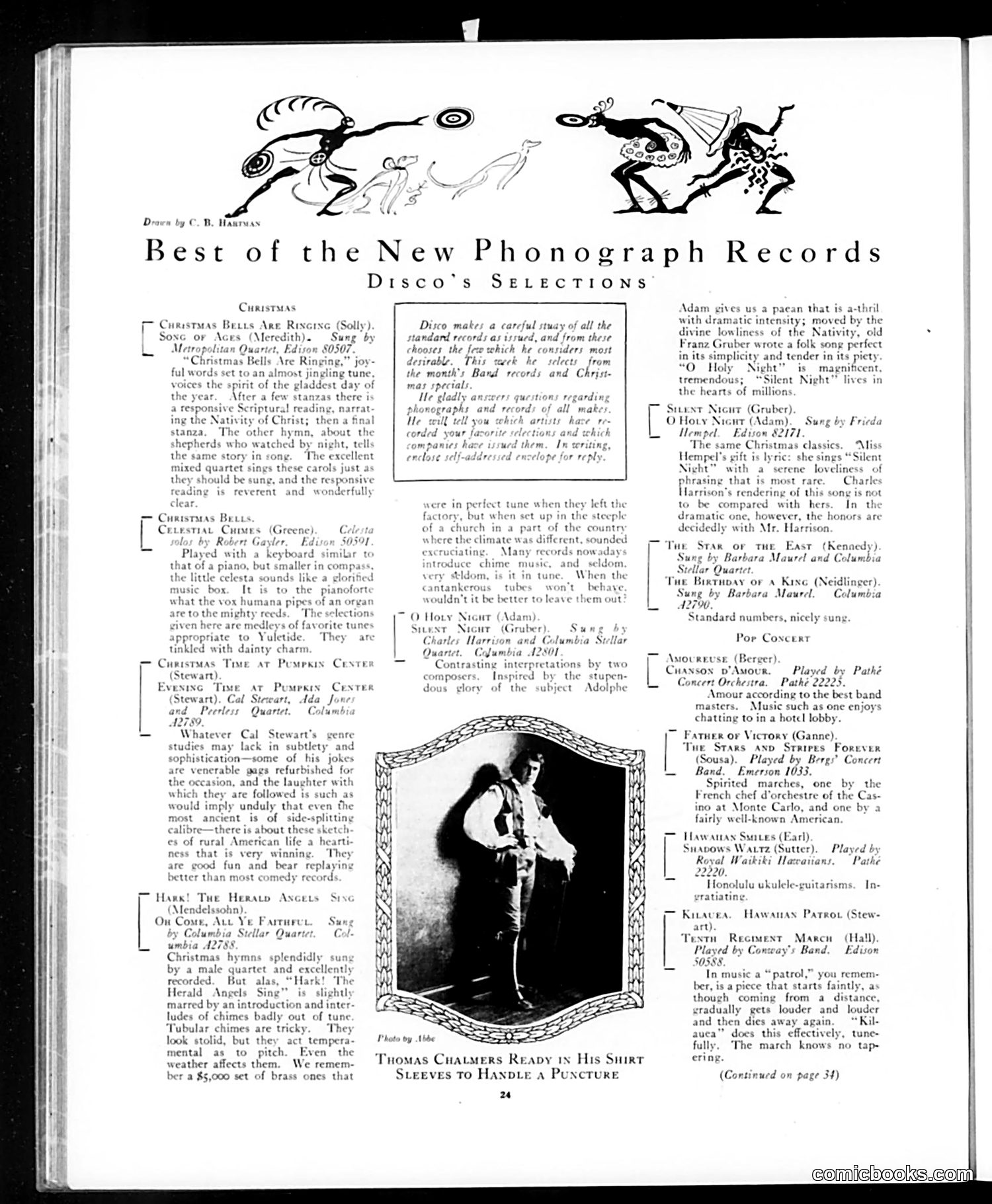
This page is **not a political cartoon** but rather a **music review column** titled "Best of the New Phonograph Records." It showcases popular classical and semi-classical recordings available on phonograph records, curated by "Disco's Selections." The decorative illustrations at the top are stylized drawings of musicians and dancers—not caricatures of specific political figures. The central photograph shows **Thomas Chalmers**, a singer, posed humorously "ready in his shirt sleeves to handle a puncture"—a lighthearted caption playing on the image rather than making a satirical point. The content itself discusses Christmas music, sacred hymns, and orchestral pieces. The reviews highlight technical qualities like pitch accuracy and instrumental balance. This reflects early 20th-century popular entertainment: phonograph records were relatively new technology, and classical/religious music dominated "serious" listening. **No political satire appears on this page.** It's simply period music criticism aimed at consumers interested in purchasing quality recordings.
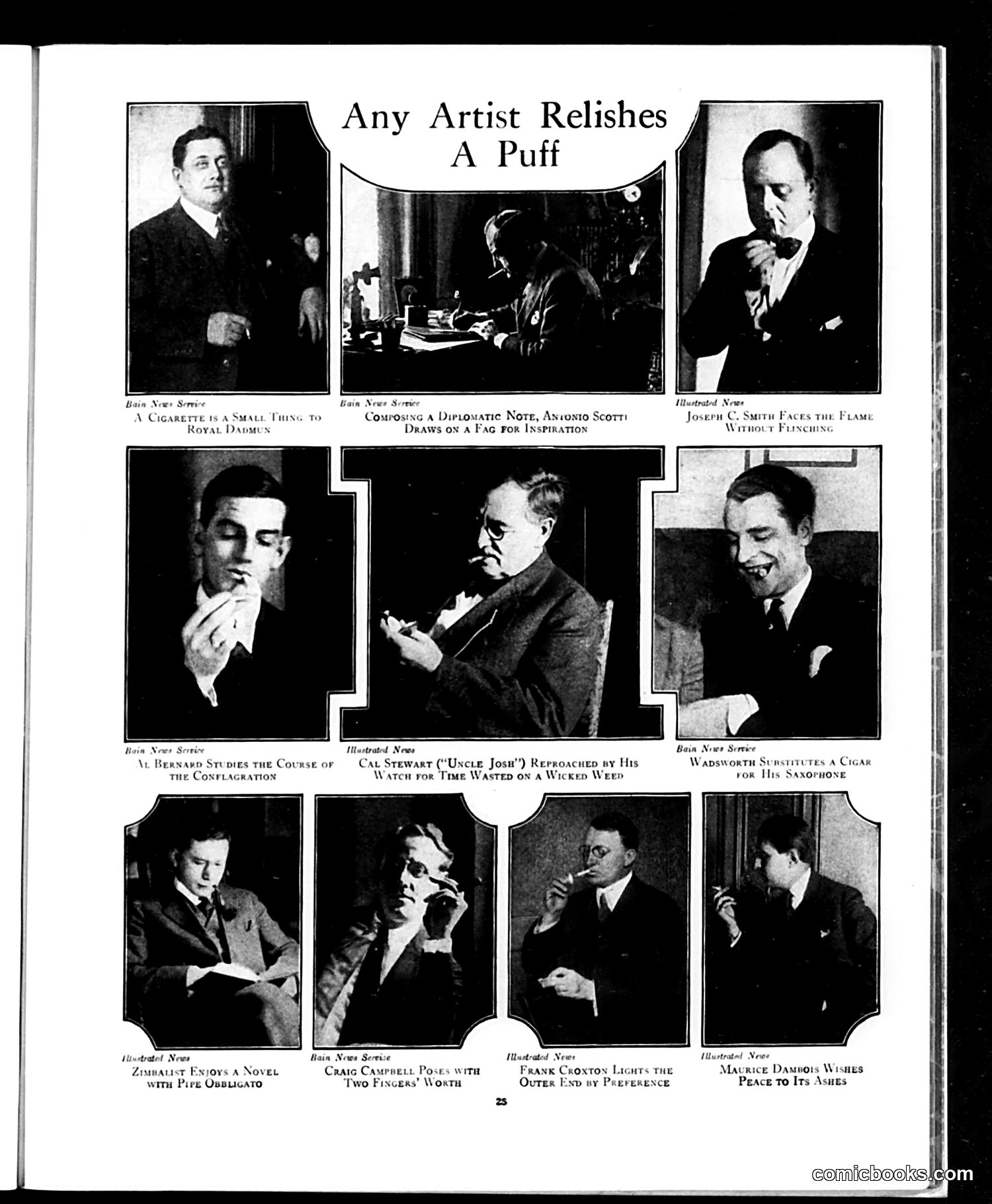
This page satirizes prominent early 20th-century figures through their smoking habits. The title suggests that creative professionals—artists, writers, performers—enjoy cigarettes and cigars as sources of inspiration or relaxation. The page presents nine photographs of named individuals (Joseph E. Smith, Aristide Scotti, Frank Crouton, and others—several names partially illegible in OCR) posed smoking cigarettes, cigars, or pipes. The captions provide humorous commentary: one notes a diplomat "draws on a fag for inspiration," another jokes that "Uncle Josh" was "reproached by his watch for time wasted on a wicked weed." The satire appears gentle rather than biting—it's poking fun at these public figures' well-known smoking habits, treating their tobacco use as a defining characteristic. This reflects early 1900s attitudes when smoking was socially acceptable and even fashionable among professionals and artists. Without clearer identification of all subjects, the specific satirical targets remain partially unclear.
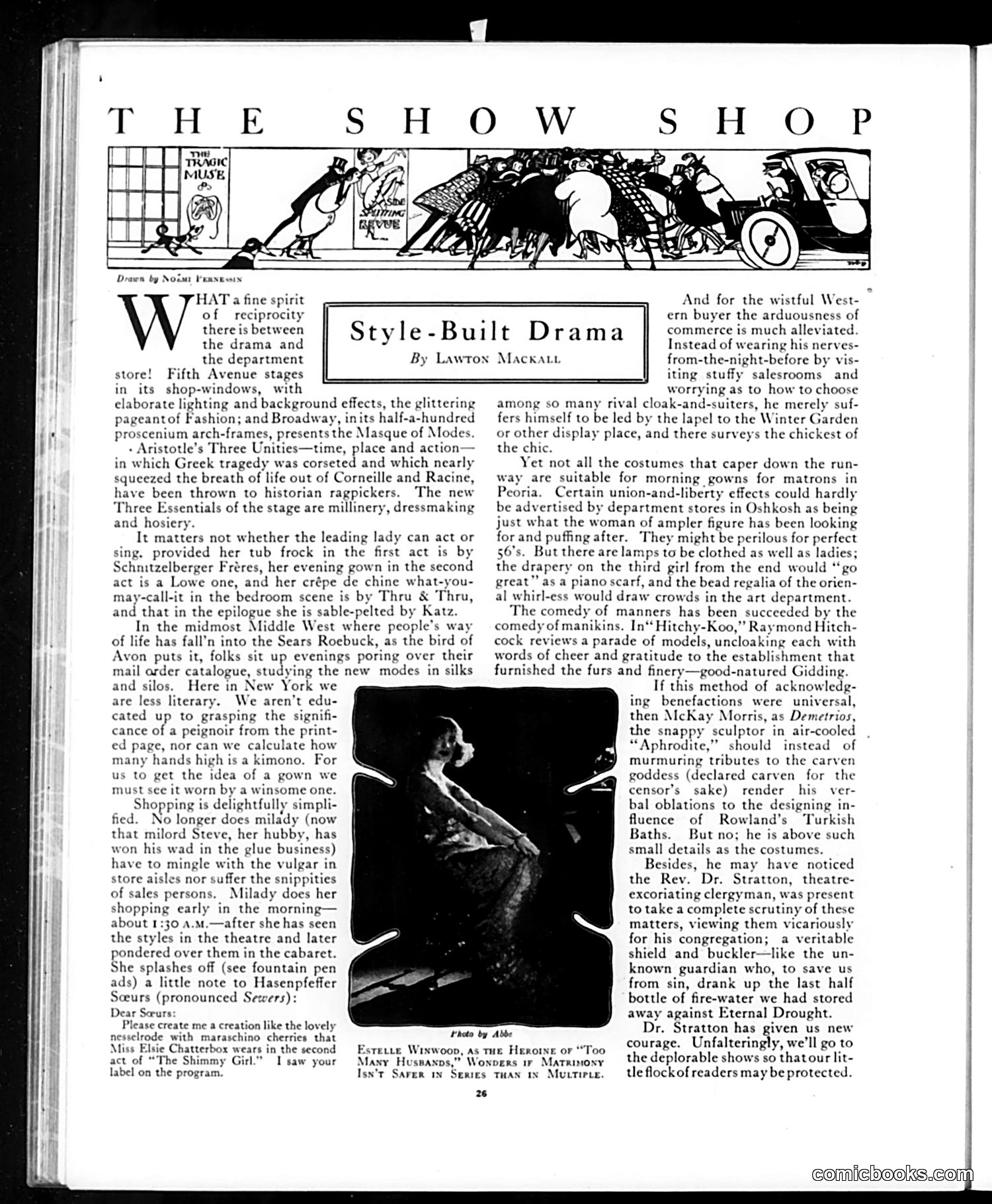
This article satirizes how 1920s Broadway theater has become primarily a fashion showcase rather than a venue for serious drama. The author argues that theatrical merit—acting ability, classical dramatic structure—has been replaced by designer clothing as the main draw. The satire targets both theaters and department stores, which compete by displaying fashions: Broadway stages elaborate costume parades while Fifth Avenue window displays mimic theatrical spectacle. The piece mocks wealthy female theatergoers who attend plays solely to copy fashions, then order replicas from designers by mail. The author also jokes about regional audiences: Midwesterners study mail-order catalogs instead of reading (referencing Sears Roebuck), while wealthy New Yorkers need to *see* clothes worn onstage to understand fashion. The article concludes by noting that theatrical productions now function primarily as moving advertisements for costumes and designers—turning actors into human mannequins promoting commercial goods rather than performing art.
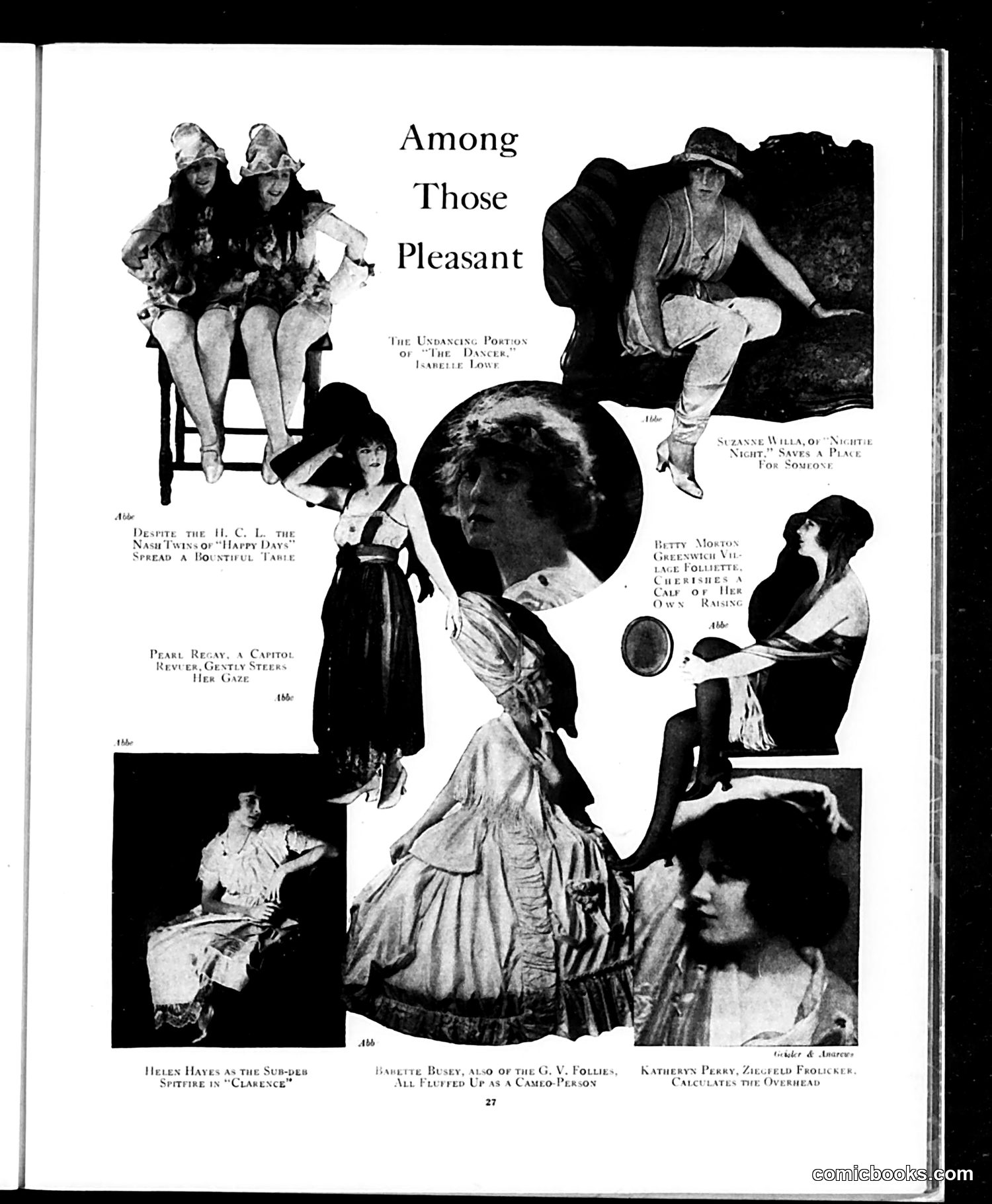
This appears to be a theater/entertainment page from Judge magazine featuring actresses from early 1920s Broadway productions. The title "Among Those Pleasant" introduces photographs and captions identifying performers in various shows, including "The Dancer," "Harry Days," and "Clarence." The captions highlight the actresses' roles and physical attributes in a manner typical of entertainment journalism of the era—mixing professional credits with personal observations. References like "Despite the H.C.L., the Nash Twins of 'Happy Days' Spread a Bountiful Table" suggest the H.C.L. (likely "High Cost of Living," a contemporary economic concern) provides context for the period's financial anxieties. This is primarily **theatrical publicity content** rather than political satire. It reflects how Judge used entertainment pages to appeal to readers interested in Broadway and popular culture of the 1920s, with celebrity photographs functioning as a form of advertising and gossip combined.
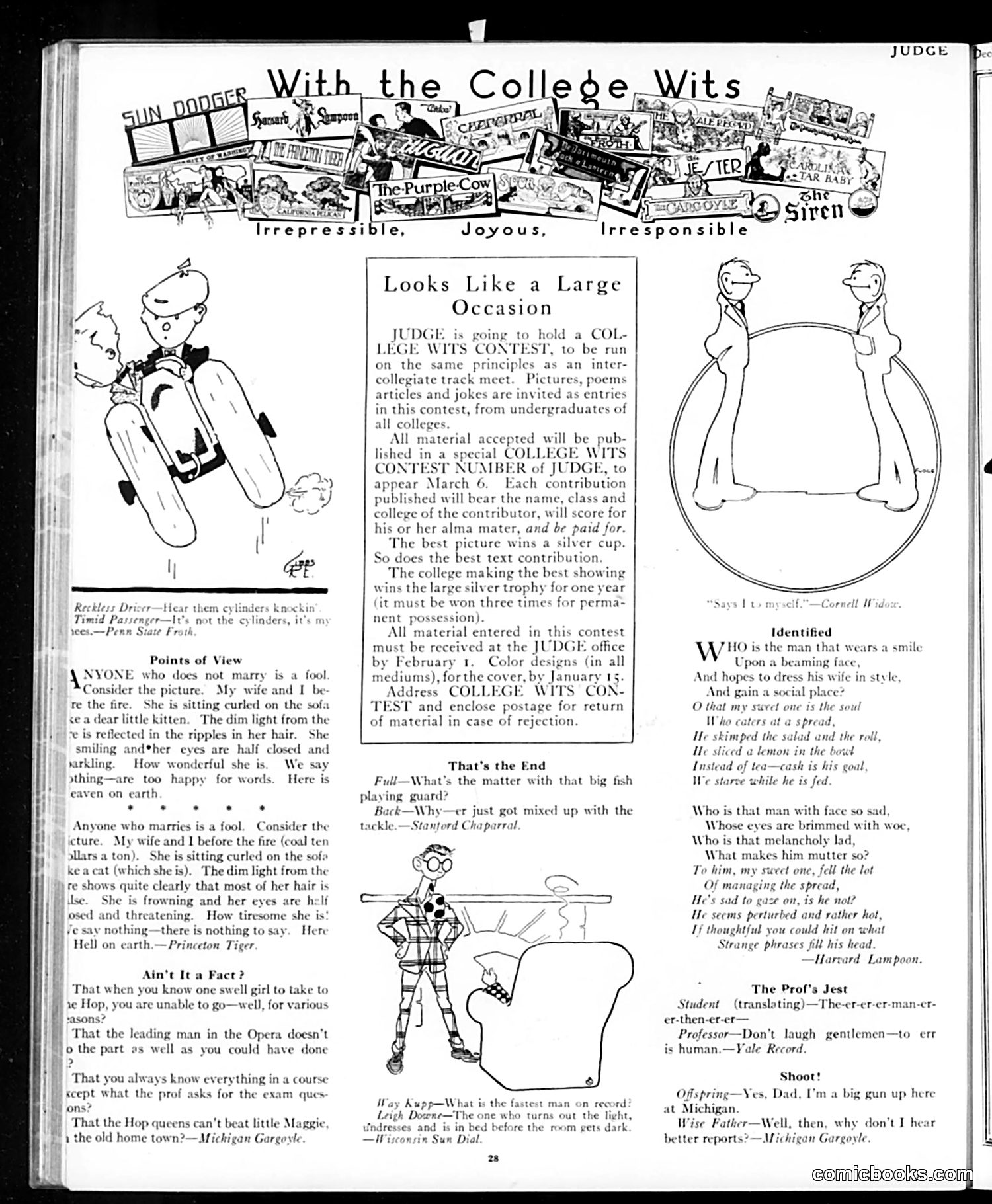
This page announces Judge magazine's **College Wits Contest**, a competitive humor competition among American college publications, modeled on intercollegiate athletic meets. Colleges submit pictures, poems, articles, and jokes; winners receive silver cups and trophies. The deadline is February 1, with results published March 6. The page includes satirical commentary typical of early 20th-century college humor: the "Points of View" section contrasts bachelor and married life (both presented as foolish), while scattered jokes mock academic life, romance, and social pretension. The cartoons show college stereotypes: a reckless driver, awkward social situations, and romantic misadventures. The "Identified" riddle mocks materialistic husbands indifferent to their wives' happiness. This reflects how college humor magazines were competitive outlets for student wit, and how early Judge targeted educated, collegiate audiences with sophisticated satire about modern courtship, marriage anxiety, and campus life.
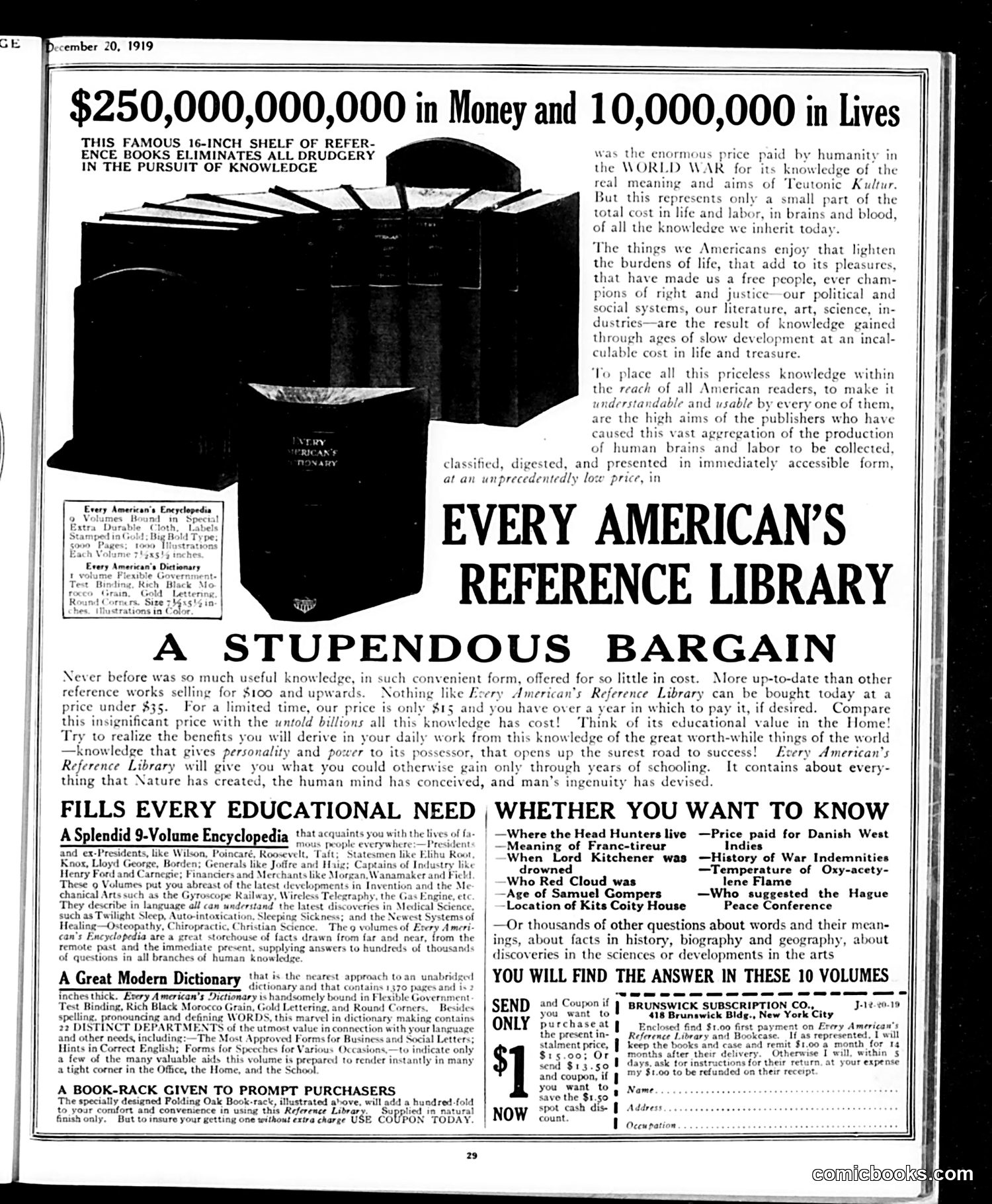
This is primarily a **full-page advertisement** for "Every American's Reference Library," a 10-volume encyclopedia set, dressed up as editorial content in *Judge* magazine (dated December 20, 1919). The satirical framing uses World War I as its hook: the headline claims the war cost "$250,000,000,000 in Money and 10,000,000 in Lives" to gain knowledge of "Teutonic Kultur" (German culture). The copy then pivots to argue that all human civilization's achievements—art, science, democracy—represent accumulated knowledge gained through immense historical sacrifice. The sales pitch: this encyclopedia compresses all that priceless knowledge into an affordable package ("only $15") and conveniently fits on a 16-inch shelf. **The satire is subtle**: the ad uses patriotic, post-WWI sentiment to justify selling reference books—essentially marketing knowledge as a bargain by comparison to war's terrible cost. It's commercial messaging wrapped in high-minded rhetoric about American progress and education.
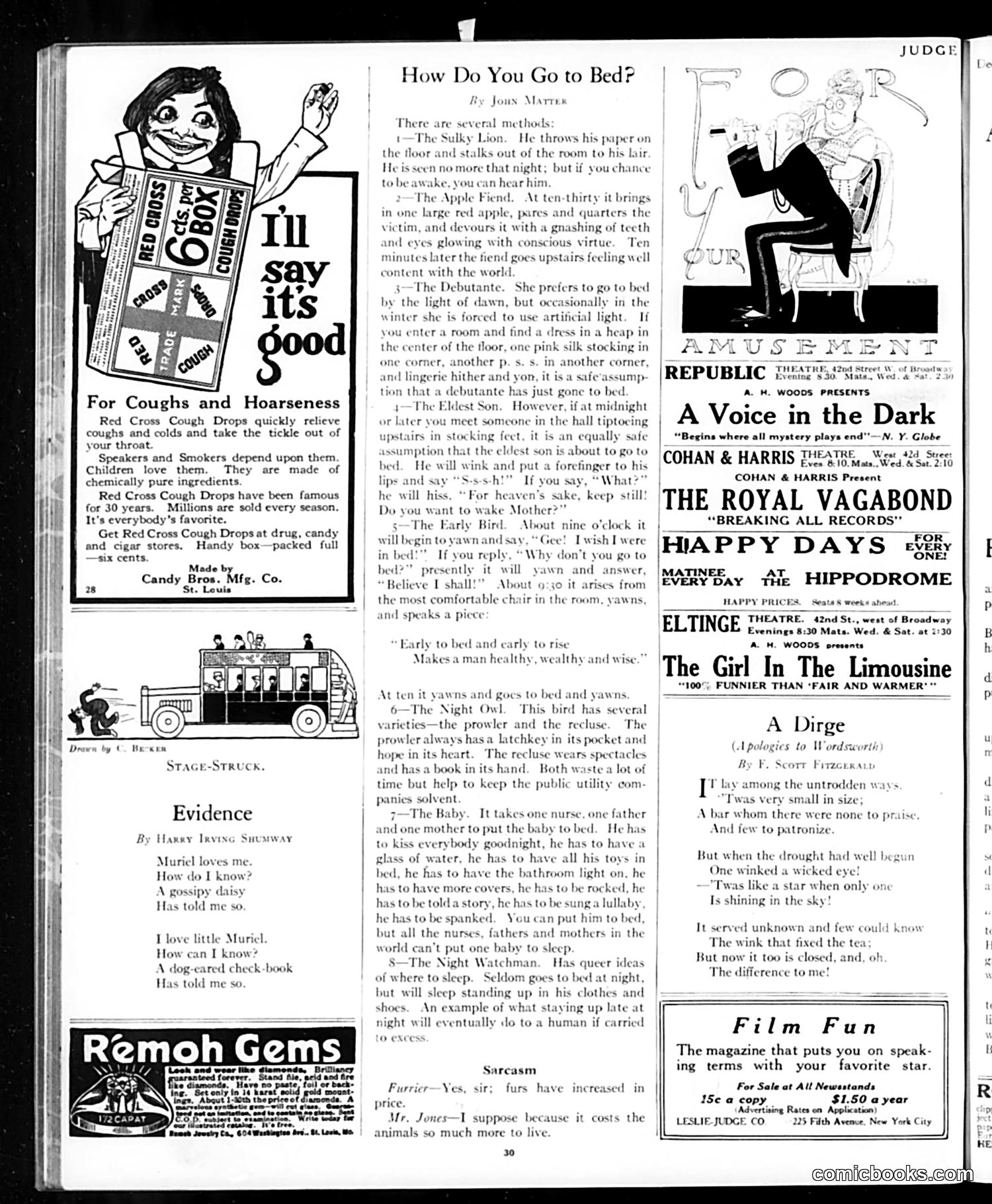
This page from Judge magazine contains humorous social satire and period advertisements typical of the publication's early-20th-century style. The main article "How Do You Go to Bed?" by Jons Mattee satirizes bedtime habits across different social types. It presents eight exaggerated character sketches: "The Sulky Lion" (moody man), "The Apple Fiend" (virtuous health enthusiast), "The Debutante" (wasteful, fashion-conscious woman), "The Eldest Son" (sneaking around), "The Early Bird" (eager sleeper), "The Night Owl" (productive night person), "The Baby" (dependent child), and "The Night Watchman" (exhausted worker). Each represents recognizable social stereotypes of the era, mocking their bedtime behaviors and implicit character flaws or peculiarities. A brief sarcastic exchange "Sarcasm" jokes about rising fur prices caused by animals living longer. Advertisements for Red Cross Cough Drops and Judge-related services fill remaining space. Overall, this represents light social commentary characteristic of Judge's satirical approach to middle and upper-class American life.
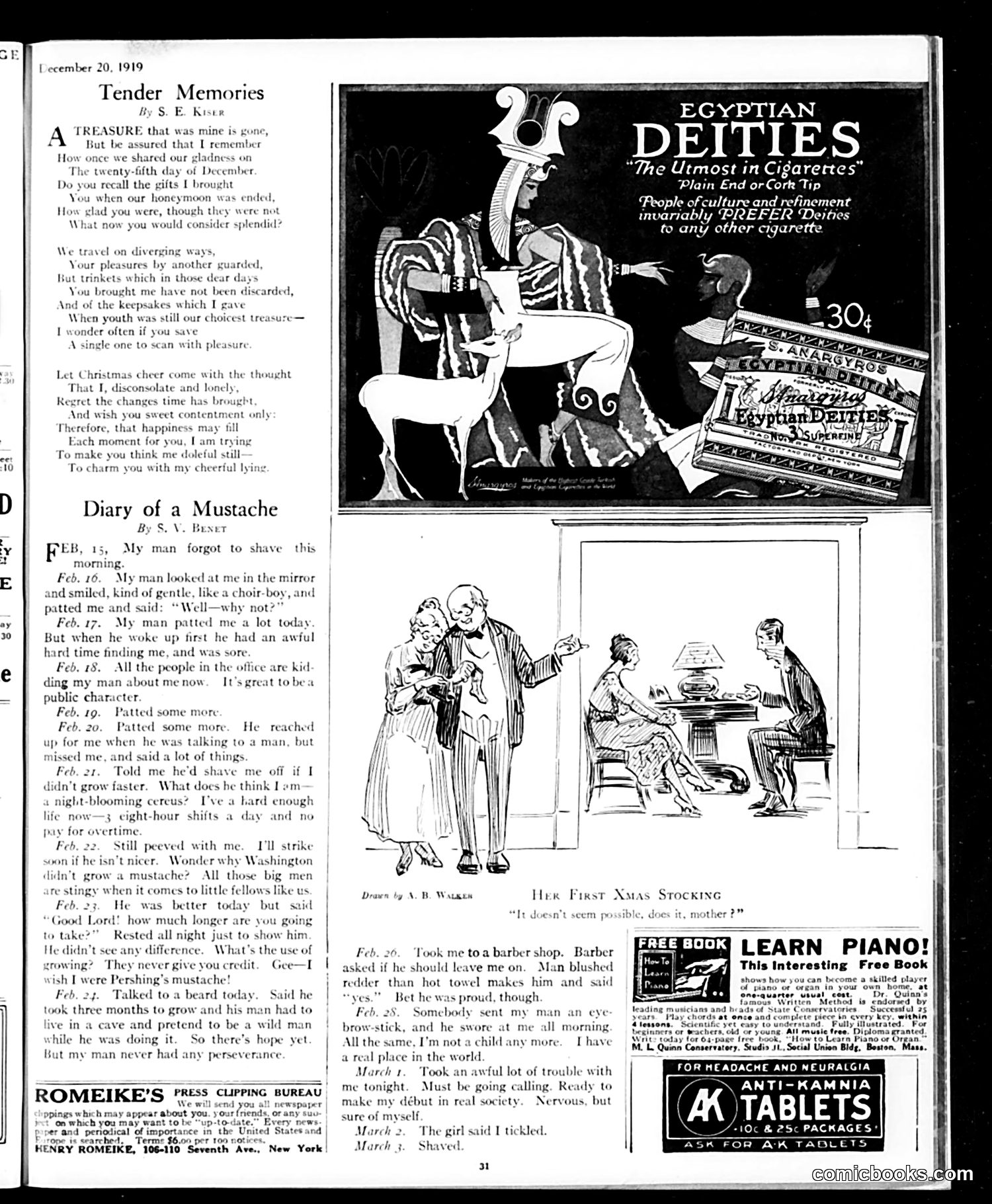
This humorous piece personifies a newly-grown mustache as a character with feelings and grievances. Written by S.V. Benét, it's a playful complaint from the mustache's perspective about its owner's neglect and impatience. The joke satirizes male vanity and grooming standards of 1919. The mustache "speaks" of being patted affectionately one moment, then forgotten or nearly shaved off the next. It compares itself to General Pershing's famous mustache (Pershing led U.S. forces in WWI and was widely celebrated), lamenting that its owner lacks the patience or dedication to properly cultivate facial hair. The satire gently mocks masculine insecurity about appearance while poking fun at the owner's fickleness—he alternates between pampering the mustache and threatening to remove it. It's light social commentary on how men treated grooming as both a point of pride and frustration.
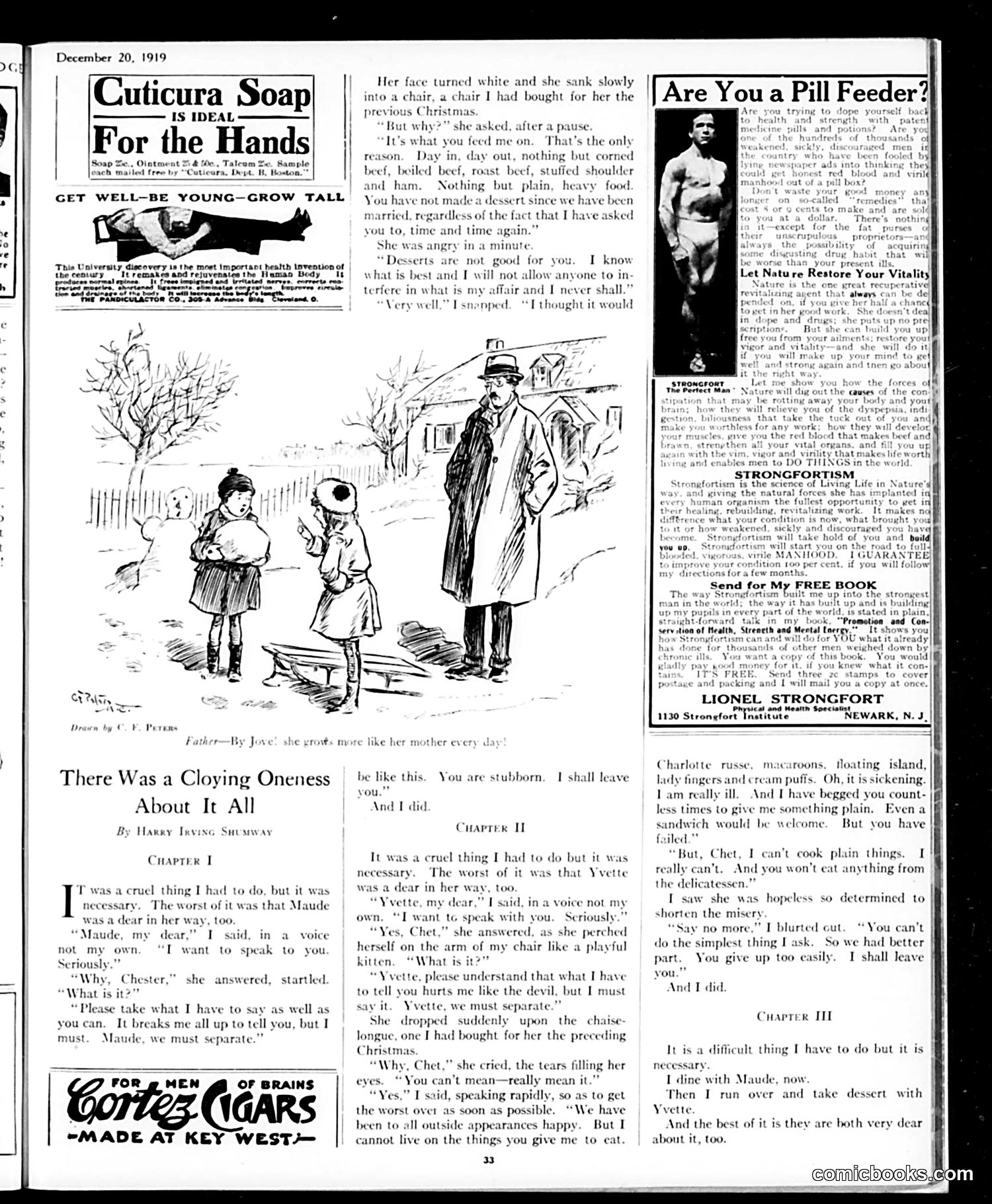
This page contains a serialized short story titled "There Was a Cloying Oneness About It All" by Harry Irving Susway, presented as satirical fiction rather than a political cartoon. **The Satire:** The story mocks a man (Chester) who leaves his wife Maude, then his girlfriend Yvette, for the identical reason: they won't stop serving him elaborate desserts and rich foods (corned beef, macaroons, floating island, cream puffs). He demands "plain" food but both women refuse, so he abandons them. The final irony: he now dines with both women separately and finds them "very dear." **The Joke:** This appears to satirize either domestic complaints about wives' cooking, male fickleness disguised as principle, or perhaps post-WWI food rationing anxieties (the date is December 1919). The absurdity of leaving relationships over menu complaints suggests commentary on shallow male reasoning or the triviality of domestic disputes. The surrounding ads (Cuticura Soap, Cortez Cigars, Strongfort bodybuilding) are period advertisements, not satirical content.
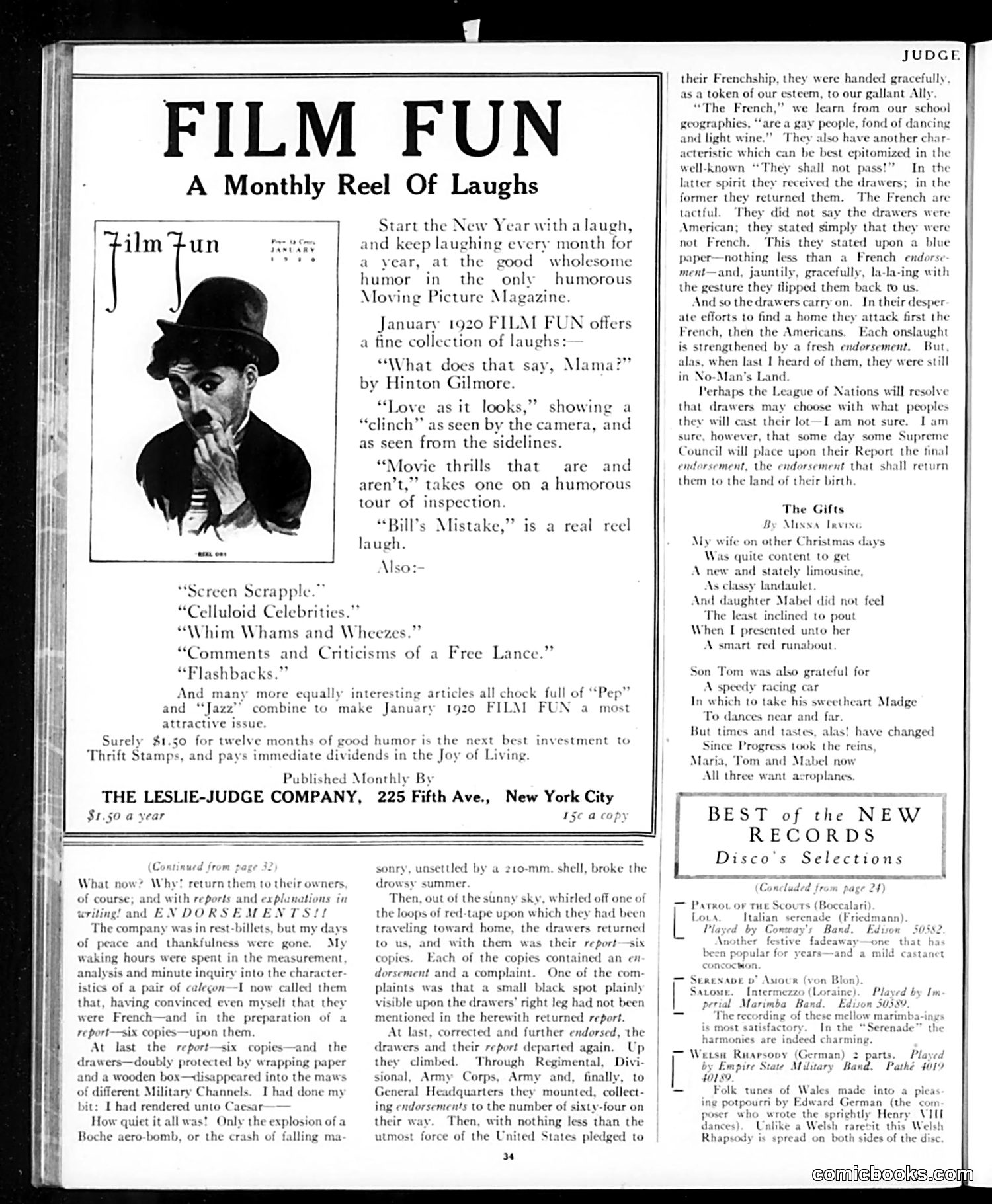
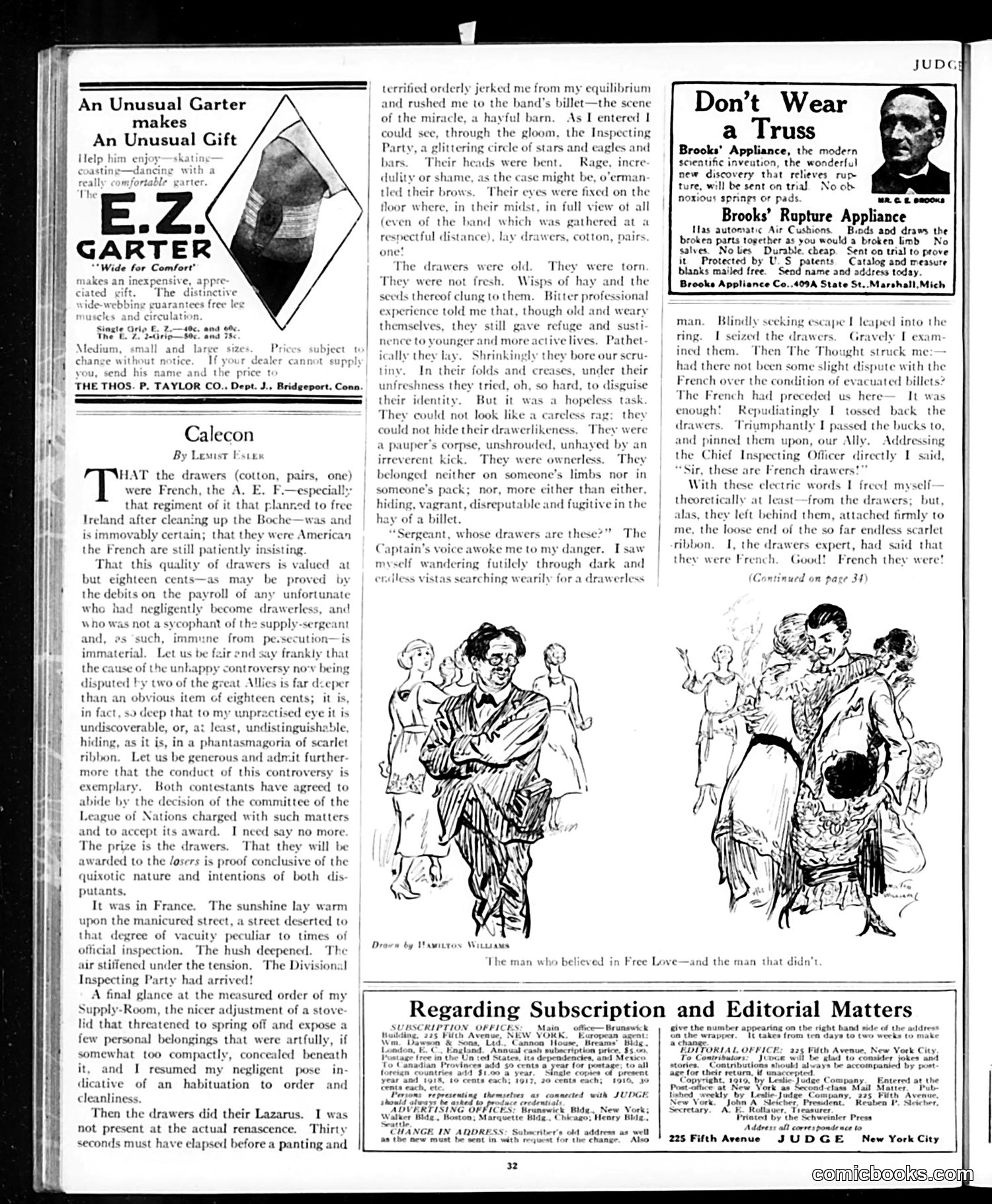
This page advertises **Film Fun**, a 1920 humor magazine focused on cinema. The illustrated figure appears to be **Charlie Chaplin** or a similar silent-film comedian character, identifiable by the bowler hat and mustache—the iconic "Tramp" persona. The satire targeting French-American relations is obscure today: the lengthy text describes U.S. military bureaucracy during WWI, where a pair of drawers (underwear) gets passed between French and American officials, accumulating 64 endorsements without resolution. The joke mocks: 1. **Allied tensions**: The French tactfully refuse the item, suggesting it's "not French"—a diplomatic insult 2. **Military red tape**: Endless paperwork and authorization channels produce nothing 3. **Post-war friction**: Implied friction between American and French forces The magazine itself promotes cinema humor as wholesome entertainment ($1.50/year), positioning "moving pictures" as the era's primary entertainment medium. The page is part advertisement, part satirical commentary on contemporary bureaucratic absurdity.
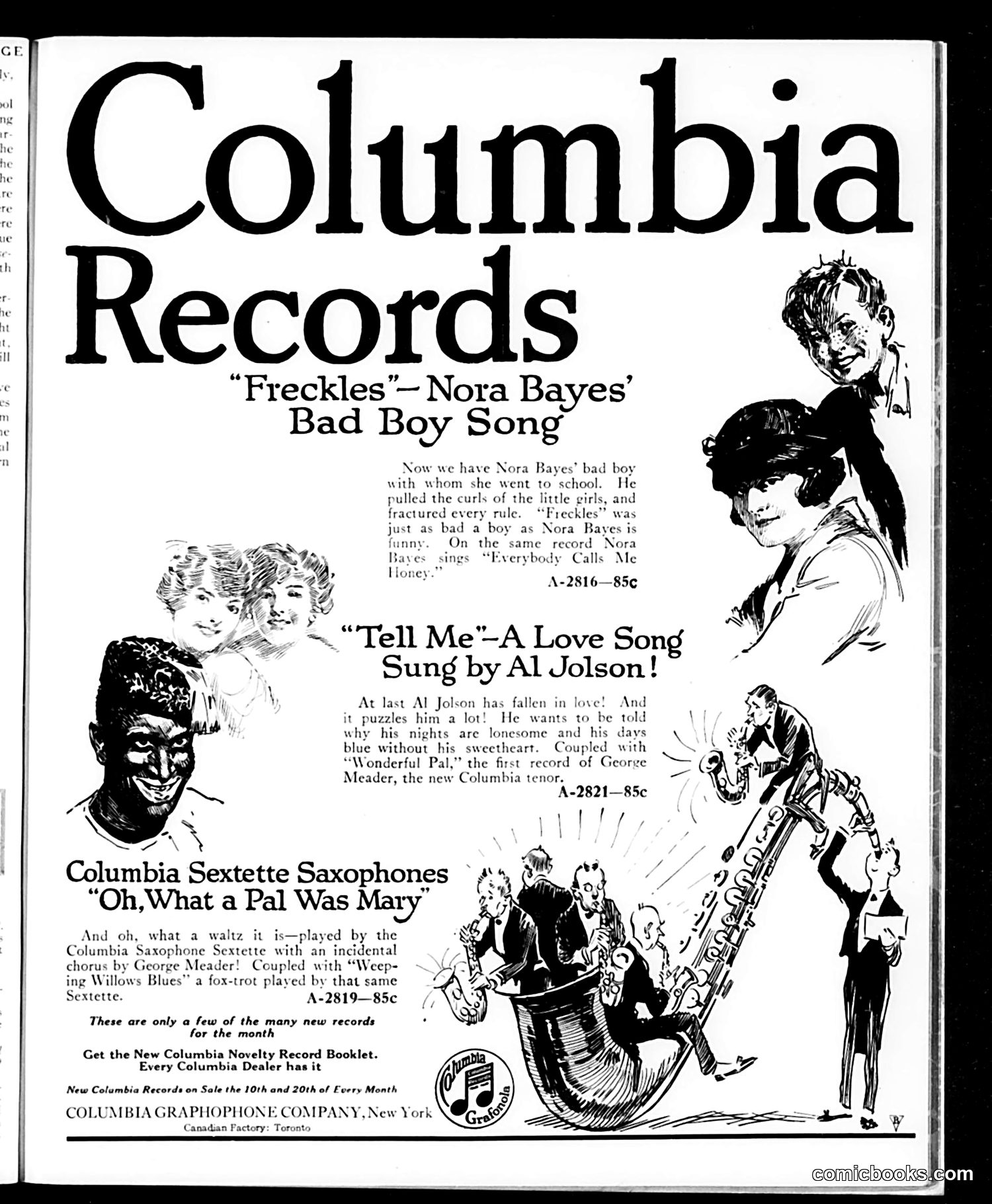
This is a **Columbia Records advertisement**, not political satire. It promotes three phonograph recordings featuring popular entertainers of the era. The page advertises records by: - **Nora Bayes**, a well-known vaudeville performer, singing about a mischievous "bad boy" - **Al Jolson**, a major star of the time, performing a sentimental love song titled "Tell Me" - **Columbia Saxophone Sextette**, an instrumental ensemble The illustrations show the performers in period style. The humor is light and playful—the ad describes Jolson's romantic confusion in a charming way ("puzzles him a lot"), and Bayes's song uses a nostalgic schoolyard narrative. This reflects early 20th-century popular entertainment marketing, when phonograph records were novelty items. The "85¢" price and emphasis on "new records for the month" indicate this targets record collectors and music consumers interested in the latest releases from major entertainers.

This is a **patent medicine advertisement**, not political satire. The page depicts a snowy winter scene with two people exposed to harsh weather—one person shivering in wet clothing near a stalled automobile, another sneezing or coughing. The ad promotes **Piso's**, a cough and cold remedy available at drugstores for 30 cents. The advertisement's logic is straightforward: winter exposure causes illness; Piso's provides prompt relief and prevents "real sickness." It emphasizes the product is safe ("contains no opiate"), suitable for all ages from babies to grandmothers, and recommends keeping it readily available in the medicine cabinet. This represents typical early-20th-century advertising in magazines like *Judge*—using relatable scenarios and health anxieties to market patent medicines, many of which had minimal actual medicinal value.