
Judge, 1919-12-20 · page 9 of 36
Judge — December 20, 1919 — page 9: what you’re looking at
What you’re looking at
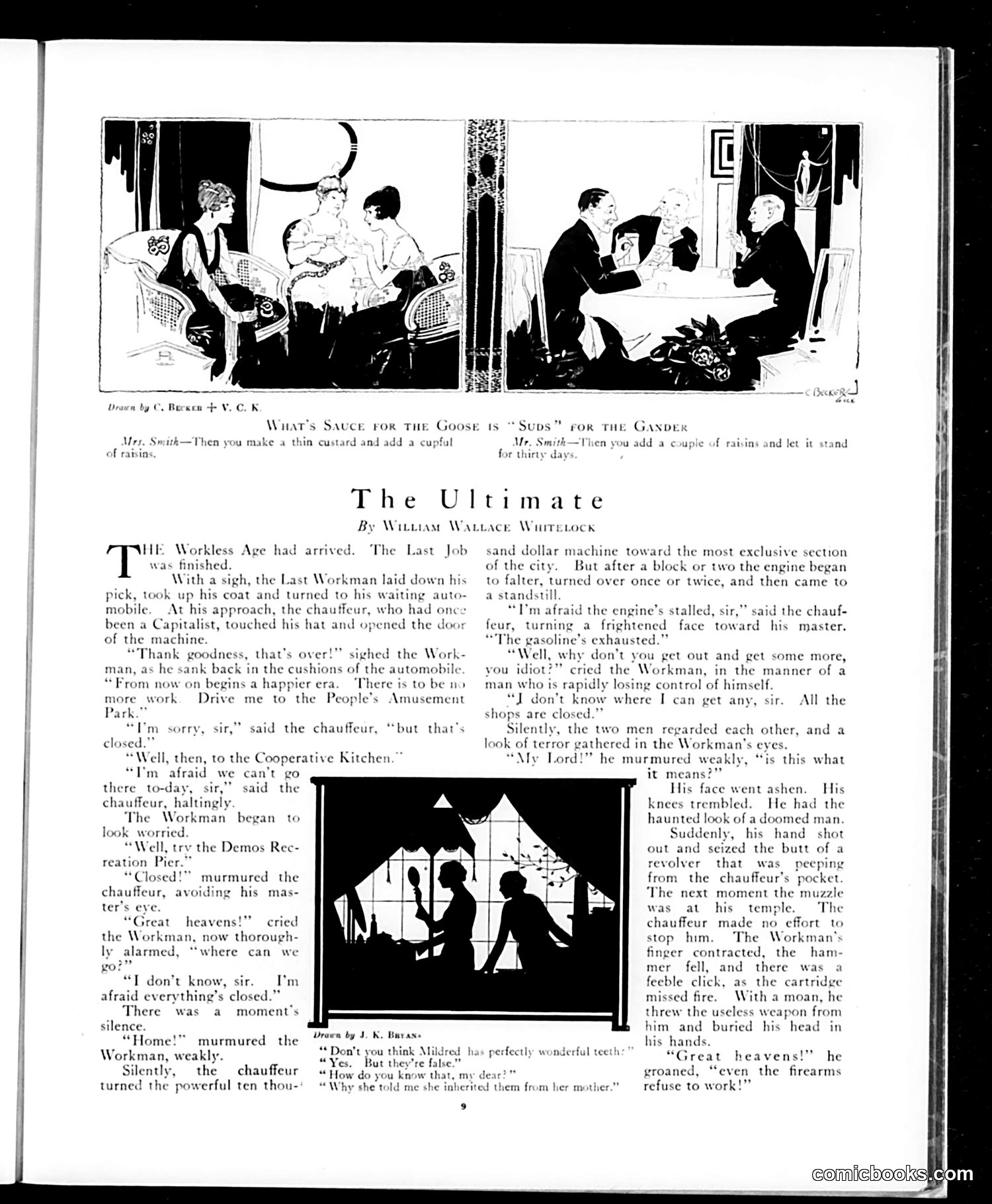
This satirical story depicts a dystopian "Workless Age" where automation has eliminated all jobs. The narrative follows the "Last Workman," who discovers that society has collapsed into complete dependency on mechanical systems and cooperative institutions. The satire targets early 20th-century anxieties about technological unemployment and socialist organization. When the workman seeks leisure at various public facilities (amusement park, cooperative kitchen, recreation center), all are closed—suggesting that without workers, even utopian collective systems fail. The climax—where even firearms refuse to function—represents total societal breakdown. The humor is dark: the former capitalist chauffeur and workman are equally helpless. The story mocks both fears of automation eliminating human purpose and optimism about socialist alternatives, suggesting neither system accounts for human agency or survival needs. The upper cartoons show domestic dining scenes, likely contrasting pre- and post-work social arrangements, though the specific joke requires clearer resolution.
📄 Transcribed text from this page (OCR, searchable)
Machine-transcribed from the original scan — historical spelling and the odd misread are preserved.
Wuat’s Sauce rok tHe Goose ts “Sups”™ ror tHe Ganpex and add ac al ¢ a thin cust Mrs. Smith—Then you m of raisin The U By Wittiamn W HE Workless Age had arrived. The Last Job was finished. With a sigh, the Last Workman laid down his pick, took up his coat and turned to his waiting at \t his approach, the chauffeur, who had once ened the door mobile been a Capitalist, touched his hat and of of the machine. “Thank goodne: , that’s ov sighed the Work- ik back in the cushions of the automobil: von begins a happier era. ‘There is to be Drive me to the People’s Amusement man, as he “From ne ore. work ‘ark “I'm sorry, sir, closed.” “Well, then, to the Cooperative Kitchen “Tm afraid we can’t go there to-day, sir,” said the chauffeur, haltingly. The Workman began to look worried “Well, try the Demos Rec- reation Pic: “Closed! murmured the chauffeur, avoiding his mas- said the chauffeur, “but that’s ter’s eye. “Great heavens! cried the Workman, now thorougt , alarmed, “where can we I don’t know, sir. I'm afraid everything’s closed.” There was a moment's silence. “Home!” murmured the ren by 4: K: Brass Workman, weakly. agent an think Niidsed Silently, the — chauffeur —«j1ow do you kaw that turned the powerful ten thou-' “Wt ) man who is rapidly los y she told me she inherited Mr. Smith—Then you add a couple of + for thirty ltimate ALLACE WitireELocK sand dollar machine toward the most exclusive section of the city. But after a block or two the engine began to falter, turned over once or twi and then came to a standstill “I'm afraid the engine’s stalled, sir,” said the chauf- feur, turning a frightened face toward his master. “The gasoline’s exhausted.” “Well, why don’t you get out and get some more, you idiot cried the Workman, in the manner of a 1g control of himself “J don’t know where I can get any, sir. are closed.” Silently, the two men regarded each other, and a look of terror hered in the Workman’s eyes. “My Lord!” he murmured weakly, “is th it means?” His face went ashen. His knees trembled. He had the haunted look of adoomed man. Suddenly, his hand shot out and seized the butt of a revolver that was peepin the chauffeur’s pocket next moment the muzzle was at his temple. The chauffeur made no effort to stop him. The Workman’s finger contracted, the ham- mer fell, and there was a feeble click, as the cartridge sed fire. With a moan, he rew the useless weapon from him and buried his head in his hands. “Great heavens!” he groane: ‘even the firearms m from her mother.” refuse to work!" All the what has perfectly wonderful tee 9 comichoo!