
Judge, 1919-12-20 · page 6 of 36
Judge — December 20, 1919 — page 6: what you’re looking at
What you’re looking at
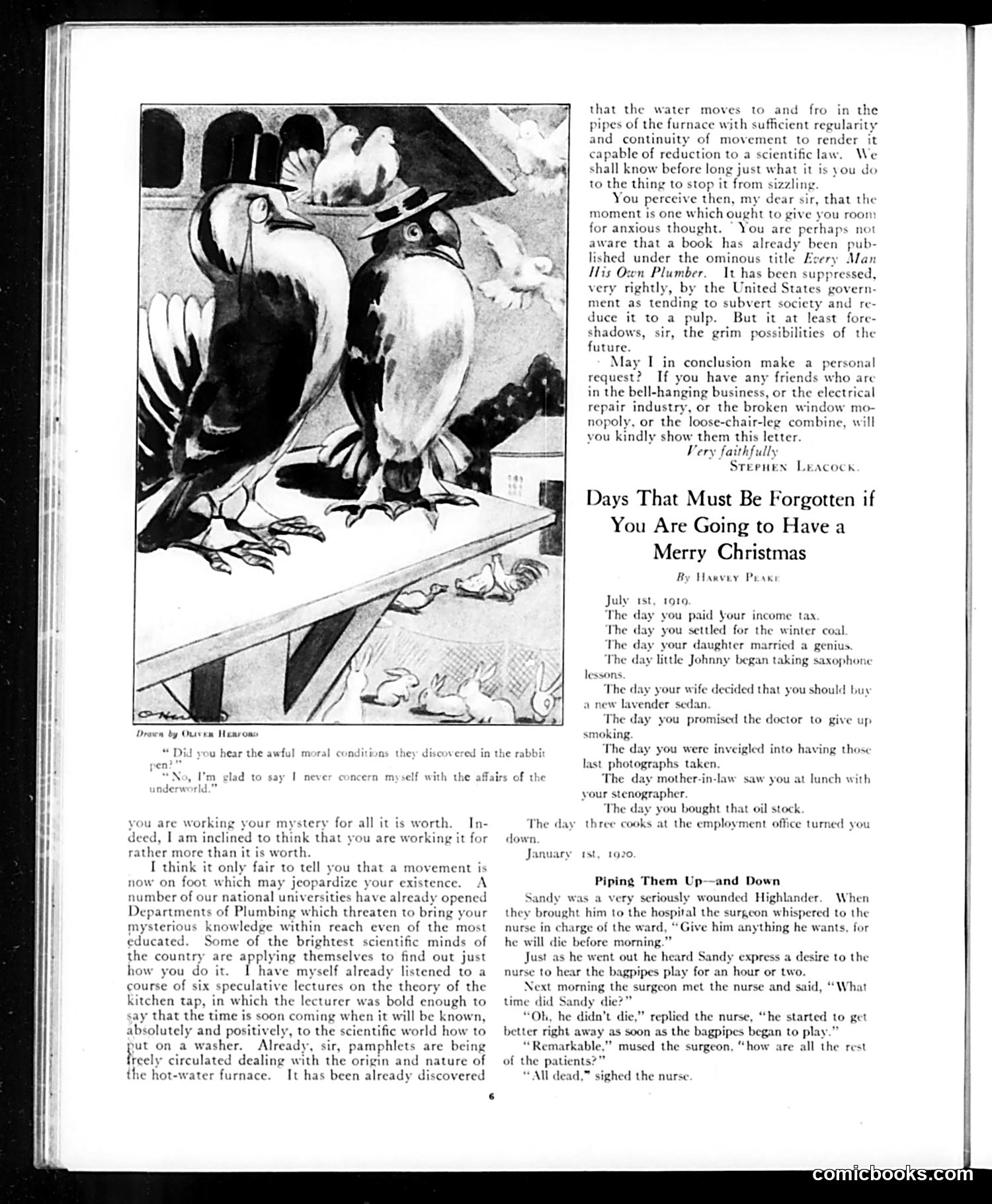
The main illustration depicts **anthropomorphic birds (likely roosters or similar fowl) near plumbing fixtures**, drawn by Cesare Mazzoni. The accompanying text discusses plumbing and furnace mechanics, suggesting this is satirical commentary on the **plumbing industry or household management**. The caption references "moral conditions" discovered in plumbing work, implying plumbers encounter unsavory domestic situations. This appears to be **social satire about what service workers observe in homes**—a common Judge magazine theme mocking middle-class pretensions. Below are unrelated pieces: Stephen Leacock's letter about industrial concerns and Harvey Peake's humorous article about forgettable days, listing mundane 1919-1920 life events (tax day, daughter's marriage, doctor visits). These represent typical magazine miscellany rather than unified editorial content.
📄 Transcribed text from this page (OCR, searchable)
Machine-transcribed from the original scan — historical spelling and the odd misread are preserved.
Drawn by Ouven Hearony ar the awful moral “p glad to su are Working your mystery for all it is worth. In- deed, I am inclined to think that you are working it for rather more than it is worth. I think it only fair to tell you that a movement is now on foot which may jeopardize your existence. A number of our national universities have already opened Departments of Plumbing which threaten to bring your mysterious knowledge within reach even of the most educate Some of the brightest scientific minds of the country are applying themselves to find out just how you do it. I have myself already listened to a course of six speculative lectures on the theory of the kitchen tap, in which the lecturer was bold enough to say that the time is soon coming when it will be known, absolutely and positively, to the scientific world how to nut on a washer. Already, sir, pamphlets are being freely circulated dealing with the origin and nature of the hot-water furnace. It has been already discovered that the water moves to and fro in the pipes of the furnace with sufficient regularity and continuity of movement to render it capable of reduction to a scientific law. We shall know before long just what it is you do to the thing to stop it from sizzling You perceive then, my dear sir, that the moment is one which ought to give you room for anxious thought. © You are perhaps not aware that a book has already been pub- lished under the ominous title Every Man His On Plumber. It has been suppressed, very rightly, by the United States govern- ment as tending to subvert society and re- duce it to a pulp. But it at least fore- shadows, sir, the grim possibilities of the future: May I in conclusion make a personal request? If you have any friends who are in the bell-hanging business, or the electrical repair industry, or the broken window m nopoly, or the loose-chair-leg combine, will you kindly show them this letter. Very faithfully STEPHEN Leacock Days That Must Be Forgotten if You Are Going to Have a Merry Christmas By Hanvey Peane July tst, 1010 The day you paid Your income tax The day you settled for the winter c The day your daughter married a gen The day little Johnny began taking saxophone lessons. The day your wife decided that you should buy a new lavender sedan. The day you promised the doctor to giv smoking The day you were inveigled into having th last photographs taken. The day mother-in-law saw you at lunch with your stenographer. The day you bought that oil stock three cooks at the employment office turned you The day down. Ist, 1920 Piping Them Up-—and Down Sandy was a very seriously wounded Highlander. When they brought him to the hospital the surgeon whispered to the nurse in charge of the ward, “Give him anything he wants, for he will die before morning.” Just as he went out he heard Sandy express a desire to the nurse to hear the bagpipes play for an hour or two. Next morning the surgeon met the nurse and said, “What time did Sandy die?” “Oh, he didn’t die,” replied the nurse, “he started to get better right a soon as the bagpipes began to play.” “Remarkable,” mused the surgeon, “how are all the rest of the patients?” “All dead,” sighed the nurse