
A complete issue · 36 pages · 1919
Judge — October 11, 1919
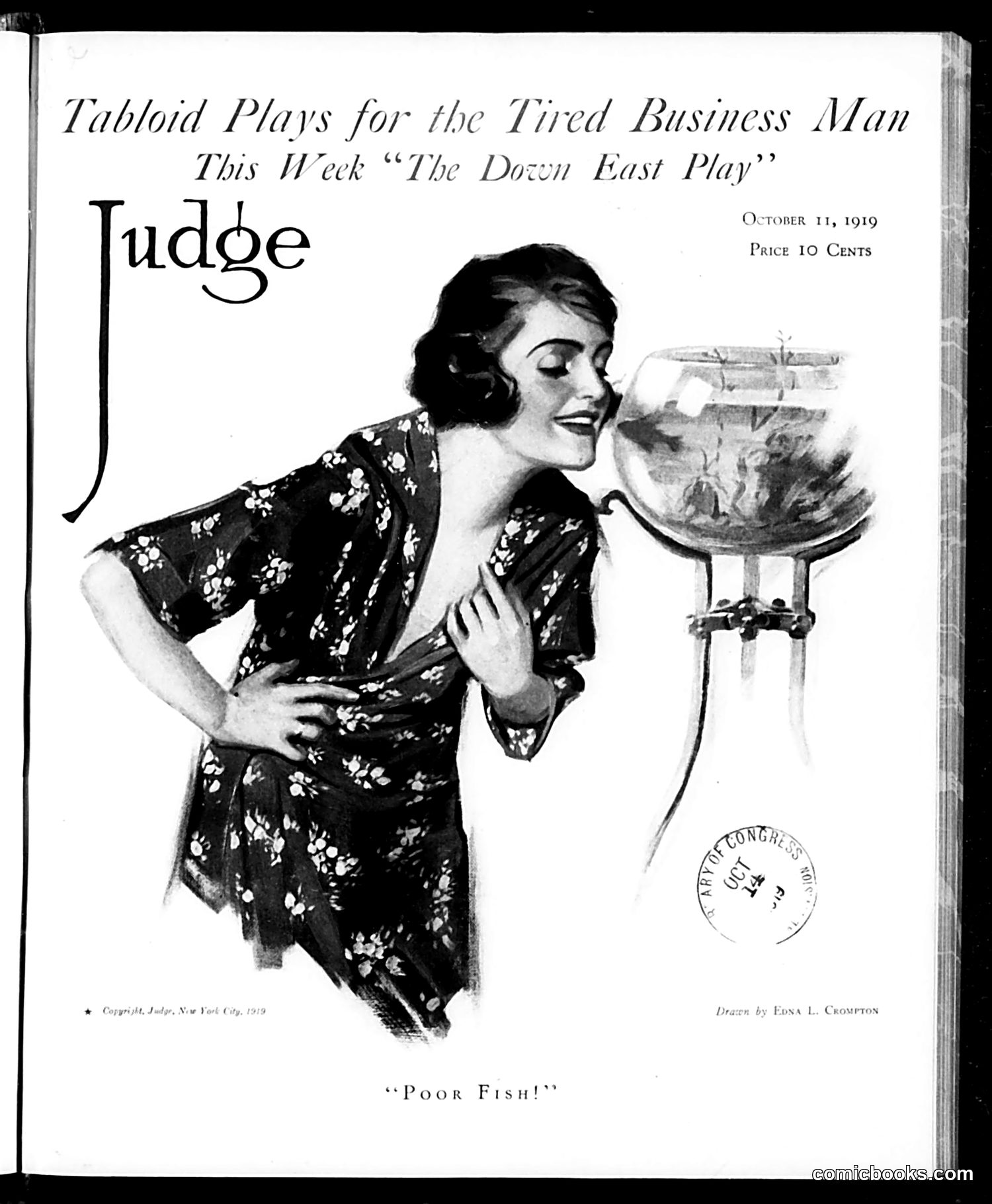
This illustration by Edna L. Crompton depicts a woman in a floral dress holding a round fishbowl containing what appears to be a bewildered fish. The title "Poor Fish!" suggests the cartoon is making a visual pun—the woman's expression and posture indicate she's observing the fish with amusement or pity, while the fish appears distressed. The exact satirical target remains unclear from the image alone. It may reference contemporary social commentary about war (WWI had just ended in November 1918), gender relations, or perhaps commentary on naive or trapped individuals. The "Tabloid Plays for the Tired Business Man" header suggests this is entertainment-focused content rather than hard political satire, though the precise joke requires additional context about 1919 events or theatrical references.
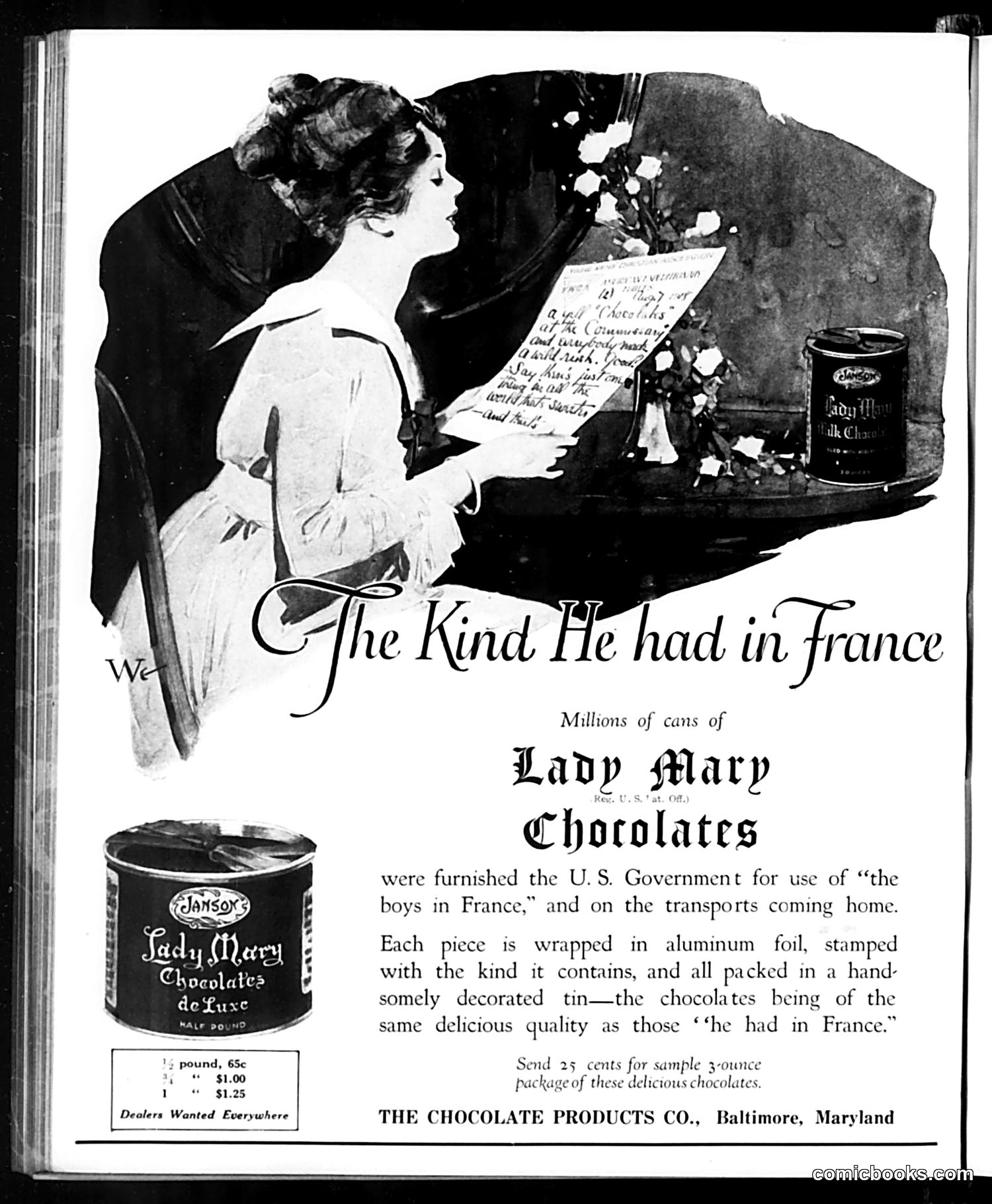
This page is primarily a commercial advertisement rather than political satire. It promotes Lady Mary Chocolates, manufactured by The Chocolate Products Co. of Baltimore. The ad capitalizes on post-WWI nostalgia by referencing American soldiers' experiences in France. The illustrated woman reading a letter appears to be receiving correspondence from a serviceman abroad, evoking emotional connection to the war effort. The tagline "The Kind He had in France" suggests these chocolates were supplied to U.S. troops and are now available for civilians. The marketing appeals to patriotic sentiment and romantic longing, positioning the product as a way to recreate soldiers' experiences or maintain connections with loved ones overseas. Pricing information and sample offers are included below.
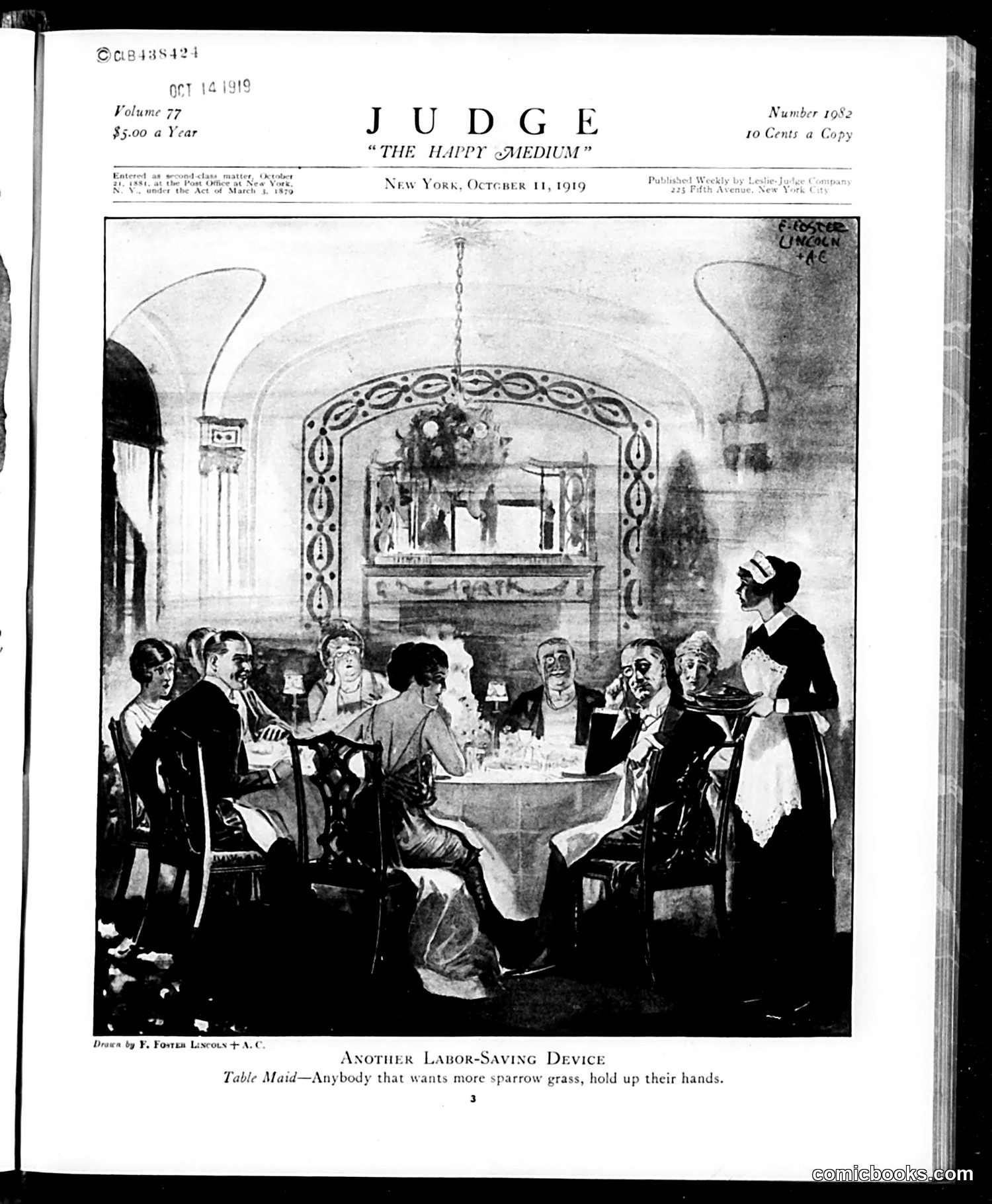
This satirical cartoon depicts a formal dinner scene with well-dressed diners seated around a table. The caption reads: "Table Maid—Anybody that wants more sparrow grass, hold up their hands." The joke targets post-WWI food scarcity and rationing. "Sparrow grass" is period slang for asparagus—a cheap vegetable. The humor lies in depicting wealthy socialites at an elegant dinner being served such humble fare, with the maid conducting the service like a school classroom rather than fine dining. The cartoon likely satirizes either food shortages/inflation from 1919, or the pretensions of the wealthy eating poorly during austere times. The title "Labor-Saving Device" suggests the maid's efficient mass-service approach mocks formal service traditions.
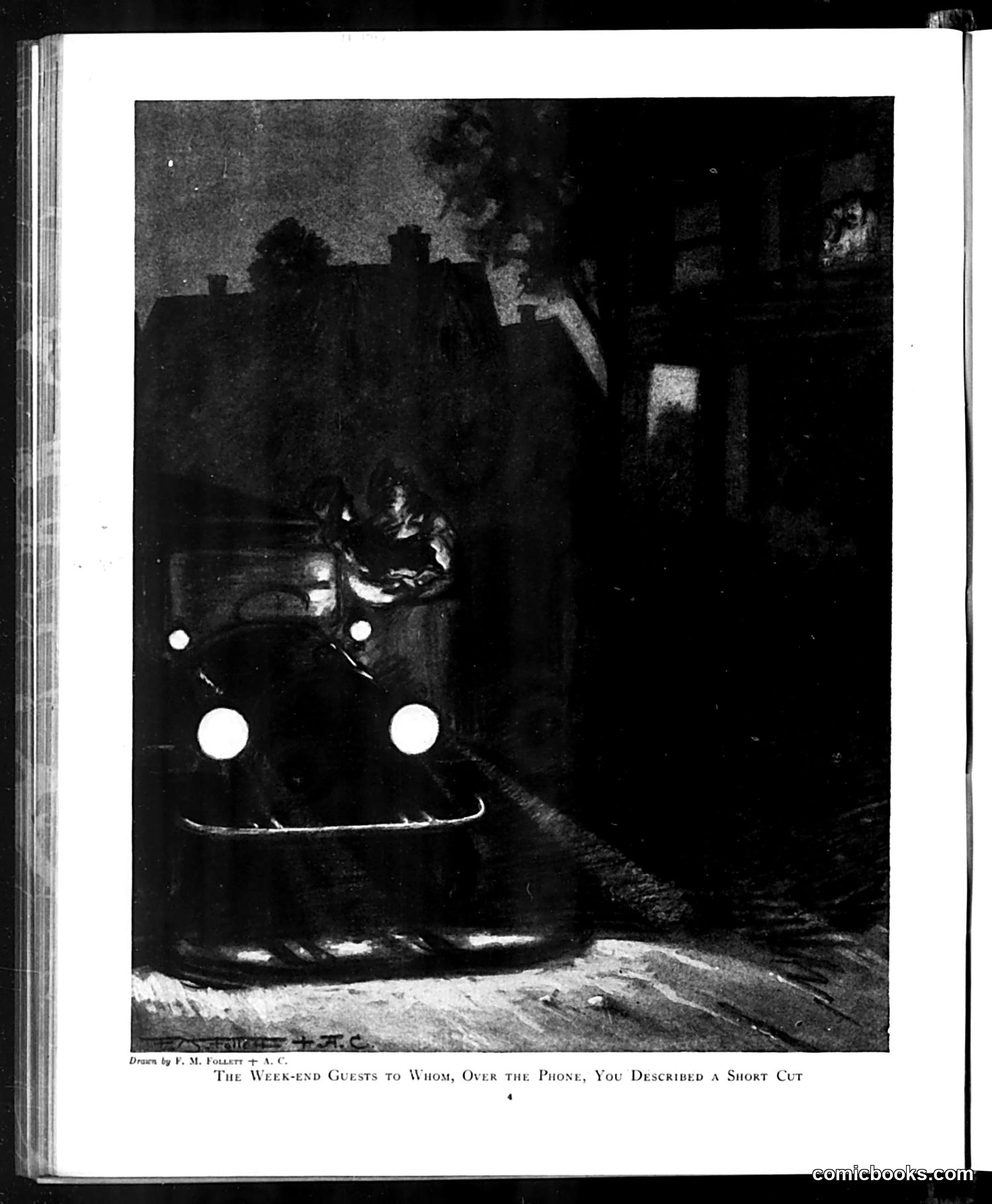
This appears to be a dramatic illustration from Judge magazine showing a car with headlights on at night, positioned outside what looks like a building or house. The caption reads: "THE WEEK-END GUESTS TO WHOM, OVER THE PHONE, YOU DESCRIBED A SHORT CUT." The satire likely mocks the common social situation where someone gives driving directions over the telephone to weekend guests, only to have those directions prove inadequate or misleading. The car's prominent headlights and nighttime setting suggest the guests have become lost while following the poorly-described route. The illustration humorously depicts the consequence of relying on verbal directions—the guests arriving at an unexpected or wrong location, frustrated after their journey. This reflects early 20th-century frustrations with navigating without modern GPS or detailed maps.
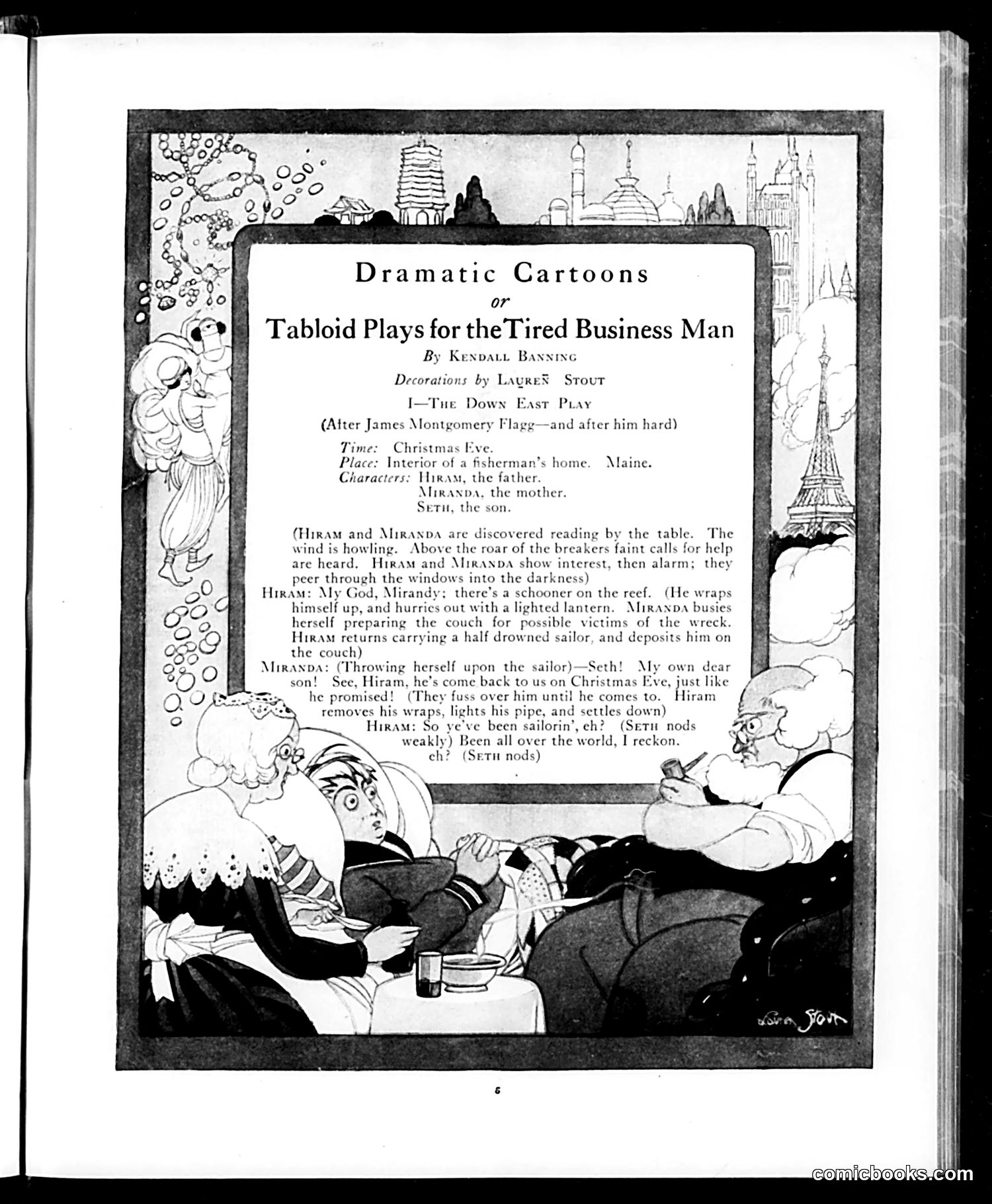
This is a humorous dramatic sketch titled "Dramatic Cartoons or Tabloid Plays for the Tired Business Man," credited to Kendall Banning with decorations by Lauren Stout. The sketch depicts a Christmas Eve scene in a Maine fisherman's home. The humor centers on a shipwreck rescue: while parents Hiram and Miranda read by the fire, their sailor son Seth unexpectedly returns home carrying a half-drowned sailor he's rescued from a reef. The comedy derives from the contrast between domestic comfort and maritime drama, and the family's simultaneous concern and casualness about the rescued stranger. The illustration shows the tired businessman audience as the actual subjects being entertained—satirizing leisure reading for exhausted workers.
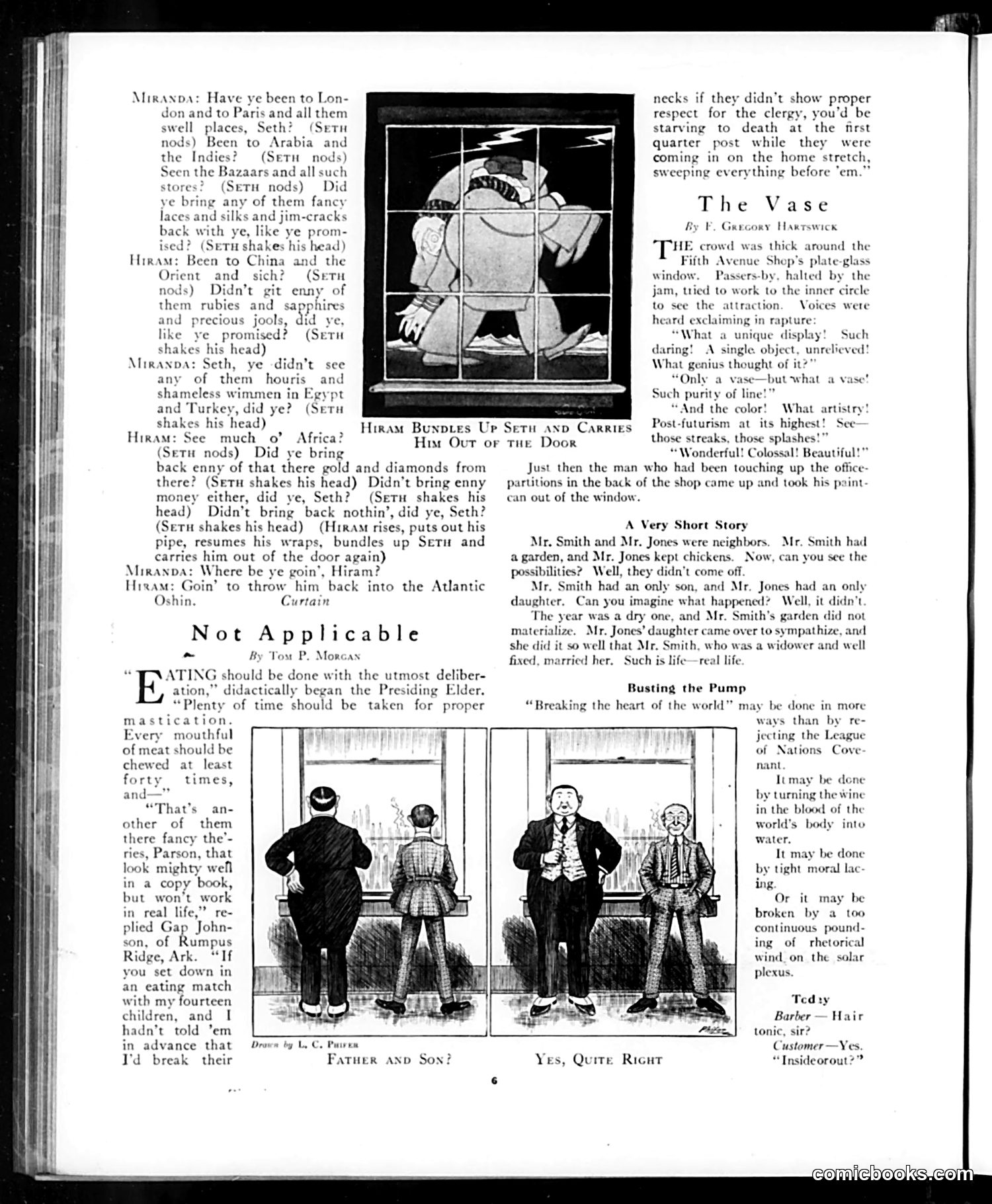
This page contains three separate pieces of satirical content: 1. **"Not Applicable"** (Tom P. Morgan): A satirical etiquette piece mocking overly formal dining rules. It parodies pretentious social conventions about proper eating, suggesting such rigid formality is impractical in real life. 2. **"The Vase"** (F. Gregory Hartswick): A story about a crowd gathering around a Fifth Avenue shop window to admire a single vase. The satire targets post-futurism art and minimalism—mocking how people uncritically praise avant-garde art simply because it's presented as sophisticated. 3. **"Father and Son?"** (cartoon by L.C. Pinder): Shows two pairs of figures at what appears to be a shop window. The caption's meaning is unclear without additional context, but likely satirizes class differences or generational expectations. The page reflects early 20th-century satirical concerns with snobbery, pretense, and artistic fraud.
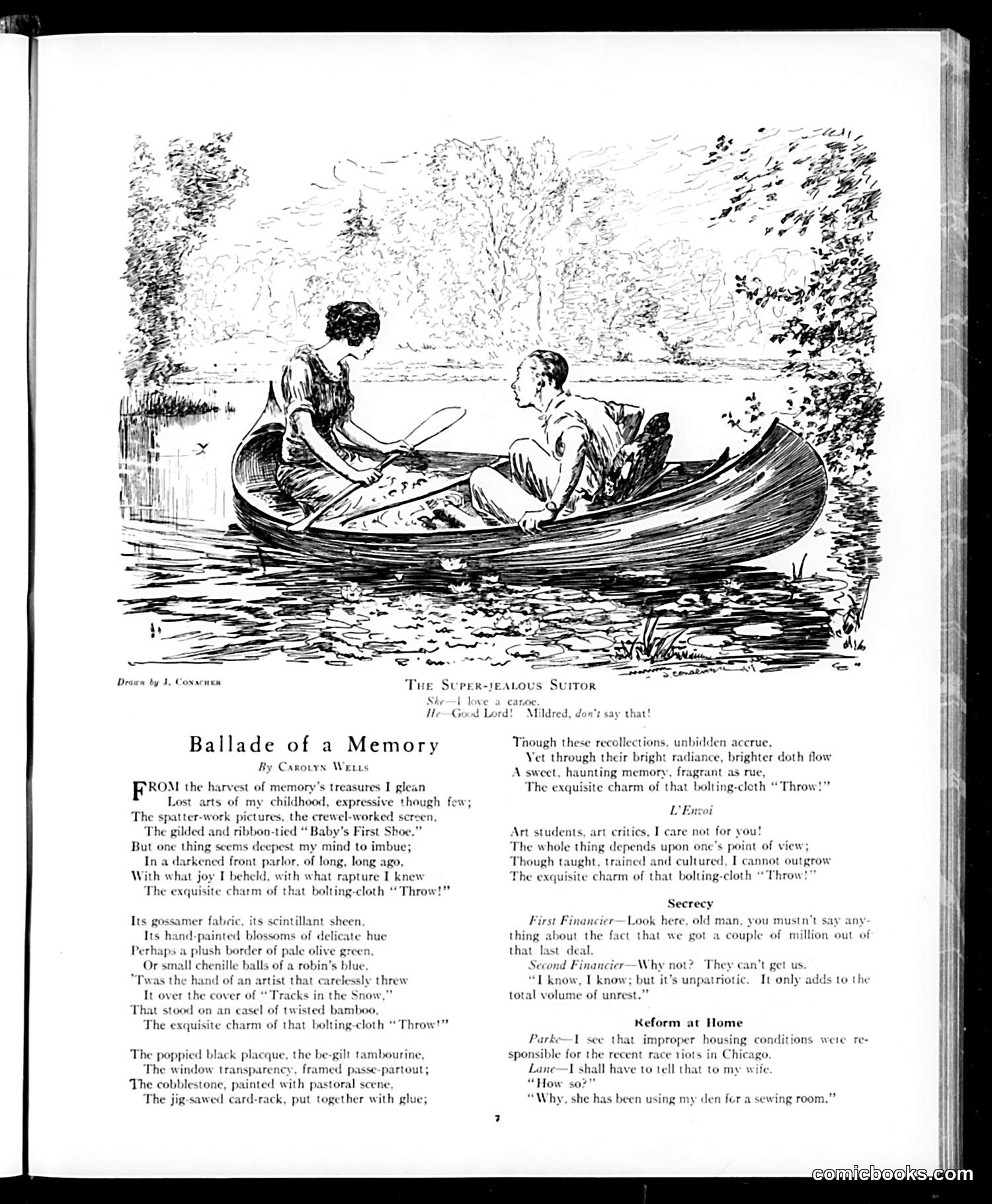
**The Cartoon "The Super-Jealous Suitor":** A couple in a canoe; the woman says "I love a canoe," and the man responds "Good Lord! Mildred, don't say that!"—his exaggerated alarm satirizes male jealousy and possessiveness. The joke plays on outdated social conventions where a man might irrationally fear his girlfriend's innocent enthusiasm for something (a canoe) as somehow threatening to him. **"Ballade of a Memory":** A nostalgic poem about Victorian-era domestic decorative objects (bolting-cloth throws, painted screens, bamboo easels)—likely satirizing sentimental romanticism about the past and the middle-class aesthetic of previous generations. **"Secrecy" and "Reform at Home":** Two brief satirical dialogues. The first mocks wealthy financiers hiding unethical profits while citing "patriotism" and "unrest." The second jokes that social reformers ignore their own domestic problems—a man can't discuss improper housing while his wife has converted his personal study into a sewing room.
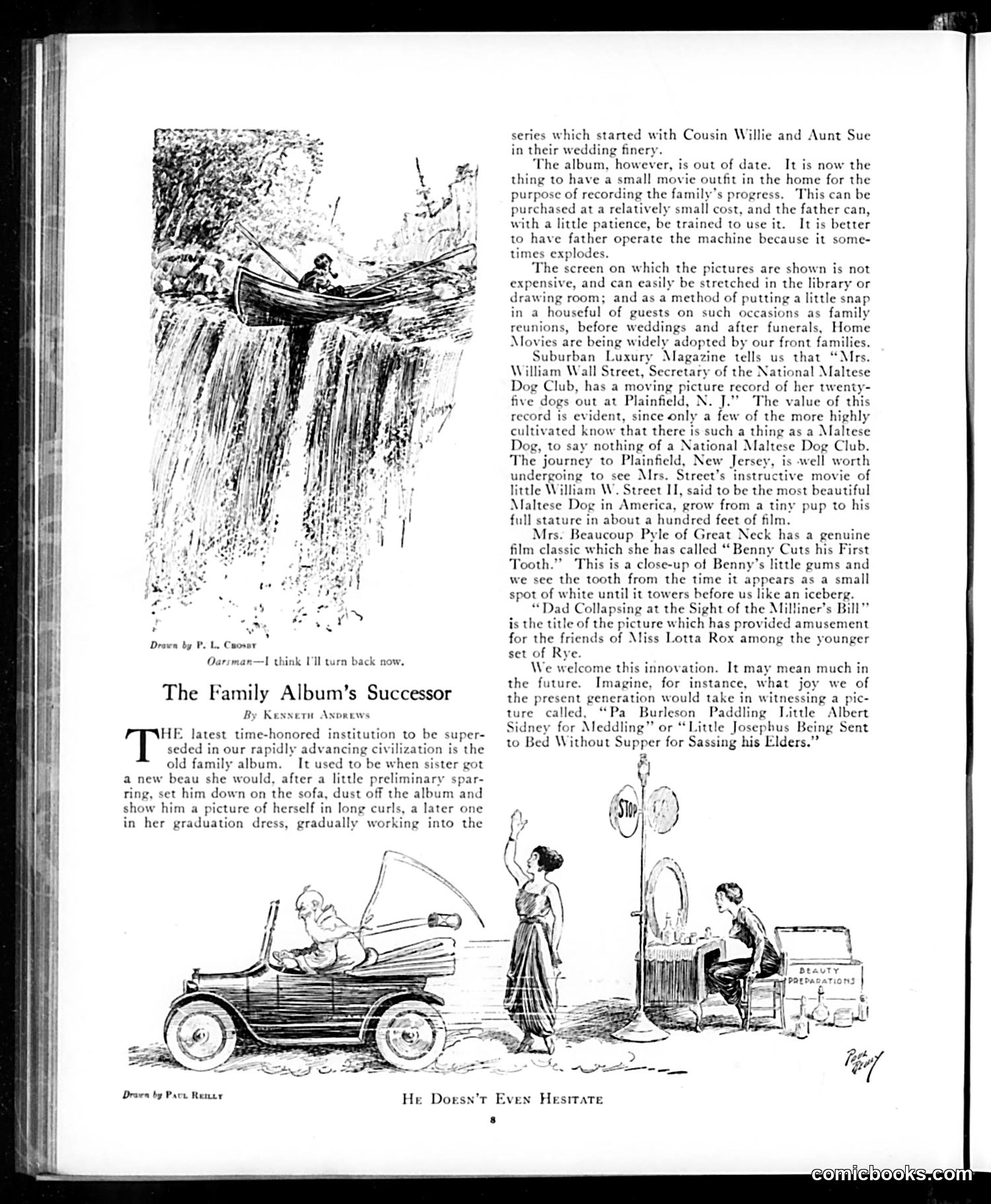
This 1920s *Judge* article satirizes the replacement of traditional family photo albums with home movie cameras—a new technology gaining popularity among wealthy families. The satire targets upper-class pretension: wealthy socialites like "Mrs. William Wall Street" (a generic name mocking Wall Street types) are recording trivial domestic moments on film—a Maltese dog's growth, a baby's tooth emerging—as though these mundane events deserve cinematic documentation. The humor lies in the absurdity of treating ordinary family life as worthy of elaborate film production. The closing joke is political. The author imagines what *historical* films would show: "Pa Burleson Paddling Little Albert Sidney" and "Little Josephus Being Sent to Bed"—likely references to Secretary of War Newton Baker's children, mocking how self-important wealthy families immortalize even discipline moments. The cartoon below (captioned "He Doesn't Even Hesitate") shows a father casually filming while his child sits in a baby carriage and a woman operates beauty preparations—illustrating the article's point that fathers are enthusiastically adopting film despite being incompetent operators ("sometimes explodes").
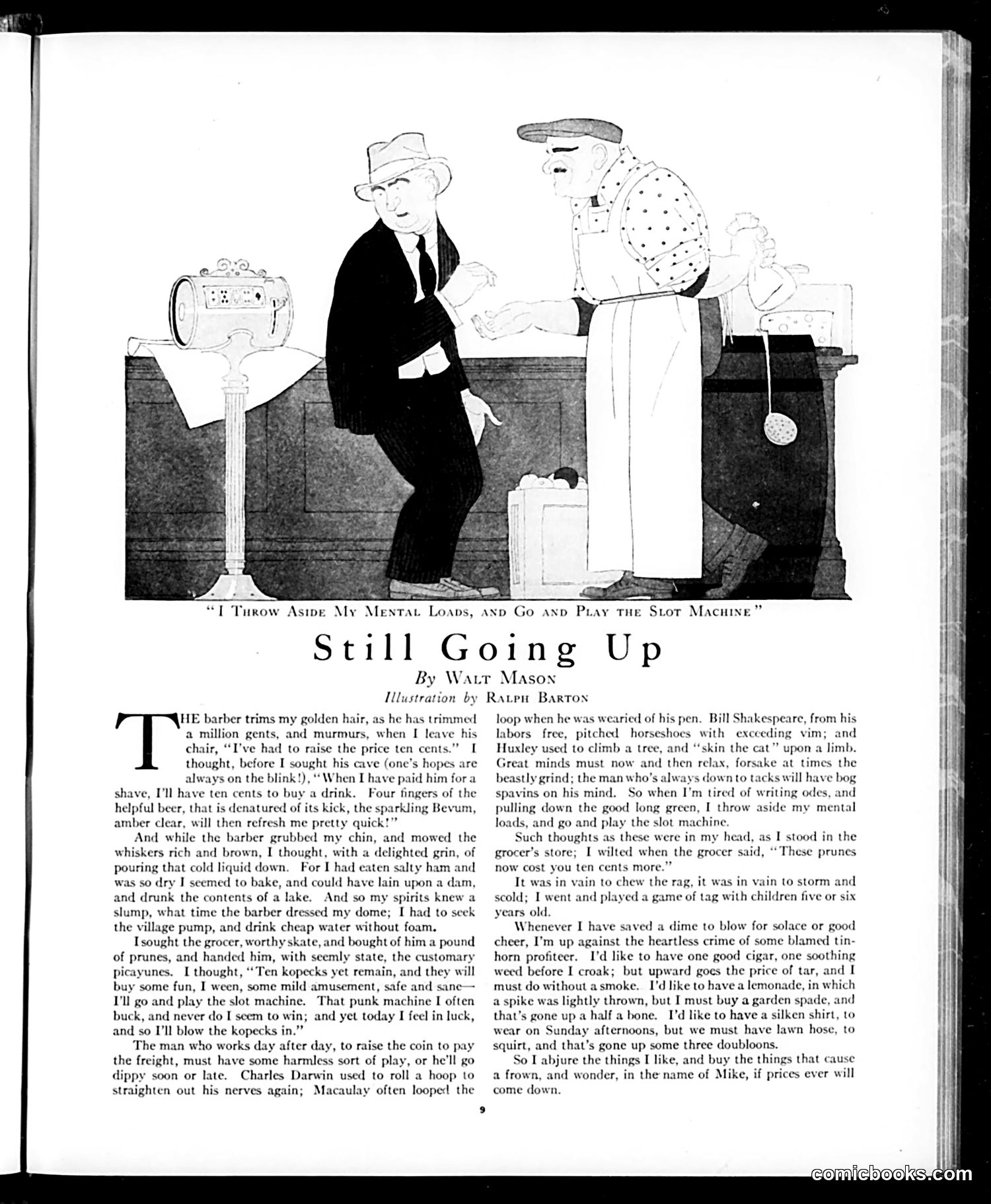
This is a humorous poem about inflation and rising costs, illustrated by Ralph Barton. The cartoon shows a working man encountering price increases everywhere—his barber raises rates ten cents, prunes cost more at the grocer's, slot machines take his money without paying out. The satire targets the frustration of ordinary laborers facing continuous inflation. Mason uses the speaker's modest aspirations (a drink, a cigar, a lemonade) to show how rising prices deny even small pleasures to working people. The references to great minds like Darwin, Macaulay, and Huxley needing harmless recreation suggest that leisure isn't luxury—it's necessary for mental health—yet remains beyond reach. The "slot machine" serves as a symbol of the speaker's futile attempts to find relief or escape. The overall message: no matter how hard workers labor, inflation keeps them perpetually broke and unable to afford even basic comforts.
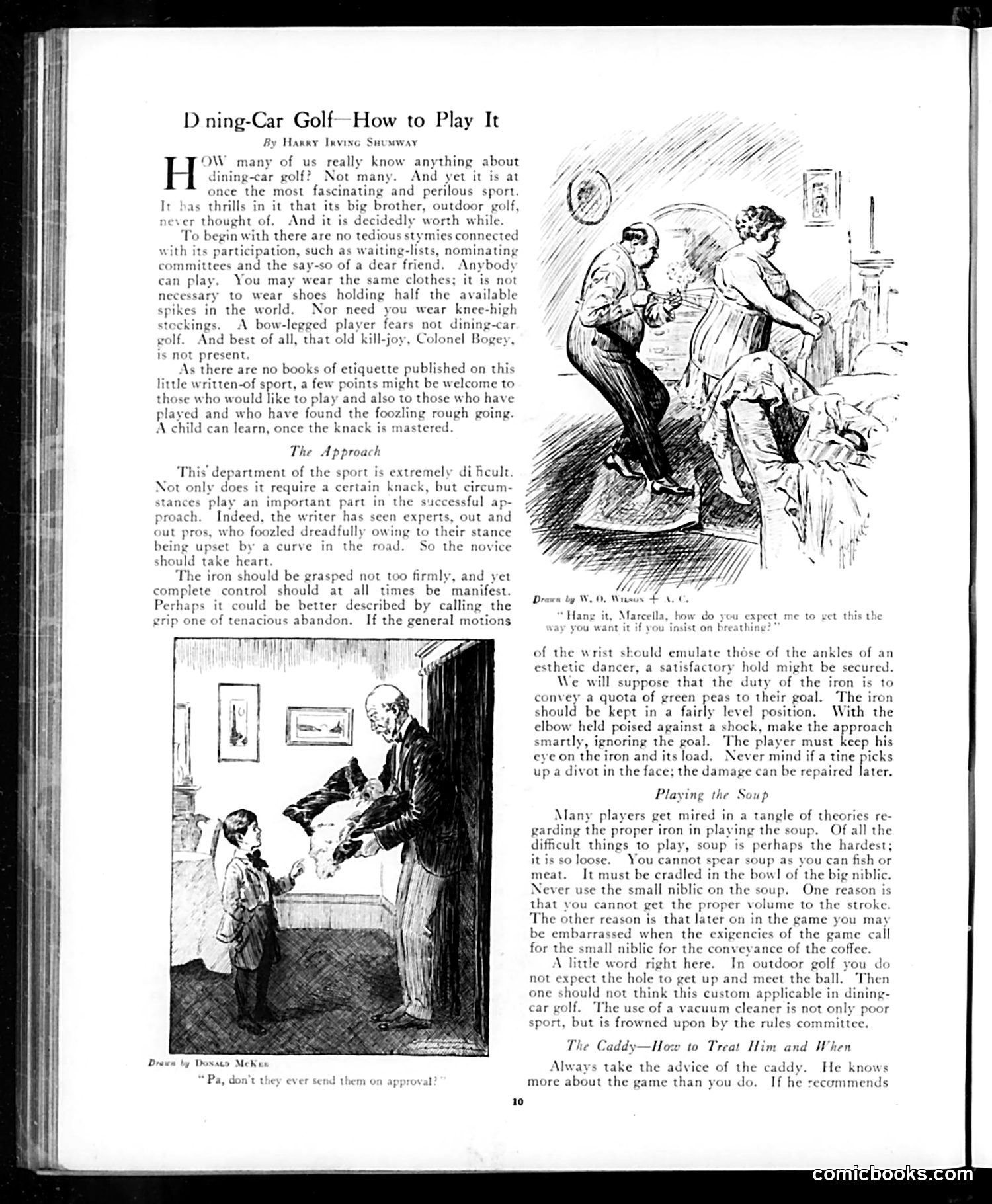
This article satirizes the elaborate etiquette and pretension surrounding golf by applying golf terminology to the mundane activity of eating in a dining car on a train. The "sport" involves using dining utensils (irons, niblics) to navigate food—green peas become "the goal," soup is "the soup," and coffee is referenced as part of the course. The satire mocks golf's exclusivity and complexity: the author notes dining-car golf requires no waiting lists, special clothes, or Colonel Bogey (golf's personified standard of excellence). The illustrations show diners attempting to eat while the train curves and jolts, creating humorous situations. The joke targets early 20th-century golf culture's snobbishness and arbitrary rules. By treating dinner service with golf's overwrought vocabulary—discussing "grip," "approach," and caddy advice—the piece ridicules how pretentious and inaccessible golf had become to ordinary Americans, suggesting even common eating could be treated as an exclusive sport requiring expert instruction.
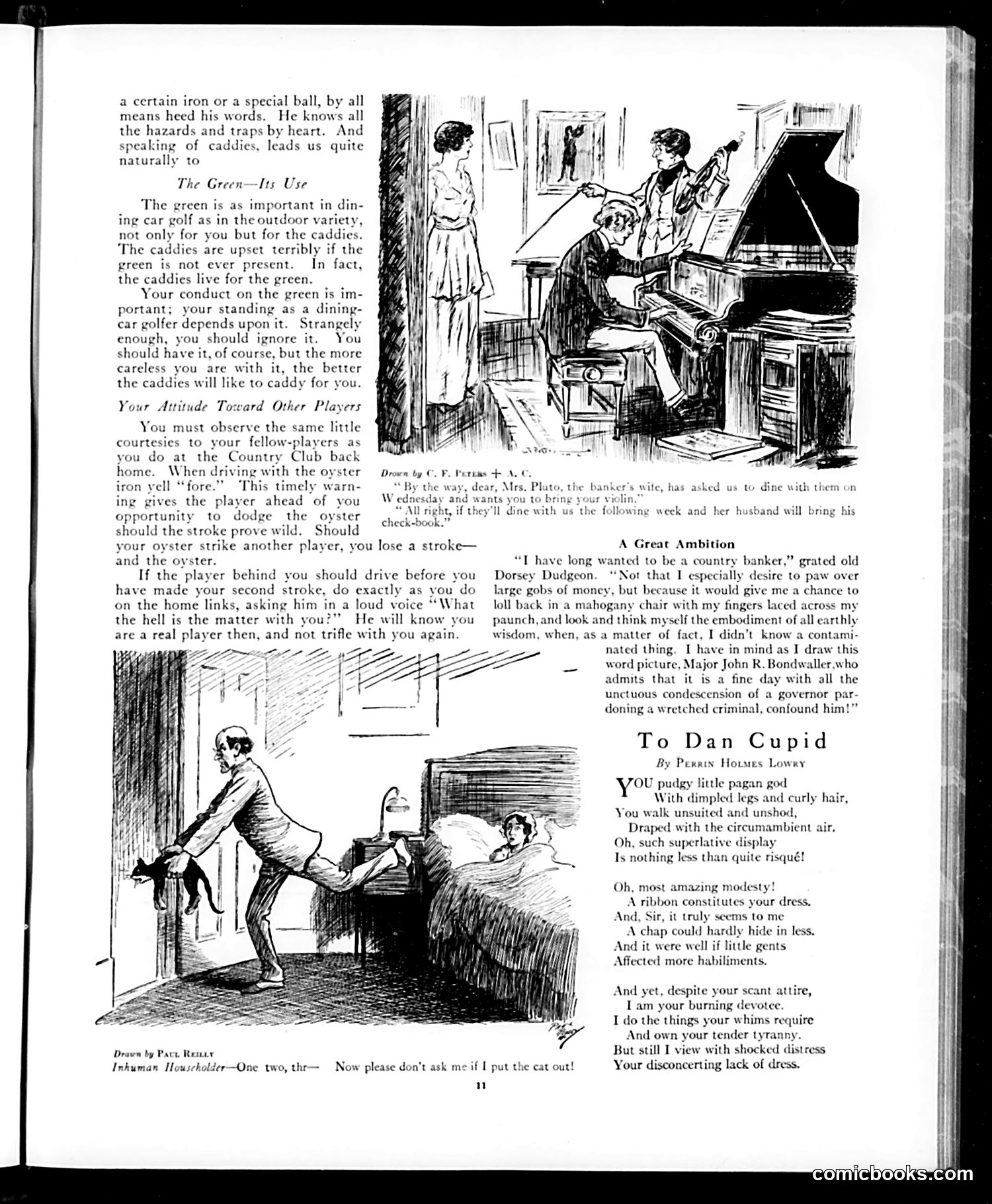
This page contains three distinct pieces of satirical content: **1. "Dining Car Golf" (top section):** A humorous instructional article about playing golf on a dining car, with accompanying illustration. The satire mocks both golf etiquette and train-travel pretension by treating dining-car shuffleboard with mock-serious sporting language. **2. "A Great Ambition" (middle-right):** Social satire targeting small-town bankers. The character Dorsey Dudgeon admits he wants to be a country banker not for financial reasons, but to sit back and dispense wisdom with unwarranted authority—mocking the pomposity and self-importance of provincial bankers. "Major John R. Bondwaller" appears to be a specific satirical reference to a recognizable figure of affected dignity, though the identity is unclear today. **3. "To Dan Cupid" (right column):** A humorous poem by Persix Holmes Lowey gently mocking Cupid's state of undress while paradoxically declaring romantic devotion. The satire targets romantic sentiment and cupid imagery rather than any political figure. The overall tone is light social satire typical of Judge magazine's humor.
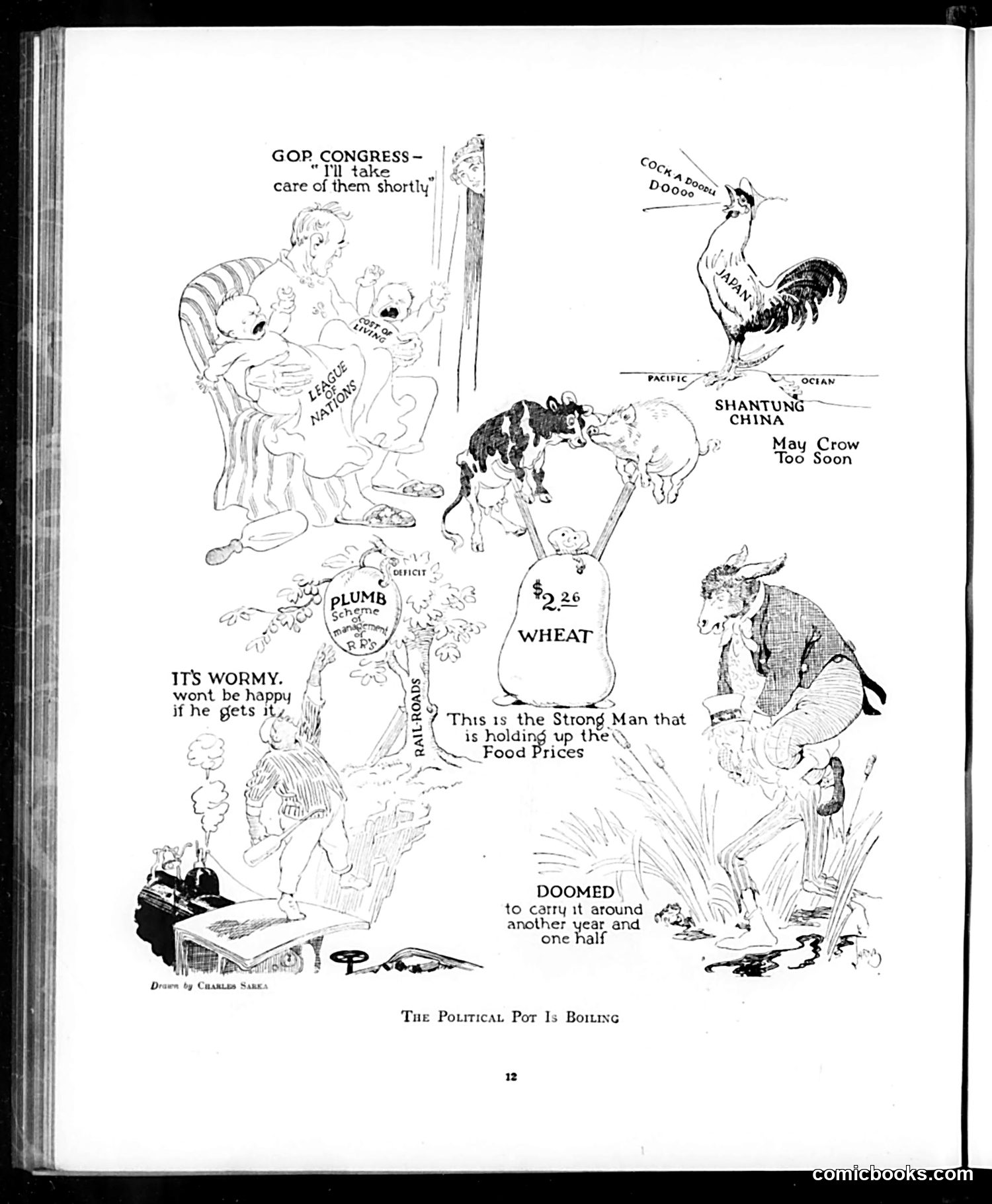
This satirical cartoon critiques GOP Congress's handling of post-WWI economic crises. The central figure labeled "$2.26 WHEAT" represents inflated food prices—the "Strong Man holding up Food Prices"—while surrounding elements show interconnected problems: "PLUMB" (likely plums/produce), "LEAGUE OF NATIONS," and "SHANTUNG CHINA" reference unresolved international disputes. The top left shows Congress claiming they'll "take care of" these issues "shortly," while lower vignettes depict ongoing suffering. References to a "wormy" problem and something "doomed to carry around another year" suggest food spoilage and the burden of unresolved economic policy. The cartoon criticizes Republican inaction on domestic inflation and international commitments, implying Congress's promises are hollow while citizens suffer economic hardship.
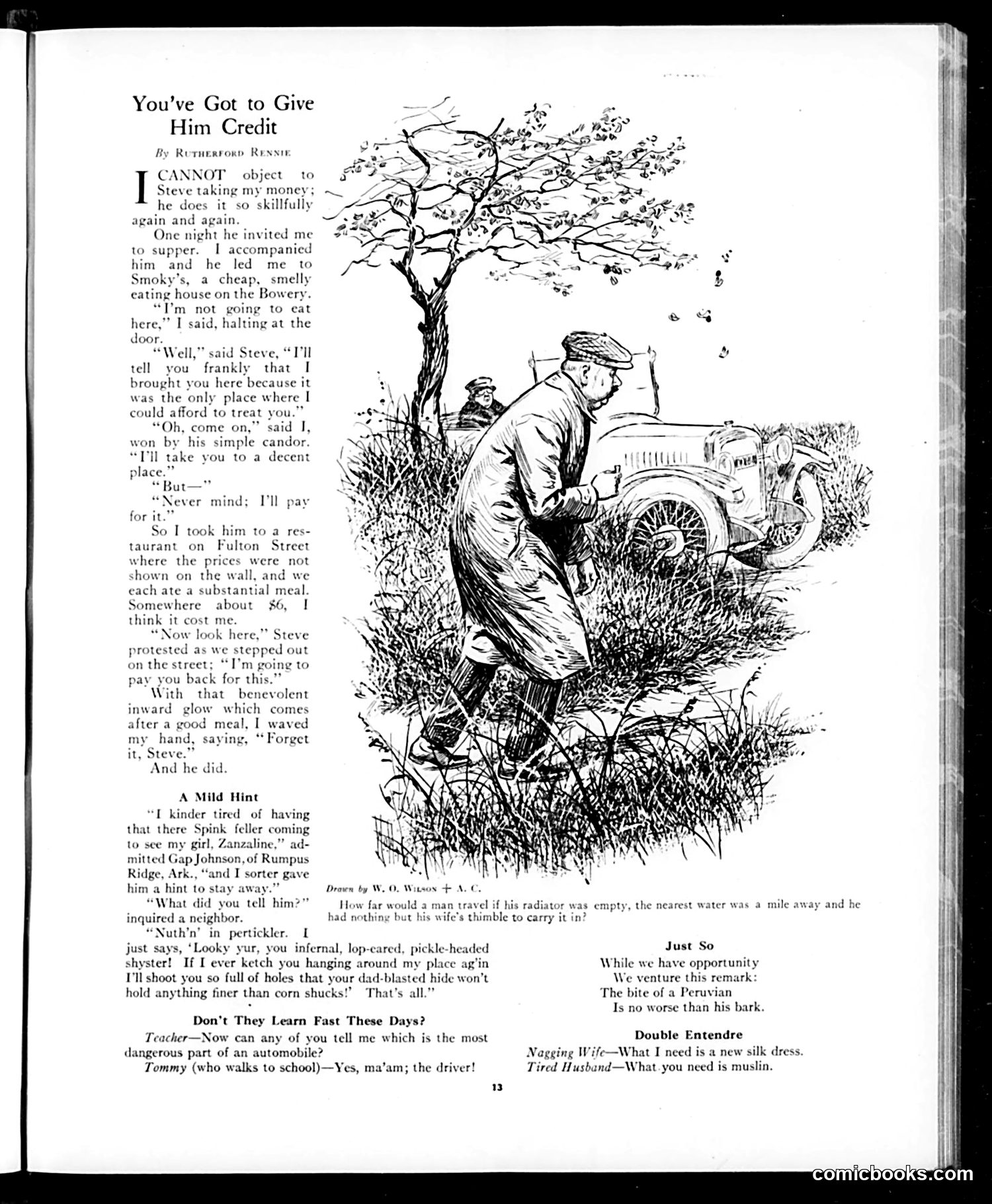
This humorous story satirizes con artists and swindlers operating in early 20th-century America. The narrator describes "Steve," a skilled manipulator who repeatedly borrows money. When invited to dinner at a cheap Bowery establishment, Steve uses false modesty—claiming it's the "only place" he can afford—to appeal to the narrator's pride. The narrator then impulsively offers to take him to an expensive restaurant instead, where the bill is substantial. The joke's point: Steve's con succeeds perfectly. Despite the narrator's generous gesture and explicit forgiveness ("Forget it, Steve"), Steve gets what he wanted—a free meal at a fancy restaurant—while maintaining plausible deniability through feigned embarrassment. The title sarcastically applauds Steve's skillful manipulation. The illustration shows the two men by a car and tree, depicting the moment of their street-level exit from the restaurant. The page also includes unrelated comic snippets and a riddle about automobiles, typical of *Judge* magazine's miscellaneous humor format.
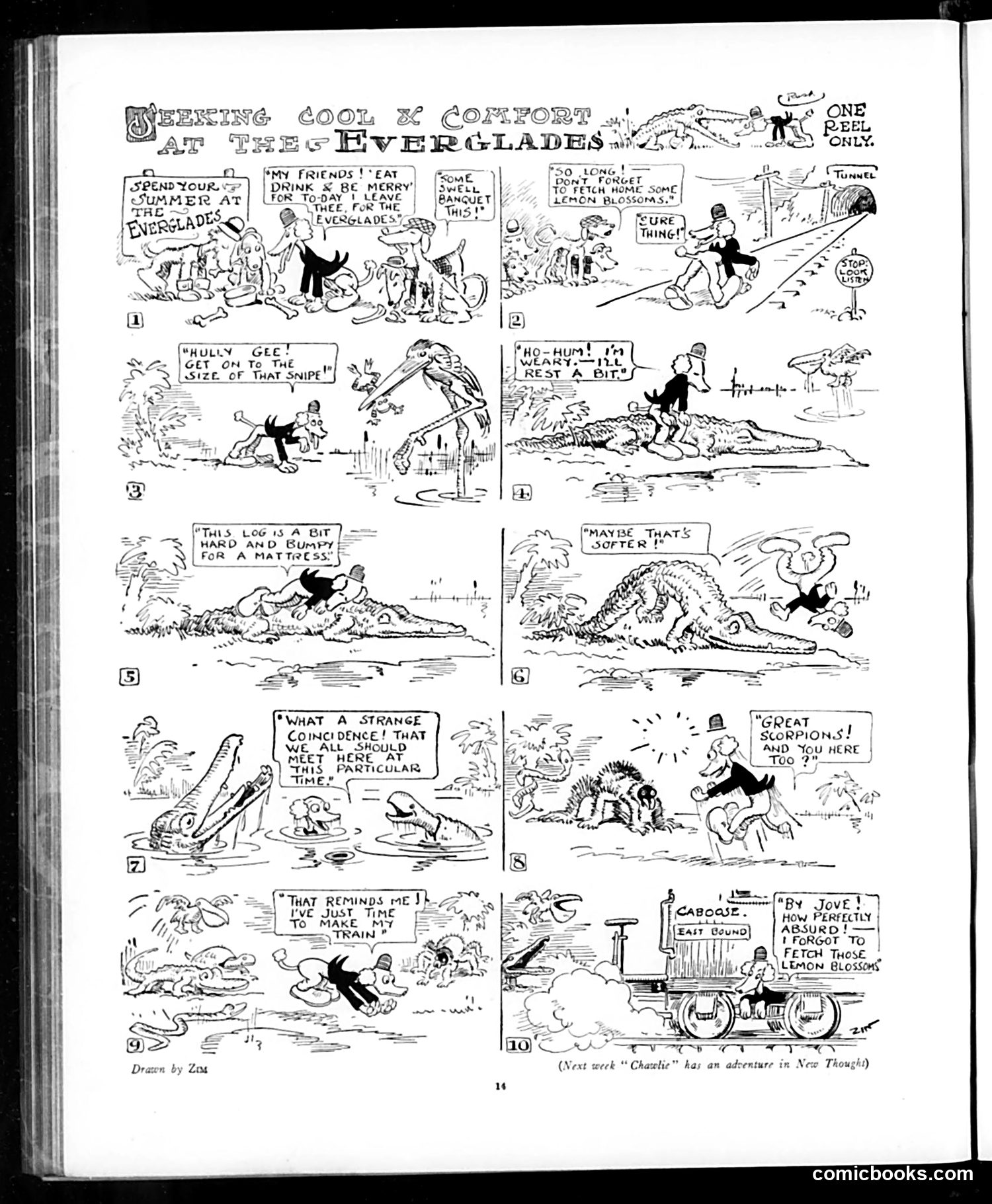
This is a humorous comic strip about a group seeking relaxation in Florida's Everglades. The narrative follows their increasingly absurd encounters with wildlife—alligators, scorpions, and other swamp creatures—that repeatedly interrupt their leisure. The satire mocks the era's romanticized vision of exotic travel destinations. Tourists arrive expecting comfort and natural beauty ("eat, drink and be merry"), but reality proves far more dangerous and uncomfortable. Each panel escalates the chaos: what begins as a pleasant "banquet" devolves into encounters with hostile wildlife and physical mishaps. The final panel's reference to a character needing to "fetch lemon blossoms" suggests the group's disconnect from reality—they're more concerned with trivial comforts than the obvious perils surrounding them. The comic gently satirizes both the tourist industry's overselling of exotic locations and visitors' naïve expectations of wilderness travel.
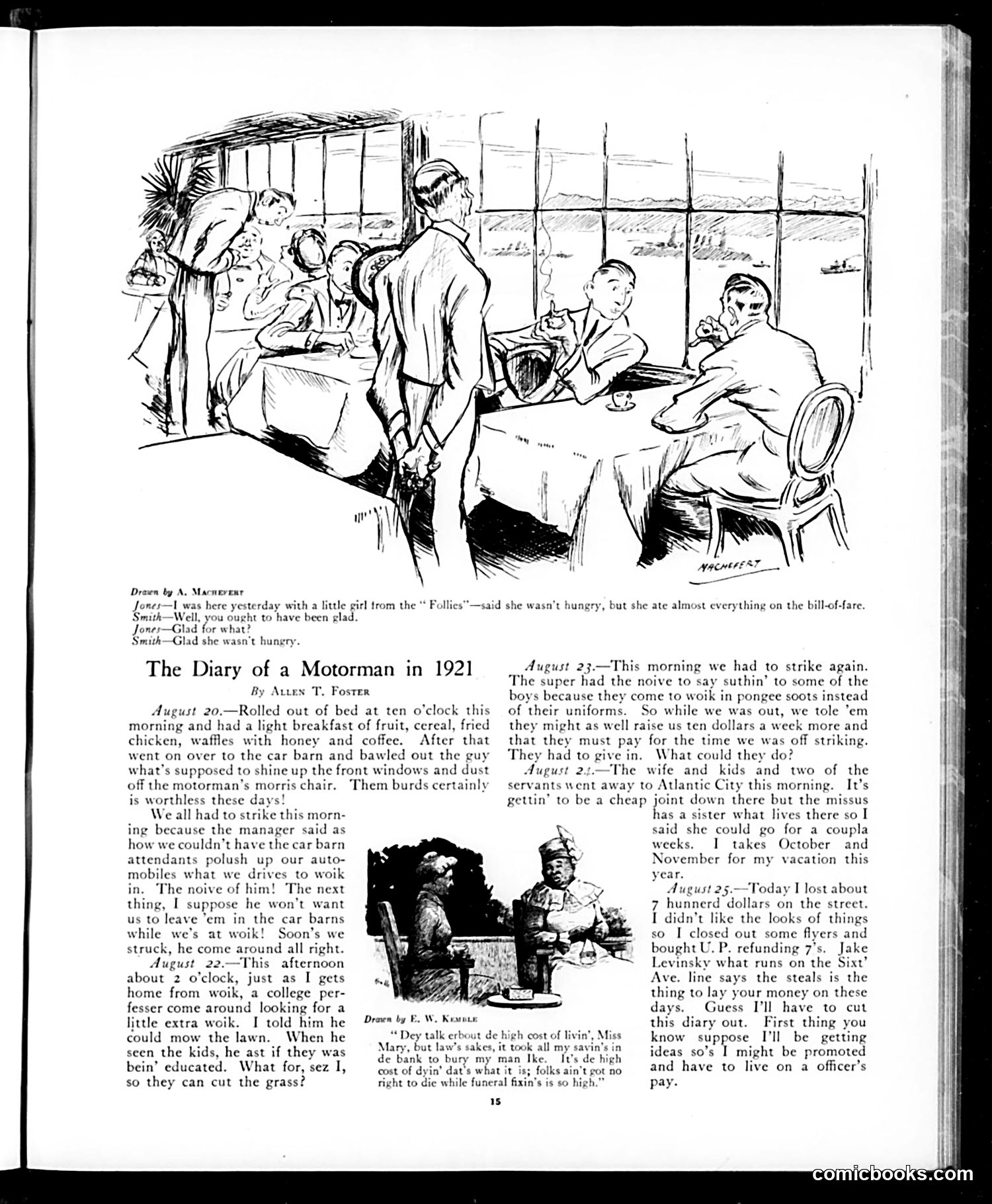
This 1921 *Judge* page satirizes American labor strikes and working-class entitlement during the post-WWI period. **"The Diary of a Motorman in 1921"** mocks streetcar motormen (trolley operators) through first-person narrative. The motorman strikes repeatedly over trivial grievances—first demanding the car barn attendant polish their personal automobiles, then objecting to uniform requirements—while living lavishly (servants, college tutors, stock trading). The satire escalates when he loses $700 gambling, closing with dark irony: he fears promotion because "an officer's pay" would be insufficient for his extravagant lifestyle. The joke targets labor unions as unreasonably militant and workers as hypocritical—simultaneously demanding better conditions while enjoying upper-class excess and avoiding actual work. The upper cartoon joke is simpler: a diner criticizes his companion for bringing a hungry girl from the "Follies" (theatrical troupe) because she ate everything expensively. Both content pieces reflect 1920s anxiety about labor unrest and perceived worker ingratitude during economic transition.
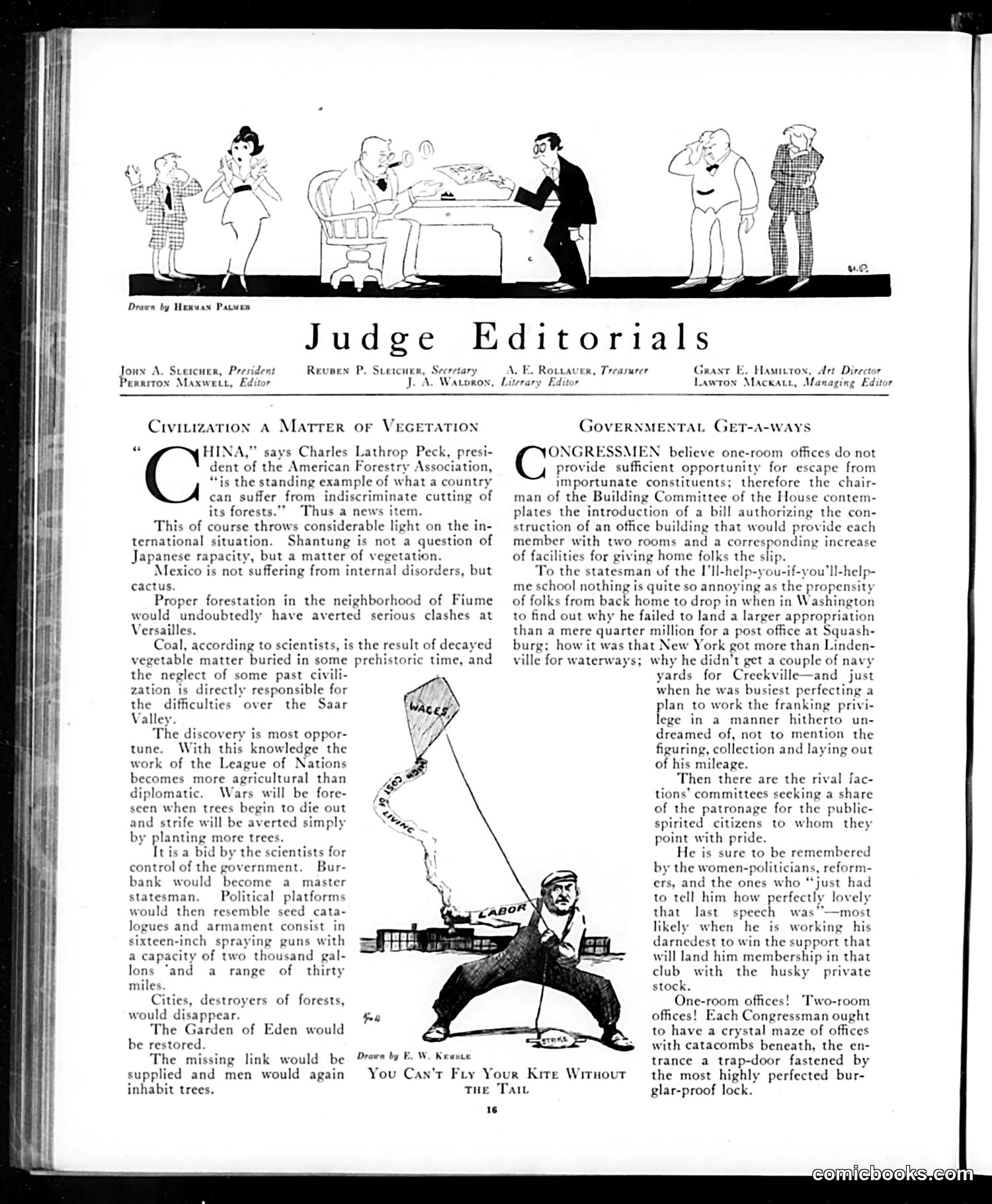
This page contains two satirical editorials mocking contemporary political issues. **"Civilization a Matter of Vegetation"** ridicules attempts to explain international conflicts through environmental causes. It sarcastically suggests that complex geopolitical problems—the Shantung dispute with Japan, internal Mexican strife, Fiume border clashes, the Saar Valley coal dispute—are merely vegetation problems. The editorial lampoons scientists' and agricultural experts' (like Luther Burbank) growing influence in policy, imagining a future where political platforms resemble "seed catalogues" and wars are prevented by planting trees. The satire targets the naive oversimplification of complex political issues. **"Governmental Get-a-ways"** mocks congressmen seeking additional office space to escape constituents. The editorial sarcastically portrays representatives avoiding hometown visitors seeking explanations for failed appropriations and patronage requests. It ridicules their desire for elaborate, hidden office complexes with "catacombs" and "burglar-proof locks" to evade bothersome citizens—especially women reformers and political activists. Both editorials use exaggeration to critique governmental inadequacy and politicians' self-serving behavior during the post-WWI period.
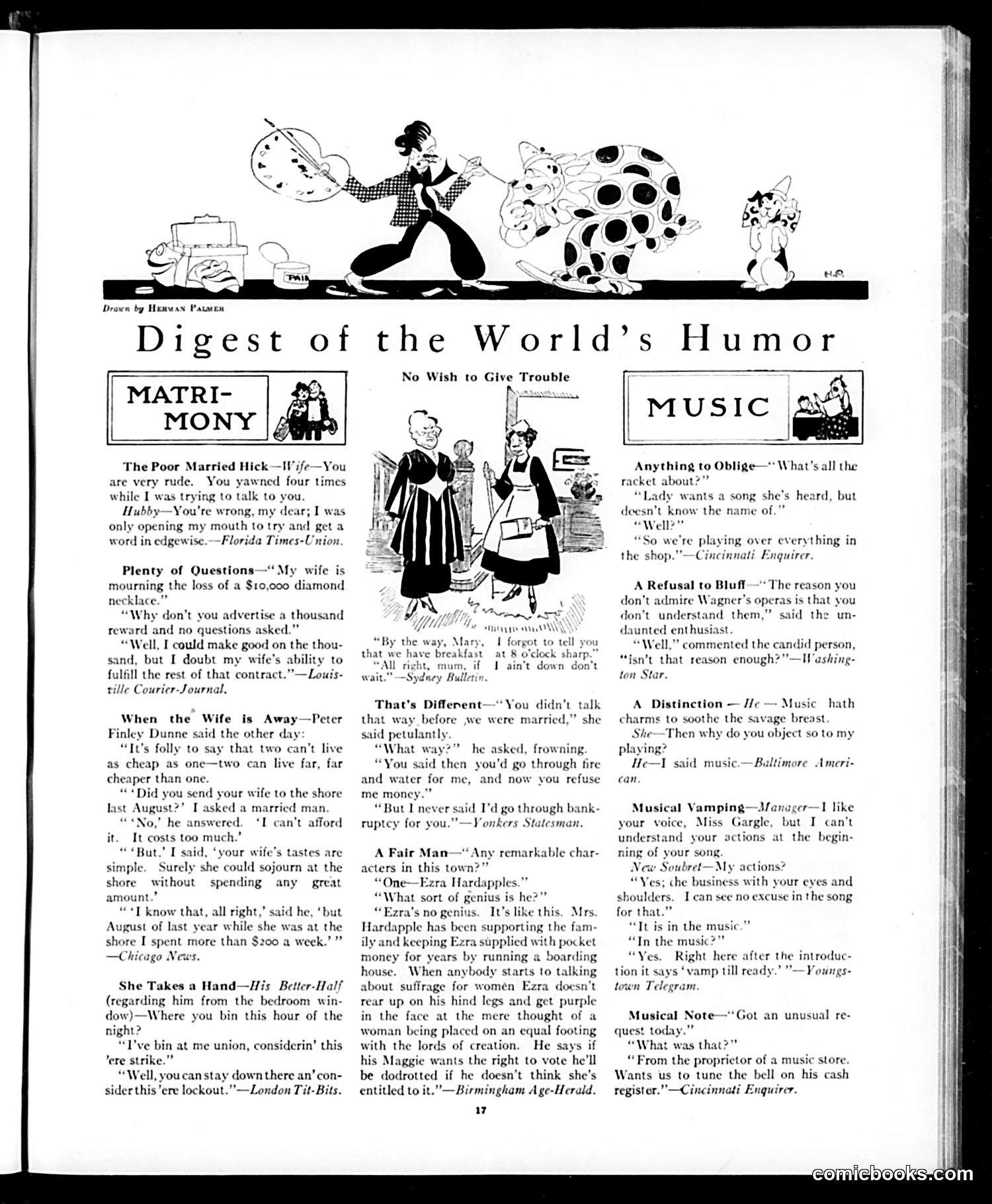
This page collects brief humorous anecdotes organized by topic (Marriage, Music). The cartoons mock domestic life and gender relations typical of early 20th-century American humor. **Key themes:** - **Marriage complaints**: Wives are depicted as talkative, expensive, and demanding; husbands as reluctant providers. "The Poor Married Hick" jokes about wives monopolizing conversation; "Plenty of Questions" satirizes a wife mourning a diamond necklace. - **Women's suffrage**: "A Fair Man" ironically praises Ezra Hardapples—a man who supports women's voting rights *only* because his wife financially supports the family anyway. The joke mocks both suffrage advocates and economically dependent husbands. - **Musical humor**: Jokes about opera singers' pretension, female vocalists' exaggerated stage movements, and music-store proprietors. The cartoons reflect period attitudes: wives as financial burdens, marriage as emasculating, and women's rights as laughable. The humor assumes a male audience amused by domestic discord and female ambition.
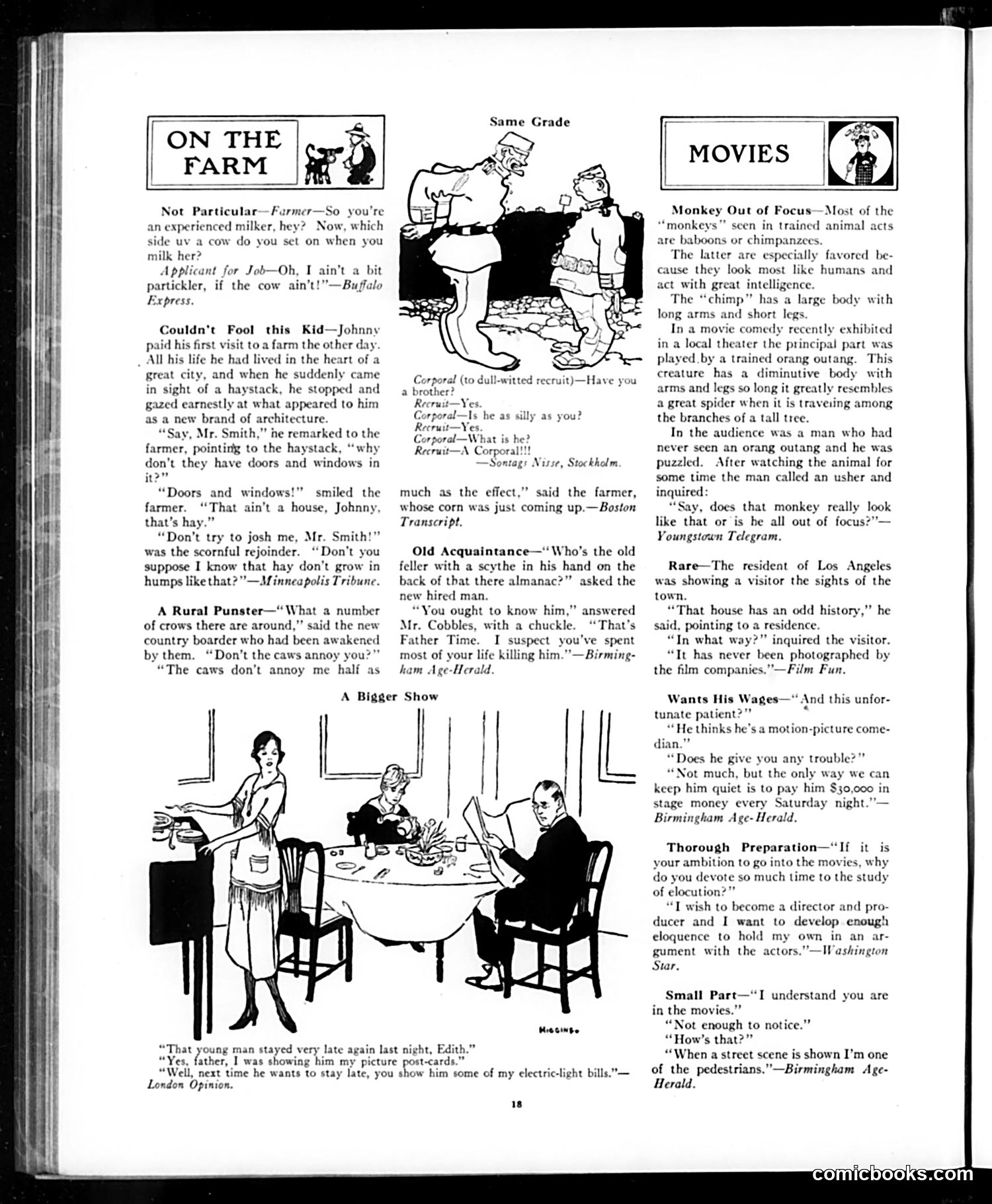
This page collects rural humor and early film-industry jokes typical of 1920s American satire. **"On the Farm" section**: These jokes mock urban ignorance of rural life. A city child mistakes a haystack for architecture; a job applicant claims indifference to which side of a cow to milk from. The humor targets urbanites' comic unfamiliarity with farming basics. **"A Bigger Show"**: A father uses his electric bills as a deterrent to a suitor lingering with his daughter—suggesting the young man's interest is primarily romantic rather than innocent, and that displaying bills is a humorous way to discourage visits. **"Movies" section**: These jokes satirize Hollywood's rapid growth and the film industry's appeal. They mock aspiring actors' delusions of grandeur (mistaking themselves for "motion-picture comedians"), the bizarre demands of film work, and the obsession with appearing on screen—even as anonymous background pedestrians. The material reflects early-20th-century skepticism toward cinema as a legitimate profession and the industry's magnetic pull on ambitious but naive individuals.
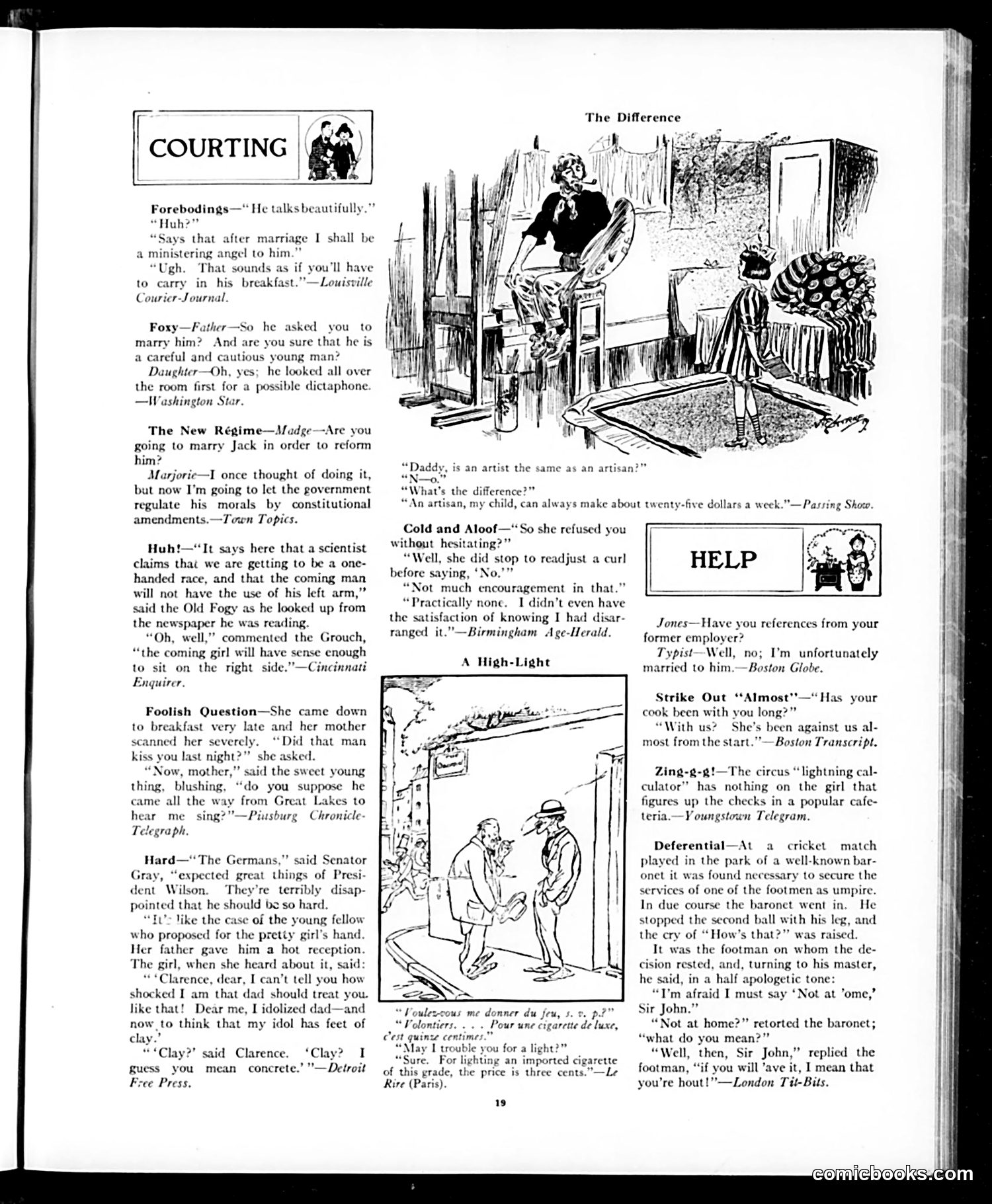
The main cartoon depicts a father watching his young daughter play in a sandbox while a boy in striped clothing stands nearby. The caption contrasts an "artisan" with an "artist"—the father explains the difference is that an artisan can "always make about twenty-five dollars a week," while an artist cannot guarantee income. This satirizes early 20th-century anxieties about class mobility and marriage prospects. The cartoon mocks middle-class parental concerns about their daughters marrying men of uncertain financial standing. The "artisan" represents stable, working-class employment; the "artist" represents romantic but economically unreliable suitors—a common source of tension in courting narratives of the era. The surrounding humor pieces reinforce the theme: several joke about women's practical calculations in romance and marriage, including one about a woman reforming a man through government intervention rather than personal influence. Together, the page satirizes both courtship anxieties and changing gender dynamics of the period.
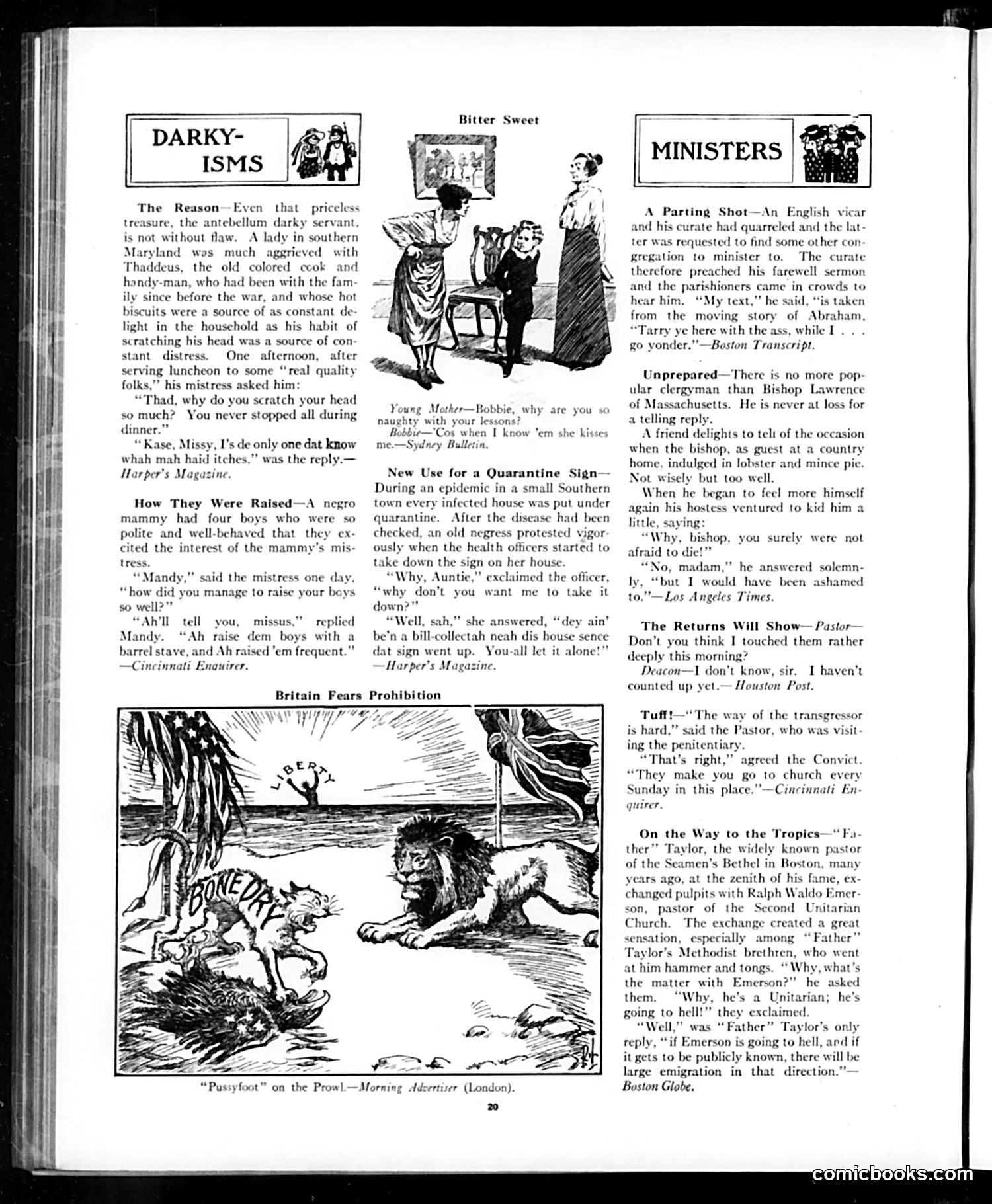
This page from *Judge* magazine contains several anecdotes satirizing race relations and religious hypocrisy in late 19th/early 20th-century America. The "Darky-isms" section presents crude stereotypes of African Americans—formerly enslaved people and their descendants—through dialect humor meant to mock Black speech and behavior. These jokes reinforce racist caricatures common to the era. The "Britain Fears Prohibition" cartoon depicts a lion (representing Britain) cowering from "Pussyfoot"—likely referencing Billy Sunday or another American temperance activist—reflecting British anxiety over American prohibition movements. The "Ministers" section mocks Christian clergy through various anecdotes, including one about a curate's pointed biblical farewell and another about Bishop Lawrence's indiscretion with rich food. Overall, the page reflects *Judge*'s satirical approach: punching downward at marginalized groups (Black Americans) while also critiquing institutional hypocrisy among the educated classes (clergy, temperance advocates). The racism is explicit and unapologetic by modern standards.
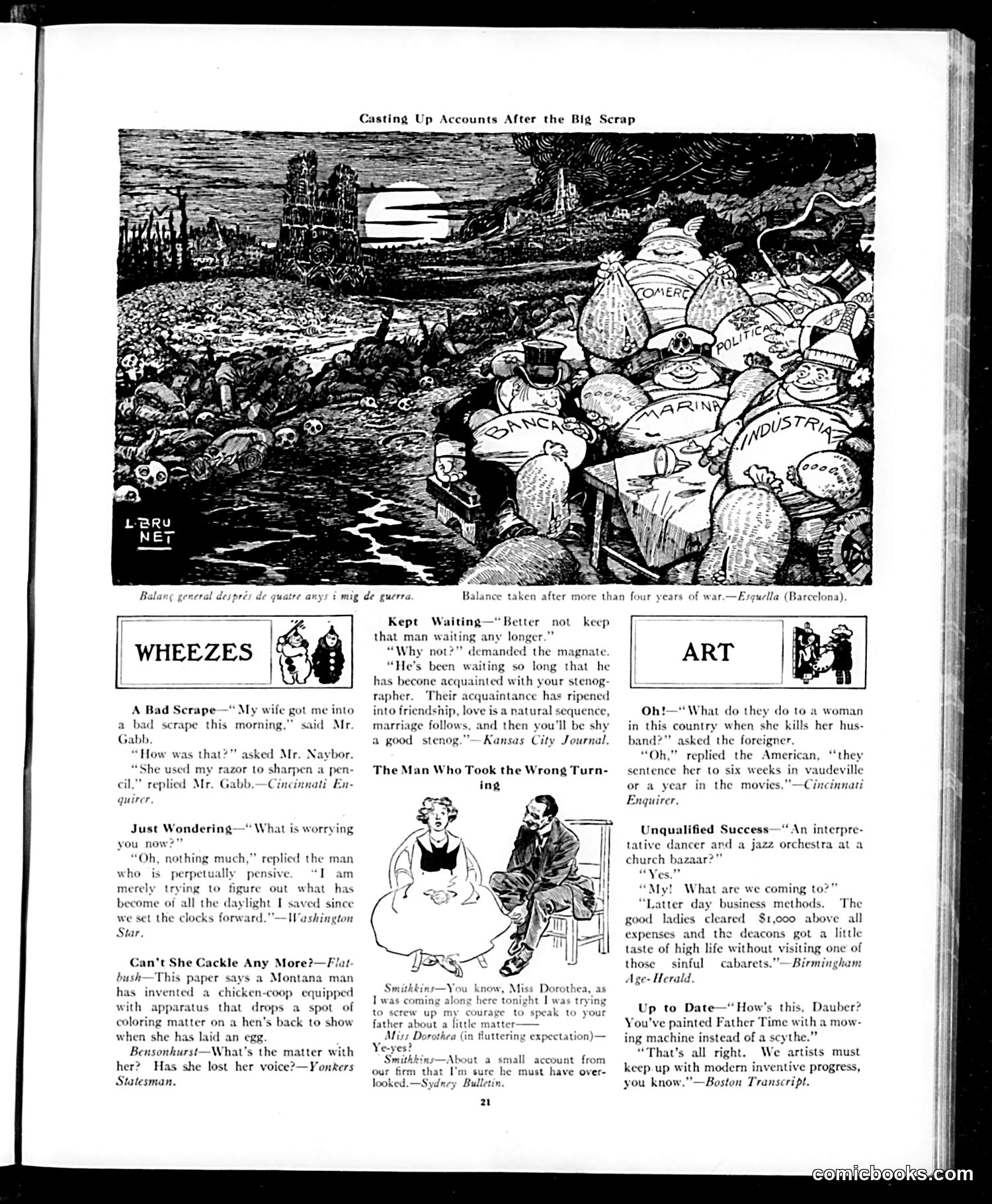
This Judge page, dated after World War I (the title references a four-year-plus conflict), presents the main satirical cartoon alongside joke columns typical of the era. The large illustration depicts **accounting or financial reckoning after WWI**, shown as a corpulent accountant surrounded by bloated sacks labeled "Commerce," "Finance," "Industry," and "Politics"—personifying economic sectors. The war's devastation appears in the background. The satire suggests **post-war profiteers and economic interests grew fat during the conflict**, while ordinary people suffered. The "Wheezes" section contains light domestic humor unrelated to the war: jokes about razors, daylight saving time, and an automated chicken-coop invention. The "Art" section mocks vaudeville and modern entertainment trends. **The political point**: While soldiers died in trenches, certain business interests accumulated wealth. The cartoon critiques how financial and industrial sectors benefited from the war's devastation—a common post-WWI sentiment about war profiteering.
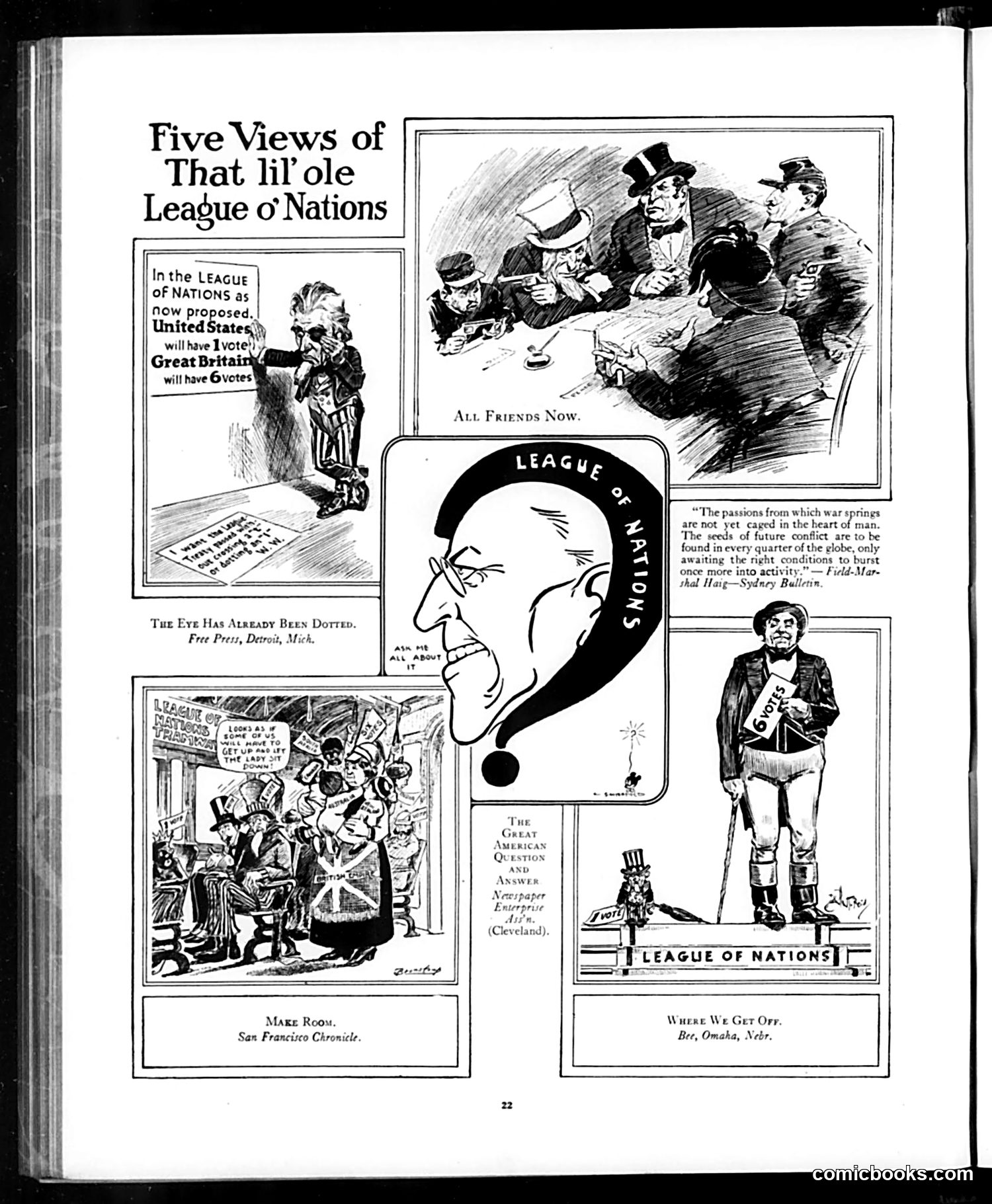
This page presents five political cartoons satirizing the proposed League of Nations, likely from around 1919-1920 when the League was being debated. The cartoons express American skepticism: **"The Eye Has Already Been Dotted"** suggests the US role is predetermined—we'll have one vote while Britain gets multiple votes, an unequal arrangement. **"All Friends Now"** depicts diplomats suddenly cordial, implying their cooperation is superficial and temporary. **"Make Room"** and **"Where We Get Off"** appear to warn about overcrowding and America being sidelined or marginalized in the organization. The central question mark labeled "League of Nations" emphasizes uncertainty about the organization's purpose and effectiveness. A quote from Field-Marshal Haig pessimistically notes that war's underlying causes remain unaddressed. Overall, these cartoons express American isolationist concerns about joining an international body that either disadvantages the US or fails to prevent future conflicts.
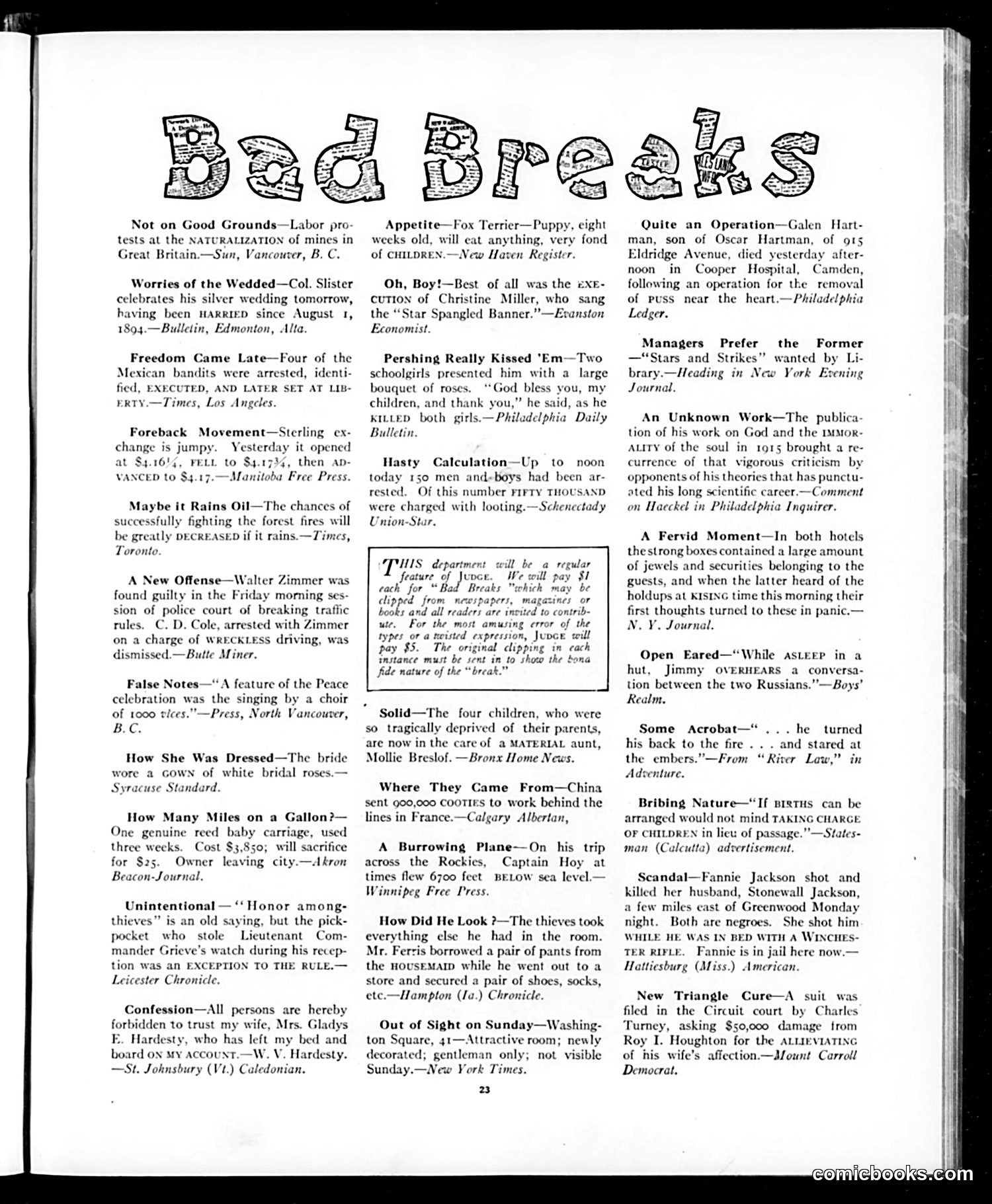
This page is Judge magazine's "Bad Breaks" feature—a humorous column collecting unintentional absurdities clipped from real newspapers. The satire works through accidental double meanings or grammatical errors in published notices: Notable examples: - "Oh, Boy!" darkly jokes that General Pershing "KILLED" schoolgirls while kissing them - "Solid" claims children are in care of a "MATERIAL aunt" (instead of "maternal") - "A Burrowing Plane" implies a plane flew *beneath* sea level - "How Did He Look?" suggests a man had literally nothing but what he borrowed These aren't meant as political satire but rather as gentle mockery of newspaper editors' carelessness during the 1910s-20s. The humor assumes readers recognize the absurdity—revealing period attitudes about death, race (note "COOLIES" from China), and class. The feature essentially mocks lower-quality regional newspapers for printing nonsensical content.
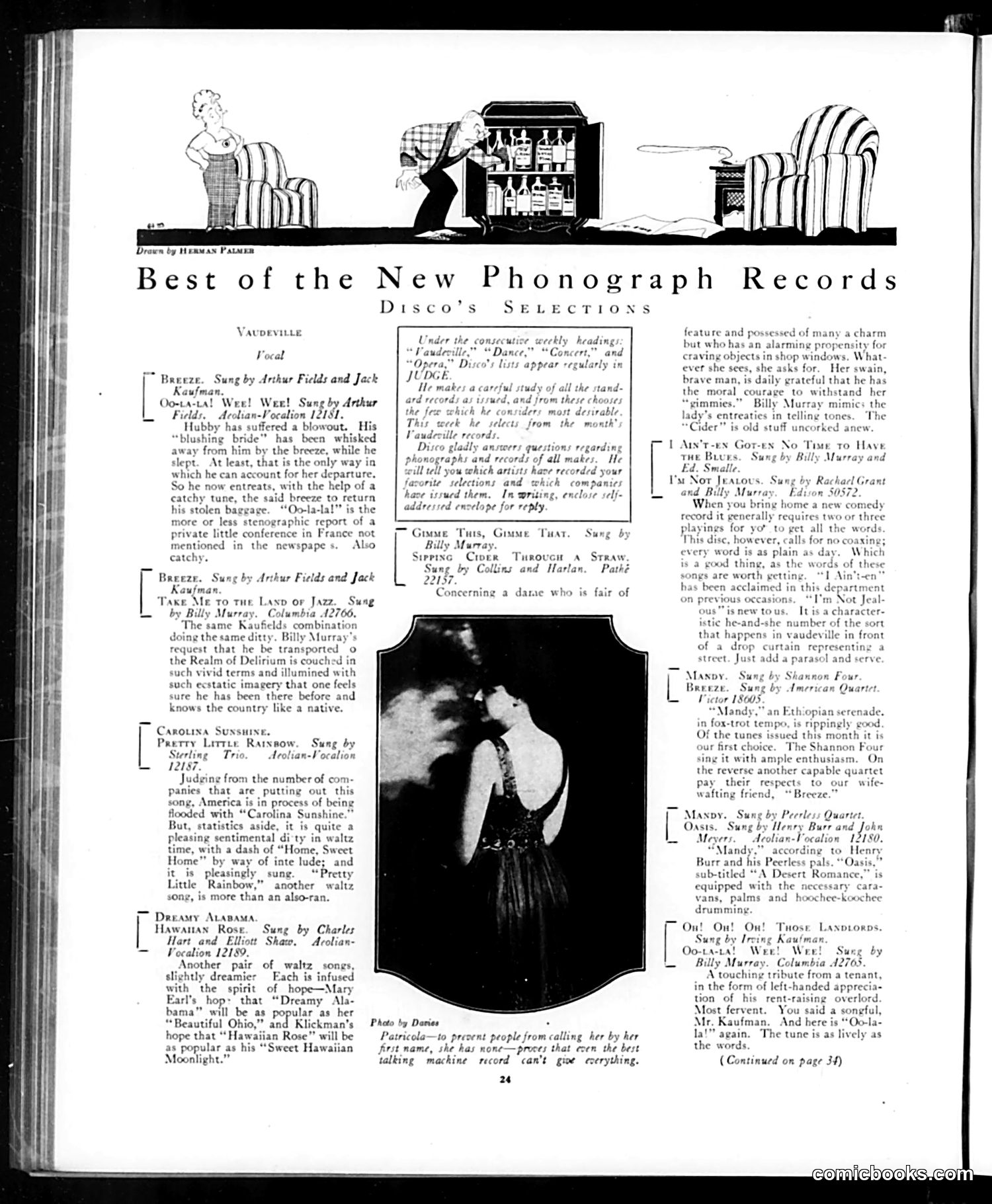
This page is primarily **music criticism and advertising**, not political satire. It reviews newly released phonograph recordings for the Disco label, a common feature in Judge magazine during the early phonograph era. The central image shows **Patricia Collina**, a recording artist, with a caption explaining she has "won—proves that even the best talking machine record can't give everything." This appears to be humorous commentary on performers whose personality exceeds what the limited phonograph technology could capture. The reviews discuss popular songs of the era—waltzes, jazz numbers, and sentimental pieces—performed by artists like Arthur Fields and Billy Murray. The humor is gentle, focusing on the quality of recordings and whether particular songs will achieve popularity. The only clear satire involves observations about market flooding (multiple "Carolina Sunshine" recordings) and the limitation of the new medium itself. **Context for modern readers**: This represents the early 1920s phonograph industry, before electrical recording improved sound quality significantly.
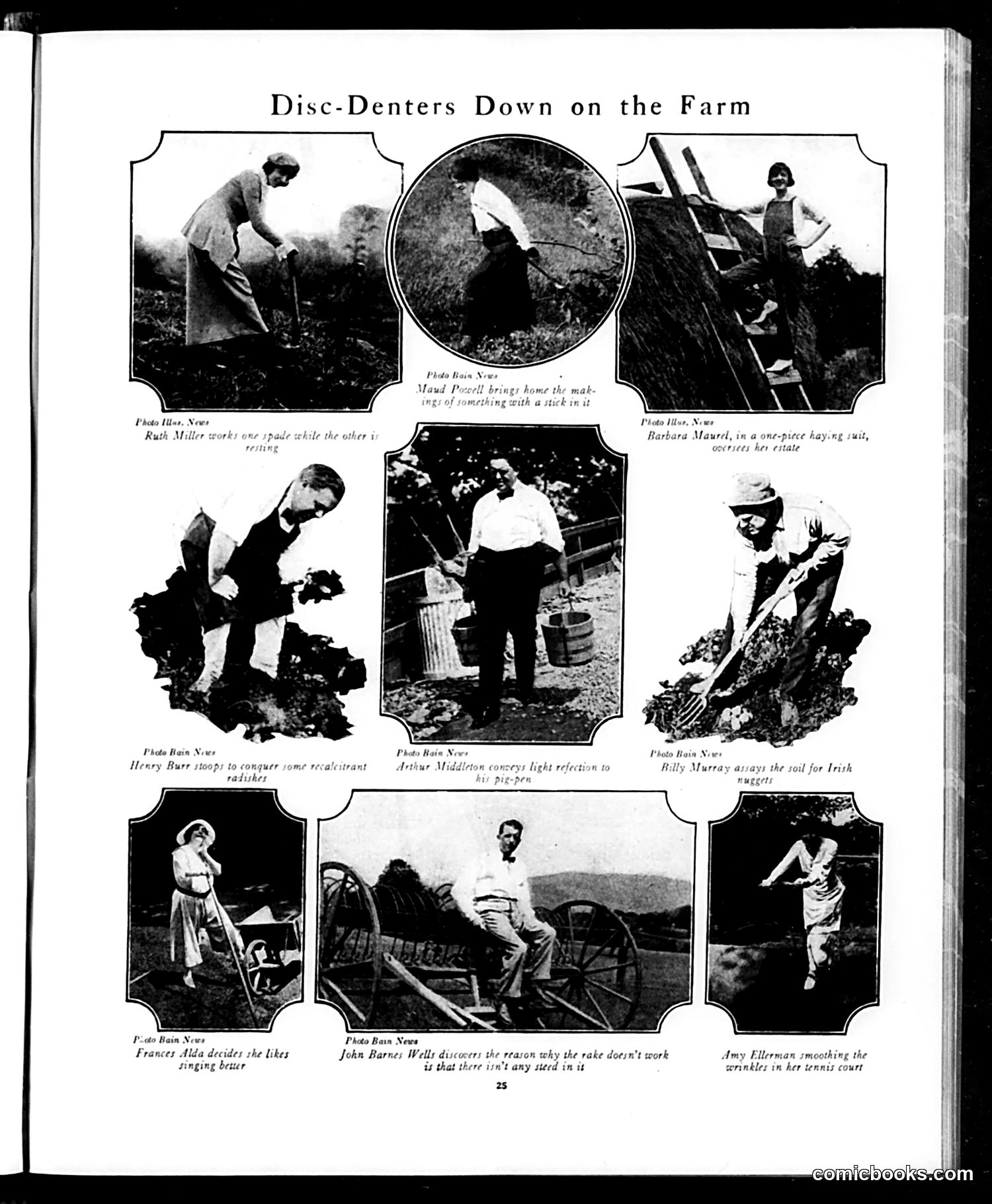
This page satirizes popular entertainers attempting farm work. The title "Disc-Denters" likely refers to recording artists (those who made phonograph discs). The captions identify performers like Henry Burr (singer), Frances Alda (opera singer), and others engaging in awkward farm labor. The satire mocks these urban celebrities for their incompetence with rural tasks—struggling with basic tools, misunderstanding farm equipment, and generally appearing out of place. The joke positions entertainers as hopelessly disconnected from practical, working-class life. This reflects early 20th-century class humor common in Judge magazine, where sophisticated urbanites (especially performers) were ridiculed for lacking basic manual skills. The page uses their fame as the setup for gentle mockery of their unfitness for "real work."
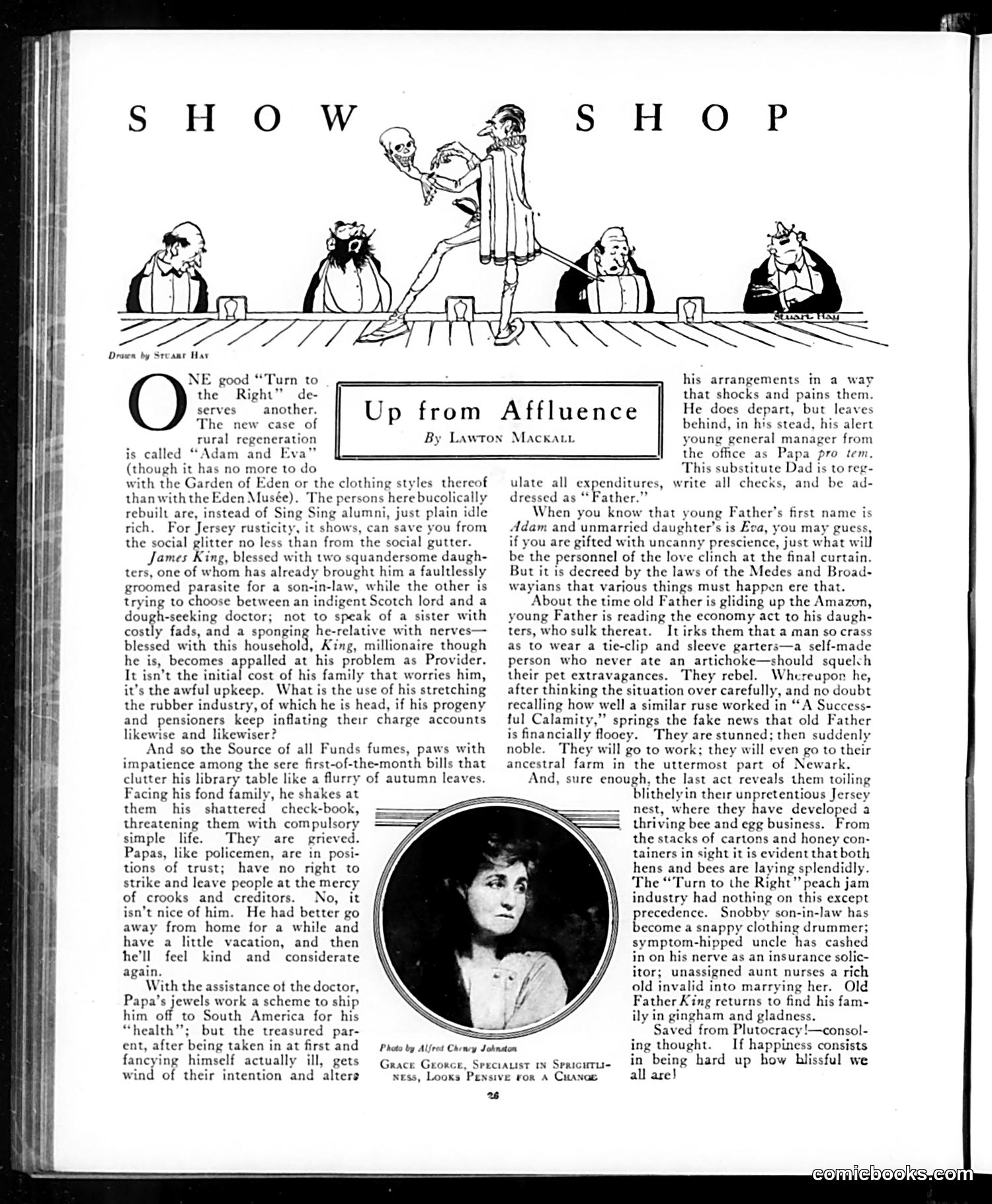
The top cartoon, drawn by Stuart Hay, satirizes wealth and social pretension. It depicts what appears to be a theatrical "show shop" where wealthy individuals are displayed as commodities or curiosities—suggesting the wealthy put themselves on display while claiming refinement. The accompanying article reviews a play called "Adam and Eva" about a wealthy industrialist (James King) whose spendthrift family nearly bankrupts him. The satire targets the idle rich: his daughters pursue unsuitable suitors (an impoverished Scottish lord, a fortune-hunting doctor), his sister indulges in costly fads, and relatives exploit his generosity. When King threatens financial discipline, they scheme to send him to South America under false pretenses of illness. The play's resolution—the young substitute manager (named Adam) imposes austerity on the daughters (including one named Eva), leading them to genuine work on a New Jersey farm with bees and eggs—mocks the notion that the wealthy could ever truly reform or understand simple living. The satire attacks both idle rich excess and the theatrical fantasy that wealth could be reformed through domestic crisis.
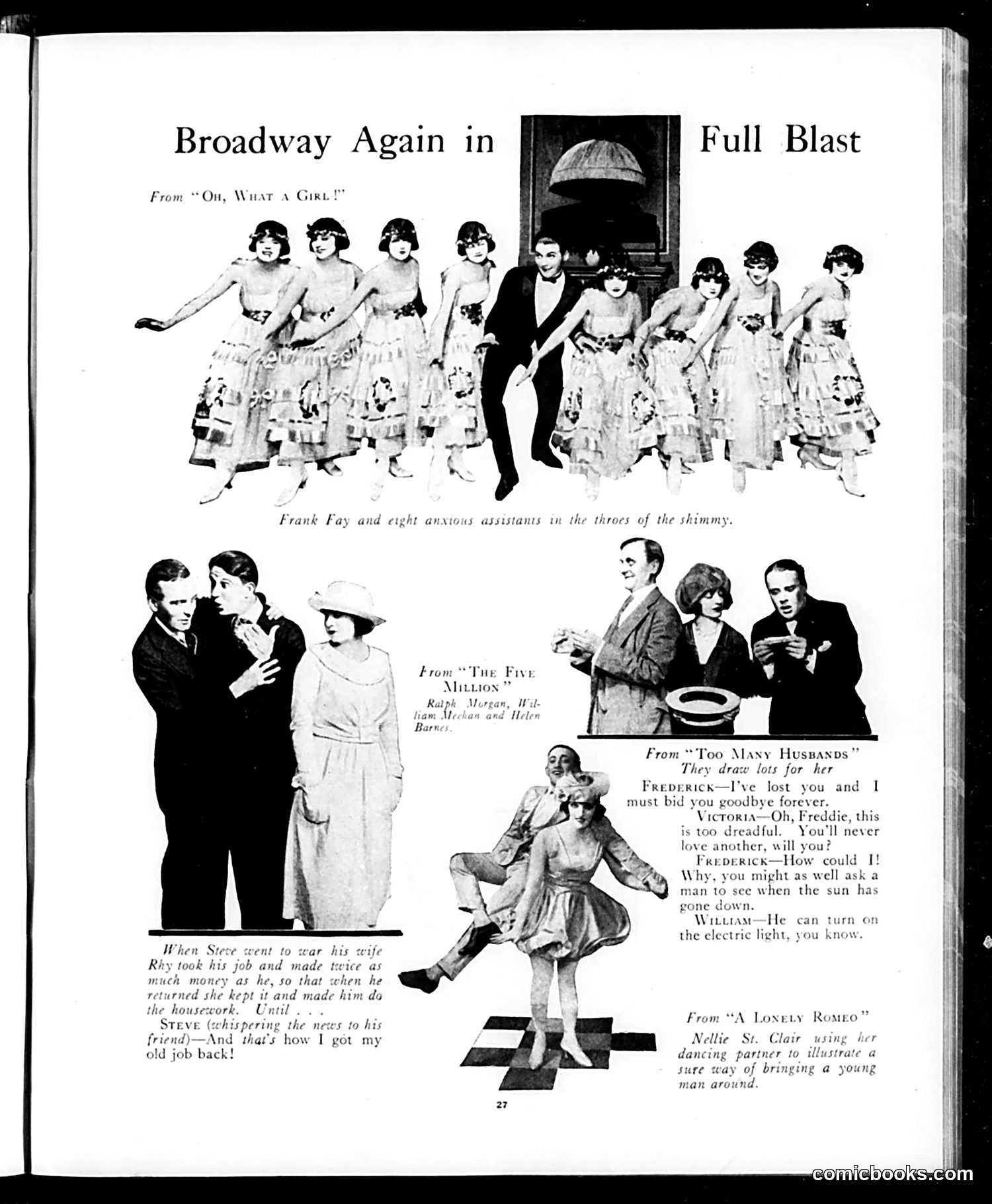
This page showcases scenes from three Broadway productions of the era. The top image features Frank Fay performing the "shimmy"—a popular 1920s dance craze involving rapid hip movements—with chorus girls. Below are scenes from "The Five Million" and "Too Many Husbands," depicting typical romantic comedies of the period. The "Too Many Husbands" dialogue reveals the melodramatic tone: a man bids farewell to his lover with overwrought sentimentality ("you might as well ask a man to see when the sun has gone down"), which the magazine likely presents for comedic effect. The final image from "A Lonely Romeo" suggests dating or courtship humor. This appears to be entertainment coverage rather than political satire—typical Judge magazine content documenting popular Broadway shows and theatrical trends of the 1920s.
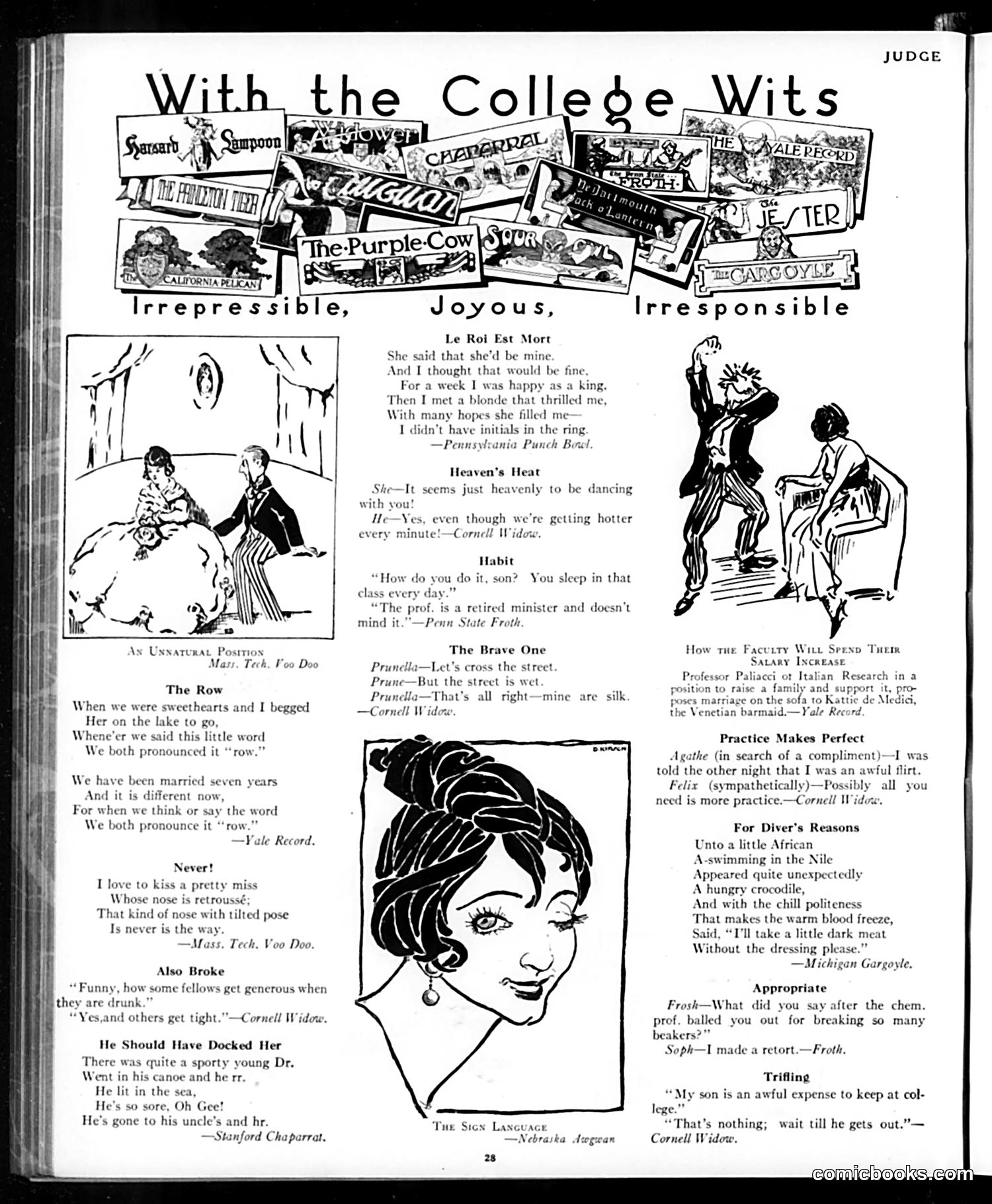
This page from *Judge* magazine collects humorous short jokes and poems from various college publications, centered on romance, student life, and wordplay—typical early 20th-century collegiate humor. **Key themes:** - **Romance and infidelity**: "Le Roi Est Mort" mocks a man who abandons his girlfriend after meeting someone blonde; "The Brave One" jokes about wet silk stockings during a street crossing. - **Student life**: Jokes about sleeping in class, expensive college costs, and chemistry lab mishaps reflect common college experiences. - **Wordplay**: "The Row" plays on pronunciation differences of the word over seven years of marriage; "Appropriate" puns on a chemistry student making a "retort." - **Gender humor**: "Practice Makes Perfect" relies on a woman being called a flirt; "The Sign Language" features crude stereotypes about African people. The cartoons show couples in romantic situations. No specific political figures are caricatured—this is purely social satire aimed at college students and young adults, emphasizing dating, courtship complications, and academic life.
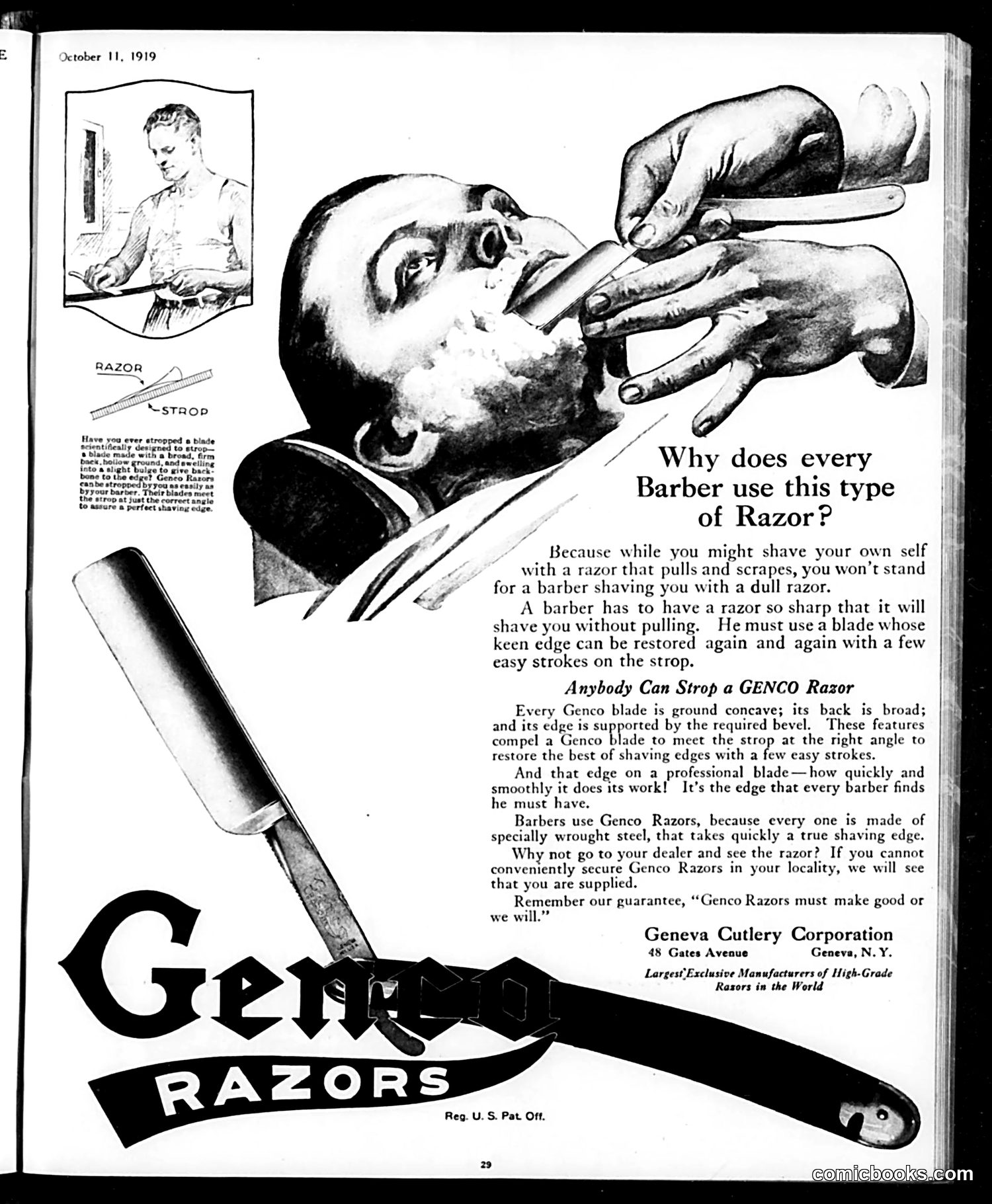
This page is **entirely a commercial advertisement**, not political satire. It's a Genco Razor advertisement from Judge magazine (October 11, 1919). The content explains why barbers prefer Genco straight razors: they maintain a sharp edge through stropping (realigning the blade on a leather strop) without pulling or scraping the skin. The advertisement uses educational copy to distinguish Genco blades' design—concave grind, broad back, proper bevel angle—as superior for professional barbering. The left panel shows razor and strop diagrams; the center depicts a barber actively shaving a customer; the large image dominates, showcasing the razor itself. The copy emphasizes durability, edge retention, and professional quality. There is no political commentary, satire, or social reference. This is straightforward product marketing targeting both barbers and consumers in an era when straight razors were standard grooming tools.
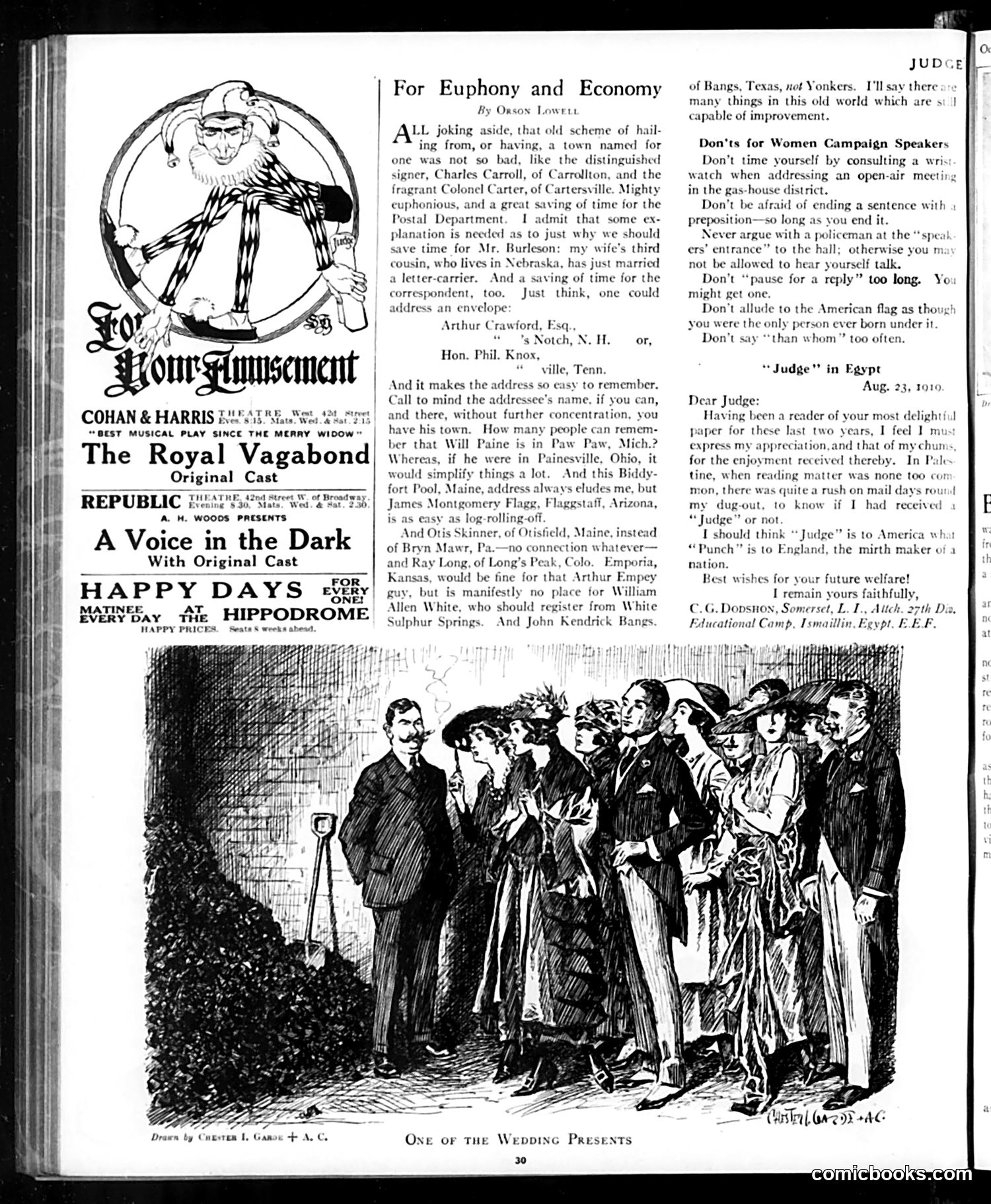
This page is primarily **advertisements and reader letters** rather than political satire. The top section contains **theater ads** for popular productions like "The Royal Vagabond" and "Happy Days," typical of Judge's commercial content. The main article, "For Euphony and Economy" by Osso Lowell, is a **humorous essay** mocking the postal system under Postmaster General Burleson. It jokes about how naming towns after prominent people (Carroll/Carrollton, Carter/Cartersville) creates easy-to-remember addresses—a trivial advantage that doesn't justify saving time for the postal service or Burleson himself. The "Don'ts for Women Campaign Speakers" section offers **satirical advice** for female public speakers, poking fun at women's activism and public speaking during the Progressive era. The bottom section reproduces a **reader's letter from Egypt** praising Judge magazine, evidently published to boost circulation and prestige. The illustration of well-dressed men and women appears to accompany the theater advertisements rather than providing political commentary.
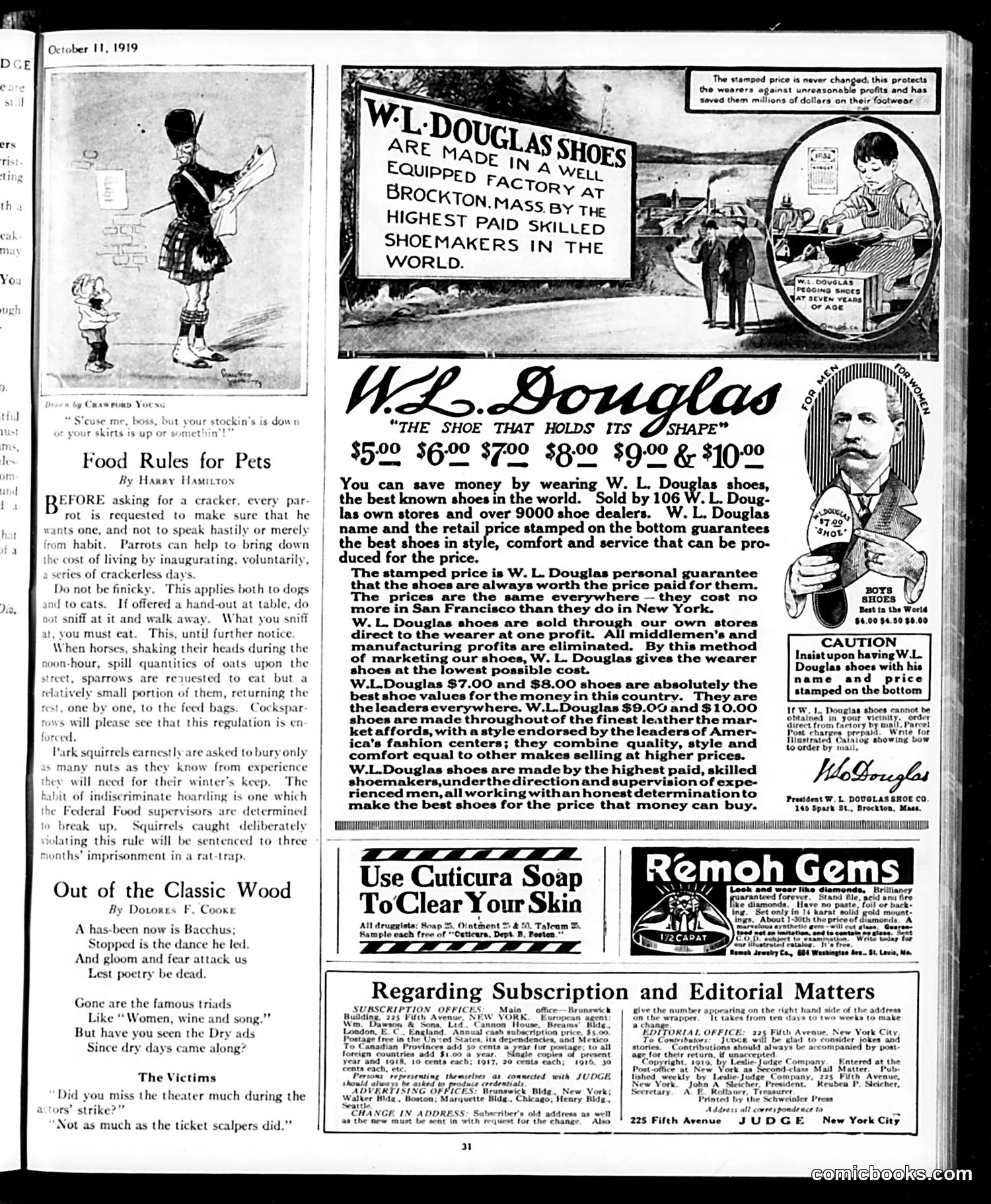
This page is primarily **advertising and light humor**, not political satire. **"Food Rules for Pets"** is a humorous article playing on **WWI-era food rationing and conservation campaigns**. It satirizes government appeals to citizens by applying them absurdly to animals—parrots shouldn't speak wastefully, dogs must eat table scraps without complaint, squirrels should hoard only necessary nuts. The joke reflects genuine wartime anxiety about food shortages and voluntary sacrifice. **"Out of the Classic Wood"** mocks **Prohibition** (the "Dry ads" reference), which had recently passed. The poem laments lost classical themes of wine and revelry, now replaced by advertisements for a dry (alcohol-free) lifestyle. **"The Victims"** is a brief joke about **actors' strike** and ticket scalpers—contemporary labor disputes and the parasitic ticket resale market. The page is dominated by a large **W.L. Douglas shoe advertisement** claiming fair wages and eliminated middleman profits—addressing contemporary consumer concerns about manufacturing costs and corporate exploitation during the post-WWI economic transition.
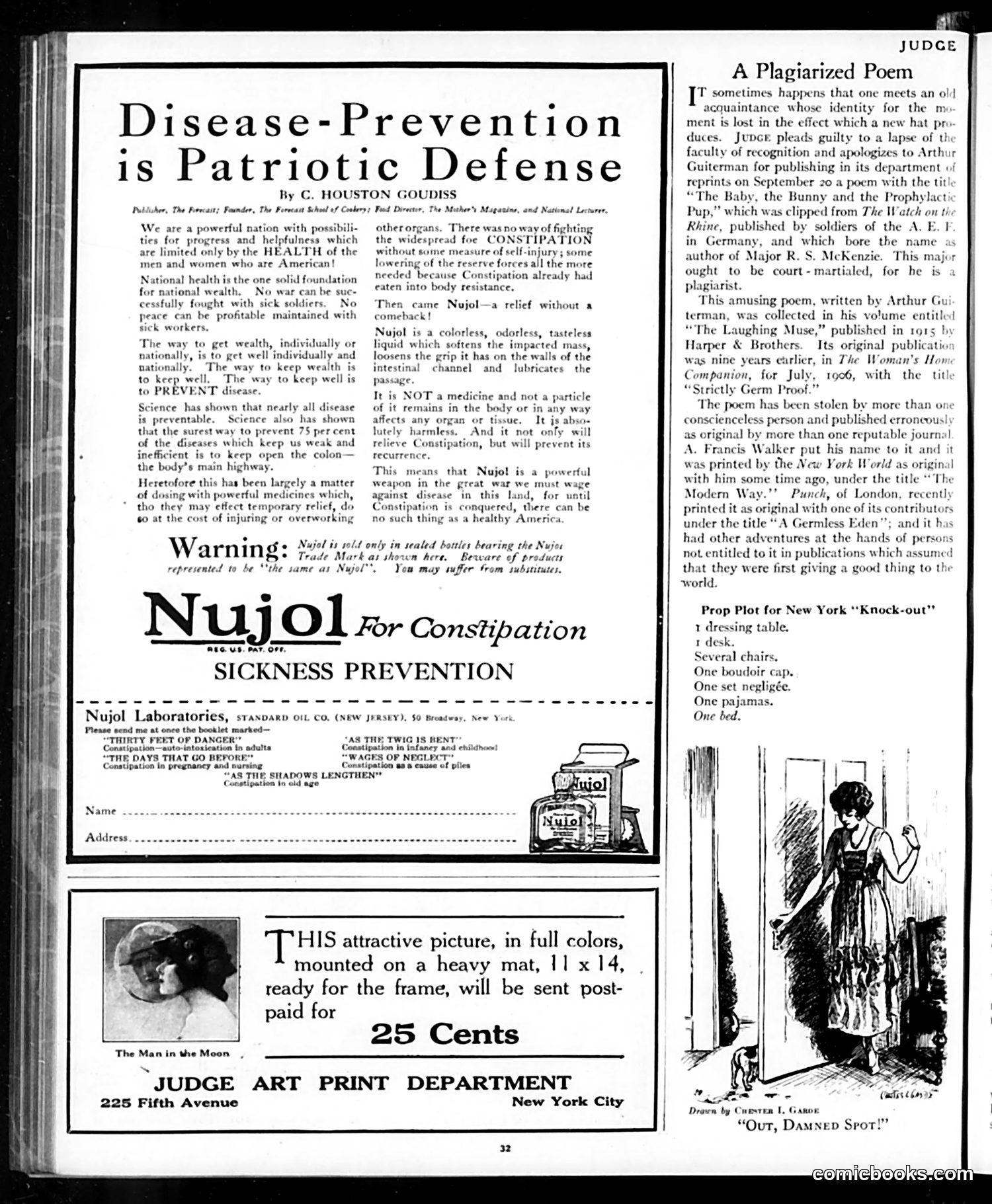
This page combines a **health advertisement with a plagiarism confession**. The main article is a sponsored piece by C. Houston Goudiss promoting **Nujol**, a mineral oil laxative marketed as "patriotic defense" against constipation—framing digestive health as a national strength issue (likely WWI-era, given the military language). The product is advertised as non-medicinal and harmless, unlike older harsh laxatives. On the right, under "A Plagiarized Poem," **Judge admits it reprinted a poem without proper attribution**. The magazine published "The Baby, the Bunny and the Prophylactic Pup" in its September 20 reprint section, crediting Major R.S. McKenzie as author. However, the poem was actually written by **Arthur Guterman** and originally appeared in 1906 in *The Woman's Home Companion*. Judge apologizes for the oversight and sarcastically suggests the major "ought to be court-martialed" for plagiarism. The page also includes a small illustration for a theatrical prop list titled "Out, Damned Spot!"—apparently unrelated content typical of Judge's mixed editorial format.
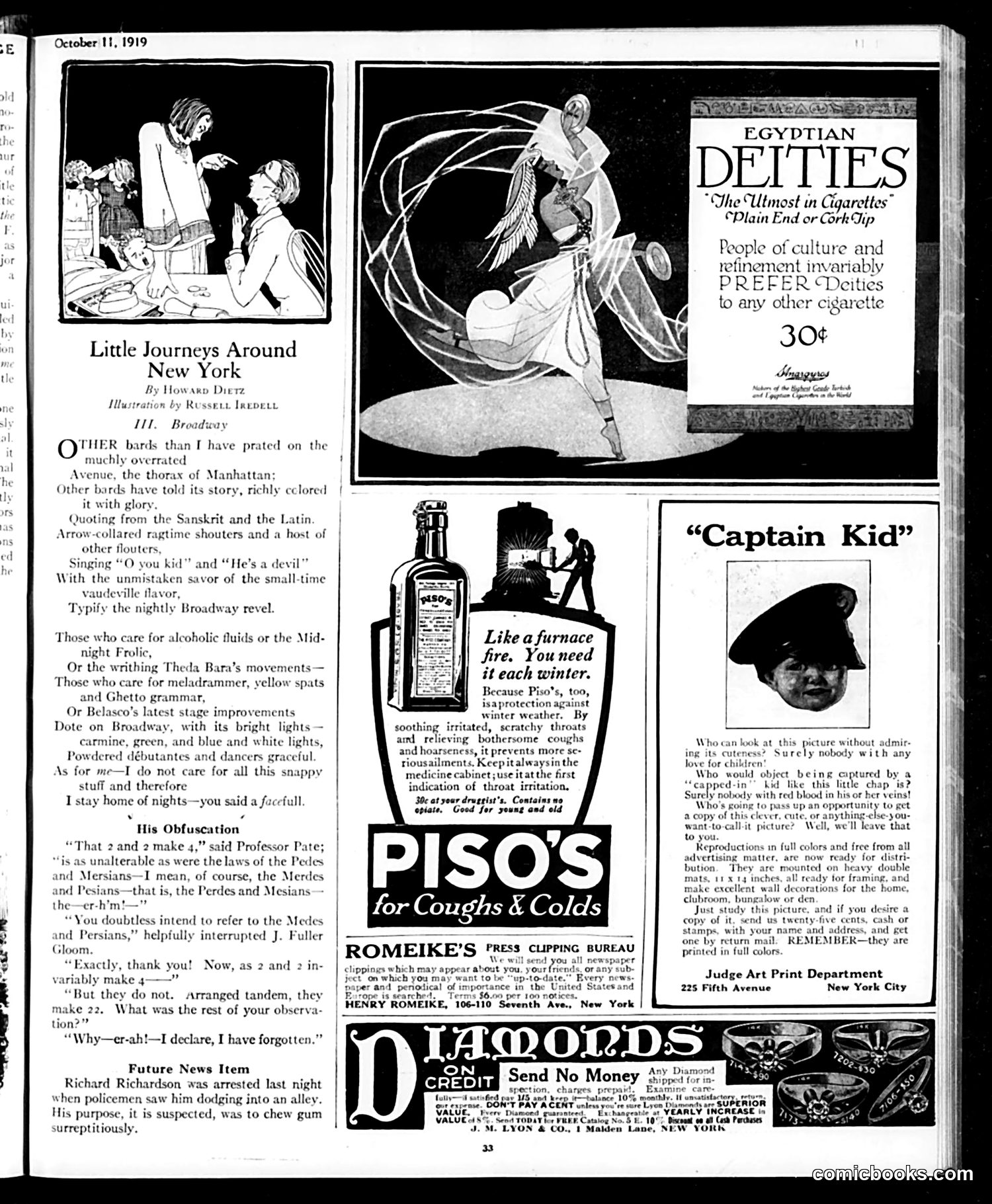
This page is primarily a literary and advertising compilation rather than political satire. The main content, "Little Journeys Around New York" by Howard Dietz, is a humorous column about Broadway culture. Dietz satirizes the era's entertainment scene—vaudeville performers, Theda Bara's dramatic movements, nightlife attractions—while humorously positioning himself as too refined for such "snappy stuff." The second piece, "His Obfuscation," is comedic dialogue mocking a pretentious professor who confuses historical names (Medes and Persians) and cannot articulate his own arguments. It's gentle satire about academic pomposity. The "Future News Item" is absurdist humor: the joke is that gum-chewing has apparently become so socially unacceptable by the future that one must hide while doing it—an exaggeration of contemporary propriety concerns. The bulk of the page consists of period advertisements (cigarettes, cough medicine, diamonds), which was standard magazine content.
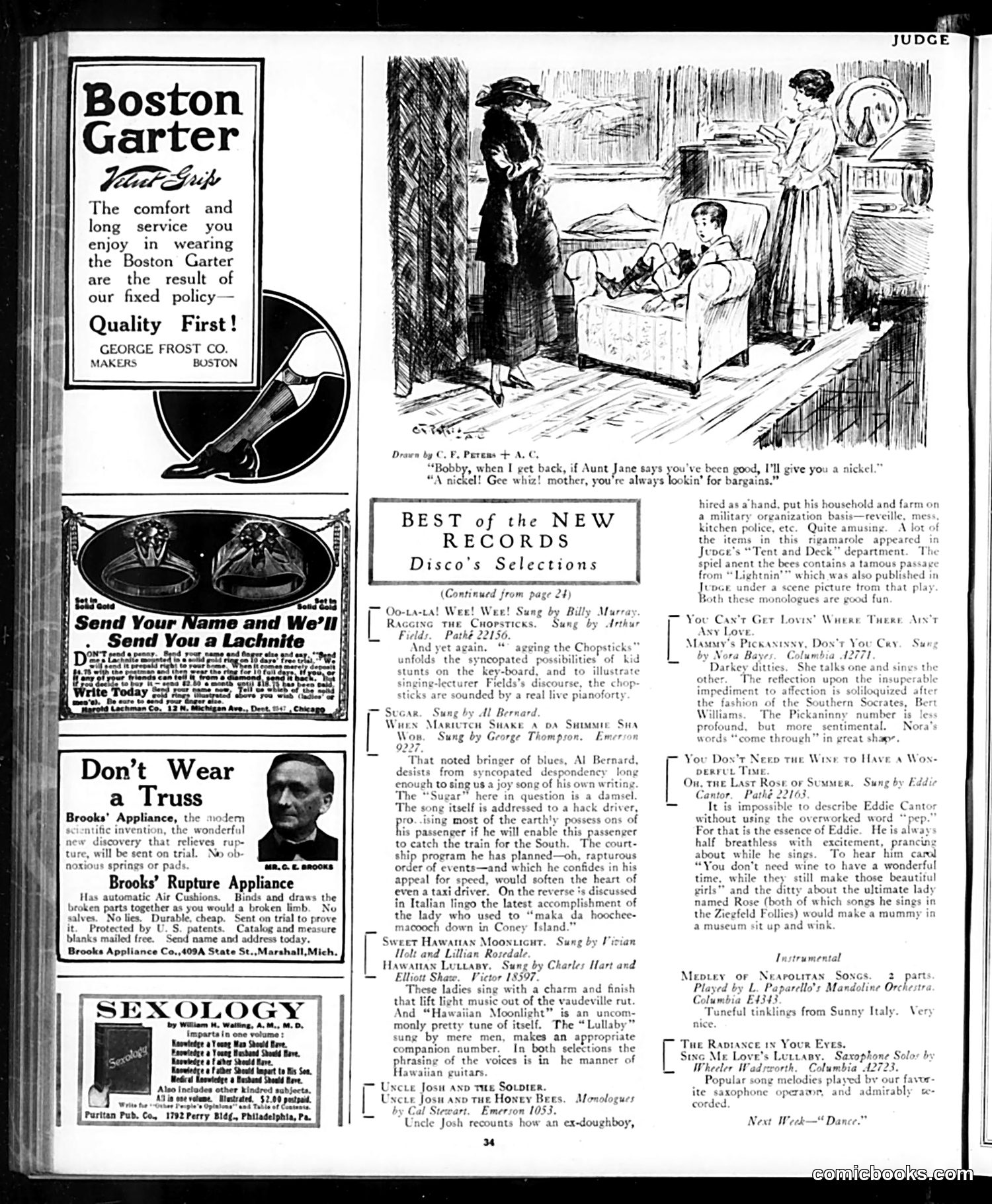
This page is primarily **advertising and record reviews**, not political satire. The main cartoon (top right) depicts a domestic scene: a mother standing over a child in bed, with an aunt visiting. The caption shows the aunt promising the child a nickel for good behavior, while the mother jokes she's "always lookin' for bargains"—a mild jab at penny-pinching relatives or working-class frugality. The advertisements reflect early 20th-century medical concerns: Boston Garters (men's hosiery), Brooks' Rupture Appliance (a truss alternative), and a "Sexology" book—products marketed to address common health anxieties of the era. The bulk of the page reviews phonograph records from Disco's label, discussing popular songs of the period including Hawaiian music and sentimental numbers, typical of 1920s entertainment. **No significant political or satirical content is visible.** This appears to be a standard commercial/entertainment page from Judge magazine.
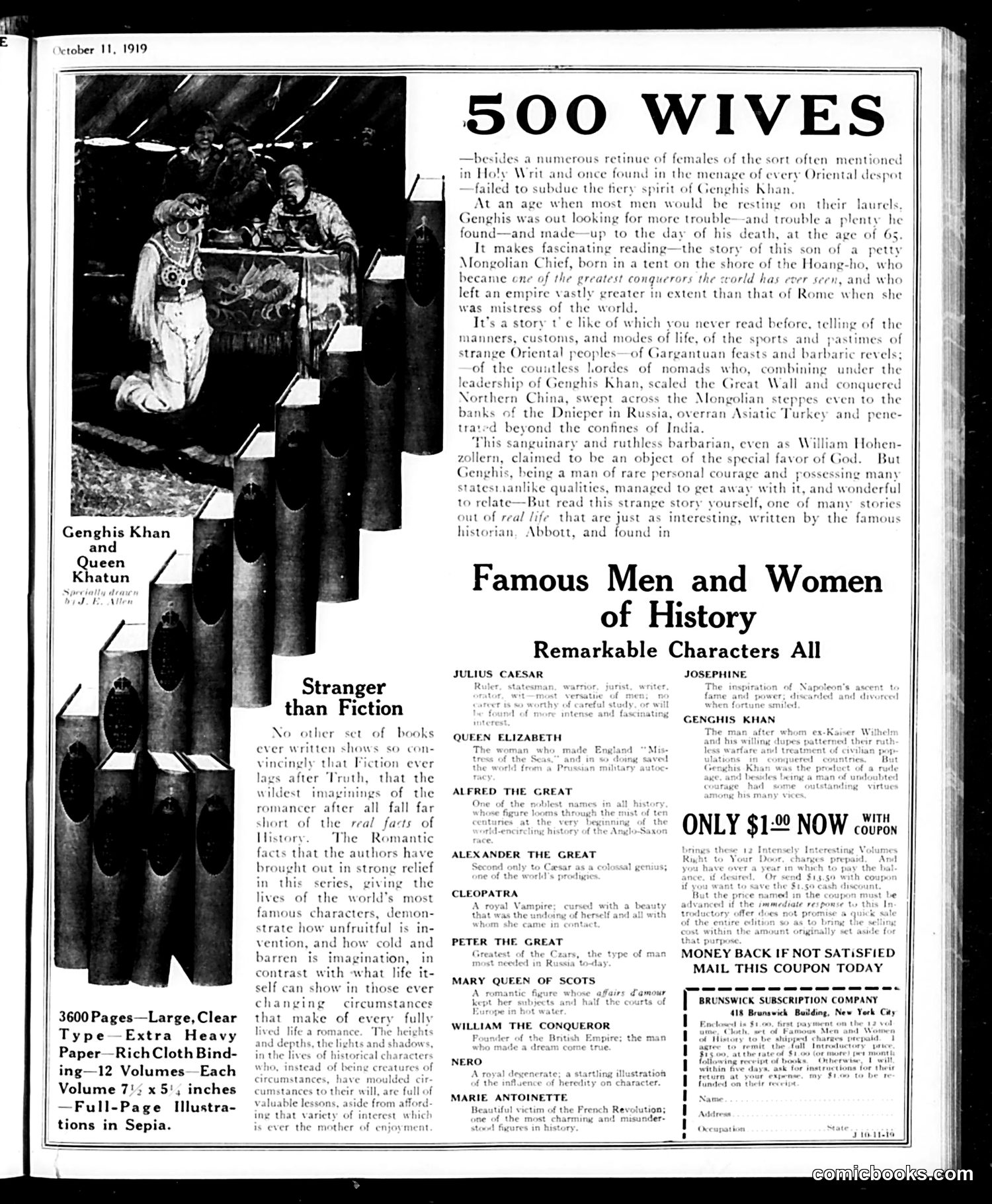
This page is primarily **advertising**, not political satire. It promotes a 12-volume encyclopedia set titled "Famous Men and Women of History," featuring figures like Julius Caesar, Cleopatra, and Genghis Khan. The only cartoon element is a small illustration labeled "Genghis Khan and Queen Khatun" (credited to artist S. D. Ehrhart), depicting the Mongol ruler with one of his wives in what appears to be a tent setting. The advertisement's text emphasizes that real historical facts are "stranger than fiction," arguing that authentic biography surpasses imagination. The Genghis Khan entry highlights his legendary status as "one of the greatest conquerors the world has ever seen" and his vast empire—larger than Rome's. The headline "500 WIVES" sensationalizes Khan's polygamy to attract readers, presenting his life as exotic and remarkable. This reflects early 20th-century popular interest in Oriental history presented through a lens of wonder at "foreign" customs. The page is essentially a straightforward product advertisement with minimal satirical content.
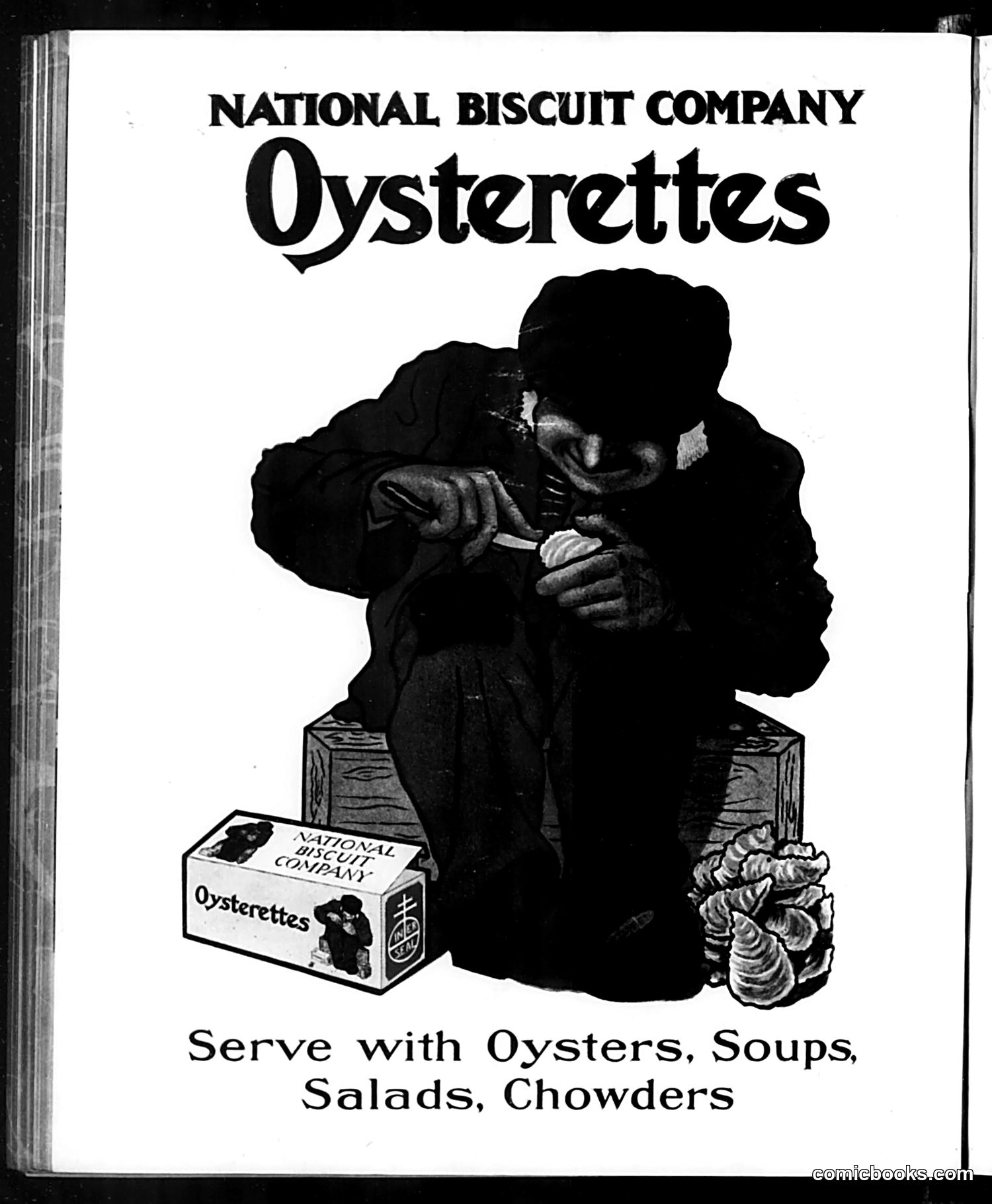
This is a National Biscuit Company (Nabisco) advertisement for their product "Oysterettes"—oyster-shaped crackers. The image shows a stylized silhouette of what appears to be a well-dressed man in formal attire eating or serving the crackers, with actual oysters depicted nearby and a box of Oysterettes visible. The advertisement's appeal relies on associating the crackers with upscale dining—they're positioned as accompaniments to sophisticated dishes like oyster stew, soups, salads, and chowders. The elegant presentation and formal dress of the figure suggest these are premium foods for refined diners. This represents early 20th-century food marketing, when crackers marketed as "gourmet" accompaniments to shellfish and fancy soups represented aspirational consumer goods for middle and upper-class households.