
Judge, 1919-10-11 · page 19 of 36
Judge — October 11, 1919 — page 19: what you’re looking at
What you’re looking at
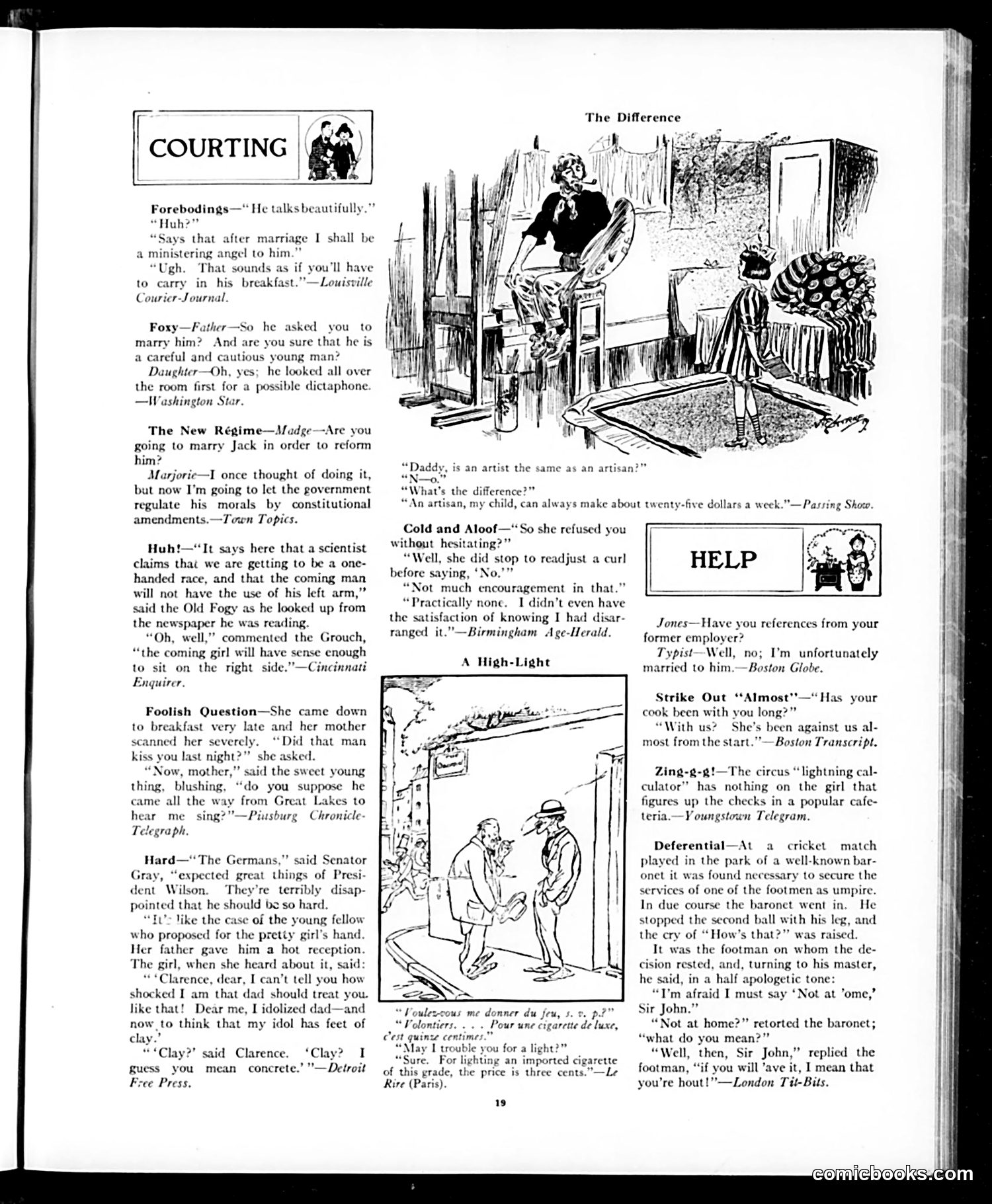
The main cartoon depicts a father watching his young daughter play in a sandbox while a boy in striped clothing stands nearby. The caption contrasts an "artisan" with an "artist"—the father explains the difference is that an artisan can "always make about twenty-five dollars a week," while an artist cannot guarantee income. This satirizes early 20th-century anxieties about class mobility and marriage prospects. The cartoon mocks middle-class parental concerns about their daughters marrying men of uncertain financial standing. The "artisan" represents stable, working-class employment; the "artist" represents romantic but economically unreliable suitors—a common source of tension in courting narratives of the era. The surrounding humor pieces reinforce the theme: several joke about women's practical calculations in romance and marriage, including one about a woman reforming a man through government intervention rather than personal influence. Together, the page satirizes both courtship anxieties and changing gender dynamics of the period.
📄 Transcribed text from this page (OCR, searchable)
Machine-transcribed from the original scan — historical spelling and the odd misread are preserved.
COURTING | Forebodings—" He talks beautifully.” “Huh?” ays that after marri a ministering angel to him.” “Ugh at sounds as if you'll have to carry in his breakfast.” —Louisville Courier-Journal. I shall be he asked And are you sure that he is a careful and cautious young man? Daughter—Oh, yes; he looked all over the room first for a possible dictaphone. —Weashington Star, r—So you to The New Régime—Madge—Are you going to marry Jack in order to reform him? Marjorie—I once thought of doing it, but now I’m going to let the government regulate his morals by constitutional amendments.—Town Topics. Huh!—“It says here that a scientist claims that we are getting to be a one- handed race, and that the coming man will not have the use of his left arm,” said the Old Fogy as he looked up from the newspaper he was reading. “Oh, well,” commented the Grouch, “the coming girl will have sense enough to sit on the right side.”—Cincinnati Enquirer. Foolish Question—She came down to breakfast very late and her mother scanned her severel: “Did that man kiss you last night?” she asked. “Now, mother,” said the sweet young “do you suppose he from Great Lakes to —Piusburg Chronicle- thing, blushing, came all the way hear me_ sing Telegraph. Hard—‘‘ The Germans,” said Senator Gray, “expected great things of Presi- dent Wilson. They're terribly disap- pointed that he should be so hard. “U> like the case of the young fellow who proposed for the pretty girl’s hand. Her father gave him a hot reception. The girl, when she heard about it, said: **Clarence, dear, I can’t tell shocked I am that dad should trea like that! Dear me, I idolized dad: now to think that my idol has feet of clay.’ Clay?’ said Clarence. guess you mean concrete.’ Free Press. The Difference Cold and Aloof—' without hesitating?” “Well, she did stop to readjust a curl before saying, “Not much encouragement in that.” “Practically none. I didn’t even hav the satisfaction of knowing I had disar- ranged it.”—Birmingham A ge-Herald. So she refused you A High-Light zcous me donner du feu, 5s. Volontiers. . . . Pour une cigarette de luxe, quinze centimes. of this grade, the price is three cen’ Rire (Paris). 19 Jones—Have you references from your former employer? Typist—Well, no; I'm unfortunately married to him.—Boston Globe. Strike Out “Almost’’—“Has your cook been with you long?” “With us? She’s been a most from the start.”"—Boston Transcript. Zing-g-2!—The circus “lightning cal- culator” has nothing on the girl that figures up the checks in a popular cafe- teria.—Youngstown Telegram. Deferential—At_ a cricket match ed in the park of a well-known bar- it was found necessary to secure the services of one of the footmen as umpire. In due course the baronet went in. He stopped the second ball with his leg, and the cry of “How's that?” was raised. It was the footman on whom the de- cision rested, and, turning to his master, he said, in a half apologetic tone: “T'm afraid I must say ‘Not at ome,” Sir John.” “Not at home?” retorted the baronet; hat do you mean?” “Well, then, Sir John,” replied the footman, “if you will ’ave it, 1 mean that you’re hout!""—London Tit-Bits.