
Judge, 1919-10-11 · page 13 of 36
Judge — October 11, 1919 — page 13: what you’re looking at
What you’re looking at
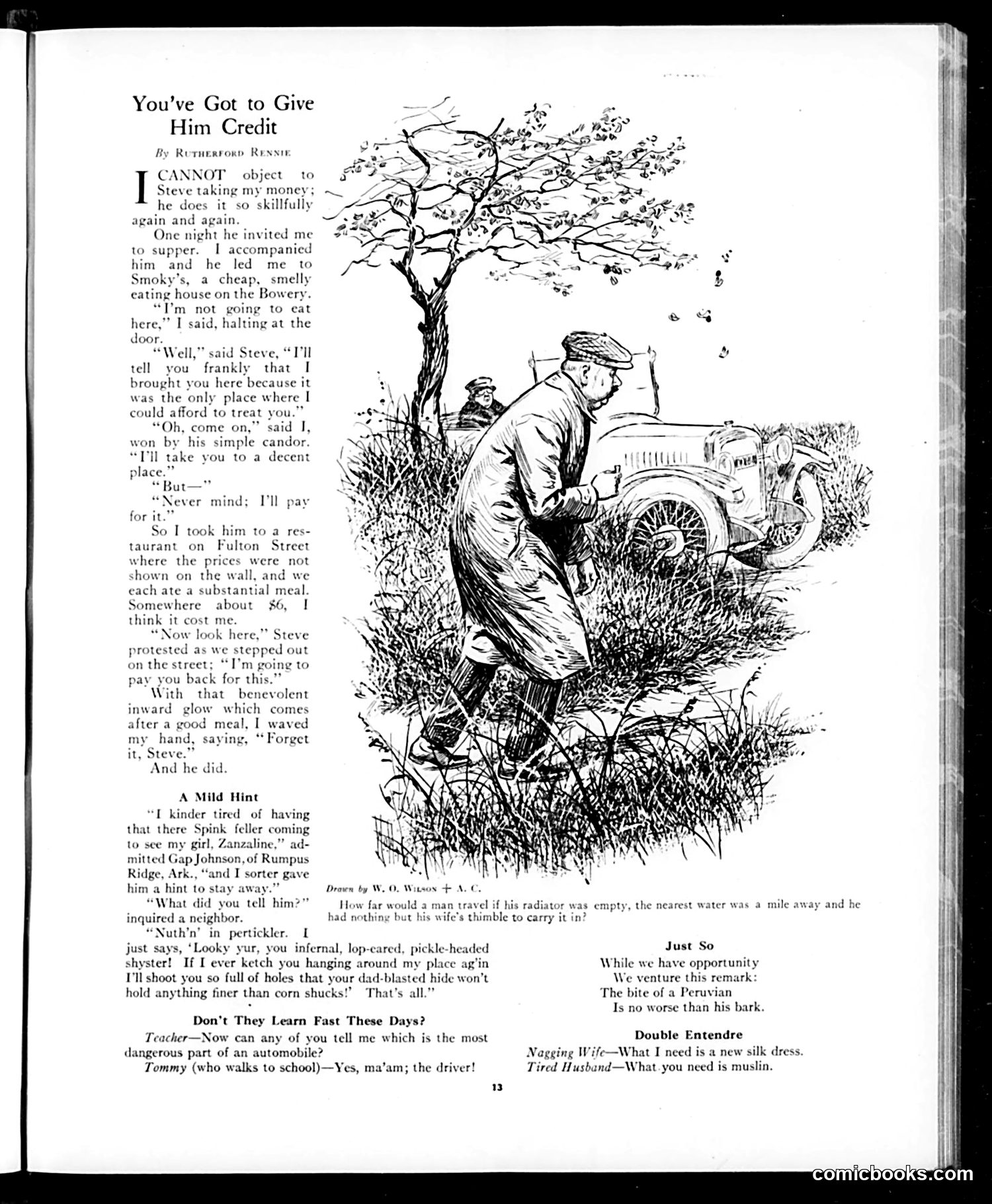
This humorous story satirizes con artists and swindlers operating in early 20th-century America. The narrator describes "Steve," a skilled manipulator who repeatedly borrows money. When invited to dinner at a cheap Bowery establishment, Steve uses false modesty—claiming it's the "only place" he can afford—to appeal to the narrator's pride. The narrator then impulsively offers to take him to an expensive restaurant instead, where the bill is substantial. The joke's point: Steve's con succeeds perfectly. Despite the narrator's generous gesture and explicit forgiveness ("Forget it, Steve"), Steve gets what he wanted—a free meal at a fancy restaurant—while maintaining plausible deniability through feigned embarrassment. The title sarcastically applauds Steve's skillful manipulation. The illustration shows the two men by a car and tree, depicting the moment of their street-level exit from the restaurant. The page also includes unrelated comic snippets and a riddle about automobiles, typical of *Judge* magazine's miscellaneous humor format.
📄 Transcribed text from this page (OCR, searchable)
Machine-transcribed from the original scan — historical spelling and the odd misread are preserved.
You’ve Got to Give Him Credit By Rotnerrony Rene CANNOT object to I Steve taking my money; he does it so skillfully again and again. One night he invited me to supper. I accompanied him and he led me to Smoky’s, a cheap, smelly eating house on the Bowery. “T’m not going to cat here,” I said, halting at the door. “Well,” said Steve, “I'll tell, you frankly that I brought you here because it was the only place whe could afford to treat you “Oh, come on,” said I, won by his simple candor. “Til take you to a decent place.” “But—" “Never mind; I'll pay for it.” So I took him to a res- taurant on Fulton Street where the prices were not shown on the wall, and we each ate a substantial al. Somewhere about nT think it cost me. “Now look here,” Steve protested as we stepped out on the street; “I’m going to pay you back for this. With that benevolent inward glow which comes after a good meal, I waved my hand, saying, “Forget it, Steve.” And he did. A Mild Hint “T kinder tired of having that there Spink feller coming to see my girl, aline,” ad- mitted Gap Johnson, of Rumpus Ridge, Ark. nd I sorter gave him a hint to stay away Drawn by W.O. Witsox # ALC. “What did you tell him?” How far would a man travel if his radiator was empty, the nearest water was a mile away and he inquired a neighbor. had nothing but hi mble to carry it in? “Nuth’n’ in pertickler. I ys, ‘Looky yur, you infernal, lop-eared, pickle-headed Just So yster! If I ever ketch you hanging around my place ag’in While we have opportunity I'll shoot you so full of holes that your dad-blasted hide won’t We venture this remark: hold anything finer than corn shucks!’ That’s all.” The bite of a Peruvian : Is no worse than his bark. Don't They Learn Fast These Days? Double Entendre Teacher—Now can any of you tell me which is the most dangerous part of an automobile? Nagging Wife—What I need is a new silk dress. Tommy (who walks to school)—Yes, ma'am; the driver! Tired Husband—What you need is muslin.