
A complete issue · 36 pages · 1919
Judge — September 27, 1919
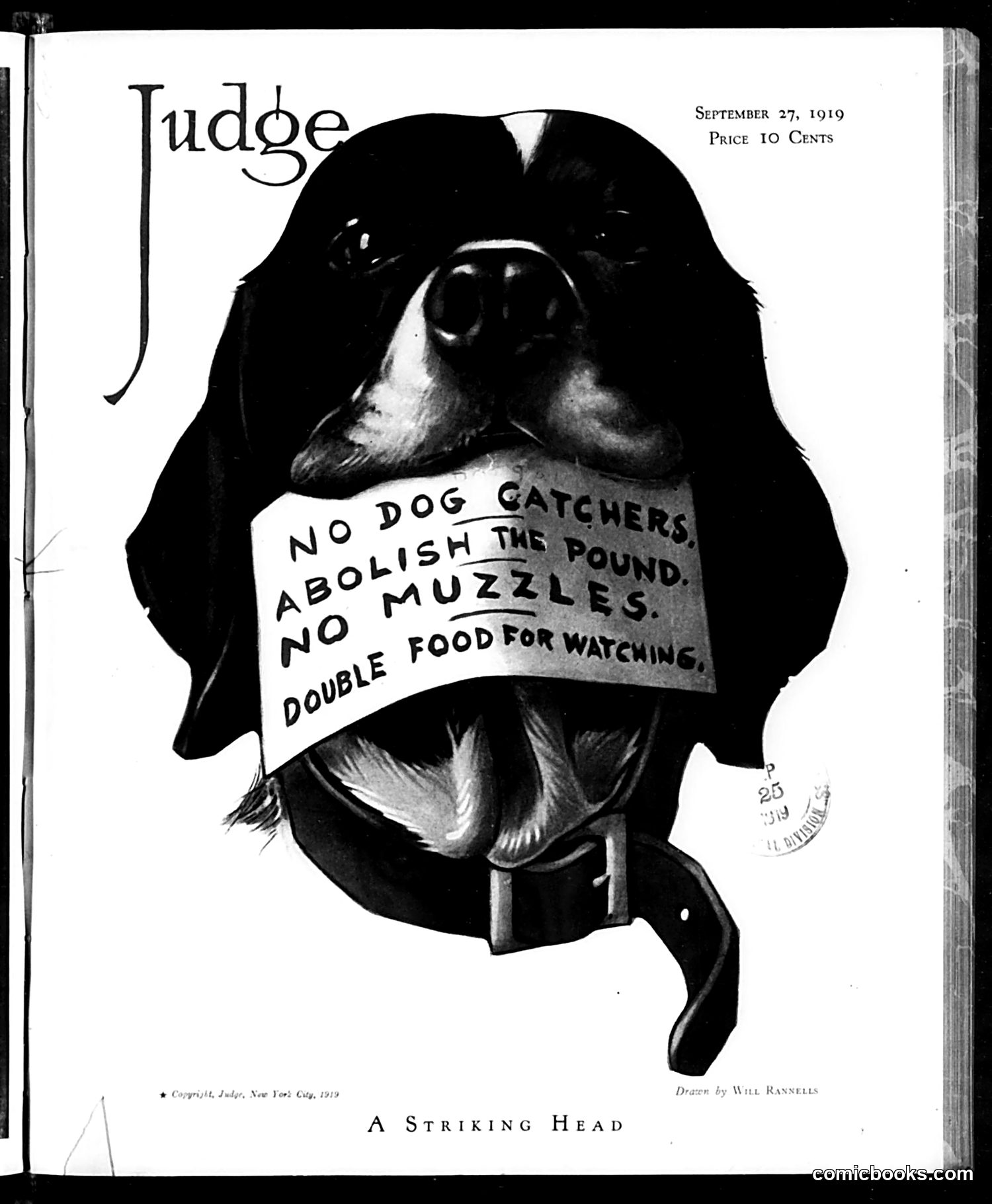
This cartoon advocates for animal welfare reform. It depicts a spaniel wearing a sign that reads: "NO DOG CATCHERS, ABOLISH THE POUND. NO MUZZLES. DOUBLE FOOD FOR WATCHING." The dog represents advocates pushing for humane treatment of working and stray dogs. The "striking head" title references a labor strike—comparing the dog's demands to workers' labor protests, which were prominent in 1919 America. The satire mocks animal rights activists by portraying their demands as absurdly self-interested, as if dogs were unionizing for better conditions. The cartoon suggests these reformers are naive or overly sentimental about animal welfare, equating their activism with frivolous labor unrest during a turbulent post-WWI period.
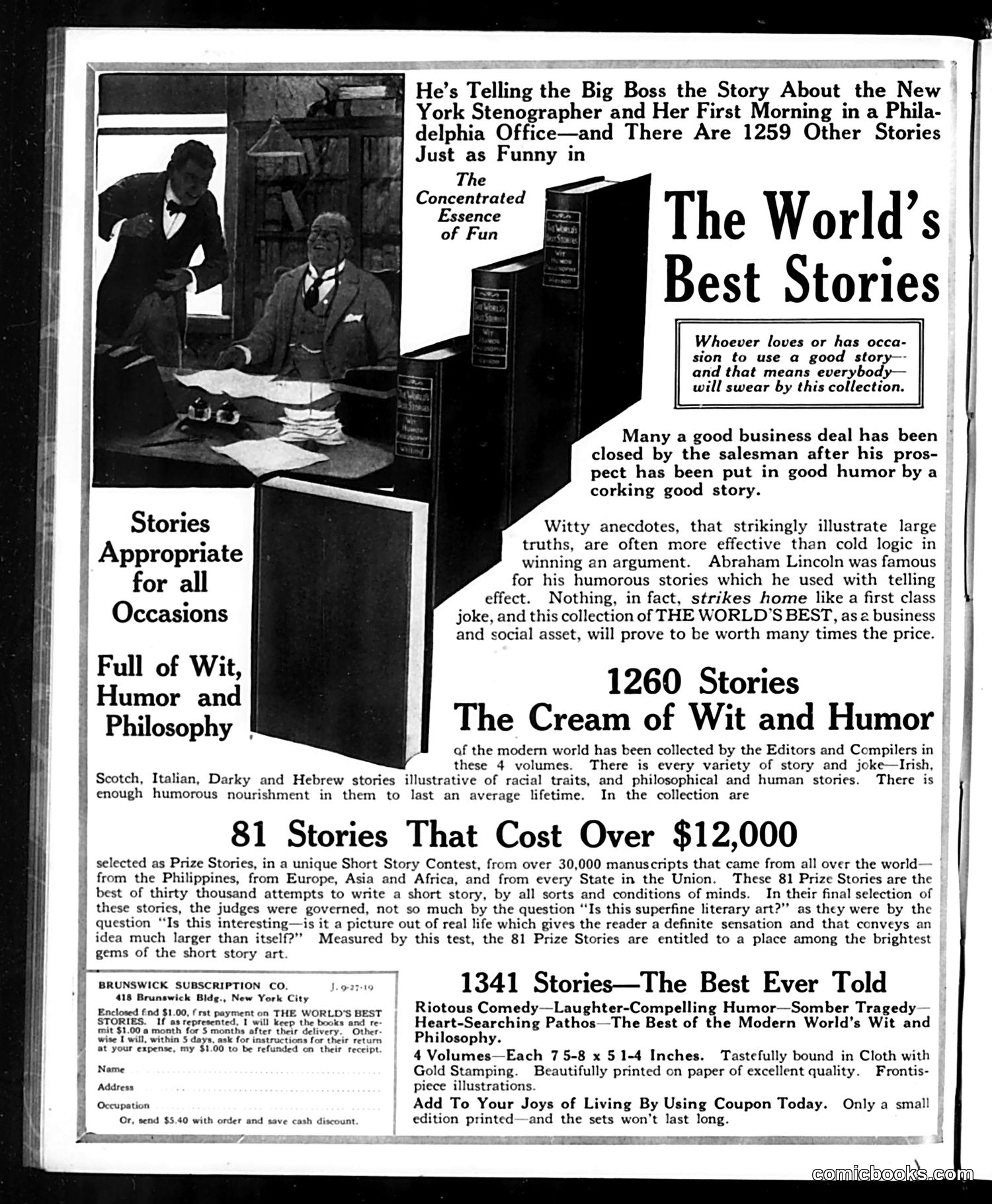
This page is primarily a **book advertisement** rather than political satire. It promotes a four-volume collection titled "The World's Best Stories" containing 1,260 stories of wit and humor. The advertisement emphasizes the collection's practical value for business professionals and social situations. It references **Abraham Lincoln's famous use of humorous anecdotes** as persuasive tools, suggesting witty stories can close business deals and win arguments more effectively than logic alone. The left image shows two businessmen in an office setting, apparently illustrating how storytelling functions in professional contexts. The ad promises stories from diverse origins—Scotch, Italian, Hebrew, Darky, and Irish traditions—reflecting early 20th-century categorizations of humor by ethnicity. The collection includes 81 prize-winning stories selected from international competitions, bound in cloth with gold stamping.
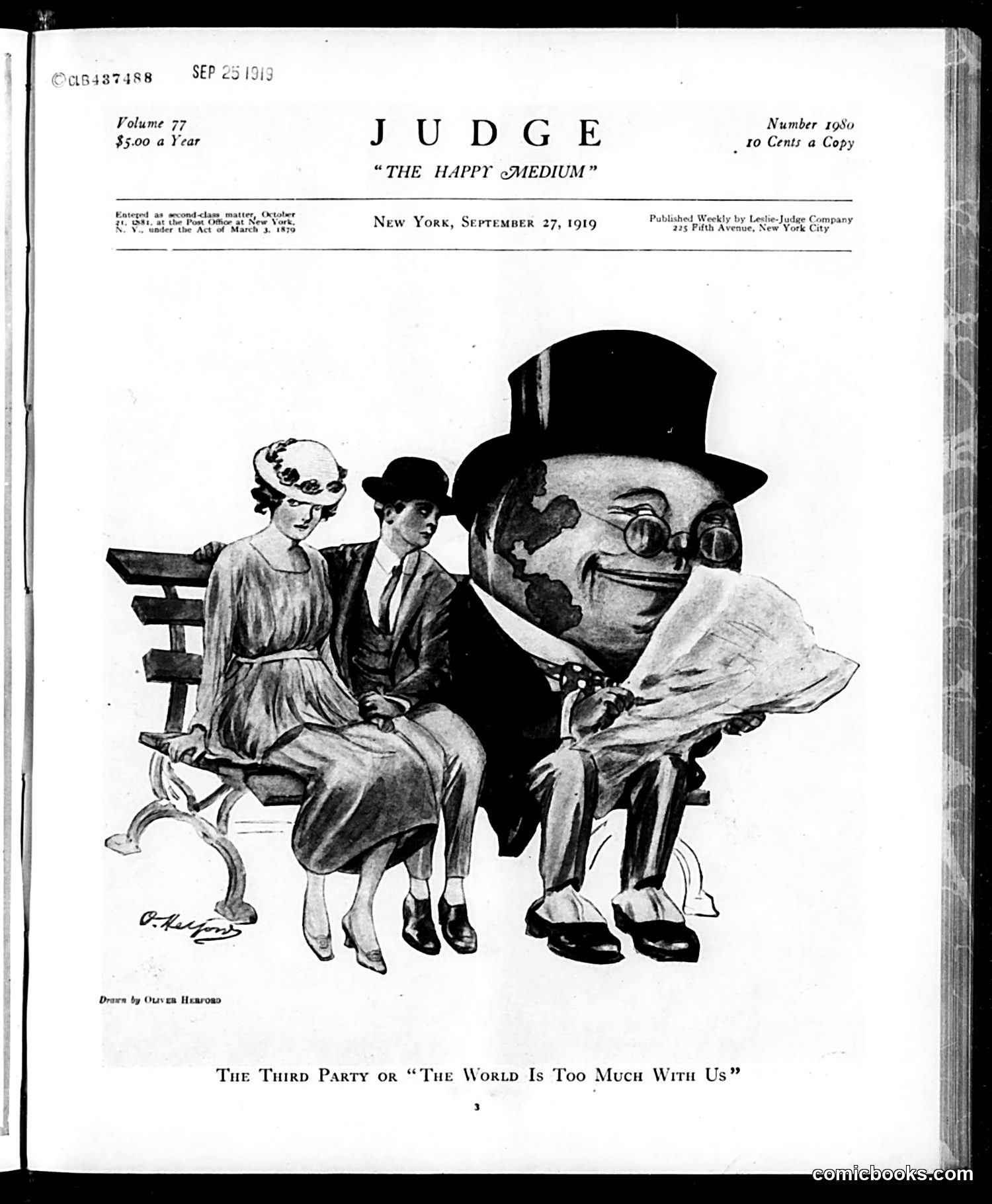
This satirical cartoon, titled "The Third Party or 'The World Is Too Much With Us,'" depicts a grotesque caricatured figure with exaggerated features, goggles, and patched clothing sitting with two well-dressed women. The figure appears to represent a disheveled or disreputable character intruding where he doesn't belong. The "Third Party" reference likely alludes to emerging political movements or social disruptions of 1919—a year marked by labor strikes, the Red Scare, and postwar social upheaval in America. The cartoon satirizes unwelcome intrusion into polite society, suggesting anxieties about radical or working-class elements threatening established social order. The refined women's discomfort underscores Judge's conservative editorial stance against perceived threats to respectable American life.
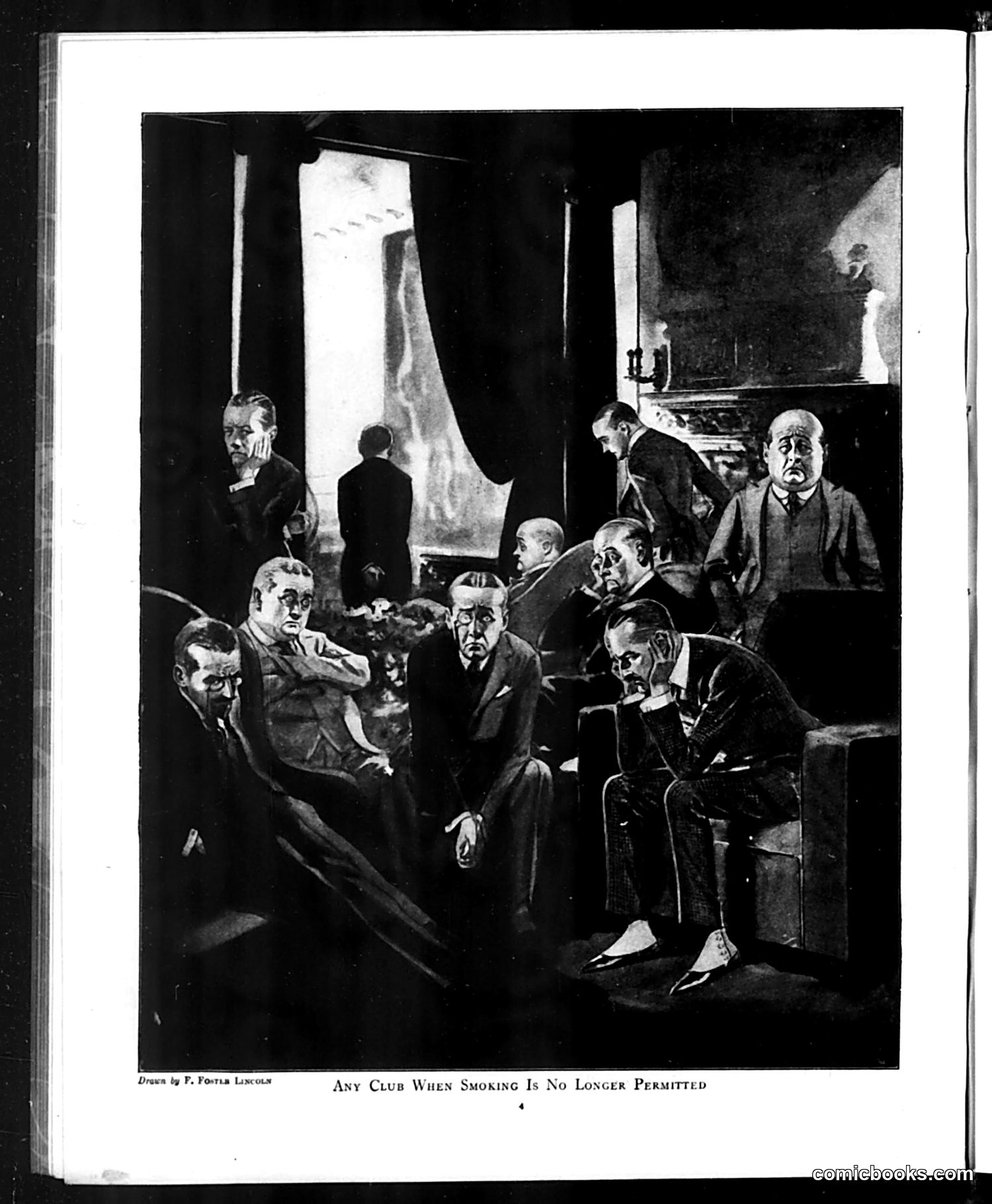
This F. Foster Lincolm cartoon satirizes the social consequences of anti-smoking restrictions. The drawing depicts a gentleman's club or similar exclusive establishment rendered nearly empty and gloomy—with only a handful of dejected men scattered throughout what should be a lively social space. The satire's point: prohibiting smoking would devastate men's clubs by eliminating the primary activity and social ritual that attracted members. The sparse, melancholy atmosphere suggests that without cigarettes and cigars, these establishments would lose their appeal entirely. This reflects early-20th-century debates over smoking restrictions, when such bans were viewed as threats to established male social institutions and leisure culture. The cartoon argues smoking prohibitions would render these spaces pointless and abandoned.
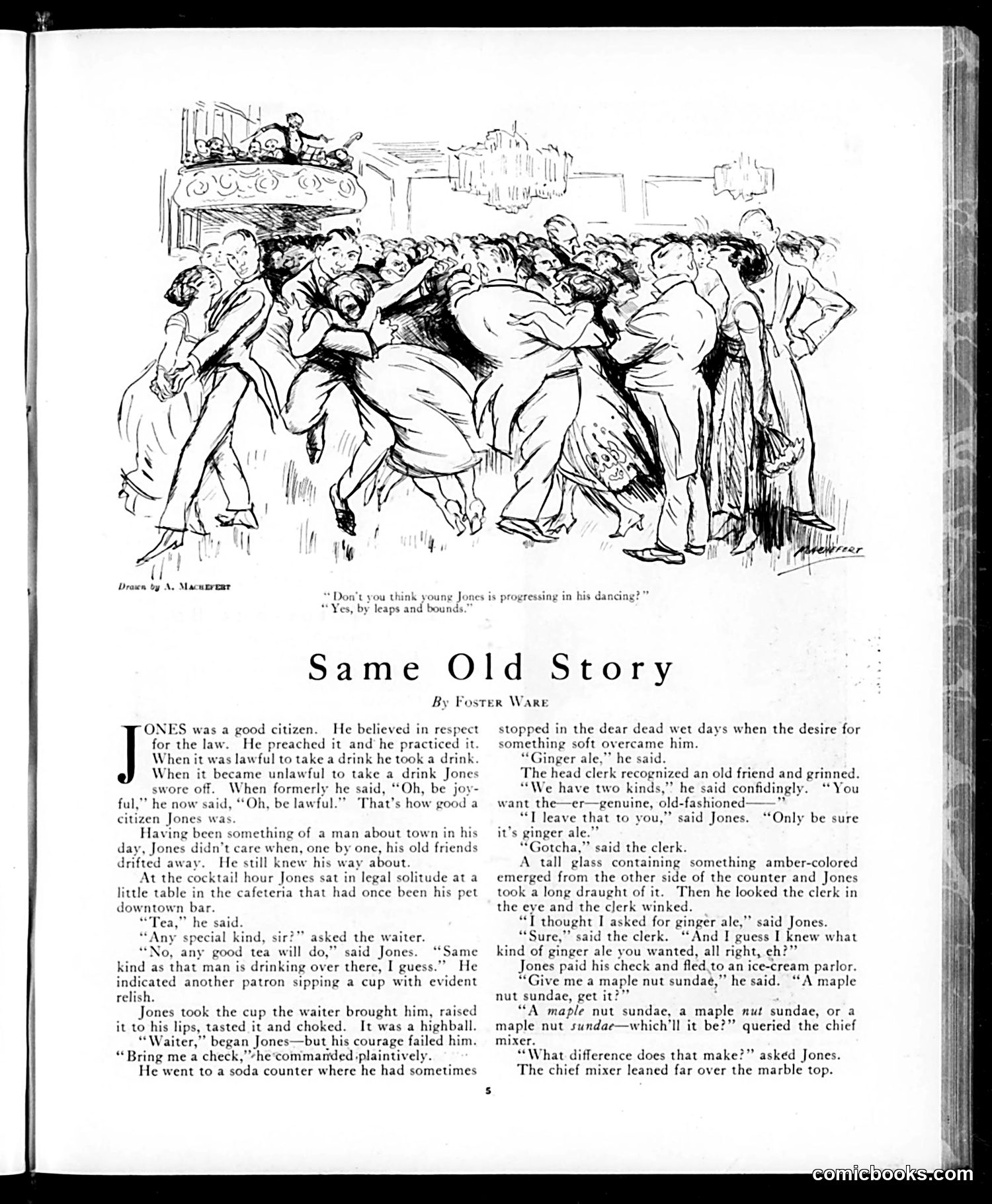
This page combines a satirical cartoon with a short story. The cartoon depicts a crowded dance floor with well-dressed figures in energetic, somewhat chaotic motion. The caption reads: "Don't you think young Jones is progressing in his dancing?" / "Yes, by leaps and bounds." The joke is visual wordplay: Jones is literally leaping and bounding around the dance floor in an ungainly manner, making "progressing in his dancing" a humorous contradiction. The cartoon mocks awkward dancers who move erratically rather than gracefully. Below is Foster Ware's story about a respectable citizen named Jones who, despite his upright reputation, secretly desires a drink and visits soda counters to order cocktails disguised as soft drinks—satirizing Prohibition-era hypocrisy about alcohol consumption.
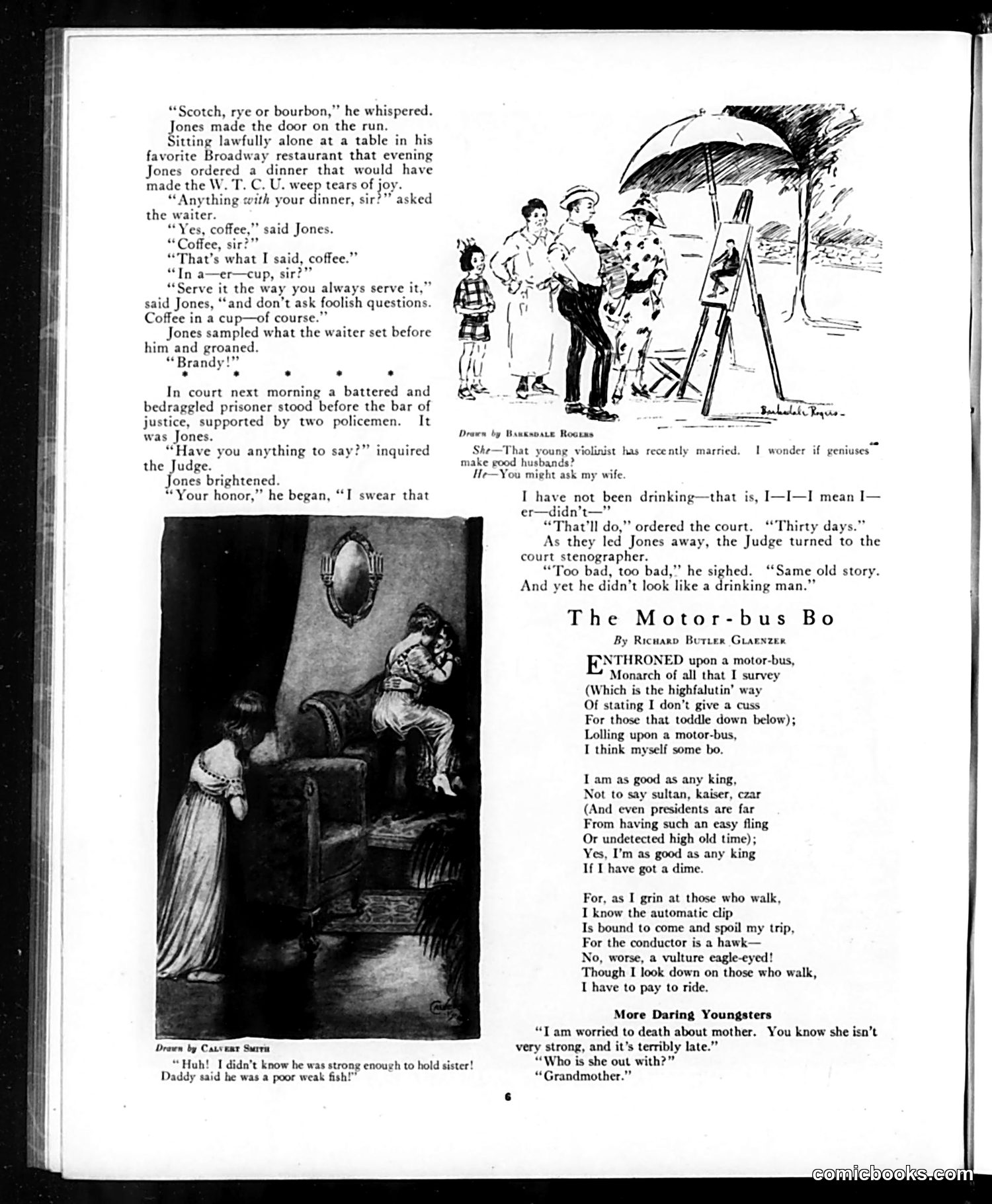
This page contains three distinct pieces: **Top section**: A humorous story about Jones, a man arrested for drunk and disorderly conduct. The joke pivots on Jones claiming he hasn't been drinking, yet the Judge sentences him to 30 days anyway—the Judge remarking that Jones "didn't look like a drinking man," suggesting his unkempt appearance made him appear guilty regardless. **Left illustration** (by Caesar Smith): Depicts a domestic scene with the caption "Huh! I didn't know he was strong enough to hold sister! Daddy said he was a poor weak fish!" This appears to satirize courtship or engagement, mocking a man's apparent weakness. **Right section**: "The Motor-bus Bo," a humorous poem by Richard Brinsley Glanzer satirizing the arrogance of motor-bus riders who consider themselves superior to pedestrians, treating walking people contemptuously.
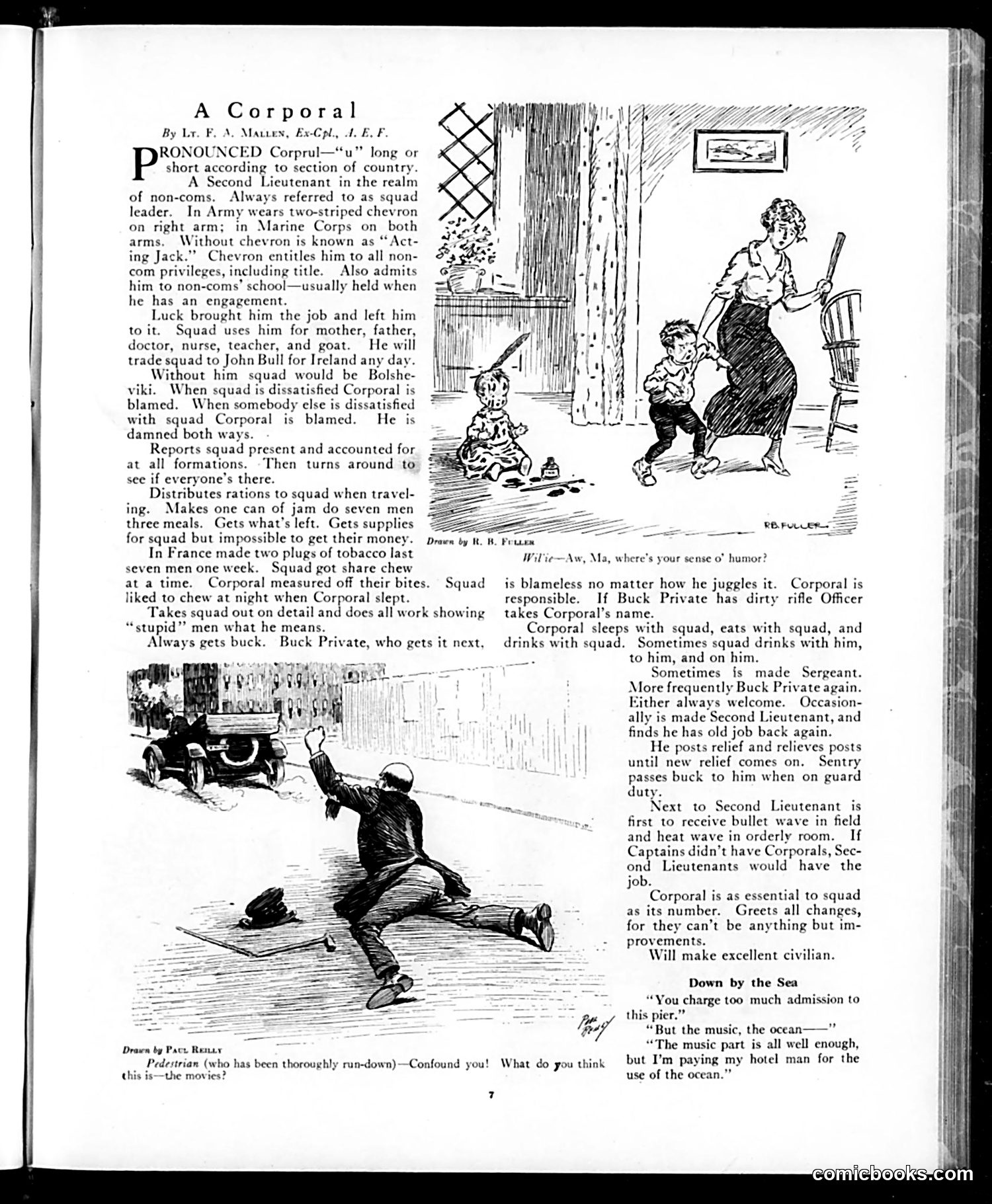
This page satirizes the U.S. Army corporal rank, written by a former corporal from the American Expeditionary Forces (WWI era). The humor targets the corporal's impossible position: responsible for squad discipline and logistics yet blamed for everything—whether the squad misbehaves or performs well. Key absurdities highlighted: the corporal stretches meager rations (one jam can across seven men's three meals), distributes chewing tobacco by measured bites, and absorbs blame from all directions. He's simultaneously mother, father, nurse, and scapegoat. Ironically, while essential to squad function, he receives no real authority—a buck private can outrank him in reality. The accompanying cartoons illustrate the chaos: one shows domestic disruption; another depicts a run-down pedestrian—visual gags about collateral damage from military hierarchy. The satire reflects post-WWI soldier frustration with rank absurdities and the corporal's thankless middle-management position.
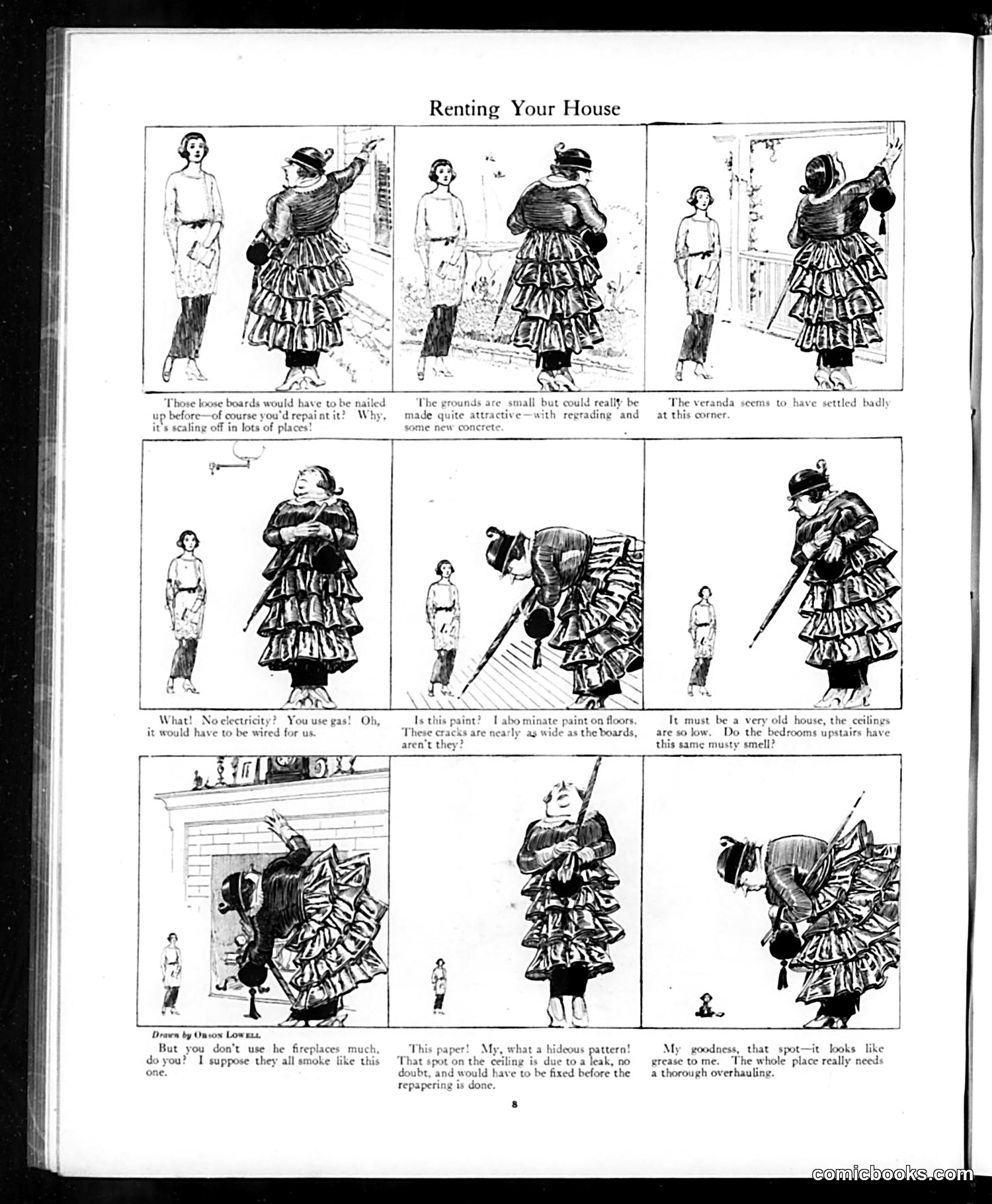
This is a humorous multi-panel comic depicting a woman inspecting a house for rental. The satire targets the poor condition of rental properties and landlords' negligence. The woman (depicted with exaggerated fashion) discovers successive problems: loose floorboards, small grounds, a deteriorating veranda, missing electricity, damaged paint and floorboards, low ceilings, and finally water stains suggesting a roof leak and mold. The joke is that each defect she identifies is dismissed or minimized—the landlord/inspector responds with excuses rather than acknowledgment. By the final panel, she demands "a thorough overhauling," highlighting the absurdity of renting a dilapidated property. This satirizes early 20th-century housing standards and the powerlessness of renters facing slumlord conditions.
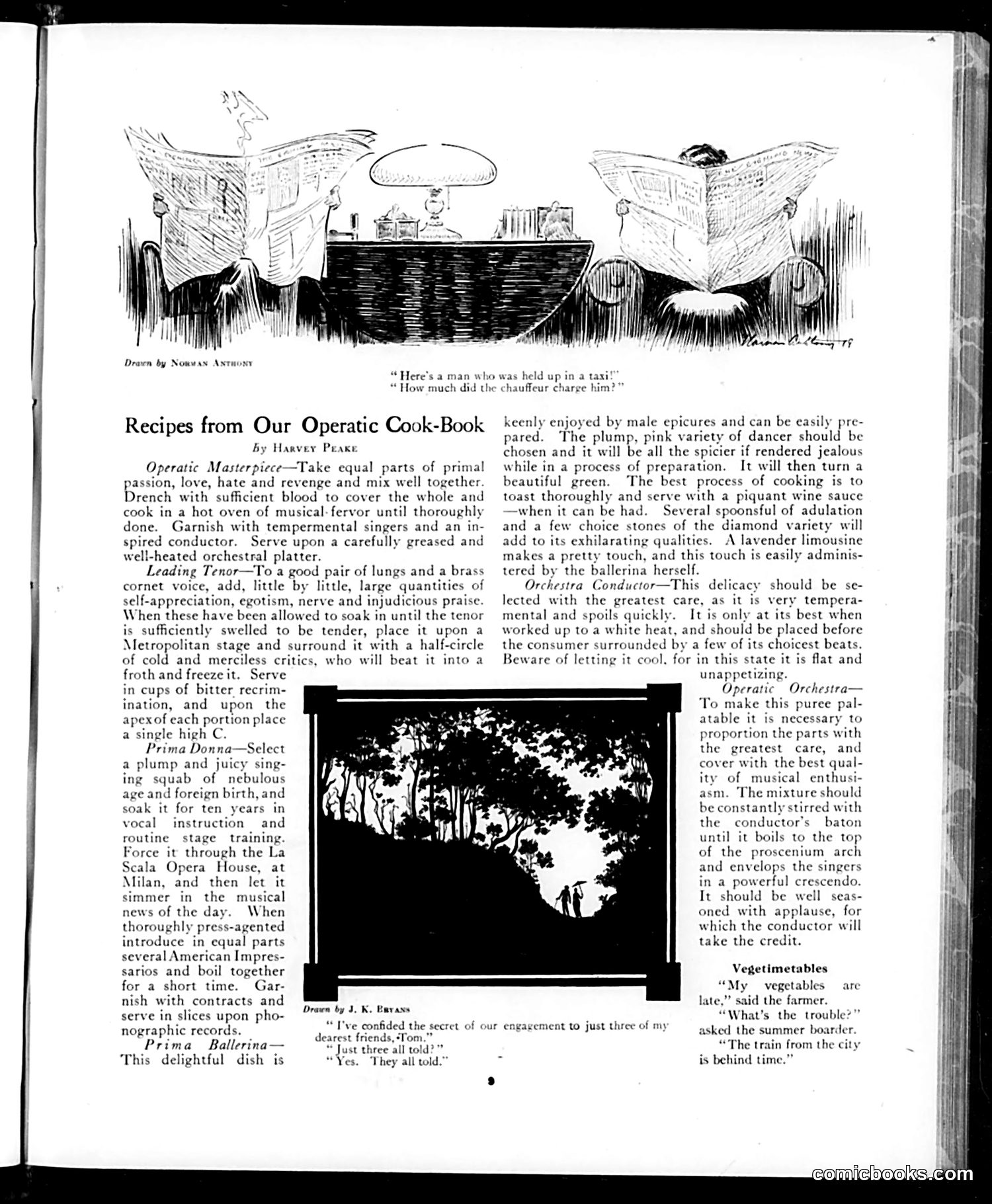
This page contains **two separate pieces of satire**: ## Top Cartoon A simple joke about taxi overcharging: two people read a newspaper account of a robbery victim asking "How much did the chauffeur charge him?"—implying taxi drivers are as predatory as criminals. ## "Recipes from Our Operatic Cook-Book" The main satire uses **cooking metaphors to mock opera world stereotypes**. Harvey Peake ridicules: - **Prima Donnas**: vain, manipulated divas who become "jealous" and temperamental - **Leading Tenors**: egotistical, needing constant praise to stay "swelled" - **Conductors**: volatile, requiring careful handling to avoid "spoiling" - **Impresarios**: exploitative, boiling singers together for profit The satire targets **vanity, temperament, and commercialism** in early 20th-century opera. By treating performers as ingredients to be "prepared," Peake suggests they're interchangeable commodities—mocking the pretension of "high art" while revealing its business-driven reality. The bottom joke about late vegetables similarly mocks urban disconnection from reality.
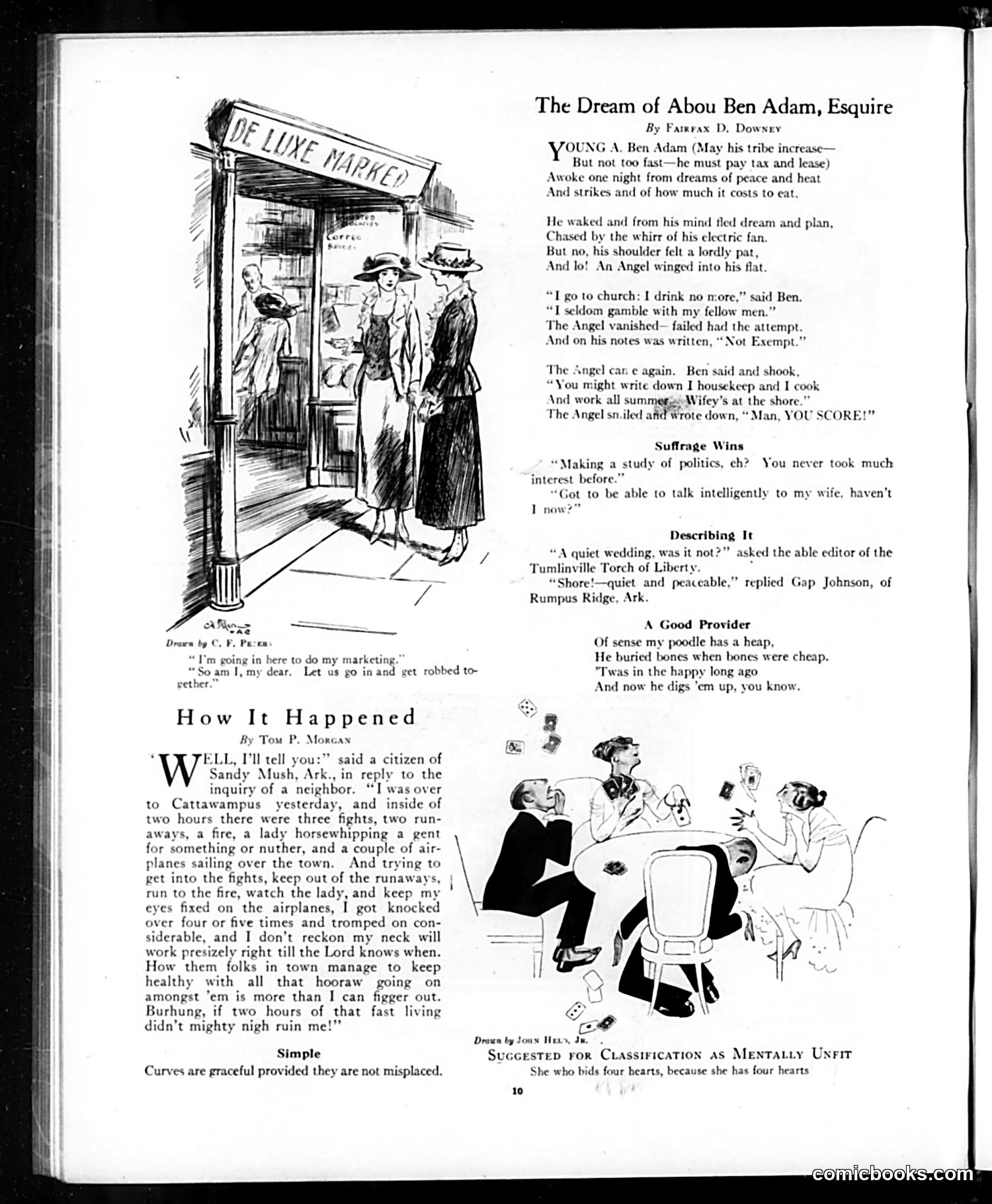
This page contains several satirical pieces mocking American life circa 1920s: **"De Luxe Market" cartoon**: Two women enter a fancy store; one quips they'll "get robbed together"—satire on inflated prices at upscale shops. **"How It Happened"**: A rural Arkansas man describes visiting a town where chaos erupted (fights, runaways, fire, airplanes)—mocking modern urban life's frenetic pace as dangerous and exhausting. **"The Dream of Abou Ben Adam"**: A man tries convincing an angel he deserves tax exemption through virtue (church, sobriety, gambling abstinence), but fails. When he mentions housekeeping and his wife working, the angel finally approves—satire on how women's labor suddenly became valuable for taxation purposes, likely referencing recent women's suffrage. **"Suffrage Wins"**: A husband now studies politics to discuss intelligently with his wife—mocking how male authority shifted with women's voting rights. The remaining pieces are light humor about dogs and bridge card games.
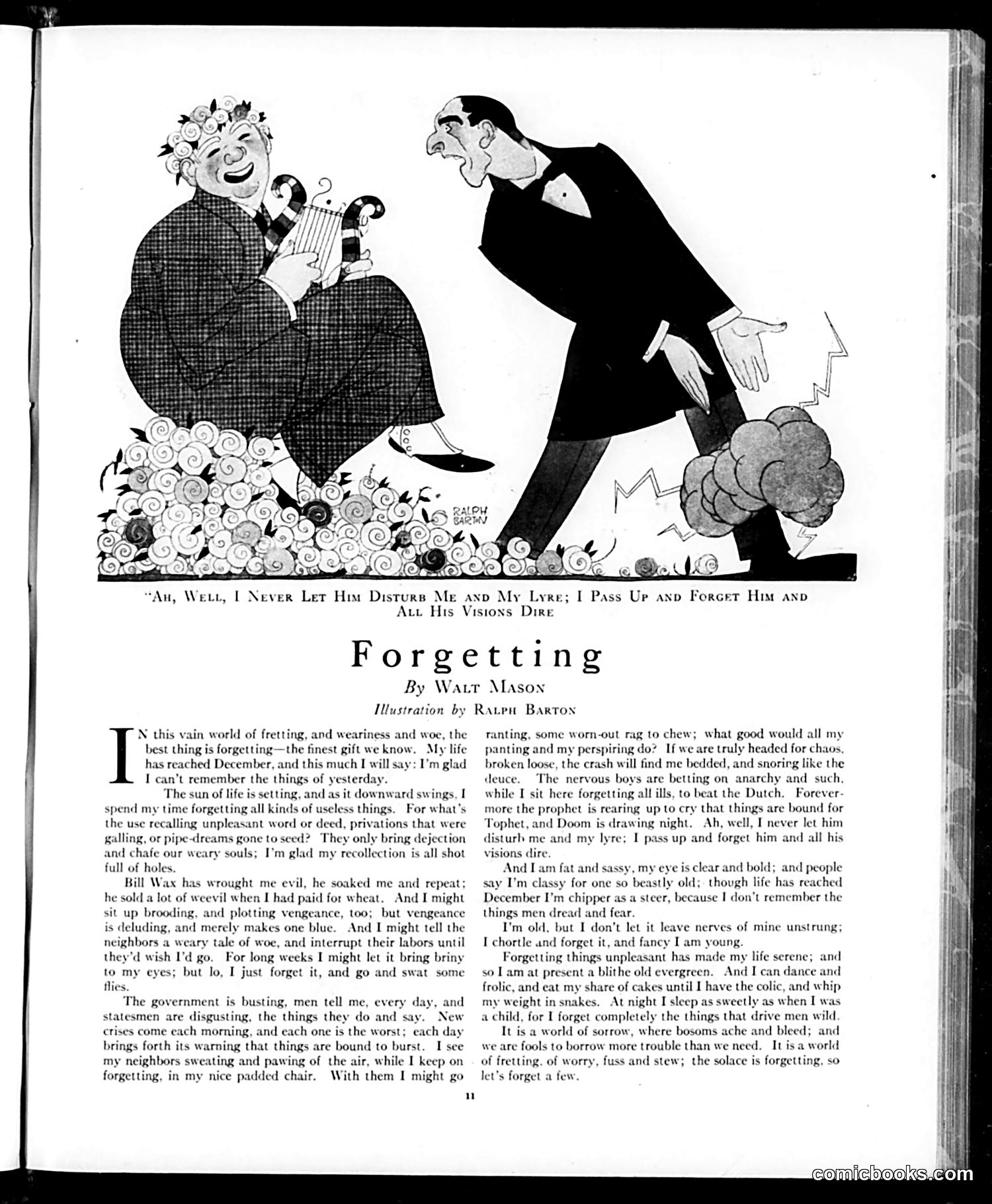
This page presents a humorous essay-poem arguing that willful forgetfulness is the path to contentment. The illustration shows a fat, cheerful man sitting atop a pile of money, playing a lyre while a thin, anxious figure gestures in agitation beside him. The satire targets early 20th-century American anxieties: political corruption ("statesmen are disgusting"), economic instability ("the government is busting"), and apocalyptic worrying ("things are bound to burst"). Mason's speaker advocates deliberate indifference—refusing to dwell on betrayals (a man named Bill Wax swindled him), government scandals, or neighbors' panic. The joke is the contrast between active fretting and passive comfort. While others sweat and worry about coming chaos, the protagonist remains "fat and sassy" by simply choosing not to care. The illustration emphasizes this: prosperity through selective amnesia versus anxiety-ridden poverty. It's escapist satire mocking both pessimistic doomsayers and the speaker's own complacent hedonism.
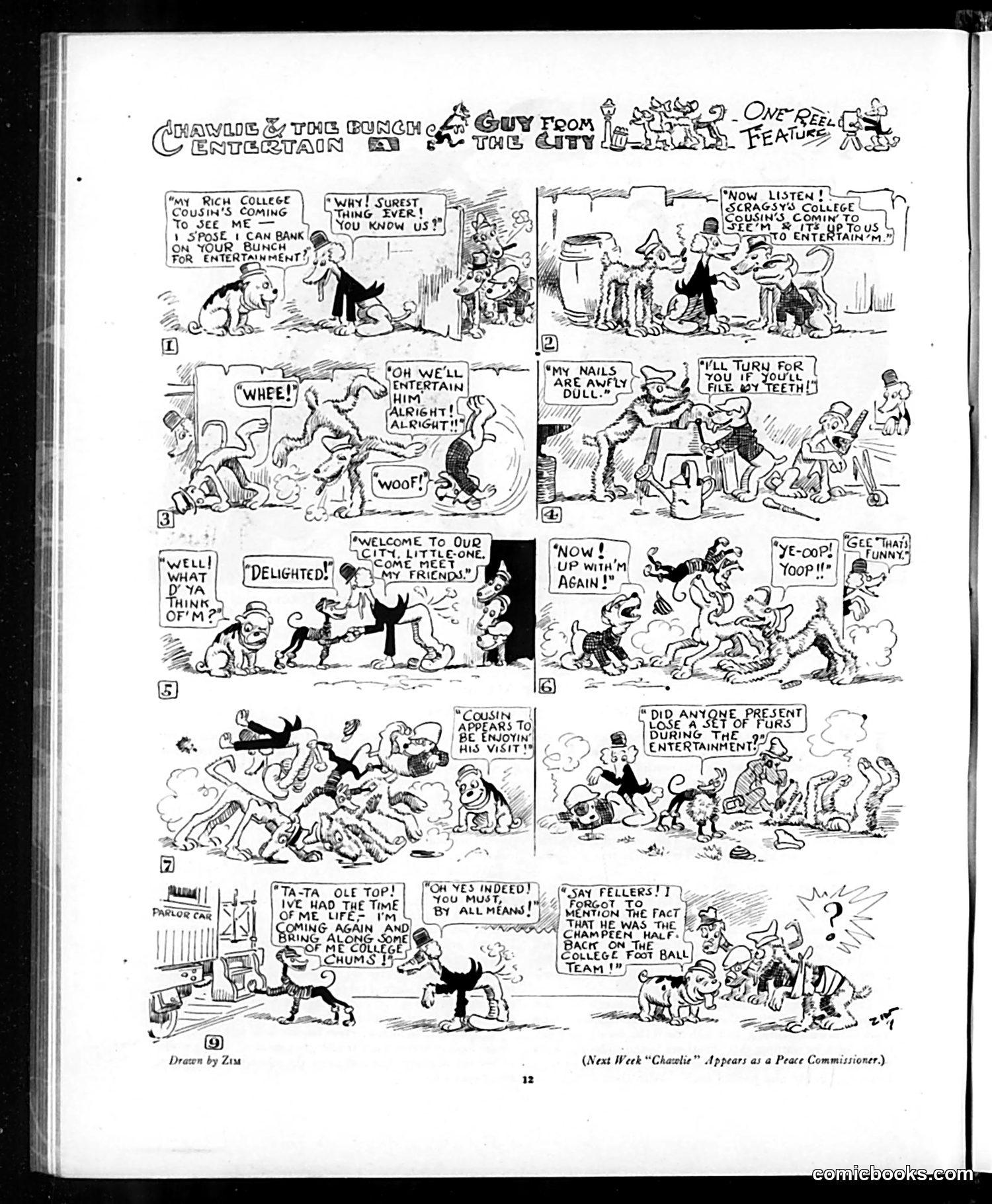
This is a multi-panel comic satirizing wealthy college students visiting poor relatives. Rich college cousins arrive to "entertain" their scraggly country cousins with promises of fun. The visiting students are depicted as vain and self-important—boasting about college football teams and their own superiority—while treating their rural relatives as entertainment subjects rather than genuine family. The humor relies on class contrast: the well-dressed, confident city students condescend to their shabby country counterparts, who respond with bewilderment and their own crude antics (rough behavior, poor manners). The final panel references "Charlie" appearing "as a Peace Commissioner" next week, suggesting this series continues. The satire mocks both groups—the snobbish pretense of wealthy college youth and the backwardness stereotypically attributed to rural Americans in early 20th-century popular culture.
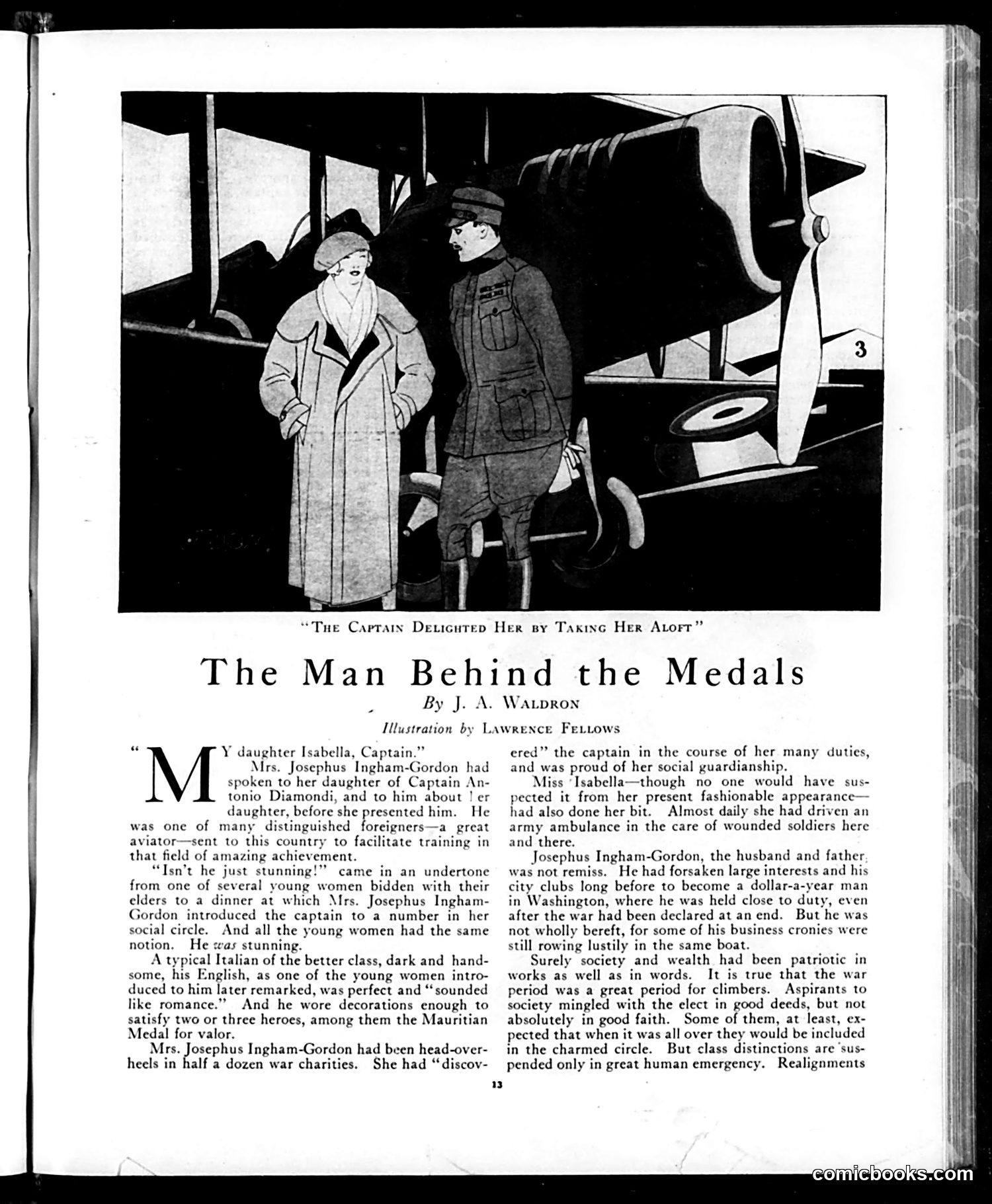
This is the opening of a short story (not a political cartoon) satirizing post-WWI American high society. The illustration shows an Italian military aviator, Captain Antonio Diamondi, being introduced to fashionable society by Mrs. Josephus Ingham-Gordon, a wealthy woman involved in war charities. The satire targets the pretentiousness of the wealthy elite: despite their patriotic war work, they are primarily motivated by social climbing and status. The story suggests that society women are impressed by the captain's decorations and romantic foreign accent, while the Ingham-Gordons perform patriotic duties to maintain social standing. The text explicitly notes that "aspirants to society mingled with the elect in good deeds, but not absolutely in good faith"—exposing wartime charity as performative rather than genuinely altruistic. The broader point appears to be critiquing how the upper class weaponized patriotism for social advancement during and after WWI.
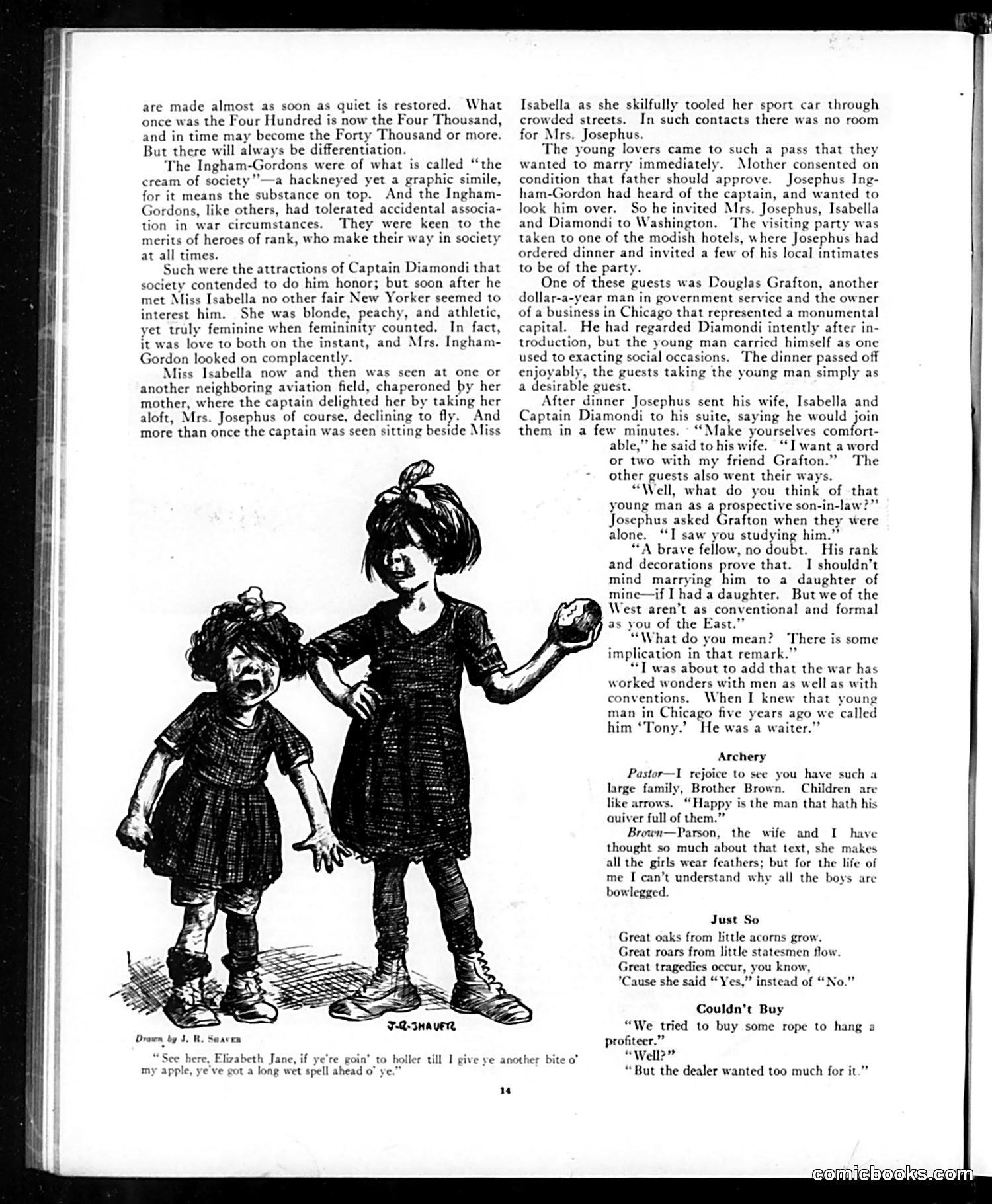
**Main Story Illustration & Text:** The central cartoon depicts a woman and child, likely illustrating a domestic scene from the serialized story about Isabella and Captain Diamondi. The narrative concerns upper-class New York society ("the cream of society") and a young woman's romance with a decorated military officer. **The Satire:** The story's punchline—revealed in dialogue—is that Captain Diamondi, despite his impressive rank and war decorations, was formerly "Tony," a waiter in Chicago five years prior. This lampoons post-WWI social mobility and the difficulty of verifying the backgrounds of war heroes who gained sudden prominence and social acceptance. **Social Commentary:** Judge mocks how wartime circumstances allowed "accidental association" across class lines and how the "Four Hundred" (old money elite) expanded to the "Four Thousand." The satire suggests that rapid social climbing via military service made traditional class distinctions unreliable. **Additional Content:** The page includes unrelated brief humor pieces ("Archery," "Just So") typical of Judge's format.
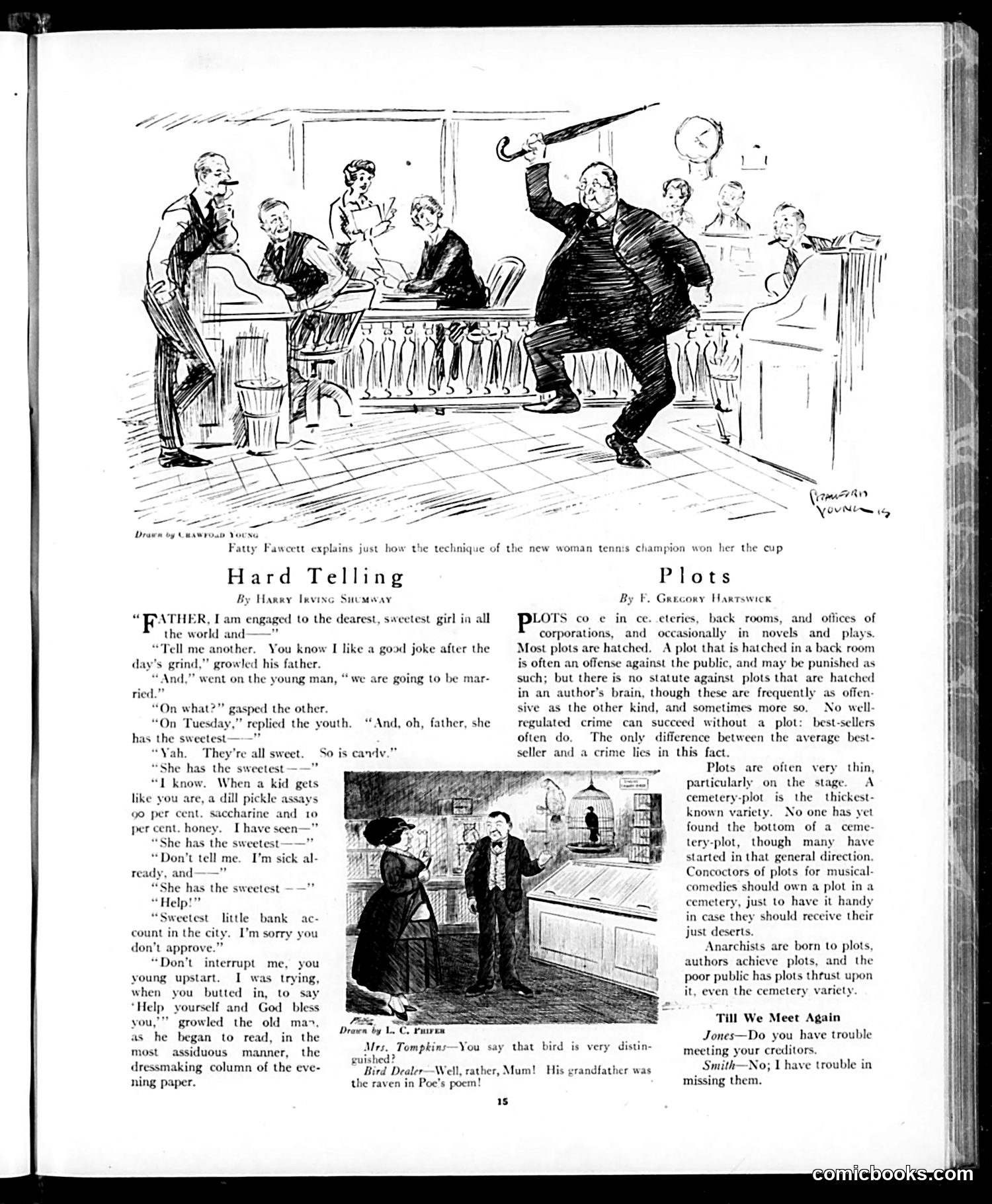
**Top Cartoon ("Hard Telling"):** A young man tries to tell his father he's engaged, repeatedly starting "She has the sweetest—" but the impatient father interrupts each time, assuming clichéd romantic compliments. The punchline reveals the sweetness he meant was her "bank account"—satirizing how marriage motivation had shifted to financial considerations, and mocking both the young man's mercenary interests and the father's cynicism about romance. **Middle Illustration:** A brief comedic exchange about a bird's distinguished ancestry (descended from the raven in Poe's poem), likely mocking pretentious genealogy-obsession of the era. **"Plots" Essay:** A satirical commentary on narrative construction, drawing parallels between criminal conspiracies and literary plots. The author humorously notes that well-regulated crimes need good plots but bestselling books often don't, and makes dark jokes about cemetery plots and anarchists. **"Till We Meet Again":** A one-liner joke about a creditor meeting—the humor lies in the wordplay of "missing" versus "meeting."
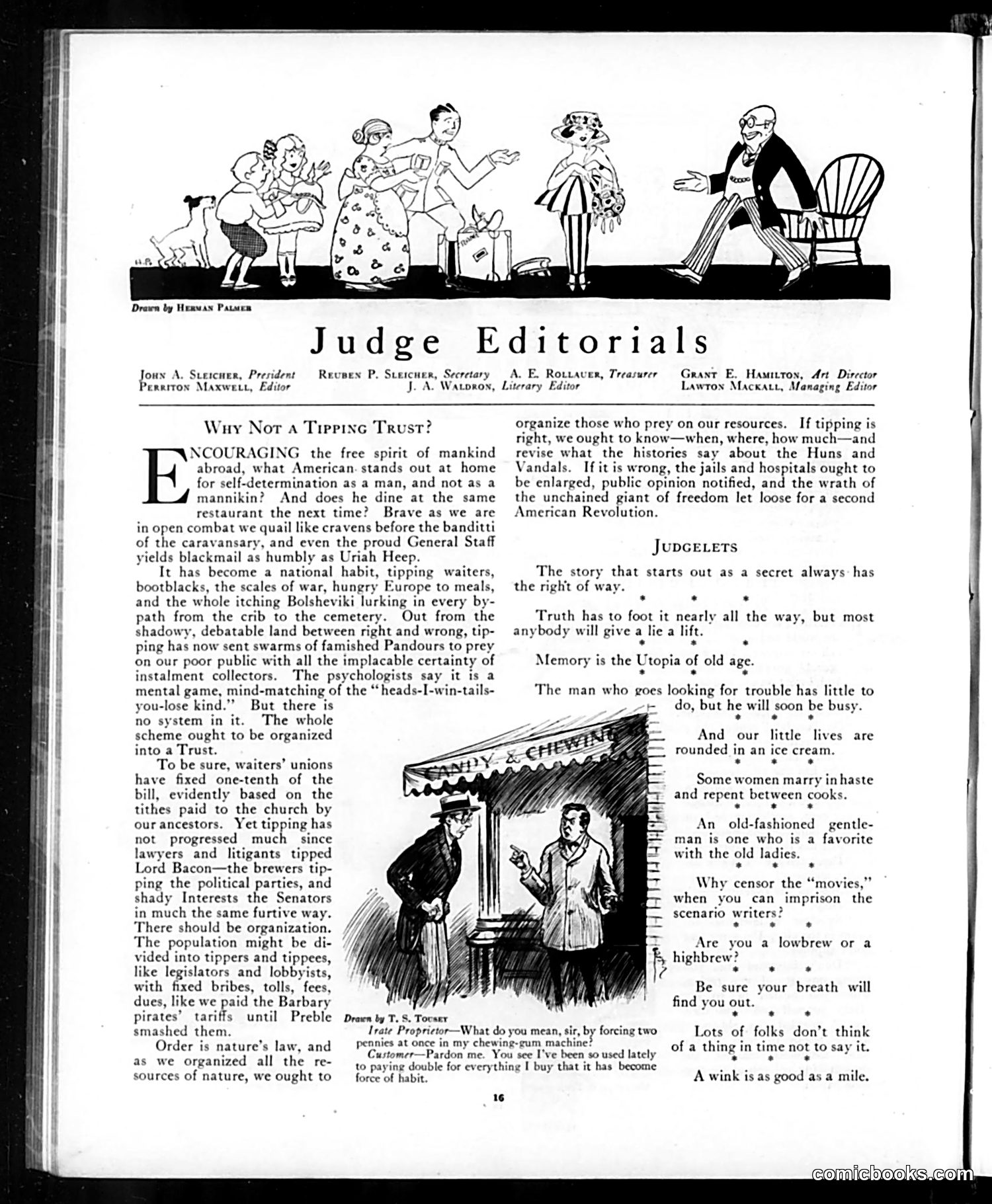
This *Judge* editorial page satirizes the American tipping custom, which the author argues has become an uncontrolled social plague. The main editorial, "Why Not a Tipping Trust?", mocks how Americans—despite championing individual freedom—meekly submit to systematic extortion by waiters, bootblacks, and service workers. The piece compares tipping to historical tribute payments (Barbary pirates, church tithes) and contemporary political corruption (senators accepting bribes). The cartoon by T.S. Tousey shows a candy-store proprietor confronting a customer who forced two pennies into a gum machine—the customer admits he's now habitually overpaying for everything due to normalized tipping culture. This illustrates the editorial's central complaint: tipping has become so culturally ingrained that people now automatically overpay even where unnecessary. The page also includes "Judgelets"—brief philosophical quips typical of the magazine's style—offering sardonic observations on memory, trouble, and propriety.
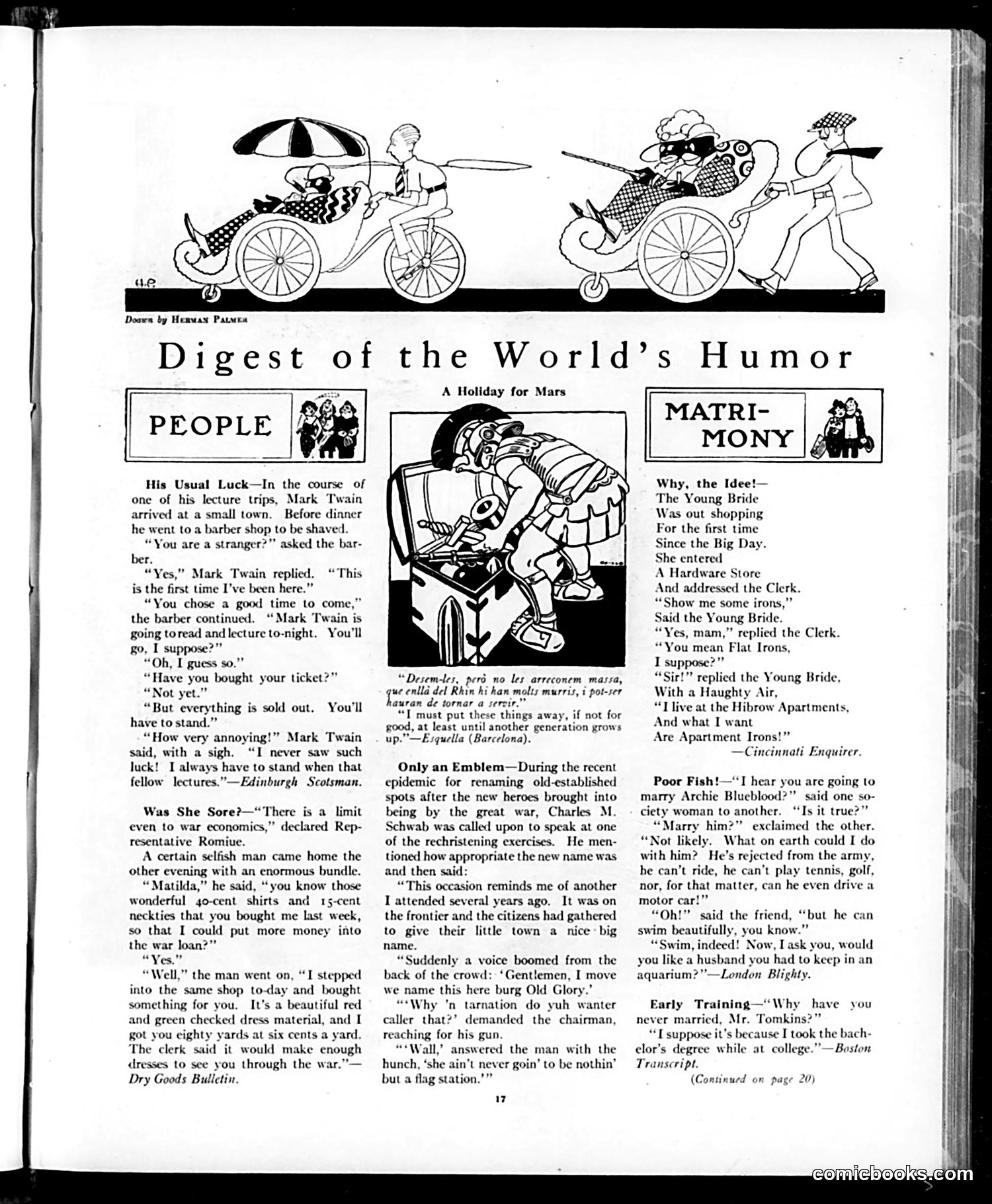
This page from Judge magazine collects humorous anecdotes and jokes from various sources. Key pieces: **"His Usual Luck"**: A Mark Twain anecdote where the famous writer arrives in a town where his own lecture is sold out—he must stand while watching himself perform. The joke plays on Twain's celebrity and ironic misfortune. **"Was She Sore?"**: A wartime joke about a husband buying cheap dress material for his wife to support the war effort, mirroring her earlier sacrifice. The humor lies in his self-serving logic. **"Only an Emblem"**: A frontier tall-tale where townspeople reject naming their town "Old Glory" because it will inevitably become just a railroad flag-stop station. It's absurdist Americana humor. **"Why, the Idee!"**: A newlywed's snobbery—she demands "Apartment Irons" (rather than common "Flat Irons") because she lives in fancy housing. Social-climbing satire. **Other brief jokes** mock women's marital expectations and bachelor reluctance. The page reflects early 20th-century attitudes toward class, gender, and wartime sacrifice through light satire.
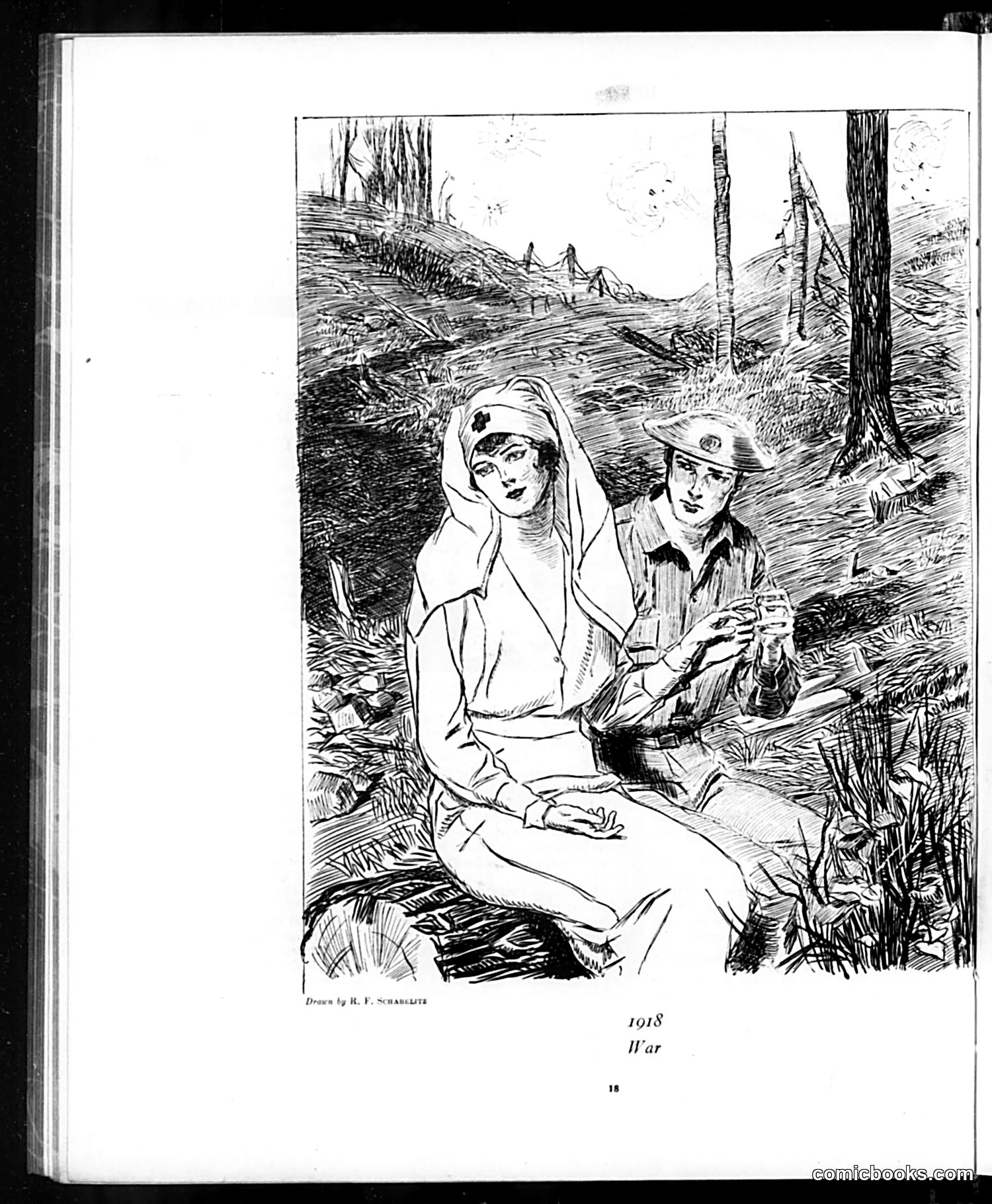
This illustration depicts two figures in a wooded, war-torn landscape. The woman on the left wears a head covering and appears to be a nurse or relief worker based on her attire. The man on the right wears a cap and work clothes, possibly representing a soldier or laborer. The desolate background—featuring bare, splintered trees and scarred terrain—emphasizes the devastation of World War I. The image likely satirizes the contrast between civilian and military experiences during wartime, or possibly critiques the romanticization of war. The title "1918 War" dates this to the final year of WWI. The intimate composition amid destruction may comment on human connection persisting despite wartime suffering, or conversely, expose the disconnect between those experiencing combat versus those on the home front.
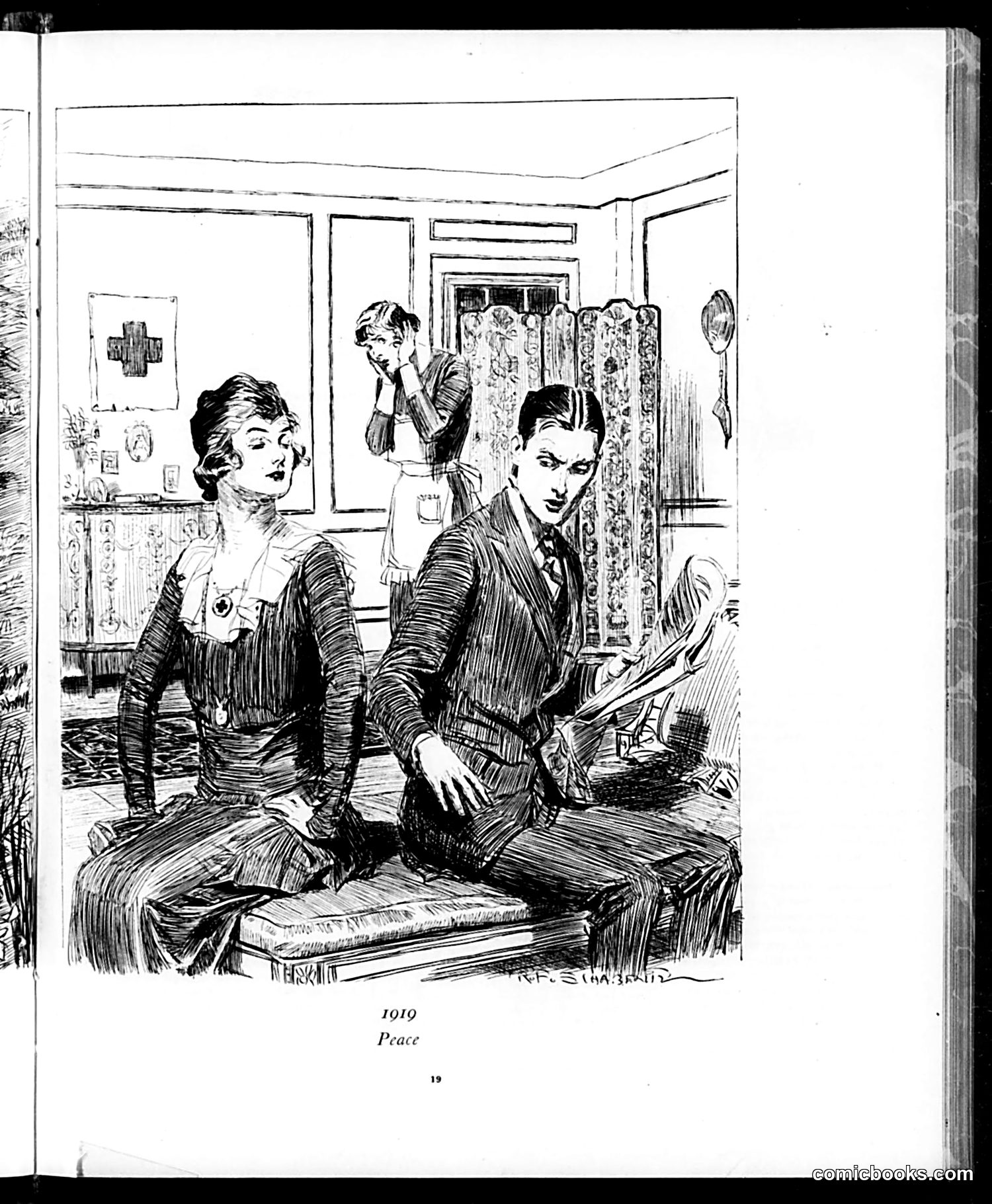
This illustration, titled "Peace" and dated 1919, depicts three well-dressed figures in what appears to be a fashionable interior. The drawing likely satirizes post-World War I society during the immediate aftermath of the armistice. The composition suggests commentary on how the wealthy or privileged classes responded to peace—possibly critiquing their detachment, frivolity, or self-absorption at a moment of significant national transition. The formal attire and domestic setting contrast with the magnitude of what peace meant for a nation emerging from four years of war. Without additional context from Judge magazine's specific editorial stance in 1919, the precise target of satire remains somewhat unclear, though the illustration appears to mock the superficiality of certain social circles during this pivotal historical moment.
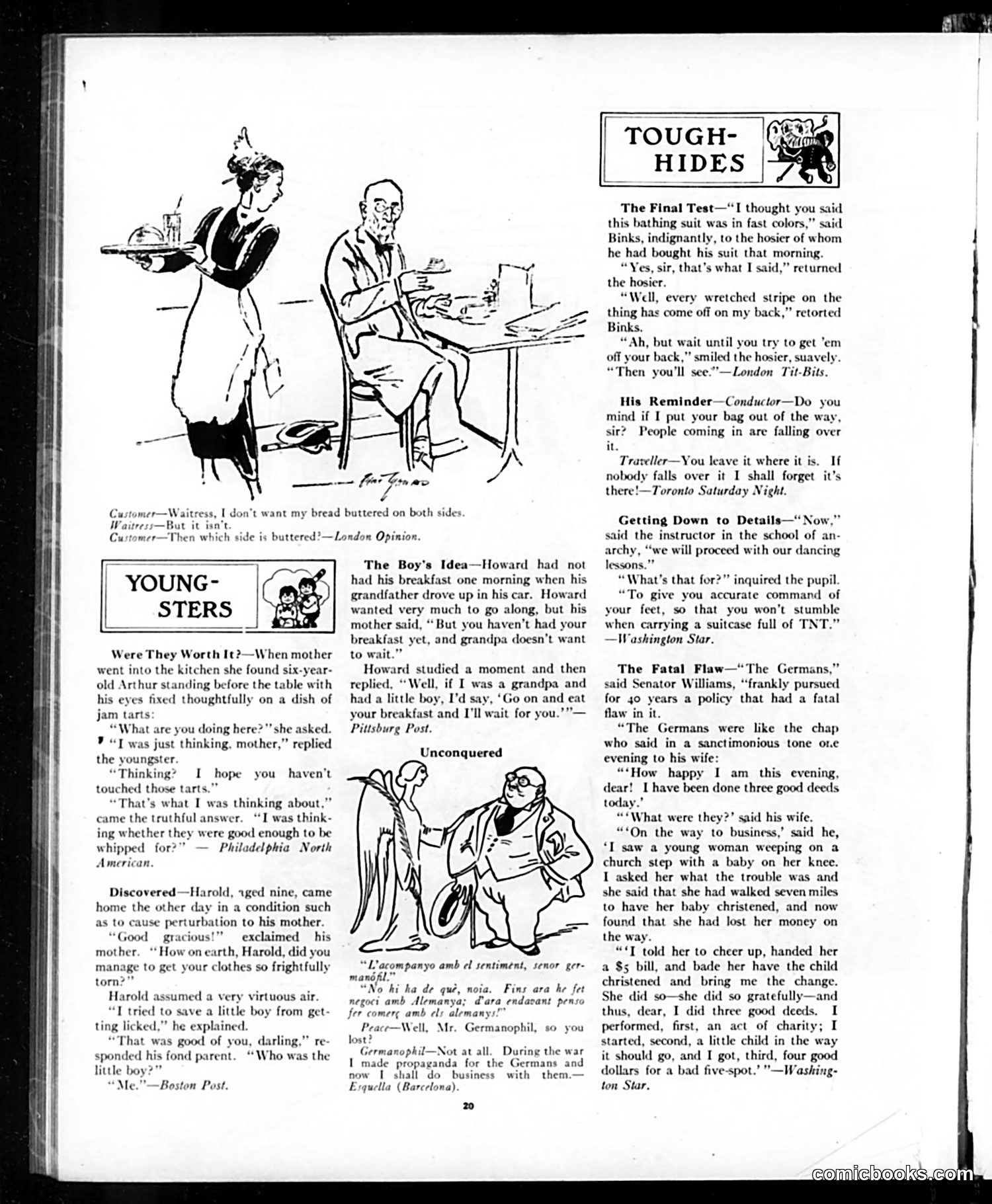
This page contains humor columns and anecdotes rather than political cartoons. The content reflects early-20th-century American attitudes: **Key sections:** - **"Tough-Hides"** and **"Young-Sters"**: Brief comedic anecdotes about domestic situations and children's logic, typical of the era's family humor. - **"The Fatal Flaw"**: Senator Williams criticizes Germany's 40-year foreign policy, using an analogy about a man performing "good deeds" (giving money) while controlling outcomes—suggesting Germany's imperial ambitions were fundamentally contradictory. - **"Unconquered" (bottom)**: A Barcelona publication quotes a Spanish businessman resuming trade with Germany after WWI, implying opportunistic post-war commerce despite wartime propaganda. These pieces reflect post-WWI sentiment: skepticism toward Germany, commentary on commerce resuming despite recent conflict, and gentle satire of everyday American life.
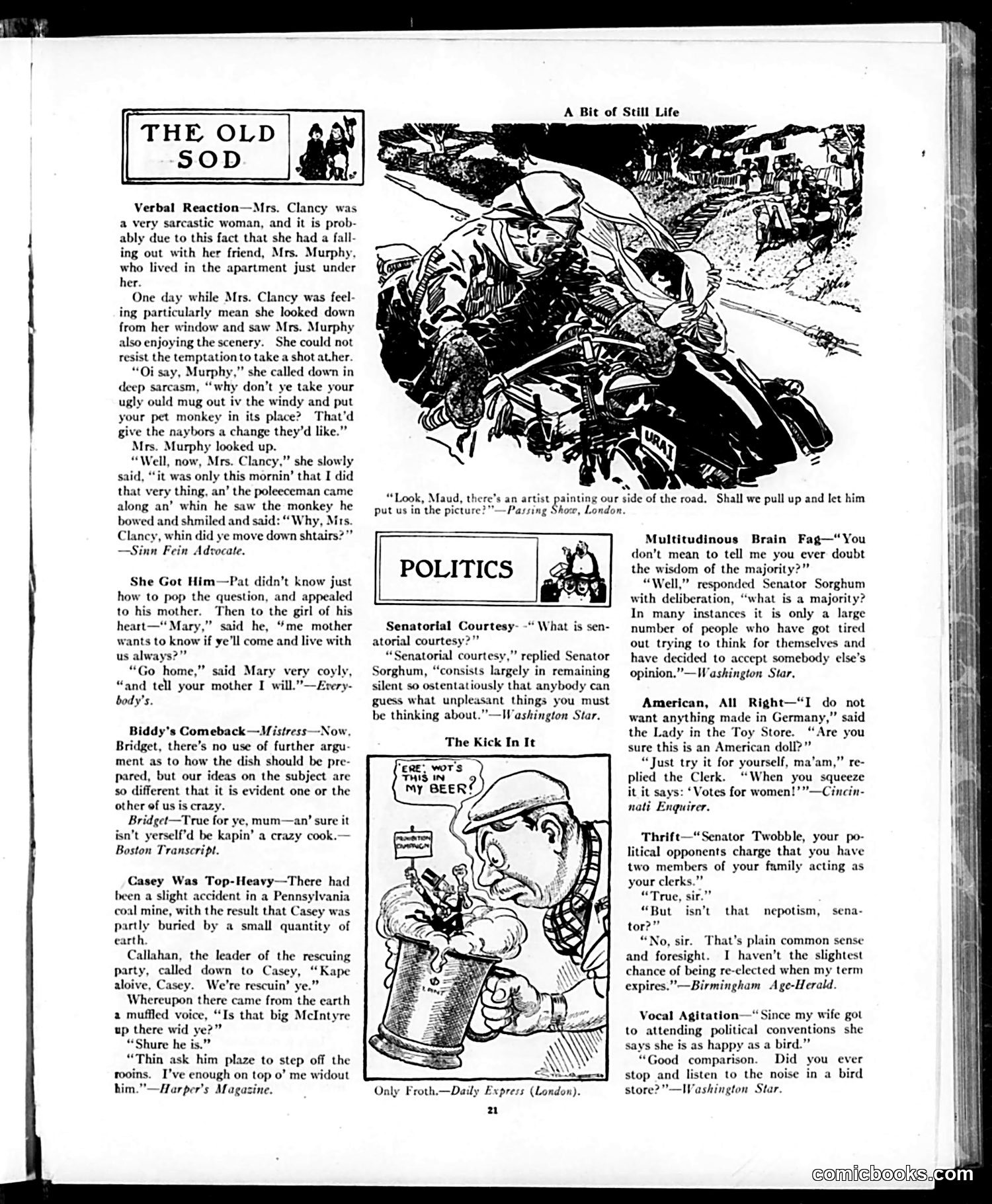
This page contains humor sketches and political satire typical of early 20th-century Judge magazine. **"The Old Sod" section** features Irish-American immigrant humor, with jokes about working-class characters named Murphy, Clancy, Pat, Bridget, and Casey. The humor relies on ethnic stereotypes and dialect humor popular at the time—portraying Irish immigrants through exaggerated accents and domestic situations. **The "Politics" section** satirizes American political figures and institutions. It includes jokes about "Senator Sorghum" (a fictional recurring character representing vapid politicians), mocking senatorial courtesy, majority rule, nepotism in government, and political wives. The cartoon showing a man drinking beer with text "ERE, WOT'S THIS IN MY BEER?" appears to be British political commentary about prohibition or alcohol regulation. The overall tone reflects Judge's satirical approach: poking fun at immigrants, politicians, and social conventions through exaggerated characterization and wordplay rather than sharp political analysis.
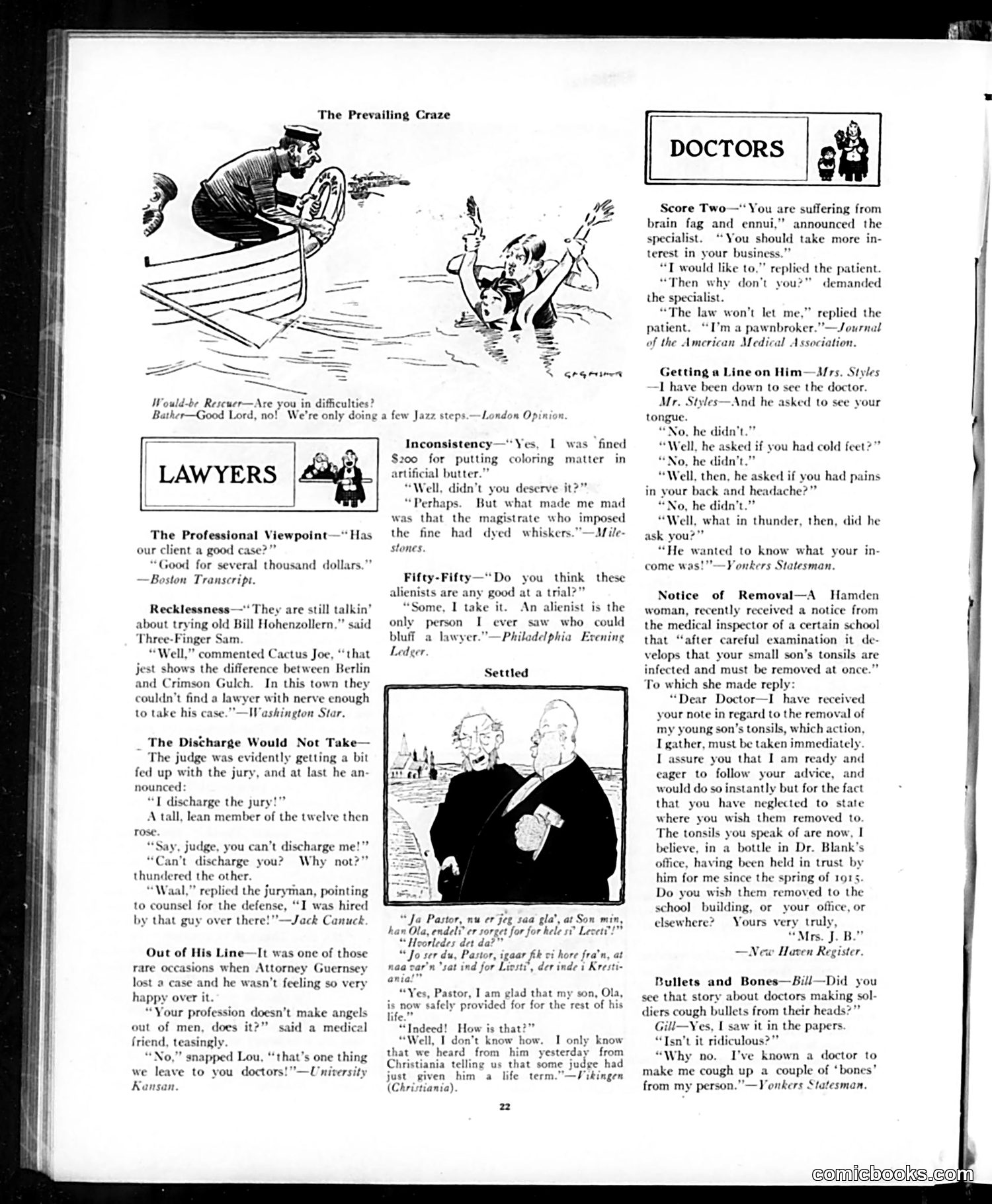
This page collects brief satirical jokes about lawyers and doctors, reflecting early 20th-century public skepticism toward these professions. **The cartoons and jokes mock:** - **Lawyers' greed**: Attorneys value cases solely by payoff ("Good for several thousand dollars") - **Lawyer audacity**: One joke suggests no lawyer would defend the German Kaiser (likely referencing WWI-era Germany), yet Western frontier lawyers would attempt anything - **Doctor-patient interactions**: Physicians are portrayed as dismissive, incompetent, or mercenary (a doctor asks about income instead of symptoms; another misdiagnoses a pawnbroker's legitimate business concerns as psychological) - **Medical absurdity**: A lengthy anecdote satirizes bureaucratic overreach when a school demands tonsil removal but the doctor neglects to specify *where* to send them The humor assumes reader familiarity with professional stereotypes of the era: greedy, self-serving lawyers and doctors who hide incompetence behind jargon or bureaucracy.
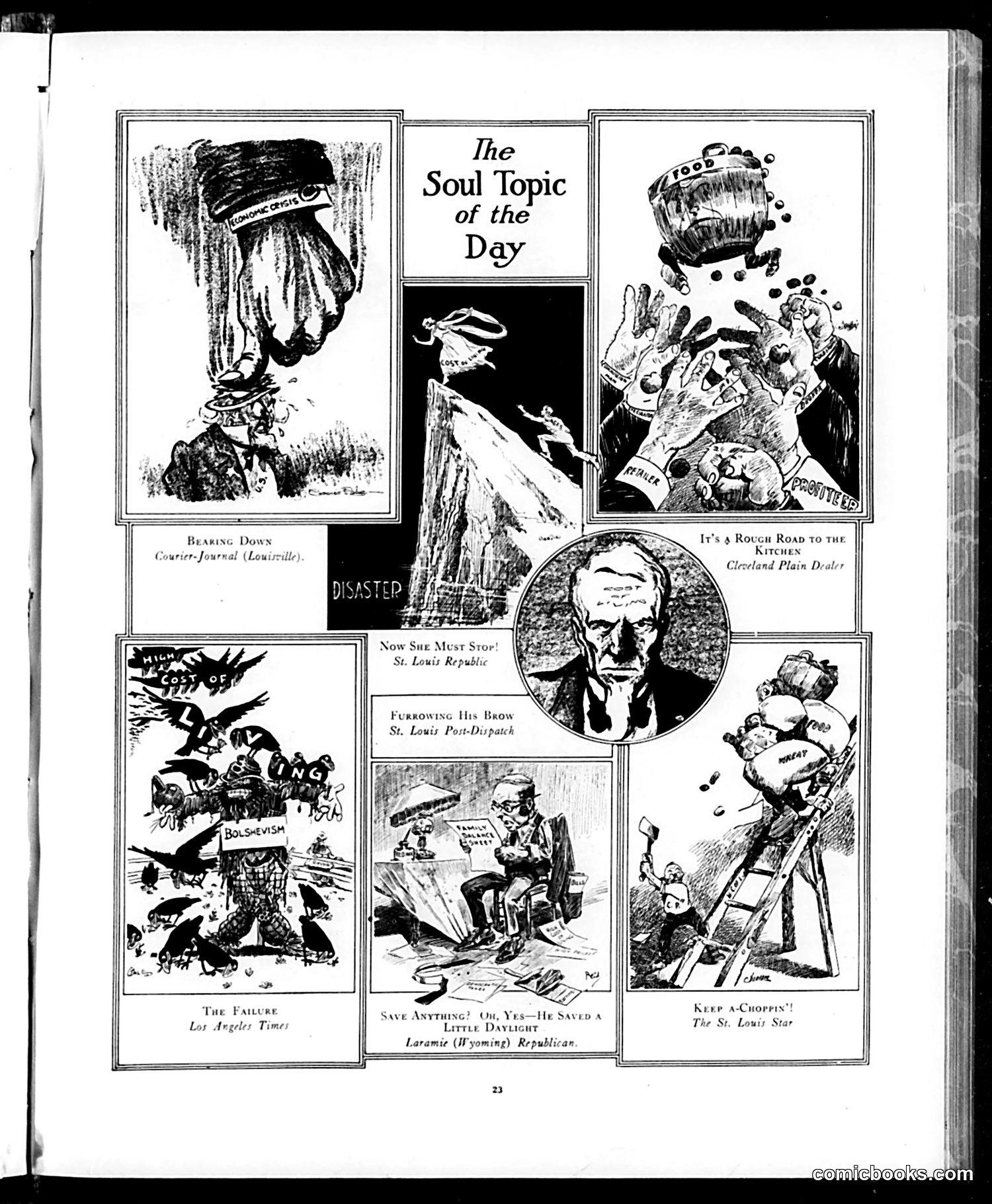
This page collects political cartoons from various newspapers addressing what appears to be a major national crisis or scandal. The central circular portrait likely depicts a prominent political figure under scrutiny. The surrounding cartoons use metaphorical imagery: one shows a figure crushed under falling debris labeled "Bolshevism," suggesting fears of radical political upheaval. Another depicts someone desperately "saving" something small while disaster looms—likely satirizing inadequate responses to a serious problem. The titles reference "bearing down," "furrowing his brow," and struggling to reach "the kitchen"—suggesting worry and difficulty navigating a crisis. The repeated sourcing from St. Louis and regional newspapers indicates this was a widespread, multi-regional concern. Without the specific date or additional context, the exact crisis remains unclear, but the cartoons collectively mock insufficient leadership response to some major threat—possibly economic, political, or social instability affecting the nation around the 1910s-1920s era.
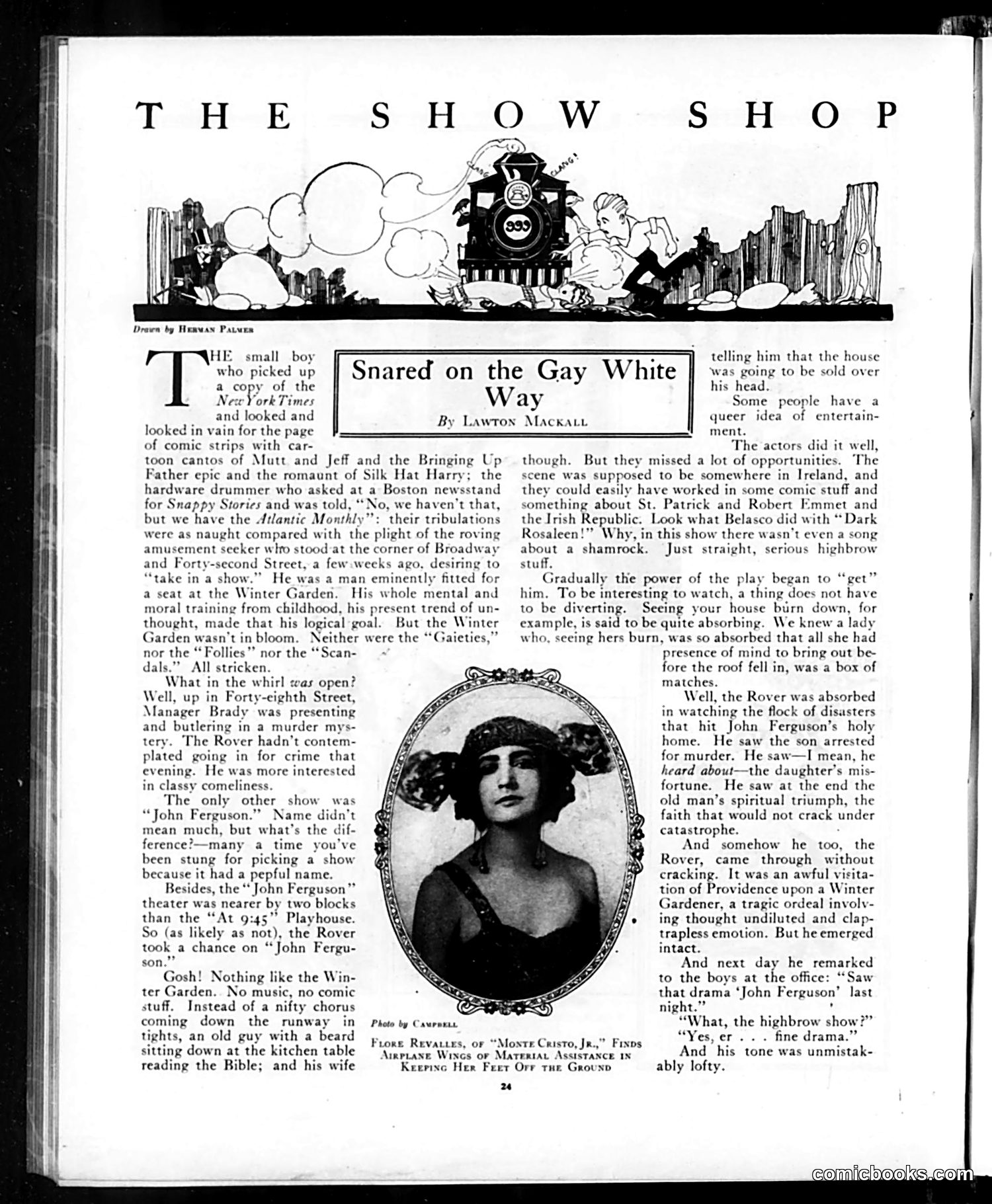
This article satirizes the Broadway theater experience and audience expectations circa the 1920s. The unnamed "Rover" (everyman character) seeks entertainment at Broadway's premier venues—the Winter Garden, the Follies, Gaieties—expecting "a nifty chorus coming down the runway in tights." Finding these closed, he reluctantly attends "John Ferguson," an Irish drama featuring only serious, austere scenes: an old man reading the Bible while learning his house will be sold. The satire's point: the Rover expects frivolous spectacle but is unexpectedly moved by genuine dramatic art. The play's "tragic ordeal involving thought undiluted and trapless emotion" transforms him. He emerges claiming the experience was "fine drama"—adopting affected, highbrow language despite his initial lowbrow tastes. Judge mocks both mass-market entertainment preferences and the pretension that overcomes viewers when exposed to serious theater. The humor lies in the Rover's involuntary conversion from vaudeville-seeker to culture-appreciator.
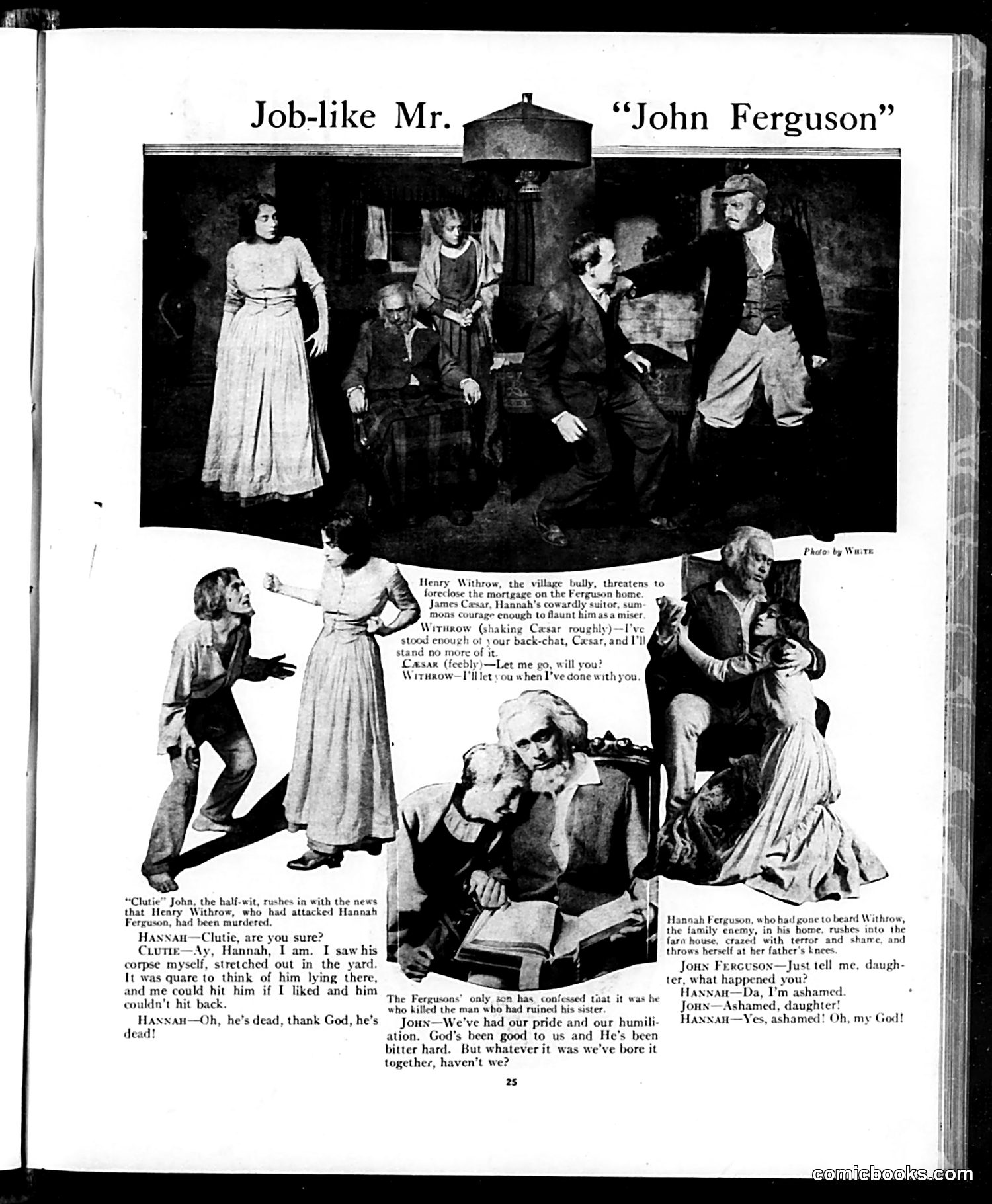
This page illustrates scenes from what appears to be a theatrical adaptation of a dramatic work (likely the play "John Ferguson"). The narrative depicts a rural Irish family in crisis: **The Setup:** Henry Withrow, the village bully, threatens to foreclose on the Ferguson family home and has assaulted Hannah Ferguson. James Cesar, her cowardly suitor, confronts Withrow but is physically dominated. **The Central Drama:** Withrow is found murdered. Hannah, traumatized by Withrow's assault, returns home in distress. The family's son confesses to the killing, motivated by protecting his sister's honor. **The "Job-like" Reference:** The title invokes the Biblical figure Job—suggesting the Ferguson family endures multiple catastrophic trials (financial ruin, sexual assault, murder) yet maintains moral dignity and faith ("whatever it was we've bore it together"). The satire or commentary remains unclear without knowing the original work's political context, though the page appears to dramatize themes of rural poverty, family honor, and moral resilience under extreme hardship.
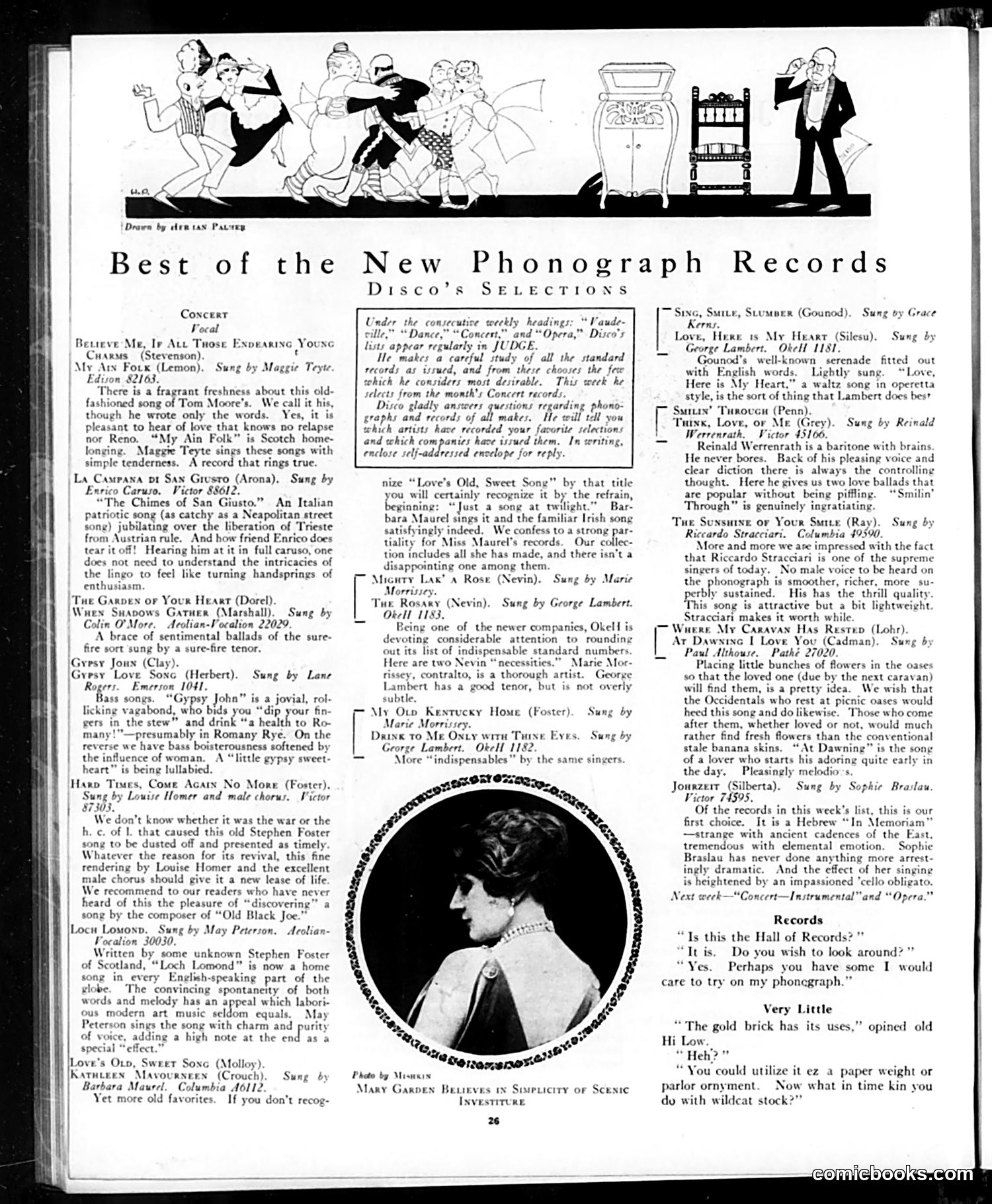
This page is a record review section titled "Best of the New Phonograph Records: Disco's Selections." The decorative header cartoon (drawn by Demetrois Palmer) shows silhouettes of people dancing, listening to a phonograph, and celebrating—a visual metaphor for popular entertainment and recorded music. The content reviews classical and sentimental vocal recordings from various labels (Victor, Edison, Pathé, Okeh), featuring prominent singers of the era like Enrico Caruso, Grace Kerns, and George Lambert. A circular portrait photograph (credited to Mishkin) shows Mary Garden, labeled as representing "simplicity or scenic investiture." The satire is subtle: this celebrates phonograph records as a modern convenience bringing concert-hall quality entertainment to ordinary homes. The page documents the early 1920s music industry's excitement about recorded sound technology. The reviews emphasize emotional delivery and technical vocal qualities—reflecting contemporary standards for evaluating recorded performance rather than live artistry.
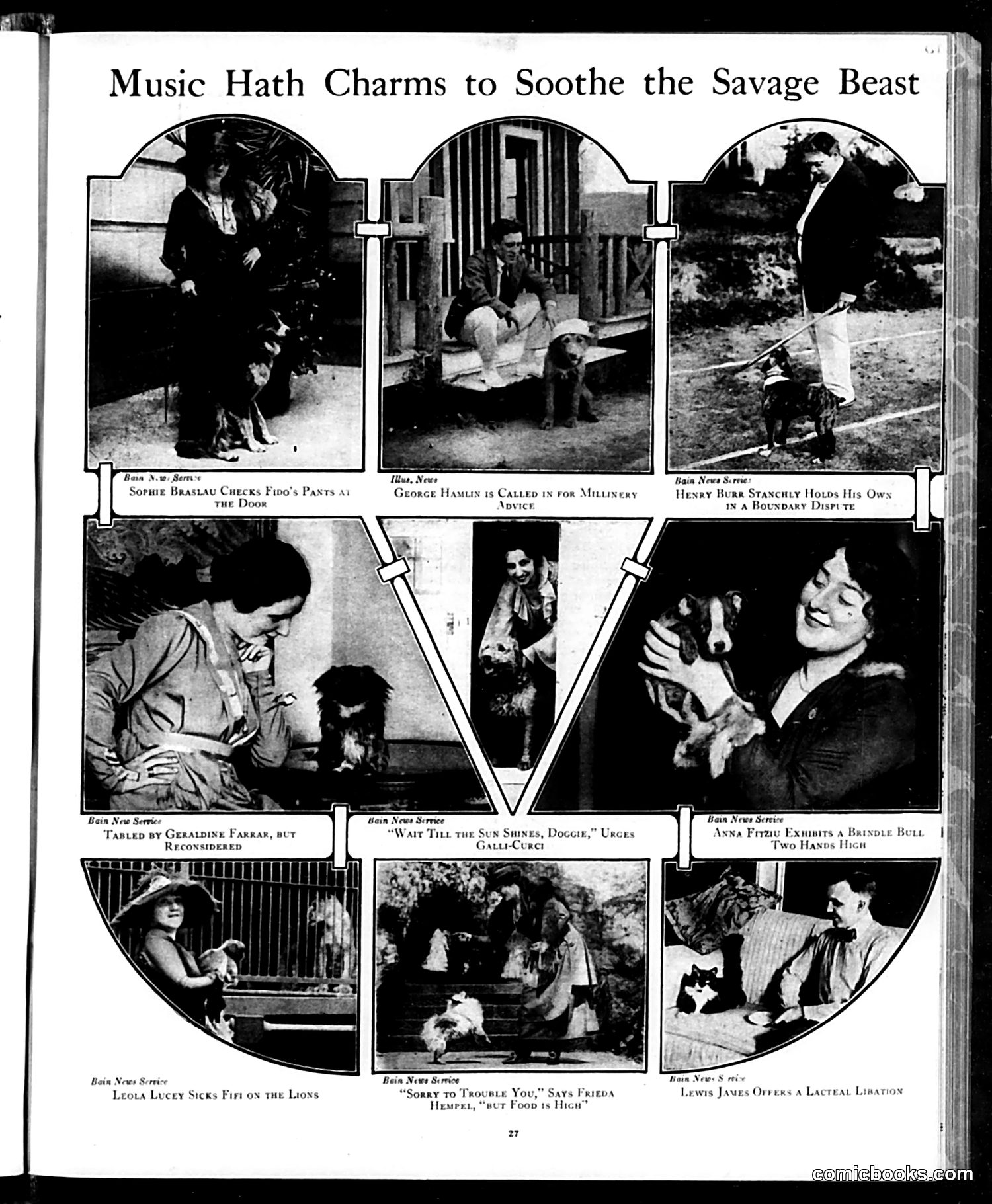
This page compiles humorous film stills from various movies, arranged to play on the common saying that music can calm wild animals. Each caption creates a comedic scenario showing performers (likely silent film stars of the era) interacting with animals in unlikely or absurd situations. The joke relies on the ironic contrast between the proverb and the actual chaos depicted—animals aren't actually being "soothed" but instead are causing trouble or requiring management. References include performers like Geraldine Farrar and various unnamed actors handling dogs, lions, bulls, and other creatures in domesticated settings. The satire mocks both the pretensions of early cinema and the old adage itself, suggesting that in reality, animals remain unpredictable despite anyone's musical or charming efforts. It's lighthearted celebrity-focused humor typical of Judge magazine's entertainment coverage.
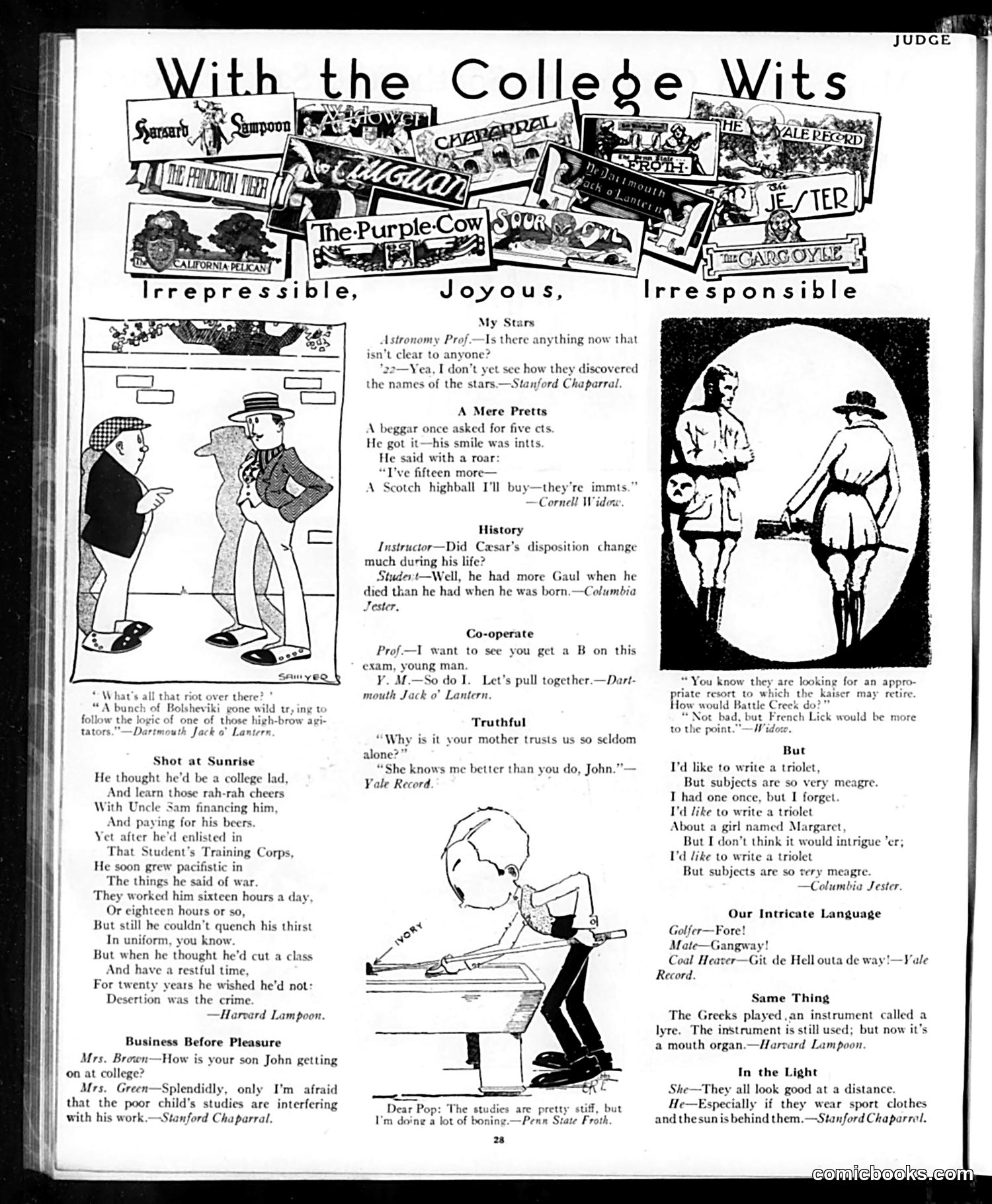
This page collects humorous short jokes and verses from various college humor magazines (Stanford Chaparral, Harvard Lampoon, Yale Record, etc.), showcasing college life satire from the early 20th century. Key themes include: **Military/War Commentary**: "Shot at Sunrise" mocks a student who enlisted in officer training, worked grueling hours, yet still couldn't abstain from drinking—and faced desertion charges for skipping class. This appears critical of military discipline during wartime (likely WWI era). **Academic Hypocrisy**: Multiple jokes mock professors and students prioritizing social life over education, or professors compromising academic standards. **Gender/Dating**: Cartoons and verses joke about courtship, appearance, and romantic interests. **College Culture**: Drinking, hazing, and the disconnect between college ideals and reality are recurring targets. The page functions as a digest of collegiate humor, presenting satire of contemporary student behavior, institutional contradictions, and social norms—the jokes rely on shared understanding of 1920s college experiences that modern readers would largely recognize, though specific references (like particular colleges' traditions) may be obscure today.
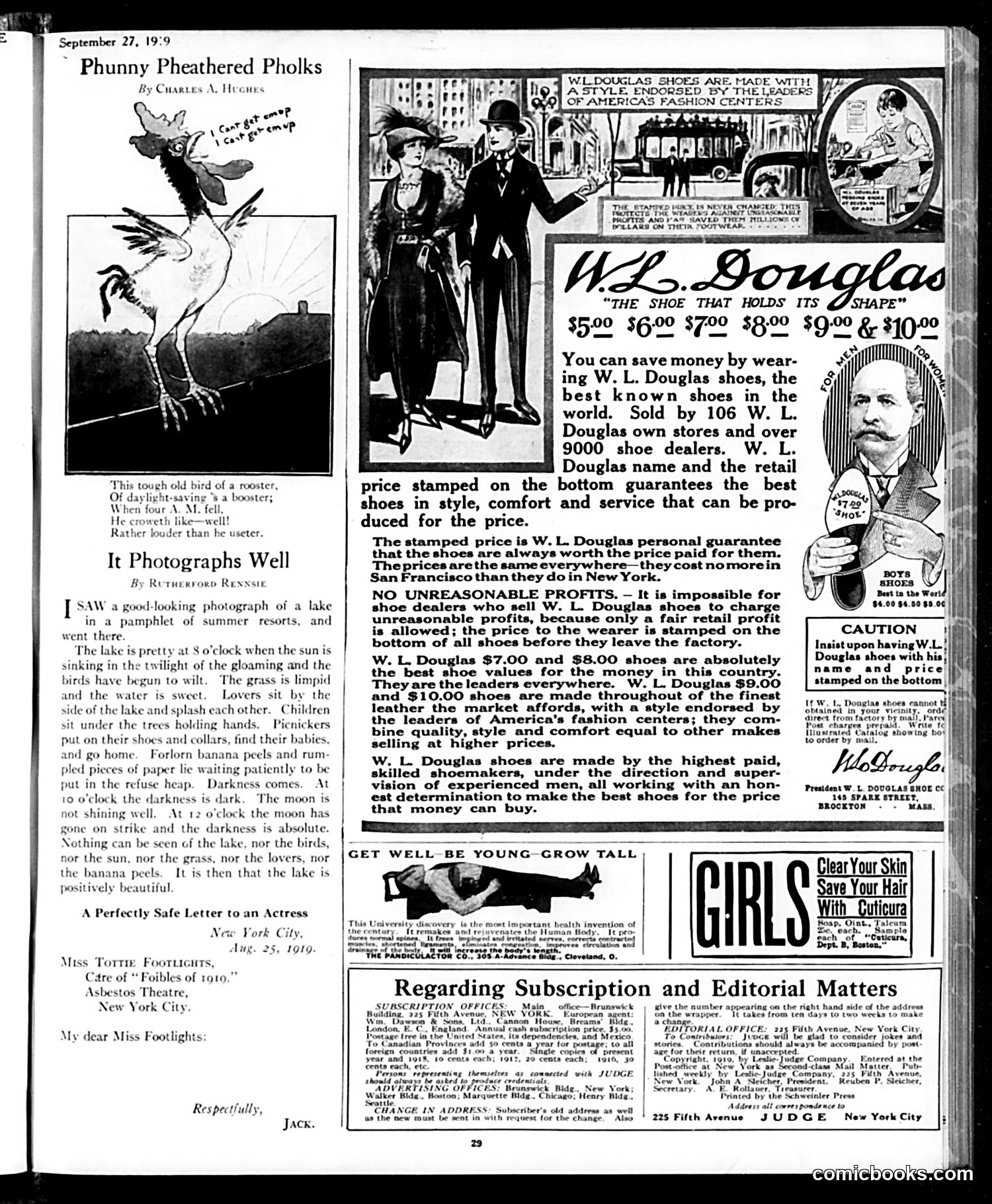
This page is primarily advertising, though it includes two brief humorous pieces. **"Phunny Pheathered Pholks"** (top left) is a visual gag by Charles A. Hughes: a rooster with exaggerated features, captioned with verse mocking an old rooster's crowing abilities—a simple barnyard joke about aging and diminished capacities. **"It Photographs Well"** is a short comedic essay satirizing false advertising in travel brochures. The author describes photographing a beautiful lake at sunset, then visiting in person only to find it utterly unremarkable and dark at night. The satire targets how marketing imagery deceives consumers into expecting romantic, idealized experiences that don't match reality. The page is otherwise dominated by a full-page **W.L. Douglas shoes advertisement**, emphasizing affordability, consistent pricing nationwide, and guaranteed value through stamped retail prices on shoe bottoms—a marketing strategy positioning the brand against price gouging by middlemen.
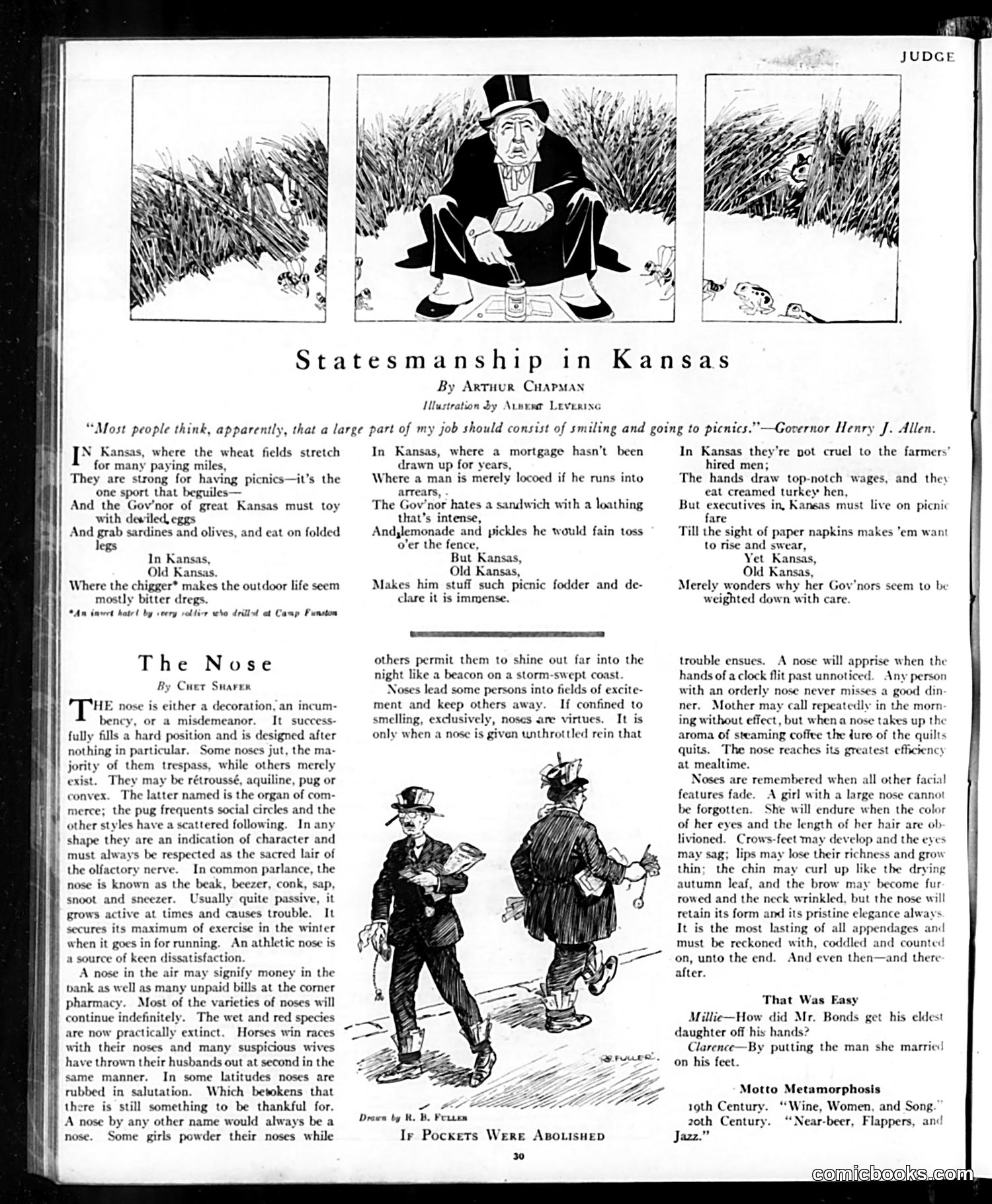
This cartoon mocks Kansas Governor Henry J. Allen's complaint (quoted at top) that his job unfairly requires constant picnic attendance. Chapman's poem sarcastically praises Kansas's casual attitude toward executive duties: while farmers' hired hands eat well, the governor must endure endless picnics with cheap food (sardines, deviled eggs, folded legs in the dirt). The joke is that Allen considers picnicking an undignified burden, yet it's his actual job—illustrating the gap between what governors think they should do versus what constituents expect. The three-panel cartoon shows a dour official surrounded by grass, eating meager provisions, stuck in rural Kansas culture. The accompanying essay "The Nose" is unrelated satirical commentary on facial features and character.
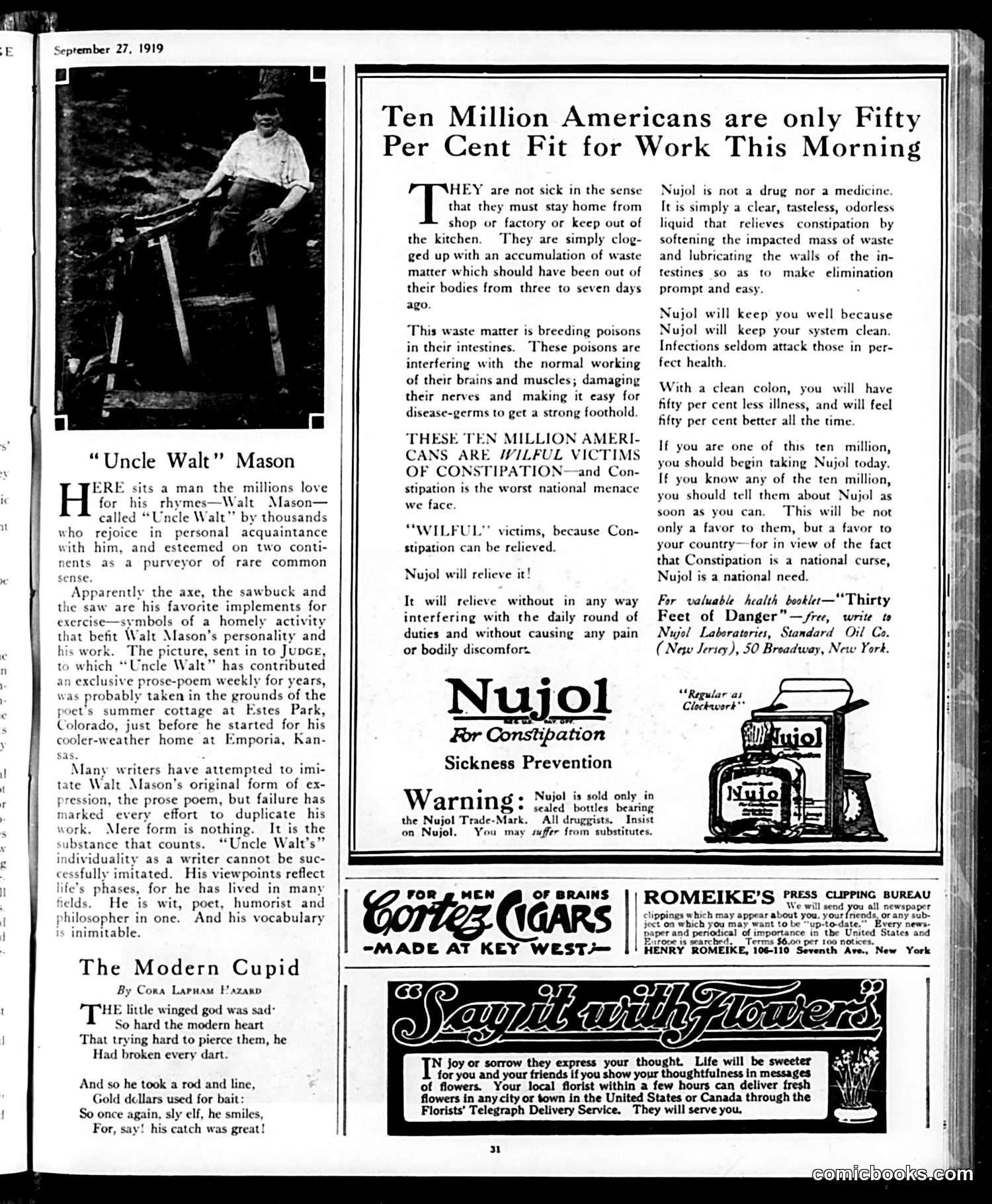
This page mixes editorial content with advertising. The main editorial feature celebrates Walt Mason, a popular newspaper poet known for homespun verse and common sense philosophy. The photograph shows Mason with an axe and sawbuck—tools chosen to symbolize his honest, working-class persona and connection to rural American values. Below runs a short satirical poem, "The Modern Cupid," mocking how money (not love) has become the bait that attracts people in modern times. The page's dominant content is a **Nujol laxative advertisement** framed as public health messaging. It claims ten million Americans are "only fifty per cent fit for work" due to constipation, presenting this as a "national menace." The ad promises Nujol—described as a "sickness prevention"—will cure this widespread problem without disrupting daily duties. This reflects early 20th-century anxieties about digestive health and the era's aggressive patent medicine marketing dressed in scientific language.
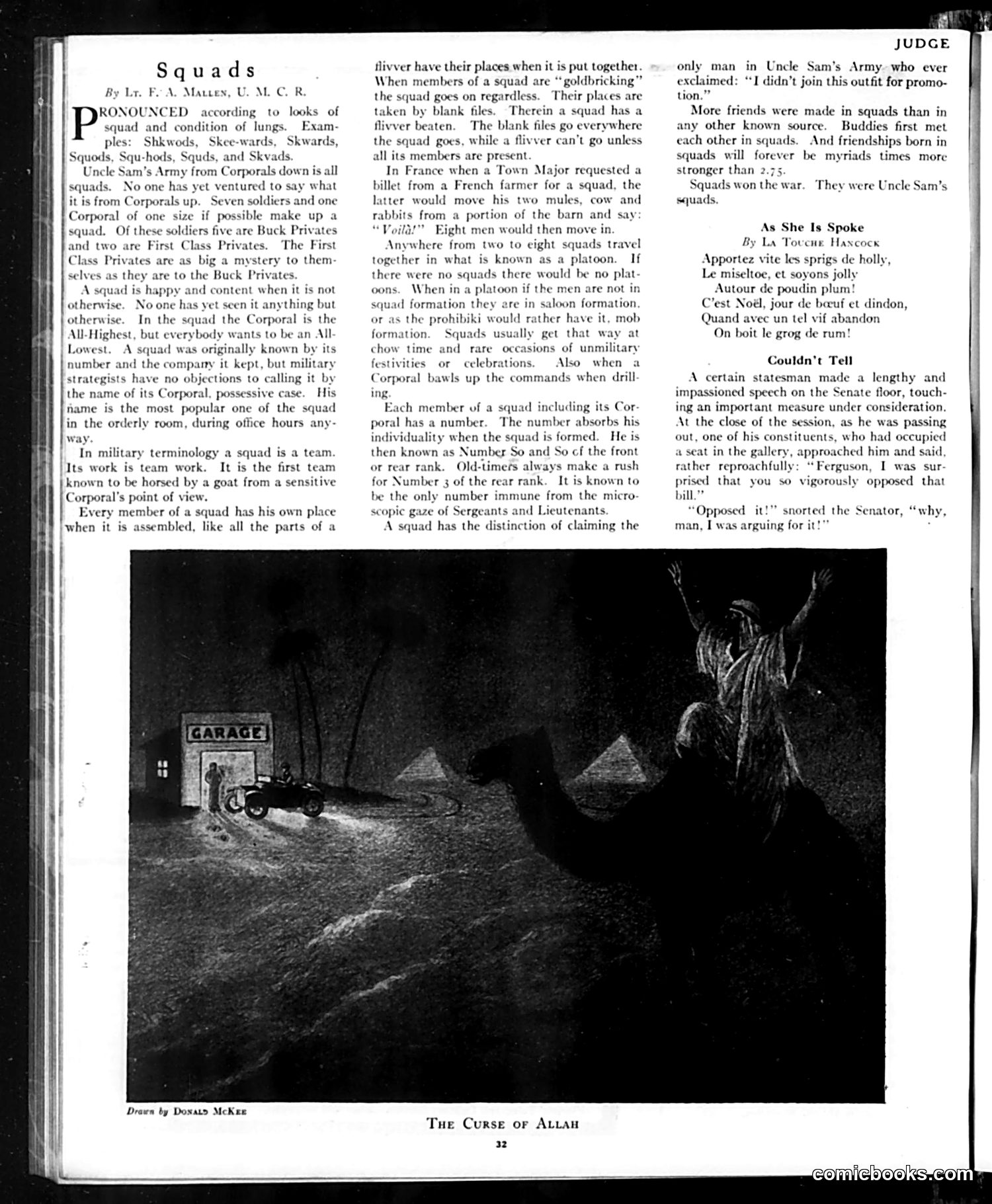
This page contains two distinct pieces: **"Squads" (Left Column):** A humorous military instructional essay by Lt. F.A. Malles explaining Army squad organization. It uses satire to critique military bureaucracy—describing squads with deadpan absurdity (e.g., soldiers "horsed by a goat from a sensitive Corporal's point of view," blank file replacements that work better than actual members). The piece appears to be wartime commentary, referencing France and ending with "Squads won the war." **The Illustration:** "The Curse of Allah" (credited to Donald McKee) shows a nighttime scene with a garage, a car, and a ghostly figure. The caption's meaning is unclear from the visible text alone. **"As She Is Spoke" (Right Column):** A brief humorous piece mocking mangled French—a mock-French Christmas poem with intentional errors, suggesting ridicule of Americans' poor French pronunciation or translation. **"Couldn't Tell" (Bottom Right):** A brief political anecdote about a senator whose constituent couldn't tell whether he opposed or supported a bill from his speech. All content appears to be post-WWI American satire.
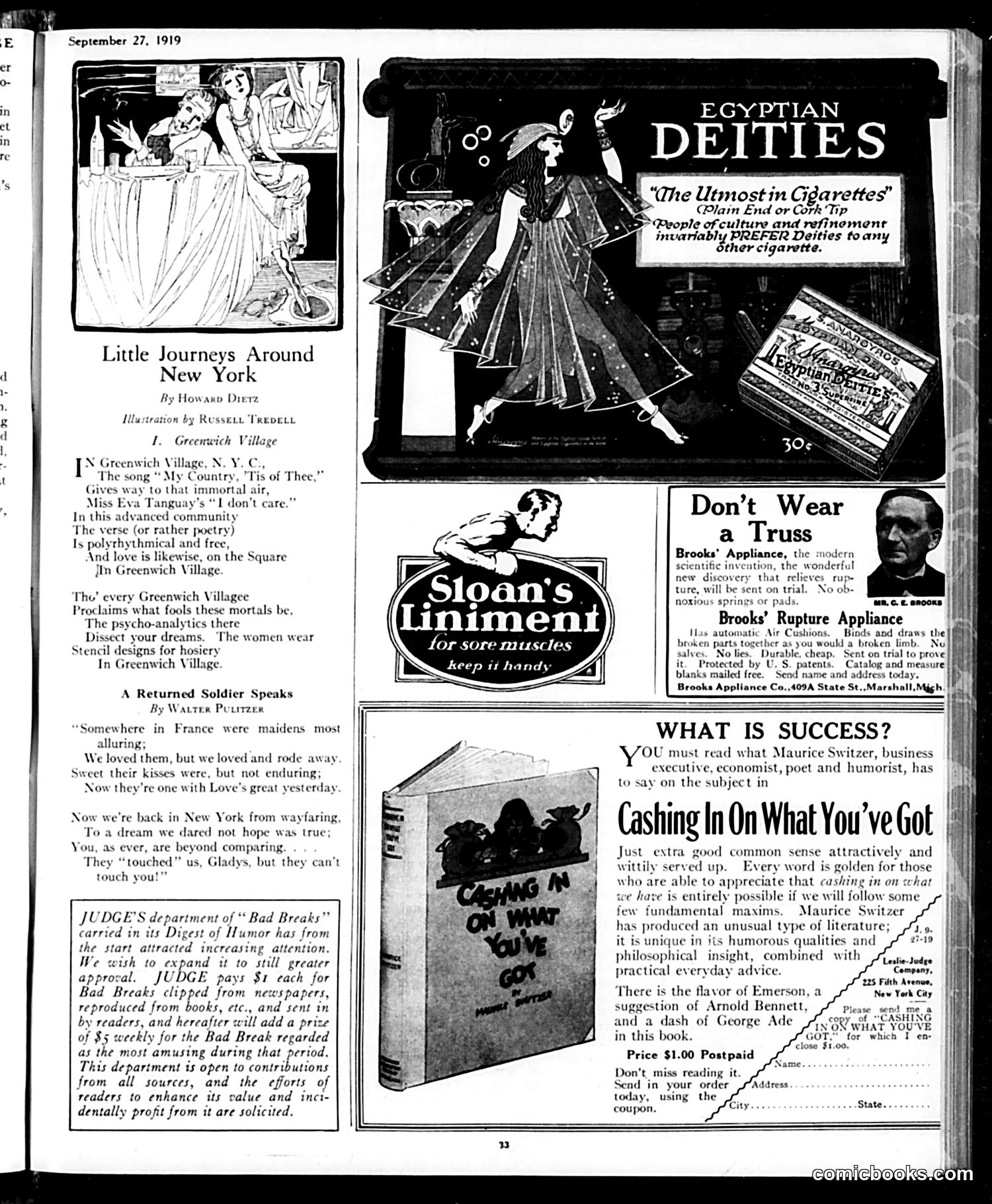
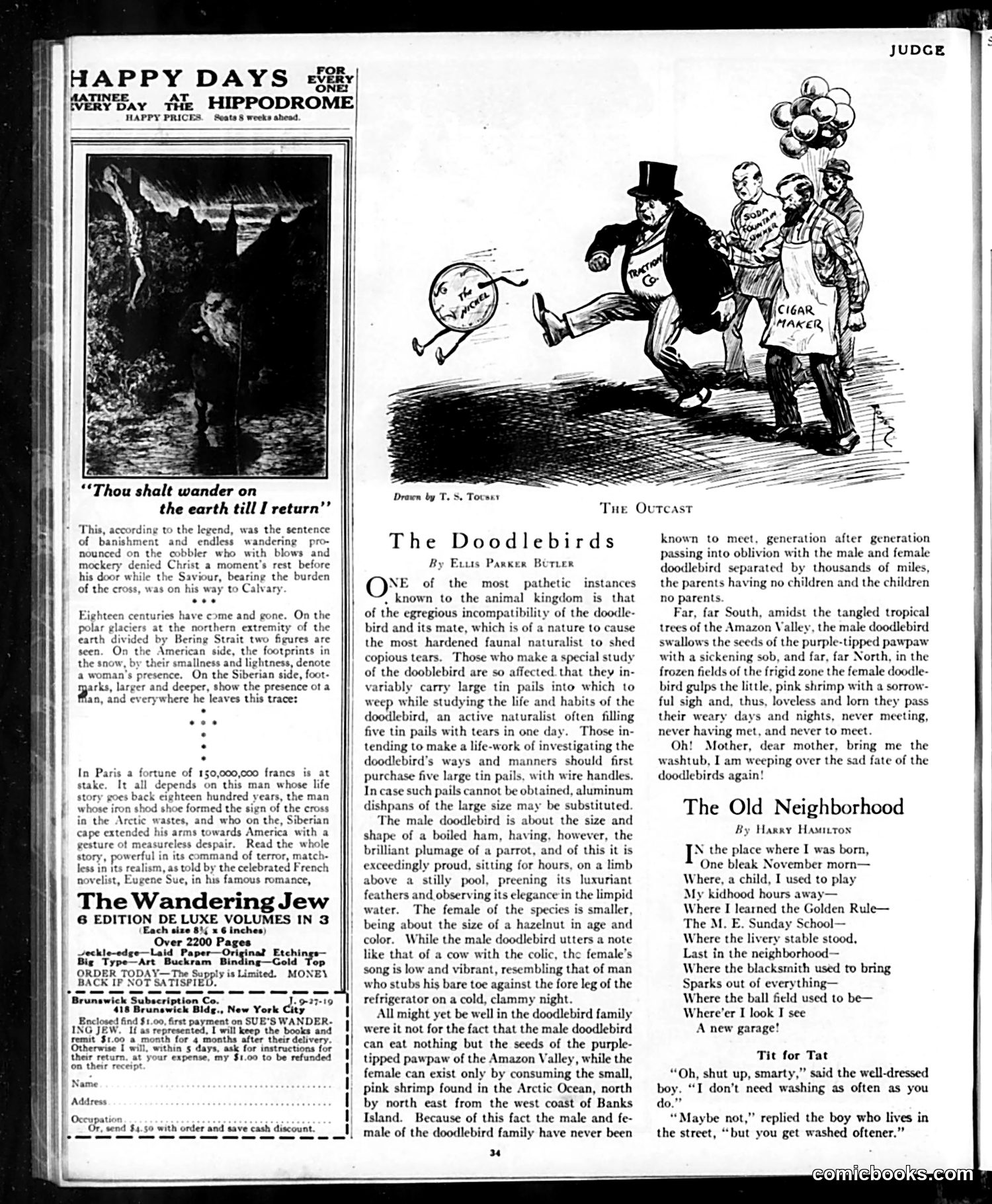
This cartoon by T.S. Tocey satirizes social hypocrisy regarding charity and the poor. A well-dressed man in a top hat kicks a personified ball labeled "Poor" away from a group of well-to-do citizens holding balloons (suggesting leisure and frivolity). The figure labeled "Cigar Maker" suggests labor exploitation. The satire targets the disconnect between professed Christian charity and actual treatment of the destitute. While the wealthy enjoy pleasures and balloon entertainment, they actively reject and cast out the poor—literally kicking them away. The "outcast" status is imposed by society's indifference, not by any moral failing of the poor themselves. The juxtaposition of idle entertainment against expelled poverty critiques Gilded Age wealth inequality and the era's failure to live up to stated moral principles, a common Judge magazine theme attacking social injustice through visual irony.
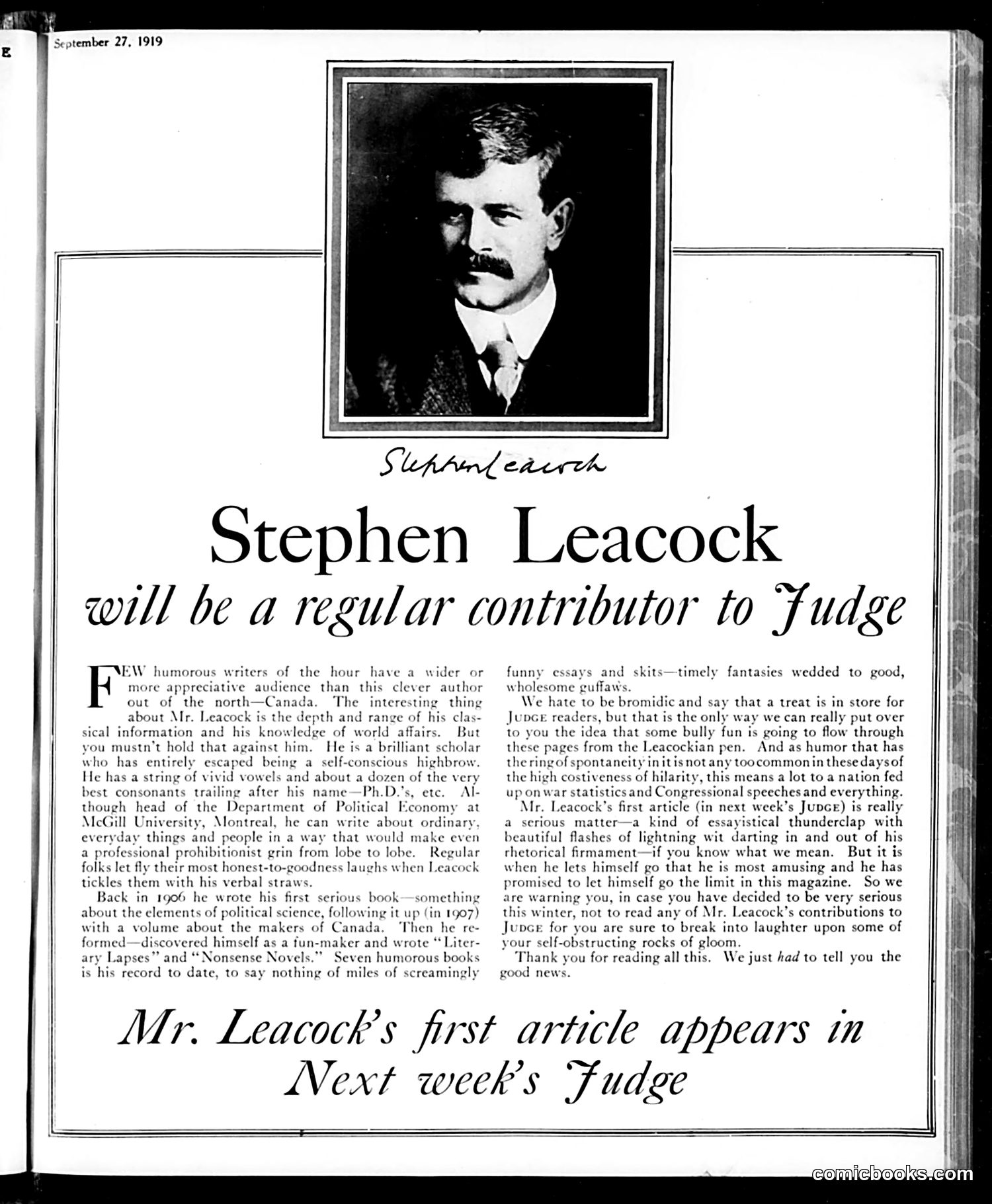
This is an announcement, not a political cartoon. Judge magazine is introducing **Stephen Leacock**, a Canadian humorist and political economist at McGill University, as a new regular contributor. The page celebrates Leacock's wit and popularity, describing him as someone who can write humorously about everyday life despite his scholarly credentials (the text playfully notes his "Ph.D.'s, etc."). The promotional copy emphasizes that his humor is genuinely funny—"spontaneous"—rather than forced, which the editors claim is rare "in these days of war statistics and Congressional speeches." The implicit appeal to post-WWI readers is that Leacock offers relief from the serious, grim tone dominating American public discourse after World War I. His first article will appear in the following week's issue. The portrait shows a mustachioed man in formal dress, typical of early 20th-century professional photography.
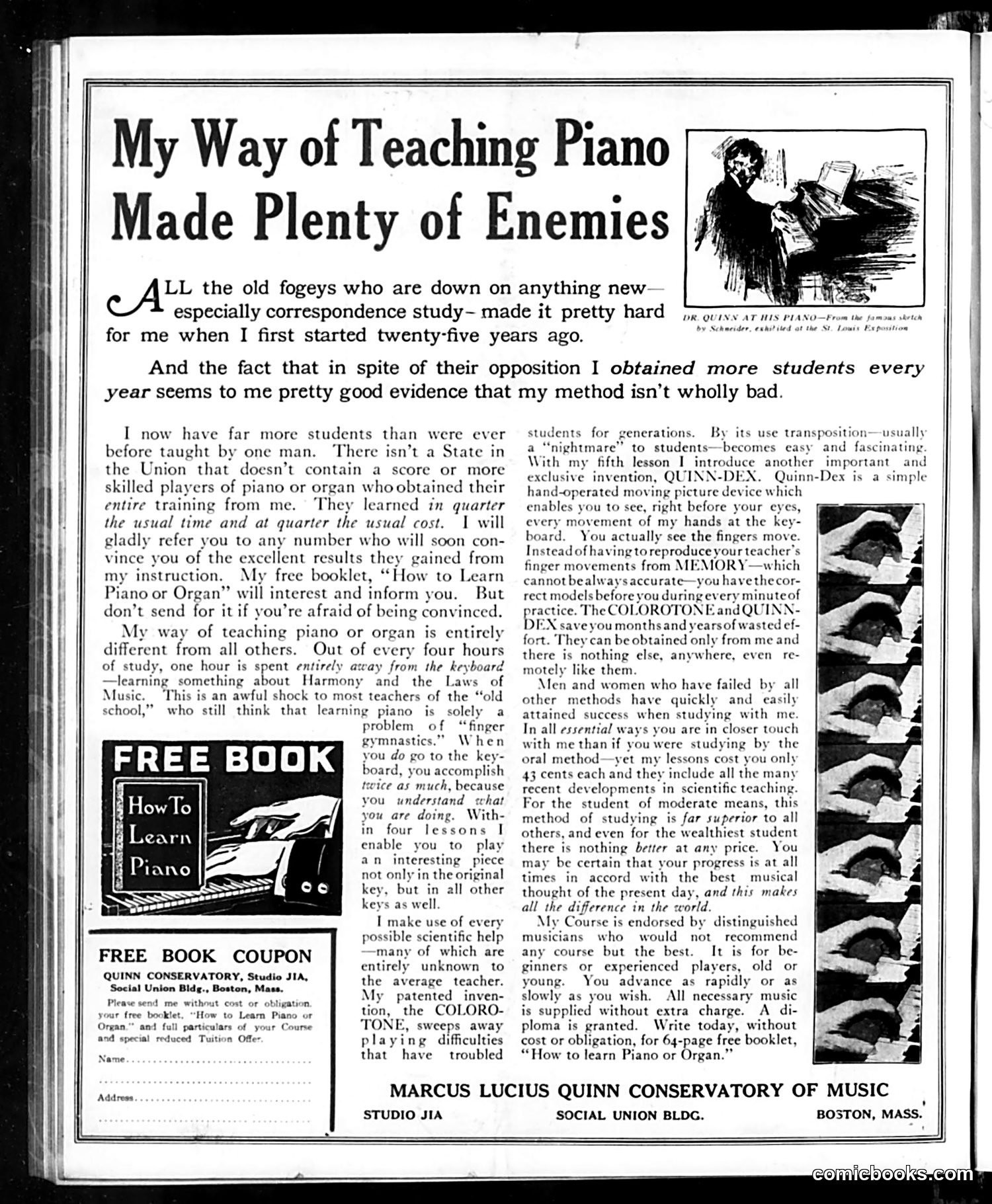
This is primarily an **advertisement** for the Marcus Lucius Quinn Conservatory of Music's correspondence piano instruction course, disguised as an editorial testimonial. The "cartoon" element is minimal—a sketch showing "Dr. Quinn at his piano" at the top, and instructional photos of hand positions on the right side. The satire lies in the headline's ironic tone: Quinn claims his innovative teaching method (emphasizing music theory alongside keyboard practice, plus patented devices like the "Quinn-Dex"—a hand-operated moving picture device showing finger movements) made him "plenty of enemies" among "old fogeys" resistant to change. However, his boast about obtaining "more students every year" undermines the victim narrative. The advertisement pitches modern, scientific innovation against traditional "old school" methods, positioning Quinn as a progressive educator while dismissing orthodox teachers. The offer of a free booklet and cheap lessons (43 cents each) targets cost-conscious students, particularly those interested in correspondence study—itself a relatively new educational format at this time. The piece reflects early-20th-century American enthusiasm for systematized, "scientific" self-improvement.