
Judge, 1919-09-27 · page 14 of 36
Judge — September 27, 1919 — page 14: what you’re looking at
What you’re looking at
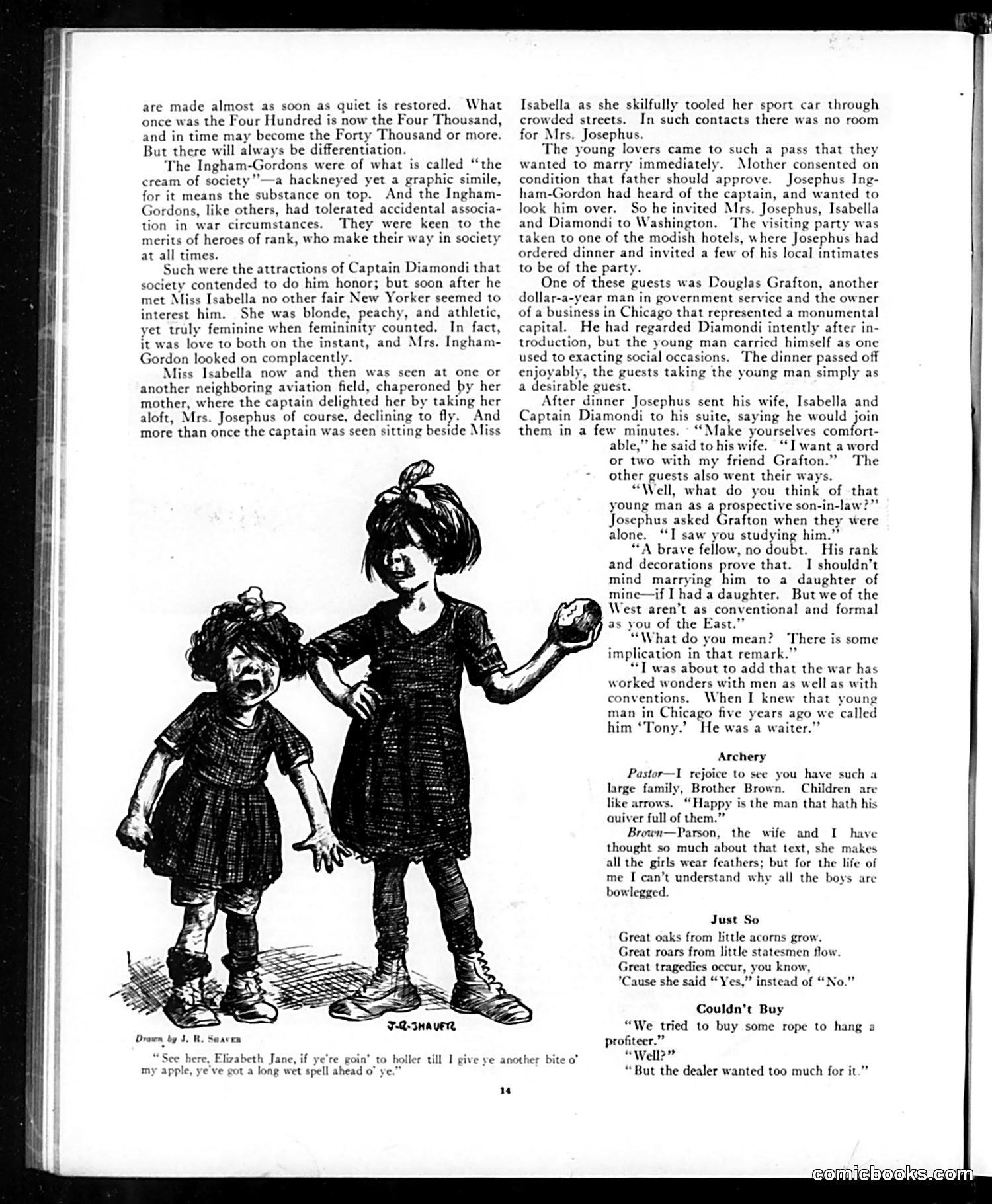
**Main Story Illustration & Text:** The central cartoon depicts a woman and child, likely illustrating a domestic scene from the serialized story about Isabella and Captain Diamondi. The narrative concerns upper-class New York society ("the cream of society") and a young woman's romance with a decorated military officer. **The Satire:** The story's punchline—revealed in dialogue—is that Captain Diamondi, despite his impressive rank and war decorations, was formerly "Tony," a waiter in Chicago five years prior. This lampoons post-WWI social mobility and the difficulty of verifying the backgrounds of war heroes who gained sudden prominence and social acceptance. **Social Commentary:** Judge mocks how wartime circumstances allowed "accidental association" across class lines and how the "Four Hundred" (old money elite) expanded to the "Four Thousand." The satire suggests that rapid social climbing via military service made traditional class distinctions unreliable. **Additional Content:** The page includes unrelated brief humor pieces ("Archery," "Just So") typical of Judge's format.
📄 Transcribed text from this page (OCR, searchable)
Machine-transcribed from the original scan — historical spelling and the odd misread are preserved.
are made almost as soon as quiet is restored. What once was the Four Hundred is now the Four Thousand, and in time may become the Forty Thousand or more. But there will always be differentiation. The Ingham-Gordons were of what is called “the cream of society”’—a hackneyed yet a graphic simile, for it means the substance on top. And the Ingham- Gordons, like others, had tolerated accidental asso tion in war circumstances. They were keen to the merits of heroes of rank, who make their way in society at all times. Such were the attractions of Captain Diamondi that society contended to do him honor; but soon after he met Miss Isabella no other fair New Yorker seemed to interest him. She was blonde, peachy, and athletic, yet truly feminine when femininity counted. In fact, it was love to both on the instant, and Mrs. Ingham- Gordon looked on complacently. Miss Isabella now and then was seen at one or another neighboring aviation field, chaperoned by her mother, where the captain delighted her by taking her aloft, Mrs. Josephus of course, declining to fly. And more than once the captain was seen sitting beside Miss Drawn by J. R. Soaven Elizabeth Jane, if ye're goin’ to h ye've got a long wet spell ahead o' ye.” Isabella as she skilfully tooled her sport car through crowded streets. In such contacts there was no room for Mrs. Josephus. The young lovers came to such a pass that they wanted to marry immediately. Mother consented on condition that father should approve. Josephus Ing- ham-Gordon had heard of the captain, and wanted to look him over. So he invited Mrs. Josephus, Isabella and Diamondi to Washington. The Visiting party was taken to one of the modish hotels, where Josephus had ordered dinner and invited a few of his local intimates to be of the party. One of these guests was Douglas Grafton, another dollar-a-year man in government service and the owner of a business in Chicago that represented a monumental capital. He had regarded Diamondi intently after in- troduction, but the young man carried himself as one used to exacting social occasions. The dinner passed off enjoyably, the guests taking the young man simply as a desirable guest. After dinner Josephus sent his wife, Isabella and Captain Diamondi to his suite, saying he would join them in a few minutes. ‘Make yourselves comfort- able,” he said to his wife. “I want a word or two with my friend Grafton.” The other guests also went their way: “Well, what do you think of that young man as a prospective son-in-law Josephus asked Grafton when they were alone. “I saw you studying him. “A brave fellow, no doubt. His rank and decorations prove that. I shouldn’t mind marrying him to a daughter of mine—if I had a daughter. But we of the West aren’t as conventional and formal as you of the East.” “What do you mean? There is some implication in that remark.” “T was about to add that the war has worked wonders with men as well as with conventions. When I knew that young man in Chicago five years ago we called him ‘Tony.’ He was a waiter.” Archery Pastor—I rejoice to see you have such a large family, Brother Brown. Children are like arrows. “Happy is the man that hath his auiver full of them.” Brown—Parson, the wife and I have thought so much about that text, she makes all the girls wear feathers; but for the life of me I can’t understand why all the boys are bowlegged. Just So Great oaks from little acorns grow. Great roars from little statesmen flow. Great tragedies occur, you know, "Cause she said “Yes,” instead of “No.” Couldn't Buy “We tried to buy some rope to hang a profiteer.” “Well?” “But the dealer wanted too much for it.” “4