
Judge, 1919-09-27 · page 34 of 36
Judge — September 27, 1919 — page 34: what you’re looking at
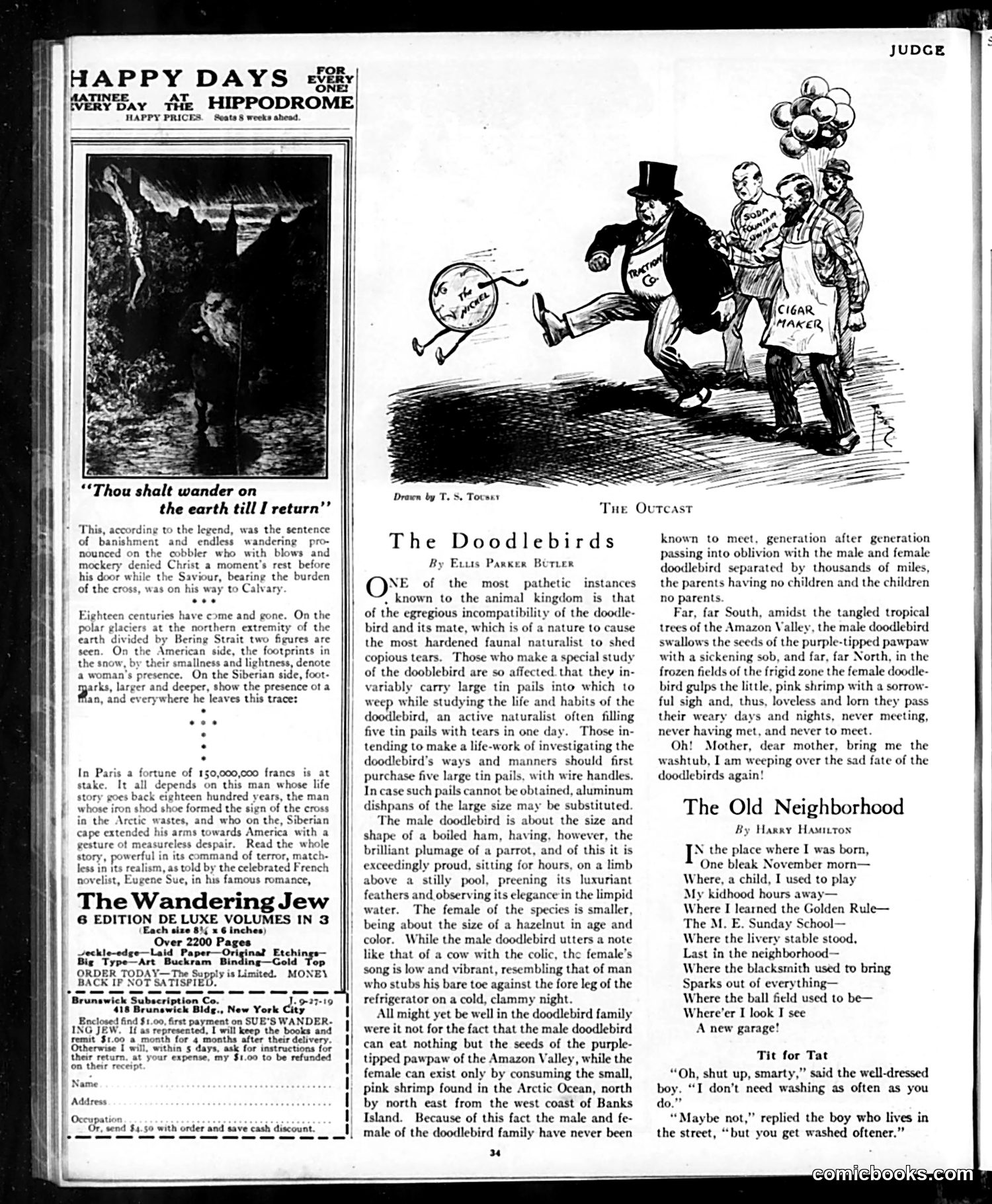
What you’re looking at
This cartoon by T.S. Tocey satirizes social hypocrisy regarding charity and the poor. A well-dressed man in a top hat kicks a personified ball labeled "Poor" away from a group of well-to-do citizens holding balloons (suggesting leisure and frivolity). The figure labeled "Cigar Maker" suggests labor exploitation. The satire targets the disconnect between professed Christian charity and actual treatment of the destitute. While the wealthy enjoy pleasures and balloon entertainment, they actively reject and cast out the poor—literally kicking them away. The "outcast" status is imposed by society's indifference, not by any moral failing of the poor themselves. The juxtaposition of idle entertainment against expelled poverty critiques Gilded Age wealth inequality and the era's failure to live up to stated moral principles, a common Judge magazine theme attacking social injustice through visual irony.
📄 Transcribed text from this page (OCR, searchable)
Machine-transcribed from the original scan — historical spelling and the odd misread are preserved.
HAPPY DAYS EVERY Weny bs HIPPODROME (VERY DAY tHe HAPPY PRICES. Seats § weeks ahead. “Thou shalt wander on the earth till I return’”’ This, according to the legend, was the sentence of banishment and endless wandering pro- nounced on the cobbler who with blows and 1 Christ a moment's rest before e the Saviour, bearing the burden was on his way to Calvary polar glaciers at the northern extremity of the earth divided by Bering Strait two figures are seen. On the American side, the footprints in their smallness and lightness, denote esence. On the Siberian side, foot- arks, larger and deeper, show the presence ot a Man, and everywhere he leaves this trace: In Paris a fortune of 150,000,000 francs is at stake. It all depends on this man whose life story goes back eighteen hundred years, the man whose iron shod shoe formed the sign of the cross in the Arctic wastes, and who on the, Siberian cape extended his arms towards America with a gesture ot measureless despair. Read the whole stor werful in its command of terror, match- realism, as told by the celebrated French novelist, Eugene Sue, in his famous romance, The Wandering Jew 6 EDITION DE Each si: Over 2200 Pages veckle-edge—Laid Paper—Ori Big ‘Type Art Buckram Binding—Cold ORDER TODAY—The Supply is Limited. MO. BACK IP NOT SATISPIED. ‘unewick Subscription Co. Jugar-ts 418 Brunswick BI Enclosed find $1.00, first payment on SUE’S WANDER. ING JEW. If as represented, I will keep the books a: ‘i remit $1.00 a month for 4 months after their delivery. Otherwise I w hin § days, ask for instructions for thee ree aty expense, my $1.00 to be refunded on ther receipt } Name Address Occupation Or, send $4.50 with order and save cash discount. Drawn by T. S. Tovey ‘Tue Outcast The Doodlebirds By Extts Parker Better NE of the most pathetic instances ~ known to the animal kingdom is that of the egregious incompatibility of the doodle- bird and its mate, which is of a nature to cause the most hardened faunal naturalist to shed copious tears. Those who make a special study of the dooblebird are so affected. that they in- variably carry large tin pails into which to weep while studying the life and habits of the doodlebird, an active naturalist often filling five tin pails with tears in one day. Those in- tending to make a life-work of investigating the doodlebird’s ways and manners should first purchase five large tin pails, with wire handles. In case such pails cannot be obtained, aluminum dishpans of the large size may be substituted. The male doodlebird is about the size and shape of a boiled ham, having, how the brilliant plumage of a parrot, and of this it is exceedingly proud, sitting for hours, on a limb above a stilly pool, preening its luxuriant feathers and observing its elegance in the limpid water. The female of the species is smaller, being about the size of a hazelnut in age and color. While the male doodlebird utters a note like that of a cow with the colic, the female's song is low and vibrant, resembling that of man who stubs his bare toe against the fore leg of the refrigerator on a cold, clammy night. All might yet be well in the doodlebird family were it not for the fact that the male doodlebird can eat nothing but the seeds of the purple- tipped pawpaw of the Amazon Valley, while the female can exist only by consuming the small, pink shrimp found in the Arctic Ocean, north by north east from the west coast of Banks Island. Because of this fact the male and fe- male of the doodlebird family have never been uM known to meet, generation after generation passing into oblivion with the male and female doodlebird separated by thousands of miles, the parents having no children and the children no parents Far, far South, amidst the tangled tropical trees of the Amazon Valley, the male doodlebird swallows the seeds of the purple-tipped pawpaw with a sickening sob, and far, far North, in the frozen fields of the frigid zone the female doodle- bird gulps the little, pink shrimp with a sorrow- ful sigh and, thus, loveless and lorn they pass their weary days and nights, never meeting, never having met, and never to meet. Oh! Mother, dear mother, bring me the washtub, I am weeping over the sad fate of the doodlebirds again! The Old Neighborhood By Harry Hastrtox N the place where I was born, One bleak November morn— Where, a child, I used to play My kidhood hours away— Where I learned the Golden Rule— The M. E. Sunday School— Where the livery stable stood, Last in the neighborhood— Where the blacksmith used to bring Sparks out of everything— Where the ball field used to be— Where’er I look I see A new garage! Tit for Tat “Oh, shut up, smarty,” said the well-dressed boy. “I don’t need washing as often as you do.” “Maybe not,” replied the boy who lives in the street, “but you get washed oftener.”” icomicbooks-com