
Judge, 1919-09-27 · page 17 of 36
Judge — September 27, 1919 — page 17: what you’re looking at
What you’re looking at
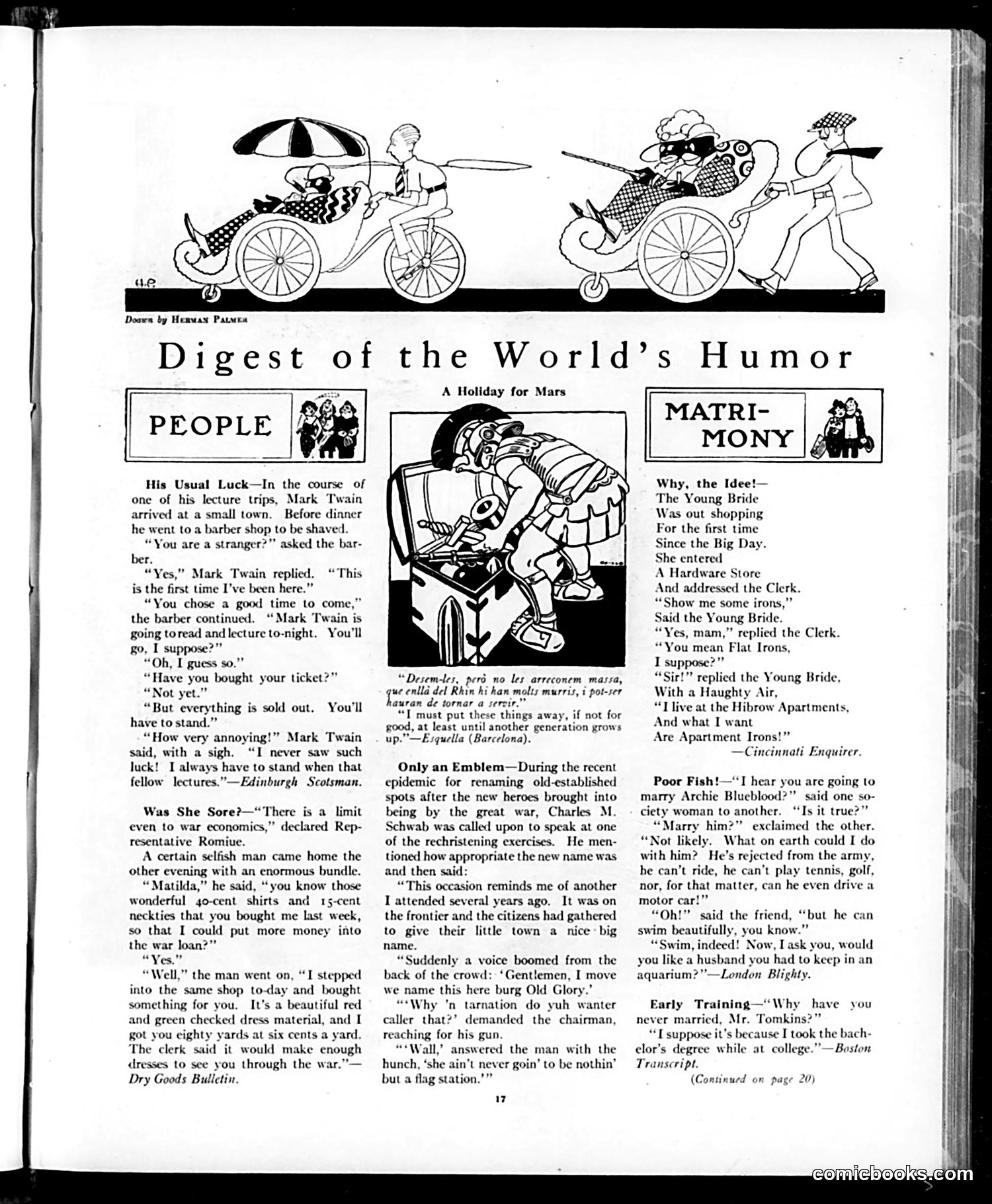
This page from Judge magazine collects humorous anecdotes and jokes from various sources. Key pieces: **"His Usual Luck"**: A Mark Twain anecdote where the famous writer arrives in a town where his own lecture is sold out—he must stand while watching himself perform. The joke plays on Twain's celebrity and ironic misfortune. **"Was She Sore?"**: A wartime joke about a husband buying cheap dress material for his wife to support the war effort, mirroring her earlier sacrifice. The humor lies in his self-serving logic. **"Only an Emblem"**: A frontier tall-tale where townspeople reject naming their town "Old Glory" because it will inevitably become just a railroad flag-stop station. It's absurdist Americana humor. **"Why, the Idee!"**: A newlywed's snobbery—she demands "Apartment Irons" (rather than common "Flat Irons") because she lives in fancy housing. Social-climbing satire. **Other brief jokes** mock women's marital expectations and bachelor reluctance. The page reflects early 20th-century attitudes toward class, gender, and wartime sacrifice through light satire.
📄 Transcribed text from this page (OCR, searchable)
Machine-transcribed from the original scan — historical spelling and the odd misread are preserved.
Dowen by Henwas Patwen Digest of the World’s Humor PEOPLE His Usual Luck—In the course of one of his lecture trips, Mark Twain arrived at a small town. Before dinner he went to a barber shop to be shaved. “You are a stranger?” asked the bar- ber. “Yes,” Mark Twain replied. is the first time I’ve been here.” “You chose a good time to come,” the barber continued. “Mark Twain is going toread and lecture to-night. You'll go, I suppose?” “Oh, I guess so.” Tave you bought your ticket?” “Not yet.” “But everything is sold out. have to stand.” “How very annoy Mark Twain said, with a sigh. “I never saw such luck! I always have to stand when that fellow lectures.”—Edinburgh Scotsman. “This You'll “There is a limit » declared Rep- Was She Sore? even to war economi resentative Romiue. A certain selfish man came home the other evening with an enormous bundle. “ Matilda,” he said, “you know those wonderful 4o-cent shirts and 15-cent neckties that you bought me last week, so that I could put more money into the war loan?” “Well,” the man went on, “I stepped into the same shop to-day and bought something for you. It’s a beautiful red and green checked dress material, and I got you eighty yards at six cents a yard. The clerk said it would make enough dresses to see you through the war.”— Dry Goods Bulletin. A Holiday for Mars “Desem-les, perd no les arreconem massa, uc ena del Rhin hi han molts murris, i pot-ser auran de tornar a servir.”” “T must put these things away, if not for good, at least until another generation grows up.”—Esquella (Barcelona). Only an Emblem—During the recent epidemic for renaming old-established spots after the new heroes brought into being by the great war, Charles M. Schwab was called upon to speak at one of the rechristening exercises. He men- tioned how appropriate the new name was and then said: “This occasion reminds me of another I attended several years ago. It was on the frontier and the citizens had gathered to give their little town a nice’ big name. “Suddenly a voice boomed from the back of the crowd: ‘Gentlemen, I move we name this here burg Old Glory.’ “Why ’n tarnation do yuh wanter caller that?’ demanded the chairman, reaching for his gun. “*Wall,’ answered the man with the hunch, ‘she ain’t never goin’ to be nothin’ but a flag station.’” 17 Why, the Idee!— The Young Bride Was out shopping For the first time Since the Big Day. She entered A Hardware Store And addressed the Clerk. “Show me some irons,” Said the Young Bride. “Yes, mam,” replied the Clerk. “You mean Flat Irons, With a Haughty Air, “T live at the Hibrow Apartments, And what T want Are Apartment Irons!” —Cincinnati Enquirer. Poor Fish!—‘I hear you are going to marry Archie Blueblood?” said one so- ciety woman to another. “Is it true?” “Marry him?” exclaimed the other. “Not likely. What on earth could I do with him? He's rejected from the army, he can’t ride, he can’t play tennis, golf, nor, for that matter, can he even drive a said the friend, “but he can swim beautifully, you know.” “Swim, indeed! Now, I ask you, would you like a husband you had to keep in an aquarium?”’—London Blighty. Early Training—“Why have never married, Mr. Tomkin: “T suppose it’s because I took the bach- ile at college.” —Boston you Transcript. (Continued on page 20)