
Judge, 1919-09-27 · page 13 of 36
Judge — September 27, 1919 — page 13: what you’re looking at
What you’re looking at
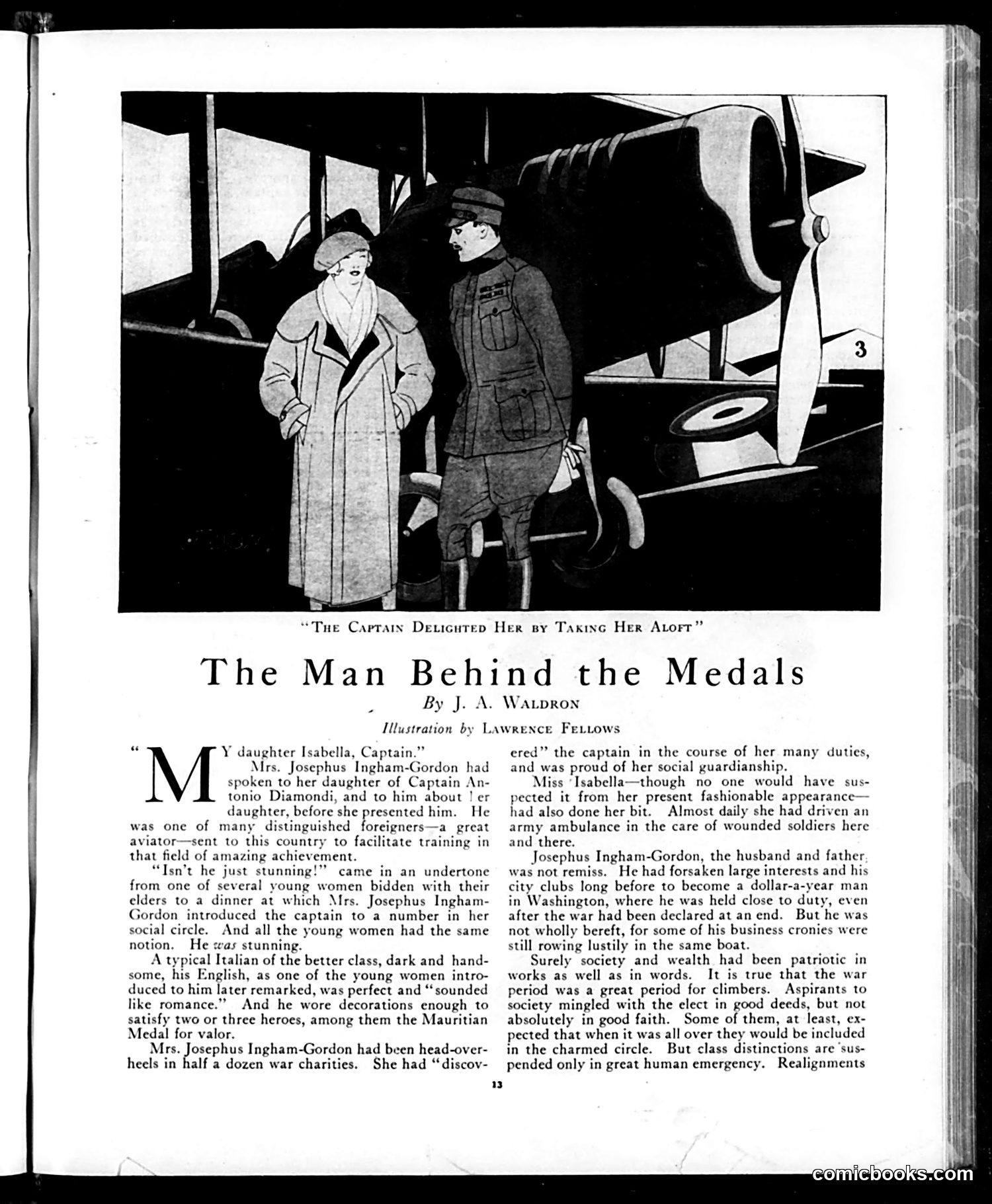
This is the opening of a short story (not a political cartoon) satirizing post-WWI American high society. The illustration shows an Italian military aviator, Captain Antonio Diamondi, being introduced to fashionable society by Mrs. Josephus Ingham-Gordon, a wealthy woman involved in war charities. The satire targets the pretentiousness of the wealthy elite: despite their patriotic war work, they are primarily motivated by social climbing and status. The story suggests that society women are impressed by the captain's decorations and romantic foreign accent, while the Ingham-Gordons perform patriotic duties to maintain social standing. The text explicitly notes that "aspirants to society mingled with the elect in good deeds, but not absolutely in good faith"—exposing wartime charity as performative rather than genuinely altruistic. The broader point appears to be critiquing how the upper class weaponized patriotism for social advancement during and after WWI.
📄 Transcribed text from this page (OCR, searchable)
Machine-transcribed from the original scan — historical spelling and the odd misread are preserved.
¥v “Tue Captain Deticuteo Her sy Takinc Her Atorr” The Man Behind the Medals By J. A. Watpron Illustration by LAWRENCE - Y daughter Isabella, Captain.” Mrs. Josephus Ingham-Gordon had spoken to her daughter of Captain An- tonio Diamondi, and to him about ! er daughter, before she presented him. He was one of many distinguished foreigners—a great aviator—sent to this country to facilitate training in that field of amazing achievement. “Isn't he just stunning!” came in an undertone from one of several young women bidden with their elders to a dinner at which Mrs. Josephus Ingham- Gordon introduced the captain to a number in her social circle. And all the young women had the same notion. He was stunning. A typical Italian of the better class, dark and hand- some, his English, as one of the young women intro- duced to him later remarked, was perfect and “sounded like romance.” And he wore decorations enough to satisfy two or three heroes, among them the Mauritian Medal for valor. Mrs. Josephus Ingham-Gordon had been head-over- heels in half a dozen war charities. She had “‘discov- 13 Fr ered” the captain in the course of her many duties, and was proud of her social guardianship. Miss ‘Isabella—though no one would have sus- pected it from her present fashionable appearance— had also done her bit. Almost daily she had driven an army ambulance in the care of wounded soldiers here and there. Josephus Ingham-Gordon, the husband and father was not remiss. He had forsaken large interests and his city clubs long before to become a dollar-a-year man in Washington, where he was held close to duty, even after the war had been declared at an end. But he was not wholly bereft, for some of his business cronies were still rowing lustily in the same boat. Surely society and wealth had been patriotic in works as well as in words. It is true that the war period was a great period for climbers. Aspirants to society mingled with the elect in good deeds, but not absolutely in good faith. Some of them, at least, ex- pected that when it was all over they would be included in the charmed circle. But class distinctions are ‘sus- pended only in great human emergency. Realignments /LOWS comicbooks-com