
Judge, 1919-09-27 · page 15 of 36
Judge — September 27, 1919 — page 15: what you’re looking at
What you’re looking at
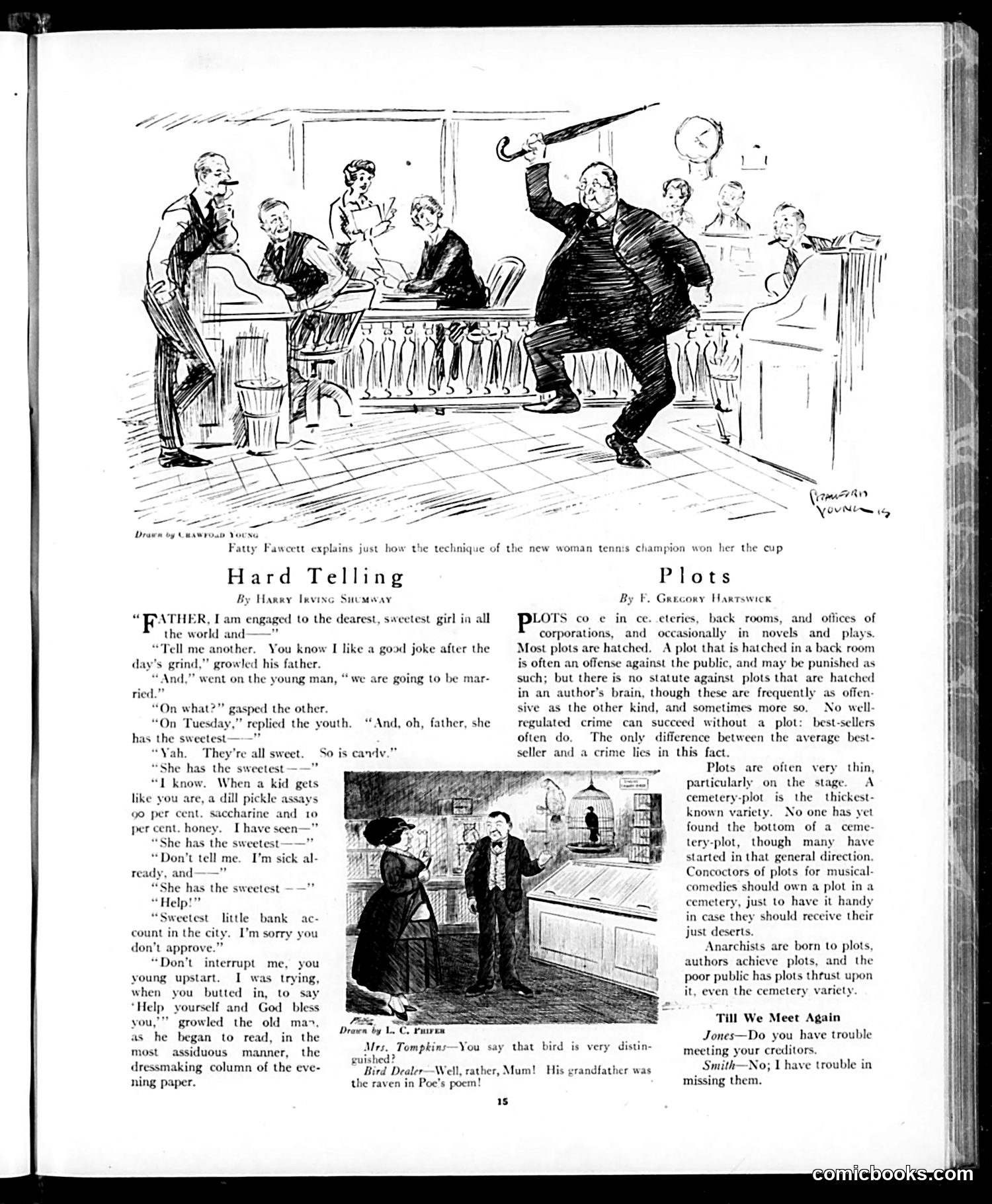
**Top Cartoon ("Hard Telling"):** A young man tries to tell his father he's engaged, repeatedly starting "She has the sweetest—" but the impatient father interrupts each time, assuming clichéd romantic compliments. The punchline reveals the sweetness he meant was her "bank account"—satirizing how marriage motivation had shifted to financial considerations, and mocking both the young man's mercenary interests and the father's cynicism about romance. **Middle Illustration:** A brief comedic exchange about a bird's distinguished ancestry (descended from the raven in Poe's poem), likely mocking pretentious genealogy-obsession of the era. **"Plots" Essay:** A satirical commentary on narrative construction, drawing parallels between criminal conspiracies and literary plots. The author humorously notes that well-regulated crimes need good plots but bestselling books often don't, and makes dark jokes about cemetery plots and anarchists. **"Till We Meet Again":** A one-liner joke about a creditor meeting—the humor lies in the wordplay of "missing" versus "meeting."
📄 Transcribed text from this page (OCR, searchable)
Machine-transcribed from the original scan — historical spelling and the odd misread are preserved.
Fatty Fawcett explains just how the technique of the new woman tennis champion won her the cup Hard Telling Haray Ikvinc Sucmway “ F ATHER, I am engaged to the dearest, sweetest girl in all the world and——" “Tell me another. You know I like a good joke after the 1," growled his father. went on the young man, “we are going to be mar- And,’ On what?” gasped the other. “On Tuesday,” replied the youth. ‘And, oh, father, she has the sweetest id “Yah hey’re all sweet. So is candy.” “She has the sweetest — “I know. When a kid gets like you are, a dill pi go per cent. saccharine and per cent. honey. I have seen— “She has the sweetest——” “Don't tell me. I'm sick al- ready, and——” “She has the sweetest —— “Help!” “Sweetest little bank ac- count in the city. I’m sorry y don’t approve. “Don’t interrupt me, you young upstart. I was trying, when you butted in, to say “Help yourself and God_ bless you,” growled the old ma, as he began to read, in the most assiduous manner, the dressmaking column of the eve- ning paper. ou Drawn by L. C, Puree Mrs. Tompkins—You say guished? the raven in Poe's poem! 15 that bird is very distin- Bird Dealer—Well, rather, Mum! His grandfather was Plots By F. Grecony Harrswick plots co e in ce. eteries, back rooms, and offices of corporations, and occasionally in novels and _ plays. Most plots are hatched. A plot that atched in a back room is often an offense against the public, and may be punished as such; but there is no statute against plots that are hatched in an author’s brain, though these are frequently offen- sive as the other kind, and sometimes more so. No well- regulated crime can succeed without a plot: best-sellers often do. The only difference between the average best- seller and a crime lies in this fact. Plots are often very thin, particularly on the stage. A cemetery-plot is the thickest- known variety. No one has yet found the bottom of a ceme- tery-plot, though many have started in that general direction Concoctors of plots for musical comedies should own a plot in a cemetery, just to have it handy in case they should receive their just deserts. Anarchists are born to plots, authors achieve plots, and the poor public has plots thtust upon it, even the cemetery variety. Till We Meet Again Jones—Do you have trouble meeting your creditors. Smith—No; | have trouble in missing them. ComicbDooK