
A complete issue · 36 pages · 1919
Judge — June 14, 1919
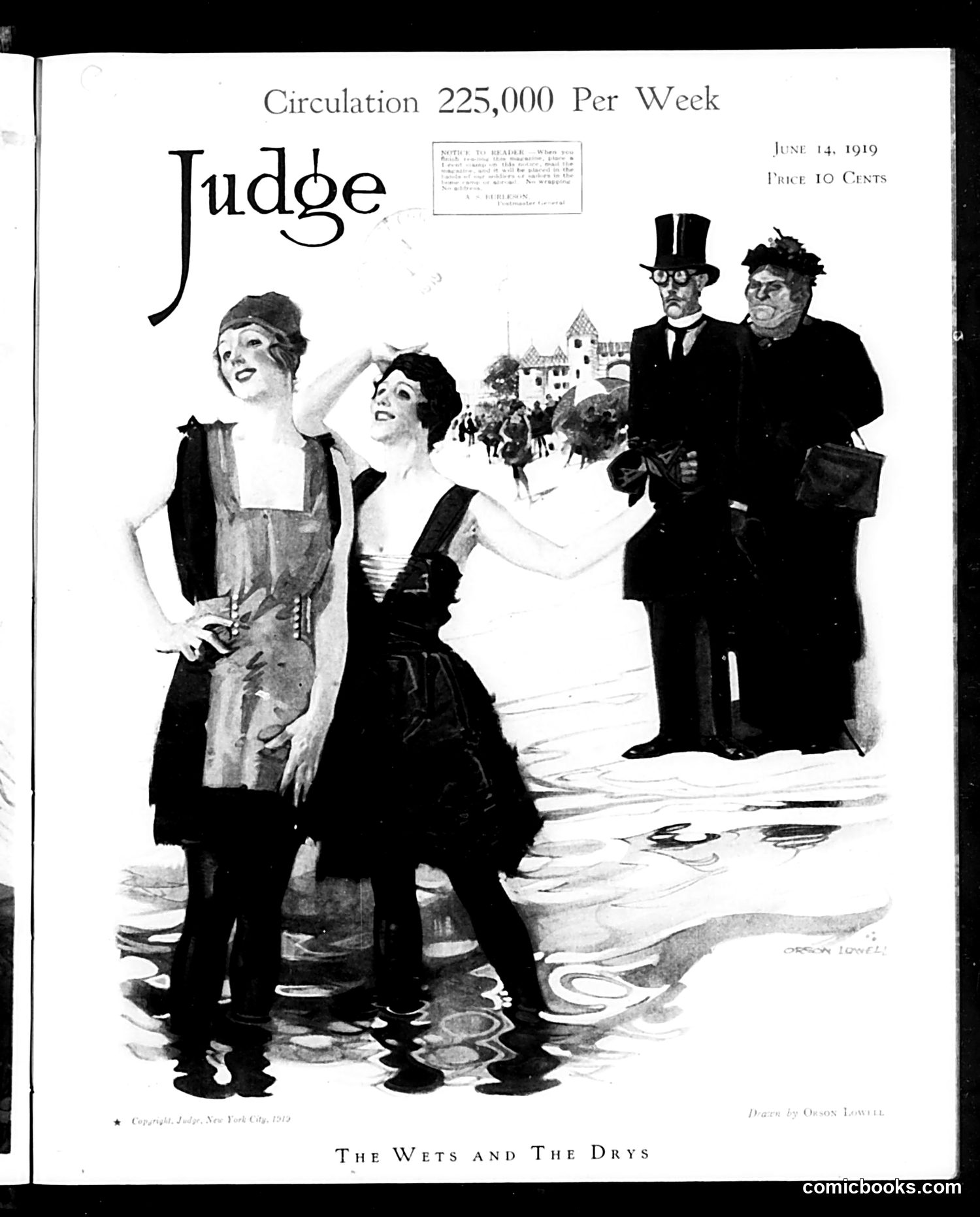
This June 1919 Judge cartoon satirizes the heated debate over Prohibition, which had just been ratified (18th Amendment, January 1919, taking effect in 1920). The cartoon depicts two groups in conflict: "wets" (those opposing alcohol bans, shown as fashionable women in the foreground) and "drys" (Prohibition supporters, shown as stern men in top hats in the background). The setting appears to be flooded or waterlogged, a visual pun on the "wet" versus "dry" terminology. The satire mocks both sides of this bitter cultural clash. The contrasting dress and demeanor suggest class and generational divides over whether to enforce national alcohol prohibition—one of the era's most contentious political issues.
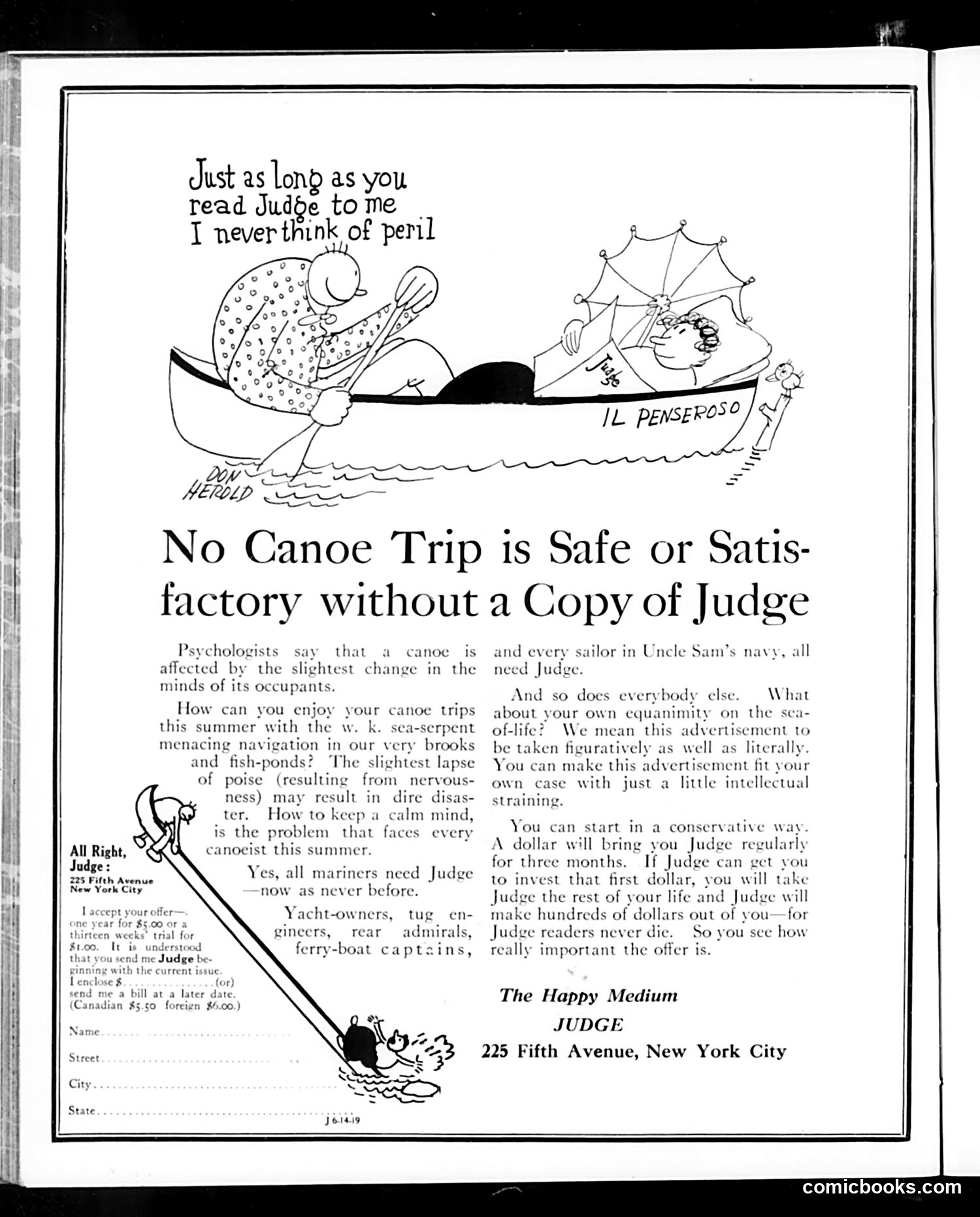
This is primarily a **humorous advertisement** for *Judge* magazine itself, disguised as satirical advice about canoe trips. The cartoon depicts two boats on water: one labeled "HERALD" (likely the New York Herald newspaper) and another labeled "IL PENSEROSO" (Italian for "The Thoughtful One"). A figure reads *Judge* magazine while canoeing, with the caption claiming that reading *Judge* prevents anxiety about navigating hazards. The satire is self-promotional: *Judge* humorously argues that subscribing to their magazine ensures mental calm during summer activities. The ad mocks how newspapers and magazines marketed themselves as essential to readers' wellbeing. The "All Right, Judge" call-out box offers a subscription deal, further emphasizing this is magazine marketing disguised as witty social commentary—typical of *Judge*'s self-referential humor.
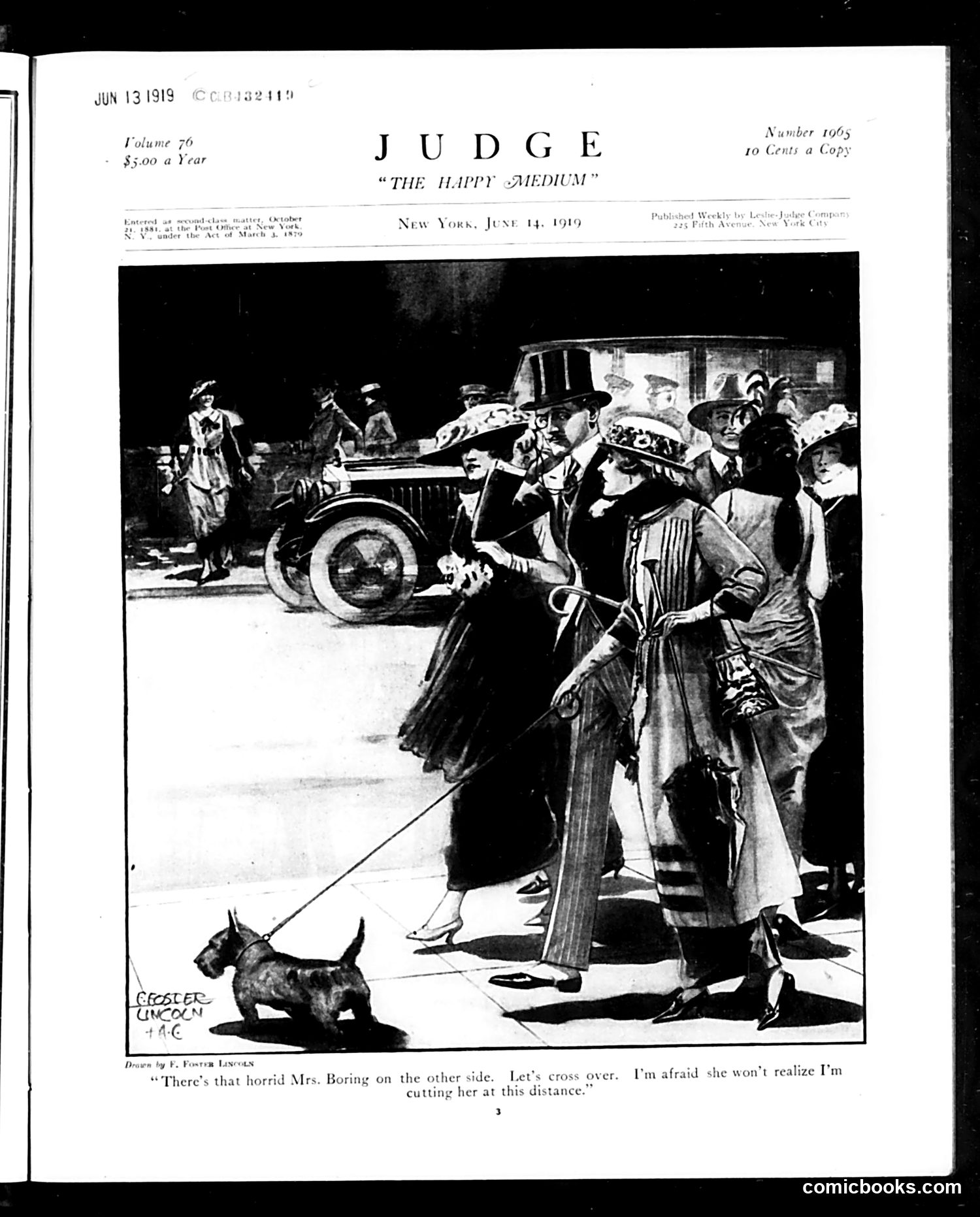
This cartoon by Foster Lincoln satirizes wealthy high-society women during the post-WWI era. A fashionably dressed woman holds a small dog on a leash while conversing with companions near an automobile. The caption reads: "There's that horrid Mrs. Boring on the other side. Let's cross over. I'm afraid she won't realize I'm cutting her at this distance." The joke ridicules the pretentious social snobbishness of upper-class women—specifically their practice of deliberately "cutting" (publicly ignoring) acquaintances they consider beneath them. The humor lies in the absurdity that Mrs. Boring might not even notice being deliberately avoided from across the street, making the snobbery both cruel and pointless.
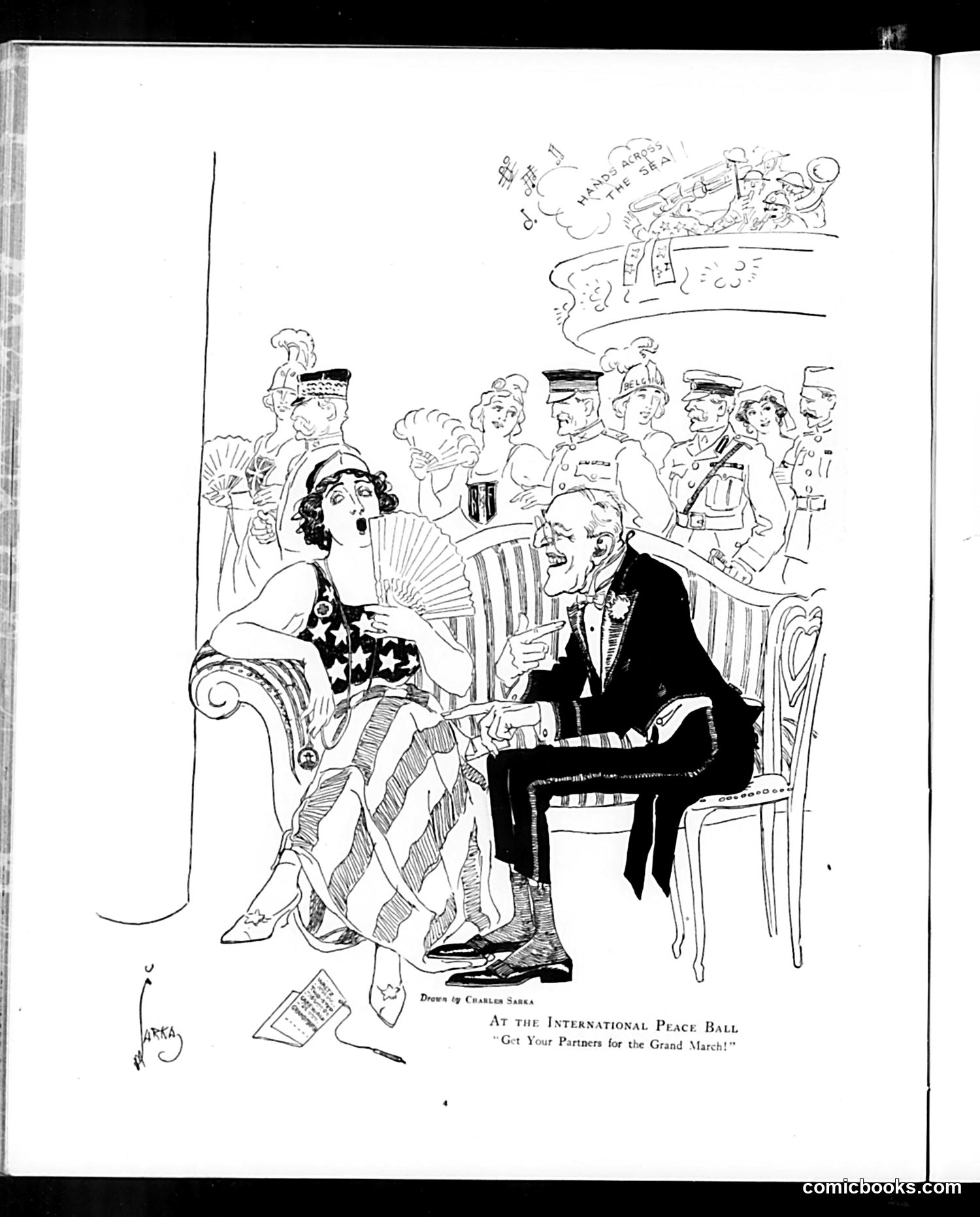
This cartoon by Charles Sara satirizes an "International Peace Ball" with the caption "Get Your Partners for the Grand March!" The scene depicts military officers in uniform gathered at what appears to be a formal dance event. A woman in elegant attire sits with a man in civilian dress, while uniformed military figures stand in the background, some appearing animated or excited. The satire likely critiques the contradiction between celebrating "peace" through diplomatic social events while surrounded by military presence and power. The invitation to "get your partners for the Grand March" sarcastically suggests that despite peaceful rhetoric, military forces remain the true partners driving international relations. This reflects early-20th-century skepticism about whether such diplomatic gatherings could genuinely promote peace.
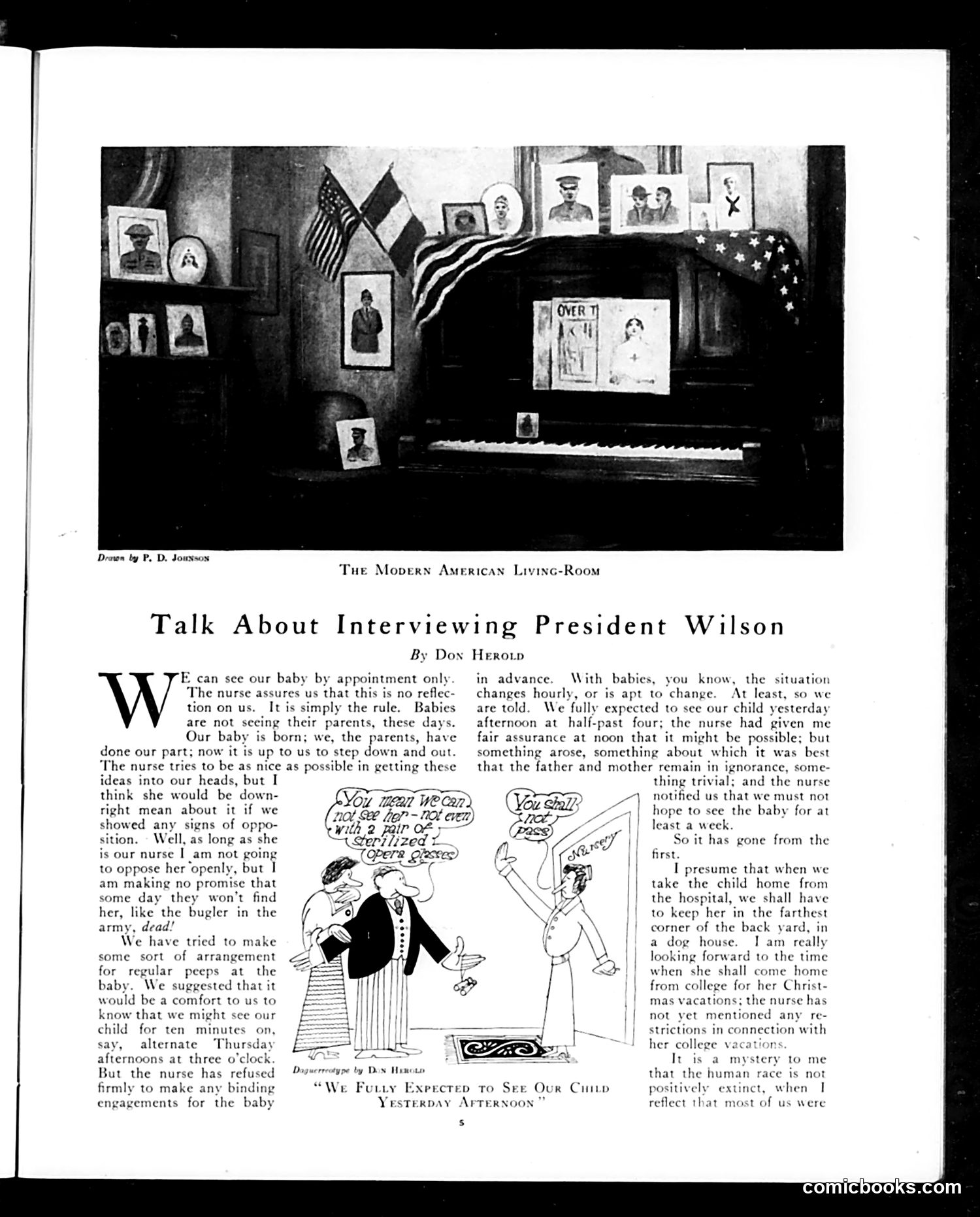
This satirical piece by Don Herold mocks the difficulty of accessing President Woodrow Wilson and his newborn baby. The cartoon depicts a frustrated couple attempting to arrange a hospital visit to see their child, only to be blocked by an overly protective nurse who enforces strict appointment-only rules. The satire targets Wilson's inaccessibility and the bureaucratic obstacles surrounding him—likely reflecting contemporary frustration with his administration's communication practices. The exaggerated nurse represents gatekeepers preventing public access. The husband's complaint that scheduling a visit to their own baby is nearly impossible as arranging an interview with the President himself is the joke's core: both are presented as equally difficult and absurd, suggesting Wilson was equally remote from ordinary citizens.
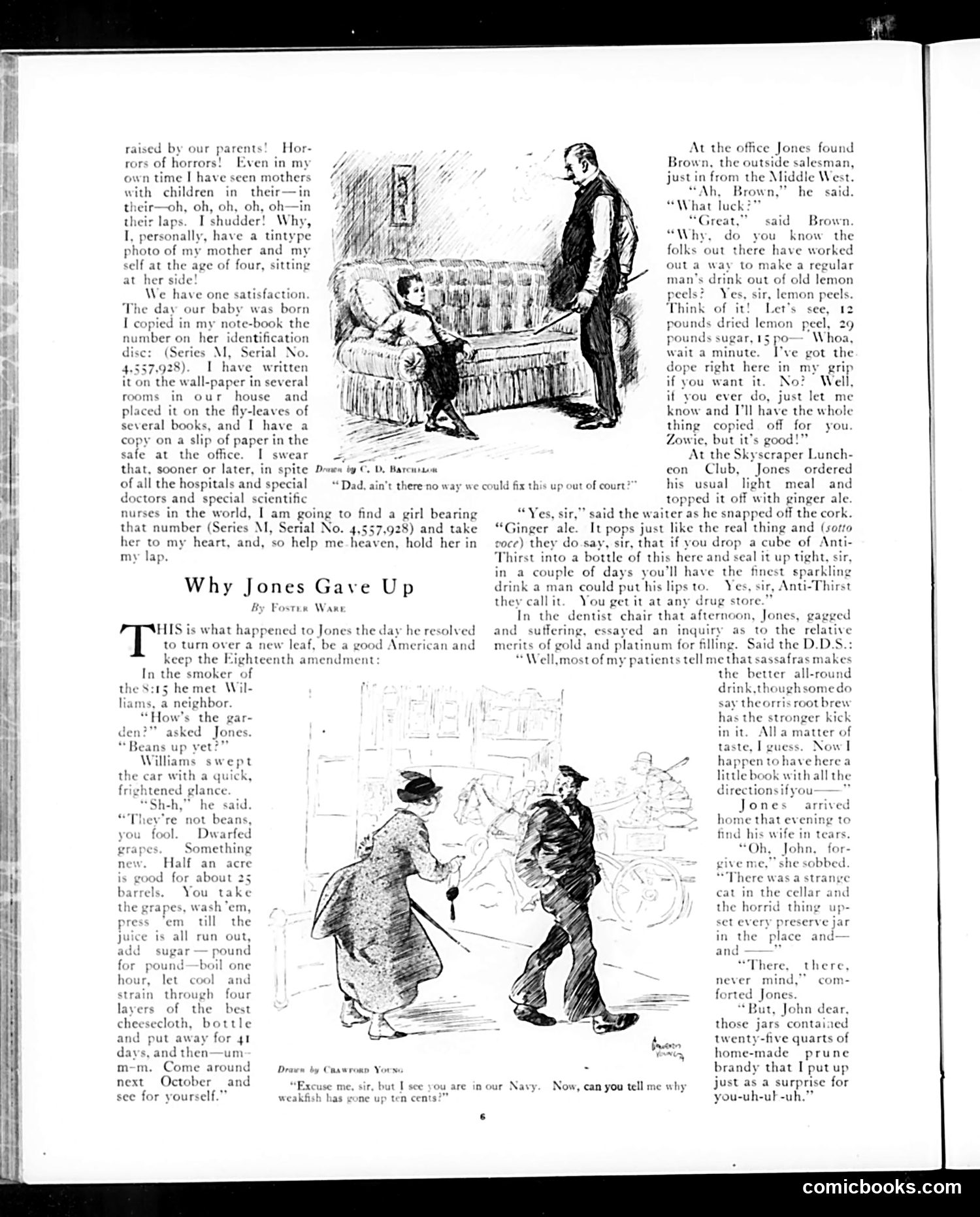
This page from *Judge* magazine contains a humorous story about a character named Jones who attempts to reform his habits and become a "good American." The narrative satirizes early 20th-century self-improvement culture through Jones's increasingly absurd encounters: a neighbor offers grape-pressing instructions, a businessman hawks "Anti-Thirst" lemon peel beverages, and a dentist discusses drink quality. The illustrations show Jones in various social situations where well-meaning people derail his good intentions with dubious "helpful" advice. The satire mocks both Jones's earnest reformism and the era's proliferation of dubious health remedies and social schemes. The humor derives from the contrast between his resolve and society's persistent temptations and questionable alternatives.
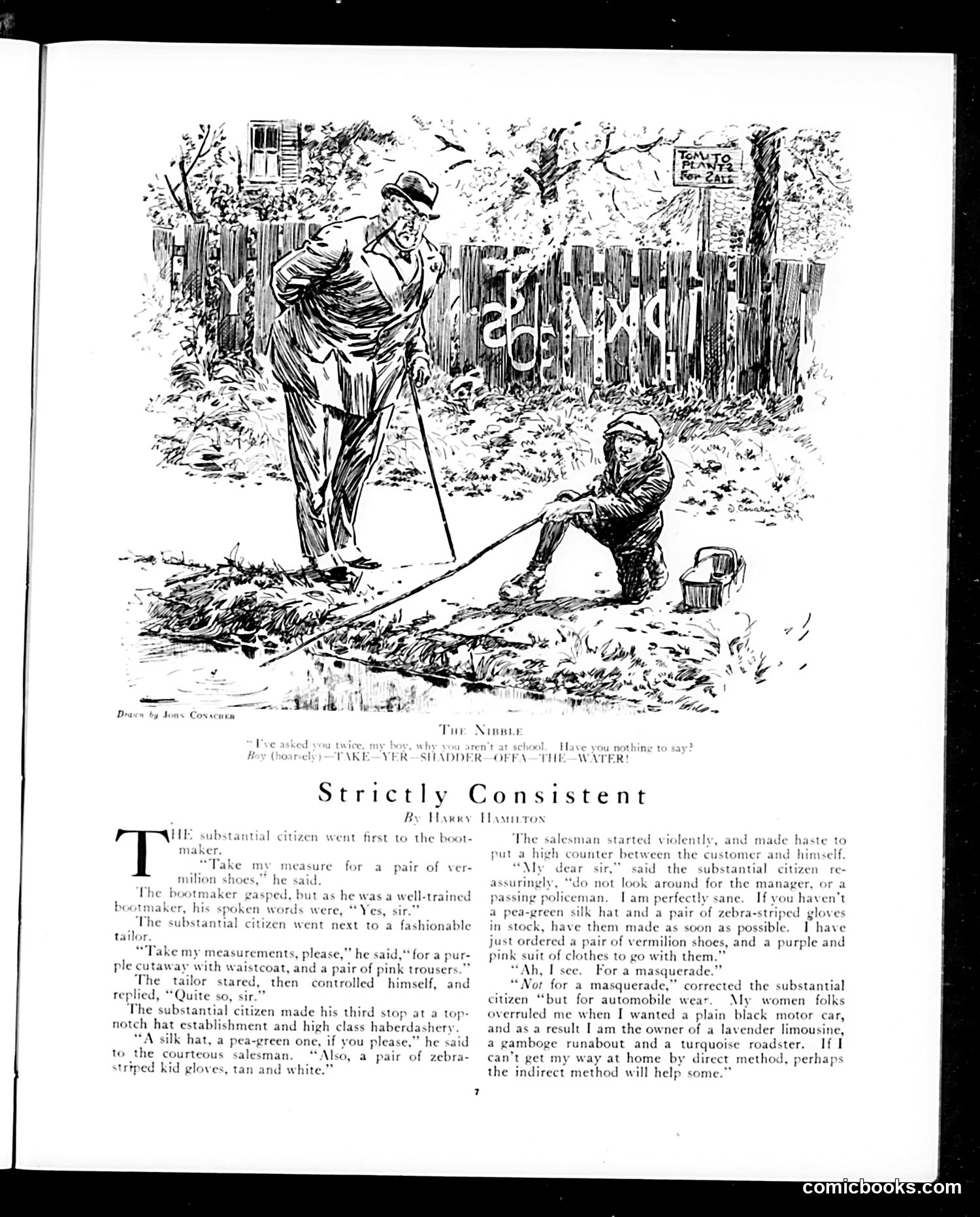
This story-cartoon mocks the absurdity of wealthy men surrendering fashion decisions to their wives. A "substantial citizen" orders increasingly garish clothing: vermilion shoes, purple-pink suit, pea-green silk hat, zebra-striped gloves. When a haberdasher questions these choices, the man explains he's dressing to match his automobile collection—a lavender limousine, gamboge (mustard-yellow) runabout, and turquoise roadster—all selected by "the women folks." The satire targets two early-1900s anxieties: the emasculation of husbands by wives' consumer power, and the absurd ostentation of automobile wealth during the car's novelty period. The man's rationalization—that since he can't control home decisions directly, he'll coordinate everything to his wives' automotive choices—epitomizes resigned domestic defeat presented as logical consistency. The cartoon illustrated this domestic comedy scenario.
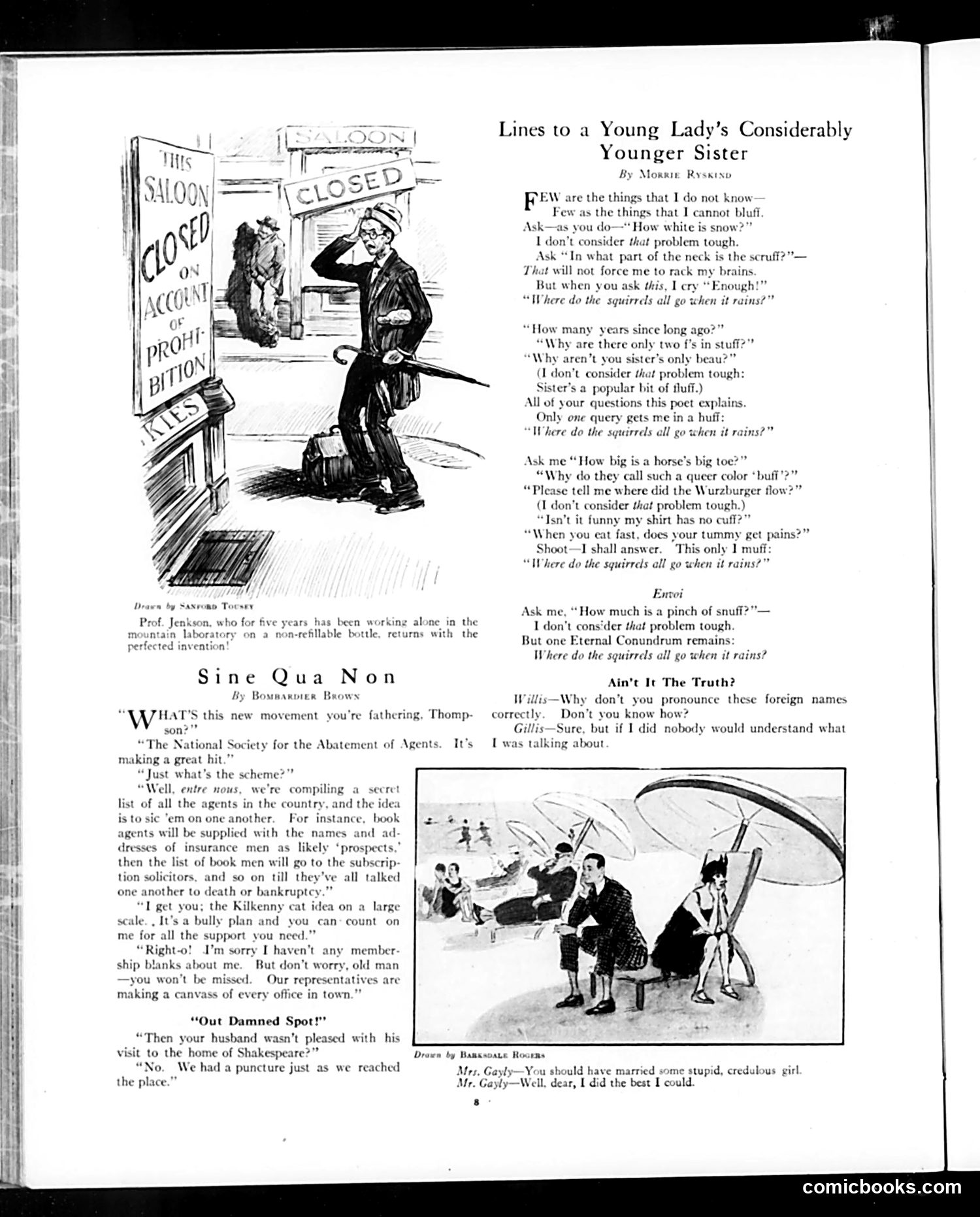
This page contains three distinct satirical pieces: **"Lines to a Young Lady's Considerably Younger Sister"** (top): A humorous poem about an older man's exasperation with a young girl's endless questions. He claims he can answer anything—until she asks where squirrels go when it rains, which becomes his comic breaking point. The satire mocks the relentless curiosity of children and the pretended omniscience of adults. **"Sine Qua Non"** (middle): Satirizes business culture and the proliferation of professional "agents" (insurance agents, book agents, subscription solicitors). A man proposes deliberately siccing these nuisances on each other in a "Kilkenny cat" arrangement—referencing the Irish proverb about two cats fighting until only tails remain. It's social commentary on the invasiveness of commercial solicitation. **"Ain't It The Truth?"** (bottom): A brief joke about pronunciation—a character admits he mispronounces foreign names intentionally because doing so correctly would confuse his audience. All pieces use light humor to comment on social absurdities of the era.
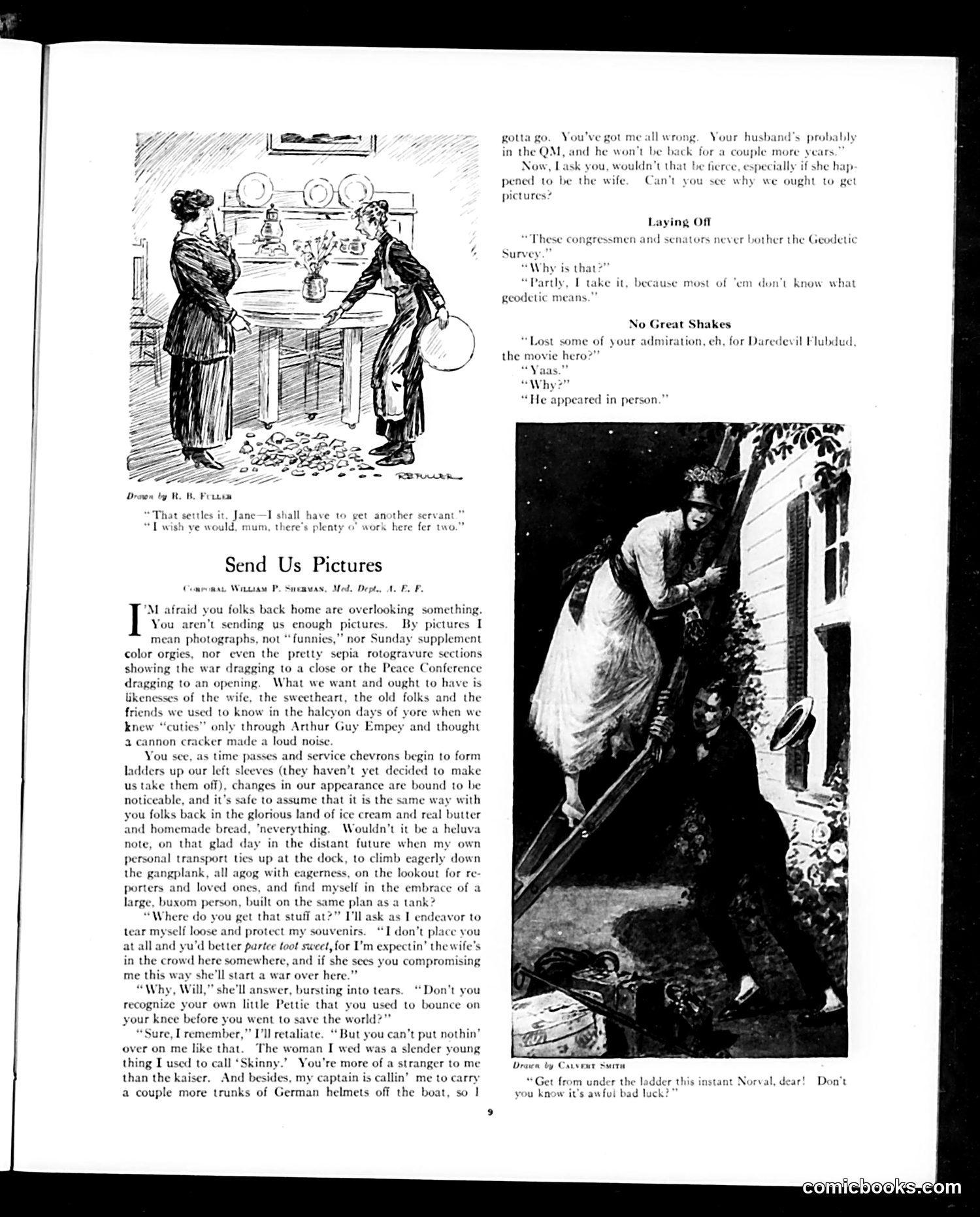
This page from *Judge* magazine contains WWI-era satirical content aimed at American soldiers and homefront readers. **"Send Us Pictures"** is a humorous letter from a serviceman appealing to folks back home to send photographs—specifically candid ones of wives, sweethearts, and friends—rather than printed "funnies" or newspaper clippings. The satire works through exaggeration: he imagines returning home and failing to recognize his own wife because she's gained weight during his absence (described as a "large, buxom person, built on the same plan as a tank"), creating an awkward reunion scenario. The joke plays on anxieties about separation, physical change, and marital reunion. The two cartoon panels on the right contain separate, brief jokes unrelated to the main article—typical *Judge* format. The piece reflects genuine WWI concerns: soldiers' long deployments, homesickness, and uncertainty about what awaited them after service.
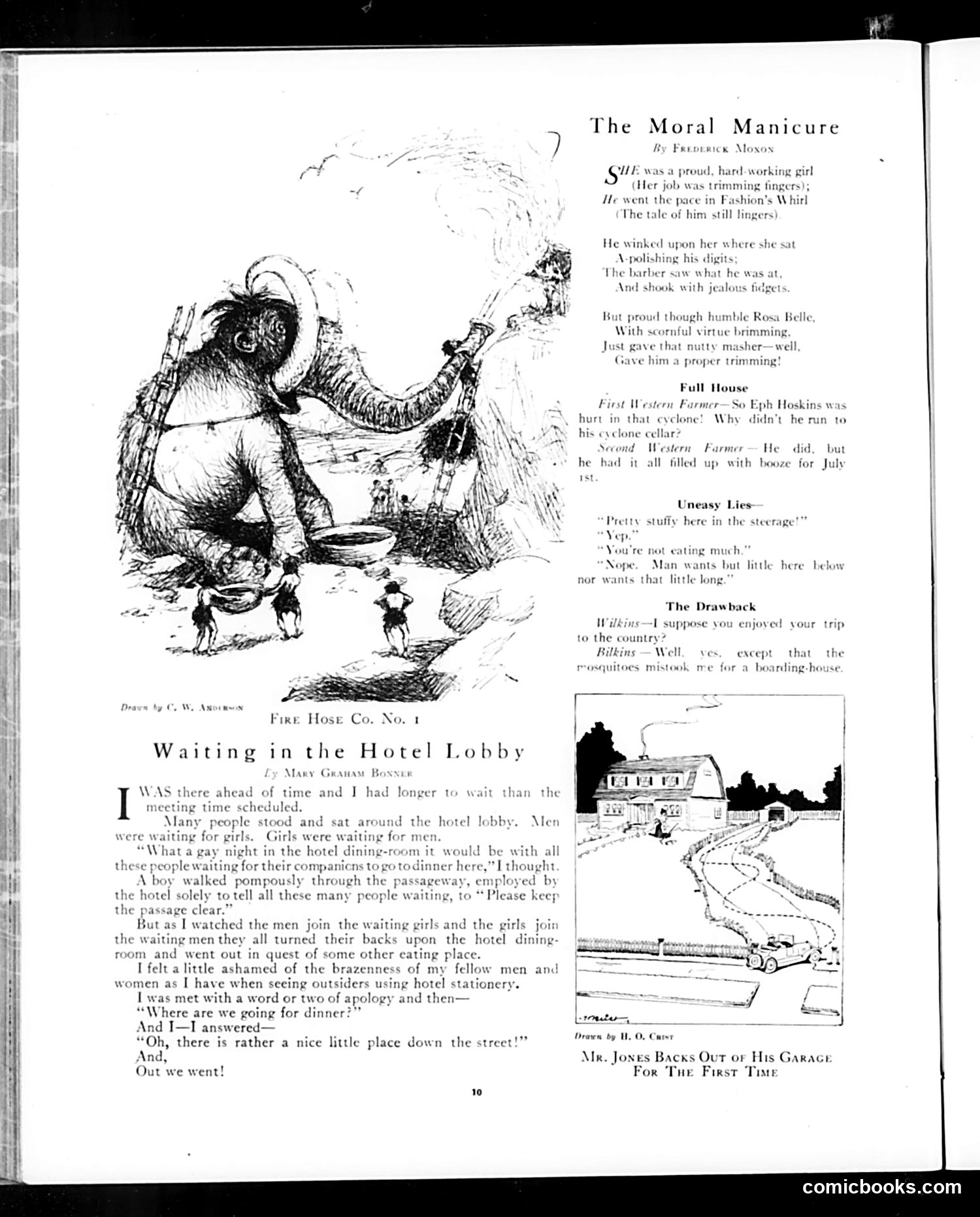
This page contains several satirical pieces typical of *Judge* magazine's social humor: **"The Moral Manicure"** tells of Rosa Belle, a manicurist who rebuffs a flirtatious male customer ("masher") by giving him a proper trimming—a play on words suggesting both her professional work and moral rebuke. The satire mocks men who presume familiarity with working-class women. **Other brief jokes** mock rural farmers (cyclone cellars filled with booze), ship passengers (steerage complaints), and country visitors (mosquitoes). **"Waiting in the Hotel Lobby"** satirizes the pretension and social awkwardness of hotel culture—a bellboy ordering people to clear passages, then guests abandoning the dining room entirely when companions arrive, preferring modest street establishments. The piece gently mocks the artificial hierarchy and performative etiquette of hotels. The cartoon drawings by C.W. Anderson and H.O. Caver illustrate these everyday social scenarios with gentle mockery of contemporary American manners and class interactions.
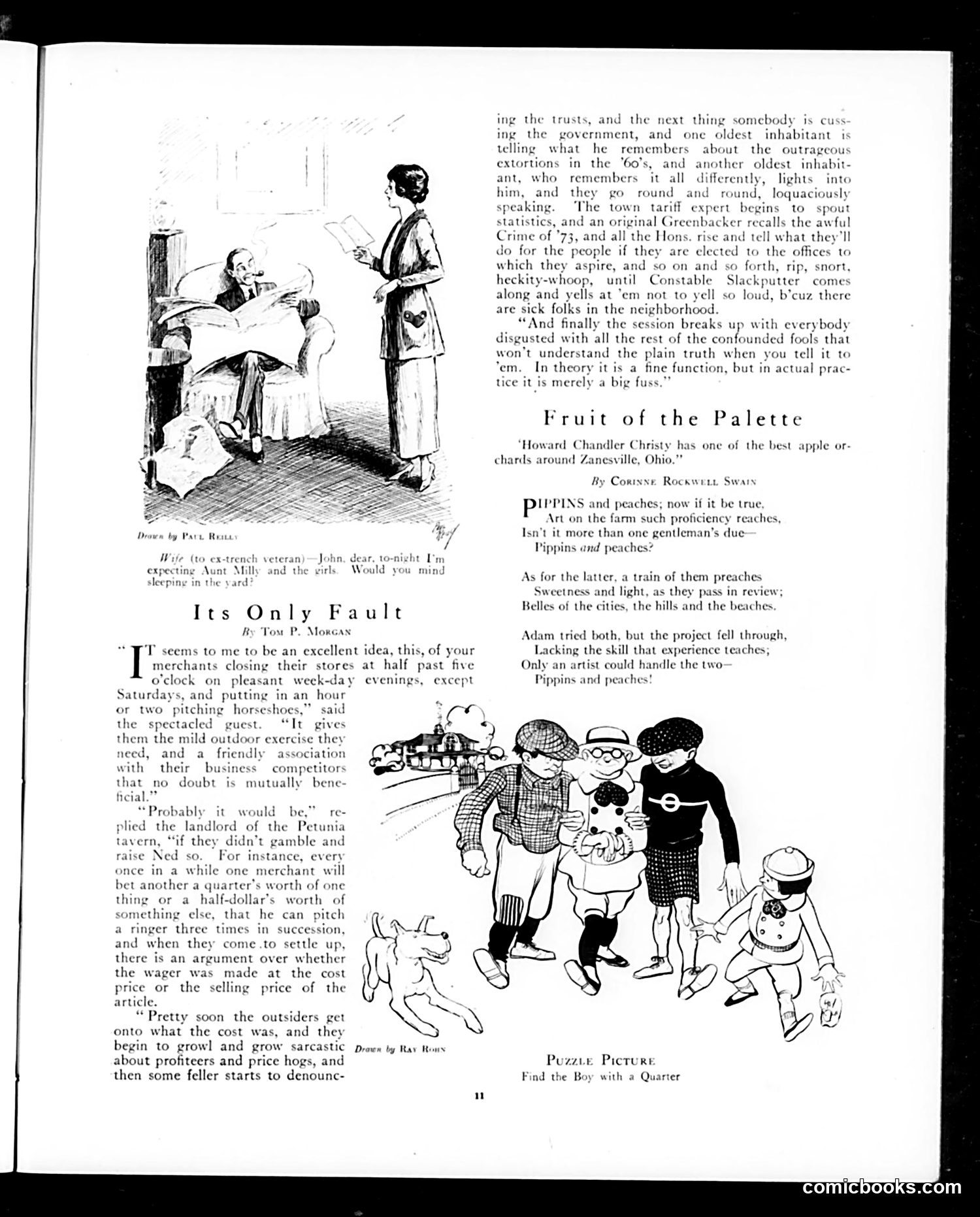
This satirical piece mocks American civic discourse through a simple premise: two men discuss merchants closing stores early to pitch horseshoes—seemingly wholesome recreation. The tavern keeper's response reveals the satire's target: these casual wagers spiral into community arguments about price-fixing, profiteering, government corruption, and historical grievances (referencing the "Crime of '73"—likely the demonetization of silver). Local politicians seize the moment to campaign with empty promises. The joke captures how Americans transform any minor disagreement into partisan bickering, with everyone "disgusted" afterward. This reflects Judge magazine's skepticism toward both business practices and political opportunism during the Progressive Era. The cartoon suggests that ordinary civic gatherings become occasions for unleashing deep economic anxieties and distrust rather than genuine community building.
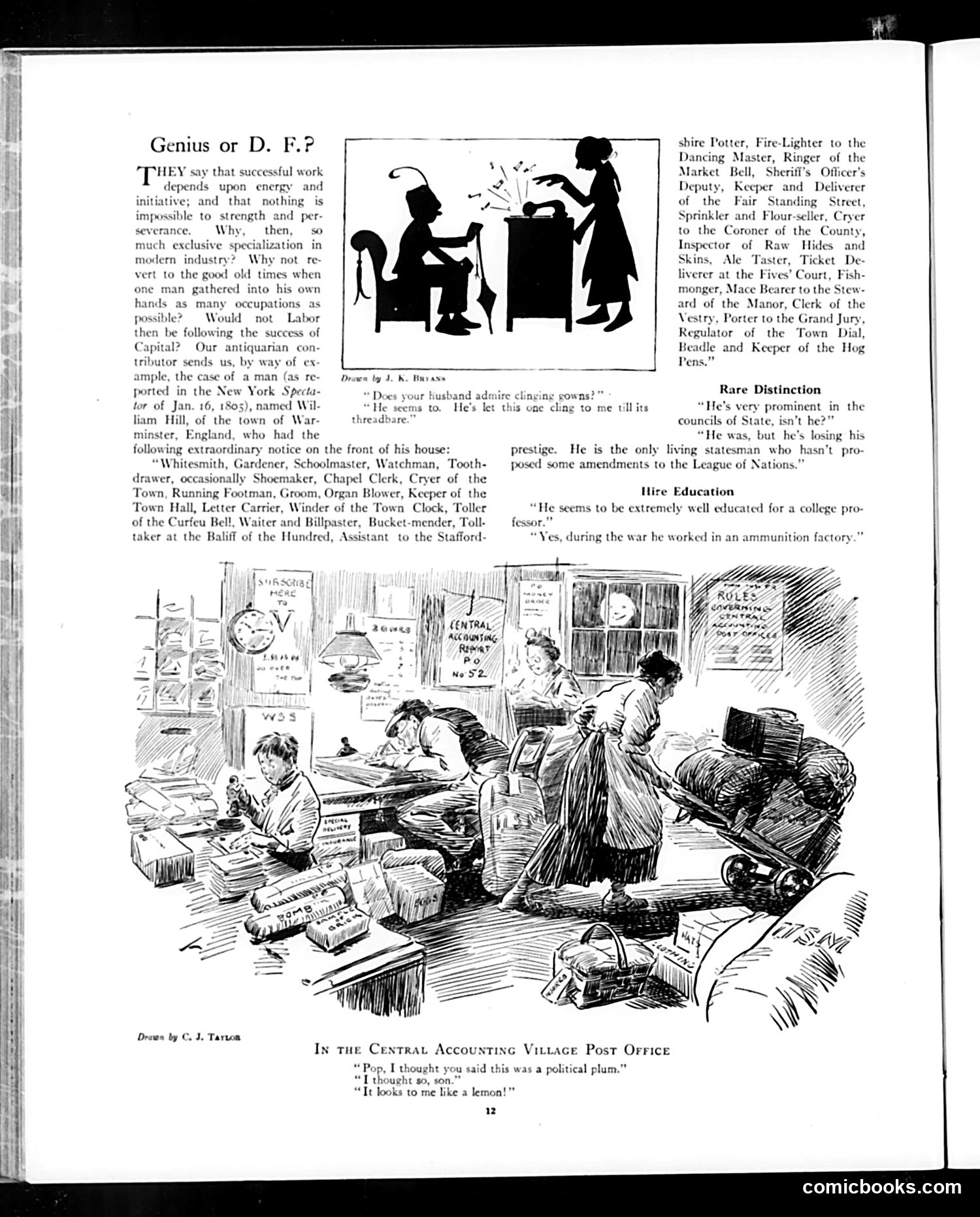
This page contains two satirical pieces from Judge magazine: **Top section ("Genius or D.F?")**: Mocks the idea of reverting to pre-industrial generalist work. It sarcastically lists a real 1805 English man (William Hill) who held numerous simultaneous occupations (whitesmith, schoolmaster, tollkeeper, etc.). The satire argues this is inefficient compared to modern specialization—the opposite of what the opening rhetorical questions suggest. **Middle cartoon**: Shows a chaotic post office. The joke appears to reference how a government job (a "political plum"—a patronage appointment) turns out to be disappointing ("a lemon"), likely commenting on inefficiency or corruption in government-appointed positions. **Bottom sections**: Two brief satirical dialogue jokes—one about a statesman who's "losing prestige" because he hasn't proposed League of Nations amendments (topical to the post-WWI era), and another mocking a college professor's credentials based on wartime factory work rather than academic achievement. The overall theme criticizes both nostalgia for the past and contemporary institutional dysfunction.
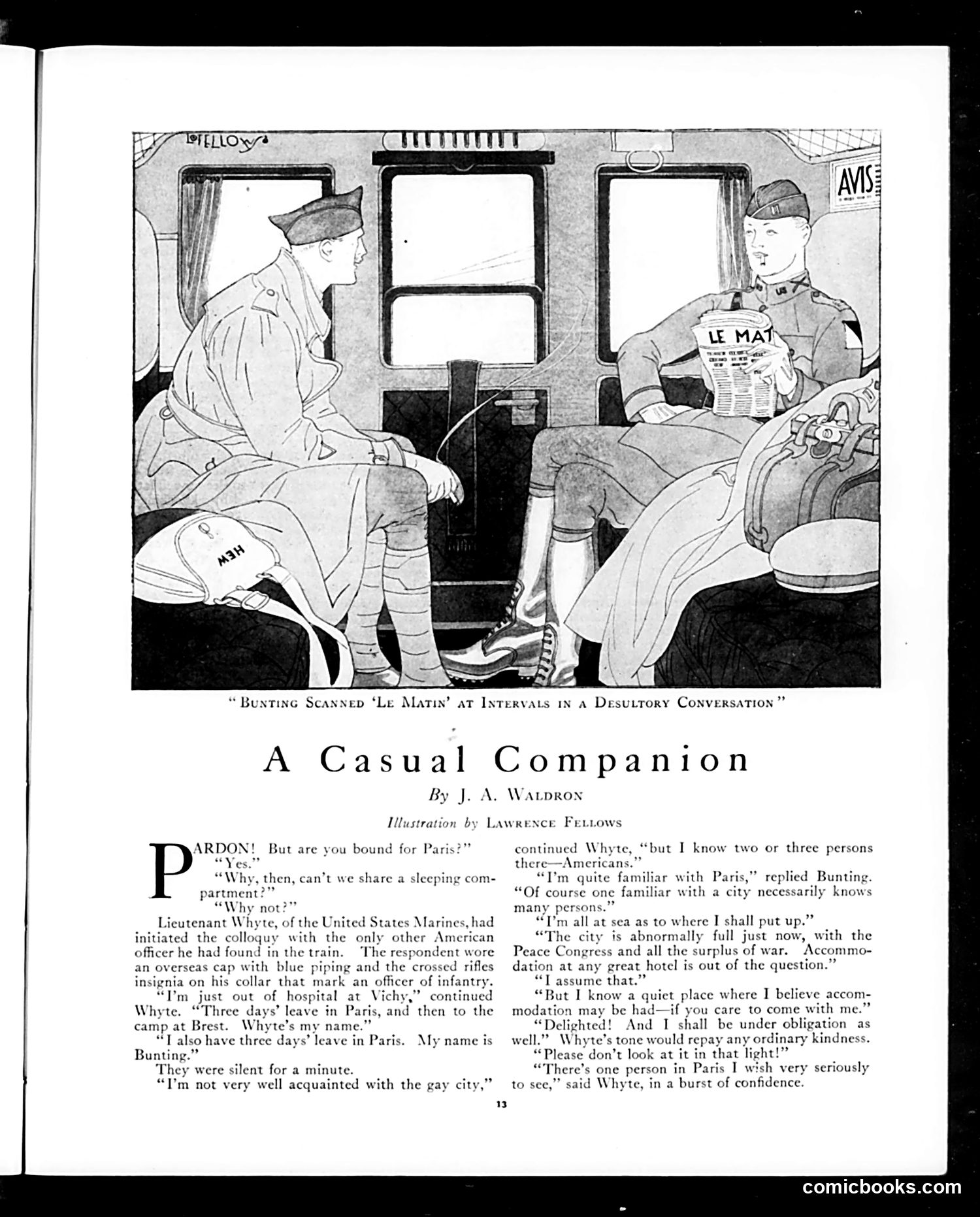
This is a story illustration rather than a political cartoon. It depicts two American military officers—Lieutenant Whyte (U.S. Marines) and an infantry officer named Bunting—meeting on a train bound for Paris after World War I. The narrative concerns post-war accommodations in Paris, which is overcrowded due to the Peace Congress (likely the Paris Peace Conference of 1919). The illustration's caption jokes about one officer reading "Le Matin" (a French newspaper) during their "desultory conversation." The satire appears gentle: it mocks the officers' difficulty finding lodging in a war-disrupted city and Whyte's unfamiliarity with Paris despite being an American military man. Bunting's offer of help and Whyte's gratitude suggest themes of American servicemen navigating post-war Europe. The story seems designed as light, humorous entertainment for Judge's readers rather than pointed political commentary.
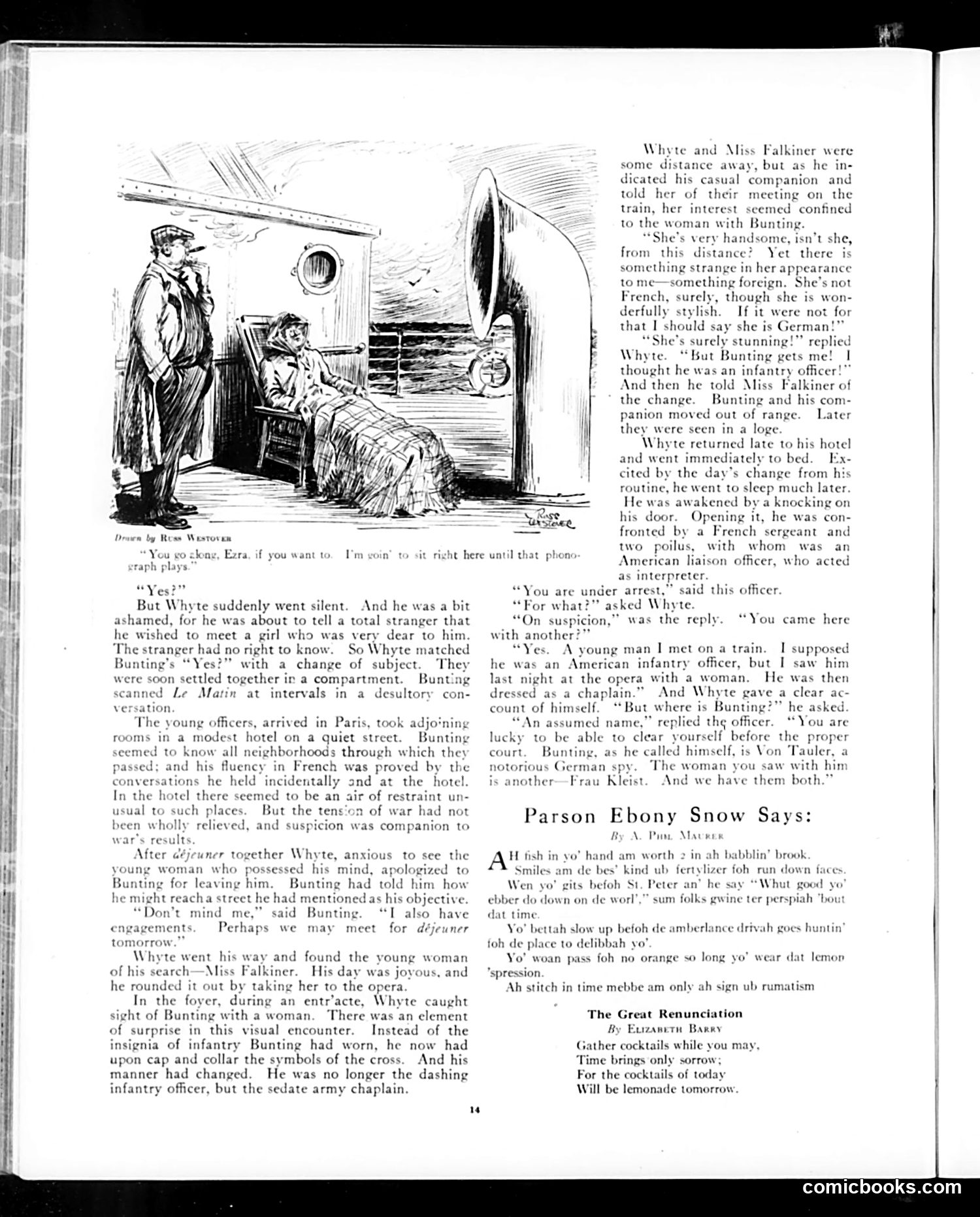
This page contains a serialized story about military deception during World War I. The narrative follows Officer Whyte, who meets a fellow soldier named Bunting on a train to Paris. Later, Whyte spots Bunting at the opera with a stylish foreign woman and notices he's now wearing a chaplain's insignia instead of infantry insignia. Whyte is subsequently arrested by French authorities and interrogated. He explains his encounter with Bunting, who is revealed to be "Von Tauler," a notorious German spy. The woman is identified as "Frau Kleist," another German agent. The story exploits contemporary fears of enemy infiltration and espionage during WWI. The page also includes unrelated humor columns typical of Judge magazine's satirical format.
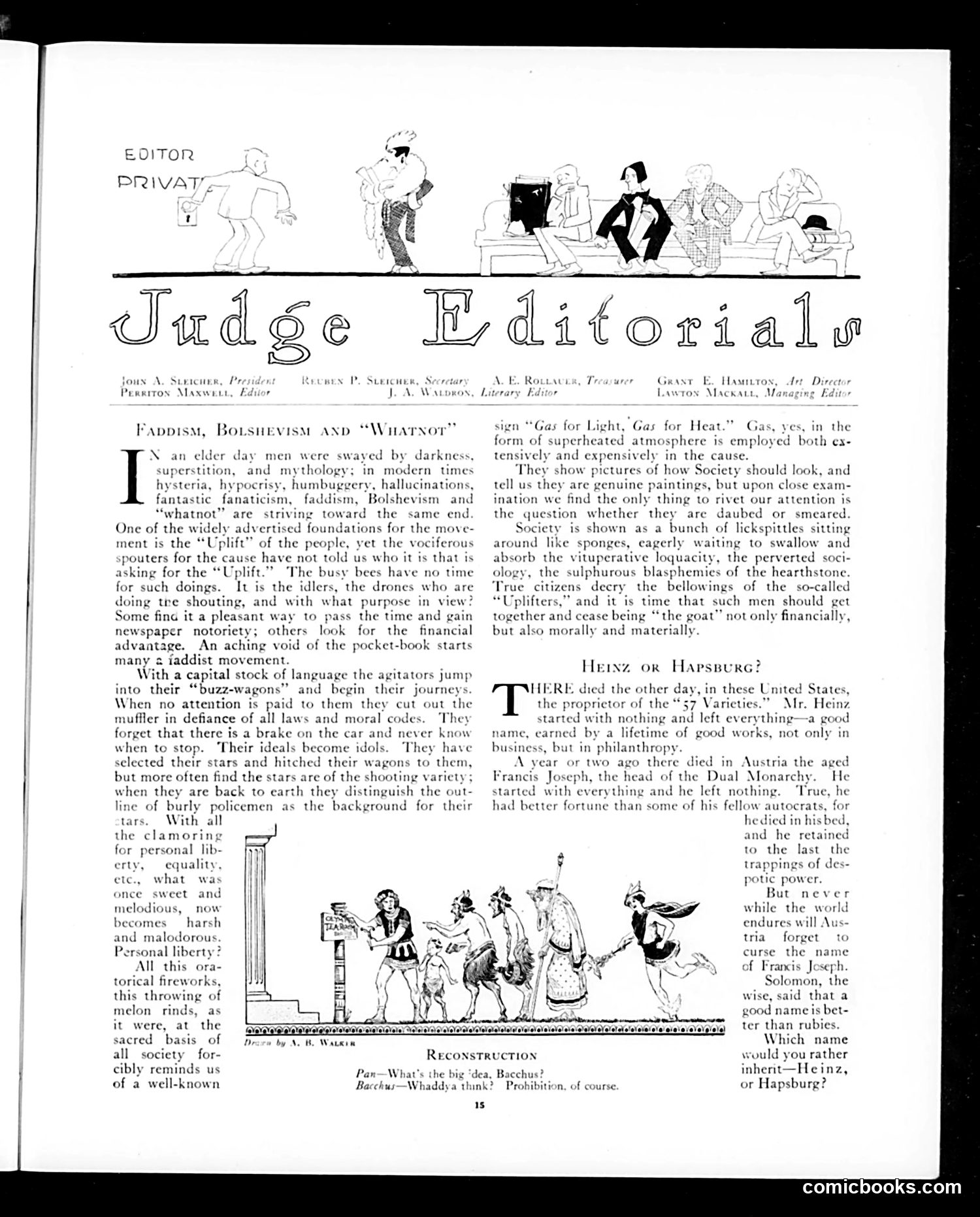
This editorial page attacks progressive reform movements—"Faddism, Bolshevism and 'Whatnot'"—as hypocritical and self-serving. The first article criticizes activist "agitators" who claim to seek an "Uplift" of the people but are actually motivated by ego, financial gain, and attention-seeking. The writer dismisses their idealism as empty rhetoric ("gas"), comparing reformers to reckless drivers who've cut their mufflers and lost control. The second piece, "Heinz or Hapsburg?", contrasts the recently deceased H.J. Heinz (the "57 Varieties" founder) with Austria's Emperor Francis Joseph. Heinz built wealth through honest work and philanthropy, earning a lasting good name; Francis Joseph inherited everything and left nothing but the trappings of autocratic power. The satire's point: which legacy would you rather inherit—one built on merit and generosity, or one based on dynastic entitlement? The cartoon below shows a "Reconstruction" scene (unclear specifics), likely commenting on post-WWI conditions.
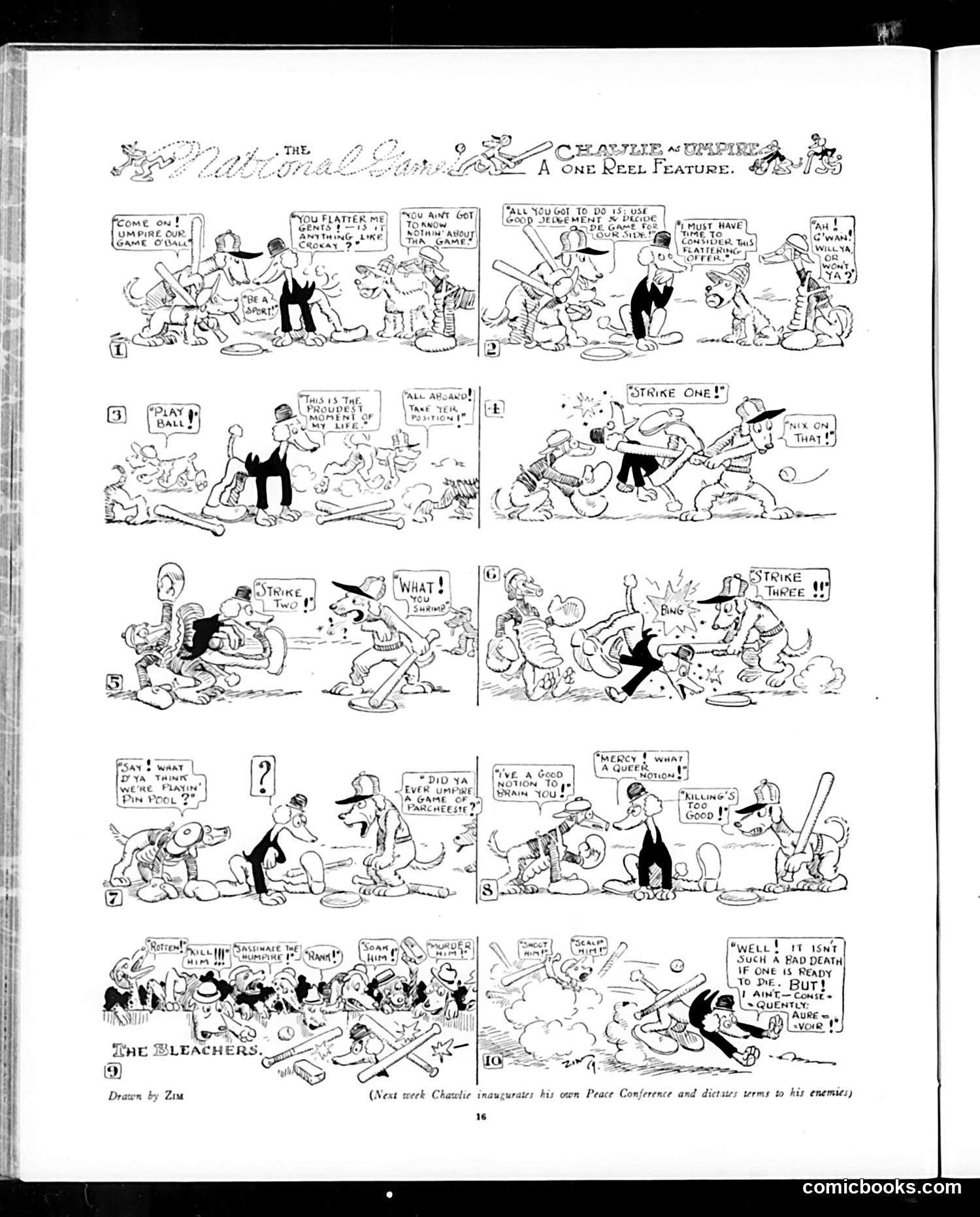
This is a one-reel silent film comedy strip, drawn by Zim for Judge magazine. The narrative follows a baseball game between what appears to be an "Umpire" team and "The Bleachers" (working-class spectators/fans). The satire depicts the chaos of amateur baseball: an umpire making questionable calls, players arguing, and escalating violence—strikes, brawls, and eventually deaths. The humor derives from exaggerating the sport's competitiveness into absurdity, with characters debating whether dying "in the game" constitutes honorable sacrifice. The joke targets both baseball's rough culture and the earnest romanticization of athletic competition. The working-class "bleachers" crowd (referenced in the title) were stereotypically rowdy, so depicting them as chaotic participants plays on contemporary class-based stereotypes about lower-income sports fans. This represents early Judge-style physical comedy satire of American leisure culture.
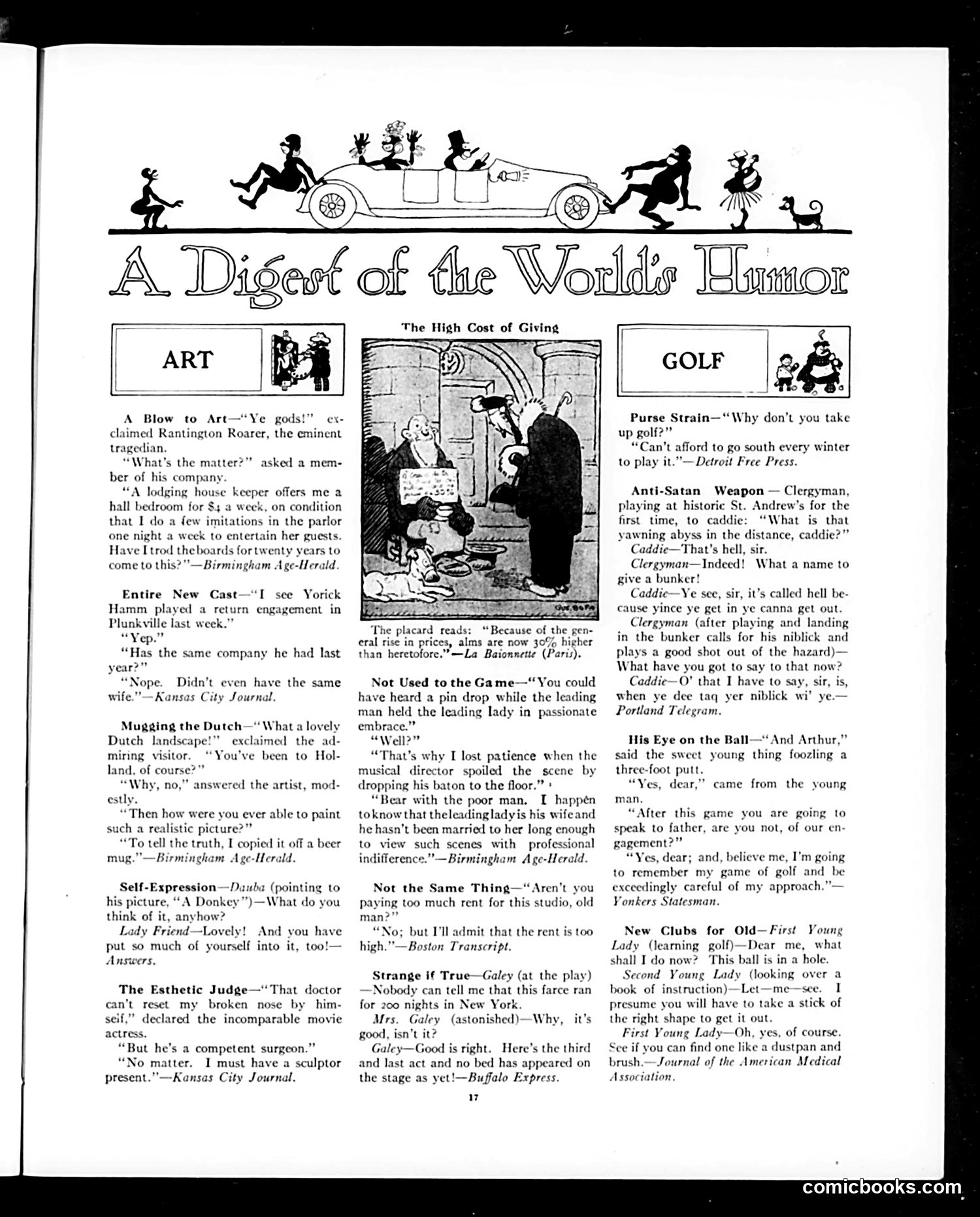
This page collects brief satirical anecdotes about early 20th-century American life, organized by topic (Art, Golf, etc.). The humor targets several social anxieties: **Art section**: Mocks struggling performers and artists. A famous tragedian must perform cheap imitations for lodging; a painter admits copying beer mugs instead of studying nature—satirizing the pretense of artistic authenticity during economically difficult times. **Golf section**: Jokes about golf's expense (requiring winters in the South) and the sport's social climbing associations. A clergyman mistakes a sand bunker for "hell"—satirizing religious figures' unfamiliarity with modern leisure activities. **General theme**: The "High Cost of Giving" (central illustration, unclear detail) reflects Depression-era anxieties about economic strain affecting entertainment, art patronage, and leisure pursuits. These anecdotes mock both the wealthy's complaints about inflation and working-class people's aspirations to respectability through cultural participation. The publication credits various newspapers (Birmingham Age-Herald, Kansas City Journal, etc.), indicating Judge syndicated humor nationally.
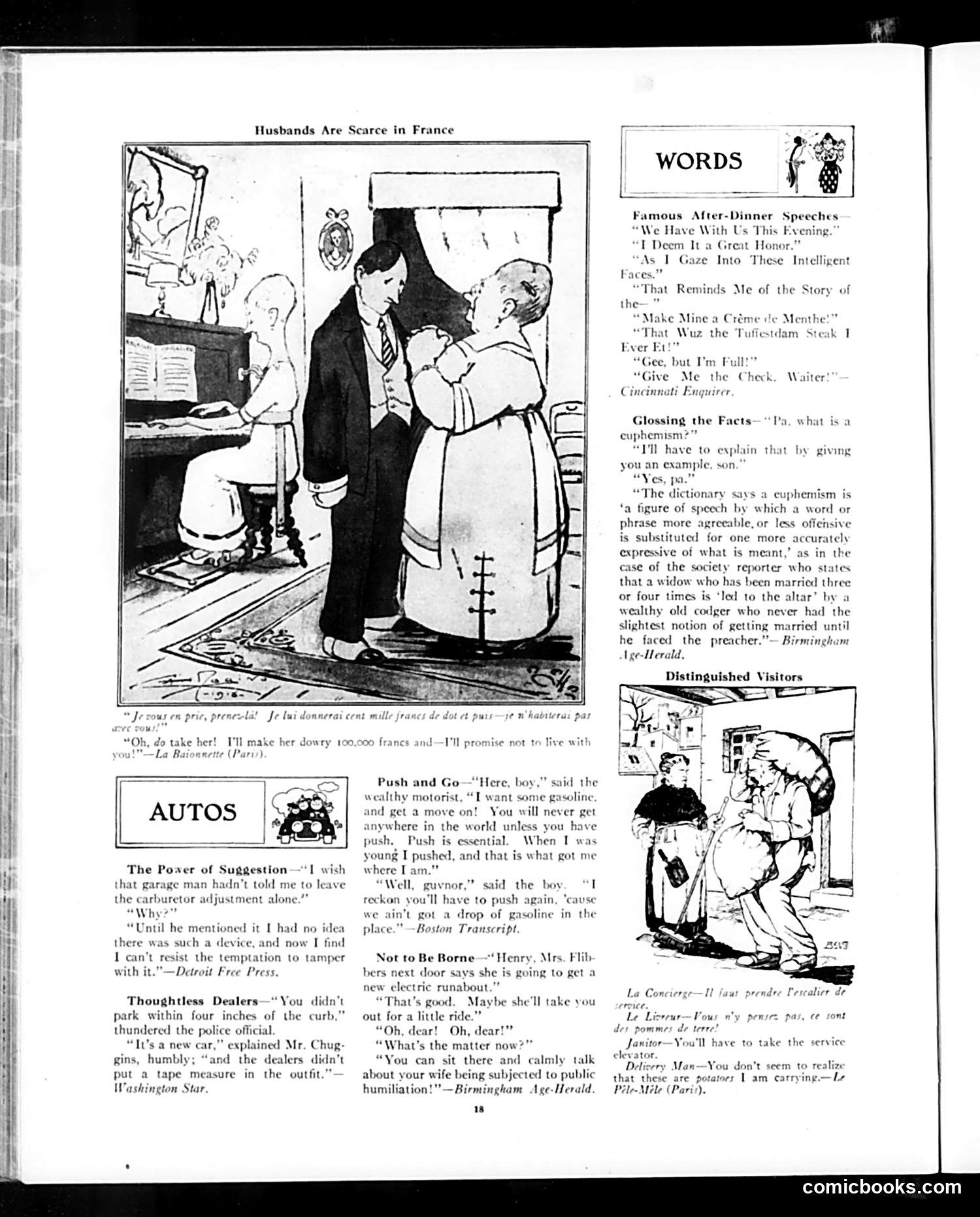
The main cartoon satirizes post-WWI France, where male casualties left a shortage of marriageable men. A woman (likely French, given the French dialogue caption) negotiates with a suitor, offering him a substantial dowry (100,000 francs) and promising not to live with him—desperation tactics reflecting the genuinely difficult marriage market for French women after the war's massive losses. The surrounding sections are unrelated humor pieces about automobiles, etiquette, and wordplay. The "AUTOS" section mocks early motorists' mechanical ignorance and aggressive driving philosophy. "WORDS" defines euphemisms—using the example of society reporters calling remarriages "being led to the altar" when the groom has no intention of marriage. The satire's bite: France's demographic crisis made marriage negotiations transactional and absurd, with women offering money and minimal domestic involvement just to secure husbands.
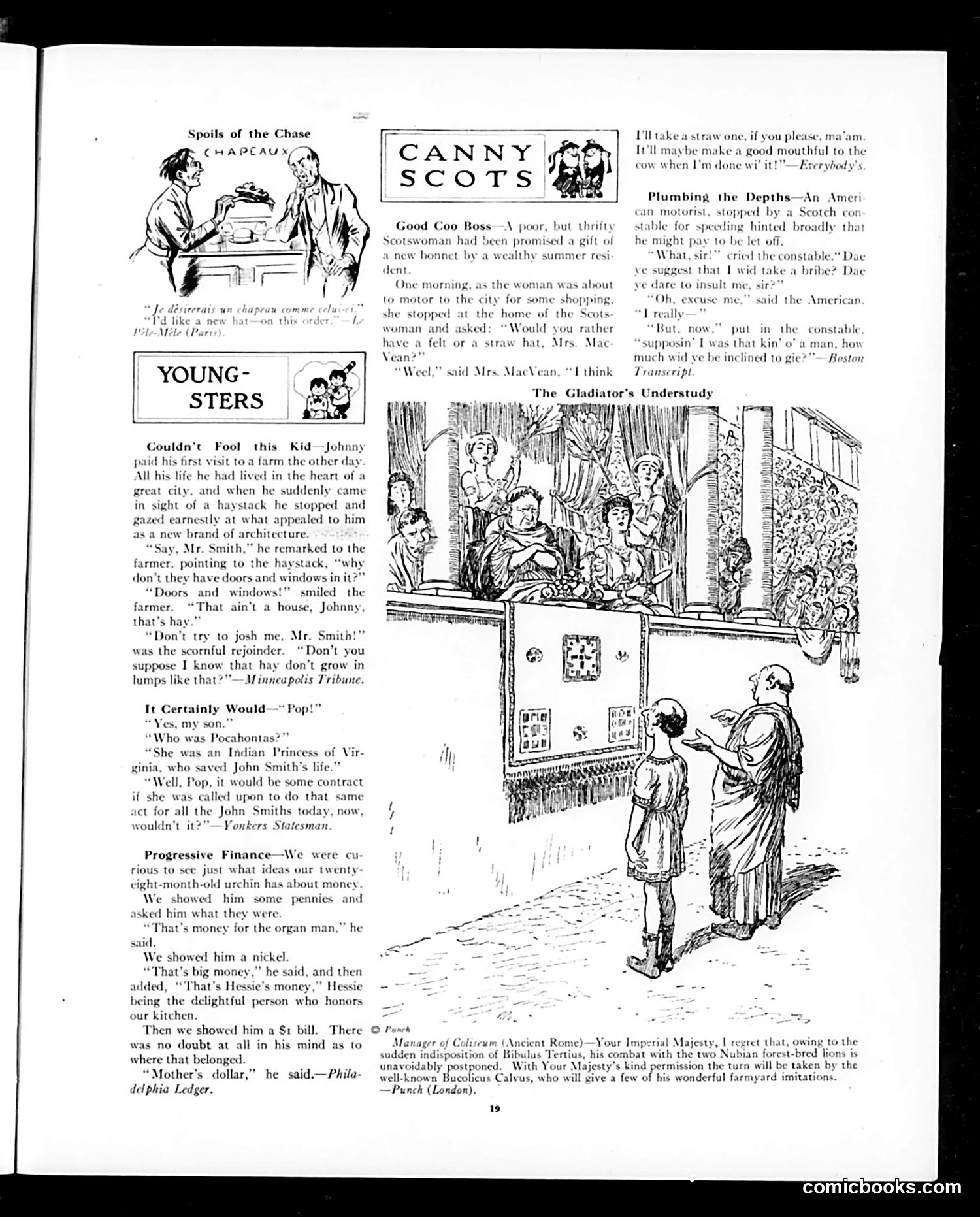
This page contains several humor items typical of early 20th-century American satirical magazines: **"Canny Scots"** depicts a wealthy summer resident offering a Scottish woman a choice of hat as a gift. She chooses straw because it will feed her cow afterward—satirizing the stereotype of Scots as miserly and practical to the point of absurdity. **"Youngsters"** section collects brief anecdotes about children's logic, including a city boy who thinks a haystack is architecture, and children's emerging understanding of money and social hierarchy. **"The Gladiator's Understudy"** (illustration): The caption references a Roman coliseum manager postponing a gladiator combat due to illness, humorously suggesting a replacement performer will substitute—likely satirizing theatrical understudies or unreliable performers. The scattered items mock ethnic stereotypes (Scottish thriftiness), children's innocent misunderstandings, and contemporary theatrical/entertainment practices. The humor relies on wordplay, exaggeration, and cultural assumptions now considered dated or offensive.
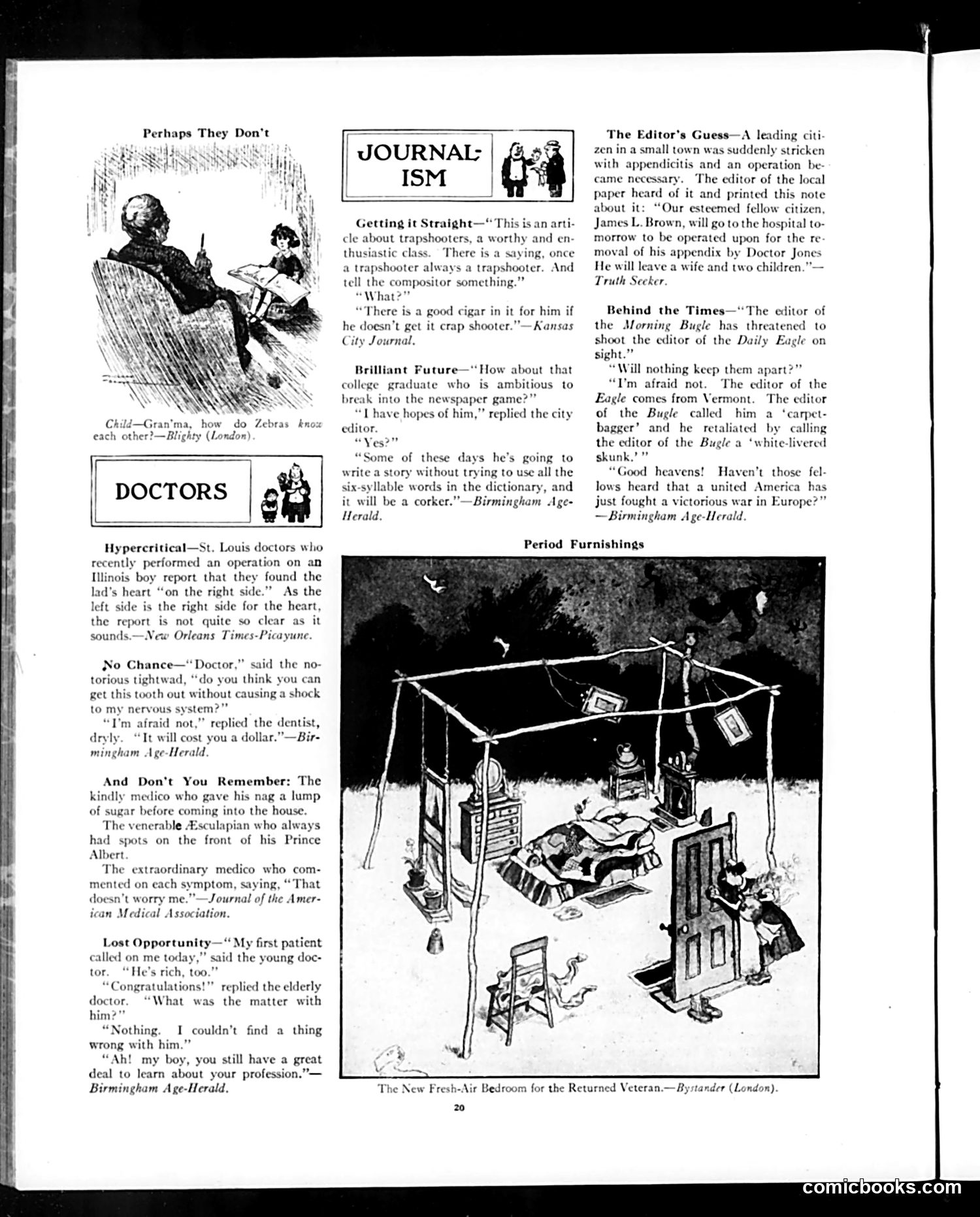
This page from **Judge** magazine contains humorous anecdotes about doctors and journalism, likely from the early 20th century (post-WWI, based on a Europe war reference). **The "Doctors" section** presents four brief jokes satirizing physicians' incompetence or greed: St. Louis doctors misdiagnosing heart position, a dentist extorting payment, doctors making callous remarks, and a young doctor failing to identify his wealthy patient's health problem—then being scolded for not capitalizing on the opportunity. **The "Journalism" section** mocks newspaper editors and writers: incompetent typesetters, rivalries between competing small-town papers (Morning Bugle vs. Daily Eagle), and a local editor's hilariously inappropriate obituary announcement that focuses on surgical details rather than mourning. **The "Period Furnishings" illustration** depicts a makeshift bedroom for a returning WWI veteran, showing resourcefulness but also the inadequate post-war conditions soldiers faced. The satire targets professional incompetence and small-town parochialism in the post-WWI era.
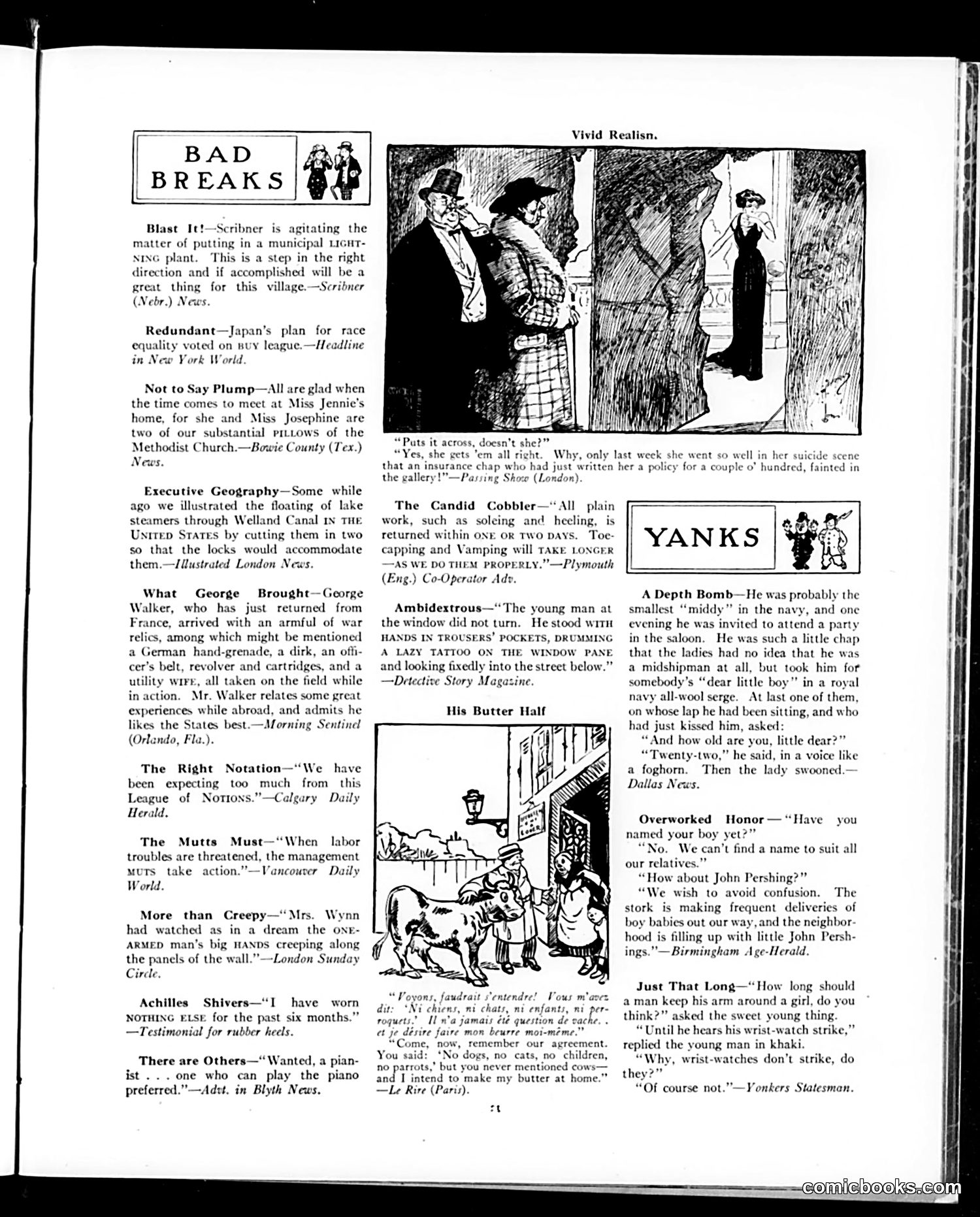
This page from *Judge* magazine contains brief humorous newspaper clippings (the "Bad Breaks" section) exploiting unintentional double meanings and awkward phrasings from actual published notices. Key examples: - **"Substantial pillows"**: A church notice meant to praise two women but accidentally calls them fat. - **"Nothing else for six months"**: A rubber heel testimonial that reads as if someone wore only heels with no clothing. - **"One-armed man's big hands creeping"**: A London story excerpt creating unintended horror through anatomical impossibility. The **"His Butter Half"** cartoon shows a woman defying her husband's household rules by keeping a cow to make her own butter—satirizing domestic power struggles and wives' resourcefulness. The **"Vivid Realism"** and **"A Depth Bomb"** sections continue this satirical humor about everyday absurdities and social situations, including a tiny naval officer mistaken for a child. The humor relies on readers catching the unintentional comedic implications in real-world writing—a staple of *Judge*'s satirical format.
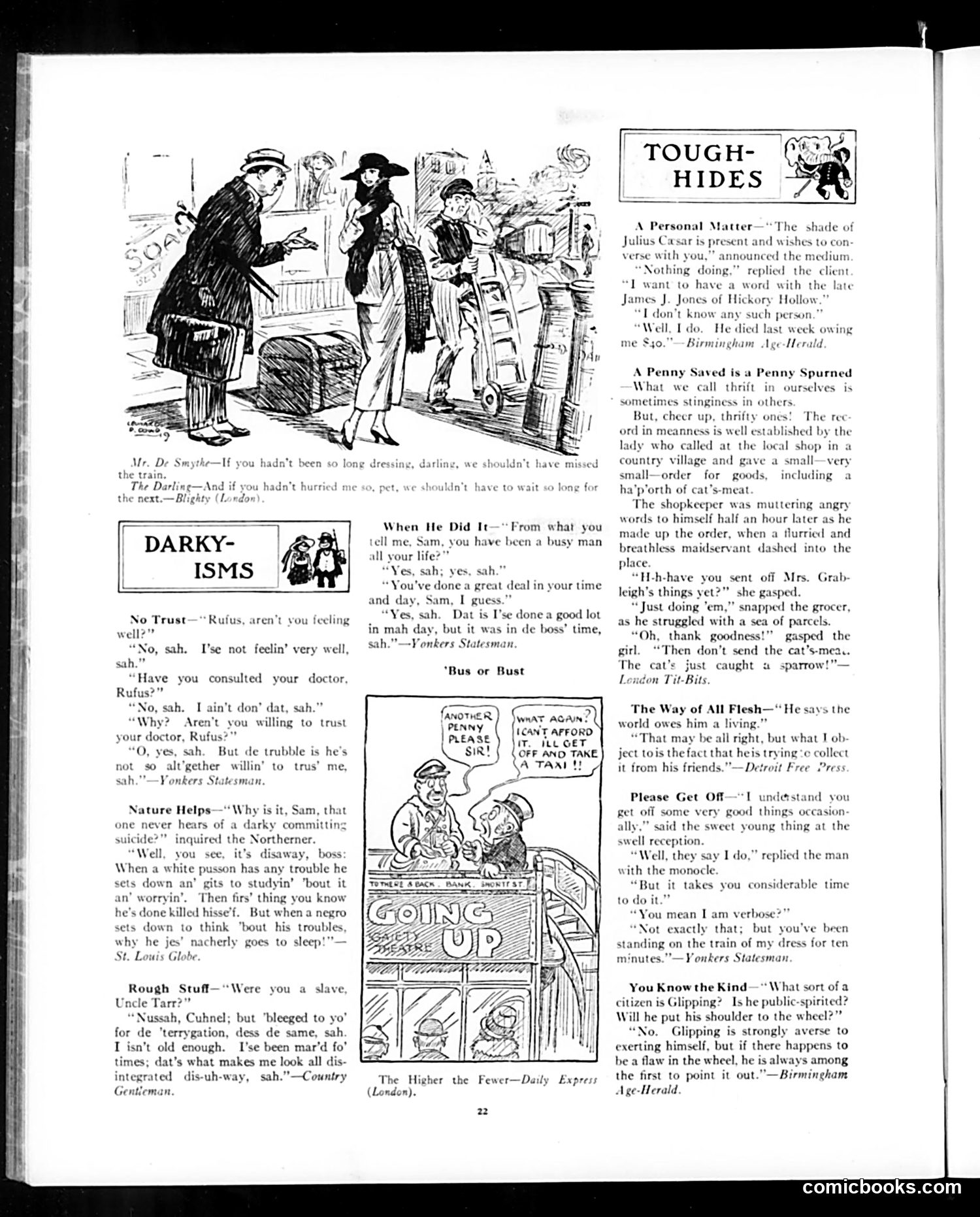
This page from *Judge* contains several brief humorous anecdotes ("Darkisms," "Tough-Hides") typical of early 20th-century American satirical magazines. The content relies heavily on racial stereotypes now considered deeply offensive. The "Darkisms" section features dialect humor depicting African American characters in subservient positions, including a formerly enslaved man and a doctor-patient exchange. These pieces perpetuate harmful stereotypes about Black Americans for white audience amusement. The remaining anecdotes ("A Personal Matter," "A Penny Saved," "The Way of All Flesh," etc.) are general-interest jokes about human nature—greed, verbosity, hypocrisy—with no specific political content. The cartoon "Bus or Bust" depicts financial struggle during economic hardship, showing someone unable to afford transit. **Context for modern readers:** This represents the casual, normalized racism embedded in mainstream American media of this era, reflecting attitudes that excluded and demeaned African Americans through entertainment.
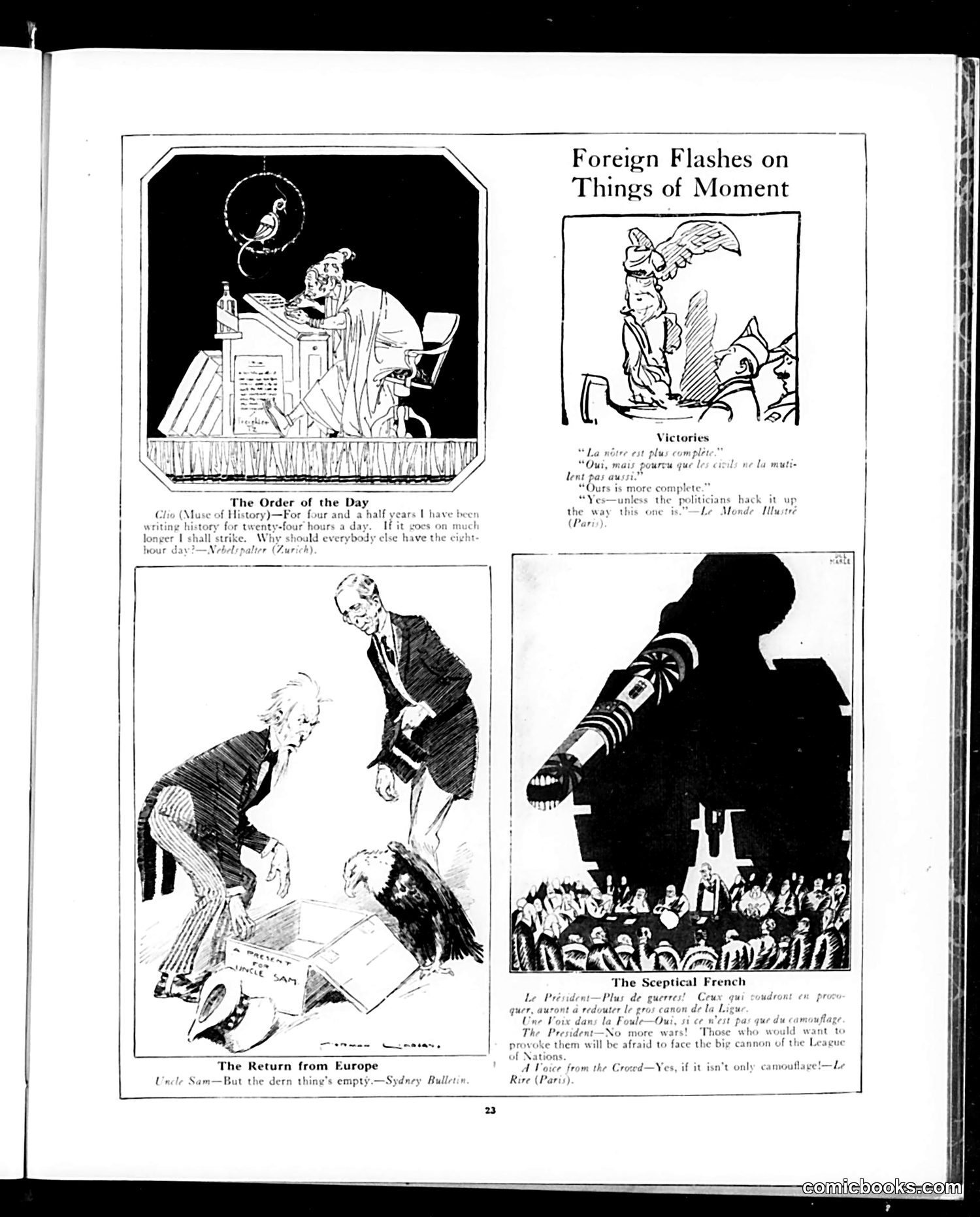
This page contains three satirical cartoons addressing post-WWI international affairs: **"The Return from Europe"**: Uncle Sam opens an empty barrel, suggesting America gained nothing material from involvement in European affairs—likely referencing post-war disappointment or financial costs of intervention. **"Victories"**: A French military figure celebrates, with French text suggesting incomplete victory and the need to "back it up," implying French military success was fragile or required ongoing support. **"The Sceptical French"**: A large cannon aimed at a crowd represents the League of Nations. The French speaker fears the League's power, suggesting French skepticism about this international body's ability to prevent future conflict. These cartoons reflect American and French anxieties following World War I about international commitments and post-war security arrangements.
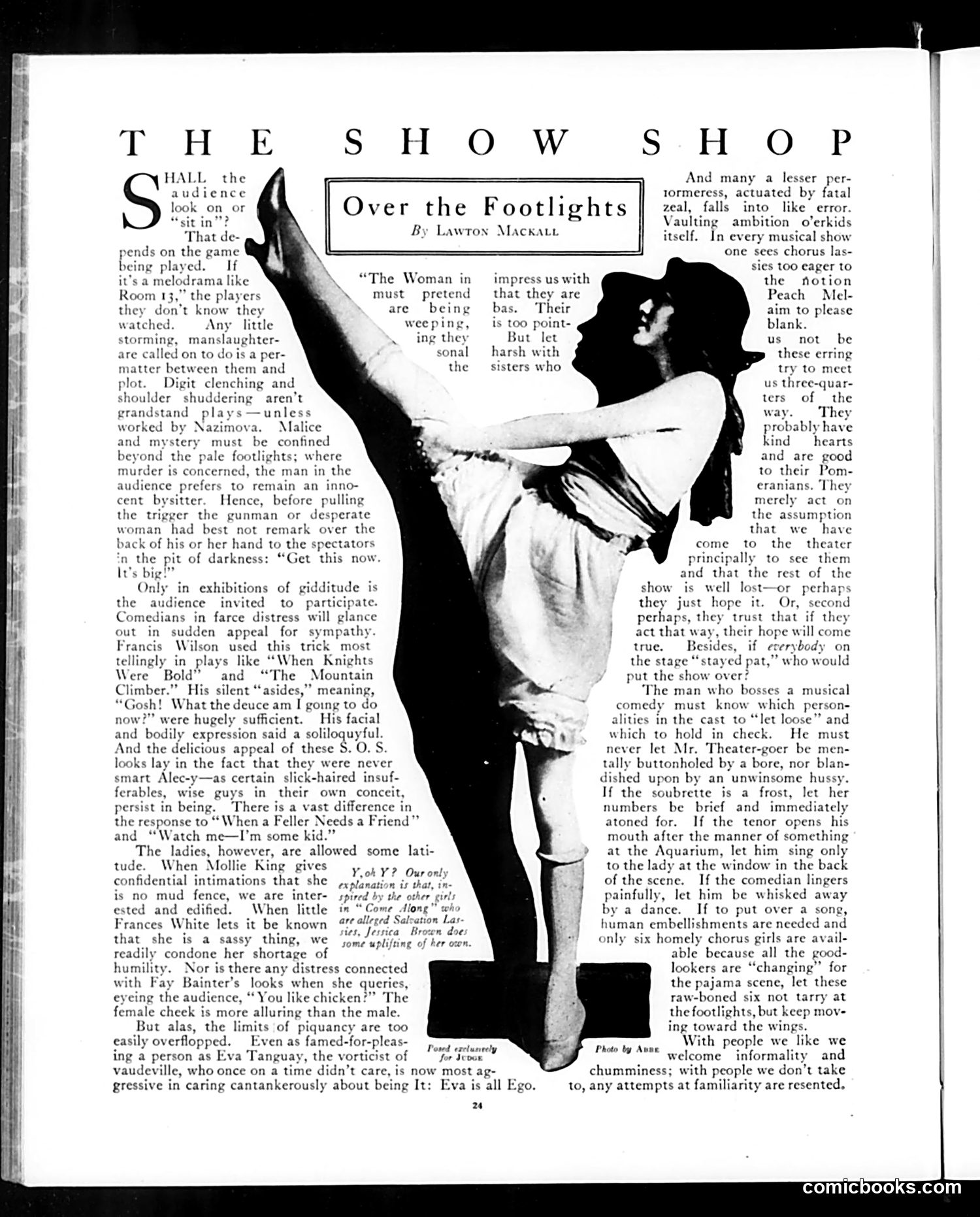
This is a theatrical column by Lawton Mackall critiquing performance styles in musical comedies. The accompanying photograph shows a chorus girl in a theatrical pose. Mackall argues against excessive mugging and "scene-stealing" by performers. He criticizes chorus girls and minor performers who overact to demand audience attention, citing this as a common failing in musical comedy. He praises restraint—using Nazimova as an exemplar of controlled acting—and argues that directors must know which cast members to "let loose" versus constrain. The piece specifically commends actresses like Mollie King, Frances White, and Fay Bainter for their ability to convey emotion subtly without undermining the show's overall effect. Mackall's central point: good theater requires ensemble discipline, not individual performers desperately seeking applause. The satire targets amateur-hour desperation and ego among stage performers.
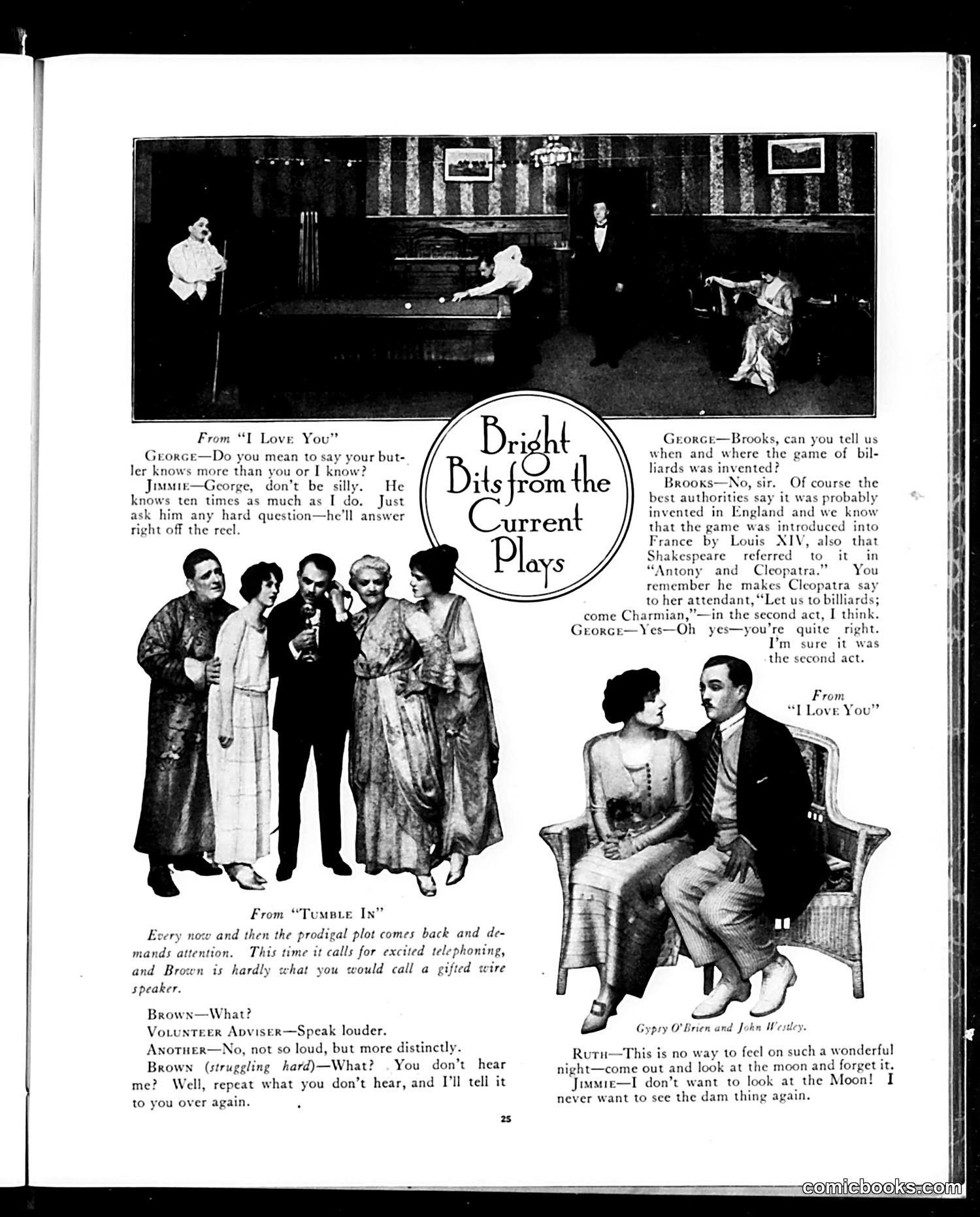
This page showcases humorous excerpts from contemporary Broadway plays, likely from the 1910s-1920s based on the aesthetic. Rather than political satire, these are comedy sketches meant to entertain readers with witty dialogue. The humor relies on class dynamics and misunderstandings. In "I Love You," a butler unexpectedly proves more knowledgeable than his employer about billiards history, deflating the gentleman's pretensions. In "Tumble In," characters struggle with a telephone connection, with Brown unable to hear callers despite repeated attempts—physical comedy around emerging telephone technology. The final scene from "I Love You" shows romantic sentiment, contrasting with the other pieces' comedic tone. The page is essentially entertainment content rather than satirical commentary, offering readers amusing dialogue excerpts and photographs from stage productions they might attend.
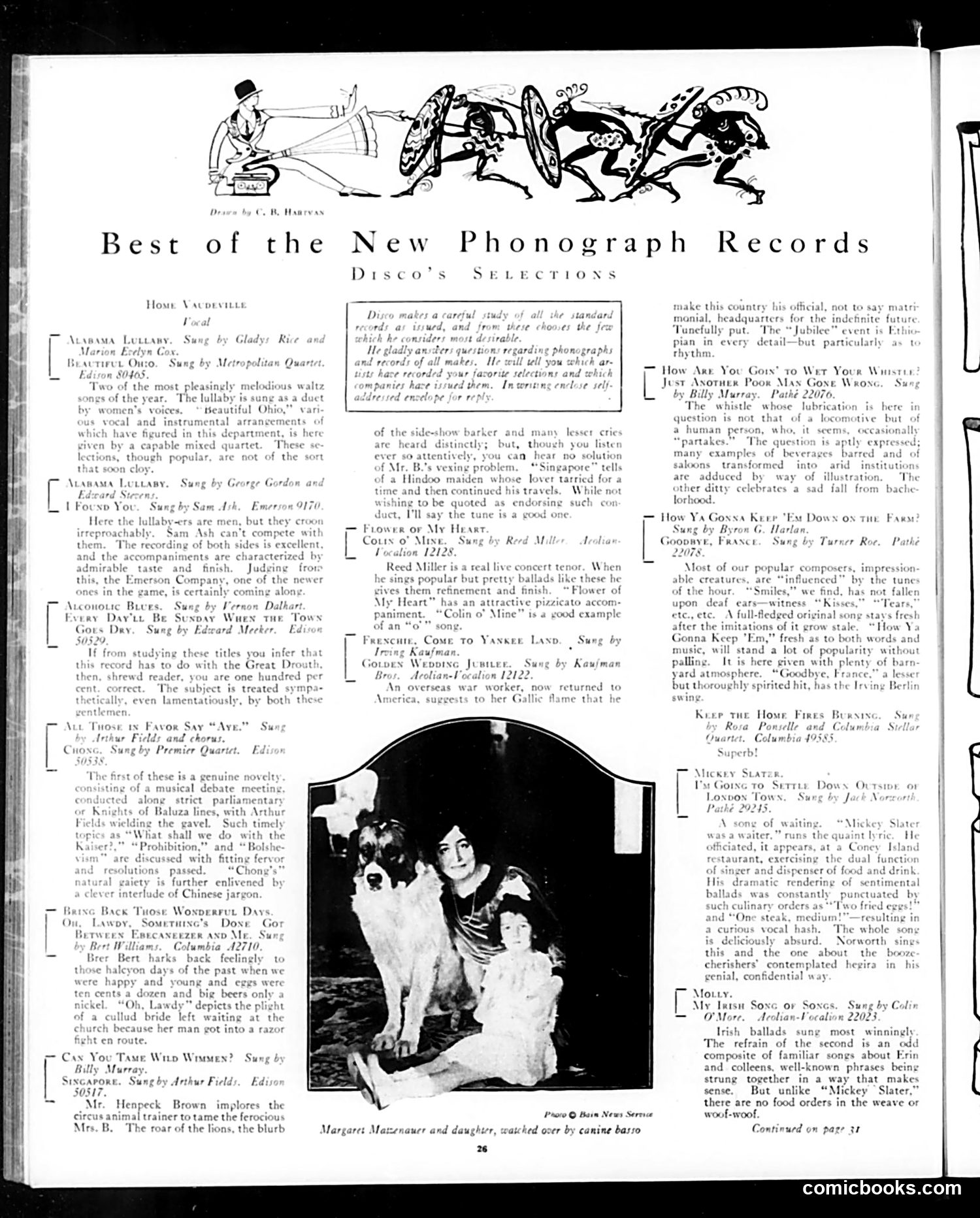
This page is primarily a **phonograph record review column** featuring Disco Records selections, not political satire. The decorative header illustration by C.R. Harriman shows abstract figures manipulating wagon wheels—likely a whimsical visual pun on "records" or musical themes. The content reviews popular 1920s-era recordings, including songs like "Alabama Lullaby" and "How Ya Gonna Keep 'Em Down on the Farm?"—the latter a post-WWI song reflecting rural-to-urban migration concerns. The central photograph shows **Margaret Matzenauer** (a noted mezzo-soprano of the era) with her daughter, supervised by a large dog—a charming domestic scene accompanying the record reviews. There is **no political cartoon or satire visible on this page**. It's essentially an entertainment column reviewing contemporary music recordings for Judge magazine's audience, reflecting early 20th-century popular culture interests.
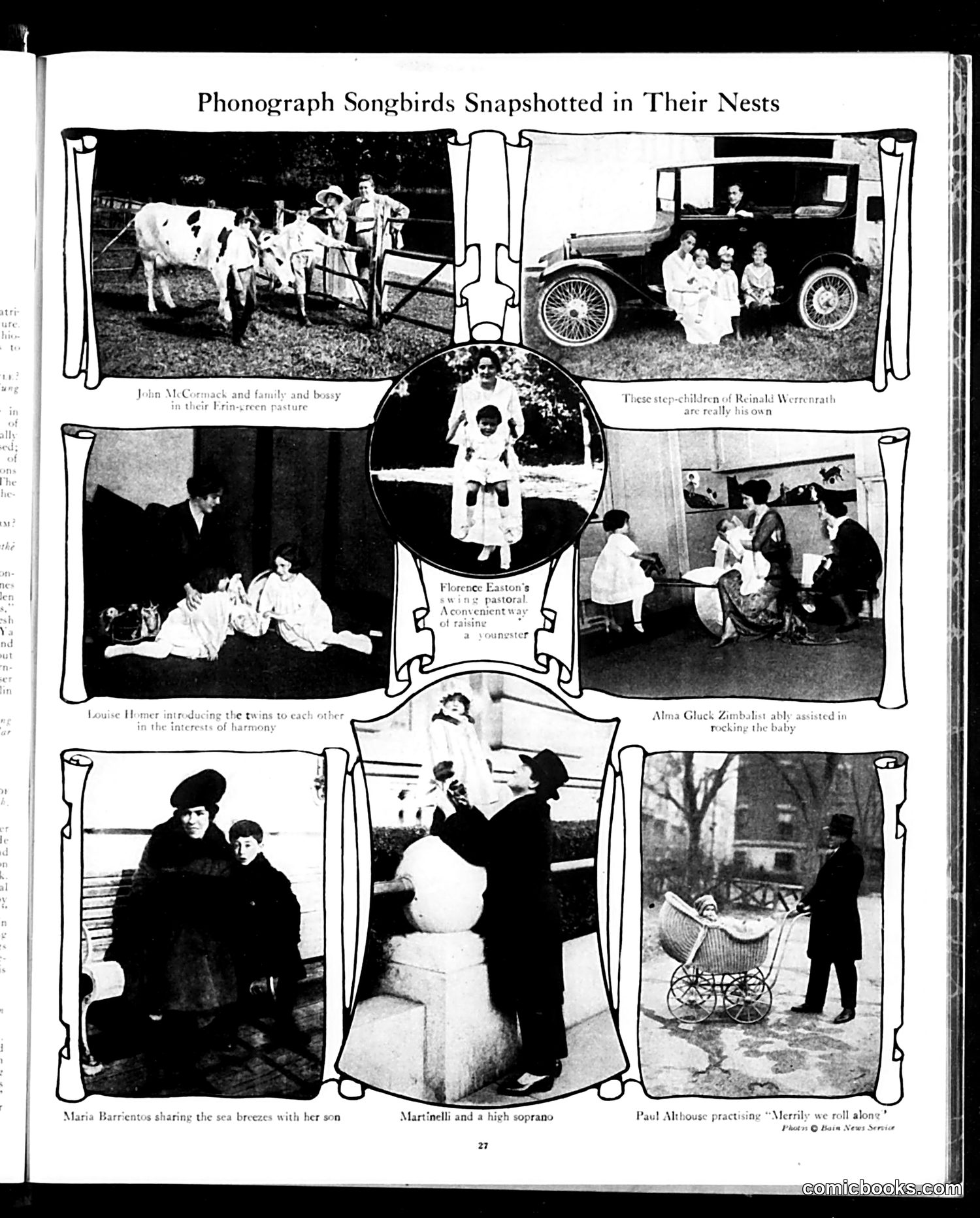
This page appears to be a humorous photo spread documenting famous opera singers and performers being "caught" in domestic, intimate moments—presented as if they were songbirds in natural habitats. The captions reference real performers like Florence Easton, Louise Homer, Marinelli, and Paul Althouse. The satire mocks the pretentiousness of high opera culture by treating celebrated singers as mere animals to be photographed. The juxtaposition of grand artistic talent with everyday domestic scenes (family outings, childcare, seaside relaxation) deflates their mystique. The title's conceit—treating human performers as "songbirds"—suggests the magazine viewed operatic performers as somewhat ridiculous or overly romanticized figures deserving comedic deflation.
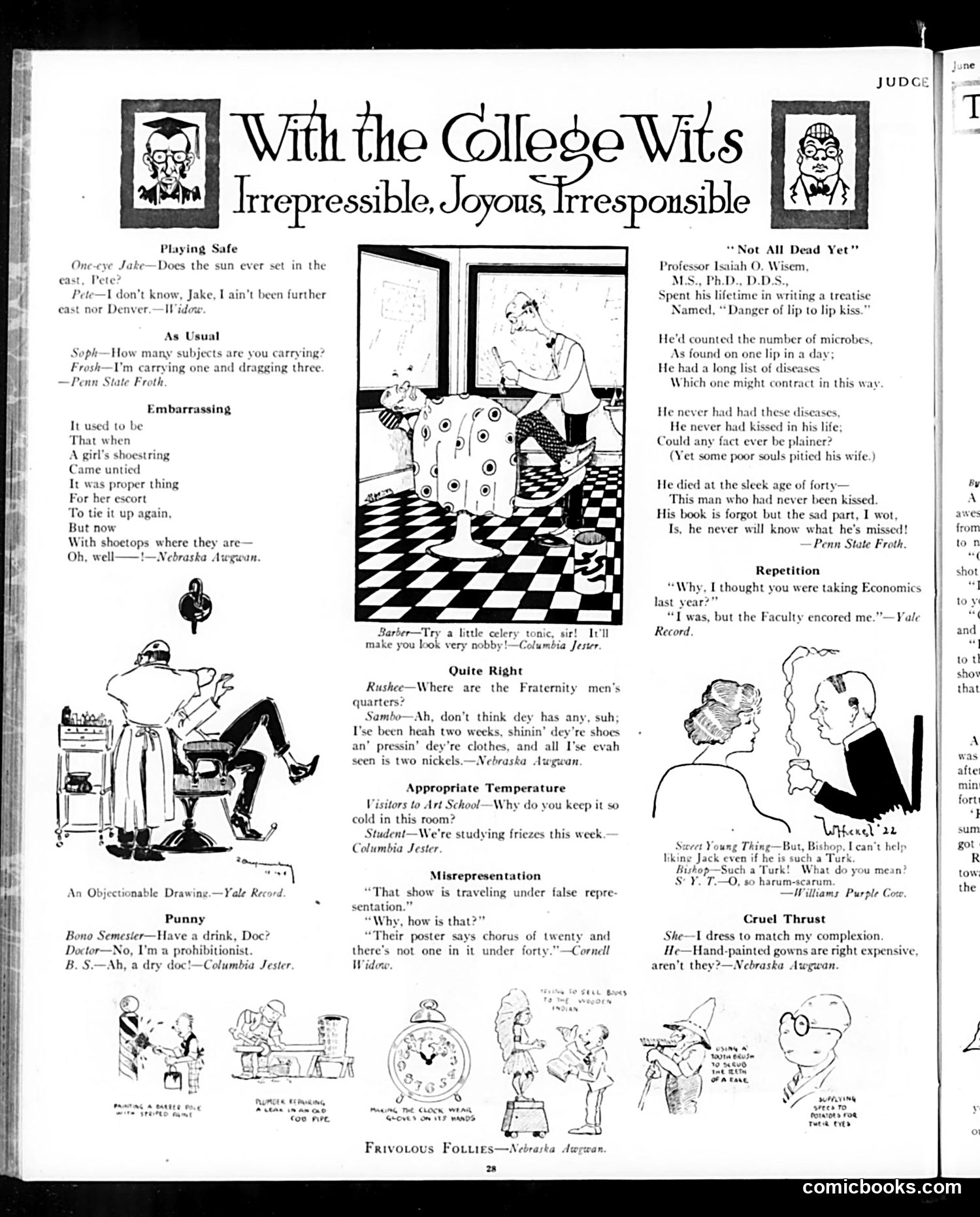
This is a collection of brief jokes and humorous anecdotes from college newspapers, typical of Judge's "College Wits" feature. The content reflects early 20th-century campus life and social attitudes: **Key items:** - "Playing Safe" mocks rural ignorance - "Embarrassing" jokes about changing women's fashion (shorter skirts/hemlines) making it awkward for chivalrous escorts - "Quite Right" uses a racist stereotype (a Black servant character) to joke about fraternity hazing—pledges only receive small tips rather than meals - "Not All Dead Yet" satirizes an overly cautious professor obsessed with germs from kissing, who dies without ever experiencing intimacy - Various puns on "dry doc" (prohibition-era humor) and college life The page mixes gentle campus satire with period attitudes toward gender, race, and propriety that modern readers would find outdated or offensive.
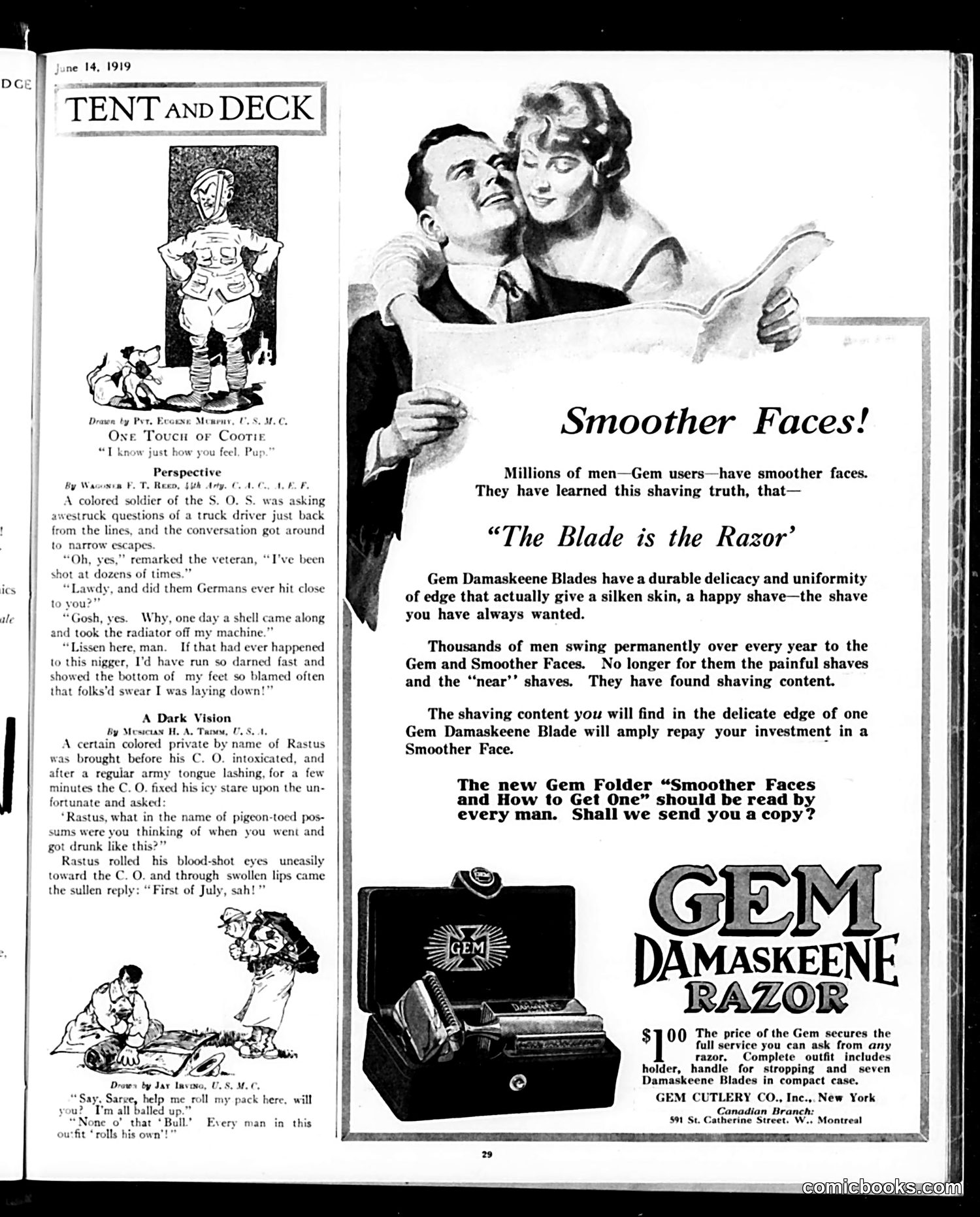
This page combines satirical cartoons about African American soldiers with a razor advertisement. **The cartoons** ("One Touch of Cooties," "Perspective," and "A Dark Vision") use offensive racial stereotypes and dialect to depict Black soldiers in WWI. The humor relies on minstrel-show caricature: exaggerated features, malapropisms, and crude characterization. "Perspective" contrasts a Black soldier's supposed cowardice with a white veteran's bravery. "A Dark Vision" plays on drunk stereotypes, with the punchline that the soldier fears punishment on July 4th (when he'd be "free" to be punished). **Historical context**: This reflects 1919 America—just after WWI's end, during a period of intense racial violence and the "Red Summer" race riots. The cartoons perpetuate contemporary racist attitudes toward Black soldiers, who served but faced discrimination. **The advertisement** for Gem razors occupies half the page, unrelated to the editorial content—typical magazine layout of the era. Modern readers should understand these cartoons document historical racism; they're not entertainment but evidence of pervasive prejudice in mainstream American media.
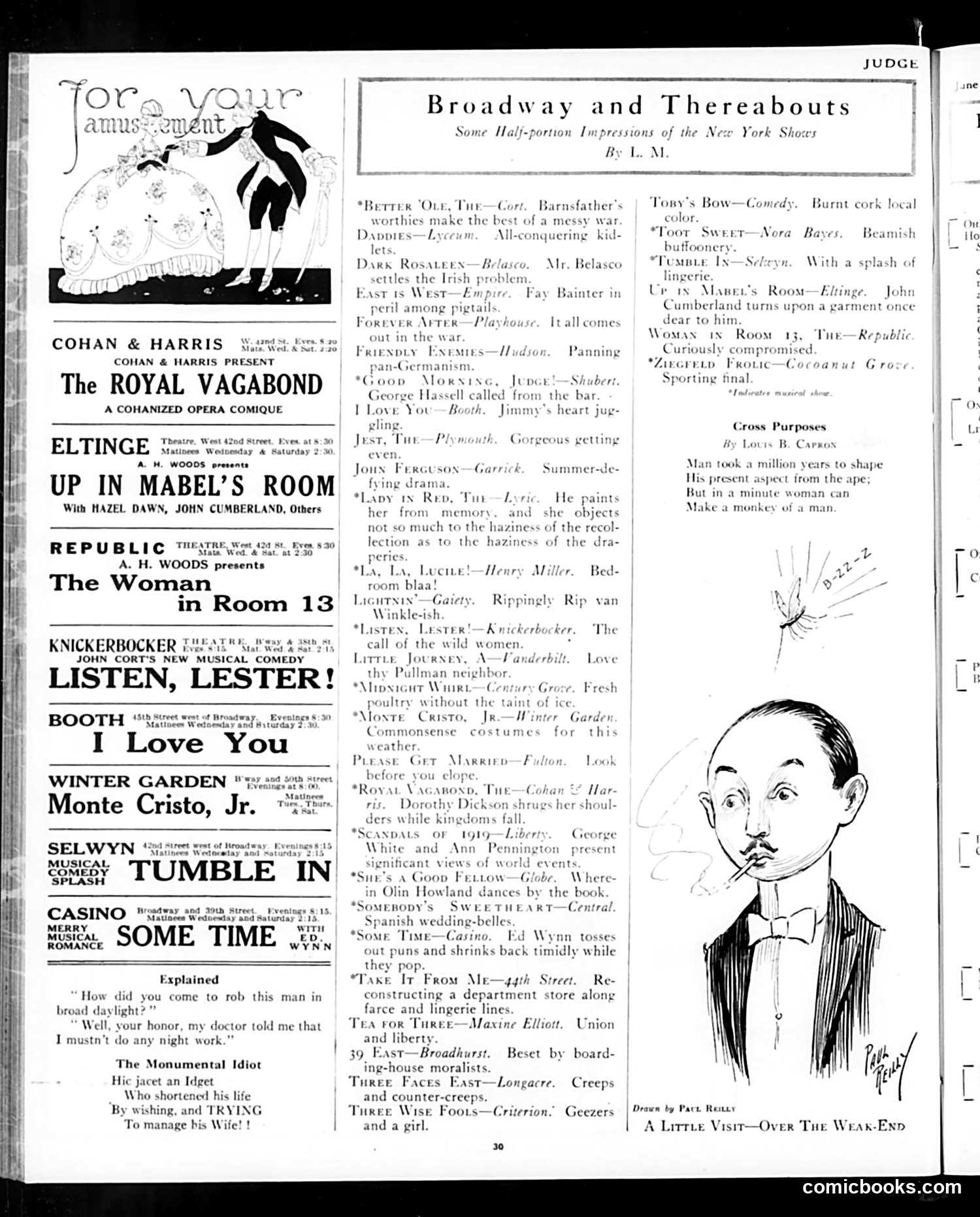
This page is primarily a **theater review column** by L.M., surveying New York Broadway productions. The left side contains theater advertisements; the right side offers brief, witty commentary on current shows. The reviews employ satirical shorthand typical of Judge magazine—punchy, sometimes crude jokes about productions. For example, "Better 'Ole" is praised for worthies making "the best of a bad war," while "Dark Rosalees" supposedly "settles the Irish lingerie"—likely mocking stereotypical Irish portrayals. References to "burnt cork" indicate blackface performances were still common in 1919. The accompanying cartoon (lower right) by Paul Bolley titled "A Little Visit—Over the Weak-End" shows a caricatured man's face—likely a theatrical figure or type—though the specific identity isn't labeled. The page reflects 1919 entertainment culture: vaudeville, operetta, farce, and racial stereotyping considered acceptable for satirical comment. The tone is gossipy and insider-focused for Judge's sophisticated urban audience.
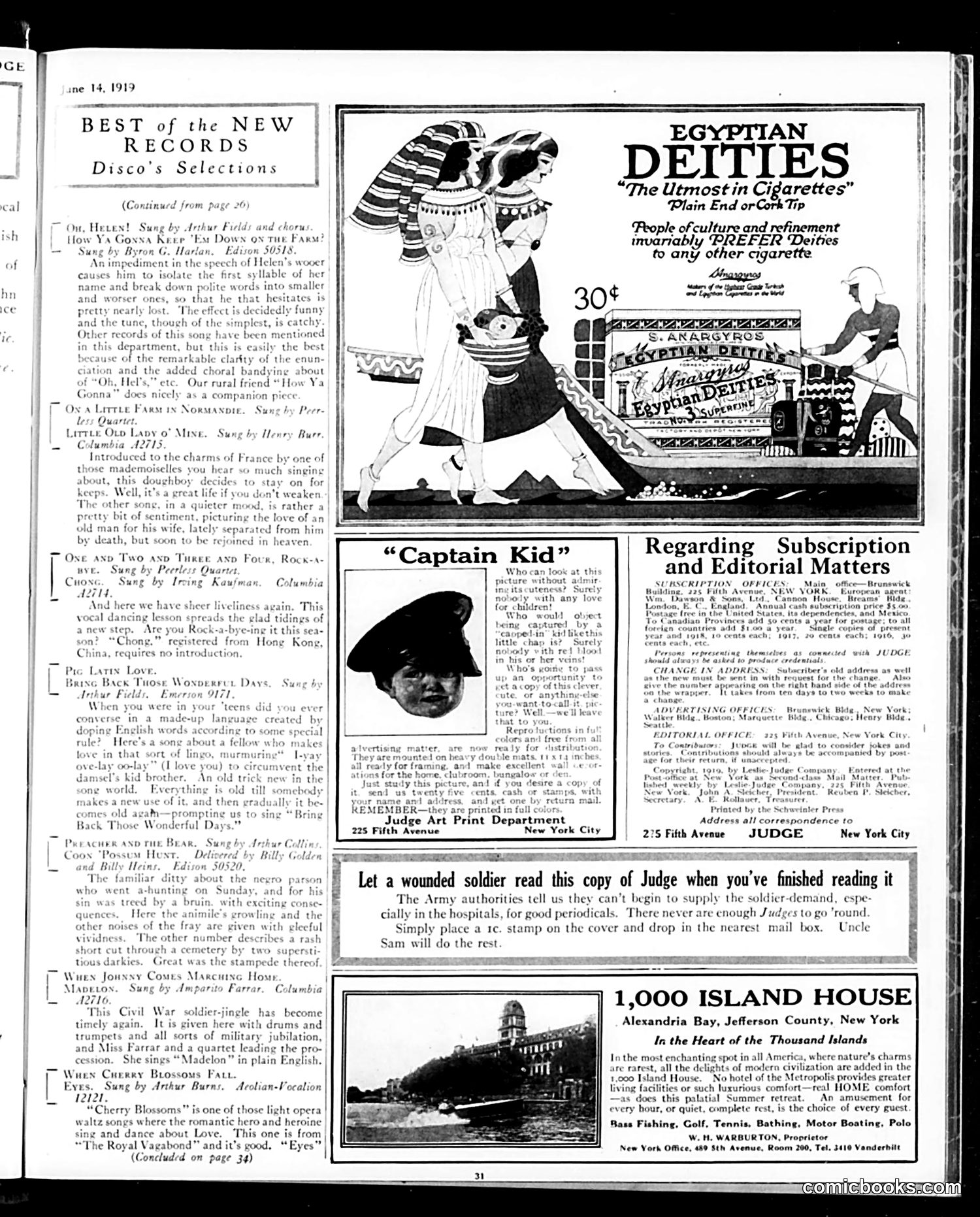
This is primarily a **records and advertisements page** rather than political satire. The main content includes: **Record Reviews**: A "Best of the New Records" column reviewing popular songs, including Civil War-era pieces and light operatic works—typical entertainment for 1919 audiences. **Egyptian Deities Cigarette Ad**: Features Egyptian imagery (pharaoh headdress, hieroglyphics) marketing cigarettes at 30¢, claiming they appeal to "people of culture and refinement"—standard early 20th-century advertising rhetoric before tobacco health warnings. **Service Appeal**: A notable section urges readers to donate used Judge magazines to wounded soldiers in hospitals, reflecting post-WWI charitable consciousness. **Island Resort Advertisement**: Promotes a vacation property in upstate New York. The page reflects 1919 America: post-WWI sentiment, pre-Prohibition consumer culture, and advertising that used exotica (Egyptian motifs) to suggest sophistication. No significant political cartoons or satire appear on this particular page.
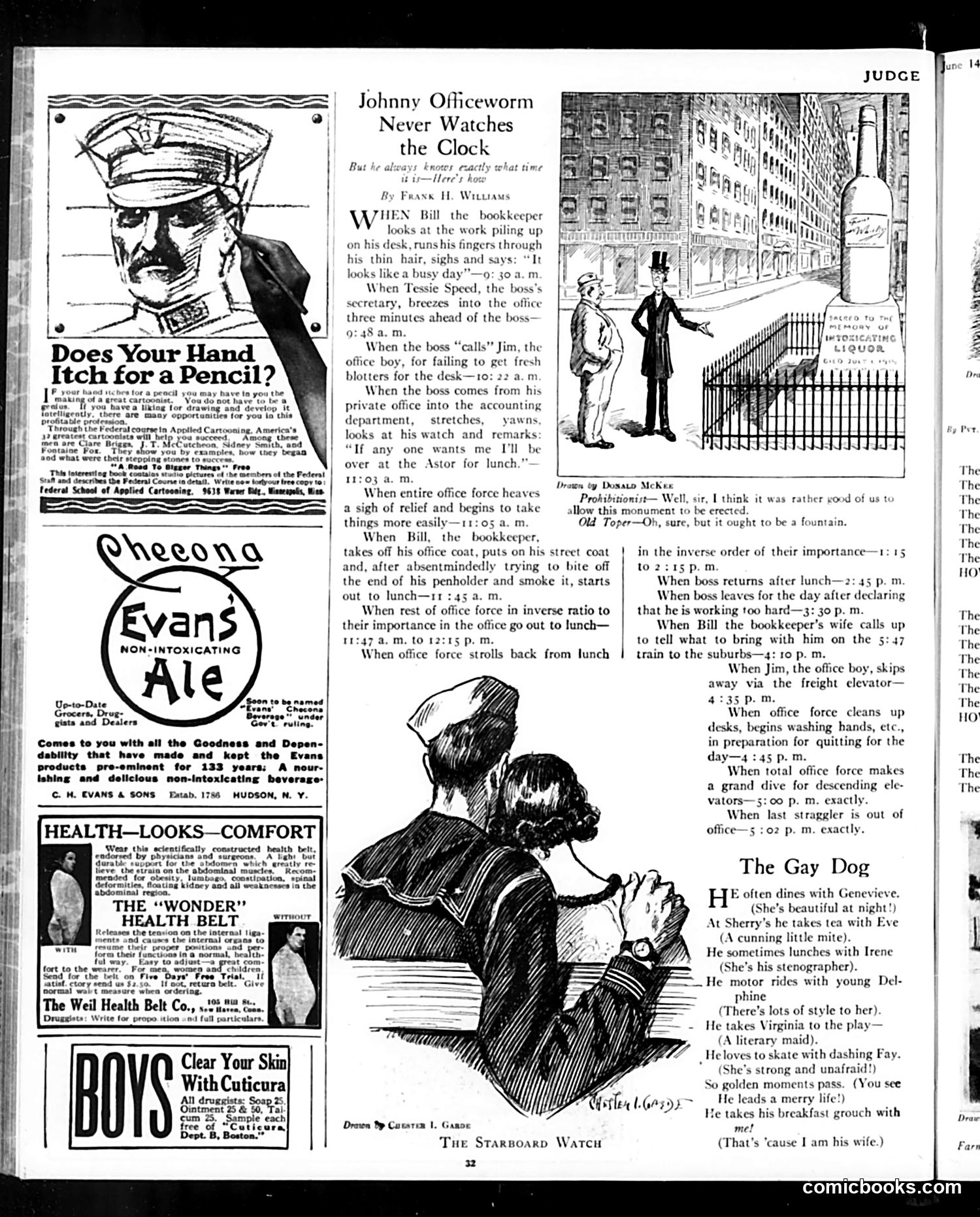
This page from Judge magazine contains satirical commentary on office life and social behavior circa early 1900s. **"Johnny Officeworm Never Watches the Clock"** mocks the disconnect between working-class punctuality and management hypocrisy. Bill the bookkeeper arrives precisely at 9:30 a.m., while his boss leaves at 11:03 a.m. claiming urgent business at the Astor (a luxury hotel), yet expects employees to work diligently. The humor lies in exposing how office hierarchy operates: junior staff face scrutiny for minor infractions while executives abandon work with impunity. **"The Gay Dog"** satirizes a man juggling multiple romantic interests—dining with different women (Genevieve, Eve, Irene, Delphine) while maintaining a wife at home. The joke critiques infidelity and the ease with which privileged men conduct affairs, contrasted darkly with his "breakfast grouch" with his actual spouse. The page also contains period health advertisements for dubious products (the "Wonder" health belt, Cuticura soap), typical of Judge's advertising revenue model.
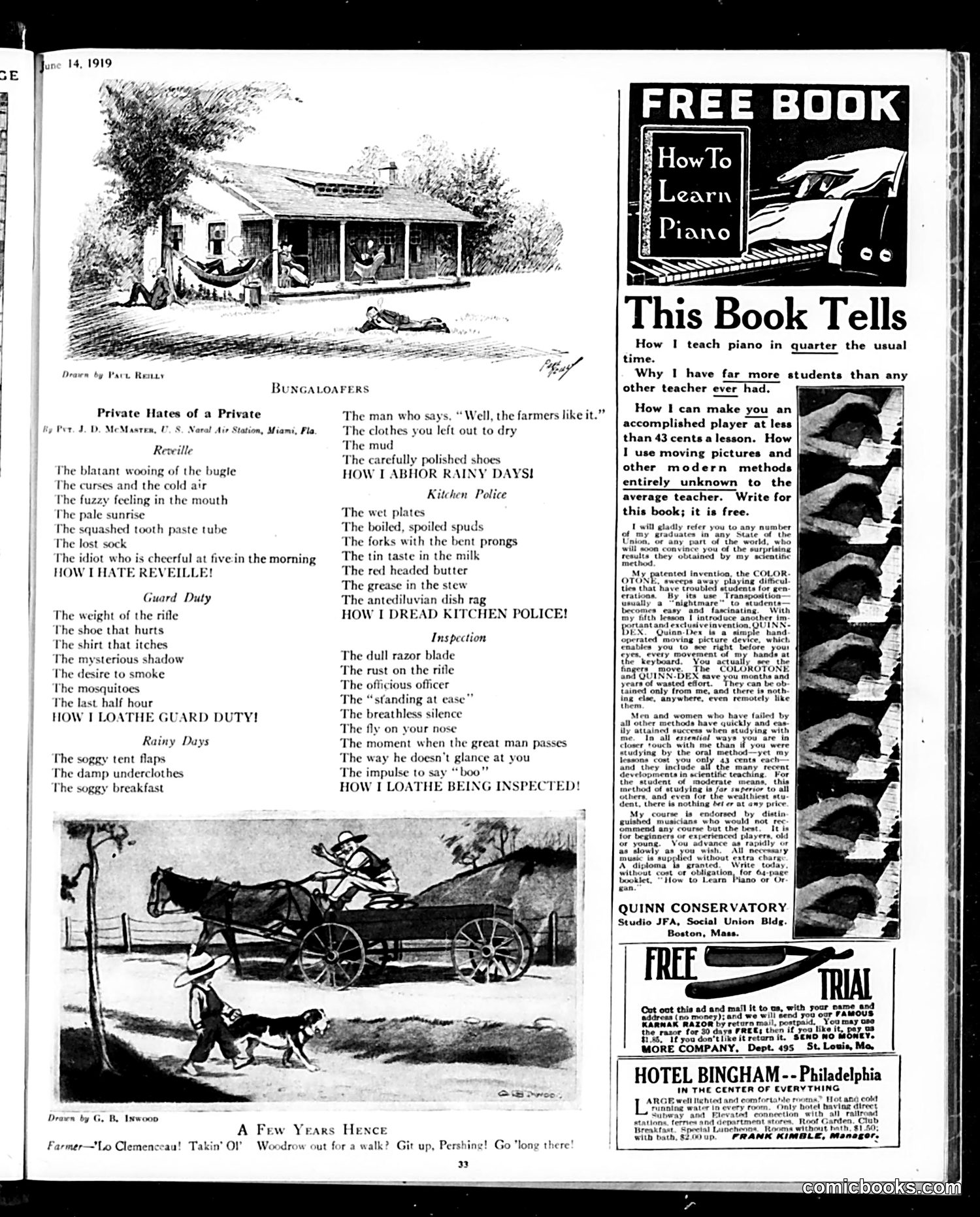
This page is primarily **humorous soldier content** reflecting post-WWI American life. The main feature, "Private Hates of a Private," catalogs the everyday annoyances of military service through verse sections titled "Reveille," "Guard Duty," "Rainy Days," "Kitchen Police," and "Inspection." Each lists mundane grievances (soggy tent flaps, bent forks, mosquitoes, officious officers) with emphatic refrains like "HOW I LOATHE GUARD DUTY!" The bottom cartoon, "A Few Years Hence," shows a farmer commanding his horse "Clemenceau" (likely referencing French PM Georges Clemenceau) and another horse "Pershing" (General John Pershing, WWI commander) as if they were ordinary draft animals—a satirical joke about post-war deflation of wartime leaders' status. The page is otherwise dominated by advertisements, including a "How to Learn Piano" book offer and a Philadelphia hotel ad. The humor appeals to recently demobilized soldiers nostalgic about military life's petty frustrations.
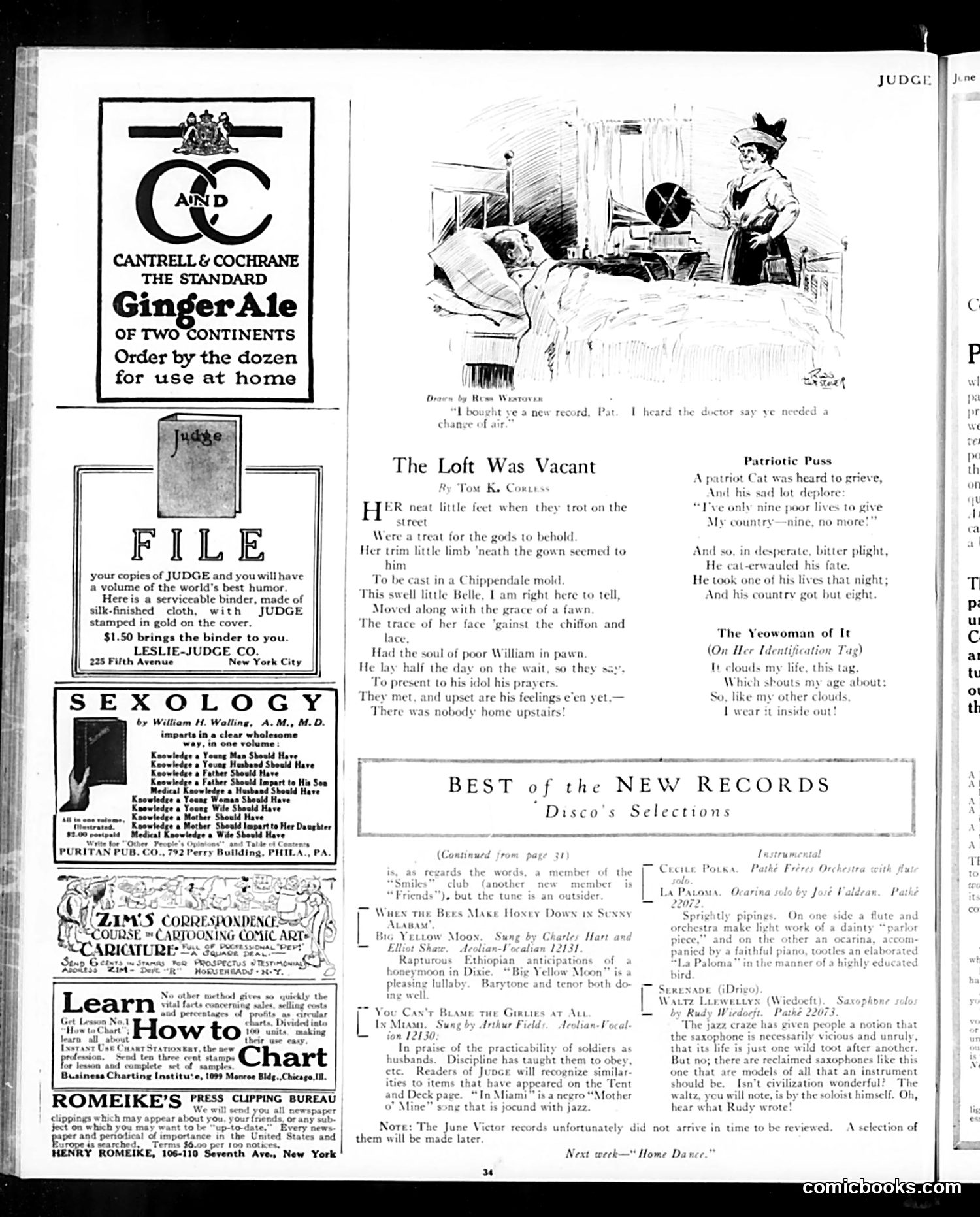
This page is primarily **advertising and filler content** rather than political satire. The main elements are: **Advertisements:** - Cantrell & Cochrane Ginger Ale ("Standard of Two Continents") - Judge magazine binder subscription - Sexology book by William H. Wallin - Romeike's Press Clipping Bureau - Business Charting Institute **Literary Content:** The page includes two poems and a brief story: - "The Loft Was Vacant" by Tom K. Corless (a romantic tale about a beautiful woman with intellectual emptiness—"Nobody home upstairs") - "Patriotic Puss" (a satirical poem about a cat sacrificing eight of nine lives for country) - "The Yeowoman of It" (appears to be humorous verse) **Record Reviews Section:** Brief mentions of jazz and classical recordings. The cartoon illustration shows a bedroom scene with a woman in bed and a man visiting—likely humorous domestic content typical of Judge's era. Overall, this is a **commercial/entertainment page** with minimal political commentary.
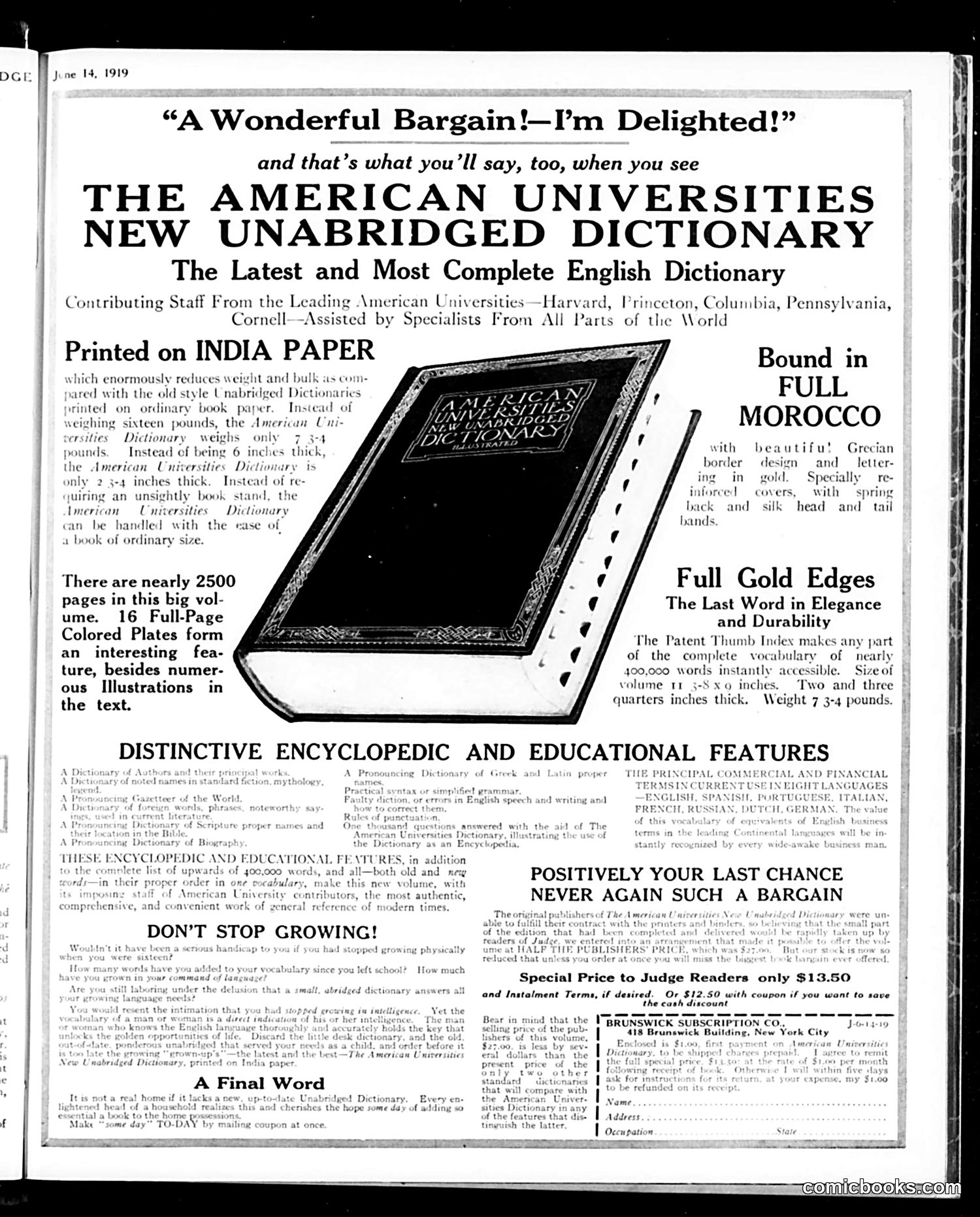
This page is primarily a full-page advertisement for the American Universities New Unabridged Dictionary, not a political cartoon. The advertisement employs early-20th-century marketing tactics, emphasizing the dictionary's credentials (compiled by staff from Harvard, Princeton, and other leading universities) and luxurious production values (Morocco binding, gold edges, India paper for reduced weight). The opening quote—"A Wonderful Bargain! I'm Delighted!"—appears designed to create social aspiration, suggesting that owning this prestigious dictionary signals education and refinement. The special pricing "for Judge Readers only" ($13.50) exploits the magazine's educated, affluent readership. There is no political satire visible here. This is primarily commercial content typical of Judge magazine's revenue model.
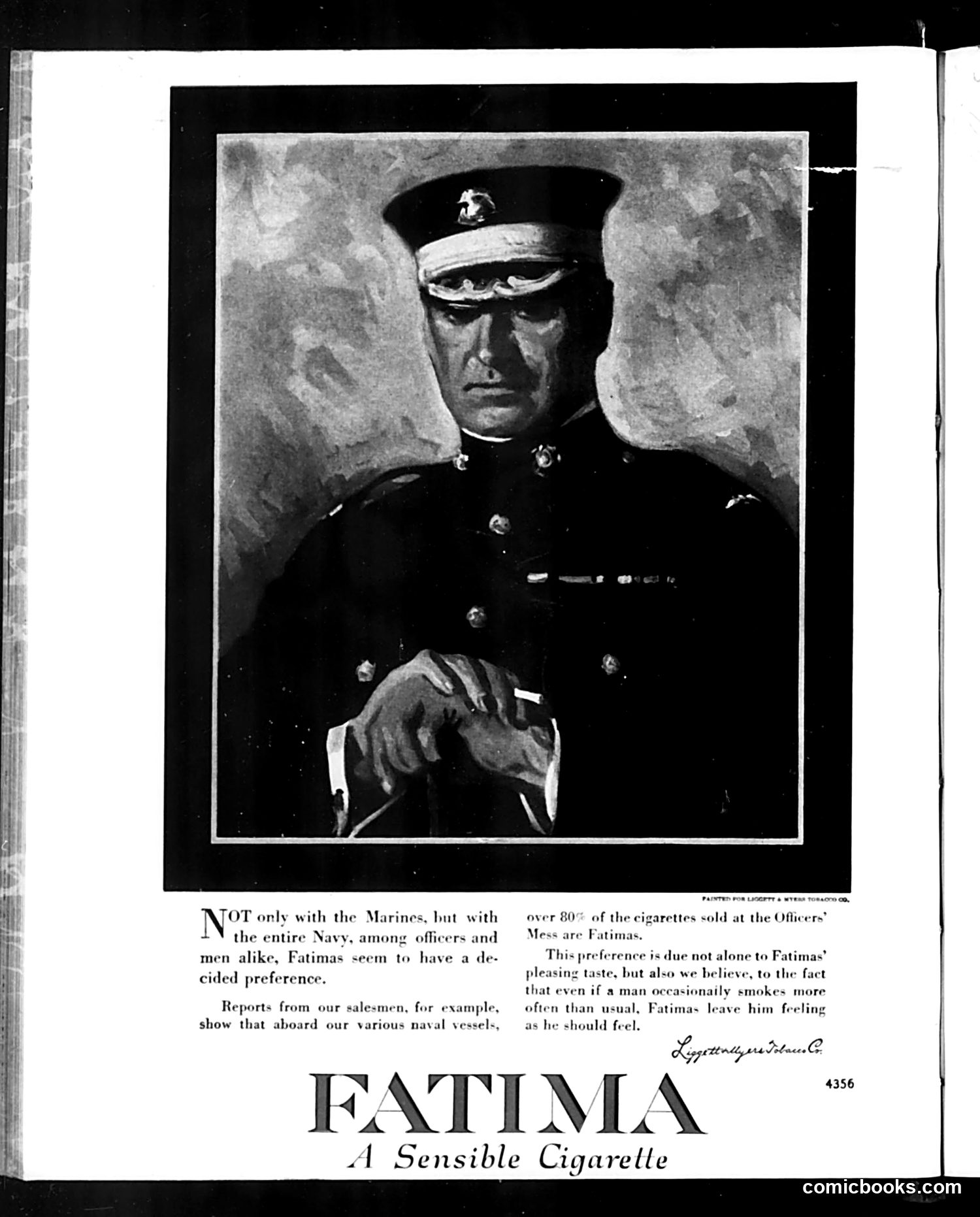
This is a **cigarette advertisement**, not a political cartoon. It features a naval officer in formal dress uniform endorsing Fatima cigarettes. The ad claims that over 80% of cigarettes sold at Navy Officers' Mess are Fatimas, appealing to military prestige and authority. The key sales pitch is that Fatimas are "sensible"—they allegedly allow smokers to indulge without the negative effects of other cigarettes ("leave him feeling as he should feel"). This represents early 20th-century tobacco marketing that: (1) leveraged military/institutional credibility, (2) made health-adjacent claims before such advertising was restricted, and (3) normalized heavy smoking among officers and enlisted men. For modern readers, the irony is stark: the ad promotes cigarettes as healthful while using military authority to boost sales—a practice now recognized as predatory marketing of a lethal product.