
A complete issue · 32 pages · 1919
Judge — May 10, 1919
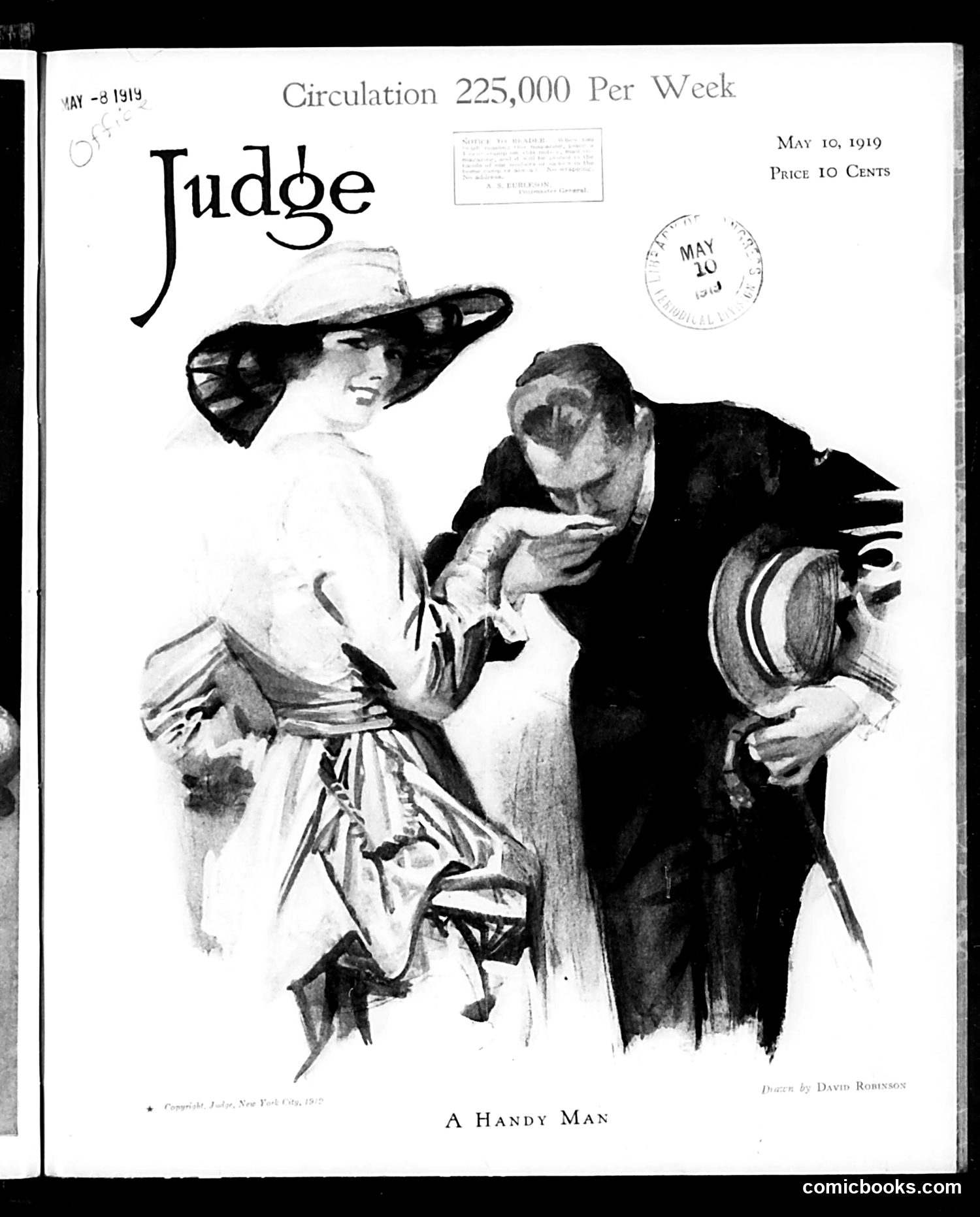
This cartoon depicts a woman in fashionable dress and wide-brimmed hat observing a man in formal attire juggling what appear to be domestic items or household goods. The title "A Handy Man" suggests satire about gender roles and domestic labor. In 1919 post-WWI America, this likely comments on shifting expectations: men returning from war were expected to resume traditional roles, yet women had gained new independence and workforce participation during wartime. The "handy man" juggling household tasks appears to mock either the idea of men helping with domestic work or perhaps critiques the complexity of postwar domestic arrangements. The drawing is credited to David Robinson, a prominent Judge illustrator of the era.
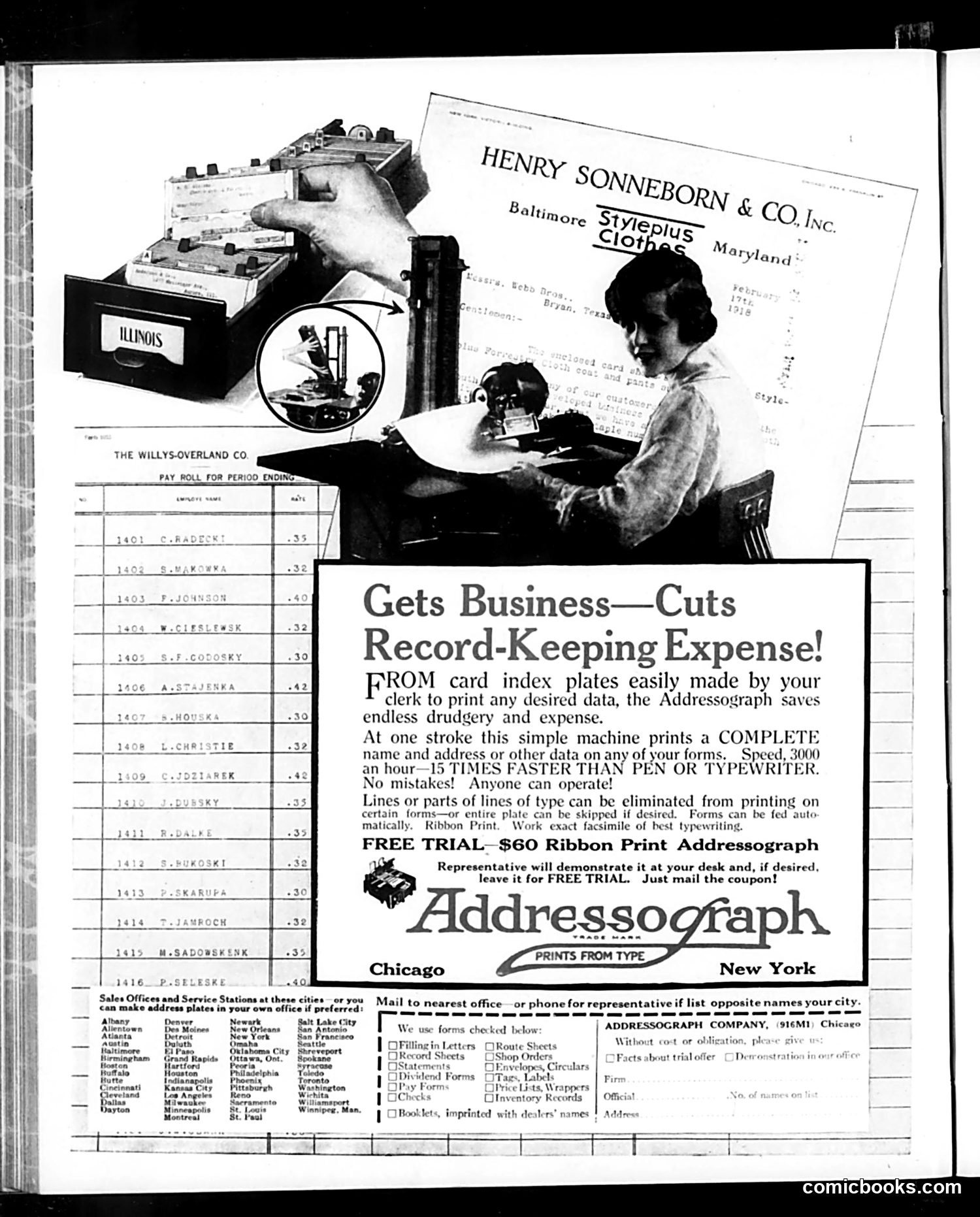
This page is primarily **advertising**, not political satire. The dominant content is a full-page advertisement for the Addressograph machine, a business device that printed addresses and data onto forms and envelopes. The ad features a woman operating the machine at her desk, with the headline "Gets Business—Cuts Record-Keeping Expense!" The marketing pitch emphasizes speed (3,000 impressions per hour, "15 TIMES FASTER THAN A TYPEWRITER") and ease of use ("Anyone can operate!"). The smaller images at top show competing office equipment (a payroll filing system from Willys-Overland Co. and Henry Sonneborn & Co. stationery). This reflects the early 20th-century office automation era when businesses competed to offer labor-saving technologies to companies managing growing administrative demands.
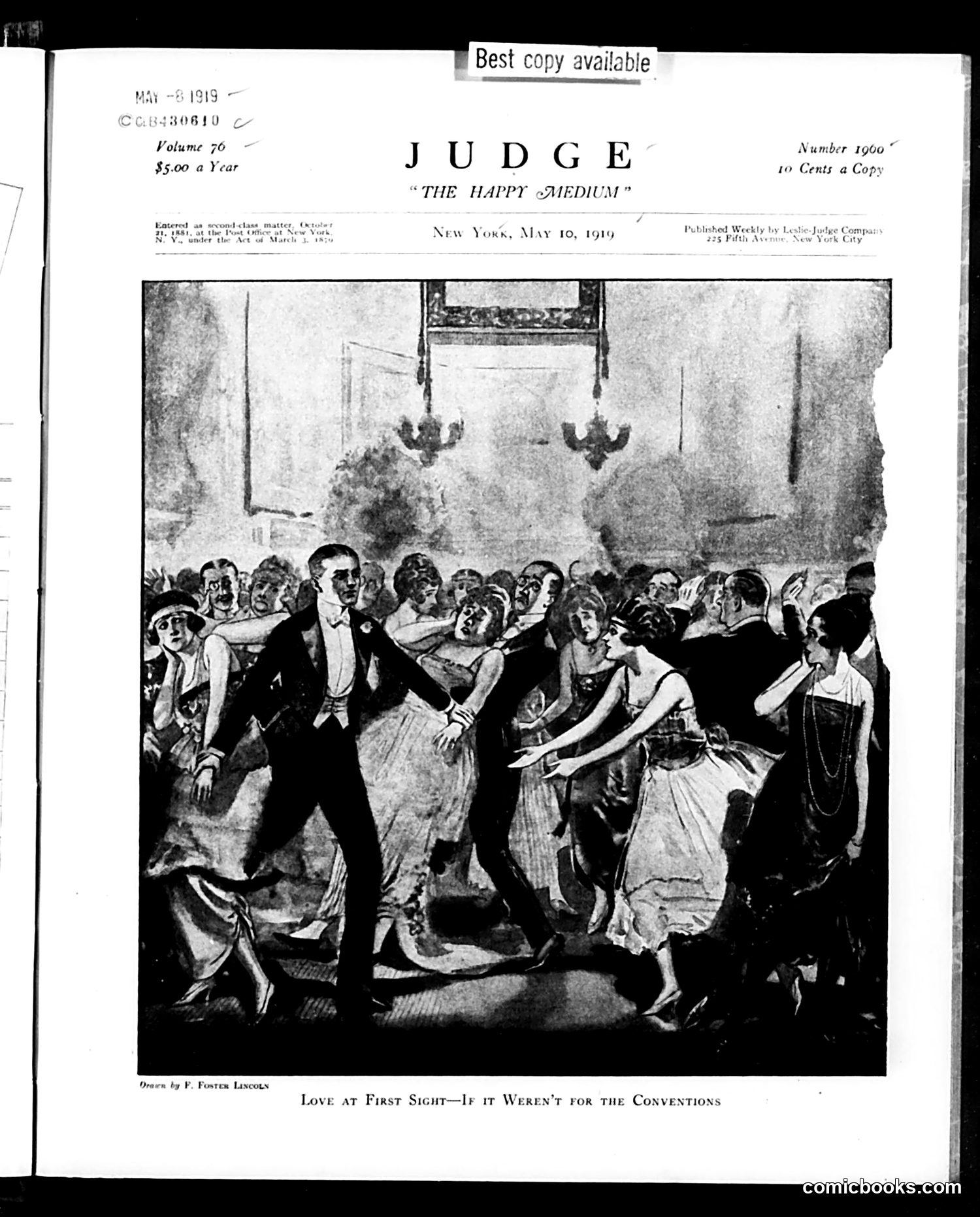
This satirical cartoon depicts a formal ballroom scene titled "Love at First Sight—If it Weren't for the Conventions." The drawing by F. Foster Lincolx shows well-dressed men and women in an elegant interior, apparently at a social gathering or dance. The satire appears to mock the rigid social conventions and etiquette of upper-class society in 1919. The caption suggests that romantic attraction between attendees exists ("love at first sight"), but formal social rules and decorum prevent them from acting on it. The cartoon criticizes how strict conventions constrain natural human behavior and desire, presenting this as an absurd tension between genuine feeling and artificial propriety—a common satirical theme in Judge during this period of social change.
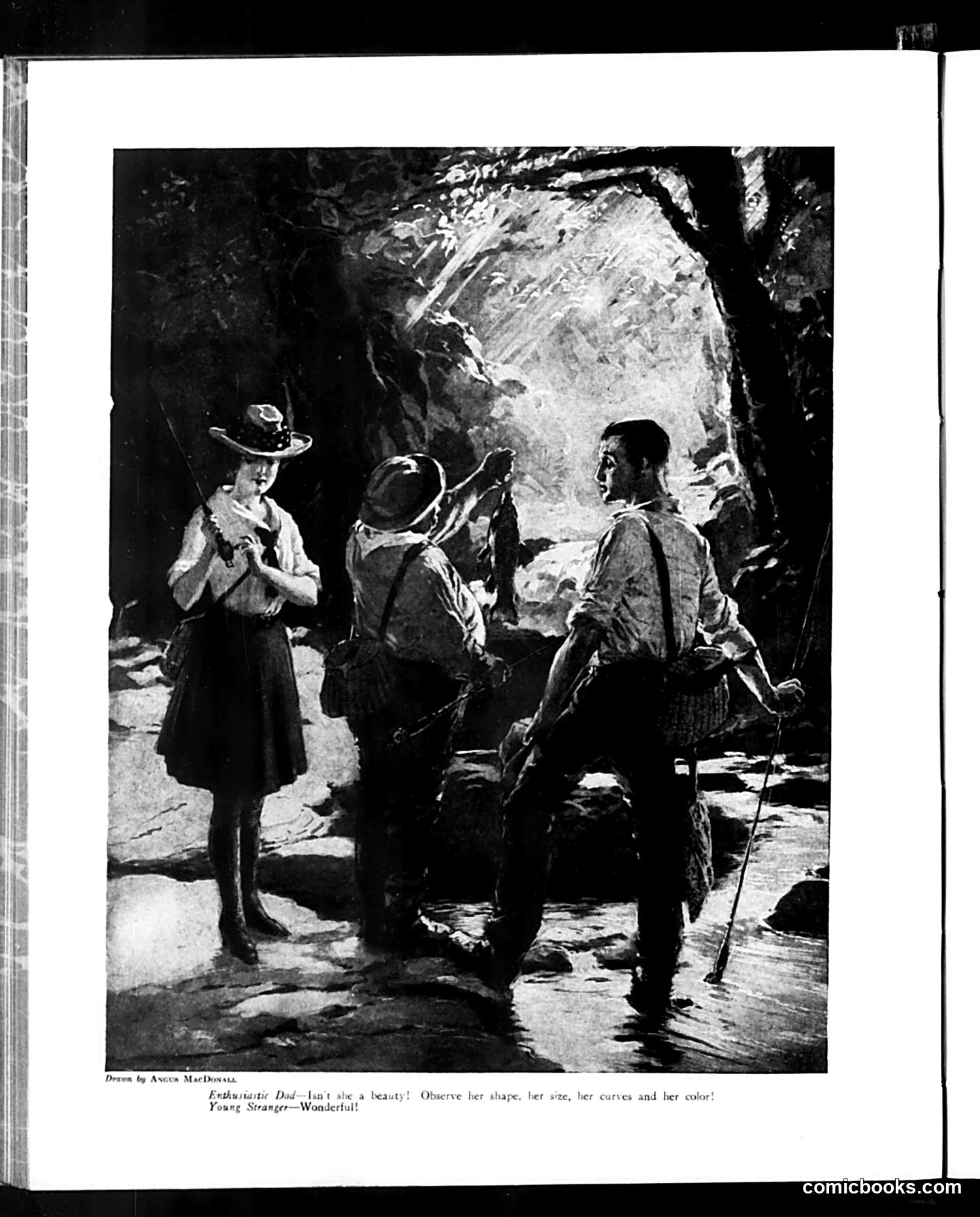
This appears to be a theatrical scene rather than a political cartoon. The image shows five figures in what looks like a cave or underground setting, with dramatic lighting from above. The credited artist is Angus MacDonald. The dialogue suggests a comedic scenario: an "Enthusiastic Dad" is praising a young woman's appearance to a "Young Stranger," calling her "a beauty" and commenting on "her shape, her size, her curves and her color." The setup implies the dad is showing off or promoting the woman in a somewhat awkward or inappropriate manner—the joke being his misplaced enthusiasm or the stranger's uncomfortable position as he's essentially being lectured about the woman's physical attributes. Without additional context about which theatrical production this illustrates, the specific satirical target remains unclear.
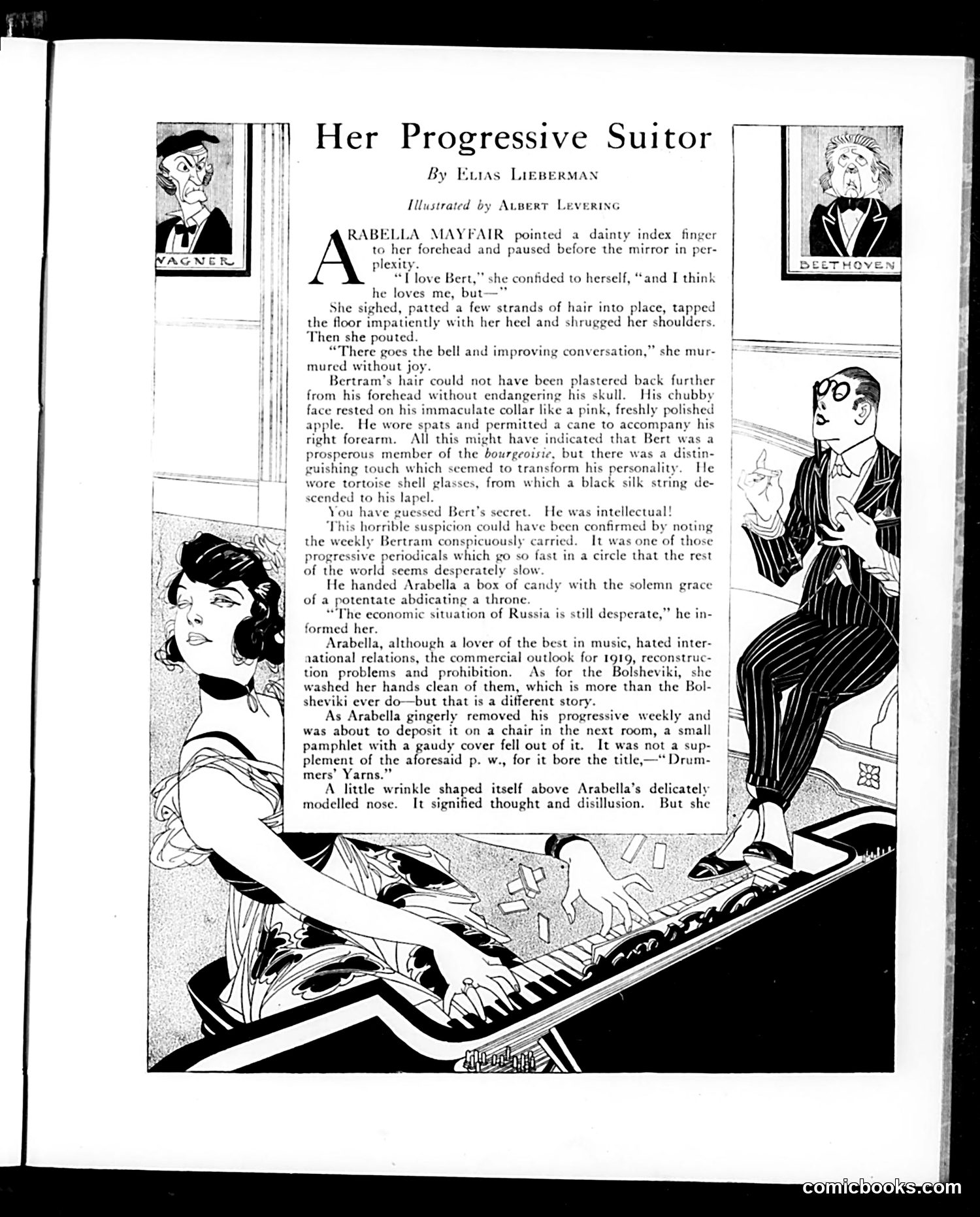
This satirical story by Elias Lieberman mocks intellectual pretension and progressive politics through the character Arabella Mayfair's suitor, Bert. The caricatured portraits labeled "Wagner" and "Beethoven" suggest Bert affects highbrow cultural interests. The narrative reveals his "intellectual" persona—tortoiseshell glasses, cane, discussion of Russia's economic crisis—as performative affectation masking his actual bourgeois conformity. The satire targets early 20th-century progressive aesthetes who adopted radical rhetoric while remaining fundamentally conventional. Arabella, who loves music and progressive ideals, finds Bert's progressive weekly journal merely theatrical. The pamphlet titled "Drummers' Yarns" (apparently dropped) suggests his supposedly serious intellectualism masks commercial banality. The illustration of Arabella at the piano emphasizes the contrast between genuine artistic appreciation and Bert's shallow posturing.
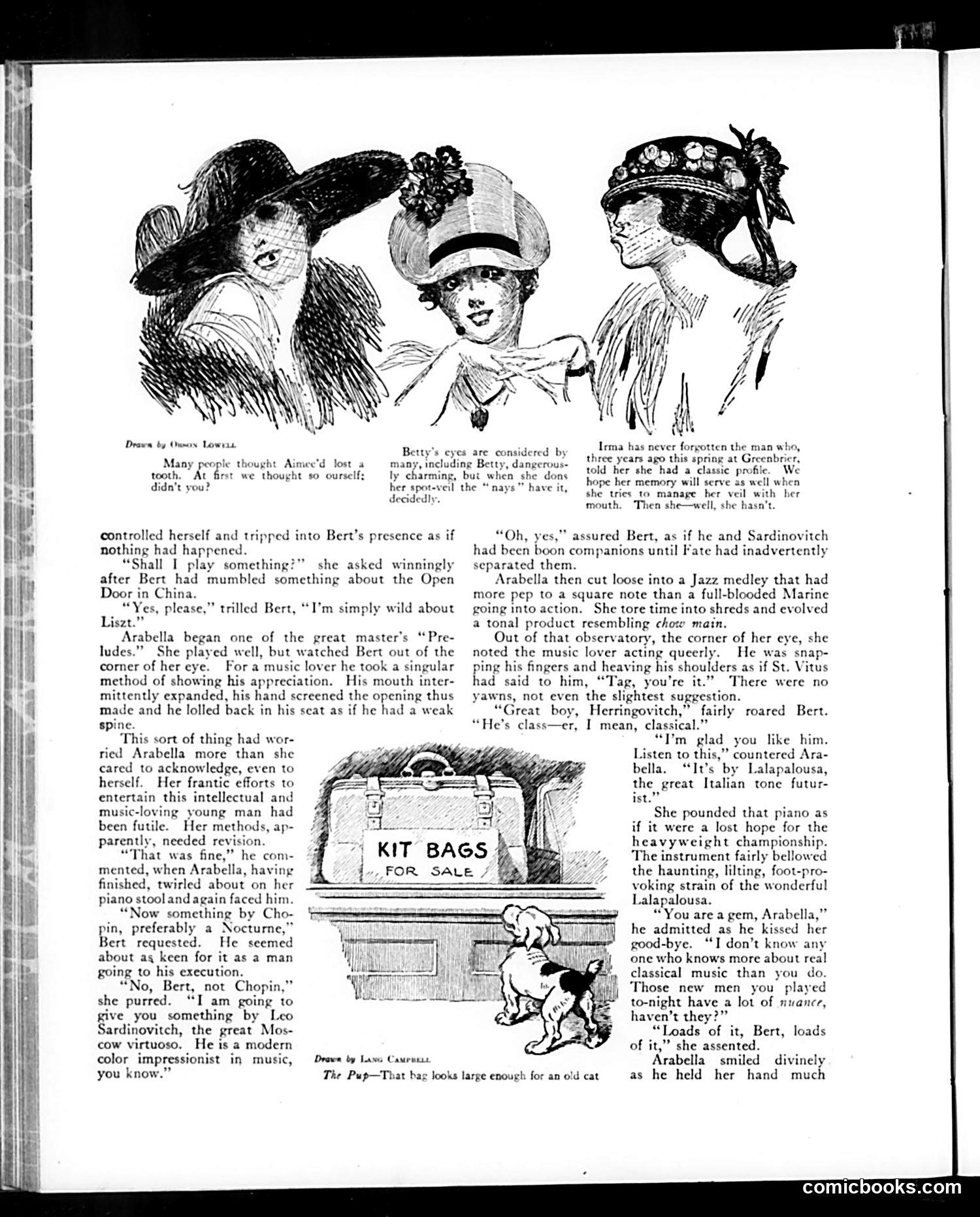
This page contains a **fictional narrative** rather than political satire. The story follows characters named Arabella, Bert, and Betty, focusing on romantic and social drama among the upper class. The three illustrated female heads at top showcase different fashionable hat styles of the era, reflecting Judge's typical coverage of contemporary fashion and social life. The main illustration shows **"The Pup"** — a small dog beside a suitcase labeled "KIT BAGS FOR SALE," which appears to be an advertisement or humorous commentary on pet-related commerce. The text discusses Arabella's musical talents, her romantic interest in Bert, and rivalry over his affections. The narrative emphasizes classical music appreciation and sophisticated social circles—typical leisure-class concerns for Judge's readership. This appears to be **entertainment/lifestyle content** rather than political commentary.
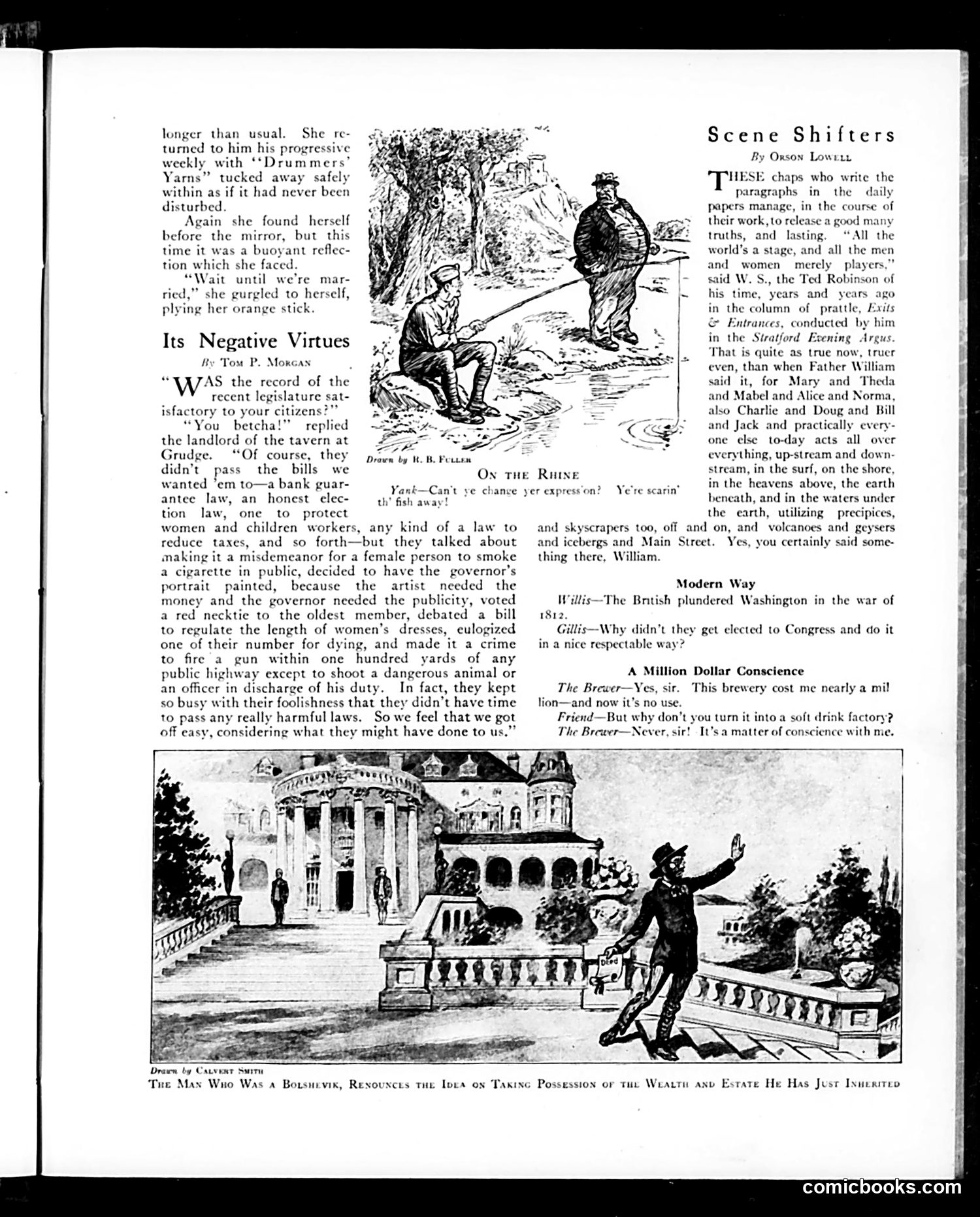
This page contains three satirical pieces mocking American political and social hypocrisy circa 1910s-1920s: **"Its Negative Virtues"** ridicules a state legislature for accomplishing nothing worthwhile—passing absurd bills (regulating women's dress length, commissioning the governor's portrait) while blocking substantive reforms (banking regulation, worker protections, tax reduction). The joke: constituents are satisfied because legislators were too busy with foolishness to pass genuinely harmful laws. **"Scene Shifters"** compares modern celebrity culture to theater, suggesting actors like Charlie Chaplin, Douglas Fairbanks, and others perform constantly in everyday life across all settings—using natural and urban landscapes as stages. **"A Million Dollar Conscience"** satirizes a brewery owner who refuses converting to soft drinks on "conscience," highlighting the absurdity of selective morality—profiting from alcohol while claiming principles. The lower cartoon (by Calvert Smith) appears to mock a Bolshevik's abandonment of inherited wealth, though details are unclear. All pieces share Judge's characteristic criticism of American pretension and inconsistency.
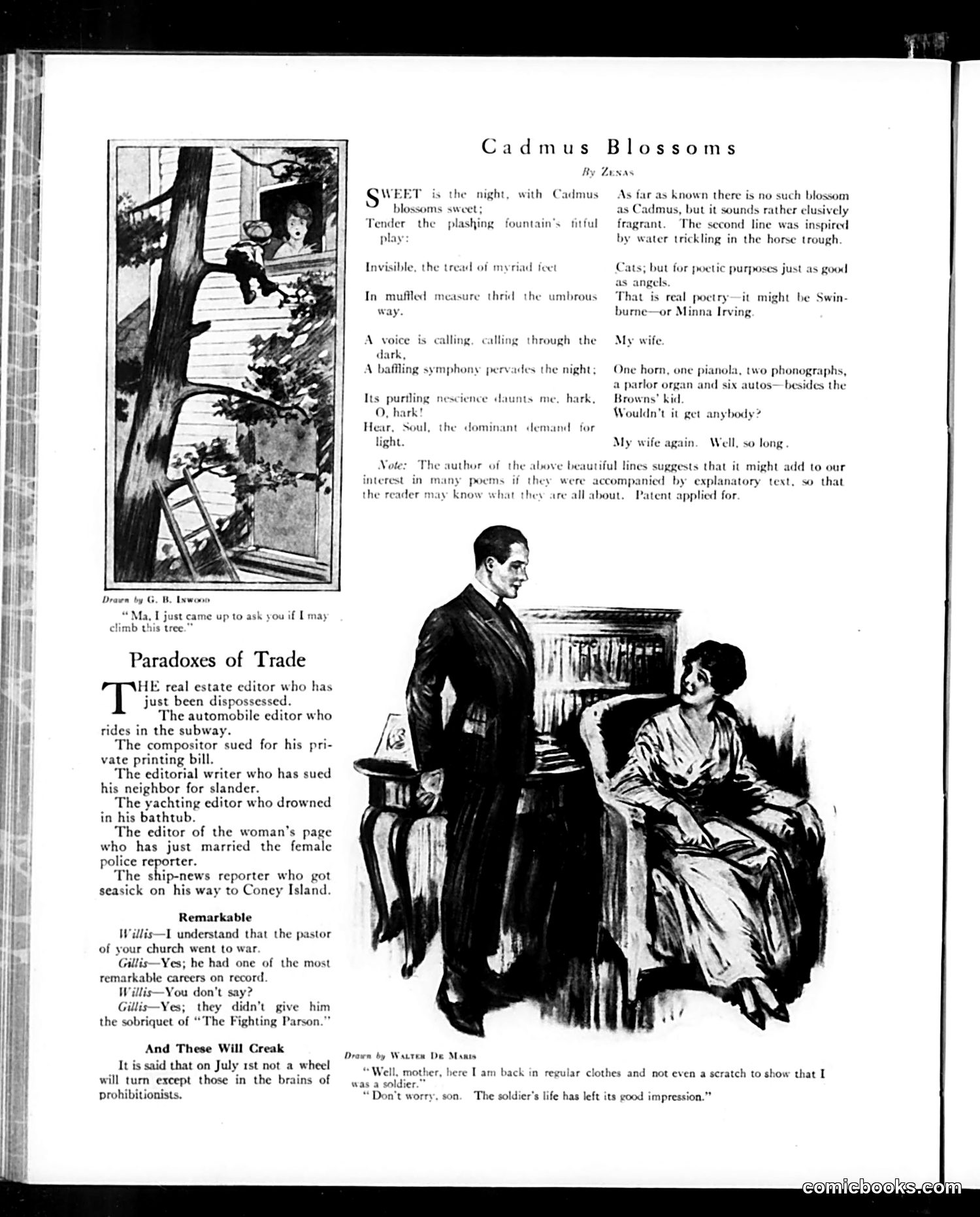
This page contains three satirical pieces typical of Judge's early 20th-century humor: **"Cadmus Blossoms"** is mock-serious poetry with a self-aware note admitting the flower "Cadmus" doesn't exist—the satire mocks pretentious, obscure poetry of the era (comparing it to Swinburne). The author suggests poems need explanatory text because readers can't understand them otherwise, ridiculing artistic obscurantism. **"Paradoxes of Trade"** lists ironic contradictions: editors whose expertise contradicts their lives (a real-estate editor who's dispossessed, a yachting editor who drowns in a bathtub). This satirizes the gap between professional authority and personal failure—common Judge fodder. **"And These Will Creak"** references prohibitionism (likely pre-1920 Prohibition debate), joking that on July 1st only "wheels in the brains of prohibitionists" will turn—mocking prohibitionists as mechanical, obsessive ideologues. The accompanying illustration shows a soldier returning home to his mother, who notes he has no wounds to show for his service—understated satire on war's psychological rather than visible costs.
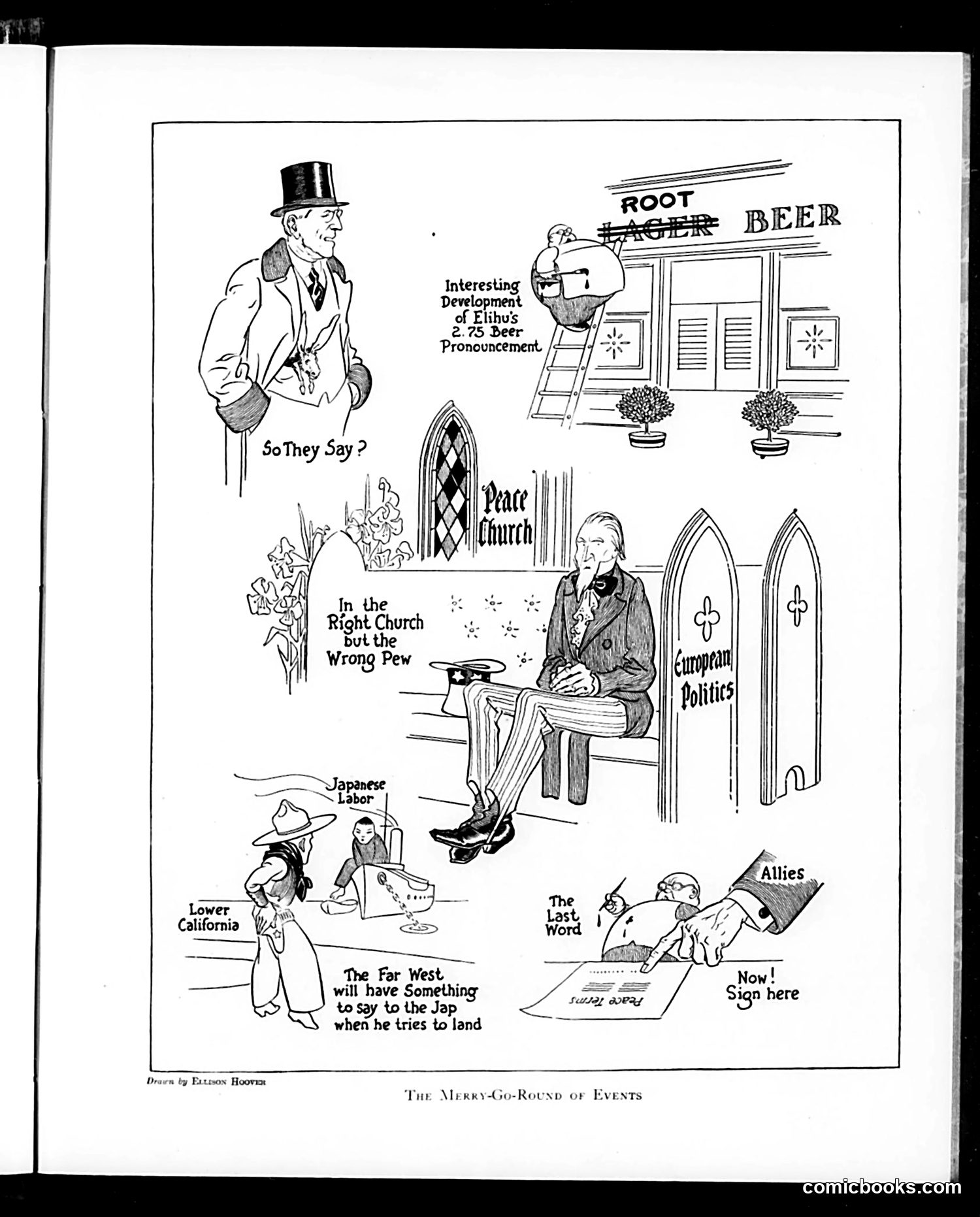
This political cartoon by Cesare Mazza satirizes contemporary early-20th-century concerns through interconnected vignettes: **Top**: A well-dressed man questions Elihu Root's pronunciation of "beer," while someone changes a "Root Beer" sign to "Root Beer." **Middle**: A churchgoer sits "in the right church but the wrong pew," and Japanese labor issues are referenced. **Lower section**: References to "Lower California," "The Far West," and Japanese immigration threats, culminating in figures discussing "The Last Word" and signing as "Allies." The cartoon uses circular logic to connect disparate political issues—possibly including Elihu Root's diplomatic role, church/religious matters, Japanese-American tensions, and alliance politics during a period of international instability. The "merry-go-round" structure suggests these problems perpetually recycle without resolution.
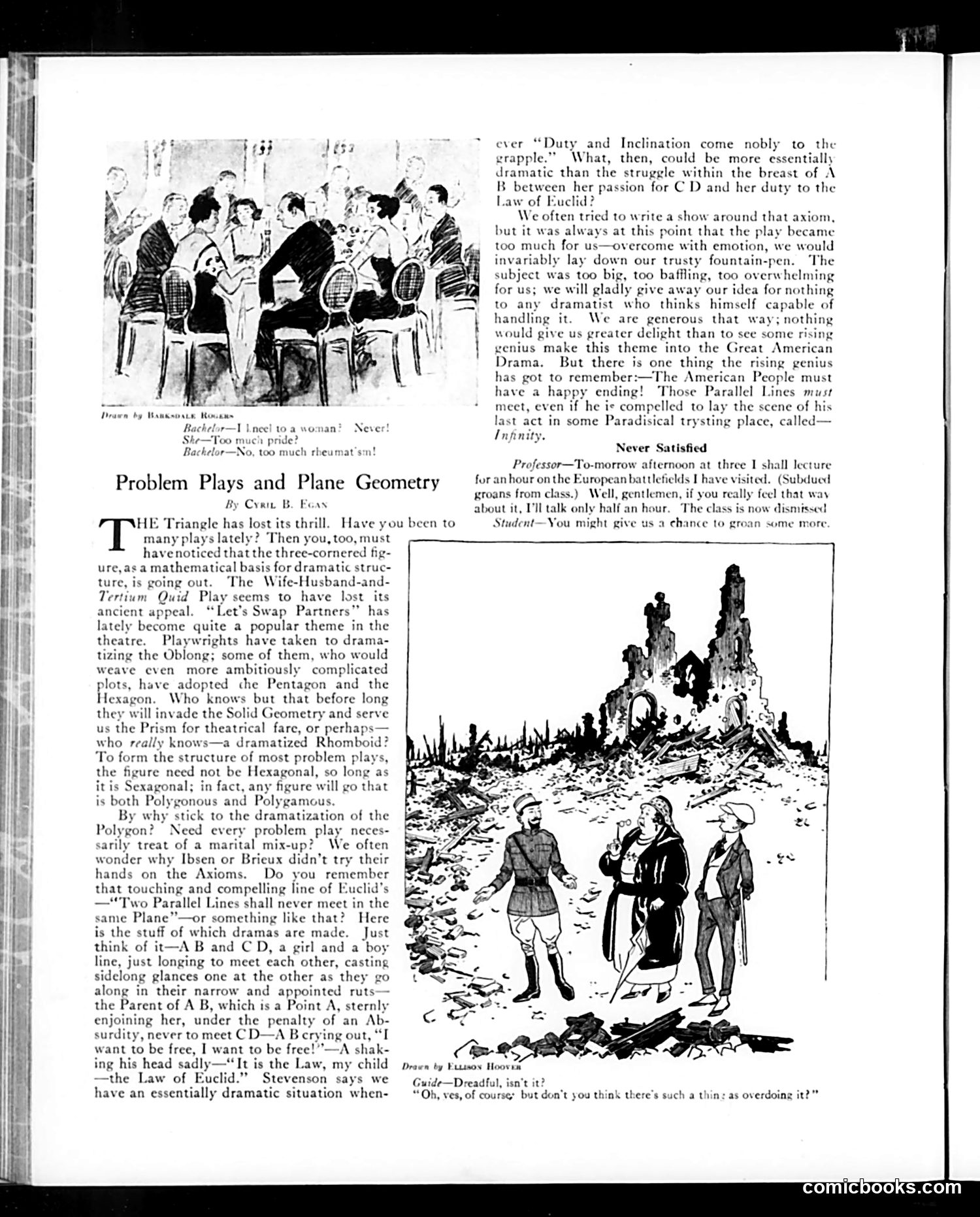
This page contains two separate satirical pieces from Judge magazine. **"Problem Plays and Plane Geometry"** mocks the contemporary theater trend of "problem plays"—serious dramas addressing moral/social issues (likely referencing Ibsen and Brieux, mentioned by name). The author satirizes how playwrights have abandoned the traditional triangular love-plot structure for more complicated scenarios involving spouse-swapping and infidelity, using geometric metaphors. The absurdist core joke: he proposes dramatizing Euclid's axiom about parallel lines never meeting as a love story between "lines" A-B and C-D separated by parental duty—a romantic tragedy rendered ridiculous through mathematical language. The satire targets both pretentious "problem play" conventions and the era's apparent obsession with marital complications as theatrical fodder. **"Never Satisfied"** is a brief joke about a student ungratefully complaining when a professor reduces lecture time after groaning protests—satirizing perpetual student complaints. The illustration shows figures in an exotic landscape, likely accompanying the geometry piece's absurdist narrative.
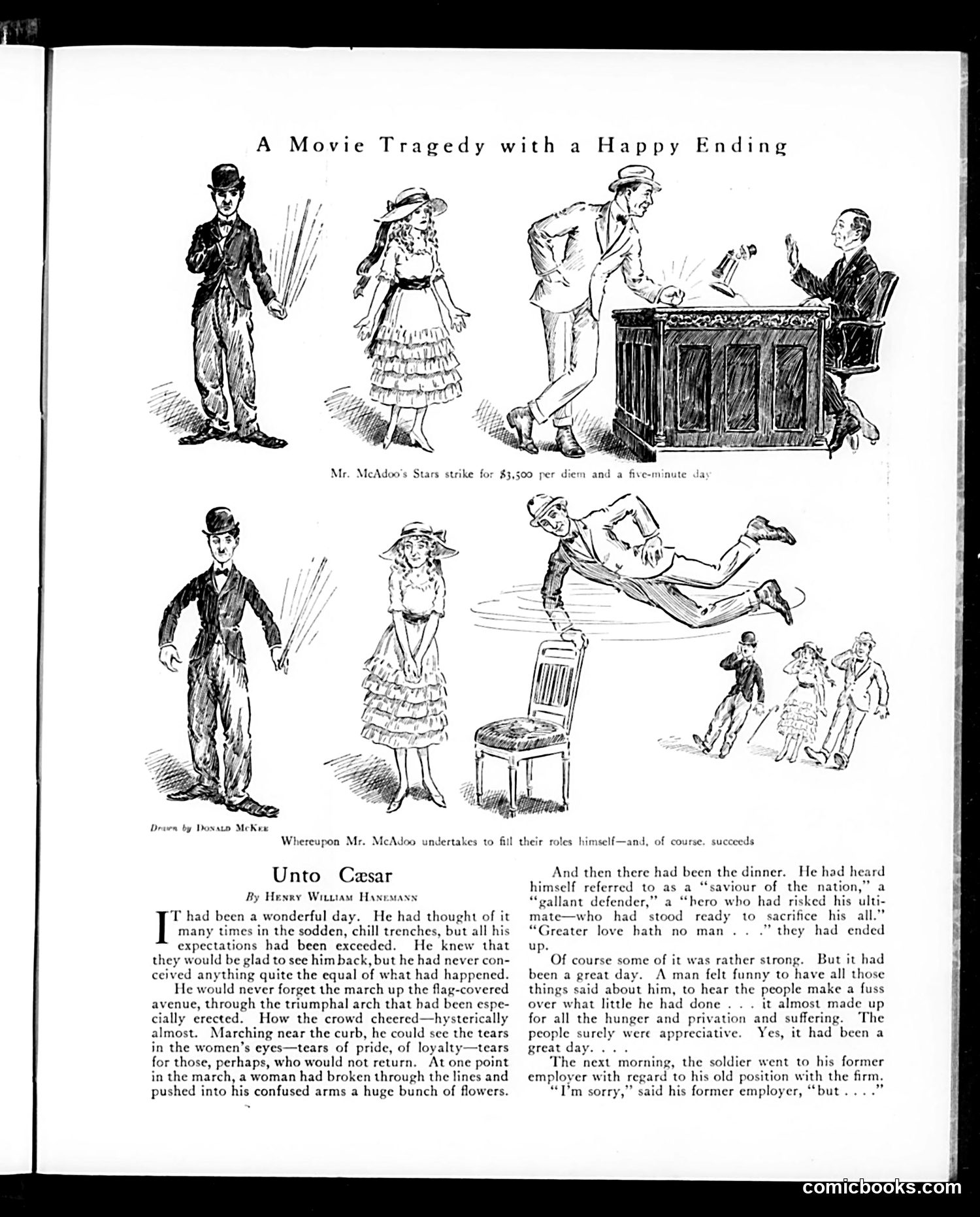
This Judge page contains two separate satirical pieces about post-WWI America. **"A Movie Tragedy with a Happy Ending"** (top): A visual gag about Mr. McAdoo (likely William Gibbs McAdoo, Wilson's Secretary of the Treasury), who appears in a film scenario. The comic premise: when actors strike for higher pay ($3,500 per diem), McAdoo simply performs all their roles himself—succeeding at everything. The satire mocks McAdoo's public reputation as a capable administrator and implicit criticism of labor demands. **"Unto Caesar"** (bottom): A short story contrasting a returning WWI soldier's triumphant homecoming parade—celebrated as a "saviour," showered with praise and flowers—with harsh reality: the next morning, his former employer won't rehire him, offering only apologies. The satire critiques America's failure to care for veterans after their service, exposing the gap between patriotic rhetoric and actual support for returning soldiers.
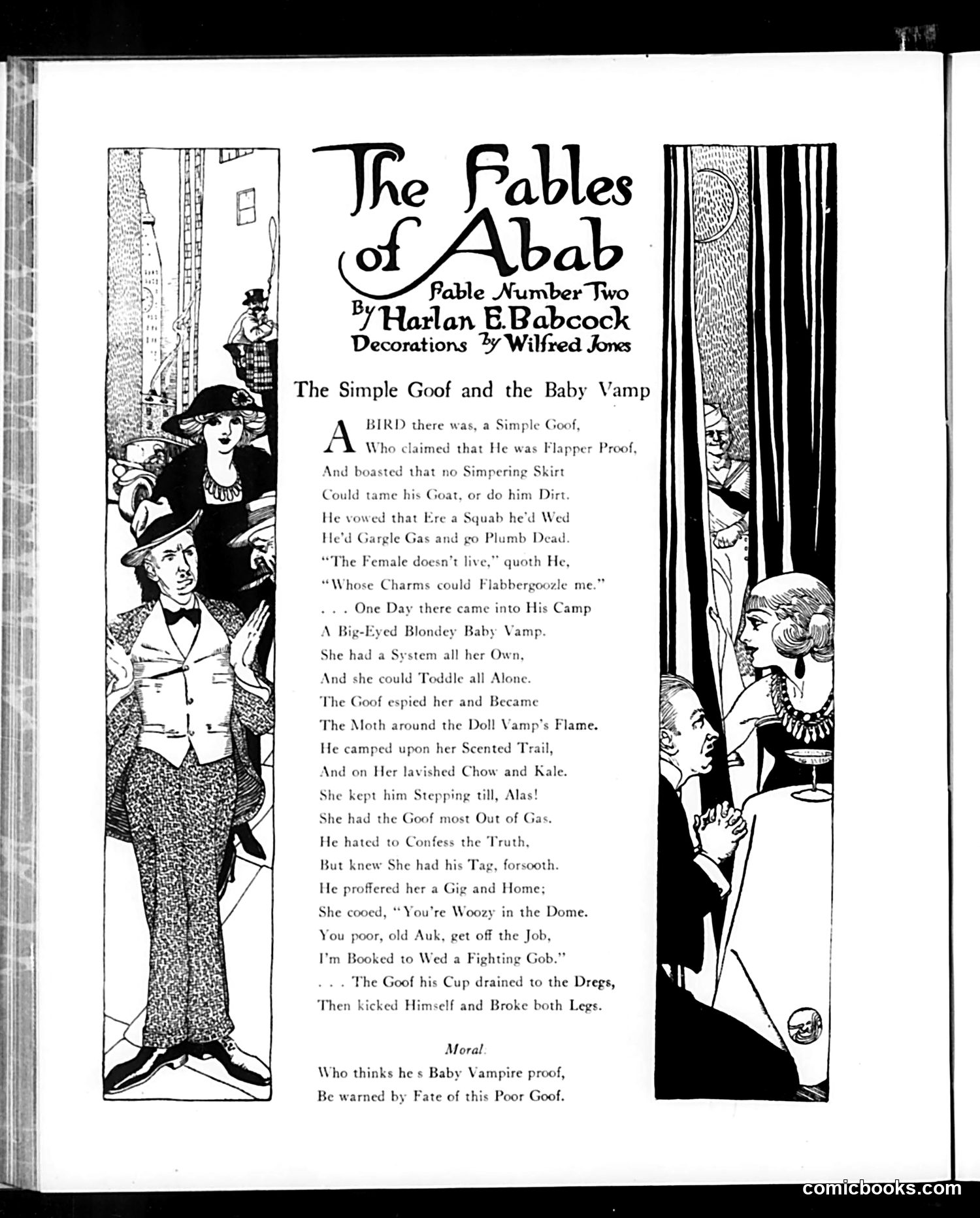
This is a cautionary fable from Judge magazine satirizing 1920s dating culture. A cocky man ("Simple Goof") boasts he's immune to women's charms, but a "Baby Vamp" (flapper—a modern, independent young woman) quickly manipulates him into financial support and emotional dependence through her attractiveness and "system." The fable mocks masculine overconfidence about resisting female sexuality. The "Baby Vamp" represents the anxious cultural figure of the flapper: sexually forward, materialistic, and predatory toward men. She strings him along, exhausts his resources ("Out of Gas"), then abandons him for a sailor ("Fighting Gob"). The moral warns men against underestimating women's seductive power. The satire cuts both ways—mocking both male bravado and the predatory "vamp" stereotype. It reflects 1920s anxieties about shifting gender dynamics and women's newfound social freedoms post-suffrage.
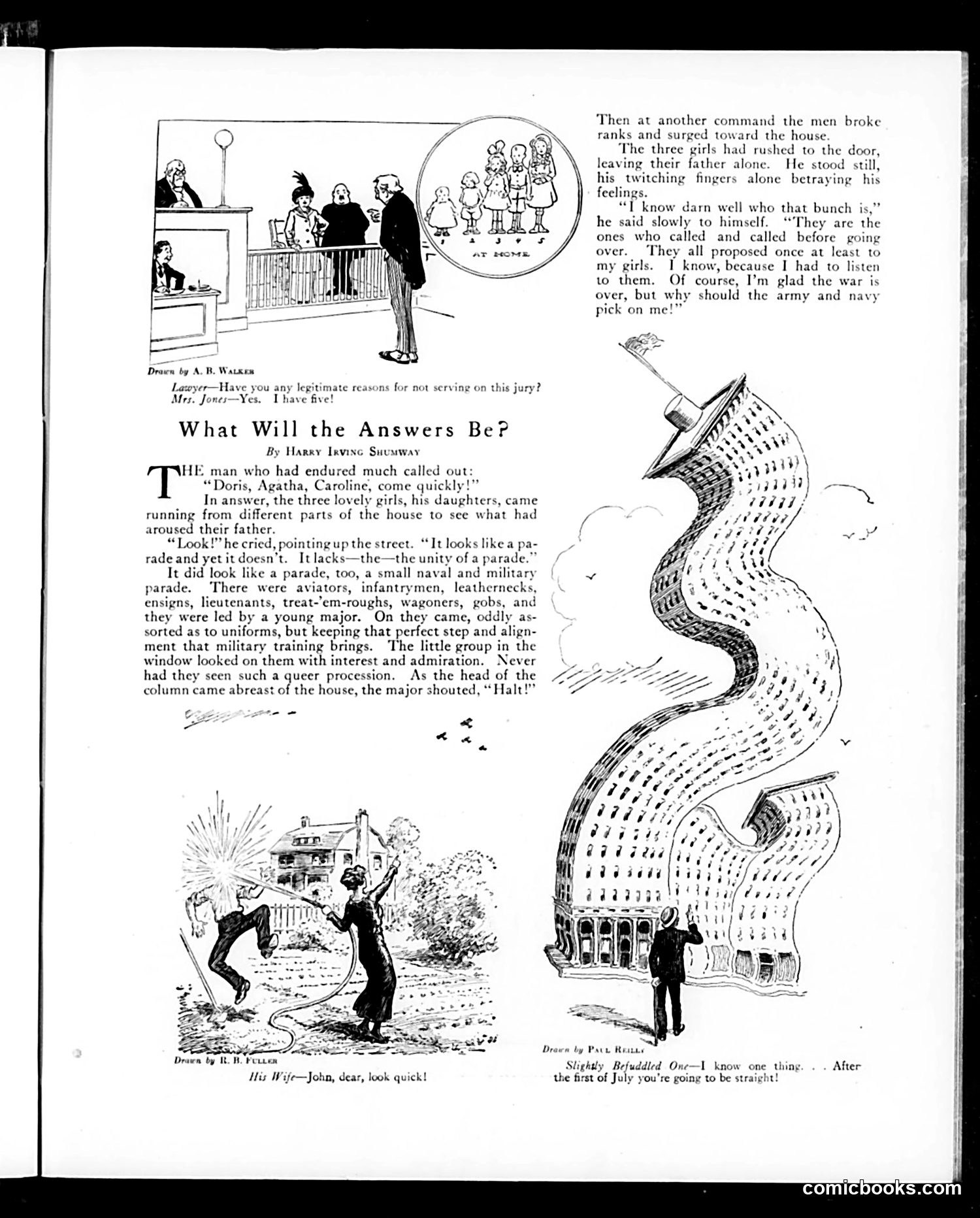
This page contains two satirical pieces about post-WWI America: **Main Story**: A father watches a disorganized military parade pass his house and realizes the marching soldiers are his daughters' former suitors—young men who repeatedly proposed to his girls before going to war. His complaint: now that the war is over, why is the army targeting *him* with this parade of eligible bachelors? The satire mocks post-war marriage anxiety: fathers feared returning soldiers would immediately pursue their daughters. **Top Cartoon**: A lawyer questions a potential juror (Mrs. Jones) about her ability to serve. She claims five legitimate reasons—clearly referring to her five children requiring her attention at home. The joke plays on women's domestic responsibilities being seen as legitimate excuses from civic duty. **Bottom Cartoon**: A husband tells his wife to "look quick" at a lightning bolt, joking that after July 4th fireworks, "you're going to be straight"—likely suggesting drunkenness from Independence Day celebrations.
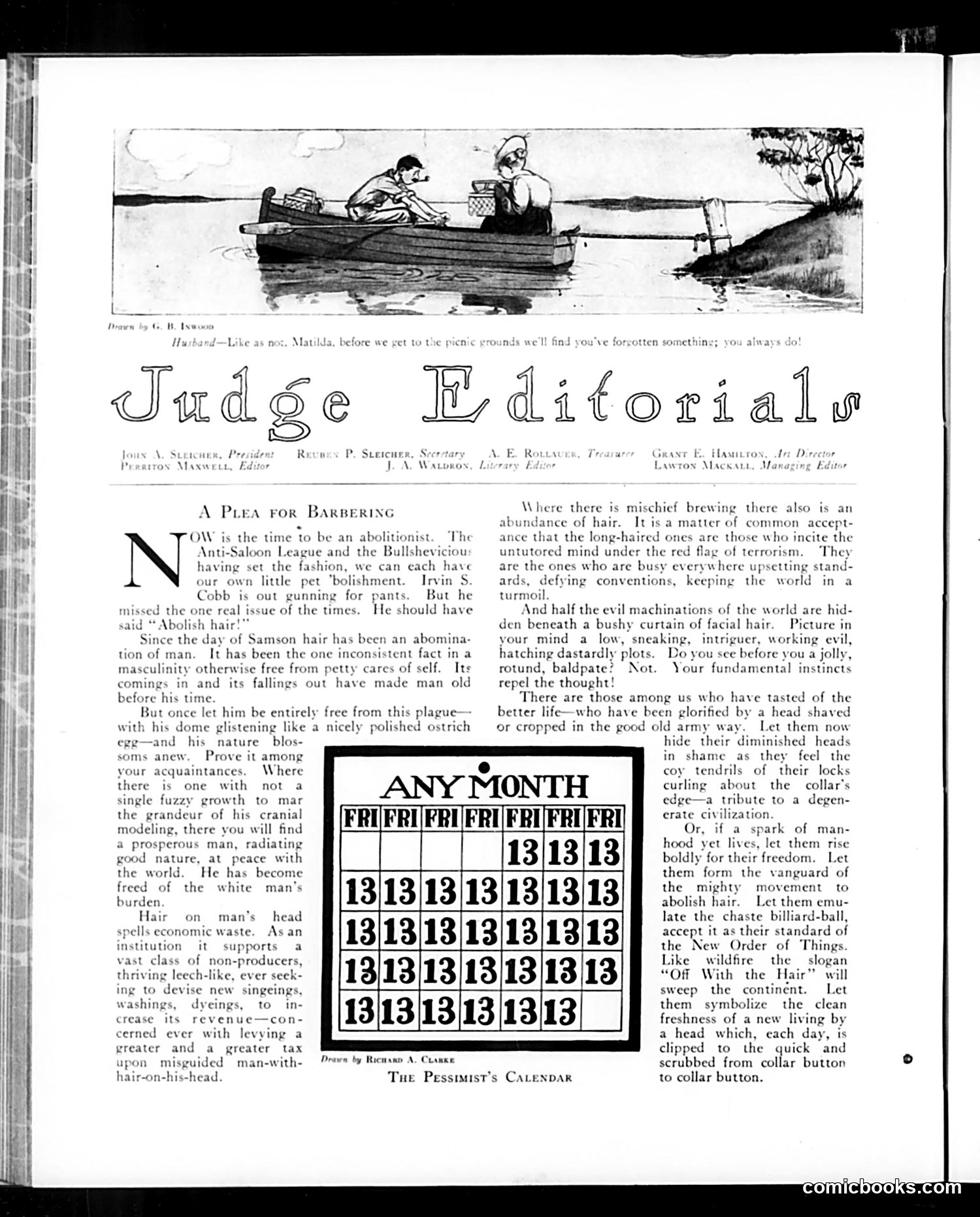
This 1913 *Judge* editorial satirizes the contemporary reform movement by proposing "abolish hair" as the next social cause. The piece mocks activists—particularly those behind Prohibition (the "Anti-Saloon League") and Bolshevism—by sarcastically suggesting that long hair, not alcohol or radicalism, is society's real evil. The satire conflates hair with degeneracy and rebellion: long-haired individuals are portrayed as terrorists, anarchists, and troublemakers ("red flag of terrorism," "sneaking intriguer"). Bald men, conversely, are depicted as prosperous, peaceful, and morally superior. The article suggests that mandatory hair-cutting would solve social ills—an absurdist position meant to ridicule reformers' certainty that eliminating one vice will perfect society. The "Pessimist's Calendar" (inset) humorously depicts unlucky Friday the 13ths, adding to the satirical tone. The cartoon at top appears to be unrelated domestic humor.
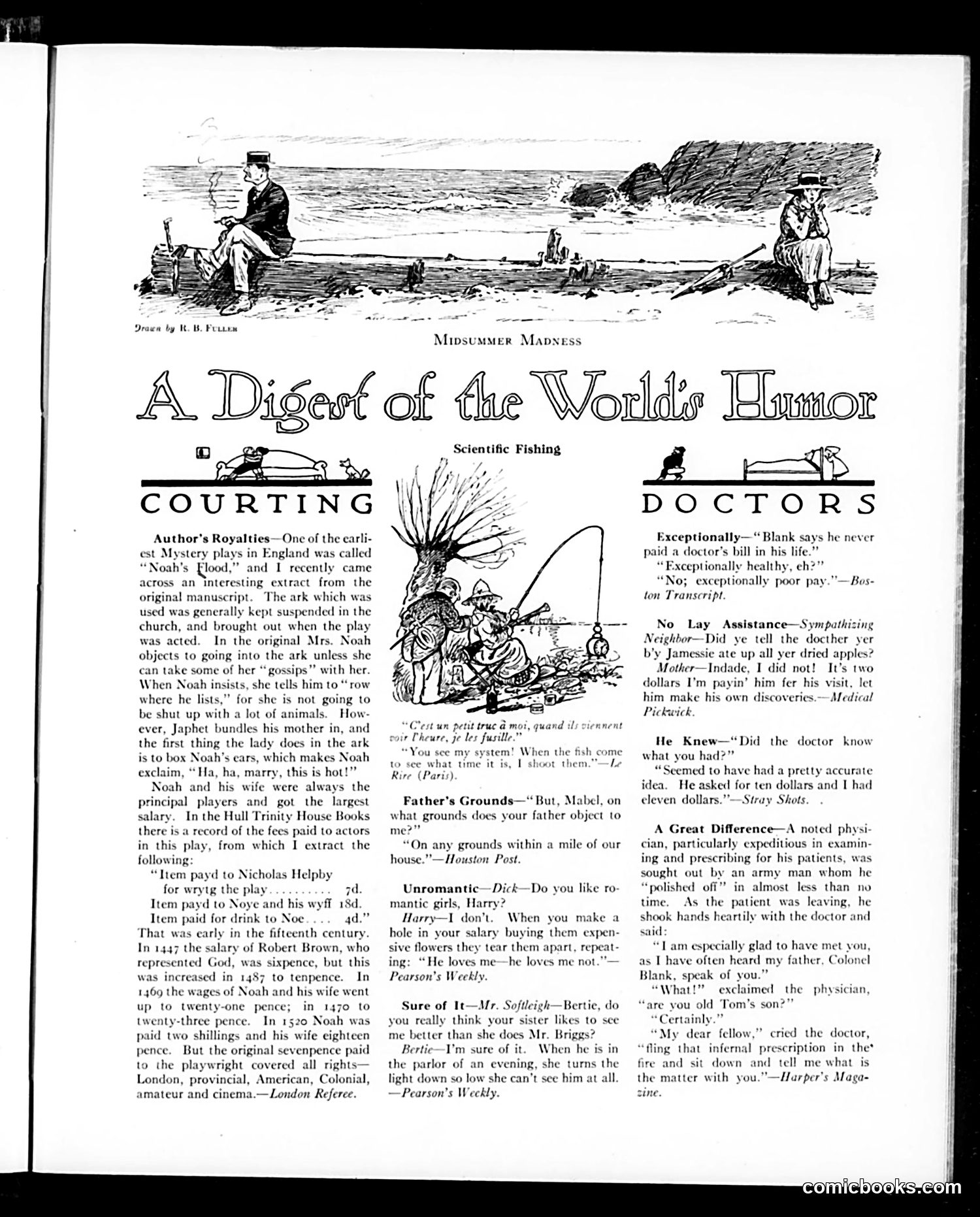
This page contains miscellaneous humor content rather than a unified political cartoon. **"Midsummer Madness" Section:** A sketch shows two figures lounging on a log by the seaside, appearing to take leisure during summer—a typical seasonal cartoon theme. **Main Content:** The page is primarily a humor digest with short anecdotes divided into sections: - **"Courting"** and **"Doctors"** columns contain brief jokes about courtship and medical visits - Pieces reference contemporary publications (*Houston Post, Pearson's Weekly, Harper's Magazine, Boston Transcript*) - Jokes mock doctors who charge high fees despite poor outcomes, romantic misunderstandings between courting couples, and class differences **"Author's Royalties" Essay:** A lengthy text block discusses historical records of payment to actors in 15th-century English "Noah's Flood" mystery plays, showing women (Mrs. Noah) commanded significant wages. The content reflects early 20th-century American humor: gender dynamics, class tensions, and satire of professional fees.
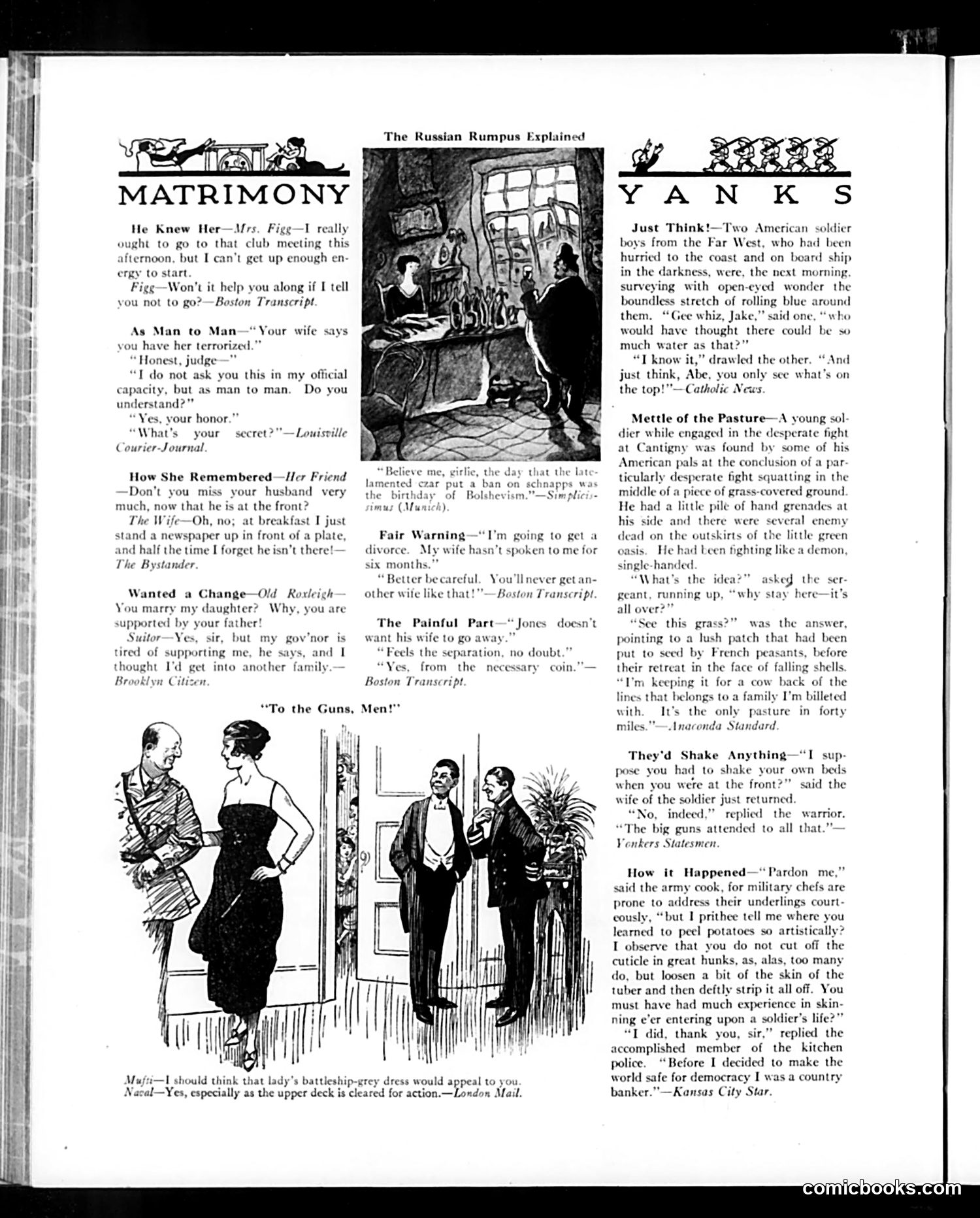
This page from Judge (a WWI-era American satirical magazine) contains several short humor pieces and cartoons mocking domestic life and soldier experiences. **Main Content:** The "Matrimony" section satirizes marriage dynamics—wives manipulating husbands, men using newspapers to avoid interaction with spouses, and the terror of separation anxiety over lost income rather than emotion. **"Yanks" section** features soldier anecdotes poking gentle fun at American troops. One story depicts naive Western soldiers amazed by ocean vastness; another celebrates a soldier's selflessness protecting French farmland for a cow. A third jokes that an army cook was previously a country banker—satirizing how the war mobilized civilians into unfamiliar roles. **"To the Guns, Men!" cartoon** contains a flirtatious double-entendre: a woman's "battleship-grey dress" appeals because "the upper deck is cleared for action"—risqué wartime humor about military readiness and romance. The overall tone reflects American home-front culture during WWI, mixing gentle domestic comedy with soldier stories emphasizing American virtue and naïveté.
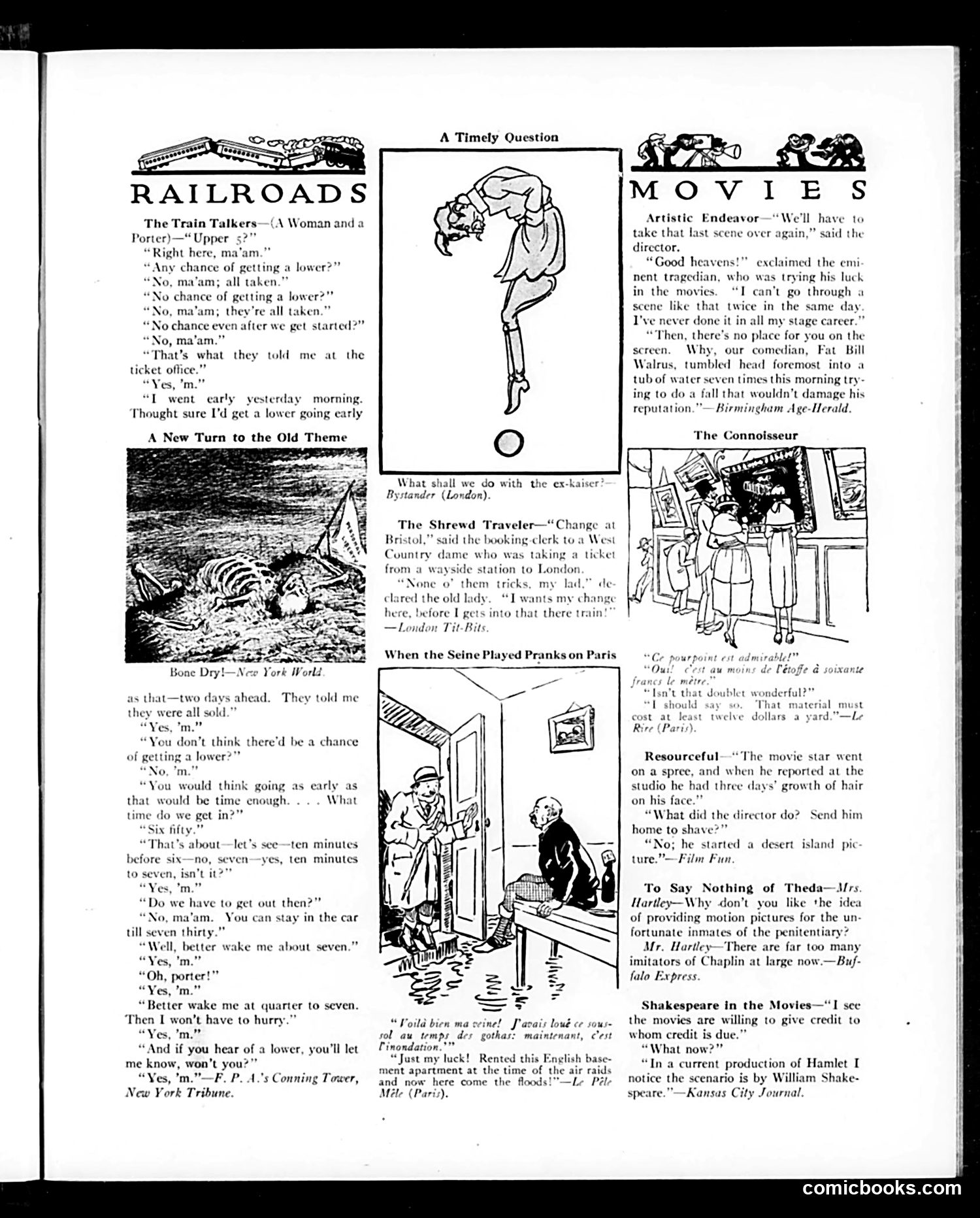
This page contains early 20th-century humor about railroads, travel, and emerging film industry topics. **"The Train Talkers"** satirizes passengers—particularly women—pestering porters with repetitive complaints about berth availability. The joke is the absurdity of asking the same question repeatedly, expecting different answers. **"A New Turn to the Old Theme"** depicts a flood scene (likely referencing the 1910 Seine flooding in Paris), with the caption "Bone Dry" creating dark irony about water disaster. The **movie-related jokes** mock film production's physical comedy demands (comedians falling repeatedly into water) and early cinema's growing tendency to adapt famous literature—"Shakespeare in the Movies" sarcastically notes giving writing credit to Shakespeare himself for a *Hamlet* scenario. **"A Timely Question"** references the post-WWI fate of Kaiser Wilhelm II (deposed 1918), asking what to do with the "ex-kaiser." Overall, this reflects 1920s concerns: rail travel nuances, natural disasters, and cinema's rapid cultural expansion and somewhat absurd practices.
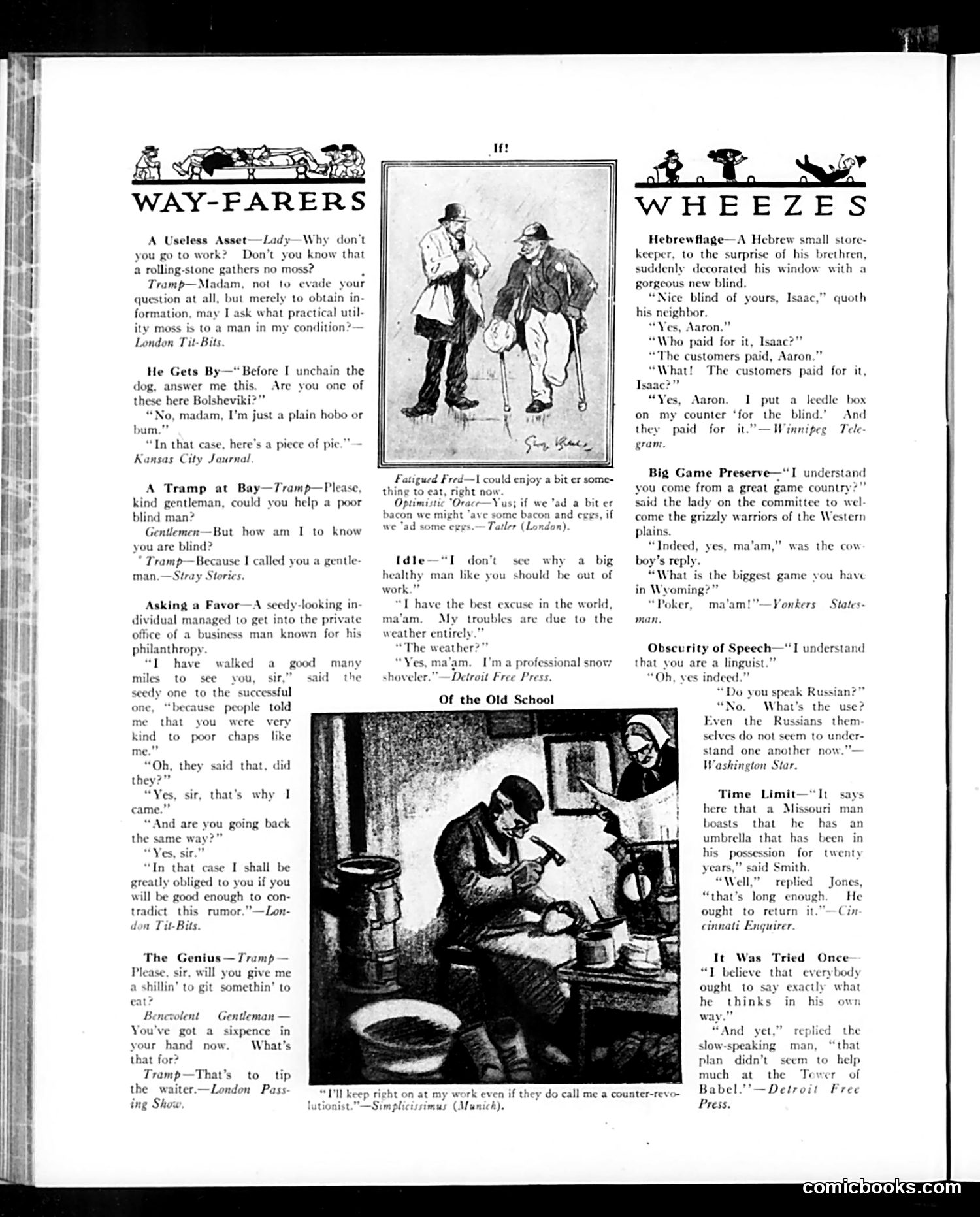
This page from Judge presents satirical humor through two sections: **Way-Farers** (left) and **Wheezes** (right), featuring brief comedic anecdotes rather than political cartoons. The **Way-Farers** sketches mock tramps and panhandlers through wordplay. One tramp argues philosophically about moss's utility; another escapes suspicion of being Bolshevik by claiming poverty instead. A final sketch shows a philanthropist refusing to help someone specifically *because* of his reputation for kindness—satirizing how charity can be manipulated. The **Wheezes** section uses ethnic stereotypes typical of early 20th-century American humor. A "Hebrew storekeeper" profits from a "blind box" charity scam. Cowboys and linguists are subjects of light ridicule. The overall tone mocks working-class survival strategies, begging, and ethnic merchant practices. The Bolshevik reference suggests post-WWI anxiety about radical politics. The humor relies on puns, logical absurdities, and contemporary stereotypes rather than specific political targets.
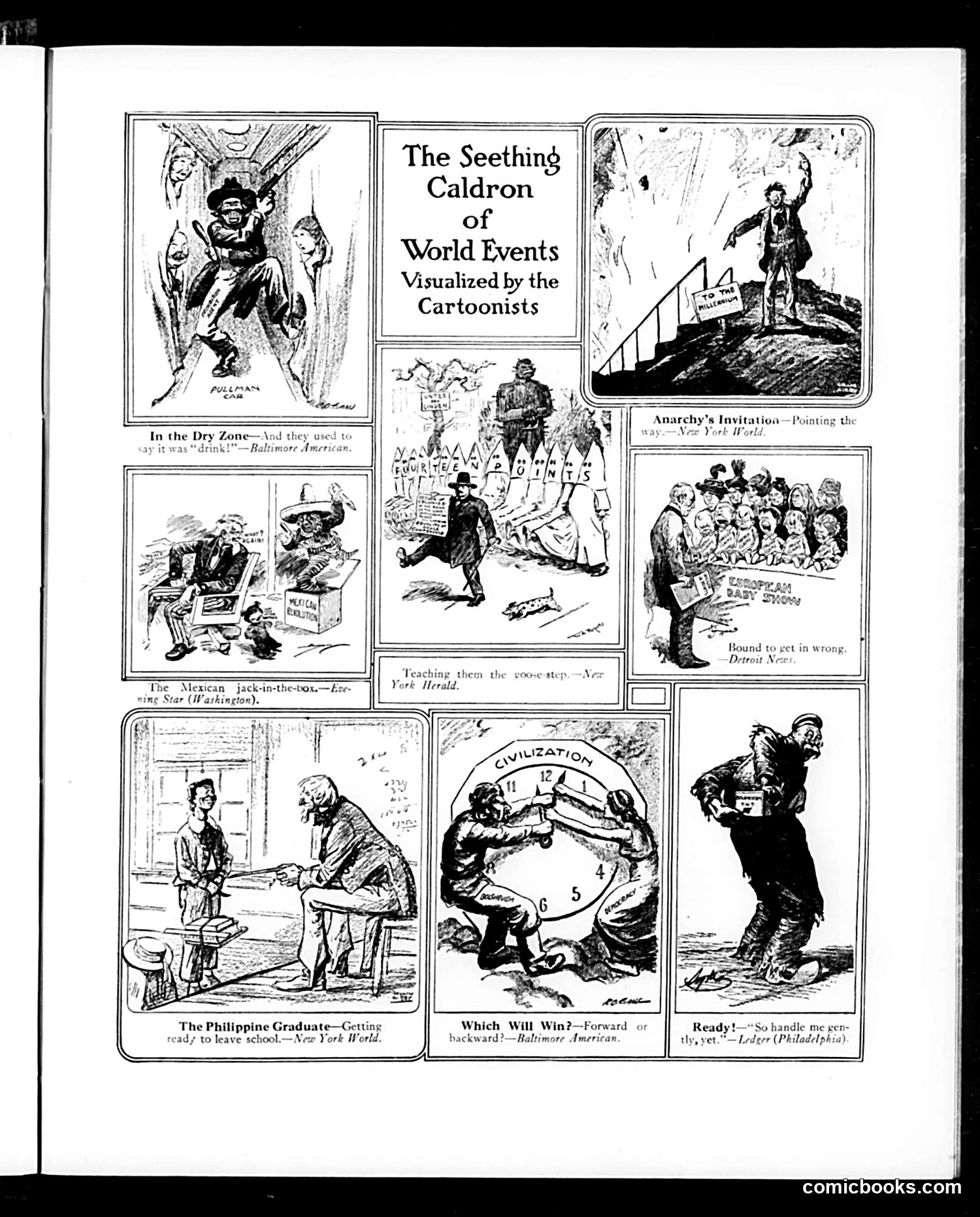
This Judge magazine page compiles political cartoons addressing early 20th-century international tensions. Key panels include: **"In the Dry Zone"**: References Mexico's political instability; the "jack-in-the-box" metaphor suggests Mexico's unpredictable upheavals. **"Teaching them the goose-step"**: Depicts militarism spreading, likely referencing German military influence or authoritarian regimes adopting aggressive postures. **"The Philippine Graduate"**: Addresses U.S. colonial administration in the Philippines, sarcastically suggesting the island was being "schooled" by America. **"Which Will Win?"**: Shows a civilization clock in conflict—the cartoonist questions whether progress or regression will dominate. **"Anarchy's Invitation"** and **"Ready!"**: Comment on social upheaval and revolutionary threats to established order. The overall theme portrays a volatile world "seething" with competing ideologies, military aggression, colonialism, and social unrest. The satire critiques both foreign adventurism and domestic instability.
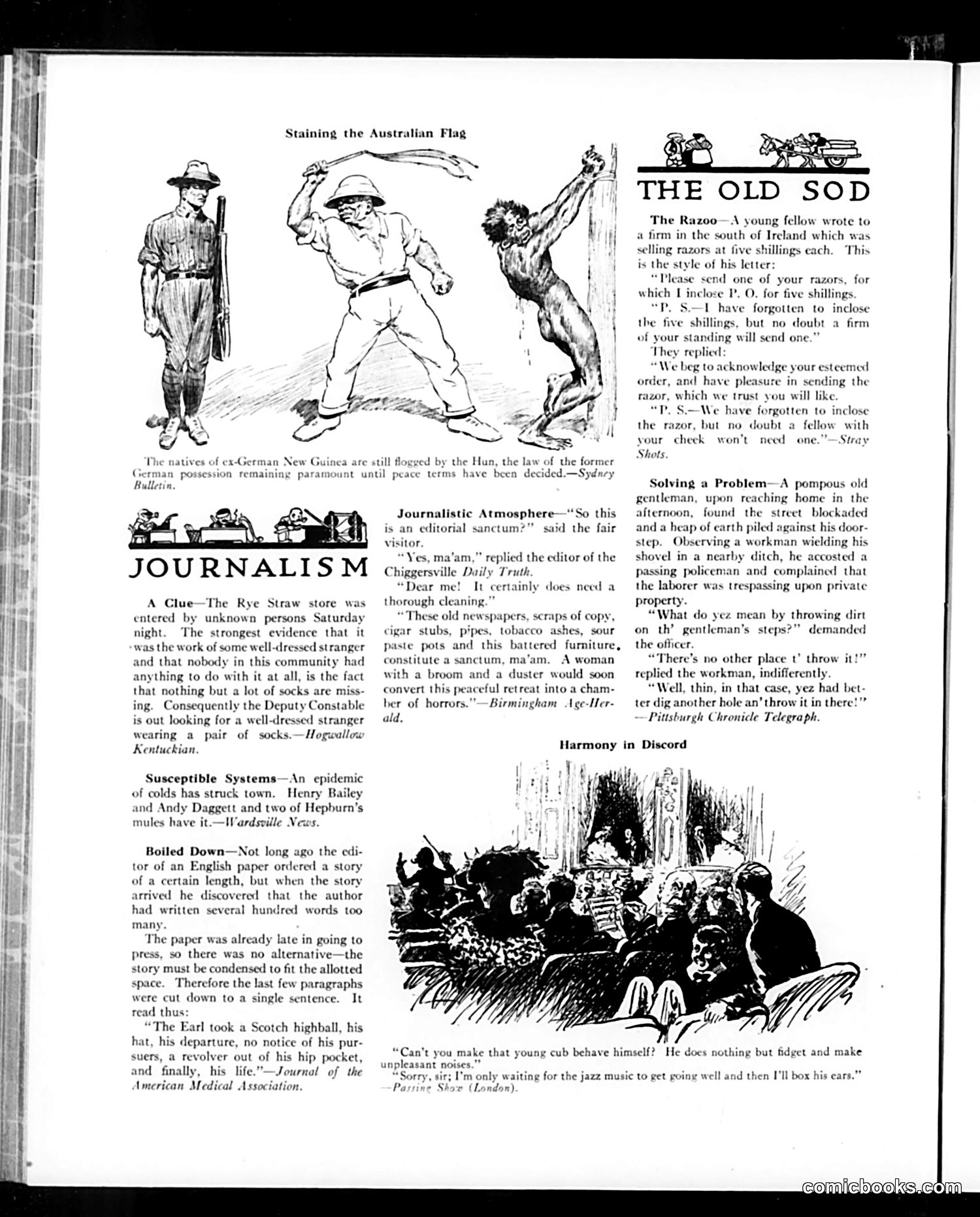
This page collects humorous anecdotes and cartoons typical of early 20th-century American satirical journalism. **"Staining the Australian Flag"** (top): The cartoon depicts what appears to be Australian soldiers or colonials engaged in physical conflict or undignified behavior. The caption references ex-German New Guinea and peace terms, suggesting this mocks Australian conduct during or after WWI, portraying them as damaging their nation's reputation through crude behavior. **Main content**: The page consists of brief comedic snippets from various newspapers—"A Clue," "Susceptible Systems," "Boiled Down," "Journalistic Atmosphere," and "The Razoo"—showcasing witty editorial jokes about small-town life, journalism standards, and wordplay. **"Harmony in Discord"** (bottom illustration): Shows what appears to be a family or group scene with a caption about a "young cub" who fidgets and needs jazz music—likely satirizing modern youth culture and jazz's controversial reputation in this era. The page reflects Judge's approach: reprinting clever newspaper excerpts and cartoons to amuse educated readers while mocking contemporary social issues, journalism practices, and generational divides.
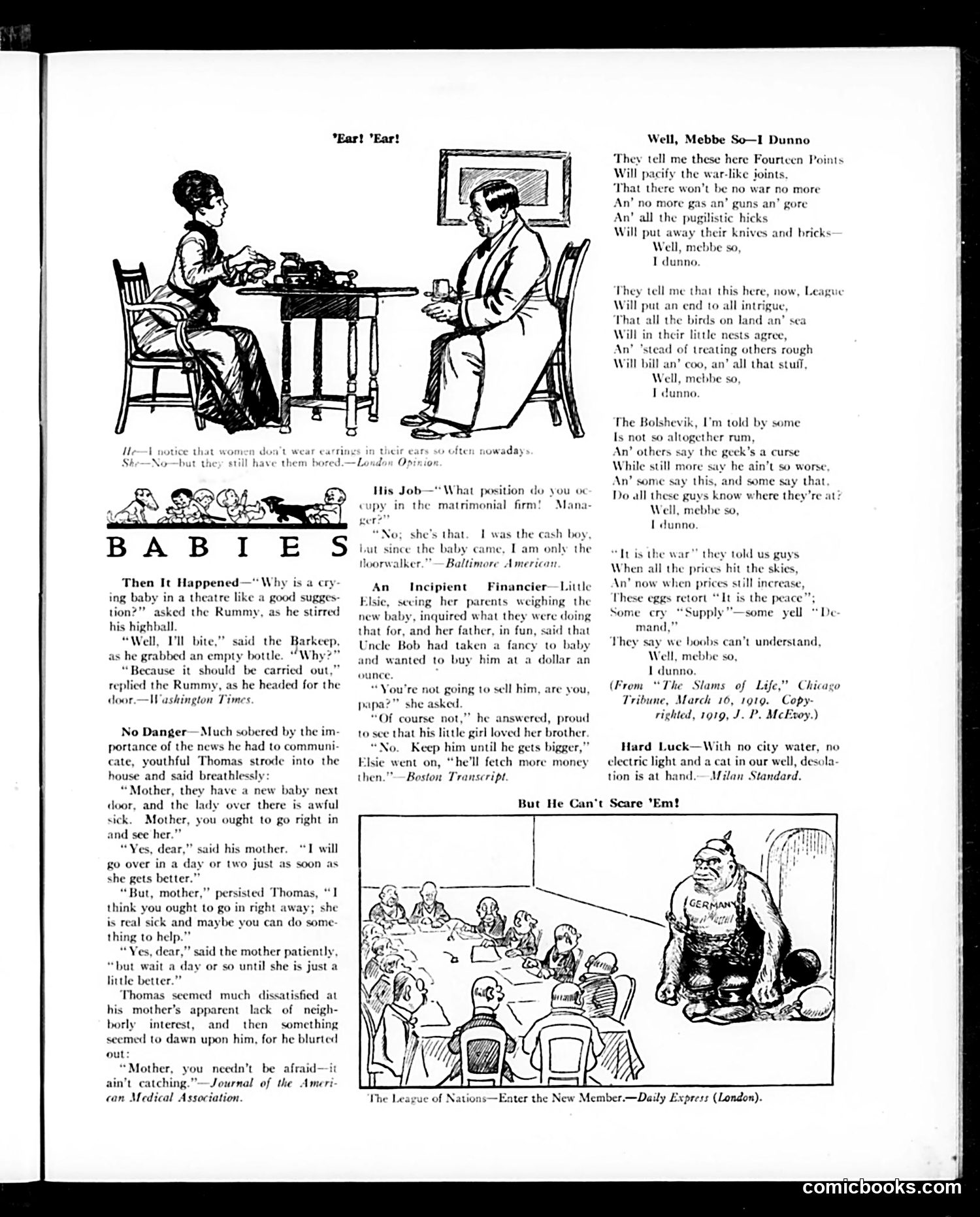
This page contains several satirical pieces reflecting post-WWI American skepticism: **Main Cartoon ("But He Can't Scare 'Em!")**: A grotesque figure labeled "Germany" sits at a League of Nations table, attempting to intimidate smaller delegates. The satire mocks the idea that Germany—despite military defeat—could still threaten the newly formed League, suggesting either the League's weakness or Germany's continued menace. **"Well, Mebbe So—I Dunno"**: A vernacular poem expressing working-class doubt about post-war promises: Wilson's Fourteen Points, the League of Nations ending conflict, and explanations for persistent inflation. The repeated refrain captures popular cynicism—these grand ideals sound nice but seem unlikely to solve real problems. **Shorter humorous pieces**: Various jokes about babies, matrimony, and finances—standard magazine filler. **Overall context**: Published in 1919, this reflects American ambivalence about international involvement and skepticism toward political solutions to war and economic hardship.
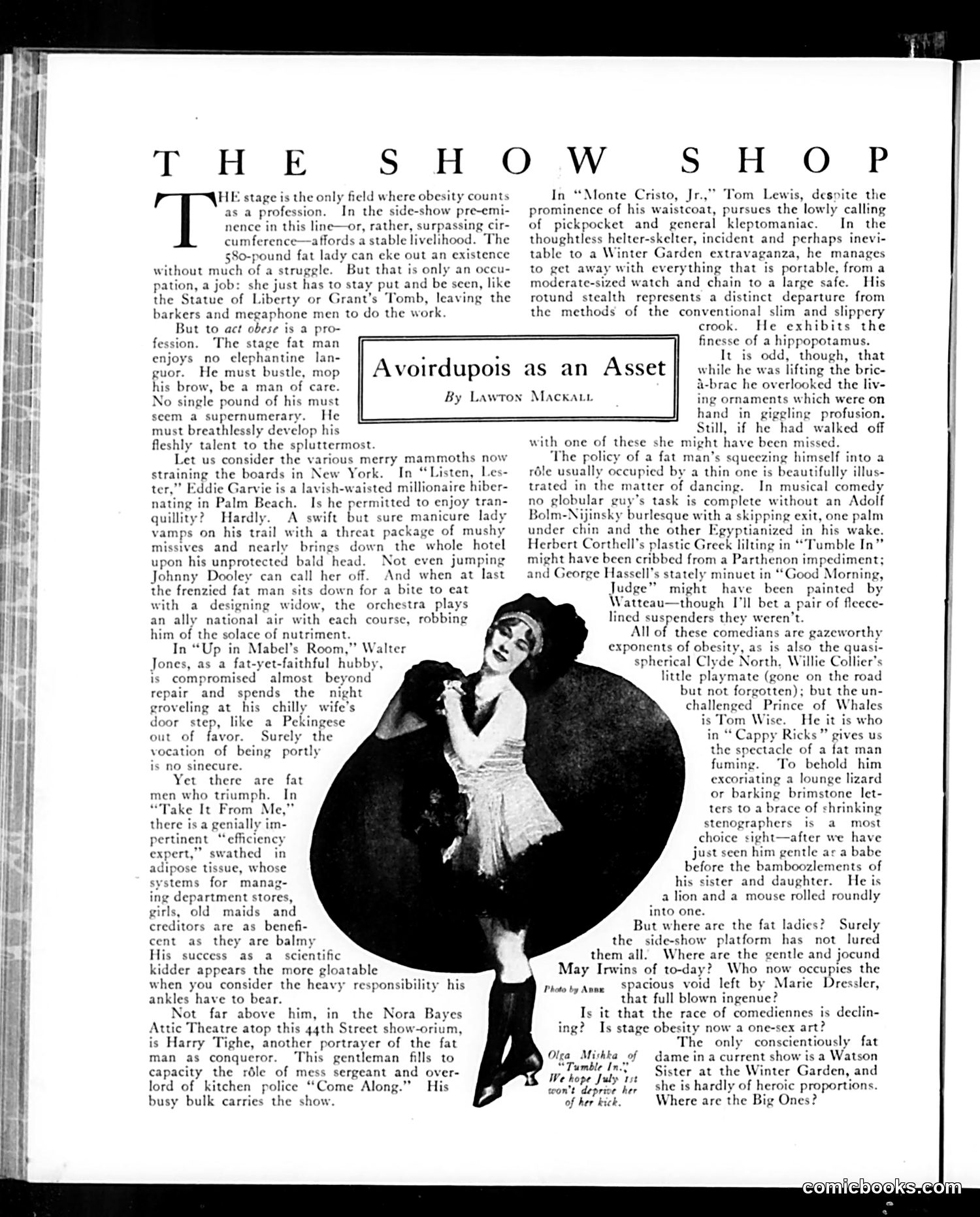
This article satirizes the theatrical convention of casting heavyset male comedians in major Broadway roles circa 1920. The author argues that while a "fat lady" in a sideshow is merely a static curiosity, a "fat man" on stage must actively *perform*—dancing, scheming, and bustling about despite his bulk—making obesity an actual theatrical skill. The piece catalogs specific performers and shows: Tom Lewis in "Monte Cristo, Jr." plays a pickpocket; Eddie Garvie in "Listen, Lester" portrays a harassed millionaire; Walter Jones in "Up in Mabel's Room" is a cuckolded husband; Harry Tighe in "Come Along" plays a mess sergeant. Each example demonstrates how these rotund actors must maintain frantic energy rather than enjoy "elephantine languor." The satire's point: stage "fatness" demands genuine comedic talent and physical exertion—it's a legitimate profession requiring skill, not mere appearance. The humor lies in the incongruity of portly men performing acrobatic feats and romantic/dramatic scenes that thin actors would handle effortlessly.
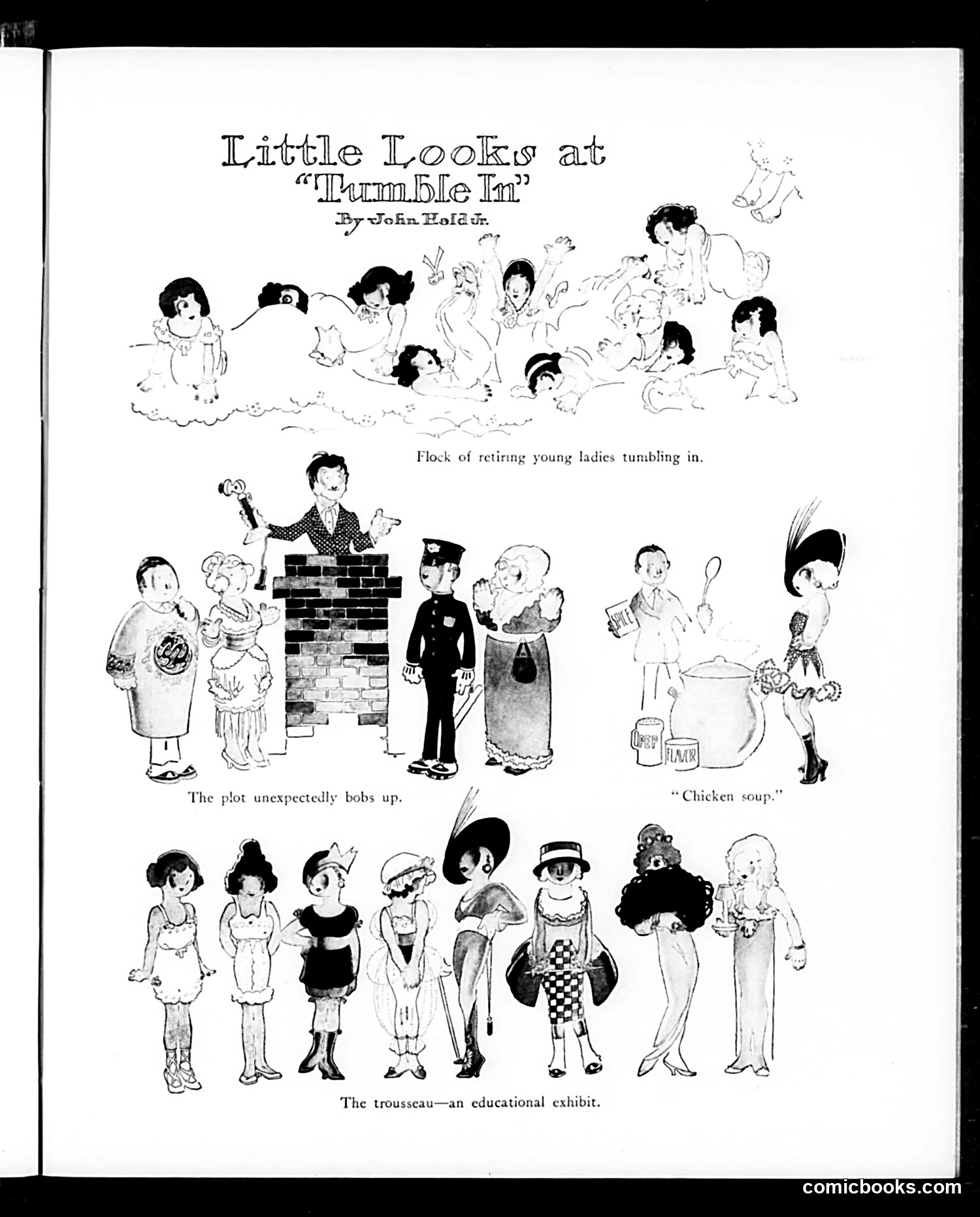
This satirical cartoon sequence mocks the modern "tumble in" trend—apparently a casual social gathering or dance where young women engaged in acrobatics and physical activity together. The humor targets: 1. **"Flock of retiring young ladies tumbling in"** — satirizes respectable young women abandoning decorum for undignified gymnastics 2. **"The plot unexpectedly bobs up"** — suggests romantic or social complications arise during these gatherings 3. **"Chicken soup"** — implies the aftermath involves modest, domestic practicality 4. **"The trousseau—an educational exhibit"** — the final panel of women in various dress styles mocks how these modern activities supposedly prepare young women for marriage instead of traditional finishing-school education The satire critiques the shift in early 20th-century women's culture toward physical recreation and away from Victorian propriety, treating this modern femininity as undignified and ultimately irrelevant to women's actual purpose (marriage).
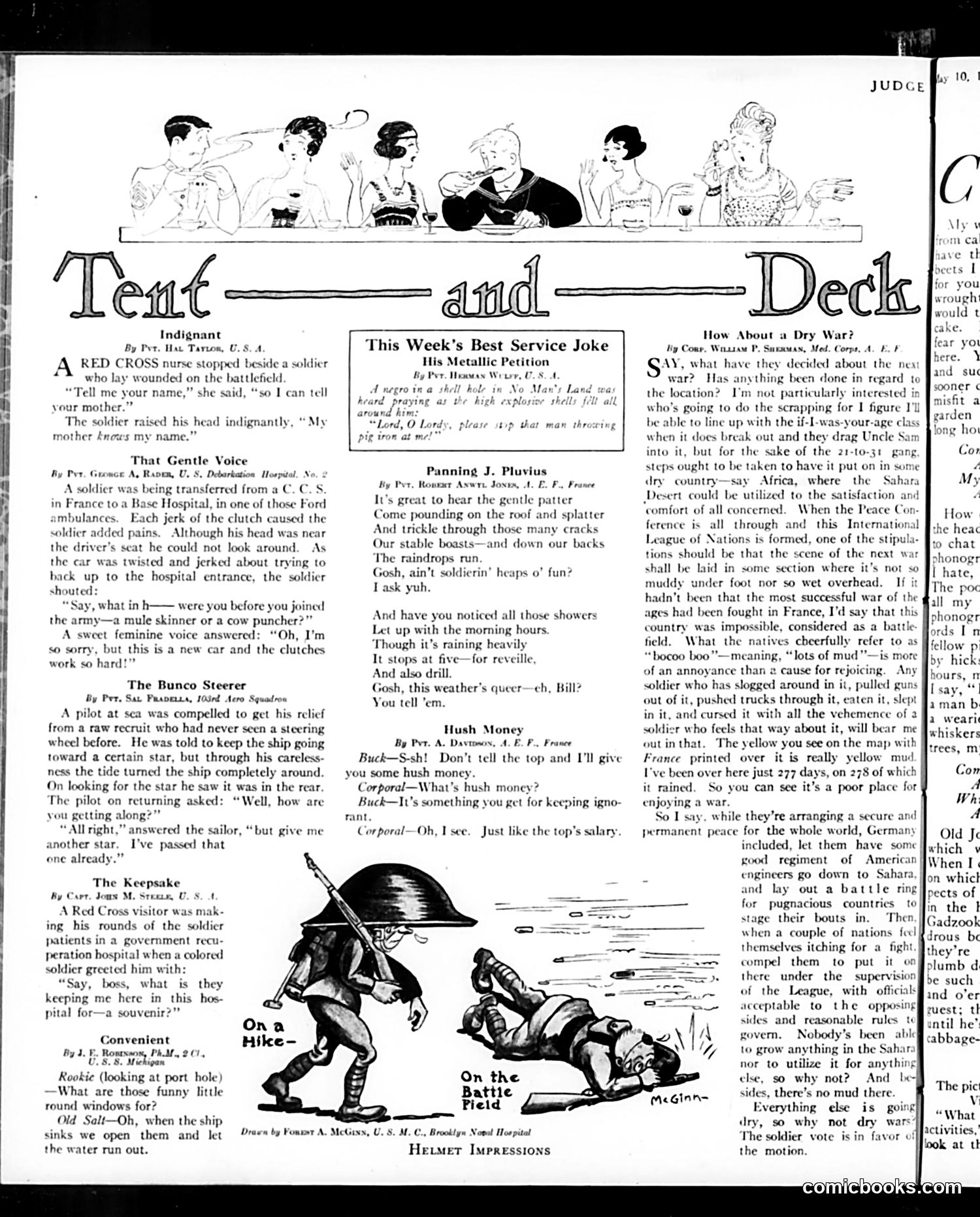
This page contains WWI-era military humor from soldiers' perspectives. The cartoons mock various military experiences: **"Indignant"** satirizes well-meaning Red Cross nurses treating soldiers patronizingly—the wounded soldier resents being asked his name as if his mother wouldn't know it. **"That Gentle Voice"** jokes about a female ambulance driver's rough clutch work, with her apologetic femininity contrasting her mechanical incompetence. **"The Bunco Steerer"** depicts a naive sailor following star navigation instructions so literally he doesn't realize the ship has turned around. **"The Keepsake"** uses a Black soldier's joke about being hospitalized as a "souvenir"—dark humor about his disposability. **"How About a Dry War?"** proposes future wars be fought in Africa's Sahara Desert for logistical convenience, satirizing bureaucratic war-planning absurdity. The humor reflects soldiers' frustrations with military incompetence, well-intentioned but foolish support personnel, and the surreal bureaucracy of mechanized warfare. These are jokes *by* enlisted men *about* their experiences.
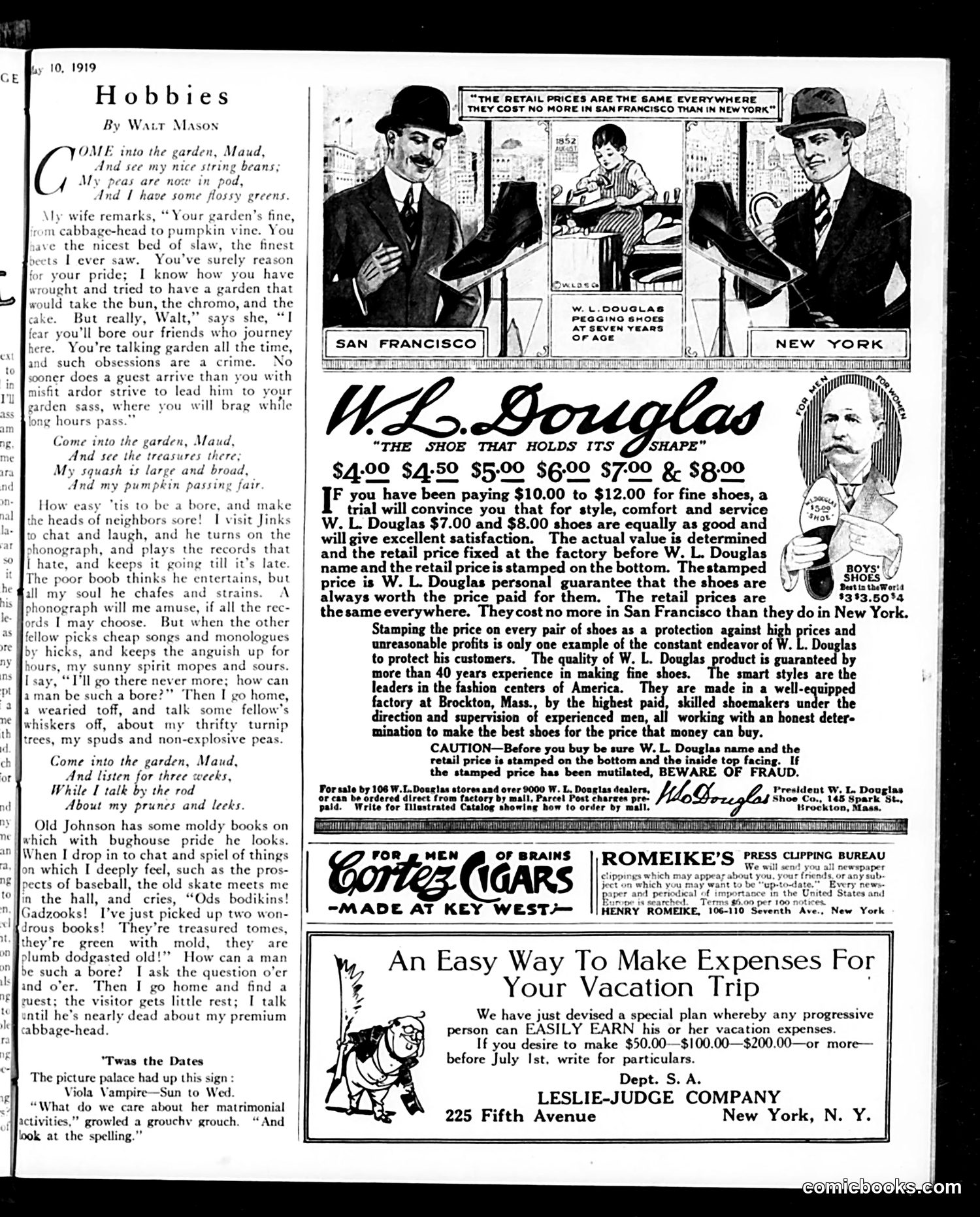
**The Page Content:** This is primarily an advertising page from Judge magazine (July 10, 1919). The main feature is a large W.L. Douglas shoe advertisement claiming identical retail prices nationwide—a significant claim in an era before chain stores standardized pricing. The ad uses a comparison cartoon showing two men in San Francisco and New York, implying the same shoes cost the same in both cities, refuting accusations of regional price gouging. **The Satire:** The left column contains "Hobbies" by Walt Mason—a humorous poem about bores who obsessively discuss their personal interests (gardens, phonographs, old books). The irony is implicit: the W.L. Douglas ad is itself a form of this boring obsession, repeatedly hammering the same message about stamped prices and quality. **Historical Context:** In 1919, before modern retail chains, prices varied dramatically by region and retailer. Douglas's guarantee to stamp prices on shoe soles was genuinely innovative anti-fraud consumer protection, though the repetitive advertising makes the page itself somewhat tedious—fitting the "hobbies" theme's critique of relentless enthusiasts.
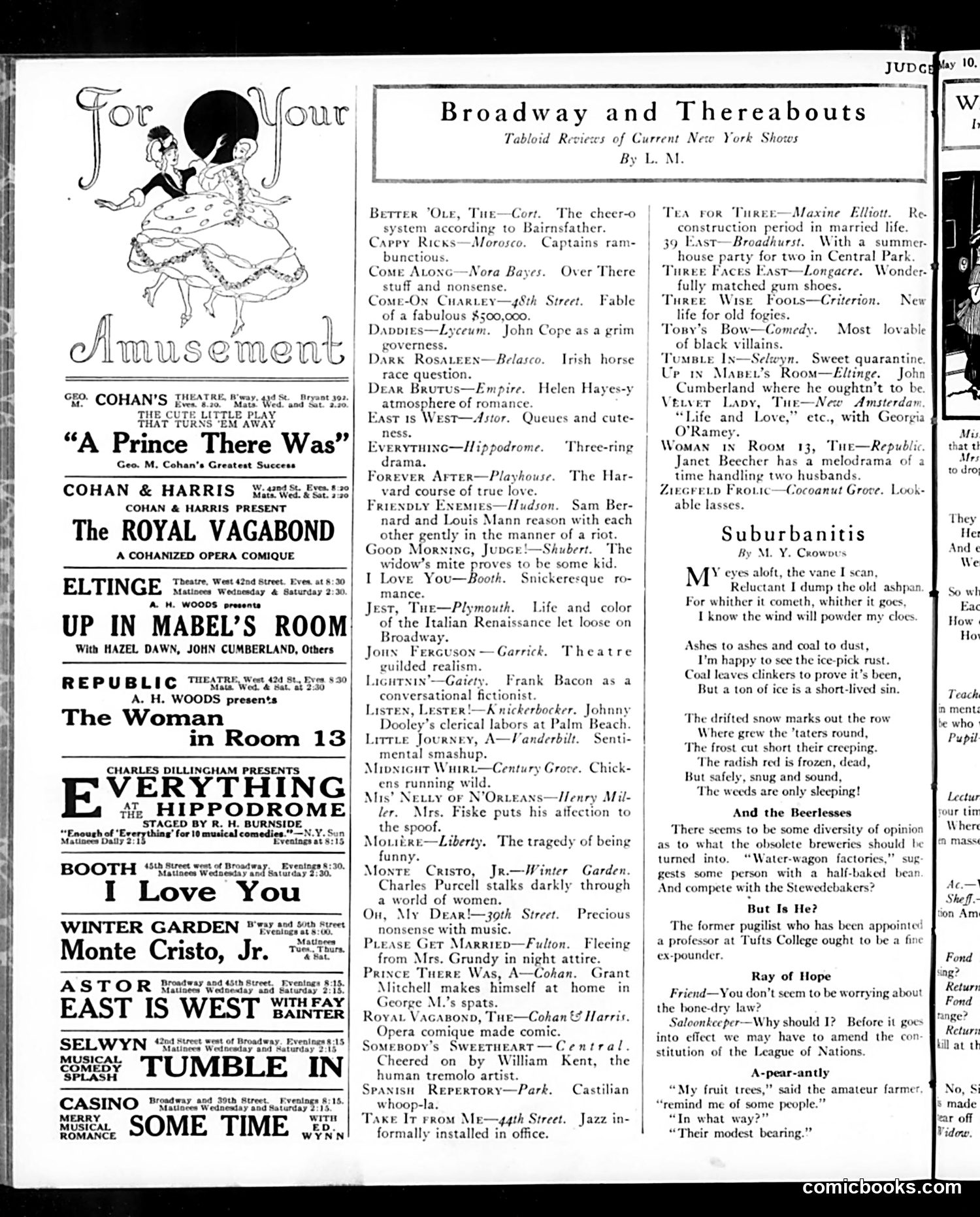
This is primarily a **theater advertisement and review page**, not a political cartoon. The large "For Your Amusement" header introduces Broadway show listings and brief satirical synopses of current productions (dated around 1916, based on context clues like George M. Cohan shows). The humor works through **theatrical mockery**: reviewers condense complex plots into witty one-liners that mock the shows' pretensions. For example, *"Come Along"* is dismissed as "stuff and nonsense," while *"Midnight Whirl"* features "Chickens running wild." The decorative header illustration shows stylized figures in period dress—typical Jazz Age design, not political commentary. The page's satire targets **Broadway itself**: its melodramas, predictable romances, and overwrought productions. The brief "Suburbanitis" poem at bottom continues this genteel humor about domestic life. This is **entertainment journalism**, using Judge's satirical voice to amuse readers about current stage offerings rather than political issues.
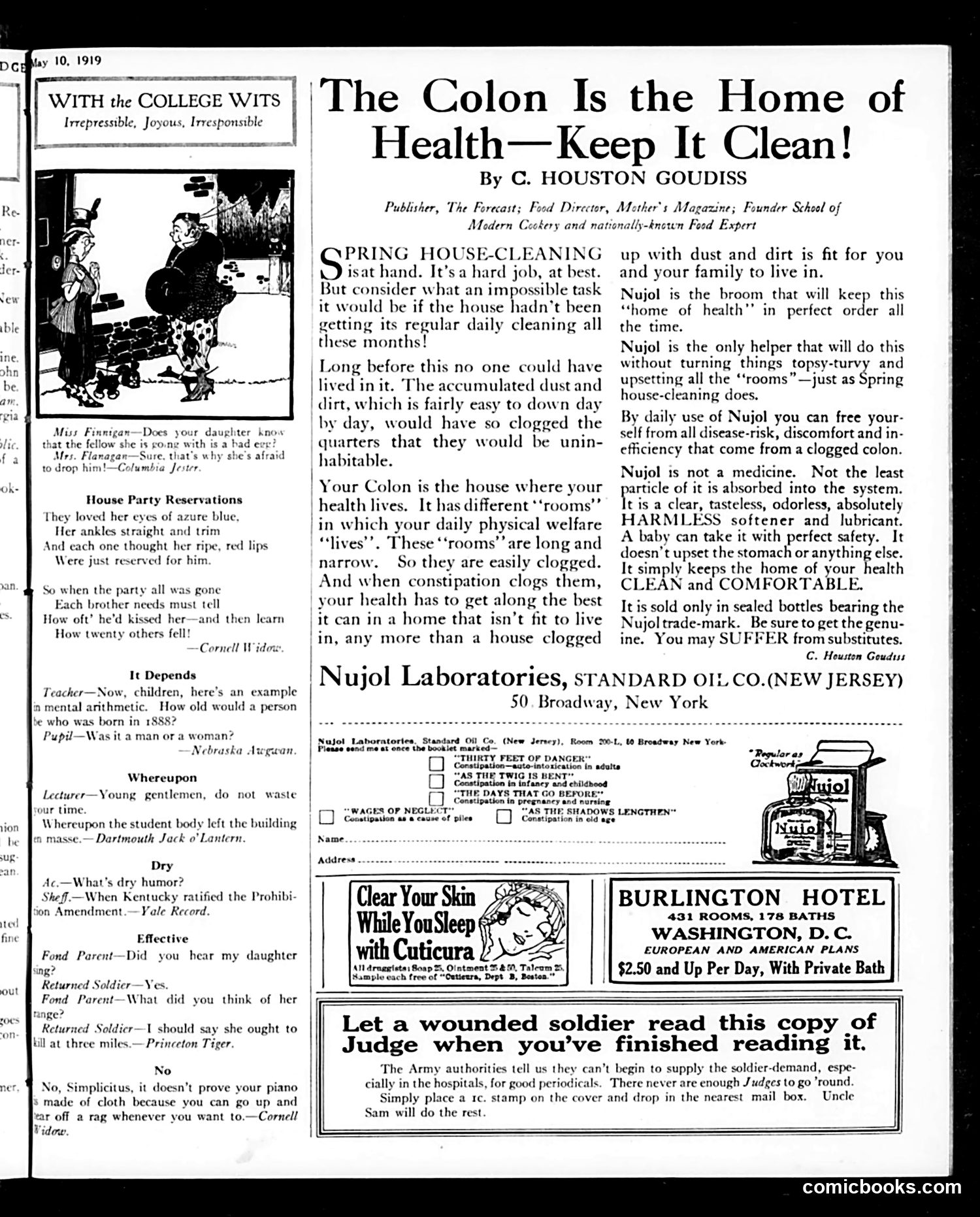
## College Humor Section The left column contains joke submissions from student newspapers (Columbia, Nebraska, Yale, Princeton, etc.)—these are light gags about dating, prohibition, and college life typical of the era. ## Main Content: Nujol Advertisement Disguised as Health Article The dominant article by C. Houston Goudiss uses an extended metaphor: the human colon as a "home" that requires "spring house-cleaning." Constipation is "clogging" this living space. **Context**: This is 1919—the height of the "constipation crisis" in American advertising. Early 20th-century marketing aggressively promoted bowel regularity as essential to health and beauty. Nujol (a mineral oil product by Standard Oil) positioned itself as a non-medicinal lubricant rather than a harsh laxative. **The Satire**: By dressing commercial promotion in a health expert's earnest language with domestic metaphors, the ad exploits American anxieties about bodily cleanliness while disguising sales pitch as education. The page reflects both genuine period health concerns and aggressive marketing that would later face FDA scrutiny.
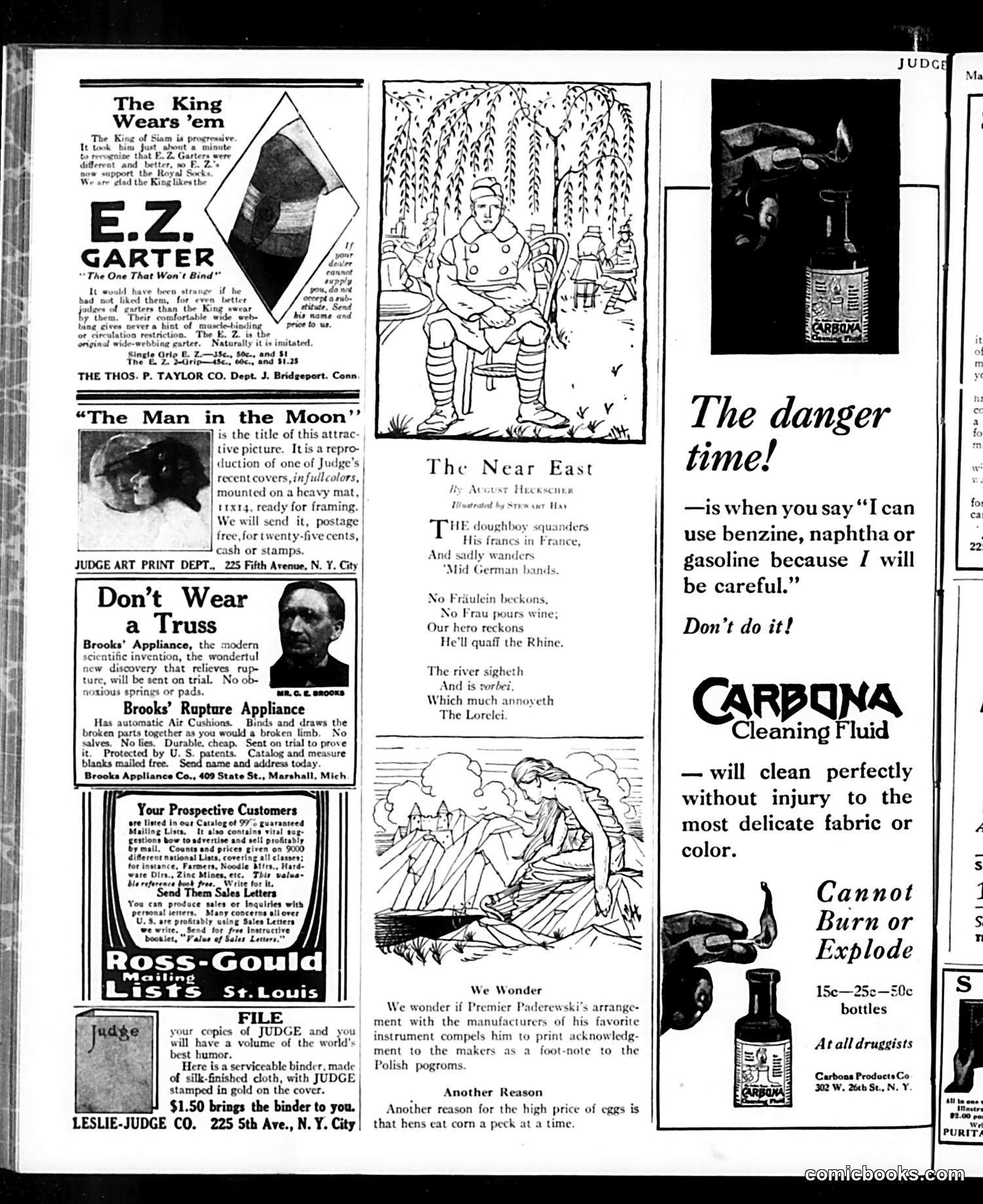
This Judge magazine page combines satirical content with period advertising. **"The Near East" poem**: A satirical commentary on American soldiers ("doughboys") stationed in post-WWI Europe. The verse mocks their romantic disappointment—expecting French women and Rhine wine, but finding only desolation and the legendary Lorelei (German folklore). The satire targets both soldier expectations and the grim reality of occupation duty. **"We Wonder" section**: Sharp political satire directed at Polish Premier Paderewski, suggesting his piano manufacturer likely demands public credit even for his involvement in the violent "Polish pogroms" (anti-Jewish massacres). This bitterly implies commercial interests exploit even tragic events. **"Another Reason"**: A mild joke blaming high egg prices on hens' consumption, offering comic relief after weightier satire. **Advertisements** dominate the page—E.Z. Garter, Brooks' Rupture Appliance, and notably Carbona Cleaning Fluid with safety messaging about avoiding flammable solvents. These reflect 1920s consumer products and health concerns typical of Judge's audience.
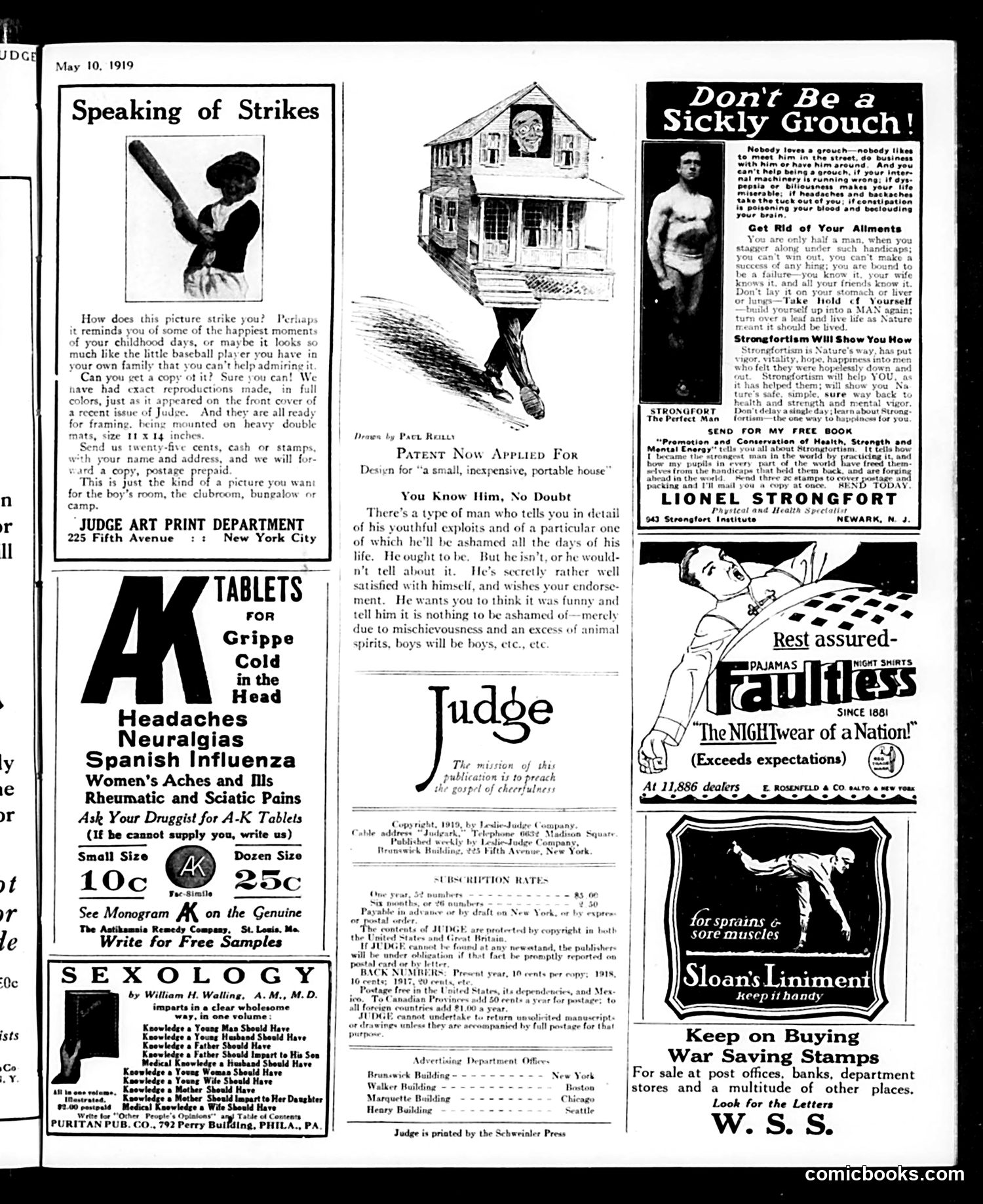
This page is primarily advertising with one short editorial cartoon. The "Speaking of Strikes" cartoon depicts a man wielding a baseball bat, likely referencing labor strikes occurring in 1919—a year of major American labor unrest. The caption suggests the image recalls childhood baseball nostalgia, but the juxtaposition with the title implies critique of strike violence or strikers' aggressive tactics. The page's advertisements reveal post-WWI concerns: A-K Tablets promote remedies for Spanish Influenza (the 1918-19 pandemic); Strongfort advertises physical fitness and health; War Saving Stamps encourage continued wartime financial support. These ads collectively reflect immediate post-war anxieties about disease, national strength, and economic recovery. The layout is typical of Judge's satirical-advertising hybrid format, where commercial messaging and social commentary coexist.
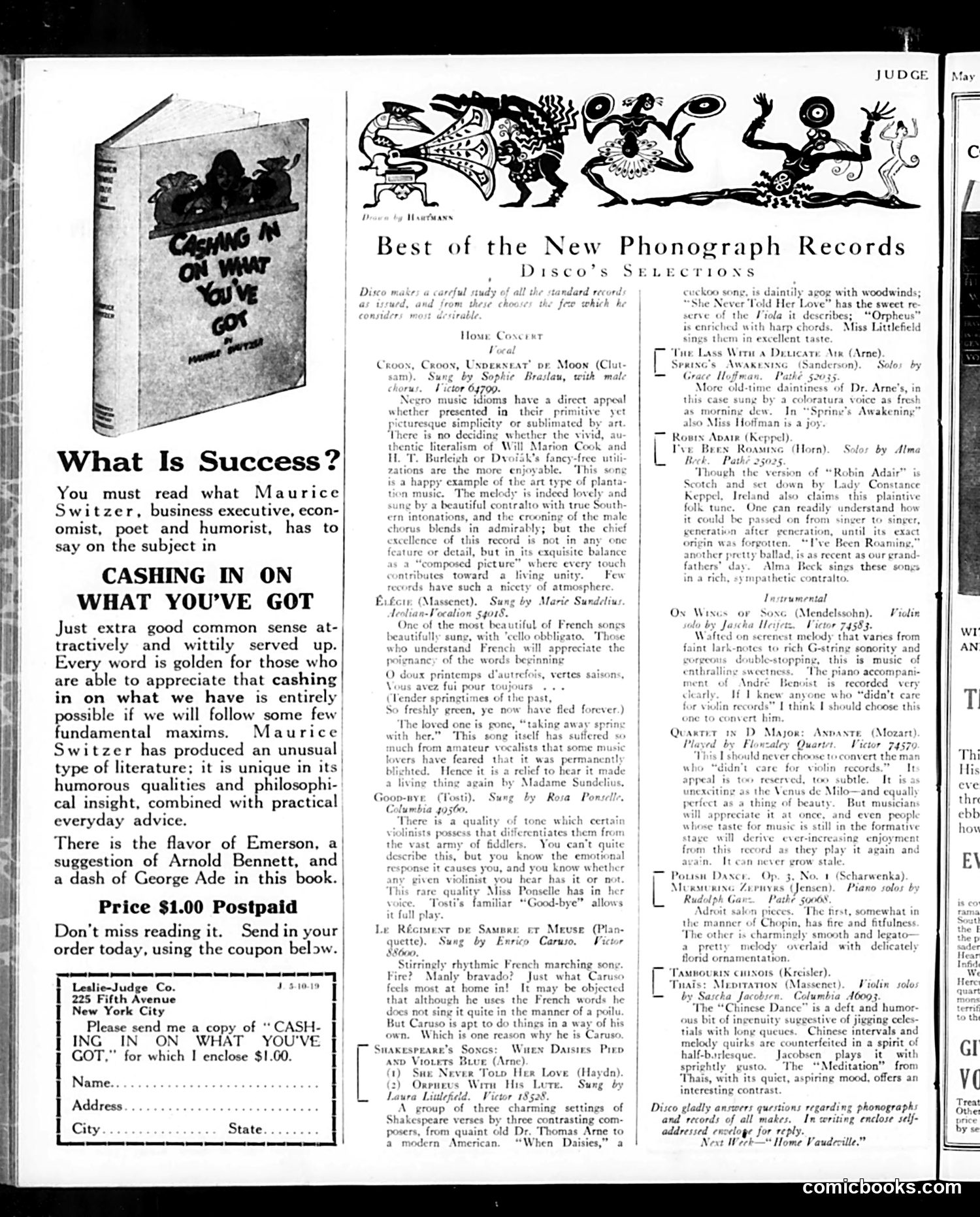
This page is primarily **advertising and music criticism**, not political satire. The left side promotes Maurice Switzer's self-help book "Cashing In on What You've Got"—positioning it as practical philosophy in the style of Emerson, Arnold Bennett, and George Ade. The pitch emphasizes common sense and financial pragmatism. The right side is a music review column titled "Best of the New Phonograph Records," evaluating classical vocal recordings (likely from 1919, based on the coupon date). It discusses operatic performances and art songs by artists like Enrico Caruso and Rosa Ponselle. **No political cartoons appear on this page.** The decorative header illustration shows abstract, modernist figures—purely ornamental. This is a typical Judge magazine interior page mixing advertisements, book promotions, and entertainment criticism rather than satire or commentary on current events.
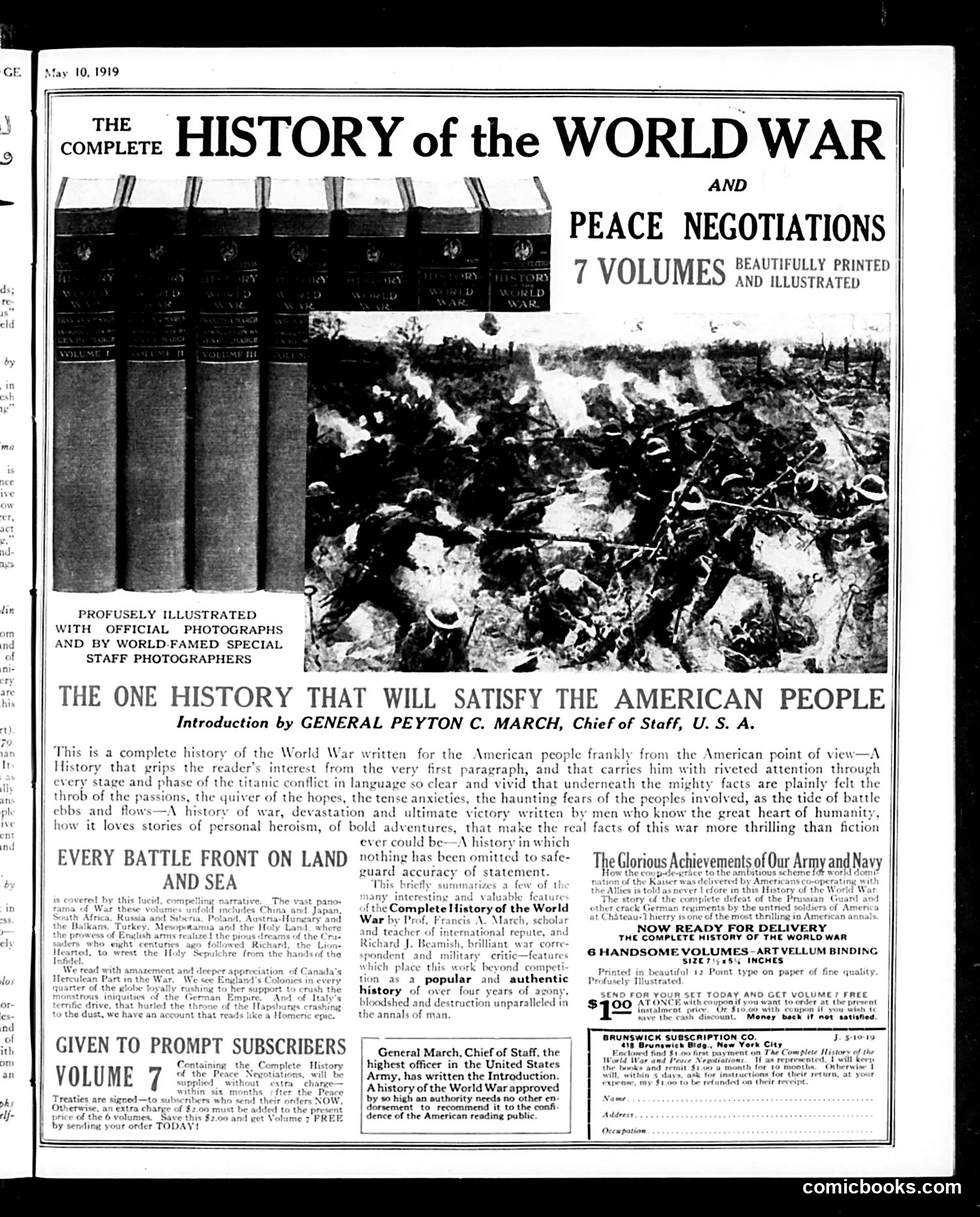
This is **not a cartoon or satire**, but rather a full-page advertisement published May 10, 1919—shortly after WWI's November 1918 armistice. The ad promotes a seven-volume history of World War I and peace negotiations, emphasizing its credibility through: 1. **General Peyton C. March's endorsement** — the U.S. Army Chief of Staff, lending military authority 2. **"Official photographs"** and "world-famed special staff photographers" — claiming documentary authenticity 3. **American perspective** — explicitly framed as written "for the American people frankly from the American point of view" 4. **Patriotic messaging** about "glorious achievements of our Army and Navy" The subscription offer promises delivery of all volumes at $1.25 per volume, with a free seventh volume to prompt immediate orders. For modern readers: this reflects post-WWI America's appetite for comprehensive war documentation and the marketing strategy of using military authority figures to establish legitimacy in a competitive publishing market.
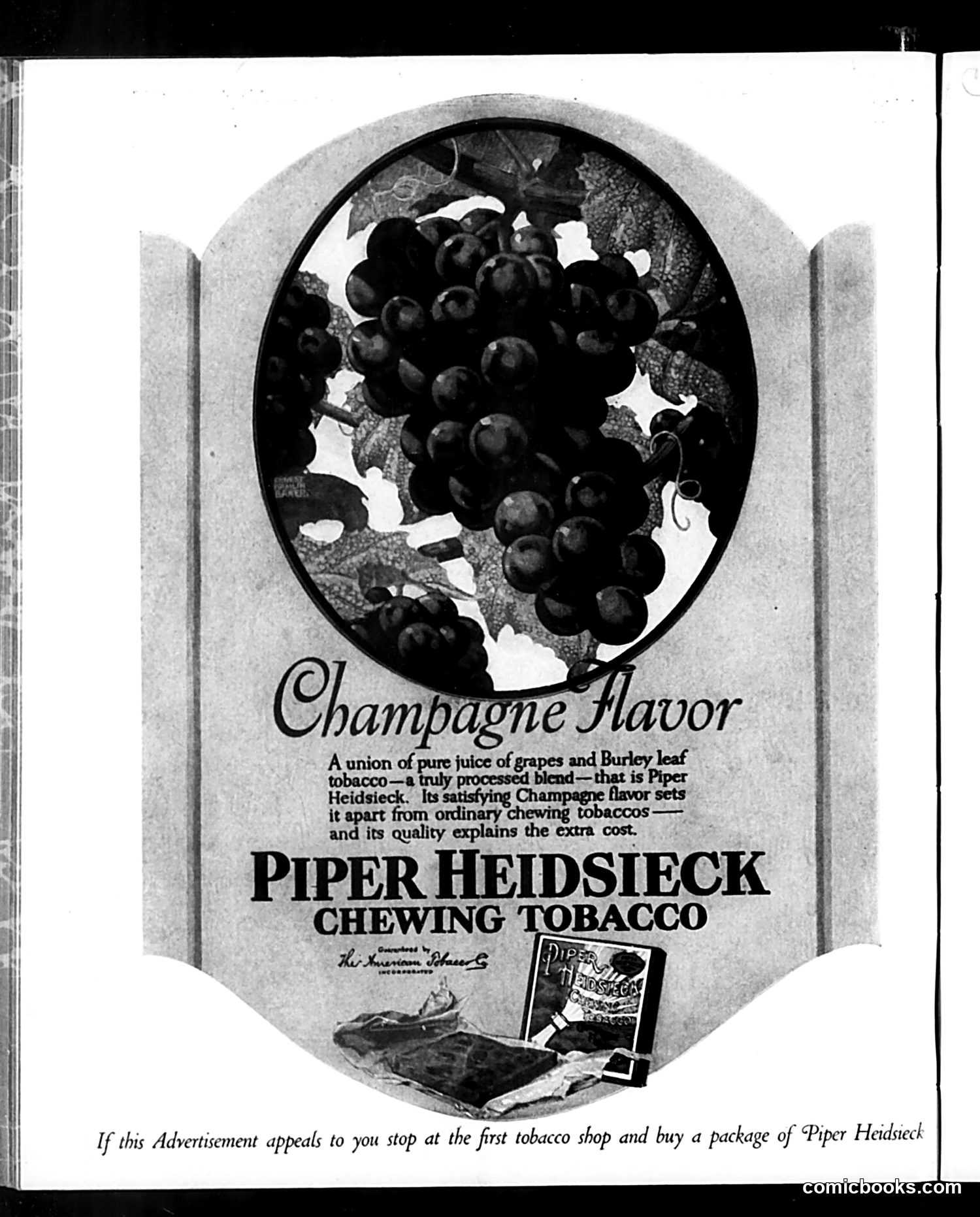
This is a **tobacco advertisement**, not political satire. It promotes Piper Heidsieck chewing tobacco, positioned as a premium product. The ad emphasizes "Champagne flavor"—a blend of grape juice and Burley leaf tobacco—as distinctive from ordinary chewing tobaccos, justifying a higher price. The large oval image shows dark grapes with leaves, visually connecting the product to champagne's grape origins and suggesting sophistication and quality. The ornate framing and elegant typography reinforce the premium positioning. This appears in *Judge*, a satirical magazine, but the page itself contains only advertising copy with no apparent satire or political commentary—just marketing rhetoric typical of early 20th-century tobacco advertising.