
Judge, 1919-05-10 · page 11 of 32
Judge — May 10, 1919 — page 11: what you’re looking at
What you’re looking at
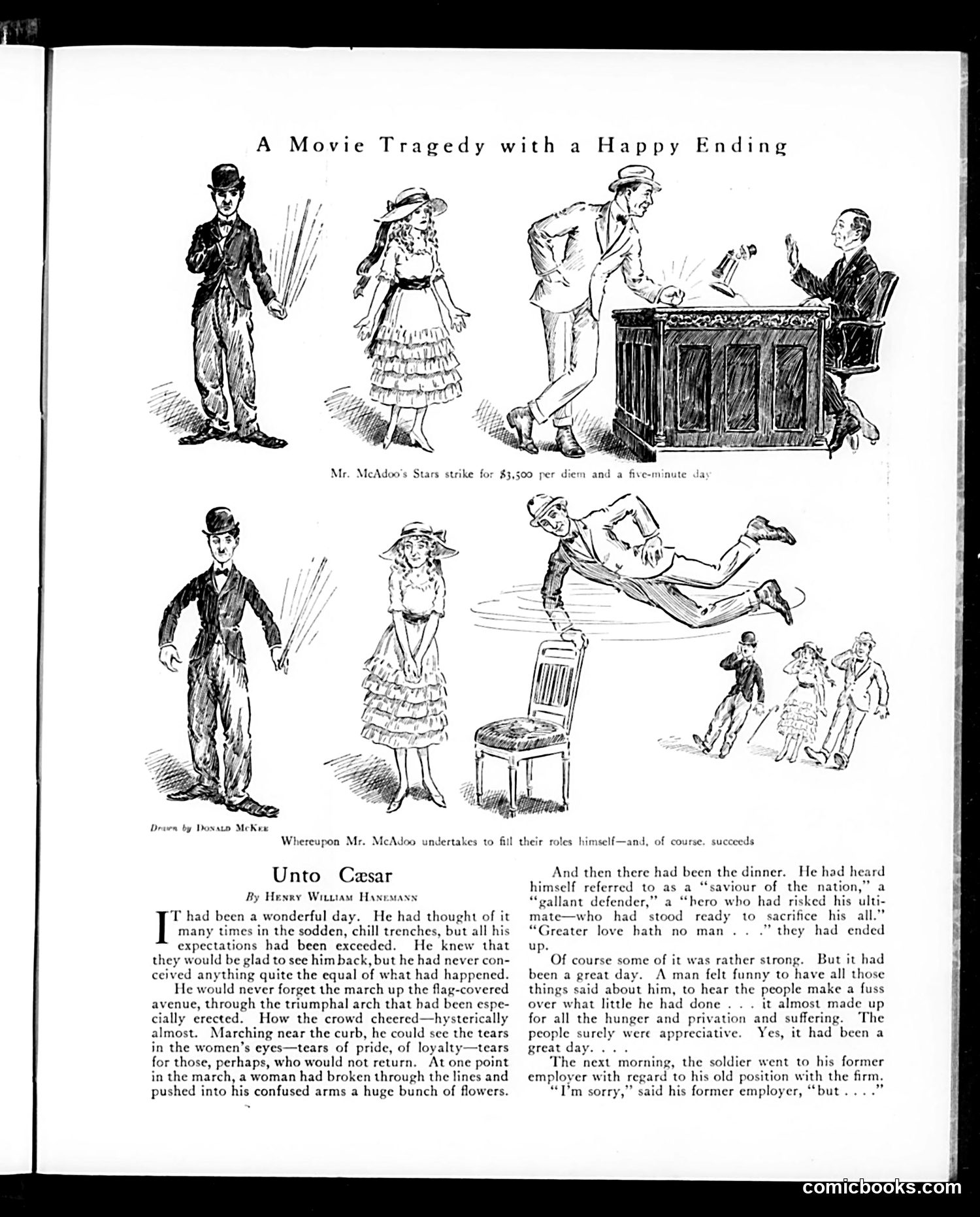
This Judge page contains two separate satirical pieces about post-WWI America. **"A Movie Tragedy with a Happy Ending"** (top): A visual gag about Mr. McAdoo (likely William Gibbs McAdoo, Wilson's Secretary of the Treasury), who appears in a film scenario. The comic premise: when actors strike for higher pay ($3,500 per diem), McAdoo simply performs all their roles himself—succeeding at everything. The satire mocks McAdoo's public reputation as a capable administrator and implicit criticism of labor demands. **"Unto Caesar"** (bottom): A short story contrasting a returning WWI soldier's triumphant homecoming parade—celebrated as a "saviour," showered with praise and flowers—with harsh reality: the next morning, his former employer won't rehire him, offering only apologies. The satire critiques America's failure to care for veterans after their service, exposing the gap between patriotic rhetoric and actual support for returning soldiers.
📄 Transcribed text from this page (OCR, searchable)
Machine-transcribed from the original scan — historical spelling and the odd misread are preserved.
A Movie Tragedy with a Happy Ending Drven by Doxato McKew Whereupon Mr. McAdoo undertakes to fill their roles himself—and, of course. succeeds Unto Ceasar By Hexry Wittiam Hanesann T had been a wonderful day. He had thought of it many times in the sodden, chill trenches, but all his expectations had been exceeded. He knew that they would be glad to see him back, but he had never con- ceived anything quite the equal of what had happened. He would never forget the march up the flag-covered avenue, through the triumphal arch that had been espe- cially erected. How the crowd cheered—hysterically almost. Marching near the curb, he could see the tears in the women’s eyes—tears of pride, of loyalty—tears for those, perhaps, who would not return. At one point in the march, a woman had broken through the lines and pushed into his confused arms a huge bunch of flowers. And then there had been the dinner. He had heard himself referred to as a “saviour of the nation,” a “gallant defender,” a “hero who had risked his ulti- mate—who had stood ready to. sacrifice his all.” “Greater love hath no man... .” they had ended up. Of course some of it was rather strong. But it had been a great day. A man felt funny to have all those things said about him, to hear the people make a fuss over what little he had done . . . it almost made up for all the hunger and privation and suffering. The people surely were appreciative. Yes, it had been a great day... . The next morning, the soldier went to his former employer with regard to his old position with the firm. “Tm sorry,” said his former employer, “but... .”