
Judge, 1919-05-10 · page 8 of 32
Judge — May 10, 1919 — page 8: what you’re looking at
What you’re looking at
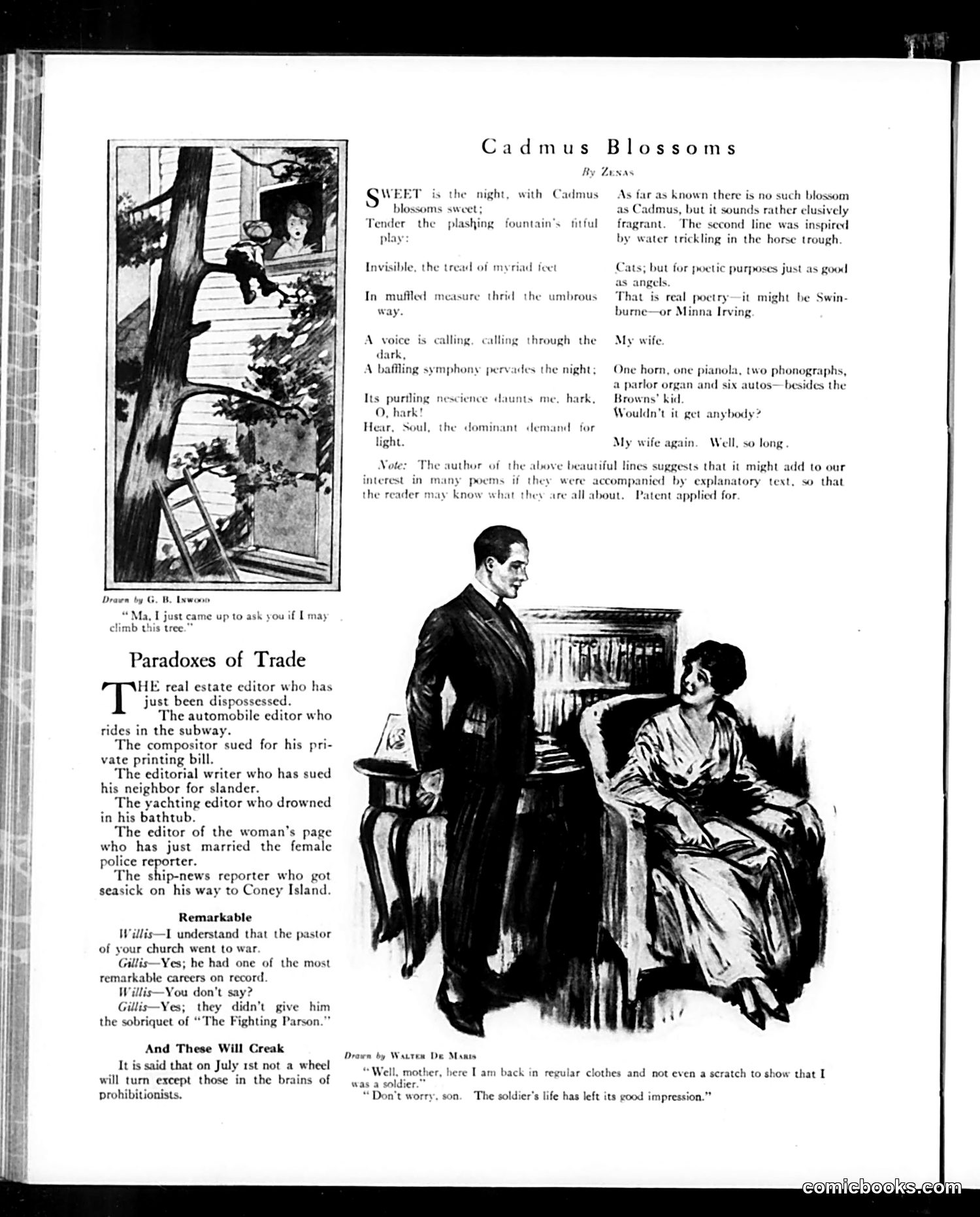
This page contains three satirical pieces typical of Judge's early 20th-century humor: **"Cadmus Blossoms"** is mock-serious poetry with a self-aware note admitting the flower "Cadmus" doesn't exist—the satire mocks pretentious, obscure poetry of the era (comparing it to Swinburne). The author suggests poems need explanatory text because readers can't understand them otherwise, ridiculing artistic obscurantism. **"Paradoxes of Trade"** lists ironic contradictions: editors whose expertise contradicts their lives (a real-estate editor who's dispossessed, a yachting editor who drowns in a bathtub). This satirizes the gap between professional authority and personal failure—common Judge fodder. **"And These Will Creak"** references prohibitionism (likely pre-1920 Prohibition debate), joking that on July 1st only "wheels in the brains of prohibitionists" will turn—mocking prohibitionists as mechanical, obsessive ideologues. The accompanying illustration shows a soldier returning home to his mother, who notes he has no wounds to show for his service—understated satire on war's psychological rather than visible costs.
📄 Transcribed text from this page (OCR, searchable)
Machine-transcribed from the original scan — historical spelling and the odd misread are preserved.
Sa atom << Se. 8 ss ee |. eee men <<iten Seeet Draen by G. B. Lxwooo “Ma, I just came up to ask you if I may mb this tree.” Paradoxes of Trade HE real estate editor who has just been dispossessed. The automobile editor who rides in the subway. The compositor sued for his pri- vate printing bill. The editorial writer who has sued his neighbor for slander. The yachting editor who drowned in his bathtub. The editor of the woman's page who has just married the female police reporter. The ship-news reporter who got seasick on his way to Coney Island. Remarkable Wilis—I understand that the pastor of your church went to war Gillis—Yes; he had one of the most remarkable careers on record. Willis—You don't say? Gillis—Yes; they didn’t give him the sobriquet of “The Fighting Parson.” And These Will Creak It is said that on July 1st not a wheel will turn except those in the brains of prohibitionists, Cadmus Blossoms Ry Zexas SWEET blossoms sweet; Tender the plashing fountain’s fitful he night, with Cadmus e play Invisible, the tread of myriad feet In muffled measure thrid the umbrous way. A voice is calling, calling through the dark, 4 bafiling symphony pervades the night; Its purtling nescience daunts me, hark, O, hark! Hear, Soul, the light. minant demand for As far as known there is no such blossom as Cadmus, but it sounds rather clusively fragrant. The second line was inspired by water trickling in the horse trough Cats; but for poetic purposes just as good as angels That is real poctry—it might be Swin- burne—or Minna Irving My wife One horn, one pianola, two phonographs, a parlor organ and six autos— besides the Browns’ kid. Wouldn't it get anybody? My wife again. Well, so long Vote: The author of the above beautiful lines suggests that it might add to our interest in many poems if they were accompanied by explanatory text, so that the reader m. ty know what they are all about Patent applied for. Drawn by Warten De Manis “Well, mother, here Tam back in was a soldier.” “Don't w egular clothes and not even a scratch to show that I son. The soldier's life has left its good impression.”