
Judge, 1919-05-10 · page 10 of 32
Judge — May 10, 1919 — page 10: what you’re looking at
What you’re looking at
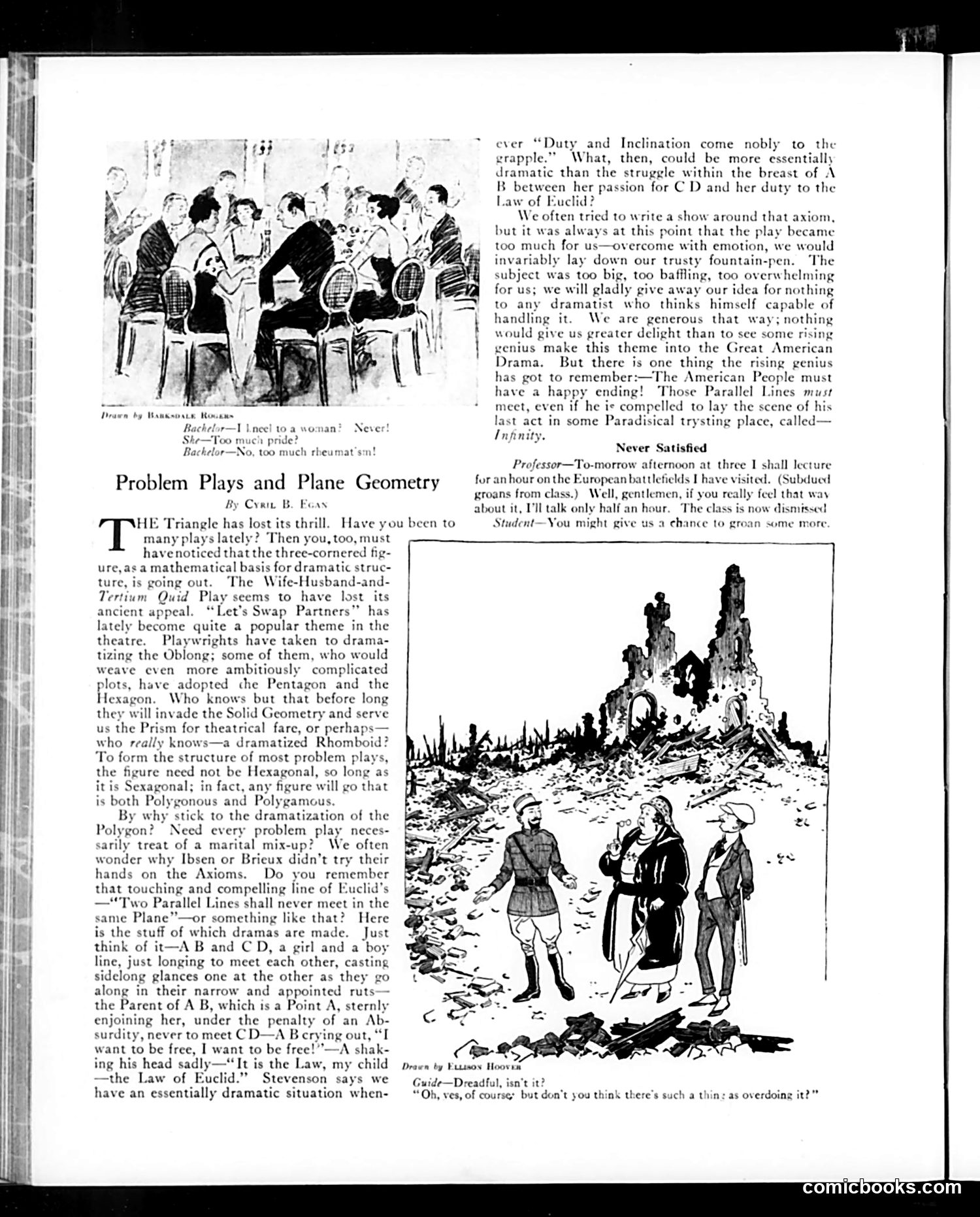
This page contains two separate satirical pieces from Judge magazine. **"Problem Plays and Plane Geometry"** mocks the contemporary theater trend of "problem plays"—serious dramas addressing moral/social issues (likely referencing Ibsen and Brieux, mentioned by name). The author satirizes how playwrights have abandoned the traditional triangular love-plot structure for more complicated scenarios involving spouse-swapping and infidelity, using geometric metaphors. The absurdist core joke: he proposes dramatizing Euclid's axiom about parallel lines never meeting as a love story between "lines" A-B and C-D separated by parental duty—a romantic tragedy rendered ridiculous through mathematical language. The satire targets both pretentious "problem play" conventions and the era's apparent obsession with marital complications as theatrical fodder. **"Never Satisfied"** is a brief joke about a student ungratefully complaining when a professor reduces lecture time after groaning protests—satirizing perpetual student complaints. The illustration shows figures in an exotic landscape, likely accompanying the geometry piece's absurdist narrative.
📄 Transcribed text from this page (OCR, searchable)
Machine-transcribed from the original scan — historical spelling and the odd misread are preserved.
OO Ee re es EE EE : SST St Drawn by Wamksoste Kowsns r—I Lncel toa woman? Neve Ske—Too much pride? Bachelor—No, too m ich rheum Problem Plays and Plane Geometry By Cyan B. Foas HE Triangle has lost its thrill. Have you been to many plays lately? Then you, too, must have noticed that the three-cornered fig- ure, as a mathematical basis for dramatic struc- ture, is going out. The Wife-Husband-and- Terti: Quid Play seems to have lost its ancient appeal. “Let's Swap Partners” has lately become quite a popular theme in the theatre. Playwrights have taken to drama- tizing the Oblong; some of them, who would weave even more ambitiously complicated plots, have adopted che Pentagon and the agon. Who knows but that before long they will invade the Solid Geometry and serve us the Prism for theatrical fare, or perhar who really knows—a dramatized Rhomboid To form the structure of most problem plays, the figure need not be Hexagonal, so long as itis Sexagonal; in fact, any figure will go that is both Polygonous and Polygamous. By why stick to the dramatization of the Polygon? Need every problem play neces- sarily treat of a marital mix-up? We often wonder why Ibsen or Brieux didn’t try their hands on the Axioms. Do you remember that touching and compelling line of Euclid’s —Two Parallel Lines shall never meet in the same Plane”’—or something like that? Here is the stuff of which dramas are made. Just think of it—A B and CD, a girl and a boy line, just longing to meet each other, casting sidelong glances one at the other as they along in their narrow and appointed ruts: the Parent of A B, which is a Point A, sternly enjoining her, under the penalty of an Ab- surdity, never to meet CD—A B crying out, “I want to be free, I want to be free!”"—A shak- ing his head sadly—“It is the Law, my child —the Law of Euclid.” Stevenson says we have an essentially dramatic situation when- Drawn by Fisssos Hoow ever “Duty and Inclination come nobly to the grapple.” What, then, could be more essentially dramatic than the struggle within the breast of A B between her passion for C D and her duty to the Law of Euclid? We often tried to write a show around that axiom, but it was always at this point that the play became too much for us—overcome with emotion, we would invariably lay down our trusty fountain-pen. The subject was too big, too baffling, too overwhelming for us; we will gladly give away our idea for nothing to any dramatist who thinks himself capable of handling it. We are generous that way; nothing would give us greater delight than to see some rising genius make this theme into the Great American Drama. But there is one thing the rising genius has got to remember:—The American People must have a happy ending! Those Parallel Lines must meet, even if he is compelled to lay the scene of his last act in some Paradisical trysting place, called— Infinity. Never Satisfied Professor—To-morrow afternoon at three I shall lecture for anhour on the European battlefields I have visited. (Subdued groans from class.) Well, gentlemen, if you really feel that way about it, I'll talk only half an hour. The class is now dismissed Student—You might give us a chance to groan some more. Guide—Dreadful, isn’t it? “Oh, ves, of course: but don’t you think there's such a thin: as overdoing it?”