
A complete issue · 36 pages · 1919
Judge — May 3, 1919
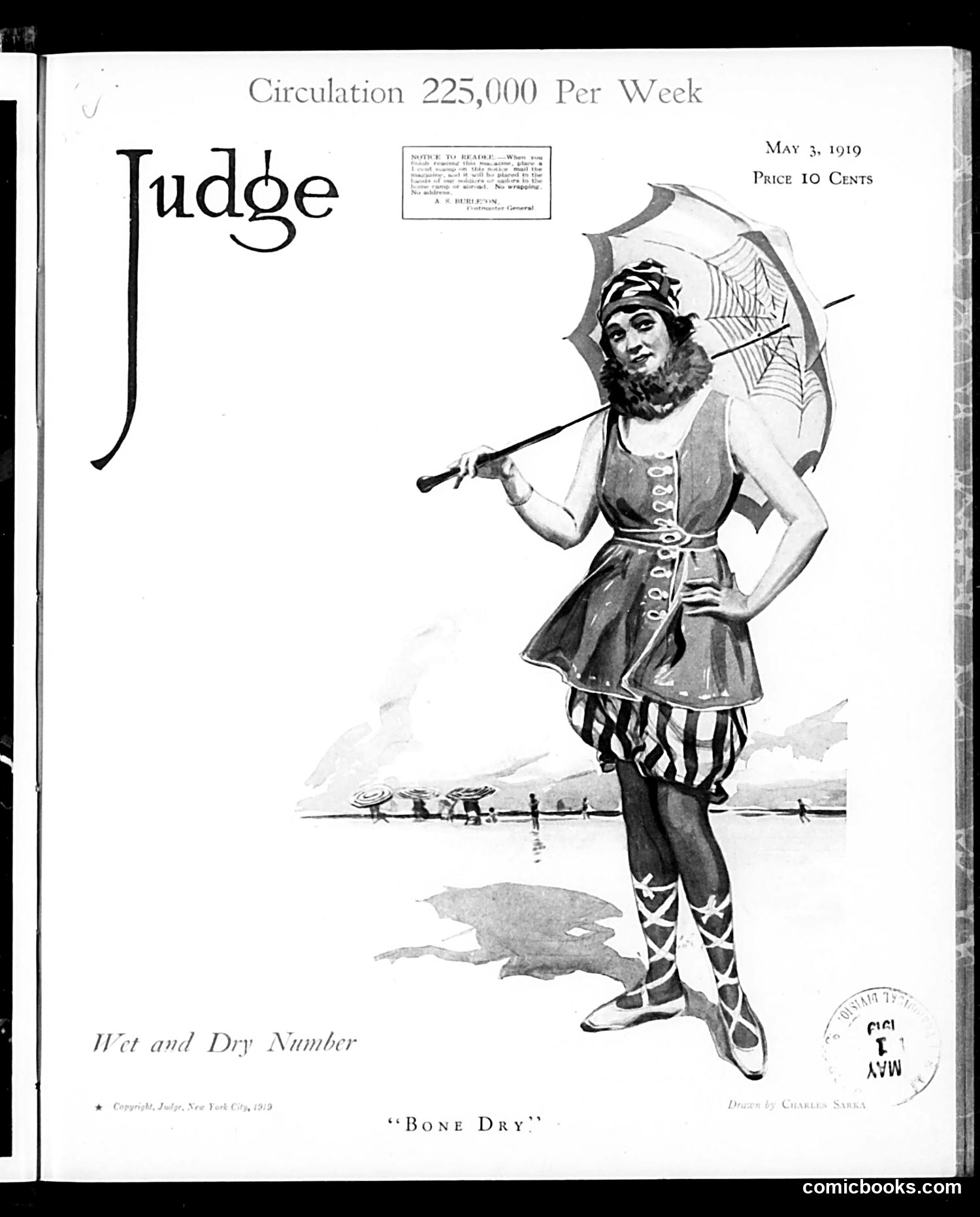
This is a satirical cartoon about Prohibition, which had just begun nationally on January 17, 1919. The subtitle "Bone Dry" references the strict enforcement goal of prohibitionists. The figure depicts a woman in theatrical/vaudeville costume holding a parasol in what appears to be a barren landscape. The "Wet and Dry Number" label suggests this represents competing political positions on alcohol: "wet" (anti-Prohibition) versus "dry" (pro-Prohibition). The cartoon likely satirizes either the absurdity of Prohibition enforcement or the dramatic social upheaval it caused. The theatrical costume and exaggerated pose suggest mockery of the movement's rhetoric. The barren setting may represent the cultural or economic devastation Judge's editors associated with the new law.
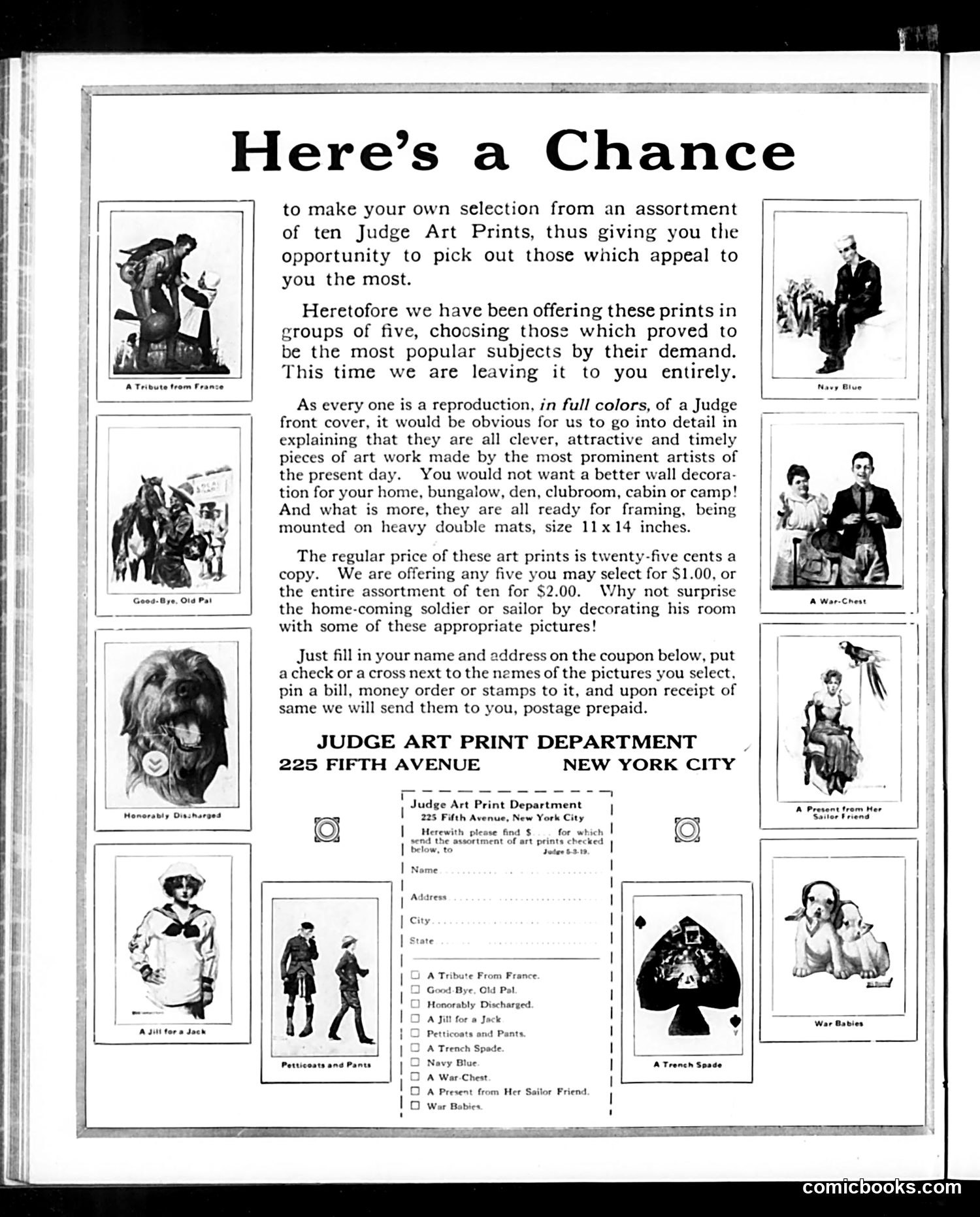
This page is primarily **advertising**, not satirical content. Judge magazine's Art Print Department is offering customers the chance to select five prints from an assortment of ten, priced at $1.00 for five or $2.00 for all ten. The prints themselves appear to be World War I–themed illustrations by prominent contemporary artists. Titles visible include "A Tribute From France," "Navy Blue," "A War Chest," "Honorably Discharged" (showing a dog), "A Jill for a Jack," "Petticoats and Pants," "A French Spade," "A Present From Her Sailor Friend," and "War Babies." Rather than satire, these prints reflect patriotic, domestic wartime imagery popular during the WWI era—depicting soldiers, women, and sentimentalized military themes intended for home decoration.
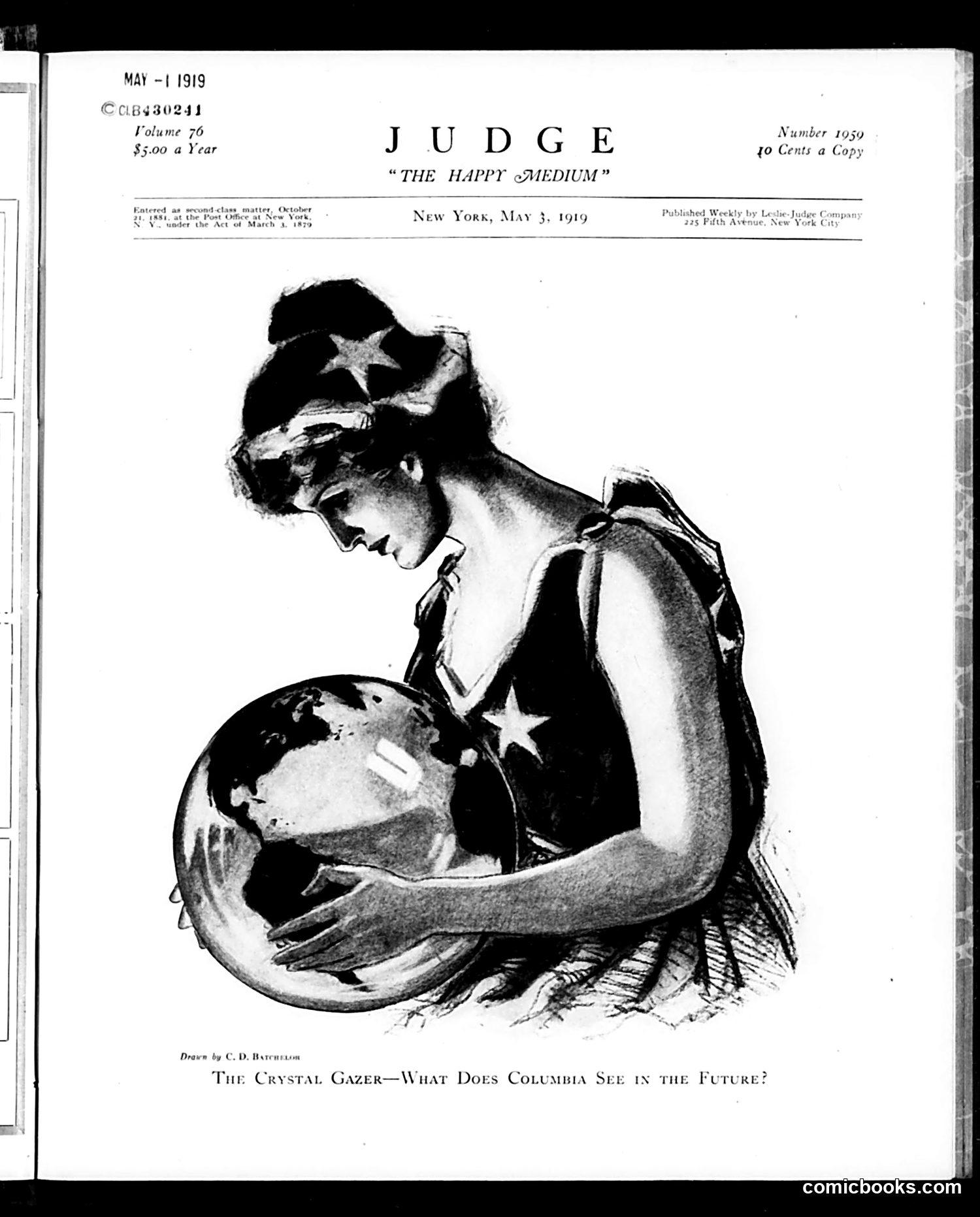
This May 1919 Judge magazine cover depicts **Columbia**, the female allegorical personification of the United States, gazing into a crystal ball. Columbia wears her characteristic starred headdress and draped clothing. The cartoon appears to address post-World War I anxieties about America's future. The crystal ball likely represents uncertainty or prophecy regarding the nation's direction following the war's end (November 1918). Drawn by C.D. Hamilton, the image suggests Americans were uncertain about what lay ahead—possibly referencing debates over the League of Nations, economic transition, or social upheaval. The "happy medium" subtitle remains unclear but may reference hopes for balanced, moderate solutions to postwar challenges.
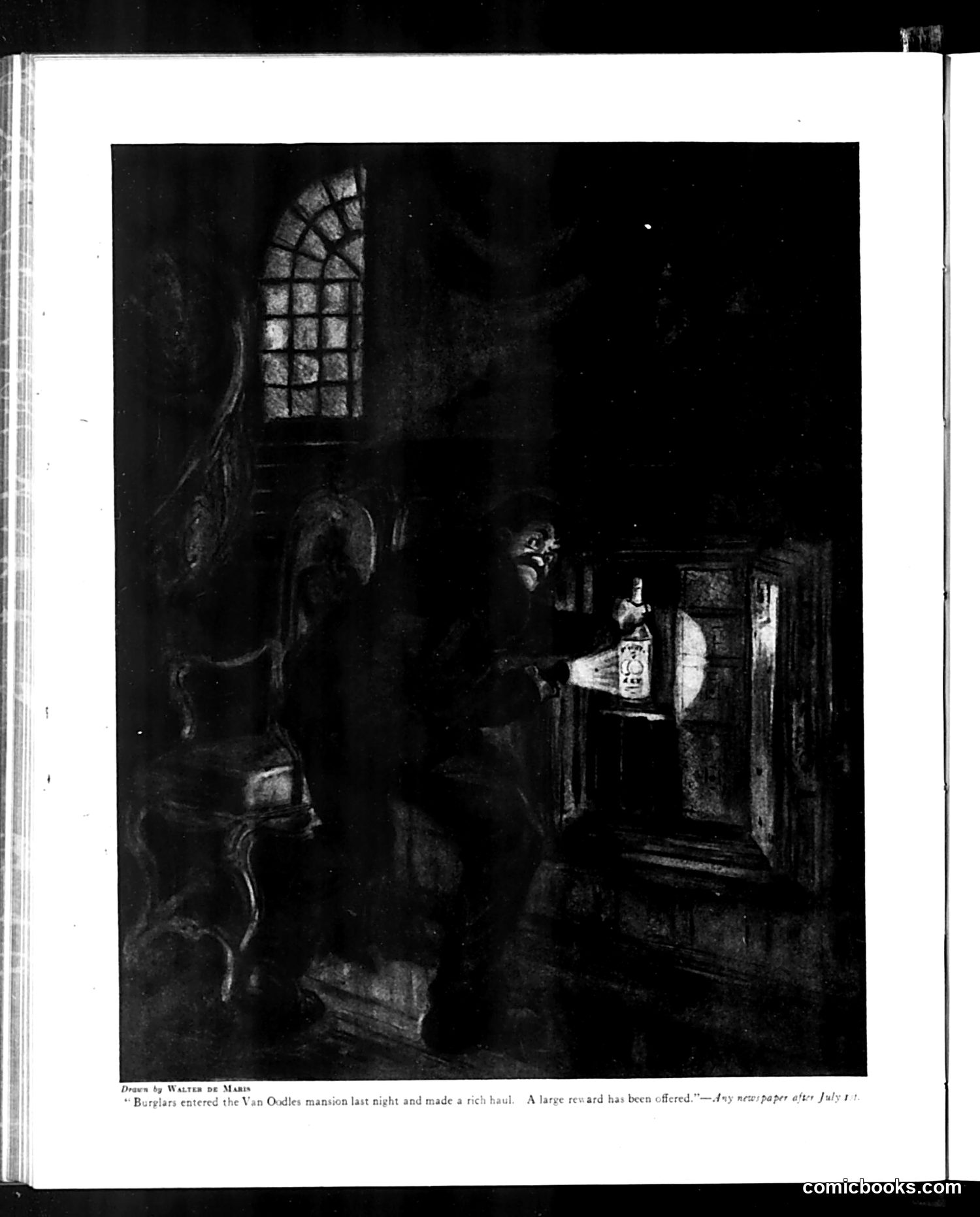
This appears to be an illustration by Walter de Maris depicting a burglary scene. The caption references "Burglers entered the Van Oodles mansion last night and made a rich haul. A large reward has been offered." The image shows a darkened interior with figures near a window and doorway, rendered in dramatic chiaroscuro typical of early 20th-century satirical illustration. However, without additional context about the Van Oodles family or the specific incident being referenced, I cannot definitively identify whether this is: - A commentary on a real crime - Social satire about wealthy families - A generic crime joke The newspaper attribution ("Joy newspaper after July 1") suggests this may reference a contemporary news story, but the specific historical event remains unclear from the image and text alone.
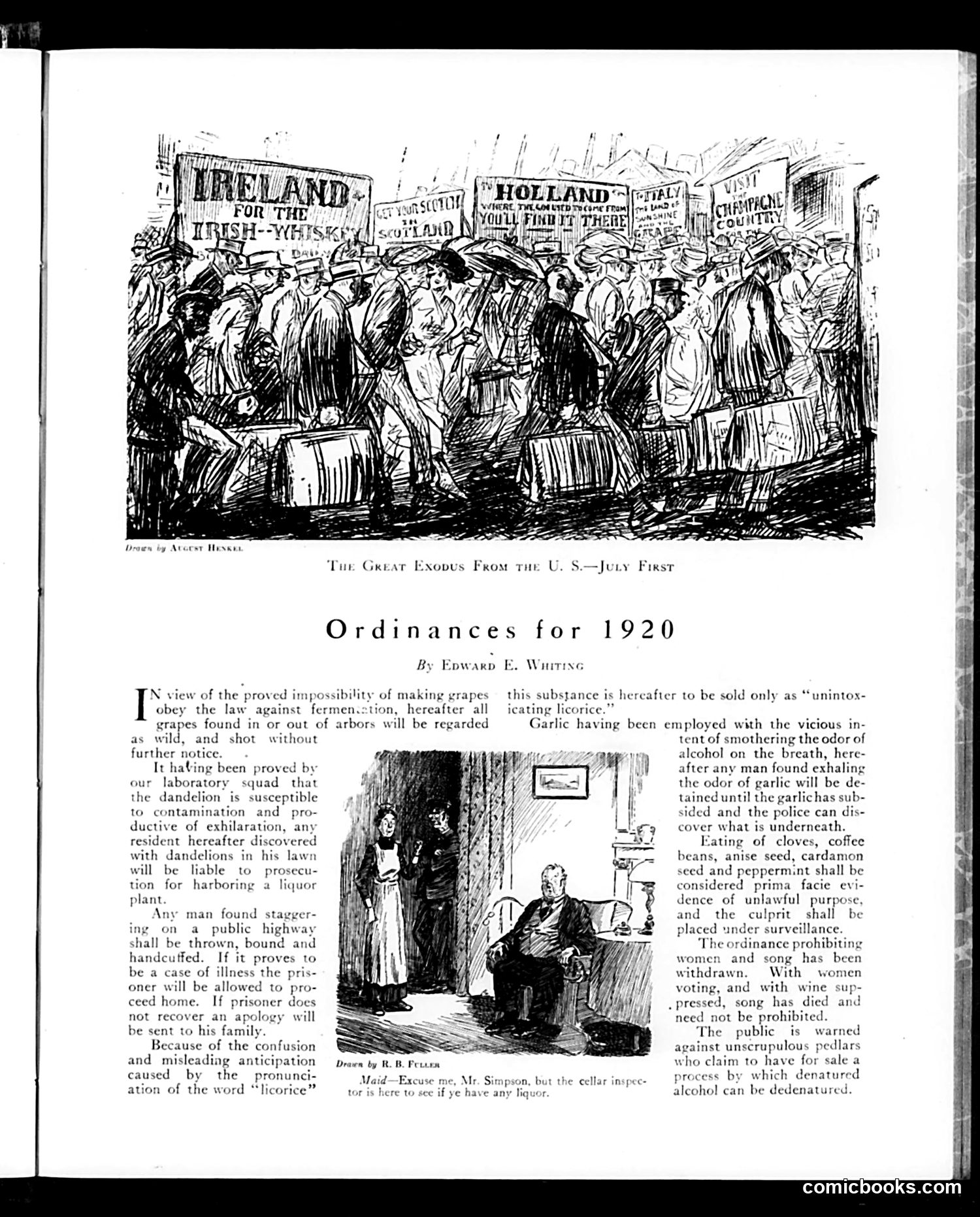
The top cartoon, "The Great Exodus from the U.S.—July First," depicts people fleeing America with signs advertising Ireland, Scotland, and chemical exports. This satirizes Prohibition's implementation on July 1, 1920, when the 18th Amendment took effect, banning alcohol sales. The bottom illustration shows a cellar inspection scene titled "Maid—Excuse me, Mr. Simpson, but the cellar inspector is here to see if you have any liquor," depicting enforcement of Prohibition laws. The article "Ordinances for 1920" by Edward E. Whiting is satirical commentary on Prohibition's absurd consequences. It mockingly proposes regulations about grape growing, public intoxication, garlic-eating (to mask alcohol breath), and "unintoxicating licorice"—highlighting how Prohibition created ridiculous loopholes and enforcement challenges that citizens worked around.
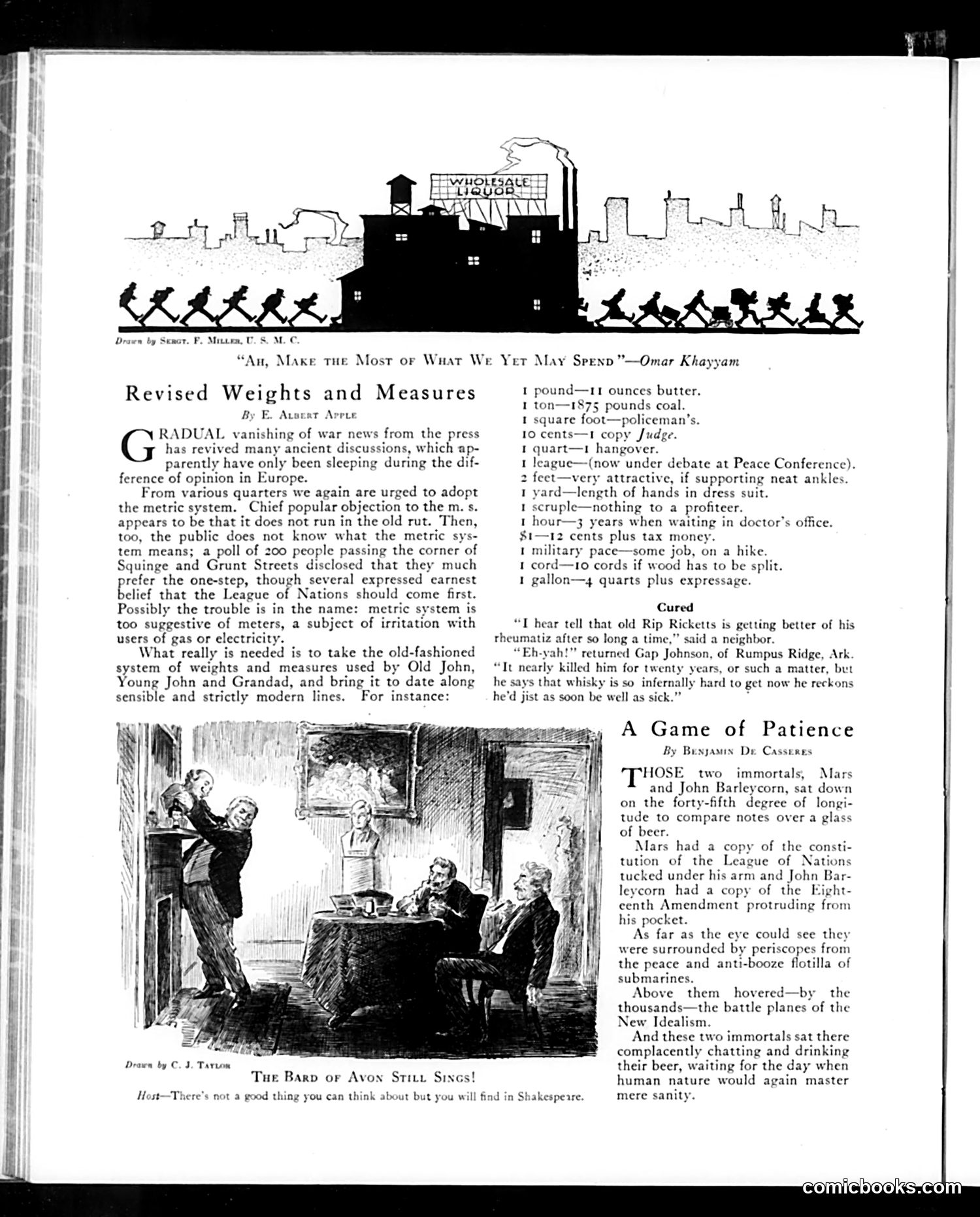
**Top Cartoon:** A silhouette showing figures running toward a building labeled "Wholesale Liquor," with a city skyline behind. This satirizes Prohibition-era bootlegging and illegal alcohol distribution—people rushing to acquire liquor during the ban. **Main Article:** "Revised Weights and Measures" argues against adopting the metric system. The author proposes keeping traditional English measurements (pounds, feet, yards, etc.) while updating their definitions humorously—for instance, redefining a "league" as a Peace Conference topic. This mocks both metric system advocates and post-WWI peace negotiations. **Bottom Cartoon:** Two men discuss Shakespeare while surrounded by periscopes and anti-booze flotillas, satirizing intellectuals discussing literature amid Prohibition's enforcement apparatus. The page overall lampoons 1920s American concerns: Prohibition enforcement, metric system debates, and idealistic post-war politics.
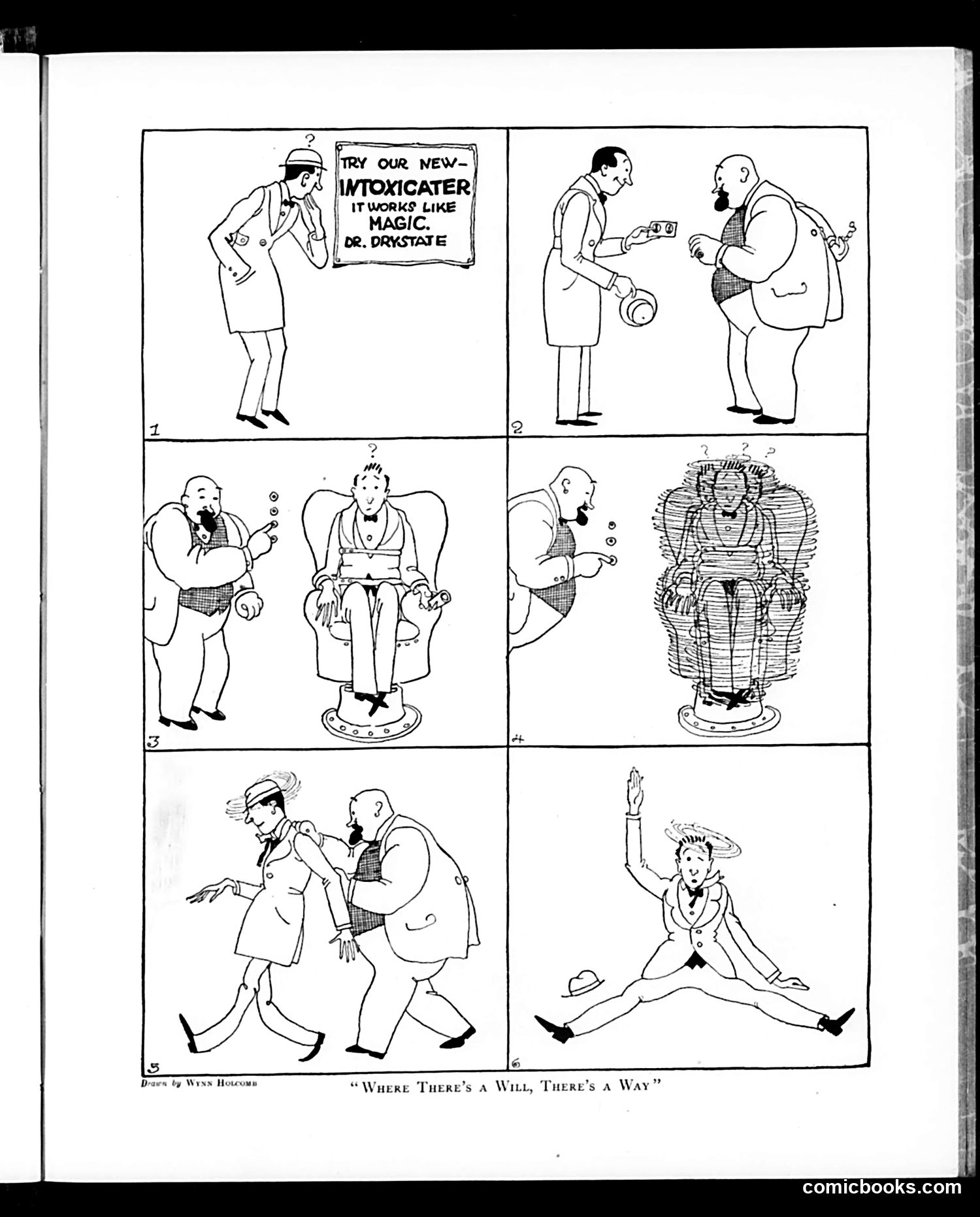
This six-panel satirical comic advertises a fake product called an "Intoxicater" that allegedly works "like magic." The joke traces a con artist's pitch: panel 1 shows him hawking the device; panel 2 depicts a customer buying it; panels 3-4 show the customer using it on himself, becoming increasingly disheveled and intoxicated; panel 5 shows him chasing a woman in drunken chaos; panel 6 depicts his final, explosive collapse. The satire mocks both patent medicine scams (common in early 20th-century America) and the absurdity of mechanical solutions to human problems. The pun "Intoxicater" (intoxicate + creator) drives home that the device simply gets users drunk—it "works" exactly as advertised, just not beneficially. The title suggests resourcefulness overcome by folly.
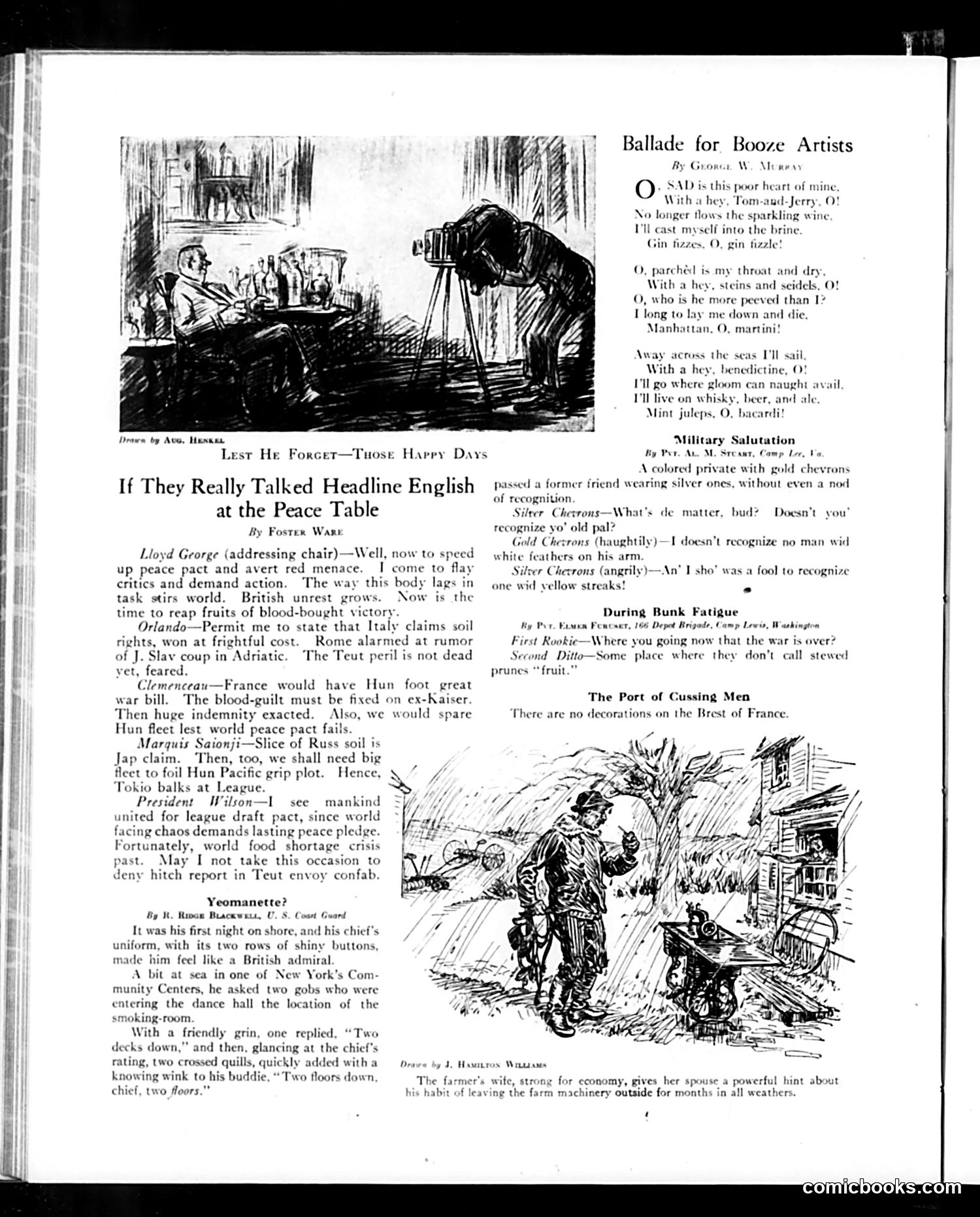
This page contains multiple satirical pieces from the WWI era: **"If They Really Talked Headline English at the Peace Table"** mocks the Paris Peace Conference (likely 1919) by having world leaders speak in exaggerated newspaper headline style. Lloyd George, Clemenceau, Orlando, Marquis Saionji, and President Wilson each voice their nations' competing post-war demands—territorial claims, reparations, naval power—revealing how their lofty peace rhetoric masks naked self-interest. The satire suggests these leaders' grandiose public statements obscure petty nationalist conflicts. **"Yeomanette?"** jokes about a Navy officer unfamiliar with shore-based American facilities, asking about a "king-room" (latrine) in a community center—mocking military pretension and cluelessness. **Other pieces** include a drinking song lamenting Prohibition, a joke about racial hierarchy in the segregated military (a promoted Black soldier snubbing a lower-ranked white one), and complaints about Army food. The cartoons satirize post-war disillusionment, military absurdities, and class/racial tensions in 1920s America.
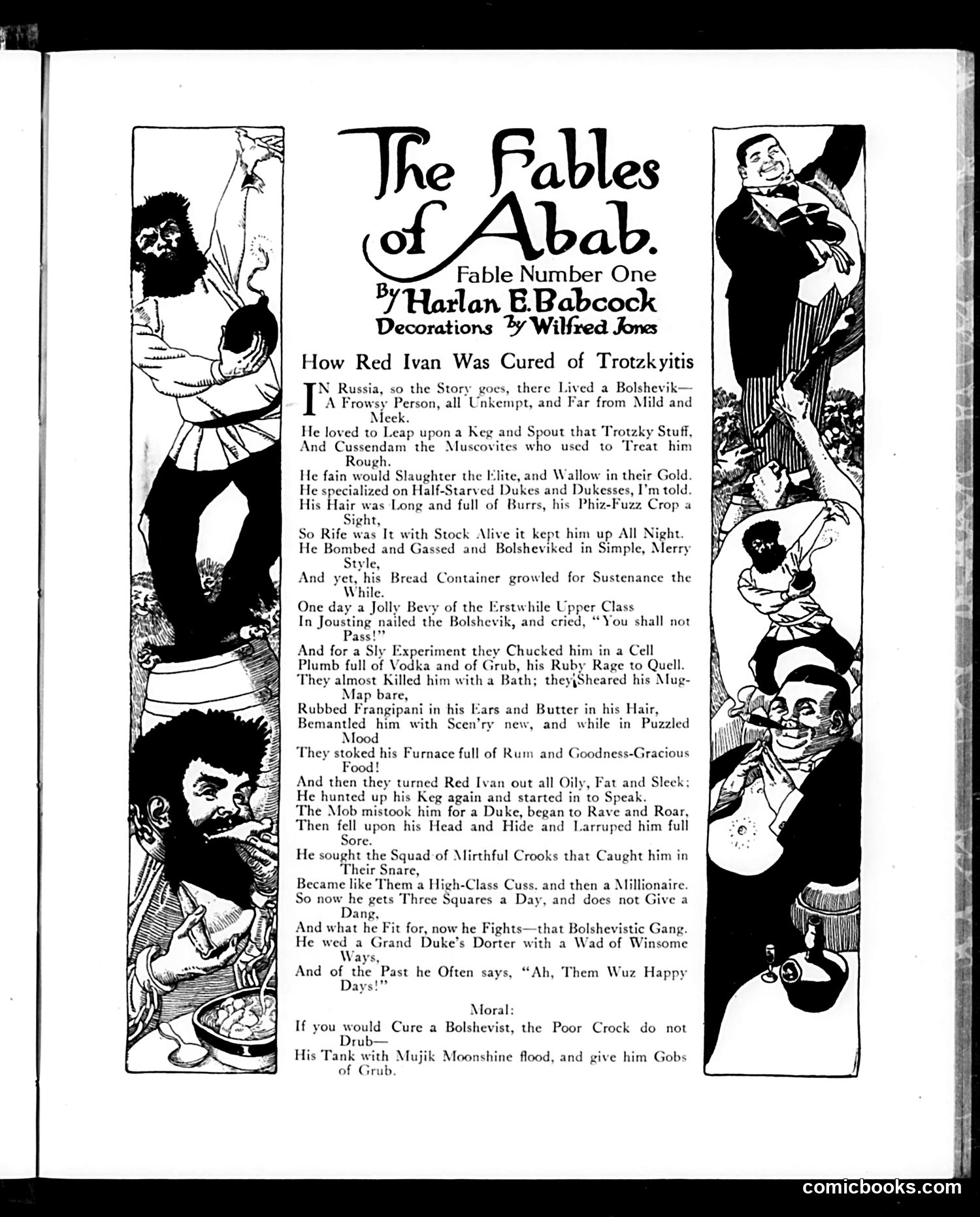
This is a satirical fable mocking Russian Bolsheviks, specifically targeting Trotskyism (reference to Leon Trotsky, Bolshevik revolutionary). The story follows "Red Ivan," a stereotypical unwashed radical Bolshevik who agitates for revolution and wealth redistribution. The satire's point: when Ivan is captured by the former aristocratic upper class and given luxury treatment—food, grooming, comfort—he abandons his revolutionary ideology entirely. He becomes a capitalist millionaire, marries a duke's daughter, and fights against Bolshevism. The moral cynically suggests that Bolsheviks are motivated purely by deprivation and envy, not genuine ideology. Give them material comfort and they'll abandon their beliefs. This reflects American anti-communist sentiment of the 1920s-30s, dismissing revolutionary politics as mere resentment rather than serious conviction. The crude caricatures and condescending tone typify period propaganda in *Judge*, a conservative satirical magazine.
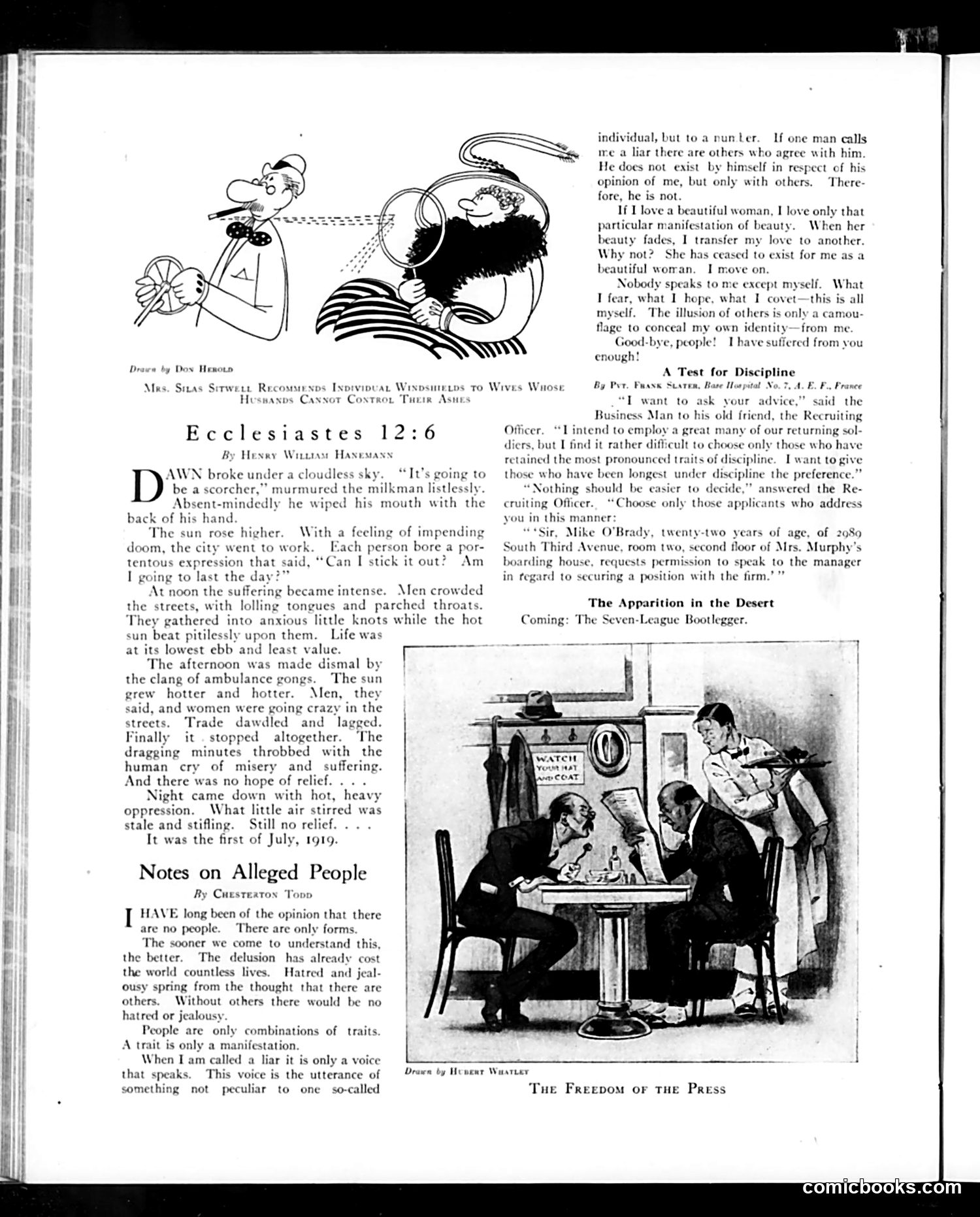
**Top Cartoon:** Depicts a milkman and woman, illustrating the caption about wives whose husbands cannot control their ashes—likely a commentary on domestic discord or marital infidelity during wartime (the date "first of July, 1919" suggests post-WWI context). **Main Article "Ecclesiastes 12:6":** Describes an unbearably hot day (July 1, 1919) when the heat becomes so oppressive that civic life essentially stops—ambulances run constantly, people crowd streets in distress, and trade halts entirely. This appears to be satirizing either an actual heat wave or using extreme heat as metaphor for social/political turmoil of early post-war America. **"Notes on Alleged People":** Philosophical satire by Chesterton Todd arguing people don't truly exist as individuals—only as combinations of traits and manifestations. Appears to critique social atomization or philosophical solipsism. **"Test for Discipline":** Humorous piece about hiring returning soldiers, suggesting those with military discipline speak in excessively formal, hierarchical language when requesting jobs. **"Apparition in the Desert":** Brief teaser referencing "The Seven-League Bootlegger," likely alluding to Prohibition-era smuggling.
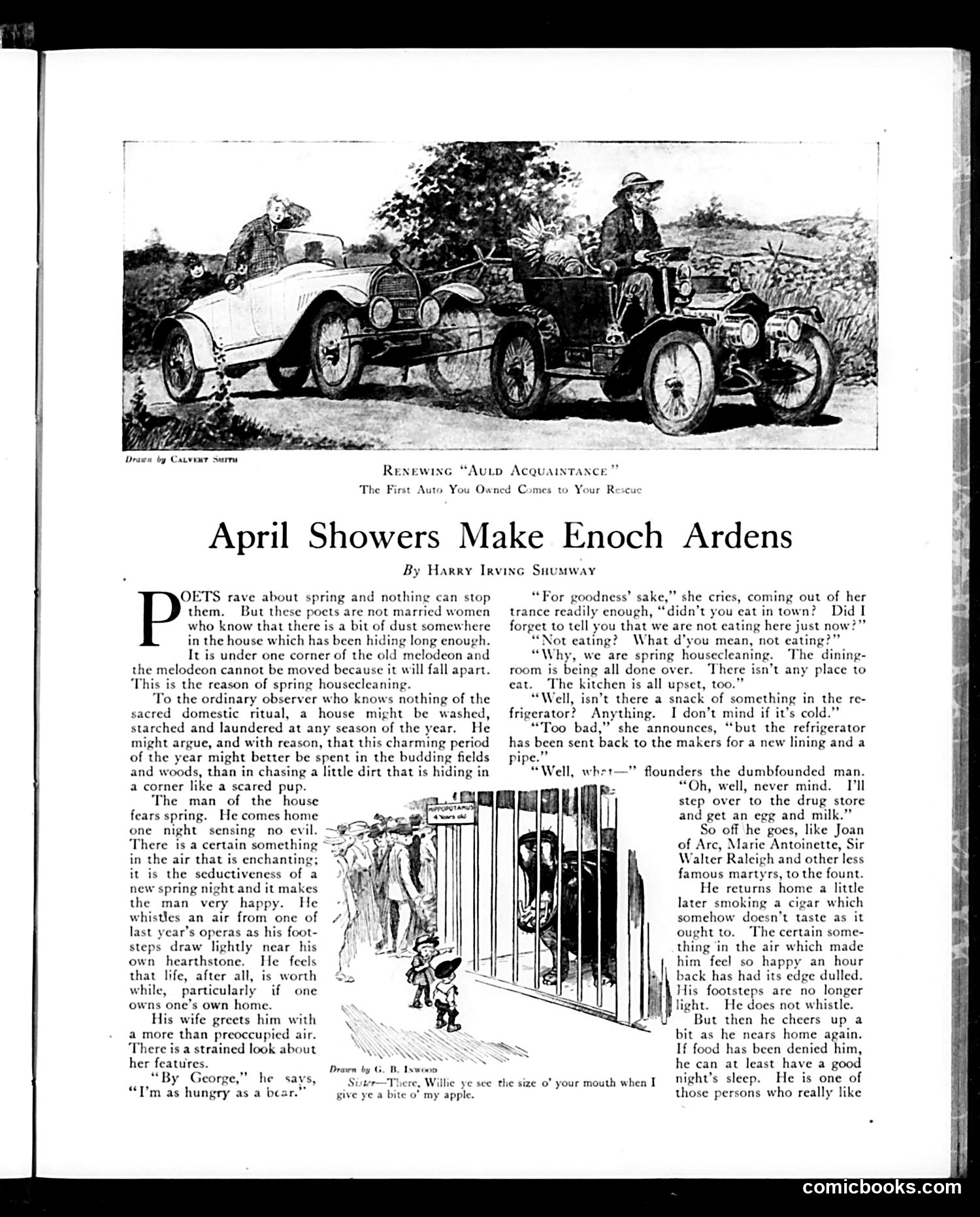
This page satirizes spring housecleaning and its domestic consequences through a humorous story titled "April Showers Make Enoch Ardens." The article mocks how wives undertake intensive spring cleaning, disrupting normal household routines. The narrative follows a husband who comes home cheerful and hungry, only to discover his wife has begun spring cleaning—meaning the dining room is unusable, the refrigerator has been sent for repairs, and no meals are available. He's forced to eat at a drugstore. The title references "Enoch Arden," a poem about a man absent from home for years, implying husbands are effectively banished during spring cleaning season. The illustration at top shows vintage automobiles, captioned "Renewing 'Auto Acquaintance'"—likely showing the first car someone owned, a nostalgic theme matching the story's nostalgic tone about domestic life disrupted by seasonal chaos. The humor targets the absurdity of prioritizing housecleaning over basic family functions like feeding one's spouse.
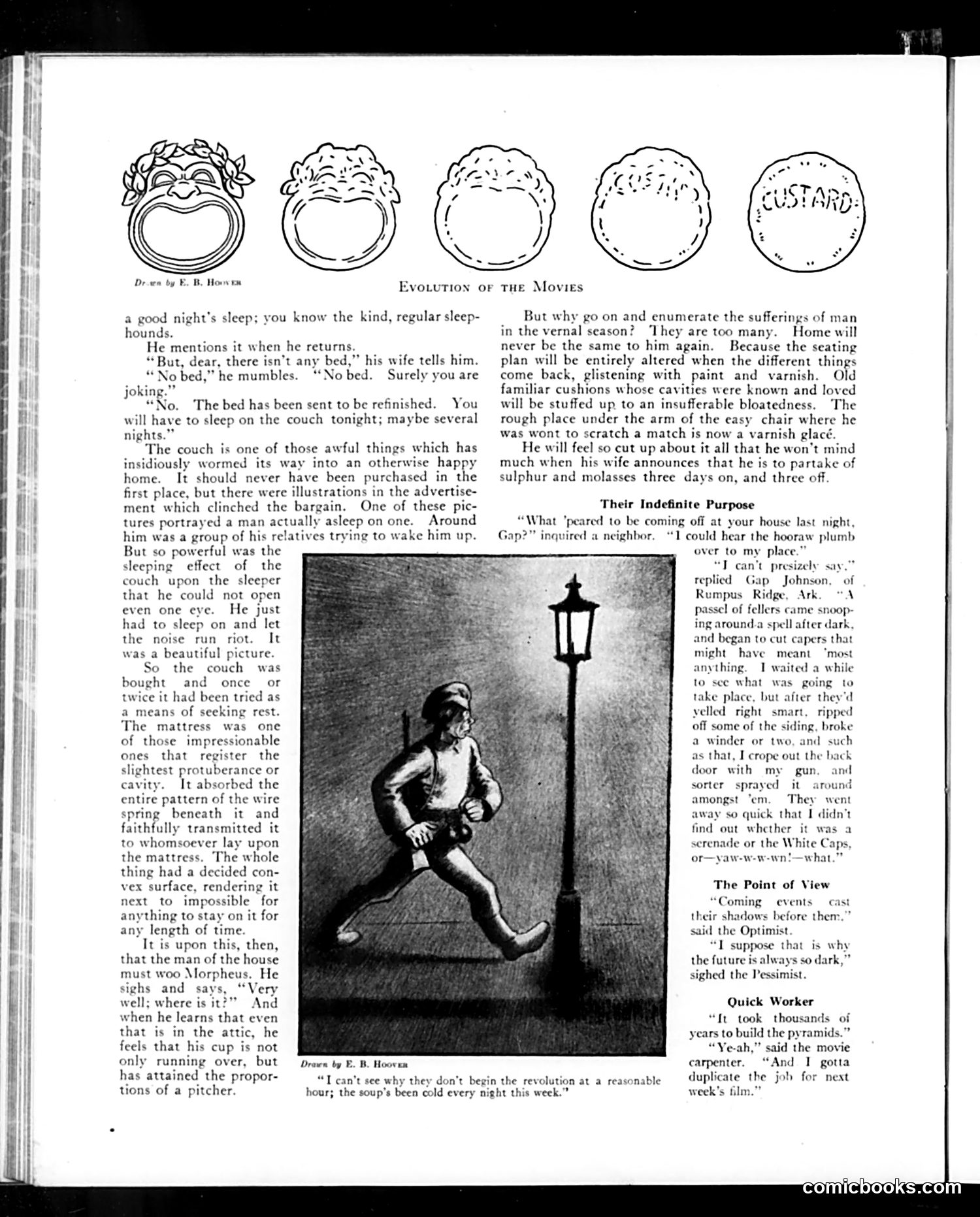
This *Judge* magazine page contains three satirical pieces mocking early 20th-century domestic life and emerging cinema culture. **The main narrative** (left) humorously depicts a husband's misery when household furniture is sent for refinishing—he must sleep on an uncomfortable couch with a convex surface that registers every wire spring beneath it. The satire targets both poor furniture design and the disruptions of spring household maintenance. **"Evolution of the Movies"** (top) shows five rings with increasingly simplified faces, mocking how cinema progressively dumbed down visual storytelling—ending literally with the word "CUSTARD," suggesting slapstick comedies reduced to lowest-common-denominator humor. **The bottom two brief pieces** satirize contemporary absurdities: a man's soup growing cold during neighborhood disturbances (likely referring to labor unrest or political upheaval), and a movie carpenter boasting he can duplicate the Egyptian pyramids in a week—mocking Hollywood's grandiose, rushed production values and exaggerated technical claims. The overall tone criticizes consumer culture, shoddy craftsmanship, and cinema's artistic decline.
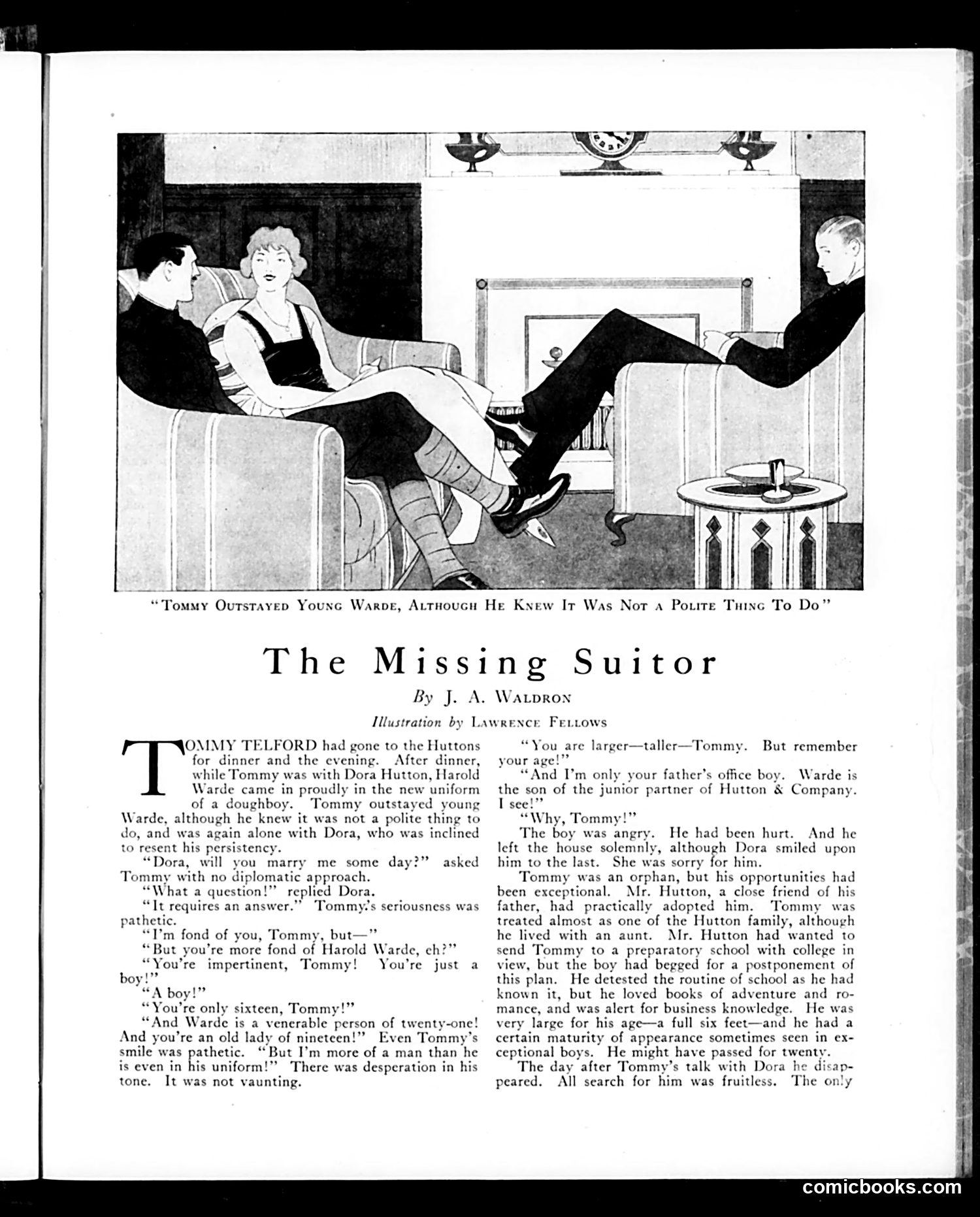
This is the opening installment of a serialized short story, not a political cartoon. The narrative establishes a romantic rivalry: Tommy Telford, an orphan office boy living with his aunt, competes for Dora Hutton's affections against Harold Warde, a soldier in uniform (likely WWI-era doughboy) whose father is a company partner. The illustration shows the three in a drawing room—Tommy and Warde lounging while Dora sits between them, suggesting the tension. Tommy, though physically mature and intellectually capable, loses Dora to Warde's superior social status and military prestige. Humiliated, Tommy disappears the next day. The story plays on class anxieties of the era: merit and effort cannot overcome social standing and romantic advantage. For modern readers, the "doughboy uniform" dates this to the WWI period.
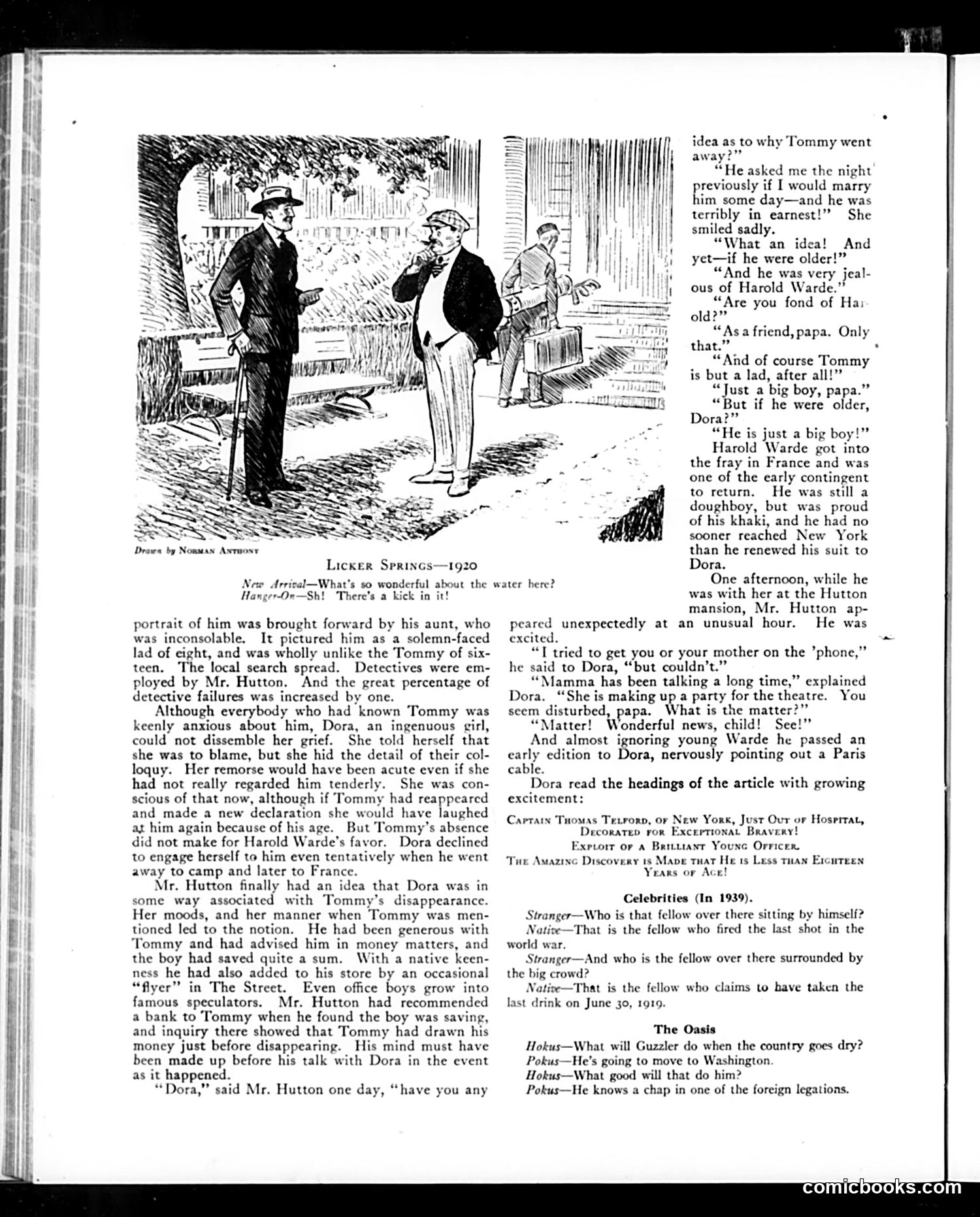
The main cartoon depicts two men at a spa or resort, with one newcomer asking what makes the water special. The other man replies "Sh! There's a kick in it!"—a joke about Prohibition. In 1920, the 18th Amendment banned alcohol production and sale. The cartoon satirizes Americans circumventing this law by seeking hidden alcohol at supposedly "therapeutic" springs resorts, which often served as fronts for illegal drinking establishments. The phrase "kick" was period slang for the intoxicating effect of liquor. The humor relies on the public's open knowledge that Prohibition was widely flouted, especially among the wealthy who could afford resort getaways. The illustration captures the winking complicity between proprietors and patrons in openly defying federal law.
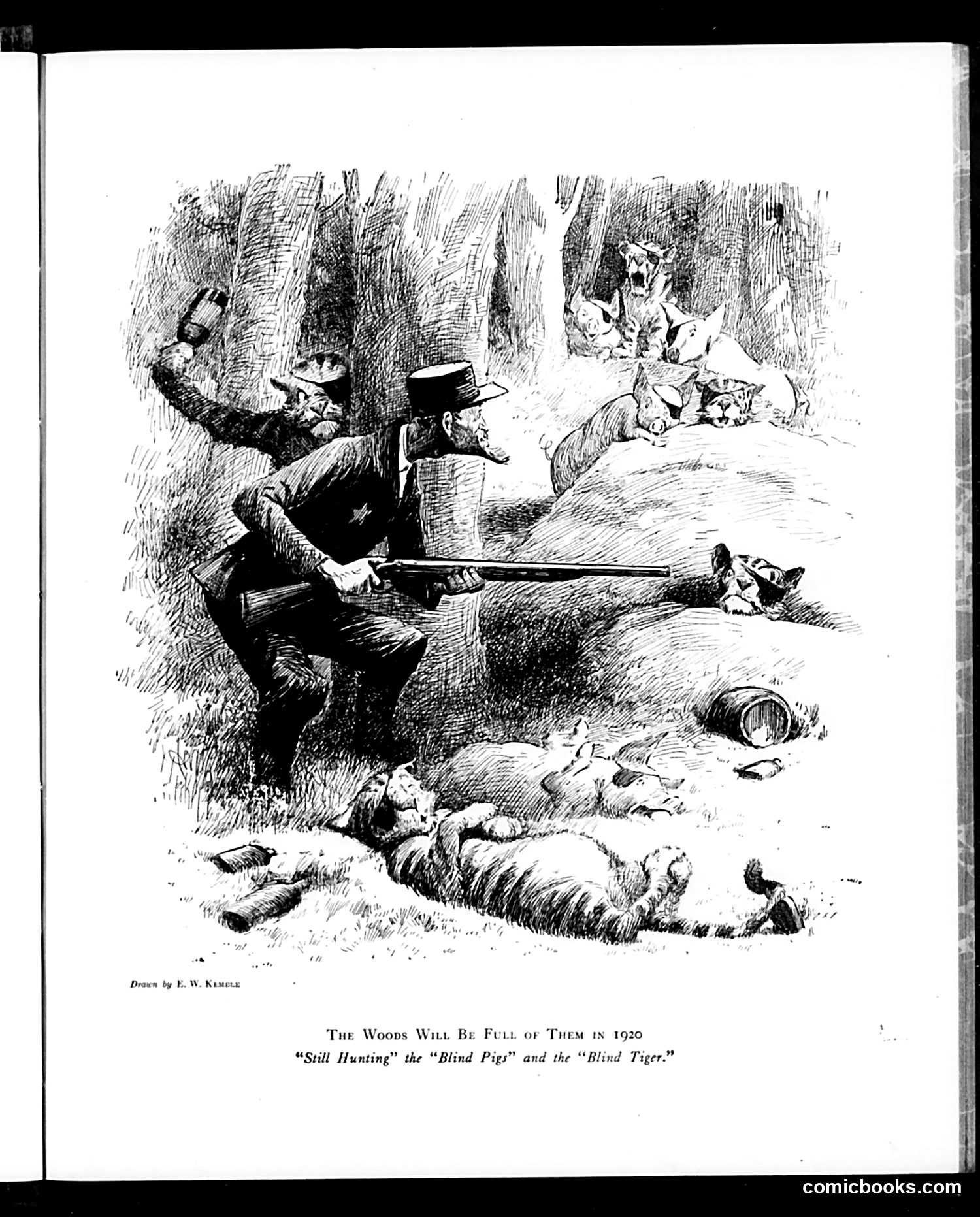
This political cartoon satirizes Prohibition enforcement. The drawing shows armed hunters in woods pursuing game labeled "Blind Pigs" and "Blind Tigers"—contemporary slang terms for illegal speakeasies and unlicensed bars where alcohol was sold secretly during Prohibition. The caption predicts that by 1920, "the woods will be full of them," suggesting that despite government efforts to enforce the alcohol ban, illegal drinking establishments would proliferate. The cartoon uses the hunting metaphor to mock law enforcement's futile attempts to eliminate these illegal operations—depicting them as an endless, elusive quarry that authorities cannot successfully eliminate. The satire critiques both Prohibition's impracticality and the government's optimistic confidence in enforcing it.
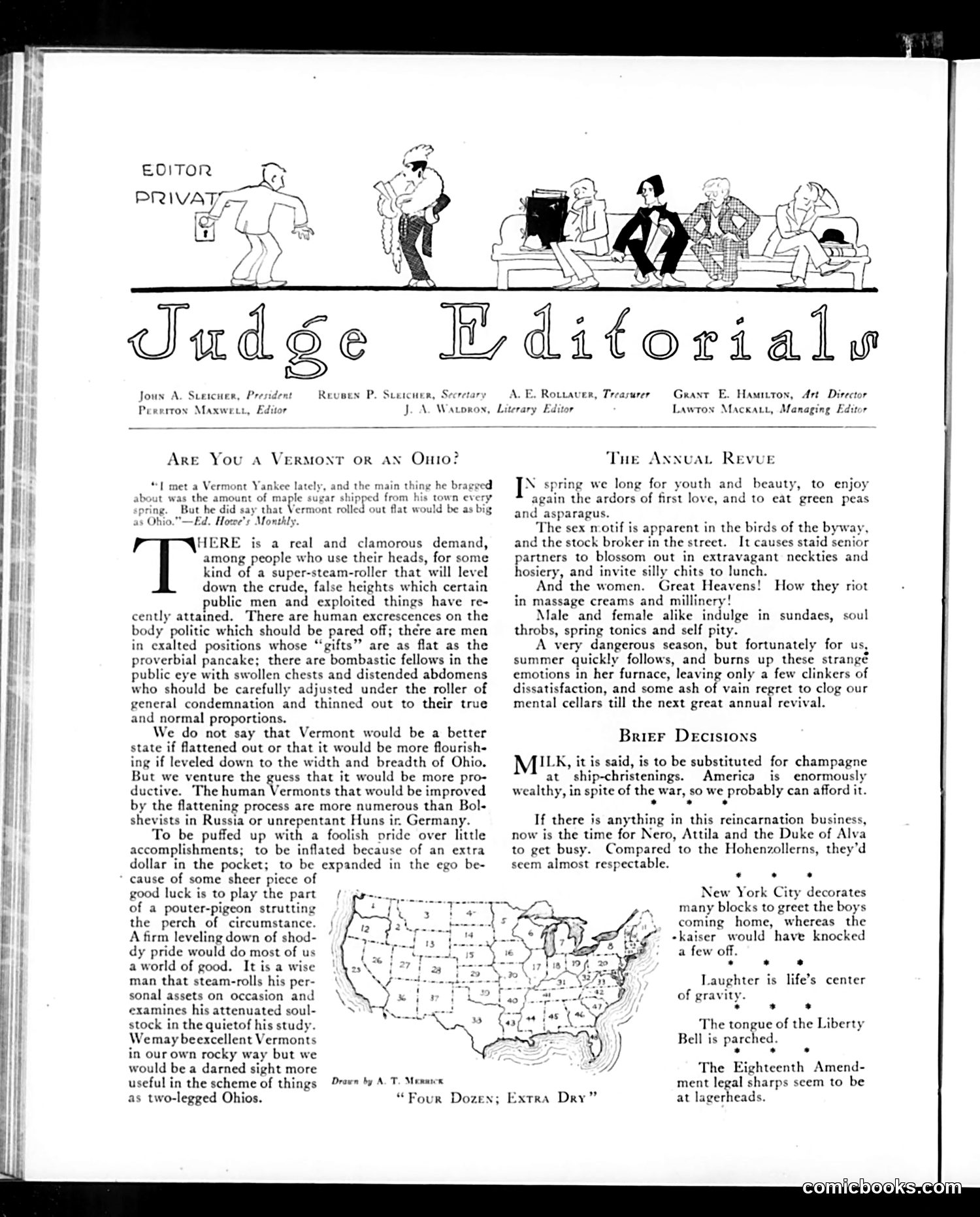
This is the masthead and editorial section of *Judge* magazine, a prominent American satirical publication. The main editorial, "Are You a Vermont or an Ohio?", uses regional stereotypes as a vehicle for social criticism. It argues that while Vermonters may have admirable qualities, they suffer from excessive pride and self-importance—they need metaphorical "flattening" by a "super steam-roller" to achieve humility and usefulness. The author suggests that inflated egos, whether from minor accomplishments or good fortune, are widespread human failings requiring moral correction. The accompanying cartoon "Four Dozen; Extra Dry" (by A.T. Menace) appears to reference Prohibition-era bootlegging, showing a map with numbered regions—likely depicting illegal alcohol distribution networks. The "Brief Decisions" section contains topical quips: references to milk replacing champagne at ship christenings (wartime rationing), reincarnation of historical villains like Nero and Attila (comparing them unfavorably to contemporary German leaders), and jokes about Prohibition ("Eighteenth Amendment legal sharps...at lagerheads").
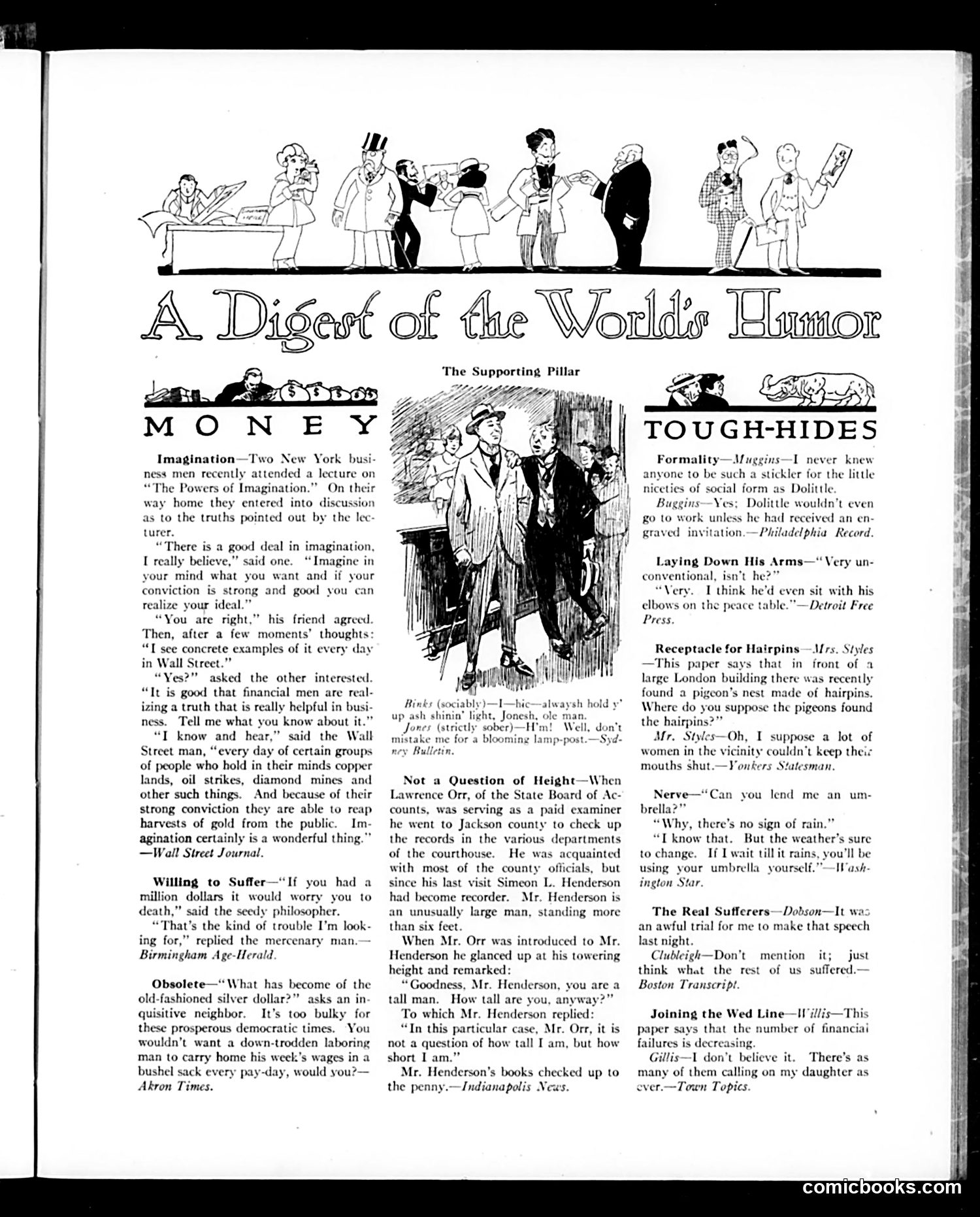
This page collects brief humorous anecdotes and jokes from various American newspapers, organized in two columns under thematic headings ("Money" and "Tough-Hides"). The satire targets: **"Money"** section mocks Wall Street speculation and financial fraud—businessmen use "imagination" to convince the public to invest in worthless ventures (copper lands, oil strikes, diamond mines), harvesting "gold from the public" through conviction rather than actual assets. **"Tough-Hides"** section offers social humor: formality in etiquette, unconventional behavior, and absurd situations (pigeons nesting in hairpins found near women's workplaces—implying women are careless or scatter-brained). The humor relies on wordplay, irony, and gentle social observation typical of early 20th-century American satire. A notable anecdote features an Indiana official's witty response about being "short" rather than "tall"—turning a physical observation into a comment on his honesty.
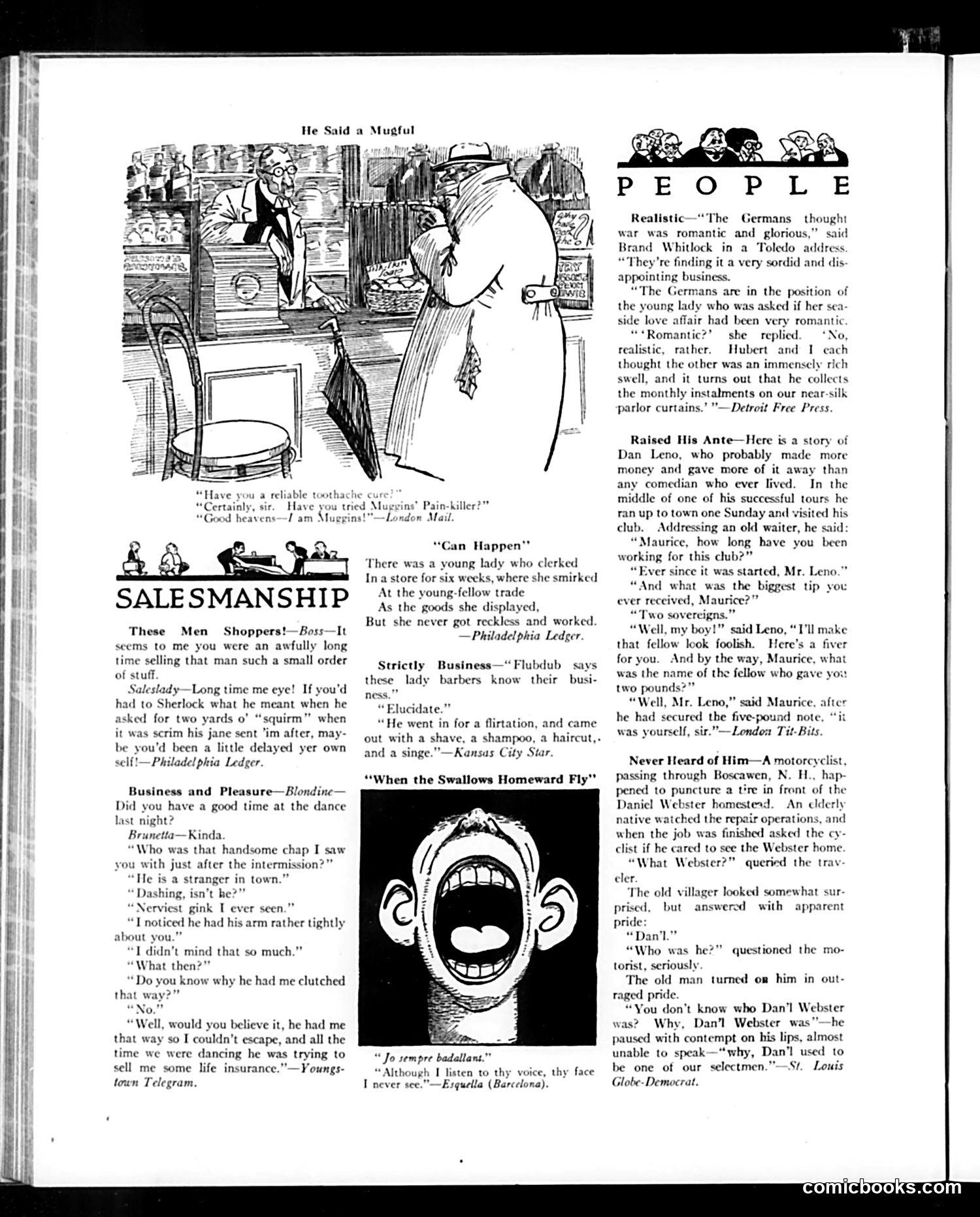
This page from the satirical magazine *Judge* collects brief humorous anecdotes about early 20th-century American life. **Key content:** - **"Salesmanship"**: A comic about a sales clerk defending her slow sale—the customer asked for "squirm" (misheard "scrim"), creating confusion. - **"Business and Pleasure"**: A flirtation joke where a man at a dance holds a woman close not for romance, but to trap her while pitching life insurance—satirizing aggressive salesmen. - **"Realistic"**: An anecdote attributed to Brand Whitlock about Germans' disillusionment with war, using a romantic-versus-reality love affair as analogy—commentary on World War I. - **"Raised His Ante"**: A story about comedian Dan Leno rewarding a club waiter generously, only to learn the previous generous tipper was himself—ironic self-deprecation. - **"Never Heard of Him"**: A motorcyclist in New Hampshire doesn't recognize Daniel Webster's name; a local villager is shocked, defining Webster merely as "one of our selectmen" rather than the famous 19th-century statesman—gentle mockery of provincial obscurity.
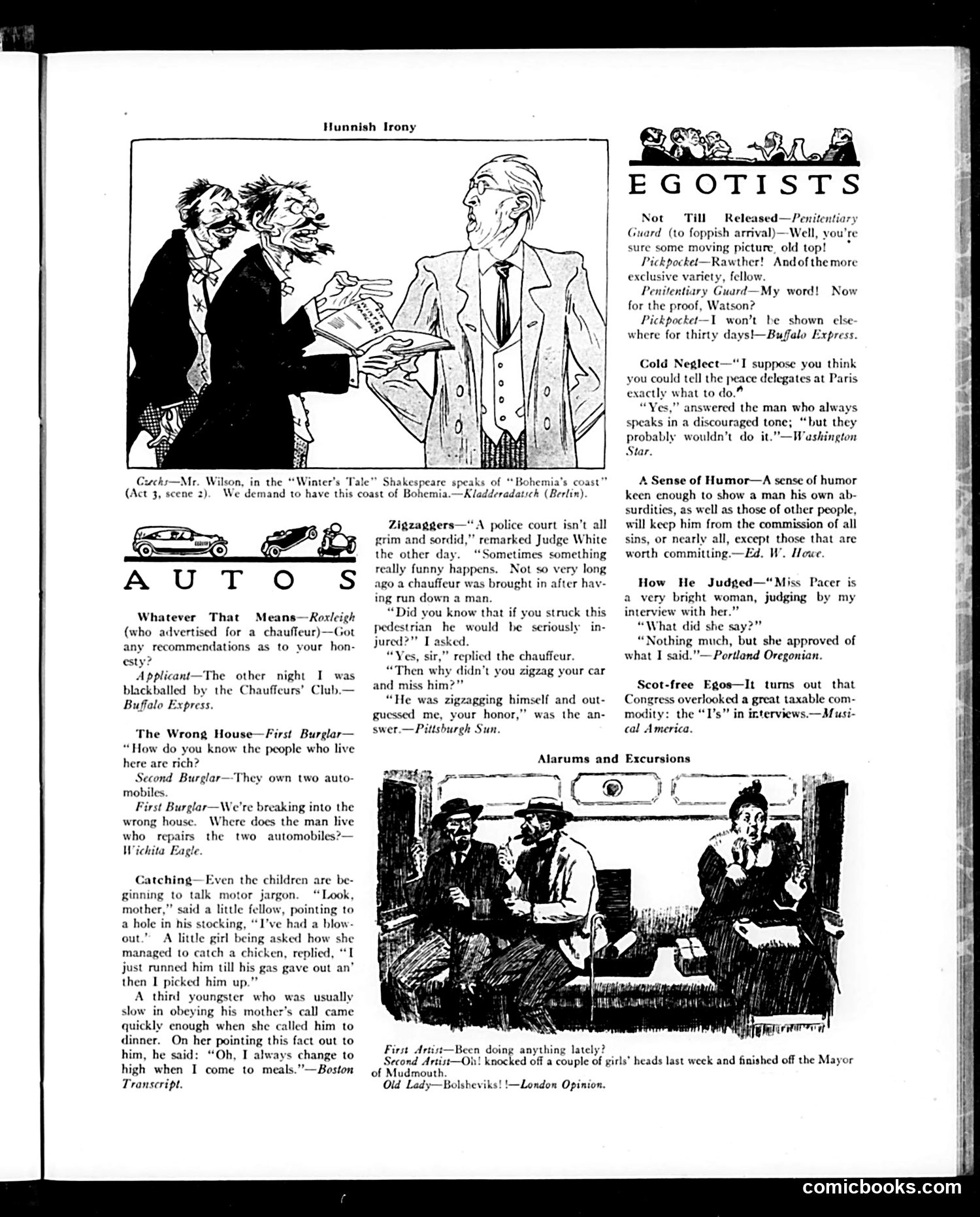
This page from *Judge* (a turn-of-the-century American satirical magazine) contains multiple short humor pieces satirizing contemporary American society, primarily through automobile culture and workplace absurdities. **Main Topics:** The **"Autos"** section mocks the era's automobile obsession. Jokes about chauffeurs, car breakdowns, and mechanics becoming wealthy (since everyone with two cars needs repairs) reflect early-1900s anxieties about this new technology disrupting class hierarchies. Children adopting "motor jargon" (calling stocking holes "blow-outs") satirizes how thoroughly automobiles had penetrated daily life. **"Hunnish Irony"** references Germany's *Kladderadatsch* magazine, suggesting wartime tensions and international joke-sharing. The **"Egotists"** section skewers vanity and self-importance through brief anecdotes about pickpockets, diplomats, and self-absorbed speakers. **"Alarums and Excursions"** features a darkly comic exchange where artists casually mention murdering women and assassinating a mayor, with an old lady's horrified response ("Bolsheviks!") implying violent radicalism—likely referencing contemporary anarchist fears. Overall, the page reflects pre-WWI American humor: automobile-fixated, class-conscious, and politically anxious.
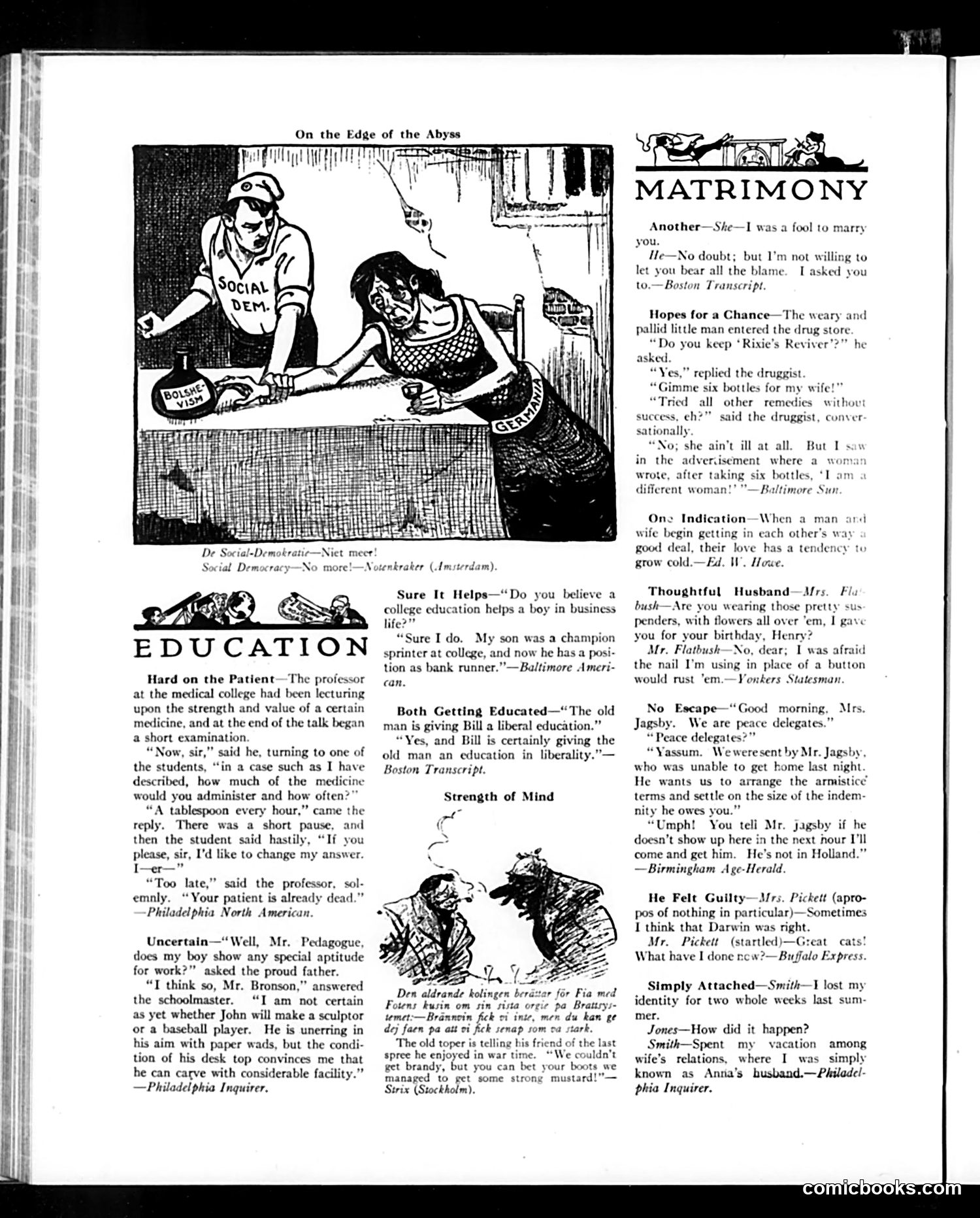
This page collects brief satirical jokes and anecdotes organized by topic. The top cartoon shows a figure labeled "SOCIAL DEM" at a table marked "BOLSHEVISM," apparently depicting socialist or revolutionary ideology being served up—likely commentary on early 20th-century socialist movements. The written jokes mock various subjects: medical education (a student's fatal dosing error), parenting and aptitude, college education's practical value, and marriage troubles. Several jokes center on marital discord and domestic disappointment—wives as burdens, husbands neglecting gift-giving, spouses unable to escape each other. The "Strength of Mind" section includes a translated Swedish joke about wartime rationing, showing this was an international satirical publication. Overall, the page reflects Judge's satirical approach to contemporary American life: poking fun at pretentious education, failed marriages, socialist ideology, and middle-class domesticity. The humor is gentle rather than vicious, targeting universal human foibles rather than specific political figures.
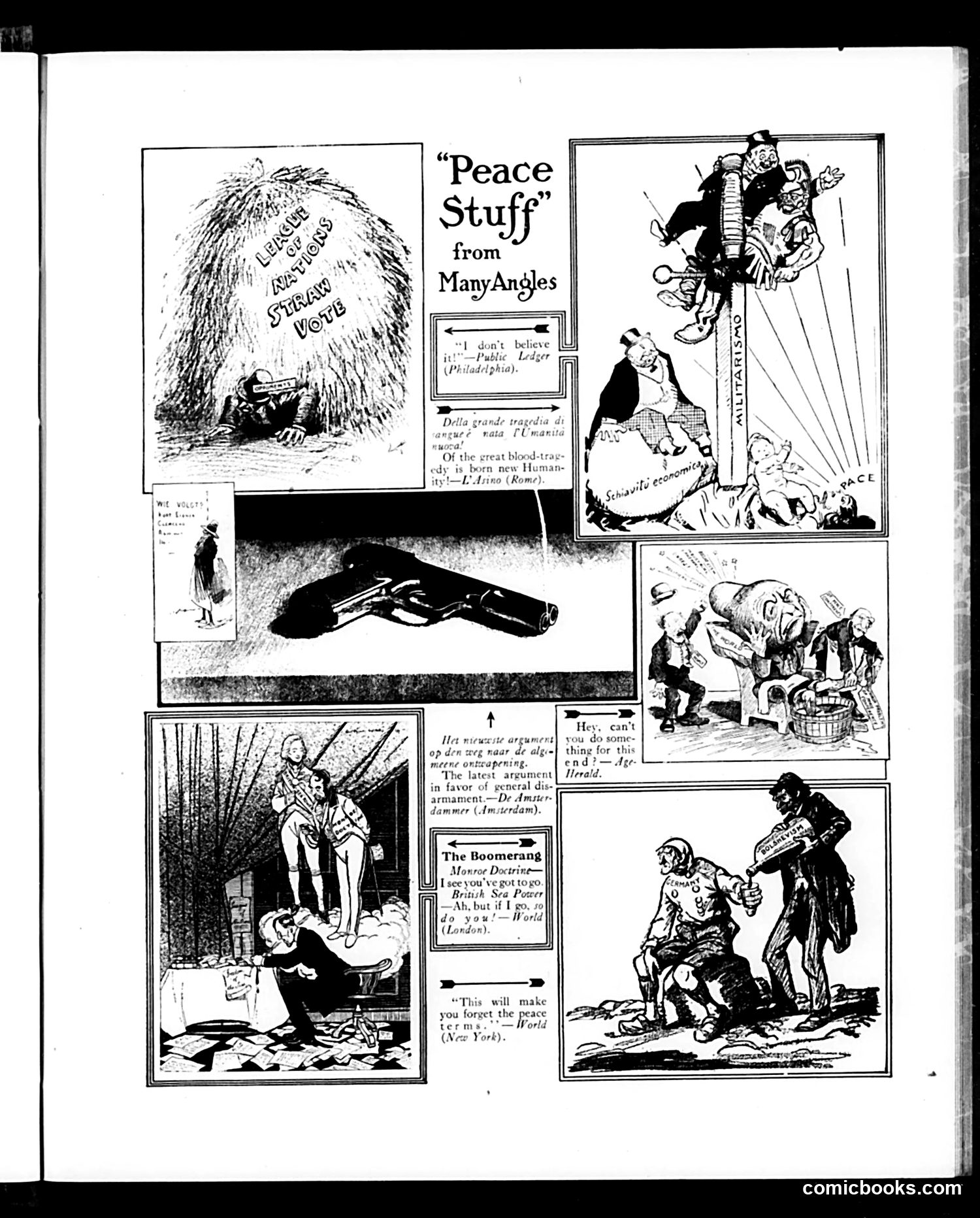
This page collects international political cartoons satirizing post-WWI peace efforts. The central image—a revolver—symbolizes how military solutions undermine peace rhetoric. Individual panels mock world leaders' hypocrisy: they claim to want peace while discussing disarmament, yet continue militaristic policies. One caption references "The Boomerang Doctrine," suggesting peace initiatives will backfire. Another notes irony: "This will make you forget the peace" (from the New York World). The opening panel shows a figure buried under a massive heap labeled "Illegal Steward Vote"—likely critiquing how peace agreements ignore democratic principles or suppress dissenting voices. Collectively, the cartoons argue that post-war rhetoric about peace is merely propaganda masking continued imperial ambitions and military buildup among major powers.
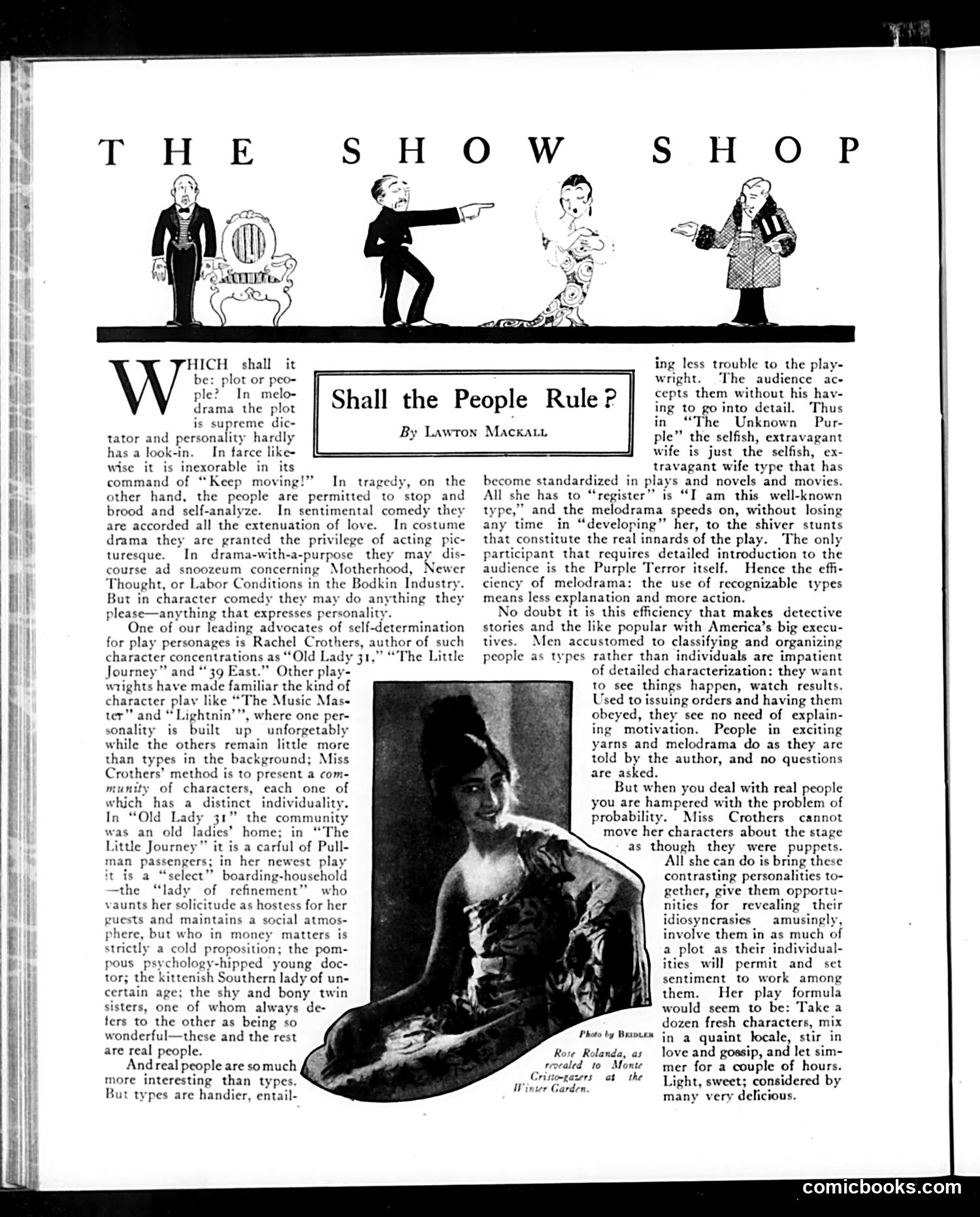
This page analyzes competing approaches to dramatic playwriting, using **Rachel Crothers** as the exemplar of character-driven drama. The title's question is metaphorical: should plays center on complex individual characters ("the people") or efficient plot mechanics? The article contrasts Crothers's method—presenting communities of distinct, psychologically realistic characters—with the dominant commercial model of melodrama and detective stories that rely on standardized "types" (the selfish wife, the genius detective) requiring minimal explanation. The satire targets business executives who favor fast-paced entertainment with predictable character archetypes over nuanced human psychology. These audiences, accustomed to issuing orders, expect characters to behave like obedient puppets rather than probable human beings with complex motivations. Crothers's innovation—giving each character genuine individuality and allowing plot to emerge organically from personality—represents artistic integrity against commercial convenience. The critique suggests modern theater has sacrificed psychological realism for commercial efficiency.
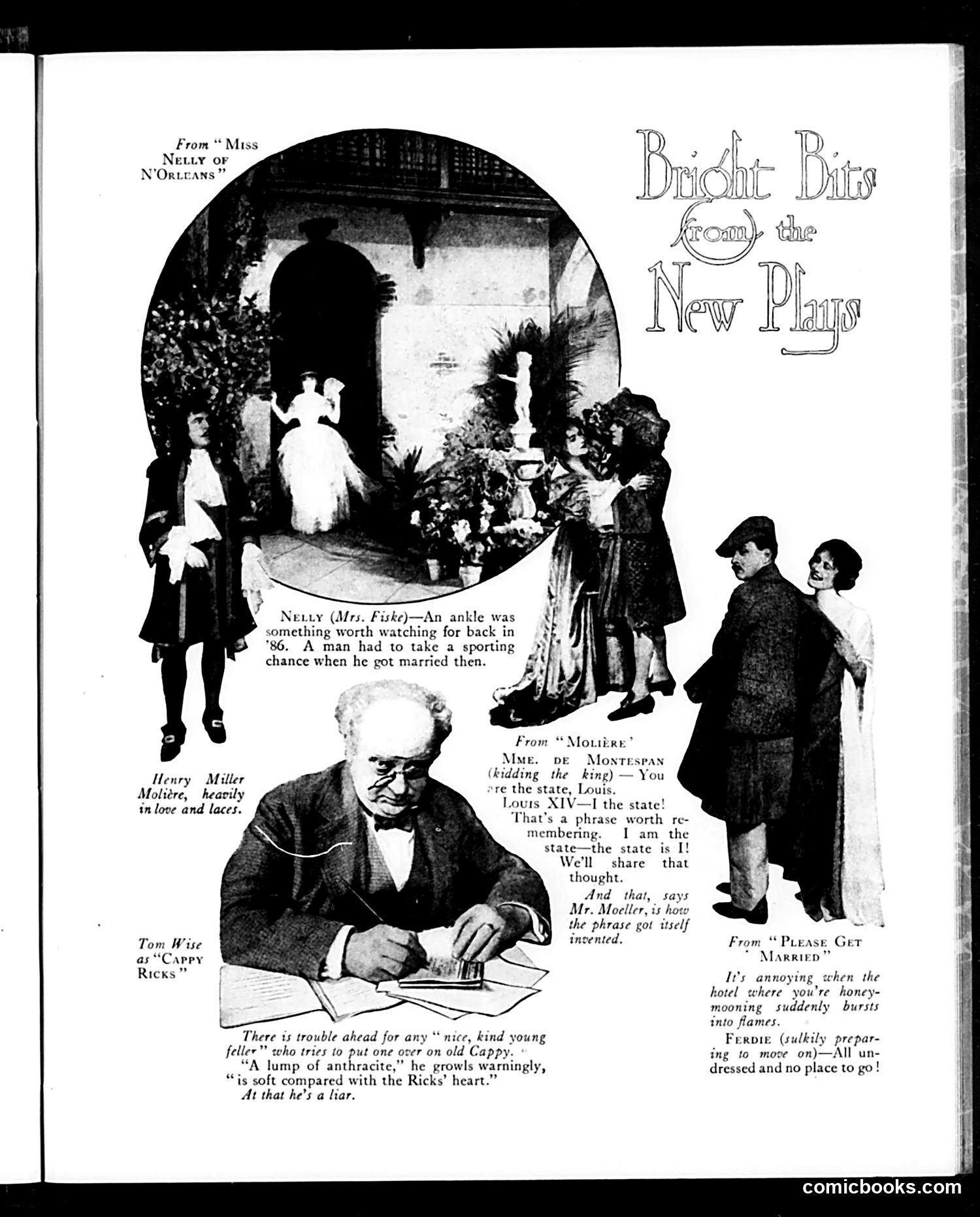
This page presents theater reviews/commentary featuring scenes and quotes from contemporary Broadway productions. It's not political satire but theatrical criticism using humor. The page references performances by actors Henry Miller (in Molière), Mrs. Fiske (in "Miss Nelly of N'Orleans"), and Tom Wise (in "Cappy Ricks"). Each snippet includes a comedic observation: Mrs. Fiske's ankle-display was scandalous by 1886 standards; a joke about the famous phrase "L'État, c'est moi" (Louis XIV); a honeymoon hotel fire interrupting intimacy; and Tom Wise's character Cappy Ricks being ruthlessly hard-hearted despite claims otherwise. These are *theatrical* bits—humorous asides about plot points and character traits—designed to entertain readers familiar with these stage productions while mocking their conventions and absurdities.
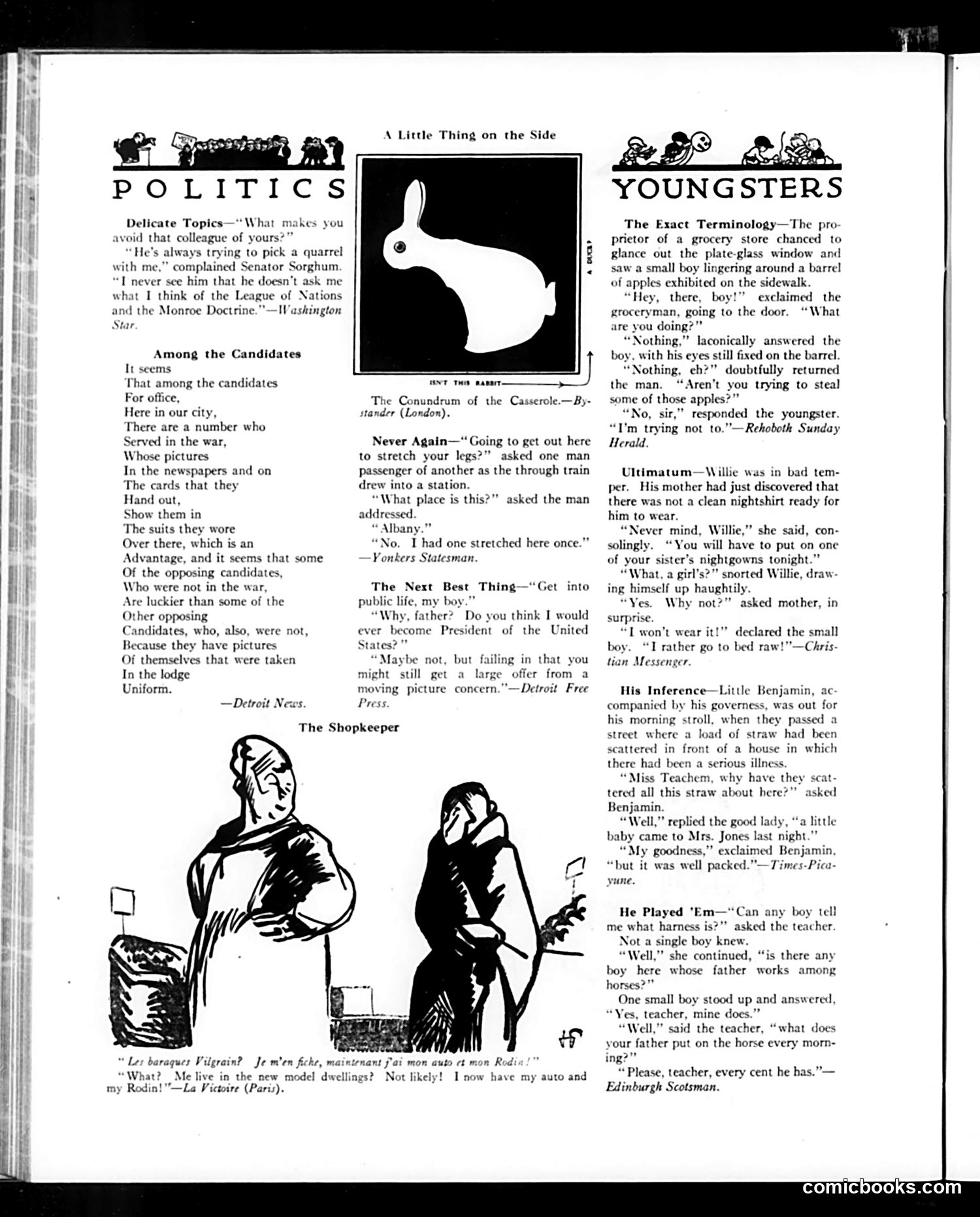
This page from Judge magazine contains satirical commentary on 1920s American politics and social life, organized into three sections: **"Politics"** lampoons post-WWI political discourse. Senator Sorghum complains that colleagues constantly ask his opinion on the League of Nations and Monroe Doctrine—referencing the contemporary debate over U.S. entry into the League following World War I. The satire mocks politicians' obsession with these divisive topics. The "Among the Candidates" poem criticizes local political candidates who pose in military uniforms from WWI service to gain electoral advantage, while opposing candidates without war records resort to lodge uniforms for similar credibility. **"A Little Thing on the Side"** offers miscellaneous humor, including a cartoon of a French shopkeeper refusing to abandon his wine and Rodin sculpture despite having a car—satirizing French materialism and priorities. **"Youngsters"** presents anecdotes about children's innocent logic and unintentional humor, a common magazine feature of the era showcasing precocious or naive youthful observations. The overall tone reflects post-war American satirical sensibilities: skepticism toward politicians, gentle mockery of class aspirations, and sentimental amusement at children's candor.
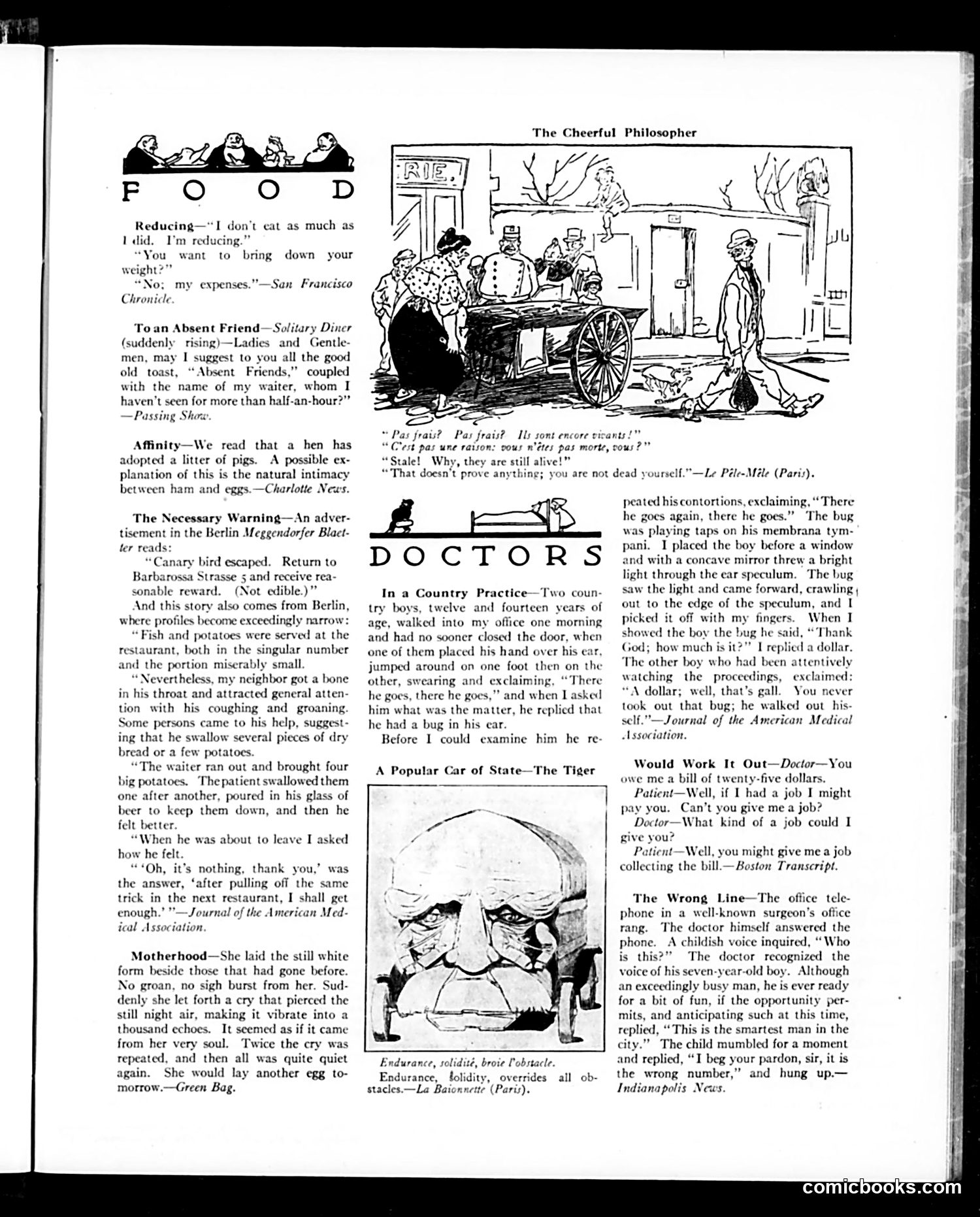
This page from **Judge** (a satirical weekly) collects humorous anecdotes and jokes satirizing early 20th-century American life and social pretension. **Key content:** - **"Reducing"**: Jokes about economic hardship disguised as dieting—a man claims to eat less but admits it's to reduce *expenses*, not weight. This reflects post-WWI economic anxiety. - **"In a Country Practice"**: A rural doctor anecdote where a boy with a bug in his ear is treated; the humor lies in the boy's friend's quip that the bug "walked out himself"—mocking the doctor's fee for simple work. - **"A Popular Car of State"**: A caricature labeled "The Tiger," likely referencing a political figure (unclear which without date), with French caption about endurance overcoming obstacles. - **"Would Work It Out"**: Dark humor about unemployment and debt—a patient owes the doctor but can't pay; when asked what job the doctor could offer, the implicit joke suggests debtors have few options. The satire targets **economic inequality, medical pretension, and post-war poverty**.
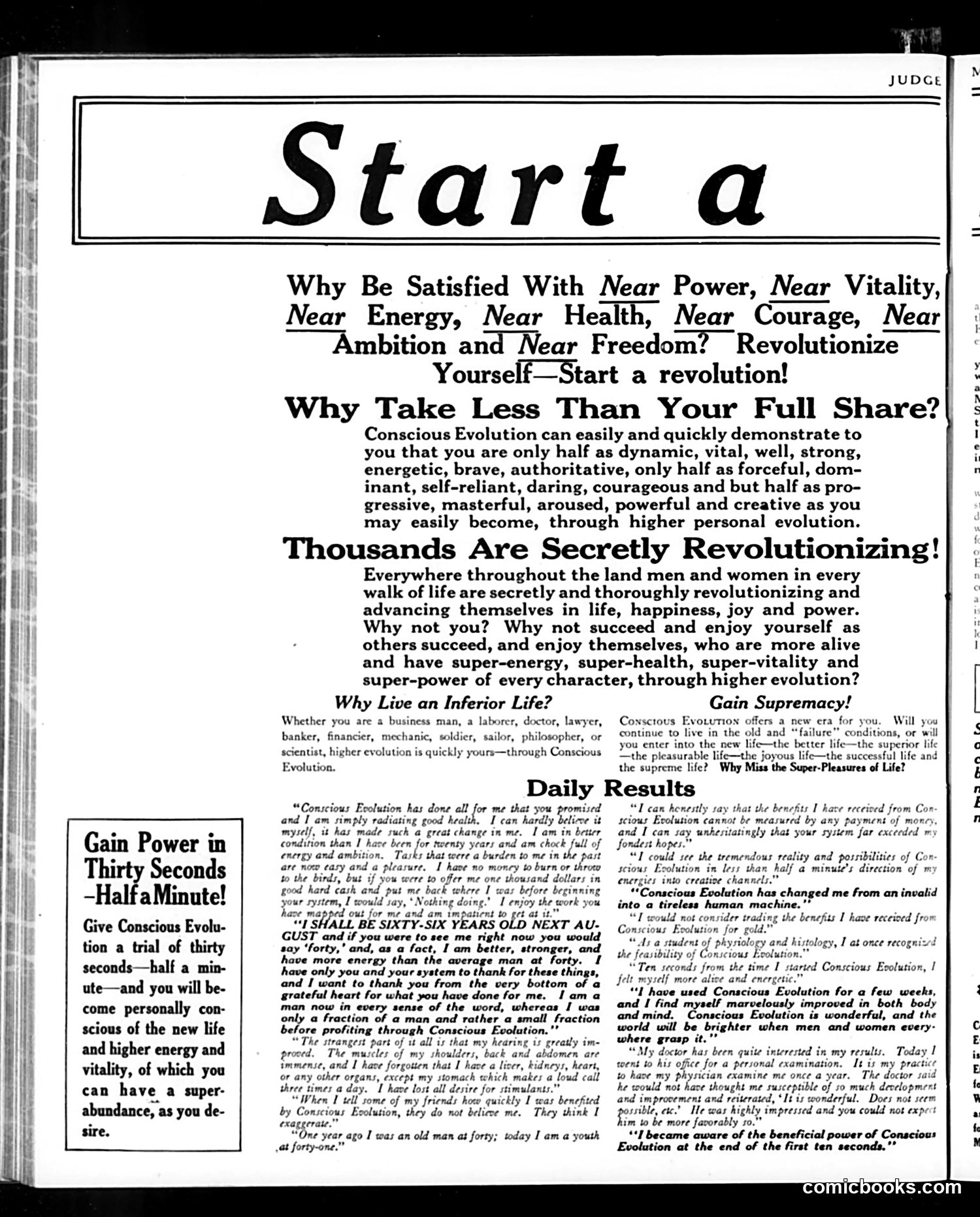
This is an **advertisement** (not a cartoon) for "Conscious Evolution"—a self-help scheme marketed as a quasi-scientific personal improvement program. Judge magazine is satirizing it by presenting the ad straight, letting its absurd claims speak for themselves. The pitch promises miraculous results in "thirty seconds": superhuman energy, health, power, and courage through undefined "higher personal evolution." It uses manipulative language ("Why Live an Inferior Life?") and fake testimonials from converts claiming to look forty at sixty-six or regain youth after one year. The satire lies in Judge **publishing the ad without commentary**—the hyperbolic promises, pseudoscientific jargon, and desperate testimonials are left to expose the scheme as ridiculous on their own. This reflects early 20th-century America's susceptibility to wellness quackery and get-rich-quick self-improvement movements. The magazine mocks both the hucksters and their gullible audiences.
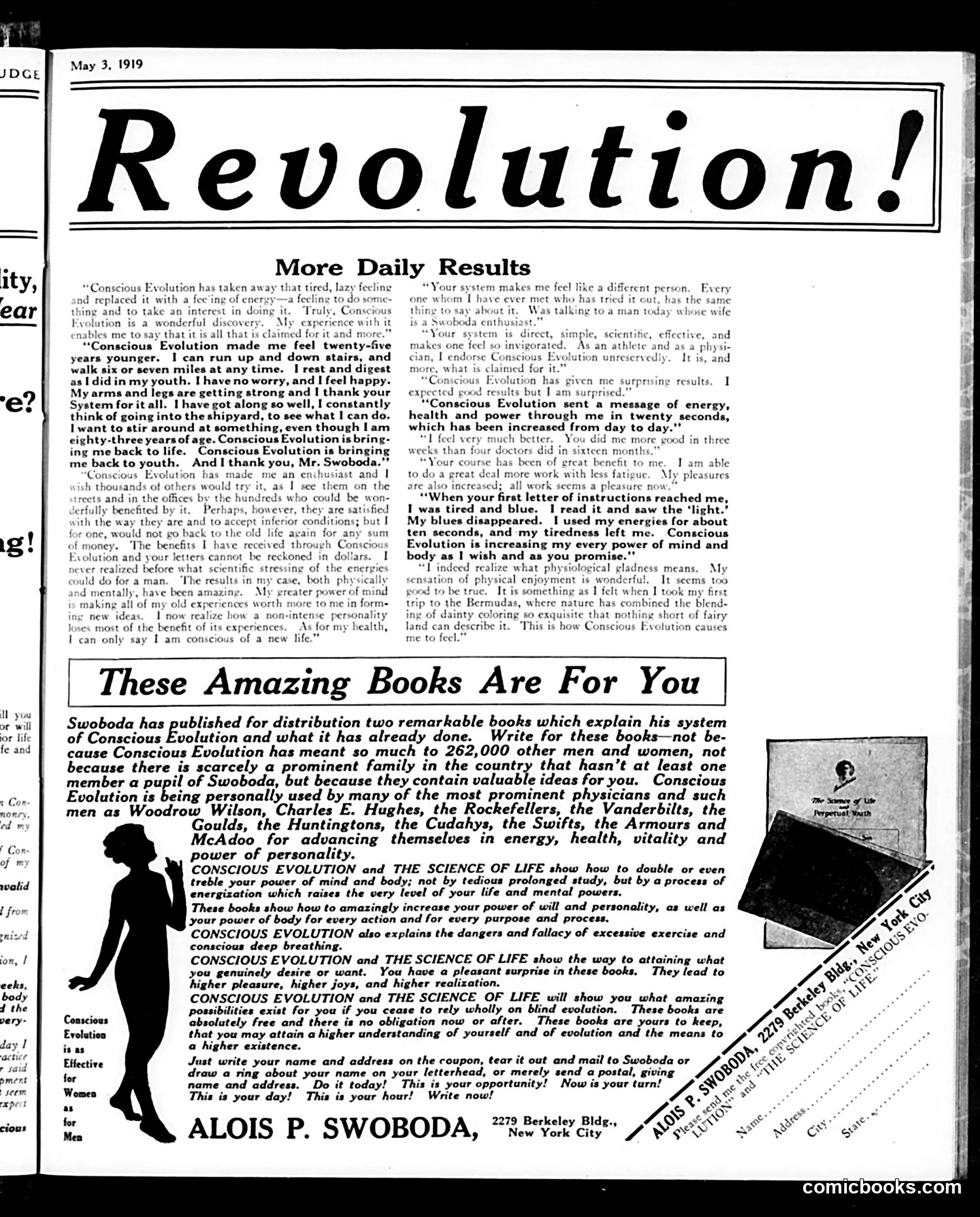
This page is primarily **advertising**, not satire. It promotes "Conscious Evolution," a self-improvement system by Alois P. Swoboda, presented as a pseudoscientific wellness method. The testimonials claim the system cures fatigue, increases strength, and rejuvenates users—an 83-year-old claims he feels "twenty-five years younger." The ad leverages credibility by claiming prominent figures use it: President Woodrow Wilson, Charles E. Hughes, the Rockefellers, Vanderbilts, and others. For modern readers, this exemplifies **early 20th-century health fraud**—exaggerated wellness claims targeting middle-class aspirations. The vague language ("energization," "stressing of energies") lacks scientific basis. The prominent name-dropping was a common marketing tactic before modern consumer protection laws. Judge's publication of this reflects the era's limited advertising regulation and widespread credulity about dubious self-improvement schemes.
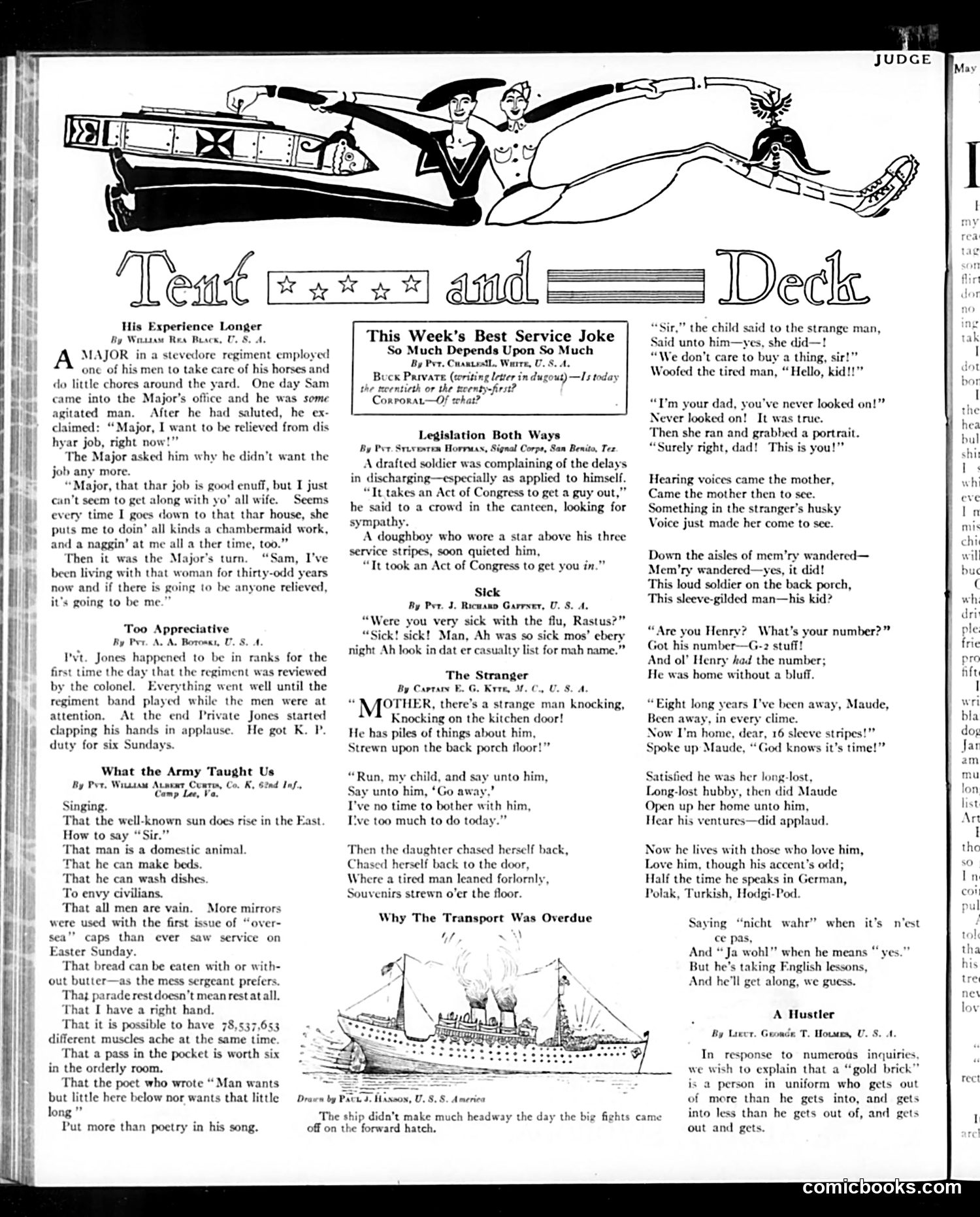
This page collects humorous anecdotes from American soldiers during World War I, organized around military life and army experiences. **Main content:** Several short comedic pieces feature enlisted men and officers in situations highlighting army absurdities—a soldier asking for relief from his Major's wife's chores, a private clapping during a regimental review (earning punishment), complaints about discharge delays. **The central cartoon** depicts a ship labeled as a transport vessel, illustrating the accompanying story about why transports were "overdue"—likely a commentary on wartime logistics delays. **Social context:** These pieces satirize military bureaucracy, racial dialect humor (common to the era), and the disconnect between soldiers' expectations and army realities. The humor relies on soldiers' shared experiences of frustration with regulations, command structure, and delayed demobilization—reflecting genuine post-war grievances among returning servicemen. The overall tone is affectionate mockery rather than serious criticism.
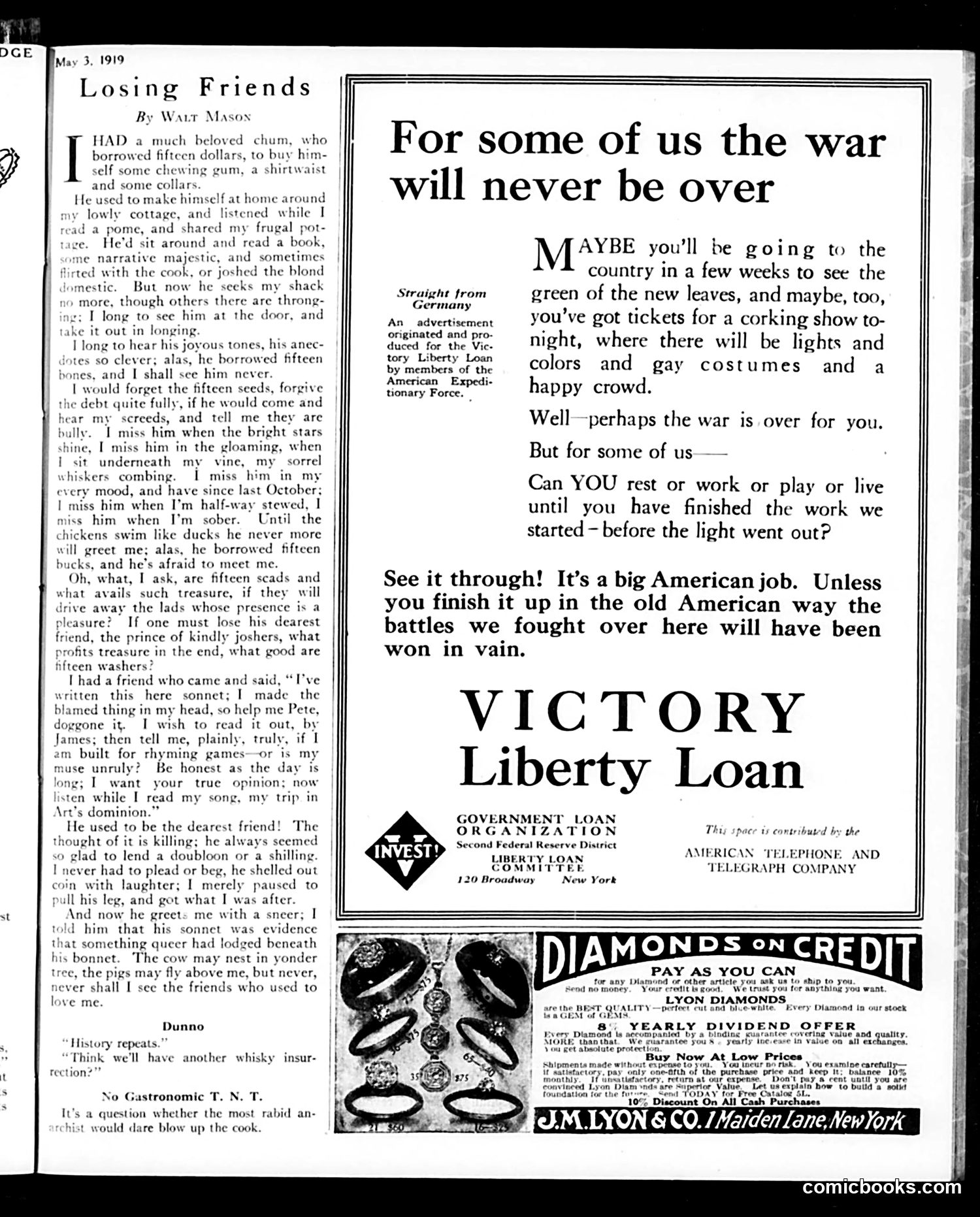
This May 3, 1919 *Judge* page contains two distinct pieces: **Left column ("Losing Friends" by Walt Mason):** A sentimental poem about friendship destroyed by debt. The narrator's beloved friend borrowed $15 and now avoids him from shame. Mason laments that financial obligation has severed their relationship—the friend won't even visit anymore. The satire is gentle: it mocks how people prioritize money over genuine affection, suggesting that forgiving small debts would preserve more valuable friendships. The repeated refrain emphasizes the absurdity of losing a cherished companion over such a trivial sum. **Right side:** A Victory Liberty Loan advertisement urging Americans to "see it through"—to complete post-WWI reconstruction work "in the old American way." This directly references the 1919 Liberty Loan campaign, appealing to patriotic duty to rebuild after the war's conclusion. The page juxtaposes personal loss against national obligation, perhaps unintentionally commenting on competing loyalties in the postwar period.
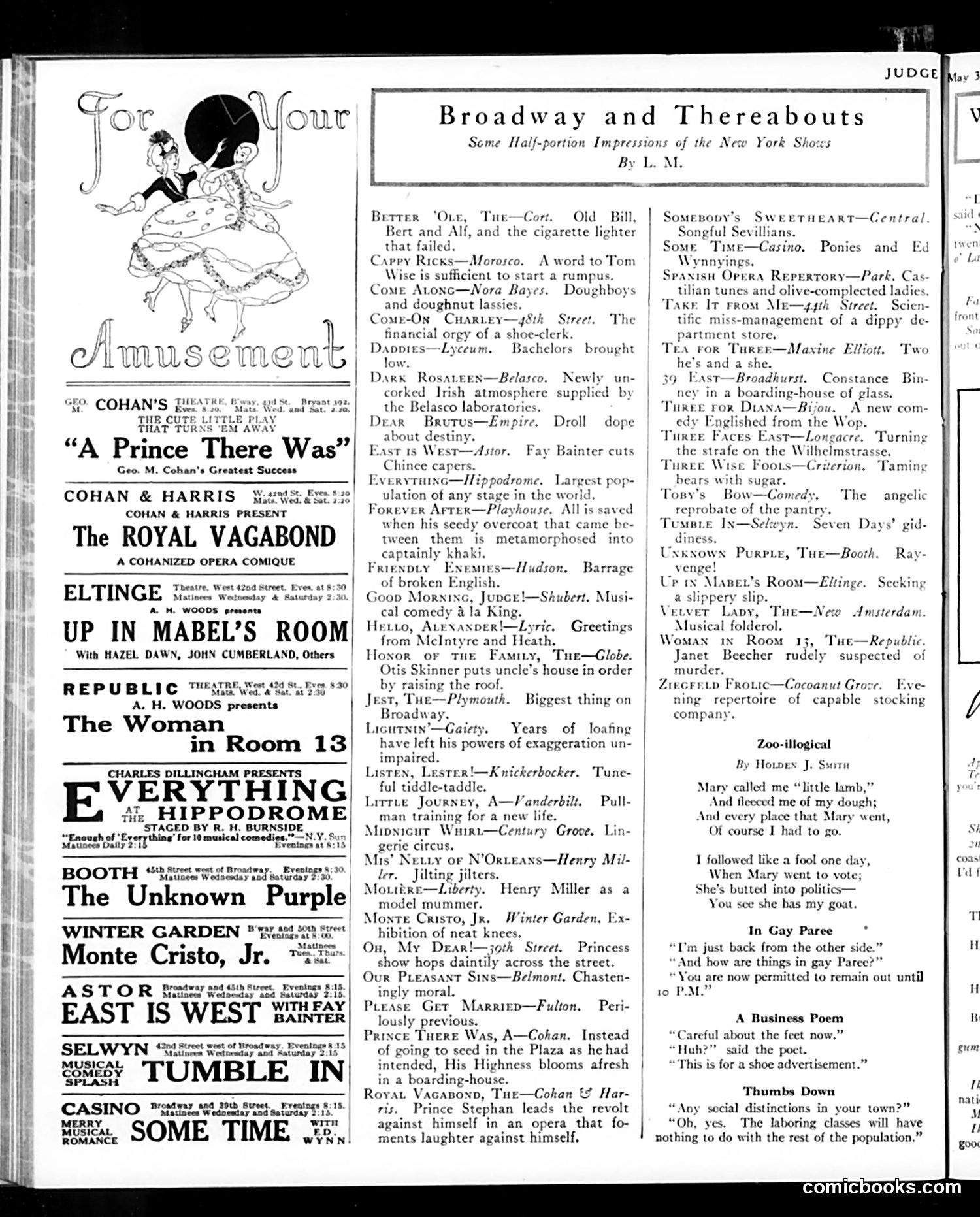
This page is primarily **theater advertisements and brief reviews** of Broadway shows. The illustrated header "For Your Amusement" shows stylized figures in 1920s dress, establishing the entertainment focus. The content lists current New York productions with witty one-line descriptions mocking each show's plot or performers. Examples include mockery of sentimentality ("*Prince There Was*—Instead of going to seed in the Plaza...His Highness blooms afresh in a boarding-house") and absurdist humor ("*Everything*—Largest population of any stage in the world"). The satirical tone is typical of Judge's approach: irreverent commentary on popular culture. George M. Cohan's productions receive particular attention, suggesting his prominence at the time. The page also includes short humorous poems like "Zoo-illogical" and "A Business Poem," maintaining Judge's mix of theatrical criticism and light satire aimed at educated urban readers familiar with Broadway.
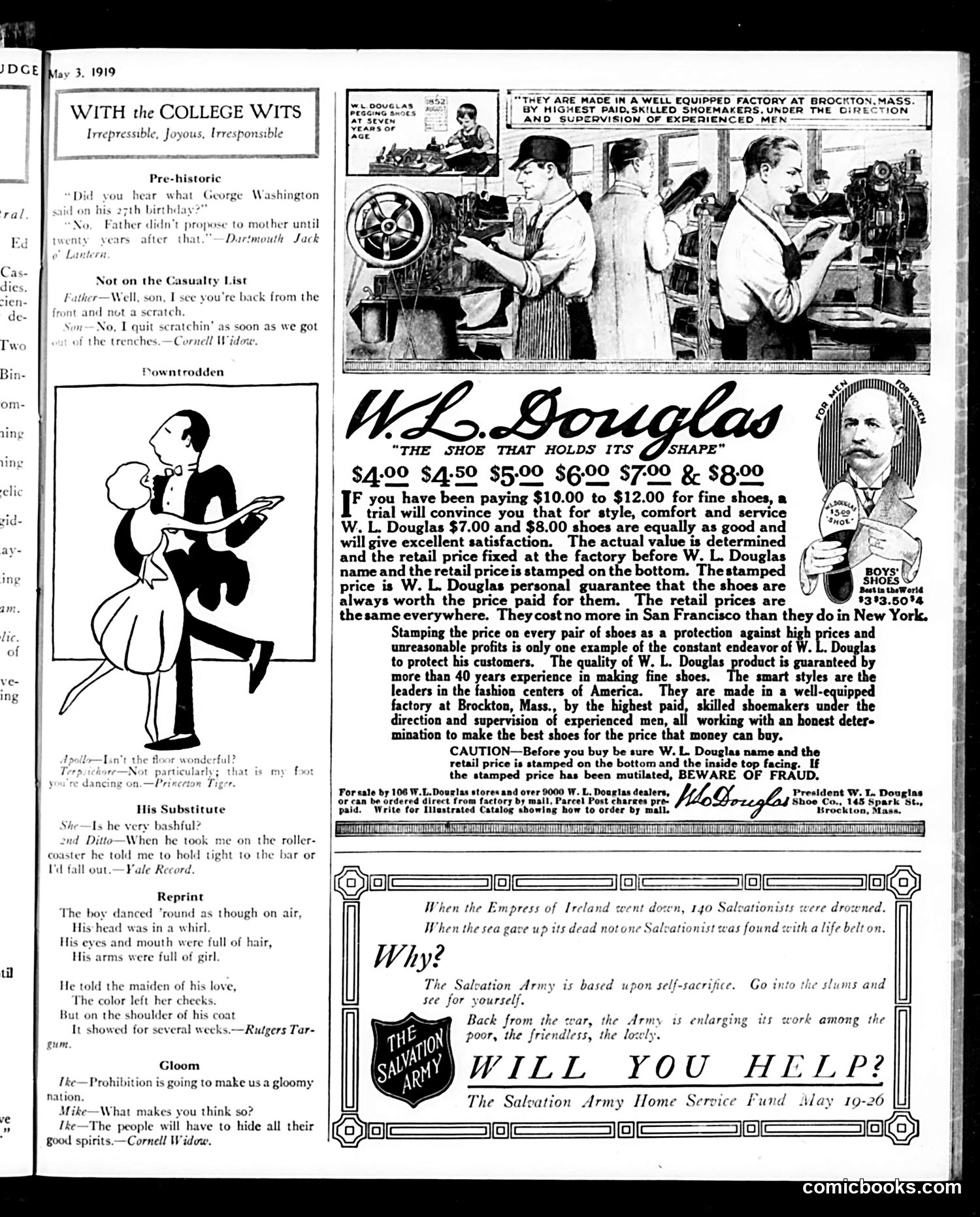
This page combines college humor with advertising and charitable appeals typical of post-WWI publications. **"With the College Wits"** section features brief jokes from college newspapers, mostly playing on wordplay and mild irreverence—typical collegiate humor of the era. One joke references a soldier returning from "the trenches" (WWI, recently ended in November 1918), suggesting the war was still fresh in readers' minds. **The large W.L. Douglas shoe advertisement** dominates the right side, emphasizing price transparency and factory quality—marketing appeals common to early 20th-century consumer goods, highlighting the stamped price as protection against fraud and price-gouging. **The bottom section** contains a **Salvation Army fundraising appeal** referencing the drowning of 140 Salvationists when the Empress of Ireland sank (1914), connecting historical tragedy to current charitable need. The appeal asks readers to "help" the organization's post-war work among the poor. Overall, this is primarily an **advertising-heavy page** mixing light entertainment with commercial and charitable messaging aimed at middle-class readers.
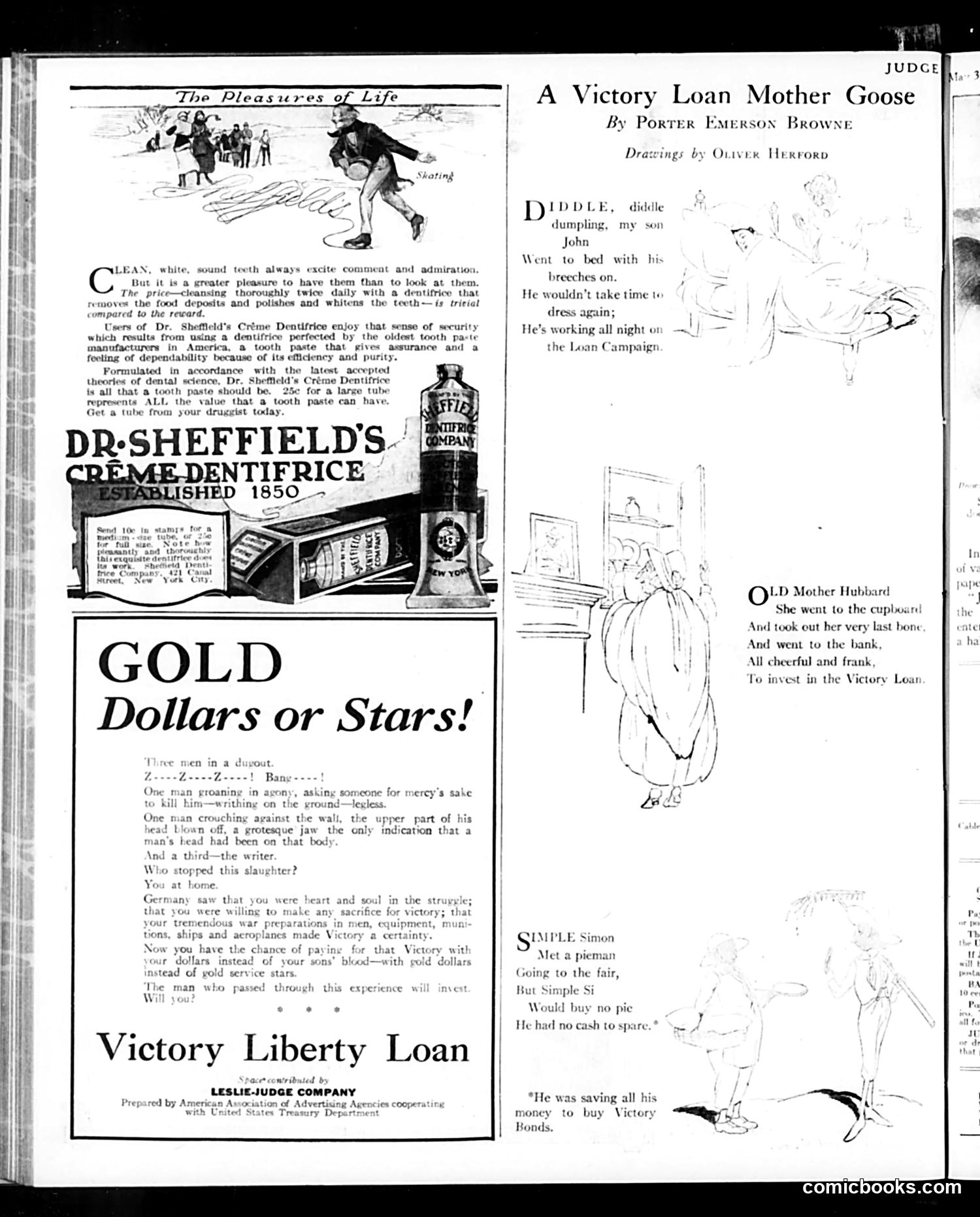
This page uses nursery rhyme parodies to promote the Victory Liberty Loan, a WWI-era government bond campaign. The satire targets citizens who *don't* invest in war bonds. **Key figures/references:** - "Mother Hubbard" goes to the bank to invest her last penny in Victory Loans—presented as virtuous - "Simple Simon" refuses to buy anything because he has no cash; he's "saving all his money to buy Victory Bonds"—presented as foolish restraint - "John" (Diddle Dumpling's son) works night and day on the Loan Campaign instead of resting **The satire's point:** These verses mock and shame people who hesitate to spend money on war bonds. By recasting refusal as character flaws in familiar nursery rhymes, the ads equate patriotism with immediate financial sacrifice. The page also includes a Dr. Sheffield's toothpaste ad—typical magazine filler—treating personal hygiene as similarly important to national duty. This represents propaganda-as-advertising during wartime mobilization.
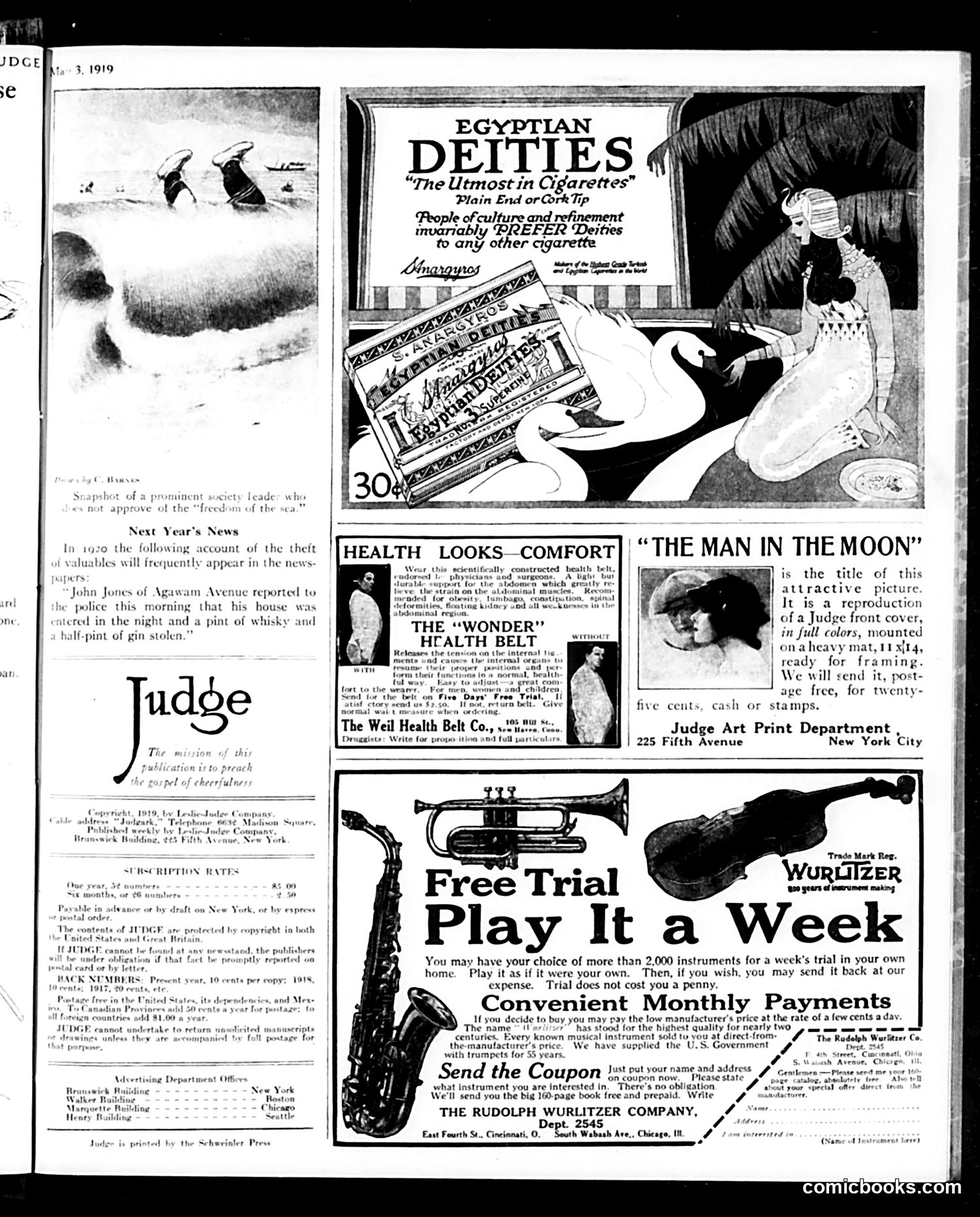
This page is primarily **advertising** with minimal editorial content. The main satirical element is the **Egyptian Deities cigarette ad**, which uses mock-grandiose language ("People of culture and refinement invariably PREFER Deities") to spoof cigarette marketing's pretentious appeals to sophistication—a common advertising trope of the era. The page also includes a brief news item about a Prohibition-era burglary (whisky and gin theft), reflecting the public concern about enforcement following alcohol's ban in 1919. The bulk of the page contains straightforward commercial advertisements: a health belt product, a Judge art print offer, and a major Wurlitzer musical instrument promotion featuring a free trial offer. These ads reveal 1919 consumer culture—mail-order purchasing, installment payments, and companies positioning themselves as established, trustworthy brands (Wurlitzer claims centuries of history). There is **no political cartoon** or sophisticated satire visible. This appears to be a filler/advertising-heavy issue.
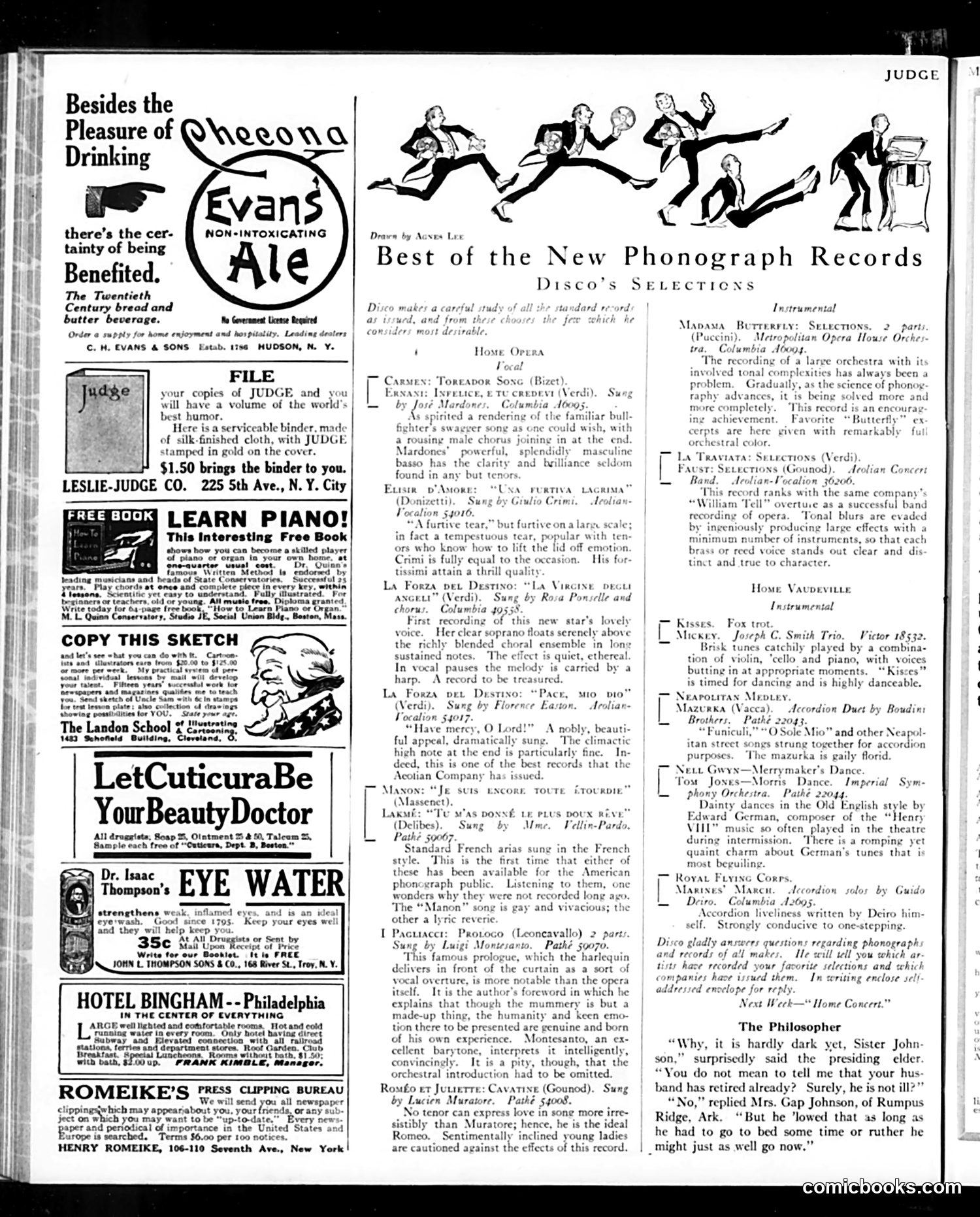
This page is primarily **advertisements and product promotions** rather than political satire. The dominant content includes ads for Chenna Evans Ale, piano lessons, beauty products, and eye water. The only illustrated content appears to be a line drawing at the top showing figures in exaggerated poses, labeled "Best of the New Phonograph Records," but this is a decorative header for a music review section rather than political commentary. The bulk of the page consists of a detailed music criticism column reviewing opera and classical recordings (Carmen, La Traviata, Faust, etc.), followed by numerous classified advertisements typical of early 20th-century publications. **There is no discernible political cartoon or satirical content on this page.** Judge magazine mixed humor with serious music and product reviews; this particular page represents the latter category—a straightforward entertainment and consumer goods section rather than the satirical content Judge is historically known for.
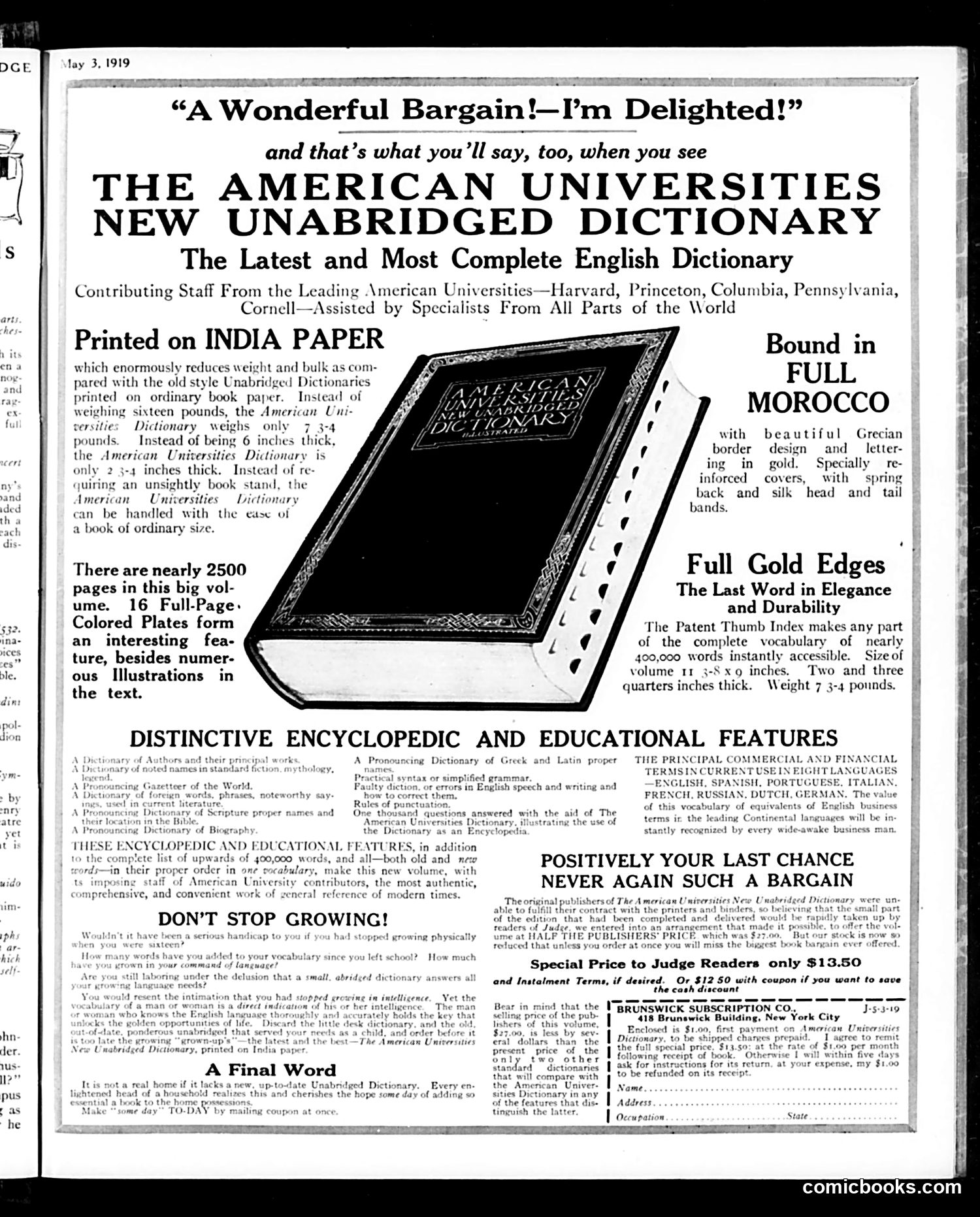
This is **not a cartoon or satire**, but rather a full-page advertisement from *Judge* magazine (May 3, 1919) promoting a new dictionary. The ad emphasizes practical features appealing to 1919 readers: the dictionary is lightweight (printed on India paper, weighing 7¾ pounds instead of sixteen), compact (2¾ inches thick rather than 6 inches), and elegantly bound in full Morocco leather with gold edges. It claims contributions from major universities (Harvard, Princeton, Columbia, Pennsylvania, Cornell) and includes 2,500 pages with 16 colored plates. The headline quote—"A Wonderful Bargain! I'm Delighted!"—uses aspirational language typical of period advertising. The special price ($13.50, or $12.50 with coupon) targets *Judge* readers specifically. The phrase "POSITIVELY YOUR LAST CHANCE / NEVER AGAIN SUCH A BARGAIN" creates artificial urgency, a common advertising tactic then and now. This is period commercial copy, not political commentary or humor content.
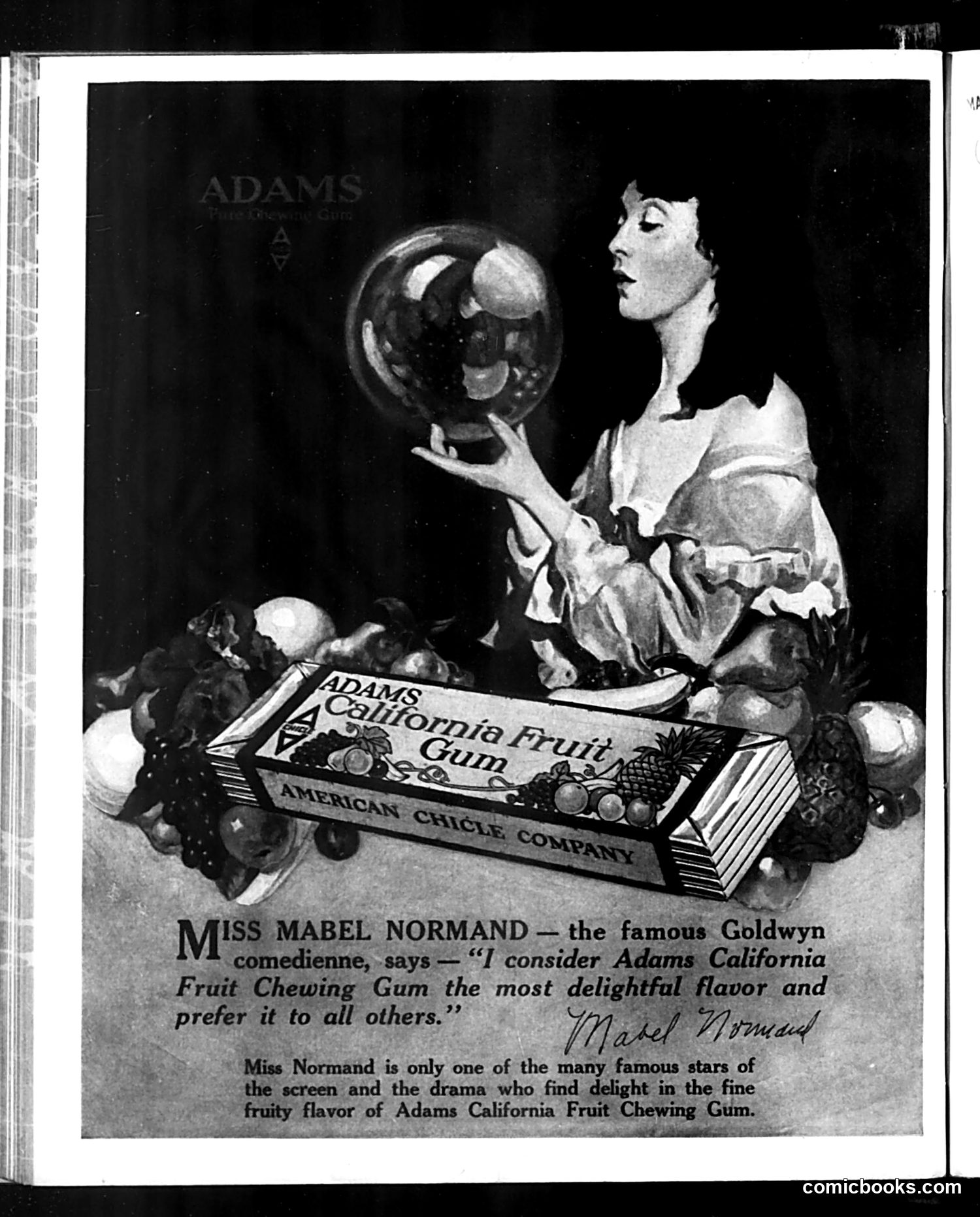
This is **not a political cartoon or satirical content** — it's a **celebrity endorsement advertisement** for Adams California Fruit Chewing Gum, published in *Judge* magazine. The page features **Mabel Normand**, identified as a "famous Goldwyn comedienne" (film actress), holding a glowing crystal ball while posed in theatrical costume. The ad presents her endorsement claiming Adams gum has "the most delightful flavor." The "crystal ball" is a decorative visual device suggesting fortune and desirability rather than satirical commentary. This represents typical early 20th-century advertising strategy: leveraging celebrity fame to promote consumer products to *Judge*'s middle-class readership. There is **no political or social satire** present — this is straightforward commercial advertising using star power.