
Judge, 1919-05-03 · page 22 of 36
Judge — May 3, 1919 — page 22: what you’re looking at
What you’re looking at
This page analyzes competing approaches to dramatic playwriting, using **Rachel Crothers** as the exemplar of character-driven drama. The title's question is metaphorical: should plays center on complex individual characters ("the people") or efficient plot mechanics? The article contrasts Crothers's method—presenting communities of distinct, psychologically realistic characters—with the dominant commercial model of melodrama and detective stories that rely on standardized "types" (the selfish wife, the genius detective) requiring minimal explanation. The satire targets business executives who favor fast-paced entertainment with predictable character archetypes over nuanced human psychology. These audiences, accustomed to issuing orders, expect characters to behave like obedient puppets rather than probable human beings with complex motivations. Crothers's innovation—giving each character genuine individuality and allowing plot to emerge organically from personality—represents artistic integrity against commercial convenience. The critique suggests modern theater has sacrificed psychological realism for commercial efficiency.
📄 Transcribed text from this page (OCR, searchable)
Machine-transcribed from the original scan — historical spelling and the odd misread are preserved.
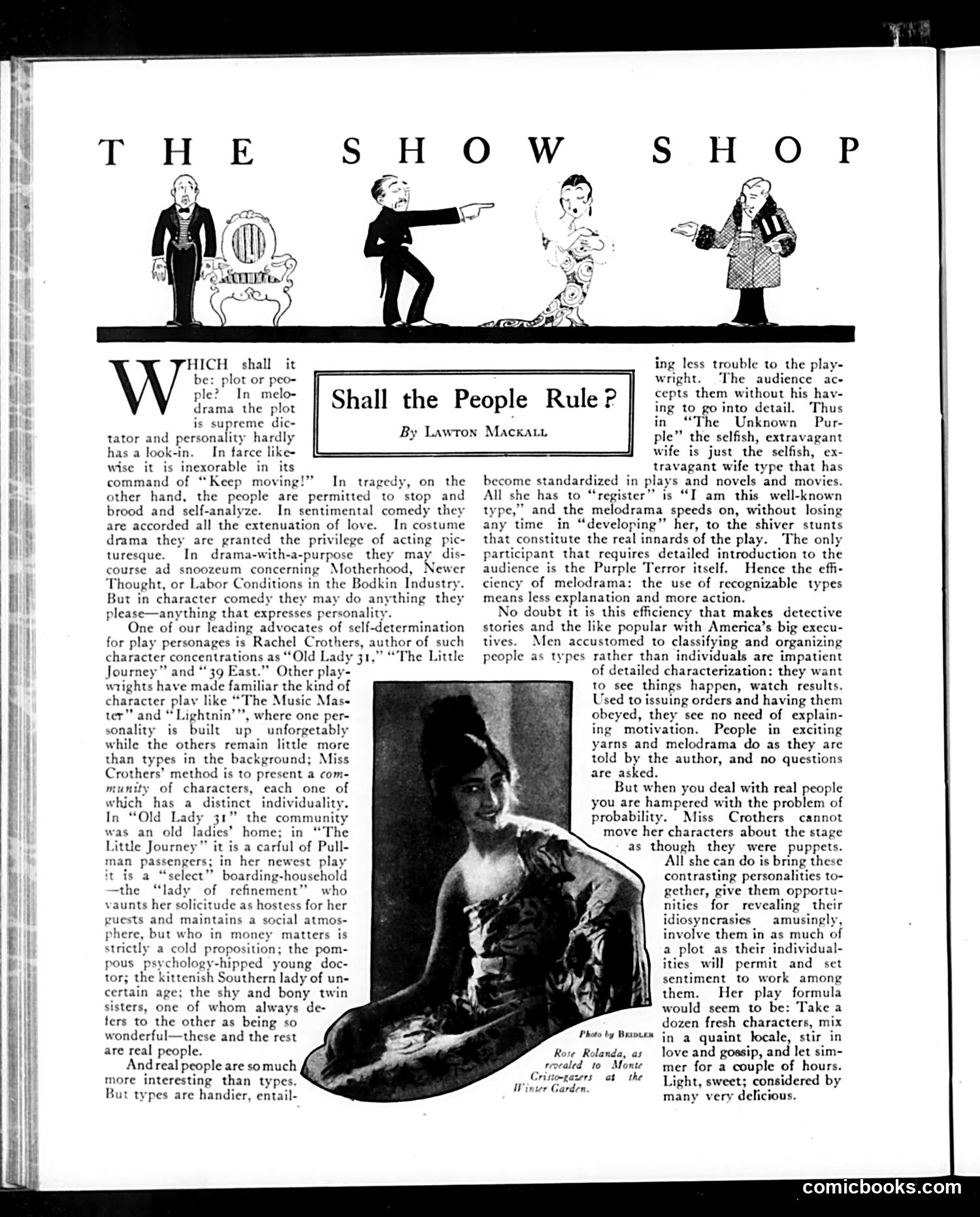
HICH shall it be: plot or peo- ple? In melo- drama the plot is supreme dic- tator and personality hardly has a look-in. In farce like= wise it is inexorable in its command of “Keep moving!” In tragedy, on the other hand, the people are permitted to stop and brood and self-analyze. In sentimental comedy they are accorded all the extenuation of love. In costume drama they are granted the privilege of acting pic- turesque. In drama-with-a-purpose they may dis- course ad snoozeum concerning Motherhood, Newer Thought, or Labor Conditions in the Bodkin Industry. But in character comedy they may do anything they please—anything that expresses personality One of our leading advocates of self-determination for play personages is Rachel Crothers, author of such character concentrations as “Old Lady 31,” “The Little Journey” and “39 East.” Other play- wrights have made familiar the kind of character play like “The Music Mas- ter” and “Lightnin’”’, where one per- sonality is built up unforgetably while the others remain little more than types in the background; Miss Crothers’ method is to present a com- munity of characters, each one of which has a distinct individuality. In “Old Lady 31” the community was an old ladies’ home; in “The Little Journey” it is a carful of Pull- man passengers; in her newest play it is a “select”? boarding-houschold —the “lady of refinement” who vaunts her solicitude as hostess for her guests and maintains a social atmos- e, but who in money matters is ttrictly a cold proposition pous psychology-hipped young doc- tor; the kittenish Southern lady of un- certain age; the shy and bony twin sisters, one of whom always de- fers to the other as being so wonderful—these and the rest are real people. And real people are somuch more interesting than types. But types are handier, entail- Shall the People Rule? By Lawton Mackatu ing less trouble to the play- wright. The audience ac- cepts them without his hav- ing to go into detail. Thus in “The Unknown Pur- ple” the selfish, extravagant wife is just the selfish, ex- travagant wife type that has become standardized in plays and novels and movies. All she has to “register” is “I am this well-known type,” and the melodrama speeds on, without losing any time in “developing” her, to the shiver stunts that constitute the real innards of the play. The only participant that requires detailed introduction to the audience is the Purple Terror itself. Hence the effi- ciency of melodrama: the use of recognizable types means less explanation and more action. No doubt it is this efficiency that makes detective stories and the like popular with America’s big execu- tives. Men accustomed to classifying and organizing people as types rather than individuals are impatient of detailed characterization: they want to see things happen, watch results. Used to issuing orders and having them obeyed, they see no need of explain- ing motivation. People in exciting yarns and melodrama do as they are told by the author, and no questions are asked. But when you deal with real people you are hampered with the problem of probability. Miss Crothers cannot move her characters about the stage as though they were puppets. All she can do is bring these contrasting personalities to- gether, give them opportu- nities for revealing their idiosyncrasies amusingly, involve them in as much of a plot as their individual- ities will permit and set sentiment to work among them. Her play formula would seem to be: Take a dozen fresh characters, mix Photo by Besourm in a quaint locale, stir in Rose Rolanda, as love and gossip, and let sim- _ revealed to Monte mer for a couple of hours. " Cristomgawrs at the 1 ight, sweet; considered by inter Garden. : many very delicious. comicbooks.com