
Judge, 1919-05-03 · page 14 of 36
Judge — May 3, 1919 — page 14: what you’re looking at
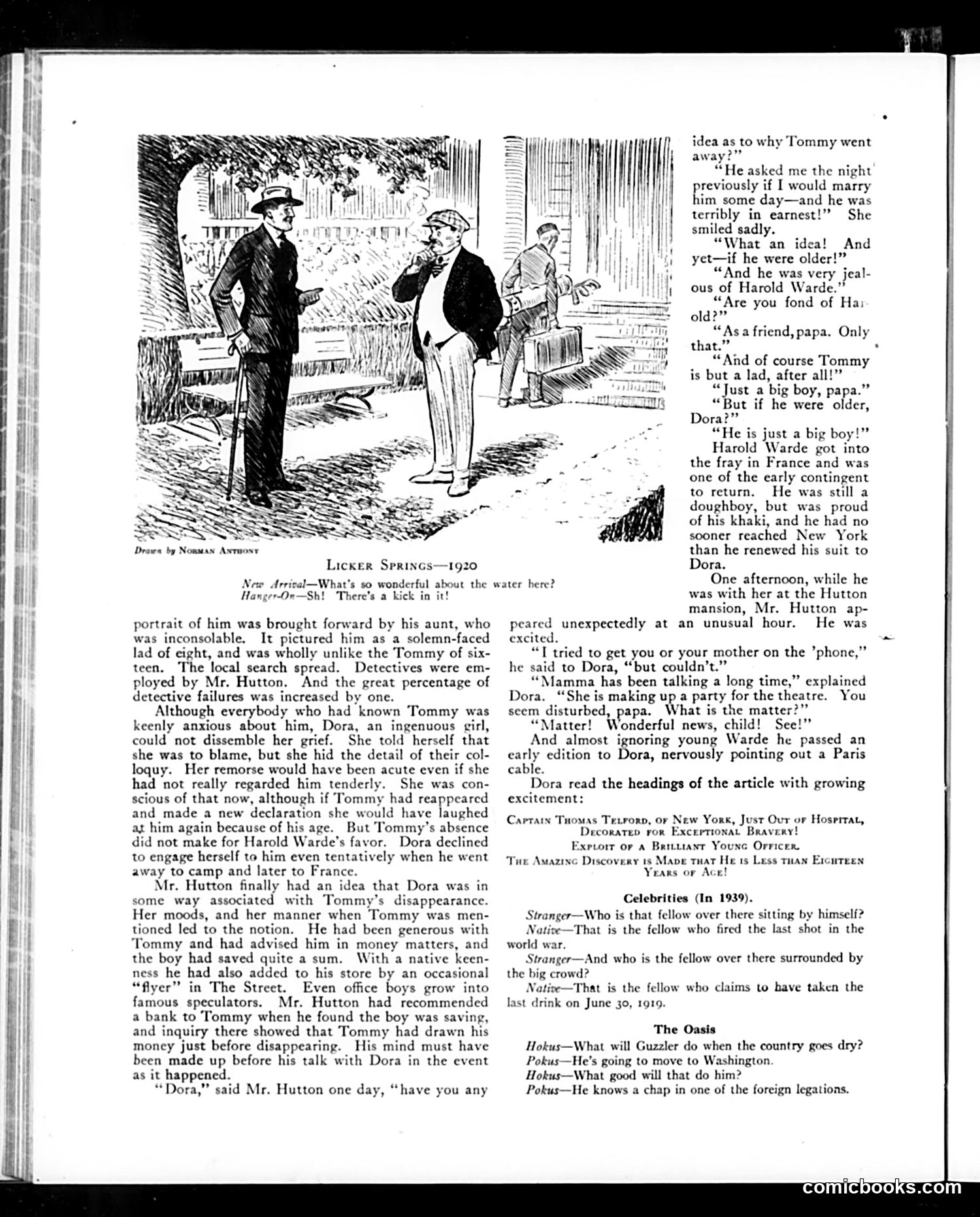
What you’re looking at
The main cartoon depicts two men at a spa or resort, with one newcomer asking what makes the water special. The other man replies "Sh! There's a kick in it!"—a joke about Prohibition. In 1920, the 18th Amendment banned alcohol production and sale. The cartoon satirizes Americans circumventing this law by seeking hidden alcohol at supposedly "therapeutic" springs resorts, which often served as fronts for illegal drinking establishments. The phrase "kick" was period slang for the intoxicating effect of liquor. The humor relies on the public's open knowledge that Prohibition was widely flouted, especially among the wealthy who could afford resort getaways. The illustration captures the winking complicity between proprietors and patrons in openly defying federal law.
📄 Transcribed text from this page (OCR, searchable)
Machine-transcribed from the original scan — historical spelling and the odd misread are preserved.
" 1 Draws by Noamax Axtuost Licker Sprincs—1920 New Arrical—What's so wonderful about the water here? Hanger-On—Sh! There's a kick in it! portrait of him was brought forward by his aunt, who was inconsolable. It pictured him as a solemn-faced lad of eight, and was wholly unlike the Tommy of six- teen. The local search spread. Detectives were em- ployed by Mr. Hutton. And the great percentage of detective failures was increased by one. Although everybody who had known Tommy was keenly anxious about him, Dora, an ingenuous girl, could not dissemble her grief. She told herself that she was to blame, but she hid the detail of their col- loquy. Her remorse would have been acute even if she had not really regarded him tenderly. She was con- scious of that now, although if Tommy had reappeared and made a new declaration she would have laughed at him again because of his age. But Tommy’s absence did not make for Harold Warde’s favor. Dora declined to engage herself to him even tentatively when he went away to camp and later to France. Mr. Hutton finally had an idea that Dora was in some way associated with Tommy’s disappearance. Her moods, and her manner when Tommy was men- tioned led to the notion. He had been generous with Tommy and had advised him in money matters, and the boy had saved quite a sum. With a native keen- ness he had also added to his store by an occasional “flyer” in The Street. Even office boys grow into famous speculators. Mr. Hutton had recommended a bank to Tommy when he found the boy was saving, and inquiry there showed that Tommy had drawn his moncy just before disappearing. His mind must have been made up before his talk with Dora in the event as it happened. “Dora,” said Mr. Hutton one day, “have you any previously if I would marry ) idea as to why Tommy went } “He asked me the night ! Hi him some day—and he was | terribly in earnest!” She | smiled sadly. “What an idea! And yet—if he were older!” “And he was very jeal- ous of Harold Warde.” “Are you fond of Hai old?” “Asa friend, papa. Only that.” . “And of course Tommy is but a lad, after all!” “Just a big boy, papa.” “But if he were older, Dora?” “He is just a big boy!” Harold Warde got into the fray in France and was one of the early contingent to return. He was still a doughboy, but was proud of his khaki, and he had no sooner reached New York than he renewed his suit to Dora. One afternoon, while he was with her at the Hutton mansion, Mr. Hutton ap- peared unexpectedly at an unusual hour. He was excited. “T tried to get you or your mother on the ’phone,” he said to Dora, “but couldn’t.” “Mamma has been talking a long time,” explained Dora. “She is making up a party for the theatre. You seem disturbed, papa. What is the matter?” “Matter! Wonderful news, child! See!”’ And almost ignoring young Warde he passed an early edition to Dora, nervously pointing out a Paris cable. Dora read the headings of the article with growing excitement: ’ Carratx Tomas Tetrorp, or New York, Just Our or Hoserrat, Decoratep ror Excertionat Bravery! Exrtorr or a Brrtttant Younc Orricer. Tue Amazinc Discovery 1s Mave tuat He ts Less Tuan Eicuteen Years or Ace! Celebrities (In 1939). Stranger—Who is that fellow over there sitting by himself? Native—That is the fellow who fired the last shot in the world war. Stranger—And who is the fellow over there surrounded by the big crowd? Native—That is the fellow who claims to have taken the last drink on June 30, 1919. The Oasis Hokus—What will Guzzler do when the country goes dry? Pokus—He'’s going to move to Washington. Hokus—What good will that do him? Pokus—He knows a chap in one of the foreign legations.