
A complete issue · 32 pages · 1919
Judge — April 5, 1919
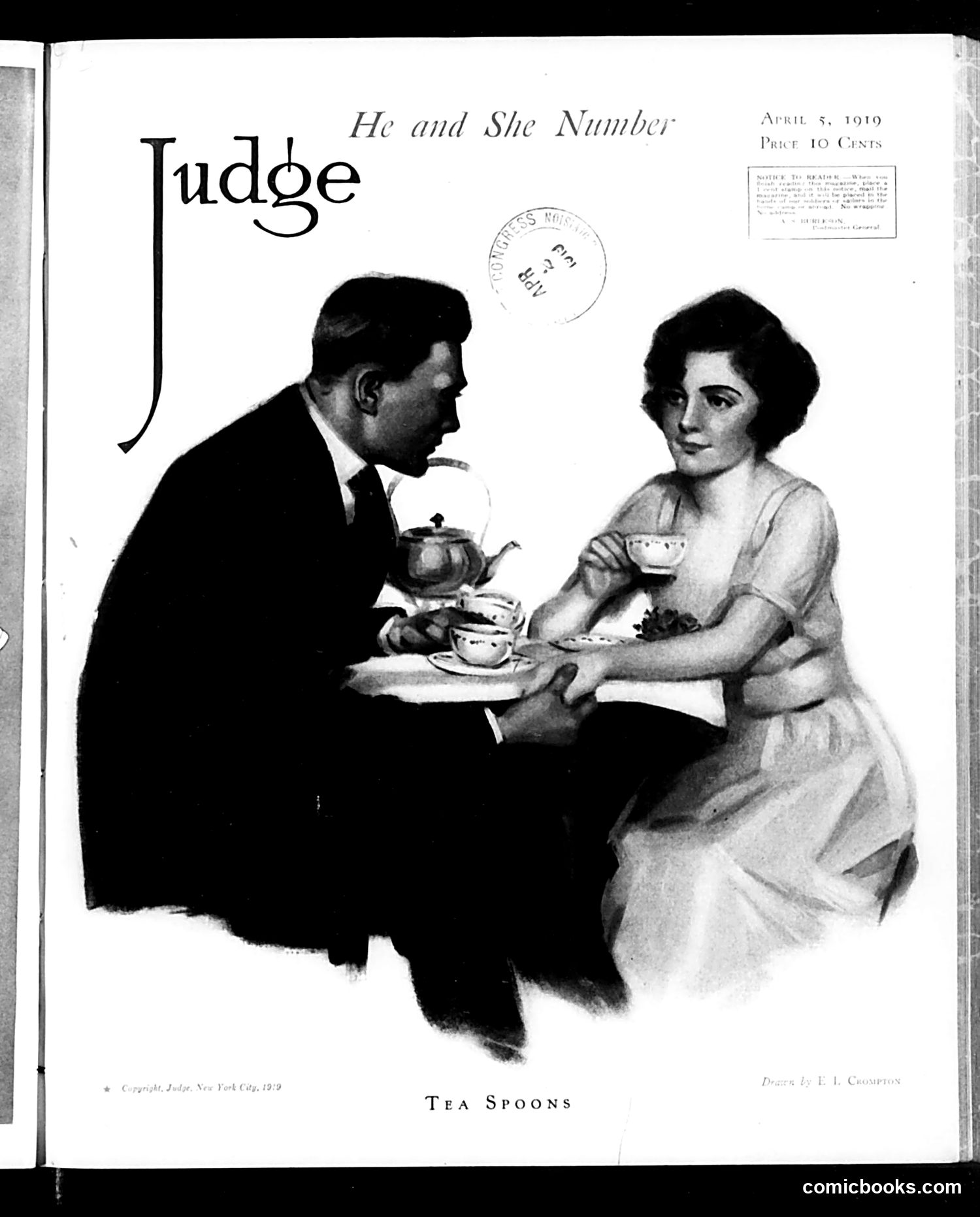
This page from Judge magazine (April 5, 1919) presents a domestic humor piece titled "He and She Number" subtitled "Tea Spoons." The illustration shows a man in a suit and woman in a light dress sharing tea together, with the man holding a teapot and the woman a teacup. The cartoon's satire likely plays on gender roles and domestic relationships of the 1919 era. The title "Tea Spoons" suggests wordplay—possibly a pun on "tea spoons" (the utensils) versus social commentary about couples or marital dynamics. The intimate tea-drinking scene appears designed for gentle domestic humor typical of Judge's "He and She" feature series, which regularly lampooned relationships and gender interactions for the magazine's middle-class readership.
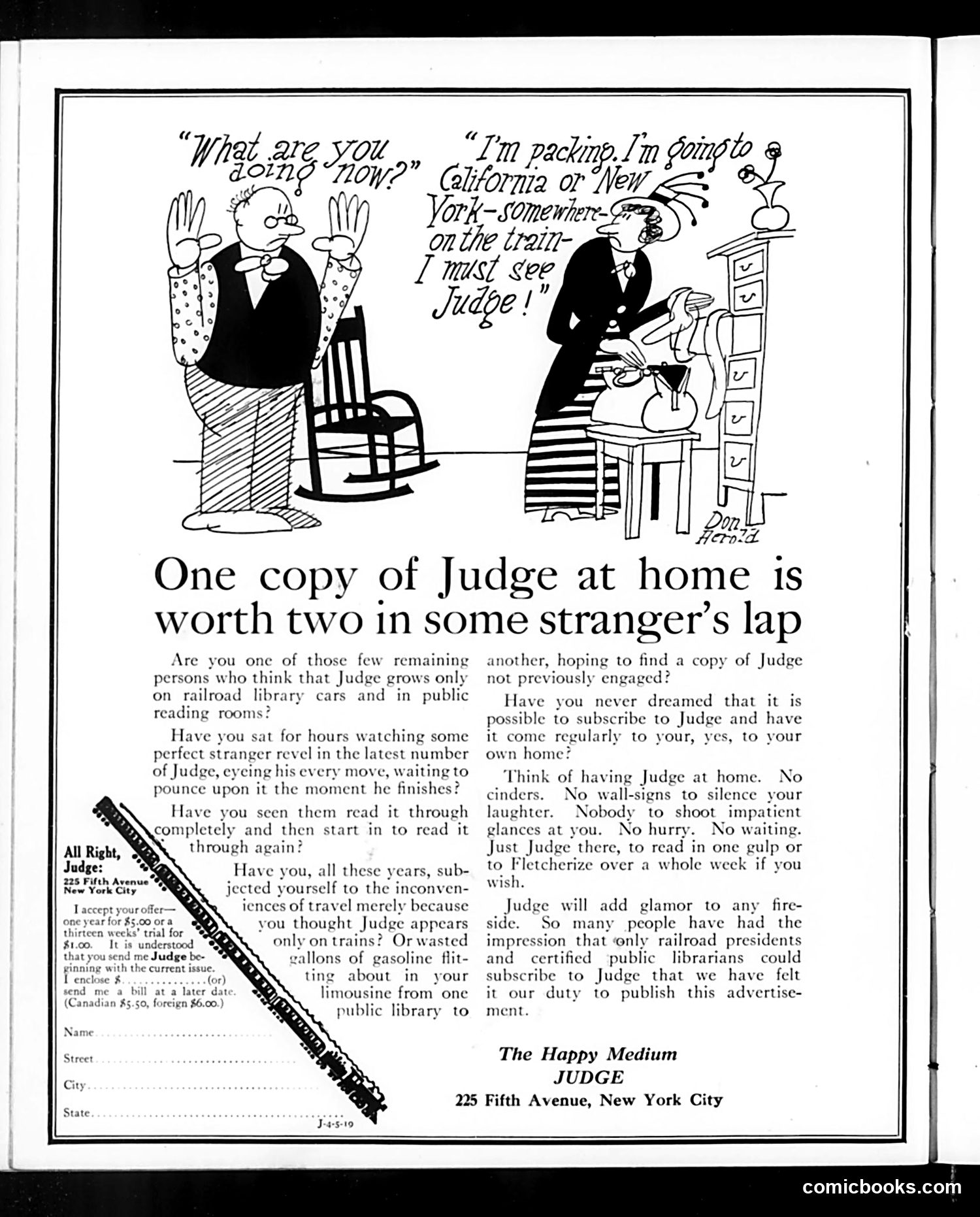
This page is primarily an advertisement for *Judge* magazine itself, using humor to promote home subscription. The cartoon depicts two characters: one excitedly telling another they're "packing" to travel to California or New York by train, hoping to read *Judge* there. The satire targets people who only encounter *Judge* in public spaces (libraries, train cars) rather than owning copies. The ad copy humorously suggests that subscribing at home offers superior reading comfort—no interruptions, no judgment from strangers, unlimited re-reading. The implicit social joke: *Judge* is so entertaining that people become obsessed with it in public settings, making spectacles of themselves. Home subscription promises dignified, private enjoyment of the magazine's satirical humor and cartoons.
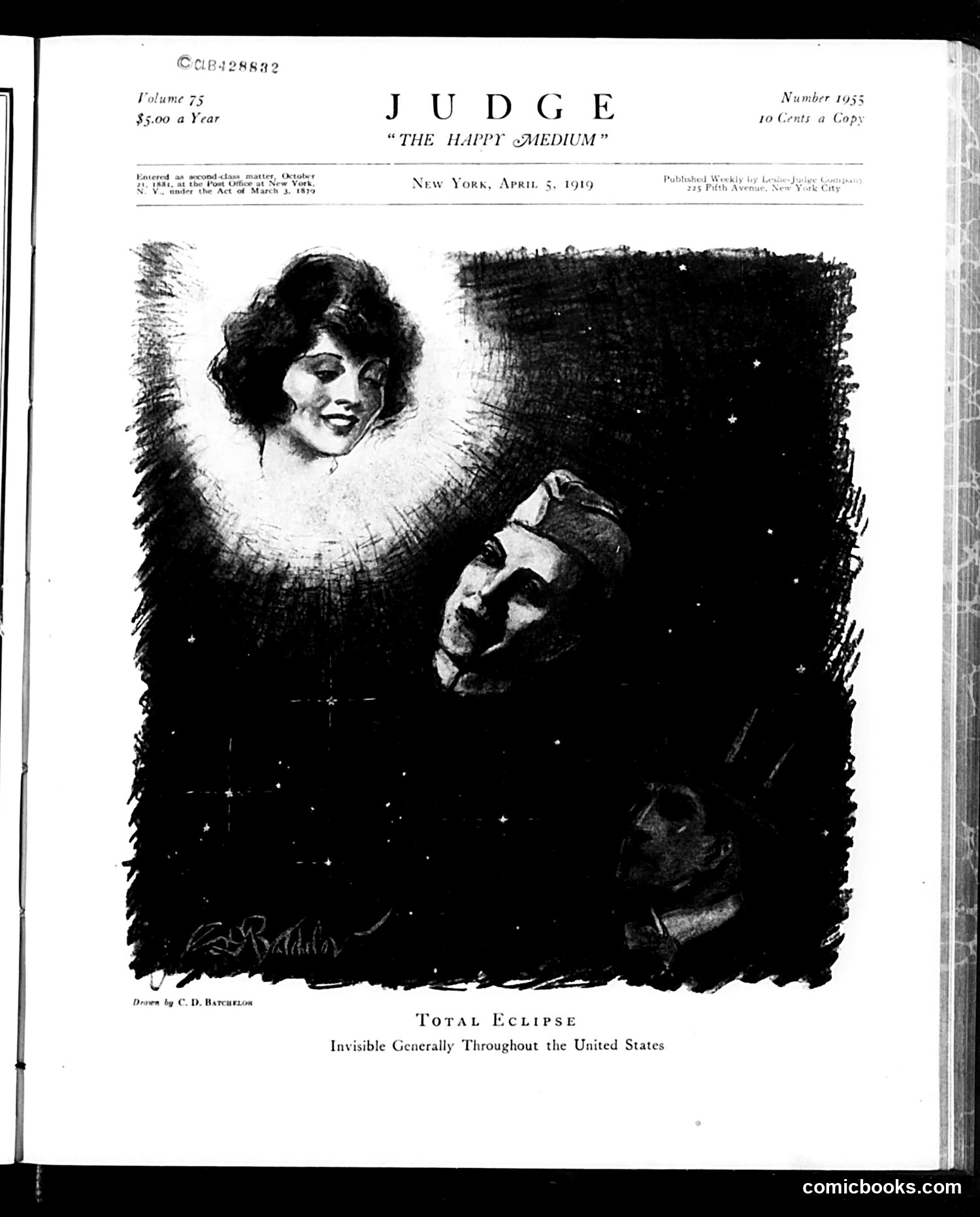
This cartoon plays on a solar eclipse (a real astronomical event) as metaphor for romantic or social "eclipse"—a darkening of one person by another's presence or influence. The image shows a woman's face prominently illuminated in the upper left, while a man's face below appears shadowed or "eclipsed" by her. The title "Total Eclipse / Invisible Generally Throughout the United States" suggests this depicts a specific relationship or romantic situation where one partner dominates or overshadows the other. Without additional context, the specific identities remain unclear, though the artwork is credited to C.D. Barreaux. The satire likely mocks contemporary romantic dynamics or a particular public couple, using the eclipse as a clever visual pun for relationship imbalance.
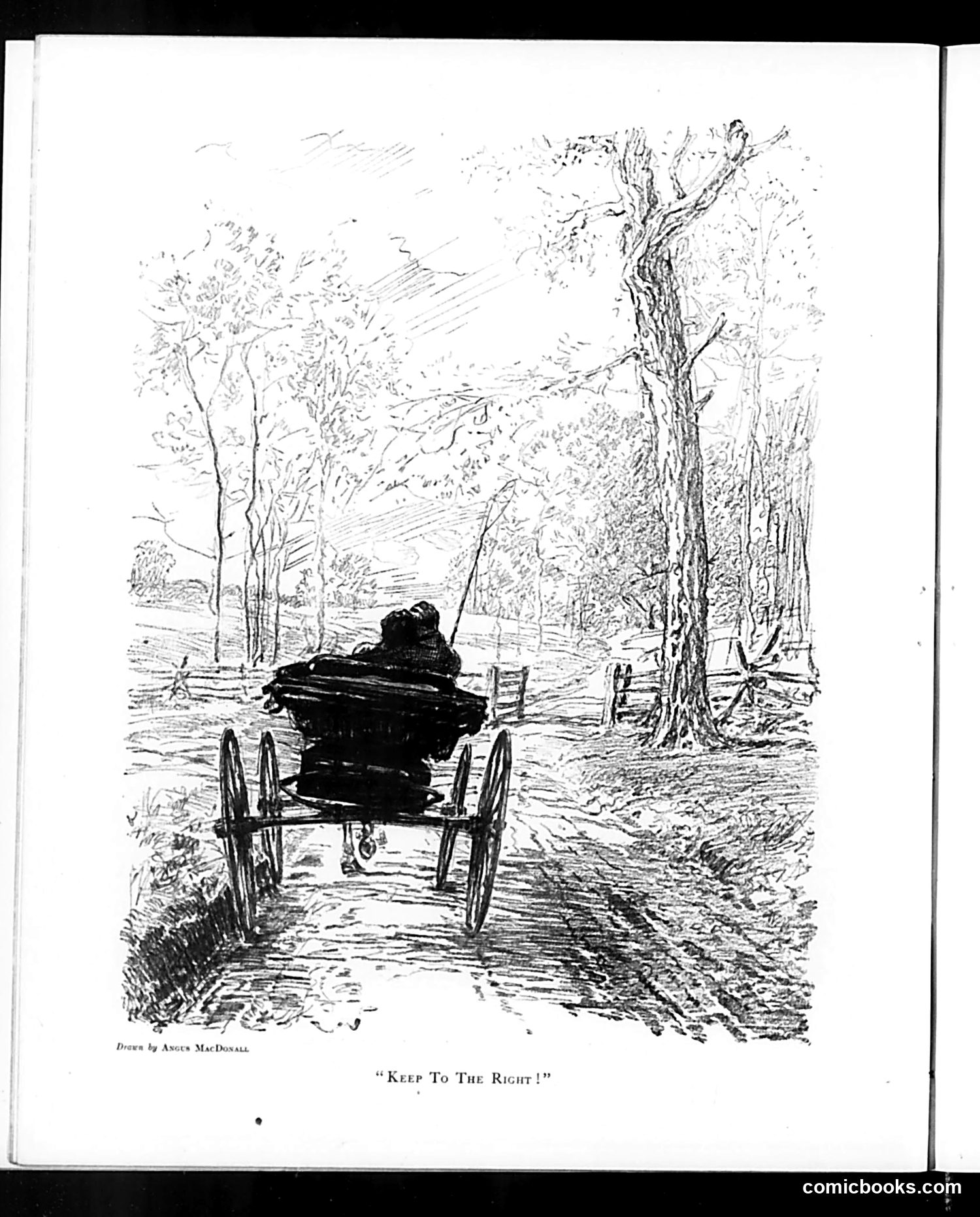
This illustration by Agnes MacDougall depicts a horse-drawn wagon on a narrow forest road, with the driver visible from behind. The title "Keep To The Right!" appears to reference traffic safety or road etiquette—a public service message rather than political satire. The image likely dates to the early automobile era when horses and carriages still dominated roads. The caption functions as a cautionary reminder for safe driving practices, particularly relevant as vehicular traffic increased and collisions became a concern. This appears to be a straightforward safety PSA rather than political commentary, using pastoral scenery to illustrate the importance of road discipline and preventing accidents through proper lane positioning.
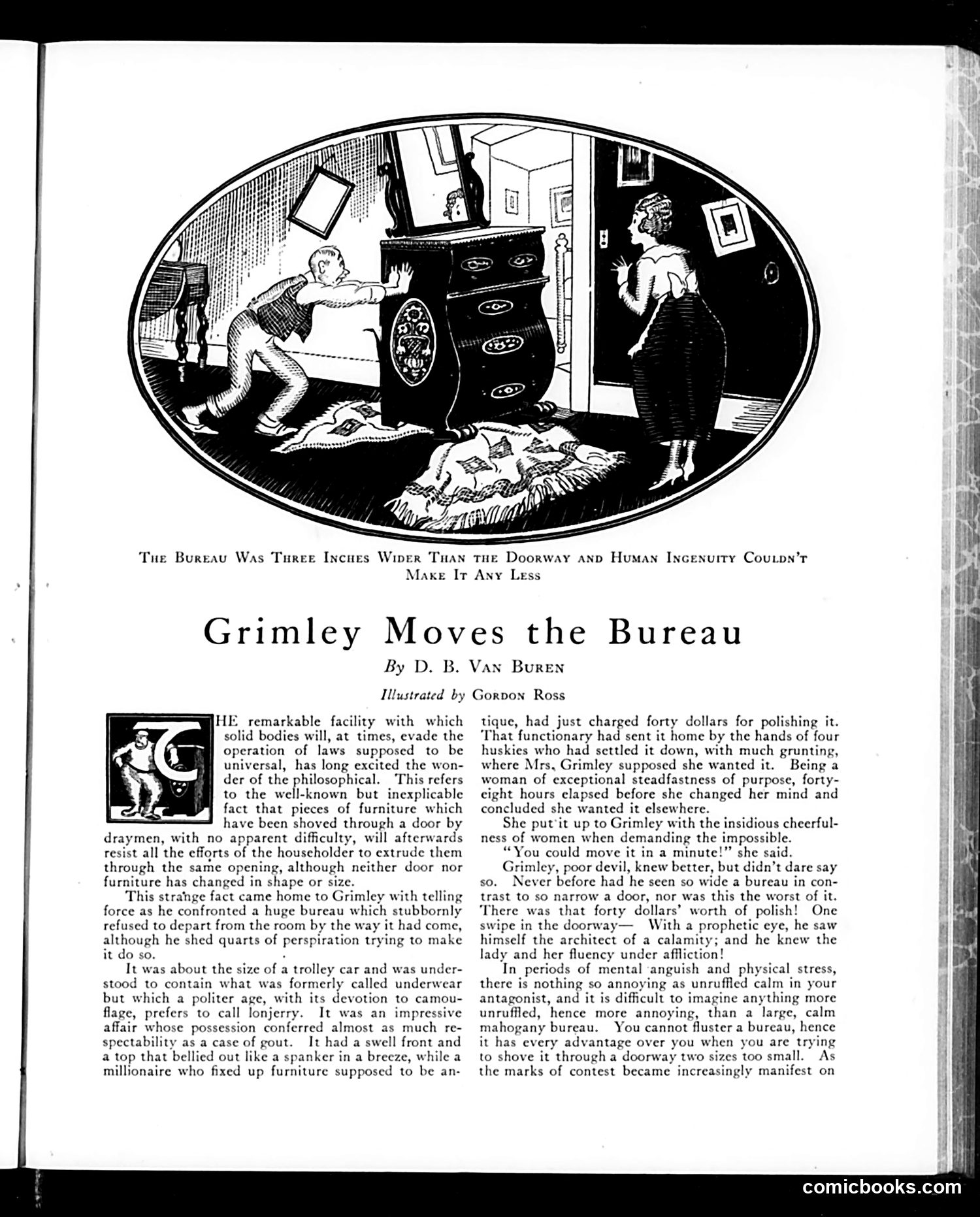
This is a humorous domestic story illustrated by Gordon Ross, not political satire. The narrative concerns Mrs. Grimley attempting to move a large, ornate bureau (dresser) through her home—a task complicated by the furniture's size relative to doorways and hallways. The joke centers on the physical comedy of moving oversized furniture through confined spaces. The illustration shows a woman gesturing in frustration while men struggle with the piece. The accompanying text emphasizes the absurdity: the bureau is wider than the doorway, yet human ingenuity somehow manages to relocate it anyway. This reflects early 20th-century domestic humor typical of *Judge* magazine, focusing on relatable household situations rather than political commentary.
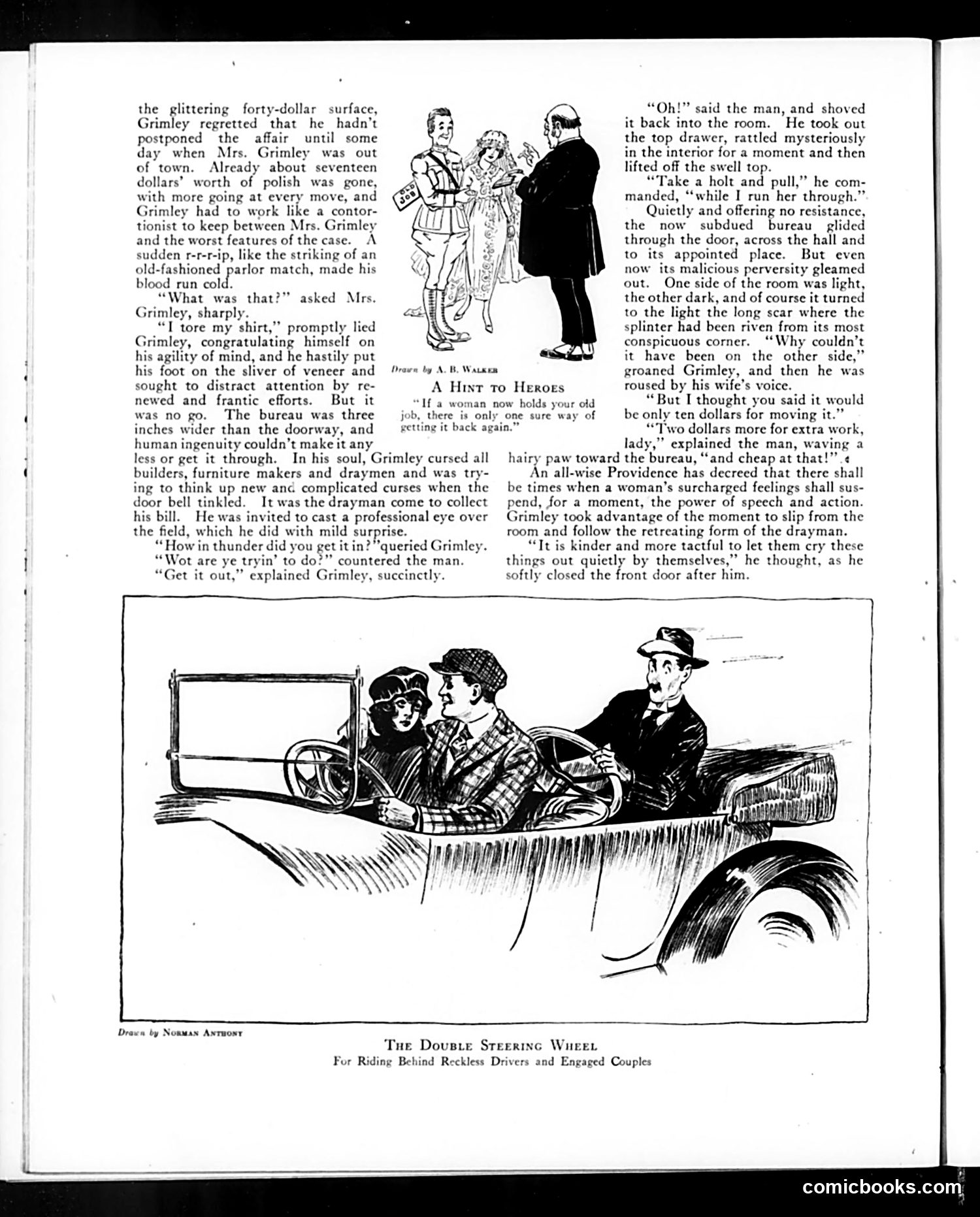
**Main Story**: The text describes Grimley, a man frustrated with his wife's expensive furniture purchases. He's trying to return a bureau, negotiating with a drayman (furniture mover), while his wife resists. The narrative humorously depicts marital conflict over household spending and the logistics of moving furniture. **Cartoon ("The Double Steering Wheel")**: Drawn by Norman Anthony, this satirical illustration depicts a car with two steering wheels—one operated by a man and another by a woman passenger. The caption jokes that this device is "For Riding Behind Reckless Drivers and Engaged Couples." The satire mocks both reckless male drivers and controlling female passengers (particularly fiancées), suggesting women felt compelled to literally take control during automobile rides due to men's dangerous driving habits—a common complaint in early automotive-era society.
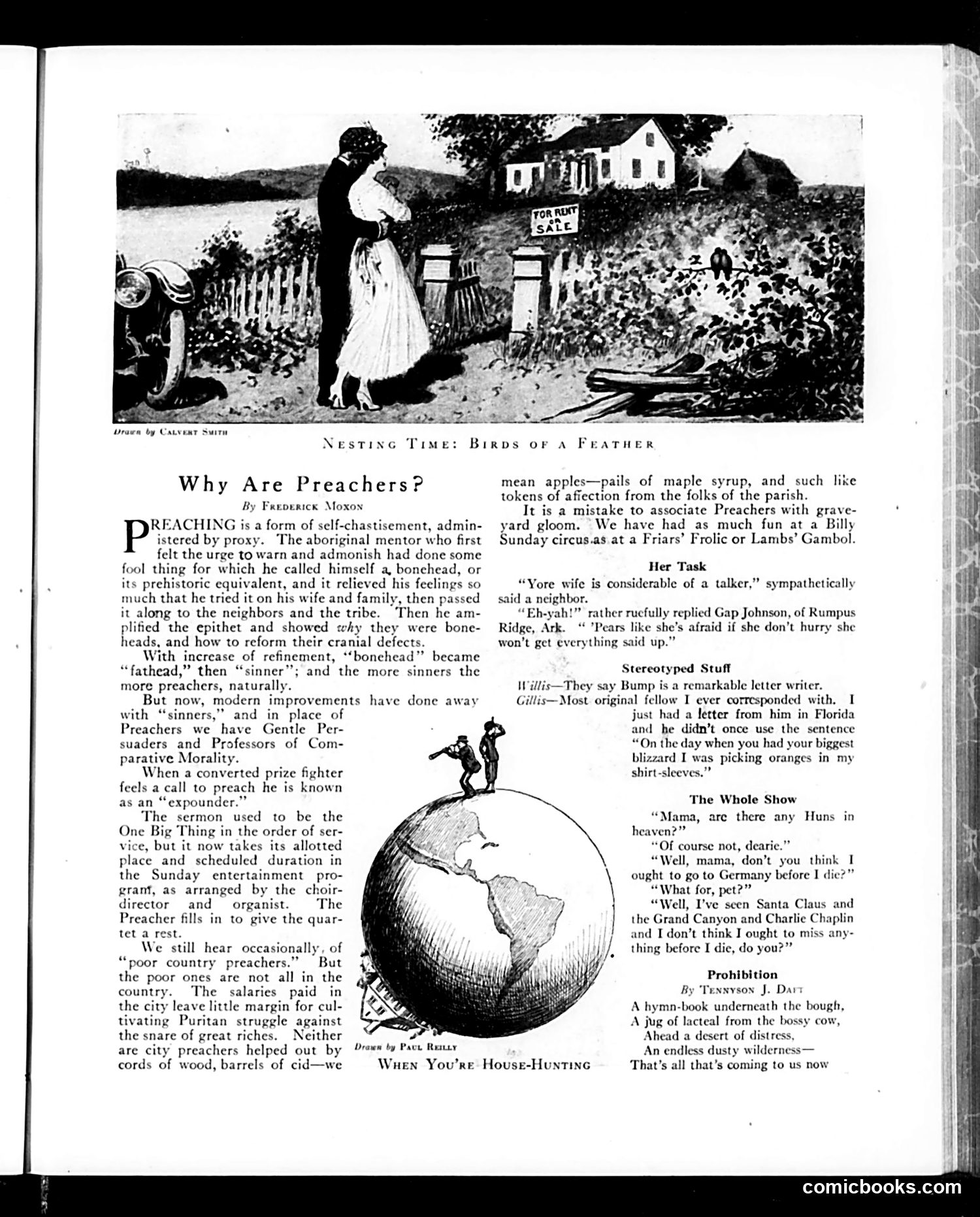
This page contains satirical commentary and humor pieces typical of the 1920s era, likely post-Prohibition's enactment (1920). **Main Article**: "Why Are Preachers?" mocks the evolution of religious authority from primitive "bonehead" correctors to modern "Gentle Persuaders" and "Professors of Comparative Morality." It satirizes how preaching has become merely scheduled entertainment—filler between choir performances—and how urban preachers, unlike rural ones receiving humble gifts (wood, apples, syrup), struggle financially despite their "moral authority." **Top Cartoon** ("Nesting Time"): Shows a couple viewing a "For Rent/Sale" house, likely satirizing the post-war housing market or marriage/domestic expectations. **"Prohibition" Poem**: Parodies Rubaiyat-style verse, lamenting Prohibition's effects—replacing wine with milk and leaving only "endless dusty wilderness" ahead, directly criticizing the recent alcohol ban. The humor reflects 1920s anxieties: commercialized religion, changing social values, and frustration with Prohibition policies.
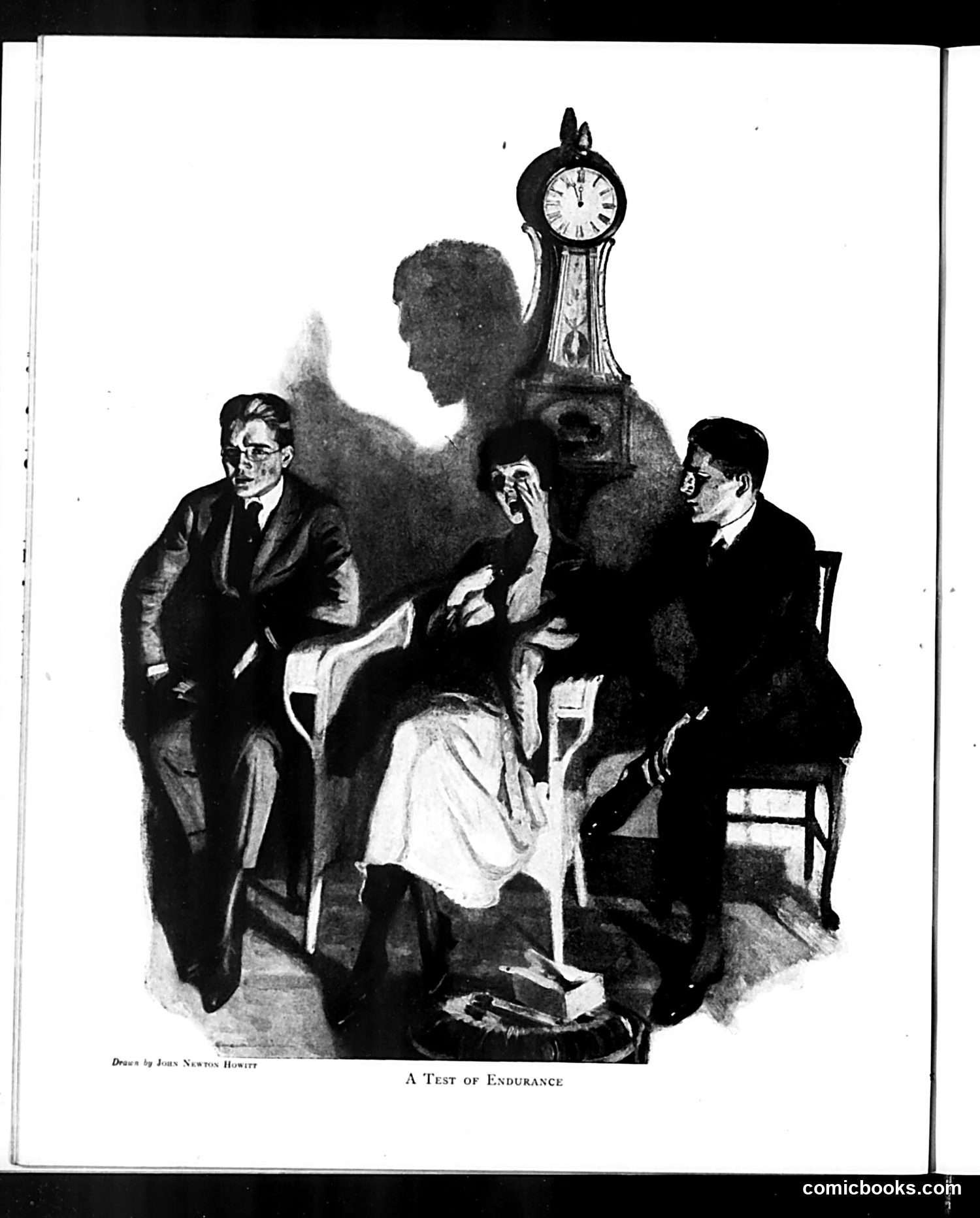
This satirical illustration by James Montgomery Flagg depicts three men in suits surrounding a woman in distress—she appears anxious or distressed, with her hand to her face. A large shadowy figure looms behind them, holding an ornate grandfather clock showing nearly midnight. The title "A Test of Endurance" suggests the cartoon satirizes social situations involving persistence or pressure. The clock imagery likely references time running out or deadline pressure. The woman's distress and the men's positioning suggests commentary on social dynamics—possibly mocking male persistence in courtship or business negotiations that wear down female resistance. The shadowy figure and ominous clock create an uncomfortable atmosphere, implying the "test" involves unwanted pressure rather than fair competition. Without additional context, the specific political or social target remains unclear.
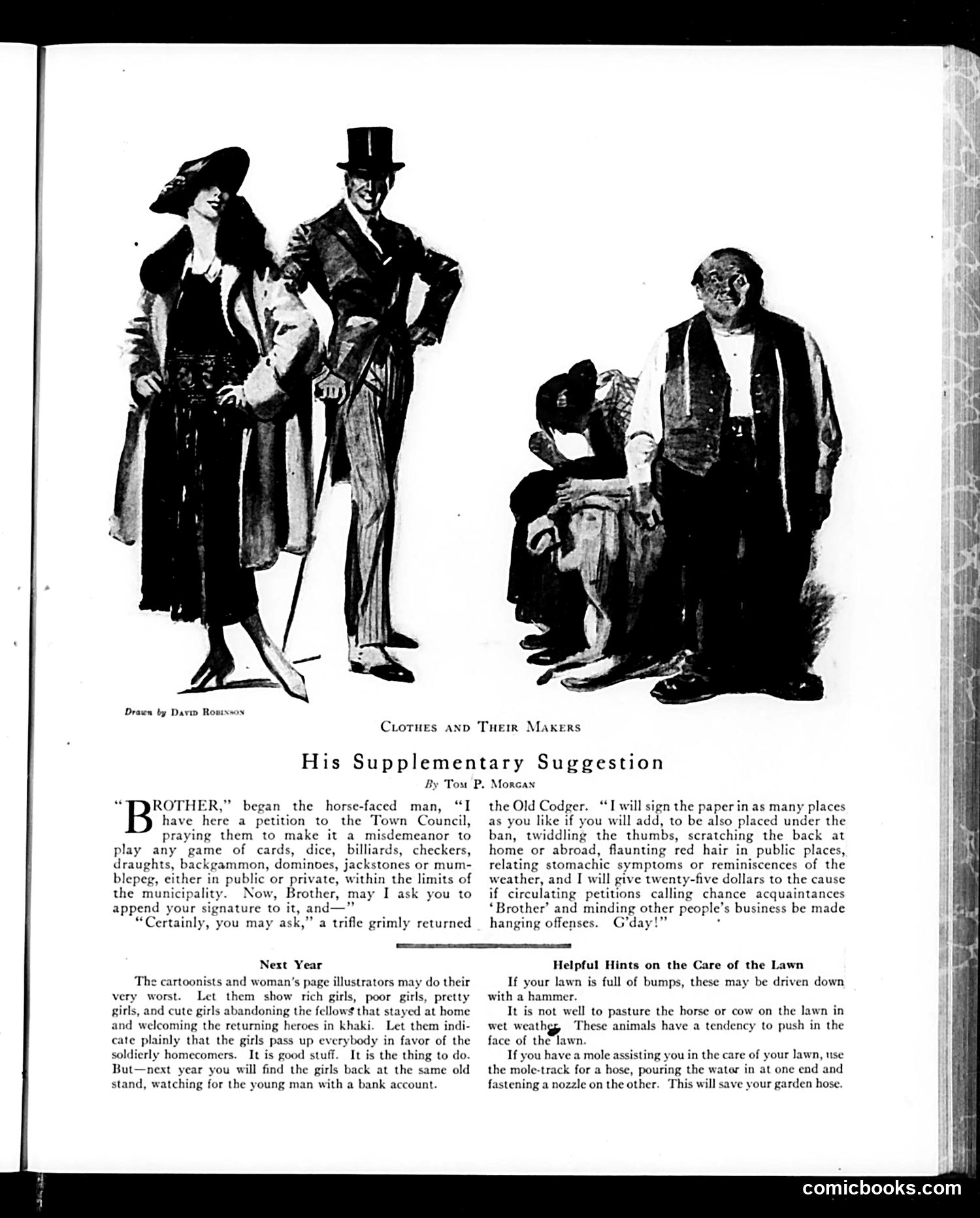
This *Judge* magazine page contains three satirical pieces: **"His Supplementary Suggestion"** depicts a moralistic reformer petitioning to ban games (cards, dice, billiards) as municipal "misdemeanors." An old man agrees—*if* the petition also bans idle habits like thumb-twiddling, gossiping about weather, and calling strangers "Brother" while minding their business. The joke mocks self-righteous crusaders who seek to legislate morality while ignoring their own annoying social behaviors. **"Next Year"** sarcastically comments on wartime romantic imagery: artists depict women enthusiastically welcoming soldier-heroes home from combat. The punch line: next year, those same women will revert to chasing men with money, not military service. This cynically dismisses sentimental patriotic narratives as temporary propaganda. **"Helpful Hints on the Lawn"** offers absurdist gardening advice (hammering bumps, using mole-tunnels as hoses), plainly nonsensical for comedic effect. All three pieces target hypocrisy, false sentimentality, and self-deluding behavior in American society.
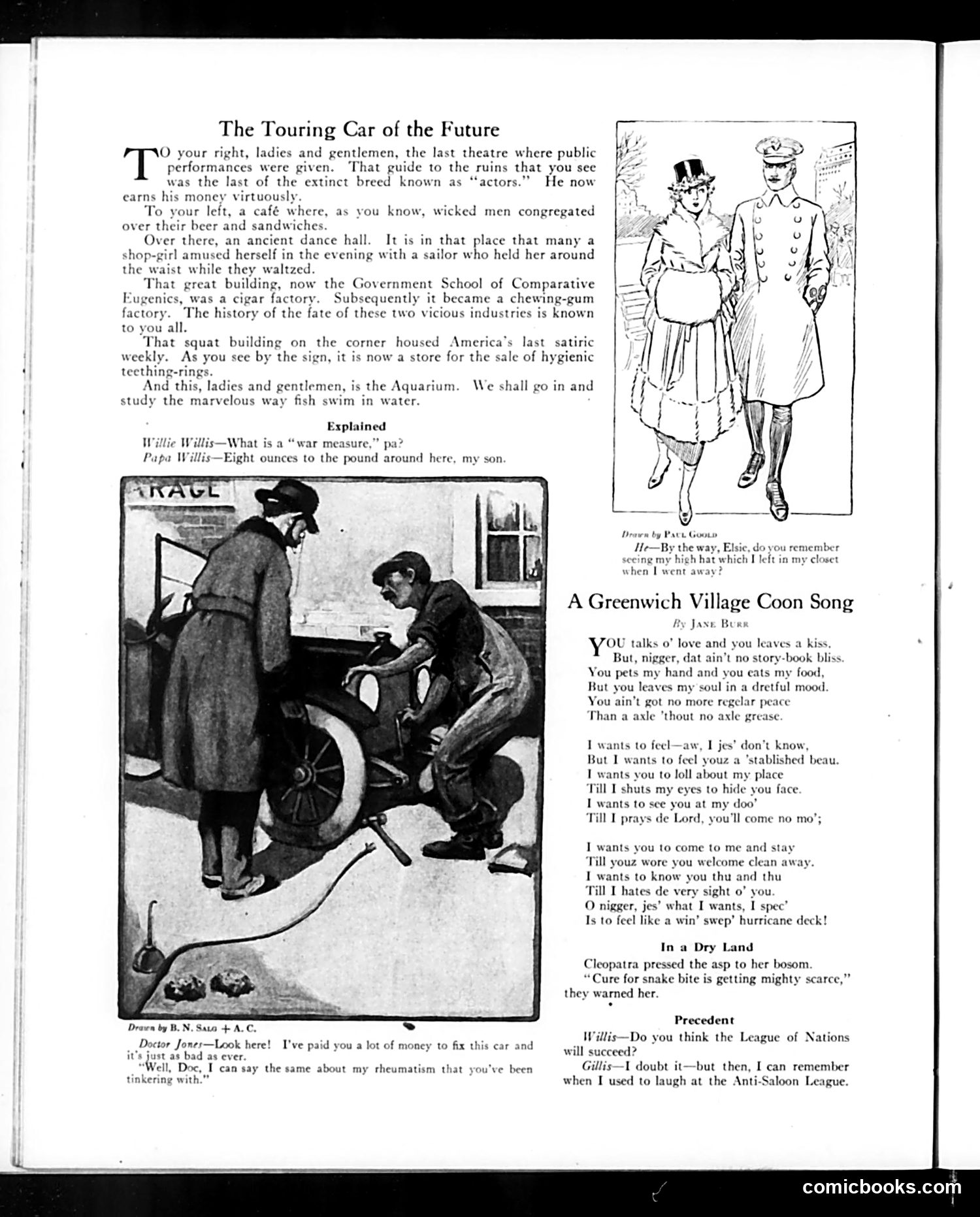
This is a futuristic tour-guide satire imagining early 20th-century America as archaeological ruins. The narrator conducts a "touring car" of visitors past extinct institutions: theaters, cafés, dance halls, and satirical publications—all presented as historical relics, like visiting Roman ruins. The joke targets progressive-era anxieties: theaters and dance halls are presented as morally questionable (shop-girls with sailors), while satirical weeklies (Judge itself) are dismissed as mere artifacts. The most cutting reference: "America's last satiric weekly" now sells hygienic teething-rings—mocking how satire has become commercialized and obsolete. The companion cartoon shows a car mechanic exploiting a customer, with a humorous exchange about wartime "measures" (price inflation). Together, these pieces satirize both societal decline and contemporary profiteering, reflecting post-WWI disillusionment and class anxiety in Jazz Age America.
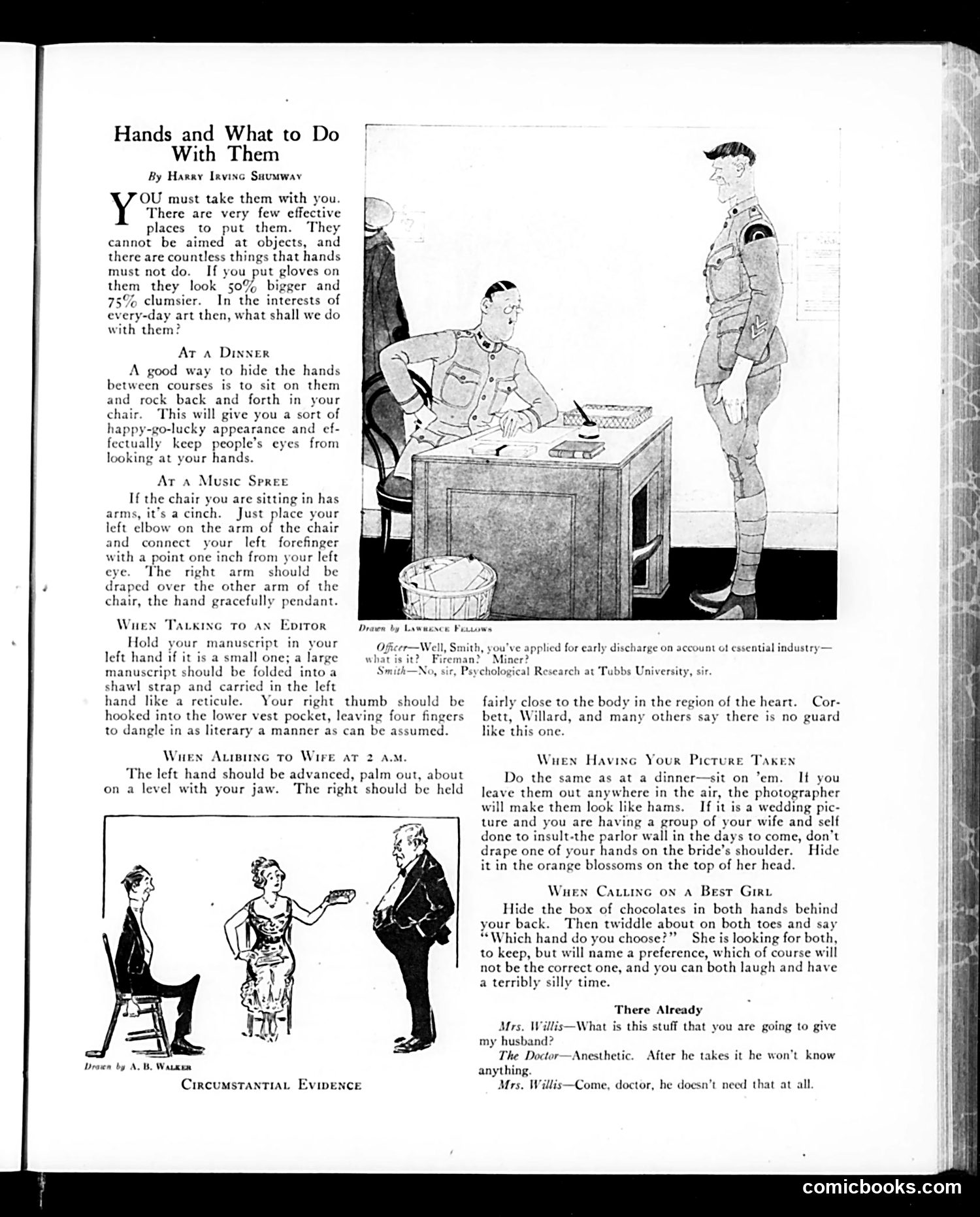
This humorous article by Harry Irving Shumway satirizes social etiquette and awkwardness of the era by offering absurd, exaggerated advice on hand placement in various formal settings. The joke targets the genuine anxiety men faced about proper deportment in public situations—where to put one's hands was genuinely discussed in etiquette guides. The cartoons illustrate ridiculous solutions: sitting on hands at dinner, contorting arms at concerts, holding manuscripts like purses when meeting editors, and hiding hands in wedding photos. The final comic strip "Circumstantial Evidence" depicts a soldier applying for early discharge, claiming psychological research at Tubbs University—the humor lying in the obvious fabrication and the absurdity of the excuse. The closing dialogue about anesthesia appears to be a separate, unrelated joke about a doctor's visit. Overall, the page mocks both male social self-consciousness and flimsy military excuses common to the WWI era.
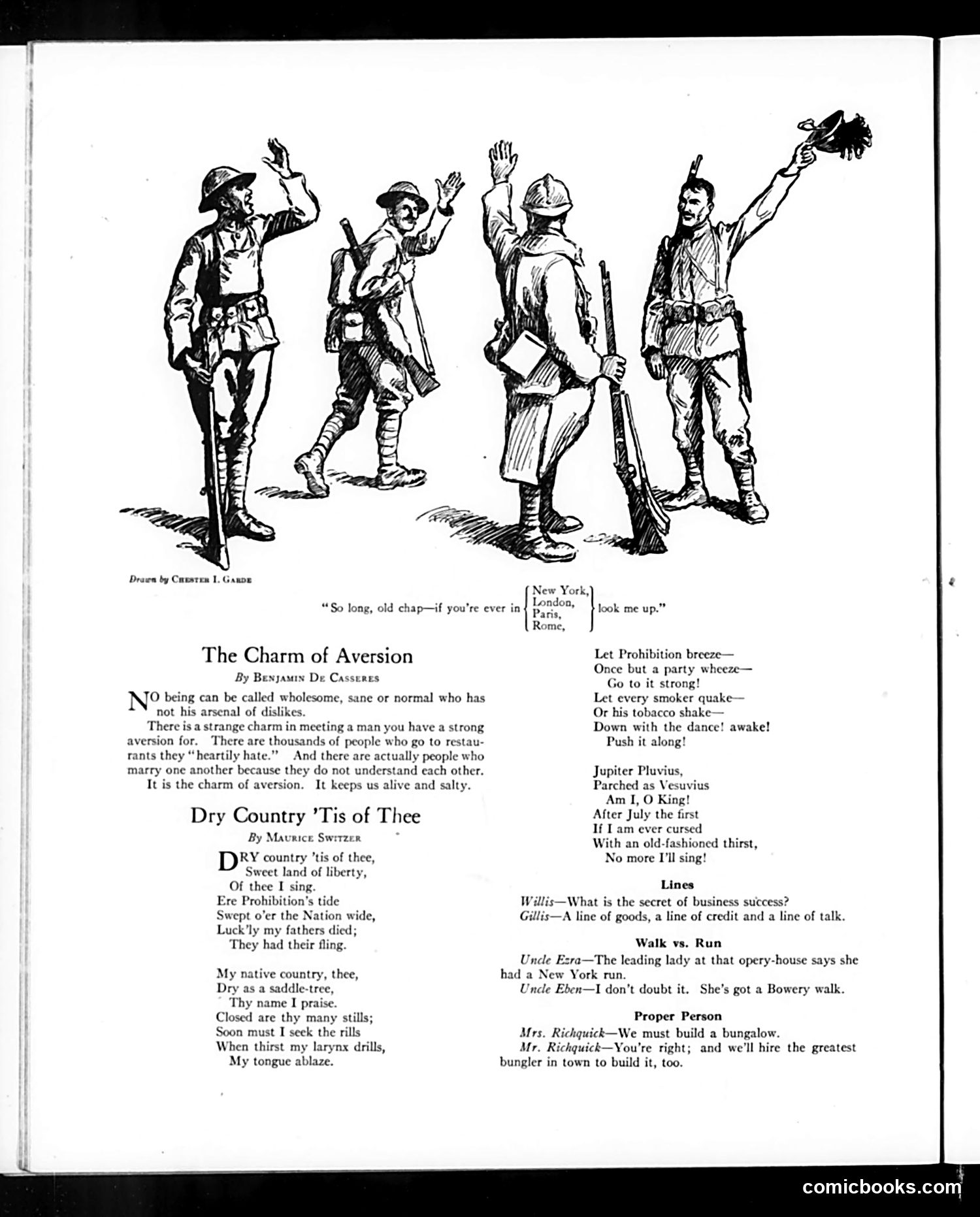
This page from *Judge* magazine satirizes **Prohibition**, the constitutional ban on alcohol (1920-1933). The cartoon depicts soldiers departing for WWI, with the caption referencing destinations like New York and Paris—likely commenting on American involvement in the war. The poetry "Dry Country 'Tis of Thee" is the main satire: a parody of "America" that laments Prohibition's arrival. The author mourns that his fathers "died" before the "dry" era, sardonically praising their escape from a nation now "closed" to alcohol production ("stills"). The final poem mocks a wealthy couple ("Richquick") building a house while hiring an incompetent builder—likely social commentary on the era's nouveau riche. The humor relies on readers' frustration with Prohibition, presenting it as absurd governmental overreach that contradicts American freedom.
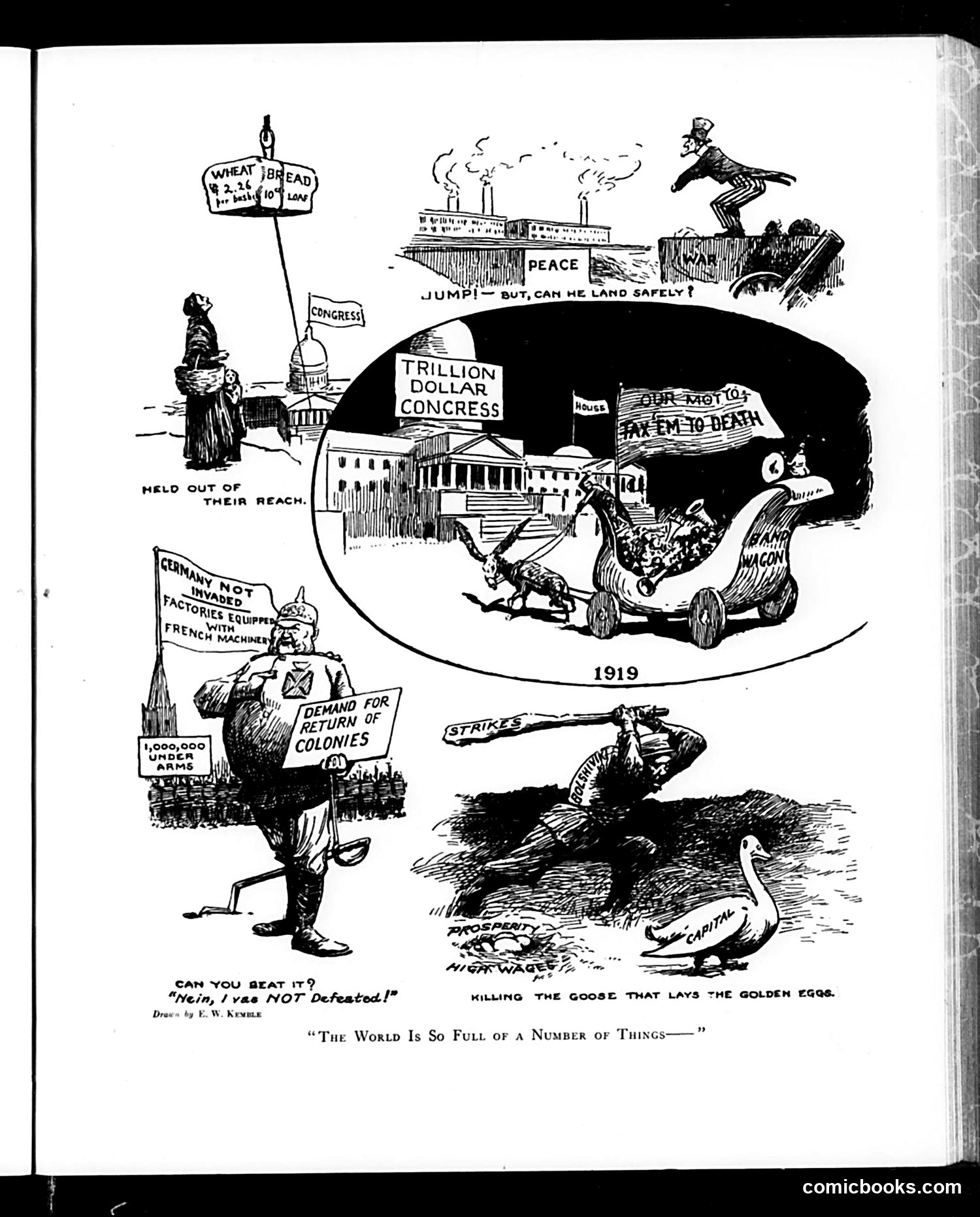
This page satirizes post-World War I tensions. The central image shows Congress juggling competing demands: a trillion-dollar budget, "Peace," labor strikes, and war debts—while attempting a dangerous balancing act. Left panel: A German military figure (marked "Germany Cannot Invade Factories...") claims "Nein, I was NOT defeated!" while brandishing demands for colony return and 1,000,000 under arms—mocking Germany's refusal to accept World War I defeat. Right panel: A goose labeled "Prosperity" is being killed by "Strikes" and "Capital," illustrating the era's labor unrest destroying economic growth—the metaphorical "golden egg." Top right: A figure labeled "Peace" struggles to land safely amid postwar chaos. The cartoonist (E.W. Kemble) critiques how postwar America faced Germany's belligerence, labor-capital conflict, and economic instability simultaneously—warning that destruction of prosperity benefits no one.
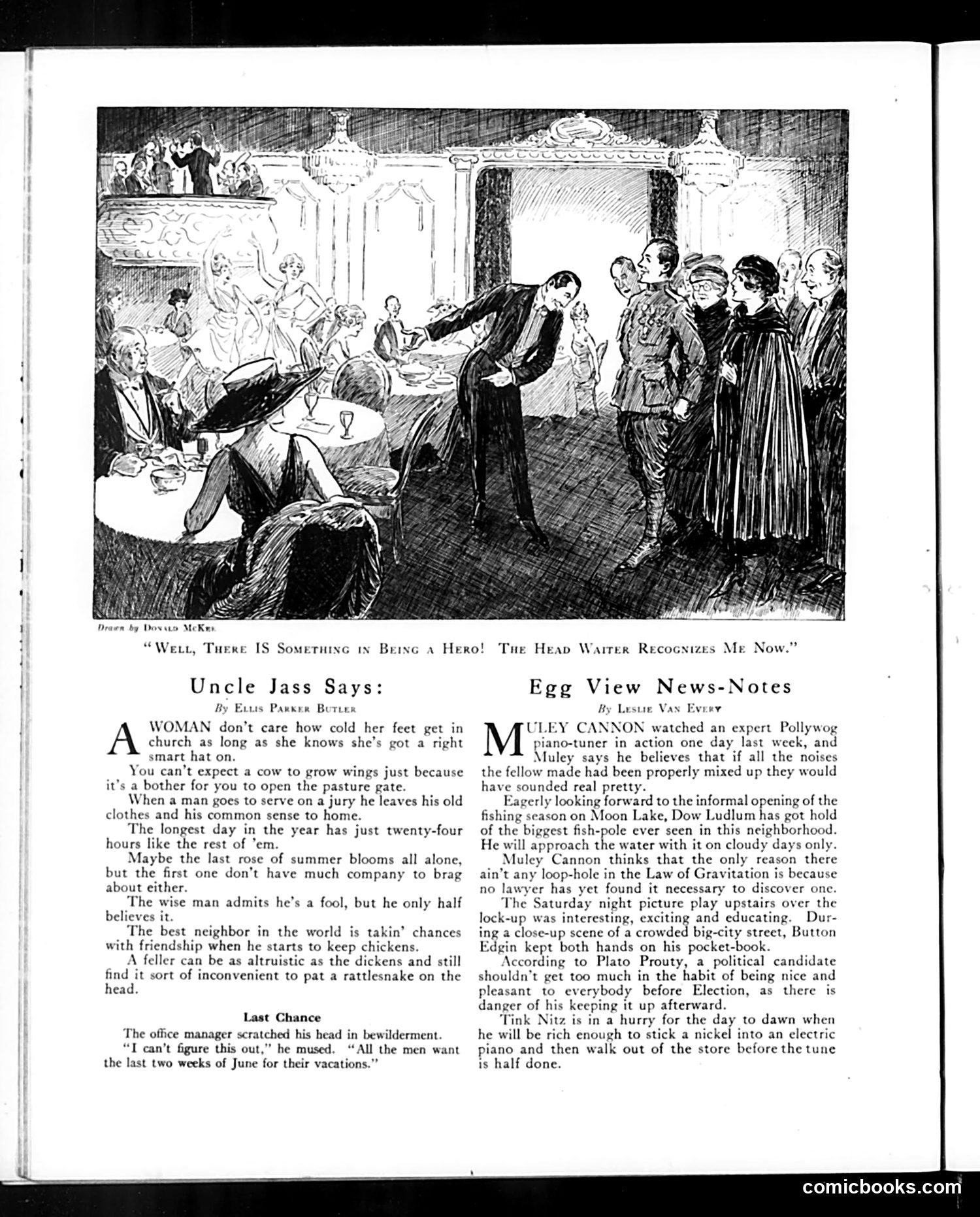
This page contains humorous social commentary typical of early 20th-century Judge magazine. The main cartoon (drawn by Donald McKee) depicts a formal dinner scene where a man appears to be recognized by a head waiter, with the caption playing on the idea that service industry workers acknowledge important patrons. The page features two columns of satirical commentary: **"Uncle Jass Says"** offers folksy, cynical observations about human nature—women's vanity, jury duty's corrupting effect on judgment, and the hypocrisy of altruism. These are gentle jabs at universal human foibles rather than specific political targets. **"Egg View News-Notes"** provides local gossip-style humor about small-town characters (Muley Cannon, Button Edgin, Plato Prouty, Tink Nitz). The Plato Prouty item appears to reference election-year politics, mocking candidates who perform niceness strategically before votes are cast. The "Last Chance" item about June vacation requests is straightforward workplace humor—all employees wanting the same time off creates scheduling chaos. Overall, this represents Judge's middle-brow satirical approach: social satire and character humor rather than hard political commentary.
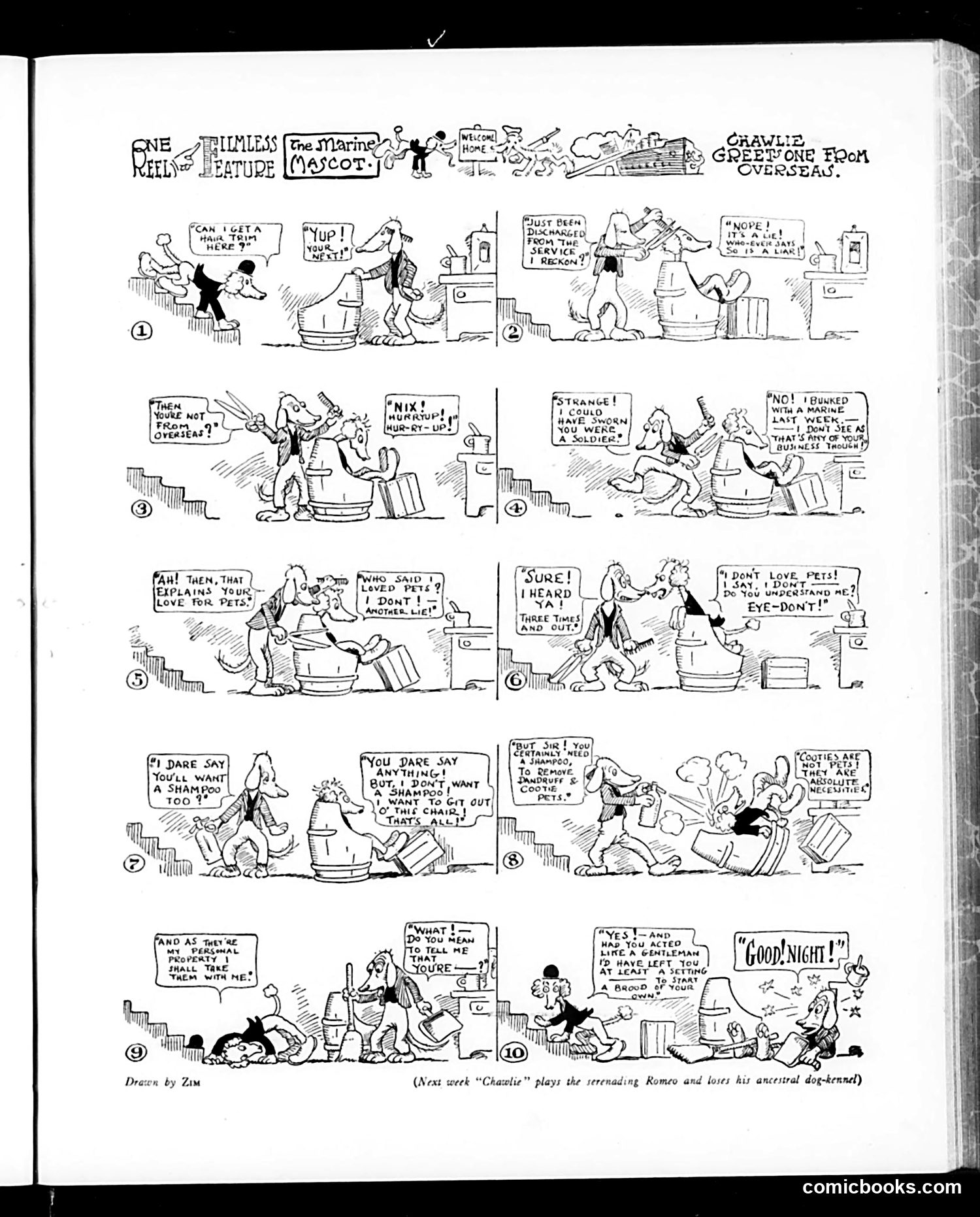
This comic strip from *Judge* magazine satirizes a recently discharged Marine soldier returning home. The protagonist repeatedly insists he "doesn't love pets," yet his actions contradict him—he keeps adopting stray animals and becomes emotionally attached despite protests. The humor plays on post-WWI soldier reintegration: this tough serviceman tries to maintain a hardened, masculine demeanor ("I dare say you'll want a shampoo") while unconsciously revealing sentiment and domesticity through his compulsive pet-collecting. The final caption indicates "next week 'Charlie' plays the serenading Romeo," suggesting the strip's ongoing joke about this character's contradiction between claimed toughness and actual sentimentality. The title references his "rimless" (empty, superficial) attitude—what he claims versus what he actually feels. The strip reflects early 20th-century humor about masculine vulnerability masked by bluster, particularly among returning soldiers navigating civilian life.
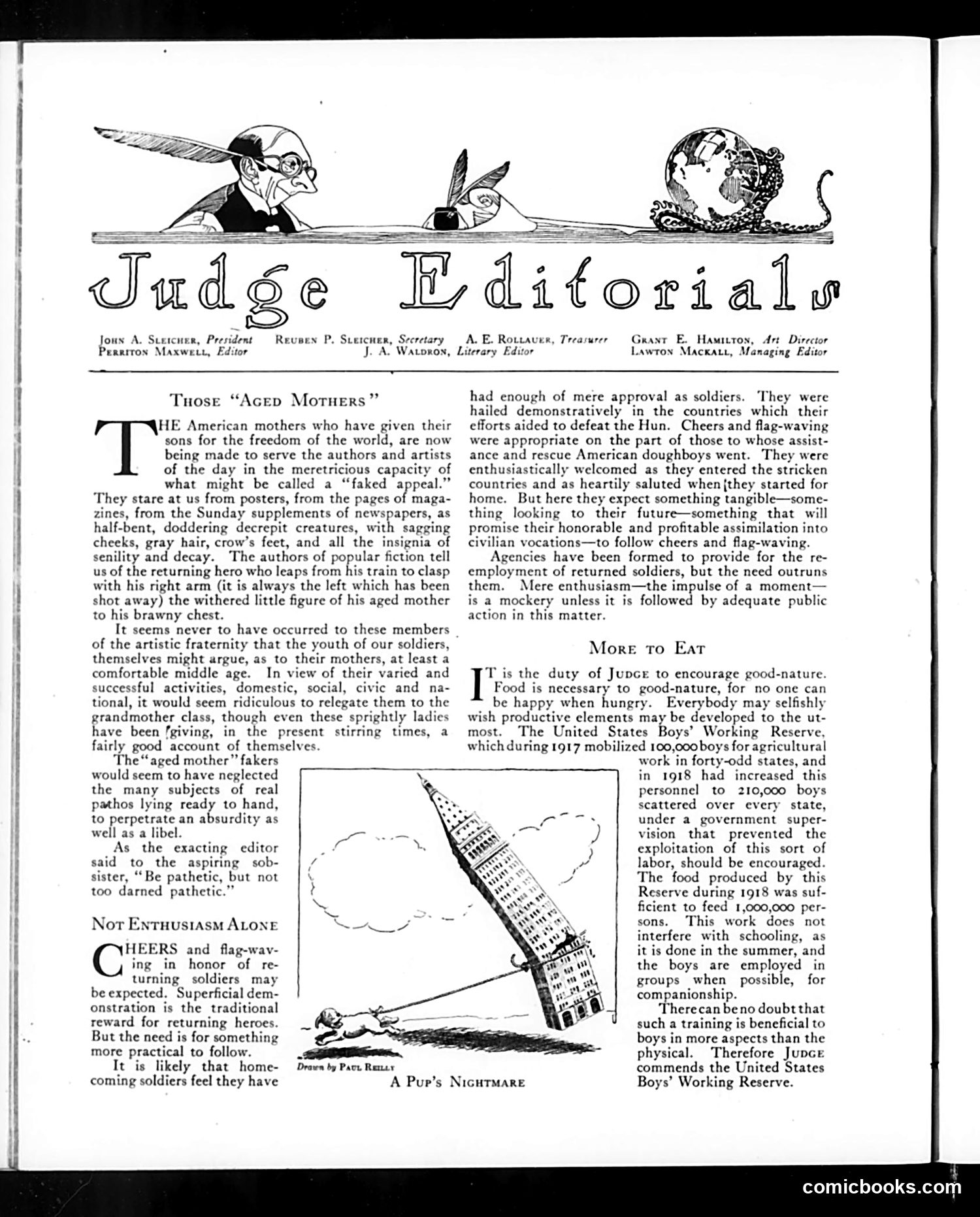
This page contains two editorials criticizing post-WWI America's treatment of returning soldiers. **"Those Aged Mothers"** attacks sentimentalized depictions of soldiers' mothers in popular media. The editorial argues that artists and writers are falsely portraying soldiers' mothers as decrepit, elderly women—when many are actually middle-aged, accomplished women. The real problem, the editorial insists, is not emotional homecoming pageantry but practical job reemployment for veterans. Mere "cheers and flag-waving" are mockery without concrete action. **"More to Eat"** praises the U.S. Boys' Working Reserve, which mobilized 210,000 boys for agricultural work in 1918, producing enough food for one million people. The editorial argues this program should be expanded because returning soldiers need tangible support—food and employment—not just enthusiasm. The cartoon "A Pup's Nightmare" (artist Paul Revere) shows a small dog dreaming of a falling building, likely illustrating anxiety or vulnerability—perhaps metaphorically representing soldiers' uncertain futures. Both pieces reflect post-WWI concerns about veteran welfare and criticize shallow patriotic sentiment divorced from material support.
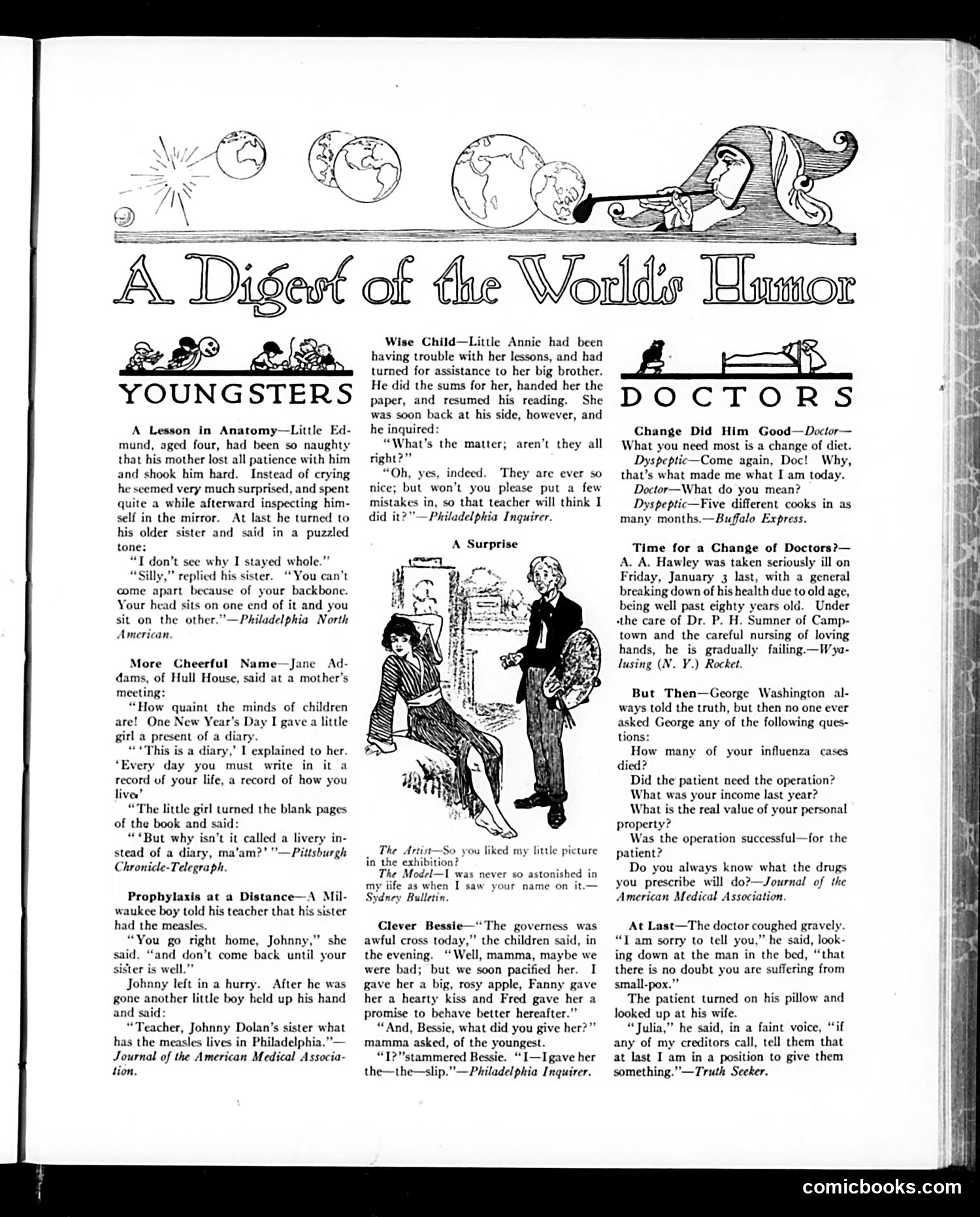
This page from *Judge* magazine collects brief humorous anecdotes organized by topic. The "YOUNGSTERS" section contains jokes about children's logic and innocent misunderstandings—a child confused about anatomy, another redefining "diary" as "livery," and a boy whose sister lives far away, thus immune to contagion. The "DOCTORS" section satirizes physicians' practices and hypocrisy. Jokes mock doctors prescribing diet changes (ironically what caused the patient's problems), asking invasive financial and medical questions patients won't answer honestly, and the implicit criticism that doctors cannot actually predict drug effects or surgical outcomes. The final anecdote references George Washington's honesty, contrasting it with doctors' evasiveness. The satire targets medical professionals' pretense of knowledge and authority while highlighting their actual ignorance and self-interested questioning of patients.
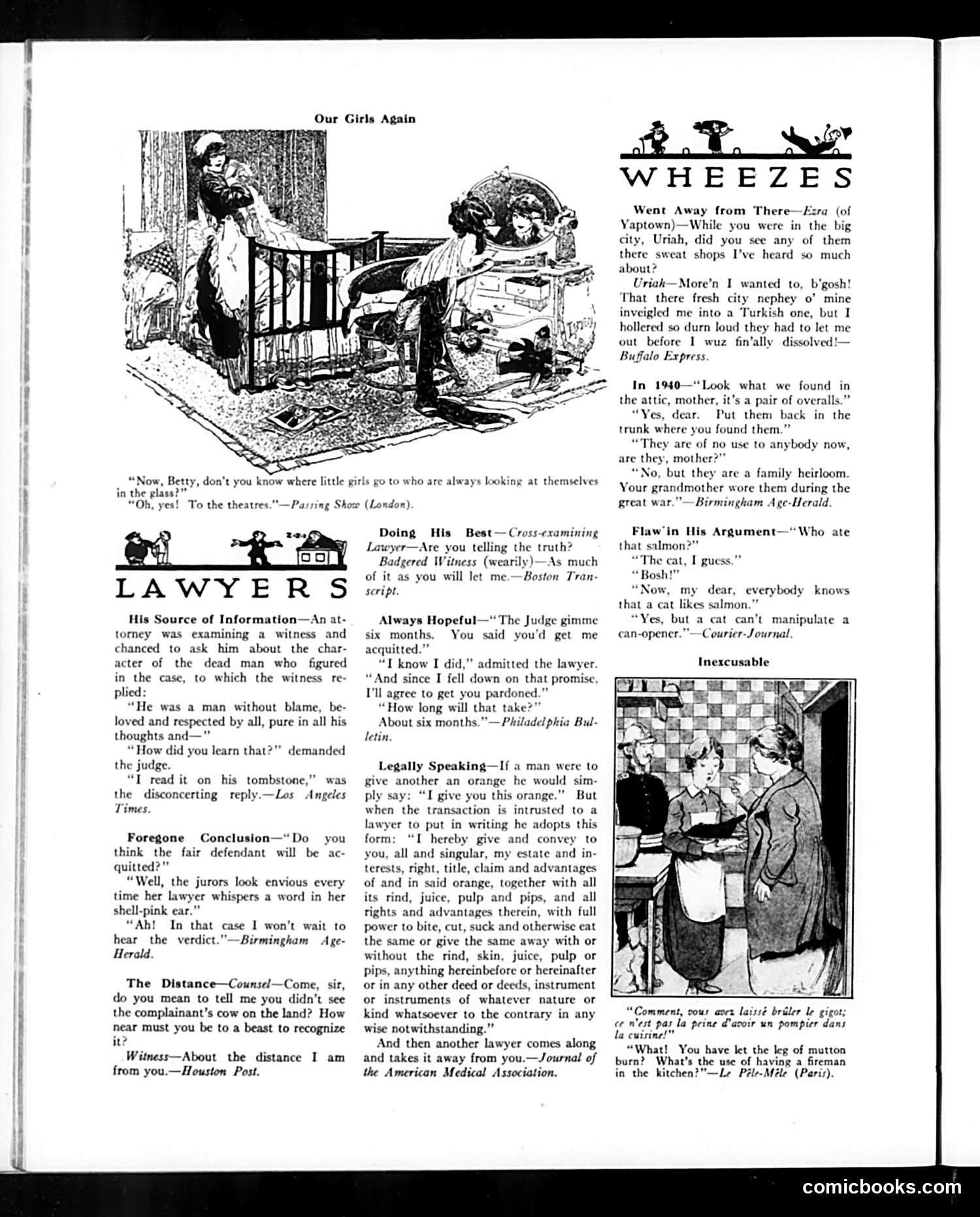
This page from Judge magazine collects humorous anecdotes satirizing **lawyers and the legal profession**. The recurring joke is that lawyers complicate simple matters through excessive verbosity and procedural manipulation. Key satires include: - **"Legally Speaking"**: Mocks how lawyers transform a simple gift ("I give you this orange") into absurdly complex legal language filled with redundant phrases, then another lawyer steals it anyway—suggesting lawyers' real function is to enrich themselves. - **"His Source of Information"**: A witness admits he learned about a dead man's character from his tombstone, exposing how legal testimony can be based on worthless sources. - **"Always Hopeful"**: A lawyer admits failing to prevent his client's conviction, then optimistically promises to secure a pardon in six months—implying lawyers make empty promises and rake in fees. The remaining items mock judicial incompetence, witness evasion, and jury bias. This reflects early 20th-century American skepticism toward legal institutions and their perceived self-serving nature.
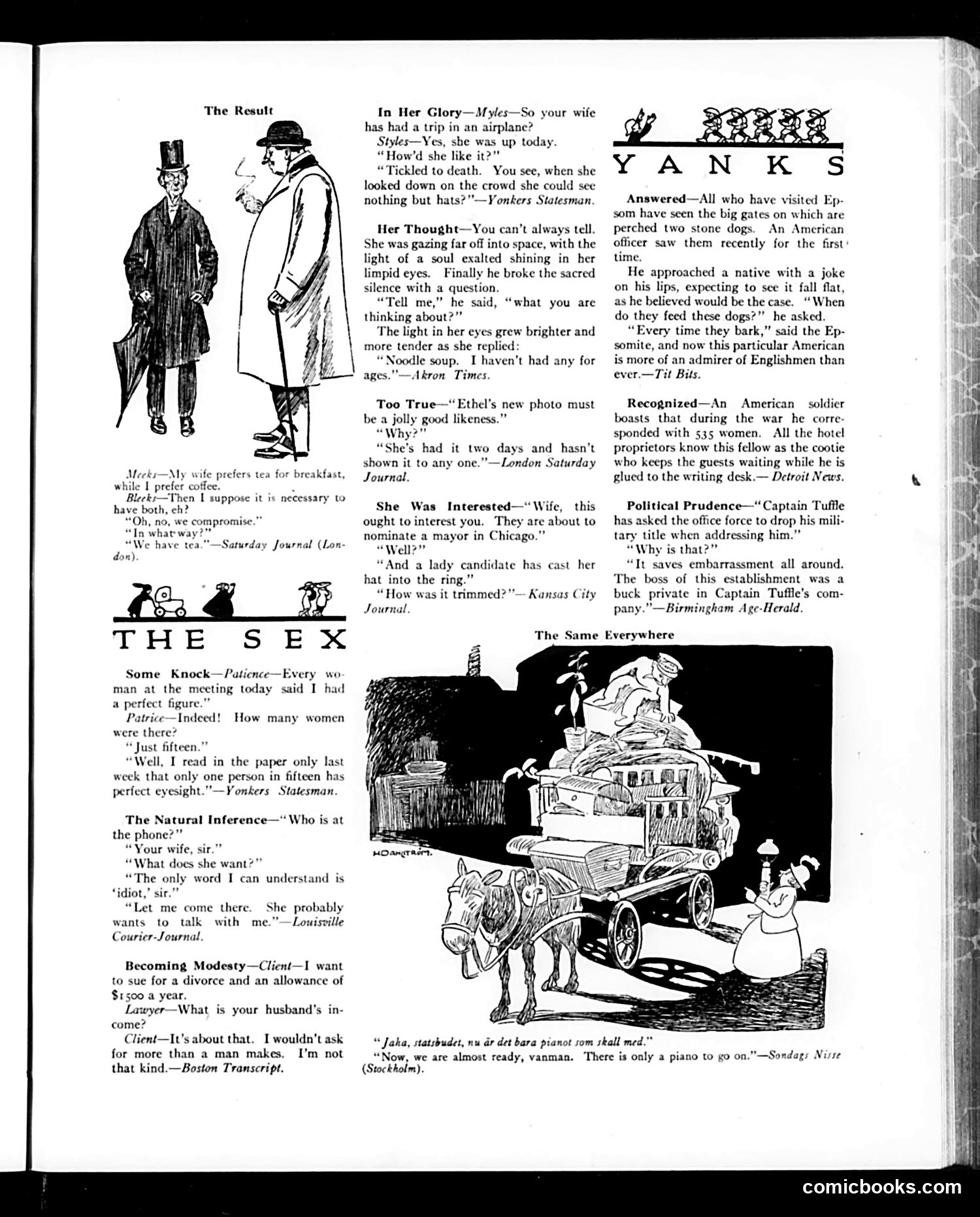
This page collects brief jokes and anecdotes typical of early 20th-century American humor magazines. The content targets domestic life and gender roles: **Key themes:** - **Marriage compromises** presented as absurd (couples can't agree on tea vs. coffee) - **Women's vanity**: A woman only values a photo when she hasn't shown it off yet; another obsesses over a hat's trim rather than mayoral candidates - **Female materialism**: A wife seeking divorce settlement equal to her husband's income, framed as false modesty - **Women's appearance**: Airplane passengers seeing only women's hats from above; commentary on "perfect figures" **The cartoons** feature domestic and social scenes with satirical captions mocking marital dynamics and gender stereotypes common to the era. The humor assumes male readers and presents women as superficial, materialistic, and obsessed with appearance—reflecting period attitudes. References to British locations (Epsom, London) and a Swedish cartoon indicate Judge's international readership.
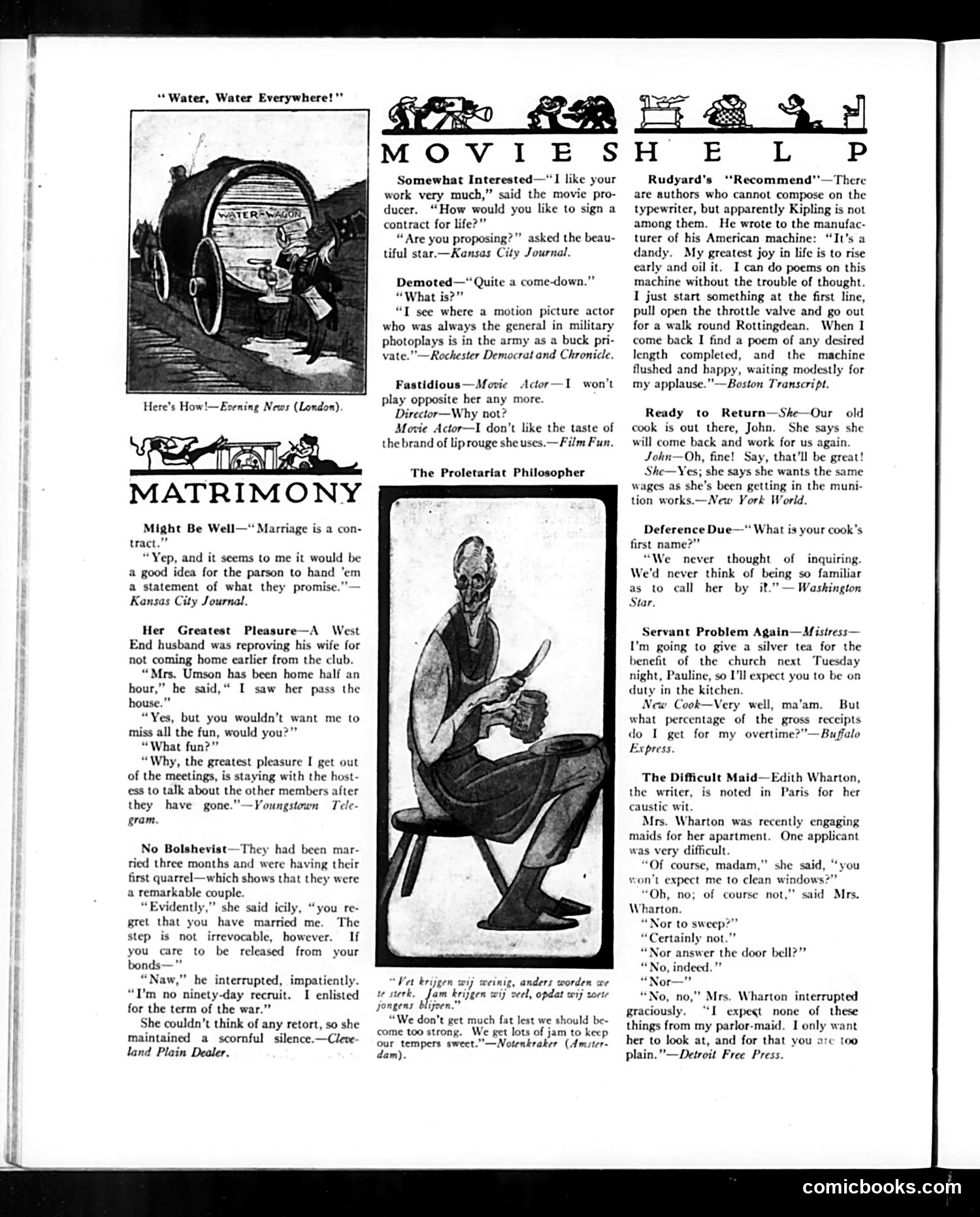
This page from *Judge* magazine contains satirical humor about marriage, cinema, and servant labor—reflecting early 20th-century social anxieties. **"Matrimony" section**: Jokes mock marriage as a contractual trap. One quip suggests couples should receive written statements of promises. Another satirizes wives prioritizing gossip at social clubs over domestic duties. A third depicts newlyweds' first quarrel, with the husband comparing marriage to military enlistment "for the term of the war"—implying marriage is an obligation endured rather than enjoyed. **"Movies Help" section**: Hollywood jokes include a producer offering a starlet a "lifetime contract" that she misinterprets as a marriage proposal—satirizing both the industry's exploitative practices and romantic absurdity. Another mocks an actor demoted from playing generals in films to being a buck private in actual military service. **"Servant Problem"**: Multiple anecdotes lampoon the era's domestic labor crisis. A cook demands union-scale wages and overtime percentages. Another applicant refuses window-cleaning. These reflect post-WWI servant shortages and workers' newfound assertiveness—anxieties that clearly troubled upper-class readers. The *overall tone*: wry skepticism about institutions and social hierarchies.
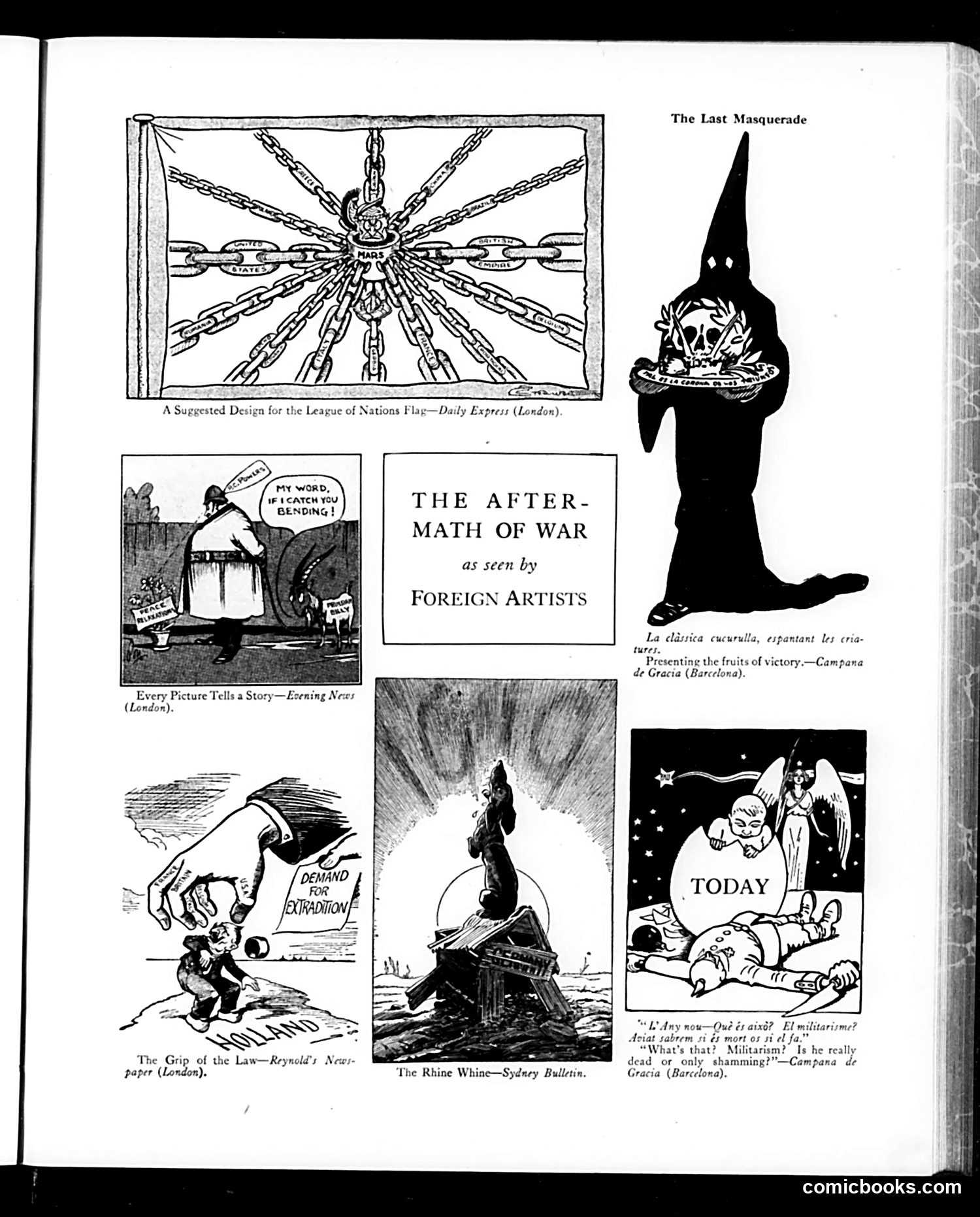
This page collects political cartoons from European publications satirizing post-WWI consequences. The central theme is war's destructive legacy disguised as celebration. **Key images:** - "The Last Masquerade": A skeletal death figure in a pointed hood, labeled as presenting "the fruits of victory"—mocking false triumphalism - "The Rhine Whine": Death perched atop industrial/military ruins - "Today": Angels observing corpses, questioning whether militarism is truly dead - "The Grip of the Law" and "Every Picture Tells a Story": Depicting power structures crushing the vulnerable **The satire:** Though WWI officially ended, these foreign artists argue militarism and its violence persist. The "masquerade" metaphor suggests victory celebrations mask ongoing suffering, death, and authoritarian control. The page presents a darkly ironic counter-narrative to patriotic war narratives—showing that peace brought no real change or justice.
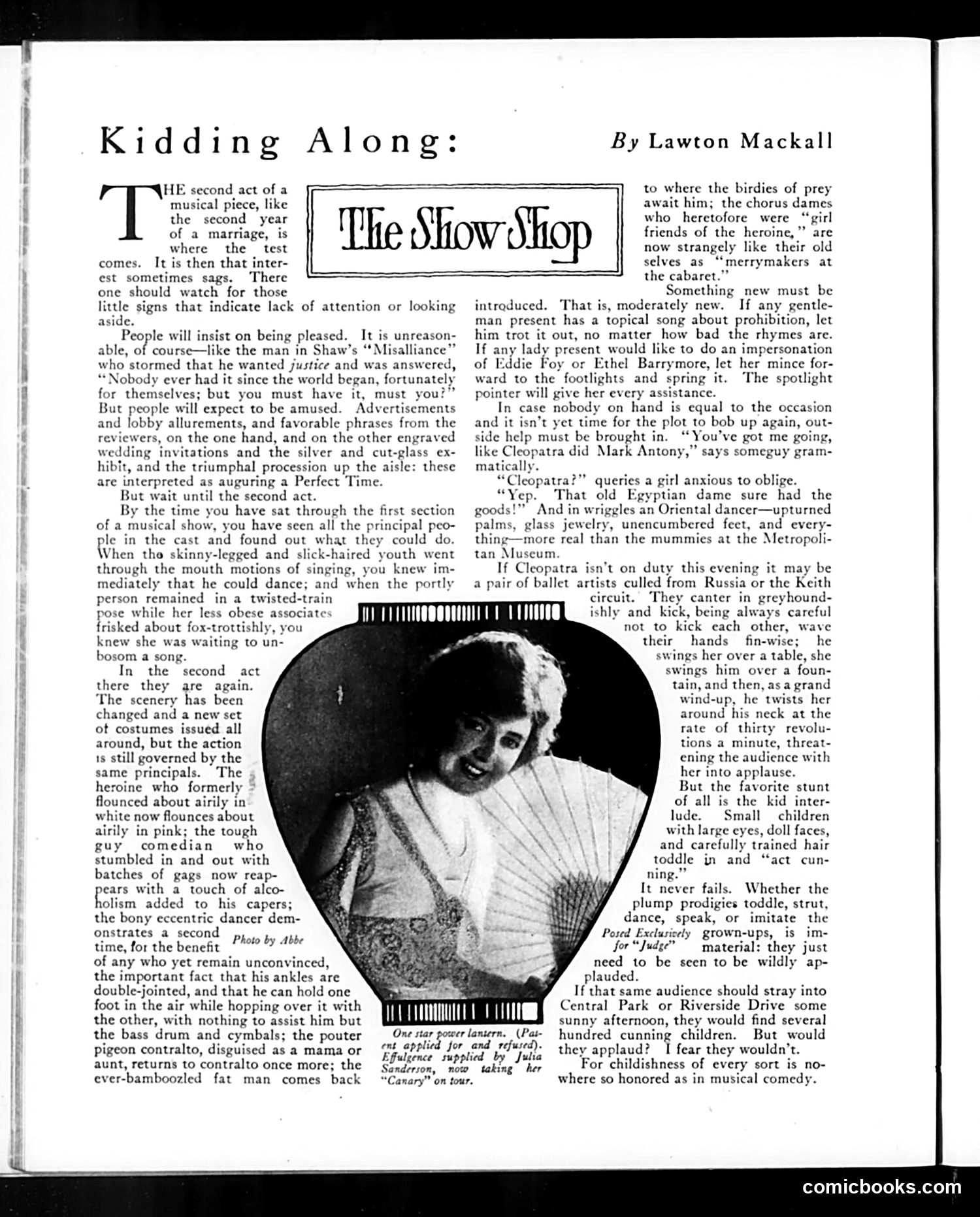
This is a theater criticism column by Lawton Mackall examining the structural weaknesses of musical comedy productions, specifically the "second act problem." The article argues that musicals follow predictable patterns: once audiences have seen principal performers' abilities in Act One, Act Two merely repeats them with new costumes and scenery. To maintain interest, producers resort to desperate measures—inserting topical songs about prohibition, celebrity impersonations (Eddie Foy, Ethel Barrymore), or completely unrelated specialty acts (Oriental dancers, Russian ballet artists). The accompanying photograph (labeled as posed exclusively for "Judge") shows a female performer—likely a chorus girl or dancer—illustrating the type of talent theaters recycled between acts. Mackall's satire targets the theatrical industry's lazy reliance on novelty-act padding rather than genuine plot development, reflecting early-20th-century Broadway's formulaic approach to musical entertainment.
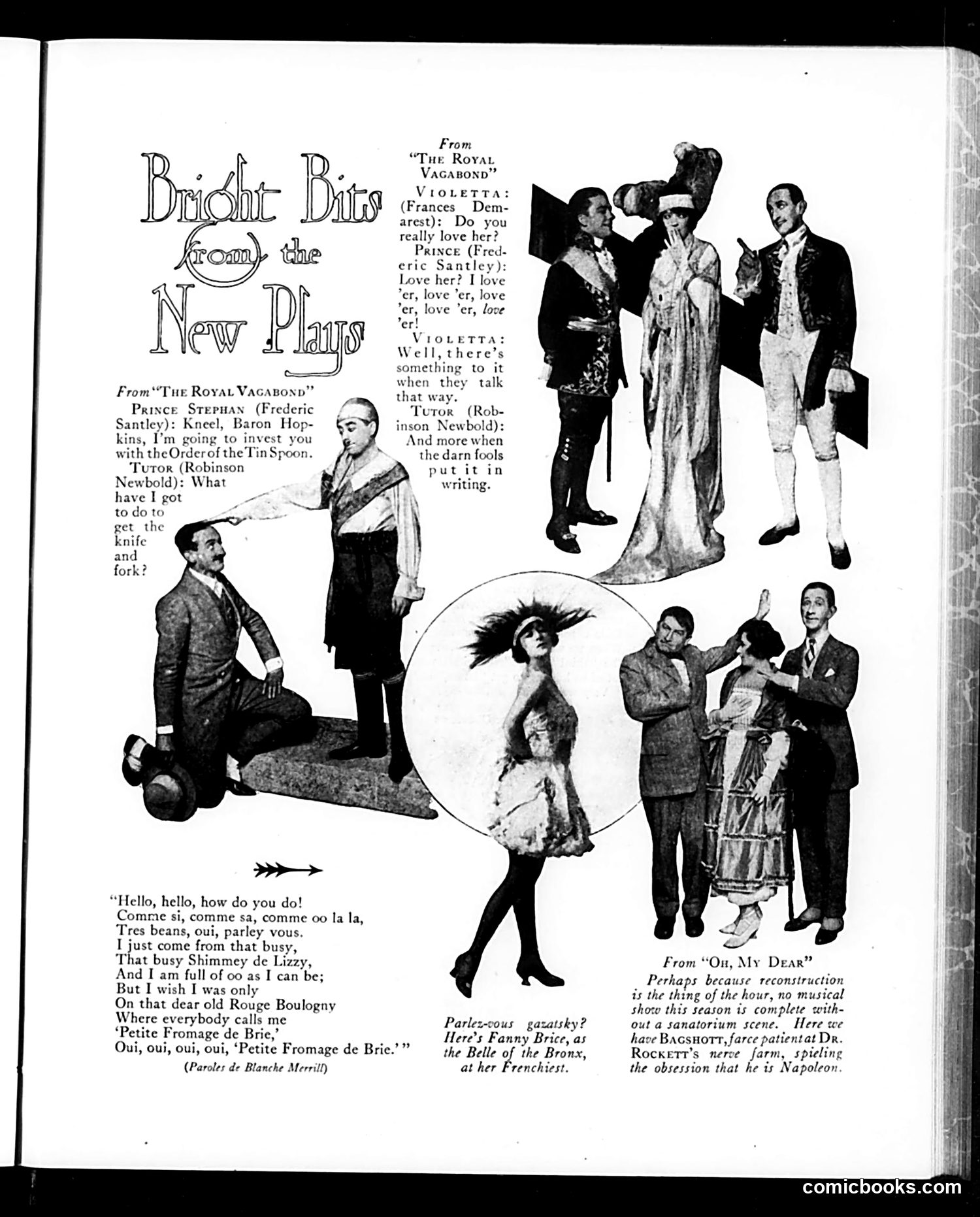
This Judge magazine page satirizes Broadway productions of the era through quoted dialogue and caricatured scenes. It mocks theatrical conventions: "The Royal Vagabond" is lampooned for overwrought French affectation (the "Petite Fromage de Bric" song mocking Francophilia) and absurd romantic declarations. A running joke targets theatrical hierarchy—a tutor character asks what he must accomplish to earn utensils, after receiving a meaningless "Order of the Tin Spoon," mocking empty honors. The page also ridicules popular performer Fanny Brice's exaggerated "Frenchiest" persona. A final jab targets contemporary theater's trend of sanatorium scenes as plot devices, suggesting producers resort to unimaginative reconstruction themes. Overall, Judge critiques Broadway's reliance on affected European pretension, sentimental clichés, and formulaic staging rather than genuine theatrical innovation.
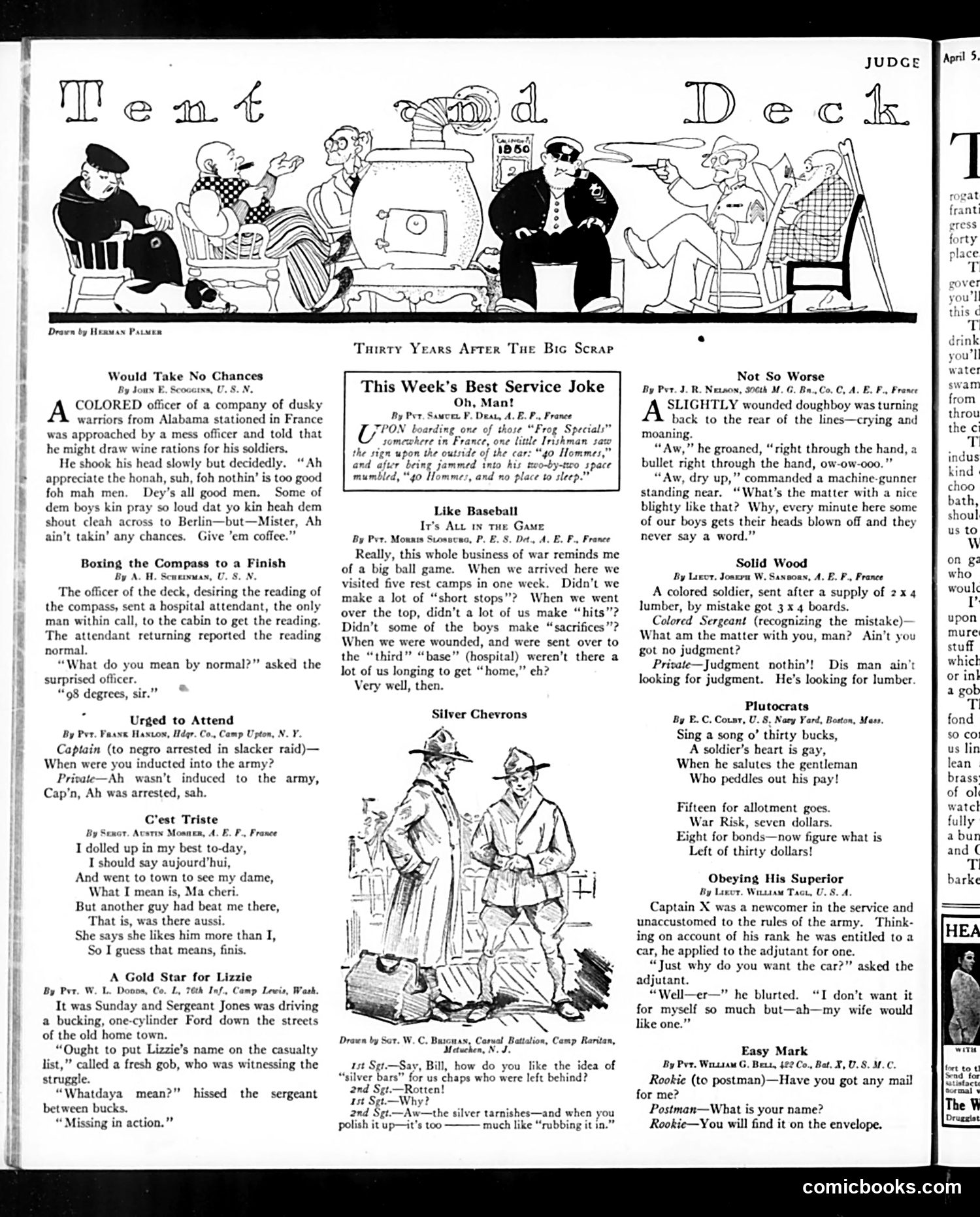
This Judge magazine page from April 1919 collects military humor from World War I servicemen, reflecting on wartime experiences thirty years hence. The cartoons and jokes employ racial stereotypes common to the era, depicting African American soldiers with exaggerated dialect. Notable examples include a colored officer refusing wine rations for his men, and a soldier sent to fetch lumber who confuses board dimensions. Other humor targets military bureaucracy and discipline: a hospital attendant reporting a compass reading as "98 degrees," a soldier claiming he was "arrested" rather than "inducted" into the army, and enlisted men mocking colleagues awarded "silver bars" (indicating non-combat service) as excessive vanity. The page satirizes wartime absurdities—comparing combat to baseball with its "short stops" and "sacrifices," and joking about a malfunctioning car nicknamed "Lizzie" as "missing in action." This represents soldiers' dark humor coping with WWI's trauma, though expressed through deeply offensive racial caricatures that modern readers must recognize as historically inappropriate.
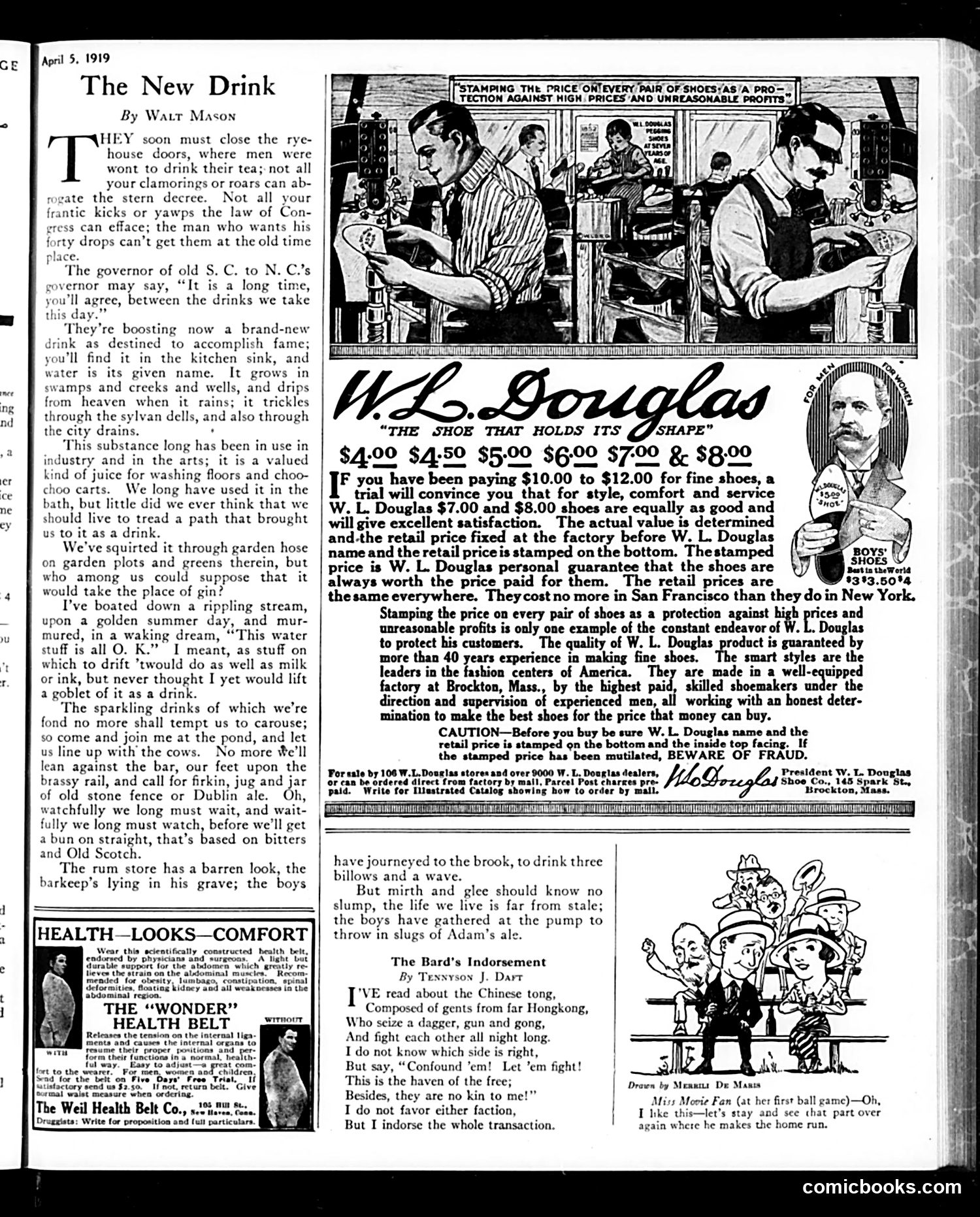
This page, dated April 5, 1919, satirizes the imminent enforcement of Prohibition (which began January 1920). Walt Mason's poem mocks Americans' forced adaptation to alcohol bans by proposing water as the "new drink" — the only legal alternative. The cartoon at top shows men at a bar "stamping the price on every pair of shoes," likely depicting workers protesting high prices through consumer action (a contemporary labor/economic issue). The satire's point: the poem acknowledges Prohibition's inevitability while lamenting the loss of alcohol culture ("the barkeep's lying in his grave"). References to "old stone fence" (whiskey) and "bitters and Old Scotch" highlight beloved drinks soon forbidden. Mason treats water humorously as civilization's embarrassing regression — using it for cleaning and now drinking it. The accompanying W.L. Douglas shoe advertisement is unrelated advertising content typical of Judge magazine's revenue model.
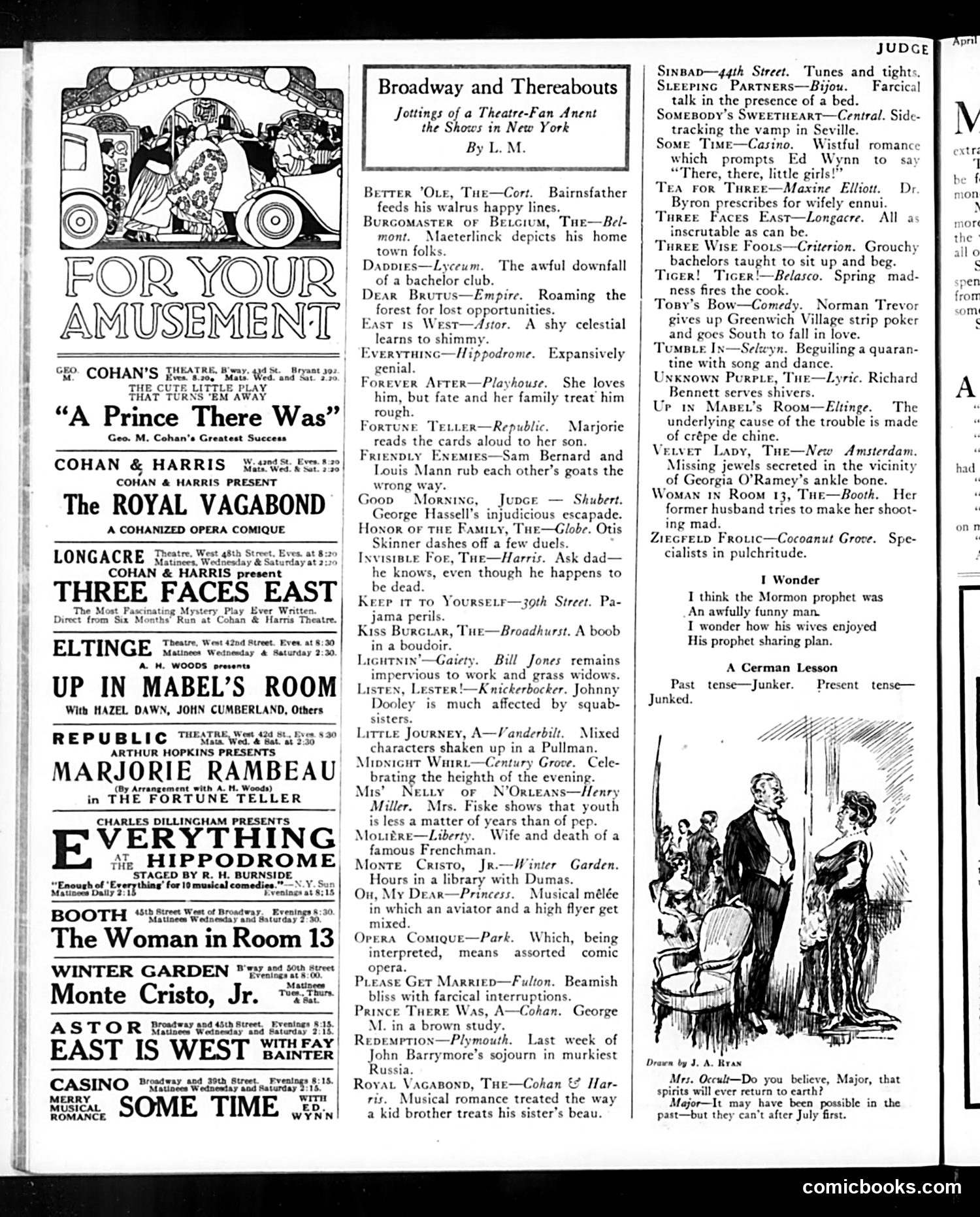
This is primarily a **theater advertising and review page** from Judge magazine, not a political cartoon. The left side features advertisements for Broadway shows, while the right contains brief theatrical reviews by "L.M." The reviews are humorous plot summaries in the style of theatrical criticism. For example, *Better 'Ole* features Bairnsfather feeding "his walrus happy lines," while *Three Wise Fools* depicts "grouchy bachelors taught to sit up and beg." These use exaggeration and wit typical of satirical theater commentary. The small cartoon at bottom right, drawn by "J. A. Ryan," shows a domestic scene where a wife asks a major whether spirits will return to earth, noting "it may have been possible in the past" but she "drew the line at Judy first"—likely a joking reference to a specific show or character. The page primarily documents 1920s Broadway entertainment rather than political satire, reflecting Judge's broader amusement focus beyond politics.
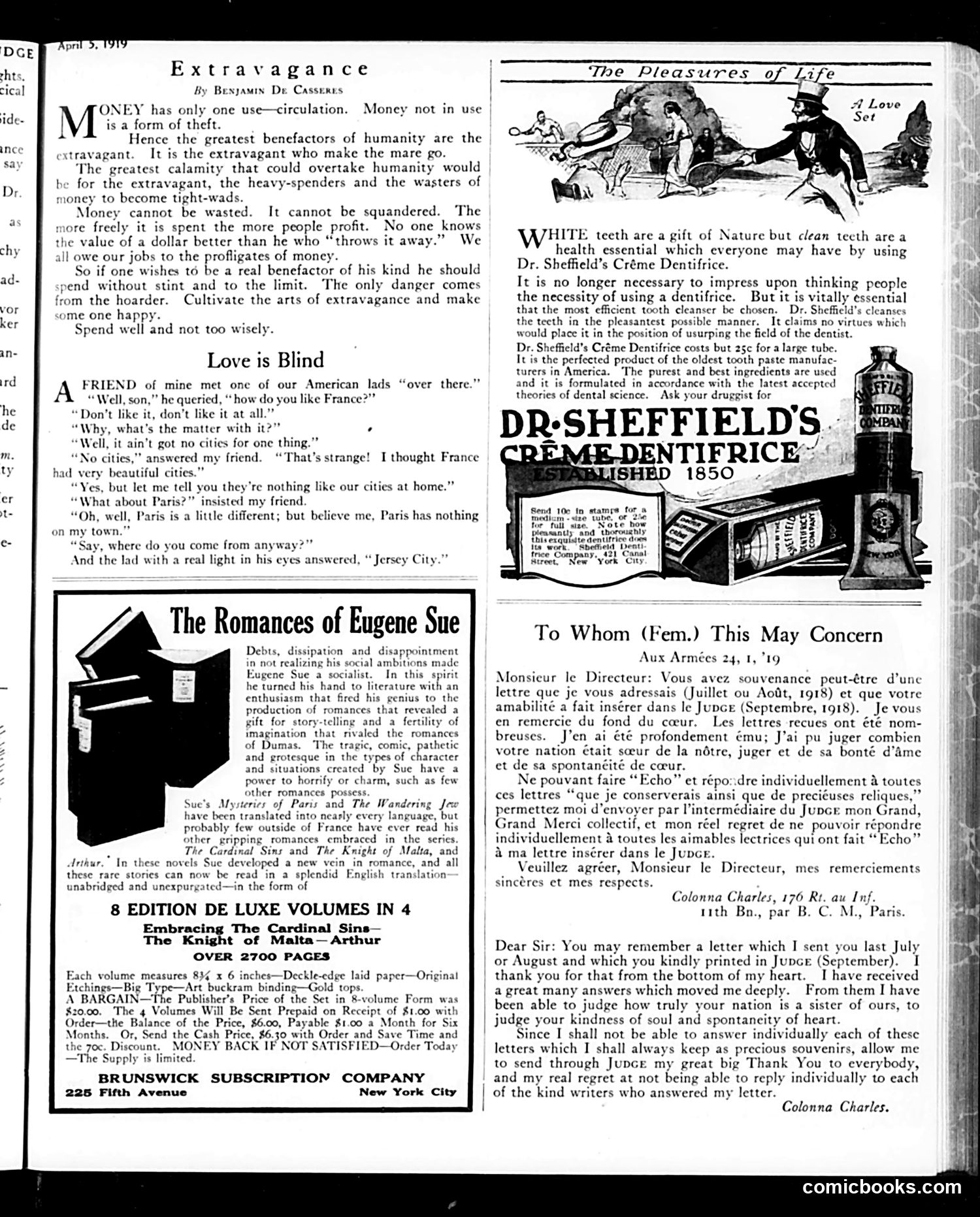
This page contains three distinct pieces of satirical commentary typical of Judge magazine: **"Extravagance"** by Benjamin De Casseres argues paradoxically that wasteful spending benefits society by keeping money circulating and creating jobs—a commentary on post-WWI economic debates about consumption versus thrift. **"Love is Blind"** is a brief humorous anecdote about an American soldier abroad who dismisses all of France's cities, declaring his hometown of Jersey City superior. This satirizes American provincial attitudes and naive patriotism, suggesting blind nationalism prevents appreciating other cultures. **"The Romances of Eugene Sue"** is primarily an advertisement for a deluxe edition of the 19th-century French author's works, capitalizing on his reputation for melodramatic social commentary. The page also includes advertisements for Dr. Sheffield's toothpaste and a book subscription service—typical of Judge's revenue model. The content reflects 1919 concerns: post-war economic theory, American soldier repatriation, and consumer culture.
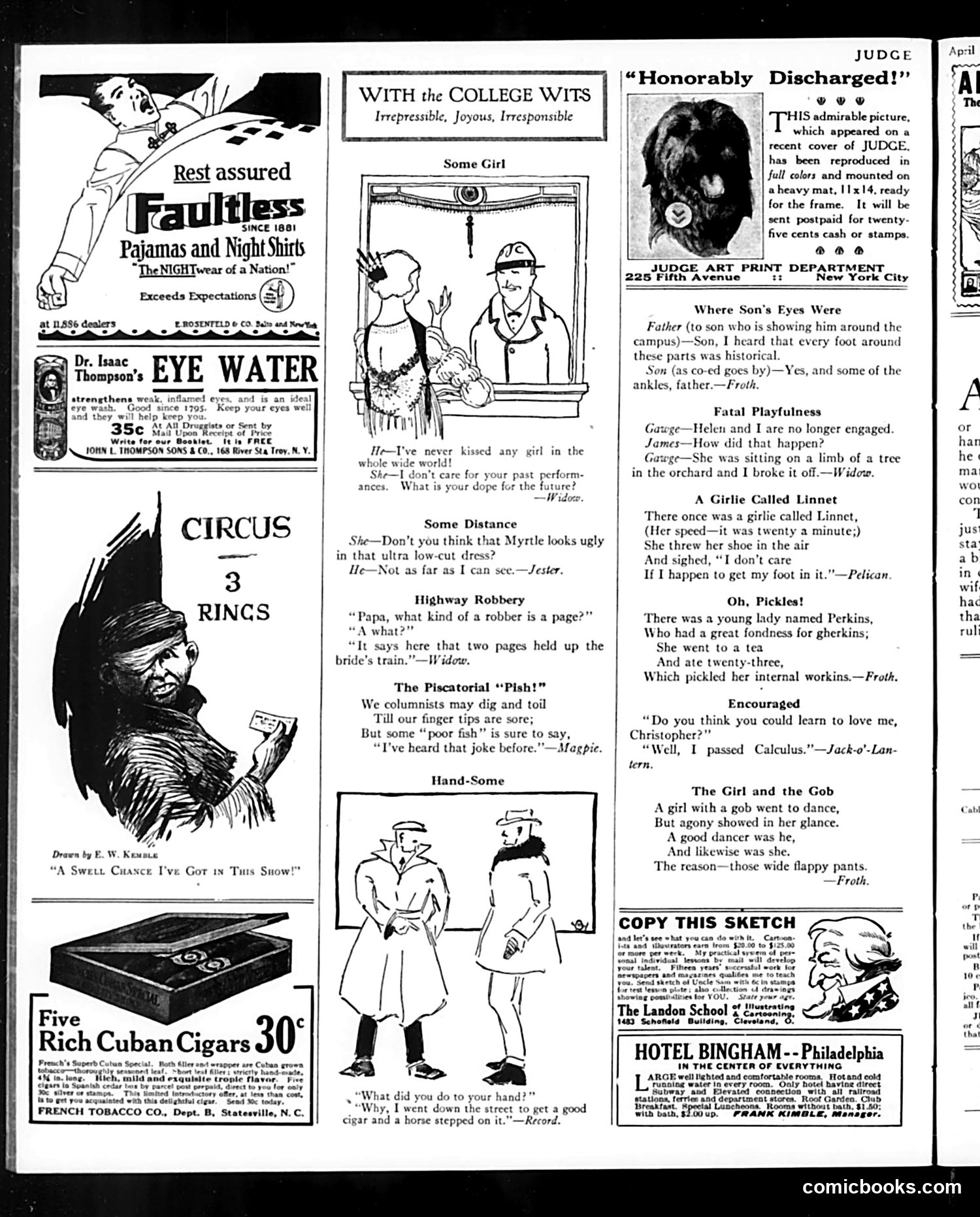
This page from *Judge* magazine features light humor aimed at college-aged readers, typical of early-20th-century American satire. The "College Wits" section collects brief jokes attributed to various college publications (noted by credited sources like "Widow," "Jester," "Froth"). The jokes reflect period concerns: sexual propriety ("I've never kissed any girl"), courtship dynamics, and physical comedy. References like "the gob" (sailor slang) and "co-ed" reflect contemporary college life. The humor is mostly innocent by modern standards—puns on "page" (wedding attendant), wordplay on "hand-some," and absurdist scenarios (a horse stepping on someone's hand). The cartoon "Honorably Discharged" depicts a dejected soldier, likely referencing post-WWI themes of discharged veterans, though the specific context is unclear from this page alone. The surrounding advertisements (pajamas, eye water, cigars, hotels) are standard commercial content typical of *Judge*'s revenue model, not satirical content.
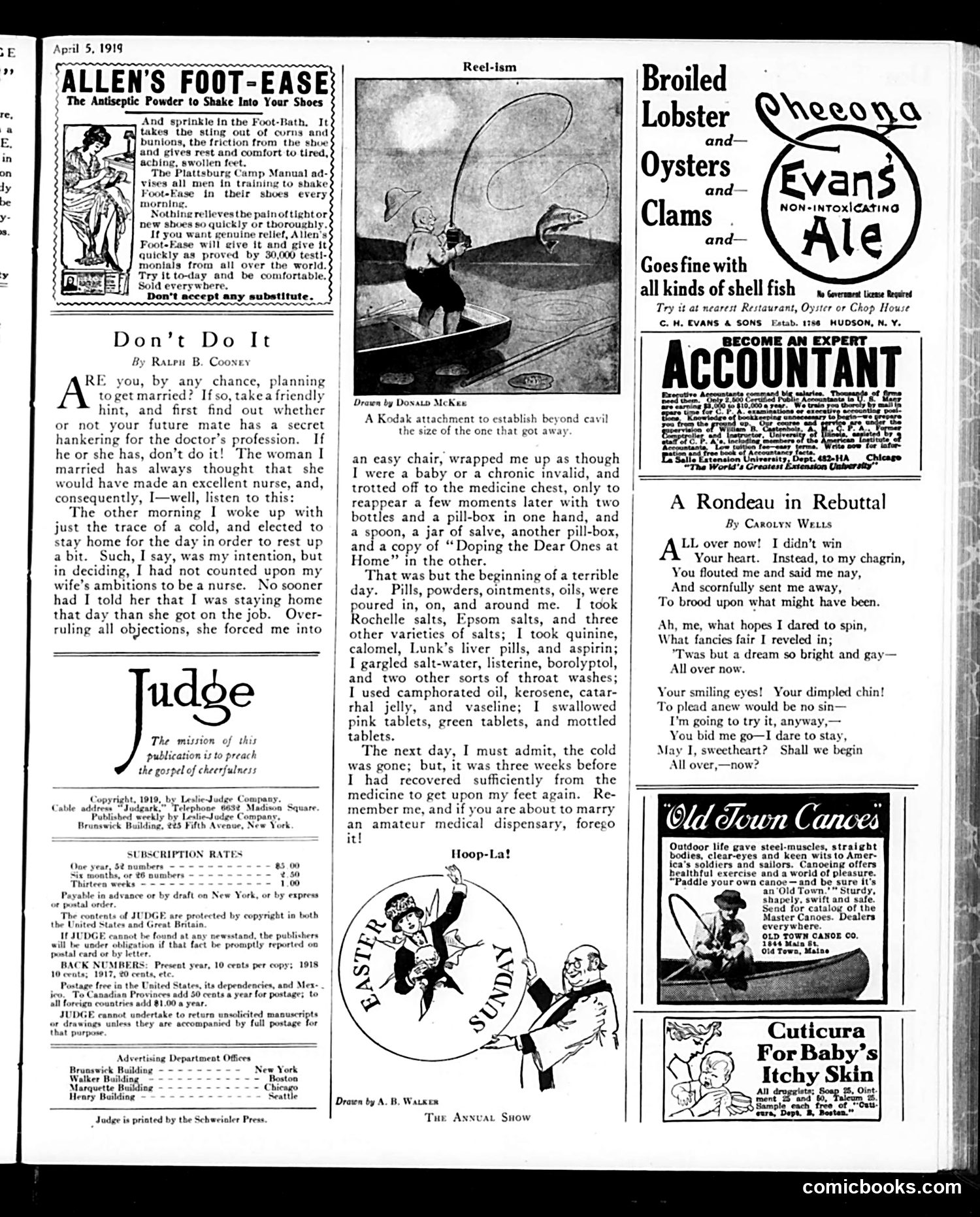
This page from *Judge* (April 5, 1919) contains three main elements: **"Don't Do It"** — A humorous article warning against marrying someone with medical ambitions. The author jokingly describes his wife subjecting him to countless home remedies (salts, pills, oils, throat washes) for a minor cold, nearly killing him in the process. The satire mocks both amateur home doctoring and wives' controlling domestic authority. **"Reel-ism"** — A cartoon by Donald McKee showing a fishing scene with a camera attachment documenting "the size of the one that got away." This satirizes fishermen's notorious exaggerations about their catches, using modern photography to humorously call out this age-old tall tale. **"Hoop-La!"** — A decorative illustrated poem about outdoor pleasures. The page is otherwise dominated by period advertisements (Allen's Foot-Ease powder, Cuticura balm, Old Town Canoes, Cheong Evans Ale). All content reflects 1919 concerns: domestic comedy, skepticism toward amateur medicine, and recreation nostalgia.
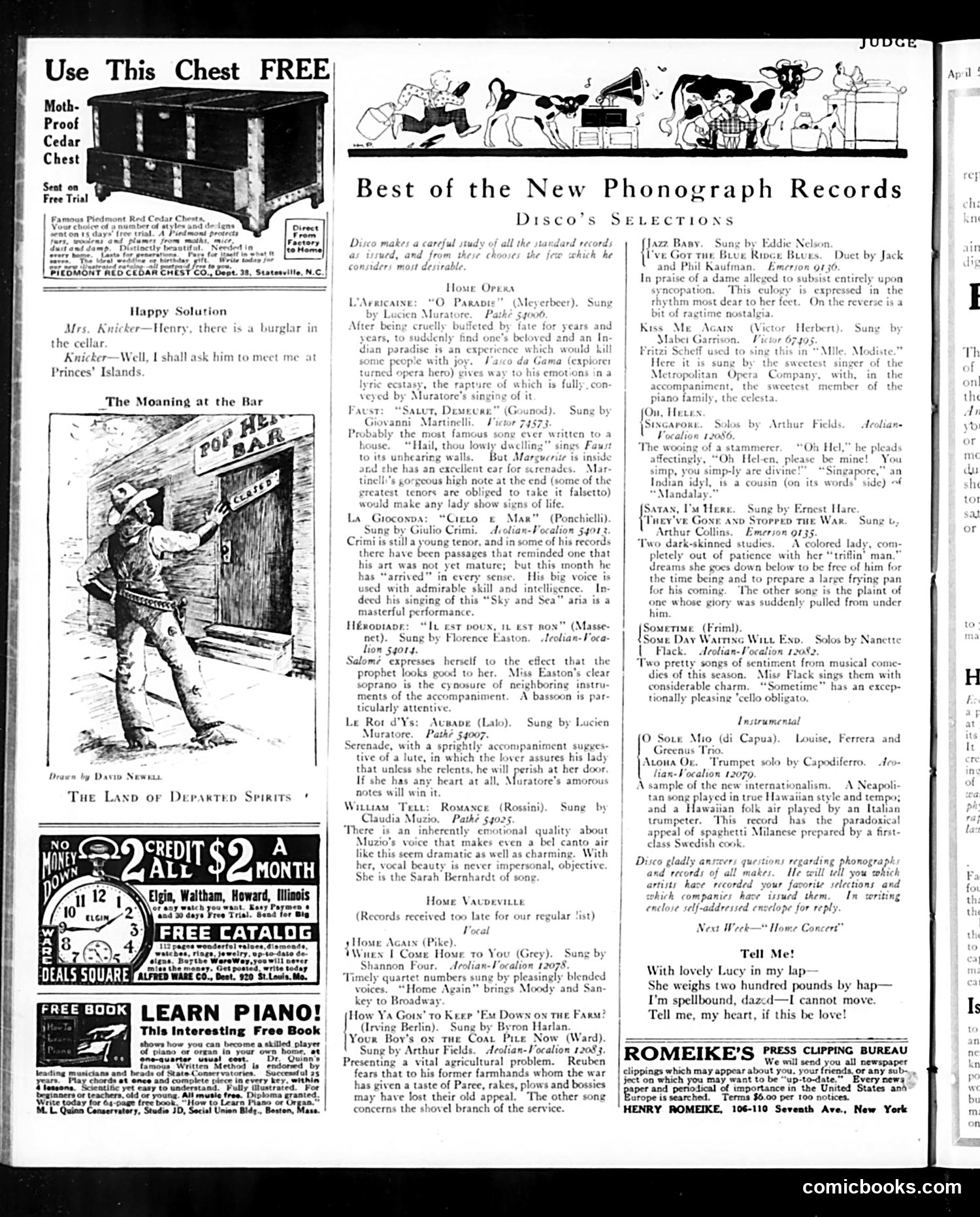
This appears to be a humorous domestic cartoon illustrating a marital dispute. The sketch, drawn by David Newell, shows a woman at a bar (likely a saloon) confronting her husband. The caption references "The Moaning at the Bar," playing on literary allusions while depicting working-class domestic conflict. The joke likely concerns a husband frequenting bars while his wife waits at home—a common satirical subject in early 20th-century American humor. The woman's aggressive posture suggests she's confronting him about his drinking habits or infidelity. The cartoon reflects period anxieties about male drinking culture and its impact on family life, themes that would gain urgency with Prohibition's approach (ratified 1919). The "Pop's Bar" sign visible in the illustration emphasizes the saloon setting as the target of middle-class moral criticism.
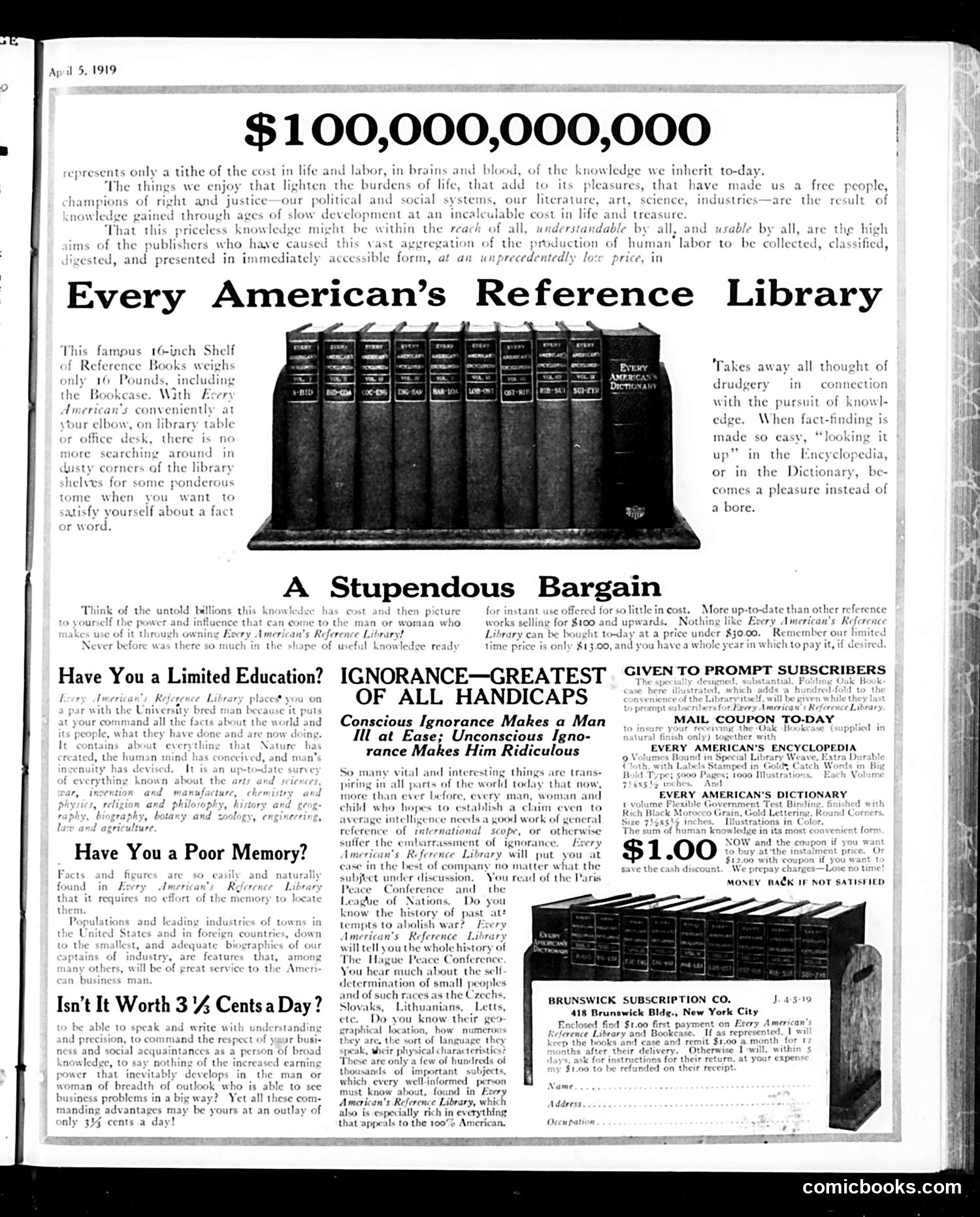
This is primarily a **full-page advertisement** for the Brunswick Subscription Company's reference encyclopedia set, dated April 5, 1919—immediately following World War I and the Paris Peace Conference. The "satire" is not a political cartoon but rather **persuasive advertising rhetoric** disguised as social commentary. The ad argues that ignorance is "the greatest of all handicaps" and uses timely references—the League of Nations, the Hague Peace Conference, Czech and Baltic independence movements—to suggest that an informed citizenry needs this $100 encyclopedia set. The framing is quasi-satirical: it mocks "conscious ignorance" (those aware they're uninformed) as less ridiculous than "unconscious ignorance" (those unaware). The implicit jab targets readers who think themselves knowledgeable but lack access to comprehensive reference materials. The advertisement conflates knowledge acquisition with patriotic duty and social competence, a common post-WWI sales strategy. Modern readers should recognize this as early **propaganda-style marketing** leveraging contemporary geopolitical anxiety to sell educational products.
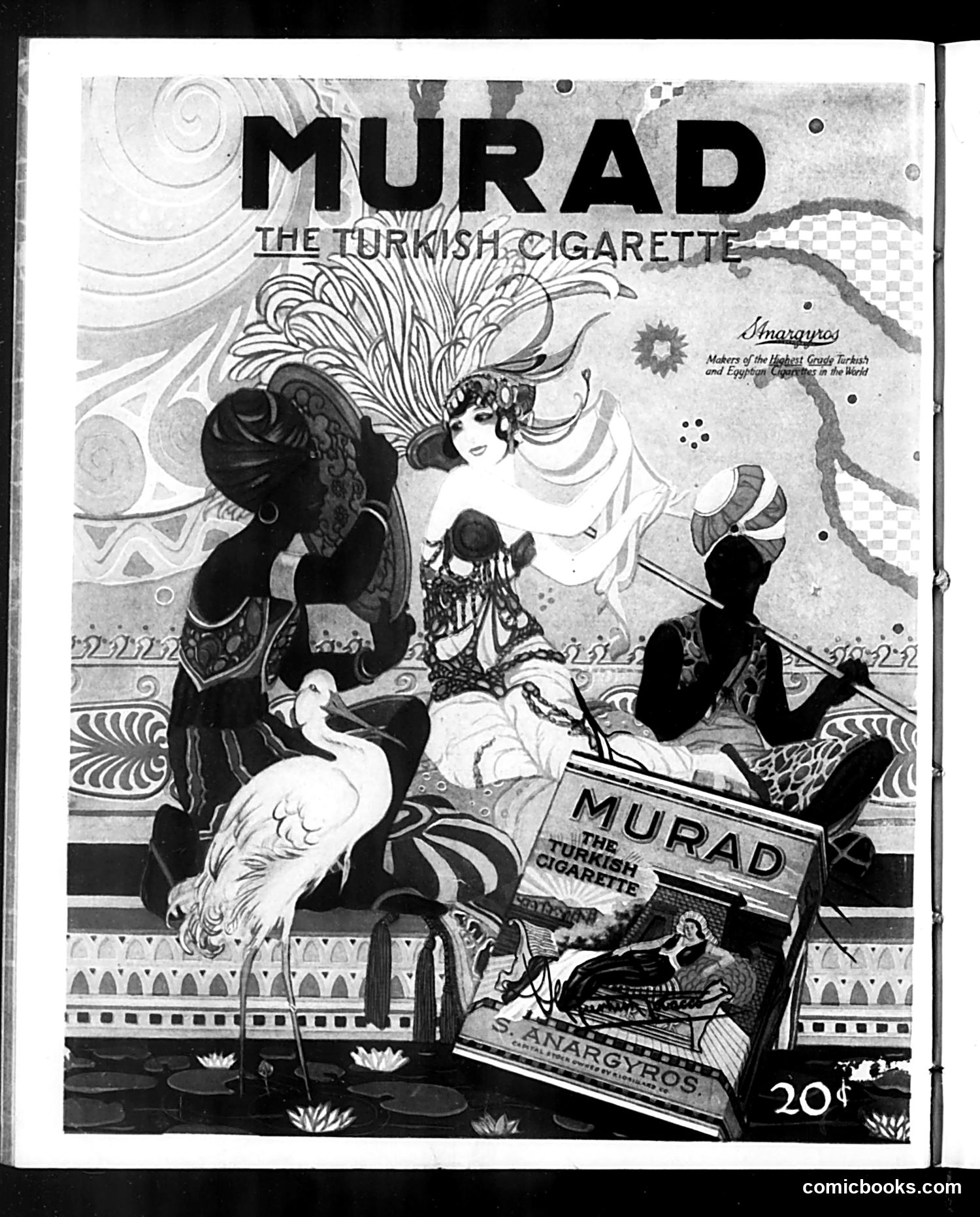
This is an advertisement for Murad brand Turkish cigarettes, priced at 20 cents. The page features an ornate, orientalist illustration depicting women in exotic dress in a harem-like setting, with decorative Middle Eastern architectural elements. A white peacock is prominently featured. The ad emphasizes that Murad cigarettes are "Makers of the Highest Grade and Finest Turkish and Egyptian Cigarettes in the World." The imagery capitalizes on early 20th-century Western fascination with "Turkish" exoticism and luxury. This represents period advertising strategy: using orientalist fantasy imagery and promises of foreign sophistication to market cigarettes to American consumers, particularly emphasizing the premium status associated with Turkish tobacco.