
A complete issue · 32 pages · 1919
Judge — March 1, 1919
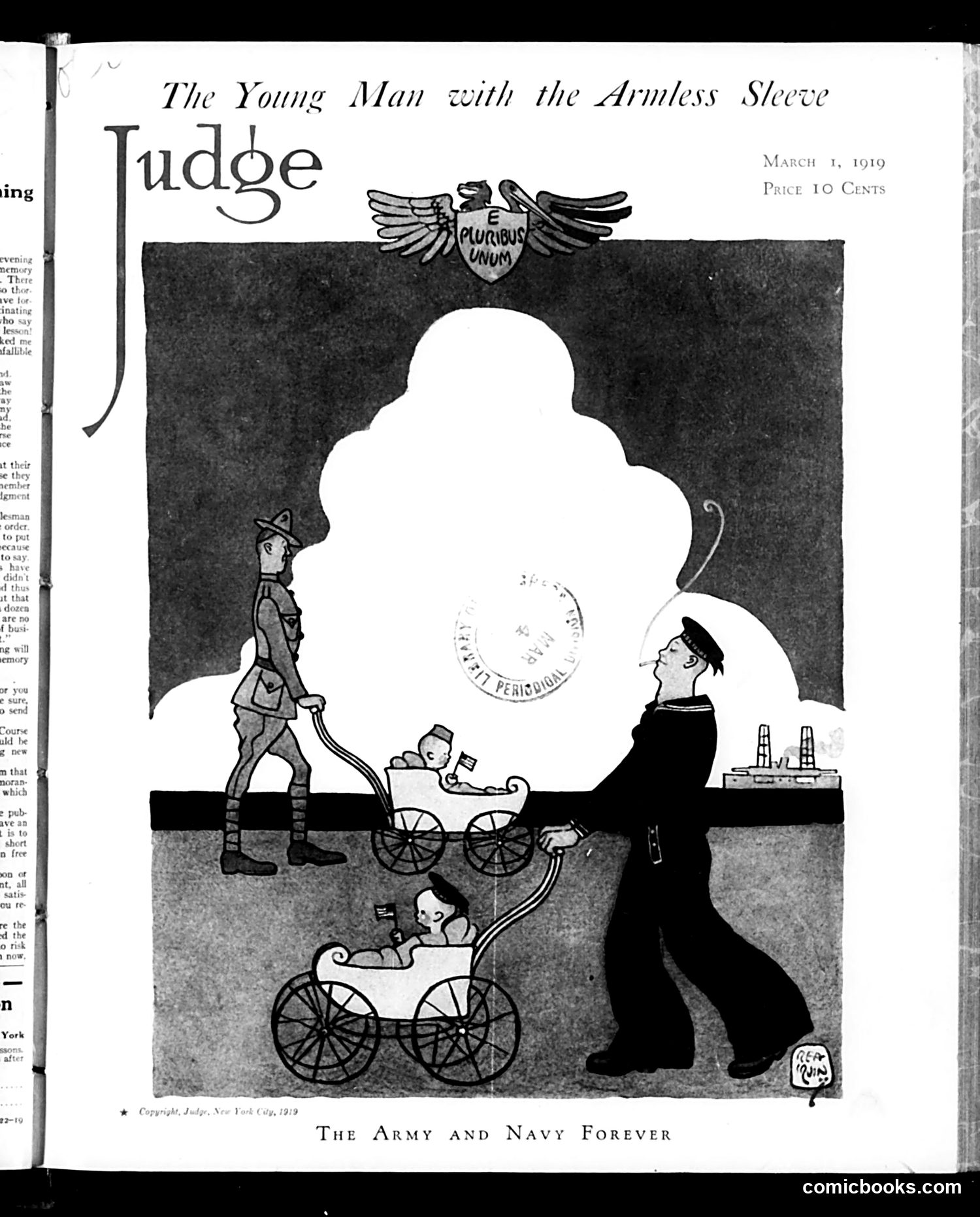
This Judge magazine cover from March 1, 1919 depicts a World War I-era political cartoon. A one-armed soldier (identifiable by his empty sleeve) walks a baby carriage while a well-dressed civilian watches. The massive ghostly figure looming behind them appears to represent the future burden of American military spending and veterans' care. The caption "The Army and Navy Forever" suggests ironic commentary on post-WWI America's military commitments. The soldier, now disabled and reduced to domestic life, symbolizes the war's human cost. The cartoon critiques whether America would properly support and provide for its returning veterans, or whether military obligations would overshadow their needs—a pressing social concern as demobilization began in 1919.
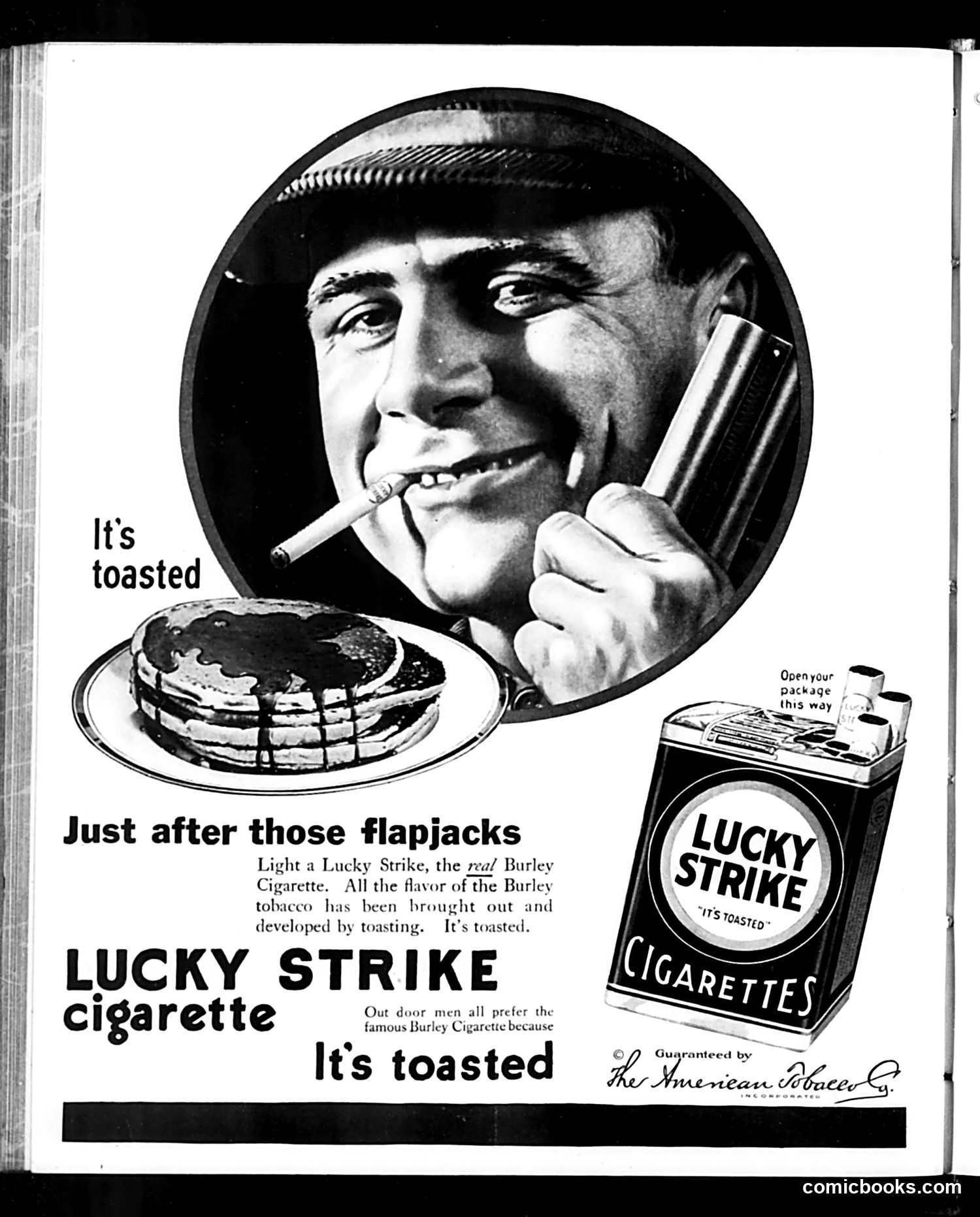
This is a **Lucky Strike cigarette advertisement**, not political satire. The page features a man in a cap smoking a cigarette while holding a lighter, alongside a plate of flapjacks (pancakes). The ad's humor relies on a casual association: eating flapjacks, then smoking a Lucky Strike cigarette. The repeated slogan "It's toasted" emphasizes the brand's signature selling point—that Lucky Strike tobacco underwent a toasting process. The phrase "Out door men all prefer the famous Burley Cigarette" suggests marketing to working-class or outdoor laborers. By modern standards, this advertisement is notable primarily for openly promoting cigarettes without health warnings, reflecting early-20th-century advertising norms before tobacco's dangers were widely acknowledged or regulated.
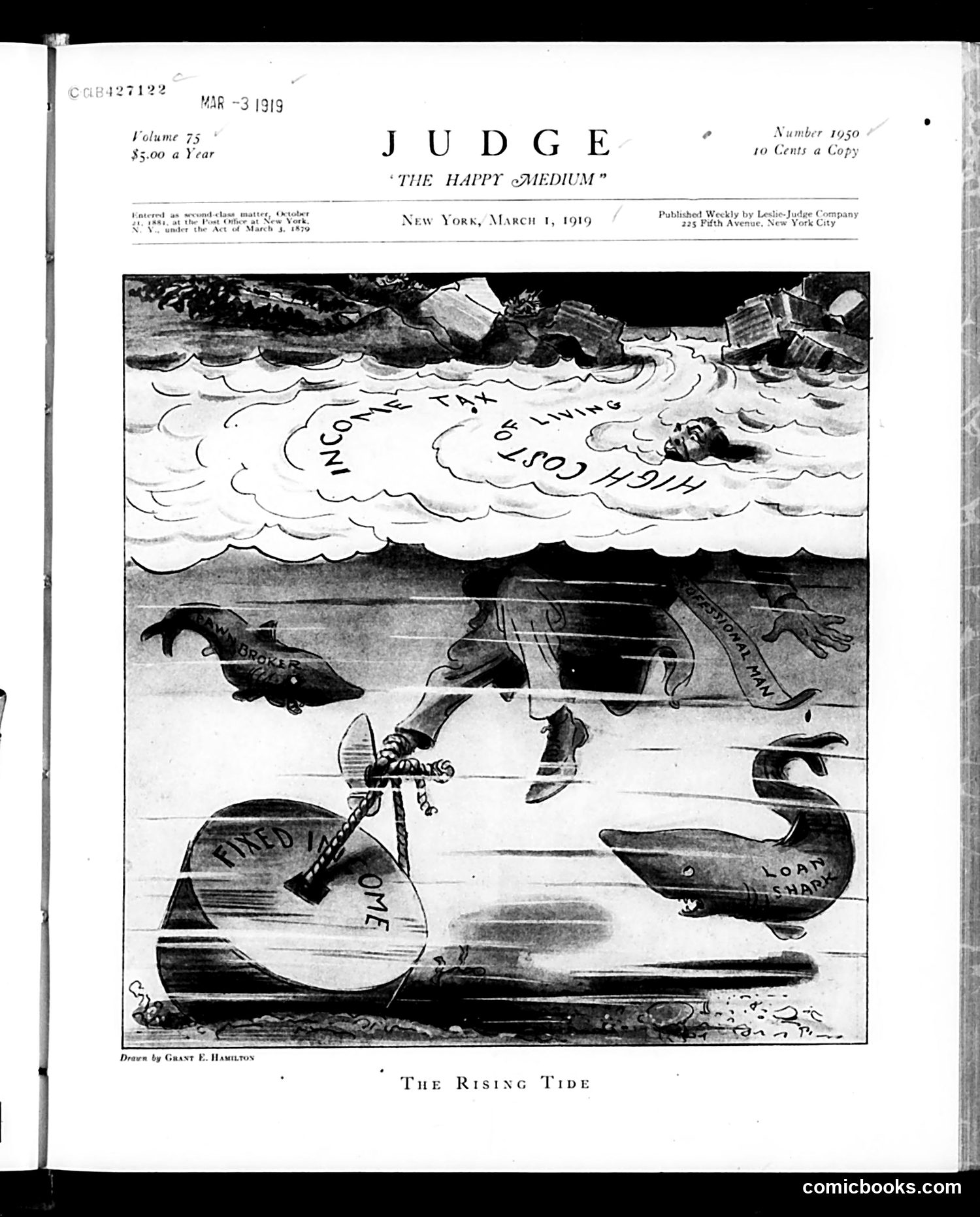
This political cartoon by Grant E. Hamilton depicts a drowning scene with labeled vessels sinking in turbulent waters. The image appears to reference post-WWI economic and social upheaval. Visible labels on boats include references to "broken," "loan," and other partially legible text suggesting financial crisis or debt. The churning waters above show distressed conditions, with debris and wreckage scattered about. Given the March 1919 date—immediately following World War I's armistice—this likely satirizes the chaotic economic transition from wartime to peacetime, including war debts, economic instability, or labor unrest that plagued the postwar period. The "rising tide" metaphor suggests catastrophic social/economic forces overwhelming established institutions or financial systems.
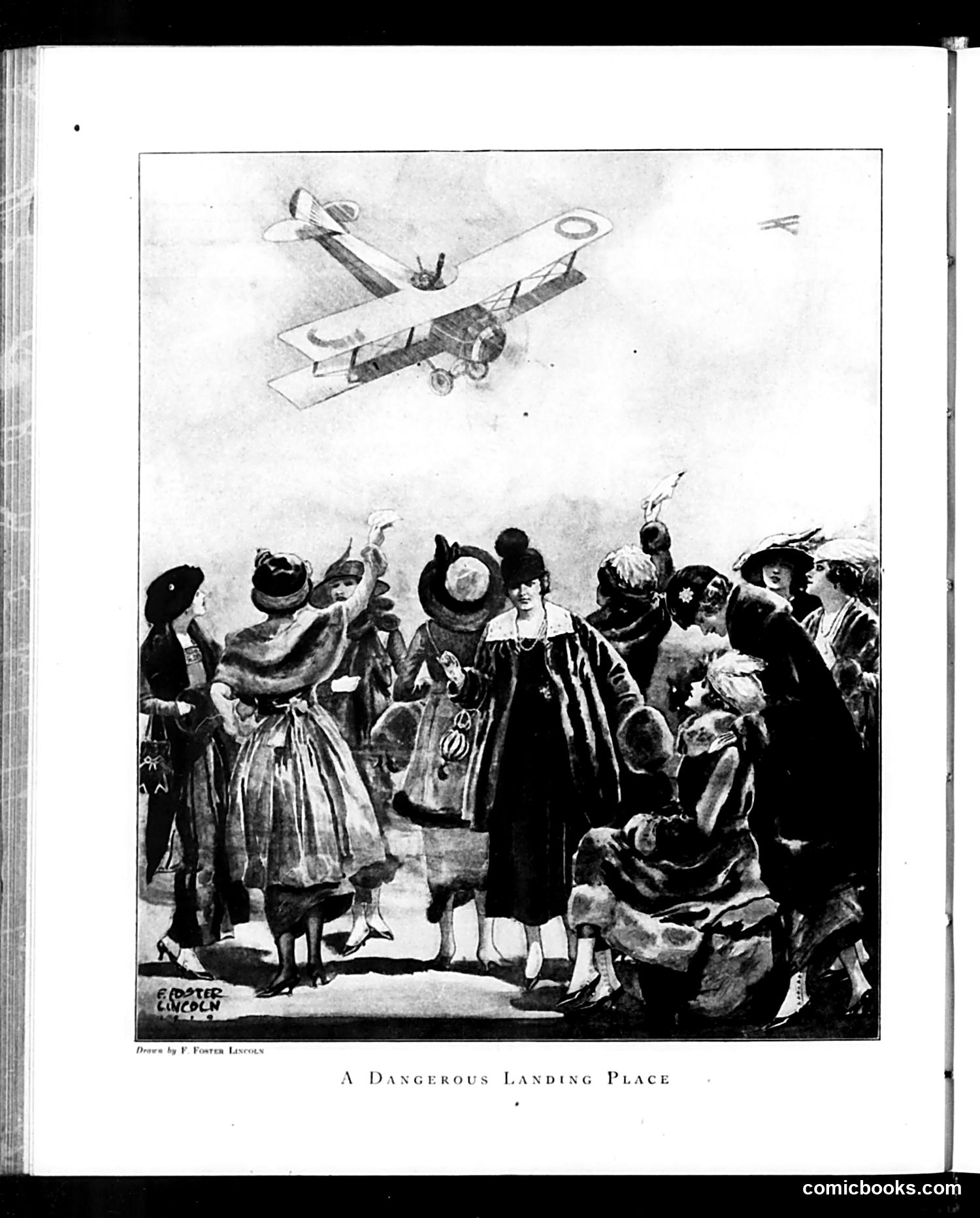
This satirical cartoon, drawn by F. Foster Lincoln, depicts an early airplane attempting to land among a crowd of fashionably-dressed women. The humor operates on multiple levels: the absurdity of an aircraft descending toward pedestrians in what appears to be a public space, and the implicit commentary on women's fashion and behavior. The "dangerous landing place" likely refers satirically to the women themselves—perhaps mocking their elaborate hats, clothing, or tendency to gather in public spaces. The cartoon may also be commenting on aviation as a novelty spectacle that drew crowds, particularly female spectators fascinated by modern technology. The drawing style and subject matter suggest this dates from aviation's early decades (1910s-1920s), when flying was still exotic and hazardous.
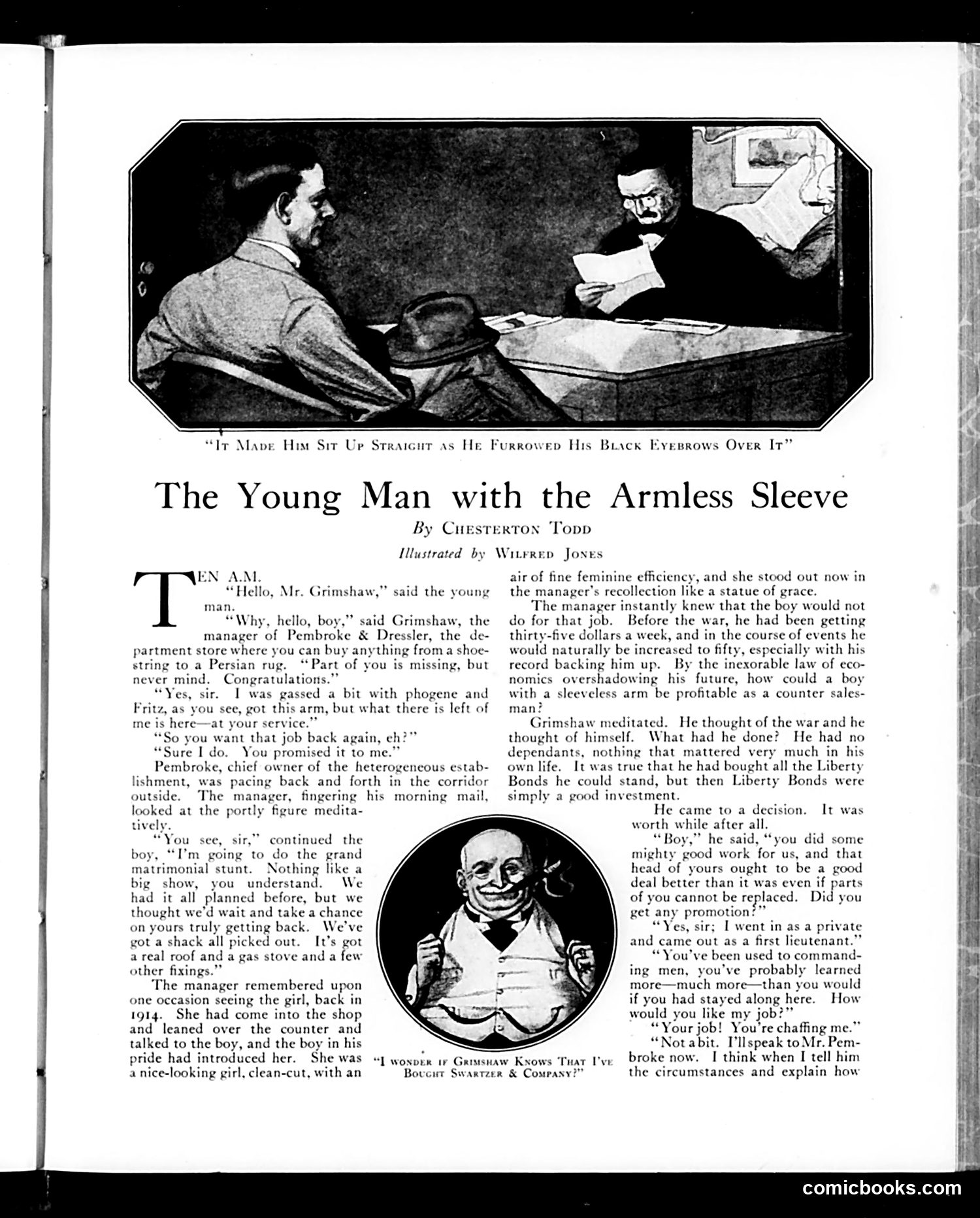
This story by Chesterton Todd, illustrated by Wilfred Jones, addresses WWI disabled veterans. The narrative centers on a young man who lost his arm in service and seeks employment at a department store. The satire critiques both employer attitudes and post-war economic realities. Mr. Grimshaw, the store manager, initially dismisses the veteran but then reconsiders, recognizing his patriotic sacrifice and value as an employee. The story ironically explores how businesses were slow to hire disabled veterans despite public gratitude for their service. The central image shows Grimshaw (a portly, satisfied businessman), suggesting the disconnect between wartime rhetoric and actual employment opportunity for wounded soldiers—a significant social issue in 1910s-1920s America following WWI.
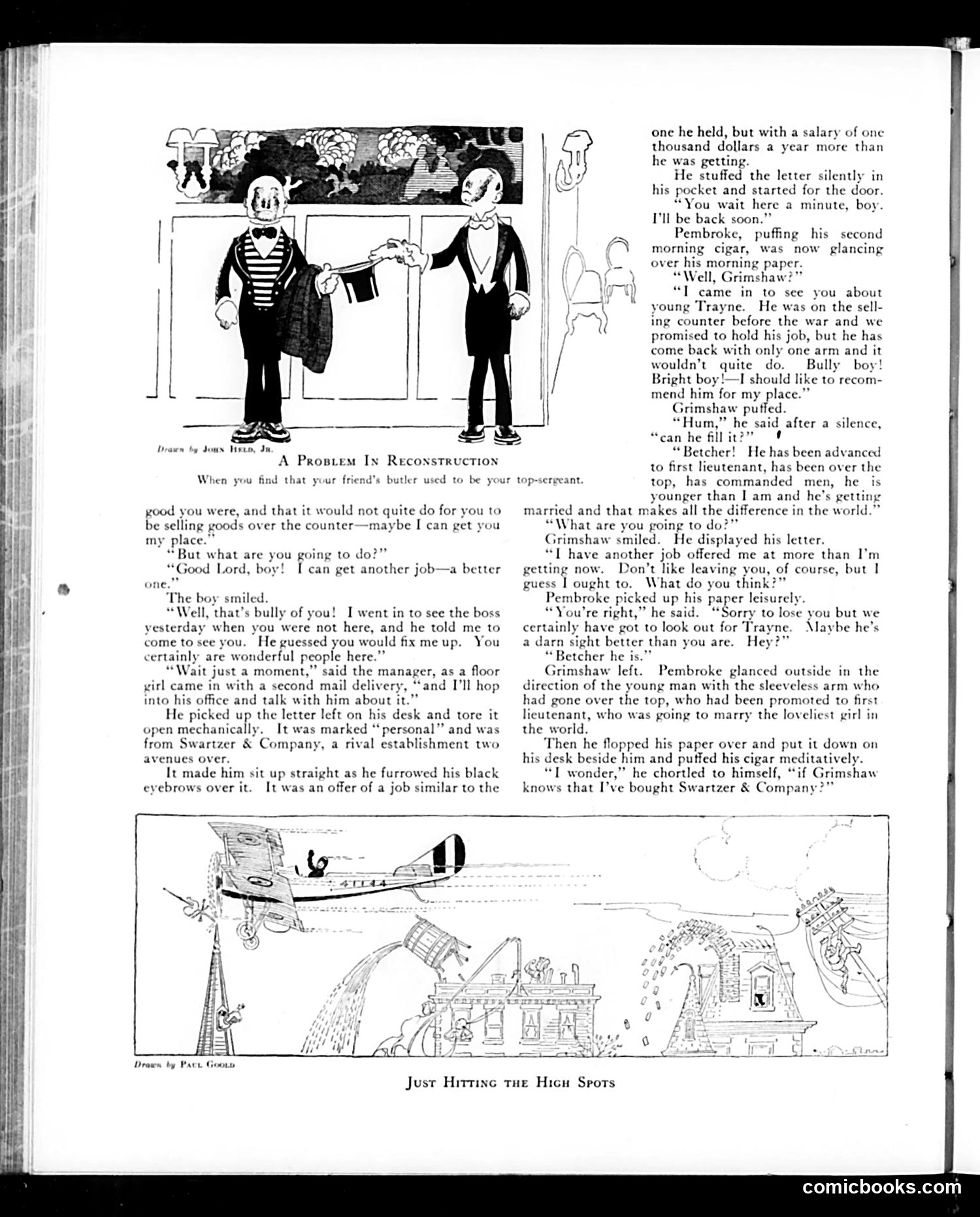
This cartoon satirizes post-WWI employment challenges. A young man (Trayne) returns from war having lost an arm but seeks his old job back at a counter. His former superior, now promoted to manager under the Swartzee & Company restructuring, refuses him—offering instead a lower position with higher pay. The satire targets the contradiction: despite economic advancement, the ex-serviceman faces demotion. The title "Reconstruction" references post-war readjustment. The joke's bitter edge criticizes how returning disabled veterans were treated—offered money but not respect or comparable positions. The lower cartoon, "Just Hitting the High Spots," appears unrelated, depicting aerial bombardment, possibly commenting on war's destructiveness.
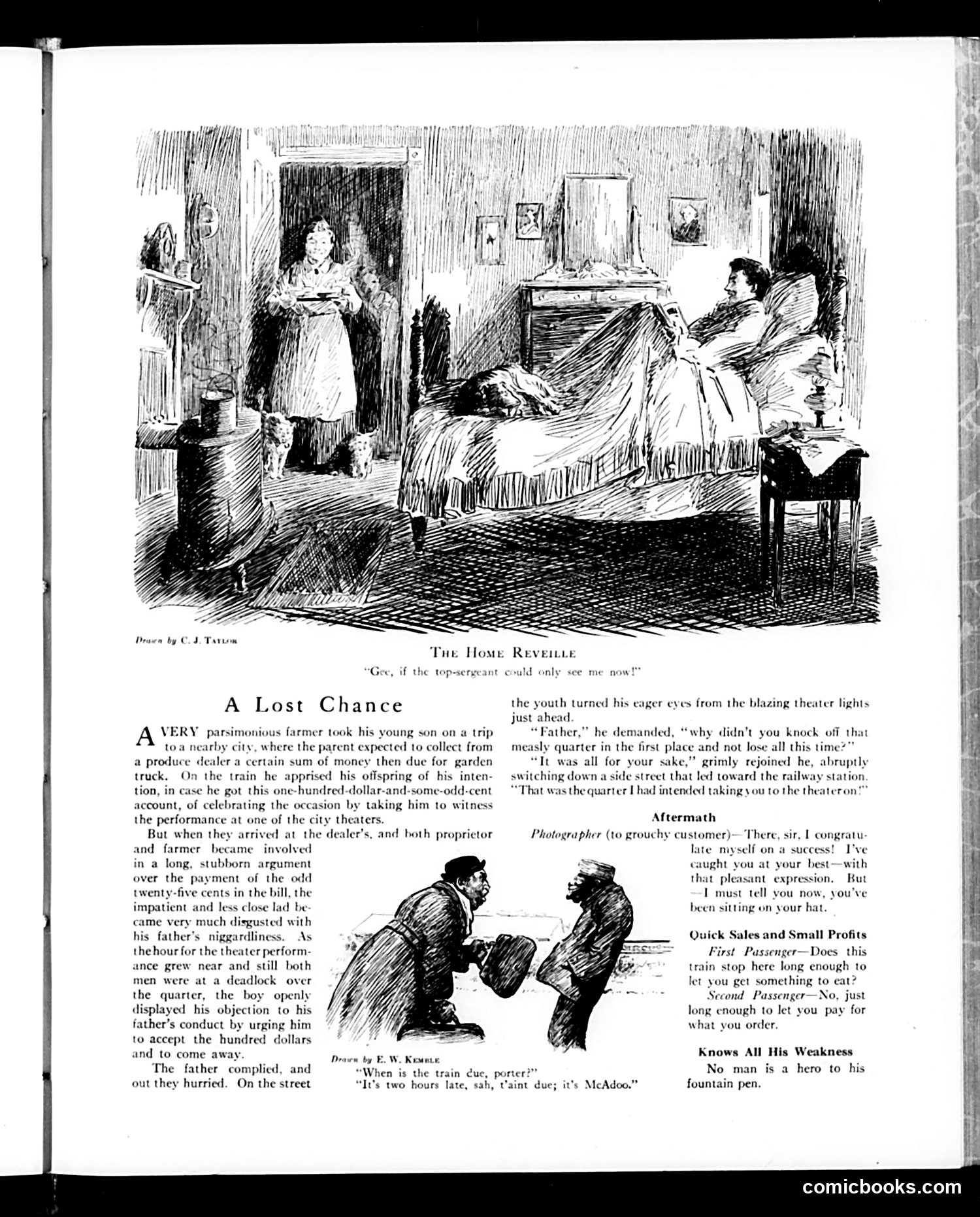
This page contains three separate humorous sketches typical of early 20th-century Judge magazine. **"A Lost Chance"** (main story): A miserly farmer refuses to forgive a produce dealer 25 cents on a $100+ bill. While he argues over this trivial amount, his son grows frustrated, missing the promised theater performance. The ironic punchline: the father was saving that quarter *for* the theater trip—he loses far more value (his son's joy, the outing itself) by being penny-pinching. **"The Home Reveille"** (top illustration): Depicts a domestic dispute over a husband's night out at theaters, with his wife clearly displeased. **Bottom sketches**: Brief comedic vignettes—a photographer's backhanded compliment; train passengers discussing meal costs; and a joke about a fountain pen being unreliable ("No man is a hero to his fountain pen"). The satire targets miserliness and petty arguing over trivial amounts while losing sight of greater goods—a common Gilded Age theme.
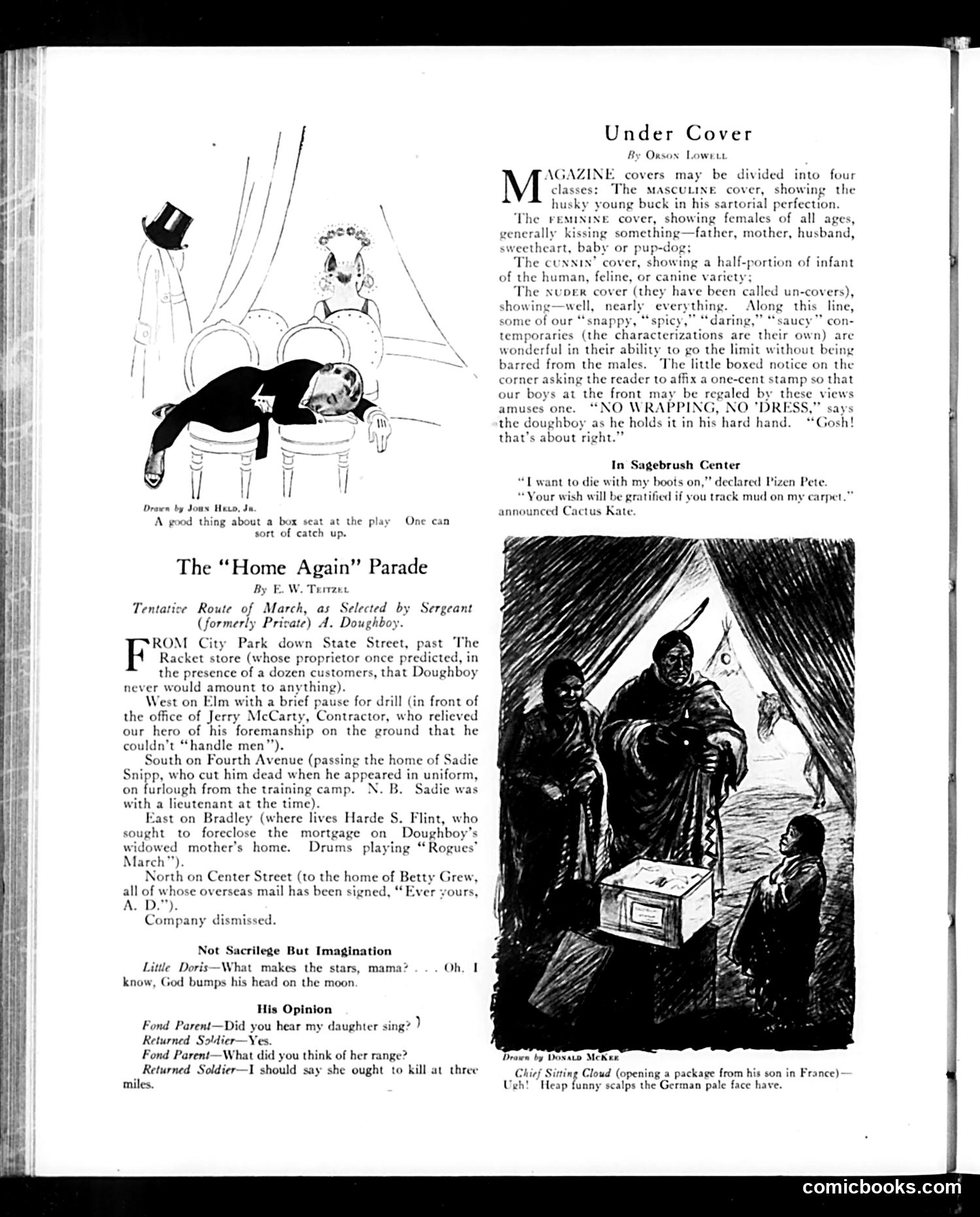
This page contains three satirical pieces targeting post-WWI American society: **"The 'Home Again' Parade"** mocks a returning soldier's planned victory march through his hometown. The satire reveals petty grievances the soldier plans to highlight: passing the store owner who doubted him, drilling before the contractor who fired him, parading past Sadie Snipp (who snubbed him for a lieutenant), and marching past Harde Flint (who foreclosed on his mother's home). The joke critiques small-town hypocrisy—these people ignored or mistreated the soldier before his military service; now he'll flaunt his uniform before them. **"His Opinion"** features a returned soldier's blunt assessment of a woman's singing voice, suggesting she "ought to kill at three miles"—dark humor about lethal range, implying her singing is weaponlike. **"Chief Sitting Cloud"** presents a Native American receiving a package from his soldier son in France, joking about "German pale face" scalps. This reflects period attitudes mixing racial stereotypes with WWI commentary. All pieces use returning soldiers to satirize American social pretense and wartime experiences.
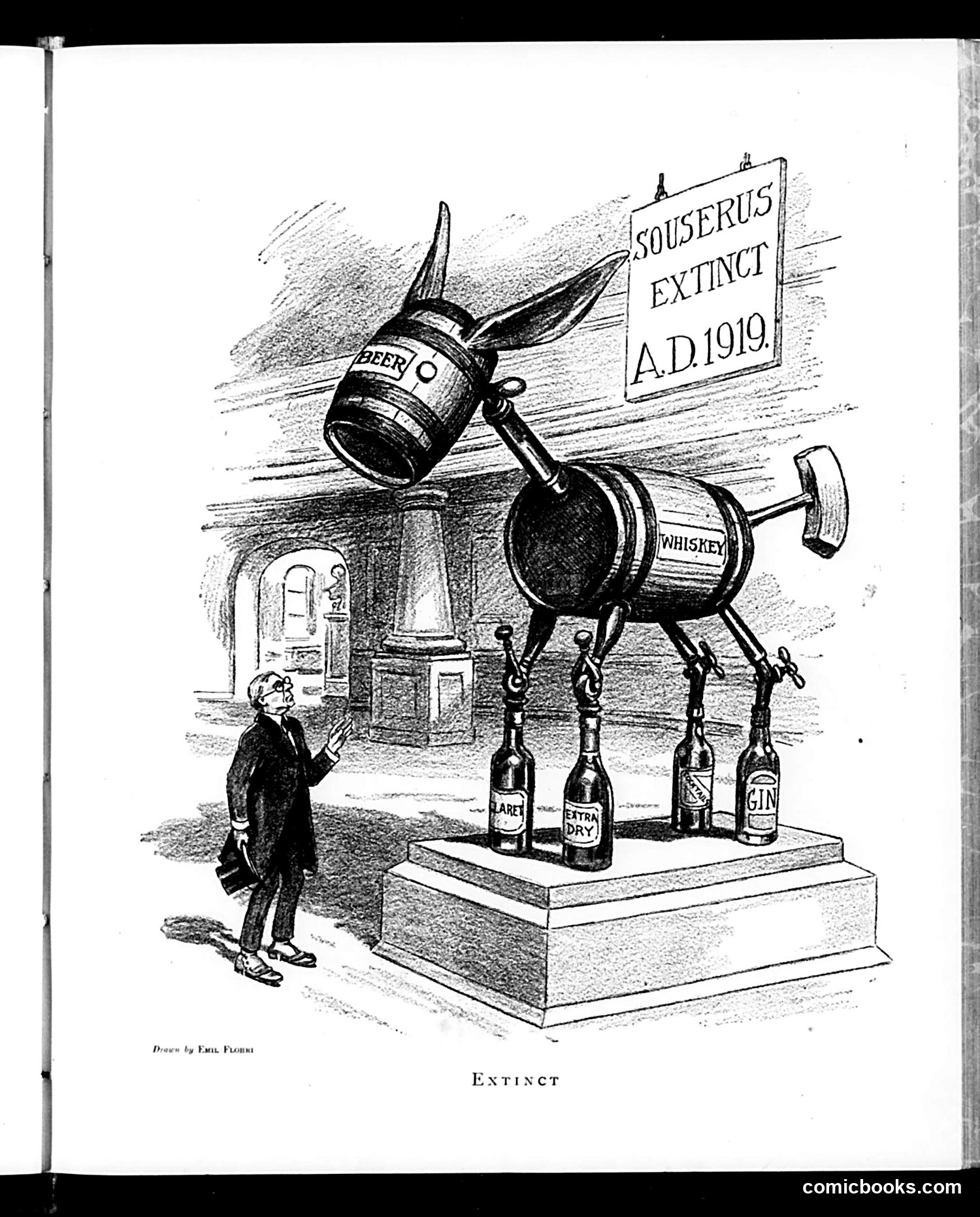
This 1919 cartoon satirizes American Prohibition, which began that year. A grotesque donkey—a classical symbol of stubbornness or folly—carries barrels labeled "BEER," "WHISKEY," and bottles of "EXTRA DRY" and "GIN." The sign reads "SOUSERUS EXTINCT A.D. 1919," mocking the idea that drunkenness would disappear. A small man observes this monument to vanished vice. The satire is clear: Judge magazine doubted Prohibition would actually eliminate drinking. The anthropomorphic "drunken beast" monument suggests satirists viewed the law as naive—alcohol consumption wouldn't truly die out despite legal prohibition. The cartoon expresses skepticism about the amendment's effectiveness, a common sentiment among critics of Prohibition.
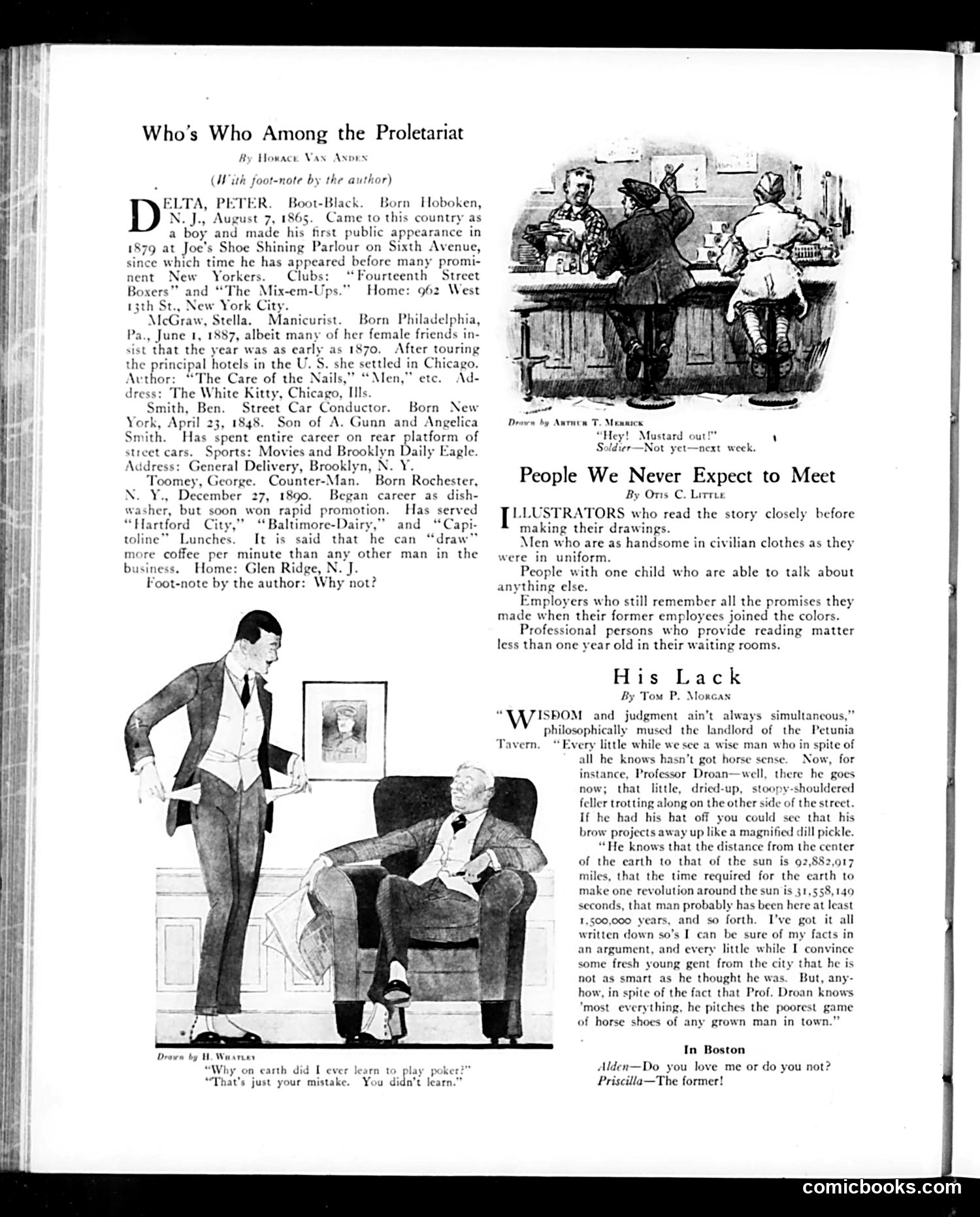
This page from *Judge* contains three satirical pieces mocking working-class and intellectual subjects: **"Who's Who Among the Proletariat"** parodies society columns by creating mock biographies of ordinary laborers (bootblack, manicurist, street car conductor, lunch counter worker). The humor lies in treating menial jobs with the grandiose tone of wealthy socialite profiles—listing "clubs," achievements, and addresses as if these were notable figures. **"People We Never Expect to Meet"** is a cynical list mocking post-WWI reality: illustrators who read scripts carefully, handsome demobilized soldiers, employers who kept promises to enlisted workers. The satire suggests these things are so rare they're practically mythical. **"His Lack"** ridicules academic knowledge divorced from practical sense—a professor knows astronomical facts but plays terrible horseshoes. This reflects early 20th-century anti-intellectual humor. The cartoons reinforce these themes of class mockery and absurdity, typical of *Judge's* satirical approach to American social pretension and contradictions.
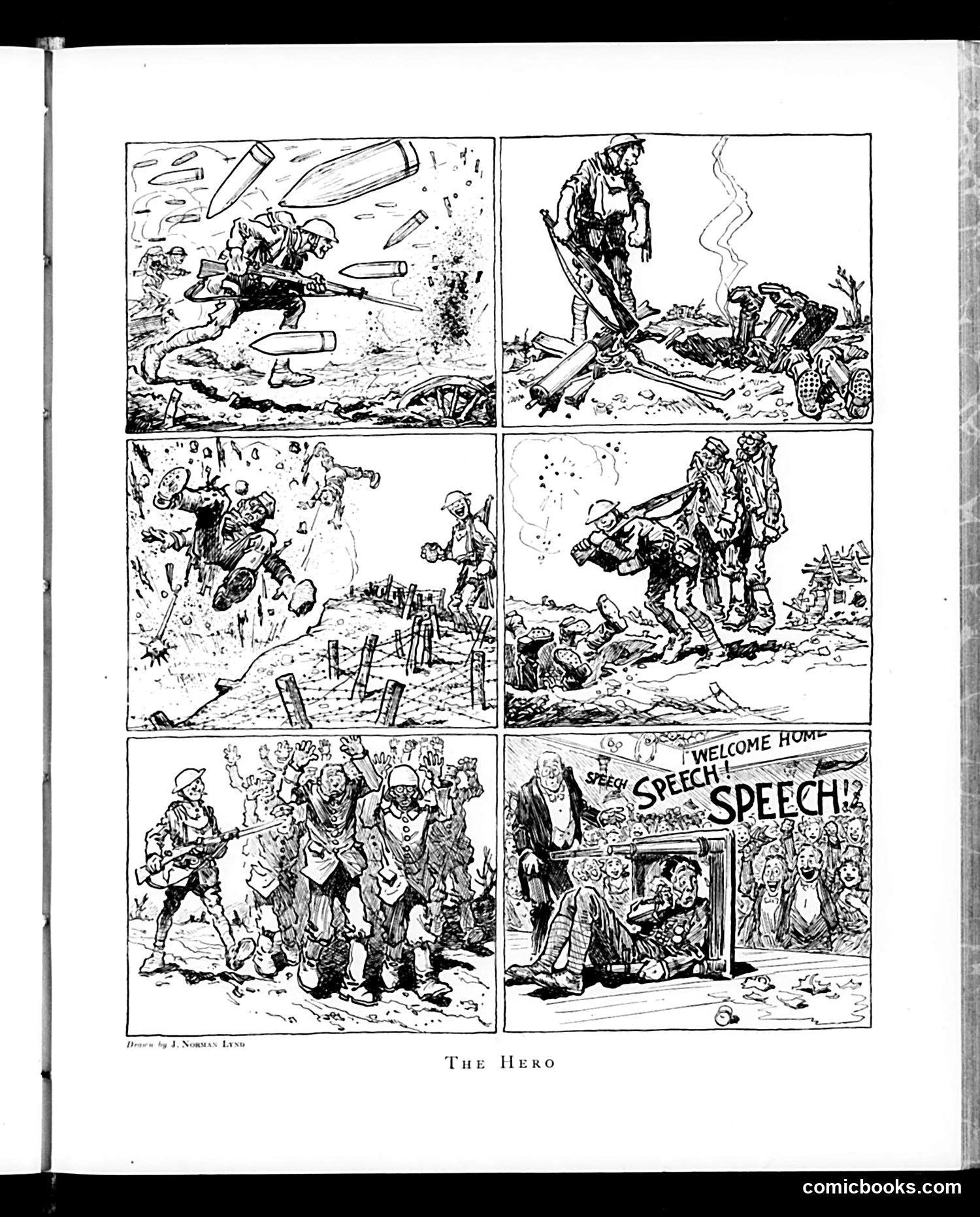
This six-panel comic strip, drawn by J. Norman Lynd, appears to satirize a military or political figure's journey from battlefield valor to public celebration. The sequence shows: 1-2. Combat scenes with explosions and casualties 3-4. The soldier amid destruction and civilian suffering 5. A triumphant reception with crowds 6. A "Welcome Home Speech" ceremony with masses gathered The satire likely critiques the disconnect between warfare's brutal reality (panels 1-4, showing death and devastation) and the hero's-welcome celebration (panels 5-6). It suggests the public romanticizes military service while ignoring its human cost. The title "The Hero" appears ironic, questioning what actually constitutes heroism—the fighting itself or the political pageantry surrounding it.
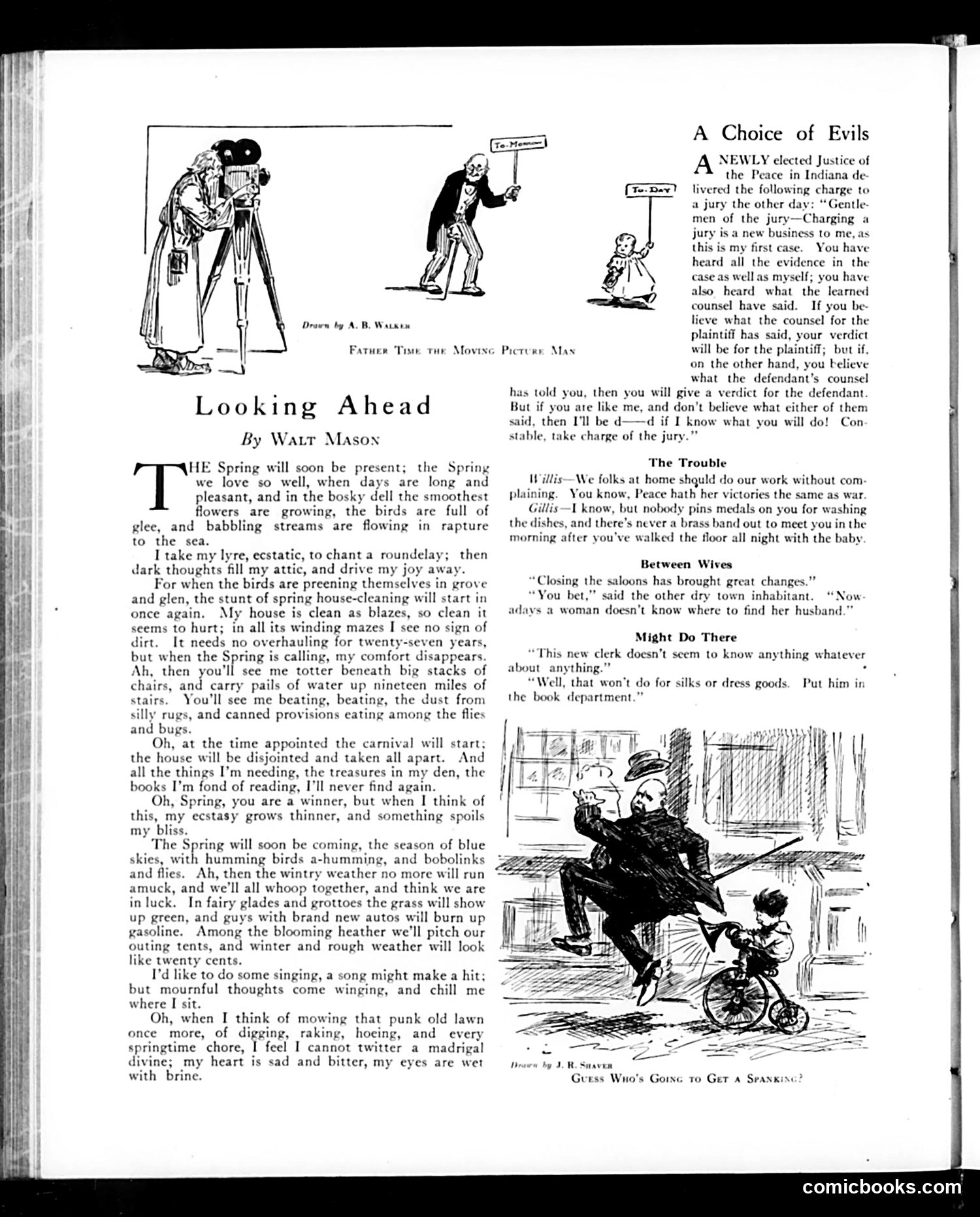
This page from *Judge* contains humor pieces reflecting early 20th-century domestic life: **"Looking Ahead"** (poem by Walt Mason): A humorous lament about spring's arrival. While spring seems romantic, the narrator dreads the inevitable spring cleaning—hauling water upstairs, beating rugs, then the house being "disjointed and taken all apart" for renovations. He'll lose his books and treasures in the chaos. The joke is the contrast between spring's poetic promise and the very real, exhausting domestic labor it triggers. This resonates with pre-modern domestic work's physical demands. **Three brief comedic sketches** present marriage/domestic humor: - A newly elected judge admits he can't judge fairly, so tells jurors to believe whoever they want - "The Trouble": A wife complains her husband gets no recognition for housework (unlike soldiers with medals) - "Between Wives": Closing saloons means wives now know where to find their husbands - "Might Do There": A clerk is incompetent—suggested for the book department The illustrations show period dress and domestic scenes. The humor is gentle, reflecting working and middle-class anxieties about labor, marriage, and social change.
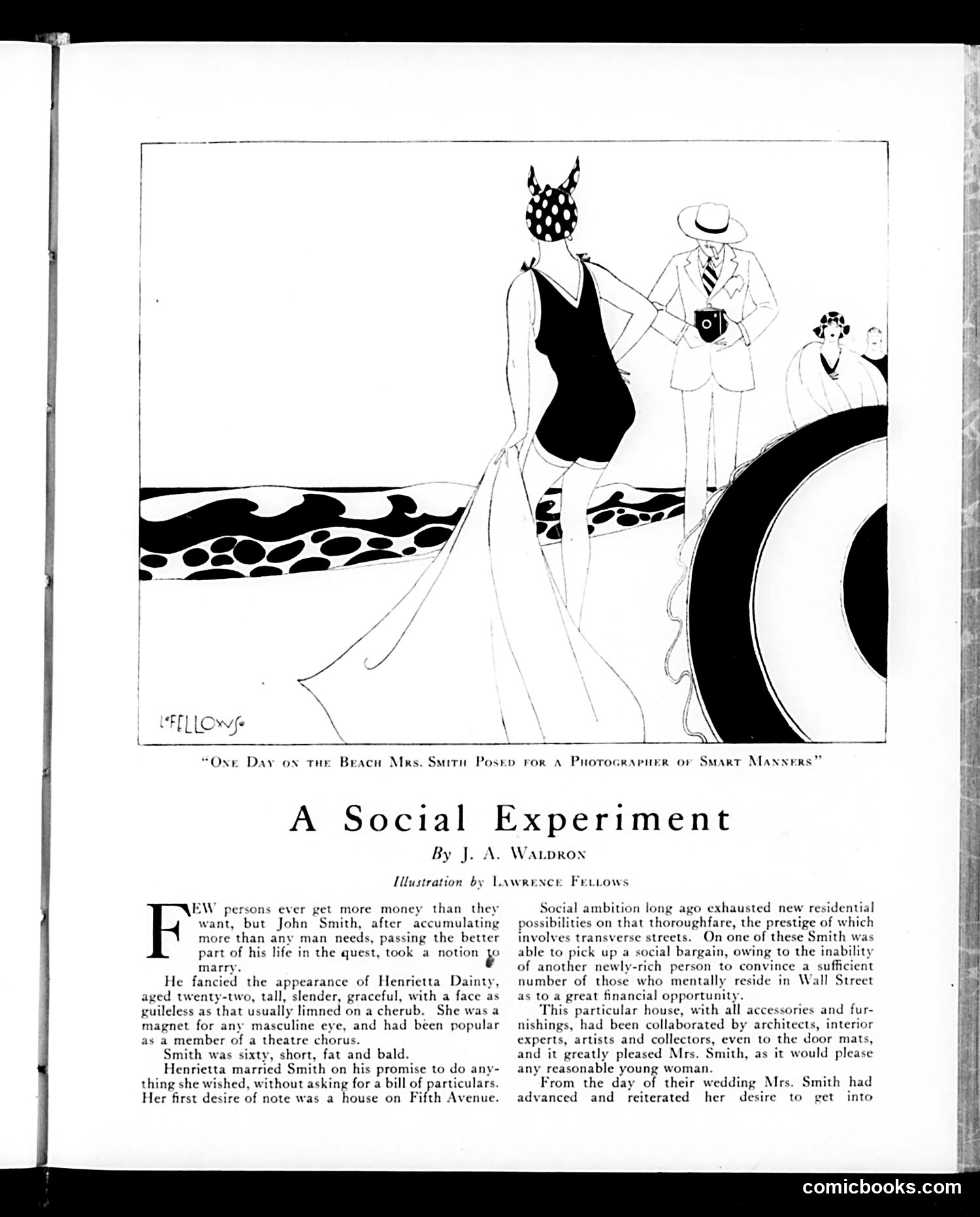
This is the opening of a short story illustrated by Lawrence Fellows. The satire targets wealthy American social climbers of the Jazz Age era. **The Setup:** An elderly, wealthy but physically unattractive man (John Smith—sixty, short, fat, bald) marries a young, attractive chorus girl (Henrietta Dainty, twenty-two) who exploits his promise to grant her any wish. She immediately demands a Fifth Avenue mansion. **The Social Satire:** The text mocks "new money" ambition—Smith acquired his wealth but lacks social standing. Even prestigious Fifth Avenue addresses are purchased second-hand from other newly-rich people unable to convince "Wall Street" residents of their financial legitimacy. The house itself, decorated by "architects, interior experts, artists and collectors," is clearly a status symbol rather than a home. **The Joke:** The illustration shows Mrs. Smith posing for a "Smart Manners" photographer at the beach—she's performing social respectability while wearing a bold, attention-getting bathing suit. The caption and story suggest her real goal isn't domestic happiness but social acceptance, which money alone cannot buy.
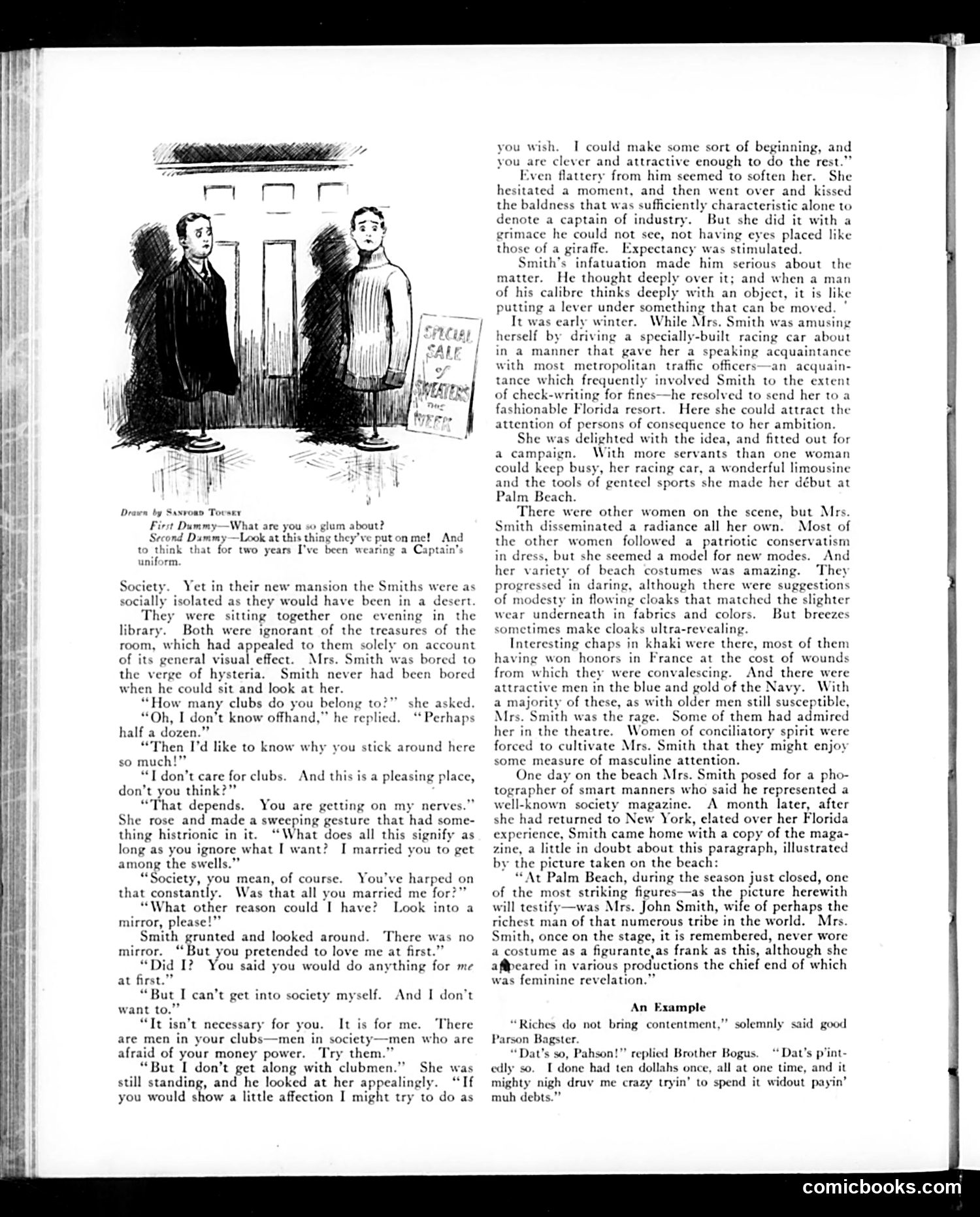
The small cartoon at top depicts two ventriloquist dummies complaining to each other. One grumbles about wearing a "Captain's uniform" for two years, establishing a military/WWI context. This appears to be satirizing men forced into military service or uniform-wearing obligations—likely referencing conscription or wartime duties that feel restrictive. The accompanying story below mocks social climbing and marital discord among the newly wealthy. Mrs. Smith married her husband solely for social access, not affection. Though he's a successful industrialist ("captain of industry"), she finds him boring and uses manipulation—withholding affection—to pressure him into facilitating her entry into high society. The satire targets both figures: the materialistic wife pursuing social status through flirtation and elaborate beach fashions, and the wealthy but socially awkward husband she despises. The narrative suggests the pretense and emptiness of both new money and society women seeking prominence through connections rather than genuine accomplishment.
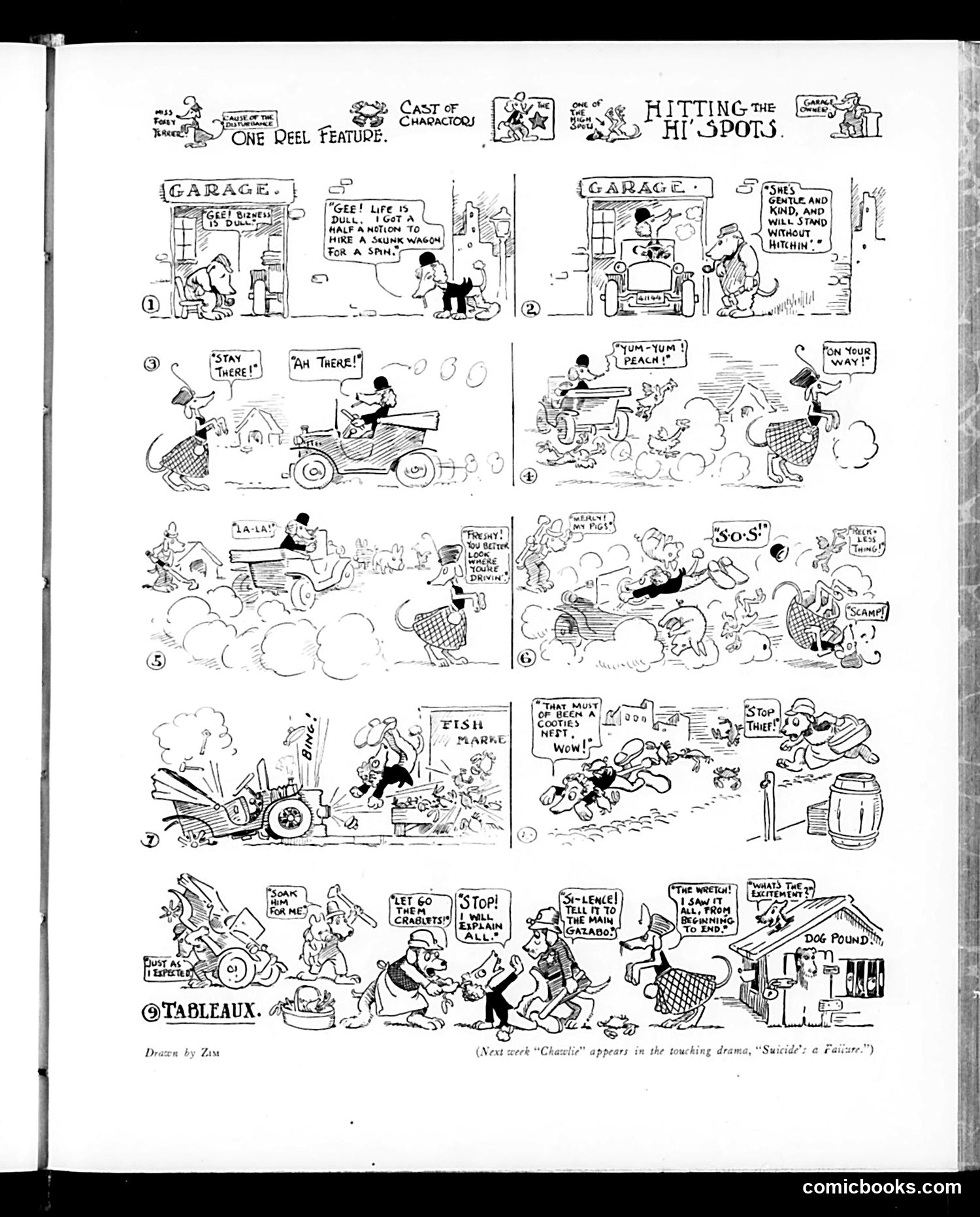
This is a comic strip drawn by Zim parodying a Charlie Chaplin-style silent film. The narrative follows a comedic character in an old automobile creating chaos through a series of mishaps: starting in a garage, careening through streets, causing a traffic accident, destroying a fish market, and ultimately crashing into a dog pound. The humor relies on physical comedy typical of 1920s slapstick cinema—collisions, property damage, and absurd consequences. The title "Hitting the Hi Spots" suggests the character is touring locations throughout town, each encounter escalating in destructiveness. The footnote references that Chaplin appears in the accompanying film drama "Suicide: A Failure," likely a contemporary picture being promoted. The strip functions as promotional material for silent film entertainment popular during this era, satirizing both the genre's predictable chaos and the era's fascination with automobile culture.
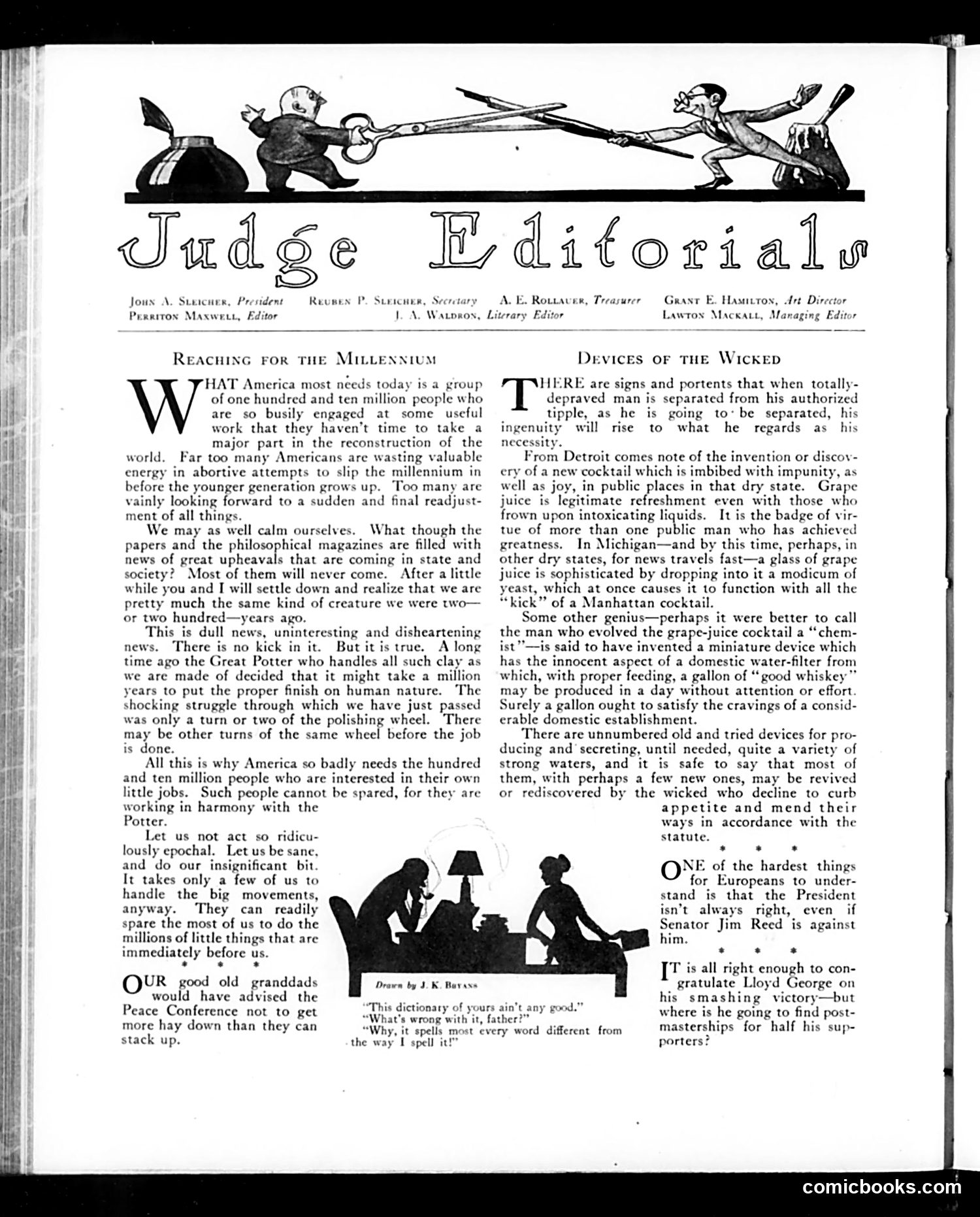
This page contains two editorials and one cartoon from Judge magazine, likely from the Prohibition era (1920s-early 1930s). **"Reaching for the Millennium"** argues Americans waste energy pursuing radical social reform. The editorial counsels patience, claiming human nature changes slowly and most citizens should focus on their own work rather than grand schemes. **"Devices of the Wicked"** satirizes Prohibition enforcement. It describes ingenious workarounds: a "grape juice cocktail" made by adding yeast to create fermentation, and a miniature device disguised as a water-filter that produces homemade whiskey. The piece mocks both the law's ineffectiveness and citizens' creative defiance. **The cartoon** (by J.K. Baraks) shows a father-daughter dispute over dictionary spelling, likely commenting on language standardization or generational disagreements—the specific point is unclear from the visible caption alone. The content reflects post-WWI American anxieties about social change and Prohibition's actual implementation challenges.
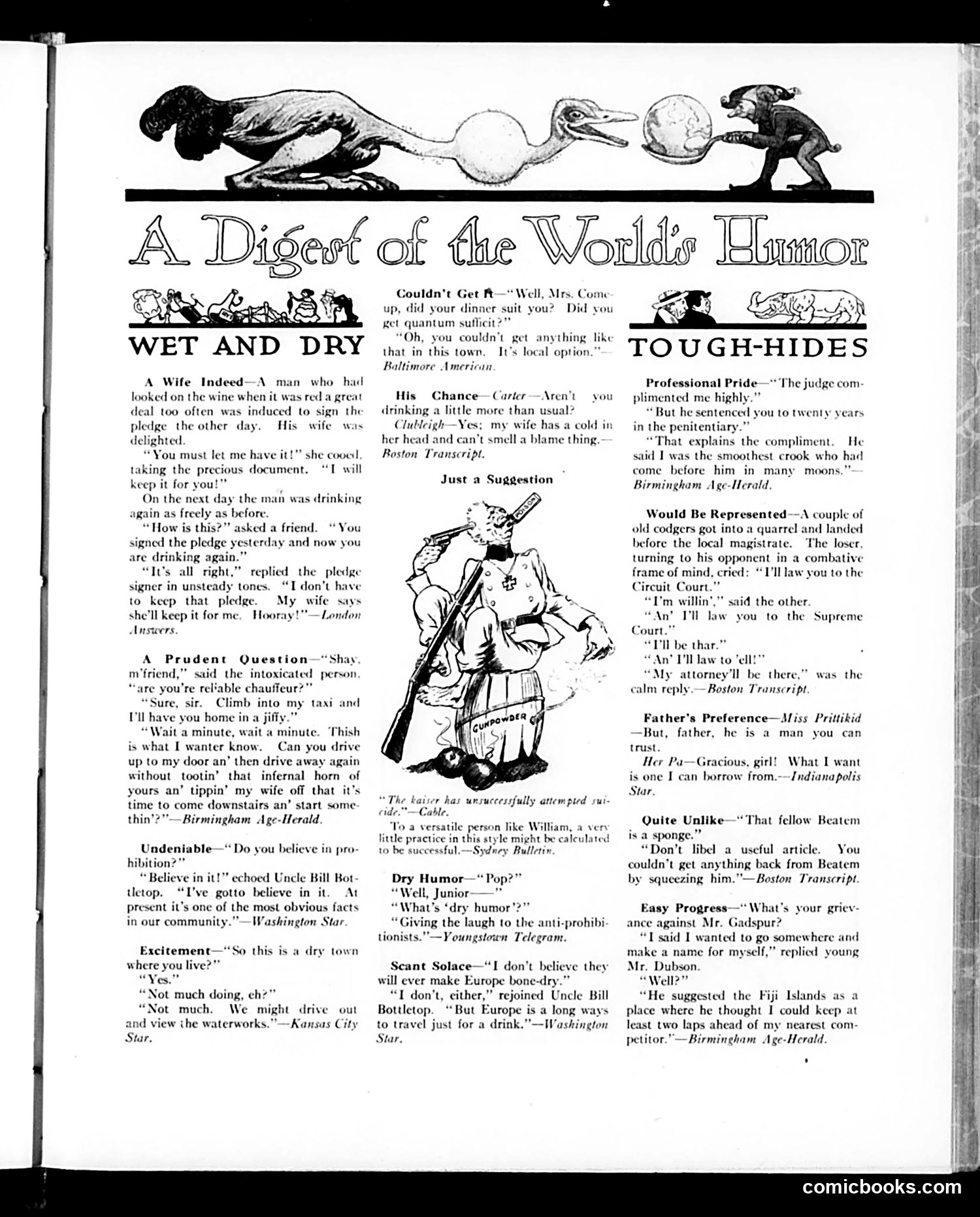
This page collects brief humorous anecdotes organized under three sections: "Wet and Dry," "Tough-Hides," and miscellaneous jokes. The dominant theme is **Prohibition**—the legal ban on alcohol that was either recently enacted or hotly debated when this was published. The "Wet and Dry" jokes mock both drinkers and prohibitionists: a man signs a temperance pledge but immediately resumes drinking; a drunk man asks his taxi driver not to honk (fearing his wife will discover his drinking); a town's only attraction is "viewing the waterworks" (implying nothing else exists in a dry/prohibition town). Other jokes target:** marital dynamics around drinking, judicial corruption, social climbing, and con artists.** The reference to "William" attempting "suicide" (with a small illustration of a military figure) appears to reference Kaiser Wilhelm II, playing on dark wartime humor. The cartoons are simple line drawings accompanying brief, punchy jokes emphasizing wordplay and social observation rather than detailed political commentary. The overall tone is light ridicule of drinking culture, spousal relationships, and small-town provincial life.
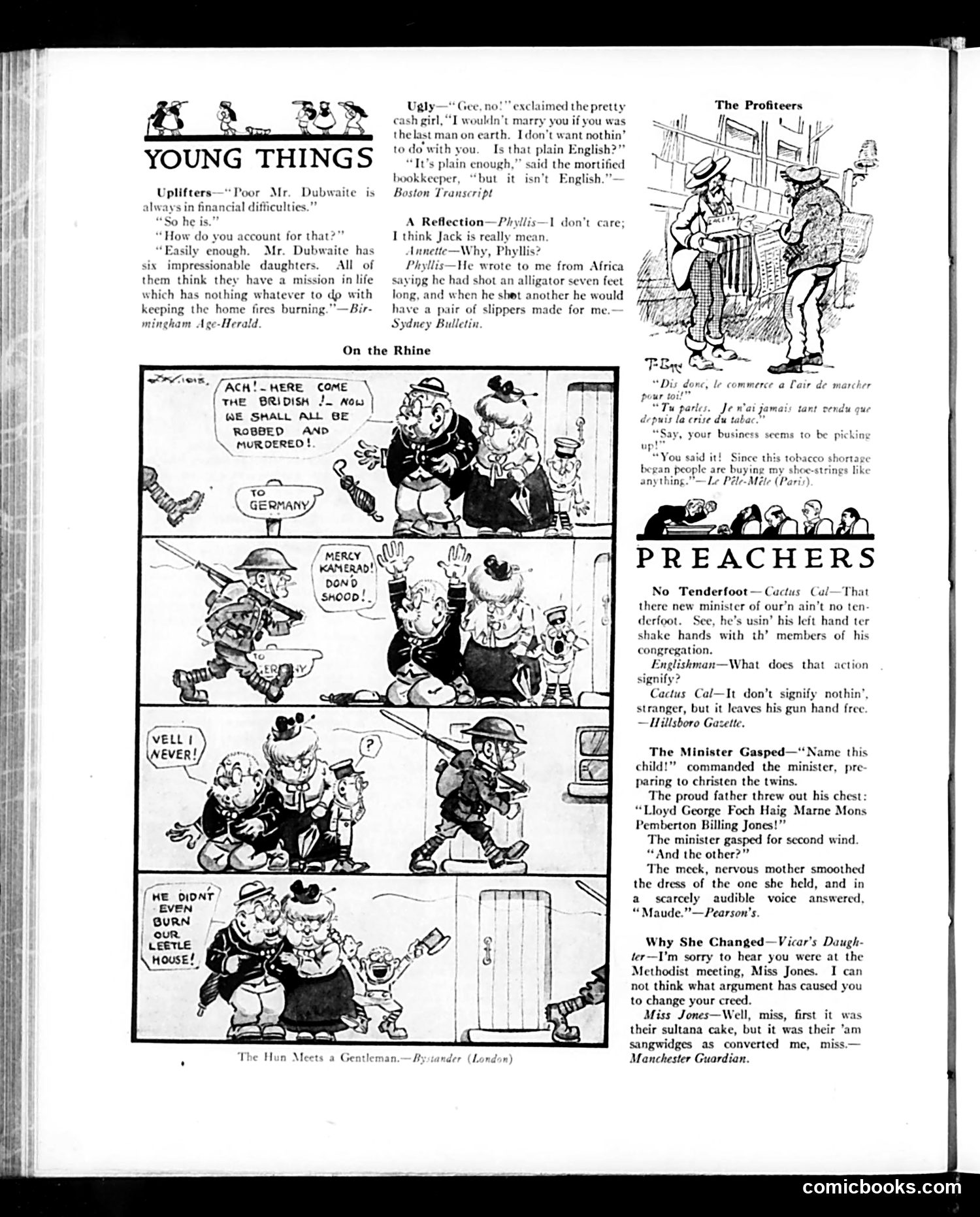
This Judge magazine page contains satirical snippets and cartoons from roughly the WWI era. **"On the Rhine" comic:** Shows Germans reacting to British soldiers with alarm ("We shall all be robbed and murdered!"). The satire mocks German anxiety about invasion, likely reflecting wartime propaganda and tensions. **Other notable content:** - **"Young Things"**: Mocks idealistic young women with "missions in life" who burden their financially-struggling fathers—satirizing early feminism/women's social activism as impractical. - **"The Profiteers"**: A French cartoon criticizing war profiteering; a businessman exploits tobacco shortages to sell shoe-strings, embodying wartime economic exploitation. - **"The Minister Gasped"**: Jokes about naming children after WWI military figures (Lloyd George, Foch, Haig, Marne, Mons)—satirizing extreme patriotic fervor. - **"Why She Changed"**: Gentle humor about religious conversion motivated by food rather than theology—mocking superficial faith. The page reflects 1910s-20s concerns: wartime anxieties, women's changing roles, profiteering, and nationalism.
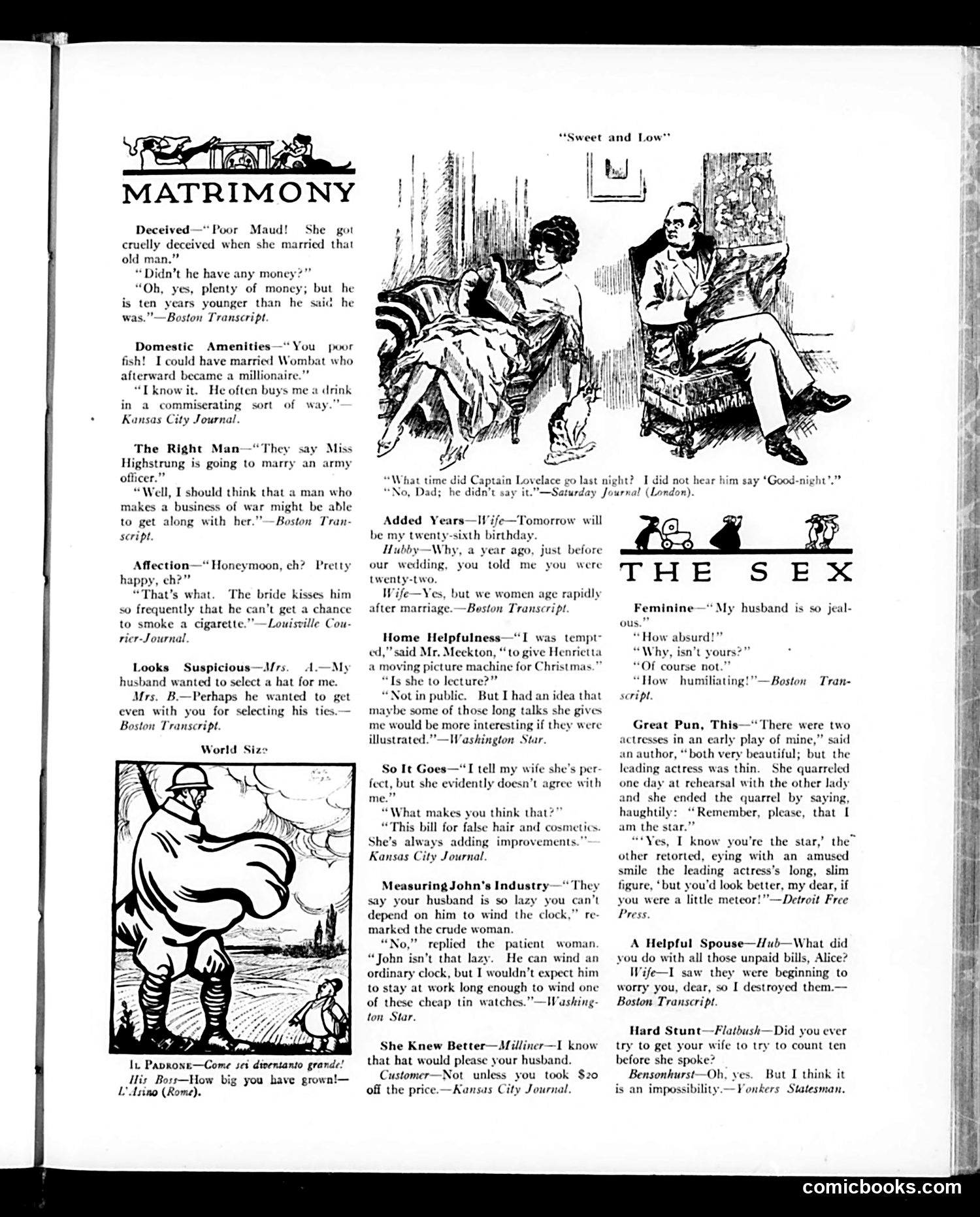
This page collects short humorous anecdotes mocking domestic life and marriage, reflecting early 20th-century attitudes toward spouses—particularly wives. The "Matrimony" section satirizes deception in marriage: a woman deceived by her husband's age despite his wealth; wives frustrated by husbands' cheapness despite becoming rich; women marrying for security then discovering their husbands' flaws. The "Sex" section ridicules gender stereotypes: wives obsessing over appearance (false hair, cosmetics), talking excessively, being jealous, or emotionally unstable. One joke mocks a thin actress—a "meteor" compared to a star. A husband "helps" by destroying unpaid bills to stop his wife's worry. The humor assumes male readers and positions wives as irrational, vain, and troublesome. A recurring theme: wives are nearly impossible to satisfy or manage. These anecdotes normalize dismissive male attitudes toward female intelligence and autonomy, typical of satirical magazines aimed at male audiences in this era.
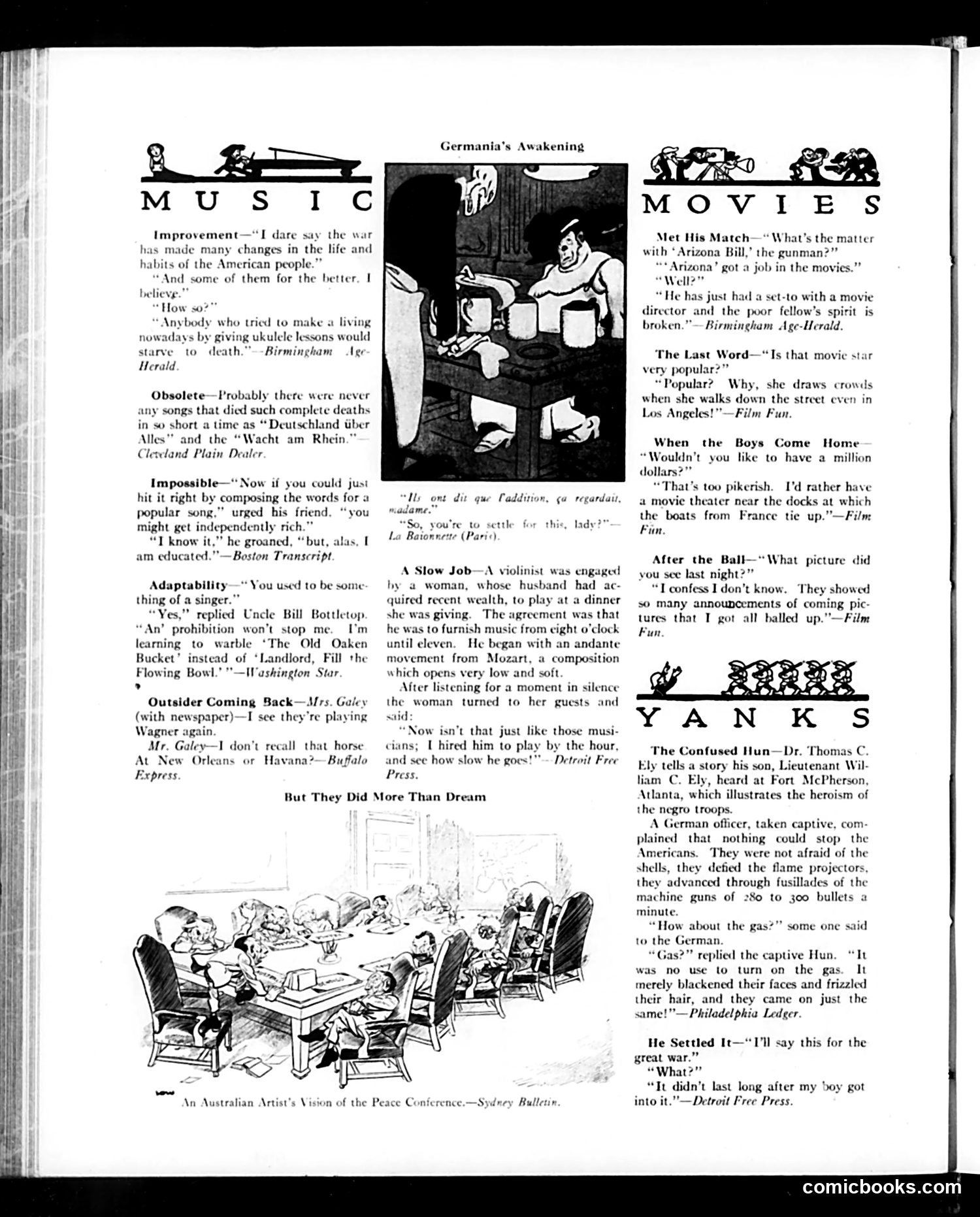
This page from Judge magazine appears to date from World War I's aftermath. The central cartoon titled "Germania's Awakening" depicts a German woman and man in conversation, with French caption indicating discussion of settling a bill—likely satirizing Germany's financial reparations obligations after the war. The cartoon mocks Germany's postwar situation, suggesting Germans must accept harsh financial penalties ("settle for this"). "Germania" personifies Germany itself, shown confronting economic consequences of defeat. The surrounding humor section includes jokes about German songs ("Deutschland über Alles," "Wacht am Rhein") becoming obsolete post-war, reflecting anti-German sentiment prevalent in 1918-1920s America. Other items joke about ukuleles and Prohibition's effects on popular music. The "Yanks" section celebrates American and African-American soldier heroism against German forces, including anecdotes about Black troops' courage under gas attacks—presenting Americans as superior warriors. Overall, the page expresses triumphant post-WWI American attitudes toward defeated Germany and celebrates the Allied victory.
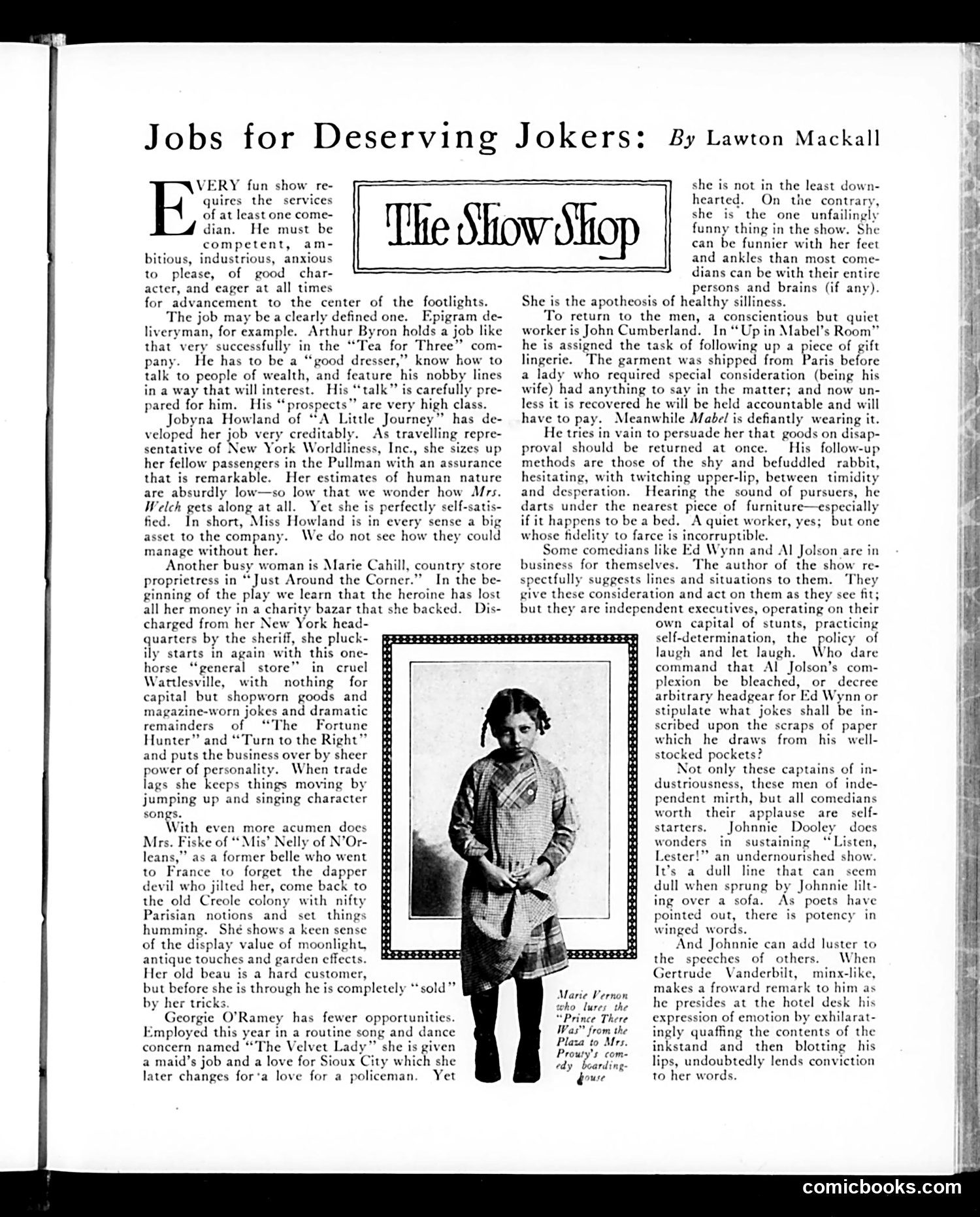
This article by Lawton Mackall analyzes comedians' specialized roles in Broadway shows circa 1920s. The piece examines how successful comedians function as distinct "jobs" within productions. The article profiles various performers: Arthur Byron delivers witty epigrams in "Tea for Three"; Jobyna Howland plays a snobbish Pullman passenger in "A Little Journey"; Marie Cahill runs a general store in "Just Around the Corner"; John Cumberland plays a befuddled husband pursuing lingerie in "Up in Mabel's Room." The satire's point: comedians aren't interchangeable entertainers but specialists with carefully crafted personas. Some (Ed Wynn, Al Jolson) operate independently with their own material; others perform scripted roles. The article celebrates how these performers succeed through personality, physical comedy, and meticulous character development rather than mere joke-telling. The accompanying photograph shows Marie Vernon in a character costume from one of these theatrical productions.
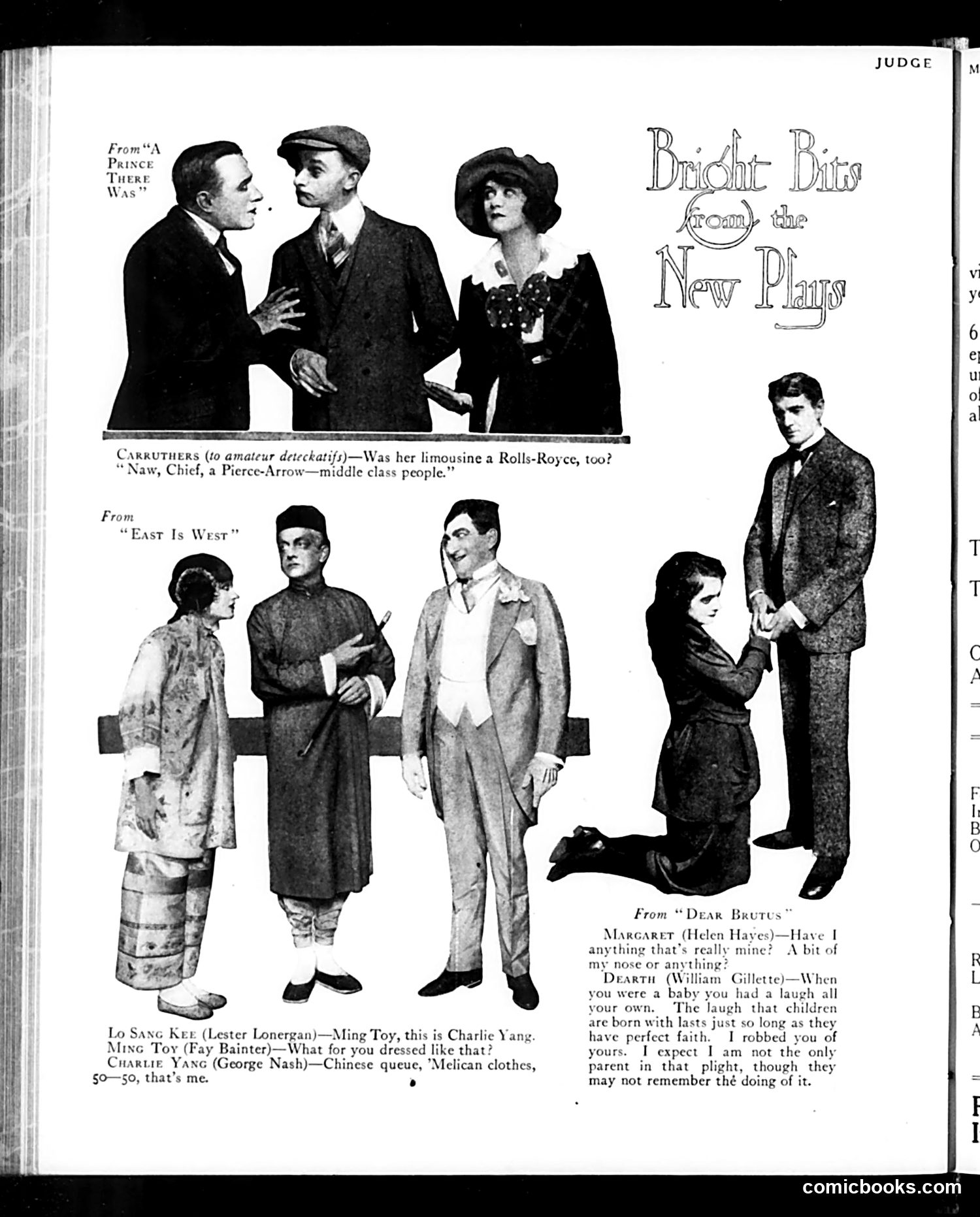
This page presents satirical excerpts from three contemporary theatrical productions, mocking both the plots and social attitudes they depict. The top cartoon ridicules class pretension: detectives discussing a woman's limousine, with the joke being that a Pierce-Arrow (a luxury car, but not the most expensive) indicates "middle class people"—satirizing the absurd status-consciousness of amateur detectives. The "East Is West" section caricatures yellowface casting and stereotypical "Oriental" humor: characters with exaggerated Chinese names discussing clothing and queues, treating Chinese culture as exotic costume. The "Dear Brutus" excerpt quotes dialogue about childhood innocence and parental betrayal of trust—presented as melodramatic sentiment the magazine found worthy of mockery. Overall, Judge uses these theatrical snippets to satirize both the plays themselves and the social pretensions and prejudices they reflect or exploit. The humor assumes readers share the magazine's dismissal of such attitudes.
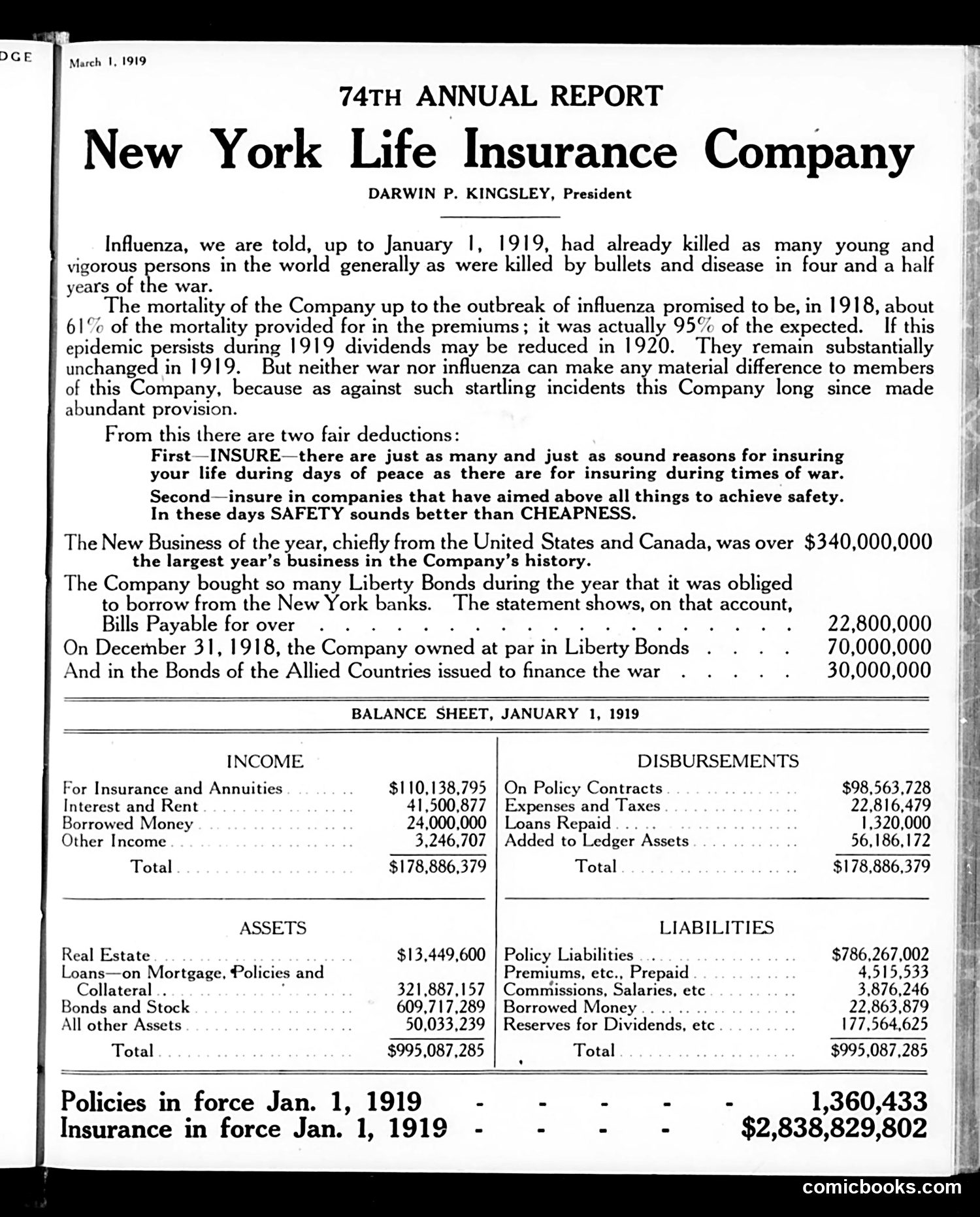
This is **not a cartoon or satirical content** — it's a straightforward corporate financial document: the 74th Annual Report of the New York Life Insurance Company dated March 1, 1919. The page contains the company president Darwin P. Kingsley's statement and detailed balance sheet. The only quasi-satirical element is the opening comparison: the 1918-1919 influenza pandemic had killed as many people as four-and-a-half years of World War I combat, yet the company remained solvent because it had made "abundant provision." The rhetorical point (stated plainly, not satirically) emphasizes life insurance as essential protection during peacetime, not just wartime. The company boasts record business ($340 million) and substantial Liberty Bond holdings ($100 million), supporting the war effort while maintaining financial stability. This appears to be Judge magazine's inclusion of corporate advertising/announcements rather than satirical editorial content.
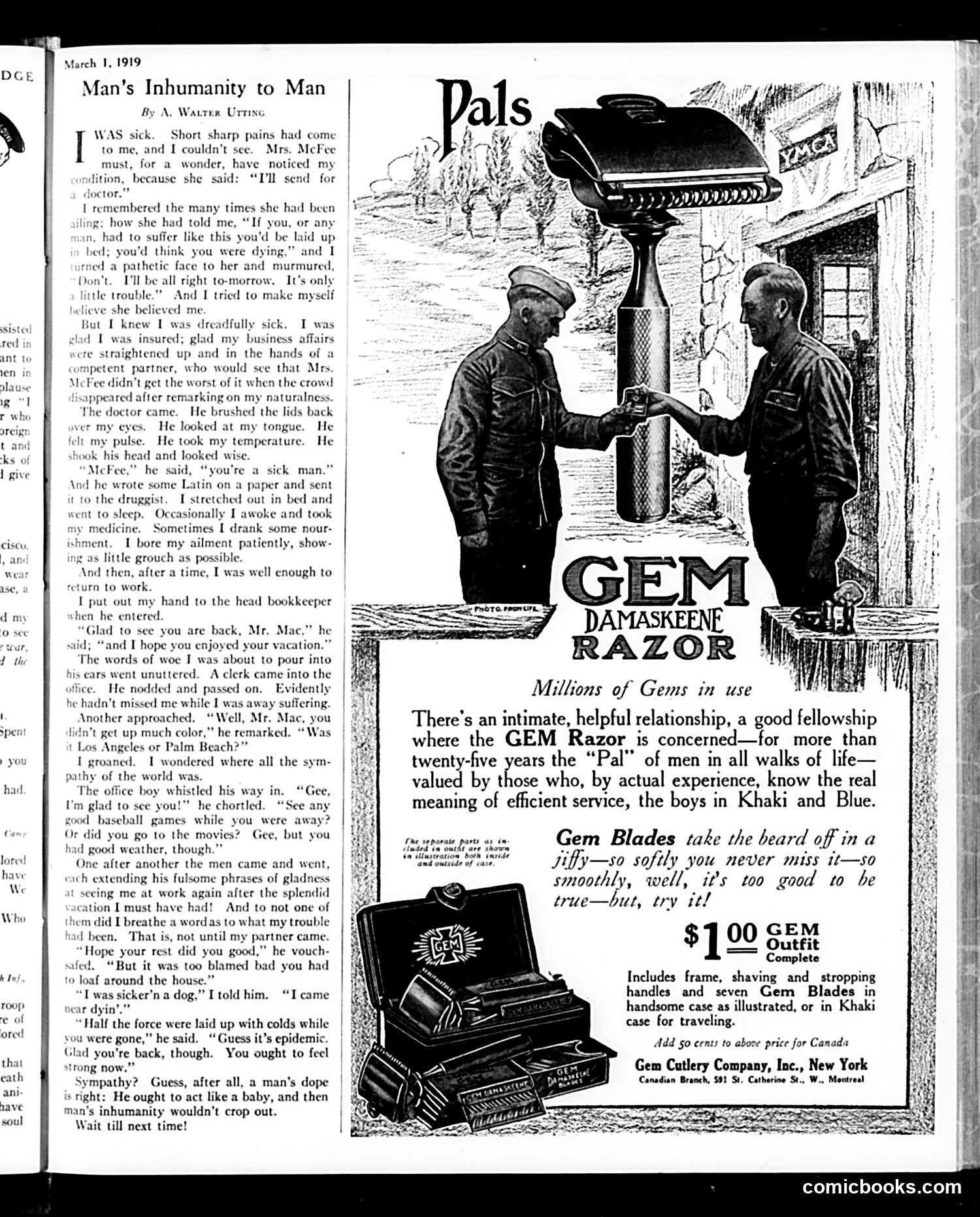
The left page presents a short story by A. Walter Upting depicting workplace indifference. A man recovers from serious illness only to return to work where colleagues show no genuine sympathy—they dismiss his suffering, assuming he enjoyed a vacation. Only his business partner acknowledges his absence, attributing it to an office-wide epidemic. The story concludes bitterly: the narrator realizes men only receive sympathy if they act helpless like babies. The satire targets **post-WWI American callousness**—written just after the 1918 armistice, it reflects broader anxieties about how society treats returning soldiers and the suffering of ordinary workers. The "man's inhumanity" theme suggests contemporary anxiety about workplace exploitation and emotional detachment in modern life. The right side is a **Gem Razor advertisement** exploiting the story's theme by positioning the razor as a loyal "pal" to men—contrasting genuine camaraderie with the cold indifference depicted left. The ad notably references "boys in Khaki and Blue" (soldiers and sailors), capitalizing on wartime sentiment.
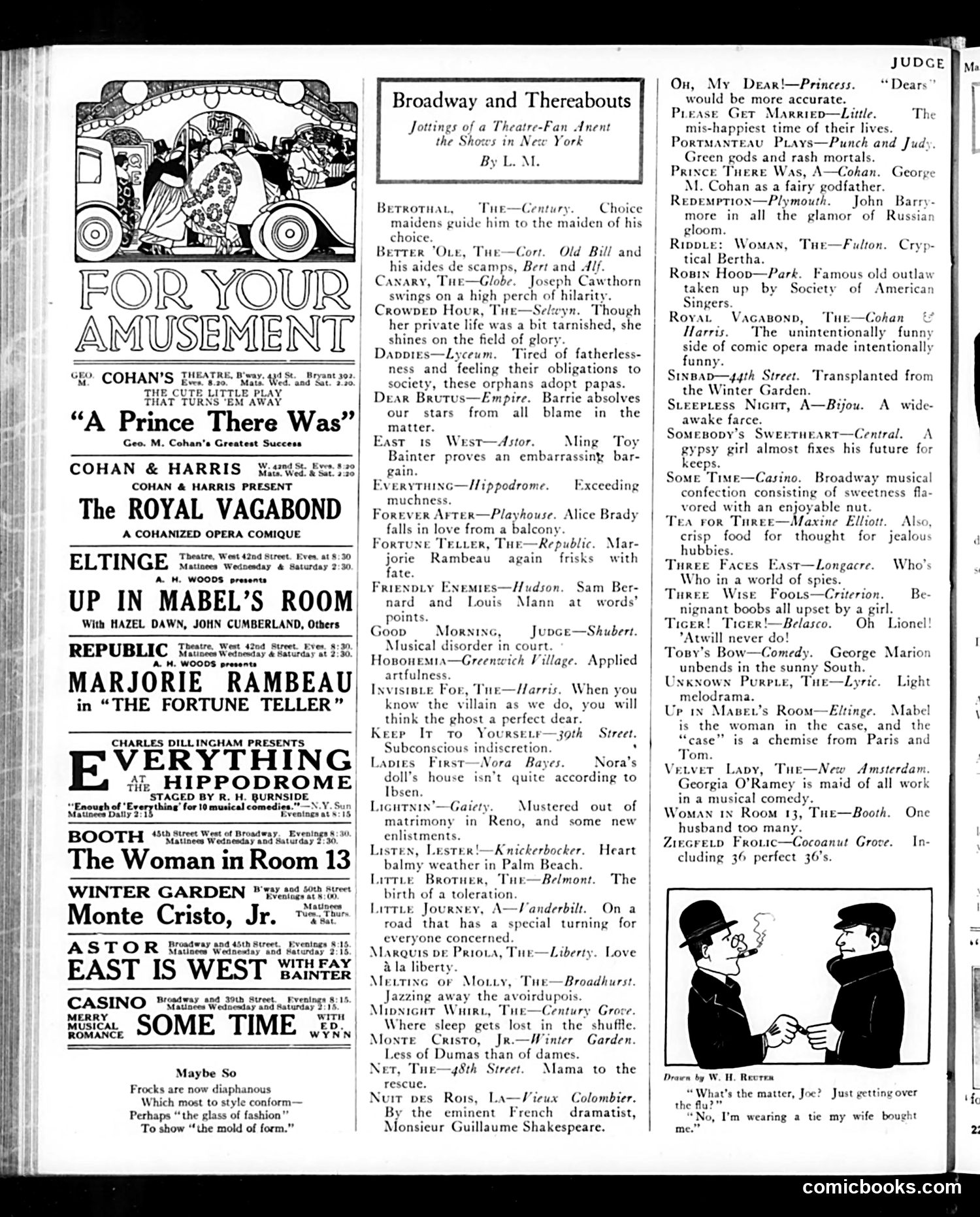
This is primarily a **theater advertisements and reviews page** from Judge magazine, featuring Broadway shows circa 1920. The small cartoon at bottom right shows two men in bowler hats exchanging words—a caption reads "What's the matter, Joe? Just getting over the blues?" and "No, I'm wearing a tie my wife bought me." This is a **domestic humor joke**: the implication is that the wife purchased an ugly or unfashionable tie, making him depressed. It satirizes marital discord and wives' questionable taste in gifts—common Judge themes. The main content is theater listings with brief, witty reviews of current Broadway productions. The style is sarcastic commentary on plots and performances (e.g., describing one show as "Musical disorder in court," another as "Jazzing away the avoirdupois"). The page is dominated by **commercial theater advertisements** for major productions and venues (Cohan's Theater, the Hippodrome, etc.), reflecting Judge's role as both satirical commentary and entertainment industry vehicle for its era.
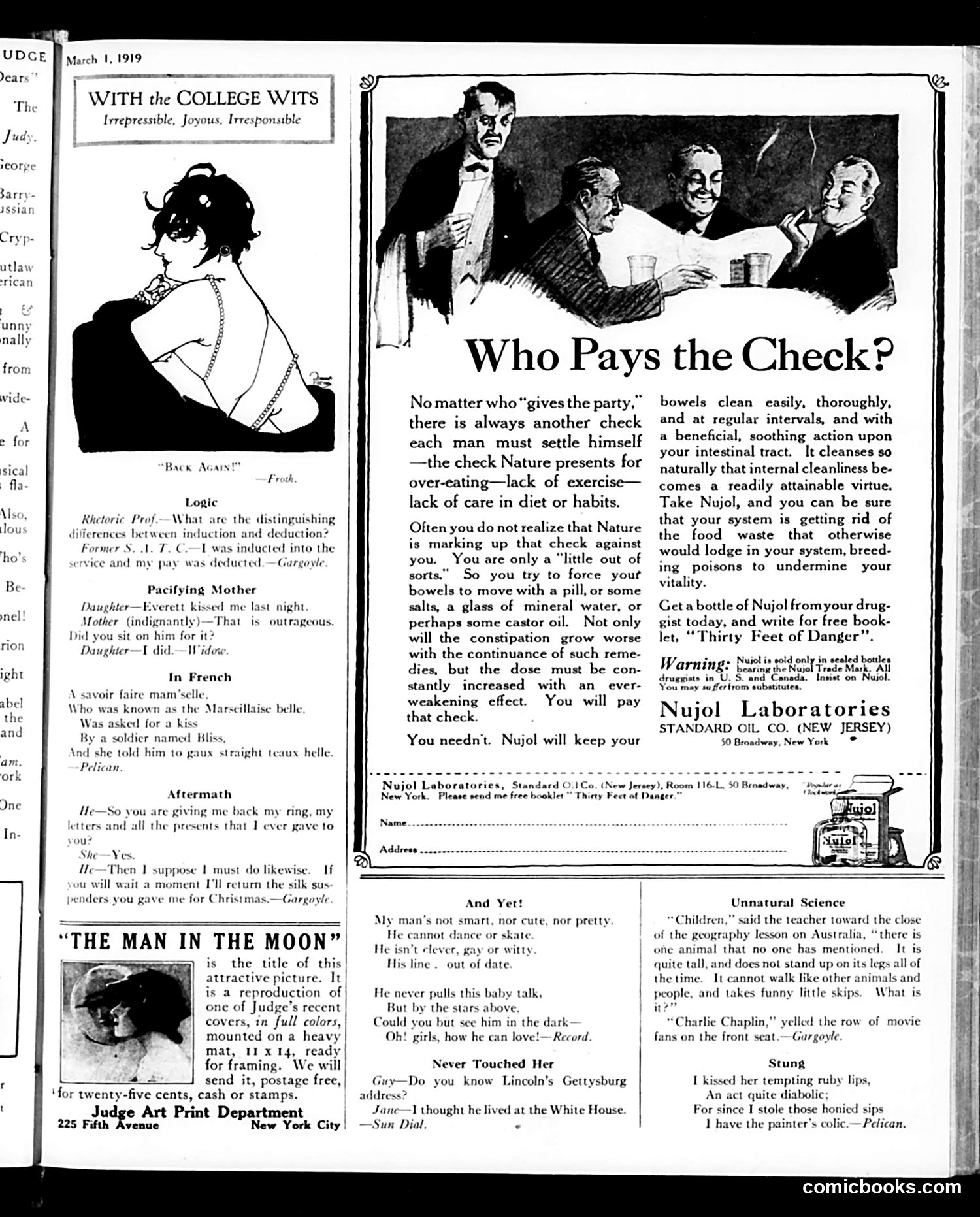
This page is primarily an **advertisement for Nujol, a laxative product** by Standard Oil Company, disguised within Judge magazine's satirical format (March 1, 1919). The main illustration shows five men at a dining table with the headline "Who Pays the Check?"—a double meaning. The text explains that while someone may host a party, "Nature" presents another bill: constipation from overeating and poor habits. The ad warns against relying on pills and salts, which lose effectiveness, instead promoting Nujol as a "natural" intestinal cleanser. The surrounding content—college humor jokes about logic, French, and romance—provides editorial padding typical of Judge. The Nujol ad occupies the dominant space, making this page essentially a vehicle for pharmaceutical marketing presented as satirical entertainment, reflecting early 20th-century advertising practices that blurred editorial and commercial content.
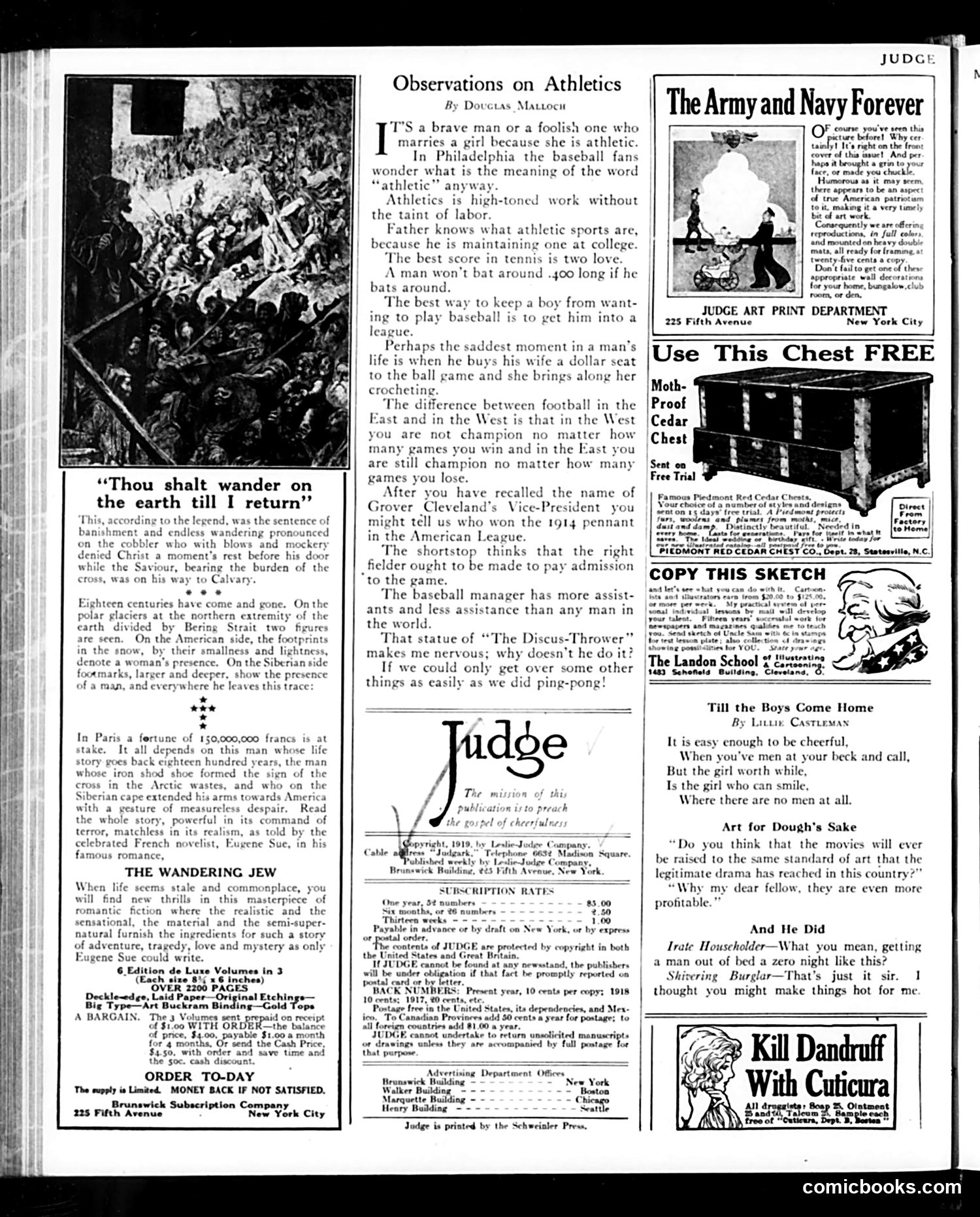
This page is primarily **advertising and editorial content** rather than political cartoons. The main feature is a serialized advertisement for Eugene Sue's novel *The Wandering Jew*, a 19th-century romantic adventure story about a cursed man condemned to eternal wandering—presented here as a subscription offer for a luxury three-volume edition. The "Observations on Athletics" column contains **sports humor** mocking American baseball culture and athletic pretension. References like Grover Cleveland's Vice-President and the 1914 pennant race were topical to Judge's 1919 publication date. The jokes satirize fans' obsession with baseball, athletes' inflated status, and the gap between athletic ideals and reality (e.g., "marries a girl because she is athletic"). The page also includes smaller ads for a cedar chest, dandruff cure, and other products typical of early 20th-century magazines. The large photograph on the left appears to document a crowd scene, likely related to the serialized novel's dramatic themes.
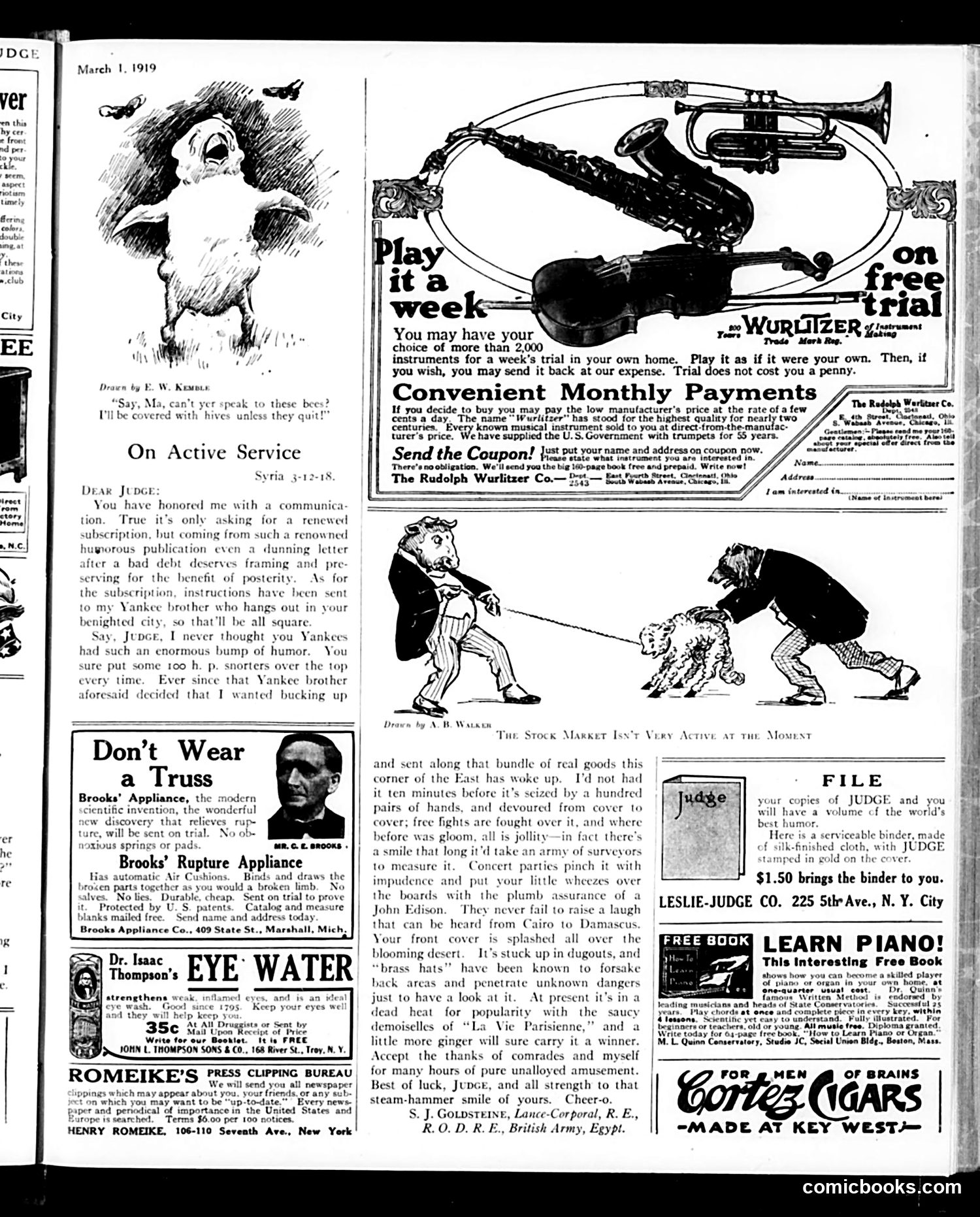
This page mixes editorial content, advertisements, and reader correspondence typical of the period. **The cartoons** are minor: a simple sketch of someone covered in bees (captioned about speaking to insects), and "The Stock Market Isn't Very Active at the Moment"—a two-panel cartoon showing a figure in formal dress being knocked down, likely satirizing post-WWI economic uncertainty. **The featured letter** from a soldier in Syria (dated 3-12-18) thanks Judge for sending copies to the front lines during World War I. He praises their humor as morale-boosting and notes the magazine's popularity among troops—underscoring Judge's role as entertainment for American servicemen abroad. **The bulk of the page is advertisements** for musical instruments (Wurlitzer), medical devices (rupture truss), and services (eye water, press clipping bureau)—typical commercial content filling satirical magazines of this era. The page reflects post-WWI America: soldiers returning home, consumer goods being marketed aggressively, and satirical magazines serving both entertainment and advertising functions.
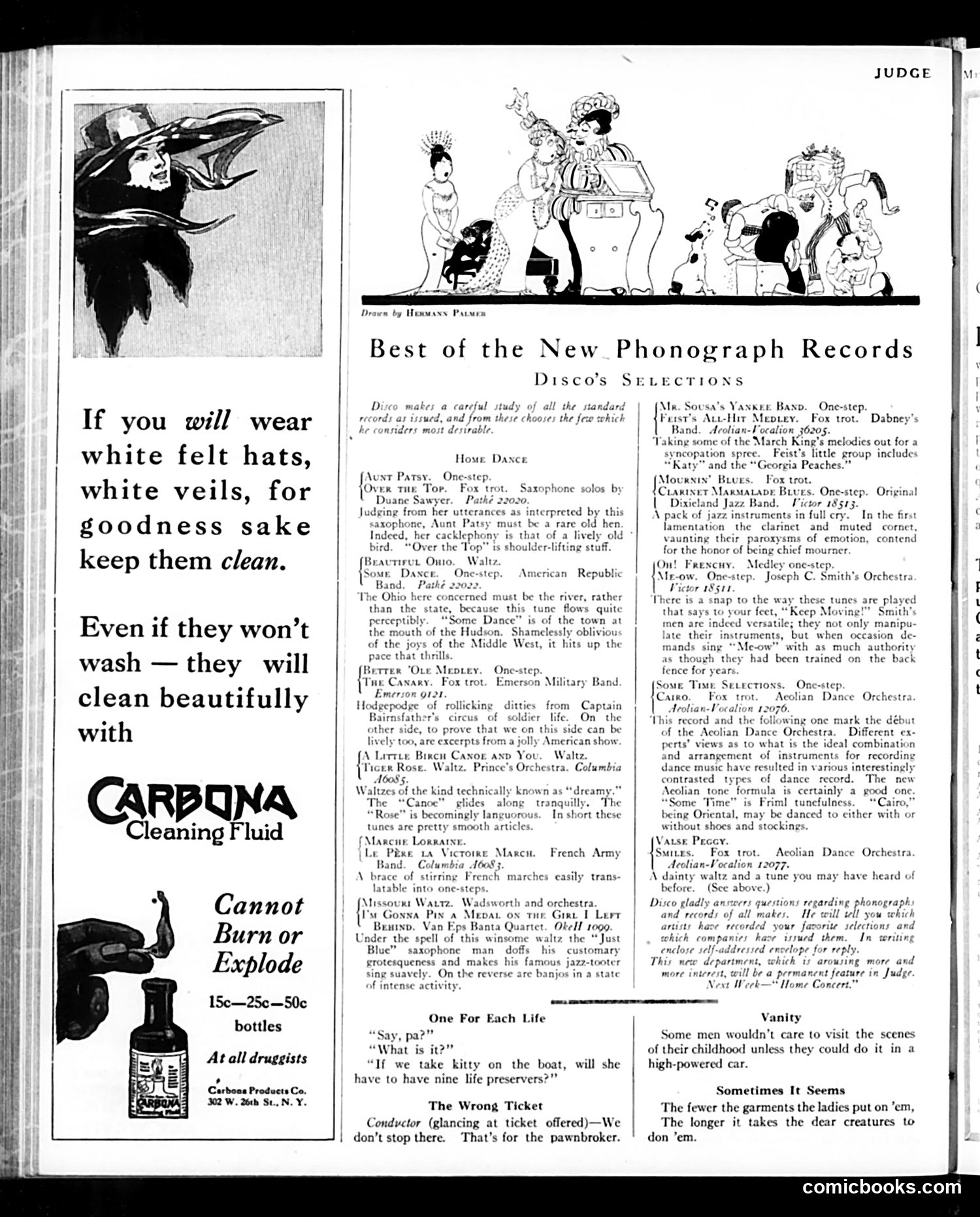
This page is primarily **advertising and entertainment content** rather than political satire. **Left side:** A Carbona Cleaning Fluid advertisement featuring a stylized witch or mysterious figure, promoting the product's safety ("Cannot Burn or Explode") and effectiveness on white felt hats and veils—items associated with 1920s women's fashion. **Right side:** "Best of the New Phonograph Records" features decorative illustration by Hermann Palmer showing well-dressed people around a gramophone. The bulk of the page is **record reviews** for popular dance music—foxtrots, waltzes, one-steps—with commentary on orchestras and performers of the era (Sousa's Yankee Band, Dixieland Jazz Band, etc.). **Scattered jokes** include "One For Each Life" (a cat/life preserver pun), "The Wrong Ticket" (conductor/pawnbroker wordplay), and brief social commentary pieces like "Vanity" and "Sometimes It Seems." This is essentially an **entertainment/lifestyle page** reflecting 1920s consumer culture, music trends, and light humor—not political commentary.
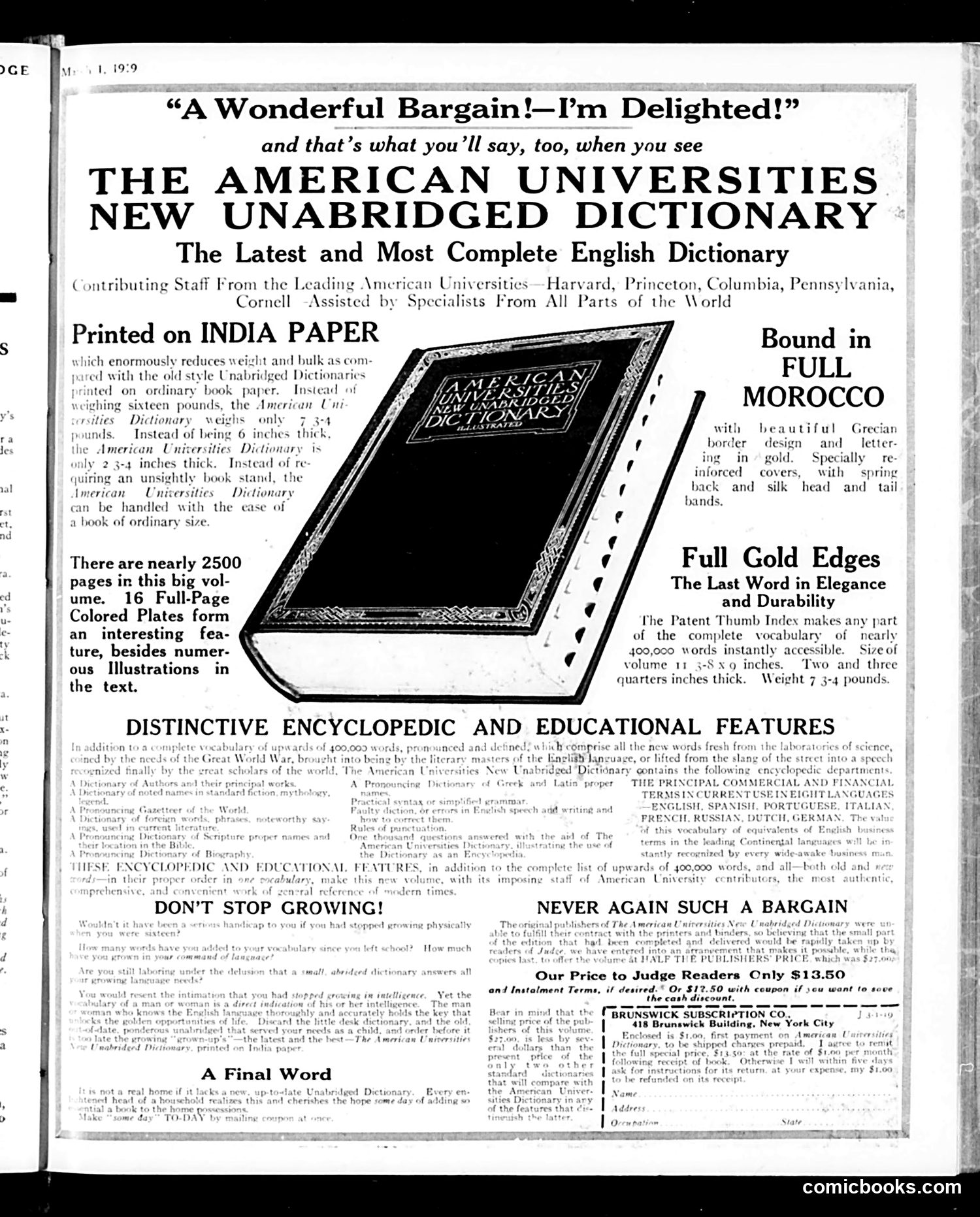
This page is primarily a **full-page advertisement**, not a cartoon or satire. It promotes "The American Universities New Unabridged Dictionary" with marketing copy emphasizing its comprehensiveness (nearly 2,500 pages, 400,000 words) and luxurious binding (full Morocco leather, gold edges, silk bands). The ad employs period sales rhetoric typical of early 20th-century mail-order marketing: appeals to authority (Harvard, Princeton, Columbia universities listed as contributors), emphasis on value ("A Wonderful Bargain!"), and special pricing for magazine readers ($13.50, or $12.50 with coupon). The headings "DON'T STOP GROWING!" and "NEVER AGAIN SUCH A BARGAIN" use hyperbolic language common in vintage advertising to create urgency. Rather than satire, this represents Judge's business model: selling advertisement space to publishers. The page reflects contemporary attitudes about self-improvement through literature and the prestige associated with owning comprehensive reference works.
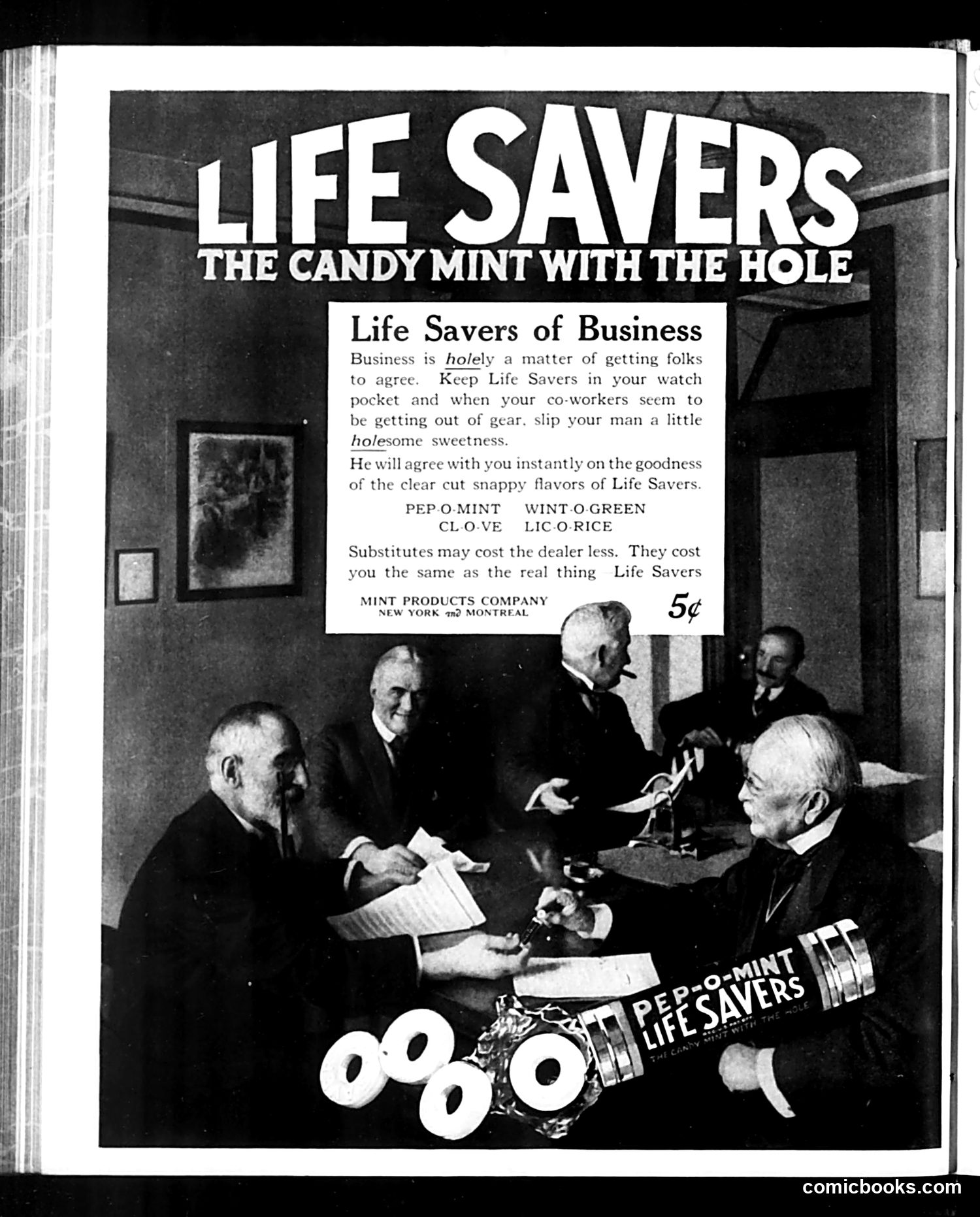
This is a **Life Savers candy advertisement**, not political satire. The page promotes Life Savers mints as a business tool for workplace harmony. The ad features five businessmen in suits gathered around a table, apparently in negotiation or discussion. The copy suggests keeping Life Savers candies accessible to smooth over workplace disagreements—offering colleagues a mint ("holesome sweetness") will supposedly make them agree with you instantly. The humor is gentle and period-appropriate: the pun "holesome" references the candy's distinctive hole. Flavors listed include Pep-O-Mint, Wint-O-Green, Cl-O-ve, and Lic-O-Rice. The price is 5¢, and the manufacturer is Mint Products Company (New York and Montreal). This reflects early 20th-century advertising's informal suggestion that small gifts could facilitate business dealings.