
Judge, 1919-03-01 · page 21 of 32
Judge — March 1, 1919 — page 21: what you’re looking at
What you’re looking at
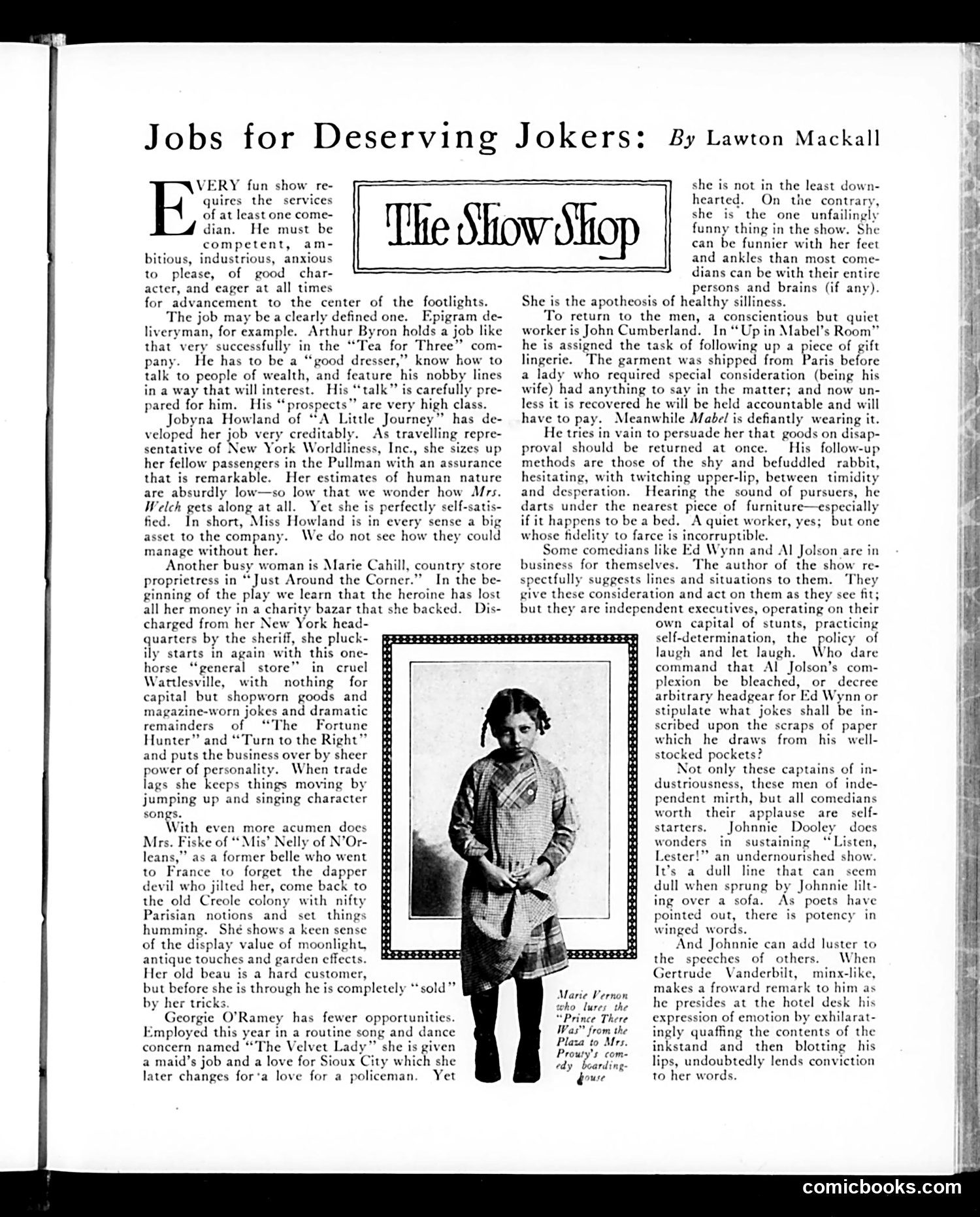
This article by Lawton Mackall analyzes comedians' specialized roles in Broadway shows circa 1920s. The piece examines how successful comedians function as distinct "jobs" within productions. The article profiles various performers: Arthur Byron delivers witty epigrams in "Tea for Three"; Jobyna Howland plays a snobbish Pullman passenger in "A Little Journey"; Marie Cahill runs a general store in "Just Around the Corner"; John Cumberland plays a befuddled husband pursuing lingerie in "Up in Mabel's Room." The satire's point: comedians aren't interchangeable entertainers but specialists with carefully crafted personas. Some (Ed Wynn, Al Jolson) operate independently with their own material; others perform scripted roles. The article celebrates how these performers succeed through personality, physical comedy, and meticulous character development rather than mere joke-telling. The accompanying photograph shows Marie Vernon in a character costume from one of these theatrical productions.
📄 Transcribed text from this page (OCR, searchable)
Machine-transcribed from the original scan — historical spelling and the odd misread are preserved.
Jobs for Deserving Jokers: By Lawton Mackall she is not in the least down- VERY fun show re- quires the services of at least one come- dian. He must be competent, am- bitious, industrious, anxious Show So hearted. On the contrary, she is the one unfailingly funny thing in the show. She can be funnier with her feet and ankles than most come- dians can be with their entire to please, of good char- acter, and eager at all times for advancement to the center of the footlights. The job may be a clearly defined one. Epigram de- liveryman, for example. Arthur Byron holds a job like that very successfully in the “Tea for Three” com- pany. He has to be a “good dresser,” know how to talk to people of wealth, and feature his nobby lines in a way that will interest. His “talk” is carefully pre- pared for him. His “prospects” are very high class. Jobyna Howland of “A Little Journey” has de- veloped her job very creditably. As travelling repre- sentative of New York Worldliness, Inc., she sizes up her fellow passengers in the Pullman with an assurance that is remarkable. Her estimates of human nature are absurdly low—so low that we wonder how Mr. Welch gets along at all. Yet she is perfectly self-sati: fied. In short, Miss Howland is in every sense a big asset to the company. We do not see how they could manage without her. Another busy woman is Marie Cahill, country store proprietress in “Just Around the Corner.” In the be- ginning of the play we learn that the heroine has lost all her money in a charity bazar that she backed. Dis- charged from her New York head- quarters by the sheriff, she pluck- ily starts in again with this one- persons and brains (if any). She is the apotheosis of healthy silliness. To return to the men, a conscientious but quiet worker is John Cumberland. In “Up in Mabel’s Room” he is assigned the task of following up a piece of gift lingerie. The garment was shipped from Paris before a lady who required special consideration (being his wife) had anything to say in the matter; and now un- less it is recovered he will be held accountable and will have to pay. Meanwhile Mabel is defiantly wearing it. He tries in vain to persuade her that goods on disap- proval should be returned at once. His follow-up methods are those of the shy and befuddled rabbit, hesitating, with twitching upper-lip, between timidity and desperation. Hearing the sound of pursuers, he darts under the nearest piece of furniture—especially if it happens to be a bed. A quiet worker, yes; but one whose fidelity to farce is incorruptible. Some comedians like Ed Wynn and Al Jolson are in business for themselves. The author of the show re- spectfully suggests lines and situations to them. They give these consideration and act on them as they see fit; but they are independent executives, operating on their own capital of stunts, practicing self-determination, the policy of laugh and let laugh. Who dare horse “general store” in cruel Wartlesville, with nothing for capital but shopworn goods and magazine-worn jokes and dramatic remainders of “The Fortune Hunter” and “Turn to the Right” and puts the business over by sheer power of personality. When trade lags she keeps things moving by jumping up and singing character songs. With even more acumen does Mrs. Fiske of “* Mis’ Nelly of N’Or- leans,” as a former belle who went to France to forget the dapper devil who jilted her, come back to the old Creole colony with nifty Parisian notions and set things humming. Shé shows a keen sense of the display value of moonlight, antique touches and garden effects. Her old beau is a hard customer, but before she is through he is completely by her tric Georgie O’Ramey has fewer opportunities. Employed this year in a routine song and dance concern named “The Velvet Lady” she is given a maid’s job and a love for Sioux City which she later changes for’a love for a policeman. Yet “sold” command that Al Jolson’s com- plexion be bleached, or decree arbitrary headgear for Ed Wynn or ipulate what joh shall be in- scribed upon the scraps of paper which he draws from his well- stocked pockets? Not only these captains of in- dustriousness, these men of inde- pendent mirth, but all comedians worth their applause are self- starters. Johnnie Dooley does wonders in sustaining ‘Listen, Lester!” an undernourished show. It’s a dull line that can seem dull when sprung by Johnnie lilt- ing over a sofa. poets have pointed out, there is potency in winged words. And Johnnie can add luster to the speeches of others. When Gertrude Vanderbilt, _minx-like, makes a froward remark to him as he presides at the hotel desk his expression of emotion by exhilarat- ingly quaffing the contents of the inkstand and then blotting his lips, undoubtedly lends conviction to her words. Marie Vernon 0 tures the “Prince There Was” from the Plaza‘to Mrs. Prouty’s co edy board owe comicbooks.com