
Judge, 1919-03-01 · page 5 of 32
Judge — March 1, 1919 — page 5: what you’re looking at
What you’re looking at
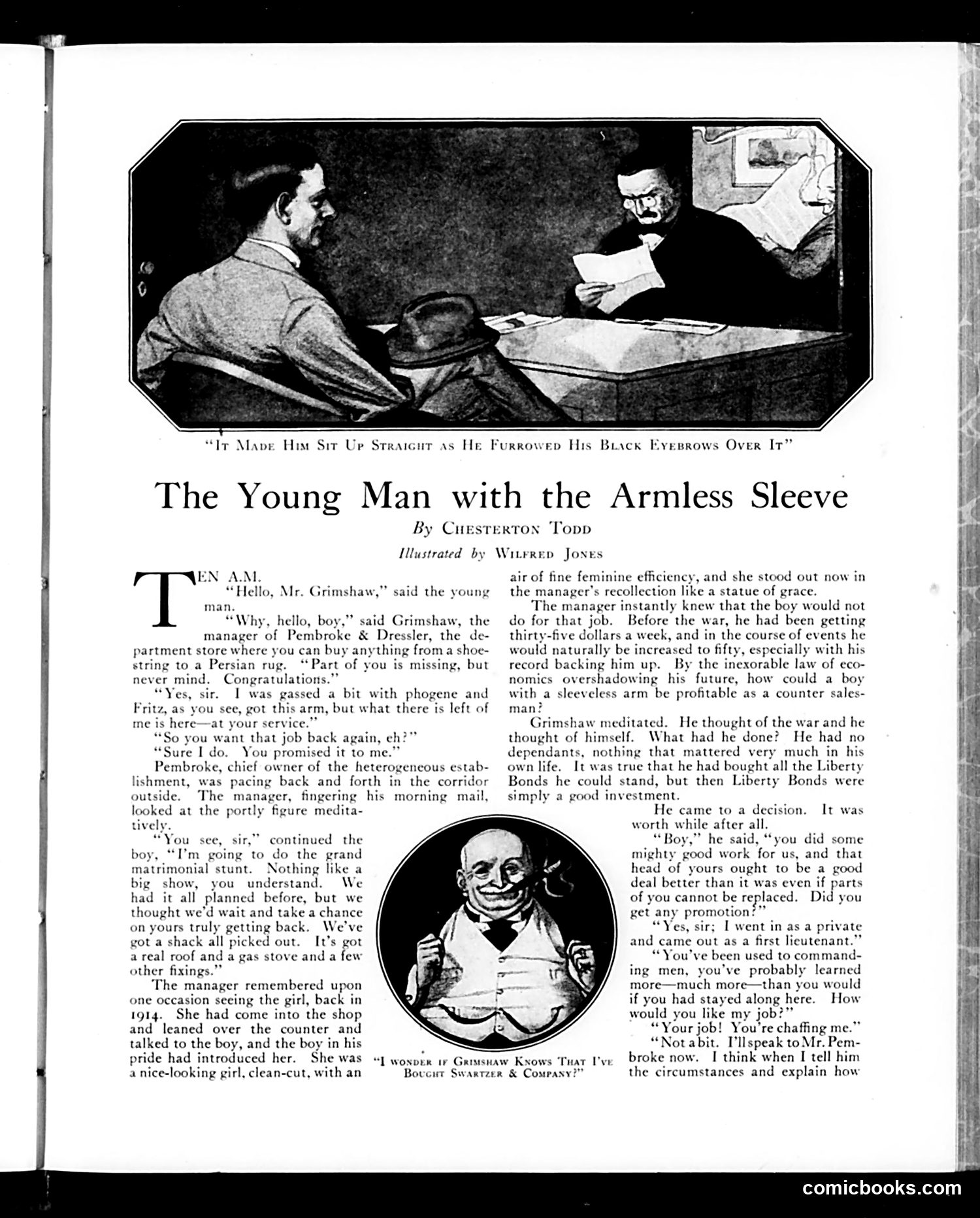
This story by Chesterton Todd, illustrated by Wilfred Jones, addresses WWI disabled veterans. The narrative centers on a young man who lost his arm in service and seeks employment at a department store. The satire critiques both employer attitudes and post-war economic realities. Mr. Grimshaw, the store manager, initially dismisses the veteran but then reconsiders, recognizing his patriotic sacrifice and value as an employee. The story ironically explores how businesses were slow to hire disabled veterans despite public gratitude for their service. The central image shows Grimshaw (a portly, satisfied businessman), suggesting the disconnect between wartime rhetoric and actual employment opportunity for wounded soldiers—a significant social issue in 1910s-1920s America following WWI.
📄 Transcribed text from this page (OCR, searchable)
Machine-transcribed from the original scan — historical spelling and the odd misread are preserved.
“It Mave His Sit Up aAiGuT AS He Furrowep His Buack Eyesrows Over It” The Young Man with the Armless Sleeve By Cur ton ‘Topp Mlustrated by Witrren Joxes A.M. Hello, Mr. Grimshaw,” said the young man. “Why, hello, boy,” said Grimshaw, the manager of Pembroke & Dressler, the de- partment store where you can buy anything froma shoe- string to a Persian rug. “Part of you is missing, but never mind. Congratulations.” “Yes, sir. I was gassed a bit with phogene and Fritz, as you see, got this arm, but what there is left of me is here—at your service.” “So you want that job back again, eh? ure Ido. You promised it to m Pembroke, chief owner of the heterogencous estab- lishment, was pacing back and forth in the corridor outside. The manager, fingering his morning mail, looked at the portly figure medita- tively. “You see, sir,” continued the boy, “I’m going to do the grand matrimonial stunt. Nothing like a big show, you understand. We had it all planned before, but we thought we'd wait and take a chance on yours truly getting back. We've got a shack all picked out. It’s got a real roof and a gas stove and a few other fixings.” ‘The manager remembered upon one occasion seeing the girl, back in 1914. She had come into the shop and leaned over the counter and talked to the boy, and the boy in his pride had introduced her. She was a nice-looking girl, clean-cut, with an “L woxpex ty Grimsuaw Kxows Tuat I've Bovour Swartzer & Cosrany?” air of fine feminine efficiency, and she stood out now in the manager's recollection like a statue of grace. ‘The manager instantly knew that the boy would not do for that job. Before the war, he had been getting thirty-five dollars a week, and in the course of events he would naturally be increased to fifty, especially with his record backing him up. By the inexorable law of eco- nomics overshadowing his future, how could a boy with a sleeveless arm be profitable as a counter sales- man? Grimshaw meditated. He thought of the war and he thought of himself. What had he done? He had no dependants, nothing that mattered very much in his own life. It was true that he had bought all the Liberty Bonds he could stand, but then Liberty Bonds were simply a good investment. He came to a decision. worth while after all. “Boy,” he said, “you did some mighty good work for us, and that head of yours ought to be a good deal better than it was even if parts of you cannot be replaced. Did you any promotion! Yes, sir; I went in as a private and came out as a first lieutenant.” “You've been used to command- ing men, you've probably learned more—much more—than you would if you had stayed along here. How would you like my job?” “Your job! You're chaffing me.” “Notabit. I’llspeak to Mr. Pem- broke now. I think when I tell him the circumstances and explain how It was comicbooks.com